This is part 2 of a series on Sensory Processing Difficulties.
Part 1 was on the sense of touch. Part 3 is on sight, and
part 4 is on taste and smell.
Part 2 will cover the two senses we aren\’t taught about in school: proprioception and the vestibular sense. These two senses, while not waxed about in any kind of poetic fashion by philosophers and artists of the past, do serve very important functions.
Just FYI…
A note, which I\’ll paraphrase from part 1 and then explain a bit more:
While I\’ll talk about these senses separately, you should keep in mind that a person can\’t process these senses separately, or turn off one if it\’s being bothersome. All people experience all these senses at once. The only reason you\’re not regularly overwhelmed by feeling where each of your limbs are in space, while smelling the odors of your house, hearing the shrieks of the neighbor\’s children playing outside, smelling the soap you used to wash your hands, tasting the last thing you ate, and feeling both the pull of gravity and the texture of whatever you\’re sitting on… is because our brains filter out all but the most relevant details. Sometimes this filter doesn\’t work very well, but I\’ll explain about that later.
Proprio-what?
Proprioception (such a weird word) is your sense of where your arms, legs, and body are in space, and it relies on being able to understand feedback from sensors in your joints, ligaments, and muscles. These sensors tell you what angle your arms and legs are at, whether any force is being applied to any of those areas, and where your limbs are at any given time. When you reach behind you to shut a door, or move yourself through a dark area, you are relying on this sense alone to not bang your arms and legs into themselves, and any objects you remember in the area. You also rely on it to use the correct amount of force to shut a door rather than slam it or leave it ajar.
When this sense goes amiss, a person can\’t locate their arms and legs in space without looking at them. You could find yourself regularly sliding out of your chair rather than sitting solidly in it. Or tripping over your own two feet as you walk or run. You might also grab things too roughly or softly, thus either breaking them or dropping them. Children with difficulties in this area might avoid (or crave) jumping, crashing into things, pushing, pulling, bouncing, and hanging. An otherwise mild-mannered child that always seems to be banging into others might not be aggressive, but rather lacking proprioception\’s body awareness.
About a year ago, I reviewed a book called The Reason I Jump, by Naoki Higashida. I didn\’t comment on the title at the time, because I didn\’t want to spoil the answer to the implied question. But in light of this particular topic: the essay that explained this answer involved this sense. Mr. Higashida pretty clearly suffers from lack of body awareness. His particular description was extremely poetic and very impressive, and I still recommend you read that book. If nothing else because it gives you another viewpoint on from the autism spectrum, and one that doesn\’t overlap a whole lot with my own experience.
Pencils, Skates, and Origami
As for me, personally? I think maybe a lessening of this sense might explain some of my innate clumsiness. As a child, I tended to always look down when I walked. This was because I tended to trip over my own feet, on apparently flat surfaces. I knew this, and knew I\’d have a better chance of placing my feet optimally if I simply looked where I was putting them. This came with the added bonus of being able to see where to catch myself when I inevitably tripped anyway.
As I grew, I got better at not tripping, and became more adept at catching myself before I fell. This was in part due to taking up roller skating. I started in the beginner\’s class, with lots of little children, but with time, effort, and many bruises, I became adept enough to skate on one foot, cross my feet over each other to do fancier tricks, and even perform simple jumps and spins. I was eventually informed that I should be in the adult class, which helped me refine and stretch those abilities. My instructor was a retired professional skater, whose high school daughters competed in the state competitions. So while I would certainly never have made it into any of those competitions, I can safely say that his instruction was excellent.
Another proprioception-related task I had to learn to overcome was my fine motor clumsiness. I think I still suffer some of that, particularly when I\’m not paying attention. I do seem to drop things and break things a great deal more regularly than my peers… But it\’s not as bad as it used to be, I think.
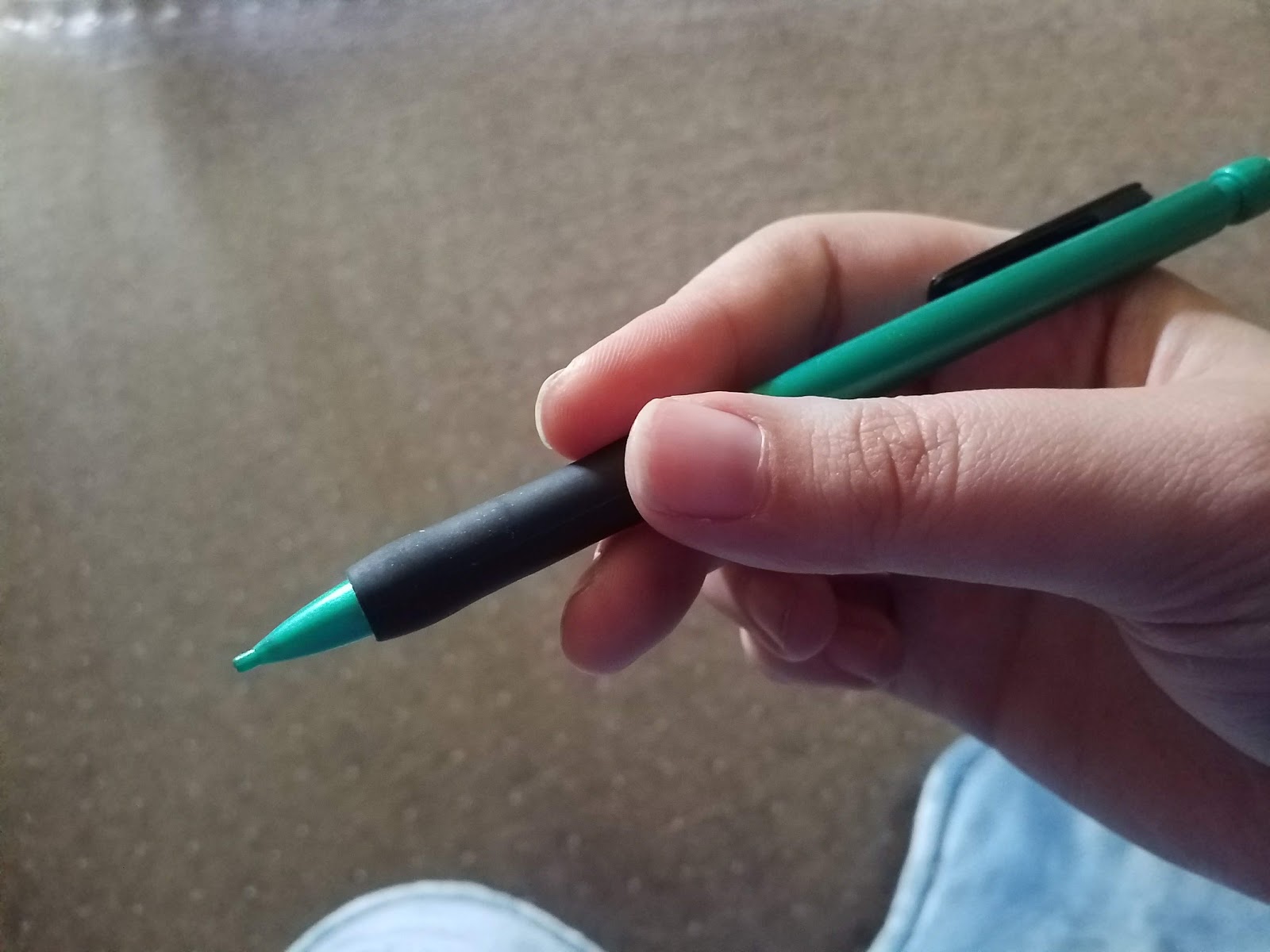
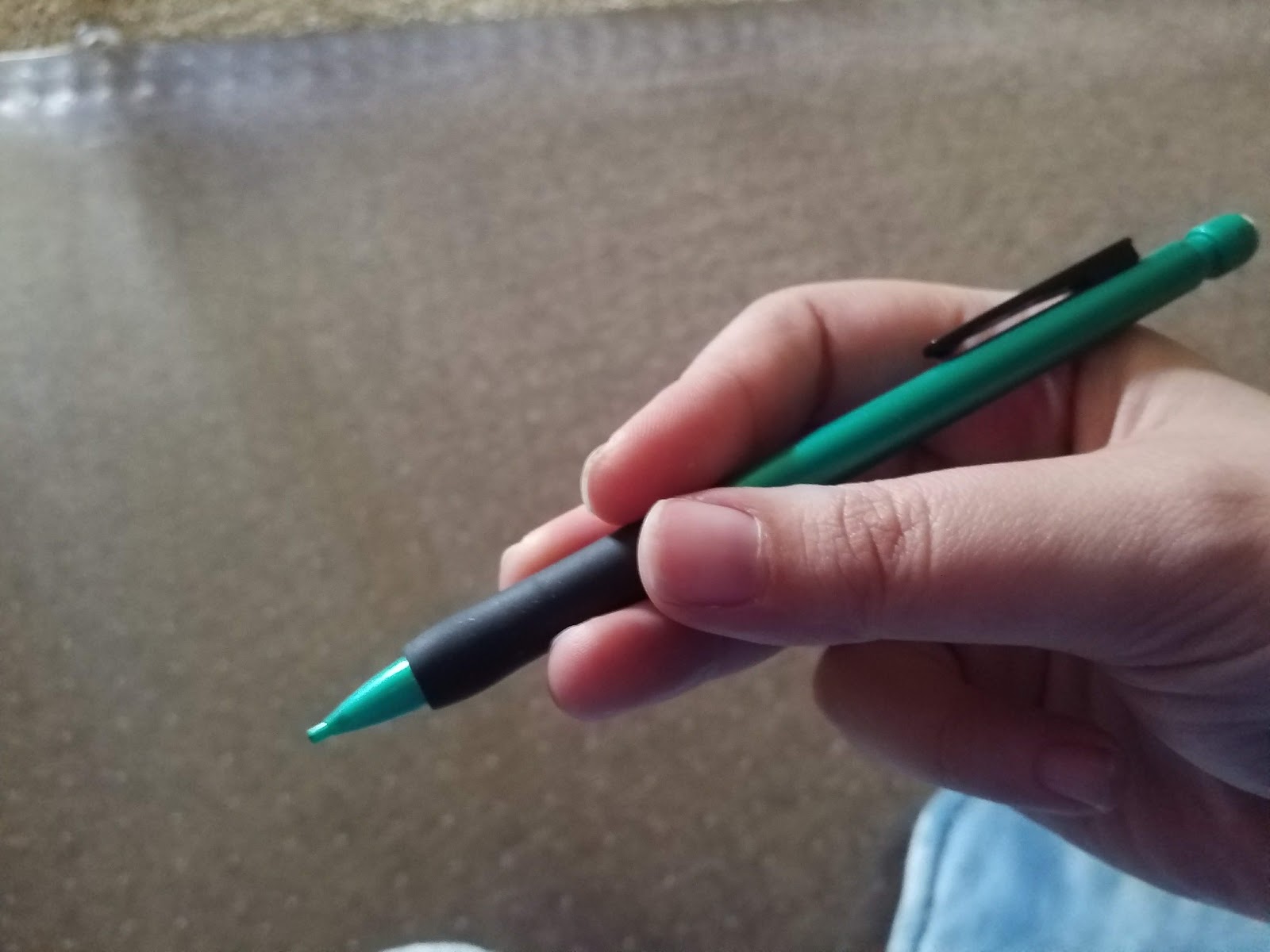
As a child, I tended to hold my pencil with a death grip. This was noticeable because my hand would tend to cramp up, but also because I held the pencil wrong. Children are taught to hold a pen with three fingers…
To this day, I hold mine with four.
This is, as a rule, an inferior grip to the first, as it strains your hand more. But for someone with clumsiness issues, adding the fourth finger stabilizes the pencil and allows for more control and accuracy. So that was how I wrote, despite teachers trying to teach me otherwise, and it\’s how I write to this day. The end result was darker marks on the paper, with occasional tears from pressing too hard. (This is actually also a sign of a messed up proprioception in children, by the way.)
As an adult, I tried the three-finger grip out, and can now manage it without losing too much by way of speed. But it\’s not comfortable or how I\’m used to doing it, and since writing has become far less common, I see no need to change my habits. I did work to overcome some of my fine motor difficulties, though… with another hobby: origami.
I\’m almost 30, so it bears pointing out that when I was learning, you couldn\’t simply pull up videos on the Internet to teach you how to make this fold and do that technique. Instead, I had books. These books had the words \”mountain fold\” and \”valley fold\” and \”bird base\” and all manner of other artistic-not-immediately-helpful-to-a-small-child vocabulary.
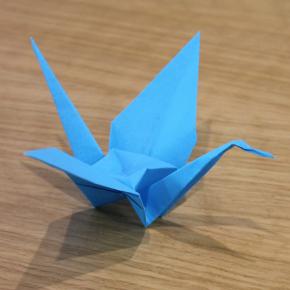
So learning was a bit of a struggle, but I\’m extremely stubborn, so after accidentally tearing, smashing, and otherwise destroying probably hundreds of squares of paper, I did actually learn the basics of the art. Origami is an art of precision, particularly when you\’re working with specialized paper. The closer your folds are to their destinations, and the thinner the creases, the better your final product. This means you can manage to follow all the directions, yet still have a final product that doesn\’t look that great. But it also means that practice really does make perfect.
I can now boast of being able to teach anyone how make a traditional Japanese crane, so long as they\’re patient and willing to put in the effort. Also, I once pranked my second high school by scattering a thousand of these cranes, along with the wish that the place would become less of a toxic hellhole. I kind of doubt I got my wish, but at least the prank was fun, and I really doubt they\’ve found them all unless they\’ve renovated their ceilings…
Vestibular Sense
The vestibular sense is also involved with movement, but instead of your joints, it\’s instead linked to your inner ear. It\’s your sense of how fast you\’re going, whether you\’re accelerating, and the pull of gravity itself, which in turn affects your balance. Apparently this is registered by… what amounts to little hairs with protein crystals suspended on them, inside your inner ear. It sounds really weird and random, but when you turn your head, the hairs move, pulling the crystals after them, and that movement is gauged by sensors inside the inner ear.
When you lean over to pick something off the ground, you\’re using your vestibular sense to counter-balance yourself so you don\’t tumble to the ground right after the object. You also use this sense to figure out what position you\’re in, related to the pull of gravity. After all, a standing position is relatively similar to a lying-down position… at least if you\’re in space. With gravity, your inner ear tells you which way is down.
When this sense goes awry, all kinds of exciting and unfun things can ensue. Your balance can go entirely out of whack. Without the ability to sense the pull of gravity, you can over- or under-compensate for it, resulting in uncoordinated and clumsy movement, if not outright falling. Stairs, ladders, and slides can become your worst nightmare… or your best friend, if your body craves that sensory input. Motion sickness might be your constant companion, or you might never ever get motion sick even in circumstances that would make pretty much anyone else ill.
Most interestingly to me, apparently the vestibular sense also factors into your vision. When a neurotypical person jumps or bounces up and down, their field of vision appears to remain relatively stable. With a wonky vestibular sense, that is not the case. So you can have a child perfectly able to read the blackboard or a computer screen, but not able to walk across the school room without banging into desks and classmates. I guess, something like that accursed \”shaky cam\” technique that keeps making me miserable and confused while watching movies.
Personally, I think I mostly lucked out when it comes to this particular sense, sans the motion sickness aspect. I don\’t particularly suffer oversensitivity to movement, and my vision complications are brain-related, not inner-ear-related. I usually don\’t fall while leaning down to pick something up, and my sense of balance is remarkably good considering my proprioception-related limitations.
The motion sickness, though… I don\’t recall getting very motion sick, ever, as a child. I could even watch those enormous IMAX 3D screens in reasonable comfort (but my mom couldn\’t). I didn\’t adore theme park rides, especially not roller coasters, but I could tolerate them. If it got too bad, I\’d simply shut my eyes, thus eliminating the most dizzying form of sensory input, and huddle until the ride was over. It was still uncomfortable, but not intolerable.
Now? Now I can get motion sick from things as simple as \”riding in the back seat of a car.\” It helps if I\’m hungry. Something about being hungry makes it exponentially more likely I\’ll get sick on a theme park ride or a car ride. However, that naturally makes the fix just as basic: get off the ride or out of the car, and eat something simple. I have no idea why this works. Even with food freshly in my stomach, though, I no longer care for IMAX 3D movies, and tend to avoid most theme park rides.
It\’s notable that this particular sense (in conjunction with others) is also used by some autistic people for calming down. Dr. Temple Grandin, the foremost autistic speaker, includes spinning and rolling as forms of comfort. There\’s a clip from the HBO movie where the actor playing her explains exactly this. I… am not like that. I don\’t really like spinning or rolling, and get dizzy at a regular rate, if not faster than usual. This actually made learning those skating techniques a great deal harder, as a dizzy person is more likely to fall down than a stable person.
Summary
This week I\’ve described the two \”ignored\” senses, proprioception and vestibular sense, and given you a basic idea of how they work, what it looks like when they work, and what it can look like when they don\’t work. In addition, I\’ve given you a few examples from my own life as an autistic person as to how these specifically play out. Next week, I\’ll get into vision, the sense almost all of us take for granted. I have a unique brain-eyeball communication problem that makes this sense extra fun. Should be interesting!
 realisticautistic