The Toothbrushes
Show/Hide


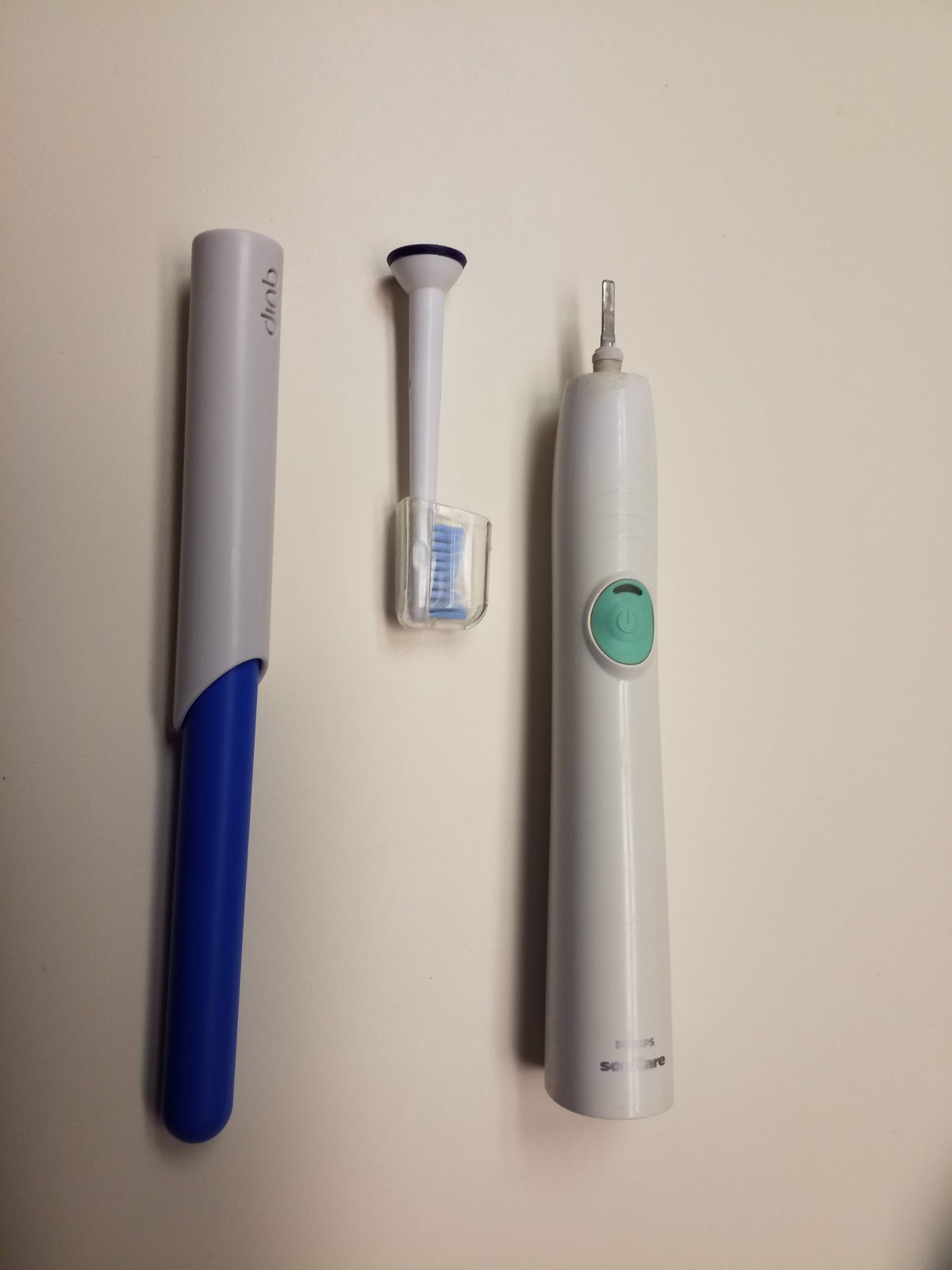
As you can see, the Quip disassembles a lot more than the Sonicare does.
The Sonicare has the handle (not meant for the user to be able to take apart), the toothbrush head (with plastic cover), and the charging base. The Quip breaks down into the toothbrush head, motor, battery, plastic handle, and sliding cover. The cover fits either end of the toothbrush. Due to the sticky tape (not shown) on the cover, it serves as both a travel cover and holder. You can literally just stick it to the counter or to your mirror and put the handle into it for easy access.
The Quip uses a standard AAA battery, whereas the Sonicare uses a rechargeable battery pack. I have no information on how long each lasts, but I can safely say the Sonicare battery pack has lasted like 5 years. I suppose one could always use a rechargeable AAA battery in the Quip as well.
I\’ll be heading out of town for Thanksgiving soon, so another question arises: How do they handle for traveling?
The Quip runs a lot quieter, and vibrates my hand a lot less. This has the added bonus of not making my hand slightly numb after using it. It does also vibrate the teeth and gums slightly, but not nearly as much as the Sonicare. This does make me wonder if its cleaning efficacy is as good as the Sonicare, but time alone will tell that.
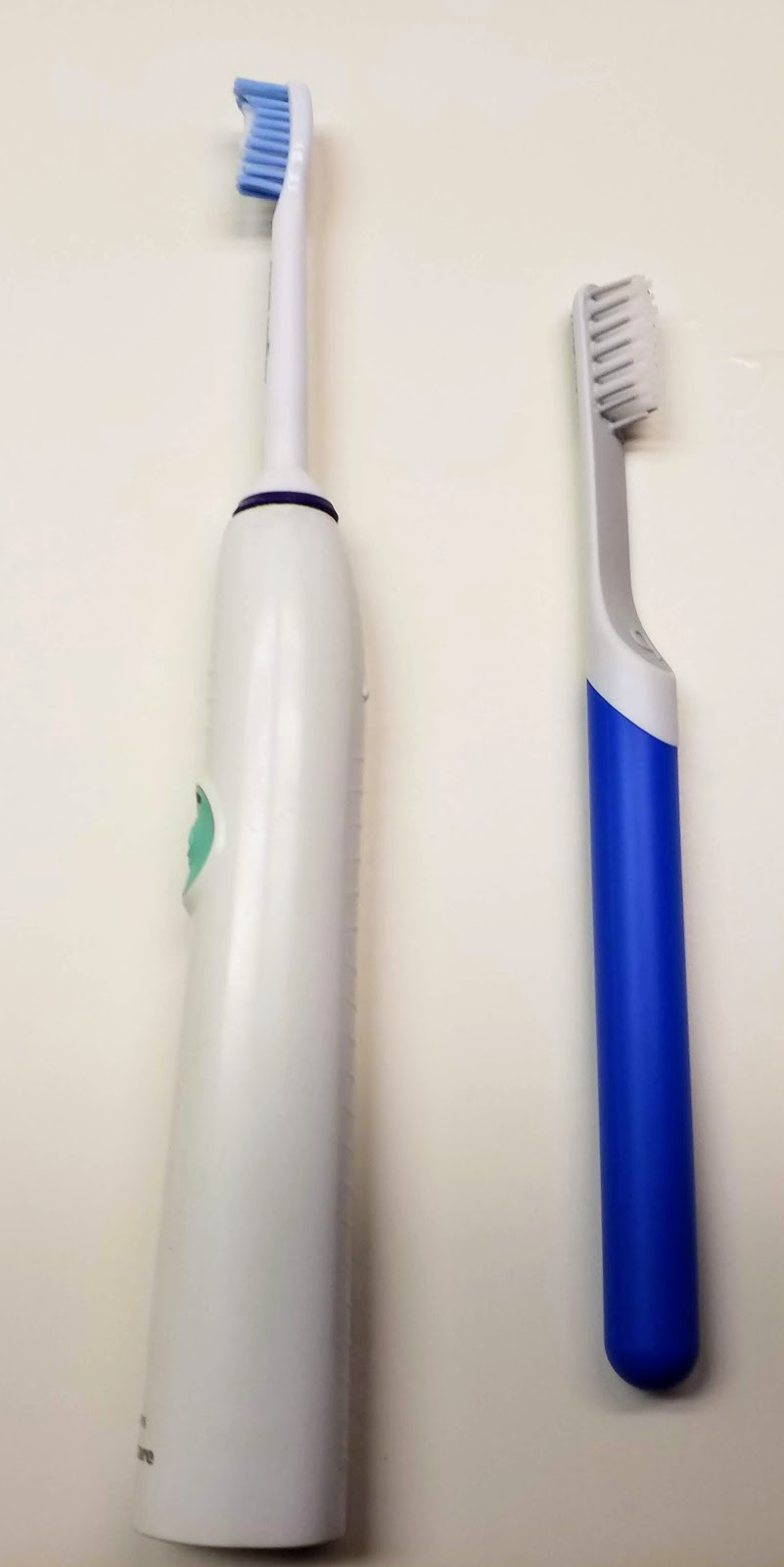
Another note on using the toothbrushes. The brush heads my spouse and I use with the Sonicare are \”extra soft.\” This is because gum erosion is a possibility with the intensity of electric toothbrushes, and the idea of tooth care is to clean the gums, not destroy them. I don\’t know what the Quip\’s brush softness is, but it\’s definitely not \”extra soft.\” I\’d guess \”soft,\” not \”medium,\” judging by the manual toothbrushes I own.
It makes sense to me that the Quip perhaps makes up for its gentler vibrations by using \”soft\” rather than \”extra soft\” bristles, but I have literally no formal education in dentistry, so I\’ll double-check that idea when I next visit my dentist.
Both toothbrushes run for 2 minutes. Every 30 seconds, the toothbrushes stop buzzing for a split second, which tells you to move on to the next quadrant of your mouth. In this manner, you spend half a minute on each quadrant and get a more thorough cleaning. This is a good feature, which I\’m guessing is standard these days.
The Winner
At least for me, Quip wins this comparison hands down.
It\’s smaller, lighter, has more functionality, is more portable and travel-safe, and most importantly, its vibrations don\’t upset me nearly as much as the Sonicare toothbrush\’s do. With the Quip, I could see myself brushing my teeth twice a day, as the dentist recommends, rather than once a day as I do now. Once a day has been enough to keep me cavity-free, but if the Quip doesn\’t clean as vigorously as the Sonicare, then twice a day would definitely be a wise idea (as well as what the doctor ordered…).
I\’m also extremely impressed that they designed a toothbrush where every single one of the parts is easily replaceable. If the Sonicare\’s motor ever dies, there won\’t be any option but to replace the whole handle, which is kind of a waste of perfectly serviceable plastic and the rest of the toothbrush. If the same thing happens with the Quip, I need only buy a new motor. Or handle. Or sliding cover.
This strikes me as more environmentally friendly than the Sonicare, though the question of whether the AAA batteries will add up over time is relevant. You can somewhat offset that by using rechargeable AAA batteries yourself, I expect. But each toothbrush head with the Sonicare toothbrush comes with a little plastic cover, and I\’m fairly certain Quip\’s refills won\’t. So it\’s at least a tie, given a conscientious consumer, I expect.
I\’ll start using the Quip instead of my spouse\’s toothbrush immediately, and try to add an evening brushing into my oral care routine.
If you\’re interested in checking out the Quip, I saw it at Target recently on an endcap in the tooth care section. You can also get your first toothbrush from them for only $25 on their website.
Extra: The Rest of My Mouth Care Routine
- Scrub tongue with tongue scrubber. My tongue tends to build up bacteria, especially in the morning. Scraping off the buildup makes the clean taste from brushing last longer and reduces the overall amount of bacteria in my mouth.
- Floss. I use two types of floss. A braided, thicker floss is the staple for between most of my teeth. It\’s quite gentle, doesn\’t cut into my gums, and catches more food and plaque than the regular floss. A thinner, waxed floss goes between my lower front teeth and their neighbors, which have a metal wire across the back side of them due to orthodontics.
- Brush teeth (and gums). I use an electric toothbrush with baking soda toothpaste. There are about 3 bajillion toothpaste types, but my dentist commented to me that my mouth tended to be more acidic than most. Baking soda toothpaste helps offset that. I also try to switch brands after each tube. I read somewhere that the bacteria in your mouth get used to a toothpaste formula after a while, so it\’s best to do that. I also try to focus more on the gumline and the back of my mouth rather than the teeth directly. When the toothbrush\’s timer ends, I brush the roof of my mouth, then brush my tongue again with the remains of the toothpaste.
- Mouthwash. This keeps my mouth feeling clean a lot longer, even though it can really sting and tastes quite strong. Listerine\’s a good brand. There\’s been some back and forth about whether alcoholic mouthwashes are a bad idea, since alcohol can dry out your mouth (which leads to more bacteria). I brush in the morning, so it\’s not as much of an issue as it would be if I was using it at night. If you can\’t stand the flavor of alcoholic mouthwashes, or you tend to do your tooth care at night, there are several kinds of non-alcoholic mouthwashes that still definitely help.


 realisticautistic