Legwork and Life, week of 6/26/19
The weirdness with my diaphragm seems to have worn off entirely, which I\’m really glad of. I don\’t really understand how this weeklong experience happened without any pain, and still had such important side effects, but the human body is a weird mystery, so whatever.
Speaking of weird, I went with friends to go cattail pollen collecting! You can use cattail pollen as flour, and we wanted to try it, so off we went. It was quite an endeavor, what with it being hot out and having to push my way through the head-high cattails. It\’s no jungle, but it\’s probably the closest I\’ll get to traversing something like that. I didn\’t have sufficiently waterproof footwear, and quickly got soaked socks and such.
I used a technique recommended by a seasoned harvester: grabbing a gallon jug, cutting a hole in it, inserting the pollen-laden cattail head, and shaking it. This allowed me to collect mostly pollen in my efforts. The stuff is bright yellow, as you\’ll see, and I was quickly covered in pollen. Fortunately I\’m not allergic.
The results of my labors had to be sifted for bugs and plant fibers, which I did using a sieve to get the big stuff, and then cheesecloth for the smaller debris.
![]() |
| Fiber and bugs certainly won\’t kill you, but they\’ll mess up the texture of your baked goods. |
![]() |
| The final result! |
I want to say I was out there collecting for maybe 15-25 minutes, and we started collecting relatively early in the pollen window, so we had to search fairly hard for cattails with pollen. Which is probably why the end results only came out to half a cup. Still, that\’s more than enough for a recipe of pancakes, and that\’s fine with me. If I like the pancakes and flavor, I\’ll get a larger batch next year.
Reading the Research: Leaking Blood-Brain Barriers
Today\’s article is a step forward in our ability to test chemical interventions. While the study itself calls out specific disorders, like Huntington\’s disease and Parkinson\’s, the fact is that autistic people also tend to have leaky blood-brain barriers.
The job of a blood-brain barrier is to screen out toxins, hormones, and neurotransmitters not generated in the brain itself. This protects the brain\’s environment so it\’s not affected by things the liver, kidneys, and other detoxification systems should be handling. If it leaks, the brain has a much harder time doing its job, and you\’re more likely to suffer depression, anxiety, fatigue, and brain-specific autoimmune disorders (which includes Parkinson\’s). Clear that up, and the autistic person suffers less, which also leads to less difficulty communicating, handling new situations, and managing their life.
So it seems these scientists were effectively able to grow brand new blood-brain barriers using stem cells from donors. Like, cells from Person A became new blood-brain barrier with the same defect as Person A\’s would have inside their body. That really is science-fiction territory, because you can literally test out drugs on the created blood-brain barrier and figure out which ones have the best chance of helping, on a person-to-person basis.
That seems to be the idea behind this study and several others this team is working on, given the name of the program: Patient-on-a-Chip. I can\’t imagine this sort of thing is going to be cheap, especially in the beginning, but it is potentially highly useful. Like computer parts, the price will come down as the demand increases and people learn to make the process simpler and more efficient.
I actually have no idea whether the leaky blood-brain barriers that autistic people have are genetically induced or environmentally affected. It\’s probably some of both, and I\’d bet you could induce environmental changes in a grown blood-brain barrier. It\’s just not exactly what they\’re doing right this moment. Still, even at this stage in the research, this is pretty cool. It may well help a lot more than the millions affected by disorders listed in the study. Perhaps in the future you\’ll be able to send a sample to a lab, and receive a scientifically rigorous recommendation for anti-depressants, as well as non-chemical interventions to help solidify that barrier.
(Pst! If you like seeing the latest autism-relevant research, visit my Twitter, which has links and brief comments on studies that were interesting, but didn\’t get a whole Reading the Research article about them.)
WYR: Dear Parents- Don’t Go Alone
I\’m not a parent. I\’m an adult that used to be a kid raised by parents. So my insight here is limited. What I do have is a background in psychology.
Humans are a social species. We developed around the concept of tribes, in-groups, essentially. Our technology level has far outstripped this concept and made it possible to be part of an absolutely dizzying number of \”tribes,\” but the basic need to be recognized, understood, and have people to lean on remains the same.
Being an autism parent, I\’ve come to see, can be a very alienating experience. Your kid(s), regardless of their specific capabilities, is/are going to be a lot more difficult to raise than neurotypical children. That is not your fault. It is nobody\’s fault. It simply is, and it falls to you to handle it.
That does not mean you should handle it alone. The same advice given to autistic self-advocates applies to you too: Find Your Tribe. Look for community resources. My own community has at least three parent support groups specifically for autism parents (one is entirely in Spanish!). Call autism organizations like the Arc and the Autism Society. Check into group-finding services like MeetUp. Check on forums, in online communities. Ask around in your church, if you attend one.
The phrase \”no man is an island\” comes from a piece of poetry, but it\’s particularly true in the modern age. The house I live in, I couldn\’t build. The computer I work on, I built from component pieces, but I couldn\’t build those pieces if you put the raw materials and tools in front of me. The food I eat, I didn\’t grow and don\’t really know how it came to the grocery store. If my car breaks, it\’s almost immediately a trip to the mechanic, because I can only fix very minor problems with it. We live in a very interconnected, very dependent world.
Please, if you don\’t have a support network for this kind of thing, you need it. Fellow parents have insights, ideas, and comradery. One of the major indicators for how well an autistic kid will do in life, is how well their parents are while raising them. Take care of yourself. Find people that support you. Crises will happen, but they\’re easier handled with the help of others.
Find your tribe. Find respite care. Find what you need. Please.
WYR: Dear Parents- Don\’t Go Alone
I\’m not a parent. I\’m an adult that used to be a kid raised by parents. So my insight here is limited. What I do have is a background in psychology.
Humans are a social species. We developed around the concept of tribes, in-groups, essentially. Our technology level has far outstripped this concept and made it possible to be part of an absolutely dizzying number of \”tribes,\” but the basic need to be recognized, understood, and have people to lean on remains the same.
Being an autism parent, I\’ve come to see, can be a very alienating experience. Your kid(s), regardless of their specific capabilities, is/are going to be a lot more difficult to raise than neurotypical children. That is not your fault. It is nobody\’s fault. It simply is, and it falls to you to handle it.
That does not mean you should handle it alone. The same advice given to autistic self-advocates applies to you too: Find Your Tribe. Look for community resources. My own community has at least three parent support groups specifically for autism parents (one is entirely in Spanish!). Call autism organizations like the Arc and the Autism Society. Check into group-finding services like MeetUp. Check on forums, in online communities. Ask around in your church, if you attend one.
The phrase \”no man is an island\” comes from a piece of poetry, but it\’s particularly true in the modern age. The house I live in, I couldn\’t build. The computer I work on, I built from component pieces, but I couldn\’t build those pieces if you put the raw materials and tools in front of me. The food I eat, I didn\’t grow and don\’t really know how it came to the grocery store. If my car breaks, it\’s almost immediately a trip to the mechanic, because I can only fix very minor problems with it. We live in a very interconnected, very dependent world.
Please, if you don\’t have a support network for this kind of thing, you need it. Fellow parents have insights, ideas, and comradery. One of the major indicators for how well an autistic kid will do in life, is how well their parents are while raising them. Take care of yourself. Find people that support you. Crises will happen, but they\’re easier handled with the help of others.
Find your tribe. Find respite care. Find what you need. Please.
Legwork and Life, week of 6/19/19
Poor sleep seems to be the order of the week. Well, poor sleep and bad dreams. Yesterday morning\’s involved acupuncture from hell, where each needle was scream-inducingly painful. There were a lot of needles, and afterwards my brain added insult to injury by simulating free candy afterwards… but only the kinds I can\’t have because they\’re made with cow and pig bones (gelatin). I\’m really not sure what I did to anger my subconscious, but it must have been something really bad.
Possibly it\’s the poor sleep. The thing is, I\’m not really sure what I\’m doing wrong. I have the room darkened quite thoroughly. I just acquired a body pillow that seems to be much more effective in lining up my back and joints. I have much fewer cracking joints on waking up.
I guess there\’s the fact that my grounding mat is wearing out? Maybe it\’s not so effective now that it\’s pulling apart? But I was never convinced that was a major issue. So I guess I can replace it with the nearly flawless one I\’ve been using at my computer and see if it makes a difference. I\’ll let you know if it does. I\’ve been somewhat curious on that front, but lacked conclusive proof either way.
Other, possibly related news: I upset my diaphragm (or possibly lower lungs?) by leaning over my couch for a few minutes. I\’m not really sure what happened, but the organ(s) in question were not forgiving. I spent a lot of the weekend unable to breathe very well, and constantly feeling like my lower middle wouldn\’t expand properly. It made it really easy to run out of breath. Very unpleasant. Not recommended.
Basically, it put me in a slightly oxygen deprived state at all times, which made me very grumpy. I didn\’t do a whole lot due to that. A hot bath helped somewhat, but didn\’t really fix the problem. It did, at least, let me try out some Japanese import bath salts (label in Japanese, a gift from a friend), which… the label was lavender, the powder was orange, and it turned the bathwater bright, fluorescent yellow. Super weird, no idea why. But it smelled nice, at least. I didn\’t dare mix it with the epsom salts after the overdose debacle last time, so that\’ll still have to wait another week or so.
Anyway, my breathing seems to be more or less back to normal now, for which I am very grateful. Speaking of things that had to be put back to normal, this weekend my spouse and I attempted to fiddle with my tablet to make it more functional. The process is called \”rooting\” and it basically lets you customize every aspect of the software in the device. It also voids your warranty in most cell phone companies. The thing is, this device already sports a thoroughly cracked screen, and the warranty doesn\’t cover that. I\’ll be needing to get a new device soon, so as to avoid glass splinters. So rooting the tablet doesn\’t really change a whole lot.
Unfortunately, it turns out the device actually can\’t be rooted, due to weirdness in the hardware and software. But the attempt did wipe all my data off the tablet, so I spent a good part of the weekend putting back my apps, games, and interface. Not my favorite use of time, but it wasn\’t awful, and it\’s all done.
Next week is Summer Games Done Quick, which is a charity video gaming event, and basically it means I\’m going to have zero time. So I\’m trying to work ahead this week. Made some small progress already! Hopefully more progress will ensue.
Reading the Research: Categorizing by Secondary Conditions
Today\’s article has an unusual take on reducing the trashbin nature of an autism diagnosis. The saying, attributed to Dr. Stephen Shore, is, \”if you\’ve met one person with autism, you\’ve met one person with autism.\” The meaning being that every one of us is different, in many different ways. We have common experiences, but the way our autism and other differences manifest can be startlingly different. To the point of utter absurdity.
Apparently these folks from Rennselaer Polytechnic Institute think a viable way of splitting the spectrum would be to map out our other conditions and categorize us by those. Their test population was the data of over 3,000 autistic children, which they ended up placing into three subcategories. Roughly a quarter of the children had high rates of gastro-intestinal issues, immune disorders, seizure disorders, and sleep disorders. Another quarter had lots of developmental delays, which would include intellectual disability, ADHD, cerebral palsy, and language delays. The final group, with the remaining 50%, had only slightly higher incidence rates of those two issues when compared to typically-developing children.
I\’ve written before about my reluctance to greenlight splitting the autism spectrum. I think it could serve as a dangerous divider between the autistic self-advocates and the children who suffer as we do, simply because the given diagnosis might not match exactly. It\’s already hard enough for us to speak, never mind be heard, and then actually listened to. We\’re not asked to speak and advocate for ourselves. We\’re told to be quiet and have still hands and do as we\’re told.
It\’s not a great situation and it\’s particularly stupid when we, the grown autistic people, have the first-person view and understanding that parents, professionals, and teachers can only guess at. I can walk through a grocery store or a business and point to things that might send an autistic child into a meltdown, but I have serious doubts someone will value that enough to actually pay for it.
I do think that pointedly noting how many autistic people suffer from which comorbid (co-occurring) conditions is probably a good thing. I have yet to be convinced it\’s as simple as these three categories this researcher team has come up with, given the riot of diversity I\’ve seen in the autism spectrum. Either way, it\’s an interesting idea, and I\’ll be curious to see where it goes.
(Pst! If you like seeing the latest autism-relevant research, visit my Twitter, which has links and brief comments on studies that were interesting, but didn\’t get a whole Reading the Research article about them.)
Sensory-Alert Grocery Shopping, part 2: Sounds and Policies
Last week I went over about half the presentation, including the various issues and curiosities with the lights in the store, as well as the pitfalls of smell. Today I\’ll finish up with the sounds I encountered in the store, as well as store policies and ideas for changes.
——————————————————————————-
Like smell, sound is a facet of the senses that\’s best kept very simple and minimal while shopping. The fewer noises, the better. I was surprised as heck that the store\’s music was actually set quite low, making it quite sensory-friendly. Normally that\’s the first offender in every store and restaurant I set foot in. They did somewhat make up for this bit of friendliness by having periodic ads interrupt the music, which is both sensory-unfriendly and highly obnoxious. Still, that was maybe every 5-10 minutes, not constantly.
Speaking of ads, there were many. The PA system was just the start. The shoe section had a massive TV screen with an ad for a shoe brand, complete with flashing pictures and sound. Ew. There were a couple smaller, tablet-sized ads in the alcohol section, though I couldn\’t say for sure they had noise or not.
By far the most painful sound I encountered was the mobility devices\’ backup noises. Essentially high pitched shrieks, they grated on my ears like nails on a chalkboard, only louder. I don\’t begrudge people use of the devices, but I deeply wish the devices didn\’t sound like construction equipment when backing up.
I was, however, rather pleased at how most of the store\’s other operational sounds, like the sound of an item being scanned, the overhead fans, and even the theft alarm, were almost muted and polite. I recall, growing up, when barcode scanners hurt my ears. They emitted a high pitched \”sckreek!\” sound for each item. The ones at this store were several octaves lower. Not perfectly painless, but much better than it could be. The theft alarm makes a \”boop boop boop\” sound when triggered, roughly around middle C on a piano keyboard. So quite tolerable, while still being alarming if it goes off near you.
I wasn\’t as thrilled with the talking self-checkouts. If the aim is to reduce the amount of noise-clutter, having a half-dozen registers speaking near-simultaneously is… not great. I also happened upon what I assume is a malfunctioning piece of refrigeration equipment in the vegetable section, which made a high pitched whine I could pick out from several aisles over.
The fun bit about this section is that Meijer actually already has a lot of good policies in place already, just in the course of trying to make the shopping experience optimal. The key here is predictability. Meijer already labels their departments in absolutely massive lettering and abundant signage, and the stores themselves tend to be organized similarly. Two main entrances, one side leading to the food, the other to the non-food.
The exact placement of the departments can vary somewhat by the store, but between the aforementioned signage and the general rule of \”food on one side, clothes in the middle, everything else on the other side\” you can usually get where you\’re going fairly quickly.
The one exception to the excellent labeling is the fruits and vegetables department, which is so utterly lacking in signage I just kind of sat and stared for a minute. I have no idea why that\’s the case. When I brought it up at the meeting, the official wasn\’t sure either, but thought it might have something to do with how often those sections are reorganized. I still think signage could be managed, though.
Other immediate ideas included eliminating the current policy of greeting customers throughout the store. Like Walmart, Meijer has greeters at the entrance. Those are anxiety-provoking enough for someone like me. Making the stockers say hello to me at random just makes me want to melt into the floor and die. This sentiment was echoed by at least one of my autistic adult contacts.
Another thought I suggested was putting together a Social Story. Ideally these are personalized down to the exact store you\’re going to be going to, but for someplace like Meijer, even a broad-spectrum one would be better than nothing. The idea is to give the child or adult a sense of the place you\’re going, what to expect there, and what things are expected of them. This doesn\’t directly address sensory overload, but it could include another thing suggested during the meeting: a sensory map.
The idea of providing a map to a business isn\’t new. Noting areas that might overload the nose or ears, though, is something I\’ve never seen in a retail setting. Marking off the perfume aisle (smell), the alcohol section (ears-crashing bottles), and the cleaning products aisle (smell again) as potentially harmful areas could make a shopping experience a lot more tolerable, especially for people new to the store, unfamiliar overall, or people with memory problems.
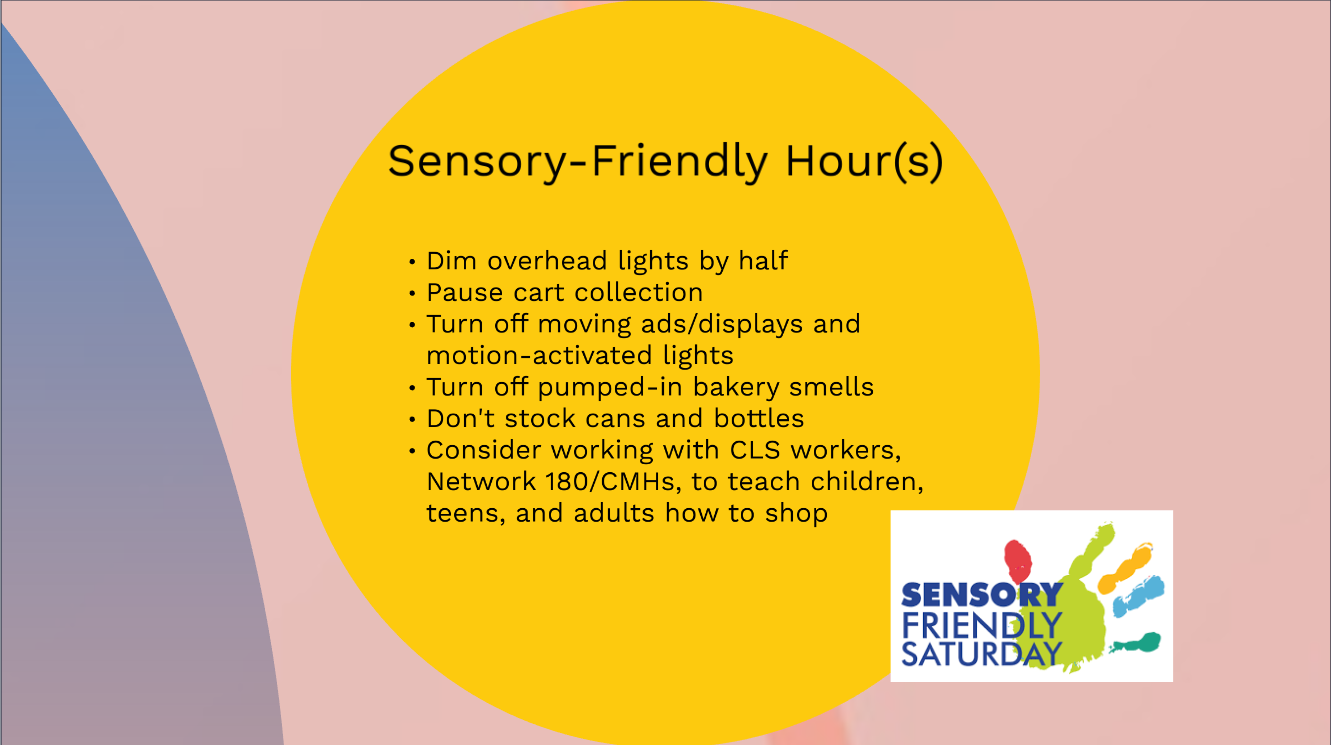
There were two major ideas that were suggested in my various reading materials. The first is the more feasible one, and is already being done in grocery stores in Australia and Britain. It\’s fairly simple: a major complaint from autistic people is that stores are too loud and overwhelming.
The solution? Turn everything down, for an hour or two every week, or a day or three every month.
Turn off in-store ads and flashing signs, pause cart collection, and turn down the lights. Based on my walkthrough experience, I expanded on this little by also suggesting they turn off the pumped in bakery smells and avoid stocking cans and bottles. To this I\’d probably also add \”silence the talking self-checkouts.\” Doing these things vastly reduces the amount of sensory information pushed onto shoppers, which is awesome for people with overload tendencies.
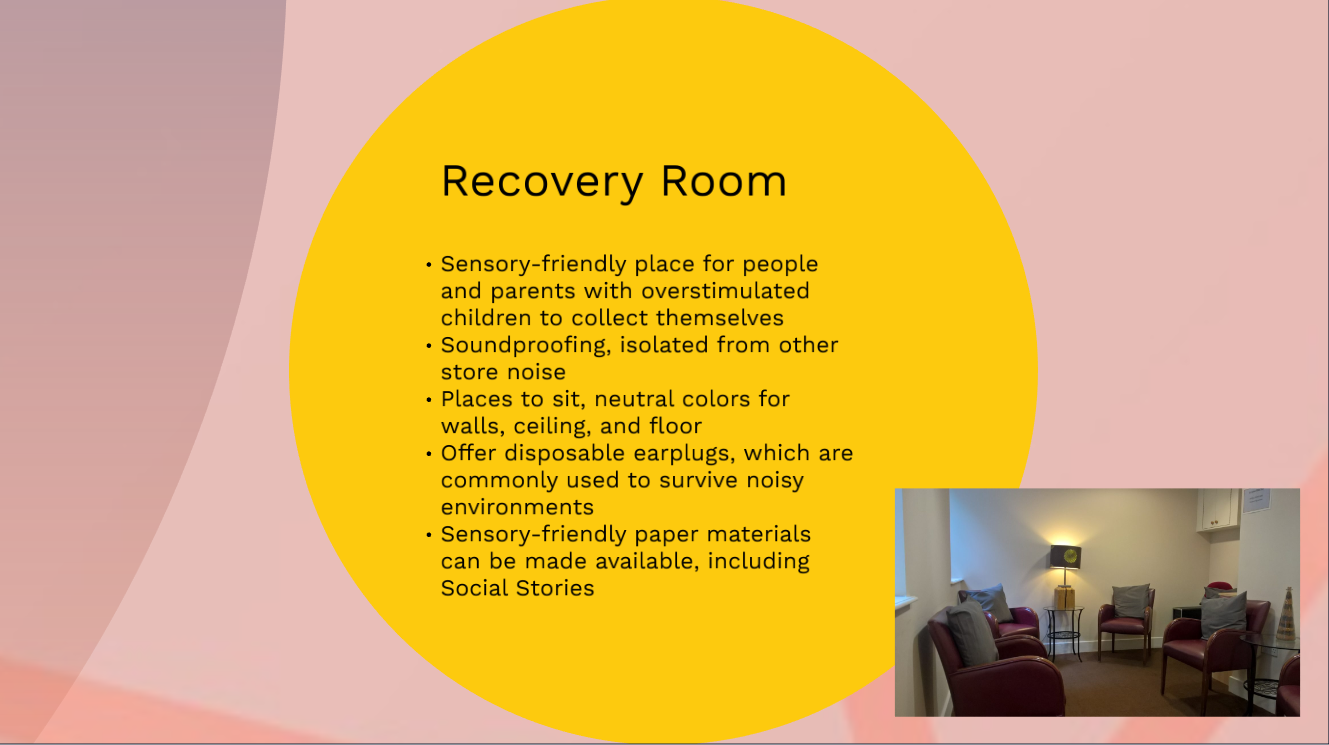
The more expensive and less likely accommodation I saw was a sensory-friendly room. This is a phenomenon I tend to see more at conventions, but in all honesty, I could really use one everywhere I go.
The idea is to establish an accessible, quiet room with neutral decor and places to sit while someone tries to wind down from a meltdown. Small autistic child having issues? Go to the sensory room and get out their favorite stim-toy. They calm down, and you can get back to your shopping.
In conventions I\’ve been to, this room was literally as simple as \”we turned off the lights in this panel room and left like three basic chairs in there.\” It wasn\’t exactly comfortable, but it was kinder on my senses than the convention overall.
My additional suggestions for a room like this include offering disposable earplugs, which are a common assistive technology for people with sensory sensitivities, and placing copies of the aforementioned sensory map and Social Story there.
Really though, it doesn\’t need to be fancy. It just needs to be there and accessible. I don\’t really think Meijer will go for this idea, though, because any public space they\’re not using to display products is lost income.
——————————————————————————-
I included this, in the main, because it seems negligent not to do so. The Autistic Self Advocacy Network has taken great pains to establish easily-digested materials on the subject, and the Autism Society has put together an actual program you can qualify your business for. It seemed criminally negligent not to at least say, \”hey, these are cool, maybe check them out?\”
In all honesty, though, in a perfect world, I might be able to make a living simply by getting hired to walk through places and point out the autism- or sensory-unfriendly parts of them. I can hear things that most people can\’t, and am sensitive to bright lights in a way most people can\’t imagine. I\’m also fully verbal and can communicate that information even while stressed.
In this very non-ideal world, I\’m not honestly sure there\’s enough market for such an idea. If you know someone who\’d like to know if their business is autism-friendly, though, give me a shout. My rates are very reasonable. : )
Legwork and Life, week of 6/12/19
Last week I talked about how awesome an Epsom salt bath was. Turns out they have diminishing returns, based on how much magnesium is in your system! Also, like any other substance, you can absolutely overdose on magnesium. One symptom of magnesium overdose is anxiety! Irony sucks. I was hoping to have a nice relaxing bath and ended up with anxiety dreams for the next four days.
Before anyone gets worried, it was only four days because I routinely take a large-ish dose of magnesium in supplement form, so those kept my levels a bit too high for longer than they had any right to be. After a few days, I skipped a single dose and the anxiety dreams stopped.
This is kind of the story of my life: find something that seems to help, try to use it regularly, find out it has significant limits, doesn\’t work all the time, or actually doesn\’t help as much as you thought it did. Presumably this is life\’s way of telling me that \”no, nothing is ever going to be easy for you.\”
Anyway, I\’m not ruling out Epsom salt baths as a thing, but they\’re clearly more of a \”once a month, maybe\” thing, rather than a \”I can do this once or twice a week and it\’s super nice!\” thing.
There\’s been no word from Meijer about the review of their store or making them more sensory-friendly, but I\’m developing a spreadsheet of audit criteria using the materials I put together for the presentation. I figure I can probably get some use out of it when I shop in other stores. I\’ll probably run it by my doctor, who also has sensory issues. Plus if Meijer follows up, I\’ll have something nice and fancy-looking to bring to the next store I audit.
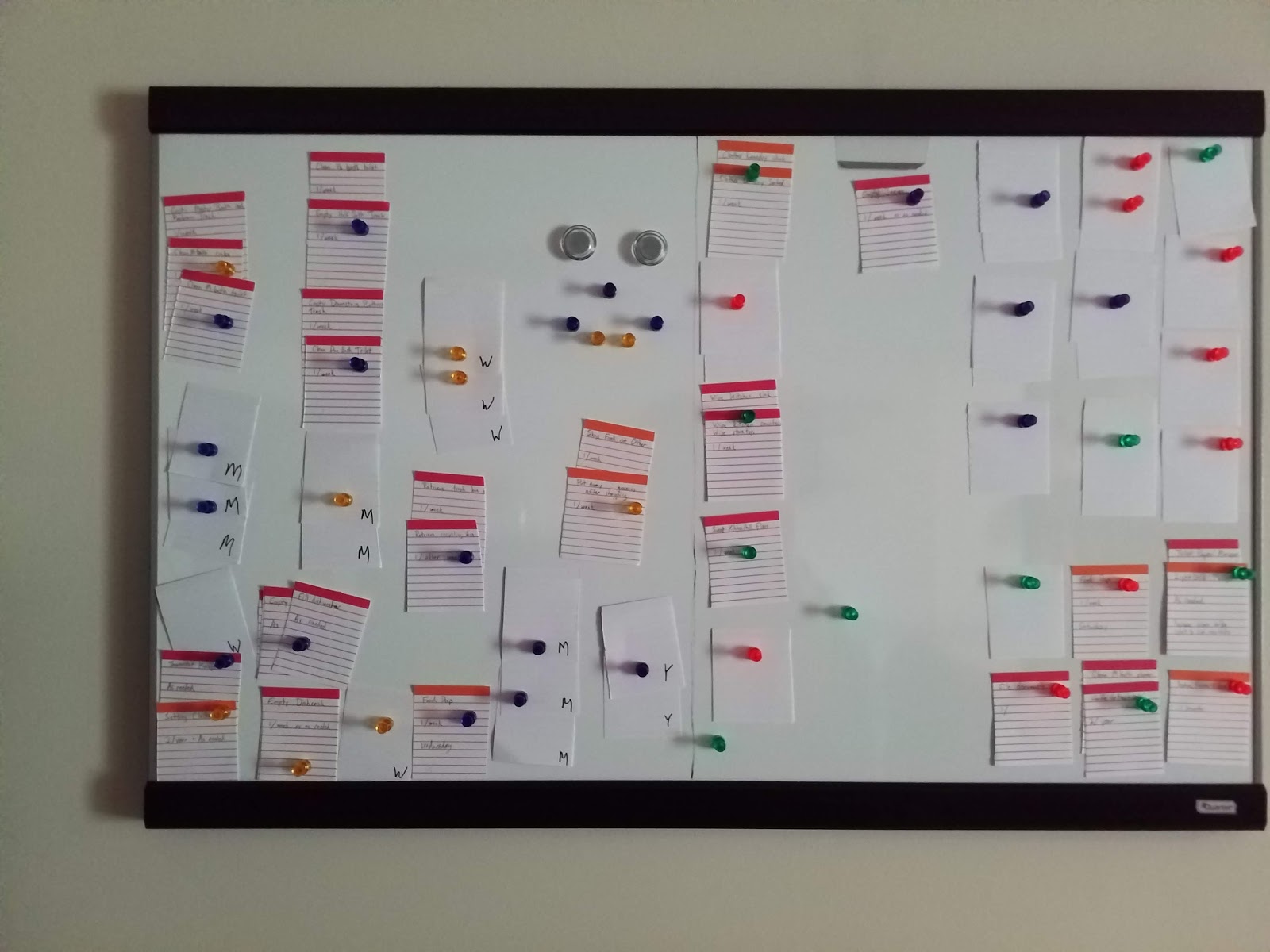
Other than that, I\’ve been mostly keeping busy with house maintenance and improvement. Nothing super impressively major, just a slightly different setup for the downstairs TV, moving a couple small furniture things around, and rearranging some of my space in the bedroom. Also this:
With luck, the board will help me and my spouse keep on top of weekly, monthly, and yearly responsibilities. Sadly some of these chore-cards will never actually get turned over, because they\’re on an \”as needed\” basis. Things like adjusting the thermostat, resetting the clocks whenever the power goes out or daylight savings time hits, etc. Still, it\’s good to have them where they\’re visible and easily-referenceable.
Reading the Research: Receptive Language
Today\’s article is right in line with last week\’s article, showcasing another neurological autistic oddity. This time, rather than social behavior patterns, it\’s a reactive behavior, which is even more curious to me. Essentially, this study tested whether (probably) autistic babies would turn their heads to pay attention to new and interesting speech sounds. They didn\’t do so as much as their neurotypical counterparts.
In normally-developing children, this speech-focused selective attention helps teach the baby the correct syllables and sounds to communicate with their family and the people in their area. This reactive learning is what psychology calls \”receptive language.\” But it seems the (probably) autistic babies weren\’t as good at recognizing relevant speech to learn from.
The differing attention patterns of the autistic versus neurotypical babies strikes me as a good reason that some of us develop speech later, or even never. I\’d always assumed it was more of a \”slower brain development\” thing, or a \”sensory sensitivities interfering with learning\” thing and I suppose those might also factor in. Usually the story of autistic lives is \”here\’s my laundry list of diagnoses and complicating factors, it\’s as long as your arm.\” With so many extra drains on the child\’s mental resources, it would be hard to learn at the same rate an unhindered child would.
This is honestly fascinating, but I really wonder if it applies to me. As of a few years ago, minimum, my brain has had the uncontrolled tendency to drop whatever it\’s doing and listen to speech over anything else. This was great for conversations with friends while I was wearing headphones, but very bad for ignoring a TV in a waiting room or conversations I\’m not a part of. Or, really, ignoring one conversation in a public space to listen to another. So it\’s kind of like my brain went for the polar opposite, I guess?
I couldn\’t tell you what I was like as a baby, though. I don\’t recall having any specifically focused attention as an elementary school child, but there\’s a good chance I simply wasn\’t self-aware enough to know if I did or not. At the time, I had very different priorities, like not getting bullied, passing my classes, and surviving each day.
If pressed, I suppose it might\’ve been possible I developed this way? The thing is, pretty much as soon as I could read, I dove into books. I had a knack for reading, and generally had a book with me wherever I went. Over the years, I osmosised a good sense for grammar, as well as gained enough exposure to how US English spelling works that I didn\’t have to try that hard at it, either.
I do recall various incidents with people correcting my pronunciation of various $1 and $5 words I learned from books, because English is a flighty language that steals words from everywhere, and pronunciation rules that work in English don\’t work in French or Spanish or even Latin. I recall pressing my mother on this unpredictability a few times after being corrected on a word\’s pronunciation, and she essentially shrugged and said that English didn\’t really like to follow rules, and that I shouldn\’t be bothered by it.
(Pst! If you like seeing the latest autism-relevant research, visit my Twitter, which has links and brief comments on studies that were interesting, but didn\’t get a whole Reading the Research article about them.)