Grocery Shopping: Part 1 of a Sensory-Alert Walkthrough

Last week Autism Support of Kent County, the organization I volunteer with, was invited to the corporate office of the Meijer, the local chain of super grocery stores. Meijer is hoping to make their stores a bit more sensory- and autism-friendly. I was invited along (after asking if I could be), and so in order to be properly prepared, I took a trip to the store I usually shop at.  There, I walked through the whole store, doing a slow but thoughtful shopping trip.

I came away with six pages of stream-of-consciousness notes, and roughly two dozen pictures.  After getting home, I condensed those into four topical headers and organized the information into those.  After that, I put together a very hurried and extremely unpolished presentation, which I will, I suppose, re-publish here with apologies to your eyeballs.  I\’m going to do it in two parts, because otherwise it\’s too long.  
Before I begin, please understand this is a single store I visited, not the chain at large.  It\’s one of the stores I shop at, in large part because it carries so much of what I need, at reasonable prices.  There are a lot of good things about Meijer that may seem ignored in the tide of criticism I offer here.  Check the second post, which will cover Sounds and Store Policies for a lot of those.
Main slide from a presentation, titled Gaines Township Meijer: An Autistic Walkthrough.  Main topics are Lights, Sounds, Smells, and Store Policies.
I haven\’t made Powerpoint-esque presentations for, um… something in excess of seven years.  Things have slightly changed when I wasn\’t looking, and I wouldn\’t say I was good at them in the first place.  You\’ll see what I mean later.

——————————————————————————-

Slide from a presentation, titled Lights.  Subtopics: Overhead Lights and LED Light Strips

For lighting, I was trying to get the basic understanding for design choices across.  Natural light or at least incandescent light over fluorescent lights.  Warm, soft white lights over harsh blue white lights.  No flickering lights.  These seem obvious to me, but I guess if you\’ve never stared directly into those awful new light blue headlights or into an LED light strip on a dark night, you might not know what I\’m talking about.

Slide in presentation, titled Overhead Lights.
Naturally, fluorescent lights are the cheapest for retail businesses by a hefty margin, so this normally falls somewhat on deaf ears.  When researching the subject, I did run across instances of teachers putting films or sheets over their fluorescent lights, which possibly moderated the flickering and humming.  So that\’s something.  
These particular overhead lights were of an unusual design.  They had a single, bright (probably fluorescent) tube bulb, facing UP.  The rest of the light was a curved white surface, which reflected the light out and down.  I\’m not a person that can actually see the fluorescent lights flicker, so I can\’t be sure that this design was meant to reduce that effect… but it does seem unusual and intentional, so that\’s certainly something.  
The lights themselves were… much too bright, honestly.  The reflections would bounce off every plastic-wrapped item, every glass item, and every polished surface (like, y\’know, the floor).  See the lower picture there?  The reflection of the overhead lights is visible in every single package of meat.  The end result was rather painful once I focused on it.  Dimmers would be a good option here, if the store wanted to be more sensory-friendly. 
LED light strips.  I hate them so much.  Whoever invented them has earned the swift kick in the pants I have saved for them.  They are very often the horrible piercing blue-white variety.  
Meijer, as it turns out, makes copious use of these light strips.  I found them in every refrigerated section, all over the health and beauty aisles, and even in special displays in the food and electronics areas.  Now, to the store designer\’s credit, many of these light strips were not visible from an adult\’s height and perspective.  They\’d installed them facing away from the customers, or blocked the immediate view of them with a plastic strip.  
The issue, of course, is that these precautions don\’t shield children, who are lower to the ground and have a different perspective on the displays… and it also wasn\’t sufficient to keep me from spotting them, because several of them still managed to stab me in the eyeballs.  The next time you see a kid screaming on the ground, apparently having a tantrum, look around for light strips, flickering lights, or obnoxious sounds.  It might not be a tantrum, but a meltdown caused by so many awful and painful sensory inputs.  
There was one exception to the \”light strips are awful\” rule, and I couldn\’t manage to get a good picture of it.  The refrigerated juice aisle had these long warm-colored light strips that had been shielded entirely.  This allowed them to emit light, but reduced the eyestrain to the point where I noticed no pain while staring directly at them.  It was really nice, and I hope it becomes the standard everywhere.
Another thing I found and hated with light strips: the ice cream and frozen food sections have those tall upright freezers.  Those are fine.  However, they decided to install motion-activated lighting in those upright freezers, so when you walk by, everything brightens up.  This is highly disorienting to me, and I hated every minute of it.  I actually had no idea why I felt so disoriented in the freezer section until I did this walkthrough and noted the motion sensors every 3 freezers on each side.  Hate it, do not want.
The view looking up in a grocery store.  Painfully bright spotlights shine down on bottles of alcohol

Something that didn\’t make it into the presentation was spotlights.  I think I\’d meant to have them, but just… didn\’t.   In my defense, it was well past midnight when I was working on the presentation, and I\’d had roughly 24 hours\’ notice that  this meeting was happening, and that I was coming.

I squinted at this flickering spotlight for about a full minute, trying to decide if it was malfunctioning or if this was intentional.  The flickering was quite regular, and wasn\’t making extra sound, so I got the sense that it was intentional.  Obnoxious and possibly dangerous to people with epilepsy, but intentional.  The whole spice display flickered with light, as a result, which I think was to make it stand out more.  It was kind of like poking me in the eye repeatedly.  Needless to say, I am not a fan.  
——————————————————————————-
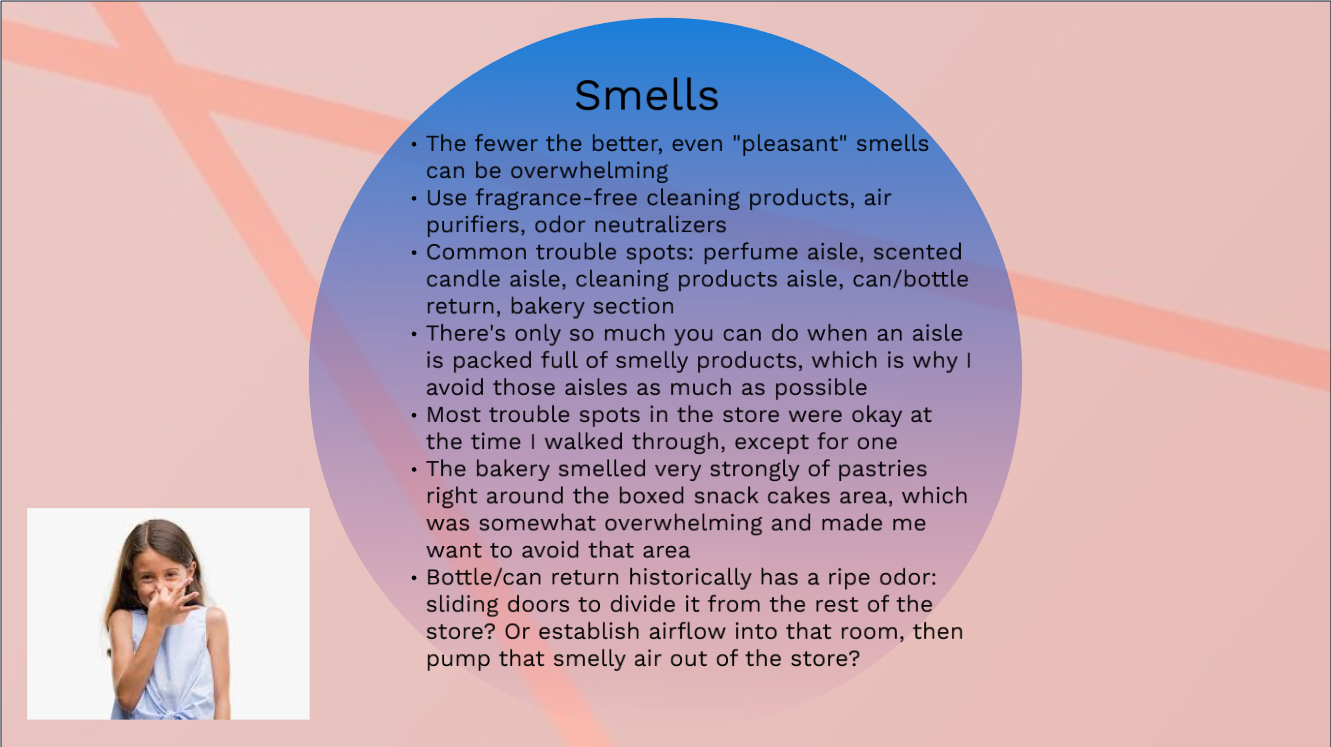
We\’re going to skip over Sounds this week to jump right into Smells.  You can see from how lengthy the bullet points are here that I\’m very out of touch with how one makes a presentation.  I really just wanted to have my thoughts organized.  
As a general sensory-friendly rule, you want zero odors in a public area.  The nose can\’t cause you pain if it has nothing to react to.  Odorless cleaning products are my friends.  Even pleasant smells, like fruit, flowers, or baked goods, can cause pain and sensory overwhelm.  My doctor actually gets bad headaches from flower-scented things, even though basically everyone likes flowers.
Obviously, in a grocery store, this is only so possible.  The perfume aisle, the scented candle aisle, the cleaning products aisle, the can/bottle return, and the bakery section are going to have smells.  You can use odor neutralizers and air purifiers around and in those aisles to help, but the fact remains, those places are full of smelly things.  And worse, those things are often purposely made with porous packaging (the material has tiny holes in it) so you can smell the product and decide if you want it or not.  
In the walkthrough I did, the trouble spots were actually pretty good, with one exception: the bakery.  I\’ve read somewhere that stores like to pump canned \”fresh bread\” or \”baked goods\” smells into their bread and bakery departments, and I\’d bet my comfy blue slippers that Meijer is no exception.  I got a strong noseful of \”baked goods\” smell when I stepped into the packaged snack cakes and cookies section.  Which is curious, since, y\’know, they\’re in packages, and I was still like 10 feet away.  
Historically, though, the can and bottle return is malodorous in the extreme, to the point that even people with normal senses avoid the place.  This location had the entrance to it located right in the entrance to the food, unfortunately, which I can guarantee will make it Bad Times in summer.  
I\’m not really sure how the store handles that, but the entry to the return area is unimpeded by sliding doors.  Adding sliding doors, or establishing a breeze going into that room, which is then pumped out of the store, would probably be a way to handle it.  I\’m no engineer, though.  
When I shop, I tend to avoid all the trouble spots I\’ve mentioned here, simply because I know they\’ll be unpleasant.  The discussion brought up the idea of mapping those trouble spots, as well as any quieter or safer areas in the store, and having those maps be available to parents and anyone else with an interest.  I think that\’s a good idea overall, and I\’ll go into that idea and some related ones next time, when I talk about Sounds and Store Policies.  
Legwork and Life, week of 6/5/19

This is Legwork and Life, where I track the legwork and opportunities in my career as an autistic advocate, and also describe parts of my adult autistic life, including my perspectives on everyday problems and situations.

In brief: last week had a sudden frantic spurt of work activity which exhausted me for a couple days thereafter. You\’ll see the results of that frantic work this Friday.  But I also maybe discovered something to help boost my relaxation, possibly by overdosing on it.  I have also possibly hopefully gotten a buffer restarted, which is excellent because it\’s very helpful to my overall anxiety level.  

The work intensive thing spanned roughly 28 hours, and began with an email that I read upon waking up.  Essentially, it was a call for comment from various qualified-to-comment people, asking how to make my local Walmart-competition store more sensory-friendly.  The public face (and only paid employee) of Autism Support of Kent County was being invited to speak to someone at the corporate office.  She wanted ideas from everyone so as to present as many good ones as possible.  The meeting was scheduled for the next morning.

This is the sort of meeting I think firsthand experience is essential for, so I politely requested to be invited along.  Fortunately, she tends to agree on the value of firsthand experience and wasn\’t put off by my forwardness.  But even before hearing back from her, I made plans to go off to my local store and essentially audit it.  Which I did, though it took over an hour to traipse the whole store and investigate various things.  

I also sent out a message to the local autistic adults I\’m in contact with, asking their opinions on the subject.  The thing with autism is that at present, it\’s a very individualized experience.  I have over-sensitivities in the sensory department.  Some autistic people have undersensitivities, a combination of both, or their senses are normal.  

I came back from the trip with six pages of notes and the desire to have a presentation ready on what I\’d found.  Which I managed, but it took basically the rest of the day and well into the wee hours, and the result was, um…  let\’s say \”functional.\”  A good presentation is pleasant on the eyes and includes more than simply organizing the information.  This was more \”it\’s organized into headers, here you go.\”  I made the meeting and did some of my presentation, anyway.  

After all that rush and time spent all at once, I was exhausted.  I spent most of the next day doing no work at all, because I was brain-burned and just wanted to lie around.  My life is not so luxurious that doing so was an option, but I did take a bit of time for myself in the evening.  I took a bath.  

I have various good quality bath bombs from a nice Etsy shop, as well as presents from other people.  I often use these, and they smell nice and make me happy.  However, I\’d also heard of good results from using Epsom salts in baths, and so I\’d sometimes stir in a cup of those in addition to my bath bomb.  Epsom salts, you see, are magnesium salts.  Magnesium is sometimes deficient in autistic people, which can lead to anxiety and other detrimental effects.  So some autism parents swear by Epsom salt baths, saying they\’re massively helpful for calming down their children.  This time, I eschewed the usual bath bomb and began dumping Epsom salts into my tub like there was no tomorrow.  

I wasn\’t thinking super-clearly, but I think the closest approximation for my frame of mind was, \”I\’m going to prove these stories right or wrong, one way or the other, or so help me God.\”  I\’m not actually sure how many cups of Epsom salts went into the tub, because I wasn\’t measuring.  It\’s a big tub, so more than the single cup is probably necessary to get the appropriate effect.  At any rate, I dumped probably 3 times that, maybe more, into the tub, including some directly onto my submerged legs.  

It\’s a little weird to have salt in your bath, but it does eventually mix with the water.  As long as you\’re not drinking it, it\’s basically fine.  Just be sure to buy the unscented if you have sensory issues.  I had a very relaxed bath, which I mostly noticed because I didn\’t start getting super antsy to get out when the bath started to cool.  

After I got out was when I really started to notice the difference.  My muscles were hyper-relaxed.  My brain was very very quiet.  I mostly just wanted to lie around in bed and do nothing.  Fortunately, it was my spouse\’s turn to cook, so I did just that while I waited for dinner to be ready.  I think I dozed off a couple times.  This alarmed me a little, so I looked up magnesium overdoses the next time I was properly awake, and I miiiiight have overdone it just a little.  Lethargy is a symptom of magnesium overdose.  I didn\’t have any of the other symptoms, though.  

So I dunno if this is a universal thing, but I\’m probably going to buy Epsom salts in bulk now, and make regular use of them.  I will definitely need to see about a better dosage than, \”1 cup, plus a bit more, and a bit more, and screw it a lot more, and maybe a bit more…\”  

In the meantime, I have a bit of buffer again!  There\’s not a whole lot to say on this, it\’s just me stockpiling Reading the Researches and Friday posts for rainy days.  Some weeks there really aren\’t good research articles for this blog, while others come with several.  It\’s wise to have backups, but I haven\’t done that a lot of this year, I guess because there\’s been a lot of rainy days and not a lot of success in rebuilding the buffer until now.  Here\’s hoping I can keep up the good trend.  

Reading the Research: Joint Attention

Welcome back to Reading the Research, where I trawl the Internet to find noteworthy research on autism and related subjects, then discuss it in brief with bits from my own life, research, and observations.

Today’s article highlights a basic neurological difference in autistic people.  Apparently, we simply don’t initiate social actions as much.  The article calls this “reduced social motivation” which basically means we’re not as likely to put in effort to interact with others.  Some people think this is because we don’t find it as rewarding as typically-developing people do.  

The lack of this motivation would account in part for our lesser social skills.  When a child grows up, they run into hundreds of thousands of social situations.  Social motivation pushes them to develop their own, and to interact with the ones they find themselves in.  With reduced motivation comes reduced opportunities to learn the typically expected behaviors, and observe others’ behaviors. 

Let’s say an autistic child grows up only responding to half the presented social situations, and, not being interested in creating their own, has no further ones.  They will then be, at best, half as adept at social situations as a typically developing child.  The learning opportunities were missed, so the learning didn’t occur.  This quickly becomes a disability in a world that expects everyone to react and behave similarly.  And this doesn’t even factor in other common issues, like sensory sensitivities, gut dysfunctions, and anxiety.  

Tellingly to me, though, was that the children that were later given autism diagnoses did still respond properly to initiated joint attention.  Our brains are different, but not so different we can’t learn or have anything in common with typically developing children.  I’ve heard of early intervention programs that focused on teaching autistic children to pay attention to others, thus kind of overriding this neurological quirk.  Establish that valuable information can be had from other people, and the child will then learn to keep an eye on other people for that information.  I’ve not heard what the programs’ success rates were like, though.

I think it’s safe to say this is one of those observations that was right on target for me as a child.  Prior to reading this article, I would have assumed that was a facet of my introversion, not my autism.  I guess it could be both.  Or the autism lead to the introversion, for me?  Not all autistic people are introverts, though, so the two things might be unrelated.  

In any case, I was definitely a socially-reactive child, not a proactive one.  I was interested in what I was interested in, but I don’t think it generally occurred to me to try to share that interest.  I’m sure that was in part because my peers, in general, were at best neutral to me.  You wouldn’t walk into a room of hostile people and expect them to care about your latest favorite song.  You’d avoid the room, or tiptoe in quietly if you had to go in, so as not to upset them further.  Though I guess some people would also try joking with the people to try to lighten the mood, but I am not one of those people.  I just wanted to be left alone.

In the course of trying to be left alone, I had a lot of opportunity to observe people… so I did.  Which taught me a lot about people and social systems, though unfortunately from the outsider’s perspective.  Still, it’s that knowledge that has let me be so successful as a bridge between autistic people and neurotypical people. 

At this time, I would say that I regularly initiate joint attention, though not as much as my spouse does.  He’ll sit and browse on his phone and try to show me pictures or stories or whatever every minute or so if we have downtime.  I’ll only do that if I find something particularly funny or highly related to his interests.  Still, I think now I probably fall a lot closer to “normal” in terms of this facet of social communication.

(Pst! If you like seeing the latest autism-relevant research, visit my Twitter, which has links and brief comments on studies that were interesting, but didn’t get a whole Reading the Research article about them.)