Reading My Psychological Evaluation

Recently, due to participating in a research study, I was asked to get a copy of the psychological evaluation that told me I was autistic.  I did so, and summarily read it.  I can\’t remember if this is the first time I\’ve read it, or if I had a copy ever.  But it\’s certainly the first time in quite a while that I\’ve read it, so it was interesting… and depressing, reading.

The place that did the evaluation is a local one, with various therapeutic programs in addition to their diagnostic services.  I wasn\’t over-impressed with their offerings at the time, and my insurance wouldn\’t have covered them anyway, so I never got too involved with the organization.  I have no idea if that was a good decision on my part or not.  But all the same, I do at least finally have a date on which I got my autism diagnosis.  It turns out I was almost 20 and a half when I got my diagnosis, right on the tail end of my sophomore year of college.  Near finals week.  No wonder I don\’t remember it very well.

It\’s worth noting, before I begin, that I was diagnosed under the DSM-IV-R, or the revised version of the 4th edition of the American Psychological Association\’s diagnostic manual.  At the time of this writing, the most current DSM is the 5th edition, wherein Asperger\’s Syndrome only exists as a different name for ASD, or Autistic Spectrum Disorder.  Also known as \”autism.\”  I now choose to identify as \”autistic,\” because of this diagnostic change, and because while I speak, live independently, and present as fairly normal, I share some of the same difficulties as a nonspeaking, dependent, poorly-blending autistic person.  Also, by putting a human face on the condition as a whole, it becomes harder for people to treat nonverbal, poorly speaking, dependent autistic people as… less than people.  And there\’s already quite enough abuse of disabled people to go around. 

The First Page and the Interview

The first page of the report involves demographics, including some unusual and probably unnecessary information.  Date of birth, name, education, and medications, naturally.  But they also wanted to know where I was living, any eyewear I happened to need, and which hand is my dominant one.  I have a bachelor\’s degree in psychology, and I really have no idea why those last three pieces of information are relevant.

I remember being mentally exhausted after the test, and looking back at the list of tests and the number of hours billed, I can kind of see why.  The testing process took a minimum of 4 hours, possibly 5.  The psychologist began by interviewing me, which included getting everything from my birth weight to any surgeries, allergies, family history, and my particular descriptions of my personal oddities.  While she was getting all this information, she was also observing what I said and how I said it.  Which is how you get sentences like, \”From the initial interview throughout the assessment process, it was noted that Ms. Frisch does have some unusual intonation and patterns of speaking.  She presents as being very factual and concrete, but often tells stories that are somewhat unusual in that they are more detail focused or seem to be slightly \’off center\’ of the main topic of conversation.\”

As an aside on that second sentence, my brain references things by associated things, rather than in chronological order or some other more pragmatic system.  So if I was trying to remember a particular dog species, I\’d need to flip mentally through my concepts of similar dog breeds until I found the one I was looking for, or try to remember another dog I knew that looked like the one I was trying to remember.  This associational pattern of organization can lend itself to that slightly \”off center\” kind of comment… but in all honesty, this psychologist is the only one to ever complain about it.  And in truth, I\’m not the only one I know that does this, and I find it simply moves the conversation along.  So I don\’t find it all that bothersome.  I am not, after all, an encyclopedia.

There was also this comment: \”While she attempts to engage readily in conversation and is able to be reciprocal back and forth, she sometimes will take the conversation to an unusual level that may reflect intellectual knowledge, but may also be reflective of some of the social dynamics of Asperger\’s.\”   I\’ve included this sentence exactly as written, awkward grammar and all, because it\’s always nice to know that even doctors need to have a human eye check over their work.  As for my conversational skills, I find that the more enlightened and accepting people I speak with find my particular tendencies interesting, rather than detrimental.  Exploring a subject in detail, or from an unusual angle, rather than skimming over it lightly, is an educational exercise. 

This section gets the summary: \”Her overall presentation, tone of voice, being more monotone, and difficulty with eye contact are also consistent with a typical Asperger\’s presentation.\”  It\’s worth noting that some autistic people actually go the exact opposite way in terms of voice tones, to the point of sounding \”sing-song,\” or even cartoonish.  I\’m actually familiar with one such autistic person, and the end result is probably just as confusing as my semi-monotone voice was.  I think my vocal variance has probably improved somewhat in the 9 years since this evaluation was done, but I guess I\’d have to go back to find out.

So Many Tests

After the interview, the tests began.  There were… so many.   (The paper says there were only six, but on average, each took 45 minutes, minimum… so it added up fast.)  One came after the next, too, with almost no breaks.  I think I remember calling for a break after my bladder filled up so much I couldn\’t see getting through another test… and when I got up, my legs felt stiff and tired from all the sitting.  
At the time, I found the experience fascinating… at least until I got tired, so I took notes about the tests in my downtime between tests.  I took them on my puzzle book, which I still have because I\’m only occasionally interested in word search puzzles. 
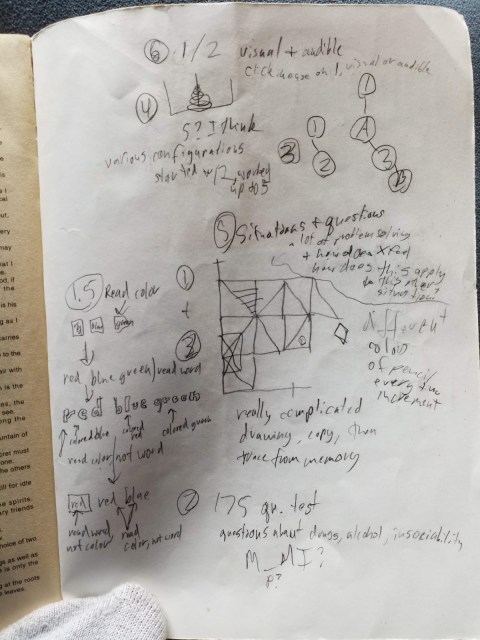
You can also see how frazzled I was overall by how disordered my self-explanation of the tests is…
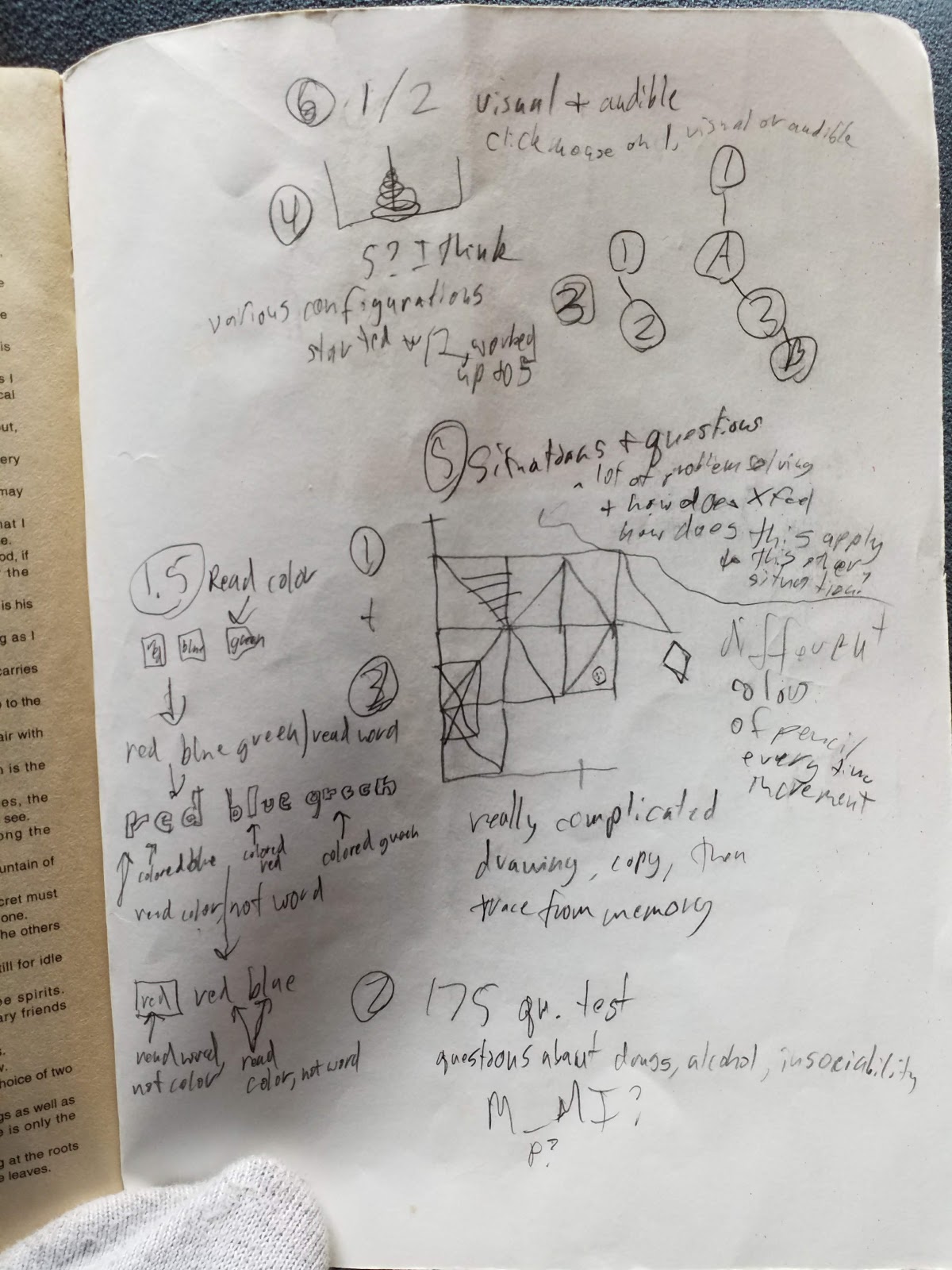
I am not 100% sure which tests came first, even with my notes here… but we have to start somewhere, so we\’ll start with the Rey-Osterreith Figure Drawing.  I linked the complete figure in an earlier post regarding visual processing difficulties, but I\’ll post it here again.

Rey-Osterreith Figure Drawing

This is overly complicated on purpose.
If you compare my drawing in the picture above with this figure, you can kind of start to see how markedly different my visual processing is from the average person\’s.  The average person, you see, recognizes that this figure is an overly complicated box with a fin on top and a triangle on the right side, at its heart.  They then fill in as many details as they can remember.  
My drawing can tell you that I entirely missed that, and instead drew a series of triangles and small boxes, with some of the finer details noted but not necessarily in their correct places.  The report notes, \”Her approach was to start at the top and work her way down rather than conceptualizing the outer gestalt.\” (I should note that I drew this version after my official test results had been recorded.)  The figure is made purposely overly complex so that nobody but a savant would remember and be able to reproduce the full shape and details perfectly, by the way.  Still, \”As a result, her overall drawing was impaired compared to similar adults and does suggest difficulty with complex visual assessment.\”  I can\’t stress enough how true that last bit is.  Most visually complex art is wasted on me. 
The tests were drawn from a larger collection of tests called the Delis-Kaplan Executive Function System.  Specifically, my notes and the report say I did the Color-Word Interference Test, followed by the Trail-Making Test, followed by the Tower Test.  

Color-Word Interference Test

The Color-Word Interference test is a variation on the Stroop effect.  Which is to say, they timed how quickly I could identify colors as shown to me on cards ( ), then how quickly I could read the words of colors (blue), and then how quickly I could read the color of the text that spelled out a different color\’s name (orange).  The correct answer for all these examples is \”blue\” but it\’s harder for a person to read the color of a word, rather than the text of the word.  Now imagine doing that when presented with tons of these:
Apparently I only made two mistakes, but those mistakes knocked my score down below average for my age.  Meh.  

Trail-Making Test

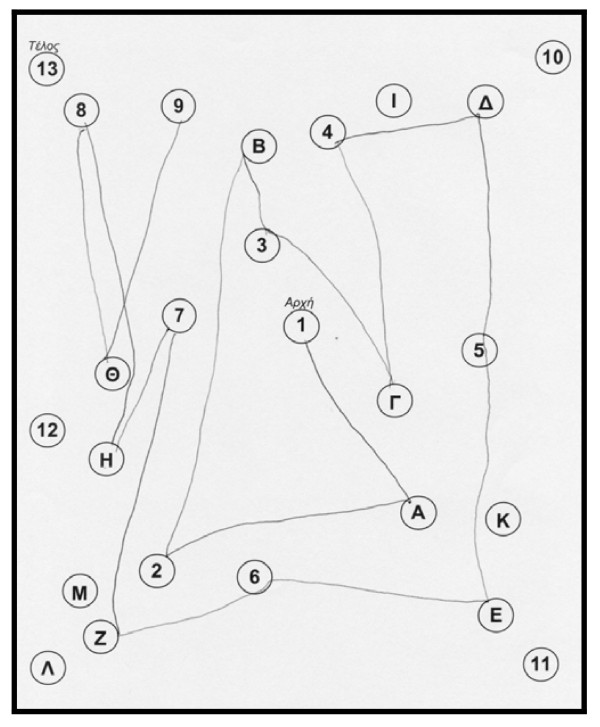
The Trail-Making Test is a test of following a sequence while adhering to rules.  You\’re given a page with the letters A-M and numbers 1-13 on it, and are then told to draw lines from 1 to A, then A to 2, then 2 to B, all the way through the page, without crossing your own lines, until you connect 13 and M.  Here\’s an example of someone getting partway through a variation of this test:  

My particular test results noted, \”…it was difficult for her to draw a straight line.  Most of her lines between the items were very shaky, wavy, almost \’bumpy\’ suggesting that even though she was able to conceptualize the task, her control of the pencil was less than expected for her age.\”  In retrospect, this is particularly funny to me because I already hold the pencil wrong (in four fingers, rather than three).  I do, however, have a hand tremor when riled up, so maybe that was the problem.  Or maybe it was just that I\’m kind of garbage at fine motor control to begin with.

Tower of Hanoi

The Tower Test I remember most because I ended up sitting on my left hand for a good portion of it.

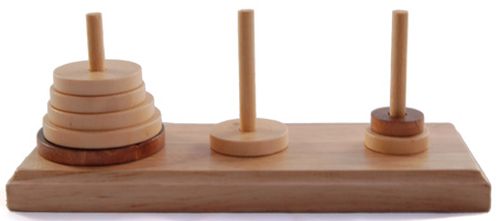
You had a set kind of like this, in different configurations, and were expected to stack the pieces with the smallest on top, expanding to the largest on the bottom.  You may only move one piece at a time.  This is a test of executive functioning, or your ability to coordinate and plan your actions as well as carry them out.  About midway through, though, my interest in trying to solve the puzzle overrode my memory of the \”one piece at a time\” rule, and I snagged two pieces, intending to move them one after the other.  After that was called out as not allowed for the second time, I simply sat on one hand, thus disabling my ability to accidentally violate the rule again.

There were nine of these puzzles, and I scored about average on all of them save the last, which I didn\’t finish. The test results note that I spent a lot longer trying to finish the puzzle than most people do, which the psychologist charitably explained as, \”great perseverance and hard work ethic, even when she is unable to complete something easily.\”

The psychologist in question didn\’t know me, so she was mostly unaware that a lot of my life has been marked by difficulty.  This puzzle being \”not easy\” was just another in a long line of challenges, and one with relatively few poor side effects if I didn\’t succeed.  As I recall, I didn\’t lose interest in trying to figure out the test.  The psychologist actually suggested to me that we could move on to another test unless I thought I had the solution in mind.

\”Perseverance\” is the word my mother uses, and the clinical word the psychologist used.  I tend to be more perverse and stick to \”stubbornness,\” personally.  It\’s part a point of pride and part a personal reminder that being persistent is not always a good thing.

TOPS

The next test was more socially-focused, rather than a test of how well my brain worked.  The test was a series of interpersonal situations followed by questions about each situation.  The contents were mostly problem solving, or \”how does this person feel in this situation,\” or \”how does this apply to this other situation?\”  An example was something along the lines of, \”Mary, a 13 year old girl, lives with her father.  Her father remarries and the new wife has a 10 year old daughter, who will be coming to live with them.  How does Mary feel about sharing a room?\”  
I should note, before I give my scores, that the TOPS test only scores up to age 17.  Why 17?  I have no idea.  I was almost 20.5 years old when I took the test, too, which makes me wonder if the test results might\’ve been off a bit… but never mind.  Cognitively, and in my ability to draw inferences regarding situations, I maxed out the test, scoring at 17 years old.  For determining solutions to the situations I was presented, I only scored at 15 years old, and my ability to communicate insights was at 16 years old.  Here\’s the kicker: when interpreting other peoples\’ perspectives in the given situations, I only scored at 14 years old.  
Basically, taking others\’ perspectives was a lot harder, and understanding emotions and others\’ emotional responses was difficult.  I\’d like to think I\’ve improved since then, and… I think I have, but again, without retaking the same test, I couldn\’t say.  

IVA

This is the test that really tired me out.  The Integrated Visual and Auditory Continuous Performance Test involved you looking at a computer screen, with big bulky headphones.  You needed to click the mouse whenever the correct number (either 1 or 2, it changed) showed on the screen or was pronounced through the headphones.  The graphics were very simple, white numbers on a black screen, and the task mind-numbingly boring.
\”Mind-numbingly boring\” is a particularly apt description, because by the end of it, I really wanted a break and/or to do literally anything else.  I recall them asking how I thought I\’d done on the test.  Somewhat over-optimistically, I said I thought I\’d done okay.  It turns out my visual score was utterly abysmal.  I scored in the lowest 5% on that test, which effectively makes me a dunce on that end of things.  At least I scored about average on the auditory part.  

MCMI

The last test was more to root out any marked signs of mental illness than anything else.  The Millon Clinical Multiaxial Inventory asks a series of kind of obvious (to me) questions about your tendencies and personality type.  I tried to answer as honestly as possible, without leaning too hard on the obvious: I felt like I was kind of depressed and overstressed.  I\’m not sure whether I succeeded in being objective, but regardless, the results came back as \”clinically elevated levels of anxiety with depressive features.\”  I was not noted to have major depression at the time (though actually, I would later slide into and out of major depression next year during finals).  Nothing else was of serious note, apparently.

Results

Interesting as the tests were to me, the whole point was the results.  So, from the report, I was given five diagnoses: Asperger\’s Syndrome, ADHD, Cognitive Disorder (Not Otherwise Specified, concerns in visual processing and complex visual motor integration), Generalized Anxiety Disorder, and Dysthymia.  In more plainspeak: I\’m autistic, they think I have mild impulsivity issues, my brain doesn\’t process what my eyes see very well, everything makes me nervous, and I\’m mildly depressed and probably will be for a very long time.  
The report ends with a list of recommendations, which include \”further testing,\” \”join our therapy sessions,\” and \”maybe get some drugs to help with the anxiety?\”  The precise wording for the last, which I took exception to, was \”Ms. Frisch may wish to speak with her physician regarding possible anti-anxiety medication to \’take the edge off…\’\”  The anti-depressant drugs (note: same drugs as anti-anxiety drugs) tend to be over-prescribed, and the process of finding the correct one can be likened to playing a game of roulette with one\’s health.  Some people get lucky and respond well to the very first one, and others spend months to years suffering from bad side effects from each successive drug.  Things like \”ballooning weight gain,\” \”complete loss of sex drive,\” and \”worsening symptoms of the original problem,\” are included.  
I recognize that these medications offer many people improved health and welfare, and respect the people that choose to embark on that process despite the drawbacks.  Personally?  \”Taking the edge off\” was insufficient reason to throw myself headfirst into that kind of roulette game.  Honestly, those four words might be the exact reason I forewent further treatment or analysis at the company at the time.  
(The very back of the last page includes raw test results for all the tests above, but as I\’m not a trained clinical psychologist with familiarity of all these tests and their scoring, I mostly can\’t read them or explain what they mean, so they\’ve been excluded from this post.)
Legwork and Life, week of 7/10/19

This is Legwork and Life, where I track the legwork and opportunities in my career as an autistic advocate, and also describe parts of my adult autistic life, including my perspectives on everyday problems and situations.

I\’ve been sick for the last week and a half with a summer cold.  It\’s sapped my energy and also made it hard to sleep, which is a really shoddy combination if you\’re trying to get better quickly. Apparently \”quickly\” is just not happening, though, because every time I think I\’m getting better, I wake up just as sick or worse the next day.  It\’s just kind of been a bad month, since getting wound up from SGDQ, I just haven\’t recovered.  Neither has my buffer, which isn\’t helping my anxiety levels at all.
 
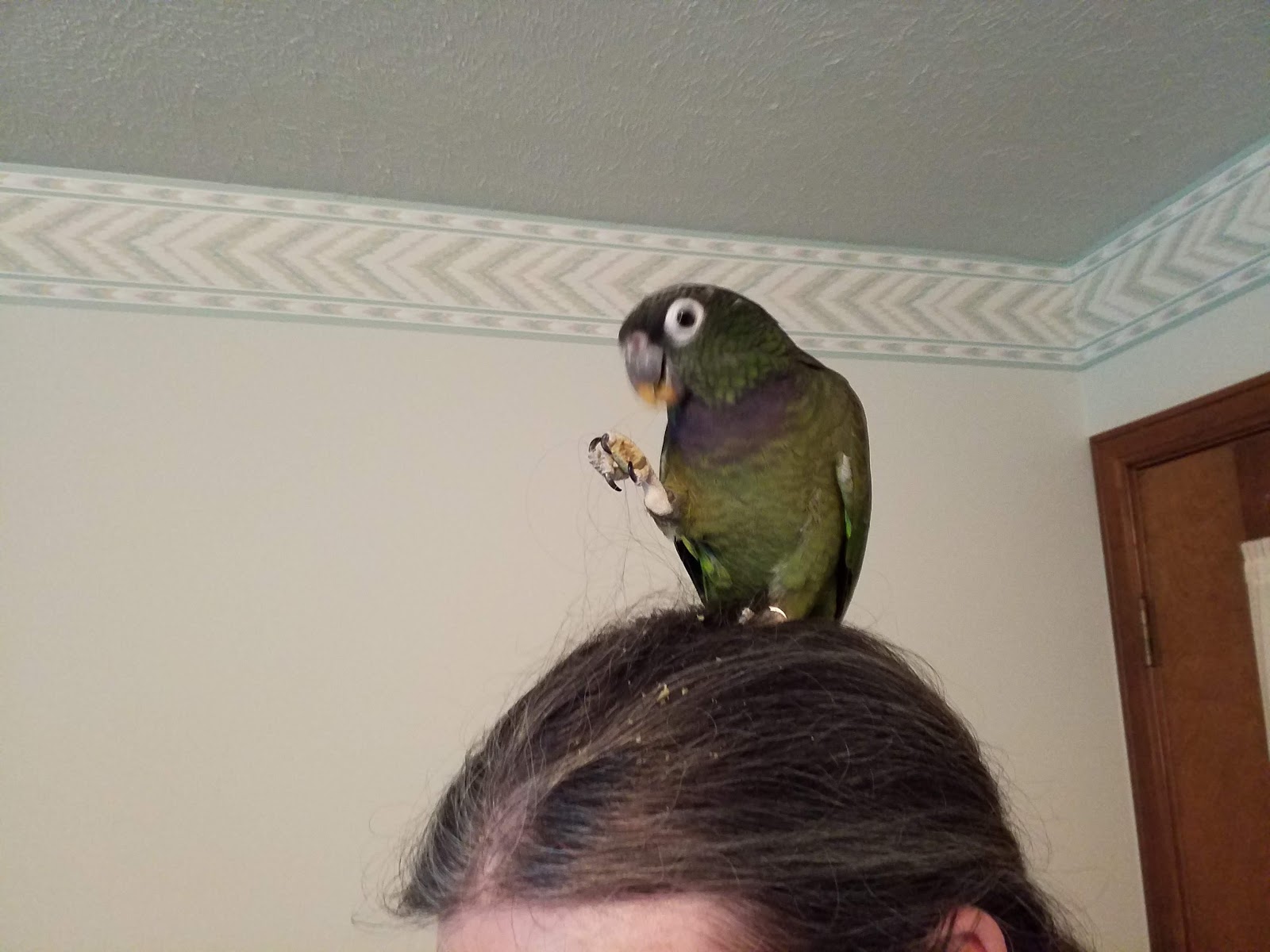
This is Toro.  I\’m taking care of her for about a week and a half.  She is quite a handful.  She\’s a Pionus parrot, and she belongs to some friends who have to be out of the house for that long.  Parrots are social critters, and it\’s bad for them to be alone.  She\’s fully flighted, and is happiest being out of her cage for the whole day at a time.  So we\’ve semi-parrot-proofed the downstairs for her.  
Taking care of her is an endeavor, and reminds me that I still have a lot of my own life stuff to sort out before my spouse and I adopt anything ourselves.  
In the meantime, other things occurred:
One of those same friends is into wild food, so we went berrying for black raspberries recently.  They\’re ripe now.  I actually had that container on the left entirely full, but they\’re tasty.  So I\’ve been eating them, feeding them to friends, and trying to feed them to Toro.  She\’s not impressed so far.  
I am, though.  They\’re mainly sweet, but there\’s some tang and tart mixed in.  When I was little, I\’d found these and pointed them out to my mother, who told me they were safe.  After a certain age, I didn\’t put things in my mouth that I wasn\’t sure about, so it was cool to be able to just wander into the woods and find these in my first neighborhood in Minnesota.  I had no idea they were called black raspberries, just that they were tasty and you had to fight with thorns to get at them.  I never collected a ton, and of course they don\’t last forever.  
This time, my friend and I went prepared.  I\’d read in a book to have your container fastened around your waist, so you can use both hands for picking, so I rigged up some string, tape, and the rectangular container there.  The thorns definitely had their say, and I had to pry a few off me in the course of gathering.  I was also still sick at the time, so I had to take rests quite regularly, which was disappointing as it wasn\’t exactly hard work.  Lots of bending over, but not really jumping jacks or even running.  

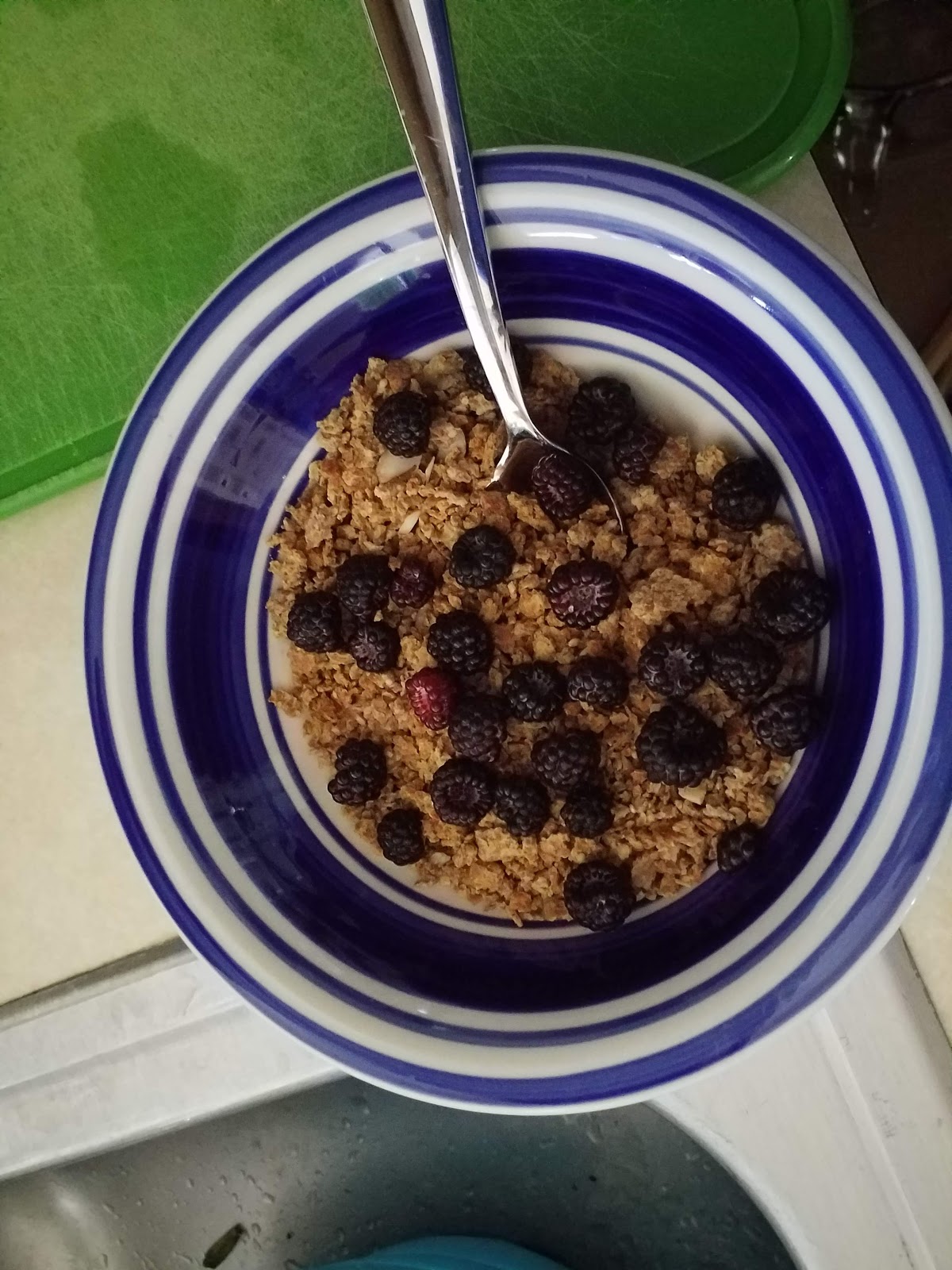
Still, can\’t argue with the payoff.  I had a small bowl of berries in addition to this cereal for breakfast.  Tomorrow my spouse will make summer salad, which is kind of what you get if you mix fruit salad with green leafy salad with herb baked chicken and top the whole thing with flax seeds and slivered almonds.  It was an odd concept for me at first, but I can\’t argue with the delicious results.  Normally he\’d just use raspberries or blackberries from the store, but since we have these, why not use them?  They\’re maybe a quarter to a third the size of store raspberries, but they\’re packed with flavor and nutrition.  

Probably a lot moreso than their domestic cousins, actually.  Modern crops tend to be grown in nutrient-poor soil.  They plant the same crops there year after year, and only plant one type of plant, which all uses the same nutrition out of the same soil.  After a few years, the soil\’s nutrition is gone, but in modern farming, you don\’t let that stop you from planting again the next year… or the year after, or the year after.  So you get crops with poor nutritional content.

Wild stuff, on the other hand, grows alongside tons of other types of plants, which have varying nutrient requirements but also put back some kinds of nutrition into the soil.  So you get good, healthy, nutrient-filled soil, which grows these black raspberries into little nutritional powerhouses.  

Reading the Research: Beyond Mouse Models

Welcome back to Reading the Research, where I trawl the Internet to find noteworthy research on autism and related subjects, then discuss it in brief with bits from my own life, research, and observations.

Today\’s article represents a probable step forward in all kinds of brain-related research.  The jargon and specific language in this article is plentiful, so to summarize: researchers at Harvard have basically discovered a way to grow specific human brain cells.  It\’s been possible in the past to grow brain cells, but not to control that growth in a useful way.  Assuming the technique is valid and can be reproduced, it may soon be possible to grow brain cells from living humans with brain-related conditions or diseases.  Those cells can then be grown into clusters and used in experiments without harming the human donor.  

Basically, assuming this method works, we could kiss mouse models of autism  goodbye forever.  This would be fantastic.

I haven\’t written a whole lot on mouse models, which are, for now, the main way researchers have been trying to understand and experiment with autism.  But my complaint (which is accurate, by the way) is that while mice are excellent creatures and can teach us many things, autism doesn\’t have a singular cause or even a few causes, so any mouse model is not going to be a good representative.   The thing is, we can\’t just experiment willy-nilly on humans, because of pesky things like \”human rights,\” \”ethics,\” and \”morals.\” ( <- sarcasm)  So mouse models are what researchers have mainly had available to work with.  

Replacing those with actual human brain cells would make for much more accurate representations of autistic people.  That makes for better science, and in turn, more valid, accurate results.  We already have genetic databases of thousands of autistic children and adults.  Imagine if we had databases of brain cells, too.  You could run broad tests across a dizzying variety of autistic people, seeing what anti-depressants, nutritional supplements, and other treatments were likely to work for the broad population.

More relevantly to parents and autistic adults, you could, for a price, grow cells into a cell cluster, and try various interventions on those cells.  The treatments that seem to help, you could then take home and try yourself.  It could make the Russian roulette of anti-depressants a thing of the past.  It could save a lot of money, a lot of pain, and a lot of time.

Needless to say, I really hope this method works, and can be done cheaply, very soon.

(Pst! If you like seeing the latest autism-relevant research, visit my Twitter, which has links and brief comments on studies that were interesting, but didn\’t get a whole Reading the Research article about them.)

Constantly Wound Up

Recently, I remotely attended an event called Summer Games Done Quick.  It\’s basically a convention for a subset of video game players, and it raises money for charity.  Literally, every penny they raised this time went to Doctors Without Borders.  (They raised a lot of pennies, I\’ll get to that later.)

I found myself in kind of an interesting mental state during the event, so I thought I\’d discuss it a bit.

So, this convention was unlike most of the ones I\’ve attended, in that it more or less had no breaks.  First, it was literally a 24 hour a day event.  There was always something happening.  Most conventions have events until dinner time, and then you\’re done for the day.  But also, when you attend a convention in person, you have to tend to your physical needs, like using the bathroom, eating, etc.  Because you\’re away from home, these things take time, which you would use to mentally unwind a bit.  
There was none of that during this virtual event.  You could take the event with you to the bathroom and to the dinner table.  You probably SHOULDN\’T, as I was to learn, but you could.  I normally don\’t watch much TV, or even livestreams, but I made an exception for this event.  
The results were interesting.  I experienced a kind of mental static, a distracting hum of sorts, when I wasn\’t immediately listening to the event or doing something else on my computer.  This was particularly obvious after watching for a couple hours straight.  I\’d take off my headset to go to the bathroom and hear it.  Or maybe feel it, I\’m not really sure.  The hum came with brain fog, reduced mental capabilities, and snappishness, though both of those might also be because I didn\’t sleep terribly well.

Besides the unusual schedule, where someone was always playing something, my brain also seemed wired, like it only slept reluctantly.  When I woke up, I was near-immediately awake, and usually only after 6 hours or so.  Combined with the weirdness of my bedtimes (sometimes after 2am), it was… not a healthy situation.  

That\’s possibly why I got sick with a cold… though I\’d be more inclined to say I probably already had the cold and the unhealthiness of my sleep schedule simply exacerbated my symptoms.

In addition to the cold virus, I got a lot of exposure to various kinds of people and various kinds of video games.  It was pretty cool to see so many gender non-binary people.  There were various guys with long hair, people who specified their pronouns before starting their speedruns, and people who presented as neither male nor female or some mix of both.  And of course, there were people of color and people from other countries represented in this mostly-US event.  
I think next year I\’m going to have to very selective about what I watch.  It was really fun to see a lot of the things, but I don\’t think I want to be this tired or this sick again in January, when the event goes again.  I didn\’t cancel any of my regular life events, but I still became this tired and sleep-deprived, so something definitely needs to change for next time.

It was a really successful run this time, though.  The previous record for a Games Done Quick drive was $2.2 million, and this year they got over $3 million, all of which went directly to Doctors Without Borders.  Seeing everyone get so jazzed up at the live event was kind of awesome, although it made me very glad I wasn\’t there due to the sheer noise levels.  People were VERY happy, and VERY loud.

It\’s taken me a few days to get back to normal.  I might not quite be there yet, even now, honestly.  There\’s at least some truth to \”don\’t watch TV for hours, it\’s bad for you.\”  Still, most of my symptoms are cold symptoms now, I think.  The static\’s gone, and I\’m less crabbity and grumpy.  Hopefully soon the cold will go away and I can get entirely back to the usual life.  

Legwork and Life, week of 7/3/19

This is Legwork and Life, where I track the legwork and opportunities in my career as an autistic advocate, and also describe parts of my adult autistic life, including my perspectives on everyday problems and situations.

I made pancakes!  


They\’re 1/3 cattail pollen, 2/3 whole grain flour pancakes.  I\’m told not to go higher than 1/2 cattail pollen when baking, probably because baking is finicky.  Still, I was pleased with the results.  They did have a distinctive taste to my taste buds, but I couldn\’t really identify what it was.  I guess if we go collecting again next year, I\’ll need to get more and do a half and half recipe.  Either way, the yellow color these turned due to the pollen was quite pretty.  

Summer Games Done Quick is over.  It was quite an experience, and I\’ll talk about it this Friday.  Suffice it to say, it was exhausting, many gamers went home very happy, and Doctors Without Borders is going to receive a lot of money to provide medical services all over the world.  So basically everybody wins, at least after I rest up.  

I\’m still doing the experiments with the grounding pad, but the results aren\’t as dramatic as I was hoping.  Real science often isn\’t.  I didn\’t really have results from having the grounding pad\’s connectivity changed from day to day, so I\’m in the process of trying it with one week on, one week off.  Double-blind, so at the moment I have no idea whether it\’s plugged in.  I\’m merely documenting my results until both weeks are over.

…It occurs to me that not everyone has a background in psychology, so: Double-blind experiments are ones where the full conditions of the experiment are hidden from both researchers and subjects.  This is to prevent either group from making assumptions, and from those assumptions affecting the data.  

In this case, I kind of expect to sleep better when the grounding mat is plugged in.  That\’s my assumption, which biases me towards putting more favorable results for my sleep if I know the mat is plugged in.  Therefore, I should not be told whether the mat is plugged in.  That\’s \”single blind\” in this experiment.

My spouse is helping me.  Kind of being my research assistant, he\’s the one plugging in and unplugging the grounding mat.  He knows, therefore, the status of the mat, but not what results I\’ve been getting from my sleep.  This ignorance to the results of the experiment is the \”double blind\” in the experiment.  The whole experiment, having both of these, is therefore \”double blind.\”  

Last thing, I picked up a cold somewhere.  I was originally assuming it was an allergic reaction to the new nut butter I\’ve been trying, or to the cattail pollen… but the progression is pretty unmistakable by now.  Fuzzy head and slightly scratchy throat, leading to sniffy nose, leading to massively stuffed up nose, leading to hacking cough (my current location), which eventually fades away (hopefully soon!).  I\’ve frozen the last of my cattail pancakes, just in case, but I don\’t expect a reaction when I eat them in a couple weeks.  

Reading the Research: Preparing Our Children

Welcome back to Reading the Research, where I trawl the Internet to find noteworthy research on autism and related subjects, then discuss it in brief with bits from my own life, research, and observations.

Today\’s article points out a helpful method for combating the rising levels of mental illness in our young people: giving them the tools they need to handle it, as soon as possible.  

I studied psychology in college, and one of the many things it taught me was that the many and varied forms of psychotherapy available to the public… mostly didn\’t work.  We learned roughly a dozen schools of thought regarding the understanding and healing of the human mind.  They ranged from charmingly idealistic to deeply cynical.  

Of that dozen, only two stood the test of scientific rigor.  The human mind is a complex and difficult thing, but these two schools of thought showed in study after study, that they reliably helped people process, understand, and move beyond their traumas and life events.  

Cognitive psychology was one.  It focuses on changing how you think about yourself, your life, and people and events around you.  It gives you mental tools to wield against the stresses and traumas of your life.  By changing the way you view situations and people, you can identify toxic situations, stress points, and self-care options.  That knowledge can let you better your life and how you handle your life.  

Behavior psychology was the other.  It\’s had a few sub-schools of thought, but essentially, rather than focusing on the mind, it focuses on the behavior that springs from the mind.  It teaches you how to modify your behavior, regardless of your thoughts.  Training good habits, like regular hygiene, or speaking a certain way, are part of this school of thought.  Getting rid of bad habits is another part.  Predicting behavior within systems (like your workplace or home) is still another.

Cognitive-behavioral therapy is the inevitable combination of those two schools of thought.  Once it was known that both worked, it was a very short logical leap to assume both should be tried at once.  The results bear this out. 

The normal pattern with psychotherapy is that a person tends to ignore the option of psychological help until they reach a breaking point, after which they get help and hopefully recover.  This is fine, except for the fact that an ounce of prevention is worth a pound of cure.  

Thus, the idea of teaching CBT techniques to children who are likely to need them.  Obviously, some of the ideas have to be made simpler for children to grasp, and some ideas simply have to wait until some cognitive functions have developed.  Still, giving at-risk children any of these tools before they develop severe depression, anxiety, and systemic chronic stress, would be invaluable to their development and health.

Y\’know what this study doesn\’t mention?  The benefits of having children educated in mental health issues.  Say an autistic child is trained in how to recognize and handle depression.  That child will do better in their personal fight against depression, but they may also notice when friends show similar symptoms, and be able to offer practical and useful advice to those friends.  On the whole, you get healthier schools and healthier children.  Those children become healthier adults.  Everyone wins.  

(Pst! If you like seeing the latest autism-relevant research, visit my Twitter, which has links and brief comments on studies that were interesting, but didn\’t get a whole Reading the Research article about them.)