Reading the Research: Predicting the Medication Roulette

Welcome back to Reading the Research, where I trawl the Internet to find noteworthy research on autism and related subjects, then discuss it in brief with bits from my own life, research, and observations.

Today\’s article is a step in the right direction when it comes to prescribing pharmaceutical depression treatments.  Many autistic people suffer from depression, myself included.  In fact, when I was first diagnosed, it was recommended to me that I go to the doctor and get a prescription for an SSRI (Selective Seratonin Reuptake Inhibitor: the most common antidepressant type).  \”To take the edge off\”, they said.  

Because I\’m occasionally a prideful and stubborn human, and I was already aware of what I call the SSRI Russian Roulette Game, I ignored this advice and opted to not get help with my depression.  Later, after failing out of a couple jobs, I found my way to Dr. Nicole\’s office.  Under her care, a combination of supplements, exercise, neurofeedback, and improved mental/emotional management have reduced my depression and anxiety to the point where medication would be redundant.

Most people don\’t ignore this advice to get help, especially if their depression is severe.  The problem is that you never know which SSRI is going to help, and there are dozens, if not hundreds.  Finding the right one can take literal years, and that\’s assuming there is a right one (some forms of depression aren\’t helped by SSRIs).  In the meantime, you try one every 2-3 months (because that\’s how long it takes to figure out if one\’s working), and hope the side effects aren\’t too onerous.  Weight gain, sexual dysfunction, insomnia, nausea, headaches, and dizziness are all possible options when using SSRIs.  

All this to say that the way we figure out how to help people is, um… extremely suboptimal.  That status may be a thing of the past soon, though!  These researchers say they\’ve been able to use brain scans to predict whether SSRIs in general will help a given person.  If this technology proves to work, it could cut years out of the treatment process.  I could see such technology and algorithms predicting responses to specific SSRIs, and even other classes of anti-depressants.  I really hope so.  Depression and anxiety are very common problems even outside the autism community.

(Pst! If you like seeing the latest autism-relevant research, visit my Twitter, which has links and brief comments on studies that were interesting, but didn\’t get a whole Reading the Research article about them.)

WYR: The Difficulty of Including Everyone

http://www.thinkingautismguide.com/2019/09/you-cant-have-neurodiversity-without.html

This is a summary of a Twitter thread written by an autistic person with intellectual disabilities.  They have a number of good points, so I highly recommend you read the linked post, particularly if anyone in your life has learning or intellectual disabilities.  
What I wanted to focus on here was a specific complaint Ivanova has regarding the neurodiversity movement.  As you\’ll see, this complaint shows why you basically can\’t have hard and fast rules for any given situation.  They observe that new rules are being made for conferences or gathering places for neurodiverse people, mandating that everyone be quiet.  This is meant to help people who are easily distractible or have sound sensitivities (or both, like me).  With less noise, people like me can focus more clearly on the presentation material.  Sounds great, right?
Well, turns out it\’s only great for that particular type of autistic person.  Ivanova talks about their friends (also with intellectual disability) who actually need noise in order to focus.  These are people who play in the Special Olympics, people who\’ve accomplished good things.  People whose input would be valuable to the conversation about neurodiversity.  Clapping, echoing words, or being able to jump up and run around is just as important to these autistic people as silence is to me.  
So here\’s the tricky part: neurodiversity mandates the inclusion of everyone.  How do you reconcile two such different needs?  
My best guess is that you try to seat people like me towards the front, and people like Ivanova\’s friends towards the back, and you don\’t set a noise policy but you do ask people to stim quietly if they can, and warn people like me that they may need to handle some noise because other people have needs too.  Is this ideal?  Certainly not.  The noise-sensitive autistics may jump with every clap, and the people that need to clap so they can pay attention may feel suppressed because they\’ve been asked to clap quietly or stim in some other manner.  However, I\’m told a good compromise makes everyone unhappy, so it\’s at least a start.  
A truly good policy or rule is inclusive to all people.  That is remarkably hard to pull off when peoples\’ needs can vary so much.  And because people with intellectual disabilities are just as valuable people as I am, it\’s important that we accommodate them and give them a platform for their voices, too.  Even if they use methods of communication that we don\’t already know how to understand.  Even if they\’re entirely nonspeaking and rely on 100% nonvocal methods of communication.  
If this was a more high-tech age with a lot of money to throw around, I would say a reasonable accommodation for very noise-sensitive people like myself would be noise-canceling headphones that are linked into a closed hearing aid loop system.  You see, in churches and some other places, you can have a channel for people with special hearing aids.  Using this, they can hear the music and the sermon as it\’s picked up by the microphones for the church\’s sound system.  It\’s like a direct line to the \”important noise\” of the event.  The noises around them aren\’t amplified, and so they\’re able to pay attention much more clearly.  Having headphones that canceled out the random noises around us, but still gave us the ability to hear what was going on?  That would be a great solution.  
In all honesty, though?  It may take a few decades, but I\’m hoping Virtual Reality (VR) will close the gap and make it so you can virtually attend a conference without having to be in the room.  In such an environment, you could mute everyone who wasn\’t the speaker (if you need silence) or mute yourself (if you need to clap or jump).  With holograms and such fine-tuned control over your surroundings, anyone\’s needs could be met without too much difficulty.  
The movement for quiet in neurodiversity conferences were made with good intentions, but like any group does eventually, it\’s gone too far in a single direction.  In doing so, the people who made these rules have strayed from what neurodiversity is meant to mean.  I fondly hope that these conferences will listen to Ivanova and their friends, revoke these restrictive rules, and seek a way to make events as accessible as possible for everyone.  

Legwork and Life, week of 9/25/19

This is Legwork and Life, where I track the legwork and opportunities in my career as an autistic advocate, and also describe parts of my adult autistic life, including my perspectives on everyday problems and situations.

Today finds me in Reston, VA, quite near Washington DC. I spent a good period of time yesterday panicking or at least semi-panicking for the travel portion of this trip.  I\’d mainly packed for the trip the day before, but some things had to be left for the day of, including some chores.  

I also spent too much time that morning beating my face fruitlessly on configuring an older model iPhone that a friend kindly gave me to use as an exercise buddy.  Between the fact that it\’s an older phone and I had an older copy of iTunes, many errors ensued while trying to get it set up.  I didn\’t manage to get it exactly the way I wanted by the time I needed to leave, which I blame entirely on Apple.  Still, it does have most of the music I wanted on it, and fiddling with it has been excellent practice for helping my mother set up her phone in a few weeks.  

Thankfully I\’ll be able to relax for the first part of today.  The orientation for the Autism Research Program (ie: why I\’m in Reston) won\’t begin until early afternoon.  I\’ll be able to eat breakfast at my leisure and try to decompress from airport security.  Dealing with TSA is by far my least favorite part of traveling.  Apparently they won\’t be accepting driver\’s licenses as valid IDs soon, so I\’ll have to go get whatever they consider \”Real ID.\”  Like a driver\’s license or state-issued ID is somehow fake ID.  Honestly.  I have half a mind to apply for a new passport and tell TSA that if they have a problem with my identity, they can take it up with the US government.  

Anyway, at least I\’m prepared for this trip.  I got all of my assignments done, first and second rounds of reviews.  I\’m extremely pleased to see that the two applications I wasn\’t impressed by also didn\’t really impress the other reviewers.  There\’s some dissension around the issues, but not a ton.  The one whose idea I hated actually got such poor reviews that I\’m not sure we\’ll even bother discussing it.  Which is just fine by me, because it means less talky-time.  

I\’m anxious about this trip, but not super anxious.  I\’ve done this before a few times, and while I\’m probably a bit more wound up this time than I have been in the past, I can still probably handle it.  The staff of the program seem to like me, and I haven\’t been too much of an ass since the first year.  So I don\’t know.  It\’ll probably go well.

Not going as well: my new supplement.  Apparently the extra side effects I\’ve been experiencing, the bumpy skin, weird metabolism, and gurgly guts, aren\’t normal.  My doctor thinks I tolerate herbal type supplements poorly, based on this and my previous experiment with the Feminessence, where I broke out a rash, a vicious headache, mood swings, etc.  

I\’m not really sure what to do with this information. I know my system is sensitive.  But at least in the case of the histamines, I really need something to handle the problem. I may see about lessening the dose, and see if I still have good effects with the exercise. I really don\’t want to lose this progress, because I\’ve been able to go jogging twice now. It was really tiring, but not miserable.   I\’m continuing to lose weight (1-2 pounds a week, which is the maximum healthy weight loss rate).  It\’s the first real progress I\’ve seen on that front in literal years.  I don\’t want to give it up. 

We\’ll see what my doctor says when I see her next…

Reading the Research: Brain Scans and Crying Babies

Welcome back to Reading the Research, where I trawl the Internet to find noteworthy research on autism and related subjects, then discuss it in brief with bits from my own life, research, and observations.

Today\’s article describes, in technical detail, why unpleasant sounds are unpleasant.  I found this particularly notable due to my oversensitive hearing, a problem which many autistic people suffer from.  These test subjects were neurotypical, but I bet if you hooked me up to the monitoring equipment and did the same trials, you\’d get the same kind of response, only worse.  

The gist of this study is this: they hooked people up to a brain scanner and played a bunch of sounds for them, including unpleasant ones that were artificially created (car horns, fire alarms) and natural ones (baby crying, human screams).  They then asked the people whether the sounds were continuous or interrupted, and how unpleasant the sound was on a scale of 1-5.  In the meantime, they monitored the peoples\’ brain reactions to the sounds.

They found that high frequency sounds blurred together in the brain.  However, Lower frequency sounds, especially unpleasant ones, not only activated the hearing circuits of the brain, but also activated other parts of the brain responsible for pain, aversion, and judging something as distinctive.  This is likely why a crying baby is so easy to pick out of the commotion of a noisy room: it literally provokes a much greater reaction from your brain than the other noises.  

Offhandedly near the end of the article, a researcher commented that autistic people tend to have unusual responses to sounds near the lower end of the range.  They say it might be worth looking into whether you can detect autism and other conditions using a sound test.  I\’m honestly curious as to whether they\’ve tested the whole range of frequencies on autistic people or not.  

I have rather poor responses to, well, many sounds.  My responses are to a greater degree than most people\’s, which makes me think I must suffer the activation of those extra parts of the brain much more often than most people.  I have the usual (or more intense) reaction to a feedback loop, a baby crying, or nails on a chalkboard, of course.  But I also can\’t stand to be near a piccolo, sudden thumps or thudding sounds make me jump (just ask my poor spouse), and the sound of dishes grating or clanking together makes me upset.

I haven\’t made an exhaustive list of all the noises that upset me, because in general I don\’t find it productive to spend time dwelling on unhappiness.  But I have noticed I tend to describe things as \”sharp\” or \”sudden\” or \”loud.\”  The higher-pitched a sound is, like nails on a chalkboard, the more likely it is to be sharp.  But you can still have sharp low-pitched sounds.  

In any case, I would guess I have much more pronounced reactions to a broader range of sounds than most people do.  Add in my brain\’s reduced ability to \”tune out\” unimportant sounds, like a police siren several roads away, or a crying baby that isn\’t my responsibility, and you have a whole lot of unpleasant brain activation.  
(Pst! If you like seeing the latest autism-relevant research, visit my Twitter, which has links and brief comments on studies that were interesting, but didn\’t get a whole Reading the Research article about them.)
Book Review: Asperger\’s and Girls

Asperger\’s and Girls, by Tony Attwood, Temple Grandin, and a bunch of other experts, is a book of essays on specific issues and specialized focuses on topics that come with being born with two X chromosomes and autism.  At the end, it includes a trio of essays by autistic authors, which help put the information from the previous chapters into context.  There are thoughts and guidance on the differences we\’ve seen between male and female autistic people, on sex education and puberty, on navigating the social life of a school, on transitioning to adult life from school, and even pieces on careers, relationships, dating, marriage, and motherhood.

The book is from 2006, so it\’s unfortunately a bit dated.  You wouldn\’t think that much could change in 13 years, but it can!  At that time, it was news that autistic people could be female, and everyone and their sister didn\’t own a smartphone.  Hence, there was a strong need for this book.  Fortunately, the general knowledge of autism has increased.  Possibly less fortunately, or at least very differently, the way kids learn about some of these subjects has changed. For example, never mind school sex ed or even proactive parental teaching, most likely the first place kids learn about sex is via the Internet, either from porn sites or (preferably!) from helpful online resources like this, this, and this.  Even so, the book still contains a good bit of useful advice and insight on the subjects it addresses.

Of particular interest was the section on social groups, how to fit in, how to navigate the school\’s social hierarchy, and the model of relationship levels.  This was information I was definitely missing when I grew up, and while I didn\’t entirely agree with every sentence in the essay, I probably am not the greatest resource for this information anyway.  I spent most of school as a loner (which I was just fine with), and only had an actual friend group in high school.  I must have done okay by them, or at least tolerably, but I can\’t imagine I was anyone\’s Friend #1.

The section I had the most disagreements with was also one of the most important and useful sections: the one on puberty.  In 2006, the culture was beginning to shift, but wasn\’t yet to the point of understanding Consent, or recognizing that while you don\’t just… talk about menstruation or sex with strangers, they\’re also not subjects you should be ashamed of, and it\’s okay to talk about them with your close friends. Or… I guess random strangers in a supportive Internet environment like Scarleteen (All hail the mighty Internet, where you can sidestep your embarrassment on a subject by being anonymous).

At the time this book was written, I was in high school, and these things were beginning to change… but consent was still poorly understood.  And in fact, it\’s mentioned in this book, but not by that name, and certainly not discussed in detail, like the difference between \”no means no\” and \”yes means yes.\”  The book even counsels not talking about having a period, as if it\’s impolite to mention this basic fact of life and people will faint if it\’s brought up.  Maybe it\’s that I\’m autistic, but I personally think if you can\’t handle hearing that a person is suffering cramps or needs to use the bathroom to change their pad, you need to grow up.

A minor concern about this section was the espousing of disposable pads.  I know disposable pads and tampons are easy and convenient and all that, but they\’re incredibly expensive over time, environmentally unfriendly, and there are perfectly good reusable options for both products.  I would rather autistic girls (and all girls, really) be taught how to use these reusable options, and only rely on disposable products for emergencies.  In all honesty, the disposable pads are scratchy and annoying by comparison to the washable ones anyway.

Still, the essay is quite right in telling you to start teaching body changes, cleanliness, use of hygiene products, sex ed, and personal safety.  And not only to teach it outside school, but teach it early, and in steps rather than all at once.

Read This Book If

You want a general overview of the ways autism can be experienced differently in women and girls, and don\’t mind that some of the recommendations and information are outdated.  Teachers, parents, and even some professionals could really benefit from the information here.  In particular, I appreciated that the book didn\’t shy from talking about and instructing you how to teach about menstruation, body changes, and sex.  I really wish Future Horizons (the publisher) would update this book for the Information Age.  A discussion of consent would be an excellent addition to the book.  Regardless, it was a valuable read, especially since, even 13 years later, some people still insist on thinking autism is mainly a condition that guys have.

Extra: Resources for Women

https://www.reddit.com/r/aspergirls/

https://www.aane.org/women-asperger-profiles/

https://awnnetwork.org/

Book Review: Asperger\’s and Girls

Asperger\’s and Girls, by Tony Attwood, Temple Grandin, and a bunch of other experts, is a book of essays on specific issues and specialized focuses on topics that come with being born with two X chromosomes and autism.  At the end, it includes a trio of essays by autistic authors, which help put the information from the previous chapters into context.  There are thoughts and guidance on the differences we\’ve seen between male and female autistic people, on sex education and puberty, on navigating the social life of a school, on transitioning to adult life from school, and even pieces on careers, relationships, dating, marriage, and motherhood.

The book is from 2006, so it\’s unfortunately a bit dated.  You wouldn\’t think that much could change in 13 years, but it can!  At that time, it was news that autistic people could be female, and everyone and their sister didn\’t own a smartphone.  Hence, there was a strong need for this book.  Fortunately, the general knowledge of autism has increased.  Possibly less fortunately, or at least very differently, the way kids learn about some of these subjects has changed. For example, never mind school sex ed or even proactive parental teaching, most likely the first place kids learn about sex is via the Internet, either from porn sites or (preferably!) from helpful online resources like this, this, and this.  Even so, the book still contains a good bit of useful advice and insight on the subjects it addresses.

Of particular interest was the section on social groups, how to fit in, how to navigate the school\’s social hierarchy, and the model of relationship levels.  This was information I was definitely missing when I grew up, and while I didn\’t entirely agree with every sentence in the essay, I probably am not the greatest resource for this information anyway.  I spent most of school as a loner (which I was just fine with), and only had an actual friend group in high school.  I must have done okay by them, or at least tolerably, but I can\’t imagine I was anyone\’s Friend #1.

The section I had the most disagreements with was also one of the most important and useful sections: the one on puberty.  In 2006, the culture was beginning to shift, but wasn\’t yet to the point of understanding Consent, or recognizing that while you don\’t just… talk about menstruation or sex with strangers, they\’re also not subjects you should be ashamed of, and it\’s okay to talk about them with your close friends. Or… I guess random strangers in a supportive Internet environment like Scarleteen (All hail the mighty Internet, where you can sidestep your embarrassment on a subject by being anonymous).

At the time this book was written, I was in high school, and these things were beginning to change… but consent was still poorly understood.  And in fact, it\’s mentioned in this book, but not by that name, and certainly not discussed in detail, like the difference between \”no means no\” and \”yes means yes.\”  The book even counsels not talking about having a period, as if it\’s impolite to mention this basic fact of life and people will faint if it\’s brought up.  Maybe it\’s that I\’m autistic, but I personally think if you can\’t handle hearing that a person is suffering cramps or needs to use the bathroom to change their pad, you need to grow up.

A minor concern about this section was the espousing of disposable pads.  I know disposable pads and tampons are easy and convenient and all that, but they\’re incredibly expensive over time, environmentally unfriendly, and there are perfectly good reusable options for both products.  I would rather autistic girls (and all girls, really) be taught how to use these reusable options, and only rely on disposable products for emergencies.  In all honesty, the disposable pads are scratchy and annoying by comparison to the washable ones anyway.

Still, the essay is quite right in telling you to start teaching body changes, cleanliness, use of hygiene products, sex ed, and personal safety.  And not only to teach it outside school, but teach it early, and in steps rather than all at once.

Read This Book If

You want a general overview of the ways autism can be experienced differently in women and girls, and don\’t mind that some of the recommendations and information are outdated.  Teachers, parents, and even some professionals could really benefit from the information here.  In particular, I appreciated that the book didn\’t shy from talking about and instructing you how to teach about menstruation, body changes, and sex.  I really wish Future Horizons (the publisher) would update this book for the Information Age.  A discussion of consent would be an excellent addition to the book.  Regardless, it was a valuable read, especially since, even 13 years later, some people still insist on thinking autism is mainly a condition that guys have.

Extra: Resources for Women

https://www.reddit.com/r/aspergirls/

https://www.aane.org/women-asperger-profiles/

https://awnnetwork.org/

Legwork and Life, week of 9/18/19

This is Legwork and Life, where I track the legwork and opportunities in my career as an autistic advocate, and also describe parts of my adult autistic life, including my perspectives on everyday problems and situations.

Anxiety is probably the word for this week.  I\’m scrambling to meet various deadlines.  It is not enjoyable.  I\’m good on this blog at least \’til the end of the week, but no decent research articles have presented themselves for next Monday.  That\’s… worrisome.  Either something will turn up on my RSS feeds, or I\’ll have to go looking specifically for something… or I\’ll miss a day.  And I haven\’t missed a day since I established a schedule.  That\’s something like 2-3 years.  It\’d be upsetting to me if I missed a day.

Friday also marks when the next round of reviews for the research applications go live… and I\’ll only have a couple days to manage that before I\’m off to DC.  Whereupon I\’ll be expected to socialize heavily in between long stretches of socializing.  I really need a buffer to handle the burnout I\’m likely to suffer, but I don\’t have one.  Ugh.  

Also on Friday, I need to be done with that fiction review.  My first draft came back with some potentially major requested revisions.  I kind of feel like I\’m in school again.  I\’m not used to such serious, in-depth critiques of my writing any more.  While I know in my head that every author, no matter how successful, could probably improve their writing somehow (and I am hardly a highly successful writer), it\’s still a bit of a shock to receive feedback that might well involve rewriting a sizable chunk of the review.  

I\’m in the phase of \”highly stressed and anxious\” where everything is just going haphazardly and I avoid all my stressors as much as I can, then latch onto anything solid that seems like work I can handle.  I had one of these situations in my freshman year of college, and I handled it by putting up a whiteboard with all my projects and their due dates.  Then I broke those projects into doable chunks, prioritized them, and did them one tiny chunk at a time.  My current projects don\’t seem so \”break-into-chunks\”-able.  

I\’d say \”this too shall pass\” to comfort myself, but it really feels, at the moment, that when \”this too\” passes, I\’m going to not have done my best and disappointed myself and others as a bonus.  And I still have October, Month of All Birthdays, to look forward to (/sarcasm)!  

Other news: the new supplement (Hista-Eze) I mentioned last Friday seems to have some extra effects.  My skin has been getting bumpy and scratchable at random spots, which is a phenomenon I used to have a lot more often.  It\’s why my arms are sheets of tiny scars.  It started with my forehead, though, which is odd.  Also, I seem extra gassy, so it\’s perhaps doing something to my gut flora as well.  Finally, I seem… extra hungry, I guess?  I had a perfectly acceptable breakfast and lunch today, but it\’s only been a couple hours and I\’m hungry again.  So possibly my metabolism has been affected.  

I seem to have lost a small amount of weight (yay!) as well, though that could be simply the extra exercise I worked into last week\’s schedule.  I\’m planning to try to add jogging into my schedule as a regular thing… or I\’m going to try, at least.  It\’s really good exercise, and if only my muscles make me miserable while I do it, that\’s way more tolerable.  Especially if it\’s a nice day and I can get some sun.  

Weird and myriad side effects aside, I haven\’t taken any anti-histamines or vitamin C since starting the Hista-Eze.  I have yet to try jogging or intensive biking again, but I did 30 minutes on a higher difficulty than usual for my cardio on Monday without ill effects.  Well, other than demonstrating that I inherited my Dad\’s ability to sweat copiously from the scalp and forehead.  

This makes me wonder two things.  First, perhaps I needn\’t take extra vitamin C when I go exercising.  I\’ll try jogging without vitamin C or antihistamines today, if I feel up to it, and see how it compares to last week.  Second, perhaps the dosage of the Hista-Eze supplement is too high, if I\’m experiencing all these weird side effects.  Or I could just be allergic to something in the supplement.  

I\’m really hoping that\’s not it, though; it does seem to be doing its job, these side effects aside…

Reading the Research: Beyond "Light It Up Blue" (and white)

Welcome back to Reading the Research, where I trawl the Internet to find noteworthy research on autism and related subjects, then discuss it in brief with bits from my own life, research, and observations.

Today\’s article points out the increasing diversity of the autism community, as well as highlights how difficult it is to answer the question \”what causes autism?\”  Traditionally, autism has been a \”white male\” diagnosis.  This has sidelined people of color, as well as women and gender minorities.  Turns out that\’s not at all representative of the autistic population, and a lot of people got left out of the discussion when psychologists wrote the diagnostic criteria.

That includes me, as it happens.  The specter of Kannerian autism still looms large in some circles, and given that my original diagnosis was \”Asperger\’s Syndrome\” not \”autism,\” I don\’t count. That\’s the icing on the \”you were born female and also female autistics don\’t exist\” cake.  There\’s even one particular researcher that insists autism is caused by an overabundance of testosterone, basically saying all autistic people are male-brained.  

Clearly, the assumptions for who\’s autistic and who\’s invited to the discussion table about autism needs to change.  I\’m sorry to say that in my adult autistic social group, there\’s only one person of color amongst the dozen people that attend on a regular basis.  There are at least two gender minorities, and a few born-female autistic people, at least.  

There\’s one other point to make about this article.  While we don\’t know what causes people to be autistic (and we may never find out), the research has pointed to a number of factors: everything from air pollution to genetics to oddities during pregnancy.  While it\’s possible that it\’s a matter of \”minorities\’ unusual behavior sticks out more, therefore more diagnoses,\” I suspect the matter is far more systemic in nature.  

It takes time, you see, for knowledge and information about autism to make its way to the majority of the public, from the hallowed halls of lofty academia.  Time is required for insurance companies to be persuaded that autism is a real thing that needs coverage and services.  And most of all, it takes time for the government to shift its unwieldy gears of bureaucracy to serve the needs of its people.  

Black and Hispanic people, on average, have fewer financial assets, education, and social supports to fall back on, compared to the white majority.  So it would be no surprise to me that despite the claims by the researchers here, the vast majority of the difference here is simply an increase in knowledge of autism and what services are available.  Mostly, though, it doesn\’t seem like they took poverty into account.  

Poverty affects your diet (poor nutrition can easily exacerbate mental illness and interfere with your ability to learn social skills), your educational options (less advantaged schooling limits your ability to learn all kinds of skills, never mind regular school subjects), and your mental health and stability (broken homes take energy away from school and emotional development).  The definition of autism being as broad as it is, it\’s opened the door for a lot of people that might otherwise have never been able to afford that help.  

The autism community, I think, will be better for their inclusion.  I just hope, in this age of domestic terrorism and prancing white supremacists, that we can manage to listen to our people of color rather than sidelining them.  

(Pst! If you like seeing the latest autism-relevant research, visit my Twitter, which has links and brief comments on studies that were interesting, but didn\’t get a whole Reading the Research article about them.)

Histamines: Taking the Misery Out of Exercise

About a month ago, I experimented with flooding my system with histamines to see if it would trigger any ill effects.  I did this via food intake, custom-tailoring a day’s meals to add external histamines to my system.  The results were not spectacular, but they did have promise.  I experienced worse than usual brain fog, lack of focus, a burning in my stomach lining, and some trouble breathing.

As it turns out, overloading my system with histamines wasn’t actually the best experiment I could have tried, because the results were simply in degrees of discomfort.  A better experiment would have been to remove them entirely from my system and observe the results, particularly during hard exercise.  So I did that!

The Exercise Experiment

The one thing I didn’t really try during this food overload experiment (quite possibly because I felt too poorly to consider it) was exercise.  I made a note to try the exercise later, but didn’t really set up a good experiment for it until just recently.

As it turns out, as much as vitamin C is excellent for you and a good day-to-day solution, a good over-the-counter anti-histamine is more rigorous and quick to take effect.  Your basic allergy medicine, in fact, will handle this, though naturally you shouldn’t be taking allergy medicine every day unless you actually have allergies and can’t manage them without it.  So, knowing the effects were likely to be obvious, I took a single store-brand Benadryl, gave it 15 minutes, and then went biking as hard as I could.

I went for half an hour, and pushed myself hard.  Sustained cardio exercise at moderate-to-high intensity has reliably made me miserable in a hurry, so even though I was opting for an exercise that allowed for breaks, I figured I could just keep pedaling rather than taking my usual breaks for breathing.  The area I live in doesn’t have all that much by way of hills, but it didn’t matter, because…

The results were about as telling as I could have wished.  I got tired, and had to work very hard… but I did not get miserable.  Histamines, apparently, had been choking me out of my oxygen and proper brain function.  Effectively, I was having an allergy attack every time I exercised… until now.  It was extremely strange to be working my body so hard without becoming mentally exhausted and depressed.

The bane of my existence has always been exercise, and it’s because, to the best of my knowledge, I run short of oxygen very fast and spend the rest of the time simply trying to survive the exercise with enough oxygen to not fall over or stop.  I had a summer cold a couple months ago and experienced the same symptoms (misery and low oxygen intake) from simply sitting, so it was easier for me to recognize the second time around.

The Histamines\’ Source

So if it wasn’t what I was eating (I’d established in the last experiment that I mostly avoid all the foods that are high-histamine), why was my system overloaded with histamines?
The answer appears to be (at least) twofold.

This is the pond out my back door.  All the snot-colored splotches in the water are algae.  They’re some type of toxic species that happily grows in all the fertilizer runoff from the condos on my side of the pond and the apartments on the other side.  Normally they treat the pond for this mess, but after July was over, they kind of stopped, and this is the result.  I have a very high quality furnace filter cleaning the spores out of my house’s air, but it’s not like the house is airtight.  I may set up an air purifier in the bedroom as well, since I spend a third of my day in there.

The “this is definitely a problem” experience that makes me sure this is part of the problem happened when I went out to get pictures of this algae once.  I was out there for maybe two minutes, in the hot summer sun, last year… After I got back inside I had to lie down for like three hours because I felt so bad.  It was like my brain function had been repressed, almost like being extremely drunk, except without the visual impairments, coordination impairments, and nausea.  I had enough presence of mind to take my N-Acetyl-Cysteine, which helps detoxify my system, and drink a ton of water to help flush things out, and then I simply lay down, closed my eyes, and waited it out.

I woke feeling a little better, but not really back to normal, and with a much healthier respect for the toxic sludge that lives outside my back door…  Even opening the back door for a couple seconds has deleterious effects on my brain, though thankfully not the “go lie down for three hours\” effects.  More like “you’re going to feel kind of bad for 15 minutes.”

So, I’m pretty sure the algae is factor one.  Factor two?  House dust mites.

My mother is allergic to these, which is fortunate because otherwise I probably wouldn’t have attached any importance to the fact that my nose starts plugging up when I lie on bedding that hasn’t been washed in a week.  She actually has it much worse, in that she actually can’t sleep if the mites are bad.  Her nose just keeps running and stuffing.

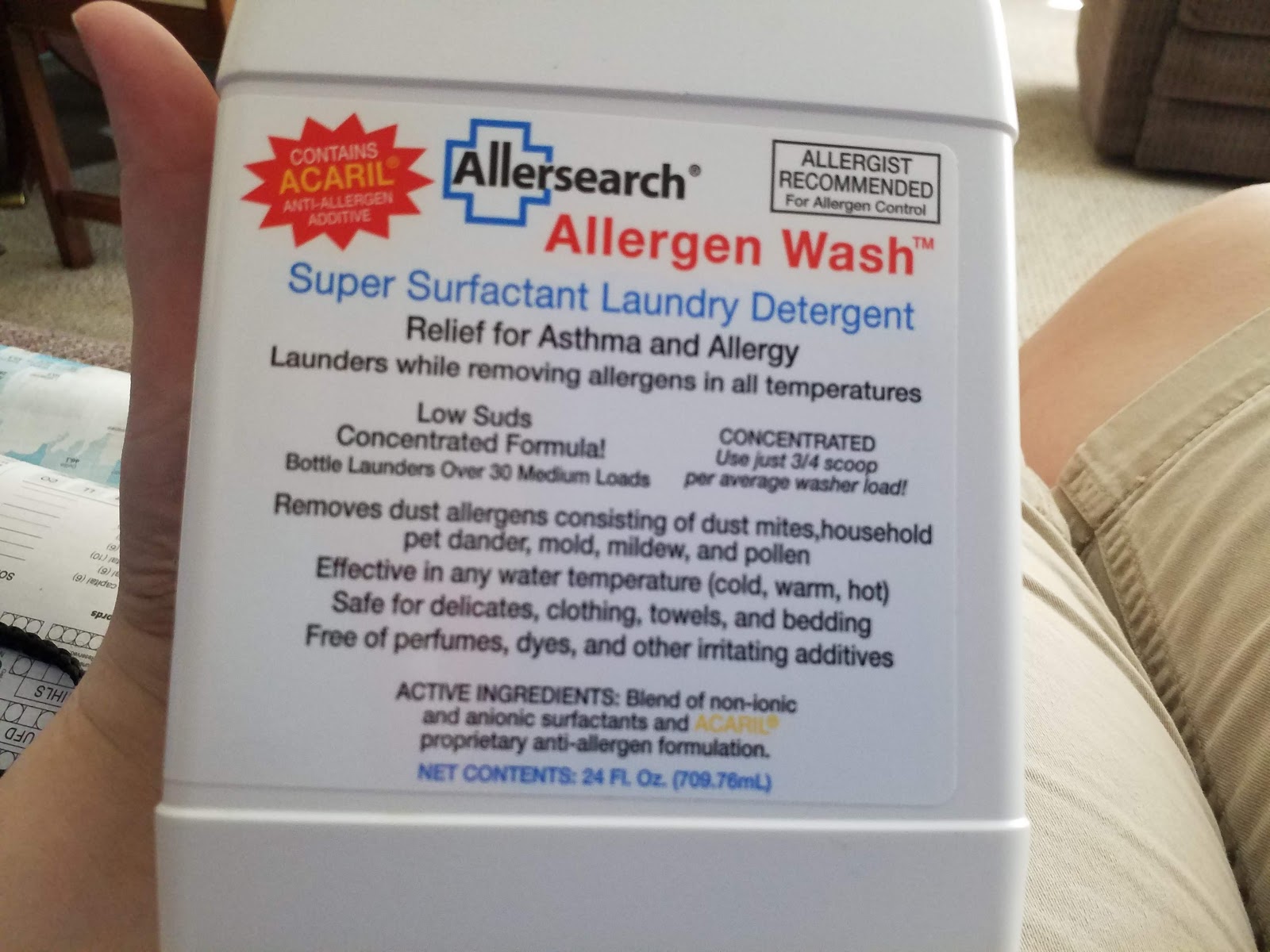
I mentioned this to my doctor, and she recommended washing my bedding in hot water.  The problem is that hot water shrinks things, and I don’t really like fighting my spouse for blanket.  Fortunately, my mother has a solution:

More the former than the latter, but if the former doesn’t entirely fix the problem, the latter might.  Or might just help with the algae also.  I’ve ordered a bottle of the deMite, and will try it next laundry day.

A Healthier Life?

I’m really hoping those are the only two factors, and that good care with both of these factors will sort the problem out.  If it does, I’ll be able to exercise more regularly, and at higher intensities than I’ve ever been able to before.  I’ve been reluctant to exercise… well, at all, really.  But especially at moderate to high intensities, because… misery.  If you’re miserable every moment you’re doing something, you tend not to repeat that activity.

I still have the years of misery associated with exercise, of course… but I’m not going to let that stop me.  Movement is immensely important to mental, physical, and emotional health.  If I can incorporate it in my life without the historically destructive, all-consuming misery, that would be a massive improvement… and it might make all the difference.  I might actually come to like exercise.  (Given my past history, this last sentence would normally equate to “pigs might fly.”  The future might be different, though!)

In the meantime, I need to manage my daily histamine levels.  This often means careful diet management, but in my case, I basically don’t eat anything that’s high in histamines anyway.  I need merely cut a couple foods that I wasn’t extremely fond of anyway.  My doctor has recommended an herbal supplement that should help with the day-to-day management of this histamine overload.

Notably high in vitamin C, of course, but the various herbs listed there also help with histamine management.

In the meantime, further experiments with vitamin C are in order!  I’ve had promising results with drinking a dose of my vitamin C powder about 30 minutes prior to biking.  But biking is just the easiest option.  If I can, I’d like to experiment with my archnemesis of exercise: jogging.  I have a long history with failing miserably at jogging, and it’d be a real turning point if I could succeed at it and get really good, intensive exercise at the same time.  I’m very hopeful!

Legwork and Life, week of 9/11/19

This is Legwork and Life, where I track the legwork and opportunities in my career as an autistic advocate, and also describe parts of my adult autistic life, including my perspectives on everyday problems and situations.

Whew… September is busy.  I managed all my preliminary reviews for the government work, but in about a week, I\’m going to have to go over those reviews again and rewrite and reconsider them.  In the meantime, I\’ve been asked to read a fiction book and review it… which… you would think wouldn\’t be so different than what I already do for this blog.

But there\’s actually a major difference between reviewing a book for factual accuracy and reviewing a book for entertainment purposes.  In a factual book, you evaluate the facts first, and the presentation of the facts second.  In a fiction book, you evaluate the story and the believability of the world and the characters.  The former is more objective, the latter more subjective.  

I feel… a bit out of my depth, to be honest.  I shouldn\’t; I did the latter kind of work in school on a regular basis.  I guess anything subjective is… subjective.  I like solid, yes-or-no questions better than I like \”the main character was highly believable, but personally I think if the world changed in X way, you wouldn\’t see people in general doing Y.\”  Or… something.  I don\’t know, maybe I\’m even rustier than I thought.  Maybe I can do research on how one writes a book review on fiction books…  

Happier news:  I had a great breakthrough regarding the histamine issue!  I\’ll detail it this Friday, so look forward to that.  I\’m really excited.  

Also happy news, this happened:


This is fancy ramen.  A friend of mine had some unexpected life complications and ran a bit short on money, so I hired them to make me… well, basically a meal kit of fancy ramen.  They found and prepared a lot of fresh veggies, including turnips, shiitake mushrooms, scallions, and bamboo shoots.  They marinated the soft boiled egg in seasonings.  They even toasted and seasoned bok choy leaves for a crispy topper.  Also, and perhaps most importantly, they made bone broth.  Like, the kind you have to boil for like 48 hours straight with tons of seasonings and spices.  

I\’ve never had bone broth, and didn\’t really ever think I would, because I\’m picky about my animal products, and very few restaurants care about serving humane products.  I provided my friend with humane meaty bones from a local farm, and they added some veggies and other seasonings to make this broth.  The end result was highly delicious, and there\’s plenty left even after serving myself and my spouse.  

There\’s so much broth left that I think even after the other ingredients are gone, I\’ll be able to make broth cubes and throw them into all sorts of recipes.  My mother did this, too.  You pour the broth into an ice cube tray, making frozen cubes of broth.  These store easily and can be thawed out whenever you need some flavor.  Even a single one of these cubes could seriously spice up pretty much any dish.  

Basically, my friend did an amazing job and the results will brighten my meals for a good while.