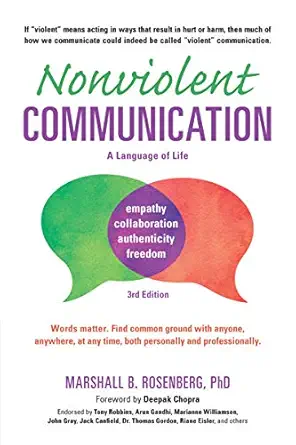
Nonviolent Communication: A Language of Life, by Marshall Rosenberg, is a book describing how to communicate in meaningful ways that are supportive of yourself, your relationships, other people, and life itself. Though the book doesn’t ever talk about autism, I feel it’s still useful to discuss. I feel that this communication style would reduce misunderstandings on and off the spectrum. If I could change English so it mostly used these ideas and rules, I would.
This book is both a work of education and also of philosophy. Rosenberg teaches different mechanics of communication (as in, phrase your thought this way, not that way). But he also teaches a positive, humanistic point of view that’s essential to making those mechanics work best. In reading this work, I could clearly see the influence of the psychology Carl Rogers.
However, Rosenberg has taken those ideas and both expanded on them and also made them practical. Which is to say, the tagline, “Find common ground with anyone, anywhere, at any time, both personally and professionally,” is not a joke or a marketing gimmick. It is quite literally true, and there are several examples in the book of practitioners doing exactly that. In at least one instance, the practice likely saved them from significant injury or even death.
Violence in English
I agree with Rosenberg that a lot of English and general communication involves a stunning amount of inaccuracy and manipulative language. For example, we often say, “this made me feel angry.” The reality is that although our reactions may be immediate, we choose whether to feed that reaction or set it aside in favor of a different one. Nobody can make you feel or do anything. The phrase shifts the responsibility off the speaker and onto someone or something else. Which is both dishonest and unhelpful, to be honest.
This applies to working with autistic people and kids. One might typically say, “His stimming drives me nuts!” Or even, “His stimming is so annoying!” You could instead say, “I feel aggravated when he stims because I expect a quiet environment right now, and his stimming makes noise.” This recognizes that your aggravation isn’t really with the example stimming autistic guy, and it also expresses why you’re feeling upset. Rather than lecturing the example guy to stop stimming (and thus making things worse), you could politely ask him to move to a different room. Or even move yourself, adjust your expectations, or change the situation positively so he doesn’t feel the need to stim. Instead of attacking the autistic person, this phrasing opens up conversational options, including possible solutions.
Not Easy, but Important
This method of nonviolent communication definitely requires a lot of honesty. It requires you know yourself and what you want and need. And, it requires you be clear and direct about those things when communicating about them. This is not an easy set of requirements. But I do think it’s incredibly important, especially when dealing with autistic people.
By and large, autistic people do not read between the lines. We can have trouble taking others’ perspectives, because others can be so different from us. Our own needs can include things like “taking 15 minutes after work to spin a bicycle wheel and stare at it” (a real stim I heard described once). How, then, can we be expected to understand exactly what everyone else’s wants and needs are unless we’re told?
Especially since those wants and needs can change based on the situation at hand. A mom or roommate might be okay with having a playlist of favorite YouTube videos playing loudly in the morning before school or work, for instance. But many parents and roommates wouldn’t be okay with that same playlist going loudly at 10pm, when everyone is heading towards bed. In the morning, a certain level of noise and activity can be normal. But in the evening, headphones might be a wise choice.
Confusingly, some households might be different if people work second or third shift, or like a certain noise level all day. This is why it’s so important to communicate needs and wants clearly. There isn’t one correct way everyone does things. There are ways that work better for some people than others, and communicating about them is how you find what works best for everyone.
Personal Communication Adjustments
As I was reading this book, and afterwards, I began to notice how my own use of language tended to evoke guilt, shame, and negativity. This was true of how I spoke and thought to myself as well as how I communicated with others. I strongly suspect I have a lot of very significant work to do in terms of word choice adjustments, if I want to use nonviolent communication regularly.
However, it might well be worth it. I have the ability to predict, to some extent, how people will act or react to different ways of phrasing things. I also have a general understanding of how people and systems work. In reading the philosophy and mechanics of this book, it struck me as significantly different than the norm. However, the assertions the author makes ring true to me.
In life, I try to be kind and supportive of others. It’s something I value about myself and in others. This philosophy shares that value. I recognize it as superior to some of my current styles of communication. So I’ll be trying to let this book change me and make my communications with others more positive.
It’s going to be a long road, because I have a lot to unlearn. But this book has made my life and communication better already. I hope you find it as wonderful as I did!
Read This Book If
No if. Just read this book. Autistic people, parents, professionals, teachers, everyone. The ideas, methods, and philosophy Rosenberg teaches would be valuable in any setting where humans are involved. Honestly, my only regret about reading this book is that I opted to do so in audiobook format first. That was all the library had available. I have since purchased a copy and will be rereading it in hopes of improving my own life and communication.
 realisticautistic