Book Review: On the Spectrum

blue green and red abstract illustration

On the Spectrum: Autism, Faith, & the Gifts of Neurodiversity, by Daniel Bowman Jr. is a series of essays and interviews around the titular topics. The author is an autistic adult, which is a nice change from people talking about autistic people over our heads. The book is Christian-centric, reflecting the author’s beliefs.

Unlike a lot of books written by autistic authors, this one contains very little “this is what happened to me and why I am the way I am!” explanatory story. The author talks a little about his childhood, but it’s not really the focus of the book. Far more than most books I’ve read by autistic adults, this is a topical piece rather than an autobiographical one.

On the Spectrum is also very definitely a work of philosophy and art, rather than a set of self-help or concrete recommendations. My grandmother on my dad’s side would sometimes say of her husband, “He is not of this earth,” referring to his remarkably brilliant but sometimes impractical tendencies. It seems to me that she might describe Mr. Bowman the same way.

I’m not going to try to summarize the philosophy and essays. They’re not exactly disparate, but it’s certainly not a cohesive narrative. On the Spectrum is a book you can read in chunks, an essay here, one there, and not get slowed down by needing to remember what happened before. It is also kind of a feat to marathon, which was my mistake when reading it myself. I only have so much time with which to do things, and most of it is eaten by managing my life. But hey, you know better now, so don’t repeat my mistake.

Notable Points

The book opens with a lot of pain… which is a theme that often plagues many autistic lives. Rarely is it expressed so emotionally… and so I wasn’t surprised to learn Bowman is a poet. It was a bit shocking to me, though, and hence the warning here. His situation does improve, and so the painful tones mostly abate.

I also found similarities to the author in our love of stories. He specifically calls out that they grant you insight into people and stories, as well as predictability. I’m not certain that’s all of why I loved books growing up, but I can’t deny he’s right. Especially in fiction, stories tend to follow certain rules. I effectively carried a book around as a comfort object when I was younger. I’ve now graduated to a tablet, which carries thousands of books. Also the Internet.

The last thing I appreciated was the description of neurodiversity and ableism. Despite being a college professor, Bowman has managed to state these ideas without being pedantic. I feel like some of his thoughts would have been better illustrated with the typical autistic adult autobiography/memoirs format. Despite their lack of scientific validity, anecdotes are spectacular ways to make a point. But I still appreciate that he took the time to say things like “please don’t kill us (also please get help)” and “it gets better.”

He’s probably the most shy autistic adult I’ve read, in terms of sharing his life. We’re all typically so open and honest and “please understand me!about it that it really surprised me that he wasn’t. That said, nobody is owed another’s story. Even if they’re autistic. Even if that story could potentially change lives or make things better. A person’s life and perspective are theirs. Nobody has the right to demand it be shared.

That’s something at least one person in my church doesn’t seem to understand, to my irritation. You wouldn’t just walk up to someone on the street and demand they share their life story. They’d quite rightly tell you to bugger off.

Read This Book If

You’re interested in a work of prose and philosophy around the title’s subjects. On the Spectrum is not a typical autistic adult memoir, it’s a series of essays and interviews on those topics. Church leaders and staff would probably benefit most from reading this book, as well as church members with an interest in these things. It’s written well, and approachably. It’s markedly different from pretty much every other book by autistic adults I’ve read. I’d read it again when I have time, so I could digest it better.

Book Review: Nonviolent Communication

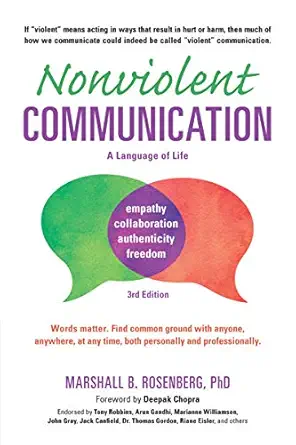
Nonviolent Communication: A Language of Life, by Marshall Rosenberg, is a book describing how to communicate in meaningful ways that are supportive of yourself, your relationships, other people, and life itself. Though the book doesn’t ever talk about autism, I feel it’s still useful to discuss. I feel that this communication style would reduce misunderstandings on and off the spectrum. If I could change English so it mostly used these ideas and rules, I would.

This book is both a work of education and also of philosophy. Rosenberg teaches different mechanics of communication (as in, phrase your thought this way, not that way). But he also teaches a positive, humanistic point of view that’s essential to making those mechanics work best. In reading this work, I could clearly see the influence of the psychology Carl Rogers.

However, Rosenberg has taken those ideas and both expanded on them and also made them practical. Which is to say, the tagline, “Find common ground with anyone, anywhere, at any time, both personally and professionally,” is not a joke or a marketing gimmick. It is quite literally true, and there are several examples in the book of practitioners doing exactly that. In at least one instance, the practice likely saved them from significant injury or even death.

Cover of Nonviolent Communication, by Marshall Rosenberg: a pair of overlapping word bubbles.  One green, one red, purple where they overlap.  Subtext: A language of life.  Words matter.  Find common ground with anyone, anywhere, at any time, both personally and professionally.
Cover of Nonviolent Communication, by Marshall Rosenberg

Violence in English

I agree with Rosenberg that a lot of English and general communication involves a stunning amount of inaccuracy and manipulative language. For example, we often say, “this made me feel angry.” The reality is that although our reactions may be immediate, we choose whether to feed that reaction or set it aside in favor of a different one. Nobody can make you feel or do anything. The phrase shifts the responsibility off the speaker and onto someone or something else. Which is both dishonest and unhelpful, to be honest.

This applies to working with autistic people and kids. One might typically say, “His stimming drives me nuts!” Or even, “His stimming is so annoying!” You could instead say, “I feel aggravated when he stims because I expect a quiet environment right now, and his stimming makes noise.” This recognizes that your aggravation isn’t really with the example stimming autistic guy, and it also expresses why you’re feeling upset. Rather than lecturing the example guy to stop stimming (and thus making things worse), you could politely ask him to move to a different room. Or even move yourself, adjust your expectations, or change the situation positively so he doesn’t feel the need to stim. Instead of attacking the autistic person, this phrasing opens up conversational options, including possible solutions.

Not Easy, but Important

This method of nonviolent communication definitely requires a lot of honesty. It requires you know yourself and what you want and need. And, it requires you be clear and direct about those things when communicating about them. This is not an easy set of requirements. But I do think it’s incredibly important, especially when dealing with autistic people.

By and large, autistic people do not read between the lines. We can have trouble taking others’ perspectives, because others can be so different from us. Our own needs can include things like “taking 15 minutes after work to spin a bicycle wheel and stare at it” (a real stim I heard described once). How, then, can we be expected to understand exactly what everyone else’s wants and needs are unless we’re told?

Especially since those wants and needs can change based on the situation at hand. A mom or roommate might be okay with having a playlist of favorite YouTube videos playing loudly in the morning before school or work, for instance. But many parents and roommates wouldn’t be okay with that same playlist going loudly at 10pm, when everyone is heading towards bed. In the morning, a certain level of noise and activity can be normal. But in the evening, headphones might be a wise choice.

Confusingly, some households might be different if people work second or third shift, or like a certain noise level all day. This is why it’s so important to communicate needs and wants clearly. There isn’t one correct way everyone does things. There are ways that work better for some people than others, and communicating about them is how you find what works best for everyone.

Personal Communication Adjustments

As I was reading this book, and afterwards, I began to notice how my own use of language tended to evoke guilt, shame, and negativity. This was true of how I spoke and thought to myself as well as how I communicated with others. I strongly suspect I have a lot of very significant work to do in terms of word choice adjustments, if I want to use nonviolent communication regularly.

However, it might well be worth it. I have the ability to predict, to some extent, how people will act or react to different ways of phrasing things. I also have a general understanding of how people and systems work. In reading the philosophy and mechanics of this book, it struck me as significantly different than the norm. However, the assertions the author makes ring true to me.

In life, I try to be kind and supportive of others. It’s something I value about myself and in others. This philosophy shares that value. I recognize it as superior to some of my current styles of communication. So I’ll be trying to let this book change me and make my communications with others more positive.

It’s going to be a long road, because I have a lot to unlearn. But this book has made my life and communication better already. I hope you find it as wonderful as I did!

Read This Book If

No if. Just read this book. Autistic people, parents, professionals, teachers, everyone. The ideas, methods, and philosophy Rosenberg teaches would be valuable in any setting where humans are involved. Honestly, my only regret about reading this book is that I opted to do so in audiobook format first. That was all the library had available. I have since purchased a copy and will be rereading it in hopes of improving my own life and communication.

Book Review: How to Be Human

How to Be Human: An Autistic Man’s Guide to Life, by Jory Fleming with Lyric Winik, is an exploration of Fleming’s rather unique mind and perspective. Despite Fleming’s listing as the main author, Winik seems to be the organizing force behind the book. Through his eyes, and through his questions, we meet and see through the eyes of Fleming.

Cover of How to Be Human.  Overlapping circles of the primary colors red, yellow and blue, against a white background.
The cover of How to Be Human: An Autistic Man’s Guide to Life

It’s an interesting journey. The book is not quite stream of consciousness, but it is the product of many interviews and time spent together with Fleming. Winik tries to arrange the topics in a coherent flow, and you’re sort of drawn along in the experience. It starts out with more concrete subjects, but by the end the biographical subjects have ceased and you’re listening to the two authors talk philosophy and the value of human life.

What This Book Is Not

The book is not, I should point out, any kind of guide to autistic life. While I’m somewhat disappointed about that fact, I’m not overly surprised. Every autistic experience is different. Some autistic people, like Jory Fleming, seem to be more divorced from their emotions. I certainly was for a good chunk of my childhood.

This book is also not a “story of my life” tale, as is so often typical for autistic adults to write. Instead, it’s of a much smaller category. This book is one of the very few “see through my eyes at this very moment” types. Other books of this type include The Reason I Jump and How Can I Talk If My Lips Don’t Move? I’d say both of those have more “this was my childhood” built into them than How to Be Human. But that’s in part because Jory Fleming simply doesn’t remember much of his childhood.

He also isn’t typically affected by his emotions, and views most things exceptionally logically. One interesting caveat to that is that he doesn’t seem to understand shared cultures based on geographical area. So the idea of regional accents, shared beliefs about the world because that’s how everyone thinks, etc, those are all alien to him.

Bright Points

I had to laugh at one particular section in the book, where Winik and Fleming discuss art. I laugh, because I’ve finally found a fellow modern art critic with my exact same complaint:

LW: What are things you like and don’t like to look at?

Jory: I hate to say it, but really artsy stuff I don’t get. Like modern art or that art where it’s abstract and you’re supposed to bring meanings from something. My nephew could probably do that if we gave him some paint. I’ve looked at art exhibits and London and Paris, and sometimes I think the work is terrible.

How to Be Human, page 140-141

Jory Fleming describes himself as a relentless optimist. He’s very logical and reasonable about why he chooses to be that way. But it strikes me as rather unusual, because he had a reasonably difficult childhood from the small bits mentioned in the book. He didn’t start talking in the usual way of children. His mother homeschooled him and became an expert in how to communicate in “Joryspeak.” The most common example in the book is Fleming saying, “It’s a cold night” to her to ask her to turn on music for them to listen to. Because that was apparently something she’d sometimes say before turning on the music.

Also interestingly for a person that’s exceptional logical, Fleming is a person of faith. The discussion of that apparent contradiction is near the back of the book, and I found it both interesting and helpful.

Read This Book If

You’d like to explore an exceptionally unique autistic person’s mind and viewpoint on life. Parents, professionals, teachers, and fellow autistics might find commonalities in reading this book. Jory Fleming is eloquent in his way, and Winik guides you through the topics, flowing one into the next. It makes you think. I enjoyed it.

Book Review: Following Ezra

Following Ezra: What One Father Learned About Gumby, Otters, Autism, and Love from His Extraordinary Son, by Tom Fields-Meyer, is a “my family’s experience with raising an autistic child” book from the father of that family. This is somewhat unusual. Usually it’s the mother that writes the book. That difference makes it more accessible to other dads, in my opinion. And unlike Not My Boy!, vast quantities of sports star money and fame aren’t involved. This makes the story more approachable to other families, I feel.

Cover of the book Following Ezra: toy dinosaurs in a line on a blue background.
Cover of Following Ezra, by Tom Fields-Meyer

I liked this book. Tom Fields-Meyer wrote Following Ezra in an easily-digestible, flowing narrative from his own perspective. The family is Jewish, so the story follows Ezra from early childhood to age 13. For those unfamiliar, at age 13, Jewish children celebrate their bar/bat mitzvah. It’s a coming of age ceremony and their first step to joining the larger Jewish community. It’s a very tidy place to bookend his life. Though I think we can all agree Ezra’s childhood is hardly over.

Neurodiversity Without The Word

Something I really appreciated about Ezra’s parents was that they didn’t try to shoehorn their child into some kind of imagined future. The book title itself, “Following Ezra,” clues you into this fact. They followed him. They didn’t metaphorically walk before him, pointing to all the best places to step. Nor did they dictate his path to him. Instead, they watched and listened and did their best to be supportive of him as he went.

The word “neurodiversity” is never printed in this book. Yet Ezra’s parents seem to understand that their son’s way of living is as valid as theirs. They presume competence rather than defining their son’s limitations to themselves. And they make the assumption that he will learn and grow. After the suggestion that Ezra might be autistic and being told he should grieve for the child Ezra didn’t turn out to be, the author puts it this way:

My answer will never be to mourn. It will be to pour love on my son, to celebrate him, to understand, to support him, and to follow his lead.

End of Chapter 1, Following Ezra
Not a Cakewalk

I should note, in all this, that Ezra’s childhood was nothing like mine. I followed the more “Aspergers” development path, where I developed skills unevenly but I did develop them over time. Ezra, on the other hand, experienced the regressive autism pattern. He developed, seemingly normally, until a certain point, and then seemed to lose skills and slip away. This is a soul-crushing thing to watch happen to your kid. It typically leaves quite a bit of pain in its wake.

Ezra’s parents are no exception, but they try not to dwell on it. They’re helped along by various experts that seem to understand what autism is and isn’t. A special-needs-friendly hair cutter, an experienced matron and Floor Time practitioner with her own child on the spectrum, case workers, school paraprofessionals, and a psychologist that could describe why Ezra seemed panicked by so many unpredictable facets of life.

They had to learn to cope with a child who rarely spoke at all for years. And then, of course, in true autistic fashion… when he did start speaking (around age 7), he immediately started asking honest (but socially inappropriate) questions like, “why are you so fat?” And while Ezra learned to read at an appropriate age, he didn’t demonstrate it in anything approaching a normal way. The final proof was when he followed the directions on a fire alarm during an event at the synagogue: “Pull down.” The book is full of stories like that.

His parents learn to live with his hobbies/special interests/obsessions, and then, to use them to connect with him and share in his life. They share in his celebration of the first day of every month. A pet dog becomes a way to help him connect with other humans at the dog park. There are all sorts of moments and and roundabout learning experiences.

Read This Book If

You’d like a dad’s eye view of raising an autistic child from birth to age 13. This book is written by a trained writer in a stable marriage. It’s fairly easy reading for a layperson, with a focus on the ideas rather than the fancy names and scientific details of things. “Following Ezra” embodies some of the best ideas of neurodiversity, but without ever using (or possibly even knowing about) the word. I enjoyed the read, and I hope you will too.

Book Review: I Am In Here

I Am In Here: The Journey of a Child with Autism Who Cannot Speak but Finds Her Voice, by Elizabeth M. Bonker and Virginia G. Breen, is a “my family’s story with autism” book with an emphasis on the author’s relationship with the Judeo-Christian God. As such, I’ll get a bit into my own beliefs during the discussion. As a note, the mother-author of “I Am In Here” is a privileged white woman with significant resources at her disposal, which is not uncommon in these books.

Cover of the book I Am In Here- a side head view of a white middle-school aged child in front of a grassy meadow with mountains in the distance.
Cover of the book I Am In Here

The book is somewhat deceptively titled, to my annoyance. Elizabeth, the autistic daughter, doesn’t seem to have had much say in how the book was organized. The account is very much from the mother’s perspective, and most of the writing is hers. “I Am In Here” is sprinkled through with pieces of Elizabeth’s poetry and prose, fitted in with the mother’s account of the growing up and life on the spectrum story.

I should note that Elizabeth is actually not the only autistic child in this family. Her older brother, Charles, is also autistic. But he’s rarely mentioned in this book. His autism is more like mine. It saddens me that his mother hasn’t used his experiences to help understand hers at all. They may be different people and have some different experiences, but what he struggles with may also be what she struggles with.

Finally, the author-mother of “I Am In Here” makes the typical medical/parental mistake of equating autism to “everything that’s wrong with my child.” She repeatedly wishes for “recovery from autism” for her daughter. Neurodivergent readers should try not to take offense. This is the wish of a mother that wants to see her daughter happy and free of suffering, not a eugenics-focused monster.

Caution: Lots of Christian Musings

When I was doing some advance research on this book, I ran across a particular complaint over and over. It was that, in the second part of the book, the mother loses the story of her family in musings about God and her relationship with her daughter. This is a very accurate complaint. People that aren’t religious or spiritual might find the insight into a suffering believer interesting, but it might also simply feel annoying.

Personally? I believe in God. But I also became annoyed. The author spends a significant amount of time desperately trying to pray her daughter into being able to speak. On one hand, I understand this. Speech is a mode of communication we (definitely including me) take for granted. It’s the default in typical human interactions. Any mother would want her child to be able to speak. If nothing else so that they could communicate with more people, faster. We live in a world that doesn’t give the metaphorical time of day to alternative communication methods, after all.

However… God is not a vending machine. There is no way to pray that’s so perfect that God is somehow forced to give you what you’re asking for. That isn’t the point of prayer. My understanding of prayer is that it’s to talk to God, yes, and ask for things you want… But mainly it’s to help you be mindful, reframe your thinking, and align yourself with His perfect and good plan for the world.

It saddens me that Elizabeth’s existing communication (typing and using PECS and a letterboard) feels sidelined and undervalued, compared to the focus on speech. “I Am In Here” overflows with her poetry. Yet the mother’s single-minded focus on speech implies a certain amount of inability to see past the neurotypical world and its values.

Why Suffering?

The author also struggles with the question of why suffering is in the world at all, which is a normal and entirely reasonable question anyone might ask of an omnipotent God. Especially when you and the ones you love most are suffering. My best guess is that God has opted to self-limit his power to respect the free will of all his creations. Unfortunately, free will means the ability to choose wrong. We have to live with the consequences of those wrong choices… but so does everyone around us, including God.

Autism is a neurological difference that often comes with medical conditions. The brain and body can develop differently because of any number of things. Some of these are air pollution (a choice made by people in industries), toxic substances in plastics (also people in industries), genetics (a product of peoples’ choice of mates), and other factors.

Besides the co-occurring medical conditions (which can be very significant, like epilepsy), autistic people are often disabled by those around us. We think and act different than neurotypical people. We stim when upset or when happy. The people around us often see these differences and reject or avoid us. Because they do that, our work opportunities are fewer and more limited. It reduces our ability to make and keep friends and connections. Our chances to thrive and develop our interests are fewer. This is why autism is a disability, even after you set aside the co-occuring medical conditions.

Speaking of suffering, the mother writing this book describes an incident when Elizabeth contracted a rare brain virus. The virus caused her a lot of pain, and in response she began a lot of self-injurious behavior.

Good Parenting

I want to highlight this incident because although it was horrible, the mother did a lot of things right. She listened to her child when she said it hurt, and differently than usual. She observed her child’s behavior and recognized there was a serious issue. The author didn’t accept “that’s just the autism” from medical professionals. Instead, she tried option after option, searching for every possibility until they found what was going on.

I also want to highlight something in particular in the next:

This was a dark time of trying medication after medication. We just tried to get through every day. Nothing helped very much or for very long. Some medications made her much worse and were immediately discontinued. Every time I placed a new pill in her mouth, I felt terrible because I believed we were not dealing with the root cause, only its terrible outward effect.

Page 228-229 of I Am In Here

This is a revelation I wish a lot more people would have. Because yeah, most medication prescribed today is only to treat the symptoms. Psychiatry is particularly guilty of this, but the overall field of medicine in the US is as well. Finding and treating the root cause should be the primary focus of healthcare, not simply easing the symptoms and washing your hands of the matter.

All too often with co-occurring medical conditions, the root cause is unknown. And in many cases, it’s quite expensive to try to find those causes. Which, as an aside, is why I think universal healthcare should be guaranteed for all people. You shouldn’t have to be rich to get good medical care.

Read This Book If

You’d like to experience a “my family’s story with autism” involving a nonspeaking autistic child and a mother with a significant Judeo-Christian faith focus. The title is deceptive. This book is not from the autistic child’s perspective. Her writing and poetry is included, but the mother clearly organized and directed the flow of the narrative. The author-mother also clearly makes the typical medical/parental mistake of equating autism with (almost) everything that makes her child suffer. Beyond that, “I Am In Here” can be a valuable, eye-opening read into the nature of faith, hope, perseverance, and transformation.

Book Review: In a Different Key

In a Different Key: The Story of Autism, by John Donvan and Caren Zucker, is a dramatized storyline of the evolution of how we understand autism. At 551 pages plus the bibliography, timeline, and notes in the back, it is a lengthy read.

The writing style has more in common with Life Animated or Neurotribes than any other works I’ve read. This is likely due to the authors’ backgrounds in journalism and other media. You won’t find the classical autistic “frank, direct, and explanatory” tone in these pages. Nor will you find the loving and earnest tones of a parent fighting for their child. Instead, it’s a more restrained style. Dramatic, but you have to look carefully for the authors’ opinions of the people and ideas. The idea is to seem as non-biased as possible in service of the truth.

Despite that stylistic difference, In a Different Key is still readable to a layperson. But I will say it took me the better part of a week to get through it. I like to think I’m no slouch in reading speed and comprehension, but this was a dense read, even for me. It covers over a hundred years of history and several major social movements. Some names I recognized from my previous research. Others I didn’t.

Part of the difficulty in understanding the book for me was the sheer number of names. There are a lot of players in this history of autism. Keeping them all straight was difficult for me, and from my reading of Neurotribes, I know the authors didn’t even include all the major characters. I could have used a “Who’s Who” section in the back of the book, alongside the timeline, bibliography, notes, etc. That said, no less than a quarter of In a Different Key’s pages are “back of the book” resources. Adding a few more pages to an already lengthy read was perhaps not a high priority for the publishers.

An Education with a Couple of Gripes

This book was an education. It was an incomplete education, I should note, but it’s still highly valuable. And infinitely more digestible than poring over the letters, documents, interviews, and other sources. Among the movements it describes are the infamous “refrigerator mother” theory, the eugenics movement, institutions, behaviorism (ABA), neurodiversity, and the amorphous definition of autism.

An irk of mine kept cropping up while I read In a Different Key. The writers seem to tie up each movement, such as the institutions issue, with a neat little bow at the end. It’s feels like, “and then this issue was settled and no one was institutionalized after that.” I am very sorry to say that institutions absolutely still exist. They aren’t as centralized as they used to be, and now come in the form of group homes, state schools, and intentional communities.

Not every entity with those names will be an institution, but if the autistic person doesn’t get to make their own choices, go out when and where they want (with supports as needed), get the help they need to meet their goals, meet new people and spend time with friends and family, it’s an institution. Please feel free to read this literature about the subject.

The same goes for the behaviorism issue. Applied Behavioral Analysis was completely flawed and abusive in its inception. And it may have grown and changed over time. But I can safely say people continue to send their small children to centers, or sign up for in-home ABA therapy. In fact, prior to understanding how damaging ABA can be, I worked in one. That was less than 10 years ago. The era is hardly over. Despite the adult autistic people advocating against it with a truly vigorous fervor..

Biases

The first and clearest bias to me in reading In a Different Key was their kind treatment of Dr. Leo Kanner. Having not read the literature myself, I couldn’t say whether their “he liked the limelight but really, his focus was helping the children” interpretation is truly accurate. I can say that a lot of my other reading was much, much less forgiving, and tended to believe that Kanner was egotistical.

The next was the treatment of Andrew Wakefield. The vaccine controversy is flatly exhausting, and I won’t explain it in detail here, but it’s not as simple as they make it out to be. Vaccines can, and do cause harm. Anything, including the very substance that makes up more than 70% of our own bodies, can harm people. There is an entire legal framework constructed especially to investigate and handle such vaccine harm cases. If vaccines were truly 100% safe, no such things would be needed.

However, vaccines are also incredibly important. The ability to protect our most vulnerable from killer viruses and infections with herd immunity is one of modern society’s greatest triumphs. I will never argue that vaccines should be discarded. They are, however, something to be careful with. In vulnerable people like myself, the preservatives and added chemicals can overload an already struggling body and cause significant harm. The chances are very low, but they exist, and I don’t feel that In a Different Key did justice to that reality.

Neurodiversity

Finally, the authors of In a Different Key have essentially represented the entire neurodiversity movement with one person: Ari Ne’eman. This is hilarious reductionistic, as there are dozens or even hundreds of advocates that are part of the movement. Where was the section about Maxfield Sparrow? Where is John Elder Robison? Or Ann Memmott, Dr. Stephen Shore, or really any of the other contributors on this list? It was as if it was too bothersome to recognize the diversity of the spectrum.

Again, I have not read the correspondences that the authors used to craft their narrative. But I do feel Ne’eman was more or less presented as a myopic leader, unconcerned with the plight of autistic people with greater medical needs and less mainstream communication than his own. This is a typical criticism of the neurodiversity movement, to be honest. It’s often put forth by parents insisting that autistic people that pass for neurotypical can’t possible know what their life is like for nonspeaking, medically burdened children. That we’re somehow so different that there’s no reason to listen to us.

The fact is, neither side is entirely correct. The ability to pretend to be neurotypical does not mean the person is somehow not disabled. It doesn’t mean we don’t have similar medical difficulties. And it certainly doesn’t make us less autistic somehow.

But the neurodiversity movement also goes too far. Some proponents of it argue that all disability stems from social sources. That if people would simply accept us, there would be no disability. This is an absurdity, of course. Medical issues, while not actually autism, are prevalent in autistic people. You can’t love a person’s food allergies away. An imbalance in gut bacteria can’t be hugged or talked away. Treating it is the only way the person can thrive. Advocating otherwise is thoughtless at best.

Focus and Overall Agreement

The authors contend (and I agree) that the overall focus of parents, neurodiversity advocates, and many (though not all) of the medical and philosophical experts is the same. All parties want good lives for autistic people. The trouble is that the definition of autism is very unclear, and so is what constitutes a good life.

If the definition of autism contains chronic gut dysbiosis, mental illness, seizures, aggression, and the assumed lifelong lack of interest in others, of course it’s reasonable for autism parents to want a cure. They are literally watching their children suffer every day. Who would live like that and not want something better for their children? Certainly not I.

Obviously I have a bias of my own. I do feel that if you want to know what it’s like to live with autism, and what a good life for autistic people is, you should ask the actual autistic people. Discard your perfect narrative of “school -> college -> good job, dating -> marriage -> kids -> grandkids.”

Maybe those things are what your loved one wants. Or maybe school is painful for them and they’d be happier working with their hands in a technical school, or a blue-collar job. Perhaps they love kids, but don’t want their own. Maybe they’re happy living a solo life, with friends but no partner. Or perhaps they’ll end up in a polycule relationship, surrounded by people who love them for who they are.

Autistic people are startlingly different at times. Don’t shoehorn us into an imagined perfect life. Find out what we love. That’s what should be in our lives.

Read This Book If

You want to read a history of autism and don’t mind devoting a significant amount of time to the effort. It’s not a perfectly complete history, as it mostly stops at 2010. At times In a Different Key is biased and limiting. It boils the neurodiversity movement down to a single advocate. However, for the amount of territory they had to cover, the authors did a pretty good job of writing this book in a digestible, if lengthy format. I had a lot of gripes in reading this book, but I can’t deny it’s a quality publication. Do read it, but keep your metaphorical salt shaker on hand so you’ll have plenty of metaphorical salt grains ready to take with the material.

Book Review: Funny, You Don’t Look Autistic

Funny, You Don’t Look Autistic: A Comedian’s Guide to Life on the Spectrum, by Michael McCreary, is a “growing up with autism” story from a somewhat unusual source: a standup comedian. Autistic people aren’t typically known for our senses of humor or ease with handling a crowd. The stereotype is more intelligence with math and science. Naturally, Mr. McCreary is absolutely awful with math.

Cover of the book Funny You Don't Look Autistic: a concerned young white man looking between a microphone and its unplugged cord in front of a blue background.
If You’ve Met One Person with Autism…

The fact is, autistic people don’t fit neatly into a shoebox. We’re all kinds of people, including actors, accountants, and athletes. Our hobbies (“special interests”) vary from trains to animals to foraging. We have commonalities, but like any group of people, there’s a lot of diversity, too. Since autism is a neurological condition, that includes racial and gender diversity as well as basic neurological differences.

One of the challenges of being an autism advocate is trying to speak for such a broad range of people. Some of us speak many languages fluently. Others don’t speak at all. Mr. McCreary pointedly says at the beginning of Funny, You Don’t Look Autistic, that he’s pretty much only speaking for himself. I did find it a nice touch that he grew up with an autistic brother, and one rather different than him. It made for an interesting comparison point as the story went on.

Like a lot of autism memoir-style books, this one mainly covers the author’s childhood. It’s a strange feature of books by autistic people that we do tend to write memoirs before becoming old and grey. I choose to believe it’s because we’re just too interesting to wait until our stories are nearly finished. The world needs to know us, and about us, now. It can’t wait for another two or three decades.

I don’t have a good sense for how to be funny, because that’s not one of my focuses in life. But I do have enough pattern recognition to recognize that this book is written in a cross between the typical plainspoken autistic “I’m explaining myself” tone and the typical stand-up comedian storytelling/joke style. That may make this book easier to digest. And, y’know, funnier. A lot of humor is context-sensitive. The author does a pretty good job of giving you the needed context, thankfully.

Not Alone

One of the major differences I see between Mr. McCreary’s life and mine is that he found his tribe, so to speak. In less obscure terms, he found and befriended other autistic people. People that accepted him for who he was, eccentricities and all. He talks about this friend group and how it was much more supportive for him overall than even shared hobby groups based around theater.

He’s less than 10 years younger than me, but I guess that must’ve made a major difference in recognizing and diagnosing people. I didn’t get my diagnosis until my early 20s. It took me until middle school to find other (probably, none of us knew) autistic people, and until high school for people overall to tolerate me and to really find a place I felt comfortable in. So naturally, my family had to move away pretty much immediately.

Probably mine would be a happier story if it had included this kind of support. Or even a clue that I wasn’t so incredibly abnormal that no one at all was like me. Instead, I spent much of my childhood isolated because no one understood me and I had no clue how to do anything but survive each day.

So I’m jealous of what the author had, but also glad… because it’s what I want for every autistic person. It’s why social groups just for autistic people are so important. In meeting our tribe and accepting them, we learn to accept ourselves. And y’know, knowing people who have similar issues to yours means more ideas for how to cope with them.

A last note: at no point in the story is the title relevant. I’m uncertain as to whether it’s a reference to a bit the author does in his standup comedy, or just something he or the publisher thought was clever. Either way, I’m not really sure what “autistic” is supposed to look like.

Read This Book If

You’d like to read an extra funny “my life with autism” story where the author . The chapters are short and easily digestible. The humor is clean and family-friendly. Overall, Funny, You Don’t Look Autistic is a good story, told well.

Book Review: Parallel Play

Parallel Play: Growing Up With Undiagnosed Asperger’s, by Tim Page, is a “my life with autism” story from one of our older survivors.  The book mainly deals with his childhood, as the title suggests, and is written in the typical autistic conversational-explanational tone that so frequently graces our literature.  Mr. Page’s prose is more polished than most, I would say, which is likely due to his many years of wordsmithing.  

I call this autistic generation The Lost Generation, personally, because few of these autistic people avoided institutionalization, and those that did typically suffered immensely.  Autism was simply not understood, let alone supported.  There was no community to which we could find advice from others like us.  No comradery and fellowship.  No support services designed to meet our needs.  

Those of us that survived without being sent to the destructive prison-institutions typically bear scars and unhealthy adaptations from the experience.  Depression and anxiety are common.  For this author?  One of those unhealthy adaptations is a fixation on death.  This isn’t uncommon for autistic people- anything can turn into a hobby or fascination.  Morbid subjects aren’t unreasonable, especially when a close family member (such as the author’s grandfather) dies when the autistic person is young.  

In the author’s case, there are no gory details to be had.  His interest in the subject included a much-heightened fear of death and interests in deceased authors, musicians, and silent films.  I suspect this book would be quite a nostalgia trip for an older person, especially one that grew up in the Northeast US at around the same time.  In that sense, I am very much not the target audience.

One thing is painfully consistent regardless of generation, though.  The pain of living in a world that constantly misunderstands and willfully rejects you is clear throughout this book.  You can see this same pain in Liane Holliday Wiley‘s writing.  Both Tim Page and Liane suffered immensely, and neither of them had any kind of fellow autistic community.  They were simply alone, and found their way as best they could with other misfits.  

Another painful echo found in this book as well as other autistic accounts was perhaps summarized best by Jennifer Cook O’Toole: “How can I be so smart, yet so stupid?”  Tim Page mentions scoring well on IQ tests (though no specific numbers) a couple times in the book, and inevitably with those mentions also comes a certain disbelief, and the suggestion that his father might have tampered with the results.  I certainly have no special insight into that suggestion, but I suspect Mr. Page, like many people, operates on the idea that IQ is somehow a blanket score for intelligence.  

I strongly suspect I will go blue in the face before I ever finish convincing people that no, it is not.  IQ is a measure of how well a person is likely to learn in a typical school setting, using typical teaching methods.  It does not account for learning disabilities.  It does not cover common sense, emotional intelligence, musical ability, hand-eye coordination, and social skills.  It’s a highly restrictive scale that should only be considered useful in highly restrictive settings.  But because of the value people place on it, a person with a high IQ score is assumed to be good at all these other things.  When they turn out not to be, disappointment is about the kindest response I’ve seen.  Rejection, disbelief, and avoidance are significantly more common.

This aloneness and rejection tends to breed a mindset of “I don’t fit in and it’s my fault.  If only I wasn’t so ____, I would have friends and be happy.”  This sense of being wrong and bad is pervasive.  I should know: a part of me still believes that even though it’s definitely unhealthy, bad, and just flat-out wrong.  It’s the same poisonous mindset as believing that I can’t be beautiful because larger women can’t be beautiful (except for every other larger woman, because obviously the beauty industry is manipulative and horrible).  

It’s exactly these kinds of experiences that make it worthwhile for me to step forward and identify myself as autistic.  Simply knowing “there’s someone else like me” is a massive relief and boost to quality of life.  It’s why representation in the media, especially genuine representation, is so important.  Parents do better knowing autistic adults, because it gives them a picture of what their kids might grow to be.  Autistic kids can receive that same benefit, but they also can gain courage to be themselves.  Also strategies and insights they might never have had themselves.

In short, they can have the things I never had, and hopefully be healthier and happier humans for it.  We march to our own drums, we autistic people.  Each of us stunningly unique.  One day I hope that uniqueness won’t contain a rainbow of trauma as a given.  

Read This Book If

You want to experience a vivid slice of life narrative from an autistic man who grew up in the 50s and 60s.  They were a remarkably different time, those days before cell phones, and the Internet in everyone’s pocket.  This era wasn’t my era, but I think there’s value in knowing what life was like before the modern one… and in knowing the stories of the Lost Generation, perhaps find something of ourselves.

Book Review: Asperger’s Syndrome: Helping Siblings

The Visual Guide to Asperger’s Syndrome: Helping Siblings, by Alis Rowe, is a plainspoken children’s book-sized publication focused on helping parents help siblings of autistic people adjust and thrive. I found this book in the autism section, not the children’s section, but it’s pretty clear from the font size and pictures where it’s meant to go. At less than 100 pages in large sized font, it’s not a long read.

I picked it up anyway because this is a vastly under-served and under-recognized need. There are hundreds, if not thousands of books geared towards educating parents and professionals. Even books specifically focused on other autistics, often written by the same. But very little has been done to help siblings of those on the spectrum cope with, say, the resentment of regularly being overlooked in favor of handling the autistic child’s special needs.

Sometimes, in the stress of everything that has to be done to manage the finances, support services, and even themselves, parents miss things. These things can include their own self-care and wellness, and it can also include making time for doing things with just the sibling(s). This is entirely understandable- after all, every autistic child is different, so there is no one “do this and everything will be fine” guide. Children are already challenging, even without factoring in unusual developmental patterns and the need for support services, specialized learning, etc.

Though all this happens unintentionally, it can be really hard on the neurotypical sibling(s). Anger, embarrassment, jealousy, and frustration are common. If autism isn’t well-explained, confusion and misunderstandings about why the autistic child is treated differently may result.

This book tackles the job of pointing out common pitfalls as well as providing answers and suggestions as to how to address each problem. It lists and addresses specific concerns and feelings a sibling might have, which I thought was useful as well as enlightening.

One thing I particularly appreciated was that the book spends time explaining the difference between a tantrum and a meltdown, which is an exceptionally important concept for family to understand. For the unfamiliar: tantrums are goal-oriented. The person throwing the tantrum wants the attention, or wants something (like candy, ice cream, a toy, etc), and when that want is met, the tantrum ends.

Meltdowns, on the other hand, are a response to overstimulated senses (like loud environments) or other adverse circumstances, and only end when the person has calmed down. The two behaviors look superficially the same, especially to someone unfamiliar with the person, but should be treated very differently.

Read This Book If

You’re a parent of an autistic child with at least one other, neurotypical child. This is a tightly focused, easy-to-read book meant to guide parents in helping both their autistic child and their neurotypical child(ren). It lays out important basics as well as very specific concerns and feelings a sibling might have. At less than 100 pages and in large, easy-read font, this is a good starting place for a parent to begin with this important, often sidelined, subject.

Book Review: Start Here

Start Here: a guide for parents of autistic kids, is a booklet available for sale or for free online from the Autistic Self Advocacy Network (ASAN), which is a group of adult autistics and parents of autistic people that got together to educate and advocate for the rights of autistic people.  The book is what it says on the tin: a starting place for parents who\’ve gotten the news their kid is or may be autistic, and are sitting back and going \”uhhh, now what..?\”  

Like many publications from ASAN, this is written in an easy-to-read style.  Complicated or specialized words are defined.  Important concepts are defined and repeated regularly to ensure understanding.  The writers don\’t shirk from pointing out the racism and sexism in the system, in addition to the prejudice against disabled people you\’d expect from such a book.  

In total, the book is 52 pages long, which is somewhere between a book and a pamphlet, I suppose.  The resource list begins on page 42, though, so you\’re really only reading about 40 pages.  I agreed with almost everything mentioned in the book, which was a nice change from some of my previous reads.  

Topics covered include: what autism actually is, communication differences, listening to autistic advocates, defining disability, presuming competence, choosing services, and schooling options.  It\’s all done in pretty broad brush strokes, and with the assumption that the parents in question live in the US.  (This isn\’t unreasonable, since ASAN mainly operates in the US.) 

My only disagreement with the publication was its section on vaccines.  I\’m afraid the subject is a great deal more complicated than this book makes it.  While the overall message isn\’t… entirely wrong, it\’s not accurate to say Dr. Wakefield put out a study that said the MMR vaccine causes autism.  He put out a set of case studies, or stories of children he was treating, that suggested the MMR vaccine might be related to their symptoms, including autism.  Case studies are a basis for further research, not a means of determining cause and effect.  By putting out the study, he was simply saying \”hey, someone should maybe look into this, because here\’s what happened with these people.\”  At no point in that study did he say, \”vaccines cause autism\” the way people seem to insist.

Also, vaccines are not always 100% safe, and in rare cases, can have side effects.  Even lifelong ones.  Pretending otherwise is absurd, since the VAERS exists to help track these.  I found it kind of unfair that the publication didn\’t even bother to mention Dr. Wakefield\’s doctorate.  I suspect this was done to give as little legitimacy as possible to the antivax movement, which some consider him a part of.  Still, it sits poorly with me to continue tarring an innocent man that way.  

Beyond that disappointment, this is a broadly useful resource that I feel fulfills the need it sets out to address.  

Read This Book If

You\’re a parent of an autistic child, especially a newly-diagnosed one.  More seasoned parents might still be able to use this as a refresher, but overall it\’s a quite targeted publication.  It\’s a short read, which is appropriate for an overwhelmed parent, but it covers most relevant subjects in broad terms.  A list of resources is included at the end for further (much needed) reading.