You know, I describe myself as fundamentally honest. I don’t lie very often. It takes too much energy and mental bandwidth. I’ve known that about myself for a while. It’s not necessarily a positive thing. We lie all the time. Conceal our struggles from each other and even ourselves. (“Hi, how are you?” “Oh I’m fine.”)
But there’s more to my honesty than that. I figured out recently, I often lack the ability to subdivide my experience. To say and act things I don’t mean. I can choose to say what I’m thinking or not, but. That’s as far as it goes. I have a one-track mind in conversations.
I learned, not that long ago, that most people have a very different, more expansive set of options. Here’s a example.
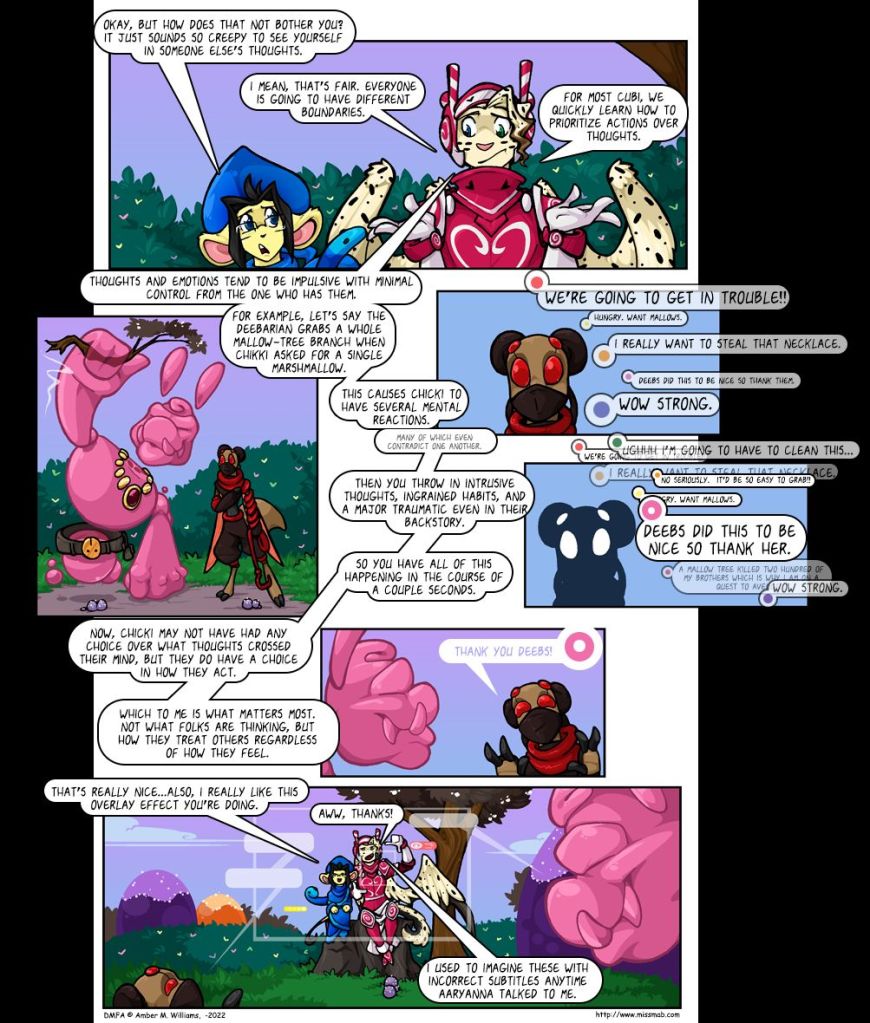
From the excellent webcomic DMFA, at missmab.com. It is, hands down, my absolute favorite storytelling in comic form.
Chicki here has six different options. Six! Most days I have one. Maybe 2 if it’s a good day. No wonder I’m quiet so much.
I’ve been talking with a friend recently about sex and roleplay in sex, and like… he’s into people being mean to him. Only in fun, and consensually, as is healthy, but. I thought about it and I actually have a mental block to saying belittling things or acting like I mean them.
I rarely insult people or make fun of them in large part because I’ll mean it if I say it, and the world is usually better if you keep unkind thoughts like that to yourself. People can absolutely act dumb and mean and frustratingly, but everyone is fighting their demons and you really never know what someone is going through when they cut you off in traffic or say something kinda rude.
The worst part of all this is not the limitation, but that some days, like once a month, I can get like 3 options and the ability to select one or spin one to a better version if I judge it would help the situation.
But not usually. And I still remember what it was like and how positively people responded. How good it felt to competently manage my side of a conversation. Just think how much easier I’d get along with people if I could do that all the time!
But no; once a month. A glimpse at what I’ve wanted for decades, but can’t have most times. Disability is so fucking frustrating.
So my church voted yesterday on whether to adopt a fully welcoming stance regarding LGBTQIA people. It was all a bit complicated, but basically they presented a document to the congregation and asked if they wanted to have it be church policy. The document isn’t precisely pro-LGBTQIA so much as it is pro-all kinds of people, regardless of their sexuality and gender identity. It’s a document I view as being made in love, with an ear to those of us marginalized by the Synod. It is also idealistic, for which I love it.
I did not get to vote on this document, because I was not a church member. That was partially my own fault- I haven’t transferred my church membership from like… 3 states ago. Because I couldn’t be made to care. What matters to me is where I spend my time, not whether I’ve jumped through some hoops.
So they voted, and I stood on the margins where I often find myself. And honestly, I stood there without really knowing what I wanted. Like, I knew what was going to be best for me- I’m queer, and I belong in the church. Adopting the document is, I firmly believe, the most Christ-like path. But I also knew full well several people were planning to leave if it was adopted. Including someone I worked closely with. And he’s taking his family with him.
So I sat there on the margins and I worried. And I wondered. I’m one of the most visible LGBTQIA people in the church. Am I worth it? Is it really worth losing those people over something like me?
I’ve had a really, really mixed experience in life, re: my worthiness as a person. It’s been mostly blanket rejection and pain, with a small slice of humanity that thinks I’m spectacular. And like… I think you’re supposed to go find and be with the people that think you’re great, but like… I never really knew how to do that. And there was usually just a couple at a time, not a whole group.
…This church, it’s… a lot of them. I’m sure some of it is my parents, who are good people in their own right, and joined the church a couple years before I did. But not all. I’ve been visible enough, I’ve served the church, and I’ve been open and honest about my struggles. And somehow, these people care. Somehow, they come up to me and say so. It… it boggles my mind. It probably shouldn’t, but it does.
The results have come in. The church voted, and 60% or more said they wanted to adopt the document. To turn their backs on the Synod and their mandates to reject me and others like me.
I should be happy. I should be jubilant, knowing this one church, at least, chose God’s love. But all I can think about is the person that’s said he’ll leave. And so I grieve.
I shouldn’t. He made his choice. I have no control over it, only what I choose to do with what he chooses.
And in the end, it’s not really me the church was voting about. It’s the other two people that spoke with me at the panel a month ago, that grew up in the church. It’s their family, their friends, all the LGBTQIA people that are spread across the myriad of connections of every voting member. It’s the convictions they hold dear, the will to love as Christ did. Even if it costs them. They could get thrown out of the denomination for this decision. People have said they’ll leave.
It’s what we’re called to do, as Christians- to choose to welcome and love the outcast, the prisoner, the impoverished, and the exile. I’m just so unaccustomed to people actually living their faith when push comes to shove, that it shocks me. And of course my own self-worth issues are coming through.
Tomorrow I have to face a world not of my making, and not of my deciding. But I guess I get to do so knowing my church is very, very serious about their belief that I belong there. I can’t seem to untangle the mess of my emotions, but I’m grateful.
I looked at myself in the mirror today at work. And I saw something new. I saw a boy.
I was wasting time in the bathroom. They’d sent us home early, and I didn’t want to lose all that money. I could linger in the bathroom for a few minutes and be justified as I washed the dust and dirt off my arms. By and large, I don’t pull stunts like this… but it was like this every day this week. We were supposed to be working full time hours, but the company could get away with only giving us 4 hours in a day. So they did. Every single day for two weeks.
I was tired of it, so I was protesting in a very small way. 5 extra minutes in the bathroom, when I’d normally take only the needed amount. A pitiful defiance, really- the wasted time wouldn’t even buy a cup of decent coffee. But I stared into the mirror.
My face, masked as always at work during the Pandemic. Barely-visible, easily-dismissed eyes behind large glasses perched atop the face-swallowing mask. A blue mask, of course. Middling blue today. My hair, cut very short and near-freshly dyed: sapphire blue, fading a bit at the very front as some of my natural golden shine tried to re-assert itself. The result: a more seafoam blue at my forehead than the true sapphire I prefer.
I looked past my face, to my torso. My chest, with the breasts my genetics determined I’d grow. Not so large as to be intrusive and cause back problems. Large enough to not be missed. Broad, manly shoulders- a gift from my father’s side of the family. Most of me is built on a larger scale. Shoulders and hips to start, but legs too. I’ve been overweight most of my life, but because of how big I am, I carry it well.
I returned my own gaze calmly. I’ve been known to unsettle people simply by looking at them. Nobody’s ever told me why. I assume it’s the intensity of the expression. It comes in handy sometimes.
My clothes were work standard. A work t-shirt, grey today to match my mood in the morning. Brownish-grey cargo shorts. Underneath, a plain white sports bra (over a decade old- don’t fix what isn’t broke), and plain white underwear. By and large I don’t give a crap about undergarments. Other people do, and that’s fine. It’s just not my thing.
Bemused, I pressed down on my chest. With my breasts out of the equation, I looked even more like a boy. Inexplicably standing in the women’s restroom.
I don’t particularly identify as male. There’s nothing affirming about being told I’m “manly.” “Capable,” yes. “Strong” or “authoritative” perhaps. But masculinity and the toxicity that so often goes with it is really of no interest to me. I don’t love hunting or fishing or shooting guns or explosions. Or violence.
And really, masculinity shouldn’t be defined by those things… and perhaps it no longer is, as the times change. But it’s how I see it I guess. And gender is, after all, a psychological construct.
I’ve experienced moments of joy when referred to as “sir” or “young man” (by a half-blind older man as I held the door for him). The easy answer would be to assume that’s because I’m a trans man in denial. And that could still be it… but I don’t think so. The answer is a bit more complicated.
I think, thanks to the Internet, I’ve come to see “male” as the default human. When I was growing up, people assumed you were a guy in virtual spaces unless you specified otherwise, or your voice gave you away. Since I stayed away from voice channels, I was merely annoyed by the joke “there are no girls on the Internet.”
In time, though, rather than loudly proclaiming my identity as a vagina-haver, I simply let people think I was male. And thus, rather than bringing gender baggage into the equation, they were more likely to treat me like an equal and a fellow human. And so that was my default.
Real life doesn’t work that way. People of my generation and older look at a person and automatically assign them “male” or “female” based on presentation and physical features. Sex and gender are usually assumed to be one and the same. They are not, obviously.
But I think that mid-point is what I’ve been unconsciously aiming for. T-shirt and jeans or shorts are more “masculine” clothes, but they’re also what’s comfortable for me. I don’t experience dysphoria around my chest. I’d get rid of my breasts for being mildly annoying, but they’re attractive to more than half the world, plus the surgery is expensive. So why bother?
It was a strange, but valuable, experience. I understand a bit better why I identify as non-binary.
I’ve been thinking about the nature of our interactions with each other.
You see, as we meet and learn about people, we determine for ourselves what kind of person they are. We take what we know of the world and people in general, and apply it to what we see of a person’s actions and words. We develop a story for ourselves about that person.
That story is inevitably wrong. Sometimes a little, sometimes a lot. Our perceptions and biases warp our judgments. And it’s not possible to entirely understand a person. People are always changing, and act differently in different circumstances based on their own perceptions and history.
That impossibility hasn’t stopped me from trying to fully understand people, but as I’ve aged I’ve come to see I can never truly do it. Like fundamental truths of the universe and life itself, it’s complicated beyond my ability to comprehend.
I know that. And the temptation, in knowing that, is to stop trying. But I can’t. I won’t. Truth is my highest ideal. And in the seeking of truth, I get closer to it, understanding more and more.
Today I feel like I’ve reached a milestone. I realized this morning, based on how people have been dealing with the new supervisors and old ones, that the stories we tell ourselves about us and about others fundamentally limits their potential.
The way we treat people, based on those stories, can limit a person. If, for example, you have supervisor that acts like a bully, a petty human being, and a general pain in the ass, you may come to see him as merely those things.
In truth, he does those things… but not all the time. He is a different person when he’s in a good mood, perhaps a different person to his equals and superiors, and probably a different person at home.
It may be pretty reasonable to expect him to always be a misery to work under… but in doing so you limit his ability to change or be any different.
This was more obvious to me in the treatment of the new supervisors. They seem to be trying to treat us like people with opinions that matter instead of inmates to be herded, which I mightily appreciated. But not everyone seems willing to give them that chance to do better.
Which limits their ability to do better. Enough limitations, and their attempts and intentions won’t matter, and the cycle will repeat itself. I really don’t want that.
It broke my heart, this morning, thinking about how much we limit those around us with our expectations and our judgments. How much we limit ourselves…
In 20 some days I’m going to New Mexico to meet Koopz and Más. Over time, I’ve come to know them. Or at least who they portray themselves to be online. I have, in essence, built stories about who they are. How they act. Why they do what they do. What they want out of life, and what they believe.
Soon I will come face to face with them, and they will not be exactly what I expect. I hope to love them anyway. As much or more than I do now. I can only hope they’ll be able to do the same.
One of the strengths of growing up partially oblivious to the expectations of those around you, is that they don’t limit who you might be. As a result I suspect I’m far odder than I would have been otherwise. But also far more interesting in my opinion.
I am still discovering things about myself, especially now that I’m not held down in shackles of depression. I think I would like to be the sort of person that expands, rather than limits, who and what a person could be.
I’m sitting outside my house eating breakfast in early fall sunshine, emotionally exhausted on my Friday. But enjoying a Switchfoot album a friend (Sancho) finally gently pestered me into listening to.
I’m sad and crushed because my regular work partner (Cody) moved on without me and didn’t want to stay friends outside work. And a really promising romantic interest (Más) moved on without me.
I’m in a dead end job with barely any energy for trying to get a better one. And it costs me so much energy to deal with the job that I haven’t been able to do as much with house upkeep as I’d like.
But. Another friend (Kristophe) just bought me Baldur’s Gate 3, I’d been wanting to play, and couldn’t afford it. He bought it pretty much just because he wanted to. Blindsided me. It’s downloading and will be waiting for me when I get home.
I’ve kept the email notification alongside the one from earlier this year when someone bought me Diablo 4. Because I kind of can’t believe someone would do that.
And I’m reading a good book series a friend (Prety) recommended and talking to him about it. And One Piece, a manga, same deal with Koopz.
My DMs on Discord have never been so busy. My emotions are a confusing mess of sadness, despair, joy, gratitude, and confusion.
Once upon a time I did 1-2 emotions at a time, and they were always all good or all bad. Mostly all bad. Then my life crashed, my toxic relationship ended, I unpoisoned my brain, and…
(Note from July 2023: the relationship that provoked this post ended with them withdrawing after a few months. I took things from the experience, grieved, and moved on. I’m declassifying this now because it no longer hurts me enough to fear posting it.)
I never noticed how much of my life was ruled by fear until recently. How much of a coward I can be. Looking back over my life, fear has always warred with love. And, usually, won.
It makes sense, you know. I’ve generally considered myself brave, but how can you be brave unless there’s something to be afraid of? Something to strive against. Something to be brave despite?
I’ve spent the last year of my life in circumstances that, honestly, are miserable. But they do pay the bills. For now. And now, on the tail end of it, I’ve recovered enough from the tragedy of my failed marriage to really, deeply care about somebody else. To feel joy in their presence, enjoy their quirks and their passion and really see the beautiful parts of their personality. To see, through their eyes, the beauty of the world around me.
Nothing will come of it, I’m sure. There are a lot of factors against anything serious coming of it. But it’s so beautiful and the feelings are so good that the idea of losing them apparently shook my unconscious so badly I started resorting to unhealthy behavior in an effort to prolong it… frankly, in circumstances that weren’t really even threatening to the relationship.
I feel ashamed. And small. And so, so weak.
My therapist would say, with a supportive and encouraging smile, “Well, it looks like you’re still human. And that’s okay.” And she might also point out, after so long being miserable, it makes sense to be desperate to keep that kind of joy close.
But I’ve always wanted to be better than human. To not fall prey, over and over, to the same stupid mistakes. To be done with it eventually, and just be able to live unhindered. It’s why I’ve worked so hard on self-improvement. It’s why I try so hard to be kind to others. I want to break limits.
It’s an impossible dream, of course. Until, perhaps, God comes again, I’m stuck being human and having to forgive myself and making mistakes and having to be kind to myself as well as others.
It’s funny, I despised pointers in school. Pointers, in computer science, are like little Post Its with directions scribbled on them. They say “the information you’re looking for is stored here.”
I learned Java first. Java, being a newer programming language, takes care of its own pointers. But then I took a class on C++, which is slightly older. Suddenly I needed to know what pointers were, but also how to manage them. Forget to delete them, and your code got messy and inefficient, or even outright broke. It was exasperating.
So it’s funny how much of my brain now somewhat resembles a mass of pointers. Before the Internet broadened all our horizons so much, people knew how to do a few things. You learned from your dad or your aunt or whoever, how to change a tire. If you needed specialized knowledge, you asked someone at church or in one of your friend groups. Maybe you asked someone who knew someone and got an answer.
The process was slow. Inefficient. Much like humanity, I suppose. It did allow you to make new social connections in the process, or fail to do so, I guess.
It’s a very different world now. I’ve been an adult for years now. My dad did show me how to change a tire on a car… but in all honesty, I don’t remember how.
This isn’t a problem. I don’t need to remember how. All I need these days is my phone and YouTube. I did a quick search while writing this article, and stopped counting at 20 how-to guides. There are basic ones, starting with one that’s 12 years old (ancient by Internet standards). There’s ones by women for women. There’s ones by people who spell tire “tyre.” There’s even slightly related ones like how to change a dirt bike tire, motorcycle tire, or just generally about car tires.
The Internet is now in my pocket at all times. In my adult life, I think I’ve needed to change a tire maybe 5 times. It’s simply not worth it to try to keep that memory accessible. Instead, I outsource the knowledge to hundreds of enthusiastic YouTubers, who will, for the price of a few minutes of my attention, provide me with exactly the information I need.
I still memorize things, such as info I use for my job. How to run each machine, what things need to be set up and how. And to be fair, specialized knowledge like that often can’t be found online. My dad’s ultraspecialized chemistry knowledge, for example, is likely only found in textbooks or the heads of people like him.
That’s likely becoming less and less true as time goes on. The example in was going to use was “how to run the machine I use at my job,” but when I looked online, I found an hour and a half video of a maintenance guy explaining and demonstrating how the machine works, plus several other machines in less detail.
Granted, none of that information would tell you how to do my job, but it’s still far more than I expected to find. It probably helps that the USPS is a bigger company than McDonald’s, Wal-Mart, and Starbucks combined. So that’s a lot of plants and a whole lot of employees. But still, that information is supposed to be proprietary. We’re not supposed to have phones out in the plant and somebody did this whole lengthy video. The mind boggles.
I guess in the end it’s less important that I know how to do things, and more that I know how to problem solve or find the answers I need. I hope. But a brain full of pointers seems more efficient than the old way of doing things, at least for now.
A couple days ago, Mad in America published a good summary piece on the problem of communication between autistics and allistics (neurotypicals). Briefly: there can be significant communication differences between the way neurotypical people communicate and the way autistic people communicate. While autistic people are constantly critiqued and criticized, neurotypical people are assumed to be perfectly fine and left alone. No training is deemed necessary for the majority to learn to get along better with minorities.
There’s an obvious bias there, which the article doesn’t go into much. But it does point out the innate unfairness in explaining the Double Empathy Problem and the Privilege Problem. These ideas suggest that autistic communication difficulties aren’t just “we don’t communicate the way others expect.” There is also, “others don’t make efforts to understand us the way they should.”
To quote a particularly good paragraph:
While autistic people are forced to understand and predict neurotypical behavior, allistics are remarkably bad at empathizing with autistic people. Inability to empathize can translate to a lack of compassion towards autistics and contribute to the pathologization of autistic traits. This pathologization has leadto interventions that focus solely on surpressing behaviors that are considered odd or abberant by neurotypicals. In fact, some commonly used autism interventions, such as Applied Behavioral Analysis (ABA) have been found to be both ineffective and abusive, inflicting trauma on those subjected to them.
Personal Experience
ABA is staggeringly common. I thankfully missed out on this particular kind of systemic cruelty. But the feedback from the autistic community is pretty clear.
And to be honest, I didn’t need ABA to tell me that my existence was wrong. The rest of the world accomplished that just fine. My life has always included overtones of “what a weird person,” and subtle forms of rejection and alienation. I was bullied for years, starting in elementary school. I was the favorite target. Because of that, I spent most of middle school alone, because that was safer.
It’s a minor miracle other (undiagnosed) autistic people found me in high school. But it took them bodily shoving me across a gymnasium floor and demanding I sign up for a school club to even start the process of reaching out. There is zero exaggeration in that last sentence. That literally happened, heels skidding as they each pushed on a shoulder. It wasn’t a mean action. It was a “this is your for your own good,” action. Typically I don’t take well to those, since it’s rare that others actually understand me better than I do. But they were right. And it was the first community that accepted me in a meaningful way.
It wasn’t a purposeful peer support or mentoring program. No one instructed them to reach out to the obviously alienated weirdo I seemed to be. As a society, we didn’t really understand autism that well then, especially not in people raised female. Their kindness just happened, messily, the way life does. But it helped. I would be a very different, far less compassionate and happy person without it. Even now, part of me still insists I’m obviously defective. But most of me knows better.
Looking Forward
The article is correct that acceptance builds confidence. Properly supported, autistic people can lead happy, healthy lives. Once I had that accepting community in the anime club, I began to reach out and accept alternative philosophies to life that weren’t, “Emotions are stupid, people suck, and I want nothing to do with either one.”
I hope you find this article as helpful as I did. It’s a medium length read. But it does a good job summarizing where things currently stand in communication between allistic and neurodiverse humans. And it includes links to relevant, recent research all throughout, in case you want to follow up on a particular subject. Check it out!
This post on autism friendly communication is part of a series on thriving as an autistic person. We live in a world that is not always kind or accommodating for people who are different. Not only that, but autistic and other neurodiverse people can have very fragile health and specific medical needs.
As you read this series, please remember autistic people can have very different experiences. I’ll tell you what works for me, and do my best to explain other things I’ve heard of. But in the end, you are your own best resource. Try things. Find what works for you. Find doctors and specialists that will help you explore your options intelligently and safely. How good or bad you feel every day is, in some very important ways, up to you.
Types of Communication
Autistic people communicate in various ways. The societal standard is, of course, verbal communication. It’s expected that you express yourself over the phone or in person. This type of communication is often supplemented by nonverbal information, such as facial expression, posture, and head/body orientation. The modern world also allows and expects a significant amount of ability to communicate via text. Things like sending text messages, emails, or even writing letters are valued to some extent.
The thing is, autism friendly communication can include a whole lot more than just these. I’ve described some forms of communication in more depth in the past, but in truth, I left some things out. Some people use sign language, for example. There are various systems of communication involving pictures, including the Picture Exchange Communication System. Some of these come in smartphone app form, making them extremely accessible.
Alternatives and Preferences
There’s also things that technically count as Augmentative and Alternative Communication, but I consider facets of one of the previous categories. For instance, physicist and genius Steven Hawking used a speech-generating device to communicate verbally. I’d consider that verbal speech, even if the tempo of the speech isn’t an exact match to a human using their vocal cords. Pencil and paper communication is a form of textual communication to me.
Although I learned to speak and write at about the same rate as other children, I still favor textual communication over other forms of communication. I do best with instant messages or texting, where you’re still having a conversation at a rate I can follow, but I don’t need to worry about displaying or reading body language. My absolute least favorite form of communication is using the phone. Something about having the tones of voice and immediacy without having the person’s face to read is utterly maddening to me.
As always, your metaphorical mileage may vary. Some people love talking on the phone above all else, and hate writing emails. Others prefer communication where they don’t feel pressured to respond right away, and so emails and snail mail (physical mail) are their preference. Some autistic people’s vocal cords don’t respond the way they want, which makes verbal communication difficult or impossible. Others have motor skills challenges, which can make sign language and typing immensely frustrating. Autism is a very individual experience, and autism friendly communication means finding what works best for you.
Direct, Honest, and Kind
These three qualities are best practices when communicating with autistic people. When I communicate with people, these are what I aim for, even an an autistic person talking to neurotypical people. Since miscommunications are common in autistic-neurotypical communication, I find it valuable to take steps to minimize them as much as possible. The less time and energy I spend trying to figure out misunderstandings, the better I do.
Direct
Approaching a subject directly, rather than circumspectly, helps us know exactly what you mean. It’s essential for autism friendly communication
For example, say it’s my chore to do the laundry. For some reason, I have not done this chore despite the dirty clothes piling up. One way to remind me of my chore would be to put laundry hampers of dirty clothes in front of my door. The sight of this might remind me.
However, I might simply move the hamper out of my way and continue onwards, entirely oblivious to your implied message. And thus, it is wiser and more effective to say, “Hi Sarah. I had the expectation that you would do the laundry this week, since it is your chore. It doesn’t seem to have been done, and I’m feeling frustrated about that.”
We can then have a discussion about the situation. Perhaps I might recognize the situation and apologize for forgetting. We both might realize I’ve been working extra hours this week, and my normal patterns have been disrupted. Or it might be that we recently swapped chores and that one is actually your responsibility this week. Regardless, your frustration can be addressed and the situation rectified.
Honest
This hopefully goes without saying. Autistic people typically don’t thrive at noticing subtleties or reading between the metaphorical lines. Lying or being misleading about what you want or how you’re feeling is incredibly unhelpful. Even white lies can cause a great deal of confusion. Being “polite” should come second to being understood, in my opinion.
Many autistic people, including myself, tend to take things at face value. If you say you’re feeling a certain way, I tend to believe you. So sarcasm and some types of humor can be really challenging. So can metaphors and turns of phrase.
A few years ago someone used the phrase “loaded for bear” to summarize how incredibly prepared I was for my doctor’s appointment. I was utterly confused until he explained the context, which apparently was that when you went hunting, you took ammunition for the quarry you were after. But very safe (or paranoid) hunters might also take bullets suitable for shooting bears. Just in case one happened along and threatened to ruin your trip.
I find it interesting that some familiar sayings can actually be deconstructed or put into context to make sense, but that’s not always the case. When in doubt, avoid the idiom and just say what you mean clearly. Not every autistic person has an affinity for language.
Kind
I wish this went without saying.
Be kind; everyone you meet is fighting a hard battle.
Ian MacLaren/John Watson
This is typically true of all people, but it’s especially true of autistic people. We often have a multitude of medical issues, emotional baggage, and communication difficulties. These factors make it exponentially more difficult to handle situations, manage ourselves and our emotions, and thrive.
I include being tactful as kindness, by the way. Honesty without kindness is rarely welcome at parties, and wins you no friends or consideration from others. There are ways to say, “Yes, that dress does make you look fat,” that don’t run such a high risk of hurting the asker’s feelings. Although in that particular case, I typically just point that I have no fashion sense and thus my opinion won’t be helpful.
Ask vs. Guess Culture
When you ask for a favor, do you go right out and ask, knowing the person might say no? Or do you hint at your problem and see if the other person will offer what you need? On the whole, which of these two approaches do you use?
For instance, say you need a ride home from school or work. Do you ask a friend or family member, “Hey, I have an appointment after work, but my car’s in the shop. Could you pick me up from work today?” Or do you tell them about the circumstances that have made your usual transport not possible, and hope they’ll offer what you need if they can help? Like, “I have an appointment directly after work, and my car’s still in the shop. It’s such a bother. I’d take the bus, but it’s so slow I’d miss the appointment…”
Defining
This direct method is Ask Culture. The indirect, subtle method is Guess Culture. This is an Internet theory, rather than a scientifically proposed theory. However, I found it rang remarkably true on inspection. So here’s the original inciting story, if you’re interested. The short version is that these two styles of communication exist side by side in people. Sometimes people use a mix of these, or are more likely to use Guess Culture in their families or friendships that aren’t super close.
In Guess Culture, you avoid putting a request into words unless you’re pretty sure the answer will be yes. Guess Culture depends on a tight net of shared expectations. A key skill is putting out delicate feelers. If you do this with enough subtlety, you won’t even have to make the request directly; you’ll get an offer. Even then, the offer may be genuine or pro forma; it takes yet more skill and delicacy to discern whether you should accept.
The original article and thinking insists that these types of communication are equally valid. And I will say that it’s not uncommon to have either style. Some families communicate almost entirely in Guess Culture. So it’s not like either style is abnormal. However…
Choosing Fair Communication
Frankly, when it comes to autism-friendly communication, Guess Culture is disabling. That tight network of shared expectations? And the skill of putting out delicate feelers? That’s putting a steeper learning curve on communication. That’s extra effort and pain, put on a person who’s often already struggling with significant emotional and physical difficulties.
In my opinion, that’s asking us to play mind games. We already often start at a really significant disadvantage when learning how to communicate. Sometimes even stringing together whole sentences is a struggle. And then this is the expectation? If this was math, that’s like asking someone to do Calculus when they haven’t even gotten a handle on Algebra yet. It’s patently, systemically unfair.
So yeah. If your goal is to support your autistic loved one or self, opt for Ask Culture. Become okay with asking directly for what you want, and hearing “no” sometimes. It’s really not the end of the world. It’s clearer, more honest, and it’s a lot fairer to people with all kinds of communication struggles, not just autistic people. In my opinion, there’s nothing polite about complicating your communication and disabling an entire group of people in the process.
Nonverbal communication differences
Autism-friendly communication can mean recognizing and accepting differences in body language. There can be some really major differences, which can cause significant friction if left unaddressed.
Eye Contact
This is such a common metaphorical tripping hazard in autism communication that it was literally the first thing I thought of when I sat down to write these sections. Autistic people, and other neurodiverse people, often have different patterns of eye contact than the established norm.
Allistic or neurotypical people adhere to a socialized norm for eye contact. In conversations in the US, that’s about 85% looking directly at the speaker, 15% looking away at the floor or some other object. If you give 100% eye contact, it comes across as aggressive or like you’re staring. But if you don’t look at the speaker enough, the assumption is that you’re not paying attention.
There’s a problem with those assumptions. Being forced to make eye contact or look at someone’s face can wreck an autistic person’s ability to comprehend spoken words. Some autistic people can’t hear at all if they’re forced to make eye contact.
If this is true of you, it’s something you should communicate to friends, family, and coworkers. The potential for misunderstandings around this facet of communication is quite high, unfortunately. These are expectations neurotypical people have but often don’t realize they have. It’s important to help them realize that their observations and expectations might be incorrect when it comes to autistic people.
Posture and Body Language
This subset of nonverbal communication is actually one of the fastest ways I typically spot other autistic and neurodiverse people. For me, it’s particularly evident when people walk. Autistic and neurodiverse people, myself included, often have a certain clunkiness or stiffness to our movements. I assume this is related to differences in our brains, and goes hand-in-hand with gross motor function challenges and problems with feeling where your body is in space… but I honestly don’t know.
What I do know, though, is that if I’m doing poorly, I notice my movements actually become more stiff and clunky. Which can be one of the first signs of struggling that I notice, sometimes. Which feels kind of backwards, but I figure as long as it works, it’s fine. (I wouldn’t say I’m ever graceful in motion, by the way… except maybe 13 years ago, and only on roller skates. Maybe.)
Regardless, autistic body language can be different than neurotypical body language. Certain parts of body language may be stilted or exaggerated in autism communication, and others may be missing entirely. As a result, I have to confess to significant discomfort when interacting with other neurodiverse people.
I spent years finely tuning my senses to pick up on all these minute details from neurotypical people. There are certain rules that are typically followed. Certain gestures mean things, and I’ve memorized quite a bit in terms of general patterns and specific details. It’s really confusing to now be interacting with people where these rules don’t apply, or partially do. It’s all on a case-by-case basis, because autistic people are very different.
That doesn’t mean I’m going to stop spending time with other autistic people. I simply need to get better at adjusting my expectations for body language and posture.
Complicating Factor: Mental Illness
By the way, a person’s entire posture may be dictated by struggles with mental illness. Depression and anxiety often co-occur with autism due to the difficulties we can experience in a world that isn’t suited to us.
Growing up, my own posture, which included hunched shoulders pretty much all the time, was likely a product of my depression and lack of confidence as well as my general struggles. I’ve seen similar postures since I started paying attention. Here’s an example.
I’ve actually seen even worse versions of the leftmost pose.
Again, body language is partly a socialized thing. It’s not usually directly taught. If it was taught by rote, it wouldn’t be such an issue in autistic communication. I don’t think I chose to slouch in childhood, but I also didn’t try to stand or sit differently. I’m fairly certain I was told to, but it simply wasn’t a priority.
Facial Expressions
This is one of the biggest parts of nonverbal communication that autism research focuses on. It’s been a big thing because autistic people often don’t read them well, or at all. Yet it’s something neurotypical people often take for granted.
Think about it. The way one person expresses anger might include narrowed eyes, furrowed eyebrows, and a raised voice. But some people go quiet when they become truly angry. They stop showing emotion as much, in service of trying to restrain their fury. Or in a quiet, comfortable home setting, a person might feel free to express themselves as they choose. But in a workplace, especially an office, it may not be acceptable to raise your voice to indicate your anger. So a neurotypical person might modulate their anger response or stifle it entirely.
And finally, some cultures prize lively expression. I currently work in a factory with various people with heritages from parts of Central and South America. Some of them dance and sing, even as they work repetitive, boring jobs that could easily crush the soul. One guy I’m particularly fond of actually insisted today that I might call him a mildly insulting word, simply because he forgot to show me the plastic aprons this morning and I got icing all over my clothes.
Nonverbally autism friendly
Nonverbal autism friendly communication doesn’t mean leaving body language out of the conversation. But it can mean noticing what body language you’re using and translating it directly if your words aren’t already doing so.
If you are feeling frustrated because you don’t think your partner is listening to you, your face is likely communicating that fact. But you might also say, “I am feeling frustrated right now because it doesn’t seem to me like you’re listening.” Expressing yourself clearly gives the other person a second chance (or first chance, if they can’t read your body language) to address your concern.
Autism friendly communication also means being okay with atypical body language, eye contact, and facial expression patterns. It can mean learning what’s normal for the autistic person. Because we differ so spectacularly, there aren’t really basic rules to rely on. The only pattern you can link back to is that we’re all trying to “speak” different versions of our cultural standard for body language. How well we learned those standards varies. So does how well we can use our bodies to express what we’ve learned.
Supports
Most of what I’ve discussed here is more about direct communication with people with autism, like talking or emails. I’d like to briefly touch on some things that are also communication, but are more indirect.
It can be helpful for autistic people to have routines and patterns to our lives. It can also be helpful to have expectations expressed clearly, in a central location, where they’re easily accessible to us. This is where supports come in.
Think about the expectations you have for yourself or your loved one with autism. Who does which chores, how often? Where are appointments tracked? Schedules, calendars, and chore boards can all be important and helpful additions to our lives.
For example, I started using Google Calendar in my second year of college. I have it track everything. It’s complete with reminders, notifications, addresses, even the people I went with sometimes. I couldn’t possibly remember most birthdays without it. And definitely not my doctors appointments. I can now look back and find out exactly what I was doing in any given week, which is really helpful for filling out job applications.
Similarly, there’s a chore board up on the wall by my computer. Each chore is on a card. The cards are labeled with their frequency and the chore’s name. The board has two halves, with my name on one side and my spouse’s on the other. I can easily check which chores I’m responsible for at any given time.
Maybe you do better with a physical planner you can carry with you. Or perhaps your chore board should live in the family room. There are a lot of different options to try. Find what works for you.
TL;DR Autism Friendly Communication
Recognize there are many kinds of communication. Speech, texting, emails, Picture Exchange Systems, and behavior are just a few. All of them are valid. Regardless, be direct in your communication as best you can. Be honest. Lying or twisting the truth only makes things harder for us. And be kind. Autistic people often struggle with medical issues, emotional difficulties, and communication difficulties. Recognize each of us has our own problems, and extend grace and kindness to others.
Choose Ask Culture over Guess Culture. Ask directly for things, and be okay with hearing no sometimes. Don’t make us guess what you want or mean. That relies on us knowing your expectations and behavior patterns without communicating them, and that’s disabling. Choose fair communication. Ask.
Be aware of differences in nonverbal communication. Eye contact is a big one. Some autistic people aren’t able to listen well if they’re forced to make eye contact. Forcing neurotypical-style eye contact is disabling to such people. Our body posture and movements can vary too. Facial expressions can be a nightmare to read properly, in part because they vary by the person, the situation, and even the culture.
Translate your body language if needed. Telling people directly that you’re upset, rather than waiting for them to read your frowning face, can help make communication easier for autistic people.
Finally, include supports to clarify communication. Centrally-located calendars chore boards, and schedules can be incredibly helpful to making expectations and routines clear for everyone. These supports can improve the wellbeing of autistic people in the short and long term.
This post on making an autism friendly environment is part of a series on thriving as an autistic person. We live in a world that is not always kind or accommodating for people who are different. Not only that, but autistic and other neurodiverse people can have very fragile health and specific medical needs.
Finding out what works for you is a significant endeavor. This week I’ll be focusing on environmental and sensory factors so you (or your loved one) can live your best life. The first post, which prompted this series, is here. The second post, on food and supplementation, is here. The third post was on movement (exercise and more).
As you read this series, please remember autistic people can have very different experiences. I’ll tell you what works for me, and do my best to explain other things I’ve heard of. But in the end, you are your own best resource. Try things. Find what works for you. Find doctors and specialists that will help you explore your options intelligently and safely. How good or bad you feel every day is, in some very important ways, up to you.
Environmental Impact
There’s an old saying that seeing is believing. I consider it a commentary on the metaphorical blindness of people, though I’m not sure it’s meant that way. The subjects I’ve talked about in posts prior are somewhat visible things. After all, if you’re sitting around all day instead of getting some movement, that’s somewhat noticeable. And what you put in your mouth every meal, same deal.
This week, though one of the things I’d like to focus on is your home environment. And your work environment, if you have a job or volunteer position. What exactly makes for an autism friendly environment?
Trouble in the Air
We do not, as a rule, think a whole lot about our home environments. The air, after all, is typically invisible. However, the air can carry all sorts of things that interfere with human functioning. Some of the obvious ones are:
air pollution
mold
algae and pollen
dust and dust mites
perfume/cologne
pet dander
At work, things like sawdust, airborne flour or other food products, printer pollution, and industrial chemicals also factor in.
Despite their near-invisibility, these airborne factors can have a huge effect on an autistic brain and body. Usually the human body is supposed to purge toxic or inflammatory substances from our blood and body. However, sometimes autistic bodies do not necessarily do this quickly (or, rarely, at all).
An Autistic Environment Example
A few weeks back, I found myself dropping into depression. My mood climate sank and darkened, and I felt dissociated and sad. As much as I could, I evaluated things. Nothing obvious had changed in my life. I was still eating incredibly healthily. Still getting good exercise 5 days a week. My social life hadn’t changed. Everything seemed the same as it had been a couple days ago.
When I thought about it, my current circumstances weren’t great. I was in a job that didn’t pay my bills, was physically taxing (not in a good way), and had little in common with my interests in life. So I figured the difficulty of my circumstances had simply started hitting home. I assumed there was nothing to be done. It was reasonable, honestly, to be depressed in my circumstances.
The thing is, a day later I happened to stick my hand into the bag of fresh cherry tomatoes on the kitchen counter, and one of them went smush. It had molded. The rest of the bag was 100% fine, it was just that one. I tossed the tomato, washed my bedding, and cleaned up the kitchen. Within a couple days, the depression and dissociation had receded.
As you can guess from this story, I am extraordinarily sensitive to mold. Different kinds of mold affect me differently, which makes detecting its influence difficult. But if I start feeling bad out of the blue, that’s the very first thing to check.
Things to Help with Airborne Issues
If you or your autistic loved one seem to have an easier or harder time with life when traveling or staying over at a relative’s house, you may want to explore why. Or even, if they seem to have different problems in one area versus another. It isn’t always the autism or the person specifically. Sometimes it might be that the trash isn’t taken out as routinely, or the new environment doesn’t have a pet.
Some ways to address these things include having personal air filters and/or upping the quality of your home furnace filter. I live next to a pond that grows toxic algae in the summer, for example. So having a good furnace filter supplemented by some smaller HEPA air filters in the bedroom and office is mandatory.
Personally, I use two of these Levoit air purifiers. They’re fairly inexpensive for what they do, and the filters refills last months and only cost $30. One is located near my home computer, where I work. The other is in the bedroom. This model is particularly nice for the bedroom because it has a “lights off” setting. My bedroom has to be kept as dark as possible for me to sleep well (more on that later), so that feature is mandatory. It also runs very quietly. The marketing says as low as 24 dB. All I can tell you is that I can hear it, but only barely, when the house is completely quiet.
Light, Sound, and Electricity
There’s actually way more to an autism friendly environment than these familiar airborne concerns. These will be briefer, so bear with me. Let’s start with light.
The first thing to mention is that some types of lighting flicker. And while most people don’t notice, some autistic people do. Headaches, annoyance, and focus issues aren’t uncommon as a result. Incandescent lightbulbs are usually your best choice for autism-friendly lighting.
I mentioned above that my bedroom needs to be kept quite dark. That’s because my internal clock (circadian rhythm) is easily disrupted. If my body registers too much light late in the evening, I don’t sleep very well. This is not uncommon with autistic people.
Sunlight
In order to get the best quality sleep, I try to get sunshine in the morning to wake myself up properly. Where I live, though, there often isn’t any during the winter. The days are typically overcast and grey. In lieu of sunlight, they make lamps to simulate sunlight. Verilux is the brand I’d trust for this.
I have one of these lamps, which I use in the morning on occasion. You don’t need a really big or fancy one. At least for me, a few minutes of this light is more than enough to make a difference. You can literally just point it at yourself while you’re brushing your teeth in the morning and that can be enough.
For darkening the bedroom, I found out that blackout cloth is quite inexpensive. Making proper blackout curtains may be difficult, but stapling blackout fabric to the wall or over windows isn’t very hard at all. Weatherproofing stuff can be good for lightproofing door frames. And in lieu of all that, there’s always sleep masks. I like ones with molding over the eyes, so I can blink without feeling like my eyelids are being held down.
Screens
Another complicating factor in an autism friendly environment is blue light. Most phones, TVs, and computer screens generate a lot of blue light in addition to the other colors they display. This light tells your body to wake up. Which is fine in the morning and afternoon. And definitely not great in the evening, when you should be winding down.
For computers and jailbroken phones, the best app hands down is f.lux. It changes the quality of the light your devices emit, warming the colors so your internal clock isn’t fooled into thinking you’re outside in the sunshine. My doctor also strongly recommends simply putting away your phone or getting off the computer or TV an hour before bed. I personally struggle with that, so f.lux is my go-to.
Again, your mileage may vary here. But it’s worth testing using apps, sleep masks, or putting your devices away before bed, to see if it affects you.
Sounds and noise isolation
There’s a few things to keep in mind here. Autistic people are prone to sensory over- and under-sensitivity. So we might as easily seek out playing drums (or pots and pans) loudly as hide from them. A home can be a surprisingly loud place, with cooking in the kitchen, siblings playing or listening to music while they do homework, appliances running, and even perhaps a TV playing.
A soundscape doesn’t need to be loud to be overwhelming. A few years back I reviewed a pair of noise-canceling headphones in conjunction with a complex gym environment. The fact was, the headphones were excellent, but they didn’t entirely spare me from the exhaustion of being in that environment. Having a quiet place to go was essential, even with the volume of the place turned down.
Any autistic person could benefit from a safe, predictable space where everything is the way it should be, mind you. Soundproofing it is a touch that can be added to help isolate the person from the house’s noise, or the person’s noise from the rest of the house.
I personally fall in the over-sensitivity category, which means it’s best for me to have a quiet place to retreat to. Thankfully, most of my house falls into that category. But it can just as easily be a single room in the house, or even a big cardboard box. An autism friendly environment can be any number of things.
Motor sounds
Another sound issue I’ve only recently become aware of is machinery-based. Very low frequency sounds can affect a person’s wellbeing. Some industrial motors generate sounds in this frequency range, and it can affect people even if they can barely hear it.
In my condo association, we installed a motor for some equipment to kill off the toxic algae that grows here. The motor was installed in the back yard behind a few units, fairly near where I live. I don’t particularly notice a difference, but one resident who lives closer to the motor did. They reported not being able to focus or sleep. A fairly major problem I would say!
Because I’m a curious sort, I went and stood by the motor for a while one day. It felt bad. It was like the sound was shaking my internal organs and making them malfunction. I now avoid the area entirely. Usually the equipment that would make this kind of noise is kept away from homes, but workplaces are another story. If you work around boiler rooms or near equipment that makes a low droning sound, and tend to feel worse when you’re there, it might be worth investigating whether this is an issue for you.
EMF
The last thing I want to mention is electromagnetic fields, which are generated by objects that use electricity, such as computers, TVs, and cell phones. A certain amount of this is normal in life. For example, the Earth itself has a magnetic field. It’s really low-grade, but it exists.
The thing is, we’ve filled our modern lives with EMFs. In suburbs and cities, you’ll pretty much always be in range of a wifi network. Even if you can’t connect to it, it’s still permeating the air and vibrating your cells. Same with cell phone towers. If EMFs were audible, it’d be like a dozen orchestras blasting at all times. As our technology improves (3G -> 5G -> whatever we have next), the intensity of these signals amps up. This really doesn’t make for an autism friendly environment.
Most people seem relatively unaffected by the silent cacophony, but because of our sensitive bodies, autistic people can sometimes be severely affected by it. It can affect our sleep, digestion, mood, and mental health. I personally sleep on a grounding mat, put my phone in airplane mode, and turn off my wifi at night. All of these things, though seemingly strange, do actually help me sleep better.
I’m still exploring this subject, to be honest. It’s clear to me that it matters, but my exact tolerance isn’t clear. It remains to be seen what measures help the most. Regardless, here’s a supplier that makes meters and shielding items to help live with less EMF. I’m thinking I might try the hoodie this year, but I want to be sure I can safely wash it before I buy.
Sensory Supports
An autism friendly environment doesn’t need to be all about taking factors away. While it’s good to reduce noise, EMF, and light for someone like me, it can also be important to add things.
I’ve heard this sort of thing called a sensory diet. Basically, a person can be comforted and supported by sensory experiences. A hot cup of tea or coffee is a more mainstream sensory experience. So is familiar music, or comfort foods.
But autistic people can derive comfort and joy from a much broader range of things. Consider chewable or fidget toy jewelry, fabric swatches, essential oils or other scents. All of these things can add to a person’s experience or provide a moment’s respite from the demands of life.
I carry around a small tin of solid perfume, personally. The smell, which is mostly floral with some spice, calms my mind when I smell it. I typically take it out when I’m panicking about a social interaction I can no longer do anything about. Putting my nose into it for a bit helps me mentally move on from the situation by bringing me elsewhere. The tin fits easily in my pocket, but a purse or backpack would serve just as well.
TL;DR: Autism and Environment
There are tons of environmental factors that can affect autistic people’s wellbeing. Airborne factors include allergens like mold, pollen, and dust, but also air pollution and perfume. HEPA air purifiers can help, and so can face masks like the KN-95 types.
Lighting is another factor in an autism friendly environment. Having interior lighting that doesn’t flicker is important, but some peoples’ internal clocks are so sensitive that it’s best to lightproof the bedroom or wear a sleep mask. Finally, computer and phone screens put out blue light, which can trick your internal clock and really wreck your ability to sleep well.
Sound can play a big role in things too. Too much or too little sound can make an autistic person’s life harder. There’s also certain very low frequency sounds that can affect a person’s sleep and focus. Having a safe, sound-dampened space to be can be a very important accommodation.
Finally, EMF is a possible factor. Phones, wifi networks, cell towers, TVs, and computers all put out these fields. While most people aren’t strongly affected by them, some people, including me, are. My sleep is much better without the silent cacophony of my wifi networks, phone, and computer going all night. It’s worth investigating if this is an issue for you, as there are some fairly simple fixes to help.
Don’t forget that building an autism friendly environment isn’t all about taking things away. Having stim toys, comforting scents, fabric swatches, lava lamps, and whatever else makes you happy is also important.
I hope this post has given you some things to explore. Your environment can have a major impact on how good you feel every day. Moreso than I think most people realize. Find what works for you and what makes you happy, and include it in your life as much as possible.




 realisticautistic