Thriving Autisticly: Movement and Exercise

woman running on pathway

This post about autism and exercise/movement is part of a series on thriving as an autistic person. We live in a world that is not always kind or accommodating for people who are different. Not only that, but autistic and other neurodiverse people can have very fragile health and specific medical needs. Finding out what works for you is a significant endeavor. This week I’ll be focusing on movement and exercise so you (or your loved one) can live your best life. The first post, which prompted this series, is here. The second post, on food and supplementation, is here.

As you read this series, please remember autistic people can have very different experiences. I’ll tell you what works for me, and do my best to explain other things I’ve heard of. But in the end, you are your own best resource. Try things. Find what works for you. Find doctors and specialists that will help you explore your options intelligently and safely. How good or bad you feel every day is, in some very important ways, up to you.

Why Movement?

I’ve talked about this before, but movement is incredibly important. Chief among the reasons for me is that movement seems to burn off excess energy. If I don’t take time to move my body, the energy turns into anxiety and nervous habits. My depression gets worse. It’s harder for me to focus. And my thoughts feel murkier. It’s kind of like I’m missing every other frame in a movie. Things just slip by me.

Physically, this means I stim more and don’t handle social situations as gracefully. So when I don’t exercise, my autism sticks out more. Then I have to juggle more neurotypical unease, and the whole thing becomes a downward spiral of anxiety. Keeping movement in my life stops that downward spiral before it can begin.

Another thing I notice is that my physical body seems happier when I have movement in my life. Bodies are made to move. In the past, my lifestyle (both work and leisure) mainly involved sitting at a computer all day, which kind of isn’t great. My past hobbies were all indoors, sedentary ones (reading and video games).

Now, this may be an artifact of my age (I haven’t been in my 20s for years now…), but I notice my back, neck, and legs work and feel better when I move. I’m prone to having tension build up in my shoulders and neck, which can result in some truly horrific tension headaches. Chiropractic work helped change that, but movement in the form of yoga is what made it stick. I used to get tension headaches 2-4 times a month. Now it’s maybe once or twice a year.

Finally, I’m (paradoxically) less tired when I have movement in my life. Because of that energy burnoff, I sleep better. Which means my body repairs itself, stores memories, detoxifies itself, and recuperates better. Basically, I function much better on pretty much every facet when I have movement in my life.

Movement (not Exercise)

When I talk about movement, by the way, I don’t mean exercise.

Exercise as we typically understand it- lifting weights, jogging, using various gym machines- can fill this need. But a lot of people find running on a treadmill excruciatingly boring and unfun. The idea of dragging yourself or your child on the autism spectrum to exercise at the gym might seem impossible. If any of this describes you, that’s normal.

Don’t push yourself to do something you find boring or frustrating. It’s self-defeating and will most likely only make you miserable.

Consider how many people say, “I’m going to get in shape” for their New Year’s resolution. And maybe for a month or so, they’re very good about going to the gym. But then the monotony gets to them or other things in life happen, and they start missing days. Then they stop going at all. This happens over and over, to people who otherwise show no signs of being “lazy” or whatever.

The gym, while a fine institution for some folks, is not really what people are designed for. We’re made to be outside, running or walking or hiking or exploring. But if “going for a jog” in your neighborhood doesn’t sound like fun, take heart. That isn’t your only option either.

Choosing What You Love

Instead, think about the things you like to do. People with autism often have a few hobbies (“special interests”) we’re quite fond of. Are there things you can do with those hobbies that can include movement?

If you like video games, for example, you might consider trying Ring Fit Adventure, Dance Dance Revolution (or any of its clones), or Beat Saber. All of these games will get you moving, either to various kinds of music or to progress in an RPG world. The movement is part of the game, but the game itself is the focus.

If you like eating food or cooking, consider learning how to forage for wild food, or gardening. There’s some really tasty delicacies that might be growing in your own back yard, or just around the corner. The care for your own plants, too, can be surprisingly rewarding. Having fresh herbs available, or growing your own zucchini or tomatoes, can be a really wonderful addition to any meal. The search for hidden wild food gems can build in hiking trips and time spent outdoors into your life. No expensive trips to the gym required!

Perhaps you enjoy birdsong, exploring, or taking walks. Geocaching might be something to try, and it can be done anywhere: city, country, or suburbia, no problem. If you love stories or music, consider trying Zombies, Run! You become the main character is a post-zombie-apocalypse world, where all is not as it seems… The story unfolds while you listen to your favorite music. (Also you can use the app while biking or walking the dog, you don’t have to run. I personally verified this.)

All these activities can be really fun, and they all involve movement… but the movement is typically not the point. It’s simply part of the experience. Choose something you love, and find a way to do it with movement.

Movement/Exercise at Work

Finally, consider that a job can be a reliable way to put movement into your life. People with autism thrive on schedules, and jobs that incorporate exercise can be a perfect match. Whether volunteer or paid jobs, it all factors in.

I currently work at UPS as a person that unloads truck trailers. That means I pick up a lot of boxes and load them onto conveyer belts. It doesn’t sound too tiring until you realize I’m standing for the entire shift, they want us moving as fast as possible, and some of the boxes weigh upwards of 70 pounds. The weight adds up fast. Also, the workplace isn’t air conditioned, and it’s summer. My clothes are almost invariably soaked through by the time my shift is done.

It doesn’t have to be quite that exhausting. Local pet shelters often need help caring for and walking their dogs. Stocking shelves at a local retail store can have you bending high and low while carrying things- which is movement. Landscaping, factory work, construction, and other jobs can involve a decent amount of movement.

It all counts, and it’s another way you can potentially bring your hobbies or special interests into making your life better.

One Caveat: Histamines

I don’t believe this is common, but I’d be remiss if I didn’t mention it. Sometime autism comes with unusual biological differences that can make exercise harder. For most of my life, moderate to high intensity cardio exercise, like running, made me miserable. It still does, because while there are solutions, I haven’t figured out one that works for me yet.

Exercise makes me miserable. It’s not a laziness thing. Or a muscular malfunction. It’s not a heart problem. It doesn’t even appear to be an oxygen processing issue. I explored every one of these avenues while trying to figure out why typical exercise was such a bad experience for me.

To put it simply, exercise made me psychologically miserable. The misery would creep up on me while I was pushing myself, and nothing but stopping would make it go away. I assumed for years that I was just lazy and bad at exercise.

Apparently that was a lie. Apparently, I was experiencing an allergy attack every time I would exercise. Histamines are released when you exercise. But the misery and difficulty breathing was my only sign. My nose wouldn’t plug up, and my eyes wouldn’t water (unless I was crying because of the misery). There were no classical allergic symptoms to help me realize what was going on.

An exercise question answered

Instead, on the advice of my doctor, I took an antihistamine before doing some moderate-intensity exercise. The results were stunning. I got tired, sure. I could tell I was exerting myself and working hard. But I did not get miserable. On one of my tests, I ran a mile and a quarter with no ill effects. After years of dreading the mile run at school, it was a really strange experience.

Apparently, my body simply doesn’t flush out histamines the way it’s supposed to. Most peoples’ bodies clear out the histamines before they get to misery-inducing levels. Mine doesn’t. This hindered me for years as I tried to be more active.

There are solutions to this problem. Taking antihistamines is one, though it’s a bit overkill. Supplementing with extra vitamin C is another. There are also herbal supplements that can help, and reducing your intake of foods that are high in histamines is a good idea as well. My body doesn’t like the herbal supplements and the vitamin C doesn’t help enough, so I’m still looking for a solution that works for me.

Still, I’m glad to know what’s going on. I can declare to the world that I’m not lazy, I’m just disabled. It’s important to know what limitations your body has when considering lifestyle changes. Change is already hard for people on the autism spectrum sometimes; when adding exercise into your life, it’s best to be sure it’ll be workable for you.

TL;DR Movement/Exercise and Autism

Movement (not exercise) is a very important part of a person with autism’s life. It can help manage our moods, anxiety and stress levels, and improve our sleep and physical health. I have personally experienced all these benefits and strongly recommend having movement in your life.

When I say movement, I do not mean exercise. I do not mean going to the gym (unless you really like that). I mean doing things you already love, and having movement in them. Think about your hobbies (special interests) and how you might add movement into them.

Lovers of video games might play Ring Fit Adventure on the Nintendo Switch. You play the game by moving, but the point is the game. People who like food might try gardening or foraging for wild food, both of which involve being outside and moving your body. There are tons of ways to incorporate movement into your life, and paying for a gym membership needn’t be involved.

A job can be an easy solution, whether it’s a volunteer job or a paid one. People on the autism spectrum thrive on routines, which jobs often provide in addition to the exercise. An active job can provide the movement you need as well as time out of the house and the ability to pay your bills.

One thing to keep in mind. When it comes to exercise, autism can come with physical or biological hurdles. One of mine was that exercise made me miserable. This was because of histamines, which are released when you exercise. My body doesn’t flush them out the way everyone else’s bodies do.

Keep your specific body and its needs in mind when you plan your lifestyle changes. Movement and exercise are incredibly important, but part of autism is finding what works for you.

A Superficial World

person walking on the road

I dreamt, this morning just before I woke, of a superficial world. A world where deep thought and meaning were prohibited. Interactions were always superficial. Small talk only. No exploration of a subject or how someone felt about it was permitted. And no one really cared or listened to the answers others gave. All smiles were fake, and all people making conversation were just biding time until it was their turn to speak.

You proceeded from one area to the next in this world, solving problems that didn’t matter. Like making your car finish slightly faster on a short race course than another car. But a clever solution, like modifying your car to be faster, wasn’t allowed. The only way you could solve the problem was by shoving your car forward a couple feet before the race started. All tasks were busywork with boring solutions.

When you finished at one place, you moved on to the next. All problems were small, piddling things that had to be solved, or you couldn’t move on. Yet there was no joy or satisfaction in solving them, because they were so meaningless. The solutions were never difficult, challenging, clever, or fun. They were just time consuming.

The people of this world flitted from one distraction to the next. Gossip and small time news were the distractions of choice. TV screens were everywhere, so no one would ever be out of the loop.

Sex was sometimes offered on the spot as a reward for finishing tasks, if the person was so inclined based on your appearance. But no actual intimacy, excitement, sharing, or closeness was ever involved in the experience. It was literally just a bland “you look good, and solved this problem, want to hop in bed?” deal.

Nothing truly changed in this world. The tasks you completed reset as you walked away, ready for the next person to pass by. The people in the world didn’t work towards a better life or future for themselves or their children. I couldn’t tell whether it was because they didn’t care, or they did but were too distracted by the TV, the gossip, and the news.

And in all this, there was me. Hiding in this superficial world, still thinking my deep thoughts and caring about the answers to small talk. Feeling my emotions. All alone.

I spent some time on a conveyer belt, pretending to be zoned out mindlessly as the system demanded. Like an object. But it was just a cover so I could live, think, and feel as myself, with all the depth I possess, without alarming anyone or being reported. Being on the conveyer belt was a refreshing experience, a break from the constant distractions of this superficial world. But it was also sad, because I was all alone.

Meaning

I don’t typically dream. I’m not honestly sure why. It may be that I simply don’t typically get enough quality sleep, or that my anxiety is normally too high to let me experience such things. All this to say that when I do dream, I try to pay attention to it.

In all honesty, this dream feels like an exaggerated version of reality. I dreamt of TVs, not smartphones and computer screens, but the never-ending stream of distracting information is a reality. There’s news services, there’s social media, there’s other people… You could spend a whole life doing nothing but looking out for yourself and barely experiencing other people in their depth and complexity. And I’m afraid some people do.

Generally speaking, I don’t think people really listen to or care about the answers to small talk. If they do, it’s because it’s a form of connection, rather than a legitimate exchange of ideas or information. I’ve always thought that was strange. If you ask about someone’s wife and kids, shouldn’t you care about the answer? If you care about that person, shouldn’t the wellbeing of their dog or kids or family matter to you? Or the weather. If it’s good weather, shouldn’t you take a moment to exult in the sunshine? And if it’s bad, isn’t it relevant to appreciate raincoats or air conditioning or roofs?

Maybe what was most depressing about this dream, to me, was how nothing changed. Nothing you did really mattered. Nothing you said to people made a lasting impression. Everything you did was automatically reset back to where it was before you arrived. Every day went by for people, the same as the one before.

The real world isn’t like that, but sometimes it really feels like it is. Police continue to brutalize marginalized humans, and no one holds them accountable. Corrupt people in power get richer and richer while most of us scramble to make ends meet. Systems become soulless machinery, uncaring of the people they’re meant to serve and the higher purpose for which they were created.

I know that in some ways, I’m very different than the people around me. It’s not just the autism. I spent a lot of my childhood without friends, and as a result, spent a lot of time thinking about the rules and systems we live in. Most people do that to some extent as teenagers, but not usually, it seems, with the intensity and specificity that I did. Maybe most people don’t have the kind of pattern-seeking brain I do. Or maybe having friends shifts your priorities to other things, at least some of the time. I don’t honestly know.

I wasn’t really sad in the dream. Or at least not the kind of sad where you cry. It was more the old lonely melancholy, the feeling I had in high school where I was just putting one foot in front of the other. Surviving as myself, but always, always alone.

This dream, it wasn’t real… but like a caricature represents a person, it feels to me like the dream represented reality. I don’t want to live in that kind of superficial world. But I don’t know how to reverse the patterns we find ourselves trapped in.

Thriving Autisticly: Food

flat lay photography of vegetable salad on plate

This post about autism and food is part of a series on thriving as an autistic person. We live in a world that is not always kind or accommodating for people who are different. Not only that, but autistic and other neurodiverse people can have very fragile health and specific medical needs. Finding out what works for you is a significant endeavor. This week I’ll be focusing on food and supplementation so you (or your loved one) can live your best life. The first post, which prompted this series, is here.

As you read this series, please remember autistic people can have very different experiences. I’ll tell you what works for me, and do my best to explain other things I’ve heard of. But in the end, you are your own best resource. Find what works for you. Find doctors and specialists that will help you explore your options intelligently and safely. How good or bad you feel every day is up to you.

Eating Better Food

Nutrition is the first category I’m going to highlight in this series. Why? Well, you know that saying, “You are what you eat,” right? A literal-minded person may start imagining being constructed from pizza slices, loaves of bread, and chicken wings.

Autism and food: some might see a  person literally constructed of foods... "You are what you eat" after all.

Which of course isn’t literally how it works… but. What we put in our bodies is turned into fuel. If we put good quality nutritious food into our bodies, it makes good fuel and we do well. We can handle bad situations better, manage ourselves and our lives easier, and overall be happier. If we put bad food into our bodies, we don’t do so well and we don’t feel as good. New things and changes become harder to handle. Depression and anxiety plague our thoughts. Fogginess shrouds our mental landscape, making it hard to focus. Food can make autism feel far better or far worse. It just depends on what you eat.

Choosing Nutritious Food

A great deal of the food sold in grocery stores today tastes good, but effectively makes you sick if you eat it. Sugary foods, like candy, cookies, pop/soda, and cereal (yes, cereal) are big offenders here. So are ultra-processed foods like TV dinners, white bread, pasta, pizza, and most sweets. I did a walkthrough of my local grocery store a year ago where I talked about how much of the store I end up skipping- it was most of the store.

There’s a whole fad industry around telling you what to eat and why. In any given year, eggs might be considered healthy or unhealthy. Ignore all that mess. It’s mainly a scam to make money on gullible people. You won’t find actual good information about nutrition there. The actual food science is found in peer-reviewed articles, not pop science snippets and magazines.

What you want to aim for here is eating whole foods. Whole grains, fruit, vegetables, leaner meats (and less meat overall). A good rule of thumb is to have half your plate be fruits and vegetables. This is actually just basic better eating so far, but it’s a good base for the rest. You’ll get more vitamins and minerals, which help your brain and body function and repair itself. And that means feeling better overall.

I can’t stress enough how much this matters, and how much of a difference it makes in my daily life. We’re told from a pretty early age that it’s good to eat healthy. And then, over time, it becomes just background noise that no one really pays attention to, save for an occasional flash of guilt. That’s how we miss out on one of the easiest ways to feel better every day.

Transitioning to Better Eating

You don’t have to stop eating your favorite foods. People on the autism spectrum often have certain foods as part of our routines. Changing them can be very hard. But starting to choose whole foods options will definitely help your brain and body work better, which translates to you feeling better too. If you love mac’n’cheese, for example, try making it with whole grain noodles. You can also throw in greens, finely chopped broccoli or riced cauliflower, or zucchini slices to lend some fiber and nutrition to the meal.

Pizza can be made from scratch, or you can buy a premade whole grain crust at some grocery stores. I actually like using whole grain English muffins as the base and loading them up with toppings and sauce. They have a nice crunch to them when baked properly. Plus you can always make whatever type you want. If you’re craving like 3 different pizza types, you can just make a couple of each and call it a day. A seasoned salad (with olive or avocado oil as the dressing) and a hand fruit (like an apple or peach) works great to balance out this meal.

Find modifications and substitutions that work for you. Try roasting your vegetables in the oven with a savory spice blend. I have a friend that swears by roast zucchini as a snack. This doesn’t need to be a fast process. I’ve personally only come to my current patterns after years of trying things. It’s okay if it takes that long. Find what works for you, at your own pace.

Dietary and Food Allergies

These are best explored with a knowledgeable doctor’s help. While autism and food don’t necessarily need professional guidance, the subject of allergies gets complicated fast. There are all kinds of sensitivities and allergies. None of mine show up on a typical allergy test, because they’re a different type of allergic reaction. There’s some complicated language around it, and more than one kind. It gets messy fast. I’ll just talk about two major concerns here.

Dairy

I specifically avoid dairy. So cow milk, cheese, ice cream, sour cream, etc. Dairy is an inflammatory substance in the gut, which means it lowkey upsets your body when you eat it. Typically this isn’t a huge issue for most people, especially if you eat it in moderation. But for me, it effectively poisons my brain and clogs up my intestines.

I once went for a week without eating any dairy, then drank a glass of milk. I’d been feeling fine, but within 15 minutes I was in a foul mood. Doing what I did is called an elimination diet, and it’s a typical way to test whether a food is bad for you. You cut the food in question out of your diet entirely for an appropriate period of time (a week or two is usually enough), then try a small portion of it and watch for reactions. If you get no reaction or a positive one, the food is probably okay to add back in.

I tend to consume almond milk products and Follow Your Heart nondairy cheese products. There are a decent number of nondairy products out there at this point. If you find that you also react poorly to dairy after an elimination diet test, it might be worth trying some to see how you like the taste and texture.

Gluten

Gluten is another common dietary issue many autistic people do better without. It’s not a Celiac’s disease thing, necessarily, although that is also a good reason to avoid gluten. It’s just that gluten also lowkey upsets your body the same way milk does. In some cases, the body can end up treating it like an opioid, which can really, really wreck your ability to focus, self-regulate, and be happy.

If you opt to do an elimination test for gluten, keep in mind you’ll need to avoid eating it for at least a month. Gluten sticks around in the system for quite a while.

I personally haven’t gone gluten-free, but I do mainly eat sprouted grain products. There are a lot more options for eating gluten-free than ever before, which is good. When eating gluten-free, keep in mind the first thing I mentioned: eat whole foods. Eating gluten-free won’t help you much if you’re just eating tons of snack food and convenience products.

Vitamin Pills and Supplements

In theory, a person would be to get all their vitamins, minerals, and amino acids from food. A varied, balanced diet made of whole foods helps immensely with this.

However, between food allergies, special diets, and specific biomedical needs, this is not always possible. Autism can come with one or more of these factors, plus a limited tolerance for tastes and textures. That’s where supplements can come in.

On the surface this is pretty simple. Most people are familiar with taking a daily multivitamin, for example. But there’s two problems. One, the quality of the stuff put into most of those daily multivitamins isn’t great, and you don’t necessarily absorb it. And two, autistic biologies can be very unique. A typical multivitamin simply won’t cover it. There is also a major issue with quality. I’ll come back to that in a second.

Tests

When you get into specific nutrition needs, you really need a doctor. Even if it’s just your primary care practitioner. Because the way I found out most of what I needed to address was by blood tests. This gets complicated in a hurry, with all kinds of medical names and such. Some of my tests included a Complete Blood Count (CBC), a Comprehensive Metabolic Panel (CMP), which are measures of whether your blood and metabolism are working as intended. If they’re not, that’s something you A) really want to know, and B) really want to address ASAP.

There were also some specific ones that tested my iron, zinc, vitamin B12, vitamin D, copper, and magnesium levels. The idea with these is finding whether you’re deficient or overdosing with any particular vitamin or mineral. I was deficient in zinc, iron, and vitamin D. So I now take separate supplements of those, to be sure I get enough in my diet. The zinc and vitamin D deficiencies made me more tired and low-energy every day. Addressing those problems helped me feel better. It was a slow improvement, because the nutrients needed to build up in my body. But a very important one.

There were also a couple to test whether my thyroid gland (which regulates your metabolism among other things) was functioning properly. In some people, the thyroid can go into overdrive. Like overclocking a computer, kind of, except never a good idea. Or it can go the other way, and be so sluggish that the person goes through life in a fog. This is also not uncommon in autistic people, and while blood tests aren’t my definition of fun, they’re excellent for figuring this stuff out.

Where and How

Most of my blood tests have been ordered through my primary care practitioner. Because the health care industry is stupid, we needed to give a not-the-real-reason reason to bill insurance for these tests. I think “fatigue” is the one we mostly used. Which, while accurate, was not why we wanted this information.

It’s generally best to get your tests through insurance, because they can get rather pricy. Plus then your doctor is immediately involved to help you understand the results. However, if you don’t have insurance, you aren’t necessarily out of luck. Ulta Lab Tests exists. They’re pretty much a “buy the test, go get it done at one of our locations, receive results online” business, and they’ve done well by me when insurance simply wouldn’t pay for a particular test. You will pay entirely out of pocket, and some of these tests can get expensive in a hurry. Especially specialized genetic testing, which can easily run hundreds of dollars.

Choosing Good Supplements for Autism

Once you’ve identified specific deficiencies, such as vitamin D, you can then start choosing things to address that need. Maybe that’s eating better. But it can also be taking supplements as a backup. For Vitamin D, specifically, it’s not always possible to go outside and get your daily free dose of sunshine.

Do not simply go to the store and pick a random brand of whatever off the shelves. Instead, check with your doctor about good quality brands. Supplements are unregulated by the FDA, meaning false advertising and fillers and additives are the order of the day. Like food, if you put junk in, you’ll get junk out.

I can say my doctor tended to recommend Designs for Health (sold out of her own office and used by herself and her own family), Nordic Naturals, and Master Supplements. If your doctor has no suggestions for good brands, try Labdoor. It’s a free service that ranks the purity, accuracy, and safety of supplements. Here’s the list of Vitamin D options, for example.

My own list of supplements has 11 things on it. Among them, Vitamins C and D, zinc, iron (chelated, so I’ll actually absorb it), magnesium (as magnesium malate), a broad spectrum multivitamin, fish oil, a couple refrigerated probiotics, and a supplement that helps my body purge allergen by-products. I also take a very low dose of melatonin to help me sleep and stay asleep.

TL;DR: Autism and Food

When I eat well, I feel better. My depression and anxiety go way, way down. My brain focuses and organizes better. I’m able to manage events, social situations, and enjoy my favorite things more. “You are what you eat” isn’t literally true, but if you feed your body good food, it makes good fuel and your brain and body work better.

Eating whole foods, and making my plate half fruits and vegetables, is the key to this. You don’t have to stop eating your favorite foods to feel better every day. Modifying them to add vegetables and fruits, or using whole grain options when making them, is a great step to feeling better. Try different ways of making vegetables, too. Oven-roasted and seasoned zucchini or broccoli has become a favorite of several of my friends.

Knowing whether you have dietary allergies or intolerances, like dairy, tree nuts, or gluten, is important to feeding yourself well. Until I cut dairy out of my diet, I suffered much deeper depression and had more significant intestinal problems. Find what works for you.

It’s also good to know if you have specialized dietary needs. Your doctor can help you order blood tests to check whether you’re deficient in anything. Vitamin D is a very common deficiency. It’s not expensive to fix, but don’t simply buy things off store shelves. Supplements are unregulated, meaning no one oversees or tests their production to check for false advertising. Check with your doctor for brand recommendations, or use Labdoor.

What you put in your body determines how good you feel each day. If you put junk food in, you’ll get a junk performance from your brain and body. Feeling better starts with eating better.

Thriving Autisticly, Re: Vaush Twitter video

aerial photo of city

The Vaush Twitter autism controversy video. 10 minutes, 21 seconds. Stream of consciousness on the stated subject and responding to his followers’ chatter.

A friend sent me this video by a Youtube personality named Vaush who, like me, seems to be on the autism spectrum. He tackles a number of topics. This one is on the perennial “should autism be cured?” question, which seems to have popped up on Twitter again recently. Frequent readers of this blog will already know my answer to that question (absolutely not!), and Vaush agrees.

However, like me, he recognizes that autism is not some kind of perfect good. A diagnosis of autism can come with significant difficulties and negative behaviors. He names only a couple of these (trouble reading social cues and sensory issues), but I’ll name a few more: meltdowns, anger management problems, breaking things, diarrhea/constipation, depression, and anxiety disorders. You may or may not have these difficulties or behaviors if you’re autistic, but the chances are higher for you than for a neurotypical person.

Here’s the thing. These conditions and behaviors are not innate to autism the way the Vaush Twitter video seems to imply. You can see these conditions and behaviors across the range of humanity, from children to adults. Some are separate brain differences. Others are stress, anger, frustration, despair, anxiety, and pain responses. On average autistic people suffer more of these things than a typical human. And the tendency is to lump every “abnormal” thing about a person into whatever bucket is handy. In this case: autism.

When parents and professionals talk about autism, they are often including these things in the definition. I would personally argue these things are separate from autism. But regardless, reducing a person’s suffering is a worthy goal. So, to respond to the Vaush Twitter controversy video, I’ll be making a series on how to do just that for yourself or your loved one on the spectrum.

To Feel (and Do) Better

The first thing to point out here is that every person is different. The saying goes that if you’ve met one person with autism, you’ve met one person with autism. In this series, I’ll explain what works for me. Broadly speaking, a number of these things will likely help you as well. However, your specific nutritional/biochemical needs, sensory requirements, and social desires may be different than mine.

Also, all the things I’m going to list here are things you can personally control to some extent. I won’t be listing stuff like “educate everyone around you until they stop insisting you act neurotypical.” Some of the disability that comes with autism is socially-created. Our communication difficulties sometimes stem from neurotypical people being rigid about communication styles and behavior standards.

For example, neurotypical are very insistent on eye contact as an important measure of whether someone is paying attention. If you’re not looking at them at least 70% of the time (ideal is more like 85%), they start assuming you’re distracted, bored, not listening, or don’t care. They do this because that’s how it works for them (usually).

Autistic people, though, don’t necessarily engage that way. Some autistic people can’t process visual detail and audio detail at the same time. Telling them to “look at me while I’m talking to you” is insisting that they become unable to hear you. There are degrees of this, and some people merely listen better when not forced to process visual detail. Regardless, the problem here is the neurotypical expectation of eye contact. Left to our own devices, we listen in our own way, with or without the extra information found in facial expressions.

We can’t change other people. Only they can do that. We can educate and exist and show people they’re wrong by doing so, but they have to make the decision to be different. So in this series, I’ll focus on what we can do. Topics I know I’m hitting are food, movement, environment, and communication styles.

RtR: Parents, Take Care of Yourself Too

Welcome back to Reading the Research! I trawl the Internet to find noteworthy research on autism and related subjects to share with you. Along the way I discuss the findings with bits from my own life, research, and observations.

Today’s article underscores, with data, what I typically tell parents of autistic people: Take care of yourself too!

I think most people can agree that raising a kid is difficult. Maybe there’s a few non-parents out there that wouldn’t agree, but personally, I have no doubts. Little humans are complex things, constantly changing and presenting new challenges. Raising a child may be fulfilling, but it’s also stressful.

You’re needing to manage yourself, hopefully as a good example for your kid. Then you also have to manage your kid and make sure they don’t accidentally hurt or kill themself in any number of creative ways. Finally there’s still your life, which includes work and relationships with friends and family. All at the same time. Being a parent is stressful. This is a true fact before you mix in neurological differences and medical conditions.

Adding Autism or Other Conditions

Once you start adding in those medical conditions and neurological differences, the pressure and isolation grows. Parenthood is a fairly open club, but when your baby cries basically all the time when they’re awake, the “shared experiences” feeling starts to drop off.

The frequent trips to the doctor, to specialists, even to the hospital, take their toll. Your own health and wellbeing fall by the wayside as you desperately try to meet the needs of your child with services, professionals, and whatever other tools are at hand. There’s financial strain, often. The most common form of martial discord is arguments about money. That puts additional stress on a parent who may already be struggling with managing appointments, doctors, therapies…

Basically, I’m saying that even if your kid doesn’t have the alphabet soup diagnoses with serious consequences, like cerebral palsy, serious heart defects, and genetic disorders), it’s a really tough life.

An Egotistical (but not really) Sign

At some point in my early teens, my mother had a little sign in the kitchen that read: “Mom’s happy, everyone’s happy.” As I recall, it came with a smiley face, and an admonishment to take care of yourself. At the time, I thought it was kind of egotistical. My dad, my brother, and I were all separate people with our own lives, concerns, and emotions. It seemed an absurdity to presume that one person being happy would sometime short-circuit everyone around them.

This book might be why she had that sign…

In retrospect, it was a pretty typical autistic black-and-white reading of the sentiment. I wasn’t wrong, mind you. Someone being happy near you isn’t going to snap you out of depression or solve a chronic health problem.

However, I wasn’t entirely right either. How people act around us can tip our moods up or down. If someone (coughmeusuallycough) is stressed and upset on a regular basis, it can tip a nearby person’s mood downward. Especially if they spend a lot of time with that person. Naturally, living with someone pretty much guarantees that situation. Over time, those effects can add up.

My mother suffered major depression for most of my childhood. While I couldn’t have told you exactly what was going on, I did know she wasn’t happy a lot. I had no knowledge of diagnoses, and only the faintest sense that things could have been different. But it affected me, too. I could sense when things were worse than usual. Her mood affected the overall mood of the house, and thus my mood.

Take Care of Yourself… Even if it’s Only for Your Kids

You are a better parent, friend, role model, teacher, and employee if you take time for yourself. Self-care is sometimes talked up to being extravagant. You can book a weekend at the spa, sure. Or a vacation somewhere without the kids.

But it doesn’t have to be expensive and lengthy. It can be five extra minutes on the toilet reading a magazine. Or 15 uninterrupted shower minutes while your spouse watches the kids. A cup of tea and a few minutes of journaling before your child is awake, or after you’ve dropped them off at school or therapy.

Taking care of yourself also means getting therapy for yourself, if it will help you. It means taking time for your marriage, friendships, and family outside childcare.

I recognize this isn’t an easy suggestion to take. Time is a scarce and precious resource for autism parents. But I promise you, your kid will be happier if you do.

(Pst! If you like seeing the latest autism-relevant research, visit my Twitter! There are links and comments on studies that were interesting, but didn’t get a whole Reading the Research article about them.)

Book Review: In a Different Key

In a Different Key: The Story of Autism, by John Donvan and Caren Zucker, is a dramatized storyline of the evolution of how we understand autism. At 551 pages plus the bibliography, timeline, and notes in the back, it is a lengthy read.

The writing style has more in common with Life Animated or Neurotribes than any other works I’ve read. This is likely due to the authors’ backgrounds in journalism and other media. You won’t find the classical autistic “frank, direct, and explanatory” tone in these pages. Nor will you find the loving and earnest tones of a parent fighting for their child. Instead, it’s a more restrained style. Dramatic, but you have to look carefully for the authors’ opinions of the people and ideas. The idea is to seem as non-biased as possible in service of the truth.

Despite that stylistic difference, In a Different Key is still readable to a layperson. But I will say it took me the better part of a week to get through it. I like to think I’m no slouch in reading speed and comprehension, but this was a dense read, even for me. It covers over a hundred years of history and several major social movements. Some names I recognized from my previous research. Others I didn’t.

Part of the difficulty in understanding the book for me was the sheer number of names. There are a lot of players in this history of autism. Keeping them all straight was difficult for me, and from my reading of Neurotribes, I know the authors didn’t even include all the major characters. I could have used a “Who’s Who” section in the back of the book, alongside the timeline, bibliography, notes, etc. That said, no less than a quarter of In a Different Key’s pages are “back of the book” resources. Adding a few more pages to an already lengthy read was perhaps not a high priority for the publishers.

An Education with a Couple of Gripes

This book was an education. It was an incomplete education, I should note, but it’s still highly valuable. And infinitely more digestible than poring over the letters, documents, interviews, and other sources. Among the movements it describes are the infamous “refrigerator mother” theory, the eugenics movement, institutions, behaviorism (ABA), neurodiversity, and the amorphous definition of autism.

An irk of mine kept cropping up while I read In a Different Key. The writers seem to tie up each movement, such as the institutions issue, with a neat little bow at the end. It’s feels like, “and then this issue was settled and no one was institutionalized after that.” I am very sorry to say that institutions absolutely still exist. They aren’t as centralized as they used to be, and now come in the form of group homes, state schools, and intentional communities.

Not every entity with those names will be an institution, but if the autistic person doesn’t get to make their own choices, go out when and where they want (with supports as needed), get the help they need to meet their goals, meet new people and spend time with friends and family, it’s an institution. Please feel free to read this literature about the subject.

The same goes for the behaviorism issue. Applied Behavioral Analysis was completely flawed and abusive in its inception. And it may have grown and changed over time. But I can safely say people continue to send their small children to centers, or sign up for in-home ABA therapy. In fact, prior to understanding how damaging ABA can be, I worked in one. That was less than 10 years ago. The era is hardly over. Despite the adult autistic people advocating against it with a truly vigorous fervor..

Biases

The first and clearest bias to me in reading In a Different Key was their kind treatment of Dr. Leo Kanner. Having not read the literature myself, I couldn’t say whether their “he liked the limelight but really, his focus was helping the children” interpretation is truly accurate. I can say that a lot of my other reading was much, much less forgiving, and tended to believe that Kanner was egotistical.

The next was the treatment of Andrew Wakefield. The vaccine controversy is flatly exhausting, and I won’t explain it in detail here, but it’s not as simple as they make it out to be. Vaccines can, and do cause harm. Anything, including the very substance that makes up more than 70% of our own bodies, can harm people. There is an entire legal framework constructed especially to investigate and handle such vaccine harm cases. If vaccines were truly 100% safe, no such things would be needed.

However, vaccines are also incredibly important. The ability to protect our most vulnerable from killer viruses and infections with herd immunity is one of modern society’s greatest triumphs. I will never argue that vaccines should be discarded. They are, however, something to be careful with. In vulnerable people like myself, the preservatives and added chemicals can overload an already struggling body and cause significant harm. The chances are very low, but they exist, and I don’t feel that In a Different Key did justice to that reality.

Neurodiversity

Finally, the authors of In a Different Key have essentially represented the entire neurodiversity movement with one person: Ari Ne’eman. This is hilarious reductionistic, as there are dozens or even hundreds of advocates that are part of the movement. Where was the section about Maxfield Sparrow? Where is John Elder Robison? Or Ann Memmott, Dr. Stephen Shore, or really any of the other contributors on this list? It was as if it was too bothersome to recognize the diversity of the spectrum.

Again, I have not read the correspondences that the authors used to craft their narrative. But I do feel Ne’eman was more or less presented as a myopic leader, unconcerned with the plight of autistic people with greater medical needs and less mainstream communication than his own. This is a typical criticism of the neurodiversity movement, to be honest. It’s often put forth by parents insisting that autistic people that pass for neurotypical can’t possible know what their life is like for nonspeaking, medically burdened children. That we’re somehow so different that there’s no reason to listen to us.

The fact is, neither side is entirely correct. The ability to pretend to be neurotypical does not mean the person is somehow not disabled. It doesn’t mean we don’t have similar medical difficulties. And it certainly doesn’t make us less autistic somehow.

But the neurodiversity movement also goes too far. Some proponents of it argue that all disability stems from social sources. That if people would simply accept us, there would be no disability. This is an absurdity, of course. Medical issues, while not actually autism, are prevalent in autistic people. You can’t love a person’s food allergies away. An imbalance in gut bacteria can’t be hugged or talked away. Treating it is the only way the person can thrive. Advocating otherwise is thoughtless at best.

Focus and Overall Agreement

The authors contend (and I agree) that the overall focus of parents, neurodiversity advocates, and many (though not all) of the medical and philosophical experts is the same. All parties want good lives for autistic people. The trouble is that the definition of autism is very unclear, and so is what constitutes a good life.

If the definition of autism contains chronic gut dysbiosis, mental illness, seizures, aggression, and the assumed lifelong lack of interest in others, of course it’s reasonable for autism parents to want a cure. They are literally watching their children suffer every day. Who would live like that and not want something better for their children? Certainly not I.

Obviously I have a bias of my own. I do feel that if you want to know what it’s like to live with autism, and what a good life for autistic people is, you should ask the actual autistic people. Discard your perfect narrative of “school -> college -> good job, dating -> marriage -> kids -> grandkids.”

Maybe those things are what your loved one wants. Or maybe school is painful for them and they’d be happier working with their hands in a technical school, or a blue-collar job. Perhaps they love kids, but don’t want their own. Maybe they’re happy living a solo life, with friends but no partner. Or perhaps they’ll end up in a polycule relationship, surrounded by people who love them for who they are.

Autistic people are startlingly different at times. Don’t shoehorn us into an imagined perfect life. Find out what we love. That’s what should be in our lives.

Read This Book If

You want to read a history of autism and don’t mind devoting a significant amount of time to the effort. It’s not a perfectly complete history, as it mostly stops at 2010. At times In a Different Key is biased and limiting. It boils the neurodiversity movement down to a single advocate. However, for the amount of territory they had to cover, the authors did a pretty good job of writing this book in a digestible, if lengthy format. I had a lot of gripes in reading this book, but I can’t deny it’s a quality publication. Do read it, but keep your metaphorical salt shaker on hand so you’ll have plenty of metaphorical salt grains ready to take with the material.

Autistic Burnout and Surviving a Day at a Time

I have a confession to make. I am more than 30 years old and I still really don’t have a system of tracking and recognizing when I’m approaching autistic burnout. The situation Anne Corwin describes here, running on momentum, operating on a depleted state until a crash happens, is the story of my life.

I’ve written on burnout before, but it seems particularly relevant after last year’s COVID lockdown. A lot of people got a taste of burnout during that time. Sometimes it was the lack of people, sometimes using technology like Zoom, sometimes it was simply cabin fever. Or all of these, plus more.

Perhaps it was a familiar sensation for some people. For me, it certainly was. It was, in fact, almost normal.

How It Started

Autistic burnout has followed me my whole life, beginning with the demands of school. The fact that I liked learning and was fairly decent at learning in the school setting helped somewhat. But the fact is that the demands of peer interactions, the incessant noise, and the roughness and tags in my clothes all stole my energy. I was expected to develop at the same rate as my peers. But in a lot of important ways, I simply couldn’t keep up. I withdrew into myself rather than reach outward the way my peers did.

I’ve mentioned that I was bullied in elementary school, quite possibly as young as 1st grade or even Kindergarten. I can’t quite remember, but I do recall very little help was forthcoming from either the school district or my parents. Efforts were made to enlist my teachers, mostly with no results. The bullies still targeted me day after day. So naturally I withdrew more, because I just needed to survive the day. Every day was like that: the environment exhausted me, and then people went out of their way to make it worse.

That was how my life went, and it continued even after my dad’s job necessitated moving to another state.

Crashes

I can count, on one hand, the number of times in my adulthood that I’ve publically crashed and inconvenienced or upset the people around me. Two.

Once, when I was already doing poorly and we visited my grandmother in a temporary nursing home, I became overwhelmed and had to leave the building to hide in the car. At the time, my mother suggested I learn to predict things like that, so everyone wouldn’t be uncomfortable again in the future. In retrospect, it was a hideously ableist thing to say. Uncharitably boiled down, that translates to, “it is not acceptable for you to visibly be upset, so expend extra effort so others won’t be discomforted by you having emotions.”

I’d be mad about it, but that’s the exact tripe society teaches most women. She merely repeated the same toxic expectations expected of all of us.

The second time was the visit of a then-friend from college. We talked for a very long time, and my brain began to fill up with words. I didn’t recognize I was running out of energy until it was too late, and I ungracefully bundled her out of the apartment and said goodbye. I’m quite sure she was hurt, and when it was later discussed, she suggested the exact same thing as my mother.

I’ve never been able to follow their advice. If I was a car, the gas gauge would be stuck just above Empty, with the warning light on. I simply don’t seem to have a functioning interface to tell me I’m 15 minutes or 2 small failures away from a crash, or a meltdown.

Mostly, I simply avoid the possibility of a crash. That means avoiding a lot of social situations, outings, and possible adventures. Not a healthy, viable solution, I don’t think.

Still Overwhelmed

In all honesty, I don’t think I’ve moved that much beyond that “I just need to survive today” mentality, even after literal decades. I’ve learned to think in the long term, make important decisions wisely (or as wisely as possible). Projects have due dates, after all. I made and kept various medical and social appointments. I managed myself well enough to graduate from college with a Bachelor’s degree and hold an internship and a couple jobs.

It’s probably fair to say I developed the adult skillsets around the existing survival mindset. Autistic burnout is an ever-looming threat, fended off a day at a time.

The thing is, the world hasn’t become much less overwhelming. Existence is still loud and full of sounds that cause me pain. People are still demanding and not understanding. And though I’ve raised my voice to protest and explain, it still doesn’t really feel like people are listening.

My personal experience aside, one could argue things have actually gotten worse. Take 2016’s sharp nosedive into open tribalism and white supremacy. The decades of murder, violence, and exclusion visited upon the black and brown communities coming into sharp focus for white middle class people like me. And of course 2020, the year many people locked ourselves away except for work. It was the best way to avoid killing our friends and family with a virus we weren’t prepared for.

I’m not the only one feeling overwhelmed. A lot of my autistic friends went into almost total radio silence during the pandemic. I haven’t asked whether that’s because they, too, had collapsed in on themselves in autistic burnout. I hope not.

Reading the Research: Understanding Feelings

Welcome back to Reading the Research! I trawl the Internet to find noteworthy research on autism and related subjects to share with you. Along the way I discuss the findings with bits from my own life, research, and observations.

Today’s article suggests something interesting about how understanding feelings works. In turn, that suggestion might clarify something about how autistic people process emotions, and why we so often seem to have alexithymia. (Alexithymia is the word that describes when people have trouble identifying and describing emotions.)

Graphing Emotions

As mentioned last week, the latest research shows you can graph all emotions on an X and Y axis chart. If you’ll forgive a hastily drawn MS Paint drawing…

A simple X and Y axis graph for understanding feelings.  X axis is Calm to Wound Up, Y axis is labeled Pleasant to Unpleasant.  All emotions fall within these two axes.
The latest way to graph emotions. Seems kind of basic, doesn’t it? Understanding feelings seems like it ought to be more complicated, but at least according to the latest research, it’s not.

Emotions can be graphed on this chart fairly simply. The energy of the emotion is in the calm-wound up axis. If you’re calm but the feeling is unpleasant, appropriate words might be sad, depressed, or tired. If you’re wound up/high energy and the feeling is pleasant, you might feel excited or joyful.

The thing that always surprises me about this concept is that the measurement on the pleasant-unpleasant scale is entirely subjective. For example, anxiety and excitement are literally the same “wound up” / high energy feeling. The only question is how you personally feel about the situation causing that emotion. If it’s a good thing, then it’s excitement. If it’s a bad thing (or you’re prone to pessimism or anxiety in general), you’ll read it as anxiety. Make sense?

The Study

Moving on to the actual research… the team of researchers had (presumably neurotypical) people listen to a collection of nonverbal people sounds expressing various good and bad emotions. They then had to identify the emotion based on the sound. They did fairly well recognizing the moderate to higher range of emotions. But beyond a certain point, people could only recognize the intensity of the emotion and how energetic it was. And below moderate, the same was often true.

Now, this study was about perceiving emotions via hearing. But something the mentioned here seemed right on point. Natalie Holz, the lead author, said, “At peak intensity, the most vital job might be to detect big events and to assess relevance. A more fine-grained evaluation of affective meaning [the emotion] may be secondary.” Translated: it might be more important to recognize intense emotions exist and decide whether you need to care about them, than to figure out exactly what’s being expressed.

Internal Experience

While she may have been talking about the experience of processing a loud shout or scream, the idea seemed about right in describing how I process emotions internally as well. The stronger an emotion is, the harder it is for me to put a name to it. I might easily describe small irritations, like the ducks pecking on my sliding door, as “slightly annoying.” But large things, like the positive emotions I felt on my wedding day, or negative ones arising from regular friction points with my spouse, defy categorization. It’s about all I can do to pin them down to a quadrant and recognize that they’re intense emotions.

It really becomes less an issue of which emotion I’m experiencing, and more “what do I need to do to survive this situation?” The exact emotion is irrelevant, because I need to make sure I don’t say or do something I’ll regret later. I have the most experience with negative emotions. But even positive ones can sometimes end with your metaphorical foot in your mouth.

It’s known that autistic people often have trouble understanding our feelings and those of others. The Intense World theory suggests that autistic people may feel things more strongly than typically-developing people. Given the overlap of alexithymia and autism (as high as 85%), it might be reasonable to suppose my experience is fairly common.

How about you? Are you also overwhelmed when you experience very strong emotions, or are you always able to name what you’re feeling?

(Pst! If you like seeing the latest autism-relevant research, visit my Twitter! There are links and comments on studies that were interesting, but didn’t get a whole Reading the Research article about them.)

WYR: Elon Musk Showboats Autism

Why Elon Musk Being Autistic Isn’t That Great For Autistic People

In case you hadn’t already heard: Elon Musk, CEO of Tesla has proclaimed himself autistic on Saturday Night Live.

I have to agree with the author here about how problematic Musk is as a person, and the impact of his showboating. We in the autism community certainly can’t make Musk somehow not autistic. Kind of like how you don’t get to choose your family. But we certainly don’t have to welcome him. I honestly see no benefit at all to any of us from his announcement. He’s an awful human being who treats his employees like dirt. He has the money and influence to make life better for everyone, but he chooses to use it to send a car into space.

Personally, I see this announcement as just another disconnected out-of-touch ultra-rich person move to play for sympathy and humanity from the general public. Through the hard work of many other, far less privileged people, autism has become somewhat more mainstream. It’s begun to be more okay to identify publicly as autistic. Even, in some very questionable circles, trendy.

What better way to hop on the trend and pretend to be just like everyone else than to claim the identity? Y’know, now that others have suffered and slaved so that it’s safer to do so.

Avoiding Responsibility

Another point here is that Musk seems to be employing a very unacceptable mentality. Y’know, the “I have a condition and therefore I don’t need to take responsibility and you should automatically forgive me if I say or do something harmful” thing. This is a mentality I see occasionally in all sorts of conditions, from autism to mental illness. Sometimes it’s an overreaction to the feeling or reality of society telling us absolutely everything we do is wrong. Sometimes it’s simply that it’s easier to avoid responsibility so we don’t have to own up to our faults.

Regardless of the reason, it’s wrong. Society is wrong when it tells us we have to be what it wants us to be, rather than ourselves. Autistic people are people. We deserve to be ourselves and to thrive.

But everyone who responds to society’s demands with “screw you, I won’t take responsibility for anything” is also wrong. Just because we’re different from others doesn’t mean they have to drop everything for us. As we expect them to work to communicate with us, we have to do the same in return.

A Better Way

The correct path, in my opinion, is the one where both sides recognize that supporting differences and diversity is a necessary part of life. We all take responsibility for our actions, earnestly listen to and learn from each other.

The onus, or the greater share of this burden, though, falls on those with power. It doesn’t matter whether that’s money (such as Musk and Gates), or influence (politicians and leaders), or simply being the majority the systems are meant to serve (neurotypical people).

It often seems to me like power blinds, deafens, and makes idiots of those who have it. CEOs are notoriously horrible people. Rich people are almost invariably clueless about the worth of a dollar, and what it’s like to live from paycheck to paycheck. And like clockwork, priests and pastors seem to turn up violating the very rules they preach.

I guess Elon Musk and other rich white tech guys show us pretty clearly: autism isn’t the cure to the corruption of power.

Inspiration Porn and Disability

This post is brought to you by the book I\’ll review for next week, but it\’s been an issue for years.  It crops up in local newspapers, in social media, even by word of mouth.  

Defining

What is it?  It\’s typically images, videos, articles, and memes of disabled people accomplishing something, used to motivate or shame abled people.  The gist is basically \”well if this disabled person can do it, of course you (an abled person) can!\”  There\’s a variant where the disabled person is the prop by which an abled person shows how nice/noble a person they are.

Inspiration porn is called this because it is objectifying just like regular porn.  No sex is involved, but it reduces our personalities, loves, hates, and quirks down to our disabilities, as if \”autism spectrum disorder\” or \”cerebral palsy\” or \”sacral agenesis\” tells you anything at all about the human involved.  It erases us and our struggles for the sake of the comfort and happiness of abled people.  

The Problem

I shouldn\’t have to tell most parents of autistic people that not all autistic people are the same.  My life\’s trajectory, as mainly a highly verbal loner without a community to support me, but successful in academia (though not outside it, really), is one possible route of many for autistic people.  

There are also autistic people that are raised by proverbial villages, and have massive support networks and people looking out for them.  There are autistic people with intellectual disability and autistic people with average intelligence.  There are autistic people who are savants, and autistic people without \”special interests\” or favorite hobbies they love intensely.  There are brilliant wordsmiths and nonspeaking people who are still incredibly gifted, thoughtful, intelligent humans.  It is, after all, a spectrum.  

Yet my life, if I were to get famous suddenly, would be boiled down to \”autism spectrum disorder.\”  Maybe \”Asperger\’s Syndrome\” to dissociate me from nonspeaking autistic people, as if I haven\’t spent several points in my adult life nearly or totally unable to communicate verbally.  And as if I don\’t share any traits with nonspeaking autistics, despite sensory sensitivities being very common, as well as depression and anxiety.  

It also demands that disabled people always be inspirational, for the benefit of abled people\’s pleasure and comfort.  It makes the sum total of our disability \”a burden to be overcome\” and refuses to acknowledge the social barriers that so often stand in our way.  And finally,  it reinforces the stereotype that disabled people are less competent and capable than abled people.  

An Example

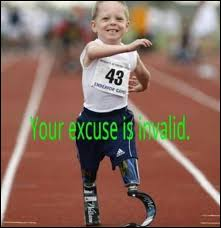
This is probably the first example I ran into, years and years ago, on Facebook.  

The text says \”Your excuse is invalid\” and the unwritten subtext is \”if this small child with prosthetic legs can get out there on a racetrack and enjoy running despite having no legs below the knee, you have no excuse for not doing whatever it is you\’re not doing.\”  

We know nothing at all about the child.  He is simply \”small white boy with prosthetic legs\” and his image is being used to guilt trip people for supposedly not accomplishing enough.  

I did some searching.  This child is now old enough to drive (and soon drink, too).  His name is Cody McCasland, a resident of Texas, and he\’s a serious athlete, but not a runner.  Running is a hobby.  He\’s a swimmer, with hopes of competing in the 2020 Paralympics.  And according to his bio on a website, he also wants to be an anesthesiologist, in part due to all the time he\’s spent in the hospital (30ish surgeries).  

Looking at the information from the media, it seems Cody has leaned into the publicity to some extent.  I sifted through a dozen or so articles, and all they typically wanted to do was rehash what amazing odds Cody beat, his promise as an athlete, and how wonderful that all is.  

Nothing is said about the difficulties inherent in affording, using, and cleaning prosthetic limbs.  Nothing about how many types of limbs he has, or why you can\’t just have one set for everything.  Nothing is asked about Cody\’s high school experience, his home life, any siblings… Nothing about the stares he inevitably gets from strangers, nor the invasive questions.  Nothing about him is of interest except his \”overcoming\” of his disability.  

In summary, Cody McCasland is reduced down to his disability, his struggles are omitted, and he is merely a prop in this picture.  His triumph is reduced to a bludgeon that, in the best case, might be used positively to elbow an abled person into starting to be healthier.  It might also be used to guilt trip someone with an invisible disability, because \”well you have both legs, so get out there!\”  (left unsaid: \”I neither understand nor care that you have chronic back pain or some weird allergy that makes you utterly miserable when you do moderate to high intensity exercise\”).

Let\’s look at an article from a prosthetic arm user.  Let\’s see, it\’s titled, \”I have one of those most advanced prosthetic arms in the world — and I hate it.\”  Hmm, can we guess how this is going to go?  The article is worth your read, by the way.  Real talk from someone whose life is unfamiliar to you often is.  She\’s even included short videos of her using the limbs.  

Generalizing Disabilities

There\’s one more issue with generalizing Cody\’s story to every possible situation, sitting back, and saying, \”well if he can do it, anyone can!\”  

Let\’s start by noting the obvious: Cody\’s disability is physical.  His legs from above the knee are flesh and blood, and below that do not exist due to a major difference in his DNA.  To move around at a normal height, he uses prosthetic legs.  This is a visible, physical disability.  

Visible disabilities mean you get stares and invasive questions.  This is typically unwanted.  However, because your difference is obvious, no one questions whether it is real.  An invisible disability, like mental illness or autism, can be disbelieved.  A person can decide, after looking at you, that your struggles are not real.  Seeing, as they say, is believing.  

Physical disabilities tend to be visible, but they don\’t need to be.  Chronic joint pain, fibromyalgia, and blindness without the person carrying a white cane or some other identifier are all physical disabilities, but not simple ones to notice in a second or two.  

Invisible disabilities include a spectrum of things people don\’t necessarily notice or care about, including depression, anxiety disorders, chronic back pain, chronic dizziness, diabetes, sleep disorders, chronic fatigue, and agoraphobia.  Because no apparent disability is noticed, the effects of these disabilities may be blamed on the sufferer\’s innate qualities.  

Instead of recognizing the very reasonable tiredness and reduced performance of a sufferer of insomnia, people might instead decide she simply isn\’t trying hard enough, or that her sleepiness is because she\’s too busy partying to adhere to a normal sleep schedule.  In reality, she may have spent hours lying in bed, fruitlessly trying everything in her power (from podcasts to boring textbooks to exercise to adult coloring books) to get to sleep, all as the clock mercilessly ticks onward towards the next work day.  

So while Cody\’s disability is clear, obvious, and the path to addressing the disability is clear… that is not the case for other disabilities.  

One need really only look at autism for a demonstration of this.  Some autistic people can find sensory relief in small perfume jars, swatches of fabric, or particular blankets.  Others would find those things ineffective or torturous.  Some autistic people suffer from gut dysbiosis or allergies, and need to eat according to special diets.  Choosing the wrong diet can be terribly painful.  Still others benefit from basic lessons in the mechanics of conversations.  I, however, would find such lessons irritating at best.  

What works for one autistic person does not necessarily work for another.  This is pretty common knowledge, immortalized in the saying, \”If you\’ve met one person with autism, you\’ve met one person with autism.\”

Saying, \”well this kid with a clear disability has a harder life than you, and still is doing this thing, so why aren\’t you doing this thing?\” is insulting not only to him, but to the person you\’re talking to, who may have struggles you don\’t know anything about.  

For further reading, please consult this article, which also links to an excellent TEDx talk.