Making an Apology: Balancing Objectivity and Subjectivity

In the last year or so, I\’ve been learning one of those Hidden Curriculum things I\’m fairly certain most neurotypical people take for granted.  That is, how to handle people, their emotions, and their subjective experiences balanced against your own subjective experience and your best understanding of what actually happened.

People seem to vary on this, but I personally believe there is one true objective reality.  The truth, so to speak.  However, humans are mostly too limited to be able to see it, blinded as we are by our cultures, prejudices, and personal experiences.

For every event that happens, there is, I feel, an objective account of what happened.  But then there\’s also the subjective experience of each person involved in that event.  A simple conversation between myself and my spouse has three parts, then:

  • What actually happened (the exact words exchanged and the objective situation)
  • My subjective experience and emotions in the conversation (my emotions and feelings during the conversation)
  • His subjective experience and emotions in the conversation (his emotions and feelings during the conversation)

Dirty Dishes

An example of this might be a quick interaction between my spouse and myself regarding a kitchen sink full of dirty dishes.  It is my spouse\’s job to put dirty dishes into the dishwasher and run the dishwasher when it\’s full.  I use this particular example because it\’s come up more than a few times, but also because typically when it does come up, it\’s usually an isolated incident of \”life was very busy, things were missed.\”
The objective facts of the situation are this: the sink is full of dirty dishes, there is room in the dishwasher for them, and this situation has been true for a couple days.  It is my spouse\’s chore to handle that situation, ideally without letting any build up of dirty dishes happen, ever.  Objectively, then, my spouse is at fault.
When I bring up the subject to my spouse, I may be upset or even angry that the situation has sat for that long.  This is because the sink being full is like a poke in the eye every time I walk past it, plus there\’s the smell, plus I can\’t use that side of the sink.  It is also not my job to police my spouse and remind him to do his chores all the time, and I may be frustrated that he still hasn\’t gotten to it.  The situation, therefore, is subjectively upsetting to me, and I may use harsher language than necessary to request that my spouse do his chore and pay better attention next time.  Objectively, it is reasonable for me to be upset in this situation; we had an agreement that he would do this chore in a timely manner, and because he didn\’t, I suffered those metaphorical pokes in the eye every time I went into the kitchen.

My spouse, on the other hand, does not experience those pokes in the eye.  In fact, he doesn\’t usually notice the buildup.  The situation, then, may have completely escaped him until I point it out.  Or he may have noticed it once or twice and said to himself, \”I\’ll do that later today,\” and then simply forgotten.  Regardless, having the subject brought up in a harsh manner would be surprising and hurtful.
So the (suboptimal) interaction might start with me saying, \”Dear, could you please take care of the sink already?\” with an edge in my voice, and then not taking \”not right now\” for an answer, and his surprise, hurt, and dismay in response to that.  We might then need to work together to convey why I was I was so upset, and I might need to apologize for being harsh, demanding the situation be fixed immediately, and for making him feel attacked.  
The objective facts remain true, that it was his job to do the dishes.  And my upset at the situation is valid, because of the reasons I listed above and because the situation shouldn\’t have happened in the first place.  However, there are better ways to address the situation that don\’t hurt feelings, and his hurt feelings in response to my harsh words are valid.  

Learning to say: \”I feel like this happened\”

For most of my life, all I\’ve cared about is the first part of the equation: the objective facts of the situation.  The second part (my subjective experience) was somewhat unavoidable, but I mainly tried to work with and focus on what actually happened, rather than anything squishier and harder to understand.  That included my own feelings and emotions.
The thing is, that\’s not really how people and interactions work.  You can\’t tell someone whose feelings you\’ve hurt, \”well that\’s not what I said,\” and expect their hurt feelings to just… magically go away.  It literally doesn\’t work like that in 99% of humanity.  To be successful, you have to acknowledge that others\’ feelings and viewpoints, while possibly inaccurate, are also valid.
It has been somewhat of a struggle to learn to say, \”I feel like this happened,\” and \”to me, this is how this happened,\” rather than, \”this happened.\”  I\’ve had a helping hand with that, which is to say that my memory doesn\’t seem to be as crystal clear as it used to be.  Regardless, though, even if it was still crystal clear, the fact would remain that I\’m prone to error.  I have a subjective experience, with emotions that color my understanding of the truth.  My memory might not be perfect, and even if it was, if the other person understood the words differently, their perspective and feelings also matter.
So, in an argument with my spouse about how to handle chores (a common friction point in our relationship and in many others), I have to keep his emotions and subjective experience in mind during and after the conversation.  If he becomes upset, it\’s not productive to try to argue him out of being upset, even if I think he\’s being unreasonable.  
Instead, I need to address the upset.  Perhaps I\’ve been unnecessarily harsh in choosing my words because I\’m frustrated.  Or perhaps it\’s not even my fault and  he\’s upset because other stuff in life (like a job change or the stress of the coronavirus) is putting pressure on him and it\’s made him snappish or more prone to defensive (rather than constructive) behavior.  
Knowing the why of the upset is helpful to me, because it makes me feel like I can handle the situation better.  Regardless, though, I don\’t gain anything by ignoring his upset emotions.  Doing so simply prolongs the bad feelings.  Even if they seemingly go away over time, resentment can build up and poison the relationship.  Since I love my spouse and want our marriage to last, I try not to let this happen.
So I apologize as best I can, using what information I have, and try to ensure that if it was my fault, I don\’t repeat the error.  Sometimes it\’s difficult to apologize, because I feel perfectly justified in what I\’ve said or don\’t feel I\’ve done anything wrong.  However, even if that\’s true or the harm I did was unintentional, my spouse is upset, and that has to be addressed in order to move on.

With the upset handled, the actual incident can be handled, and my spouse will then prioritize handling his chore, and perhaps even apologize for letting it slide for so long and subjecting me to so many pokes in the metaphorical eye.

The Parts of a Good Apology

Apologizing isn\’t really a skill I was taught much, especially as an adult, so I\’ve had to piece together how to do it well in my relationship. Your mileage may vary: some people value certain parts of an apology more than others.

First, set aside your anger, resentment, and frustration.  That can be really hard when emotions are overwhelming, so it can help to take a few minutes\’ break from the discussion before attempting an apology.

Before you start talking, take into account the other person\’s perspective.  Why are they upset? Did you cause the upset?  These need to be included in the apology. I like to ask for clarification if I\’m unclear on points, but depending on who you\’re apologizing to, asking at the moment of apology may simply bring more anger.  Some people don\’t care why you did something, because they\’re blinded by being so upset.  In those cases you need to apologize first, and the person may elaborate on why they\’re upset in response.  You can then use that information to make a better apology directly afterwards, and a third or more if needed.  
Knowing the why of a situation is very important to me when I\’m being apologized to, because it gives me information about whether the person was acting as they thought I\’d prefer, being thoughtless, or even whether a bit of cruelty was involved.  It clues me into how genuine the apology is, and the circumstances the apologizer was in make their actions more understandable.  It helps me understand the apologizer better.  
However, there are limits.  The problem with giving context for your actions when apologizing is that it can come off as making excuses rather than a genuine apology.  If there\’s too much context and not enough taking responsibility and acknowledgement of the other person\’s hurt and upset, the apology rings false.  Finding the right balance takes practice.  When in doubt, I typically apologize with whatever context I have and explain the why afterwards.  
When you make the apology, convey your understanding of the situation and acknowledge the other person\’s hurt and/or upset.  Keep in mind what you\’re responsible for: your words and how you said them.  But also keep in mind that an apology is far easier than finding new trusted friends or a spouse. 

Something to keep in mind is that when you apologize… You are not necessarily saying that you are wrong and the other person is right.  I may be perfectly correct and reasonable in being upset about the dirty dishes situation, but I still don\’t want my spouse to be upset when I bring it up.  I just want him to fix the situation and make efforts to keep it from happening again.  So my apology to him would NOT be, \”I\’m sorry I upset you, I shouldn\’t have said anything.\” Instead, I might say, \”I\’m sorry I upset you with the way I brought this issue up.  I didn\’t mean to make you feel attacked.\”  

The apology does three things: it validates my spouse\’s feelings and his right to have them (something we both struggle with), it lessens the amount of hurt he\’s experiencing, and it demonstrates that I care about him.  All these things are important to keeping a relationship healthy.  
It\’s been a struggle to learn this skill of balancing objective fact (as best I can recall it) and subjective realities, and I\’m definitely still practicing.  However, our relationship and communication has improved as a result, and conflicts happen less and are resolved far more quickly.  We used to spend hours of misery on each conflict, sometimes even on things that weren\’t really important.  It\’s now down to minutes, and the conflicts are far smaller.  

When and Whether 

As a note: The kind of people-handling I\’ve described here works because my spouse and I don\’t mess around.  We don\’t play emotionally abusive mind games or invent problems for attention.  When either of us brings up an issue, it is in good faith, something that is genuinely an issue.  I am very fortunate in that regard, because abusive people can and absolutely do take advantage of autistic people.  It can be hard for an autistic person to sort out what\’s a reasonable concern and what\’s unreasonable or emotional manipulation, because neurotypical people don\’t make sense to us in the first place.  
I don\’t typically need to use this kind of people handling in the rest of my life.  Random passersby and business associates either don\’t generate conflict or don\’t matter enough to care about the conflict.  In the latter cases, I typically apologize because it\’s the right thing to do, but I don\’t place a whole lot of emotional investment or energy into it.  So I mainly need this skill for handling friends and family.  
I suspect it helps to practice it with a wider variety of people, but with that wider variety also comes the potential for abusive or bad faith interactions.  I also have far less information on how, when, and why to make an apology, which means less successful interactions, even when I\’m doing my best.  So it pays to take care when handling conflict with less familiar people, and weigh the possibility that the other person isn\’t being genuine.  
This is honestly difficult, especially since I tend to automatically take people at their word.  It\’s exhausting to second-guess what people tell me, which is probably why I usually don\’t bother these days.  My life is hard enough without having to spend my limited energy on second-and-third-guessing what people meant.  I\’d rather spend my energy growing food or reading autism books and research.  
So it\’s only if the people are important (friends and family) or if the situation is important (job interviews or advocacy) that I usually bother these days.  Everyone else can just say what they mean.  Which is how I think everyone should act anyway. 

Doing Your Best

The last thing is that sadly, even the best apologies don\’t always fix everything. 

The other person needs to be willing to hear your apology and try to move past the conflict.  While that\’s usually the case, it isn\’t always.  Sometimes you simply have to do the best you can for a situation, and then move on.  I\’ve lost a few friends in my lifetime, and whether the fault was mine, theirs, or both, it\’s never terribly fun.

To me, doing my best for a situation means:

  • Apologizing to the best of my ability, 
  • making right what parts of the situation I can (like replacing an item I broke), 
  • reflecting on my part in the situation so I can avoid repeating it in the future, and
  • forgiving myself.

When I\’ve done those things, I can lift my head and say, \”I did my best, and if you can\’t forgive me, that\’s on you.\”  I can then move on without regrets about myself and how I handled the situation.  

At the end of the day, I have to live with myself.  Doing my best in as many situations as I can is one way I make that existence tolerable, or even something to be proud of.  

I Don’t Do Excitement: Handling Emotions While Autistic

I had kind of an interesting and educational experience last Tuesday.  Briefly, I was invited to help lead and speak on a panel to educate med students about autism.  It was myself and three other autistic people.  This was, thank God, the last major thing this month besides a dual party for myself and a friend.

I wrote the bones of my speech the day before, the speech itself the day of, and then I spent another hour or so putting together a handout with further reading and the main points of the speech.  Because I\’ve been a student and I swear to you, lectures are the least useful way to convey information.

After all this was done, I had about two hours before I needed to leave.  This left me sitting in anticipation.  I assessed the emotion absently, labeled it anxiety, and proceeded to put on depression music to shift my emotional state.  Basically it\’s the kind of sad/angry music you can kind of drown in, which helps you feel understood and also feel calmer, though not better.  I\’ve done this before, and it works quite well.

But I thought about it as I listened to the music, and realized that I was probably going about things wrong.  The anxiety feeling was uncomfortable in its strength, but the situation I was heading to wasn\’t really a bad situation.  It was simply new and important.  If I kept the depression music on, I would be less anxious, but I\’d also approach the situation with resignation and sadness.  That wasn\’t a good attitude to bring to these medical students. 

I also recalled the podcast I\’d listened to a few months back, which mentioned that emotions can be boiled down to two spectrums: wound up-calm, and positive-negative.  Excitement, you see, is merely positive anxiety.  Physiologically, they\’re exactly the same.  The difference is in how you mentally view the situation.

This realization made me realize I honestly don\’t do excitement.  I do anxiety.  All excitement in my life has likely been mislabeled anxiety or worry because it\’s what I\’m used to.  Granted, the excitement-to-anxiety ratio is probably heavily skewed toward the latter, but I don\’t honestly know. 

The end result was that I was so used to feeling bad and reading wound up as anxiety, that it didn\’t immediately occur to me that I should maybe just be happy for myself that I had this opportunity. 

After I thought about this for a while, I put on some more neutral, semi-wound-up music and sniffed my calming perfume scent to take the edge off my wound-up-ness.  I then began playing a favorite puzzle game on my phone until I could be distracted with other things and needed to go. 

I did manage the speech, though I was still pretty…well, it felt like anxiety again frankly, because there was a whole classroom of college-age students looking back at me.  I was a bit busy just trying to read the speech and not rush to question whether it was excitement or anxiety. 

That\’s something I\’ll have to look for, going forward.  I\’m not sure if I\’ll continue to have to do it via deductive work (i.e.: this situation is positive, I should be excited not anxious), or if I\’ll eventually develop a sense for the difference. 

Either way, this is progress.  

Histamines: Taking the Misery Out of Exercise

About a month ago, I experimented with flooding my system with histamines to see if it would trigger any ill effects.  I did this via food intake, custom-tailoring a day’s meals to add external histamines to my system.  The results were not spectacular, but they did have promise.  I experienced worse than usual brain fog, lack of focus, a burning in my stomach lining, and some trouble breathing.

As it turns out, overloading my system with histamines wasn’t actually the best experiment I could have tried, because the results were simply in degrees of discomfort.  A better experiment would have been to remove them entirely from my system and observe the results, particularly during hard exercise.  So I did that!

The Exercise Experiment

The one thing I didn’t really try during this food overload experiment (quite possibly because I felt too poorly to consider it) was exercise.  I made a note to try the exercise later, but didn’t really set up a good experiment for it until just recently.

As it turns out, as much as vitamin C is excellent for you and a good day-to-day solution, a good over-the-counter anti-histamine is more rigorous and quick to take effect.  Your basic allergy medicine, in fact, will handle this, though naturally you shouldn’t be taking allergy medicine every day unless you actually have allergies and can’t manage them without it.  So, knowing the effects were likely to be obvious, I took a single store-brand Benadryl, gave it 15 minutes, and then went biking as hard as I could.

I went for half an hour, and pushed myself hard.  Sustained cardio exercise at moderate-to-high intensity has reliably made me miserable in a hurry, so even though I was opting for an exercise that allowed for breaks, I figured I could just keep pedaling rather than taking my usual breaks for breathing.  The area I live in doesn’t have all that much by way of hills, but it didn’t matter, because…

The results were about as telling as I could have wished.  I got tired, and had to work very hard… but I did not get miserable.  Histamines, apparently, had been choking me out of my oxygen and proper brain function.  Effectively, I was having an allergy attack every time I exercised… until now.  It was extremely strange to be working my body so hard without becoming mentally exhausted and depressed.

The bane of my existence has always been exercise, and it’s because, to the best of my knowledge, I run short of oxygen very fast and spend the rest of the time simply trying to survive the exercise with enough oxygen to not fall over or stop.  I had a summer cold a couple months ago and experienced the same symptoms (misery and low oxygen intake) from simply sitting, so it was easier for me to recognize the second time around.

The Histamines\’ Source

So if it wasn’t what I was eating (I’d established in the last experiment that I mostly avoid all the foods that are high-histamine), why was my system overloaded with histamines?
The answer appears to be (at least) twofold.

This is the pond out my back door.  All the snot-colored splotches in the water are algae.  They’re some type of toxic species that happily grows in all the fertilizer runoff from the condos on my side of the pond and the apartments on the other side.  Normally they treat the pond for this mess, but after July was over, they kind of stopped, and this is the result.  I have a very high quality furnace filter cleaning the spores out of my house’s air, but it’s not like the house is airtight.  I may set up an air purifier in the bedroom as well, since I spend a third of my day in there.

The “this is definitely a problem” experience that makes me sure this is part of the problem happened when I went out to get pictures of this algae once.  I was out there for maybe two minutes, in the hot summer sun, last year… After I got back inside I had to lie down for like three hours because I felt so bad.  It was like my brain function had been repressed, almost like being extremely drunk, except without the visual impairments, coordination impairments, and nausea.  I had enough presence of mind to take my N-Acetyl-Cysteine, which helps detoxify my system, and drink a ton of water to help flush things out, and then I simply lay down, closed my eyes, and waited it out.

I woke feeling a little better, but not really back to normal, and with a much healthier respect for the toxic sludge that lives outside my back door…  Even opening the back door for a couple seconds has deleterious effects on my brain, though thankfully not the “go lie down for three hours\” effects.  More like “you’re going to feel kind of bad for 15 minutes.”

So, I’m pretty sure the algae is factor one.  Factor two?  House dust mites.

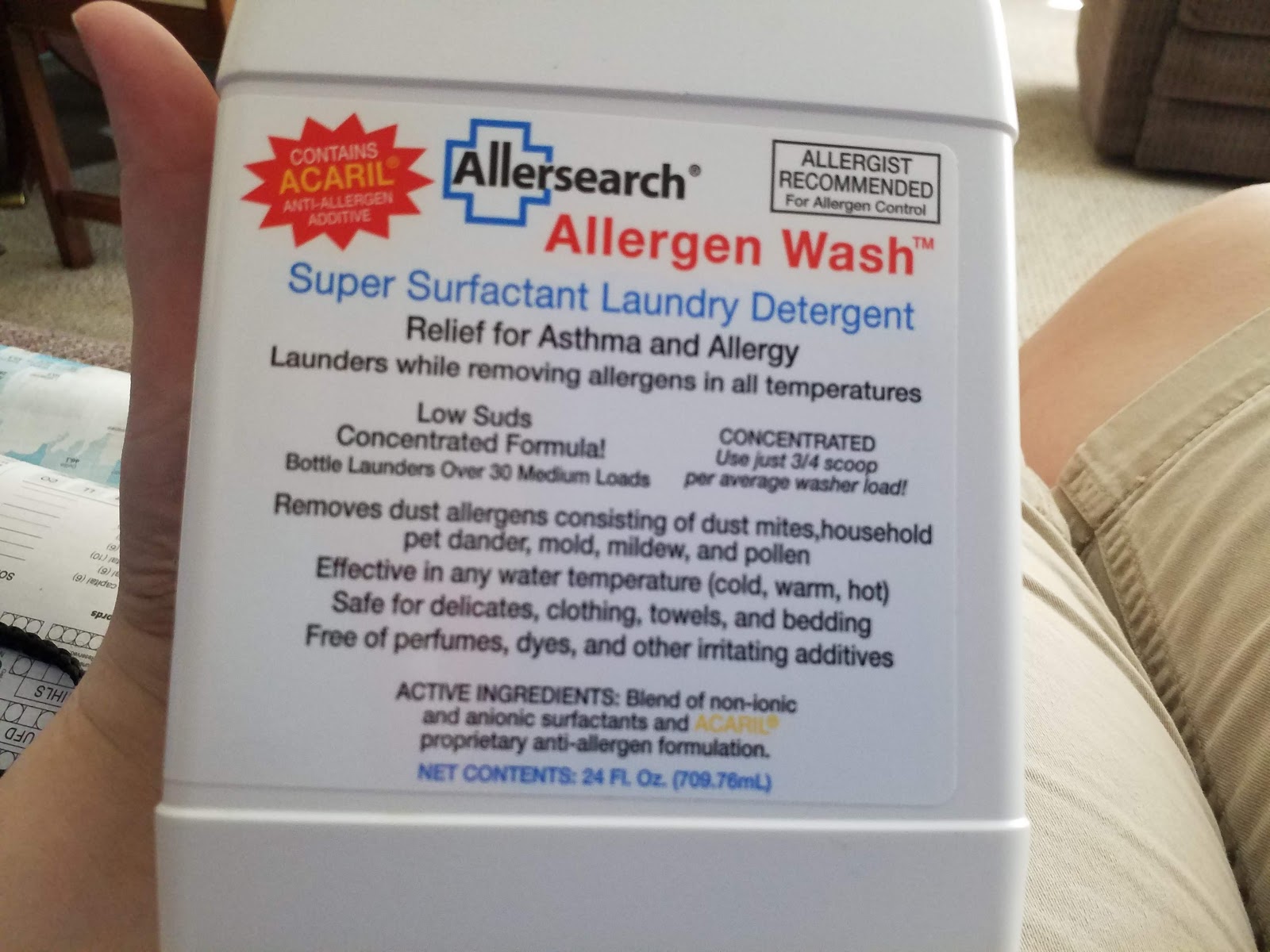
My mother is allergic to these, which is fortunate because otherwise I probably wouldn’t have attached any importance to the fact that my nose starts plugging up when I lie on bedding that hasn’t been washed in a week.  She actually has it much worse, in that she actually can’t sleep if the mites are bad.  Her nose just keeps running and stuffing.

I mentioned this to my doctor, and she recommended washing my bedding in hot water.  The problem is that hot water shrinks things, and I don’t really like fighting my spouse for blanket.  Fortunately, my mother has a solution:

More the former than the latter, but if the former doesn’t entirely fix the problem, the latter might.  Or might just help with the algae also.  I’ve ordered a bottle of the deMite, and will try it next laundry day.

A Healthier Life?

I’m really hoping those are the only two factors, and that good care with both of these factors will sort the problem out.  If it does, I’ll be able to exercise more regularly, and at higher intensities than I’ve ever been able to before.  I’ve been reluctant to exercise… well, at all, really.  But especially at moderate to high intensities, because… misery.  If you’re miserable every moment you’re doing something, you tend not to repeat that activity.

I still have the years of misery associated with exercise, of course… but I’m not going to let that stop me.  Movement is immensely important to mental, physical, and emotional health.  If I can incorporate it in my life without the historically destructive, all-consuming misery, that would be a massive improvement… and it might make all the difference.  I might actually come to like exercise.  (Given my past history, this last sentence would normally equate to “pigs might fly.”  The future might be different, though!)

In the meantime, I need to manage my daily histamine levels.  This often means careful diet management, but in my case, I basically don’t eat anything that’s high in histamines anyway.  I need merely cut a couple foods that I wasn’t extremely fond of anyway.  My doctor has recommended an herbal supplement that should help with the day-to-day management of this histamine overload.

Notably high in vitamin C, of course, but the various herbs listed there also help with histamine management.

In the meantime, further experiments with vitamin C are in order!  I’ve had promising results with drinking a dose of my vitamin C powder about 30 minutes prior to biking.  But biking is just the easiest option.  If I can, I’d like to experiment with my archnemesis of exercise: jogging.  I have a long history with failing miserably at jogging, and it’d be a real turning point if I could succeed at it and get really good, intensive exercise at the same time.  I’m very hopeful!

Constantly Wound Up

Recently, I remotely attended an event called Summer Games Done Quick.  It\’s basically a convention for a subset of video game players, and it raises money for charity.  Literally, every penny they raised this time went to Doctors Without Borders.  (They raised a lot of pennies, I\’ll get to that later.)

I found myself in kind of an interesting mental state during the event, so I thought I\’d discuss it a bit.

So, this convention was unlike most of the ones I\’ve attended, in that it more or less had no breaks.  First, it was literally a 24 hour a day event.  There was always something happening.  Most conventions have events until dinner time, and then you\’re done for the day.  But also, when you attend a convention in person, you have to tend to your physical needs, like using the bathroom, eating, etc.  Because you\’re away from home, these things take time, which you would use to mentally unwind a bit.  
There was none of that during this virtual event.  You could take the event with you to the bathroom and to the dinner table.  You probably SHOULDN\’T, as I was to learn, but you could.  I normally don\’t watch much TV, or even livestreams, but I made an exception for this event.  
The results were interesting.  I experienced a kind of mental static, a distracting hum of sorts, when I wasn\’t immediately listening to the event or doing something else on my computer.  This was particularly obvious after watching for a couple hours straight.  I\’d take off my headset to go to the bathroom and hear it.  Or maybe feel it, I\’m not really sure.  The hum came with brain fog, reduced mental capabilities, and snappishness, though both of those might also be because I didn\’t sleep terribly well.

Besides the unusual schedule, where someone was always playing something, my brain also seemed wired, like it only slept reluctantly.  When I woke up, I was near-immediately awake, and usually only after 6 hours or so.  Combined with the weirdness of my bedtimes (sometimes after 2am), it was… not a healthy situation.  

That\’s possibly why I got sick with a cold… though I\’d be more inclined to say I probably already had the cold and the unhealthiness of my sleep schedule simply exacerbated my symptoms.

In addition to the cold virus, I got a lot of exposure to various kinds of people and various kinds of video games.  It was pretty cool to see so many gender non-binary people.  There were various guys with long hair, people who specified their pronouns before starting their speedruns, and people who presented as neither male nor female or some mix of both.  And of course, there were people of color and people from other countries represented in this mostly-US event.  
I think next year I\’m going to have to very selective about what I watch.  It was really fun to see a lot of the things, but I don\’t think I want to be this tired or this sick again in January, when the event goes again.  I didn\’t cancel any of my regular life events, but I still became this tired and sleep-deprived, so something definitely needs to change for next time.

It was a really successful run this time, though.  The previous record for a Games Done Quick drive was $2.2 million, and this year they got over $3 million, all of which went directly to Doctors Without Borders.  Seeing everyone get so jazzed up at the live event was kind of awesome, although it made me very glad I wasn\’t there due to the sheer noise levels.  People were VERY happy, and VERY loud.

It\’s taken me a few days to get back to normal.  I might not quite be there yet, even now, honestly.  There\’s at least some truth to \”don\’t watch TV for hours, it\’s bad for you.\”  Still, most of my symptoms are cold symptoms now, I think.  The static\’s gone, and I\’m less crabbity and grumpy.  Hopefully soon the cold will go away and I can get entirely back to the usual life.  

Double Empathy

Autism is an actively lived condition.  Thousands, even millions of people have it.  Most of them now adults.  In that time, we’ve all been thinking about the treatment we’ve had as children, and as adults, and what autism is, what it means for us, and what we should do because we have it.  
 
The answers to those questions vary by the person, but like any communicating people, we have, as a group, gotten together in places and done some thinking.  New philosophies have risen based on those thoughts.  One of these is the Double Empathy problem.  
 
The basic understanding of autism is that some people are born different, the difference is in their brains, and that makes them have trouble communicating with others.  This would be the single empathy problem: autistic people, we’re told, have trouble communicating.  
 
The thing is, it’s not that simple.  Scads of personal testimony from autistic people networking with other autistic people have led to researchers doing studies on it… and it turns out we communicate with each other just fine.  The problems come when you mix autistic and neurotypical people.  Why is this?  
 
It’s because neurotypical people are set in a single, accepted way of communication.  Specifically: verbal speech in very limited, specific patterns, plus a layer of non-verbal body language reading.  Anyone who doesn’t communicate in that manner, or not exactly in that manner, is deemed “broken” and summarily ignored or not taken seriously.  
 
Autistic people, especially adults, don’t do that as much.  We understand and recognize a broader range of communication, because we ourselves use a broader range of communication.  We’ve spent years learning to be polite and respond appropriately and trying to think in ways unnatural to us, and it’s granted us a form of empathy that neurotypical people… entirely lack.  Because if all you use is one form of communication, you are blind to any other kind of communication.  
 
Research is beginning to bear this out.  I don’t expect the results to change much as these studies are repeated for scientific rigor.  To get an idea of the kinds of calculations you should be doing when faced with an autistic person (or really, any person that strikes you as “different”), check out this example behavioral analysis of a child named Sam in a school classroom.  How many of those factors occurred to you, when presented with the restless child at circle time?  
 
This is the Double Empathy problem.  Yes, autistic people have trouble communicating to neurotypical people.  But no, that’s not a 100% us problem.  Communication is a two-way street, requiring perspective-taking from both sides.  Neurotypical (NT) people don’t communicate back to us in ways we understand, but we’re still blamed for not understanding.  See how this works?  You’d think, if neurotypical people were so ideal and wonderful and everything we autistic people should strive to be, that y’all could communicate back to us in ways we understand.  But that’s not the case.
 
In more visual terms:
 
Autistic person ——> NT person
(difficulty communicating and being understood)
 
NT person ——> Autistic person
(difficulty communicating and being understood)
 
And yet:
 
Autistic person ——> Autistic person
(no difficulties)
 
Double empathy.  Double.  Two-way.  Neurotypical people are part of the communication problem.  We appear to be have different sets of social skills.  Autistic people are demanded to learn neurotypical social skills.  Maybe y’all should learn ours, too.  

Intelligent Lives: Attending a Screening

I went to a screening of Intelligent Lives in my area yesterday.  It\’s a documentary about people with intellectual disability (ID; ie: low IQ).   It touches on the overuse of the IQ test, but its main point is showing how people with intellectual disabilities are normally institutionalized, but don\’t need to be and shouldn\’t be. 

In the main, it follows three people with ID, and tells the finished story of a fourth.  I was pleasantly surprised to see that two of the three living subjects are dark-skinned.  The movie points out that black and brown people are twice as likely to receive ID diagnoses, so was quite appropriate. 

My opinion of IQ is known, but I\’ll summarize it quickly.  The Intelligent Quotient test was never meant to be a catch-all measure of a person\’s value or chances of success in life.  It was created to measure one thing: your ability to learn in a standardized school environment, with standard school subjects. 

This is good information to have, naturally, in a society where schooling is mostly verbal/textwall-y and also compulsory.  However, it\’s hardly the whole picture.  It\’s missing things like:

  • how well you can sense others\’ emotions and motives.
  • self-knowledge, recognizing your own reactions, motives, strengths, and weaknesses.
  • your sense of musical pitch and rhythm (perfect or approximate pitch)
  • how graceful or clumsy you are in team sports and other athletics
  • your grasp of what is important in life, what life is about, why we live, and why we die.
  • how well you can visualize things in 3D, move them in your head, and plan things out without ever touching or seeing them.
A person can excel in many of these things, but still have a low IQ.  And because of how much emphasis we place on IQ, that very intelligent person will be afforded few opportunities to use their natural talents.  They will generally be considered unable to make their own life choices, and set apart from their peers.  
Needless to say, I hope, this is both absurd and wrong.  
I attended this screening without knowing what kinds of people would be there, and how far along the community was in understanding things like \”why self-determination is important,\” \”the stress and frustration common to siblings of people with disabilities,\” and \”the importance of including the voices of the people you\’re talking about in your discussions.\”  
I was pleasantly surprised, as the discussion afterwards seemed to have a good sense for the first two points.  The last, however, was entirely neglected.  While there were people with ID present, their voices were not asked for.  It was, in the end, a meeting of special education teachers and parents.  
I spent a good amount of time being rather uncomfortable about presuming to speak for people with intellectual disability, but opted to do so anyway, merely because no one else was going to.  I do not qualify, and never have qualified for the ID diagnosis.  What I do have is the knowledge that self-advocates are often excluded from these discussions, often out of sheer ignorance.  It simply doesn\’t occur to parents and teachers that adults with the condition would have anything to say.  
I\’m afraid I couldn\’t muster the mental organization and politeness to address the room as a whole, and point out the obviously missing piece in the discussions.  I was running on very little sleep and had to skip dinner in order to attend the movie, which made me distrust my ability to make my point in an approachable fashion.  Honestly, I probably should have made the point anyway, but I was really super uncomfortable representing a group of people that I wasn\’t technically a part of and didn\’t have any immediate friends\’ thoughts to fall back on.  
I\’ll try to do better if I go to one of these things again.  I have a better sense of the community now, which will make me more confident in dealing with it.  Given how the people at my discussion table reacted to my comments on the subject, it seems like this particular message (\”invite adults with ID to the discussion table, give them the microphone, and listen to them\”) needs to be heard.  Repeatedly.  If it takes an autistic self-advocate without an ID to make that heard, at least someone\’s going to do it.  

Hospital Rooms are the Worst: Observations from a visiting autistic

I went to visit my grandmother a few months ago in two different hospitals.  As such, I got a chance to observe a bit of what being in a hospital room entails.  I\’ve had the very good fortune to not be hospitalized after the age of 3, so I don\’t have any firsthand experience to draw on.

Also, full disclosure: I am not a medical professional and have very little experience with why the system is designed the way it is.  Still, the experience was sufficiently, um… enlightening, that I thought I\’d share a bit of my observations.

Before I begin, I should note that I have no real complaints about the medical care my grandmother received, and the hospital staff I dealt with seemed neutrally helpful at absolute worst.  Most were warm and caring.  The corridors of the hospitals were fairly well-marked, even containing artwork and large windows to let in natural light.  I really can\’t complain about most of the experience.

I did want to highlight a few things, though, because first and foremost, I super duper do not ever want to have to stay overnight in a hospital room.  There are so many reasons for this.  We\’ll start with the easy ones.

Hospital rooms are noisy.  The doors to these rooms are often kept open.  If the patient can\’t get up by themselves, that\’s even less negotiable.  That means people walking by, whether they\’re staff or visitors, are clearly audible to my sensitive ears.  The air conditioning unit/heater was also very loud.  If the person is kept on oxygen, that machine also erratically makes noise aside from the puff of oxygen every 5 seconds.  I can\’t imagine having to try to sleep with that on.  And lastly, my grandmother was on an IV.  The IV was automated, to a point, and itself made this faint, but highly erratic scratchy-clicky noise.  It\’s probably highly ignorable to most people.  Not to me.

Also on the sensory end of things, the temperature.  It was the middle of winter when I visited, so while the room itself seemed warm upon arrival, I quickly found, sitting still and visiting, that I became cold.  For people who are stuck recuperating in a bed, this would mean they\’d be cold all the time.  Yes, the hospital might provide blankets, but I\’ve never yet had a nice warm comfortable blanket provided by a hospital for any procedure.  \”Easily washable\” and \”highly comfortable\” simply don\’t mix, I guess.

Then there\’s of course the various things that come with your care in the hospital.  The oxygen puffs I mentioned?  Besides being loud, they are also cold.  Y\’know how it\’s painful and annoying to have a frozen nose when you\’re walking around outside?  With the magic of modern medicine, you can have an icy nose while you\’re inside, too.  Then there\’s the IV in your hand, which can hurt as well as leaving you tethered to a bag on a pole.  You may not be able or allowed to get out of bed to stretch your legs, as well.

Distinctively disturbing-to-me, also…  hospital rooms are depersonalized, to the point of being oppressive (to me).  Neither room my grandmother inhabited during her stays was small.  And yet, there was little-to-nothing personalized.  All the surfaces were filled with hospital equipment, with almost no place for flowers, get-well-soon cards, or even personal possessions.  The second room had no window at all.  And both rooms were cluttered with medical equipment, to the point of barely being able to have visitors sit near the patient.

The staff, nice as they were, rarely if ever knocked on the door before entering. And this could happen at any time, including the hours when you should be sleeping.  There was a guy that walked in without a word, installed a piece of equipment in the room using power tools, and proceeded to waltz back out again.  I can\’t say for sure that this was normal, but nobody in the room batted an eye about it.

Finally, there was a certain amount of forced passivity about the whole experience.  You can be confined to a single room, with few or none of your personal possessions.  You do as you\’re told, eat what\’s put before you, and pretty much just sit in bed until you\’re well enough to leave.

I dunno if it\’s clear why I find all of this horrifying from how I\’ve written this post, but I\’ll explain.

From a sensory standpoint, a good place to heal and rehabilitate is not a noisy, chilly one.  With random noises and people going by at all hours, I wouldn\’t be able to sleep well, which would in turn slow my recovery as well as degrade my sanity.  Also, I get miserable when I get cold, so I would spend most of my time miserable and under scratchy, unpleasant hospital blankets.

As an autistic person, and to a lesser extent, as a human being, I prefer comfortable, familiar surroundings.  That means the having the weird light blue faux-fur blanket in my computer chair, my tablet and computer, a plastic glass with filtered water, and roughly a dozen other things, minimum.  Guess how many of those would fit in one of these hospital rooms?  (If you guessed \”just the tablet, maybe,\” you win!)  I\’d quickly become miserable without these things, assuming the cold didn\’t already make me feel miserable.

I would be constantly removing the itchy, chilly nose-pump oxygen thing, and probably getting yelled at by the staff for doing that.  I\’d probably want the IV removed as soon as it started aching, as well, which is super unhelpful considering why they use them.  I would probably become embarrassed and annoyed by the computer screen with the readout of my pulse, blood pressure, and whatever else other medical details they cared to track via the equipment.

But in the end, what would probably be most poisonous to me would be the forced passivity.  I like being independent.  I like having the ability to say \”I\’m going to get up and take a walk now\” and then going and doing it.  Hospital rooms seem very geared against that kind of personal agency.

I recognize that this is partially by design.  Medical care is hard to give effectively, particularly in cases when you don\’t know why the patient is sick or injured in the first place.  Then, too, the patient may not be cooperative.  In some cases the person has to be kept still, lest they make a back injury worse, or fall due to poor balance, or injure themselves.  I\’m sure there are other complicating factors I haven\’t thought of.

To me, though, the hospital\’s first priority doesn\’t seem to be the patient\’s mental wellbeing, but rather their physical wellbeing.  I imagine, in the future, these things will be considered two parts of the same thing, but they aren\’t at the moment from what I can tell.  As a person with an education in psychology, I don\’t approve… but as I noted above, I know very little about how or why these systems were developed the way they are.

I expect, when I end up in a hospital, I will have many very annoying questions for the staff.  

Deconstructing A Lifetime’s Expectations

I turned 30 last year, chronologically speaking.  (My actual age is debatable, but that\’s an entirely different discussion.)  Societally speaking, that\’s supposed to mean I\’m to have my life together.  What exactly \”having one\’s life together\” means is also debatable, because the American dream of \”college education, good job, house, car, spouse, kids, retirement,\” isn\’t really feasible in its entirety for most people in my generation, let alone most autistic people overall.

This is less an issue with autistic people as people, and more an issue of how many of those expectations are flatly unfair.

Starting with college education, since that\’s normally the first thing on this list people achieve, or don\’t.  The promise here with a college education is that you\’ll become a well-rounded, well-equipped person who can then proceed more successfully in life.  

First and most obviously to anyone of my generation, if you get a college education and aren\’t rich, you have to take out loans.  Lots of loans.  The days of being able to put yourself through college on a summer job or a part time job during the year ended in the 1980s.

This financial strain of the loans you take out to pay for tuition, room, and board beggars your income from any job you might get post-college… which statistics show us is not guaranteed to be a good one using your degree anyway.  Those statistics are across the mainstream population, and it\’s not just a temporary rut you fall into– the underemployment can last for much of your life.  Your prognosis only gets worse if you add in special needs.

Personally, I attempted to get a \”good job\” via an internship in my minor at the local library system.  The internship went well enough, and led, after some time, to a \”good job\” at a local company… but due to miscommunications, depression, and massive anxiety attacks, I lost that job and pretty much never regained that path since.  I worked several \”underemployment\” jobs doing secretarial work, but even those didn\’t last.   My current job, as an advocate and consultant, pays only sporadically.

Regardless of how much you make and whether it uses the degree you went to college for, you are paying a mortgage on your life, effectively.  On average, this debt will take 21 years to pay off.  
That puts a bit of a damper on getting a house.  To have a chance at a house, you need to have money for a down payment, which means having savings.  Y\’know, that thing you don\’t have because of student loans and medical bills.  You also need to be able to save some money for property taxes, maintenance, and repairs, because stuff does like to break.

I have a house at this moment because my spouse has a \”good job\” that he likes, and I had the good fortune to be born to parents that were good about saving money in the long term, as well as a generous grandmother.  Between our pitiful savings and the support of my relatives (who we are now paying back, and will be for years), we were able to make the down payment on a home in good repair and with sufficient space for us.

Unfortunately, my scenario is not the norm, even for neurotypical people.  Mostly, people of my generation rent or live with our parents.  

The latter option is particularly common for autistic people due to our higher support needs.  Our parents are often our first advocates and know our needs best.  Finding the supports we need to live our best lives is difficult and expensive.  Usually there\’s only one route to receive those services: Medicaid.  Otherwise known as the service that tends to routinely deny first time applicants*.

Show/Hide

The fun part (sarcasm) about Medicaid is that its income restrictions (meant to make sure only the poor and disadvantaged use it) haven\’t scaled with inflation over the years, so you also usually have to be nearly destitute to benefit from it.  Remember that good job you wanted?  Yeah, probably not happening if you need support services.

Even if you can get Medicaid, finding the right services is extremely challenging.  A good supports coordinator is supposed to do that for you, but with the high turnover rate, good ones can be hard to find, and in some cases, your area may simply not have what you\’re looking for.  If you need assistance moving around, taking care of things at home, or simply want something to do during the evenings, you\’re at the mercy of what\’s available to you.  In rural areas and some suburban areas, that\’s not necessarily much.

Having a car is often essential to having a job and a social life, but like a house (on a lesser scale) it isn\’t necessarily affordable (cost of a car, and then insurance, maintenance,  and repairs) or even feasible.  With certain types of disabilities, such as visual difficulties or anxiety disorders, you can\’t even pass the tests or complete driver\’s ed training for your driver\’s license.  In fact, fewer and fewer teens in general are getting their drivers licenses.  Not surprising, then that only 1 in 3 autistic teens are successfully acquiring their licenses.

My first car was a gift from my grandmother, after she decided she was done driving herself around.  Had my need for a car not coincided with that occurrence, I might not have had a car while I was in college.  Trying to buy a car while in college would likely have been impossibly difficult for me, as I was struggling to simply survive college for the first couple years.  And that\’s assuming the money was even there for such a purchase.

With less mobility (either due to lack of a car, or due to other transportation difficulties), it becomes harder to keep up a social life.  Once out of school, the forced daily social interaction disappears, and we\’re left with online communities and little else.  A church can offer some activities, as can supports derived through Medicaid or paid out of pocket.

Beyond that, though, the \”easy\” routes are gone, and you\’re left trawling for interest groups, visiting local events if you can (again, transportation!), and spending lots of time online.  Finding a spouse in all of that is… difficult, to say the least.  Autism is literally defined by having significant difficulties with social interactions and rules.  And a managing relationship is basically that, but all the time, and with high emotional stakes.  Autistic people tend to be fantastically loyal, which endears us to some people, but the strain of routine miscommunication can be difficult for both partners to bear in the long term.

For me, I didn\’t find my spouse, he found me.  This was fortunate, because during most of school, I radiated \”leave me alone\” vibes.  I\’d learned that people tended to be cruel to me, and there weren\’t sufficient positive reasons to interact with people for me to bother.  If you were decent to me, I was decent to you, and otherwise I tended to ignore you.  This does not lend itself well to meeting new friends.

So I knew Chris from my second high school.  He happened across me when I\’d had enough of the day and was having a good cry on the library steps.  I had a class with him, so he wasn\’t simply some stranger come to gawk at me.  He proceeded to plop himself down and sit with me while I was miserable, asking after my wellbeing despite it being blatantly obvious I was not doing well and he was asking to get an unhappy earful.

We did not magically become close friends that day, but I remembered that incident, and so when he said hello again, a couple years later, I responded instead of ignoring him as I would most random messages on Facebook.  This repeated about once a year during college, still with no romantic interest on either side.  We worked at the same place one summer as well, and he was again friendly without expectations or demands of me.  One year (2013, I think?), he messaged me again on Facebook, the conversation never really died after that.

This is all to underline that while the marriage we have now is definitely a partnership of equals, the actual groundwork was all by his efforts. Most autistic people don\’t get that lucky, and don\’t have persistent former acquaintances turn into friends, and then partners in life.  Rather, the autistic person has to put in effort to find friends, through dating sites, church, interest groups, etc, and one of those may turn into a romantic partner, and perhaps into a life partner.

With all the debt and/or limited finances you\’ve accrued, even if you find a good spouse, kids are not necessarily an option.  Not everyone wants kids, first and foremost (which can break relationships, by the way!).  But also the sheer expense makes it not feasible for some couples.  In the US, the cost of raising a single child is around $245,000.  That\’s not including a college education, and if you\’re still in debt paying for your own education, how are you supposed to afford a kid, and then help your kid with their own education?

For autistic people, there\’s worries about autism being genetic and passing it or any mental or physical illnesses you might have on to your kids.  There\’s also the question of whether you can manage yourself and your life as well as a tiny defenseless human.  Or whether the people in your life will allow you to do that, for some people with higher support needs.  (Having high support needs doesn\’t mean you can\’t make a good father or mother, but it does make it more complicated.)

Kids or not, eventually you will grow old.  People my age tend to have less saved aside than previous generations, due to the factors I listed above, and more.  Retirement, therefore, is a bit of a pipe dream.  Eventually, though, our bodies begin to fail us more and more, and work becomes more difficult.  It\’s likely that millennials like myself will be expected to work to age 70, perhaps even longer, in order to qualify for Social Security.  Health advancements might make that extra time more feasible for the general population.

But the autistic population is a bit of a different story.  We already struggle to have work.  Our life expectancies are much less than our peers.  Mental illnesses, seizures, gastointestinal problems, even heart disease, all occur at higher rates for autistic people.  Some estimates for an autistic lifespan are as high as the 50s, some are in the 30s.  Compare that to the current general population\’s life expectancy (70), and you\’ll get the grim picture.

Obviously I won\’t know my personal life expectancy until I actually die, but I got good genes on one side of my family for longevity.  Also, one of the main killers of autistic people, suicide, is not currently a factor.  I have depression and anxiety due to the strain of not fitting in, but my depression is on the milder side, and the emotional pain is not so great and all-encompassing as to outweigh the knowledge of what my death would do to the people that care about me.

Retirement for autistic people won\’t be a simple affair.  The popular conception of a lengthy vacation until your death is mostly a dream at this point.  It\’s better for people overall to have some form of meaningful activity to do with their lives.  Volunteer work, for example.  That is most likely what my retirement, should I live long enough to have one, will look like.

I\’ve deconstructed the \”normal\” expectations for a person\’s life in the US, and why they\’re unfair and unreasonable, especially for autistic people, it begs the question: what is reasonable?  The answer varies by the person.  This is why person-centered planning is important: finding out what the person wants in life, what their skills are, what their interests are, and what their needs are, is how you begin figuring out what kind of life to aim for.  (For a really good parent-written book on this subject, read this post.)

“If My Face Has Gone Neutral, It’s Bad”, or Flattened Affect in Camouflaging Autistic People

I’ve been married for over two years now.  That means there has been plenty of time for arguments and getting upset with each other.  While of course we do try not to argue, I can be rather rigid about some things, and my experience of our life together is rather different than my spouse’s on some important facets.  For instance, touch can hurt me rather than comfort me.A lot of the learning we’ve done over the last few years has included how to recognize when the other person is upset, and what to do once that’s recognized.  With me, the first one is an extra complicated challenge.  I thought it might be useful to present this information, because some of it may be applicable to you or your loved ones.

With most people, their faces display the whole range of their emotions, or at least what emotions they want to be displaying.  This emotional expression is called “affect” in psychology.  One of the ways you can start to recognize an autistic person is by their affect.  If their emotional expressions seem flat all the time, that’s a thing to note.  Neurotypical people can also display blunted or flat affect, but it’s usually because they’re depressed or completely worn out.

The word choice amuses me because another definition of “affect”  in the general lexicon means “to put on a pretense of.”  So, “she affected wealth and high position, but in truth was working retail.”  And also, “affected” as an adjective can mean “feigned” or “assumed artificially.”  In short, depending on how you think about the word, everyone’s putting on pretenses of what they show on their faces.

This is particularly relevant when you recall that people don’t merely convey their mental states on their faces, but instead use them as another hidden form of communication and to modify the behaviors of others.

A Matter of Degrees

So, with that in mind!  If I’m slightly annoyed by something, my face may display it briefly before I decide it’s really not worth my time.  If I am more moderately or heavily annoyed, my face may show it and I may try to address the situation.  Easy examples of both situations would be stuff that triggers my sound sensitivity.

Somebody dropping a heavy box of clothes from 60+ feet away might count as slightly annoying.  The sound that produces would be low in pitch, and while it might be loud, the distance helps make that tolerable.  I would hear this sound, but would try not to let it interrupt what I was doing.

However, someone’s child screaming within 20 feet of me is more on the moderate to heavily annoying range.  My face might display the pain of having that high-pitched, grating, unending shriek shredding into my brain.  And if the child doesn’t cease quickly, I might put in earplugs or try to leave the situation.

Emotional pain, such as that caused by arguments, can be much more painful.  This is where it gets tricky.  After a certain point, between “I’m upset” and “I am melting down, stand clear,” my face stops displaying emotions.  This is not because I’m trying to be confusing, and definitely does not mean I’m doing fine.  It means I’ve lost regulation of those muscles and am instead focusing very hard on managing myself and the pain I’m feeling.

Affect, you see, takes effort for me.  If I’m using all my energy to manage a conversation and my own hurt feelings, I have none left for communicating in a way that’s unnatural to me.  I go stone-faced.  This is easy to mistake for “calm.”  It is very much not calm.  In a direct argument, treating it like that can be disastrous.

After I’m pushed beyond “stone-faced,” my face starts expressing emotions again… but only because I’m likely in tears or screaming.  Ideally things never get to this point, but it does happen sometimes.

Not All Bad

This tendency to stone-face while moderately emotionally upset has its upsides.  It made it so that I wasn’t constantly scowling during school.  Formalized education was not a pleasant experience, and more often than not, I was miserable.  Also angry.  But mostly miserable.  If I’d actually looked how depressed and angry I was, much fuss would have been made over me.  And since all I really wanted was to be left alone, this helped me survive.

Although I’m less miserable as an adult, the tendency to stone-face does still come in handy.  In cases of being amongst strangers, I may be made miserable by any number of things, including my depression, screaming children, or people I’ll never see again being cruel or rude to me on accident.  Since I’d still generally prefer not to cause a fuss, this can be helpful.

It\’s probably not the best possible adaptation to the situation, but it beats being unable to go out in public.  Some of my misery-inducing problems, like my depression, don’t go away if asked nicely.  There are just times you need to go grocery shopping, and they can’t wait until you’ve stopped feeling like you’re everything wrong with the world.

What’s Camouflaging?

Camouflaging, in this context, is when autistic people deny their natural mentalities and behaviors in favor of appearing to be neurotypical.  This is what the worst kinds of Applied Behavioral Analysis teach.  On the surface, this might seem like a good thing: after all, neurotypical behavior is what’s expected from everyone.  Camouflaging, then, is trying to fit in.

The thing is, there’s a price for denying who you are and stifling yourself.  It’s paid in emotional pain, which expresses itself as depression, anxiety, and other kinds of mental illness.  All the responsibility is placed on the autistic person to “act normal” but neurotypical people do not then, in kind, try to accept and work with our differences when they are expressed.  The result is an unjust society, and a markedly higher suicide rate in autistic adults.

Communication Methods: An Autistic Comparison

I had the misfortune recently of being trapped handling a complex socio-emotional problem via phone.  That single conversation drained my entire store of energy for the entire weekend, which was, needless to say, not ideal.  Once I\’d recovered, I got to thinking about the various kinds of communication methods we have available to us in the modern day, and decided I might as well compare and contrast them.

We\’ll tackle these from most intensive to least intensive, for ease of understanding.

Face-to-face communication

This is the obvious and most socially-approved form of communication.  It can be as quick or as slow as either party wants it to be, though it\’s usually on the quicker side, as a response from one side usually demands a near-immediate response from the other side.  
It is also the form of communcation that\’s least convenient for the schedule and most effortful in terms of information processing.  Autistic people often stick rigorously to our schedules, so having an interaction like this can range between being tolerable (because it was planned) or completely intolerable (because it wasn\’t).  
There are many forms of unplanned face-to-face interactions in life.  Nobody that I know of goes to a grocery store with the intent to make small talk with people in line.  That just sort of happens.  You can try to avoid chatting with the employee at the checkout line by using the self-checkout machines, but you may not escape being mistaken for an employee while in the store, and thus being asked for the location of some product.  
These unplanned interactions can be very upsetting and anxiety-inducing.  I sometimes have to pull out my little container of solid perfume and take a good whiff to temporarily banish the effects of such interactions.  However, short of hiding in a private space all day, every day, they are inevitable.  Alas for our sanity.  
When spending time with a person directly, you deal with the full range of information they present in real time.  This includes things like:
  • the set of their shoulders and overall posture
  • their facial expression (there are 43 muscles in the face, and minute changes in a few of them make the difference between anger and surprise, or concentration and frustration)
  • what they\’re doing with their hands, arms, and legs (crossed arms- angry or chilly? fidgeting with their fingers- nervous, also autistic, or bored with the conversation?)
  • the amount of eye contact they give you
These are in addition to factors that other forms of communication make you process as well, such as word choice and tone of voice.  All of these pieces of information must be juggled in real time, even as you attempt to project the correct combinations of all those things back to the other person and choose appropriate verbal responses.  Most neurotypical people handle all these factors without having to think about them.  That must be nice.  
The thing that really sets face-to-face interaction apart from every other type I\’ll talk about here, though, is the fact that, at any point, your sense of smell or touch can disrupt your concentration.  At a whim, your personal space can be invaded, and your senses overwhelmed by a single touch of the arm, or a light hug.  The person may be wearing perfume, possess bad breath, or you may be walking by a scented candle store.  
While some autistic people crave sensations like these, others experience them so strongly that their concentration is destroyed.  Even assuming the autistic person was handling the high demands of the in-person interaction, adding in even a faint odor or an unexpected touch can cause the whole thing to become impossible to handle.  Environmental noise, such as small children crying, can have this effect on me.  As I\’ve aged, I\’ve mostly become more graceful about handling it.  Mostly.

Skype/Facetime/video phone calls

We have now entered the realm of not-quite-immediate communication.  Unless both of your devices have excellent connections, any electronic communication involves a certain amount of micro-delay.  This can be confusing and cause miscommunications, such as two people starting to talk at the same time even though they\’ve both learned how to take turns speaking.  This can be anxiety-provoking for autistic people.
Video phone calls still involve analyzing and projecting all the visual and audio data that in-person interactions do, but with the added complication that you may not be able to see the whole of the person and their environment.  But they also allow you to set your own environment, such as \”from the comfort of your living room\” or \”in the smaller, quieter conference room at work.\”  This can go a long way toward making an autistic person more comfortable, but many people will still struggle with the demands of processing and projecting so much visual information.  
Autistic people may have trouble projecting appropriate facial expressions, for example.  I tended to be rather stonefaced, into young adulthood.  If I wasn\’t looking stonefaced, I was probably looking angry, because I was also a rather angry child (with good reason, mind).  As such, people tended to have difficulty reading me, and came to conclusions that were often erroneous.  This included my own father, which did not help our relationship at all during those years.

To make things more confusing, an autistic person may focus so hard on projecting one facet, like facial expression, that the others fall by the wayside.  So their face might be set in the almost-smile that\’s correct for a casual friendly conversation, but their posture might scream \”discomfort.\”  Or their tone of voice and word choice might say, \”I am cautiously positive about this idea\” in a business meeting, but their arms are crossed and their face is blank, which conveys the opposite.

The only innately positive thing that comes to mind when considering these intensive forms of communication is this: there are so many social cues involved, that even if you miss more than half of them, you might still get the gist.

Phone calls/voice services

Buckle up, this is my very least favorite form of communication.  Generally if I have to be on the phone, I am wishing myself dead when I\’m not immediately handling the conversation at hand.  Sometimes I can even multitask and wish myself dead while handling the conversation at hand.

Why?  Well, for me, phone calls straddle the line between face-to-face communication (too much info, but at least I can miss some things and still get the gist) and text messages (where all you have to deal with are the words).  And they do so in the worst way.

You have the person\’s tone of voice, which you need to process, but you do so without the benefit of seeing their face.  Is that a bored tone of voice, or are they simply tired?  You don\’t know for sure.  Maybe you would if you could see their face (also bored, or perhaps puffy-eyed from lack of sleep), or see their posture (rubbing their eyes, or crossed arms because of annoyance?).  I spend a lot of time trying to process that information, guessing and second-guessing, while trying to relay whatever opinions, directions, or information the other person needs.

Their environment is even more of a mystery to you than with video calls.  Beyond audio cues (crying children, raucous music, or perhaps road sounds like car horns), you really have no idea what\’s going on with the person and their life during this conversation.  If that information is needed, it must be either intuited via those cues or communicated verbally.  This can lead to having a sensitive conversation in the middle of a public hallway, with no easy way to escape somewhere safer, which is really not ideal.  And even worse, the other party may have literally no idea that is the case, and thus unknowingly subject you to a great deal of stress and embarrassment.

The other main reason I think I hate phone calls so much, though, is that they\’re extremely disruptive.  Unless I set it to Do Not Disturb (which is not a good idea in case of emergencies), I can expect my phone to go off with no thought for my concentration, the importance of what I\’m doing, or the difficulty of my day.  The person (if it\’s not a robo-caller) on the other end usually has no idea how I\’m doing, or what I\’m doing.  And they may not care, either.

I deeply resent things that demand my entire attention, regardless of my current circumstances.  I dislike being linked to online videos and being expected to watch them immediately for the same reason.

The last reason I hate phone calls and other voice services, I suppose, is the context in which I\’ve most often had to use them: calling on health insurance issues, contacting doctor\’s offices, setting car repair appointments, rescheduling a disrupted day as quickly as possible with the other affected parties, and managing money-related issues.  I dislike doing literally everything on that list.  All of it is necessary, but none of it is enjoyable.

So basically, please never call me unless you literally have no other option.  See below for better options.  Thank you.

Text messages/Instant messaging

We are now entering more friendly territory for many autistic people, especially me.  This is the best method to use when contacting me.  Examples of this type of communication include text messages on your phone, Gtalk, Facebook Messenger, iMessage (iOS), WhatsApp, and Discord.  There are many more.

Text messages and other forms of instant messaging require careful word choice to get your point across, but are very forgiving in terms of information processing.  As the receiver, you are required to read the words, and consider the context in which those words came to you.  Perhaps the sender will also have helped you out by providing emojis/emoticons to set a particular mood associated with their words.

The environment that each participant experiences is still a mystery, but because there is no plain way the participants could know each others\’ environments, any reasonable communicator assumes the other doesn\’t know that information, and acts accordingly.  If it\’s relevant, it must be communicated.  If it\’s not, the conversation excludes any assumption of that knowledge.  For example, if you\’re aware of the fatality rate for texting and driving, and someone texts you, you might text them back: \”Driving, gimme 5 min.\”  That person will then know it is unsafe to continue the conversation, and await your response that it\’s safe.

Tone of voice, posture, circumstances, are all irrelevant unless communicated within the conversation.  This, to me, is freeing.  If the person wants me to understand a thing, they have to say it.  They can\’t just rely on the use of magical mind-reading abilities (social intuition) that neurotypical people develop and use in the previous forms of communication.  Text messages level that playing field and make it so you have to mean what you say and say what you mean.  If you don\’t, that\’s on you, and you\’re being a poor communicator.

The other nice thing about this form of communication is that you can look back at what was said.  In verbal, video, and in-person forms of communication, there is the frequent tendency to fall into \”he said, she said\” interpretations of what was said.  No one save some very gifted people can remember every word that\’s said in a conversation.  Instead, most people remember how they felt about what was said, how they interpreted what was said, and perhaps the precise wording for something particularly important or interesting.

But when it comes to, say, a task list, an important discussion with your spouse about the relationship, or important insurance information, having the possibility for fuzziness and \”he said, she said\” is disastrous.  You may lose essential information, and both parties may think they got their points across, but neither side understood the other.  With the ability to look back at the chat log, you can reference what was said, and ask for clarification as needed.  This is great for assuaging anxiety and ensuring correctness of action and understanding.

Also great for assuaging anxiety, the conversation can be a quick back and forth affair, like an in person conversation, or a more relaxed \”1 message every hour when you\’re available\” interaction, for conversations that aren\’t time-sensitive.  Or anything in between.  Instant messages let you find a stopping point in what you\’re doing, and then give the other person your full attention, rather than demanding you drop everything the instant the person rings and then suffer being distracted through the entire conversation.

Email

We now reach the slowest of modern forms of communication.  While emails can be relayed near-instantly, there is much less of an expectation of an immediate response.  This can be a great kindness to autistic people and people with high anxiety, because it gives you even more leeway about when and where you respond.  
You have time to research a topic if you don\’t feel sufficiently knowledgeable.  You have time to consider your own response and word choice more than once or twice, and come up with multiple plans of action.  You even have time to ask someone else\’s advice on a subject if you don\’t like the responses you\’ve come up with.  
Like text messages, email is referenceable.  This is particularly good because email conversations may span hours, days, or even weeks.  Email is also nice because it\’s all containable boxes.  You can have a single email address to handle all your communication needs, or you can have several, one for business things, one for personal emails, one for spam and stuff you don\’t actually want to look at, etc.

Also like text messages, your ability to read posture, facial expression, and tone of voice is entirely irrelevant.  You do still have to read the tone of the email, which is kind of like tone of voice.  But I personally find it much easier to handle.  Your experience may vary. 

Snail Mail/ the postal service

Notable mention goes to Snail Mail, or the postal service.  While it\’s rare to have actual meaningful correspondences in this day and age, I\’m old enough to remember when that people routinely sent each other handwritten letters.  (Note to anyone younger than 25 reading: Yes, this was a thing.  Yes, I am ancient.  Get off my lawn. 😛 )  
Usually snail mail these days is merely junk mail, bills, form letters, and possibly the occasional newsletter.  Actual personalized communication is rare in snail mail these days.  You might still see greeting cards around Christmas or your birthday, or perhaps post cards from traveling relatives or friends.  The vast majority of this form of communication, however, is not personalized and meaningful. 
I believe some people still have pen pals, or people they write to on a regular basis using physical sheets of paper, envelopes, and stamps.  In some cases, those people are from other countries, or live in remote areas.  It\’s kind of a cool thing, putting that much effort into communicating with someone, but something I never really got into.  In part, this is because my handwriting is atrocious.  
I was taught cursive in elementary school, and even learned a bit of calligraphy in middle school.  However, my hand-eye coordination and fine motor skills aren\’t amazing, and handwriting isn\’t really a skill that has much use in modern life.  It\’s so much faster and easier for me to put my words through a keyboard, rather than struggle to express them via pen or pencil.  Between those factors, my handwriting will likely never improve, and so, at least for me, this style of communication will continue to be almost entirely ignored.