Time, Spoons, and Energy

I wrote a blog post two years ago about Spoon Theory, which is a concept of limited energy to do things in daily life.  Recently, a friend linked me to an autistic blogger who wrote a similar, broader explanation of how much time it takes to be with people.  She titled it \”My Gift is Time.\”  I highly recommend you read it.

She talks about how many hours it takes to be prepared and decompress from one outing, and the numbers are high.  A dozen or more hours to go someplace new for a hobby.  At best, six hours prep/decompression to one hour of fun.  I\’ve never personally tried to ballpark the amount of time it takes me to gear up and calm down from activities… but I think that\’s because I tend to try to keep busy with other things, rather than taking notes about how bad I feel.  (I\’m not sure that\’s a fair assessment of what this author does to unwind after events, but I definitely try not to think about how stressful an event was lest it stress me out more.)

Spoon Theory, too, talks about spending limited energy on tasks and people. The author of Spoon Theory suffers from Lupus, which is a physical disability, an invisible but powerful disease where the body attacks itself.  Like the author of \”My Gift is Time,\” this author also makes careful count of how much effort an activity costs her.  She uses spoons as an easy-to-understand system for energy.  One spoon per activity, generally.

Hours and spoons, to count off time and effort.  Just like the last time I talked about Spoon Theory, I have no idea how to quantify the effort it costs me to spend time with people, go to new places, and do unfamiliar things.  It definitely costs me, and some days a lot more than others.  But I never seem to have a sense for how much energy (time, spoons, whatever) an activity is going to cost me, nor do I have any real sense for how much energy I start a day with. 

I\’ve made comparisons for this in the past to the gas gauge on my first car.  Though my current car follows suit, frankly, so maybe the designers are doing the \”it\’s not a bug, it\’s a feature\” mentality about car design in general.  Gas gauges, of course, go from \”full\” to \”empty.\”  Logically, when the tank is full, the gauge should read full, and when it\’s empty, it should read empty.  At half-full, it should read half-full.  Does this seem obvious to you?  It\’s apparently not to car designers.  When my car has 2/3s of a tank of gas, it reads that it\’s half-full.  When the needle points at \”empty\” it usually has at least three gallons of gas still in its 20 gallon gas tank. This is vastly counter-intuitive to me.  I\’m sure the car companies do it so people won\’t accidentally run out of gas, but it puzzles and annoys me.  I can\’t trust my gas gauge.  All it does is tell me that I need to plan on going to get more gas \”sometime soon.\” 

My mental and emotional gas gauge is somewhat the same, except that instead of starting at \”full\” and working its way slowly down, it starts at \”maybe okay?\” and stays there right until it swaps to \”not okay\” and, if circumstances prompt, \”VERY NOT OKAY, DROP WHATEVER YOU\’RE DOING AND GET OUT.\” (The last one is analogous to the car running entirely out of gas, and refusing to start/move.) Like the car\’s gas gauge pointing at \”empty,\” I can run on \”not okay\” for a very long time.  I rarely actually run out of gas, at least in part because I\’m very cautious about pushing my reserves. 

Life being what it is, though, I do have to push my reserves sometimes.  Recently I had some family in town.  I rarely see these particular family-people, because they live on the other side of the country.  No one\’s fault, just how these things shake out.  So even though I was tired, in lots of pain from female-organ cramps, and just wanted to curl up in bed and do nothing, I buckled up, changed into clothes suitable for wearing outside, and proceeded to spend upwards of five hours being social. 

This was worthwhile effort.  The outing was pleasant for a number of reasons.  But just like in the story of Spoon Theory, I had to borrow \”spoons\” (energy) from the day after, and from my reserves.  I tend to call it \”borrowing spoons from the ether\” because I have absolutely no idea how many spoons are in my reserves, I just have to pray there\’s enough to get me through the activity without needing to hide in a bathroom and cry, or leave early, or another of the various \”emergency coping\” mechanisms I\’ve had to resort to over the years. 

Perhaps in another two years, I\’ll have developed a proper system for rationing my energy, time, and sanity.  Perhaps I\’ll be able to adopt Spoon Theory properly, having discovered a method of counting my \”spoons.\”  Perhaps I\’ll develop a way to count hours of preparation and hours of recovery, like the author of \”My Gift is Time.\”  Or perhaps I\’ll opt for something a like more like video games, and invent a system with Energy Points, and give various activities a difficulty rating based on how hard they are.  Perhaps some days will be so bad, I\’ll decide that every activity costs me twice the energy points.  And maybe I\’ll have days so nice, activities will cost half the energy points. 

Maybe reading a book for pleasure could restore energy points, or going outside for a few minutes to sit quietly in the sun.  Or meditation might do it, if I ever manage to slow my mind down enough to benefit from it.  Two years is a long time by some measures.  Let\’s hope I can manage it. 

Pokemon GO, DDR, and WiiFit: The Evolution of Exercise

I was doing my Monday\’s exercise this week when it occurred to me that my views on exercise and gaming might make an interesting explanatory Friday post.  You see, if virtual reality catches on, I fully expect a nice big armada of exercise-based video games to sprout forth.  In present day, there are only a few options.  Depending on who you are, you may have heard of none of them, so let me explain some of the biggest ones briefly.

Pokemon GO

An exploratory walking game, Pokemon GO ties into the popular series Pokemon, first introduced in the late 90s.  
You may recognize parts of this, perhaps.
The idea of Pokemon was that all the animal species in the world are fantastical monsters (called Pokemon), from electric rats (Pikachu) to adorable fire lizards that grow into dragons (Charmander to Charizard), to various kinds of birds, bugs, and other fauna.  As the main character in the Pokemon games, it is your job to go meet them all, learn about them, befriend them, and become the best Pokemon Trainer in the world.  There are a lot of ways to play, but the original games had two versions: Red and Blue (Green, in Japan).  That was so you would play with a friend, and have fun together.  
Pokemon GO takes that same concept, puts it on your smart phone, and bids you go explore your neighborhood and town.  You find Pokemon everywhere, from your front porch to across town at the library.  In short, the game rewards you for getting off your couch and walking or jogging around town.  You don\’t get credit if you drive, because the game tracks how fast you\’re going and nobody walks at 40 mph.  
I played Pokemon GO for over a year, but they made a lot of mistakes when they launched the game and over the months since.  They\’re only now getting their act together, but it was too late, I ran out of patience.  It\’s a shame, because I explored a lot of parks and parts of downtown while I was playing.  

Dance Dance Revolution

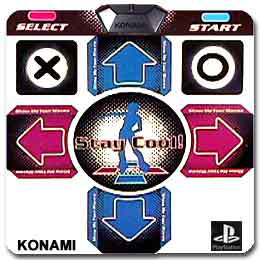
If you were relatively young in the 90s, this entry needs no explanation.  However, for everyone else…. Dance Dance Revolution (DDR) is a competitive dancing/movement game.   Unlike Pokemon GO and most other video games, it uses a controller for your feet instead of your hands.  
Yes, really.
To play, you stand on that, listen to the techno music and press the arrows as they get to the top of the screen, which can look like this:


The arrows, as you can see, scroll up to the top, at which point you\’re supposed to hit the corresponding button on the controller.  Do so in time with the music, and you\’ll get a better score.  \”Perfect\” means you were spot on.  \”Great\” means you were just slightly off, \”Good\” means you were a bit off, etc.  The people playing in this video are far from perfect, as you can see, but in some circles in the 90s, perfection was an art form with this game.  There were literal competitions that paid prizes and even money.  

If you\’re still confused as to what this actually looks like in practice, I took a crappy video of myself doing a relatively easy song. Unfortunately, Blogger apparently doesn\’t like my crappy video, and it\’s not playable, so I found you a video of a couple playing instead.

If you don\’t want to watch the whole minute and a half, they\’re doing a middle-fast song, which involves plenty of steps at a reasonable pace.  It also involves jumping in place to hit two arrows at once, sometimes in quick succession.  The guy shifting his mat halfway through the song?  Very legitimate, though really experienced players usually try to simply adjust for it until the end of the song.

Basically, this video game goes from \”gentle walking in place\” to \”hop at crazy speeds \’til you drop.\”  It tests your fitness and your balance at the same time.  Each song on the CD comes in three difficulties, which gives you replay value and the possibility of learning how to play.  Also, Dance Dance Revolution is an entire series of video games, so when you get tired of one set of 30ish songs, there\’s approximately 15+ more games you could buy and play.  

Wii Fit

If you\’ve ever thought having a personal trainer might do you good for keeping up with your exercise, the folks who made Wii Fit agree with you wholeheartedly, and set out to make you an electronic one.  There are actually a number of video games out there like Wii Fit, some less video gamey than others, but since this was the most popular one, I\’m opting to explain it.  

Like Dance Dance Revolution, Wii Fit comes with a special controller. 
I always kind of thought it looked like a scale, which I hated for some reason…
 Unlike DDR, this game is not particularly competitive.  You stand on that controller, which acts like a computerized balance board.   The game features yoga, balancing minigames, and even aerobic exercises.  The game coaches you in how to do the exercises, how to improve at them, and how well you\’re doing at them as you play.  Because the controller tracks where your balance is, it\’s capable of telling if you\’re off balance, how you\’re moving, etc.  
Here\’s a video of a single minigame, with a side-by-side of the actual human playing it.
 
 You\’ll notice he doesn\’t actually jump off the board while he plays, which personally makes me prefer Dance Dance Revolution.  But I\’ve historically been terrible at physical activities, especially balance-related ones.  

So What?

These three games, and knockoffs like them, are a few in the thousands of video games that have come out in the past decade.  However, I think they are the future of exercise for a number of reasons.  
First, inertia and lack of mobility is a factor.  Your average Joe or Jane might want to be more fit, but may not have easy access to a gym, hiking trail, or safe area to walk in.  After a long day at work, most people aren\’t interested in driving another 15-30 minutes to go to the gym, tire themselves out further, and then go home.  They would rather go home, and maybe exercise there, maybe just crash.  With an in-home exercise station, the option is available whenever.  
Second, if you don\’t already love exercise, or don\’t consider it fun (which is the state I\’m in), trying to get into shape is an excruciatingly boring and painful enterprise.  I didn\’t love exercise growing up, and year after year of abysmal yearly school fitness test reports merely solidified my distaste for the subject.  I don\’t hate gyms, but since people drain my energy, I tend to prefer not going to one.  So a more solitary, yet safe alternative is needed.
Lastly, psychology.  Research is showing more and more that \”game-ifying\” your workout (and literally everything else) is very psychologically rewarding.  People love seeing progress, earning rewards (even simple ones like a message on the screen saying, \”You achieved 45 jumping jacks in a row!\”) feeling like they\’ve accomplished something, and even competing with others.  
If full virtual reality becomes viable, the market for this sort of thing could only improve.  After all, why pedal a stationary bike looking at the other gym-goers, when you could wear some fancy glasses and be seeing some high resolution beach scenery?   Instead of jogging on a track and seeing the same thing over and over, you could be looking at a virtual simulated hiking trail, complete with different trees, shrubs, bird sounds, and wildlife.  All the while, the game will track how long you\’ve exercised, how hard you\’re exercising, how far you\’ve gone, and congratulate you after you reach a set goal.

For someone like me, who is not inclined to fitness but does love video games?  It might be the ticket to less effortful, more rewarding fitness.  

Notable Mentions

Not included in this article specifically, but worth knowing about:  
Fitocracy, which is a personalized fitness coach on your phone, but requires you to go exercising yourself.  It tracks the exercises you do, letting you log your goals and activities, and also provides gameified quests and achievements to prod you into doing more, or doing similar exercises.  In addition, it works as a social networking site, kind of like Facebook, so you can compete (or commiserate) with your friends. 

Zombies, Run!, which puts you as the main character in a post-apocalyptic storyline, written by a published author.  The world ended, zombies are everywhere, and the survivors have banded together to form settlements safe from the zombie menace.  You are Runner 5, one of a very necessary group of individuals who retrieves supplies from the wilds so that the enclaves of survivors can continue to exist.  You go running (jogging, walking briskly), and the game paints the story around you.  And the zombies are only the beginning.  As you go, you learn about the world, the people of your community, and what happened to cause the zombie apocalypse.  The game was hugely successful, and is now into its 5th \”season\” of story.  This app was actually successful in motivating me to go jogging for a time, merely because I wanted to know what happened next. 

Autism at Jury Duty

It\’s been more than a decade since I registered to vote, and only just recently has the country finally managed to call me to jury duty.  While my experience was a very short one, and I did not end up on a jury, I did manage to make some observations which I hope will be useful.

First, the experience was very disruptive to my schedule.  I was required to present myself before 7:45am, downtown at the courthouse.  This essentially required me to get up at 6am to beat the rush hour traffic.  This is much earlier than I am used to, and very unpleasant to boot.  I tried to mitigate the annoyance by laying out almost everything I needed beforehand: messenger bag, filled with snacks, books, water bottle with hydration aid, supplements, blanket, noise-canceling headphones, etc.  I stocked my tablet with episodes of the funny podcast I\’ve been listening to, and made sure I had several time-waster phone games installed.  I then drove downtown, where the process of getting there was made smoother by their accommodations for all jurors, which included free parking and a free bus ride to near the courthouse.  Unfortunately, I hate city driving and I was completely unfamiliar with the bus line.

With the help of another potential juror I met near the parking lot, I was able to get to the courthouse, where they promptly started me through security.  I had to leave part of my keychain with security, unfortunately, as it had a multitool with an inch-long blade on it.  I… honestly think I\’d have a lot of trouble hurting anyone with that, but I guess rules are rules.  I had to pick it up on the way out, and the fuss kind of upset me.  But I tried not the show it, because this day was going to be long enough without me crying at the door…

Once through security, I was directed toward the juror waiting room, which was an off-white, somewhat dilapidated affair with hundreds of chairs, a few side tables, a projector screen, and dozens of humming fluorescent lights.  (Exactly the kind of light that drives some autistic people to distraction and causes migraines, oh joy…)  Other than the side tables, the room could have passed for a lecture hall in school.  Prior to walking in, I was directed to check in and compete a survey by a polite but warm staffer.  She would turn out to be our general guide and information source.

I committed some civil disobedience with the survey.  It asked for my zip code and my gender.  I was fine giving them my zip code, but they only had two boxes for my gender, and I identify as neither, thanks.  More importantly than my personal preferences, though, this was an opportunity to stand up for a minority group.  So I wrote my own box on the survey, checked it, and identified it as \”Third Gender.\”  It would perhaps have been most correct to write \”Neither\” or \”Other\” in my case, but as there are so many gender identities, I opted for the most easily understandable objection.

(For any confused parties, there is a huge difference between sex (one\’s physical parts) and gender (one\’s identity).  While my sex is female, as I have breasts and other female organs, my gender is \”agender.\”  Effectively, I would like you to take all your stereotypes about male and female and keep them far away from me, thanks.  I am myself, the concepts and stereotypes of \”female\” and \”male\” shouldn\’t enter into it.  Generally I just handwave this fact and concept, but in such a staple part of our country\’s judicial system, I felt it best to stand up for other trans and third-gender people.  What\’s the government going to do anyway, waggle a disapproving finger at me?  Insist I take it again?)

After turning in the survey, I snagged one of the side-table seats near an electrical outlet, figuring I\’d be happiest if I could make disgusted expressions and smiles at the wall, and not annoy or confuse any other jurors.  I could also thusly limit my visual input, which would help increase how long I could stand being in a room with hundreds of other people.  Unfortunately, this seat was also near a wall, so I got to experience how poor the soundproofing of the room was.  I kept hearing thuds, bangs, and possibly someone hammering in a nail somewhere.  Out came the noise-canceling headphones, which helped somewhat.  They helped even more as people filtered in and the noise level increased.

This was alongside much more patriotic things, like an explanation of the great seal, and a story about a Supreme Court justice going to jury duty. 

The room, as I mentioned, contained a projector screen.  Onto this was projected a looping slideshow, which contained a number of useful pieces of information, most notably the bathroom locations, the options at the kitchenette, the location of a snack shop, and the wifi password.  I snagged pictures of the wifi password, because this was a very slow slideshow.  At least 15 seconds passed in between slide transitions, maybe as much as half a minute.  And there were many, many slides.

Starting with this one. 

While some of the potential jurors (probably the more awake ones, thinking about it), clustered together to chat with all these strangers, many others, perhaps excessively tired, simply spaced themselves slightly apart and got out their phones and books and such.  I was somewhat surprised by how uncommunicative many of them were, but I guess being woken up early for a job you don\’t want to do might have something to do with that.

The official court business referred to people by their numbers, not their names.  At number 117, I\’d assumed I\’d be one of the last people called for attendance, but I was very wrong.  All told, the numbers went up to 450, each person raising their hand and saying \”Here\” loudly when called.  In some cases there were discrepancies, with multiple people having the same number due to scheduling conflicts.  And in quite a few cases, people simply missed their number called, and responded promptly when their name was called.

After attendance finished, there was a video for jury orientation.  It started off very well, by threatening the choir instead of preaching to them.  Apparently you can be jailed or fined for not showing up to jury duty.  The rest of the video was basically a crash course in the judicial system.  The video guide person was of African American heritage, which I appreciated.  I was also amused to note that apparently some courtrooms use TV screens to help the jurors see evidence, and the deliberation room may include a microwave for convenience.  Also, \”enpaneled\” is a word, apparently.

After the movie, I started getting really cold.  It\’s July, it\’s hot outside, but this room started to resemble a refrigerator after a couple hours.  I got out the blanket I\’d brought and wrapped it around my legs, and that helped some.  Our guide told us that there were two judges in attendance, each with a relatively short load of cases.  Most cases are settled outside of court, so jurors aren\’t always (usually not) needed.  After an hour or so, the guide-staffer informed us that one of the judges had gotten through his queue without needing a jury, and she would keep us posted on the other.

Less than 15 minutes later, she returned to tell us that the other judge had also cleared his queue without the need for a jury, so we were clear to leave for the day, and did not need to report back tomorrow or any other time in the week.  So basically, I got very lucky.  I was able to go home within 5 hours and get started on my routine for the day. 

While I do not particularly look forward to this happening again, I also wasn\’t overly worried I would be drafted for an actual jury, either then or in the future.  The reason for this is my bachelor\’s degree in psychology. Apparently the general trend is to choose jurors with less education, and especially ones without any background in law and psychology.  \”The better to influence you with, my dear,\” I guess.  My father has told me this, but so did the section on the court system in my classes.  I think that knowledge helped me be less stressed about the experience as a whole.  That, and if the poor suckers did choose me for a jury, I have the knowledge to avoid falling for some of their tricks, and the fluency to explain those tricks to my fellow jurors.  I wouldn\’t mind being on a jury so much, but it was a fairly stressful experience overall, and one I\’m not eager to repeat.

My general takeaways from the experience:

  • Definitely prepare ahead of time like this time, and pack a second blanket in my bag.
  • 10+ 45 minute podcasts to listen to is not enough if jury duty is going to involve actual juries, bring more next time.
  • The court system is surprisingly civil to people that aren\’t accused of crimes.
  • Leave the multitool at home next time.
  • Jury duty is super boring when it\’s not being super stressful, and not autistic-friendly in the slightest.

My Mode of Thinking

Not Just Words

More than ten years ago, Dr. Temple Grandin wrote a book called Thinking in Pictures, explaining in a series of essays how she and other people on the autism spectrum do not think in words, necessarily, but in pictures.  If you said the word \”dog\” to Dr. Grandin, her thoughts would show her pictures of specific dogs she\’s known in her life, or seen in pictures.  Whereas the \”standard\” understanding of how one would process the word \”dog\” would be the concept of a four footed, furry canine, without a picture.  Most people, if they had a picture included, would have a composite image of various dogs, or a single specimen that represents the entire concept.

In short, most \”normal\” people are understood to think in words, with pictures as a sort of footnote.  Dr. Grandin, instead, visualizes everything in pictures and then has to translate to words.  For an idea of how complicated that might be, try imagining how to convey, in pictures, everything that happens to you in couple hours of your work day, including any interruptions that might occur.

Our entire school system, from about middle school through grad school, is geared towards people that think in words, and visual thinkers are expected to understand and use vast swaths of text.  Failure to do so may land you a learning disability diagnosis and the scorn of your peers.  Seems a bit unfair, when visually minded people are our very best at doing mechanical work, construction, architecture, and some kinds of engineering.  Think about it: if you can design and build things in your head, without expending any materials, of course you\’re going to have an edge over someone who has to use materials or a visualization program to try their ideas.  Dr. Grandin would build cattle-processing equipment and other things in her head before even touching drafting equipment or CAD software.  Yet we usually relegate such gifted people to minimum wage service jobs.

More than Pictures

All of this is to note that there are already examples of non-word oriented thinking.  When I first read Dr. Grandin\’s book, Thinking in Pictures, I wondered if she wasn\’t describing me as well as herself.  But it wasn\’t a perfect match.  I have the ability to consider things visually, but it is not how I think primarily.  Nor is words.  Those things puzzled me for years, since I\’d not heard of anything other than thinking in words before Dr. Grandin\’s work, and then nothing beyond \”words or pictures.\”  
You see, I am verbal and can express myself in words, and do, often, as you can see from this blog.  I grew up reading lots of books, and in fact learned most of my vocabulary and grammar that way.  (Perhaps that clues you into how I really think?  If not, keep reading…)  But I also like charts and pictures, despite my test-verified inability to process visual detail in a timely manner.  (I scored in the lowest 5% of people in a test to measure my ability to process and react to visual stimuli.)  I can\’t construct, say, a whole cattle-processing complex in my head, but I can visually judge momentum and speed of objects.  So I was very good at dodging people in school hallways, and that translates to being pretty good at estimating whether it\’s safe to cross the street, or if I can merge into any given space on the road.  
But I don\’t work purely visually at all.  In fact, one of the ways I judge my moods is by checking what song is presently playing in my head.  My brain, you see, acts like an mp3 player.  It\’s always on, always playing something when I\’m conscious.  Sometimes the music is as simple as a snippet of a song I heard earlier, sometimes as complicated as a whole orchestral piece with all the instruments.  The only caveat is that I have to know the music for my brain to play it.  I can\’t invent music and play it, I can only repeat music I\’ve already heard.  
I have music that I recognize as \”I\’m feeling depressed,\” and music that specifically plays when I emotionally feel like I\’ve failed.  There\’s an entire playlist that\’s come to mean, \”Things are utterly awful right now, but it\’s going to be okay in the end, really.\”  I have music that signifies specific people, and music that represents whole philosophical concepts.  I don\’t really control these designations, and I cannot change them at will.  They simply come into being, and I \”hear\” the songs in sufficient numbers of contexts that I finally recognize them for what they are.  
I also have a predictive ability that I\’ve honed over the years.  Between my education in psychology and my observations of people and systems, I can usually get around in situations in life without too much anxiety.  For example, most shops have service staff.  If I can\’t find something I want to buy, but I\’m pretty sure they would have it, I can find someone and ask them.  This holds true for clothes shops, grocery stores, spice shops, and hardware stores.  
This ability also extends to people, to some extent, and it\’s one of the reasons I don\’t seem as autistic as I am.  I developed social thinking, of course, but in an effort to make my life less unpredictable and anxiety-provoking, I also learned to generalize beyond \”in this situation, I should do this,\” rules.  Because different people expect different things out of others, it\’s not the best plan to have a \”one size fits all\” rule for a situation.  
If I have a conflict with Chris, my spouse, I know that I can bring it to him directly, plainly, and expect to have a reasonable discussion about it.  However, if I have a conflict with a coworker, I can\’t safely expect that tactic to have similar results.  Unfortunately, many neurotypical people don\’t like the direct and clear approach to conflict.  It\’s too confrontational, or seems accusatory, or something.  So instead I have to pick my words with great care, get input from a third party as to how best to approach the problem, and essentially bend over backwards to avoid upsetting the person I\’m upset with.  You can see I\’m a bit biased here, but hopefully my point is still intelligible despite that.  

Finally, I have the ability to memorize flavors.  This is rather helpful when cooking, as it makes me able to mix flavors in my head.  This is, I suppose, somewhat similar to Dr. Grandin constructing equipment and facilities in her head, but much simpler and less visual.  A couple weeks ago I marinated chicken breasts in pesto and honey, and served it over brown rice and quinoa.  I don\’t think I\’ve ever had those flavors in combination, but I figured it would work reasonably well, given the results when I mixed them in my head.  They\’re not flavors I\’d normally put together, but it seemed to me that they complemented each other.  I served it; Chris and I both liked it. 

So how do all these things, words, pictures, music, prediction, and flavors work together?  What do they have in common?  In the end, how is it that I think?  Well…

A Third Kind of Thinking: Patterns

It seems to me that what all these things have in common is that they contain patterns.  Words come in sentences, and adhere to specific rules for spelling and grammar.  I learned them by osmosis, mostly, from reading hundreds of books and absorbing the spellings and grammar that made it past the editors in publishing companies.  (I also learned them in school, but really, I wasn\’t that great of a student; if I hadn\’t had an edge, I definitely wouldn\’t have qualified for advanced classes.)
Pictures and visuals, at least as I use them, also come in patterns.  Graphs adhere to rules, which is how you read them.  The momentum and speed of a car or a person is predictable by a number of circumstances, which I used to great effect in school and to this day.  I can, to a limited extent, do simple visual calculations.  If I need to move an object in space, but can\’t use my hands for some reason, I may see a flash of a tool that I could use to move that object.  A simple example would be needing to pry out a nail.  If I had no hammer, I might see the flash of my multitool, which has a tool that could be (mis)used to pry a nail out, and how I might use the multitool attachment to pry out that nail.  Effectively, this pattern translates to \”multitool ~= hammer ?\”
Music is rife with patterns.  Especially pop music, which tends to be simpler than the grandly complicated orchestral and symphonic pieces one finds in classical music.  One of the staples of many pop songs is a simple, but catchy, chorus.  This is then surrounded with verses that convey what the song is actually about, but the chorus repeats between each one, providing a predictable and attention-grabbing anchor for the rest of the song.  Because the chorus is so simple, it\’s easy to memorize, which then allows people to focus on the verses.  
Pop music is perhaps the simplest example, but all music, even the complex works of Bach, Beethoven, Brahms, and Mozart, has patterns built into it.  Such patterns are sometimes called \”themes,\” and they are, to my understanding, one of the few ways to identify an unknown piece of classic music.  My mother, who has her Masters in music, has a book specifically to help identify music by its theme.  I remember it on her bookshelves in her office, a curious mix of text and short musical notations.
My social thinking and my understanding of how to deal with situations also follow patterns.  Often decision trees, specifically.  Many situations can be generalized.  How you act in a store, for example, often follows near-identical rules regardless of what store you\’re in.  Particularly the way I shop, which is \”like a man\”, as I understand it.  But people stress me out and exhaust me, so I\’m okay with that designation as long as it helps people relate to me.

The general decision flow for shopping is as follows:

  1. Can I easily locate the item I came for?  If yes, locate and proceed.  If no, look around a bit longer before asking for help, because that\’s part of what store employees are for.  Once found, proceed.  
  2. Repeat as needed for entire shopping list, ideally proceeding from the back of the store to the front.
  3. Locate place to pay for items and pay.  
  4. Leave ASAP.

Finally, flavors are sufficiently memorable to me that eventually I store them somehow, and can take them out as concepts and put them together.  Probably somewhat like people match colors and outfits styles, some things just taste better together.  I can sort of mix and match flavors in my mind, without having to necessarily try it in real life.  For instance, chicken and pesto are pretty common flavors to put together.  I figured out a few weeks back that honey is a decent addition to that mix.  Not too much, just enough to give it a sweet balance to the savory of the pesto.  Recently I tried the same thing again, but with a bit of sriracha sauce as well.  It added a minimal burn and some spice to the balanced sweet and savory, which ended up turning out rather well according to Chris and myself.

Make sense?  What modes do you think in?  Words?  Pictures?  Patterns?  Something else entirely? 

    Boomerang Memories: Artifacts of Depression

    The vast majority of my life, thus far, has been dogged by the frustrating ailment we call depression.  I have what psychology calls \”dysthymia\” or basically, low grade, long-lasting depression.  Unlike major depression, which usually only lasts weeks to a year or two, dysthymia can be with you for your whole life.  Sort of like having chronic pain, it won\’t ruin your life or make you wish you were dead, but it\’ll sure put a damper on basically everything you do. 

    So in the process of living this particular difficulty, and learning about it and other conditions in psychology, I\’ve become rather analytical about the whole thing, and I thought I\’d share a particular feature of depression that\’s been making my life more difficult in the last few weeks. 

    I\’m calling them boomerang memories, but I\’m sure there\’s a technical term for it: when your brain reaches back into the past and drags forth an embarrassing, saddening, or hurtful memory.  So if you, like many people, have had dozens of embarrassing moments in your lifetime, you can expect to review the worst of them, regularly.  Tripped over a flat surface in the lunchroom and everyone laughed at you?  Definitely seeing that again, as clearly as if it had just happened again.  Your crush in middle school turned you down?  Going to be reliving that again, without the benefit of the years to soften the emotional blow.  Said something obviously stupid when you were talking to a someone whose opinion you value?  Hope you don\’t mind wincing about that again.  Like a toy boomerang, these unpleasant memories come back, but unlike the boomerang, the memories always hit you in the face. 

    Taken one at a time, and infrequently, these sorts of memories are the kind of thing you\’d shrug off.  They\’re downers, they\’re bad for your self-esteem, but they\’re probably not going to ruin your whole day.  Everyone remembers bad things sometimes.  The thing with depression is that these things don\’t politely visit you once a week and then stay away.  Instead, they may opt to visit you every hour.  Or every 15 minutes. 

    You\’ll be thinking about what to have for dinner today, or what task you should focus on next, and suddenly you\’ll be remembering a joke you told that not only fell flat, but actually hurt someone you were trying to entertain.  BAM, your train of thought is derailed, and now you\’re sad or frustrated or angry. 

    Now, at this point, normal people just wince, shrug, and reroute their train of thoughts back to dinner or work.  You wasted a few seconds remembering this unpleasant thing, but now you\’re back to the matter at hand.  Unfortunately, depression doesn\’t work like that.  Depression, instead, makes that thought process sticky.  Like bugs on flypaper, your brain gets trapped and then stuck on that bad memory.  You live it several times instead of once, and think about what things you should have done instead.  Psychology calls this \”perseverating.\”

    Shaking yourself loose from this stickiness is an effort for people that are depressed.  I, personally, have to tell myself, \”You know what, this is a thing that happened, and that\’s okay.  It is long past, and no longer matters.  Let\’s get back to what we were doing.\”   Unfortunately, that is not a magical chant, and does not always work.  Several repetitions or interruptions to the sticky train of thought can be necessary, and this can waste a lot of time and energy. 

    It\’s kind of like having your own personal deconstructive critic inside your skull.  No one else can fight it for you, or tell it to buzz off.  Your personal anti-cheerleader has full audio-video access to your brain.  And unfortunately, you have no power to permanently drive off or otherwise silence it.  You can only shoo it away for a time, knowing it will be back.

    All of what I\’ve said so far is, as I see it, solid reliable fact.  What I\’m going to say next is not, but merely personal musings, so please consider them or pooh-pooh them away as you please. 

    The origin of this personal anti-cheerleader is up for debate, so far as I can tell.  As a person raised in a rationalist, scientific culture, I\’m inclined to think of depression and this particular facet of it as an artifact of a malfunctioning brain.  That\’s what medical science has, thus far, told us.  Depression is caused by problems with brain chemicals and the brain\’s use thereof, and is therefore an internal problem. 

    But my description, \”personal anti-cheerleader\” also reminds me of C. S. Lewis\’ writings on devils (see The Screwtape Letters).  The popular image of the angel on one shoulder and the devil on the other, both whispering what someone should do, would almost apply here, minus the angel.  Boomerang memories would then be the devil\’s purview, brought up again and again to wear you down, make you sad and crabby, and overall distracted from your life and what you should be doing with it.

    It would make sense to me if the old descriptions of mental illness, ie: demon possession, had some basis in the truth.  The fault of every age and every era is assuming they know best, and that the previous generations knew nothing of value.  Certainly, we know more today than ever before, but much of it, we\’ll find in 20 years, is wrong.  I don\’t particularly think my autism can be attributed to demons, but my anxiety and depression?  Maybe partly.  I\’ll have to reread that book and some of the others that C. S. Lewis wrote. 

    That said, medical science has apparently discovered the physical location of depression in the brain as of late last year, so perhaps, soon, our methods of treating depression will be less, ah… shots in the dark.  And perhaps my musing on demons and depression are entirely inaccurate.  Which is fine, I\’m certainly no brilliant religious scholar, philosopher, or world-mover. 

    In any case, I hope this explains boomerang memories a bit better for those of you that have them, and those that don\’t.  It\’s hard to get a good understanding of depression when you don\’t have it, or so I\’m told, and those of us that do have depression benefit from the understanding.  

    Project "Fun"

    I should probably call this project something weird, like “Project Cognition” or “Project Ludicrous,” but apparently deliberate abtruseness runs counter to my personality.  I just ended up with a simple name, for a simple idea.I do not, by and large, know how to have fun.  This won’t surprise my closer friends, since they’ve heard me patiently, half-jokingly comment, “What’s fun?” more than once.

    Somber by Nature

     
    I was a very somber child, growing up.  I paid most everything a sober interest, and while I certainly had things I preferred (reading, mainly), I don’t particularly recall finding specific things “fun.”  Preferable, yes, but at least by age 7 or so, not fun.  I say age 7 because I suspect I need to make allowances for the ignorance and glee of the earliest years, before I was fully aware of the world and how poorly I fit into it.  I don’t know what age I would have started qualifying to have my diagnosis of dysthymia (low grade, unending depression), but I would guess it was relatively young.  The generalized anxiety disorder probably didn’t start until mid-elementary school, but I’d need a time machine to be sure.

    That was how I grew up: somber and focused.  Fun wasn’t really on my radar.  It wasn’t essential to passing my classes or spending my free time alone.  It didn’t even factor into personal relationships.  I may have used the word “fun” in those years, but what I was describing was less actual enjoyment and more “this is tolerable.”  I didn’t have moments where I thought, “whee!” or “yay, I like this.”  There were simply things that were less exhausting and less stressful than other things, and so I preferred them.  My brother mocked my seriousness, probably to try and knock me out of it, or show me what I looked like.  Much good it did.  I knew I was being mimicked, at least after a few times, but not why or what the point was.  It was irritating, which didn’t cheer me up any.  He never explained, and thankfully eventually stopped doing it.

    It turns out that you do not, in fact, need any form of happiness or enjoyment to live for 20+ years.  I do think it’s probably very helpful to have those things, but clearly I didn’t die from the lack of them.  There does come a point, though, where I recognized I didn’t have those things and stopped being able to say, “oh yeah, that’s fun / I like that.”  I do not, as a matter of course, like to lie.  If someone asks me the standard trap question, “Does this dress make me look fat?”  I’ll know to answer “no,” thus saving their feelings, but I’ll still have to think about it first.  That is the case with most of the white lies civilization runs on.  Another is “how are you?” when asked to a passerby.  The expected answer is not, “Eh… I feel exhausted and worried.  Yourself?”  It’s, “Oh, fine, and you?”

    Required exceptions aside, I try not to lie to myself or others, so I stopped being able to respond “normally” to people hoping I’ll have a good time, or have fun.  I started responding instead with a tolerant smile and a half-joking question, “What’s fun?”  Mostly, people don’t answer, they get caught up in that I’m asking at all.  It’s not my fault I’m somber by nature, and my life was emotionally exhausting and difficult.

    Why So Serious?

    I think maybe part of the somberness was that I knew, unconsciously, that I didn’t fit in and had to work harder to do things than other people.  I learned how to interact with people by doing a lot of personal study, and by asking a lot of questions, and by reading books.  I had to work very hard, and be thoroughly attentive, analytical, curious, and studious.  But studiousness is not, I think, generally a joyous or happy mental state.  It’s one of perpetual interest, and that I had in abundance.  But not smiles.

    I couldn’t smile for a camera to save my life for at least a decade.  I’m positive the fact that the camera flash hurt me didn’t help, but it wasn’t the whole of the problem.  I simply couldn’t smile in any way that didn’t look as fake as it was.  I look back now on my pictures and wince at the expressions.  My eyes don’t match my mouth.  I have a deer-in-the-headlights expression in some of them.  The only exceptions are when something was genuinely amusing quite recently, and someone managed to get a picture within 5 seconds or so.

    One of the clearest examples I can remember of how utterly solemn my mindset was, is from high school.  I remember going to a comedy show with my boyfriend at the time, and if the comedy wasn’t the best I’ve ever seen, it was still pretty good.  And I smiled at things.  I didn’t laugh a lot, but I did smile, and my boyfriend looked at me like he’d never seen me before.  He asked why I was smiling so much, and confused and somewhat worried, I pointed at the comedian and said, “He’s funny.”  I have no idea what my boyfriend took away from the experience, but after that, I vaguely recognized the situation was unusual.

    That could, I suppose, have been a moment when I figured things out, realized how odd I was, and took steps to figure out what I enjoyed… but it wasn’t.  I shrugged off the experience.  It did not, in fact, even occur to me that stand up comedy might be something I should look into, since I had been smiling so much.  It simply wasn’t on my mind.  I had homework to finish and I’d done something to upset my boyfriend, and I was still trying to figure out who I was supposed to be (because teenagers do that, generally).

    In college I continued to pursue things that interested me, and were less draining.  I was comfortable with anime and with Dungeons and Dragons, so those were the avenues I used to find friends and schedule social events.  But still, I didn’t really smile all that much.  People didn’t befriend me because I was fun, they befriended me because I was interesting, or thoughtful, or because I listened and genuinely cared.  I have not been, and probably never will be, the life of a party.  (Except my wedding, and even then, I still really wouldn’t call myself the life of the party.  Just, y’know, a central point of celebration.  A lot of the pictures of the reception are me frowning in focus.)

    Sarcasm is Technically Humor

    One would think, if I was truly that serious by nature, that I made no jokes and had no sense of humor.  Incorrect.  It wasn’t that I didn’t have a sense of humor.  It’s that it wasn’t an easy sense to tickle, and so after a few jokes fell flat, people mostly stopped trying.  I didn’t get most of my peers’ humor growing up, so I could hardly adopt it for my own.

    There was one exception to the lack of practice rule for humor: sarcasm.  I became fluent in sarcasm.  Its premise took me awhile to understand, straightforward as I am, but eventually the concept of saying exactly the opposite of what you mean, and using context and tone of voice to convey it, became easy for me.  I became proficient under the tutelage of my first friend.

    I think sarcasm was probably a halfway point between actual funny humor and the dead seriousness in my nature.  Sarcasm, usually, does not provoke actual laughter, and you ruin the effect if you don’t look serious while you say things sarcastically.  I was good at keeping a straight face, so that was easy enough.

    To this day, my humor tends to be termed “dry.”  I don’t do stand up comedy or jokes.  I don’t pun (on purpose).  But I think maybe I practiced sarcasm so much it became infused into my ways of speaking.  I do, at times these days, accidentally make people laugh because of things I say.  I don’t try to be funny, it just sort of happens with some people.  It\’s sometimes confusing and startling, but it\’s just laughter, it doesn’t hurt anything.  As long as they’re entertained and the laughter isn’t mean, it doesn’t bother me that much to not entirely understand why they’re laughing.

    The closest I do to jokes is absurdity.  There’s a lot of absurdity in life.  Starting with the fact that I’m expected to hop to a rhythm and system that doesn’t even pretend to understand or care about me.  Though, this line of entertainment often strays into tragic and stops being funny to me quickly.  There are two schools of thought to dealing with life’s tragedies: laugh or cry.  I usually gravitate to the latter.

    Steps In The Right Direction?

    Part of my life in the last few years has been trying to discover and patch up my deficits, and thus improve my life.  Perhaps my first step in that regard was getting my diagnosis.  But of course, a diagnosis doesn’t fix things, it merely identifies the problem.  It did give me the option to seek specialized help, now that the source of my difficulties was out in the open.
    I was slow about seeking help.  I’m very independent-minded, and it frustrated me that I would never be normal no matter how hard I tried.  So I sulked privately and carried on with college publicly.  I did tentatively attend a couple social groups, one of which I’m still involved with somewhat.  But the organizer of that group remembers well the perpetual frown on my face the first time I attended.
    Networking was one step thing, but it didn’t change my perpetual gloom and lack of levity.  I graduated and spent a few years throwing myself at hourly and full time jobs.  They didn’t help me lighten up in the slightest.  Finally, I sought professional help for the depression and anxiety.  LENS, or Low Energy Neurofeedback System, slowly but surely changes your brainwaves.  Under the LENS, and using supplements to counter the nutritional deficits I couldn’t handle with diet alone, I began to improve in stability and mood.
    I still wasn’t funny, though, and still didn’t recognize fun when I saw it.  I still didn’t seek amusing things, or even really consider them.  My focus was still on interesting and low-stress things.  Which brings us to the last few months.
    I’ve been taking recommendations from my friends, including the previously-shunned video recommendations, and looking into them.  At present, this includes a video series, a podcast, and several comedians.  The lattermost are hard; I don’t think a lot of standard jokes in comedic routines are funny.  To me, body humor is cheap and puerile, and so I don’t enjoy it.  Jokes that involve making fun of groups of people upset me rather than amuse me.  I’m fond of John Pinette’s work, since he mainly joked about food, exercise, himself, and his travels, and tended to portray others positively.  Unfortunately, he passed away recently and so there won’t be any new works for me to enjoy.
    The idea behind consuming all this media is, hopefully, to rewire my brain into quicker, more powerful enjoyment of fun and funny things.  And also, to expand my knowledge of those things.  So far I’ve earmarked a few things as worth remembering, so if nothing else, this has been successful in that way. I still don’t stop in the middle of a thing and go, “yay, this is fun!”  But maybe that will happen eventually.
    I think part of the problem with having fun in a broader context, out among people, or even at home, is that I seem to need to be comfortable to manage any form of enjoyment or fun.  And as I mentioned, I have an anxiety disorder, which pointedly makes me uncomfortable basically all the time.  So it’s a bit of a conundrum.  Possibly if I condition my brain to lots of different funny things, it’ll be able to generalize the enjoyment to situations in which I’m uncomfortable.  If I could manage that, I would also be less uncomfortable due to the enjoyment, thus starting an upward spiral.

    Even if the whole thing falls through and I remain relatively somber by nature, I’ll still have a list of worthwhile fun/funny things.  Now if only I had hundreds of hours to devote to this project…

    Go Away, I Hate Christmas, or A Depressed Autistic’s Christmas

    Hi folks.  I\’m going to talk about why, in years past, I\’ve really hated Christmas.  Not the religious bit, Jesus being born, hymns of celebration, lighting candles and reading from the Bible etc.  It\’s the commercial aspects that got my ire: the commercialized and social aspects, the \”Christmas cheer,\” the getting together with family, the decorations, the pop music.  If this sort of discussion offends you and your Christmas happiness, then please, by all means, stop reading and keep your happiness bubble intact.

    Okay?  All right, cool.

    Christmas, as a non-religious concept, made my life miserable for about ten years.

    I have never, in my entire memory, had anything resembling Christmas cheer, or the generally goodwill and happiness that accompanies the Christmas season.  Classic Christmas music (not including Christmas carols and hymns) serves only, as a rule, to make me crabby.

    Why?  Well…

    Be Cheerful!  (NO)

    I am not, innately, a cheerful person.  I was a very serious, possibly depressed child, and I grew up into a slightly less-serious adult with a lifelong depressive disorder.  This does not lend itself well to actual cheer when told to \”cheer up.\”  It\’s been a pet peeve of mine for awhile.  You cannot, literally can not, make someone cheer up by telling them to.  You can\’t magically transmit a thought-virus of cheer.  Sorry.  Telling me to cheer up has, historically, made me extremely annoyed.  
    So, all this Christmas music, which sings about the merits of the season and how it\’s all so wonderful and put you in a good mood to shop… or whatever else…  sounds, to me, like it\’s insisting I be cheerful.  If I\’m literally not capable of being cheerful, but constantly told to be cheerful anyway, of course I\’m going to end up grumpier.  I can\’t even shout back at the music that I\’m depressed, and leave me alone already thanks!
    This actually wasn\’t as huge a problem when I was little, but starting around age 15, I recognized that society was essentially telling me it wasn\’t okay to be depressed, and I spent the next ten years resenting that. 

    Travel

    Secondly, Christmas in my family has historically always involved a lot of travel.  Pretty much all my family has always been at least 12 hours by car away, but rarely, if ever, has it been an option to simply stay in our own home and celebrate quietly.  
    So there\’s the bustle of packing, and the stressing about presents for relatives I didn\’t know that well, and the inevitable forgetting of at least one important thing…  We\’d pile into the car, my mother would zoom about doing last minute things while my father groused, and then we\’d drive for upwards of 12 hours in a single day.  
    When I was very little, it was more like 20 hours in the car, and my father would be very crabby by the end of it.  In his defense, I don\’t think anyone really likes driving 20 hours with two reluctant children in the back seat.  

    Strangers in a Strange Land


    The culmination of all this travel was getting to distant family\’s houses.  Unfamiliar, often colder than I would have liked, far from the comforts and familiarity of my own home.  Normally when growing up, I\’d have my nose in a book.  But my book selection was pretty limited, away from the bookshelves of home, so I had what I brought with me, and… that was it. 
    Then, the place was full of people I was required to sit and be social with, but barely knew anything about, and if we\’re being honest, didn\’t overmuch know about me, either.  Autistic people often have a hard time with faces and I wasn\’t an exception.  Every year I made a wishlist, and generally speaking, anyone outside my family had no clue it was a thing, or ignored it entirely.  
    I was required to sit at the dinner table and make conversation, despite being bad at it, not wanting to do it, and wishing I was anywhere else.  While I recognize this is a staple of modern society, I somehow don\’t think my sullen expression did any conversation any favors, ever.  
    So in the end most Christmases involved me feeling alienated, incredibly uncomfortable, and set-upon.  

    Well Aren\’t You A Bundle of Sunshine?

    Yeah, I know.  But hey, good news.  Notice how a lot of this entry is phrased in the past tense?  That\’s because I stopped being quite so depressed around Christmas as of a couple years ago.  I presume some of my depression has abated and I\’ve adjusted to having to entirely drop my comforts once a year for the sake of family I barely know.  I\’ve also improved at table conversation, and presumably at being polite without being sullen.
    I still love my family, even the ones I don\’t see very often, as I did when I was little. I\’m just better at expressing it in terms they understand now. 

    Origami Flowers

    My wedding is in just a few days.  Preparations are still underway, but I wanted to comment on one of the many eccentricities of this particular wedding.  I will have no live flowers as decorations for any part of the wedding.  This is partly for humanitarian reasons, but perhaps most clearly to me right now, it\’s because of who I am.

    I am autistic.  I do not, and never will, fit well into society.  This isn\’t my fault.  I was born this way, and I\’ve done my best to make things easier for everyone around me.  But it is a thing, and one I\’m keenly aware of most days.  I feel, sometimes, that because of that, I am less of a person.  An alien, or subhuman.

    The HBO movie Temple Grandin, based on the esteemed Dr. Grandin\’s childhood, posits that people like me are \”different, not less.\”  That revelation, and my diagnosis itself, were painful realizations in my life, and ones I have struggled long and hard to make beliefs, rather than simply ideas.  Just because I am different does not mean I should automatically be less than human.  But it\’s really hard to believe that when you have to struggle so hard just to seem acceptable to those around you.

    So it\’s in the name of this blog, Realistic Autistic.  I feel not quite real, not quite human.  Lifelike, realistic, but not quite true to life, not quite real.  It\’s also in these flowers.

    I could have, I suppose, opted for fake flowers: plastic or silk recreations of the intricate blooms and plants that we so treasure.  But this wedding seems, at least to me, a way to show people who I am and what I\’ve become.  Plastic and silk are too close to real flowers.  They can be mistaken for real flowers, if the observer isn\’t astute or isn\’t paying attention.

    Origami flowers cannot be so mistaken.  Particularly these, made of foil and paper, the stems of twisted wire and floral tape.  They have their own style, grace, and delicacy.  And they are shaped, at least somewhat, like the true flowers.  Each of these origami flowers are painstakingly folded, taking time, precision, and effort.  Each flower did not simply grow, given the right conditions.  It had to be shaped, attention paid at every step, for the final result to be like a flower.

    For at least one day, I\’d like people to appreciate these origami flowers for what they are: very different than what they\’re patterned after, but possessing their own beauty.

    Am I not, after all, still a worthwhile person?  Will I not be beautiful, too?

    A Hostile World

    Last week I read a book called The Reason I Jump, by Naoki Higashida.  I reviewed it last week, but it got me thinking about how I perceive the world versus how he perceives it, and other people tend to perceive it.  Mr. Higashida loves nature.  It makes him happy to be outside amongst the sounds and stillness of nature.  And I simply don\’t get that, because while outside can be nice, it also tends to have mosquitos and other bugs, and I can\’t stand having things crawl on me.  And things will crawl on me, without trying to be rude or meaning any harm.  It\’s just what they do.

    That comparison reminded me that a lot of things are like that: I suffer a lot of unintentional abuse, every day, with no particular recourse.  And often, without anyone noticing.  So in the interests of having people understand that a bit better, I\’m going to try to enumerate and describe things that make the world kind of hostile to me and others on the spectrum.

    The Very Light Itself

    Perhaps one of the first things noticeable on waking up, sunlight.  Sunlight is warm and comforting, right?  Sometimes, yes.  And sometimes it stabs my eyes when I go outside, causing physical pain until I adjust to the brightness.  This can take minutes.  Ever had a big LED flashlight shined in your eyes on accident?  Or walked out of a dark room into full sunlight reflected off fresh snow?  It hurts.  For you, probably momentarily while your eyes adjust.  Imagine you had to deal with that every day.

    I used LEDs as an example above for a reason, as well.  LEDs are painfully bright to me.  It was fine when they were covered with glass as in smart phones, or tiny and buried in TV screens.  But now we\’re using them in lightbulbs and flashlights and lanterns, and those hurt.  Never mind the artificiality of the light, such that it makes it hard to see with them anyway.  They\’re simply too direct, too bright, too focused… too something.  They hurt, like needles directly to the eyes.

    I tend to scowl and scoff at people that use vanity LED headlights for this reason.  Standard headlights are mostly white and yellow light.  But that\’s not good enough for some people, so they opt for these horrible bright bluish-white lights that blind me whether they\’re using high beams or not.

    For some people on the spectrum, it\’s even worse.  You see, LED light bulbs flicker.  The flicker isn\’t visible to most human eyes, but to some people, it can make a room very unpleasant.  Even one flickery light in a room can destroy my focus.  If all, or even most, of the lights in the room were like that, can you imagine trying to pay attention to anything?  If someone was trying to show you something, and the whole room kept flickering?  And meanwhile they can\’t imagine why you\’re squinting and getting a headache.

    Sound And Fury

    I\’ve written on sound sensitivity before, but it bears repeating.  The world is a diversely noisy place.

    Low rumbling noises, like the ones my car makes and the passing of trains or other cars, don\’t particularly bother me.  It helps that those are often quieter and further away, I suppose.  But high pitched noises, especially shrill ones, are very troublesome.  I can\’t filter them out.  They press in on my skull, demanding my attention, and sapping at my energy.  Children, sirens, the squeaks of unoiled doors or chairs, the backup noises of trucks and buses, all of these grate on my brain.  Or in the case of sudden noises, stab it. 

    In my own apartment, which is one of the quietest places I frequent, there\’s the hum of the fans in my computer, the drone of the freezer and refrigerator, the creak of my chair, the click/tap/thud of each key I press on the keyboard, the occasional plunk or ding of an email arriving.  Then you can also get the construction equipment outside, which frequently backs up or uses those bucket arm things, and that makes a high pitched beeping noise, both predictably and not, since I\’m never quite sure when they\’ll back up or stop backing up.  There\’s the school bus that comes through in the morning and the evening, and the shrieky children it picks up and disgorges.  And the blasted music from some of my less polite neighbors, either from their cars or in their apartments.

    In a place like the mall, there will be many more sounds.  Chatter and bursts of laughter from shoppers, radios from mall security, the inevitable cheery/dreary mall music, sound effects from displays of goods, music blasting from specific stores, the shrieks of children and coffee machines…  All at once, clamoring inside my head.

    All of this has to be tolerated.  It\’s irrelevant to whatever your current train of thought is, or your current conversation with a friend.  Focusing on it would simply get in the way.  Normal brains automatically filter out extraneous sounds, like the rumbling of your car or the music in the mall.  On a good day, my brain mostly follows suit.

    On a bad day, I hear everything with equal priority and must consciously dismiss it and purposefully ignore it.  If I\’m having a chat with a friend, my attention will keep getting grabbed away from their words by sudden sounds, or a snippet of conversation that I happen to catch.

    Someone doing the dishes in the next room, or over the phone, is intensely painful to me.  Chris, my fiancee, is thankfully very sensitive to this sort of thing, but even he forgets sometimes.  Even if he hasn\’t forgotten, he can hardly stop doing dishes forever, or even save them until I\’m not home.  It\’s simply not practical. 

    \”Exhausting\” is one way to put it.  \”Painful\” is another.  It\’s not just the loudness of things.  It\’s the complexity, the number of noises around me.  I used to attend a gym that was a veritable cacophony of sound, from people to exercise machines to TVs.  It was so bad that I had to wear noise-canceling earphones, which I still bring with me everywhere just in case.  Otherwise it was impossible to focus on bludgeoning myself into exercising, even with the surprisingly motivating exercise app I had.

    The Smell and Taste of Things

    I am fortunate in that I mainly grew out of my childhood eccentricities when it comes to food.  But my parents could likely give you a volume or two on how difficult it was to get me to eat vegetables.  I think most parents have some trouble with it, but I remember a great deal of aggravation at mealtimes.  Eventually we had a list of things I didn\’t have to eat, which was quite literally a Post-It note on a cupboard, and I had to give Mom warning before I changed it.  I think it was 10 things, or something like that, but it may have been less as I aged.  But even with that, there was great exasperation because I couldn\’t be coerced into eating stuff.  I would simply sit there and scowl.  
    I\’m not entirely sure when or how I grew out of it, but I try to make a point of trying things at least once, preferably every few years or so just to make sure my taste buds haven\’t changed.  They usually haven\’t.  
    When I read about kids that won\’t eat certain foods, or won\’t eat most foods, the words that often come up are texture and flavor.  The latter is obvious: if you puree kale, it\’s very acrid and bitter and overall horrifying (I may be biased against kale).  Some people just can\’t stand the taste of certain vegetables or other foods.  Something about it just rubs them the wrong way and so they don\’t like to eat those foods, or just won\’t.  
    But texture is an entirely different ball game.  The mouth, and especially the tongue, have a lot of touch receptors.  Some things, bumpy or crunchy or squishy or gooey, are intolerable to people with sensitive mouths.  You know how at fairs, they\’ll sometimes have a mystery box.  You stick your hand in the box full of something gross, and if you guess what you\’ve just put your hand into, they\’ll give you a prize?  Sometimes it\’s only a bowl of spaghetti or lumpy mashed potatoes, but sometimes it\’s live worms, wet cat food, or chicken intestines.  But either way, you\’ve just stuck your hand into something that feels gross, and now people are expecting you to be okay with it, and even make guesses as to what it is.  
    I don\’t know about anyone else, but I always found that box game disgusting and horrible, even if it was just spaghetti.  It\’s a texture you weren\’t expecting and weren\’t prepared for, and it\’s often greasy or sticky or something.  An unpleasant texture is something like that, like sticking your hand in that box, but every time you have to eat that food.  It might be the same texture every time, but it\’s always unpleasant.  
    Smell, on the other hand, is something I continue to have problems with.  My family wasn\’t much into cologne or perfume or scented candles, so growing up, I only had occasional problems with strong smells.  As an adult, I\’m finding it a trial to walk past the scented candle aisle in grocery stores, or past Bath and Body Works, or any other places that specializes in scented products.  I have to hold my breath, or flinch as my nose is assailed by a sledgehammer\’s impact of smells, all mingled together and indistinguishable.  
    My sense of smell, is, as far as I can tell, excellent, in that I can pick out individual ingredients in a recipe from merely smelling it.  Olive oil has a certain smell, as does tomatoes of various preparations.  Soy sauce, too, and chicken, steak, and bison.  So throwing a dozen or two floral, fruity, and spicy scents at it, all at once, is confusing and stunning.  The stronger the scents are, the worse it is. Needless to say, I avoid shops like Bath and Body Works like the plague, unless I have excellent reason to do otherwise.

    Even a Gentle Touch

    Temple Grandin\’s childhood inability to tolerate hugs is, I think, fairly well known at this point.  There was simply too much sensation, such that rather than enjoying the hug as the gesture of affection and familiarity it was, she would stiffen up and pull away.  It took some ingenuity on her part in college, and a lot of patience, before she was able to tolerate hugs.  She quite literally had to invent a \”squeeze machine,\” basically a machine that put pressure on her as tightly or as softly as she wished, and use it many many times to accustom herself to the sensation.  In the end, she was able to give and receive hugs. 
    This is a familiar story when reading parents\’ accounts of raising their autistic children, with the kids freezing up or crying, or even refusing to touch or be touched.  The sensation is just too strong and overwhelming.   Something like the difference between someone showing you a picture, and shoving it right at your eyeball. 
    Similarly, some people on the spectrum feel touch as pain.  For years, I\’d assumed I wasn\’t one of them.  Then I happened to notice an instance of minor pain when my fiancee was stroking my arm.  It wasn\’t a sharp, attention-grabbing pain.  It wasn\’t an ache.  It was simply the sensation of being touched, but with a dull overloading factor.  Which I hadn\’t realized until just then, but that did translate to pain.  It wasn\’t a loud kind of pain.  It simply, quietly, hurt.  I got the sense I\’d kind of been ignoring it for years.  
    So for me, apparently, light touches can hurt.  To my great and abiding irritation, that isn\’t all.  I am immensely ticklish, basically all over my body.  I have no memories of enjoying being tickled, so every successive incident just annoys me further.  It doesn\’t help that it often happens at doctor\’s appointments, when they need you to hold still so they can examine you, or on accident while trying to relax on the couch with my fiancee.

    Other Senses Exist

    Contrary to most textbooks, there are 10+ senses that the human body has access to.   I\’m not as familiar with them since I didn\’t know they existed until recently, so I\’ll cover them only in brief.  

    Balance and Kinethetic Senses: Your senses of body movement, where your limbs are in space, direction, acceleration, etc.  All that is bundled together, and if it\’s out of whack, you get all sorts of fun things.  The book I read, The Reason I Jump, talks about not being able to feel yourself in space.  The author jumps, at least in part, because it lets him feel himself in space.  Other people spin, rock, run in circles with their heads tilted at an angle so they feel balanced, or do other things.  If this sense is off, it can really disorient you. Imagine always feeling off-balance when you\’re sitting in a chair.  Could make it hard to pay attention in school. 
    And of course one of the classical Asperger\’s symptoms is a mild clumsiness and odd walking gait.  I have both of those, though I have improved markedly as I aged.  I continue to trip over flat surfaces, but rarely, if ever, fall down after tripping.  Perhaps partially due to the roller skating lessons I had in my teens.  
    Temperature and Pain: These don\’t technically go together in a scientific sense, but they\’re both extra-touch sensors to me, and no scientist has complained to me yet.  I\’ve heard from parents whose kids don\’t seem to care if they touch a hot stove.  I personally get all kinds of miserable when I get cold, and despite my layer of protective blubber, I get cold quickly.  
    Painwise, everyone has a pain tolerance (how much pain they can handle) and a pain threshold (how strong pain has to be before you notice it).  Even in neurotypical people, this varies.  In autistic people, this can vary extremely widely, from being seemingly impervious and oblivious to pain, to shrieking about even little pinprick.  My personal experience varies.  Some days I\’m more oblivious to pain than others.  In general, my pain threshold seems relatively low, but my tolerance is fairly high, given enough time.  Sudden blinding pain hurts a lot more than a headache that starts out mild but works its way up to making me dizzy and sick to my stomach.  (Why yes, I did find that out from personal experience…)

    Internal Senses: Things like how full your bladder is, how much air you have in your lungs, and how hungry you are.  Since messing up my gut bacteria with a ton of pop a half year or so ago, I\’ve had issues telling how hungry I am.  I\’ll have bouts of a minute of being murderously hungry, and then 15 minutes with my stomach telling me it has no problems whatsoever.
    Like any other sense listed above, this too can be off-kilter.  Some parents of children with autism report longer toilet-training, or delayed toilet training.  Some people with autism forget to eat unless reminded, then they notice they\’re hungry. 

    So What?

    Hopefully this has given you a bit more of an understanding of the challenges of being out in the world.  One or two of these things could be classified an annoyance, maybe, but piling them all on simultaneously makes this exponentially more difficult.  You\’ll note, too, that not a single bit of this touches on what I consider the core of an autism diagnosis: the lack of social intuition.  These are simply sense-based difficulties that add onto that lack, making it even more difficult to interact in a normal fashion with others.  
    I have a friend who, many years ago, got annoyed like most everyone else does when a baby or small child was crying in a store.  She assumed the kids were simply being brats. Then she had kids herself, and some of them were sensitive to these things I\’ve described.  After some reflection, she\’d often look for bright lights in the kids\’ faces, or unpleasant sounds, or strong smells, before assuming the child was just being bratty.  And fairly often, she\’d find something that explained the child\’s distress.  
    I wish more people would be that thoughtful about their interactions with others.  Most people have no way of knowing these difficulties I\’ve described, and so I\’m \”reclusive\” or \”hard to get to know\” or \”unsocial.\”  But most days it\’s a trial to go out for any reason.  If even a tenth of the people I normally deal with understood that, my life would be a lot less anxiety-inducing. 

    Autism is a Trashbin Diagnosis

    English is a very ambiguous language at times.  We have one word for love, a concept that spans a mother\’s bond with her baby, the relationship between two platonic friends, and the passion between two lovers.  If that doesn\’t strike you as ridiculous, I\’m not sure what will.

    We have a similar problem, I\’ve come to realize, with the word \”autism.\”  The word itself refers to such a broad category of people, it\’s all but meaningless.  I\’ve been trying to define autism since I got my diagnosis years ago.  I have been unsuccessful, and this perhaps explains why:

    \”Autism\” means many different things to many different people.  It is a blanket label, slapped on any child that fits the laughably wide criteria in psychology\’s diagnostic manual.  No wonder, perhaps, that I didn\’t recognize my symptoms in the manual when I was studying it.  Nor did I particularly have much in common with many of the people who also claimed the label of autism.

    The diagnosis F84.0, or autism, includes me.  I care for myself.  I own a car, I live independently, I went to and graduated college.  I have problems, but I\’m clearly doing a few things okay.  A good start, right?  Well, F84.0 also includes a 12 year old who deteriorated suddenly around 4 years of age, cannot be toilet trained, cannot care for herself, can barely communicate…  her life\’s story is obviously not written yet, but needless to say, it\’s going to be a struggle.  Regular schooling hasn\’t been an option, given the lack of self-care skills and development. 

    I\’ve discussed the autism spectrum before, and how wide and diverse it is.  To this we can add the adage, \”If you\’ve met one person with autism, you\’ve met one person with autism.\”  This is not a good situation.  On paper, I look precisely the same as my example child.  And that diagnosis is often all professionals see.  The point of a diagnosis is to convey, in a simple descriptor, a person\’s situation.  If, for example, I went to the doctor and told them I had the flu, they would immediately know what to tell me to do.  You can\’t, or at least really shouldn\’t, do that with autism.  Every person on the spectrum is different.  The child I\’m using as an example has vastly different care and support needs than I do, and lumping us together under a single heading and thus implying our situations are identical is… disastrous.

    If you met the girl I described prior to meeting me, and became familiar with her situation, you would be concerned that I don\’t have a guardian and am off on my own.  You might assume I\’m being neglected and need in-home care around the clock.  Needless to say, I would not appreciate those assumptions. 

    If you met me, became familiar with my situation, and then met the girl I described, you would assume she\’s simply being troublesome, stubborn, and mean.  You would be very very wrong.  And she and her family would suffer for those assumptions.

    I\’m simplifying the situation, obviously, and there are a lot of autistic people somewhere between me and the example girl, and off on their own with entirely different sets of symptoms and problems.

    When I initially got my diagnosis, I was given a tangle of words that was supposed to describe what was wrong with me.  Chief among these was autism.  As such, I ascribed everything that was wrong with me that wasn\’t covered under the other diagnoses as \”autism.\”  But I\’m educated in psychology, and soon I began to question that categorization and what precisely autism was.  So I did my homework.  \”Autism\” as it\’s listed in the DSM-IV, or the new DSM-V, has nothing about my gut issues.  Nothing about my light and sound sensitivity.  Nothing about my pickiness about clothing and food when I was growing up.  It is listed, quite literally, as an impairment of social skills and communication skills, with a few side traits that may or may not be applicable to every given case.

    So eventually between my reading and my exposure to the neurodiversity movement, I leaned away from blaming autism for every oddity about myself.  But not everyone does.  A lot of parents, for example, have their hands full caring for their kids who tend to bolt, or have regular meltdowns, and don\’t have time for philosophy given the immediate needs of their children and theirselves.  I also can\’t safely say even if they did have all that time and spare sanity to devote to the problem, that they would come to the same conclusion I did.

    So now when people discuss autism, they\’re discussing not only the social and communication deficits, they\’re also discussing the food difficulties, the sensitivities to sensations, the seizures, the tantrums, the allergies…  And they\’re discussing these things in the context with which they are familiar.  A context I am, as often as not, unfamiliar with, at least in personal experience.

    This troubles me.  My best resource is my personal experience, but it is insufficient.  And I will be expected to represent the entire of the spectrum.  I\’m trying my best with the books I\’ve been reading, and the articles, and talking with other people.  That seems like far too little, given the breadth of the experiences out there.