"Oops, there went my life" or The Effects of Losing My Support Tablet

The dependence on technology is growing, for people everywhere.  This is particularly true for me, as it turns out.  I mentioned it previously, but my tablet, upon which I depend for quite a number of things, is once again broken.

I described a situation similar to this previously, about a year ago.  If you don\’t want to read the whole thing, basically: my tablet contains my library, calendar, phone, email, music, camera, pictures, GPS navigation, news…  All in one convenient device.  Which is now broken and unusable.  What I didn\’t describe back then is how it specifically effected my life, mood, and organization.  So I thought it might be useful for document that.  Needless to say, I will be complaining.  I hope it\’s useful complaining.

1. My Organizational Skills Have Gotten Even Worse

Flying crispy cheese on a popsicle stick.  I am immensely lucky these last couple weeks have been atypical and I haven\’t had lots of events to get to.  I can\’t even remember the normally scheduled events.  I have a chiropractor appointment in half an hour and I\’m having to constantly remind myself of that fact or I will literally not make it there.  
Planning events with friends is out entirely.  Unless someone gets a message to me that they would like to see me right this instant, and I have the time available, it\’s not happening.  Not that I really feel like hanging out with other people right now anyway, but the fact that it really isn\’t even an option is kind of bad news for my status as a human being with a life.  
My organizational skills were already terrible.  In college, I was never late to appointments.  You could count on me to be there for meetups, assignments, classes, etc.  Since graduating and then not really doing well in formal jobs, my organizational skills have slipped.  I think I\’ve accidentally stood one particular (thankfully patient and gracious) friend up three times in the last year.  This makes me feel like a terrible human being, and could have been avoided with better planning around my calendar. 
To try and prevent similar occurrences, I\’d recently added notifications to my tablet so it\’ll make a noise to alert me well before I need to leave to meet friends or go to appointments.  Except now, obviously, my tablet doesn\’t work, so I\’m back to praying I\’ll remember.  I\’m down to clinging to my desktop computer, which also has my calendar on it.  If my desktop was to die, I\’d be SOL and presumably never remember any appointments ever again.  

2. My Frustration Level is Very High and Isn\’t Dropping

I don\’t talk a lot about this, but I have a temper.  Apparently I inherited it from my dad\’s side, if the descriptions of my family members are to be believed.  There are several family members on that side that might be politely called \”feisty.\”  Naturally that does not mean I\’m not responsible for my actions, it just means I\’m predisposed to be angry moreso than most folks.  
The way disabled people and black people are treated makes me angry.  The way the system props up the superrich and stomps down the poor when it\’s supposed to help the poor stop being poor, makes me angry.  The election, which is now between the Competent-Woman-of-the-Corrupted-System-Hillary and the Too-Many-Things-Wrong-to-List Trump makes me scared and angry.  
You get the idea.  A lot of things that are unjust in the world make me angry.  I think most \”normal\” people generally ignore stuff like that unless it\’s in their faces / relevant at the current moment.  I generally chew on stuff like that a lot longer than most folks, as far as I can tell.  
But it\’s not even weighty matters that are being a problem.  Every time I want to look up my appointments, or see where the nearest UPS is, or check the weather for the weekend, or read a book in my library in bed, and can\’t… I get frustrated.  Not near as frustrated as, say, people being unable to pull themselves out of poverty, or ISIS making Muslims\’ lives a living nightmare.  But a little frustrated.  Because I used to be able to look up that nugget of information and have it available at my fingertips.  I used to be able to walk out the door, confident that even though I\’ve never been to a place, I would find it without much problem.  

These are, I think, fair things to be frustrated about.  Not a lot frustrated, but a little frustrated.  But then they build up.  So now I have big frustrations and a heaping pile of little frustrations.  And let me tell you, it is making me very short tempered.  So far I\’m mostly keeping the worst aspects of high frustration in check- the desire to break things or hurt myself.  But it\’s hard, and it\’s exhausting.

3. My Mental and Physical Health is Declining

I mentioned already that I\’m not really seeing friends much.  This is, by human standards, not a good thing.  We\’re a social species, by and large.  I\’m a lot less social than your average human, but I still do better with a certain amount of Other People That Are Nice in my life.  That really hasn\’t been happening.  I think the last time I actually went out to do stuff with friends, in a group, was around the beginning of this month.  We can blame some of this on the passing of my grandmother, naturally, and other environmental and situational factors, but not all of it. I am not, as it happens, particularly interested in going to see my friends.  This is because my mood is very low and my anxiety is very high.  
Pretty much all of my friends, including my fiancee, are playing the game Pokemon GO.  The premise is that there are these fantastic monsters (Pokemon) that you can catch, tame, and be friends with.  You have to go out and find them, using your phone or tablet\’s data.  You can\’t play without that.  Along the way, you explore your area and stop at art installations, historical sites, and other places of note in order to pick up items to help you find and catch Pokemon.  I got to play and enjoy this game when I first went to Detroit for my grandmother\’s passing.  I was sick, and I went for a two mile walk despite that because I liked the game so much.  I literally prolonged my own illness to play the game. Twice.  
So now I can\’t play it because my tablet is broken.  There are literal thousands of people in my city that are playing, making events, bonding, meeting new people, having a great time, and I can\’t join them.  My fiancee, who initially resisted the game and its exercise focus, is now playing without me.  There are whole Facebook groups I\’m following actively making plans, designing Tshirts, getting involved with their local pet shelters (play Pokemon GO and walk some dogs while you\’re at it!), and all sorts of other things… and I\’m left out.  Because I can\’t play.  
Makes a person a mite alone and depressed.  
My anxiety is up.  Without my calendar within easy access and giving me reminders, I constantly worry about missing my appointments.  I stay closely tethered to my computer, which is now my only calendar, and my only phone.  This means I do not get exercise.  Exercise which would otherwise be burning off some of the energy I would use being anxious.  Never mind how important exercise is to a healthy human being. 
I mostly notice the anxiety in that I\’m avoiding getting things done.  I could be hand writing addresses on envelopes for my wedding invitations, or writing more blog entries, or making food, or any number of other useful things.  But mostly I\’ve been lying around, or playing computer games.  Which isn\’t helping at all with my depression.  
Also keeping me from wanting to be outside amongst other people, my sound sensitivity has flared up with a vengeance.  Some days are worse than others, but in the last few weeks, pretty much any sharp noise has been concentration-shattering at best, excruciatingly painful at worst.  And adult life is full of sharp and loud noises.  One of the cars around here, owned by a neighbor, has a squeaky belt.  Every time the car starts up, I wince as the belt shrieks for a few seconds.  If you add children (happy or otherwise), squeaky brakes, styrofoam, doors that need WD-40,  and other high pitched aspects of life, you wind up not wanting to leave your nice, quiet, safe house. 
I mentioned prolonging my illness already.  I usually don\’t have colds that last 3+ weeks, but this one seems to be.  Or it\’s bronchitis, I guess.  My LENS-doctor informs me that colds can last that long.  She says I\’m probably fine so long as I continue to improve.  If my progress plateaus or worsens, I should get off my butt and go see my primary care practitioner.  I really don\’t want to do that, so I hope I finish getting better soon.  

Also in physical health, I am not eating well.  Normally I need a good balance of fruits, vegetables, whole grains, proteins, etc, to have an optimally-functioning mind and body.  Unfortunately, when things start to fall apart, I stop having the energy and motivation to cook and eat complex foods like that.  So my diet goes back to sugary and white-floury.  Which in turn reduces my energy and brain function, which leads to less energy… it\’s a lovely downward spiral.

Okay, So What Are You Doing About All This?

This would be a really depressing (and let\’s face it, not terribly useful) entry if I ended it here.  I mean, certainly, someday all of this will let up.  So I could.  But that kind of skips out on some of the important information, such as coping techniques other folks might be able to use or adapt to their own situations.  
First, regardless of how terrible I feel, I still have obligations.  This blog is one.  My doctor\’s appointments, chiropractic appointments, etc, are others.  I do not see these obligations as optional.  I put those on my calendar, which for me is basically saying I will go to those things or else.  So rather than staying inside all the time, I do leave.  I try to put appointments together so I have to leave less, but I\’ll go grocery shopping or drop off mail or whatever other errands I need to do.  These insure I don\’t lead an entirely isolated life. 
Second, while flexibility is a major factor in determining how well an autistic person survives in the world, routine is very comforting.  I am adhering to my routines as best I can, which somewhat includes those appointments mentioned above.  While I don\’t have set relaxation routines, there are certain webcomics, books, and music that are still available to me, albeit not as easily.  I\’m making use of those to try to limit the badness of the situation. 
Third, I have the help of my fiancee.  His patience is limited, but he\’s a good man and he is trying to help me through this.  He\’s making efforts to make sure I feel loved and appreciated, and while my depression is undermining those efforts, the fact that he\’s still trying is not lost on me.  These things for him include driving me places without complaining (he hates driving.  Hates hates hates), giving me lots of hugs, and trying to do things together even when I\’m not at all pleasant to be around. 
Fourth, even under all the pressure, I am still making a point of taking my supplements and trying to eat healthier.  Chris is helping somewhat, since if we follow schedule he cooks two days a week, and I cook another two.  These things together will help in making sure I don\’t end up at true rock bottom, eating only crap and losing all the fine progress I\’ve made with fixing the vitamin deficiencies in my blood.

Fifth, despite absolutely hating using the phone, I have managed to get my tablet sent in to its maker for repairs.  Since the local shop was unable to fix it, the maker ought to be able to.  This was unfortunately not as simple as driving to a nearby location, as they have only five locations.  The closest of which was in New York City, I think.  So at least 9 hours\’ drive.  Into a place I would like to never ever drive in.  So I had to call them and arrange with several people who don\’t speak English as their first language to get a shipping label sent to me, put the tablet securely in a box with padding, and send it off via USP.  I have no idea how long it will take them to repair the device, but at this point, it is in the mail and I can track its status.  This restores a small modicum of control and hope to my life regarding the tablet, which let me tell you, is vastly preferable to being hopeless and powerless.

Sixth, the phrase, \”Never put all your eggs in one basket,\” is highly applicable here.  I checked into the costs of adding a second device, such as a tablet or a phone, onto my plan.  They are… absurd.  Less, somewhat, than getting an entirely new phone, but absurd all the same.  That said, if your particular situation allows it, or you already have a special family plan and adding another device isn\’t an issue… it would be wise to have a backup device already available for around the house.  I\’m using Chris\’ old iPad, but naturally I can\’t have most of my apps because my old device was Android and this is iOS.  It\’s like Mac and Windows, they\’re not friends and don\’t talk to each other.  I\’m not entirely out of options; it seems I might be able to pull the SIM card (the thing that connects it to Verizon, the carrier) and put it in another device, like a cheap Android phone, and it might work.  If so, I merely need to find a suitable phone.  Let\’s hope. 

Lastly, the saying, \”This too shall pass\” is applicable.  I have already weathered various hard times in my life, and the knowledge that I got through them gives me hope that I will get through this too.  It may not be quick or easy, but nothing, good or bad, lasts forever.  I\’ll be okay. 

Happy 4am / Reflection on Friendships and the Spectrum

I was going to write something cheerful today about my new (to me) car, because that panned out.  Unfortunately, life intervened.  It’s 4:30am, and I’ve just given up on getting back to sleep.  I went to bed at 9:30pm or so with a head full of dark and angry thoughts.  I woke up at around 2am, when a noise roused me from the melatonin-daze.  I opted to use the bathroom while I was awake, then went back to bed… and promptly couldn’t sleep for a half hour.  I got up, took my newly-fixed tablet (it has a blue light filter, so it’s less disruptive to sleep) and went to the guest bedroom.  I have a backlog of comics, so I figured I’d read those ’til I got sleepy.  Except I didn’t, all the way to 3:30am.  It occurred to me that I might’ve gone to bed hungry, so I ate a small, nutritious snack around 4.  Went back to bed and figured that would be that.

Nope.  So here I am, still with a head full of dark thoughts, and it’s three hours ’til Chris will be awake.  About the same for any semblance of daylight.  And unfortunately I do have things to do today, so hopefully the fact that I got maybe five hours of sleep doesn’t destroy my chances of managing things…

Actually, maybe one of those things will be okay.  I have a friend in England I’m rather fond of, and being a sweet person, he has requested we play video games together.  He’s having a rather hard time with life right now, and I kinda am too, so perhaps we can complain to each other while we game.  The current things bothering me are perhaps something he could help with, since they’re social in nature and he, like me, thinks deeply about things.  He may have some insight I don’t.

Social things is rather nondescript.  I shouldn’t point fingers or name names, as that’s not terribly mature or really even conducive to problem solving, but the short is that I’m having trouble either being a friend or having friends, or both.  Being too close to the problem, it’s hard for me to say whether it’s something I’m doing wrong, or something wrong being done to me.

Autistic people, as a rule, have more difficulty with making and keeping friends than most.  So even though I should know better, I tend to automatically assume that if a friendship isn’t working out, it’s my fault.  Perhaps I’m not being sensitive to their needs, or not being open enough, or welcoming, or entertaining.  That is, I think, a somewhat fair concern for someone on the spectrum to have, since our skills have to be learned, rather than intuited.  There are bound to be holes in that education.  That’s simply life.  We learn as we make mistakes, get help figuring out those mistakes, and grow as people, but those same mistakes can end relationships.

So then I have to wonder: is it my fault?  Or perhaps, “is it all my fault?” is more apt.  I tend to assume yes.  The alternative would be assuming it’s all their fault (because the middle ground is harder to fathom) and these are people I like, after all.  It would be uncharitable to assume they’re simply being bad friends.  Their lives, after all, are hardly paradise either.  The thing is, that admonition rings a little hollow when those friends make time for other friends, but not for you.  They don’t call or email or send messages saying “hey let’s do stuff.”  You do that for them, and get “yeah sure” or “eh, maybe another time”  but there’s no reciprocity.  That’s a breakdown in the process.  It’s the problem point- but not the problem.  Like my sleep problems, there are a lot of factors that go into a good friendship, and if some of them, or even just one, are sufficiently out of whack, the whole thing starts stumbling.

I’m tempted to be direct and straightforward, and simply ask what’s going on.  But that’s never worked out for me in situations like this.  If I decide to give up on the whole thing, perhaps I will ask, just to see what they say.  But in my experience, people simply aren’t aware of that level of disharmony.  When put on the spot, they flounder and make excuses and try to be polite.  I don’t need polite; I need honest.  I’m likely to get a bunch of hooey about how things are stressful right now, and everything’s in transit, and embarrassment about their lack of sensitivity, and none of that helps me patch the relationship or decide it’s not worth it.

I suppose this has all come into light for me since I recently had a nice time with a couple other friends.  People who actually act like friends.  They’re more social than I am by a good margin, but they make time for me and Chris.  They actively consider how we might be feeling.  They’re genuinely interested in us, and we in them.  That is, as I understand it, at least one definition of a good friendship.  Certainly all friendships are going to differ, since there are so many kinds of people in the world.  But it’s not really a friendship if it’s one-way, right?

I know the confident person response to a situation like this.  It’s to say, “well, if I’m not worth their time, they’re not worth my time” and walk your talk.  Stop being the one-way street.  Find other friends.  Fill the emptiness that comes with the passing of that friendship with new people.  I know that; but it’s harder to believe that’s the best course of action.  These are good people, with many good and admirable traits.  True to my base nature, I guess, I tend to assume good people that make good friends to others like me can make good friends to me.  That, clearly, is not the case.  In addition, it’s really hard for me to make new friends.  I’m unusual.  I have interests that don’t line up to most of my peers.  I’m quirky.  It takes some getting used to, and some effort to accept those oddities.  So far as I can tell, the people willing to put in that effort are few.  In this busy society, full of overworked, underpaid, under-empowered, and under-rested people, summoning up the patience to befriend someone like me is less and less likely to happen.

I also know the traditional wisdom response to that.  “Better few friends that are healthy for you than many that poison you.”  And perhaps another relevant bit of wisdom: “Don’t make big life decisions while sleep deprived.”  Come daylight (it’s 6am, still none of that to be found) I’ll discuss this with my friend, and with Chris.  Both of them will have different things to offer, and that will hopefully help me make a good decision.  Not one made in the bitterness steeped over several years, on a morning that started far too early.

Sorry about the morose today.  Happier things next week, like pictures of the new (to me) car.  And the B vitamin supplement that isn’t making me shriek in disgust every 3-5 minutes. 

A Car Owner’s Lament, or Driving on the Spectrum

Intro
This is my car.  It’s a 1999 Honda Odyssey.

I love this car.  I was around 10 when we bought it.  My parents buy cars new, pay for them in as full as possible, take impeccable care of them, and drive then into the ground.  So it was, in fact, the car I learned to drive on.  I failed my first driving test in it, and passed the second easily.  It has, as of this moment, clocked 137,000 miles. 

It is terminally broken.  One of the things my parents told me (probably my dad) was that you can only realistically keep a car so long.  Even if you take impeccable care of a car, there comes a point where it’s not worth it, monetarily, to keep repairing it.  This car is worth perhaps $1,000 (generously), and the repairs I’d need to make cost a lot more than that.  Terminally broken.

In short, I am really sad.  In terms of nostalgia, the car is priceless.  If I was rolling in piles of money, I would probably repair it merely because of that.  Since I’m not, I’m going to have to look for a new car.

So that fact, and Chris, got me thinking about the fact that I have a car, have a license, and can drive.

I wasn’t to know this until much later, but I became a statistical outlier when I got my license at the age of 17.  As it turns out, people on the autism spectrum often don’t get their licenses.  Instead, we take the bus, carpool, walk, and bike.  This is for a number of reasons.

Driving (Safely) is Complicated
First, driving is a dizzying experience, if you don’t know what to look for.  Everything you have to look at is moving (except your speedometer).  Some things outside the car are moving independently of you, at variable speeds.  You need to pay attention to those.  You need to pay attention to all the signs (and know where they are, and what they mean at a glance).  You need to pay attention to the road lines so you can stay in them.  All of that, simultaneously.  That’s when things are all going right.  Try doing that with sensory issues. 

Now add other people into the equation.  There are set laws for driving, which you can learn.  They don’t change.  Unfortunately, like any other environment, there are also unwritten rules.  For example, while the law clearly states you need to come to a complete stop at a stop sign, when was the last time you (or whoever drove you last) trundled up to a stop sign, slowed down until you could feel your car halt completely in place, waited a half second to make sure the intersection was clear, and then went?

Unless you’re a very conservative driver or a very new driver, I’m going to bet your answer is, “it’s been awhile.”  That’s because almost no one follows that particular rule, not even the police.  And it’s not high on their priority to enforce, so with few exceptions, nobody cares about it.  So instead of coming to a complete stop like the law says, we slow down enough to make sure the intersection is clear, wait our turn if needed, and then roll right through the stop sign. 

I learned about this unwritten rule by watching other drivers, using observation skills I honed trying to learn social skills.  There are many others.  Makes it kind of difficult and frustrating for someone who’s trying to adhere to the written rules, when everybody around you is breaking them.

You also need to know where you’re going.  If you’re going someplace new, you need directions.  I used to print out directions before I went someplace new, because while I can read a map, I can’t do so quickly.  All the new roads, highways, and intersections are disorienting.  I presently use an app called Waze on my tablet, which is like those dashboard GPSes but less irritating and with more features.  You can also use Google Maps or Apple Maps or any other driving app.  This takes a lot of anxiety out of my drive, because I no longer really need to know where I’m going.  If I get lost, I will stay lost for exactly the amount of time it takes the app to re-orient itself and plot a new route.  That’s usually under 5 seconds.  A great improvement from driving around town, lost, for an hour. 

Getting a License is Tricky
Second on the list for keeping autistic people from having a car and license, the licensing process itself.  Your state many vary, but mine made me have a certain number of hours driving with a passenger.  That meant needing to find an adult willing to sit in a car with me while I drove, for an hour at a time, for lots of hours.  That isn’t always feasible for people on the autism spectrum.  They may not have older siblings, or parents with enough free time to manage those hours.  My poor mother thankfully had enough time to polish off some of those hours, and driver’s ed did the rest.

At the time, the state didn’t require driver’s ed, but on the insistence of my parents, I attended it anyway.  I wasn’t sorry I did.  My teachers weren’t the nicest people, but they absolutely knew what they were teaching, and they cared.  Most of the kids learning there didn’t care, and admittedly, many of the videos they showed us were as annoying as they were informative.  But I stuck with it, and tried to keep a better attitude about it than my classmates, and eventually it was over.  They spent a number of hours with me in the car, helping me reach the required hours for the test.

I found the classroom and my peers kind of exhausting.  They were all my age, and the vast majority of them must have been forced there by their parents, because they made a game of ignoring the teacher.  I sat quietly and didn’t join in, because while I thought I deserved to drive, I wasn’t dumb enough to think I already knew everything.  But I was used to being an outcast, so while they were busy being rude to the teachers, they didn’t have any spare effort to spend on being rude to me.

In the end, the experience was a bit of trial.  I passed the written portion of the driving test with above a 90%, which was far above the minimum bar at the time.  My teachers were impressed.  I was crabby because I felt I’d tested poorly.  But I did learn the material, and wouldn’t have if I’d simply studied the laws of driving or the poorly-written state literature on the subject.  

Driver’s ed costs money, unfortunately, which can be hard to come by for families already shelling out money for medication, counseling, ABA, and other services.  I do think it’s a wise investment, especially since some driving schools will now cater to developmental disabilities/differences.

Owning a Car is Expensive
Third and finally, have you seen car insurance prices?  Or how much a not-badly-used car costs?  I read somewhere recently that people, not autistic people, just people in general, aren’t putting down 20% on their cars anymore.  They’re putting down 15%, or 10%, or whatever they can afford. People, in general, simply can’t afford as much as they used to. 

It’s already difficult for people on the autism spectrum to get a job, but trying to pay for all of that on minimum wage is impossible.  I was fortunate enough to have a sympathetic grandmother and parents, and so I didn’t have to pay scads of money for my cars thus far.  But the car insurance has been all mine, and it has not been cheap.  I haven’t gotten into any accidents, and I have a number of discounts due to driving history, seat belt usage, paperless bills, etc.  But it’s still a good chunk of change.

I’m now having to look at used cars, and they’re also a good chunk of change.  I’m probably looking at $10k or so for a reliable used car.  I’ll go into my buying process later (probably next Friday), but it’s not going to be a simple affair.  You should never simply buy a car because of how it looks.  But whatever car I end up picking, I’m going to have to take out a loan.  I can’t afford to plunk down $10,000 without flinching.

The cost of the car and the insurance aren’t even the whole story for car costs.  There’s car washes, which are a necessity where I live.  It snows heavily here, and so they salt the roads with really corrosive stuff.  All of which ends up on your car, and proceeds to rust through your car’s underbelly unless you get it washed off.

There’s basic maintenance: oil changes, windshield wipers, air filters, and other fluids like coolant, power steering fluid, and washer fluid.  My car in specific requires checks on specific areas every 10,000 miles or so, and more thorough checks every 20,000 and 30,000.  And of course, there’s gasoline, the ever-fluctuating money-devourer. 

This all adds up rather fast. A lot of families can’t afford to hand off a car to their burgeoning young adult on the spectrum, or find a cheap used car to start them with.  The insurance is an added monthly drain that isn’t sustainable on a lot of budgets.  The maintenance is expensive, and that’s if your car doesn’t break at all, and you don’t get into an accident.

In the end, it doesn’t really surprise me that the vast majority of my peers don’t drive, or only drive in a limited capacity. 

Interlude: a Short Primer on Transgender People

This post will not relate to autism specifically, other than that I’m aware of at least two individuals on the spectrum who are also transgender.  Autism is a single facet of a person, and while an important one, not necessarily even their most defining feature.  Especially as they age.  So without further ado…

There’s a lot of misinformation about what exactly transgender people are.  In my quest to understand and support other minorities, I’ve encountered everything from disbelief (“you’re kidding, right?”) to revulsion (“those people get surgery? Disgusting!”) to cruelly served ignorance (“yeah, so when I go hunting deer, I’m going to bag an extra buck and tell the park service it wanted to be female.  After all, society buys it for people!”).  Having seen a woman start and complete her transition, and having gone to learn a little more about being an ally the this minority, I’d like to present my findings in a nice, readable format so hopefully we can all understand a bit better.  I’m going to do my best to be accurate and helpful, but if I drop the ball anywhere, please let me know in the comments and I’ll try to adjust this explanation to be more helpful.

What is “Transgender”?
Let’s pull the word apart: trans-gender.  The latter word, gender, specifically refers to whether you feel male or female (or both, or neither- we’ll get to that in a bit).  Gender is how our culture views men and women.  For examples from US culture: women are stereotypically dresses, clothes, makeup, jewelry, fashion, emotions, chitchat, sharing, etc.  Men are stereotypically sports, hunting, handymen, tough, muscular, logical, individualistic, less talkative, etc.  (Please note, I am not personally agreeing with or supporting these stereotypes.  I do need to state them so you understand, though.)  Gender is often confused with sex, which is what your biology assigned you.  In 97% of cases, either male or female.  (The remainder fall into a category of people called intersex who actually have traits of both at birth.)

Okay, so first thing: gender is not sex.  You can biologically have man parts, but feel like you’re a woman in the wrong body.  That might be hard to visualize for some of you, but please give it your best.  Keep in mind the societal stereotypes I mentioned above, and imagine you grew up always wanting to be part of the other gender’s side of things.

An Example of a Trans Person
The woman I watched transition (change from one gender to the other) had exactly that problem.  She was born in a male body and grew up past age 35, knowing since she was 5 or so that she was female but having to pretend she was male.  I don’t know her specific case, so I’ll make some stuff up for an example.  She was born male.  That means despite loving fashionable dresses, heels, makeup, skirts, blouses, handbags, and other classically feminine things, culture dictated she could not enjoy those things publicly.  People, as it turns out, are not very understanding about a man wanting to be pretty and feminine.  It’s just not a thing men do, unless they’re gay (another stigma entirely).  Plus women have been considered the weaker sex, so a man wanting to be a woman would be a step down in the public judgement. (Again, please understand I do not even slightly agree with this, but it has to be stated for understanding.)

So she waited long years, and suffered inside.  Imagine if your sex suddenly swapped to the other side, and no one remembered you’d been what you were before.  You’d need a new wardrobe that you wouldn’t necessarily like.  You’d be expected to enjoy a bunch of new hobbies that you have no taste for.  There’s a whole new set of basic politenesses you have to learn.  If you’re now a man, it’s urinal behavior, man code, outdoorsy things like fishing and hunting, how to tie a tie, how to fix basic problems with a toilet or a car, and a working knowledge of sports.  If you’re now a woman, you need to learn how to apply layers of makeup properly, dress fashionably, walk in heels, deal with periods, etc.  Got an idea of that?  Awesome, now pretend you’re stuck like that for the rest of your natural life.  Maybe you’re okay with that.  If so, cool, good for you.  But a lot of people aren’t.  After years (or decades) or trying to pretend they are what they’re not, they suffer.

There’s a feeling of wrongness every time you put on and wear clothes that don’t match your identity.  Every time someone calls you “he” and you know you’re a “she.”  Public bathrooms are a trial; do you go to the bathroom that matches your sex, or your gender?  You’re going to get looks no matter which one you choose.  If you don’t dress in a manner that befits your sex, you’re also going to get looks.  Every day.  For the rest of your life.  It’s hard on a person. 

If that still doesn’t make sense to you, perhaps you’ve read about gay and lesbian teenagers, and how they suffer trying to decide whether to tell people their sexual orientations (“coming out of the closet”).  It’s similar.  Trying to pretend you’re something different than the truth exacts a toll on people, and the more aware they are of it, the more it hurts them.

Types of Trans People and the Fluidity of Gender
The example person I gave you above is a male-to-female transgender person.  There are female-to-male transgender people, and also a few other types I’ll get to shortly.

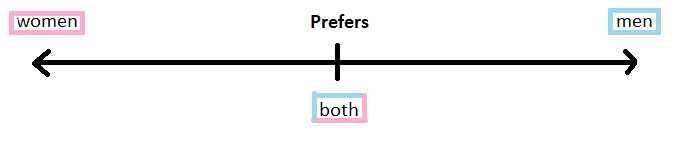
You see, while sex is (usually) binary, which is to say you’re usually born male or female, gender does not have to be.  Some people view it as a spectrum, with feeling feminine/female on one end and feeling masculine/male on the other.

You could be here…                         or here…                  or here!

Such people often plot themselves somewhere along that spectrum, as having both masculine and feminine traits.  This can be termed “genderqueer”, “bigender”, “pangender”, “genderfluid”, or a number of other things.  In addition, there’s a group of people included under “transgender” that simply don’t feel like they’re on the gender spectrum at all, or they simply find those labels inadequate or useless (“agender”).

Confusing?  A bit.  Definitely not something on the cultural radar until recently.  But very important.  No one should have to live a lie.

What Does This Mean, and How Do People Deal With It?
Mainly it means you should be a human being to anyone who doesn’t seem quite “normal.”  If there’s an otherwise normal-looking lady with 5 o’clock shadow (beard stubble) on her face, you should treat her like a person.  Don’t stare.  If there’s a man with an oddy feminine-looking face and body, same thing.  There are people out there that kind of throw your sense of what’s masculine and what’s feminine.  When in doubt, treat them like a person.  Please understand, that’s a normal part of life, and there’s nothing wrong with it.

People deal with being transgender in a lot of different ways.  When someone comes to the realization that their gender doesn’t match their body, they may change things about themselves in order to make things match.  This is called “transitioning.”  The most news-visible way to transition is to get surgery or hormone therapy, where you go under the knife multiple times or use hormones to get your body to match your mind.  This is what most people think of when they think of trans people.  STOP.  While this is a legitimate thing that trans people do, they often don’t.  Some trans people can’t afford the surgery, or prefer not to undergo it.  Some people simply need their loved ones to acknowledge they aren’t their body parts.  Some people change their wardrobe a little, as extensively as wearing only the other gender’s clothing or a simply as wearing boxers or panties under their clothes.  It just depends on the person.

By the way, the incidence rate (as far as we know) of trans people is anywhere from .3% to 10% of the population.  So you may already know someone who is transgender, or you may not know you already know someone who is transgender.  It’s hard to get accurate data because people don’t necessarily advertise they’re trans. 

Gender is not Sexual Orientation
If this wasn’t confusing enough, we have another spectrum to add to the one above: who you’re interested in, sexually and/or romantically.  Transgender people are often lumped in with gay and lesbian people.  And sometimes that’s appropriate, but sometimes it’s not, so I’m going to explain this very briefly.  (It gets complicated at length, unfortunately.)   

So we know from the fact that gay and lesbian people exist, that your sex does not decide who you find attractive.  Gay men are attracted to other men.  Lesbian ladies are attracted to other ladies.  Heterosexual people like myself are attracted to the other sex and/or gender.

So trans people run the gamut of these categories, with the added bonus that they can cross those categories in their lifetimes.  I was personally born female, and am attracted to men.  But if I happened to be transgender man, I might consider myself gay.  My body parts might be female, but my mind would be male, and my sexual orientation is towards men.  So that would make me a gay man in a female body.  (This is not the case, but it makes a fine example.)

So just to summarize: your gender does not affect your sexual orientation, or vice versa.

How Do I Treat Transpeople?
First off, like human beings.  Always treat them like human beings.  Because they are.  For all their differences, they have thoughts and feelings and lives just like you.

That said, other than really little kids, people don’t go to the effort of being another gender because it’s fun.  It’s about the opposite of fun, so if someone tells you they’re trans, please actually believe them.

1.  Use their preferred pronouns.  Usually you refer to a person by their physical sex pronouns.  For me, “she” and “her.”  For Chris, my fiancee, “he” and “him.”  For trans people, if it’s not obvious, ask, and then make an effort to remember their preference.  Usually it’s just as simple as using “he” or “she” or sometimes “they.”  This is a small but important courtesy you can give the person, acknowledging them as who they are.

2.  Don’t make assumptions about their sexual orientation.  I covered this above, but a person’s gender has nothing to do with their sexual preferences.

3.  If the person is clearly a sex that’s not their gender, but identifies with a name that matches their gender, don’t ask their previous name.  So if we have a very tall, muscular person with 5 o’clock shadow and lipstick, who identifies herself as Nicole, do not ask what her name used to be, or if she used to be called “Cole” as a man.  It’s rude.

4.  Do not ask about a transgender person’s genitals, surgical status, sex life, etc.  Those are inappropriate questions to ask anyone.  Just because this person is different than you does not make it okay to be rude.

5.  Don’t give backhanded compliments or “helpful” tips.  Saying things like, “You look just like a real woman” or, “You’d pass so much better if you wore less/more makeup, had a better wig, etc,” are not only unhelpful, they’re insulting and hurtful.  Just don’t. 

My Bias / Point of View
I do have a bit of an ulterior motive in this educational entry, as it happens.  Having watched my acquaintance transition from male to female, and gone to a seminar on how to be an ally, and tried to educate myself, I also learned something about myself.


As it turns out, I am trans.  Specifically, I’m agender.  I personally think the whole gender thing is annoying and wish it would leave me alone.   This is perhaps more obvious to some people than others.  I was born female.  But I do not wear dresses (except when I have to).  I do not enjoy makeup, or pretty clothes, or fashion, or any of that.  I simply do not care.  I respect people who enjoy culturally feminine things, regardless of which sex they were born as.  But when it comes to me, I would just as soon people take their cultural expectations of me and toss them out the nearest window.

I thought about it pretty hard, and I don’t believe I’m a guy either.  I enjoy things that are typically male, like video games.  And my clothing is more stereotypically male than it is female.  But I don’t have any particular sense that I should have a male body.  (Well, except around period time, when I just hate existing because my guts hurt.  That doesn’t count.)

I didn’t grow up with a sense of being in the wrong body, or incorrectness when addressed as “she.”  My body parts gave me a cultural identity I didn’t appreciate, but since I was already autistic and too different to fit in, it didn’t matter so much that I didn’t fit into my gender either.  I was fortunate that my parents didn’t give me much crap about it, but rather simply accepted that I was an unusual person and let me be myself.  Also, as I was growing up, it was becoming societally okay for women to cross-dress.  I wear blue jeans and a T-shirt, and no one gives me crap about it even though those are stereotypically men’s clothes.  As such, this wasn’t really an issue on my radar until my acquaintance transitioned. 

So there you have it.  If you didn’t already know a transgender person prior to reading this, now you do.  The most correct pronouns for me are “they” and “their,” but I don’t actually care that much, so if you forget or get confused, it doesn’t bother me if you use “she” and “her.” 

Accessible Lighting for Sensory-Friendly Environments

About a month ago, I was browsing Facebook and came across a fellow autistic person’s commentary and explanation of their difficulties with lighting.  It seems they notice (suffer through) flickering in some kinds of lighting, like LEDs, but not in other kinds, like incandescent bulbs.  The flickering hurts their eyes, making some places downright painful and headache-inducing.

They linked to this: http://www.archlighting.com/technology/leds-fighting-flicker_o

And proceeded to explain: 
“Incandescent filaments react more slowly to changes in their power source, and kind of trail off the glow when shut off due to thermal persistence (heat maintaining the amount of light being emitted), so even though on alternating current the it receives power in a non-steady way, the bulb appears continuously lit. For LEDs, the reaction time is quicker, so that as electricity alternates the filament switches on and off rapidly, not maintaining glow in between. I perceive this as flicker and it is awful. (This would explain why I used to think LED lights were mostly non-flickery, since LED flashlights and that were on direct current power supplied by batteries.) Fluorescent lights also flicker at 120 hertz, making school definitely worse for me all the way through.
So that’s what I mean when I talk about sensory-friendly vs inaccessible lighting; lights that flicker add constant extra sensory input (like a radio playing static) to everything else I’m trying to process, and lights that look steady to others unfortunately may not look steady to me. That the US has been trying to phase out incandescent bulbs bodes pretty ill for me and others who have overly keen perception of light.”

If this doesn’t make sense to you: all lights, even perfectly working ones, flicker to a degree.  However, the flickering differs depending on your type of light.  Incandescent bulbs continue to glow even after the loss of power, because of heat.  This ensures a steadier light source.  LEDs, however, simply shut off with no buffer. To someone with sensitive eyes/brain, this flickering is visible, distracting, and painful.

I don’t personally have this particular superpower/annoyance, but I kind of relate by comparing my experiences with messed up fluorescent lights in classrooms or lecture areas.  Y’know the kind that just flicks on and off every few seconds?  Maybe it’s not screwed in properly, or the bulb is on the end of its lifespan, or there’s something wonky with the wiring.  But it’s just that one bulb, and I glared at it through the entire lesson, while it incessantly flicked on-off. on-off.

So now imagine one of those bulbs in every room.  The light keeps changing, which makes it hard to focus on the presentation, or the person talking to you, or the job you’re doing.  Now imagine every lightbulb is that lightbulb.  And still having to try and focus through that, all day, every day.  Now imagine no one knows what you’re talking about when you react to that stupid flickery bulb, or mention it in conversation.

According to other posts in the conversation,  this person makes do with their situation by bringing a desk lamp with an incandescent bulb to work.  I imagine their home is also strictly sensory-friendly lighting. 

3 Observations From a Non-judgemental Gym

1.  TV Diversity is Highly Lacking.  Across 8 televisions, playing a variety of TV shows and movies, the most visible diversity I’ve seen in one scan across the screens was three persons of color.  Three.  (Not including sports games, because diversity needs to be in all kinds of TV and it hardly seems fair when you can get an entire team on the screen, 8+ people.)  Gee, modern TV, you know the diversity of the US is changing, right?  Try to keep up.  Prominent examples of shows toting nonwhite characters: the news (thanks President Obama), Castle (but it’s not one of the main-main characters, it’s one of the main-side characters), and some talk show I don’t recognize.  Occasionally Planet Fitness’ channel itself features minority-type people as well, so at least there’s that.

2.  Even in a Non-judgemental Gym, People Still Love to Judge.  So today I watched a thin-ish girl dressed in bright pink walk past a dozen open treadmills to slide between myself and another thicker lady.  She then proceeded to obviously compare herself to us, matching my speed and pace.  Thankfully for my pride and sense of fairness in the world, she got a stitch in her side and burned out in 15 minutes.  Meanwhile I did interval  (run/speedwalk) training for another 10 minutes, because I am no one’s bottom of the barrel comparison, thank you.  Like I don’t have enough self-esteem problems without someone obviously making that judgement.

3.  Weird Decor Is Always Weird.  This gym’s decor is purple and yellow.  Seriously, I cannot make this stuff up.

Yes, those are specifically branded cardio machines.
This isn’t my particular gym, but it’s close enough.  I keep my nose in a book, or use the Internet on my tablet, because looking anywhere else is an eyesore. There is no respite from the colors.  They’re in the lockers, the stretching areas, the consultation room…  It’s a shame I need my eyes to see my feet on the treadmill, or I might wear a blindfold while I exercise. 

30 grams of sugar

That’s how much I get to have, per day.  You know how much sugar that is?  It’s one yogurt and one truffle.  It’s two large bananas.  Roughly 55 M&Ms.  In short, it’s the easiest thing in the world to accidentally surpass.  How did it come to this?  Well…

I’ve been counting calories for about three weeks now.  While my weight has fluctuated some, it’s stayed about even.  This is despite making my calorie goals, and getting exercise 3-5 days a week.  In short, things aren’t going well.  So I asked my doctor about what else I could be doing.  She recommended 5 days/week of exercise, even really light exercise.  But she also recommended limiting my sugar to 30 grams per day.

As it turns out, this is absurdly difficult.

I’m now weighing food based on how much sugar it has per serving, rather than calories.  It turns out that if you mainly focus on sugar, you end up having to avoid a lot of calorie-intensive stuff anyway.  Y’know, like any kind of candy, most chips, and even some “healthy” foods.  I’ve sent the last of the Halloween candy to work with Chris, where its sugary deliciousness can be distributed across lots of people rather than going to my thighs.

One of the doctor’s recommendations was that I start replacing my breakfast with a protein shake.  She gave me a handout.  In the most basic of formats, the recipe is: plant-based protein powder (like hemp, pea, or rice), fiber (flax seeds, spinach, kale), fruit (berries, banana, etc), and liquid (almond milk, water, rice milk, etc).  Blend, and you have yourself a pretty healthy breakfast on the go.  She has two example recipes.  The first was okay, after I got the recipe right.  (Details are on Twitter and Instagram)

The second…  made the morning horrifying.  It was a kale-based smoothie, which I probably should have known better than to try.  But more tellingly, it lacked any sweetener whatsoever. Avocado is not sweet.  Healthy, maybe, but not sweet.  The cocoa powder (unsweetened) and almond extract could not hide the foul slap of kale.  Worse, the entire thing looked like green sludge.

I couldn’t make myself drink more than 5 swallows of it.  I was an immensely picky eater as a child.  As an adult, I’ve learned to just shove stuff into my mouth, chew it, and swallow it while trying not to pay attention to it.  I got pretty good at that, and use that tactic to this day every time I go to someone’s house and they serve something I know I don’t like.  I couldn’t manage it with this smoothie.  It was that awful.

In a fit of desperation, I doctored the unholy green sludge with a whole banana, adding a ton of sugar (albeit fructose, a natural sugar) to the mix.  It was still about the worst thing ever.  So finally, determined not to waste all the time I’d spent putting together the ingredients, measuring out and adding those ingredients to my food tracker, and the money spent buying those ingredients…. I chugged the horrific substance (20 ounces’ worth, in the end).  I then waited to see if my stomach was going to reject the unholy green sludge, because my taste buds were firmly advocating for the immediate ejection of anything that tasted that hideous.

It’s been about 7 hours, so I guess my stomach has decided to keep the unholy green sludge.  It’s extremely healthy unholy green sludge, which is another reason I downed it rather than exiling it to the garbage disposal.

Now if only my taste buds would forget this ever happened…  I tried placating them with a chunk of (humane) steak, then a truffle from my birthday present, then (sugarless) snack crackers, but apparently the whole experience was sufficiently traumatic that even that and seven hours can’t make the memory of the taste go away.

Needless to say, I’m going back to the first recipe, with the too much fructose-sugar, tomorrow.  I’ll figure out how to get rid of the rest of the kale and the remaining avocado, somehow.  I’m going to try doing half kale, half spinach for tomorrow’s smoothie.  If that’s completely horrible, I may end up screwing up my eyes and eating the kale raw.  (Let’s hope it doesn’t come to that.  One traumatic experience is enough for the week, right?)

Explaining Sound Sensitivity and Why ANC (Active Noise Canceling) Matters

(warning: this blog entry is long.  I divided it into sections to make it easier to read.  I hope that helps.)

The Intro, or Why This Came Up At All 
I’ve just returned from the gym, where I’ve had a membership for a couple weeks now.  The place is called Planet Fitness, a line of gyms that offer $10/month memberships in exchange for a stripped down (but aggressively nonjudgmental) experience.  They have the whole line of exercise machines, for example, but no pool or tennis courts or indoor/outdoor track.  The other relevant feature about them is the decor.  Besides that the colors are purple and yellow (yes, seriously), this particular gym was built in half of an old Menards (home and garden store), and they haven’t done a smidgen of soundproofing since acquiring the property, as far as I can tell.  I swear, if a single machine is clicking halfway across the massive exercise floor, I can hear it.  With at least 20 cardio machines going at any one time, and at least half as many strength training machines plus the music they pipe in…  It’s really bad for concentrating on your workout.

First Attempt
For this reason, and several others, I’ve had noise-canceling headphones on my wishlist since my last pair broke a few years ago.  I’ve gotten along well enough without them, but it’s been an itch in the back of my mind, and between this gym and the fact that my sound sensitivity seems to be worse some days now, I finally put my foot down and invested in a $50 pair.  Hooray for birthday money.

Sadly, despite my enthusiasm, the earbuds did not pan out.  They barely did a thing, in fact.  I might as well have been wearing normal earbuds.  Quite a difference from my last pair, where I could turn them on and the sounds of the road and the whistling of the wind went blissfully quiet with a polite “hiss” as the electronics powered up.

But Fortunately…
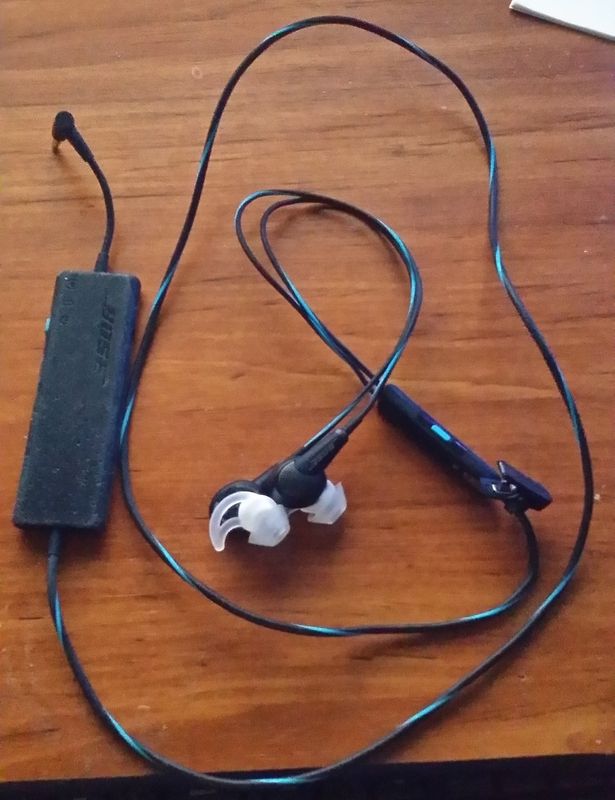
So I was back to square one, and disgruntled to boot.  I count as the working poor, which means I can’t afford to drop several hundred bucks for the high grade headphones my doctor recommended.  (Her kids have sound sensitivity too, go figure.)  As God would have it, my anniversary with my boyfriend was coming up, and given how disappointed I was at the failure of the other earbuds, he hatched a plan.  Long story short: because my boyfriend cares about my sanity and is very sweet, I now own these:

He even got them in blue.

These are Bose (QC20), meaning they’re stupidly expensive but are generally the best the consumer market can offer.  The ratings do bear that out, thankfully.  More than the ratings, though, I’ve tried these out for a week or so.  They bear out and exceed my memories of my old Active Noise Canceling (ANC) earphones.  They come with two modes of ANC operation: one for being able to hear people (Aware mode), and one for not (unnamed, but I snarkily call it “Unaware mode”).  The latter mode is excellent for drowning out road sounds, rumbles, whirs from fans, distant slamming doors, and other annoyances.  It seems to work fairly well across all ranges of sound, from high pitched squeaks on poorly oiled hinges to the bass of the sounds of the road.

(Sidenote: I do not use Unaware mode while driving.  One of the first ways you know something is wrong with your car is by the sounds it makes.  Plus being able to hear cars coming up beside you is an excellent aid to checking your mirrors.)

Active Noise Canceling, Noise Levels, and the Gym
All that said, I’ve been putting those earbuds through their paces at the gym I mentioned above, with its layers upon layers of cacophony.  Impressively, Unaware mode does not, in fact, completely drown out the noise of the gym.  I went at a relatively offpeak hour, 2:30, and I could still hear people chattering behind me (though not as well as I would’ve otherwise).  I could still hear the annoying click click behind me and to the right, the sound of a limping machine some guy wouldn’t get off.  It was all there, just much quieter. 

Having some of the best ANC available, but still being able to hear all that, got me thinking.  Prior to today, I’d always thought sound sensitivity was mainly an issue with loud noises.  The loudness of the gym, for example, necessitated headphones or earplugs.  The loudness of a movie theater always necessitates earplugs, and even then it’s noisy.  I’d get headaches.  I picked up an app that tracks deciBel levels, specifically to check how sensitive I was.

My readings on that app were… underwhelming.  The world around me almost never approximates a jet engine, even though it can really feel like it.  Noise levels rarely get above 70-80 deciBels.  (80 dB, by the way, is being right next to the in-sink garbage disposals while they’re running.  A comparison chart, for the curious.)  That lack of high readings bothered me.  If it wasn’t the noise of a place, why did I still get headaches and want to go hide in quieter places?

Sound Sensitivity Explained
I couldn’t figure it out… until I spent time in that gym today in Unaware mode.  I measured the gym’s noise level out of curiosity.  Never got above 70 dB.  So it wasn’t the sound level that drove me bonkers.  It was the sound complexity.  The sheer number of things going on at one time.  People walking around chattering, the clunks of weights and strength training devices, thud-thuddings from the footsteps on treadmills, high-pitched beeps as people programmed their cardio machines, music blaring from the speakers…

The world, you see, is a symphony of sound.  My brain doesn’t filter all that sound as politely as most peoples’ does.  At this moment in my very quiet apartment (25 dB), there are three smallish fans running, plus the hum of my computer’s machinery.  Every key I hit makes a soft sound somewhere between a tap, a click, and a thud.  The mouse makes sharpish clicking sounds.  Because all of that is relatively quiet, I’m only marginally aware of it.  Most people wouldn’t hear it at all, because the brain filters out extraneous and irrelevant noise.  No one really needs to hear every key they press on a keyboard.

So my brain doesn’t do that very well.  Here in my very quiet apartment, it’s not really overwhelming.  There isn’t much loud or complexity.  Outside, though, is an entirely different experience.  From airplanes to birds to cars to dishes, all the way down the alphabet to zippers, this world has a lot of different sounds.

The vast majority of those sounds are unexpected.  If I see a car coming by, my brain will usually buffer and “quiet” the sound of it passing.  But if a car comes up behind me suddenly, there’s an excellent chance I’ll flinch and look around.  My brain is already bad at ignoring sounds that don’t matter, but adding unpredictability into it basically ensures I won’t be able to ignore it.

Stop for a minute and listen to your surroundings.  Try to note every separate sound you can hear.  Perhaps there’s a coffee maker, or your refrigerator, or the clink of dishes, or your computer’s fan whirs quietly.  If you’re out and about, perhaps there are people talking, or machines working, or cars passing.  Try to listen to all those sounds at once.  That’s what it’s like for me to have sound sensitivity, but all the time. 

Instead of my brain automatically filtering out sounds that don’t matter, I actively have to set them aside.  If the sound was very sudden, sharp, and/or loud, it may have made me physically jump or twitch, and then I have to calm down from the sudden spike of heartrate and adrenaline.  Even if I don’t physically react, I often still suffer the heartrate spike and adrenaline. 

I do this all day. 

The Importance of Active Noise Canceling
I mentioned earlier that because my apartment is pretty quiet, I’m only marginally aware of the various noises in it.  So if I have a device that selectively quiets or eliminates sounds from my threshold of awareness, that saves me a lot of twitching, jumping, flinching, and other unpleasant reactions.  The better the strength and “intelligence” of the device, the less energy I have to spend reacting, setting aside those sounds, and refocusing on the task at hand.  It’s like having a secondary filter, complementing my brain’s subpar filter, leaving me more energy to deal with the rest of life.

I cannot stress enough how incredible that is.  Life is anywhere from draining to exhausting on any given day.  Having something to keep some of that lost energy, or a portable place to isolate myself from the chaos of the day, is wonderful.

I usually go through the day without using any ANC; this is my life, after all.  But knowing it’s there, ready to quiet the multitudinous clamor of life if it gets overwhelming, is comforting.  I’ve taken to carrying them even when I don’t think I’ll need them.  They’re nearly always at hand, and I suspect they will join the list of things I don’t like to leave home without: my tablet, keys, and wallet.  (Once upon a time, “a good book” would also have been on that list, but I digitized most of my library and put it on my tablet.  I’m presently carrying around a paperback, though.)

Some Concerns
I’m a little afraid of wearing these earbuds too often and getting used to the world not being so complex, only to be caught somewhere without them and be unable to focus.  It’s the same rationale I use with painkillers.  For an average day, I should be able to get through life without having to resort to external help.  If my headache isn’t too bad and might be from dehydration or because I haven’t exercised my neck muscles, I prefer to drink some water and exercise my neck, not pop some pills and ignore the potential causes.

There’s also the potential of making my sensitivity worse, in general.  Apparently in some cases paying more attention to these sensitivities (or trying to treat them) can exacerbate them.  I definitely, definitely do not need worse brain-sound filters.  So I’m going to have to be careful with how often I reach for these earbuds.

Does anyone else think life is like a giant balancing act? 

High and Low Functioning, or Dehumanizing Descriptions

I hear autistic people described a lot as “high functioning” and “low functioning.”  Even fellow autistics and parents use these designations.  I initially found myself using the descriptor “high functioning” to assure people that they didn’t have to worry about me throwing a tantrum or having a meltdown or something amorphously awful.  But I’ve given it some thought after reading other sources, and I’ve decided to stop using those descriptions of people.

Firstly, as someone much better at speaking than me pointed out, calling someone high or low functioning is dehumanizing.  Respectively, you’re calling them “almost human” and “not really human,” and defining “human” as “able to blend into our health- and wealth-center idealizing culture.”  That’s not okay. 

Second, the standard of measure is false.  Saying someone is high functioning is effectively saying that they have few problems with blending into the modern culture.  That is false, at least in my experience.  The most successful of us to blend are the ones who can act; the ones who studied what “normal” is supposed to look like and shaped ourselves masks to fit. 

As long as we wear the masks, people won’t give us too hard a time for existing, or draw away from us, or worry about being near us.  But they’re just masks.  Worse, is that when you act “normal” people assume you have no problems.  That’s laughable even for neurotypical people, but it’s especially laughable for autistic people.  The autism alone gives us plenty of problems, but it often comes with a host of other problems: depression, anxiety, sound or touch sensitivities, and even food sensitivities or allergies.

I’m somewhat on the fence about how to describe autistic people so as to assure our humanity to the casual listener, but at least one category that can be used is “verbal” and “nonverbal,” with plenty in between.  Most days, I’m pretty verbal and articulate.  Some days, not so much. 

In truth, I spent so long trying to learn what “normal” was and compromise with being myself and being “normal” that I’m not entirely sure whether the verbal and articulate parts I’ve developed are really me.  Or what exactly “me” is.  So perhaps I or someone else verbal and articulate on the spectrum will be able to develop a descriptor that doesn’t deny humanity to those of us that are a bit different…. not less. 

On "mind blindness"

http://www.huffingtonpost.com/liane-kupferberg-carter/autism-and-empathy_b_3281691.html

This article gives a brief history of how autism came to be associated with a lack of empathy.  It also makes an important point about empathy: that just because you lack the innate cognitive ability to recognize why someone is sad or angry doesn’t mean you lack the ability to emotionally share or pick up on that sadness or anger. 

Personally, I feel like I fell behind on the cognitive ability, at least for awhile, but the emotional ability to feel others’ emotions has been there, making my life painful.  I think in general I have a low tolerance for emotions.  I used to cry a lot when I was little, whether I was in pain or sad or angry or happy.  It wasn’t a choice, my eyes just got started and didn’t wait for the rest of me to okay that it was appropriate to do so.  Sometimes my eyes’ enthusiasm plagues me to this day, and it irritates the heck out of me.

I can’t tell if LENS has made that better or worse.  I feel more emotions now, rather than walling them away because they’re exasperating and don’t make sense and are hideously inconvenient.  But they’re still plenty exasperating, hideously inconvenient, and don’t make sense. 

I think maybe I’ll keep that phrase “my eyes’ enthusiasm,” or maybe “my eyes’ exuberance” to describe why I tear up more often than I’d like.  It’s a fallacy, of course, my brain is probably the culprit, but I have a lot of things to scowl at my brain about already.  Best to spread out the blame and maybe amuse some people in the process.