Healthy Snacks

As I was bumping around at home recently, I realized my dinner table had been taken over by snacks. The job I’m currently working frequently has mandatory overtime, up to 12 hours. In fact, quite soon it will be 12 hour days almost exclusively, seven days a week.

Now, I always pack a lunch: a hearty sandwich, greens, and a fruit of my choice. But that only lasts so long. So I’ve taken to looking (read: pestering my therapist/nutritionist, mostly) for whole foods snacks that carry nicely. I’ve talked about why good food is so stunningly important to wellbeing. It pretty much has to be lived to be believed, but you can read my guide and story about it here.

In an ideal world, you would start with fresh veggies and a healthy dip. And I do that at home, with fresh green beans, sugar snap peas, or snow peas. But at work I only have so much space, and the work refrigerator has Rules I don’t want to try managing. So instead I’m opting for mostly shelf-stable convenience foods and hand fruits, like apples, clementines, and grapes.

As I was clearing the table of my snack selections, I realized it might be helpful to I share what I’ve found. These are whole foods snacks a busy parent might also include in their kids’ lunches or household snacks with a clear conscience. Or snacks an overwhelmed autistic adult, like myself, might keep around the house instead of candy, cookies, and pastries.

Snacks Criteria

I have a relatively strict diet these days. The criteria, then, for these snacks I’ve welcomed into my home:

  • must provide nutrition
  • low sugar, keto, or at least minimal added sugar
  • whole foods as much as possible- you can typically look at the item and see what it’s made of easily
  • minimal or no added artificial colors, artificial preservatives, extra chemicals
  • dairy-free, humane treatment and slaughter if it’s meat

Without further ado: the winners:

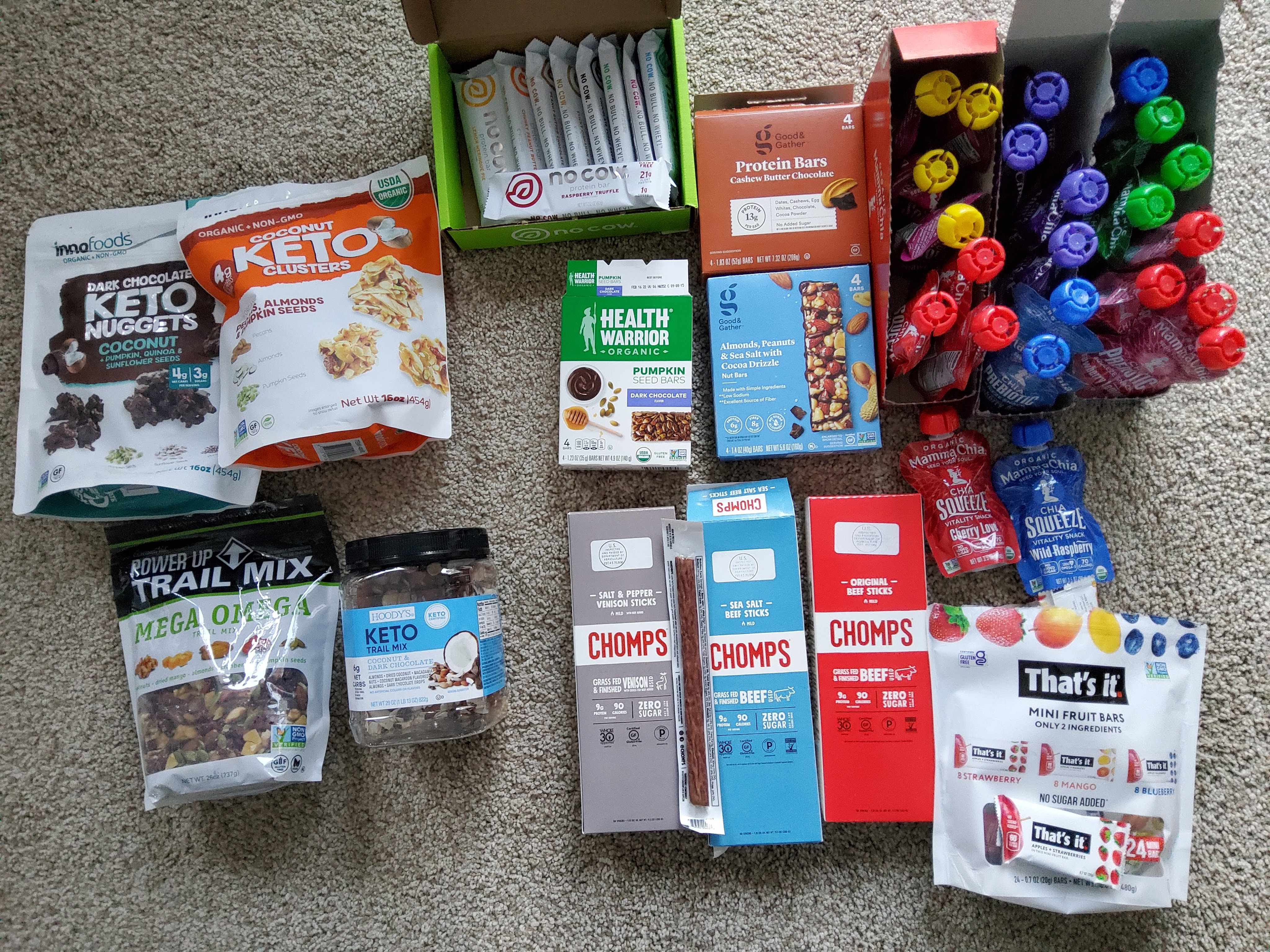
I’ll handle these healthy snacks by food type for everyone’s convenience.

Seeds and Nuts Clusters

We’ll start on the left side. On the top left is my new most favorite snack in existence: innofoods Dark Chocolate Keto Nuggets.

What they are: chocolate covered coconut, quinoa, sunflower seeds, and pumpkin seeds. My God that chocolate is delicious. They talk about it on the back of the bag and I really don’t know how much is marketing and how much is true, but. BUT. That chocolate is delicious. I can and absolutely would consume a whole 16 oz. bag in one sitting if I wasn’t paying attention. I know this because I wasn’t paying attention with the first bag and I absolutely ate half the bag before I noticed. Then I noticed and had to make myself stop eating because I didn’t want to stop.

Like its orange sibling next to it (pecans, almonds, pumpkin seeds, and coconut- still good but c’mon, chocolate!), it’s a crunchy snack. If you like crunchy snacks, tree nuts, or seeds, innofoods seems to have cleverly balanced their sweet and salty to make a snack you really do want to just keep eating. (This is also why Pringles can be hard to stop eating, fyi.) However, the sweetener is a mix of erythritol and cane sugar. So it’s still keto-friendly in small doses. Just, y’know, don’t eat half a bag in one sitting.

I found these bags at Costco. You may want to check with your specific Costco to see whether they have these, though. The two bags are from two different Costcos. The closer one has the chocolate, and the other had the orange sibling. Innofoods also has a website.

Trail Mix

Moving on (reluctantly!), we have more typical loose trail mix. Loose trail mix is vaguely annoying to me because you need a container for it. But I do have some, so I still keep this around. There are two kinds of trail mix, which I typically just throw together like a madman. Also because they’re pretty good that way.

The first is a mix of dried fruit, nuts, and seeds. It is notably not keto, but in small amounts it’s quite good. The issue with dried fruit is that it’s often laced with sugar. It’s already fairly sweet as is, and then they throw more in to make it addictive and/or cover up poor quality fruit. Really, any trail mix will do. Just avoid the ones with candy and added sugar.

The second trail mix does claim to be keto, but includes dark chocolate nubbins as well as macademia nuts. I’m not a big tree nut buff, but they are high quality protein and staying power in a pinch. The dark chocolate nubbins are mainly why I mix the two mixes together. The fruit is sweeter than the nubbins, but chocolate is delicious.

Both of these trail mixes can be found at Costco. But really, any trail mix works as long as you avoid added sugar, artificial colors, and outright candy.

Protein/Convenience Bars

Onto the wrapped bars. These are terribly convenient.

Health Warrior seed bars are first up. Health Warrior was the only brand at my grocery store that was made of whole foods without a hefty helping of sugar. They have a website, and they do both pumpkin seed bars and chia seed bars. It’s all been good. These fit the typical granola bar niche, and they’re nourishing to boot.

Target’s Good and Gather protein bars are pictured, but they’re kind of the crappier, mainstream, cheaper version of the Health Warrior options. They’re not truly low-sugar, but they were one of the first things I found that fit the bill for what I was looking for. they are, at least, whole foods. And available in much of the US. I eat these sparingly, as treats.

No Cow Protein bars are probably the best proper protein bar option. They’re a bit more processed than the other listed bars, but nourishing and low sugar as well as completely dairy, gluten, and GMO free. Also, you can cover 99 cents’ worth of shipping and have three bars sent to you free, which is pretty much the best way to try stuff like this. I personally tried that free trial, then bought the variety pack you see above, and now have settled on four flavors I like best. They’re filling and stick with you, and for that reason, they’re the last thing I typically eat in a shift. Sort of a sweet yet satisfying ultralight dinner.

Meat Sticks

Chomps meat sticks are my current go-to for humane, whole foods animal protein snacks. These are the clean food versions of beef snack sticks. They’re available at several of my local stores, but you can also buy them online. Of the listed flavors, I’ve tried Original Beef, Jalapeno Beef, Salt & Pepper Venison, Sea Salt Beef, and Italian Style Beef. I’m not a huge spice fan, so I’m not bothering with the Jalapeno again (it wasn’t that spicy, mind). The Italian Style Beef tastes like pepperoni or summer sausage, which I’ll do sometimes but not every day. And the remaining three I enjoy greatly.

Paleovalley meat sticks (not pictured) are also a thing. I have yet to try these because I can’t find them in local stores, but my nutritionist swears by them and feeds them to her kids. The site has a whole blurb about why their meat sticks are superior to the typical kind, which would include Chomps. I have no doubt these will be fantastic when I finally get to try them.

Fruit Leather and Squeezable Snacks

Mamma Chia squeezes are maybe the closest thing I’ve got to typical squeeze fruit snack type things. I’ve seen applesauce packaged like this as well as other fruit-like products. Anyway, this is basically a fruit puree with chia seeds. I’ve found it at many of my grocery stores, and they also have a website. The chia seeds are a superfood, and they also add some texture to an otherwise basic smooth puree. I’ve had every flavor they offer except mango coconut. They’re all good. My favorite is Cherry Love (tangy!), with Wild Raspberry as a close second.

That’s it. fruit bars are the last item in the picture. I have the mini bars, which are at Costco, but they sell larger ones for a heartier snack as well. Their big selling point here is that the bars are literally just what it says they are. I have the apple/mango and apple/strawberry varieties, which are respectively 1 apple + 1 mango, or 1 apple and 12 strawberries processed into a fruit leather bar-shaped thing and sealed in a wrapper. They’re sweet and good, but not laced with colors, preservatives, or sweeteners. Also, at the time of this writing, all but two flavors are sold out, so I guess consider that a resounding vote of “yes, these are excellent.”

Bonus: Drink Mix

I’ve mostly covered food here, but there’s one thing that I’d be remiss if I didn’t mention. I mainly drink water all day, every day. It’s tasty water, so I’m not bothered. But sometimes you really just want to have extra flavor and maybe some sweet in your drink. So, meet TruLemon.

TruLemon drink mixes are a fairly simple idea: low sugar, but not zero sugar, lemonades and drink mixes. I can speak for the original lemonade, raspberry lemonade, peach lemonade, and black cherry limeade flavors. They are all very good. Sweet but not overwhelmingly so. Not enough sugar to rot your teeth. Strong flavor. I’m mostly quite happy with water, but when I want to liven up my drink, this is what I reach for. Target and several other grocery stores carry these, and they have a website with a ton more options.

Autism at Food Factory Work

black ship on body of water screenshot

For the last two weeks, I (an adult with autism) have been doing factory work at a local factory that makes baking mixes, breads, and sweets. I thought it might be interesting to give an overview of my experience and tell you whether this kind of work is suitable for autistic people. The workers at the factory have a union. Which I’ve found mostly means that they have their own rules that may or may not make sense or be helpful.

I won’t name the company here because I like avoiding being sued. The job was titled General Labor, which effectively means they’re paying me to pick things up and put them down. It’s a skillset I have, though admittedly not my most valuable skillset. I got this job because I needed work that was full time, quickly. My bills need paying, and at the moment I can’t make part time work pay them.

First Impression

My first and second impressions of the company were not favorable. The online reviews on the job site I applied on were, um… not complimentary in the slightest. That was the first impression. I still applied and interviewed, but I asked some very pointed questions about their conflict and management practices. The answers were somewhat satisfactory. They suggested the management (at least of this section) listens and was reasonably adult about their crap, so I accepted the job.

Second Impression

I formed my second impression on what was supposed to be my first day. I’d been told to arrive a little early to turn in a piece of paperwork for joining the union. Which I did. I arrived about 12 minutes early, and promptly couldn’t get in or reach anyone to let me in. I wasted 5 minutes just trying to get someone to answer a phone so I could turn in this paperwork. Then the lady at the desk took several minutes just to print me a map (which didn’t end up being helpful anyway) and tell me where to go for orientation.

I arrived at 9:02am, two minutes late. The door was closed and locked. There was no built-in way to phone for help. I knocked, and nobody answered. I waited around hoping someone would go through the door, but nobody did. Eventually, in desperation, I called the main line for the company and asked what was going on. The desk jockey told me they would send someone. After another 10 minutes or so, someone did arrive… but she looked me up and down and told me I couldn’t start that day, for two reasons. One, I was late. Two, I was wearing jeans, which weren’t allowed. And there was management in the building, so she didn’t want to risk their displeasure. And thus, because they only do orientation on Mondays, I was sent home and had an entire week off.

Disrupted Schedule

Needless to say, I was not impressed. It was mainly their fault I was late, and punishing me for their failure is not a great way to start a business relationship. It also struck me as astoundingly irresponsible and uncaring of their employees’ time. The start time was 9am. Was I supposed to know, despite not being told, that I should show up at 8:45? Apparently.

Autistic people can be very good at sticking to a schedule and obeying the rules. But we have to know what the rules are. This was not a very autism-friendly start to this factory work job. I’m fortunately fairly graceful about handling sudden changes like this in the moment, but I still cried all the way home and spent much of the day in bed. It was really frustrating to have tried my best to start well, only to have them spit on my efforts and then have to go home for the entire week.

First Day

So, at the appointed time the next week, I arrived 15 minutes early. This time the door was standing open. They checked my documentation at the door and escorted me up to… basically a lecture hall. I had my picture taken for my ID before I’d even chosen a desk.

The ensuing lecture was unpleasantly reminiscent of 8am lectures in college. I came to the lecture tired and somewhat dazed. And just like those lectures, they threw too much information at you to possibly memorize it all. A pen was provided for taking notes, but paper was not. So I took notes on the back of my insurance information folder.

The lectures were with a live presenter, a la the 80s or even the 90s, I guess. Most places I’ve worked simply have training videos, but not here. Like 8am lectures, it was “sit down and listen until we’re done with you.” They then fitted us for uniforms and sent us home. Still not a particularly autism-friendly start to this factory work, in my opinion.

Subjects

We began with training about their onsite freezer chemical (which apparently stinks long before it can harm you, so you really do have to try to hurt yourself with it). Then there was a lecture on Good Manufacturing Practices, which includes a laundry list of things. But it pretty much boils down to “Keep Very Clean,” “Use Proper Clothing and Equipment,” and “Follow the Rules to Ensure Safety.”

After that it was on to Allergens, which is a big deal in food production. You really, really don’t want to accidentally kill someone because somebody had almonds for lunch and a bit got into the waffle mix. I learned here that 90% of food allergies (that are recognized as allergies) are to one of eight things: peanuts, tree nuts (like almonds and cashews), dairy, eggs, soybeans, wheat, fish, and shellfish.

I also learned that there are several additional named categories of foods they need to pay attention to. I’d heard of kosher, organic, gluten-free, and non-GMO. But they also pay attention to halal and pareve designations. All of these mean sourcing only ingredients that meet these standards, so that the final product can also be labeled that way.

After that it was on to various cleaners and chemicals we might use, including the use of protective equipment. And finally, we were taught about how to lock out equipment. And also told we wouldn’t be doing that, but that everyone needed to know it anyway.

There were a couple quizzes about the chemicals and lockout procedures that we needed to fill out and turn in. Thankfully being half-awake was sufficient for that.

Unusual Rules

I’ve never done factory work before this, so a few of their rules struck me as strange. Some are explainable, but others seem just kind of petty.

Rules that Made Sense…

In the explainable category… no one was allowed to have peanuts or tree nuts in their lunch. The exception was peanut butter, but that was it. You couldn’t have candy or gum in the production area. You also weren’t allowed to use any kind of tobacco product, to the point that they’d literally fine you every paycheck if you were. And no strong-smelling perfumes or colognes. Finally, you pretty much couldn’t eat in the production area.

These rules are all meant to limit allergens and contamination of the food products. Perfume and cigarette smoke can make the food product taste like those things. Nobody wants to eat pancakes that taste like cigarette butts or “male musk.” That all made some sense to me.

They also had a rule about not having hair ornaments, like decorative combs, clips, etc. This seems sexist until you remember these things can rip a hole right through your hair net, which then means you’re running the risk of contaminating the food. I have short hair, so I pretty much didn’t care about this rule.

And Rules that Didn’t

But then there were rules that just struck me as pointlessly oppressive or mean. Things that made this factory work job very autism-unfriendly.

No Phones and Internet

My biggest irk: you weren’t to have your phone on the work floor. Not at all, going by the signs on the walls. Absolutely no one paid attention to this when they weren’t being monitored, mind you. There were phones in pockets, phones coming out at moments when no work was immediately necessary, etc. Considering the workplace has no lockers, secure storage, and very limited numbers of clocks, I can’t really blame anyone.

However, my “phone” is a full sized tablet, and no one makes pockets that handle stuff that big. Plus it’d be very obvious. So I ended up having to leave it in the car and bring in an old iPhone I have on long-term loan from a friend. It doesn’t have a data connection, but it has phone games and a clock.

Also? The building has incredibly poor signal for most cellular carriers. The place is saturated with wifi. But when I asked, I was told basic employees weren’t given the wifi passwords on purpose. So during my breaks, I had no Internet unless I went out to my car. Which I believe I was told in my interview is not allowed. (I did it anyway.)

In this modern world, we’re often used to being constantly connected. While I don’t think it’s absurd to expect your employees to work on the clock, I do think it’s unkind to have the expectation that we leave so much of our lives at the door. A rule like this is off-putting, and for autistic people who don’t realize there are two sets of rules (the ones stated and the ones people actually follow), it might be a deal-breaker.

Corollary: No Earbuds, Music, Audiobooks, or Podcasts

I really hated this part. Doing the same thing over and over isn’t the end of the world to me. Some autistic people thrive on repetition, and getting into a rhythm doing the same thing can be exactly what we need. The kicker: some people really need to have music or audiobooks to help keep their focus. Especially people with ADHD, but many autistic people and even neurotypical people as well.

That option is literally nonexistent in this place. You aren’t supposed to have your phone. And even if you do, earbuds and headphones are not allowed. I checked. You can still have earplugs, which helps with the machine noises somewhat, but they’re provided by the company, so I hope you like blue squishy foam earplugs on strings.

This rule made this factory work very not autism-friendly, in my opinion.

Breaks

Speaking of breaks, this factory does not believe in lunch. My state does not mandate any break schedule or lunch after you become an adult. So the union negotiated for two 20 minute breaks. That’s all you get for 8 hours of work. I’m used to two 15 minute breaks and either a half hour paid lunch or an hour unpaid lunch. This rule is very stingy by comparison. Thanks to being at college, I know how to shovel food down my throat quickly. However, it’s a poor practice for enjoying, digesting, and getting the most out of your food.

The shortness of the breaks also means the workers are pretty much limited to bringing food from home. There is no time for, “I’m going to run out for Subway, everyone gimme your orders and money and I’ll bring it back!” Or, “Our team is going to Taco Bell for lunch, see y’all when we get back!” and everyone companionably piling in someone’s car.

On one hand, this means the autistic person’s diet can be catered to as much or as little as they want. If you’re always packing your own lunch, it’s up to you what you put in there. Fast food doesn’t really do dairy-free, gluten-free, low-sugar stuff at the moment. On the other hand, you’re missing the possibility of coworkers and bosses getting to know us as people, rather than just as workers. So those rules for this factory work are kind of a mixed bag in terms of autism-friendliness.

Sitting Down

This is an informal rule I learned while on the job. You are not to sit down. There are basically no places to sit down in the factory. You’re to stay on your feet for your entire shift except for breaks. Management gets upset if they see you sitting.

As someone unused to being on my feet for 8 hours, this was awful. I have two pairs of good shoes suitable for this job. But I’ve never been terribly athletic. Not being allowed to sit to rest my poor, angry feet, strikes me as just cruel. Eventually I’m sure I’d build a tolerance for it, and buying nice padded insoles would probably help. But really, why on Earth would it not be okay to rest your feet when you’ve nothing else to do? That’s stupid, petty, and just mean. If that’s standard for factory work, then factory work is inhumane. Don’t @ me.

The first day I was out on the floor, my legs and feet hurt so badly at the end of my shift that I refused to get out of bed for over 2 hours. Absolutely refused. There were various things I could have been doing that day, but the idea of putting weight onto my feet was so abhorrent that I just couldn’t.

I assume management, had they actually found me resting my feet, would have had a metaphorical heart and let me sit for a bit once I explained my situation. But having a heart is entirely optional. If the person with autism couldn’t explain themselves well and quickly, this factory work might easily become intolerable.

The Actual Work

I’ll now describe the different types of work I did over the course of the weeks. It was never exactly the same work twice over the course of the week, interestingly. I’ve described the first day, which was entirely orientation.

Day 2: Tour and Glaze Packing

The second day I started off with meeting my boss’ boss. He personally gave me and the other two new hires a tour of our area. He also explained his management style, which is aiming for “approachable, open, friendly, and willing to listen.” The tour and explanation probably took an hour or so.

Then we were given our assignments. The other two were assigned to work somewhat like warehouse jobs, where you put together bags of the ingredients needed for recipes going into production. That involves lots of lifting, and they unironically only assign men to that work. It’s insisted that this isn’t sexist. I have my doubts. At UPS, women were fairly evenly assigned to trailers. Here, not so much I guess.

On to the Production Line

I was assigned to a factory line that makes doughnut glaze. Because I was new, I was rotated through exactly two stations: making boxes and filling them with plastic bags of glaze. I was assigned to work with a kindly older Hispanic lady. She A) was clearly very competent and caring, and B) had limited English skills. She would become my Square One for the job. If I didn’t know what I needed to be doing, she was the person to ask. Or in my case, walk over and look confused. That part of the factory work, at least, was autism-friendly. Having a Square One is essential.

Many of my coworkers on this line and elsewhere spoke Spanish more than English. This was more than a little isolating, because I can count to 10 in Spanish and say good morning and thank you, and that’s about it. Learning additional languages is really not my strong point, but it could be a great experience for someone wanting to polish their skills with native speakers.

At any rate, for the rest of the day I taped the bottoms of boxes and lifted bags of icing off the conveyer line and into those boxes. I had concerns about getting a repetitive motion injury, but thankfully that didn’t happen. Fortunately I was only mildly sore, and it went away quickly. I fell into a sort of waking trance during the work, and badly missed my podcasts and music.

It was very much like school. By the last 2 hours or so, I kept checking the clock and willing the hands to move faster. It’s also the most footsore I can remember ever being, which is a big part of why time seemed to move so slowly. When I got home, I took care of a few small things around the house and then got in bed and refused to put weight on my feet for over 2 hours.

Day 3: Glaze Rework

The next day, I was still assigned to the glaze line. However, I also had an appointment to get to at noon, which would turn out to be incredibly fortunate. In this factory (and perhaps elsewhere), when you need to remake a finished product, they call it rework. And that was my job that day.

Literally, there were boxes of icing. We were issued knives, and the job was to cut the bags open and get them emptied down a specific hatch into a heating tub. The knives were not terribly sharp, I’m afraid. But I still had to wear a cut glove, which is basically a tight, knife-resistant cloth glove. That went on my off hand, under the blue gloves we wore to keep the food sanitary.

The machine room was rather warm already, and the hatch in question was up on the second floor. So this was already somewhat unpleasant. Then, despite my mask, I could also smell the icing. And unfortunately, the process of emptying the bags of icing was a messy one. You had to squeeze them with your hands to get all the icing out. Then, when it was sufficiently empty, you’d toss it into a nearby trash can. The icing got everywhere. My shoes, my pants, my shirt, my arms, and apparently even my hair.

I learned later there were plastic aprons I could have been using, but the machine operator and everyone else forgot to mention it (it’s common equipment everyone knows to use, in their defense). I eventually found one and wore it, but by then it was obviously too late to save my clothes. Fortunately, it’s mostly just sugar and liquid. Nothing the washing machine can’t handle.

How to Hate Food in One Easy Step

The real kicker was the smell. I was sweating, my arms hurt, it was hot, and the smell of the icing was all-encompassing. Like most humans, I’m an associative creature. So I began to equate the smell with the experience. Dislike started replacing my immediate “ooh, smells good” reaction to icing and doughnuts.

I strongly suspect, had I not had to leave for my appointment, I would have ended the day with a hatred of the smell of sugar and icing. Which makes me think that working in a food factory might be a spectacular way to ruin your love of food.

Thankfully, I left at noon for my appointment. So I wasn’t particularly footsore that day, and had some time to recover from squeezing all those bags of icing. I did end up with some nice bruising on both forearms from leaning on solid stainless steel equipment while I was working. As of writing this post, those bruises have mostly healed.

Day 4: “Cleaning”

When I came back to work the next morning, I found out that the glaze line had finished their work. There was nothing more to do in production there. Most of the workers went to other lines.

Me, though? I and my Square One got the clean up assignment. This involved wrapping certain pieces of smaller equipment in plastic, to start, so they would be protected from… something. I’m honestly not sure what. Powdered sugar? A pressure washer? Dust? It was never explained.

At any rate, once that was done, the torture began. You see, there was not, in fact, all that much to clean. And there were probably 6 hours to burn after the plastic stuff was done. We got 2 microfiber cloths each, and a bucket with a little water and zero cleaning product. Thus equipped, the Hunt For Anything At All To Clean was on.

I’m actually having trouble recalling precise details of this day, which I think speaks to how miserable it was. It wasn’t just the boredom. It was that there really was nothing that particularly needed the help.

Make Work

I wiped the inside and outside of cabinets, even though they weren’t or were only barely dusty. I cleaned inside phone boxes, at least one of which no longer had a phone. Wiped stainless steel equipment that wasn’t particularly dirty just to make it shine a bit more. And railings that showed no sign at all of needing the care. The water wasn’t disinfectant, so really what was the point?

By the second half of my shift, it was a joy to actually spot dust I could attend to. Even though it was barely there. The once I found some actual glaze spilled down part of a railing, I exclaimed happily out loud. That was how soul-crushing this work was.

I think I took four bathroom breaks that day, and I took zero the days before. I dumped my bucket far more often than was necessary, and took extra long in cleaning it out and refilling it. Sitting down is against the rules, remember. And there was nowhere to hide, really.

Also, it was literally “clean stuff” or “go home,” and I needed the money. I no longer wonder why everyone I’ve ever seen in the factory grimaces when they mention cleaning. It wasn’t hard work. It just made me wish I didn’t exist. At no point can I recommend this kind of factory work to anyone, with or without autism.

Work like this is where motivation and joy go to die. I would quit in a heartbeat if this was going to be my life every day.

Day 5: Waffle Mix Rework

The next day was once again different. With no more cleaning to be done, I was instead assigned to a different production line. This one made waffle and pancake mix. Y’know the self-serve Belgian waffle stations at hotels? The ones with the little cups of batter that you pour into the machine? Yeah, they make that waffle mix at this line.

It was rework again. This time it wasn’t bags of icing, thankfully. It was bags of waffle mix. I was issued a knife and a cut glove to protect my off hand, just like last time. The job was to cut open the bags and empty them into sanitary bins, roughly the size of janitor trash cans.

Once enough boxes had been emptied into the bins, we emptied the bins into the machine. This meant the mix went everywhere and got on everything, basically. Including my shoes and my clothes. After that was done, the machine processed the ingredients for a while. Which meant that after the bins were refilled, you had nothing to do but stand around.

Again, sitting down on the job gets you in trouble. Unlike the other line, though, this line was up high on the third floor. Meaning management doesn’t typically just wander by, and can’t easily spot you. So unlike other days, I did sit down a lot. The other workers mostly didn’t follow suit, but they didn’t give me grief either.

Therefore, this was the only day of factory work that I wasn’t footsore after.

Bonus Day 6: Mandatory Overtime, Just Kidding!

On Friday morning, management told us that there would be mandatory overtime on Saturday. They didn’t name anyone specifically. But when I asked the leadership afterwards, they said this was quite normal and everyone should come in. My local union rep echoed this sentiment. I assumed this meant I was to treat Saturday this like a normal work day.

So bright and early, I showed up as I had each previous day. But when I went to find where I should go, my name wasn’t on the assignment list for a production line. I clocked in anyway and went to where the 8am meeting should have been. There was nothing. No one gathered and waiting. No familiar faces. And of course, no Square One.

A Lack of Answers

I wandered around the facility trying to find someone to ask what I should do. I went to HR, which typically has an open-door policy. They weren’t in. The office was dark. The door was locked. Management wasn’t in. Same deal. I guess it’s all fine and well to demand your workers sacrifice their Saturdays, but doing so yourself is a step too far. (Why yes, I might have Opinions about this.)

Eventually I found a different assignment board that basically said “if your name isn’t on these lists, you’re not working today, go home.” So not only do they expect everyone to show up to work, but also they don’t give you the courtesy of telling you whether you’re going to waste your time and gas getting there.

This deeply displeased me. That kind of schedule disruption and implied disrespect for my time and sleep is really concerning. I can’t imagine most people with autism would handle this mandatory overtime/just kidding facet of factory work well. I really wonder about the union in this place.

At any rate, I clocked out and went home. I couldn’t get back to sleep. That ship had very much sailed. But I was able to do a few things around the house that I hadn’t expected to have time for. I also started writing this post. I felt so annoyed by the situation that I got about 2,500 words down before my brain begged to do something else. I’m kind of proud of that, to be honest.

Pros and Cons

So after all this, what’s the conclusion? Is factory work a good fit for people on the autism spectrum?

Pros

So here’s the thing. Factory work can be really good for people with autism. It’s often steady, predictable work. The hours are fairly regular, particularly with good management and a steady customer base. Autistic people can thrive on repetition, which a factory has plenty of.

The pay was decent enough ($16/hr and up), particularly with the labor shortage. Maybe not enough to pay for house, car, and expenses by yourself, but enough for a good start. And of course there’s advancement, at least ideally. So you might start on the lines, but you could move up to Quality Control or management or being a machine operator.

There’s also limited social interaction expected in factory work, which can be an important factor to keep in mind when job hunting on the autism spectrum. The two production lines I worked on had maybe six people working on them at any given time. Sometimes far less. That’s not too many people to juggle. In my case, I didn’t even need to differentiate that much. All I really needed was to recognize my boss and recognize my Square One. The others mainly kept to themselves and chattered in Spanish.

Finally, this factory was pretty clean. Sanitation is extremely important in food production, of course. Tainted product becomes sick customers and lawsuits and tons of lost money. But some food factories, I’m told, are better than others. This place had a lot of precautions in place, from washing your hands before entering work and after breaks, to shoe brushes and sprays. Hairnets, gloves, and beard nets were mandatory. It was annoying at times, but in all honesty, I’m glad for the concern.

Cons

That said… I’m going to assume success for work like this is a matter of finding a good fit. Policies and rules vary by the company and the type of work. Food production, like the place I worked, likely has more stringent sanitary requirements than other types of production. You probably don’t need to wear a hair net (and a beard net if applicable) and pay very careful attention to which color gloves you’re wearing at some types of factories. You might not need to sanitize your feet every time you leave the break room.

I, for one, found the incredibly limited breaks and the no headphones policy rather intolerable. I like to take my time eating my food. And if I’m going to be doing the same thing over and over, I want to be learning about autism or listening to music or hearing about myths and legends from around the world. Also, anyone should have the option to sit down if they need to. I don’t know what purpose that rule serves, other than to purposely make workers miserable.

Racism and Sexism

Also, the leadership in this factory is pretty white and male. Usually both those things, especially as you move into positions off the factory floor. Whereas the workers in the lines are more often black or brown, and many are female. As a white apparently-female line worker, I’m an oddity. I dislike this state of affairs, as it strongly suggests glass ceilings are in effect. The leadership of the factory doesn’t seem to be drawn from the pool of line workers… or if it is, it strongly favors cis white male workers.

Finally, there’s some fairly strong evidence for a culture of (usually) subtle sexism in the factory. Women aren’t typically assigned to parts of the line where lifting stuff is required. When I talked to a couple people about that, they said something along the lines of “oh, men are better suited for that.” In contrast, when I worked at UPS, I got assigned to trailers of whatever happened to be on hand… If it was heavy, sucked to be me. And all the women who’d worked at UPS longer could have snapped my spine in half, even if they looked tiny and fragile.

I don’t think this food factory is a good fit for me in the long run. That doesn’t mean other factories couldn’t be. Factory work in general seems like it might suit a lot of autistic people. In fact, I recently met an autistic guy that loves his factory job. So there’s definite potential there.

Would I recommend this particular factory to other autistic people? No. No I would not. I’ll be taking a new job elsewhere soon, with no regrets.

Valuable Online Resource: Fair Health Consumer

You know how you can use the Kelly Blue Book to look up the price of a car?  You input the make, model, condition, etc, and it tells you more or less what a fair price for the car is?

Imagine having something like that for medical expenses.  Hospital stays are notoriously ruinous without insurance, and sometimes even with it.  The thing about insurance is that they keep staff onhand to dispute markups on services.  So the insurance company (and by extension, you) aren’t stuck paying a thousand percent markup on over-the-counter painkillers.

The Problem

Why is it like this?  It’s actually not as simple as hospitals being greedy.  It’s because the US healthcare system has, overall, shifted away from the metaphorical ounce of prevention in favor of the metaphorical pound of cure.  Hospitals, you see, can’t refuse to treat someone based on whether they can pay.  But because healthcare is so expensive, a lot of people don’t go to the doctor or dentist immediately when they have a problem.

Instead, they postpone dealing with the issue until it goes away or turns into an emergency.  Naturally, this is when it’s most expensive to treat, and narrows your options considerably, but if you can’t afford even the basic prevention (because your insurance sucks, or you don’t have any at all), it doesn’t really matter to you.  So the hospital treats the unfortunate person, but the person can’t pay.  The hospital is still out that money, so what are they to do?  Pestering the person via debt collection agencies isn’t a very successful option, plus it takes time.

The solution, as it happens, is to jack up all their prices on everything.  By making people with actual money pay more, they can systemically balance their budgets after a fashion.

As you can hopefully see, this is a crappy solution.  And it’s vastly unfair to people without insurance companies to negotiate on their behalf, or even with an insurance company that half-asses their negotiations.  It’s also typical that people will go into getting medical procedures with absolutely no idea how much it’ll cost them, then getting slapped with the bill later.

The Immediate Solution

For both of these issues, there’s a solution, and it’s called Fair Health.  While the website has its own tutorials and informative videos, I’ll briefly explain how some of the site works.

You can look up how much a procedure or treatment will cost you.  The site will ask you where you are, because that matters in the calculations.  It may also ask you whether you’re in-network or out-of-network, which is insurance-ese for asking whether you’re getting the service from a doctor they approve of, in a place they approve of.

Finally, they’ll ask for something significantly harder to provide: a CPT code or precise description of the service.  I know about CPT codes because I did a bit of work with them at the front desk of an ABA clinic, but I don’t think most people are familiar, so:

In brief, a CPT code is a precise designation for a medical treatment or procedure.

For example, I looked up D2392, which is “a plain white resin-composite filling that covers two surfaces on a back tooth.”  You’ve got the material type (resin composite), the procedure type (filling), the location (a back tooth, like a molar), and the approximate amount of effort involved (two surfaces, meaning the top and side of the tooth could be involved, which means a moderate amount of material, molding, and drilling is likely to be involved).

You can look these CPT codes up online, but in all honesty, you’re better off just getting the exact CPT codes from the doctor’s office when these procedures are proposed.  If you’ve got a smartphone, you could even look up the codes while you’re in there with the doctor.

The site also has informative sections about insurance, including explanations of common insurance-ese terms like “in network” and “out-of-network.” It’s fairly basic information, and I don’t feel like it’s super-well organized, but it is good information to know.  Having it somewhere free and publically accessible is definitely preferable to not having it.

There’s one odd caveat with this site, and it’s that it doesn’t cover government insurances.  Medicare, Medicaid, and Tricare data is not included here.  The site pretty much exists to help uninsured people, and people on private insurance, make sure they aren’t scammed or overcharged.

In the Long Term

You may have noticed this website doesn’t solve the systemic problem of hospitals jacking up their prices to compensate for treating people who need the help but can’t pay.  It can help by educating individual consumers, but the overall problem persists.  Y’know what would solve that overall problem?
Universal healthcare.  Whether that’s Medicare for All or some other version, returning to the “ounce of prevention is better than a pound of cure” model of healthcare would save us all a fortune.  People would be able to get cavities filled without feeling like they’ve chosen their health over being able to pay rent that month.

In an age of unprecedented bad physical and mental health, where the average lifespan (for everyone, not just autistic people) is actually decreasing for the first time in decades, I feel like we could use the change.

By the way, if you ever want to do a good deed and personally take a metaphorical bite out of the suffering this unfair healthcare system creates, RIP Medical Debt is an excellent way to do so.  They buy up uncollected medical debt from debt collection agencies and forgive it.  It’s an unusual method, but it lets them take $100 in donations and use it, on average, to forgive $10,000 of debt.  Be sure to check it out!

Grocery Shopping on a Special Diet: The Checkout

Welcome back to the final installment of my autism-aware shopping trip through the grocery store.  Week by week, I\’ve shown you what the store sells, pruned down the selection to what\’s safe for me (because autistic people can have very sensitive systems) and point out various gotchas the store tries to make you buy stuff you didn\’t come for. 

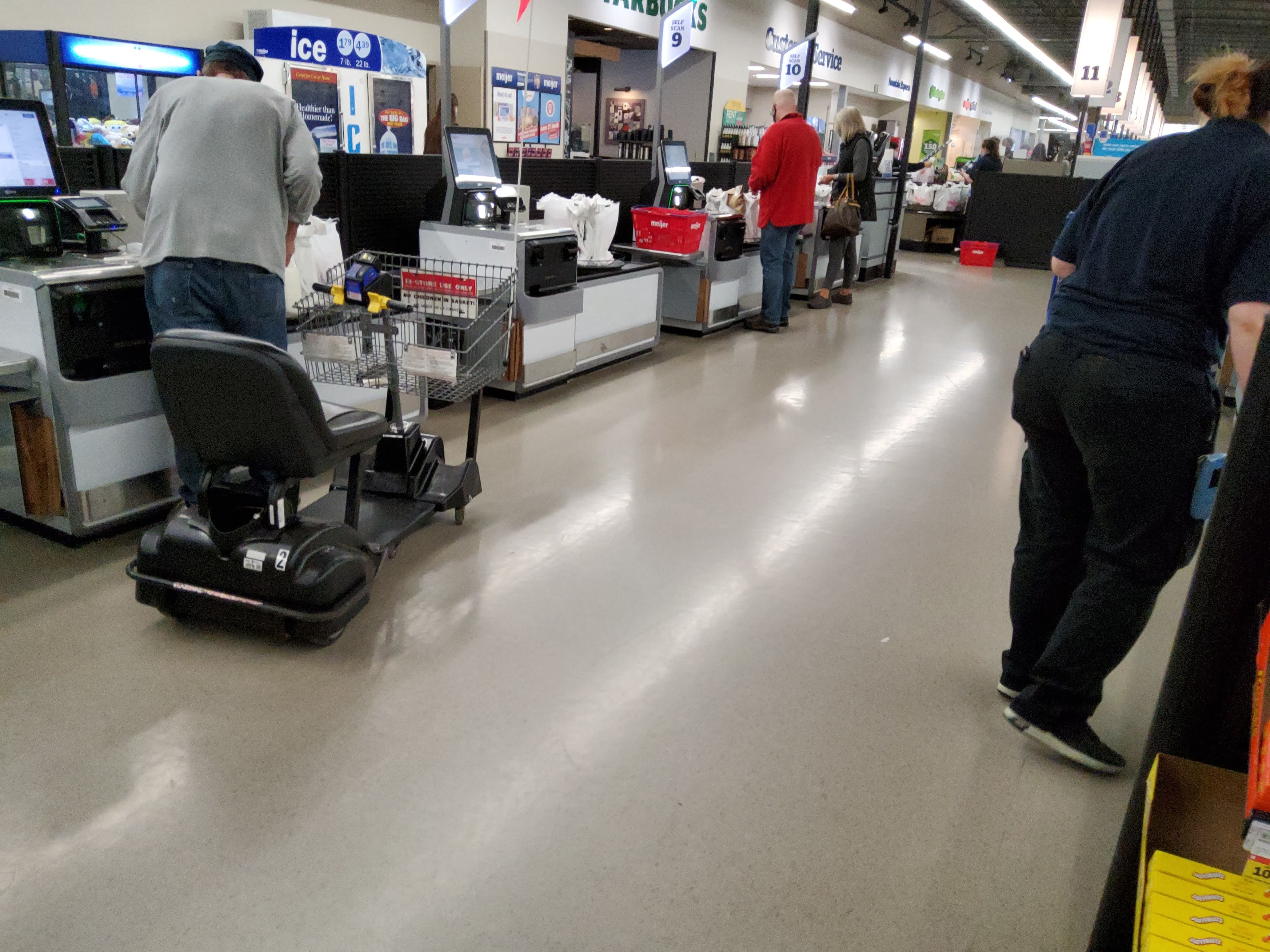
This is a bonus post, which is just for the checkout lanes.  There are actually three kinds of checkout options, including the traditional setup that was the standard for decades: a clerk, at a register, with a lane.
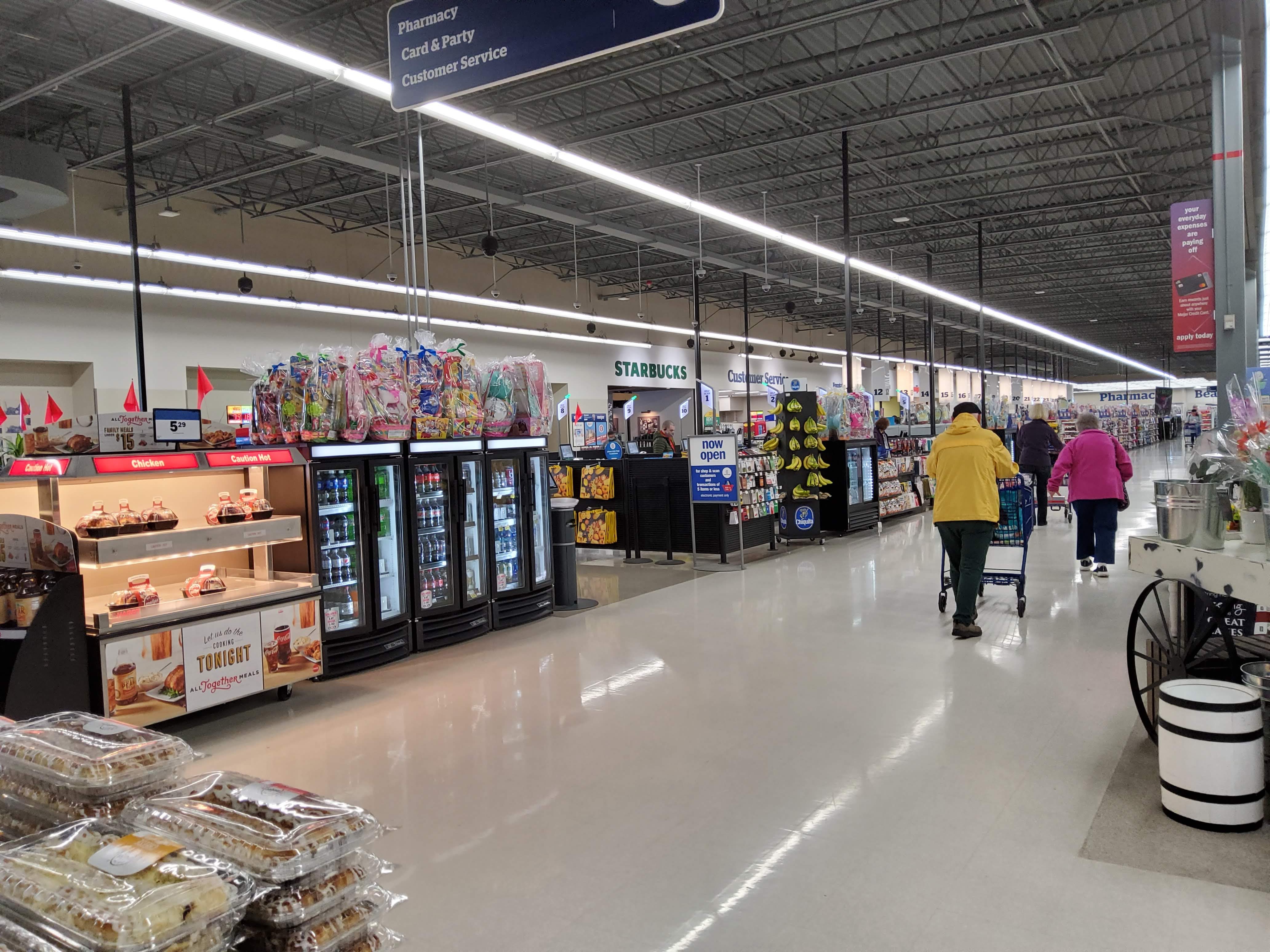
An overview shot.  You can see the sheer amount of snacks and junk food artfully arranged to tempt you at every possible opportunity.  You can also see the entrances to all three checkout options, if you know where to look.  

We\’ll start with the traditional option.  

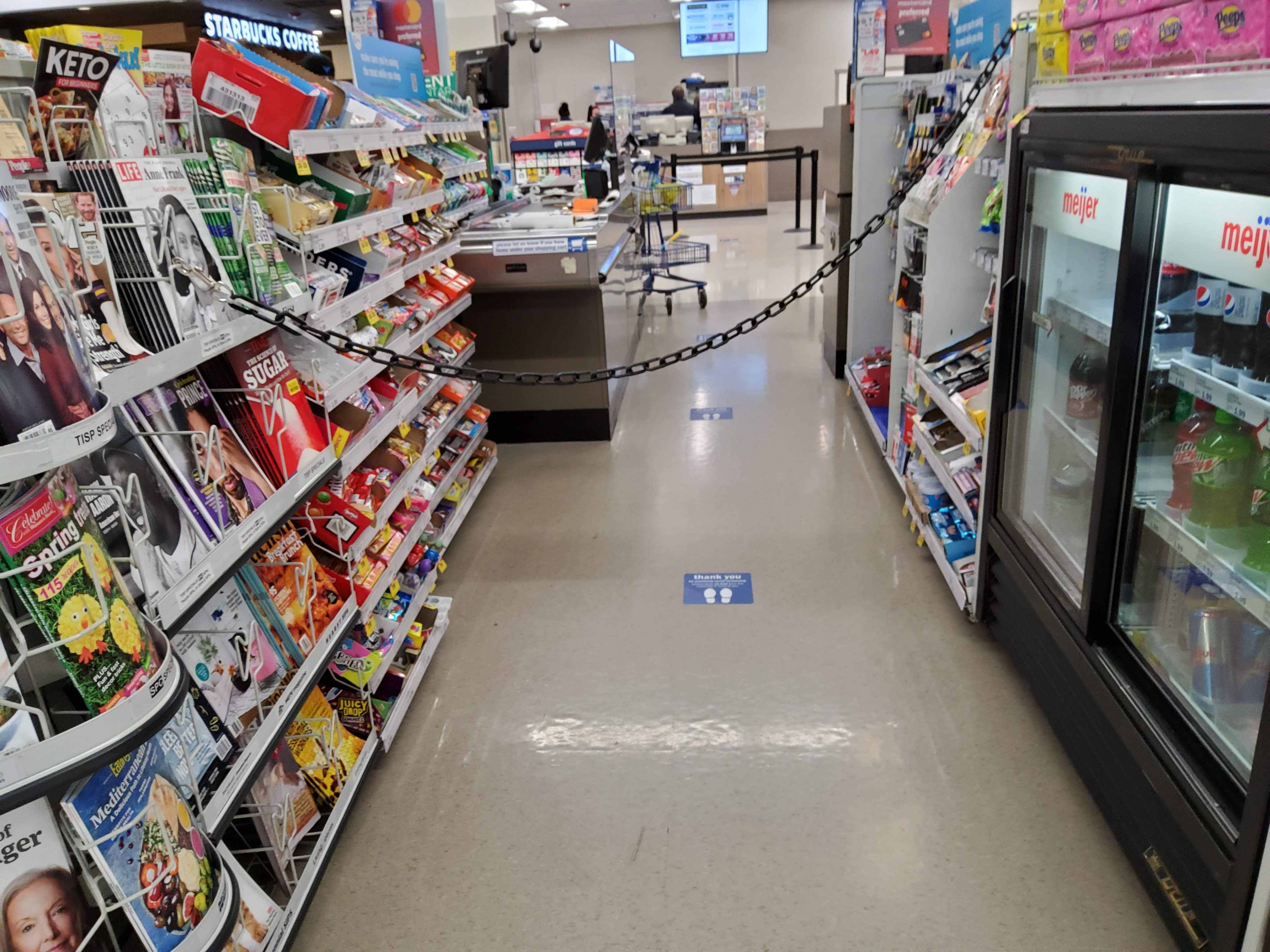
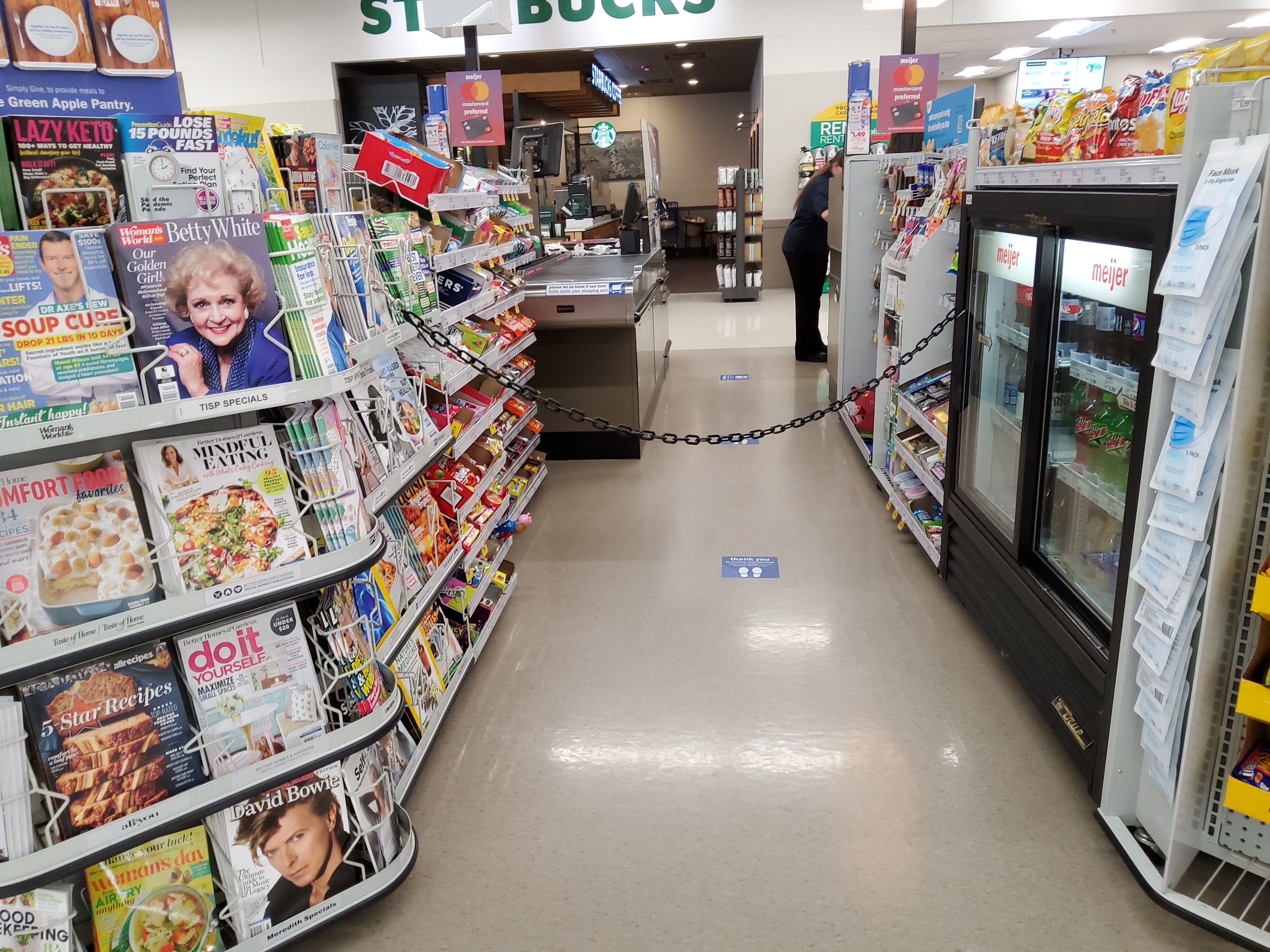
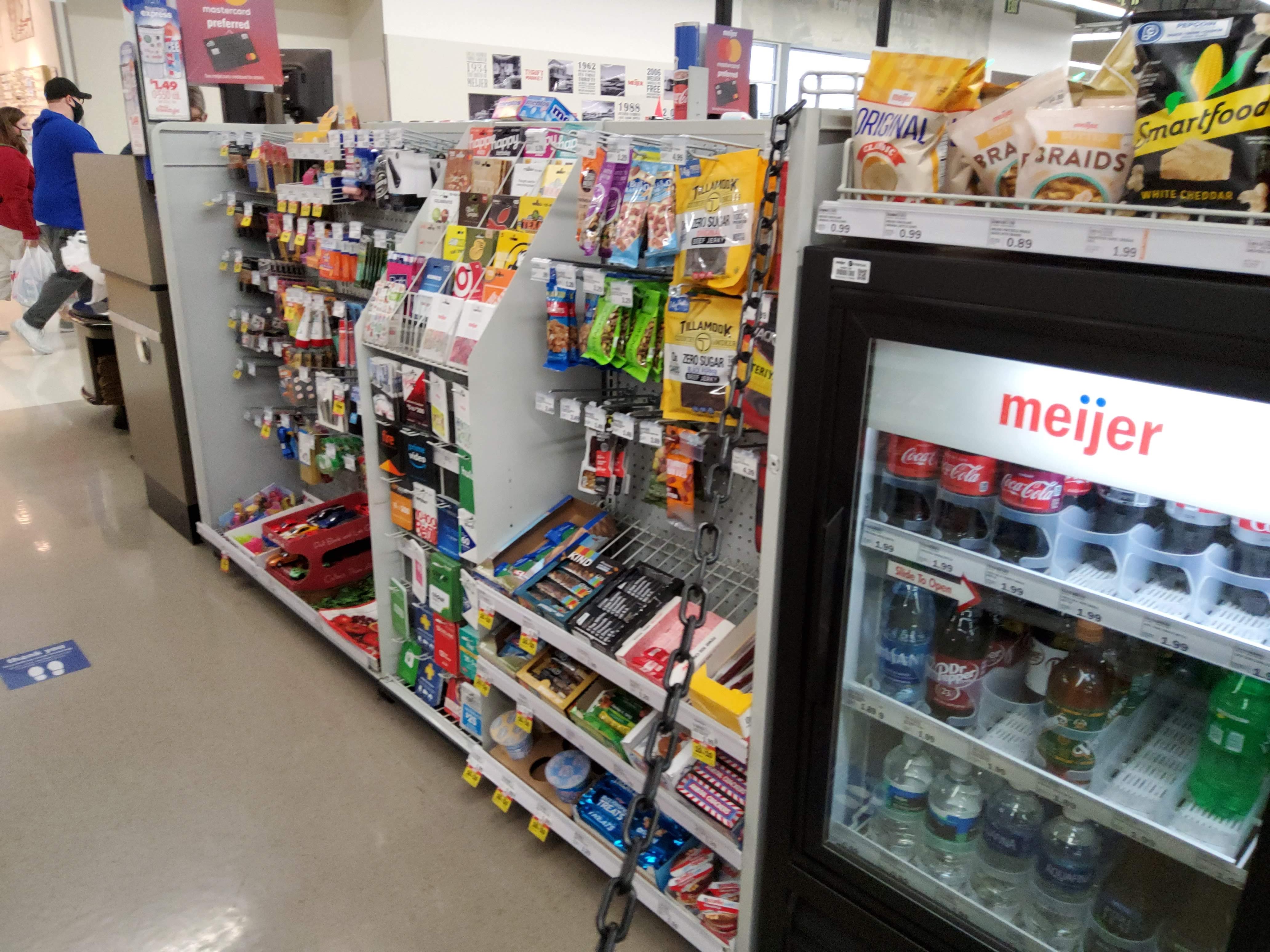
Two versions of the same thing.  You have your impulse purchases on either side, followed by the conveyer you unload your bags/cart onto for the cashier, followed by the cashier\’s station, the register, and the bagging area.  The cashier (a real person) scans your items one at a time, bags them for you, gives you the total cost of your purchases, takes your payment in cash, check, or card, and returns you any change and your receipt.  
I chose closed lanes because I didn\’t want to worry the cashiers, so you can also see the adorable plastic chain that wouldn\’t stop an excited toddler from passing.  
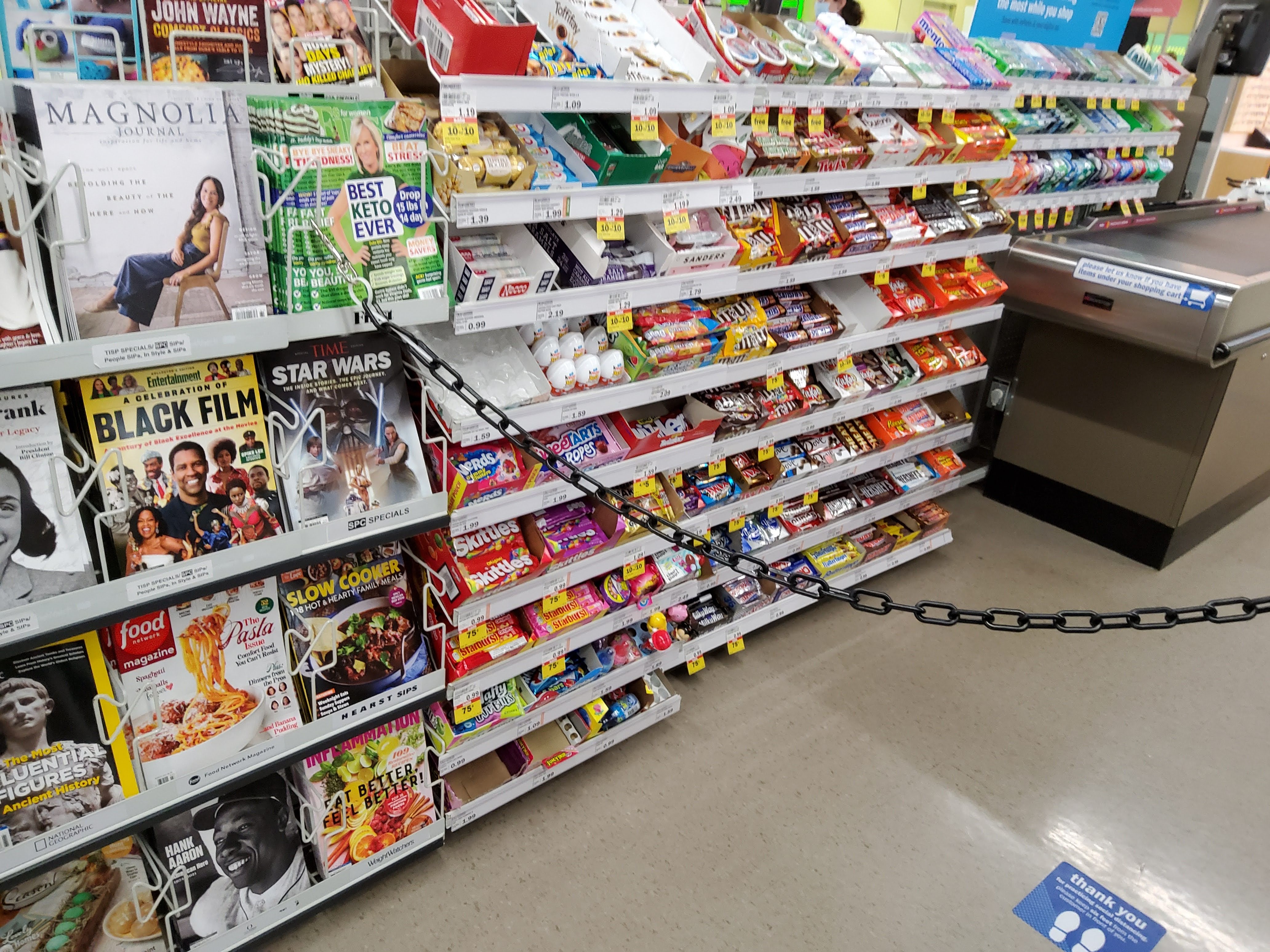
Right side of one of the traditional checkout lanes.  Magazines, which run the gamut from \”might be useful\” to \”what monster was okay with wasting paper on this garbage?\”  And after that, an array of candy.  Remember how there was a candy aisle?  Yeah, so this is in addition to that whole aisle.  
This is all designed to make you do what\’s called impulse buying, which is just buying stuff because the urge grabs you to, perhaps before you can think about it very hard.  Now, a single candy bar might not be that much money on a single shopping trip, but over the course of a year, it adds up, and the toll is taken both on your bank account and on your body.  
The other side of a typical checkout lane.  I was actually surprised at how standardized the lanes are now.  In other stores I remember, the contents of the lanes would vary, sometimes rather widely.  Perhaps because of less available space?  But these seemed pretty cookie cutter.  Magazines across from chilled drinks.  Candy across from salty snacks, gift cards, and some small convenient items, like lighters, lip balm, flash lights, bleach pens, and travel sized hand sanitizer.  
That\’s option 1, the traditional checkout lane.  I typically avoid this because dealing with a live human involves making conversation, or at least interacting to some small extent, and that costs effort and comes with tons of social pitfalls.  And I just want to avoid those as much as possible.  
Let\’s look at the other two options, shall we?  

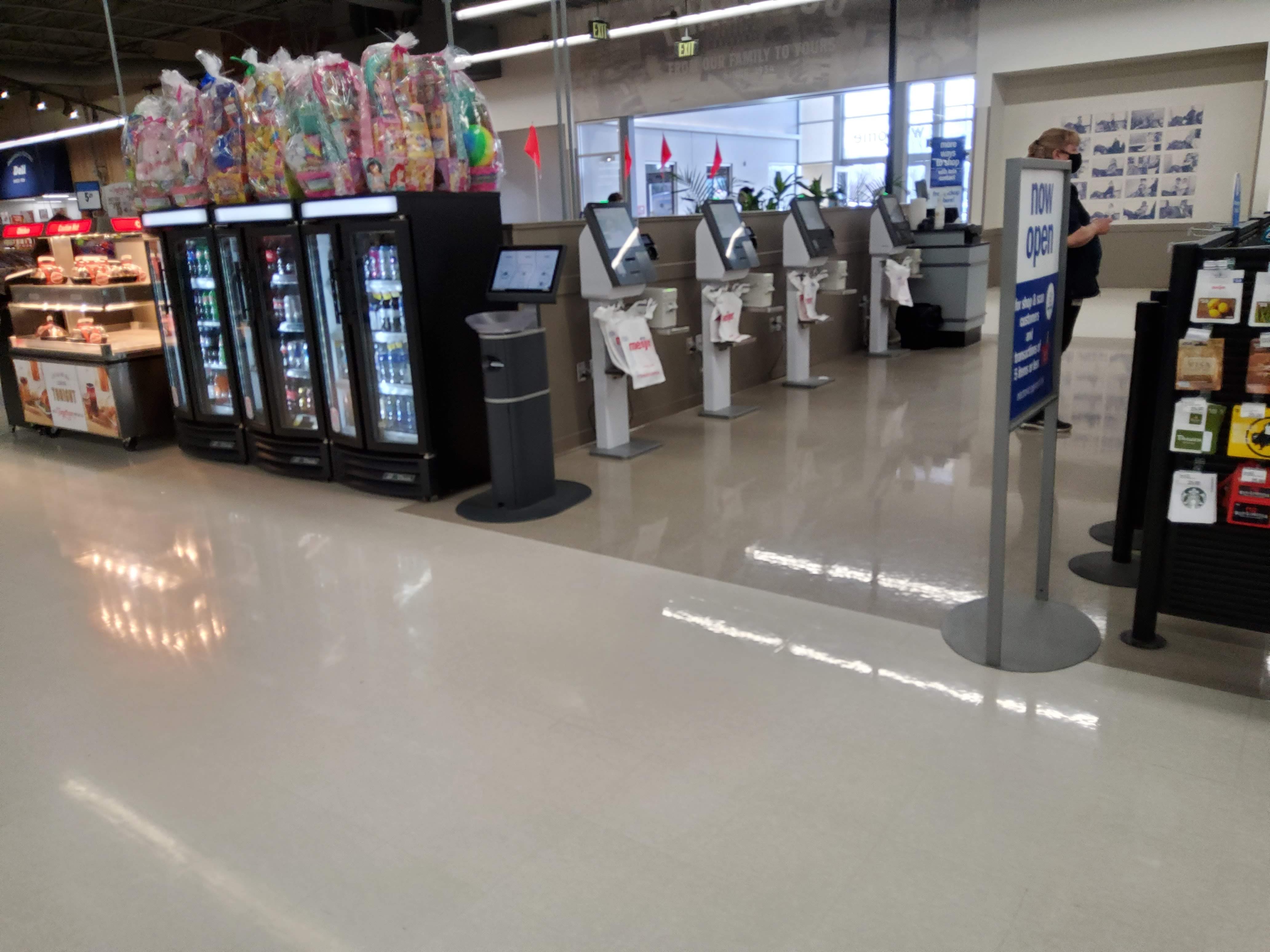
Here\’s option 2.  It\’s the most high-tech one, and it requires you to have a smart device and their special app.  You scan each item as you put it into your bag or cart, using your phone, and then take your phone and scan that at the checkout here.  You are thus an unpaid cashier your entire trip through the grocery store.  It gives you the total, you pay using the interface, bag your stuff if you want to, and go on your merry way.  

There seems to finally be an employee monitoring the area, but in times past, the whole place was deserted.  Even by the customers.  Seriously, nobody uses this despite the corporation really, really wanting people to.  
In my case, it\’s that I really don\’t want my grocery store having access to my phone, apps, and identity any more than it already does.  Can\’t speak for everyone else though.  
In one store I visited, I saw these converted to \”5 items or less, and also our system we\’re begging you to use PLEASE PLEASE PLEASE.\”  It\’s maybe telling that even in a pandemic, people would rather use option 1 or option 3 over this one…  
And that brings us to option 3: the self-checkout.  
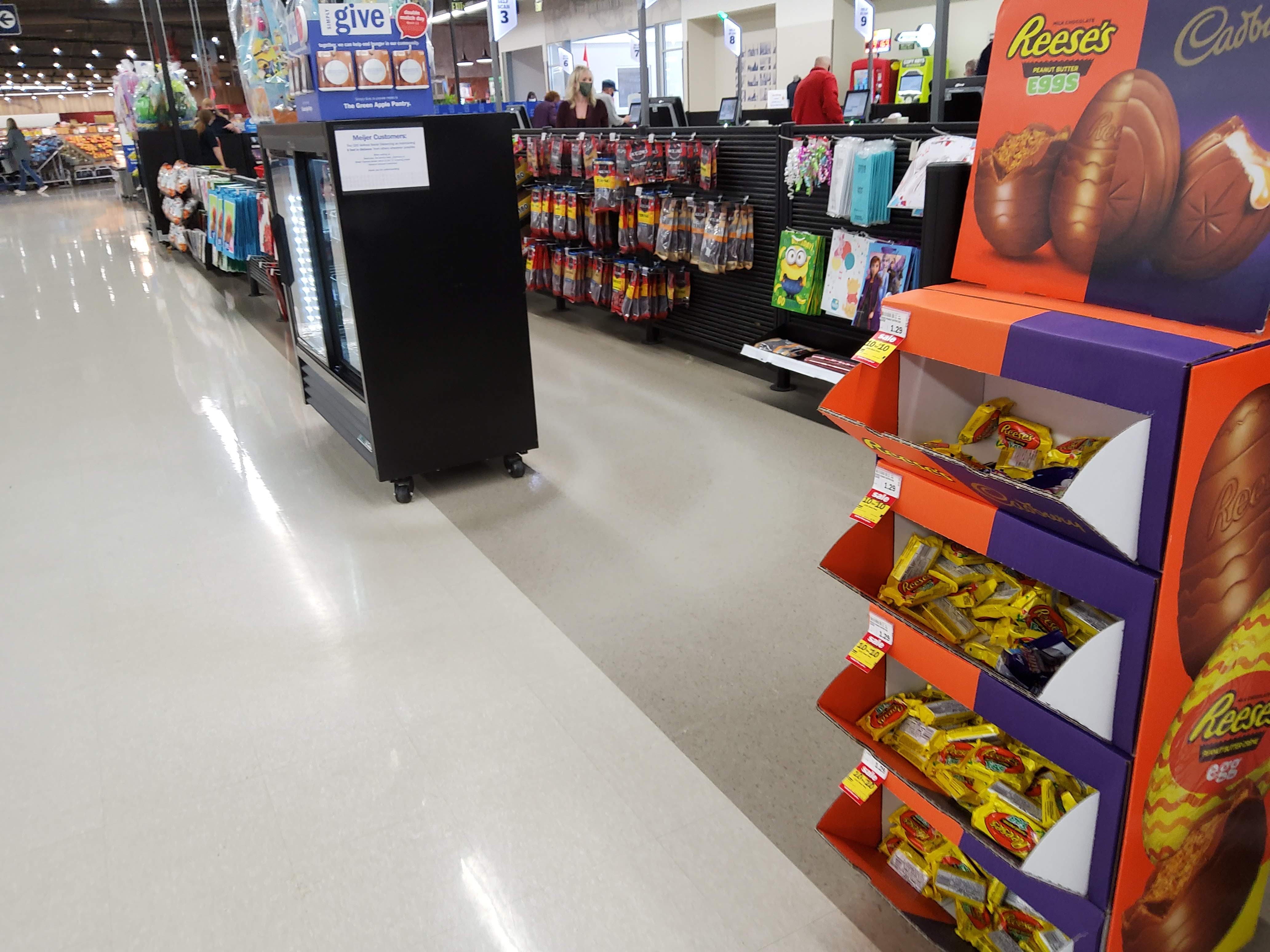
Once upon a time, these used to come in the single lane variety of the first option.  Unfortunately, some manipulative troglodyte in marketing realized that you could make people walk past a ton more impulse purchases if you just rearrange the checkout setup… and so we have this instead:
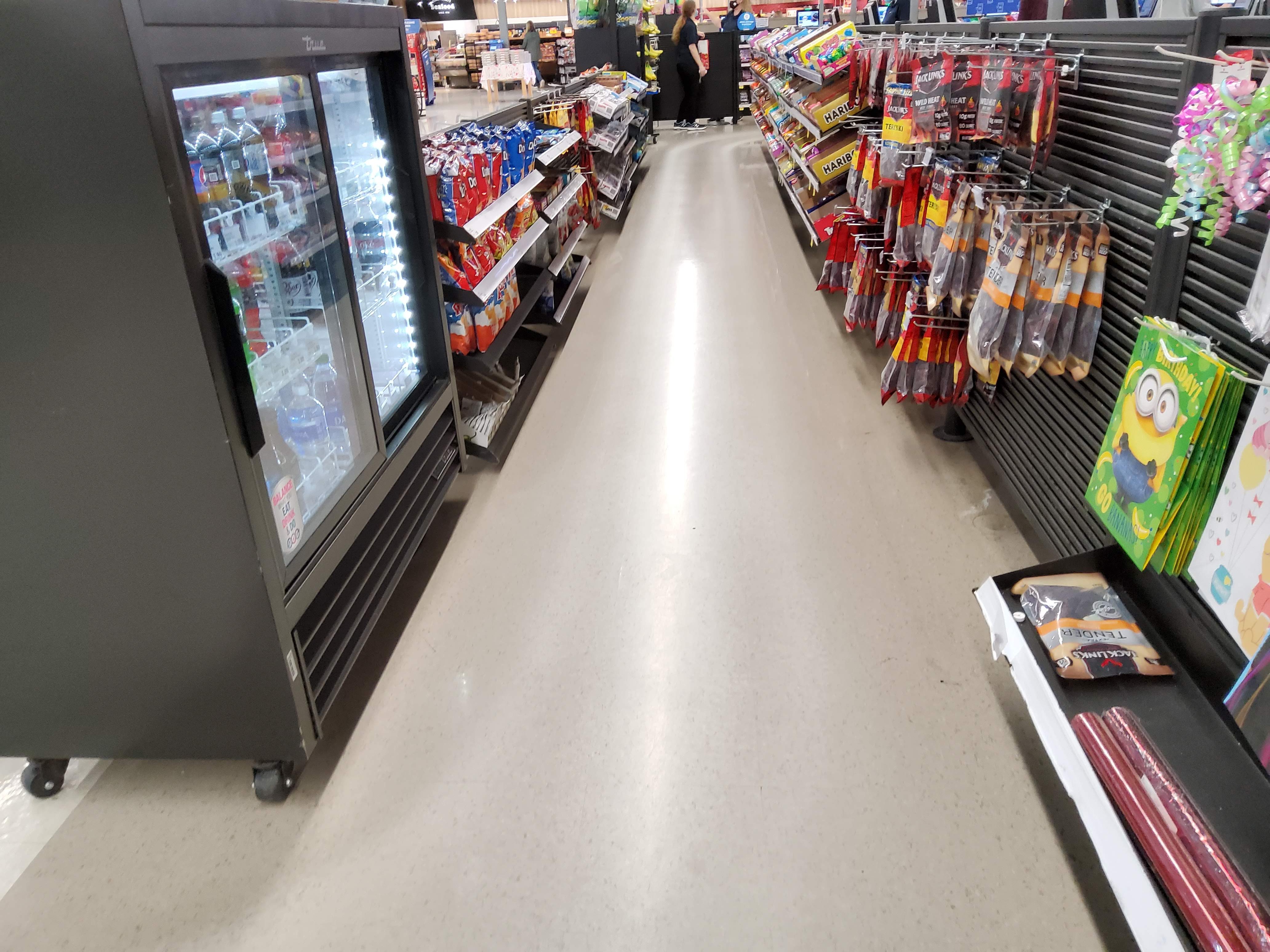
This is one long aisle that feeds into 10 mini-checkout stations.  It has everything a traditional lane has, and more.  There are candy bars. There are packs of jerky.  There are pastries and sweetbreads.  It\’s a smorgasbord of everything you shouldn\’t put in your body.  
If you\’re wondering why I sound so resentful of this development, it\’s because resisting the urge to buy impulse purchases costs mental effort, and I am painfully short on energy at most times, but especially now.  
These stations used to be \”express.\”  The definition of \”express\” varied, but it was typically 15-20 items or less.  Now, I guess the idea was successful enough that they\’ve pulled the numerical requirement off and opened it to any shopper that cares to traverse the gauntlet.  
Let\’s have a closer look.  
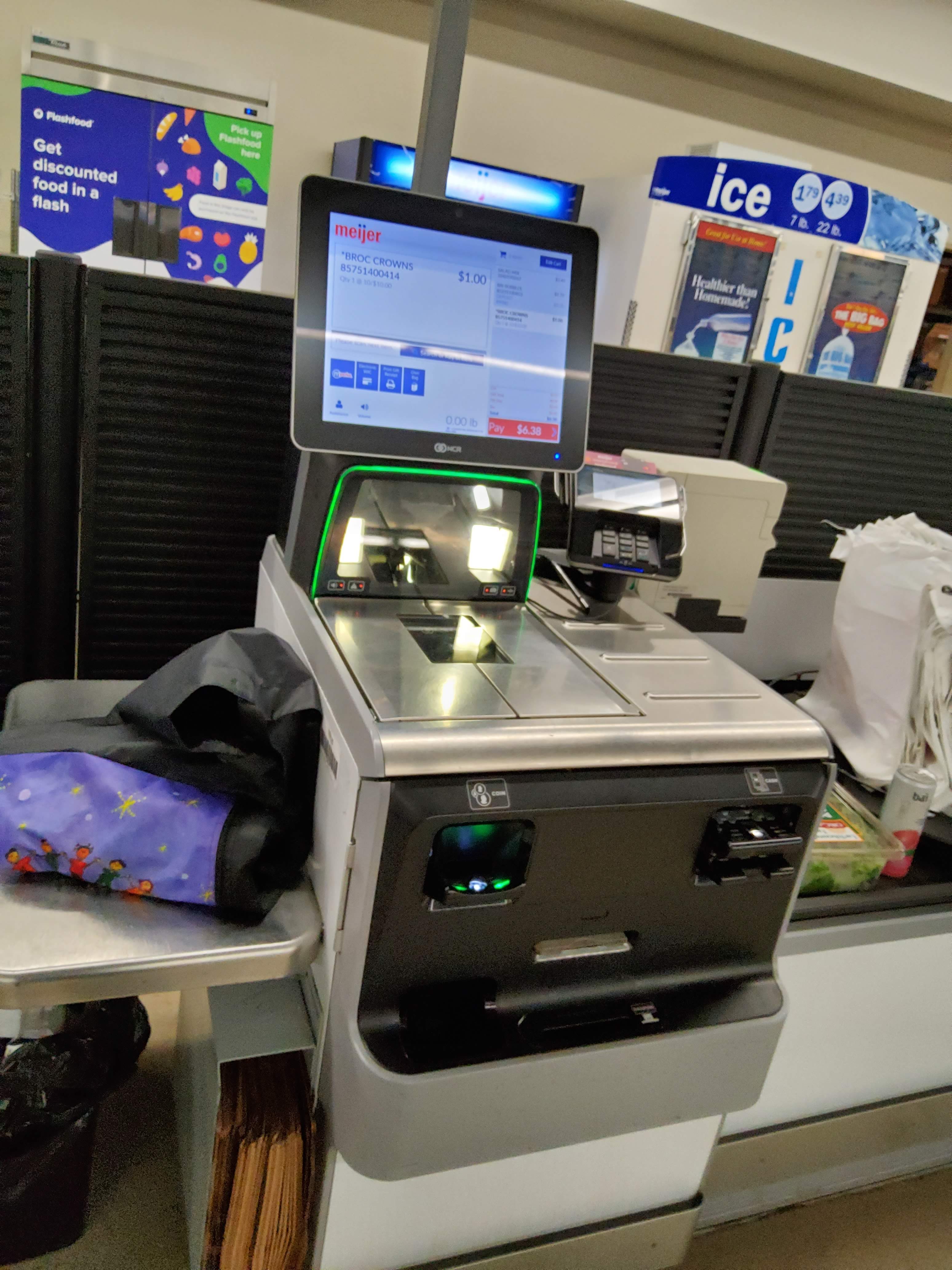
So, from top to bottom, you have your screen, your scanner and credit card reader, your scanning surface that includes a scale, a surface to put your stuff on before you scan it, and a surface to put stuff on after you scan it.  The latter comes with a plastic bag dispenser, for all your incredibly unfriendly-to-the-environment bagging needs.  Below all of that is the cash and change dispensers, the receipt printout, and the coupon receptacle.  
In this version, you scan everything at the checkout, using the interface here.  There\’s a way to look up fresh produce using the PLU (or Price Look Up) code, like 4162.  That\’s large Pippin variety apples, for anyone who was suddenly curious.  Normally in option 1, the cashier would do this for you.  
You are also responsible for bagging all your own things, which at least lets me use my cloth bags without awkwardness.  
This is the option I almost invariably take when I buy things at this store, because although it makes me an unpaid cashier, it does let me circumvent most social contact, which… I really appreciate most of the time.  
And that\’s that!  Let me know what you thought of this series, and if you\’re interested in similar walkthroughs of other stores, such as Target, Trader Joe\’s, or Aldi.  

Grocery Shopping On a Special Diet: Fruits and Veggies

Welcome back to my autism-aware shopping trip through the grocery store.  Week by week, I\’m showing you what the store sells, prune down the selection to what\’s safe for me (because autistic people can have very sensitive systems) and point out various gotchas the store tries to make you buy stuff you didn\’t come for. 

As a reminder, I shop with the following conditions in mind:

  • dairy-free
  • low sugar
  • avoid ultraprocessed junk
  • avoid artificial food coloring
  • conditional vegetarianism
  • avoid high histamine foods
  • awareness of gluten-free options and sugar-free options
Last time we explored the meat and deli section, where basically nothing is humane and snacks are abundant.  I also mentioned a pair of humane and sustainable alternative delivery services: ButcherBox and VitalChoice.  Ideally, you\’d buy your meat and eggs locally, from a family farm with standards you can rely on.  In practice, it can be hard to find those places, make time to drive to them, or even afford them. So Butcherbox and VitalChoice can give you an alternative.
This week we\’ll tackle the most important part of the grocery store: the fresh produce section. 
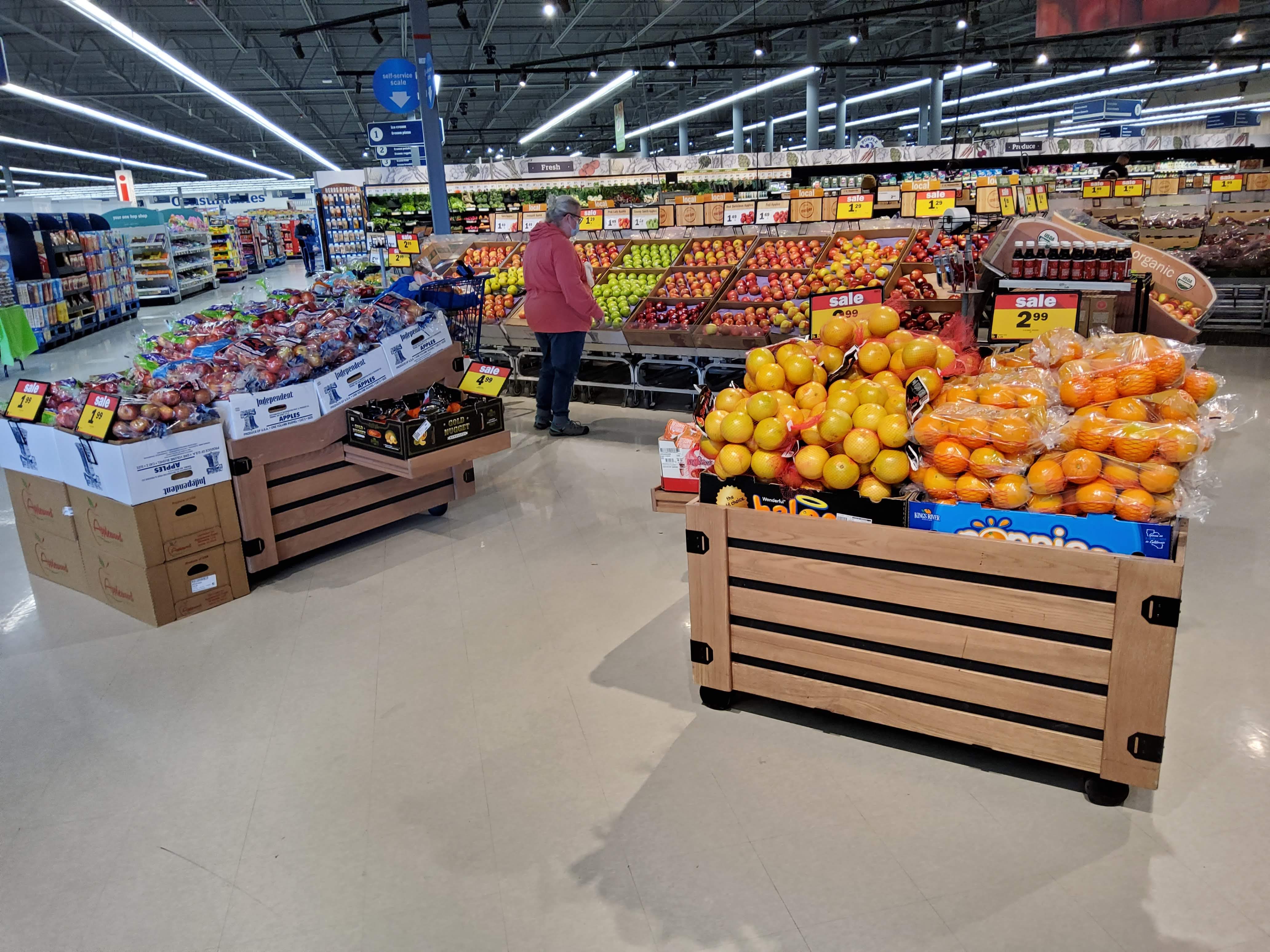
Like the meat and deli sections, the produce section is divided into long islands of products, rather than proper aisles.  The back half is more or less vegetables and root vegetables, and the front half is fruit.  And there\’s one long aisle that\’s the other side of the refrigerated section from a few weeks ago.  Also off to the side is a peanuts and tree nuts/snacks section, kind of between the produce and the bakery.  It really fits nowhere in particular, so I tossed it in here.  
While many parts of the grocery store stay more or less the same over time, the produce section does not.  About the only constant is what I mentioned above: it goes fruit, then vegetables, then root vegetables.  The specifics of what\’s in season and available varies.  

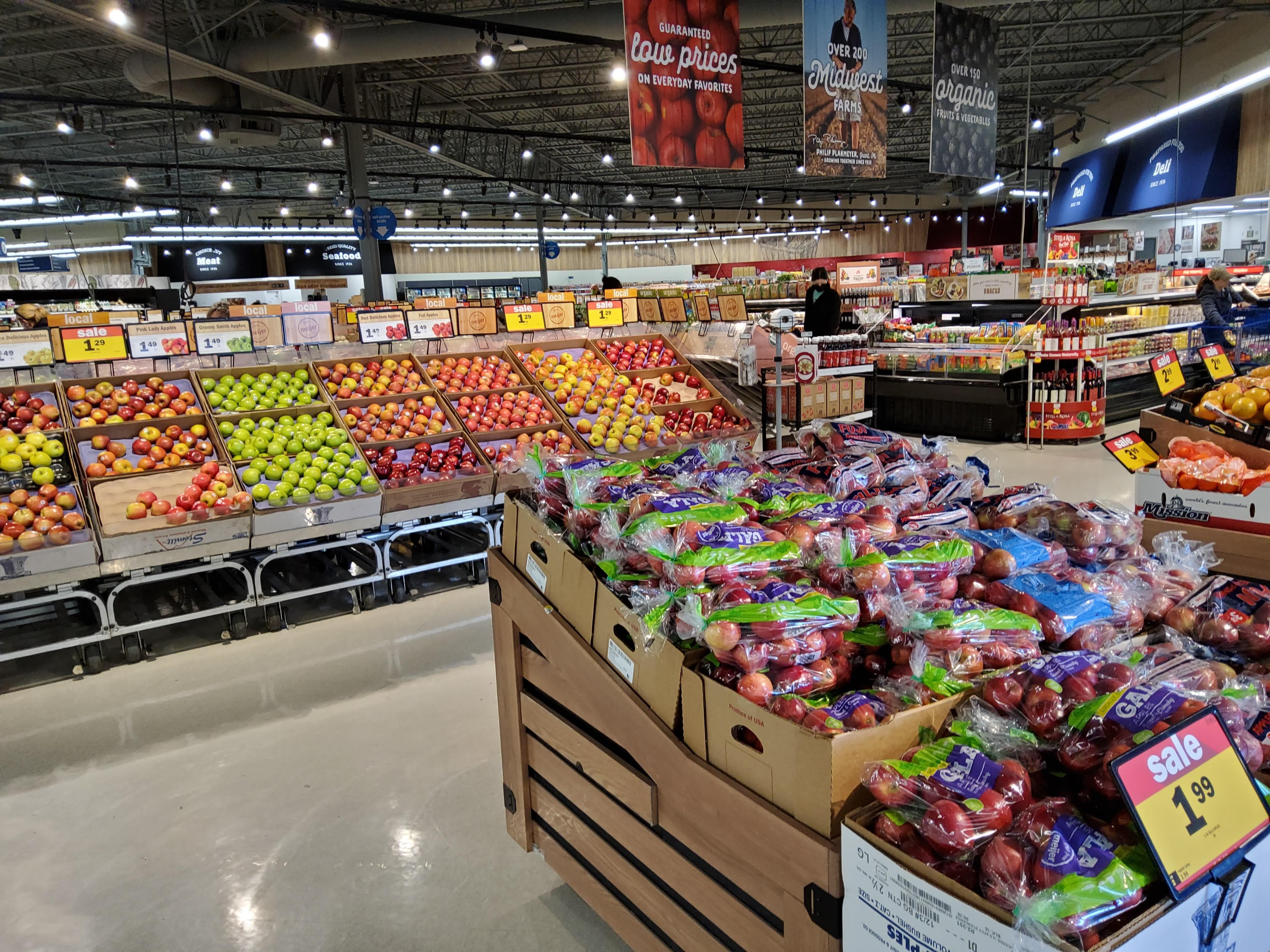
This flexibility is especially true with these square islands, which host the weekly deals.  \”Let the buyer beware\” is always relevant advice when buying produce.  Even with modern shipping and refrigeration, it\’s hard to keep perishables from perishing.  Past the islands, you can see the array of self-select apples.  There\’s about 9 kinds of apples.  Which sounds like a lot, and it kind of is for what time of year it is.  (It is, at this moment, late February, which is late winter.)
There are actually hundreds, even thousands, of apple varieties.  Some of them don\’t look like what the consumer expects.  Some of them are tiny (but taste amazing).  Some of them simply don\’t ship well.  
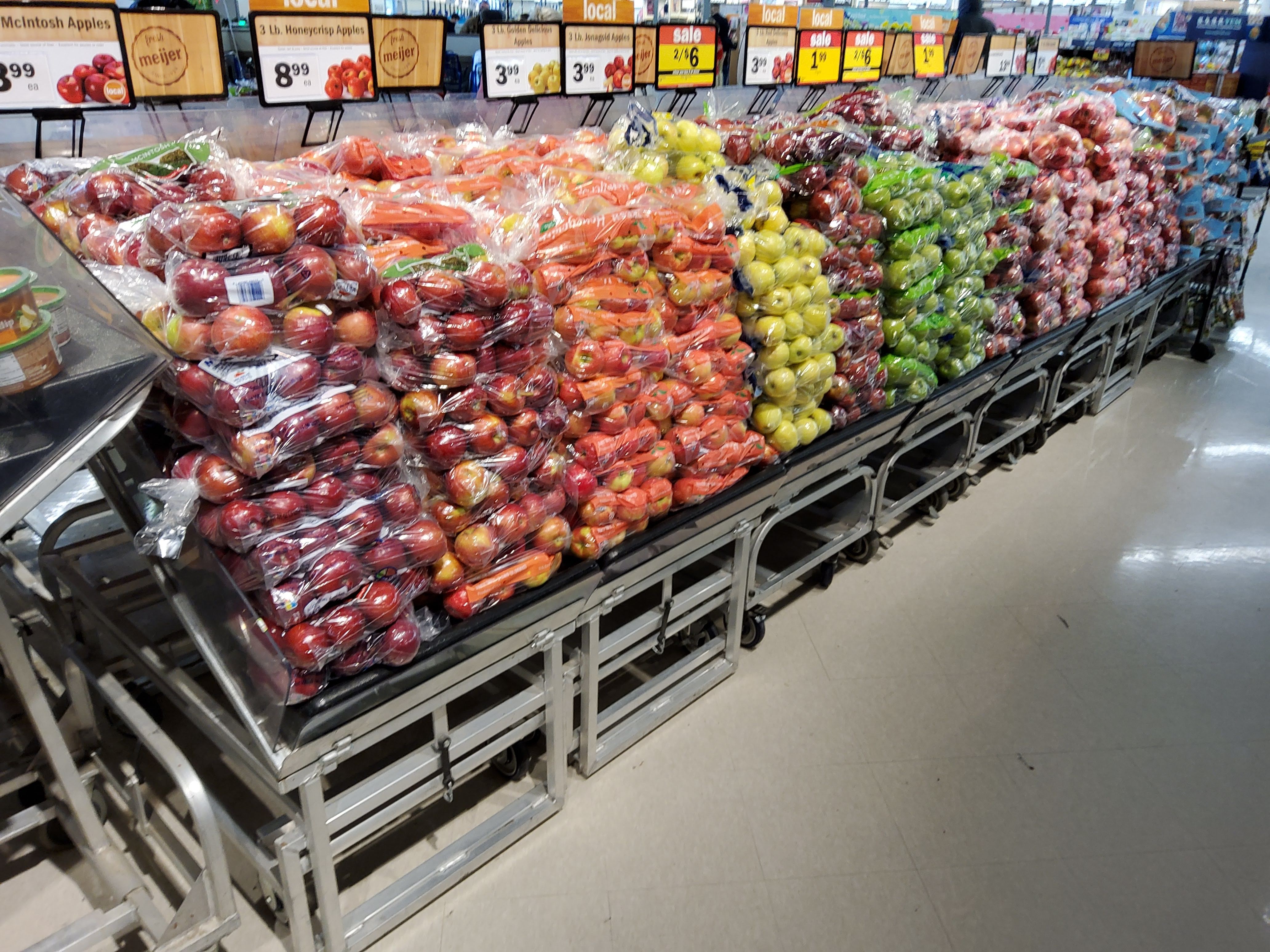
The other side of the apple aisle: bagged bulk apples.  They\’re almost entirely 3 pound bags.  These bagged apples tend to be on the smaller size compared to their \”choose your own\” counterparts, and because they\’re pre-bagged, imperfections may escape your notice.  Imperfect fruit is hardly the end of the world, but as an incredibly privileged USian used to nearly perfect fruit all the time, it\’s something I\’d notice.  
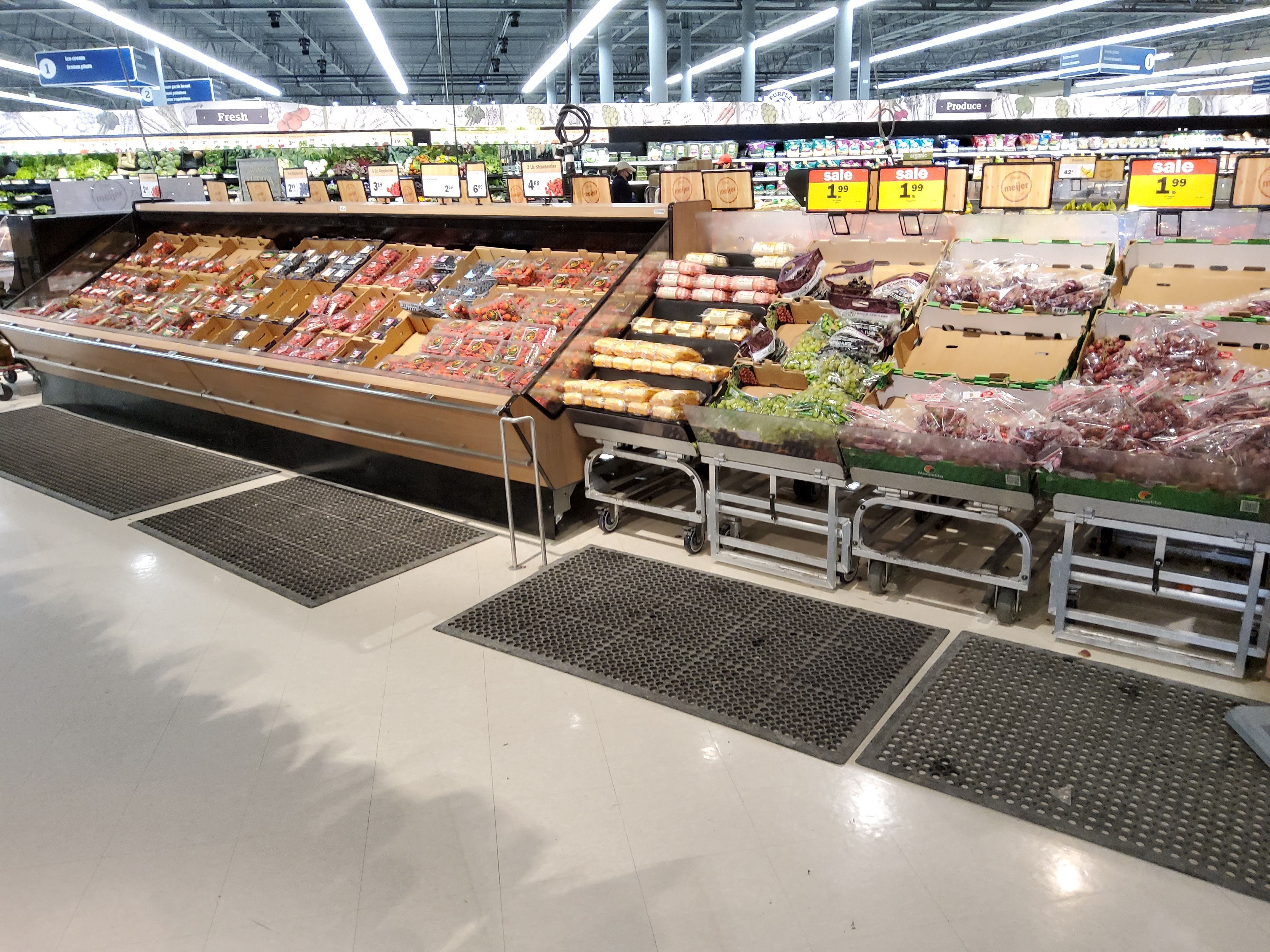
Grapes and berries.  This aisle was long enough that I had to stand pretty far back to get it all in frame.  There\’s strawberries, blueberries, raspberries, blackberries, and more strawberries.  Followed by dessert shells and dessert breads to serve those berries in, because there is no escape from the temptation to buy desserts or snacks.  And then several varieties of grapes: green, red, and black.  
In other seasons there would be at least two kinds of red grapes, and I\’ve also run across a white grape called Carnival in the organic section.  It\’s worth noting that the majority of the grapes for sale here are seedless.

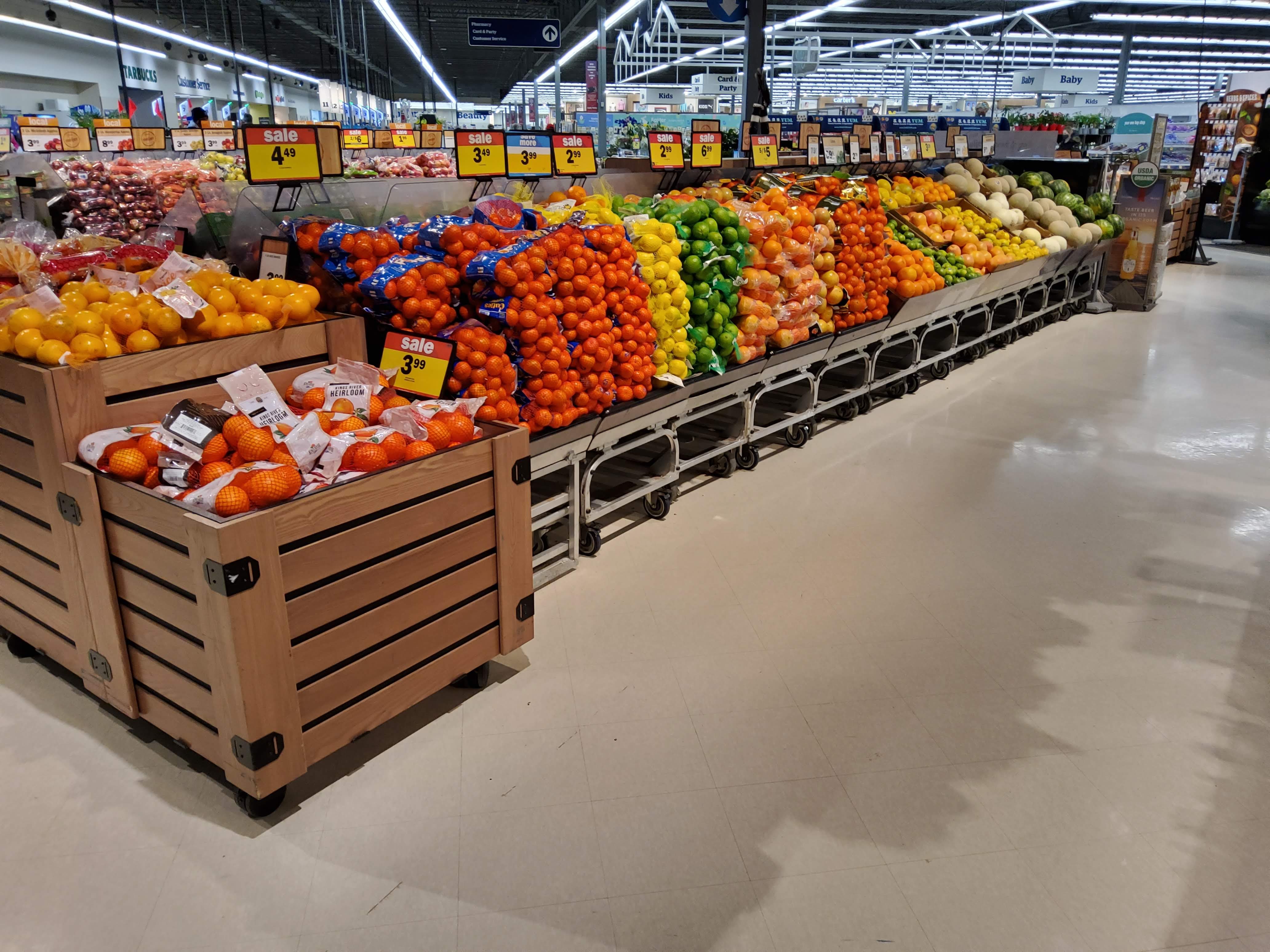
Citrus and melons.  Mostly citrus.  The bagged tiny citruses near the front are a particularly popular brand of clementine that\’s almost entirely seedless as well as being extremely sweet.  The US has a sweet tooth (by which I mean a sugar addiction) and even the fruit has to accommodate it.  
There\’s also bagged lemons, limes, oranges, and grapefruits.  After which there\’s the \”choose your own\” for if you really only need one lime for your recipe.  Which is me, often.  And then the melons, which include watermelon, cantaloupe, and honeydew.  Or it might be honeyrock.  There\’s been some interesting experiments in crossing melons and I haven\’t kept up with what\’s most popular.  

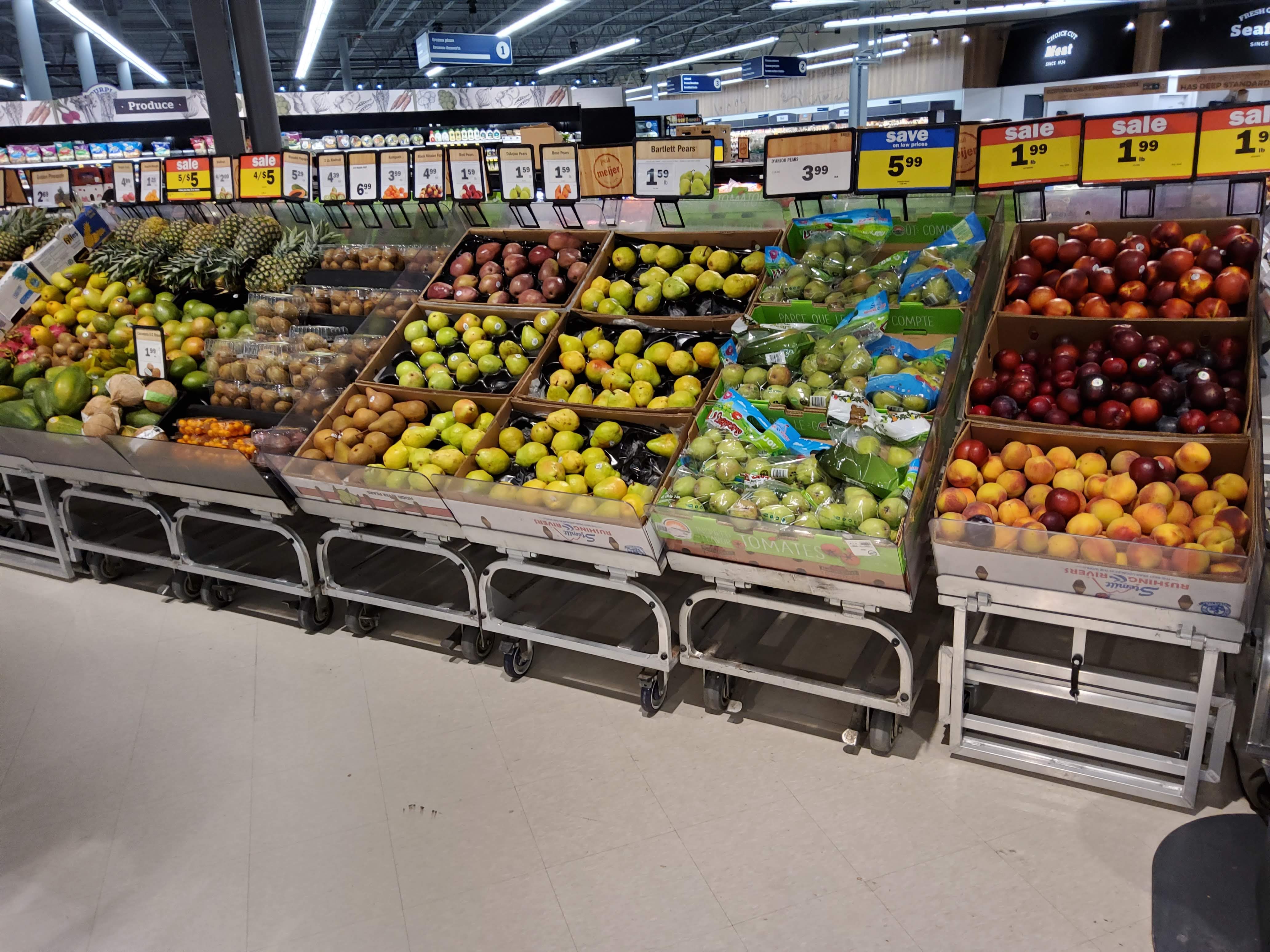
We now move onto the pears and assorted other fruit.  You can count four kinds of pears (Bartlett, D\’Anjou, Bosc, and Red), as well as mangoes, pineapples, dragonfruit, kiwis, peaches, plums, coconuts, and nectarines.  
Something I should point out, and which you\’ll notice next photo if you know anything about bananas… This great and mighty variety of fruit is available for purchase, but don\’t think for a moment it\’s at its very best or tastes anything like a fresh-picked version.  To survive being transported long distances, most fruit is picked long before it\’s ripe, shipped specially to keep it from ripening, and then ripened once it\’s arrived.  
This results in a significantly stunted flavor and texture.  I\’ve had fresh mango in a place that grows it.  The mangos you can buy here are definitely mangos, but the flavor is deeply disappointing by comparison.  

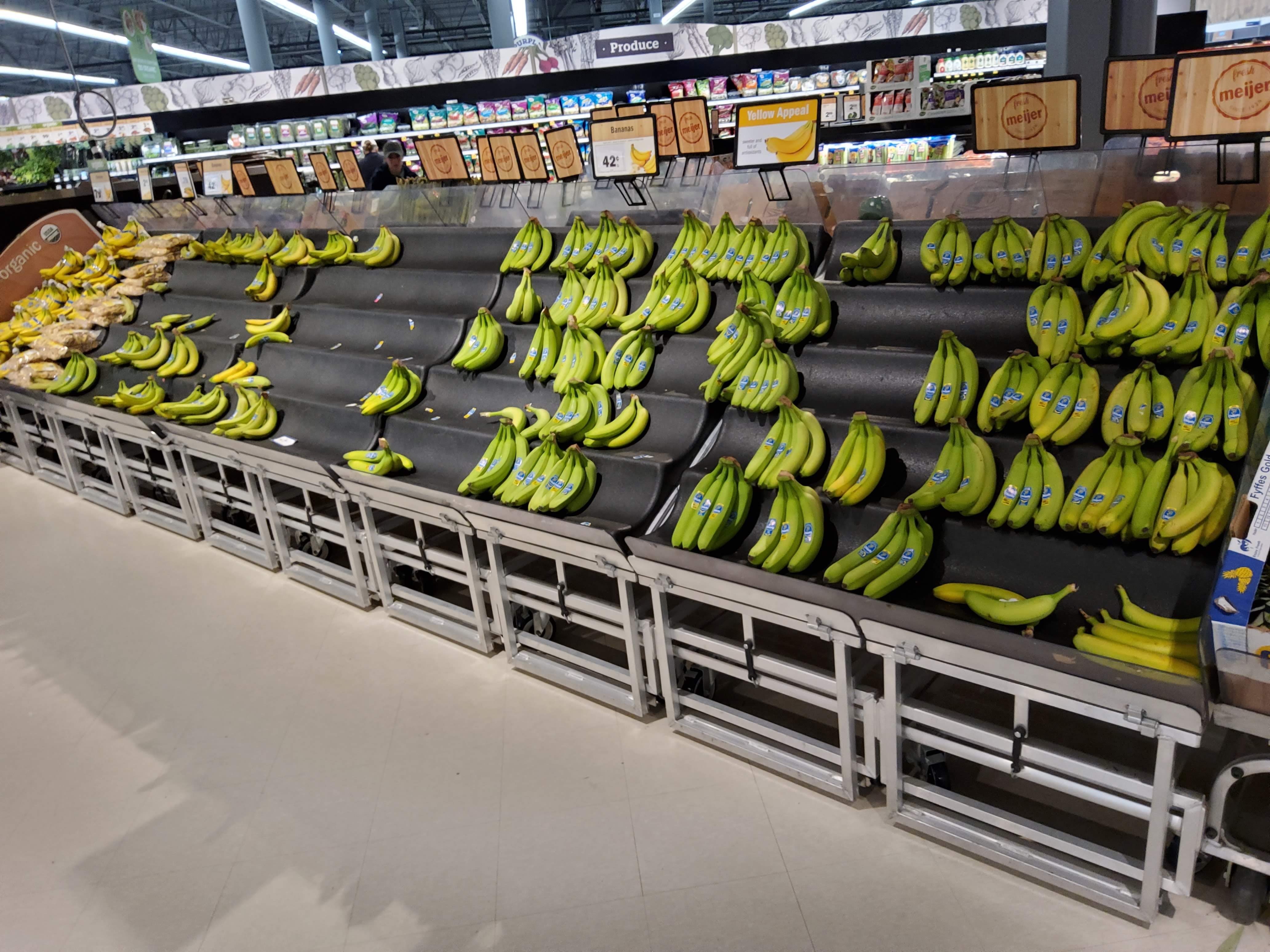
As promised, the bananas.  I\’m not sure why, but the US really loves these.  Note that most of them are green, rather than bright yellow the way the organic ones at the end are.  That\’s not just because people mainly opt to buy the ripe ones.  It\’s because the bananas are brought it very very underripe, and ripen as they sit.  
Another interesting fact about these is that they\’re Cavendish bananas.  They taste significantly different than the variety that was exported prior to the 1950s, the Gros Michel.  The Gros Michel variety fell prey to a fungal disease and was nearly wiped out.  If you\’ve ever wondered why artificial banana flavor tastes nothing like bananas, it\’s because it\’s based on the flavor of the Gros Michel, not the Cavendish.  Also, at some point, the Cavendish will likely fall prey to a similar disease, and we\’ll all start consuming some other variety of banana instead.  Perhaps Manzanos

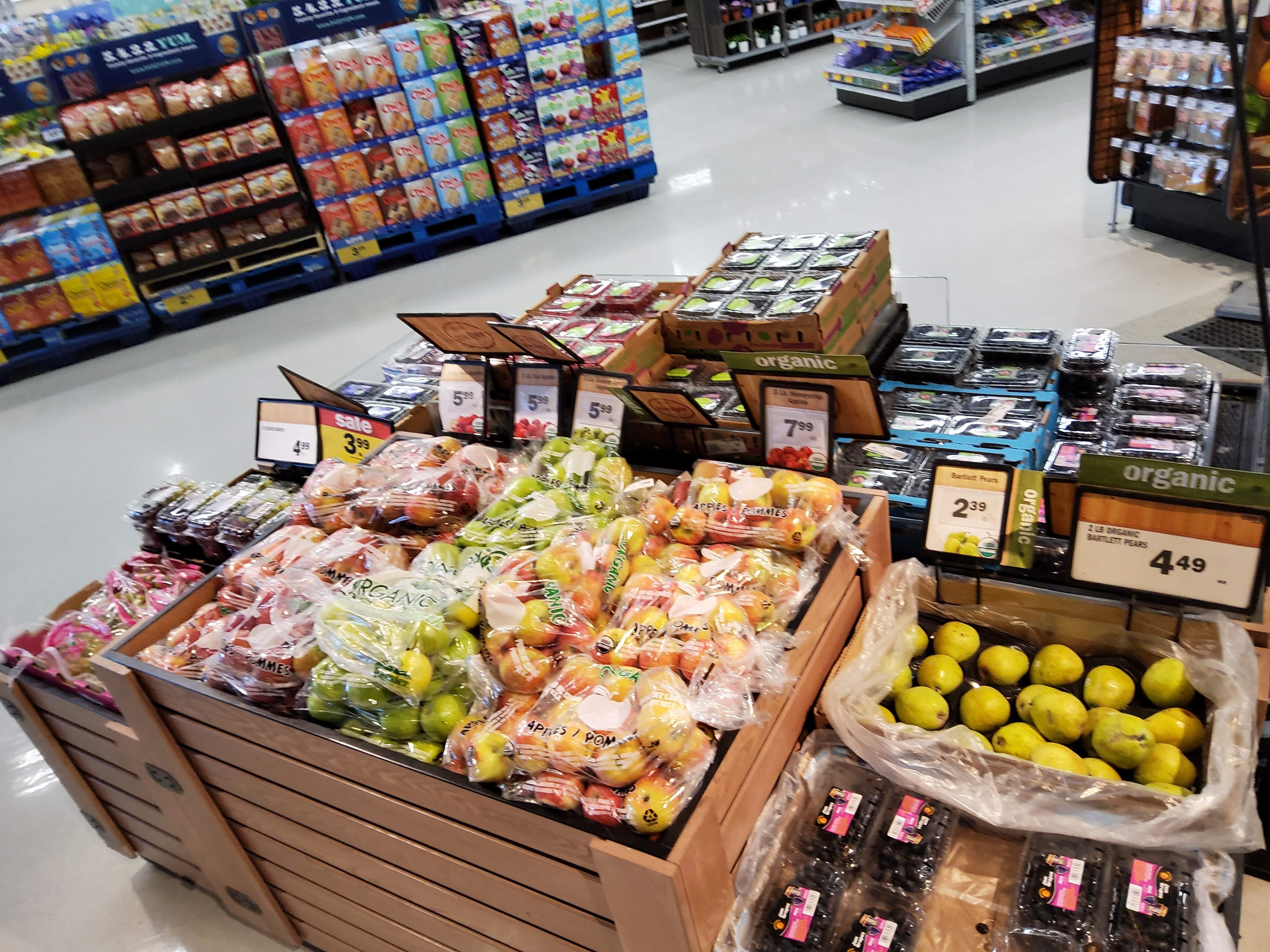
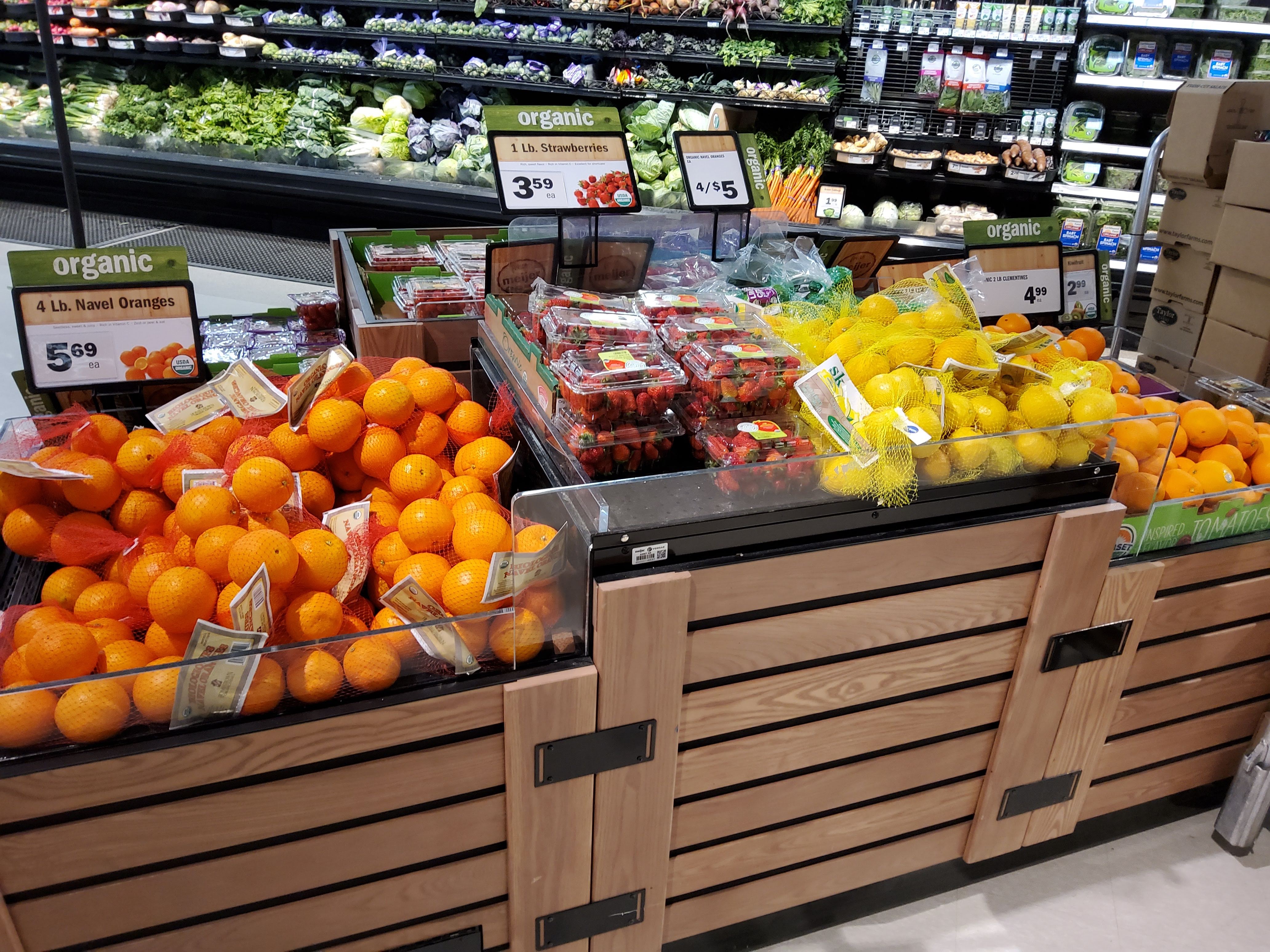
Before we leave the fruit section, we stop by the organic section.  Like the weekly deals, these sections rotate their contents frequently.  You can never be sure what they\’ll have available, though because it was grown without pesticides and herbicides, you can expect it to be more expensive than the general offerings.  

In some cases this is a very important section to be aware of.  Pesticides and herbicides can get stuck in the crevices of the fruit, and then be consumed with the fruit.  As a result, autistic and other sensitive folks\’ systems can get slowly poisoned.  Strawberries are a prime example of this.  All those little nubbly seeds make it impossible to get the chemical residue off without damaging or destroying the fruit.  As such, it\’s better to buy strawberries organic.  For more information about the Dirty Dozen (buy these organic) and the Clean 15 (no need), follow this link.

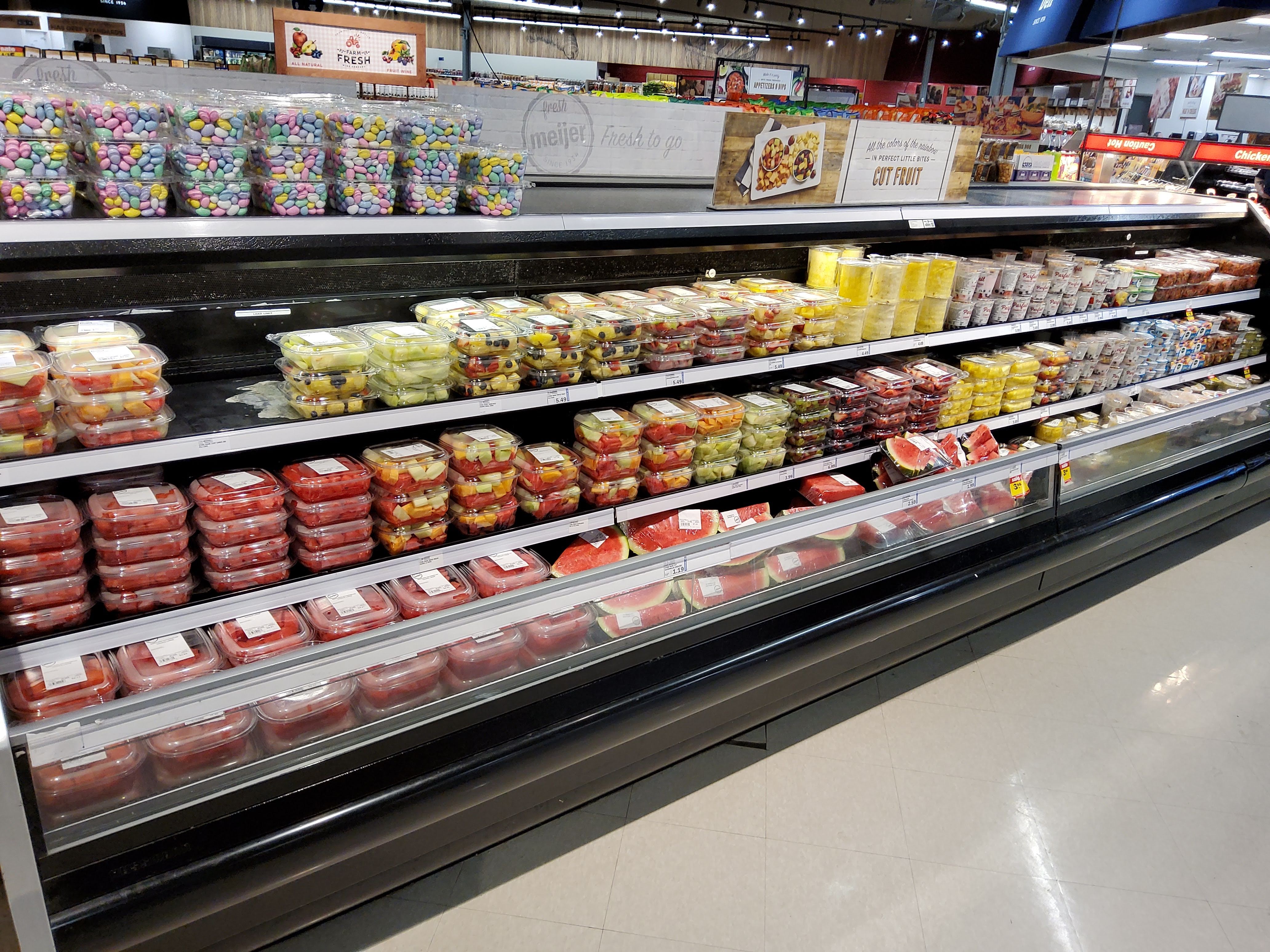
Oh, and for a huge markup, you can buy pre-cut fruit.  Let\’s look at a less extreme example.  Kind of near the end of the middle, there\’s pineapple cores.  They\’re basically cylinders of pineapple, with the very center bored out, likely put through a machine designed to generate that shape, and heedless of the exact size of the pineapple.  They cost $5.  Looking back over the photo with the whole pineapples, you could buy one for $2.70.  So for a bit less than twice the price, you don\’t have to deal with the pineapple skin and greens and center.  
We\’ll get a bit more absurd now.  There are also chopped strawberries for sale.  $6 for a half pound.  We could buy those.  Ooor we could buy 2 pounds of strawberries with the greens attached, for $4.70.  
Convenience is stunningly expensive.  It also comes with non-recyclable plastic.  
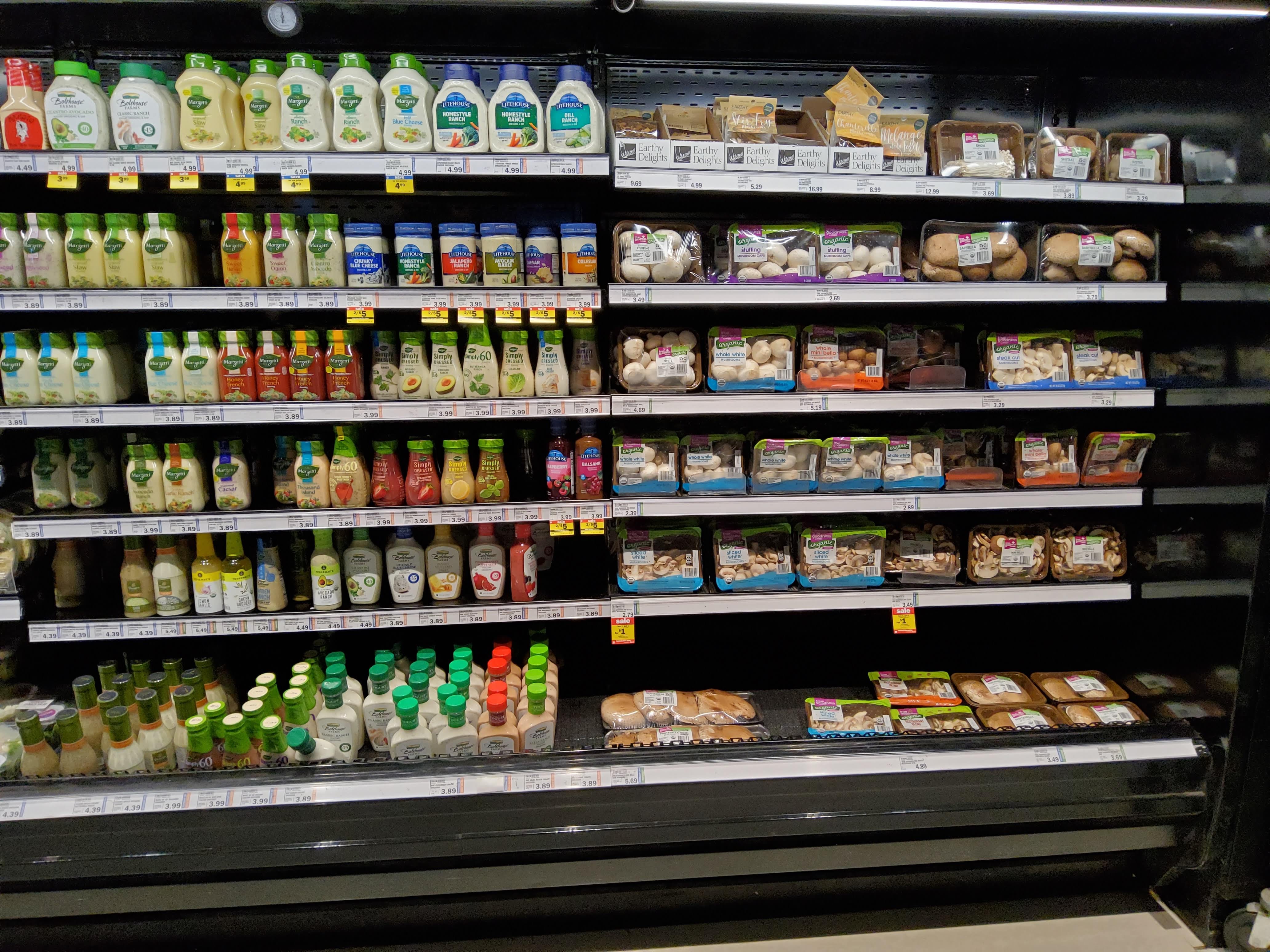
It\’s time for the long aisle!  Starting at the back, we have the mushrooms (bella, shitake, enoki, portobella and several dried varieties.  We also have the salad dressings, which is a category I flat out ignore.  Salad dressings can hide sugar bombs and can contain so many calories that they singlehanded make your salad into junk food.  I typically don\’t season my leaves, but if I do, it\’s with olive oil, salt, and pepper.  It\’s cheap and easy and tastes good.  What more could you ask?

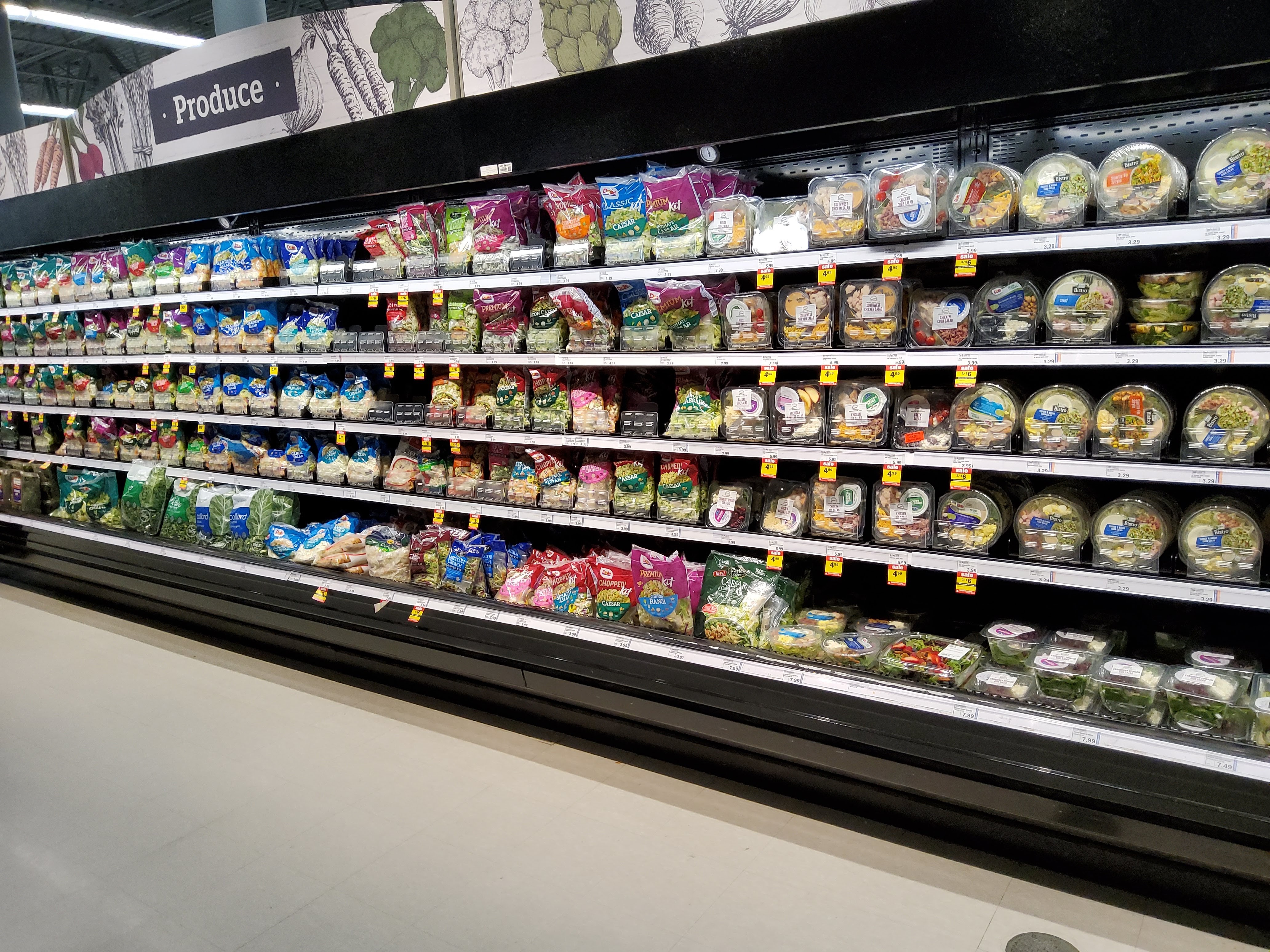
Premade salads.  Some versions come with greens, some are \”mix this with the greens and it\’s a more complete meal!\” boxes.  Either way it\’s a lot of extraneous plastic.  

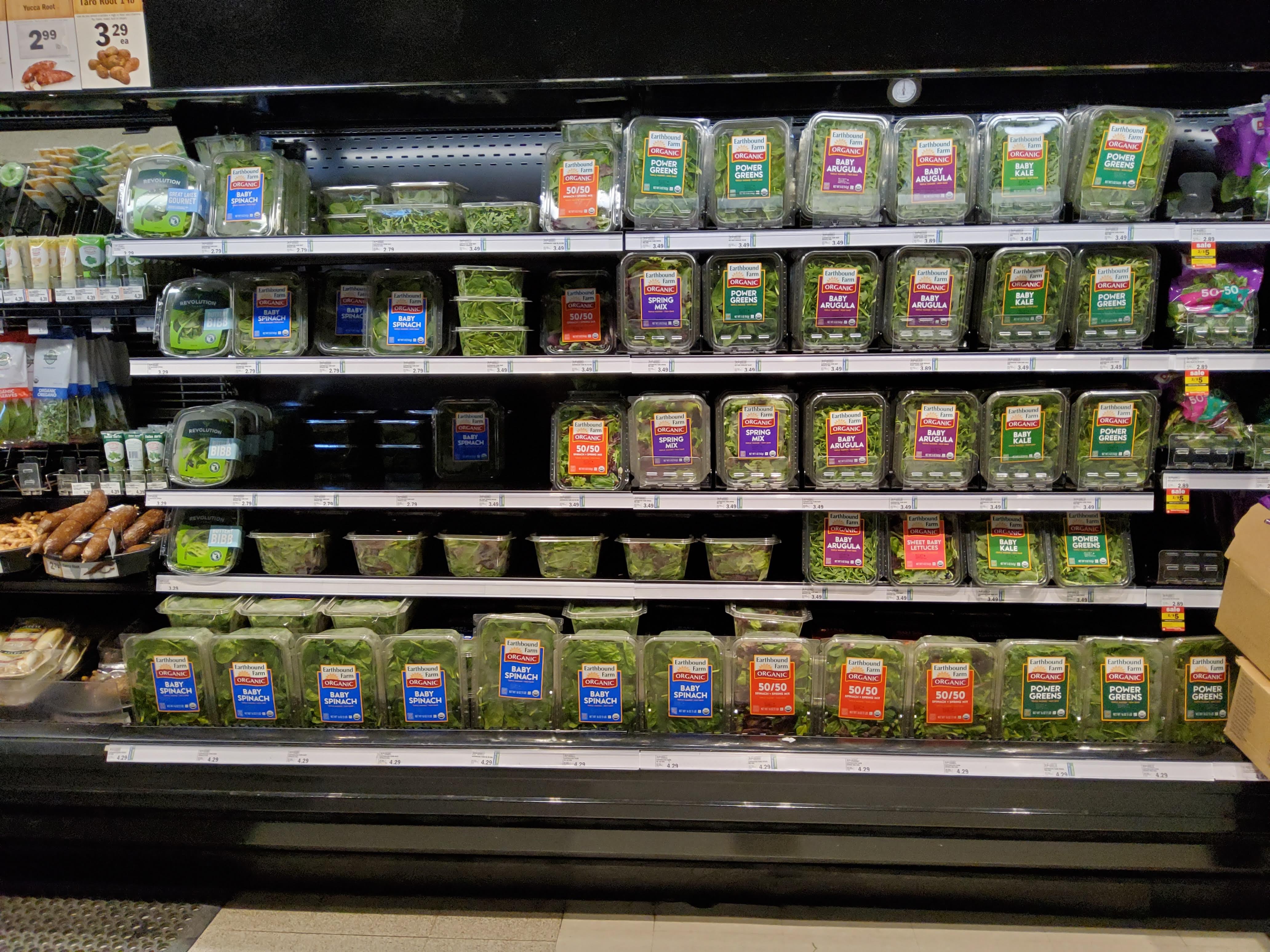
Pre-processed greens.  There\’s actually bagged varieties just to the left, but there was a stocker working there and I didn\’t want to ask her to move just so I could take my picture.  Anyway, you mainly have spinach and lettuce varieties, but you also have your choice of kale and arugula.  

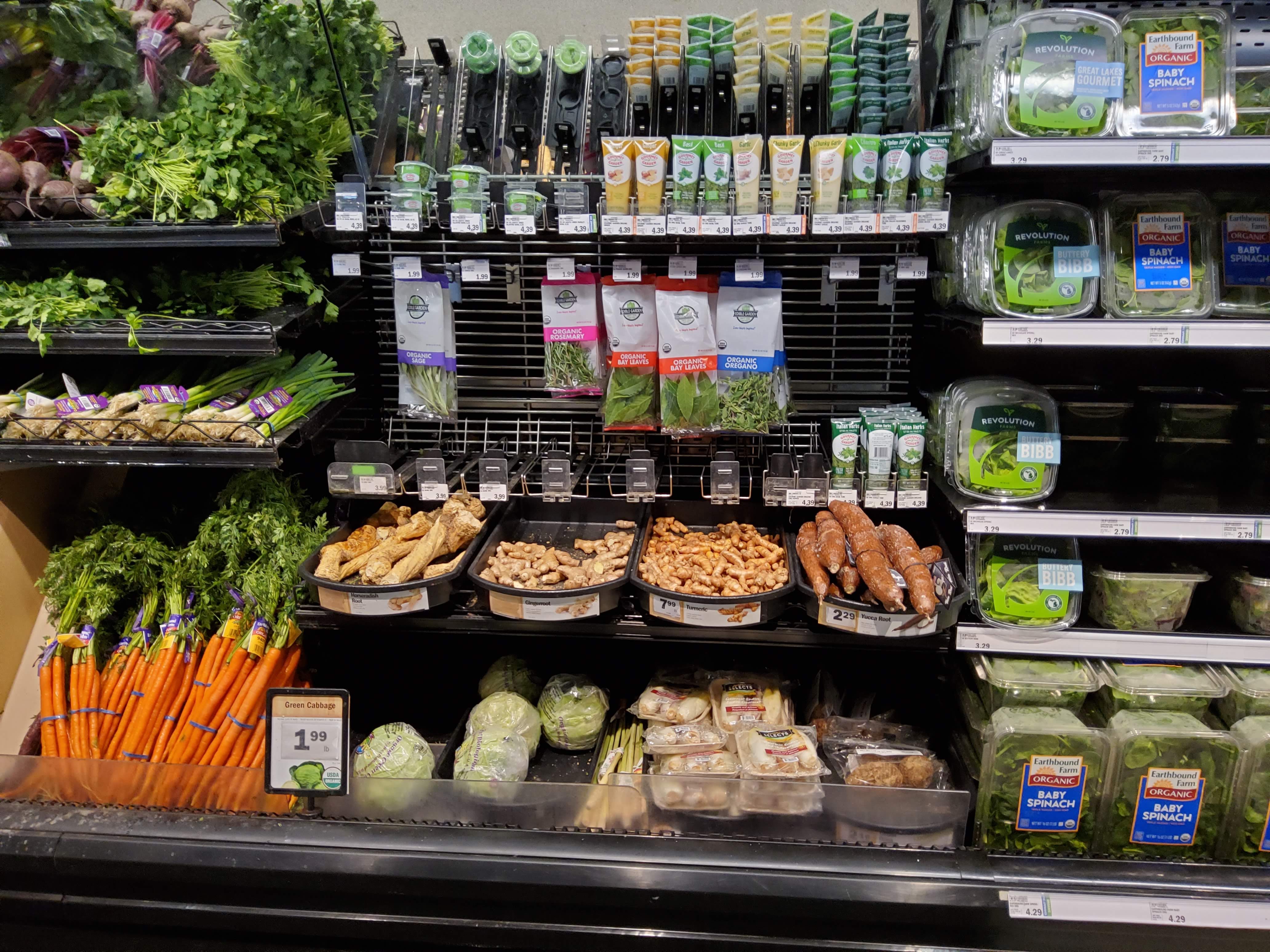
A brief pause for herbs and flavorful roots, like ginger.  In less interesting times there would be more fresh/live herb options, but in lieu of those you could make do with those tubes of herb paste.  I\’ve never bought one, but it probably works fine as long as you\’re not using the herbs for appearances.

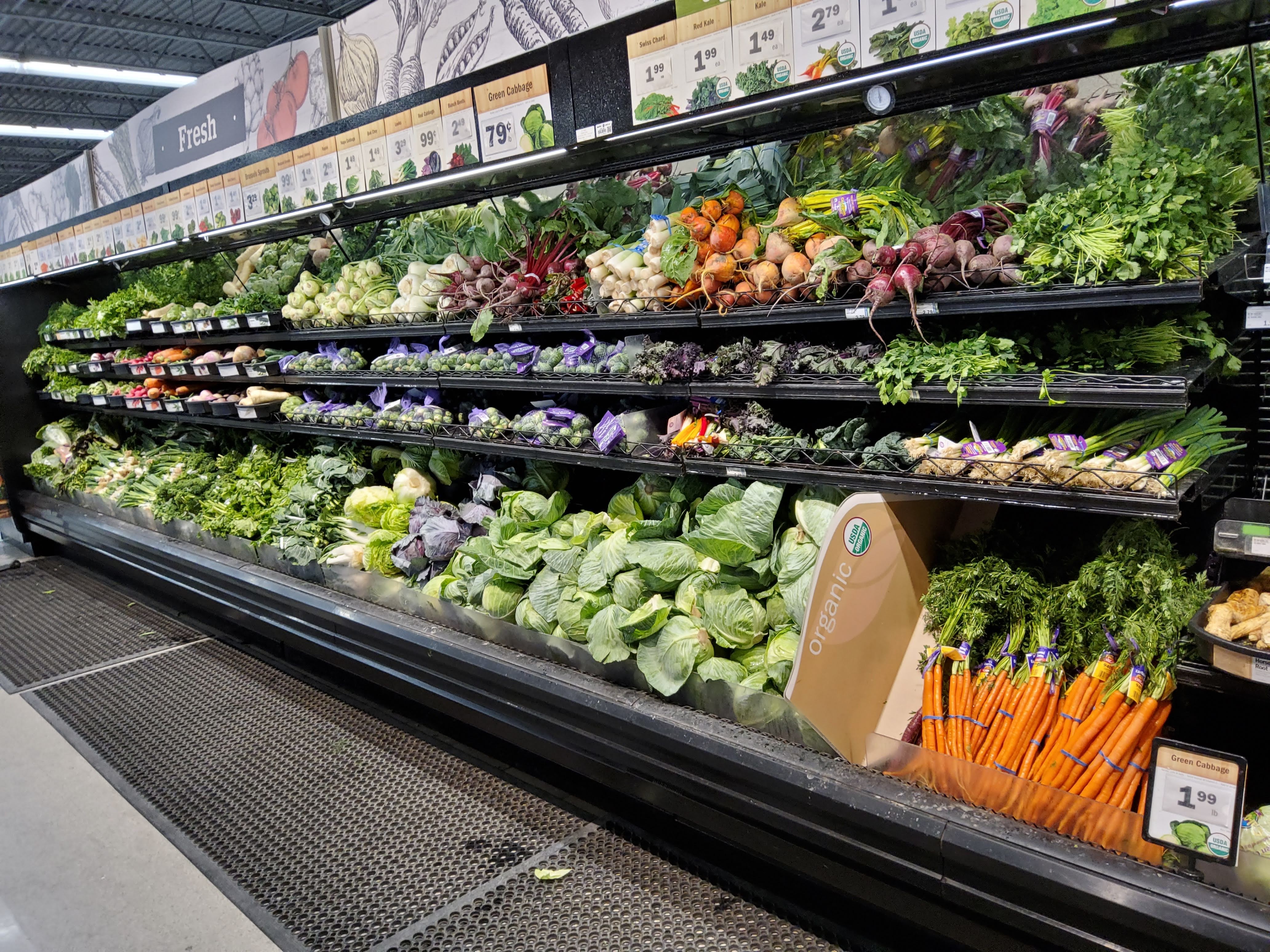
The \”select your own\” vegetable section.  I won\’t list every single thing available here, but suffice it to say there\’s a lot.  I mostly only stop by this section for lettuce, sugar snap peas, or snow peas.  But if you need just one of something (or a small amount of something), this is where you can go.  The bagged versions will be coming up shortly.

Part of why I rarely use this section is that it\’s routinely sprayed with water.  This is ostensibly to keep the produce fresher, but it also makes it wet to touch and accelerates the rot process once you get it home.  I\’m really not a fan.  

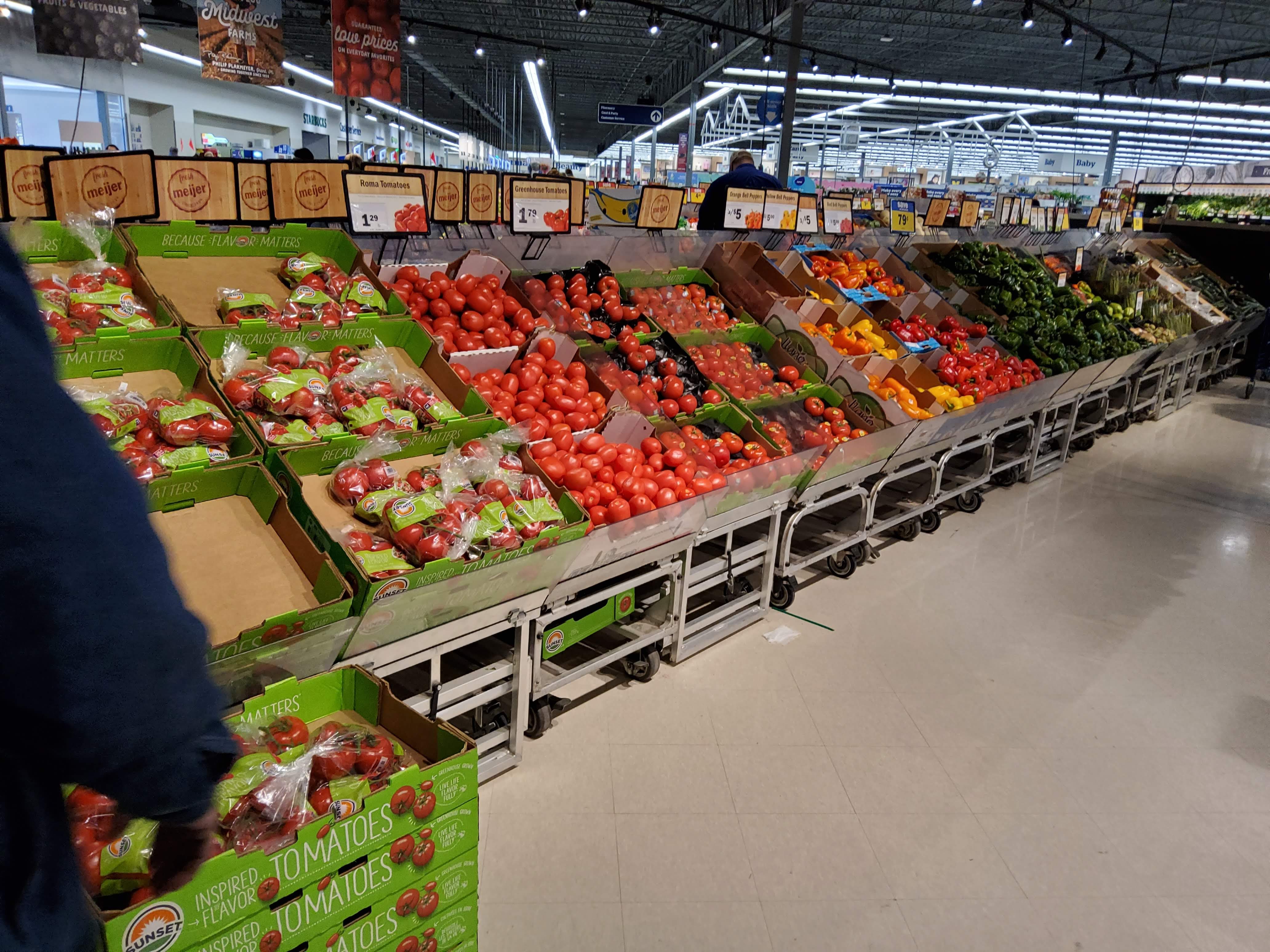
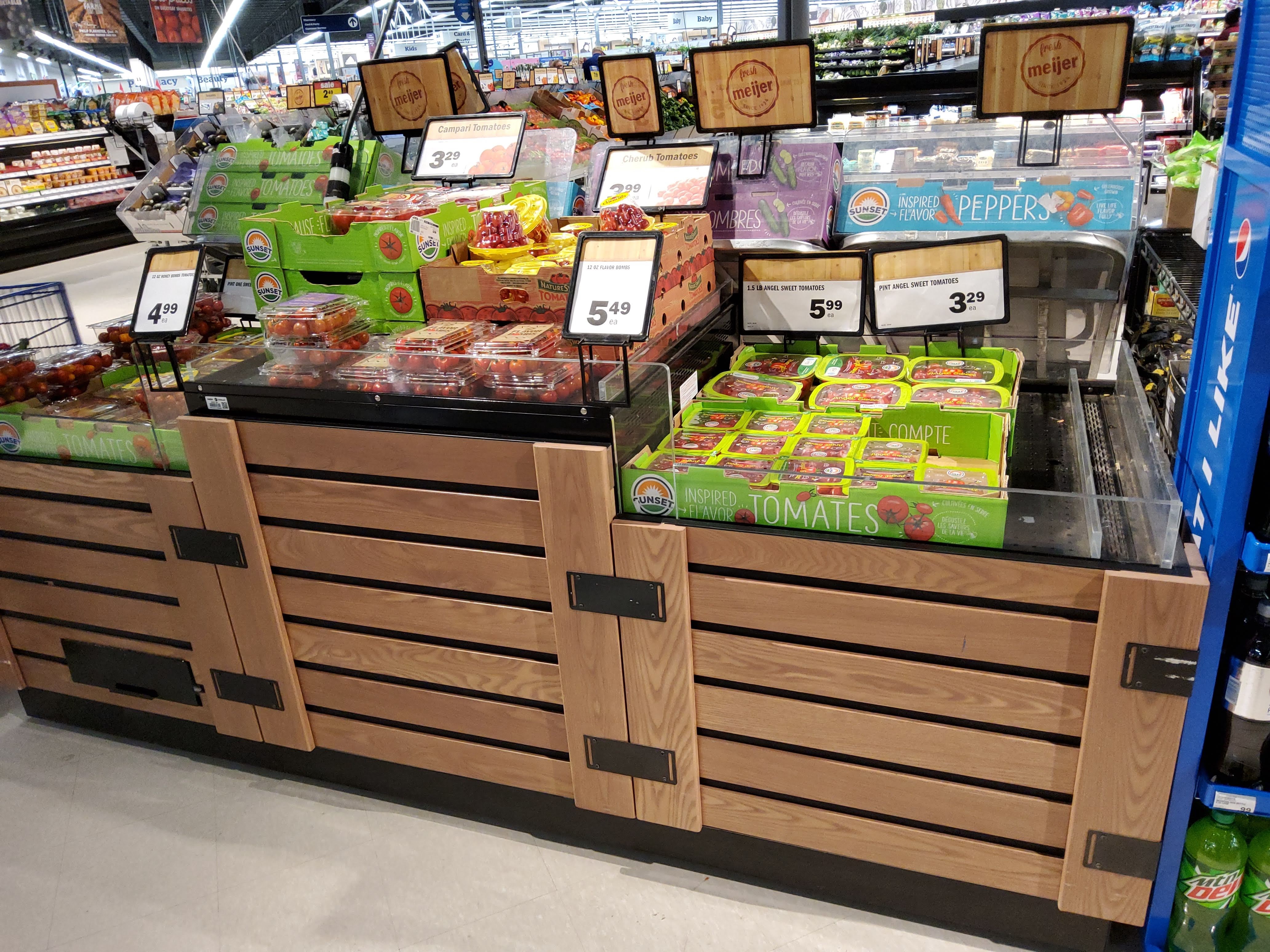
Onward to the main vegetable section.  The tomatoes, peppers, and for some reason, asparagus.  There\’s a few options for tomatoes, though mainly of the medium and large varieties.  Cherry and grape tomatoes are available, they\’re just behind the human I was trying to cut out of the picture.  Bell peppers in four colors: yellow, red, orange, and green.  There\’s actually even a stripey orange and yellow variety that shows up from time to time.  Green peppers are almost always the cheapest.  

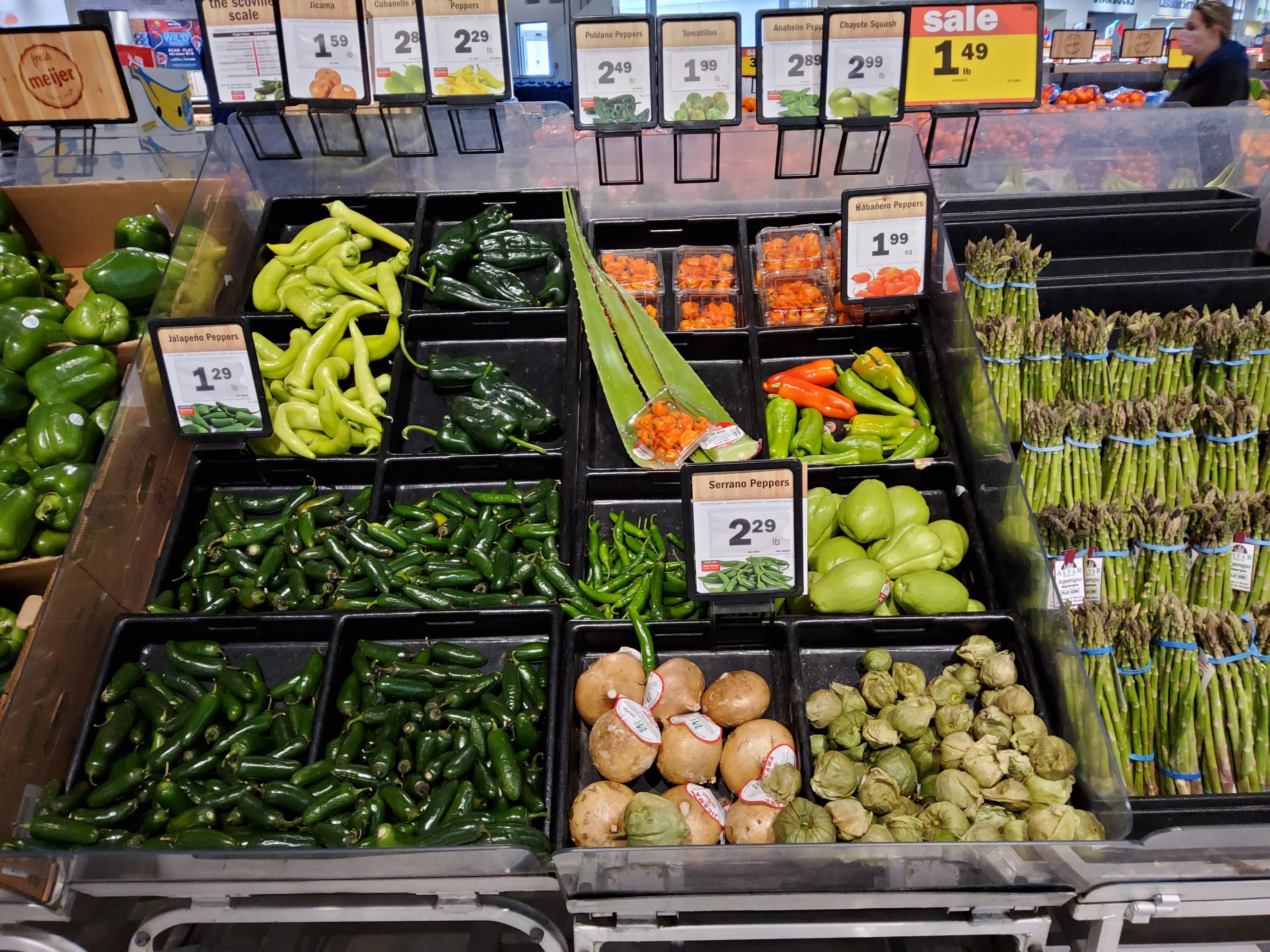
I took this to give you a better idea of the variety available here.  Again, there is literally snow on the ground and temperatures are at or below freezing, so these have been shipped from a significant distance away.   It\’s honestly a very small sample of all the types of peppers that exist, but the fact that it\’s just flatly available 100% out of local growing season speaks to how absurdly well people in the US live.  Kings and emperors in centuries past didn\’t have this kind of selection.  

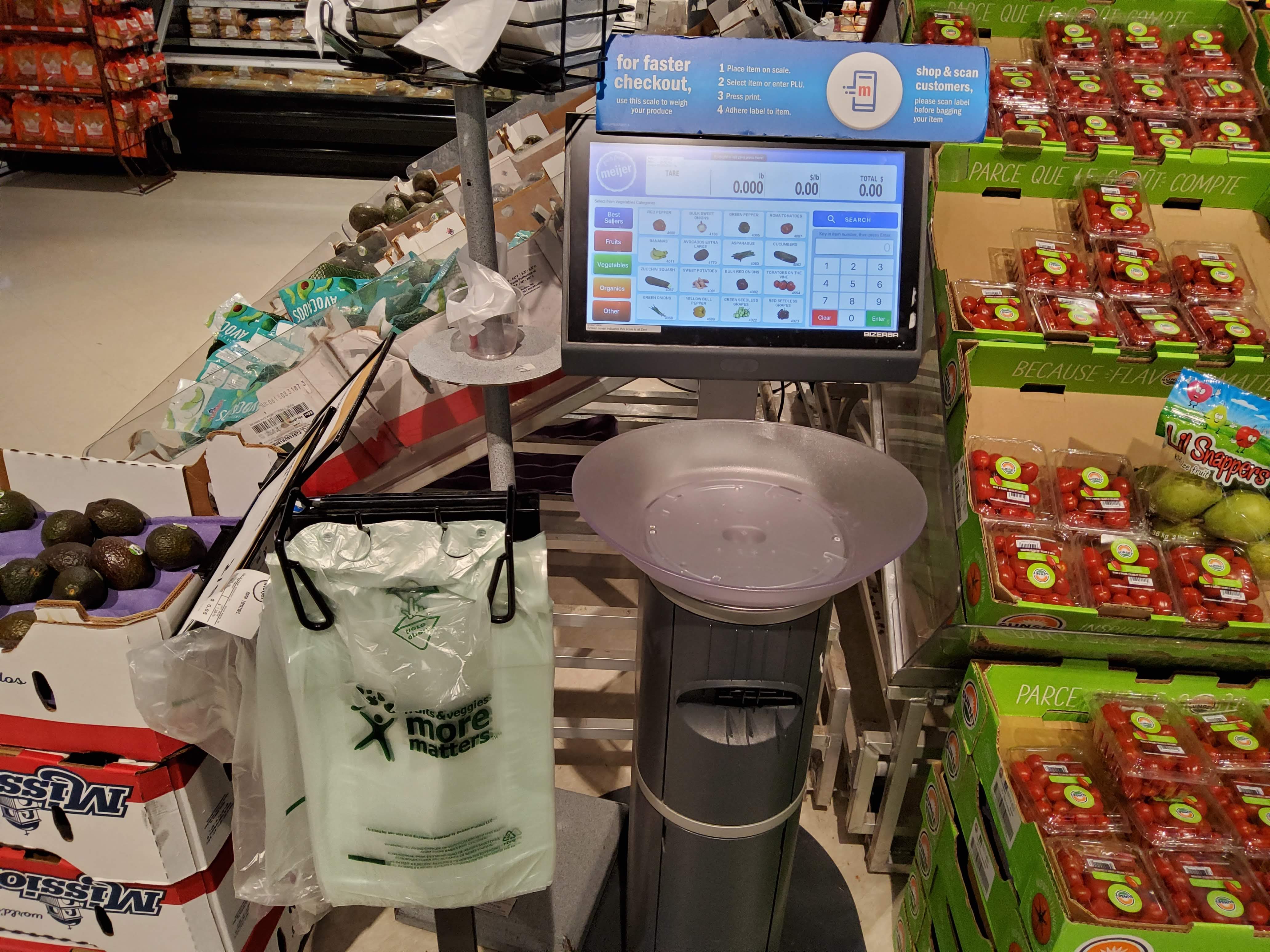
This is a weighing and labeling machine.  Produce doesn\’t always come in convenient plastic packages.  Sometimes you choose and bag your own using the bags there on the left.  This machine will weigh your produce.  It will also print you a custom bar code so that the bag can be scanned quickly at checkout.  I\’m old enough to remember when non-electronic scales were a common thing in grocery stores, but those days seem very long ago when I look at this machine…

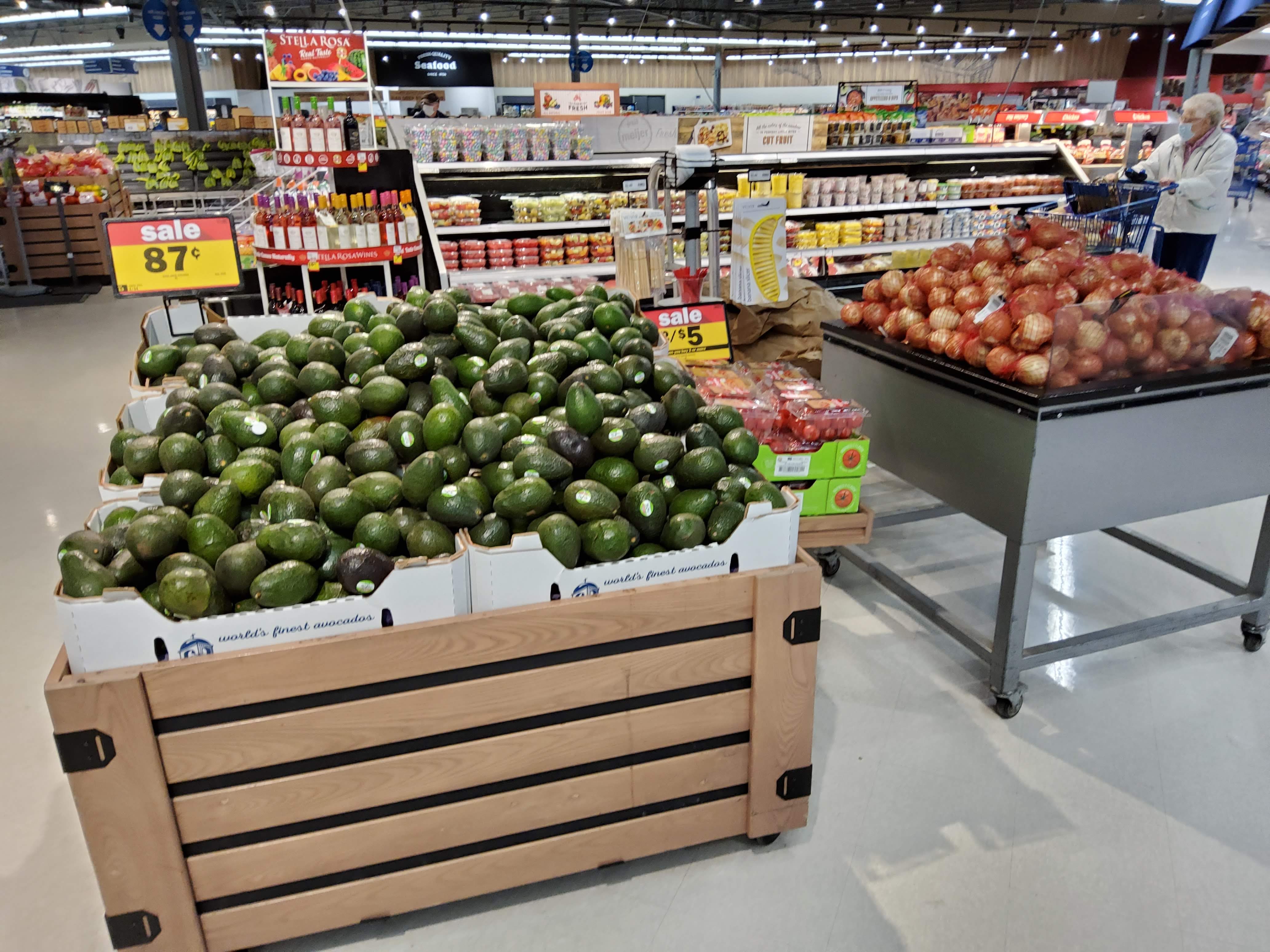
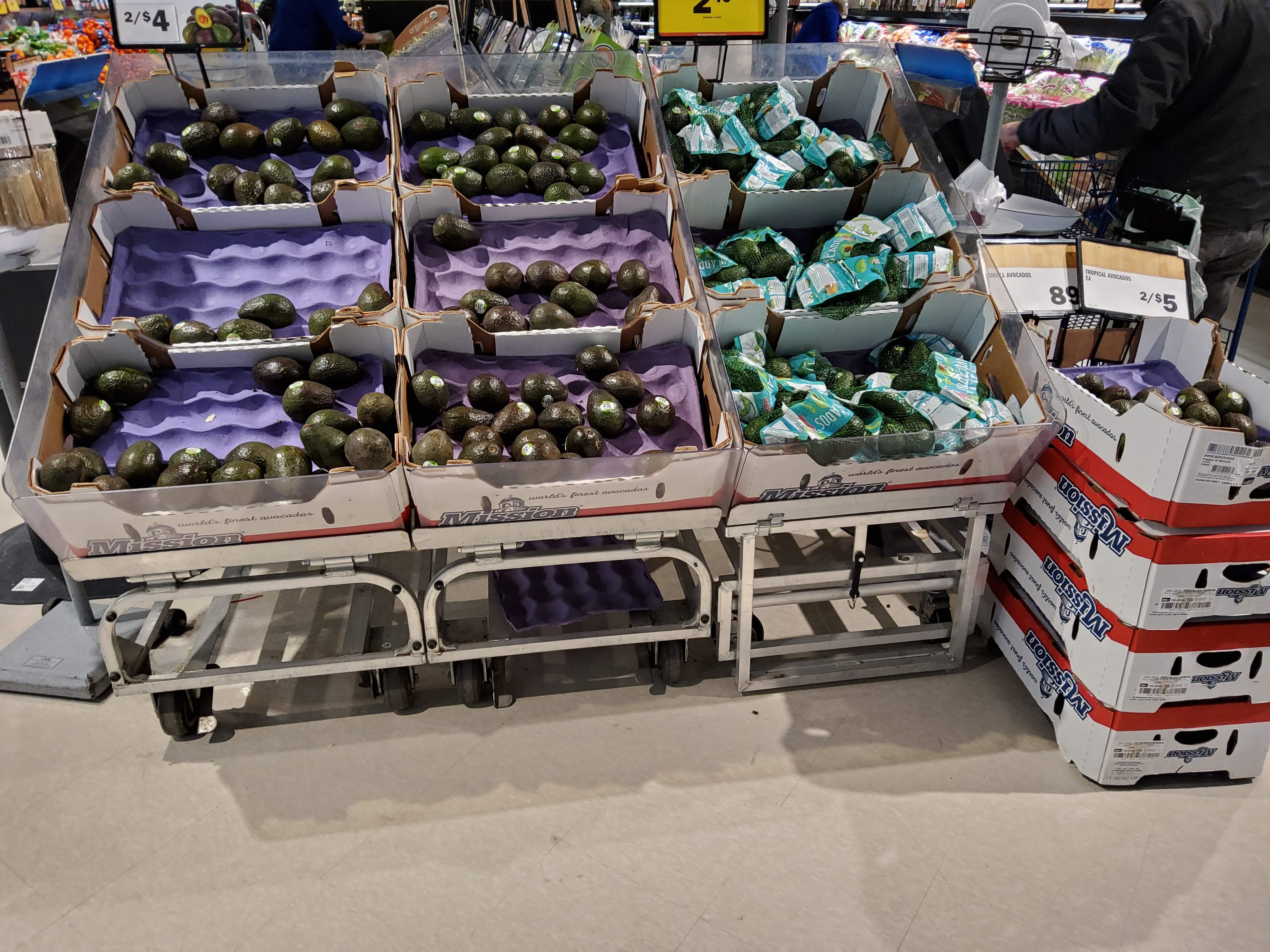
Avocados.  Yep.  This is an endcap that\’s just entirely avocados.  Apparently my generation popularized consumption of them, in part due to their healthiness.  In my memory of decades past, this would have been a small segment of the broader vegetable section, not an entire endcap (plus the weekly sale island at the start).  

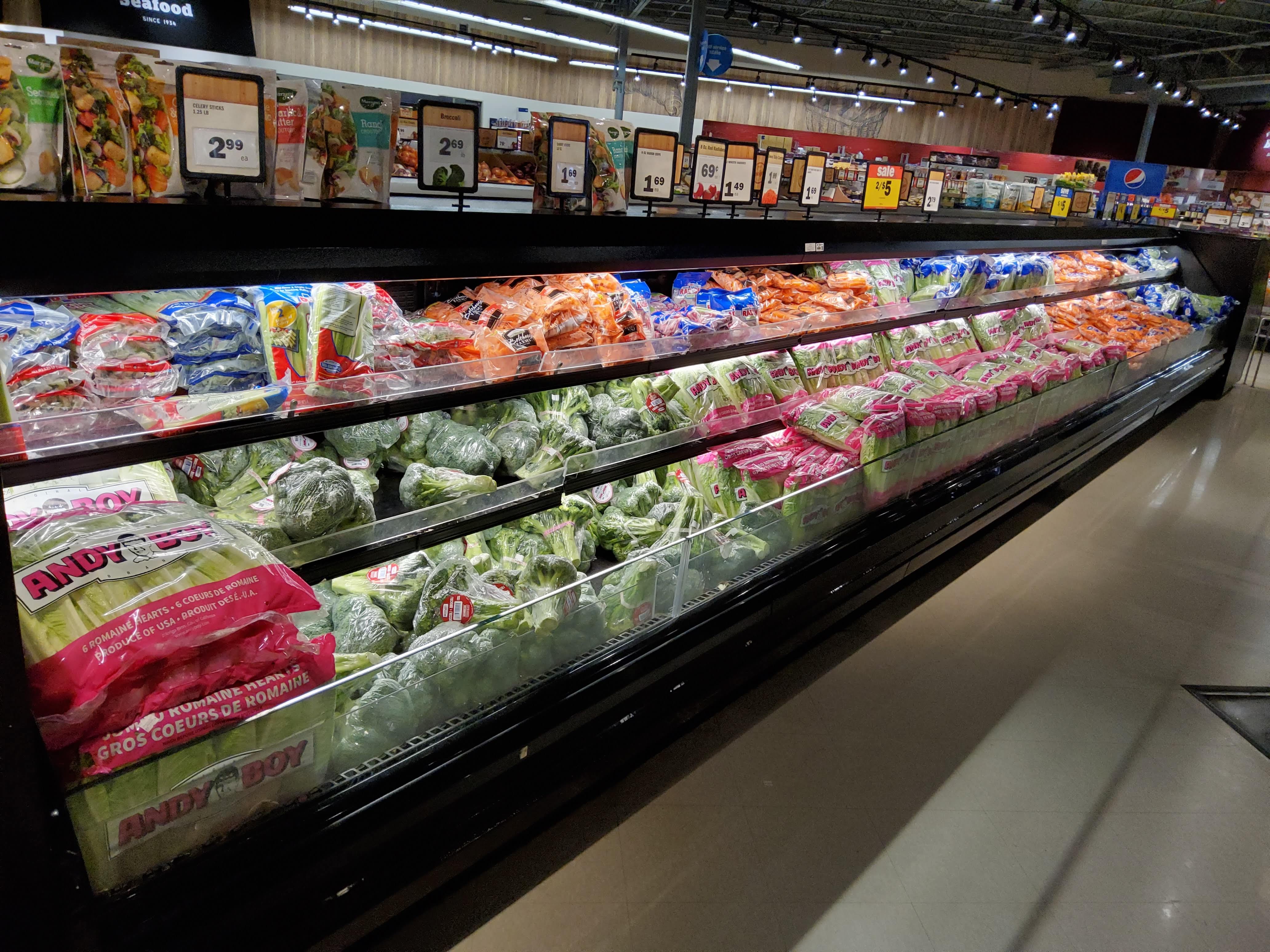
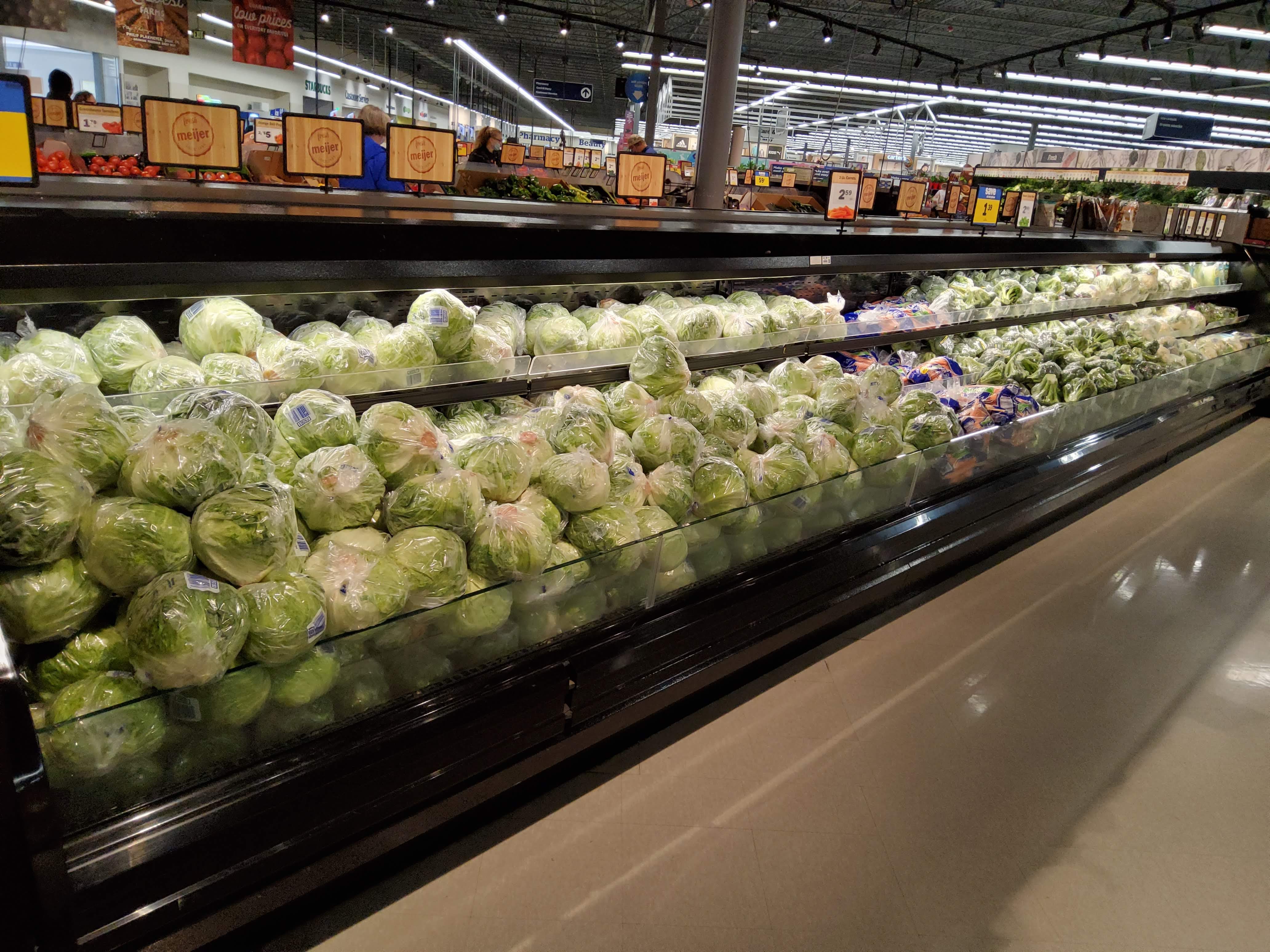
Plastic-wrapped broccoli, bulk bags of lettuce heads, bagged baby carrots, and bagged celery.  With salad fixings perched on top of the displays, because God forbid you simply eat salad without extra carbs.  

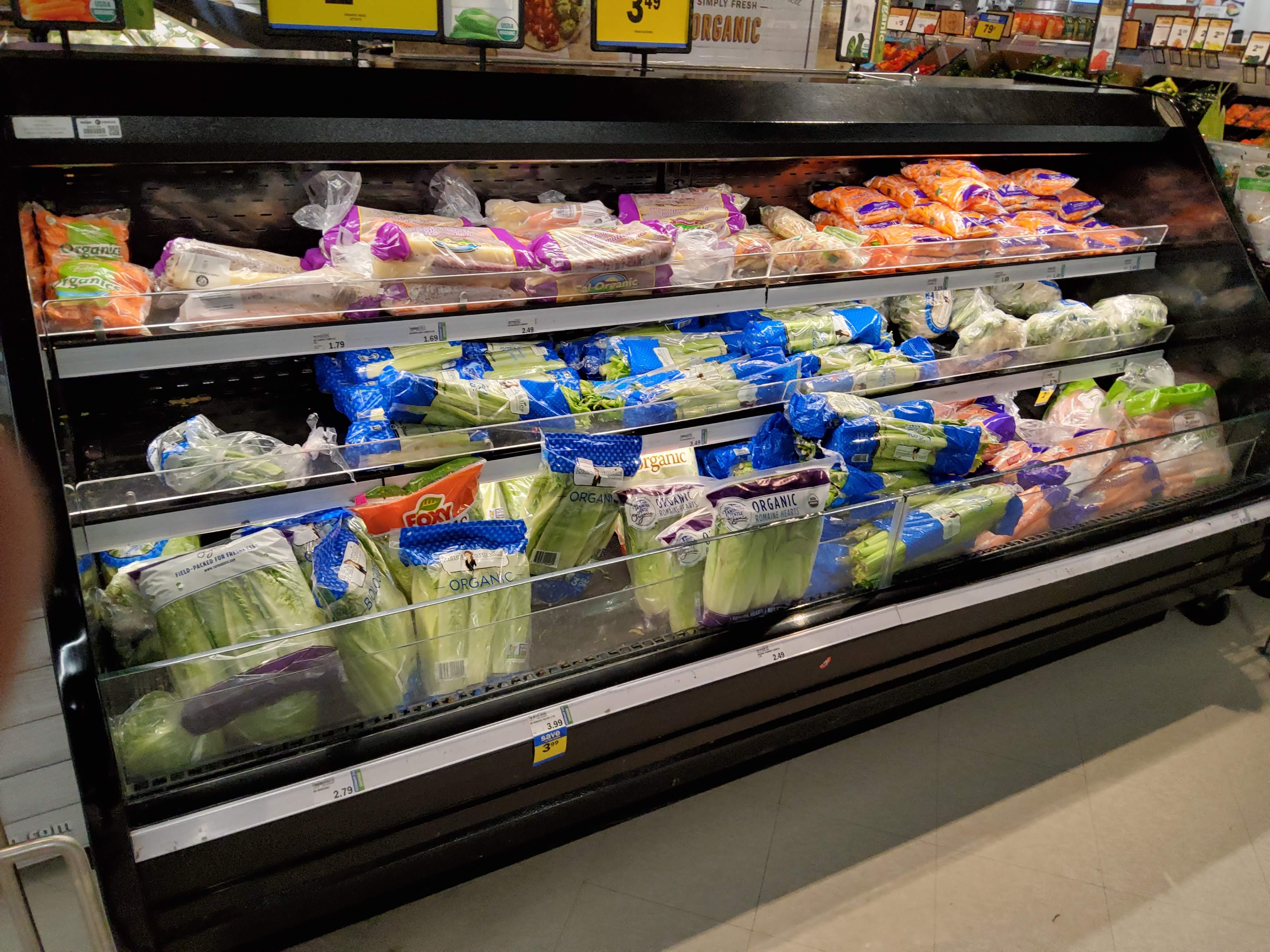
Organic options of the previous aisle, in an endcap.  Organic does not always mean \”better for the environment\” unfortunately, but as mentioned in the organic fruit section, it can be your best bet health-wise.  

The other side of the previous long island.  Plastic wrapped cabbage heads, large carrots, broccoli crowns (smaller than the other broccoli option, and with less stem), and cauliflower.  Absolutely everything you see here is sealed in plastic.  It helps preserve the freshness, but the plastic just ends up in a landfill.  

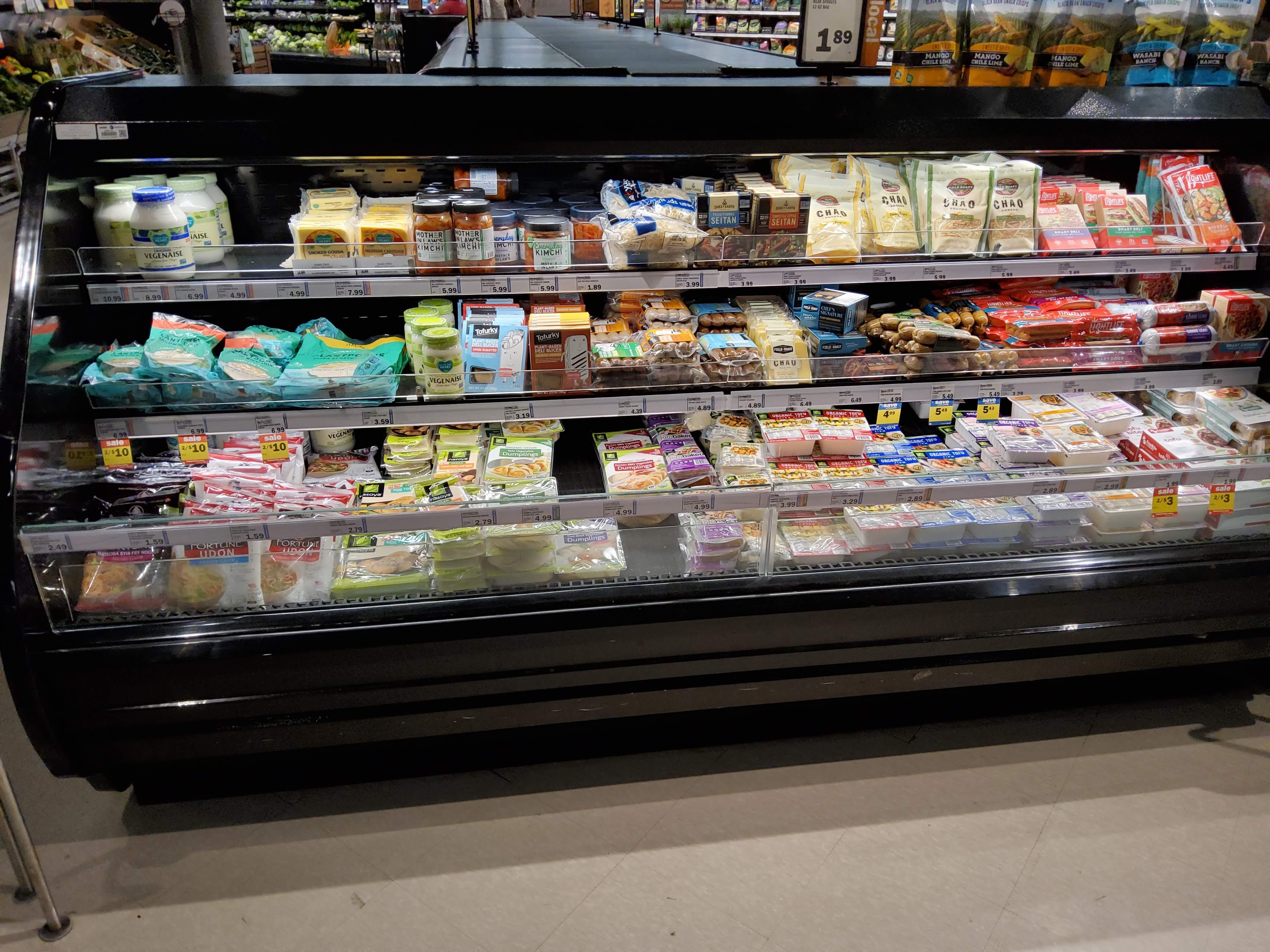
The other endcap on this island-aisle.  I\’m honestly not sure why, precisely, this is here, but it is.  These are non-meat, non-dairy options.  Seitan, tofu, pseudocheese, and veganaise.  Please note that even here, there is no escape from the barrage of snacks.  See the dumplings?  

This is a standalone island on the back edge of the area.  It\’s basically salad fixings.  This side has even more tomatoes, in the smaller varieties.  

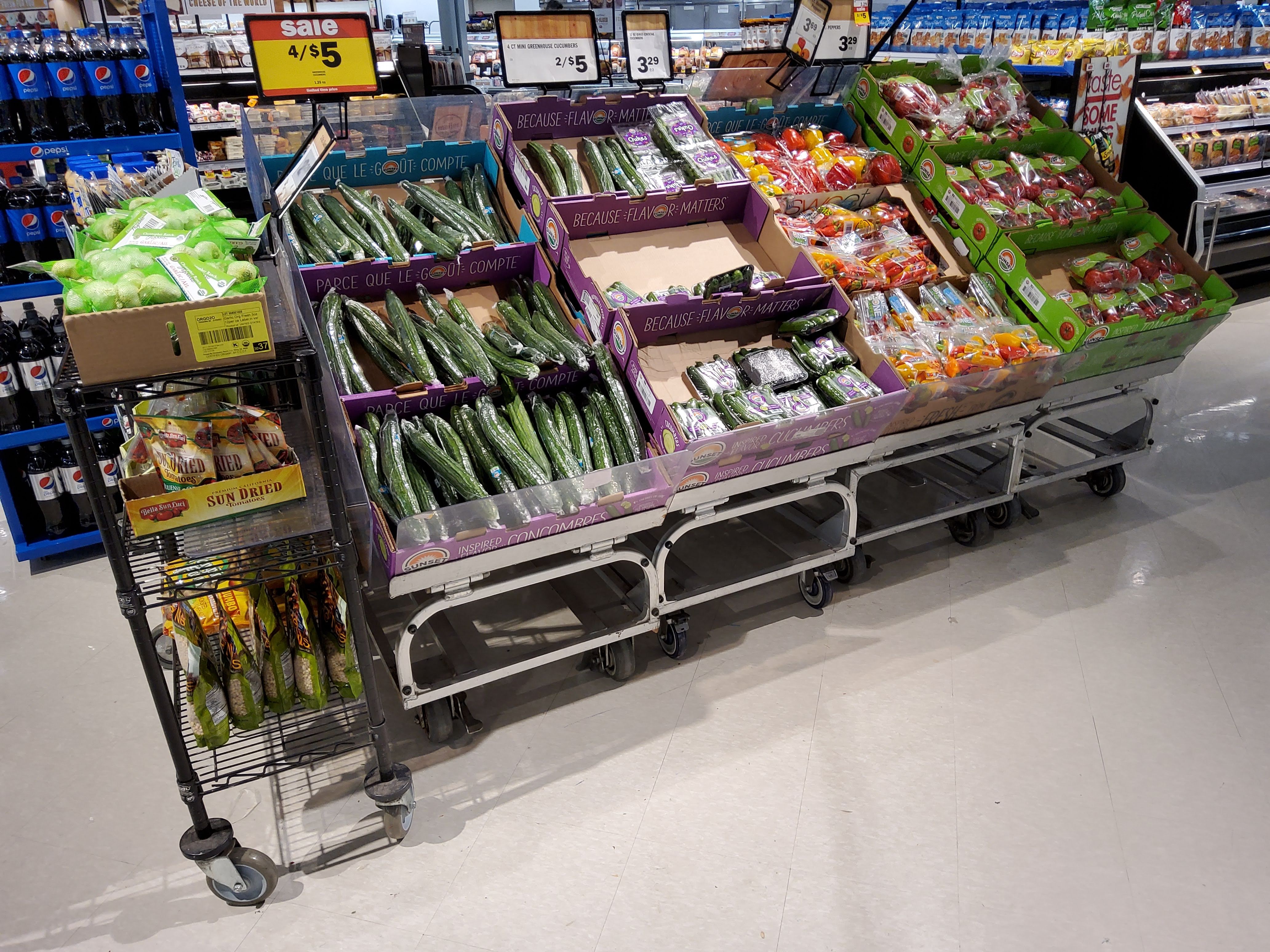
And the other side, even more peppers and cucumbers great and small for all your salad needs. I\’ve found the tiny cucumbers nice for personal salads.  

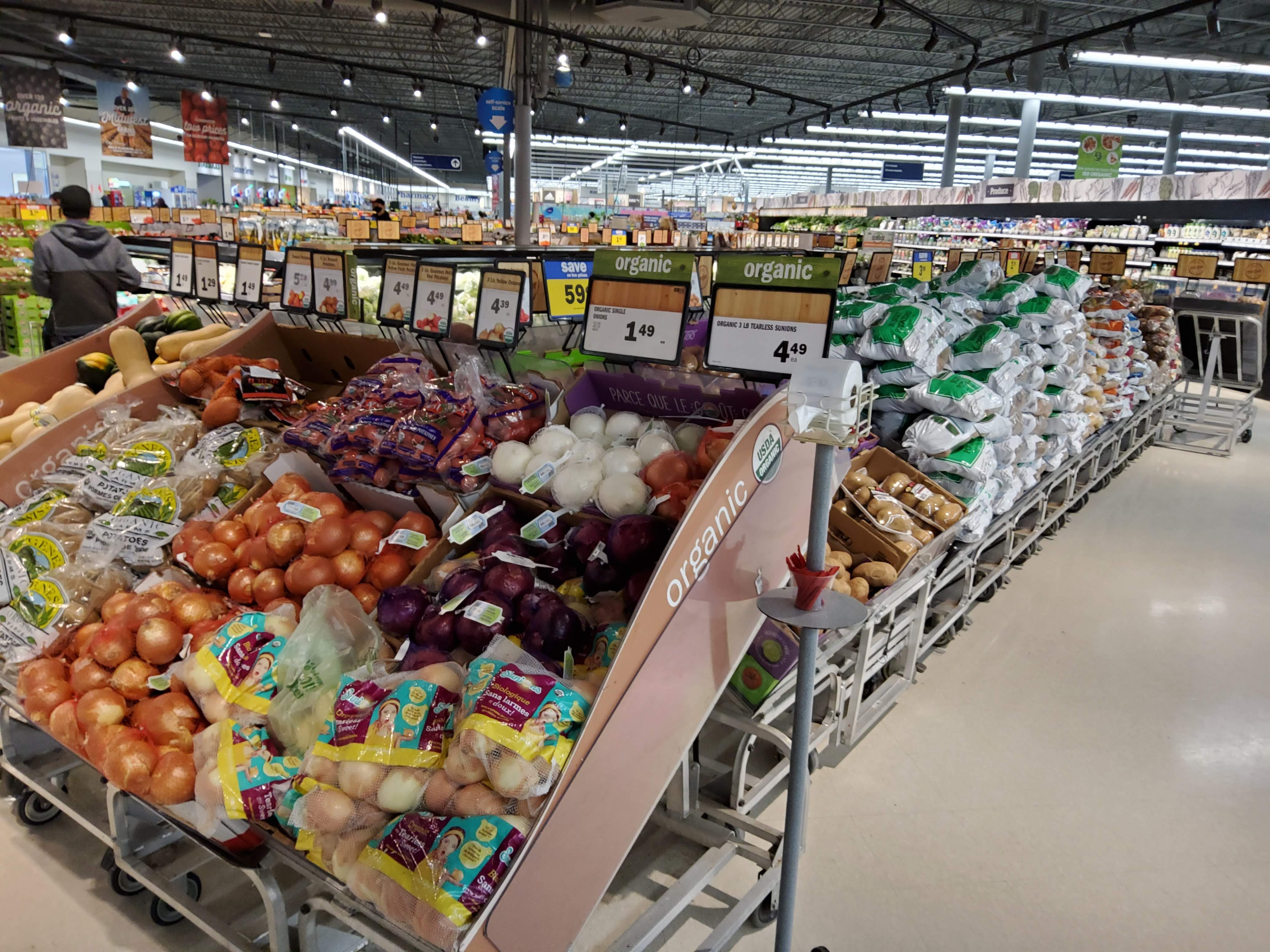
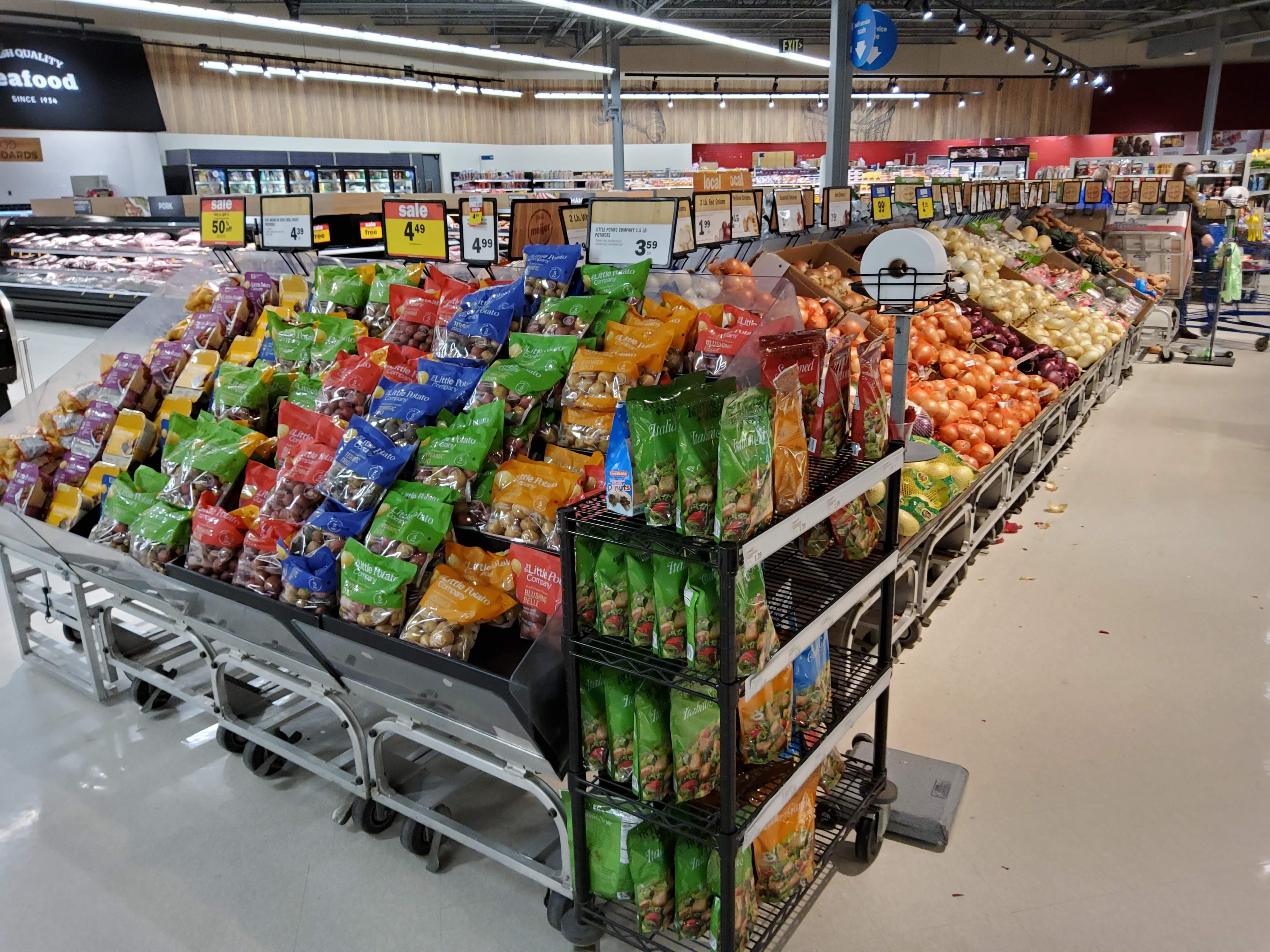
This longer island is the last one in the line.  It\’s mainly onions and potatoes, though there\’s yams and some squash for good measure as well.  The endcap has bags of teensy tiny potatoes in up to three colors for a really staggering markup.  Then there are three colors of onions (red, white, and yellow), in both bulk bags and \”select your own.\” 

The other side of the onions/potatoes island-aisle.  Organic varieties of both on the end cap, and bulk bags of russet, yellow, and redskin potatoes.   Potatoes are a very solid food choice when they\’re not heavily processed or soaked in as much grease as they\’ll hold.  The problem, of course, is that most potato products fall into at least one of those categories…  
Moving on to the last part of the produce section, which is oddly not fresh at all…

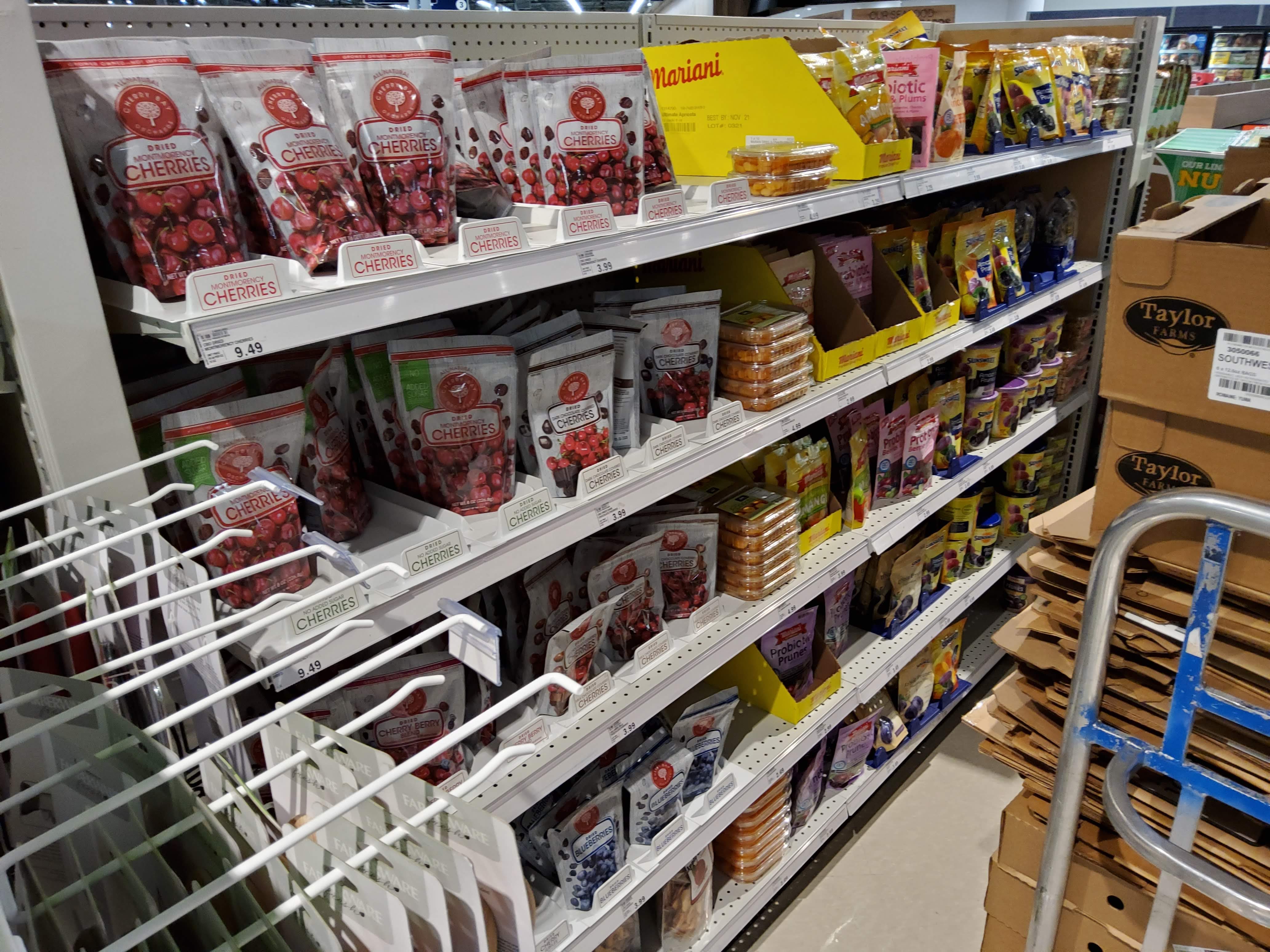
I couldn\’t get a decent shot of this due to the stocking cart on the right hand side there, but this is basically just a bunch of plastic bags of dried fruit.  The variety here includes cherries, apricots, mango, and prunes.  Dried fruit is great in theory, but in practicality it\’s typically just more like candy with fiber.  It\’s usually laced with sugar to make the fruit extra appealing.  Read your nutrition facts and ingredients carefully. 

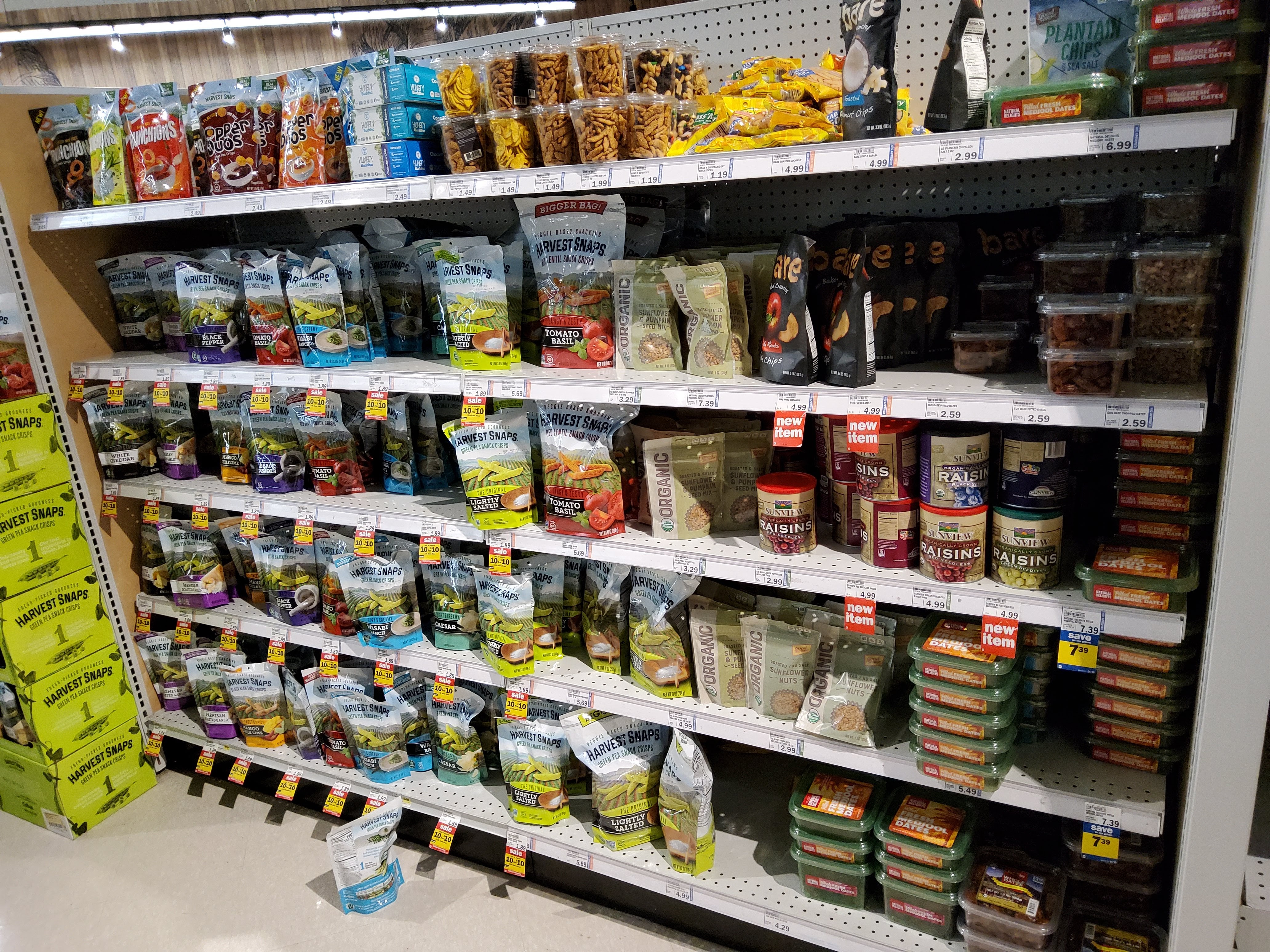
This is the other side of that display, and it includes seeds and vegetable snacks as well as raisins and dates.  I don\’t really know what one does to a pea pod to make it into a crispy salted snack, but I\’m a little afraid to find out.  

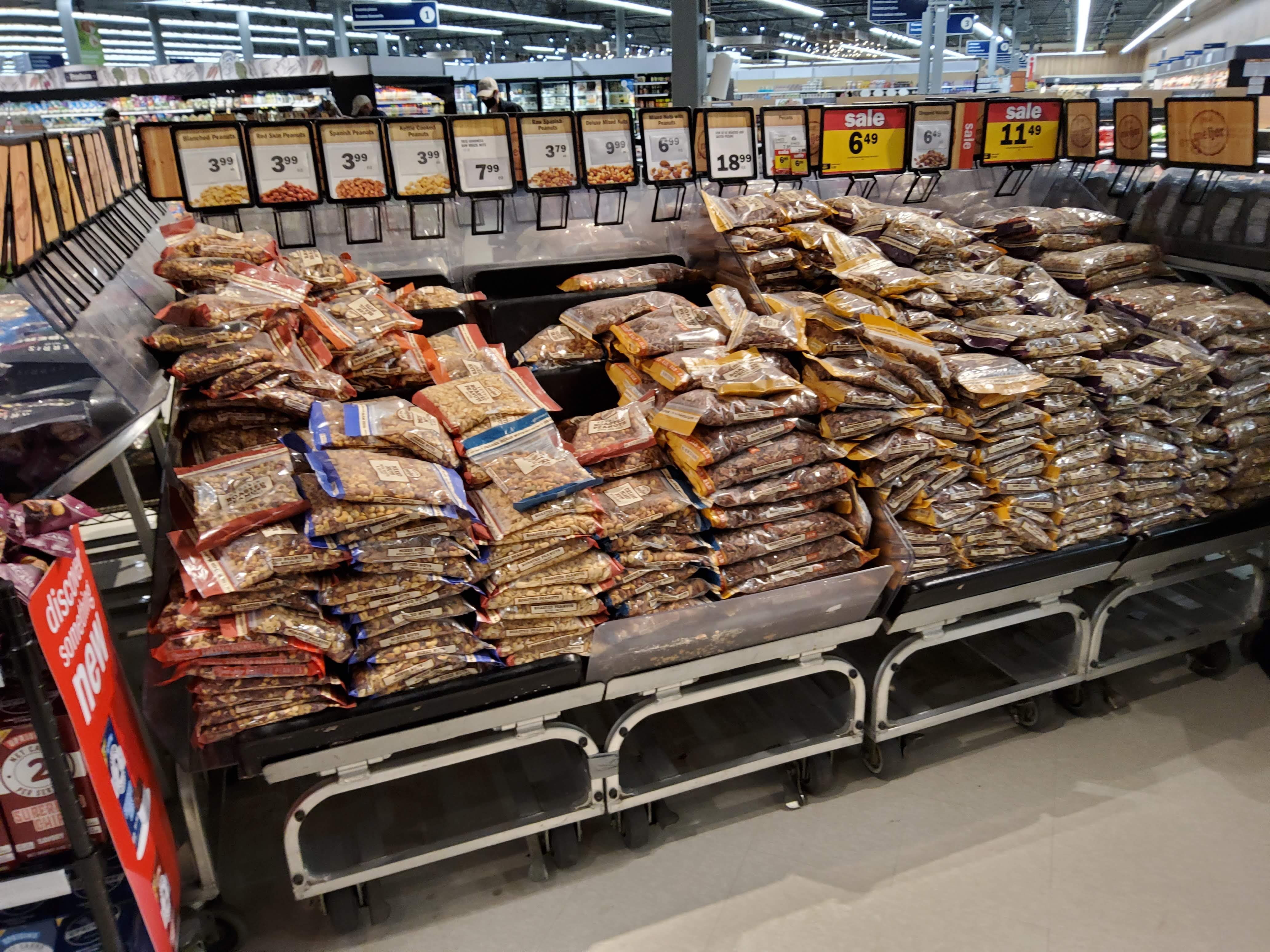
Moving on, we arrive at the bagged dried nuts.  This, like everything else in the store, is a demonstration in absurd variety.  We don\’t simply have peanuts.  We have blanched peanuts, red skin peanuts, Spanish peanuts, kettle cooked peanuts, raw Spanish peanuts (roast it yourself, I guess?), and mixed nuts with peanuts.  There\’s also pecans, and a bit further in, there\’ll be even more types of tree nuts.  As a reminder, this is the second section of snack nuts, the first being around the candy aisle.  

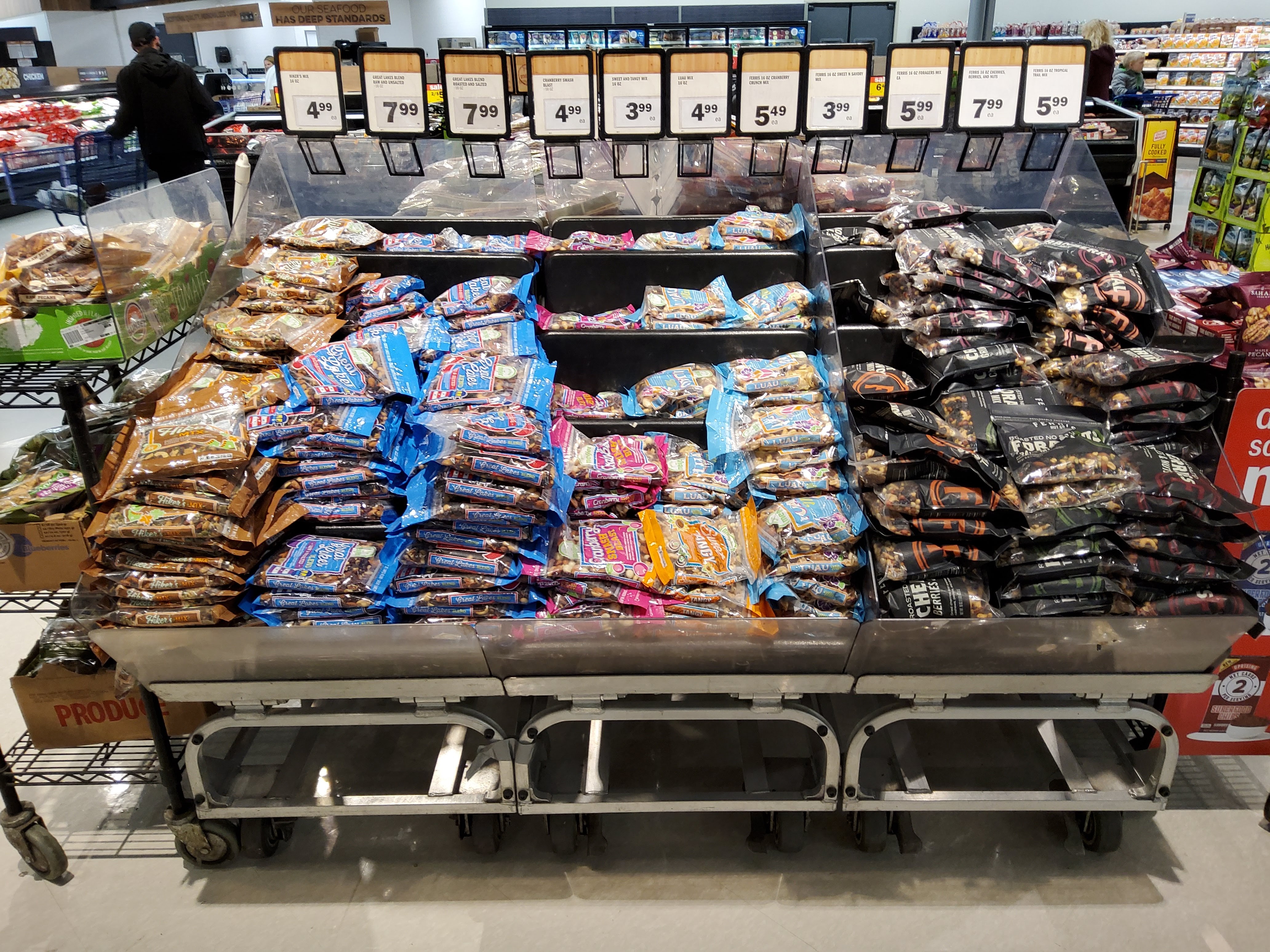
One end of the previous display.  These aren\’t cooking ingredients, they\’re snacks.  They\’re specifically packaged to go in a bowl or be eaten right out of the bag.  Mixed nuts and trail mix (with dried fruit) varieties.  

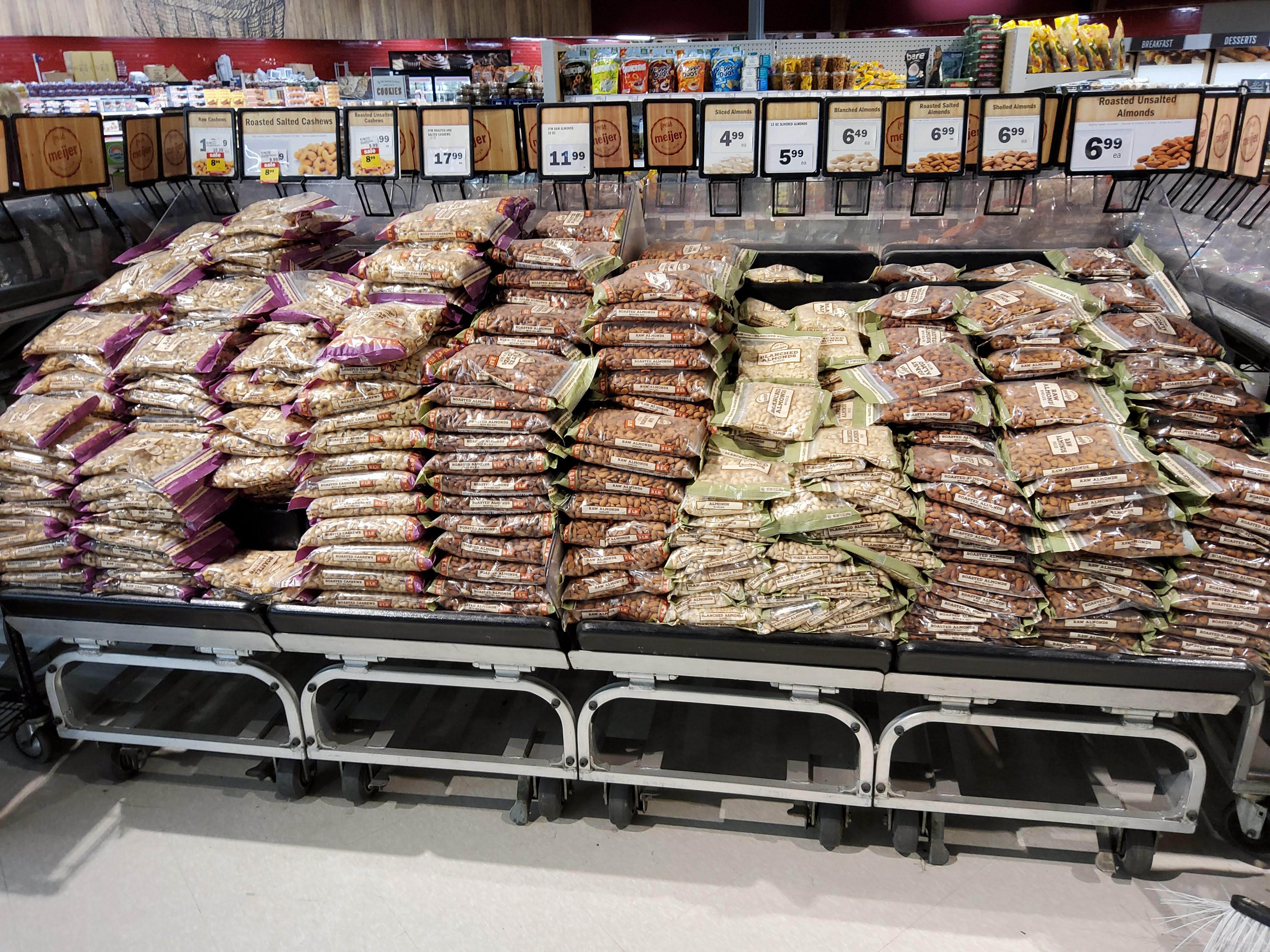
The other broad side of the display, where we can mainly find almonds and cashews.  You can have them roasted or raw, pre-sliced, salted or not, and blanched.  

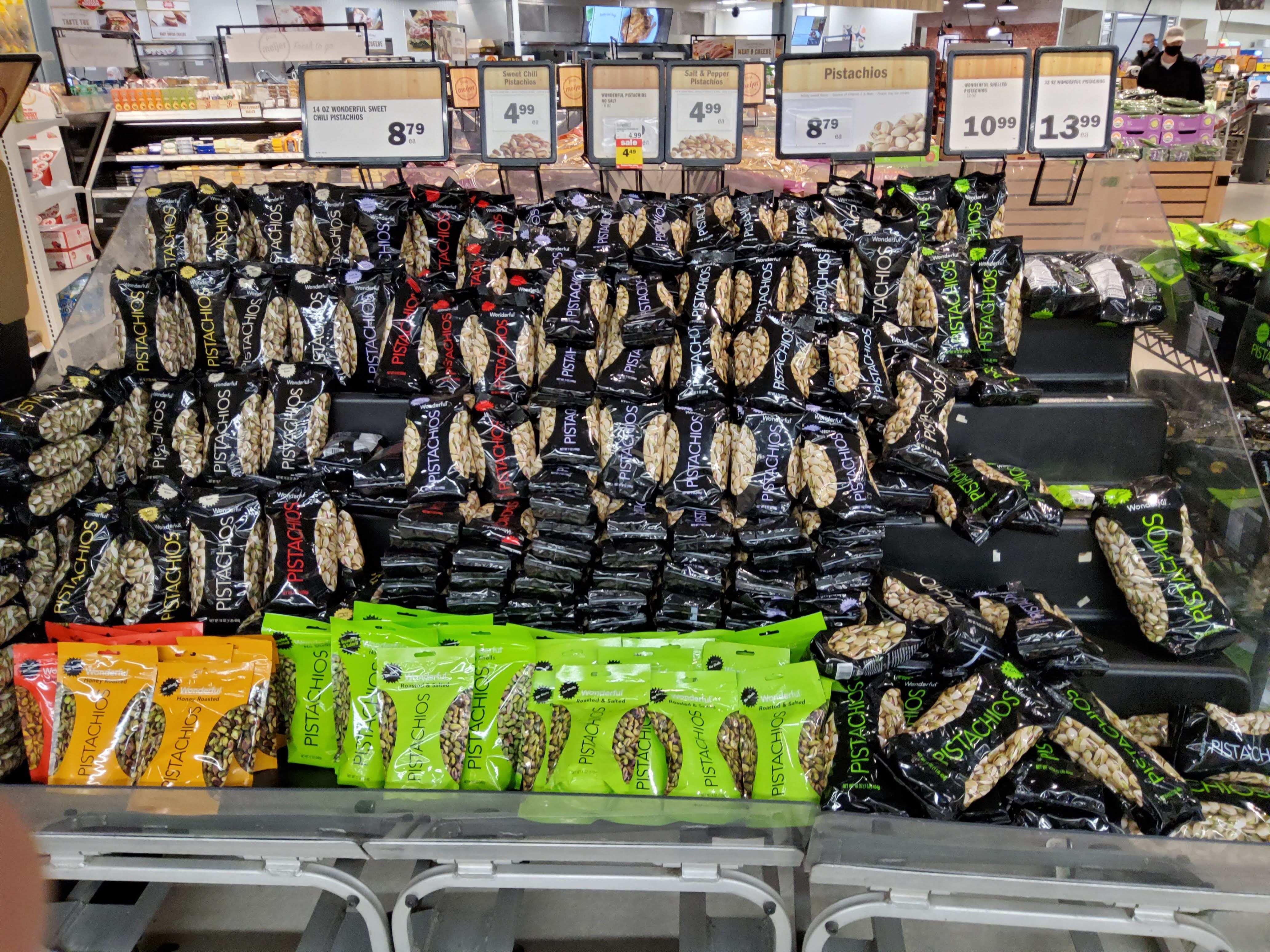
Last but not least, the other end of the display, which is entirely pistachios.  All from a single company, but you can get sweet chili, salt and pepper, honey-roasted, and basic pre-shelled varieties.  
And that finishes the produce section!  It\’s been a surprisingly long trip through the grocery store.  I started this series in early September and never expected it to take a half year to finish, even with doing posts every two weeks.  It\’s been very educational for me, and I hope, for you as well.  It turned up some interesting (and horrifying) information about grocery store practices.  
In the course of this project, I went from shopping almost entirely at this grocery store (Meijer) to starting at Target (where the employees seem happier and more like people, anyway) and then only buying what I couldn\’t find there.  The sheer amount of manipulative marketing in terms of alcoholism and snacks in every corner of Meijer is more than I can morally tolerate.  I hope to transition to not shopping at this store at all in the coming year.
I\’ll do a bonus post in a couple weeks to show you the checkout aisles, because they\’ve changed somewhat in the last few years and I think it\’s worth knowing why.  Beyond that, thank you for joining me on this adventure!

Grocery Shopping On a Special Diet: Meat and Deli

Welcome back to my autism-aware shopping trip through the grocery store.  Week by week, I\’m showing you what the store sells, prune down the selection to what\’s safe for me (because autistic people can have very sensitive systems) and point out various gotchas the store tries to make you buy stuff you didn\’t come for. 

As a reminder, I shop with the following conditions in mind:

  • dairy-free
  • low sugar
  • avoid ultraprocessed junk
  • avoid food coloring
  • conditional vegetarianism
  • avoid high histamine foods
  • awareness of gluten-free options and sugar-free options
Last time we finished off the numbered aisles.  We also saw a truly staggering number of TV dinners, and learned why, nutritionally and cost-wise, they\’re a trap.  This week we\’ll look into the meat and deli sections.
It\’s worth noting that there will be almost nothing for me in this section, because of the conditional vegetarianism mentioned above.  The US meat industry is, on the whole, supremely uninterested in matters of ethics and morality.  Meat animals are treated like objects, not living creatures, and given as little freedom as possible while still producing an edible product.  Maybe not a very healthy product, for you or for the environment, but that\’s irrelevant in the face of greed.
I\’ll pause here for a moment to note something very important:  there are a lot of things in life to care about.  One of my personal causes is the meat industry,  because I think that animals deserve to have lives beyond simply being my food.  If that is not high priority for you, or you don\’t have the money to afford more humane options, that is okay.  If your passion is ending human slavery, or starvation, or homelessness, or racial inequality, or just surviving this year because you\’re struggling hard and there seems to be no respite from the insanity, and you don\’t have time or energy to spend looking at the food on your plate right now… that is understandable.  This is something I care about, so I\’ll talk about it.  
However.  In no way am I saying, \”animal welfare is more important than any of those other things.\” It is important to me, and I\’ll be giving you information in regards to it.  I hope you\’ll look at it and keep it in mind, but if you don\’t, I am not somehow \”better than you\” or whatever it is self-righteous jerks are saying these days.  
Skipping past the very disturbing pictures of what the meat industry considers appropriate treatment for living creatures, I\’ll simply link you to Certified Humane\’s factsheets page.  Some of the common practices are described therein.  You can also check the FAQs page for a lot of very specific questions about their standards.  
I consume Certified Humane and Animal Welfare Approved products due to their transparency and independent verification processes.  This grocery store typically carries very little of either of those, but I\’ll point out the exception. 
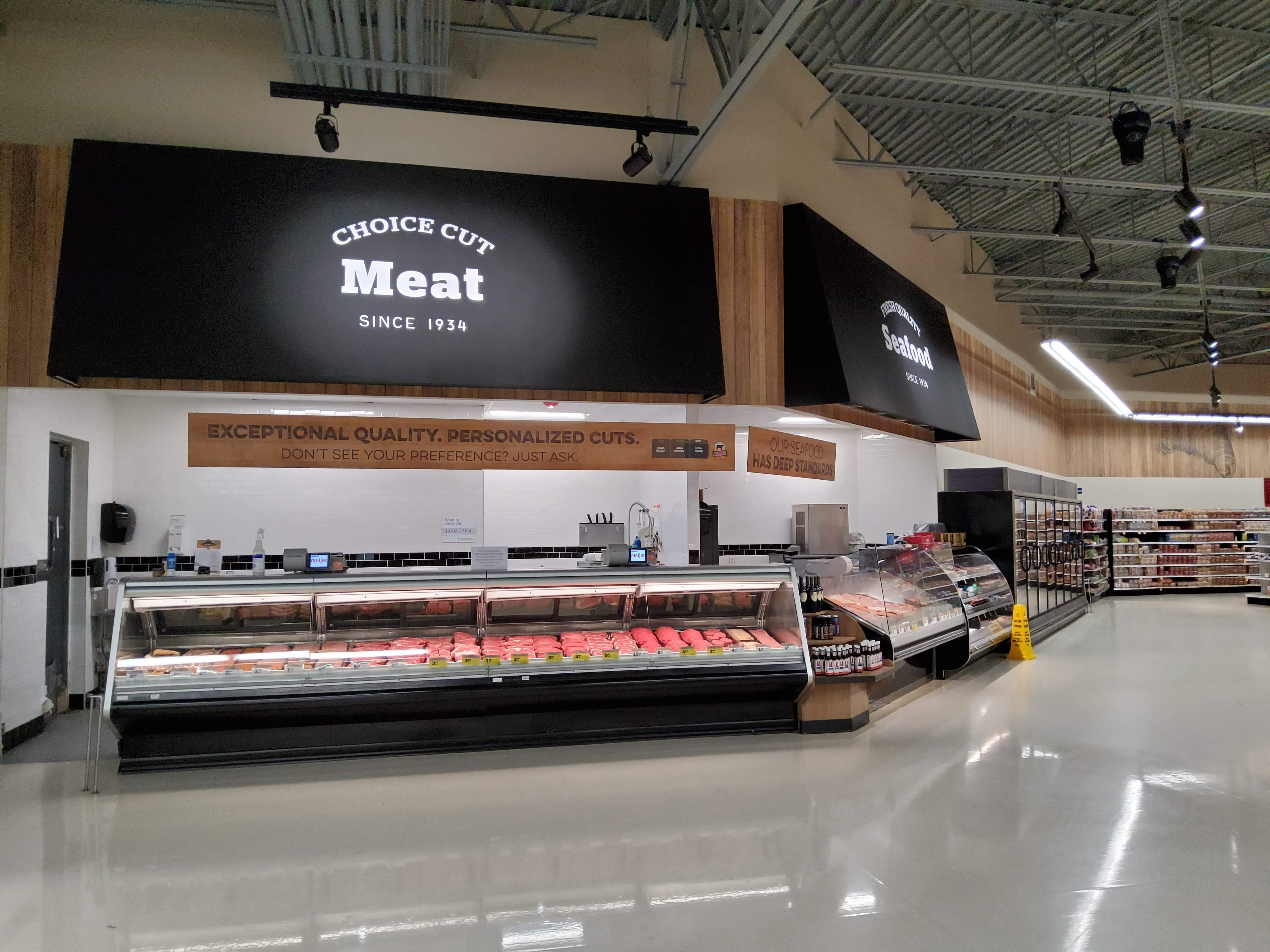
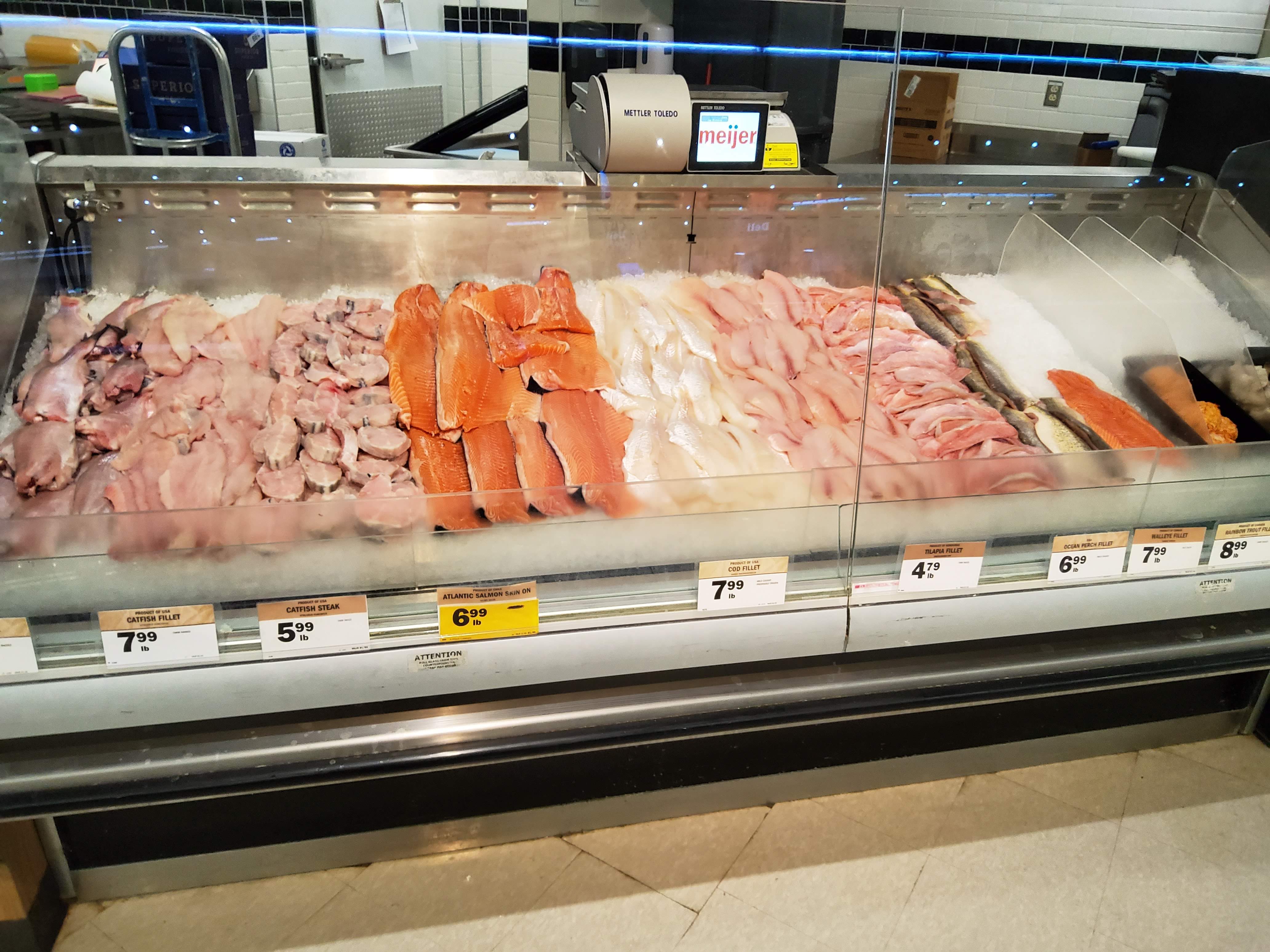
I figured we could start with the fresh meat counter.  I had to wait a good bit to get a shot without anyone in it, but I think it was worth it.  The counter is almost always staffed by at least one person, waiting to weigh and custom-chop whatever you care to buy from their selection.  
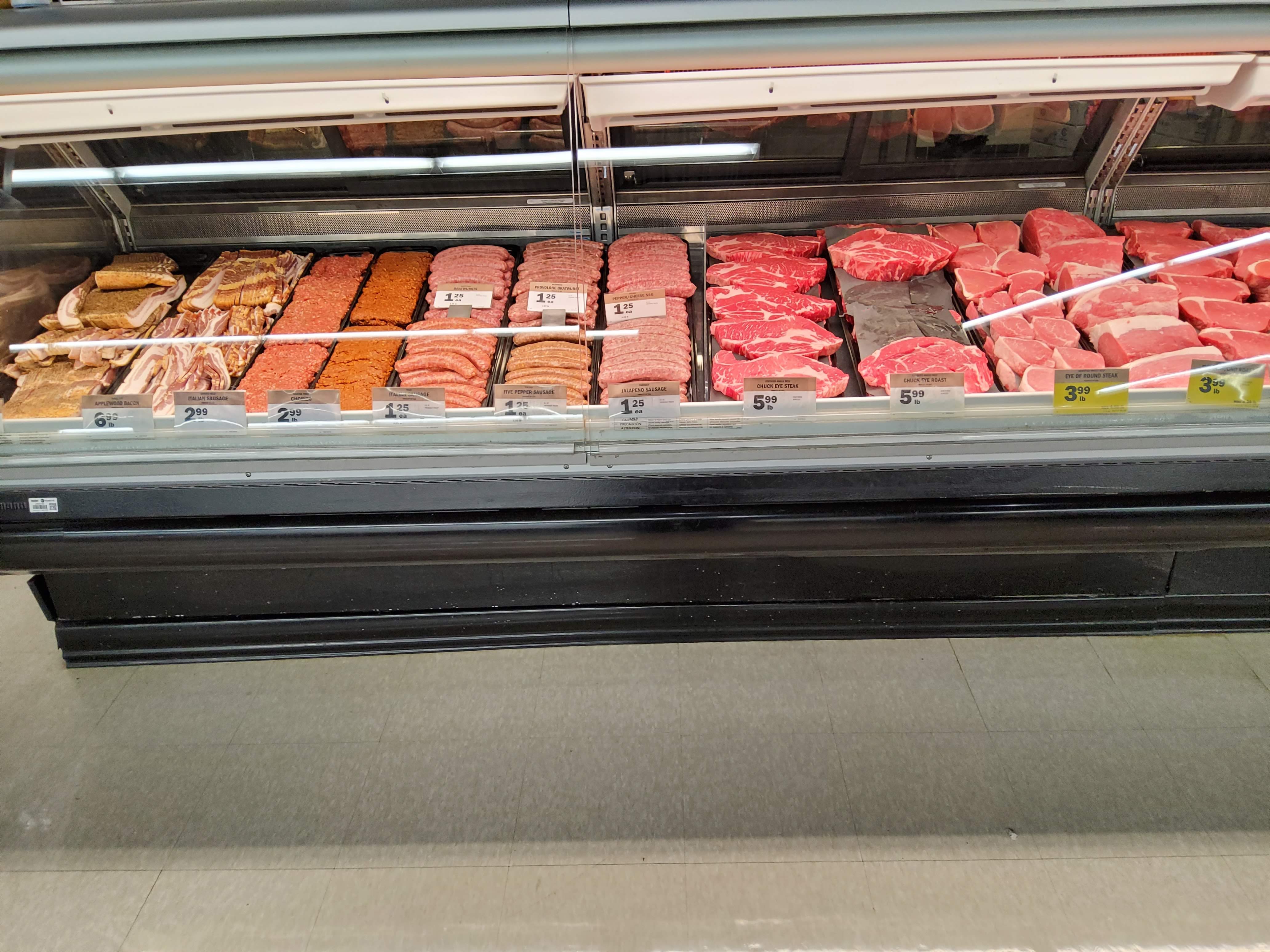
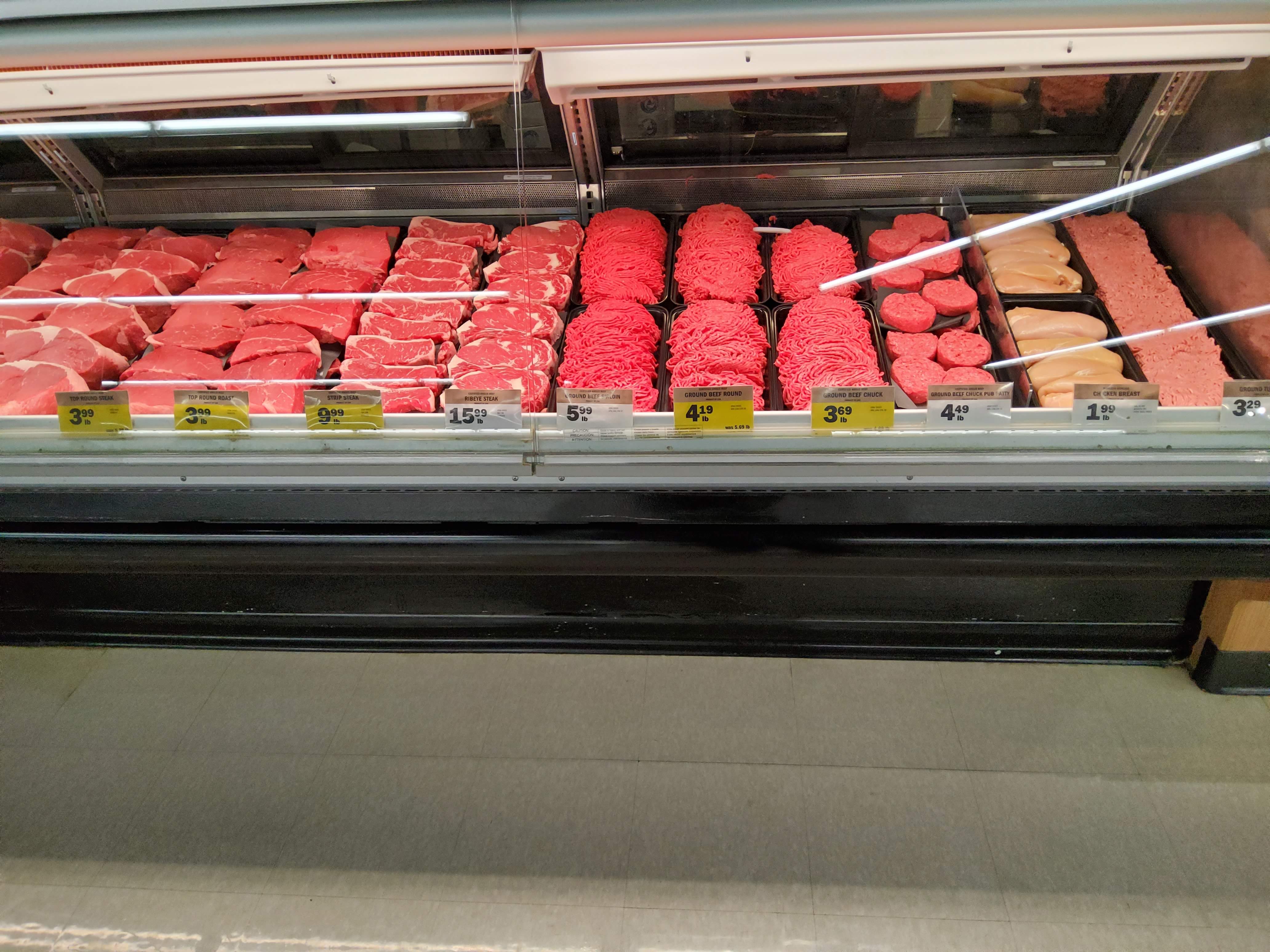
A reasonable selection.  And all of it seems nice and fresh.  Did you know red dye goes into most beef products to make it seem fresher than it is?  They also tinker with the air balance in the cases and packages to keep that red color as long as possible.  The meat isn\’t super fresh, it\’s just been made to look like it is.
Same with that salmon, by the way.  That dark color is unlikely to be natural.  Farmed fish doesn\’t have the type of diet to produce that color, so the farms feed them the processed color.  Otherwise the resulting filets would be grey. 

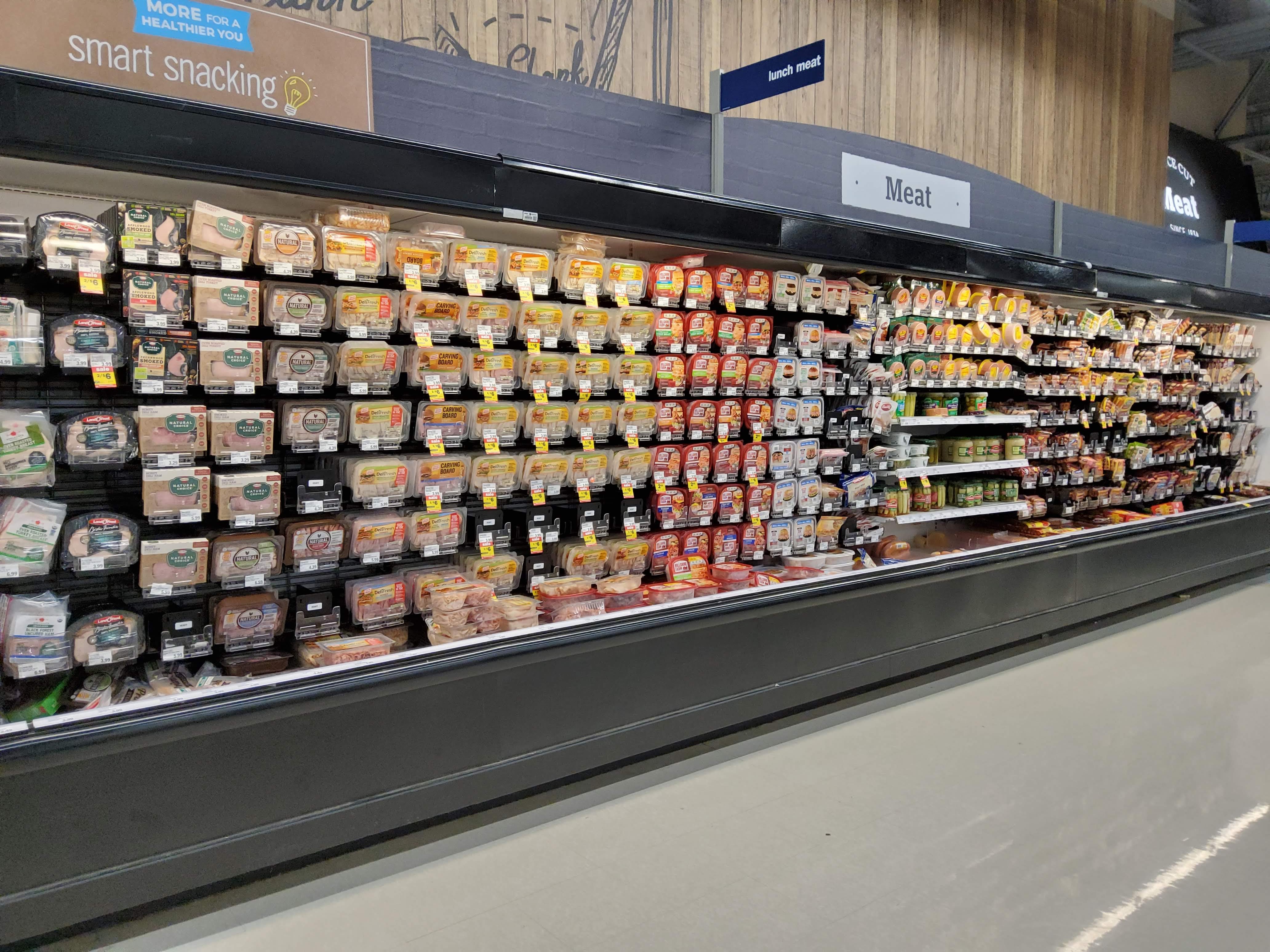
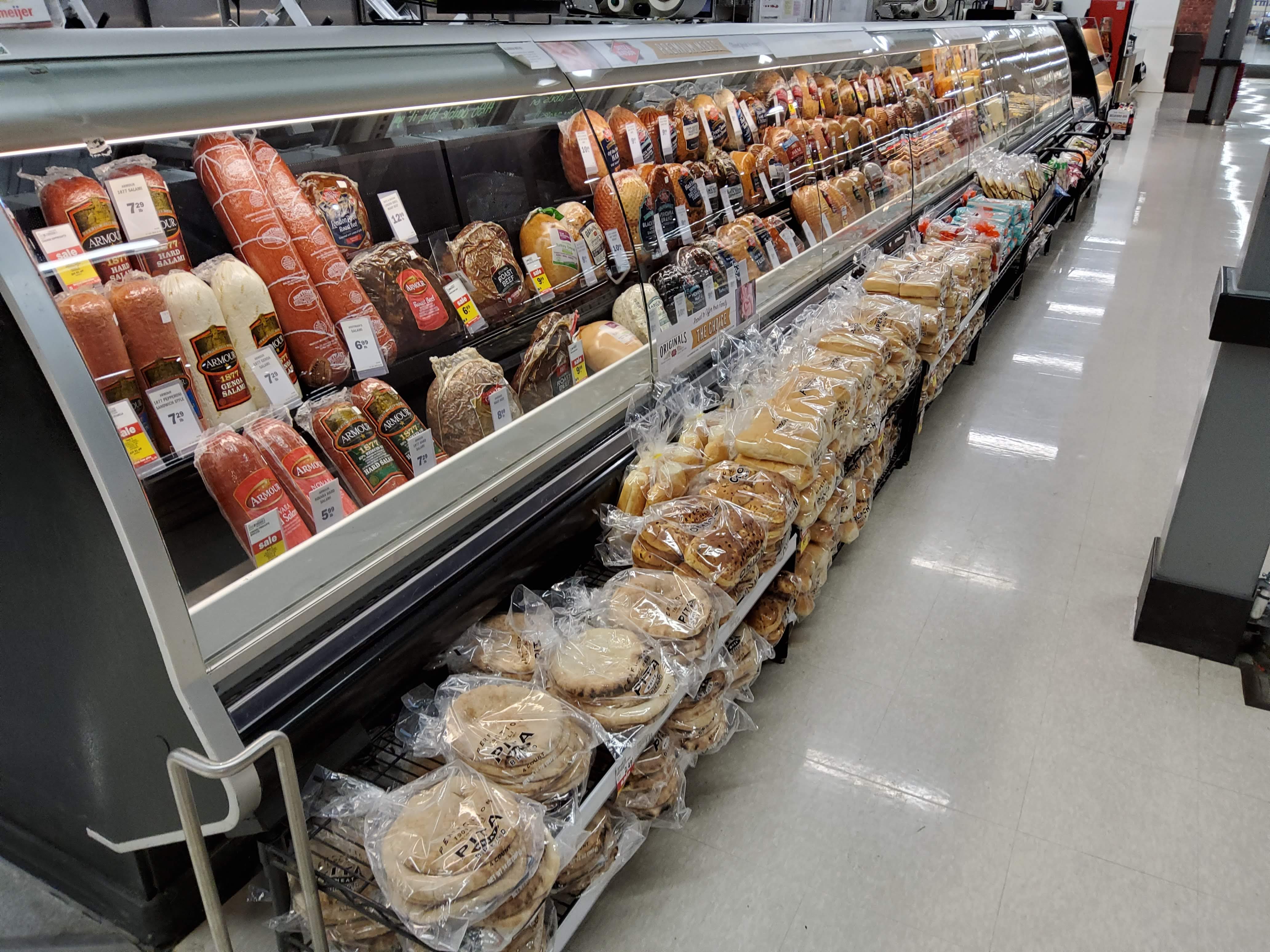
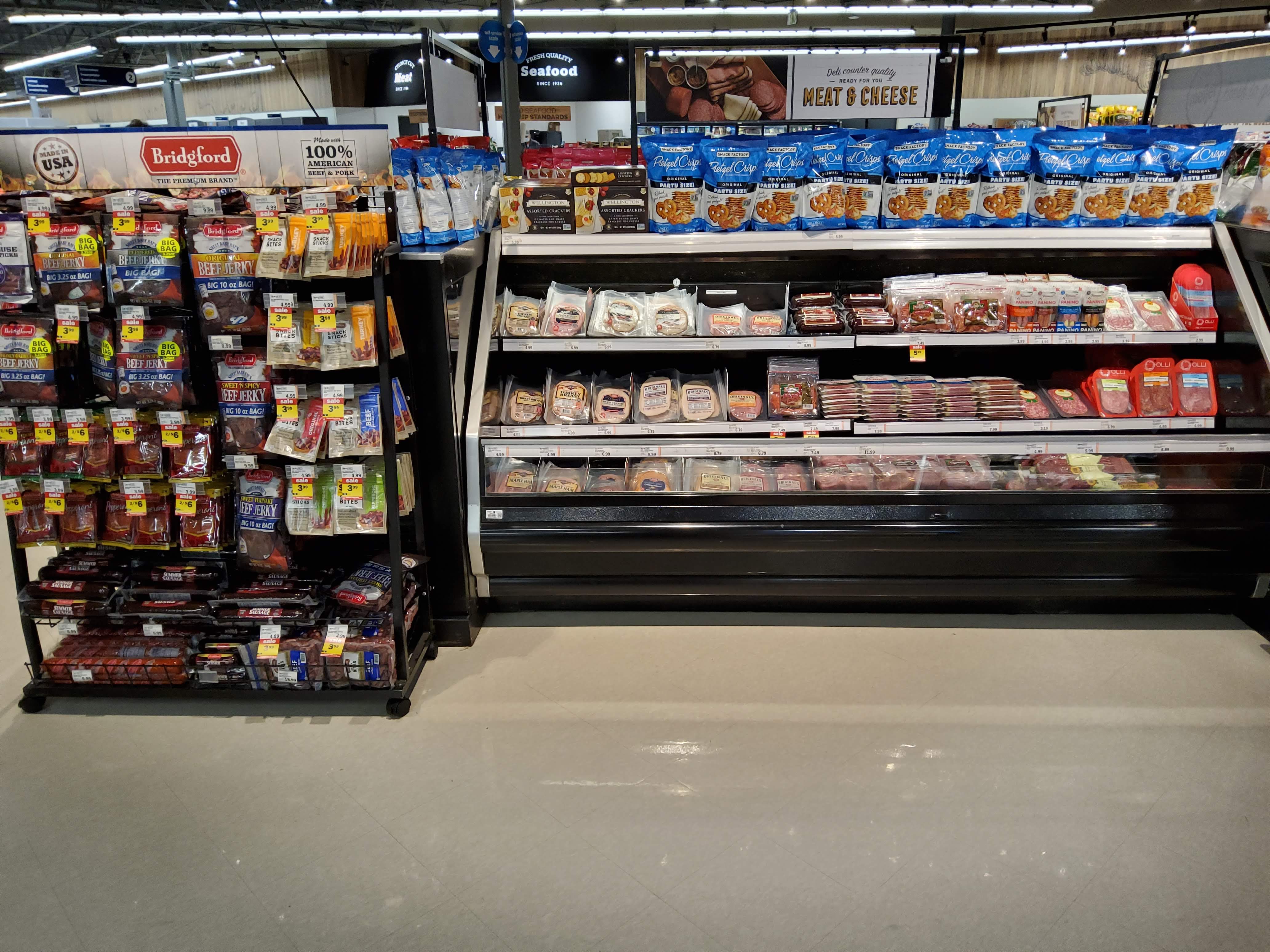
Before we dive into the rest of the meat section, let\’s have a look at the lunch meats.  As you can see, they are legion, and roughly organized by brand. Ham, turkey, chicken, salami, roast beef, bologna, it\’s all here.  You can also snag hot dogs on the far end there. And, though it\’s hard to see, meat-and-cheese snacks just after the hot dogs.  
 
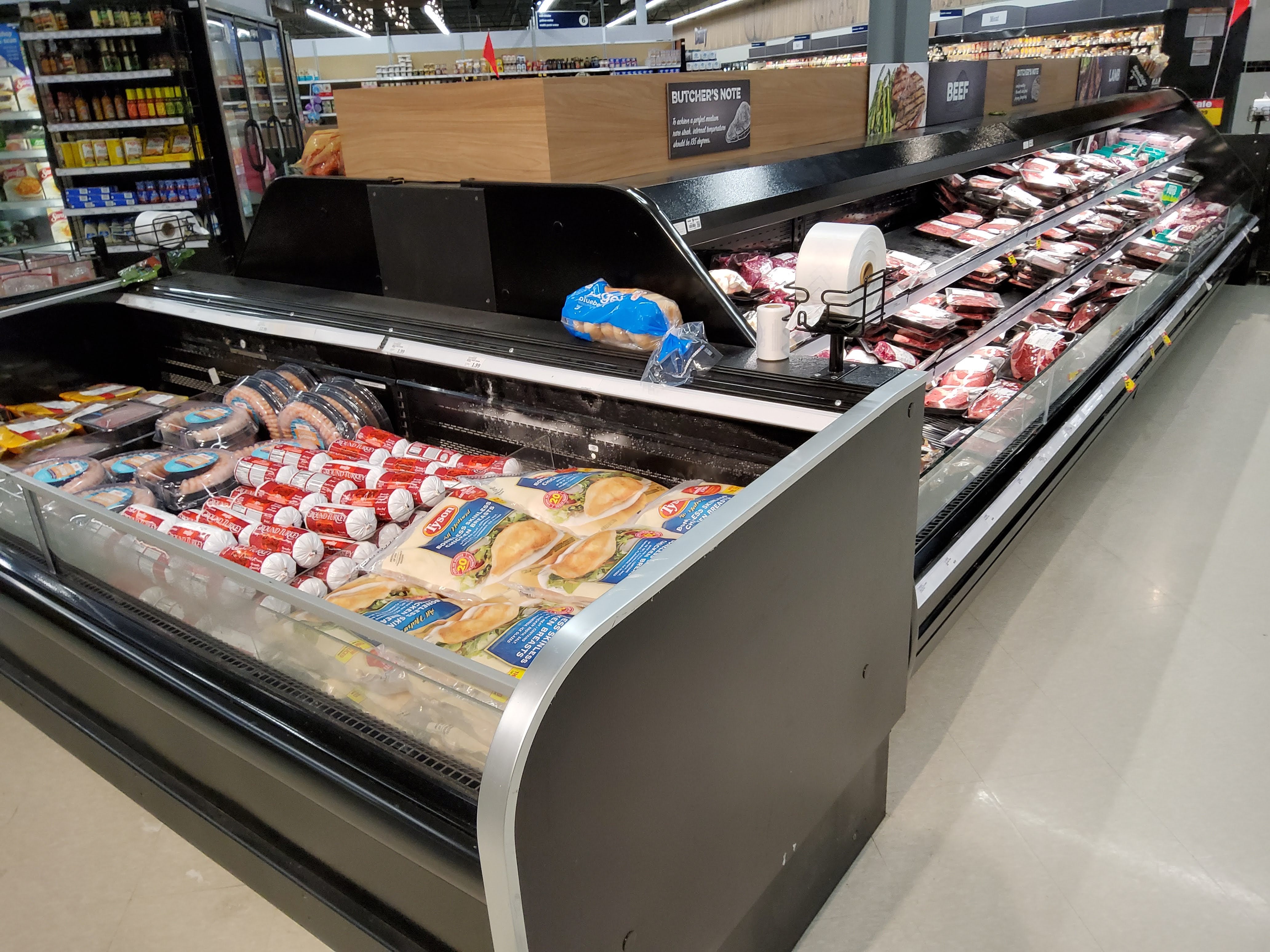
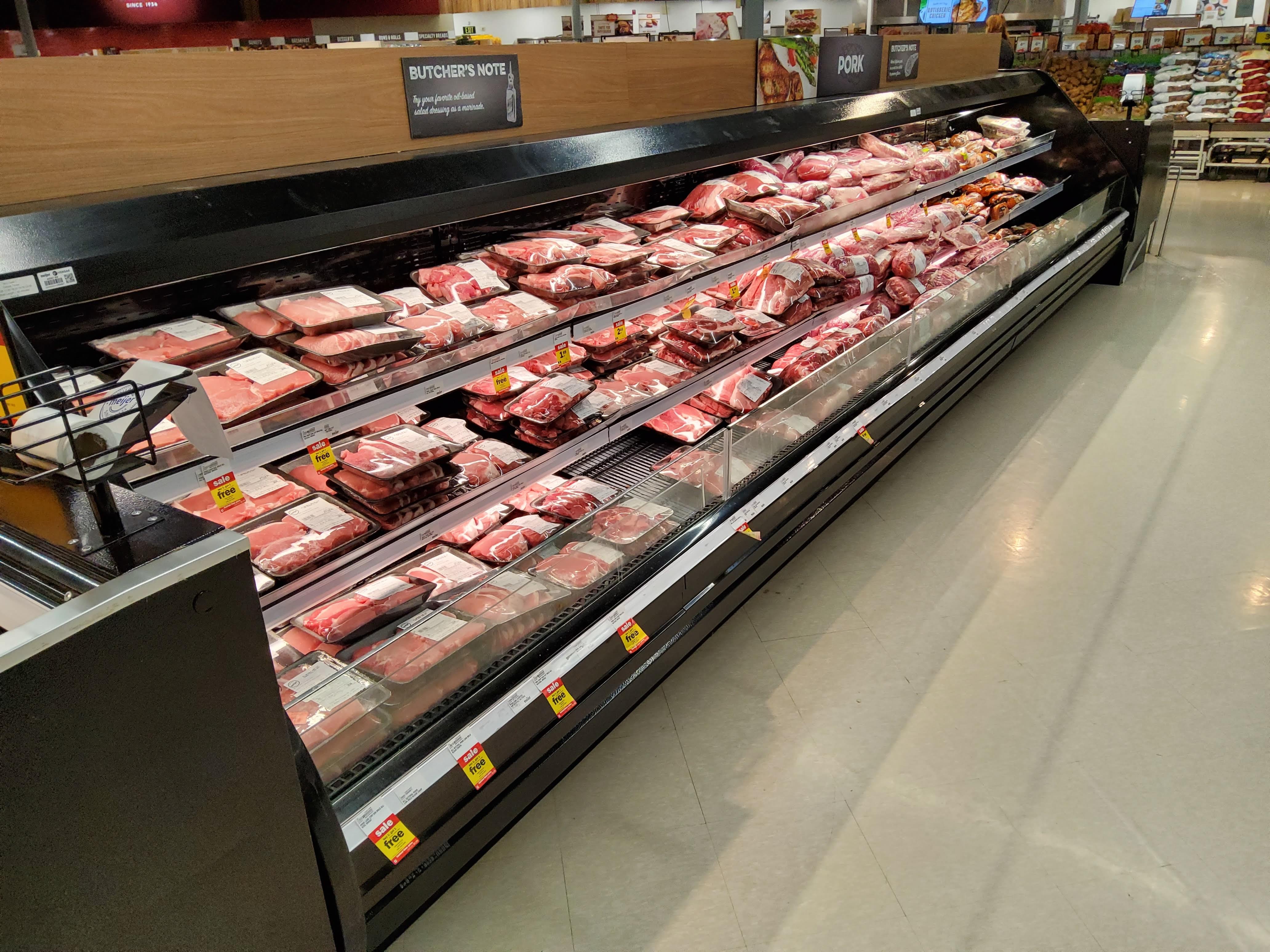
Past the the lunchmeat and the meat counter proper is a set of floating refrigerator islands that serve as aisles.  They\’re roughly organized by meat type.  For example, here\’s the beef cuts and lamb sections.  (Lamb is all the way at the end, basically a nubbin of a section due to the lower demand.)  Also, lest you be worried… that\’s not all the beef available.  It\’s just certain cuts.  There\’s still ground beef and such elsewhere, even aside from the butcher\’s counter above.  We\’ll get there, but first, we have to cross an ocean of pig products.  

Your basic chops and cuts for main dishes, plus a few rib racks for your barbecue-in-the-winter desires.  

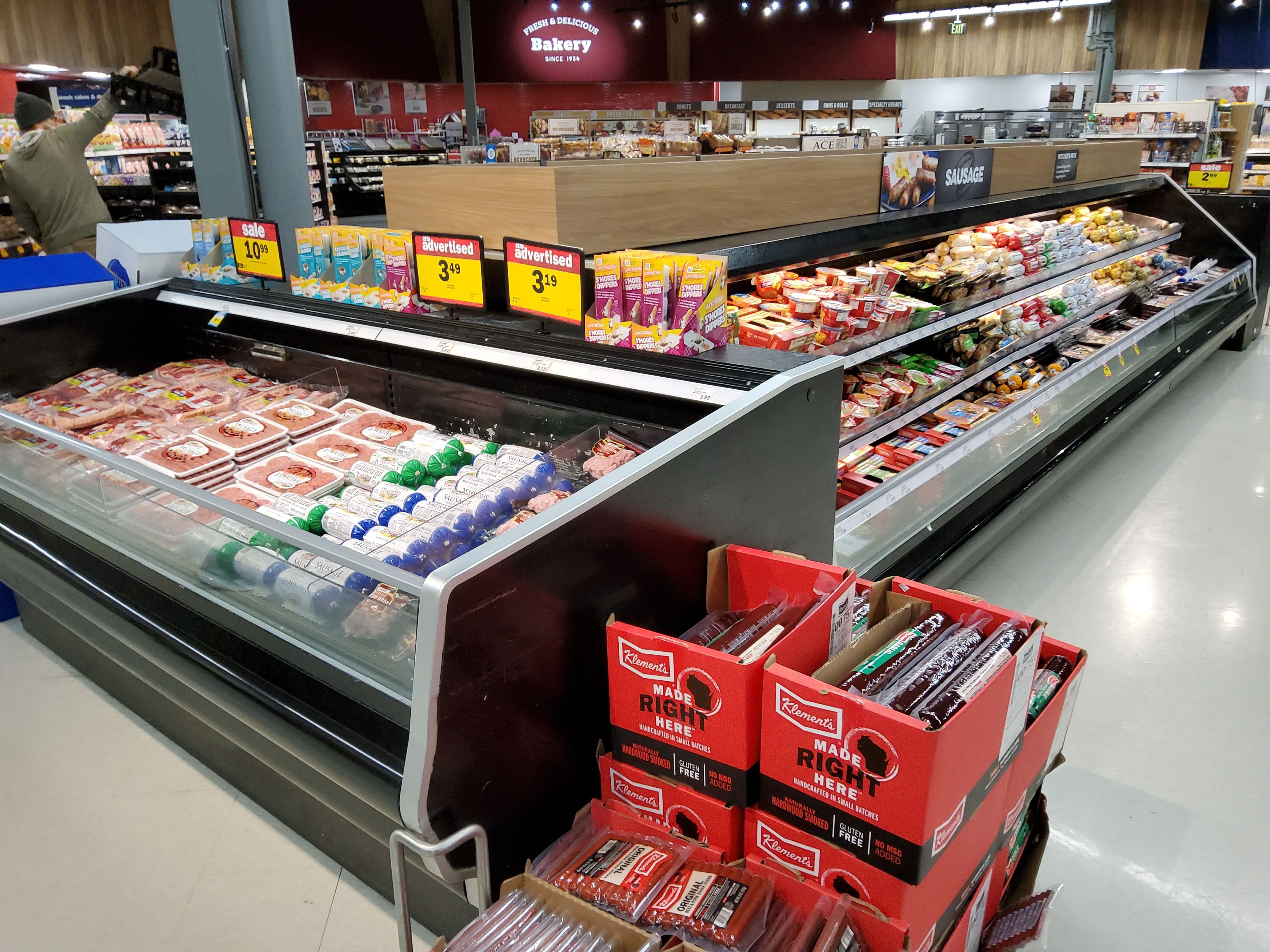
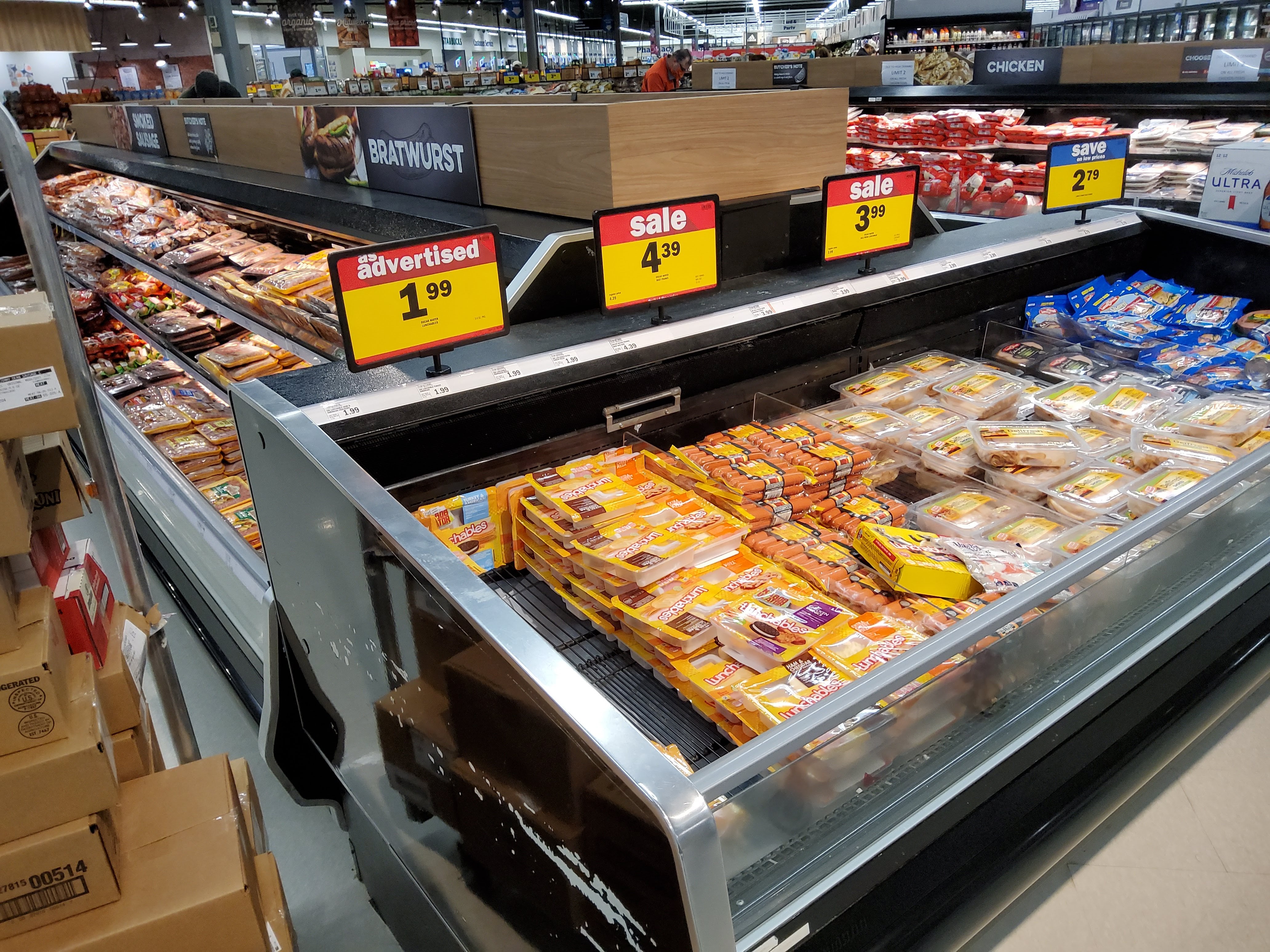
There\’s also a whole section for sausage  It\’s mostly the ground variety, but don\’t worry, bratwurst and smoked sausage have their own sections.  Also, in case you were wondering if there were going to be snacks in this section… fear not!  Here they are, on the near end of the main aisle.  They\’re prepackaged meat and cheese snacks, in case you didn\’t get enough of those in the cheese section.  

And here\’s the rest of the sausage.  And also more snacks.  As you can see, the impulse buy endcaps may or may not be entirely related to the aisle they\’re connected to, because that\’s Lunchables, hot dogs, and lunch meat.  None of which has much to do with sausage.  
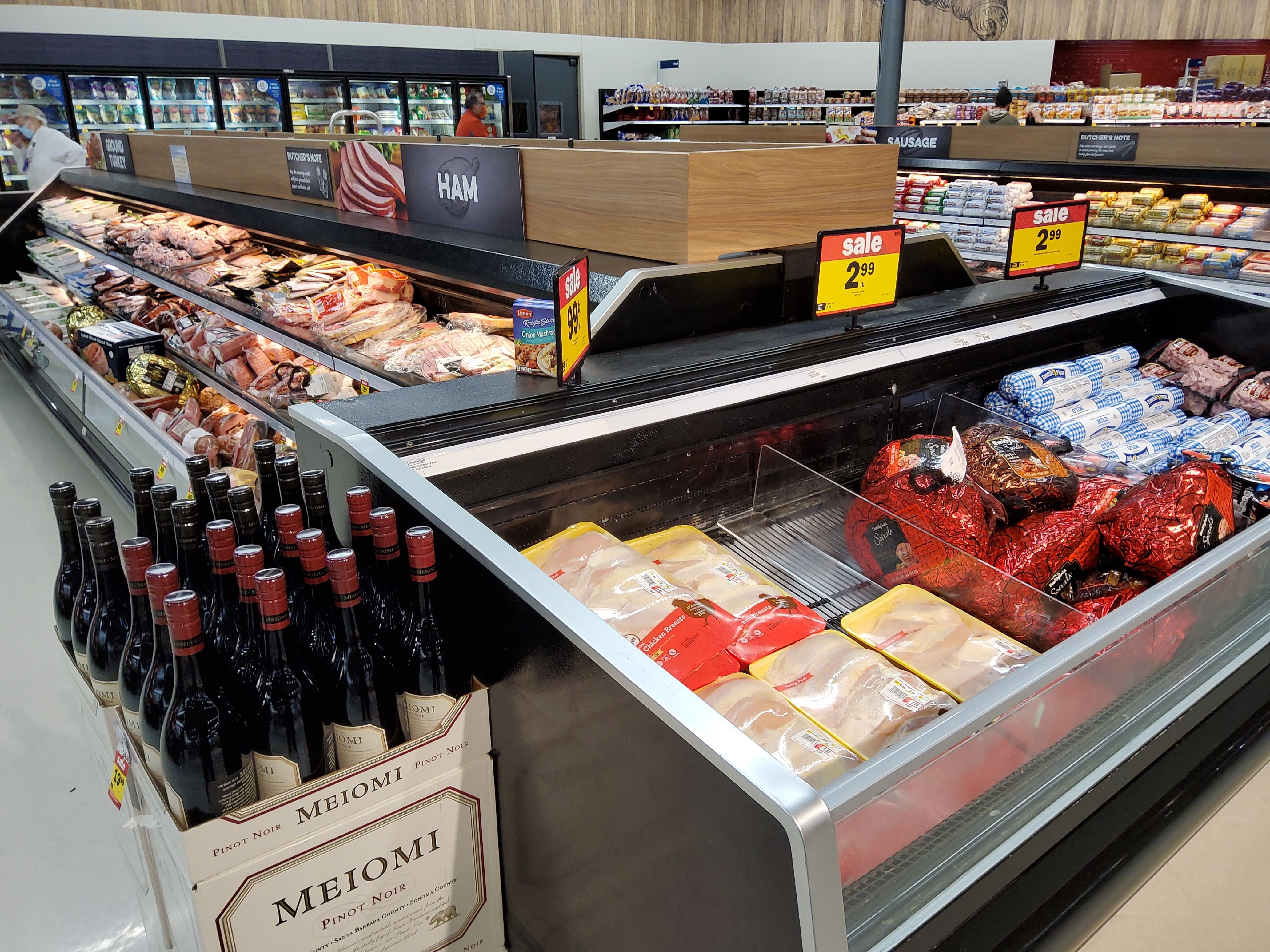
You know, prior to 2020 I think I would have said more of these aisles were devoted to beef products, rather than pork products.  I\’m honestly unsure if there\’s a supply issue with beef, or if this is just how it\’s been for the last dozen years and I just didn\’t notice.  At any rate, ham and ground turkey share an aisle here.  I\’m told ground turkey is a lot leaner than ground beef, but since I typically buy my beef locally, I haven\’t had much occasion to try it.  It is definitely more environmentally friendly than beef.  
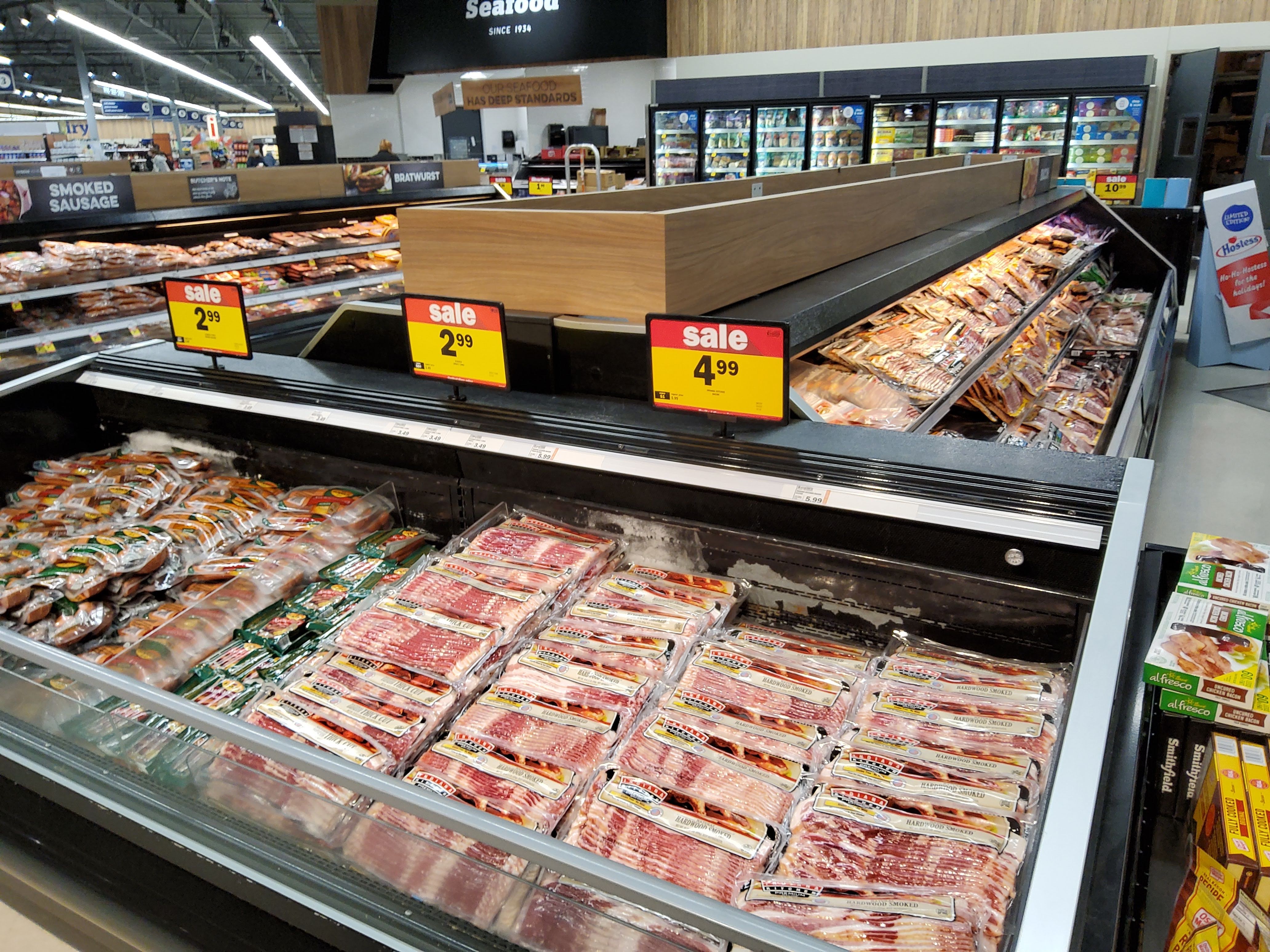
Did you wonder where the bacon was?  Worry no more, there\’s a whole aisle for it.  Sunday, Canadian, and streaky, it\’s all here.  Various brands and price points, and varying levels of fattiness.  

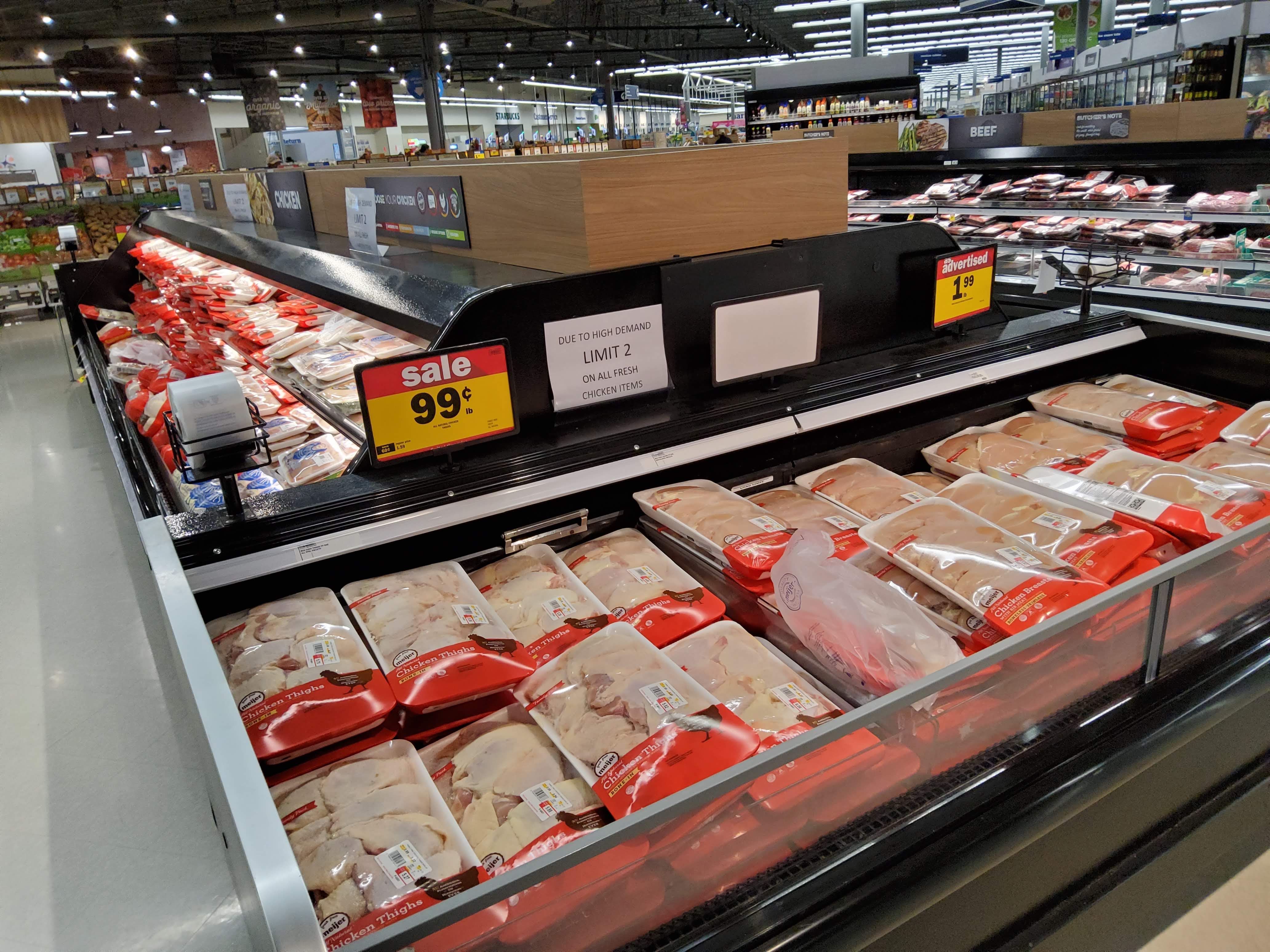
Despite most of the meat section being for pork products, there is still some room for chicken… so here it is.  We\’re mostly looking at chicken breasts here, but there are also thighs and ground chicken.  
Please note the sign here: \”Due to high demand Limit 2 on all fresh chicken products.\”  I\’ve never actually found out if this is enforced, or if it\’s merely a suggestion.  I\’ve also basically never seen a sign like this prior to 2020.  (Now that 2020 is over, I\’ve seen dozens like it and barely notice except when it affects my immediate shopping trip.)
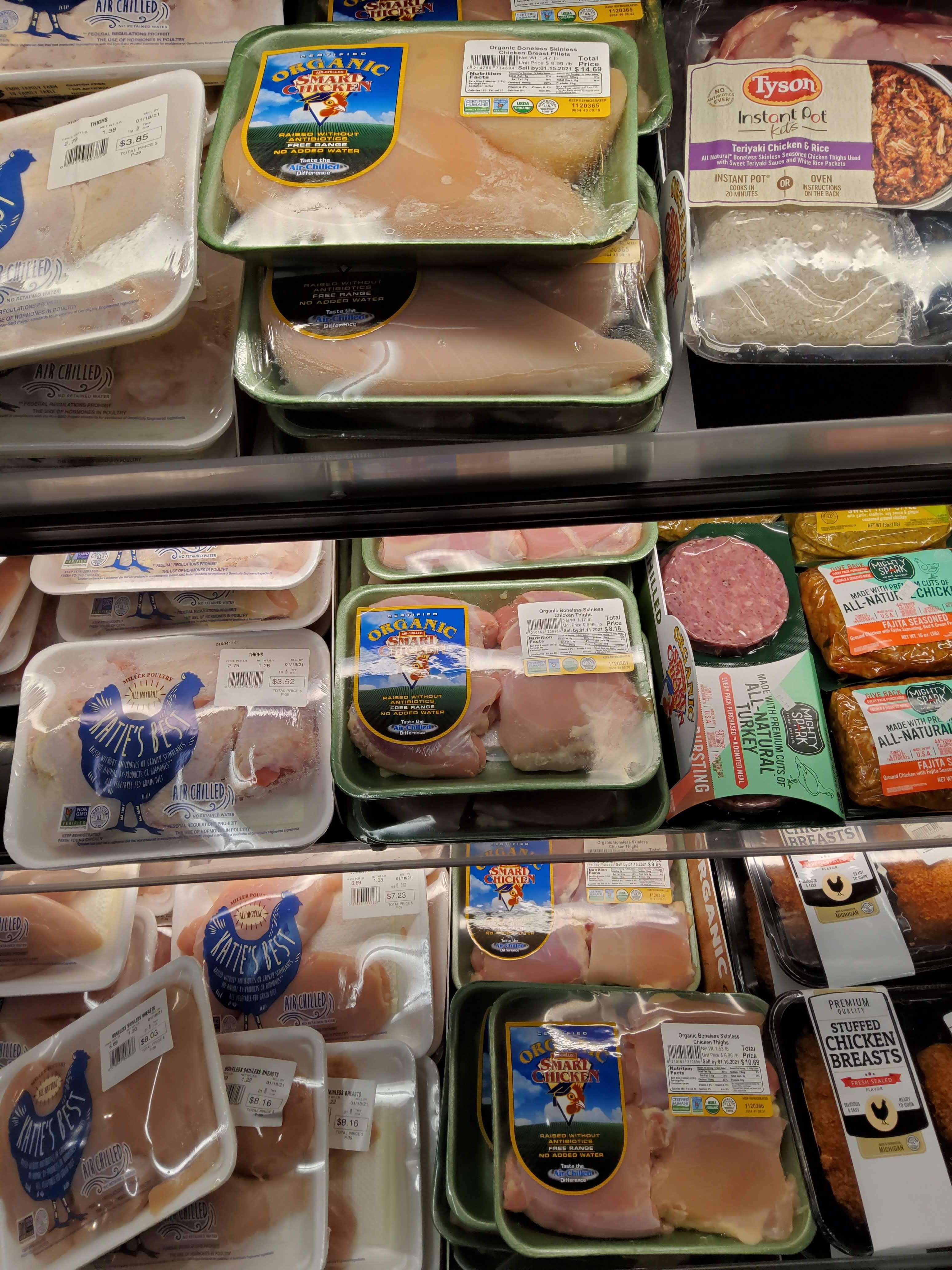
Mostly hidden in the near side of the aisle is the \”we\’re fancy and humane\” section.  Katie\’s Best is a GAP Step 2 option.  I prefer mine Step 4 and above, which is why I opt for the other available brand there: Smart Chicken.  
You have your option of boneless breast meat or boneless thigh meat.  It\’s a sign of how astonishingly sheltered I am that I honestly prefer just eating breast meat and will skip chicken entirely if it\’s not that.  It\’s a texture and flavor thing.  Also a \”good Lord that\’s some serious privilege\” thing.  

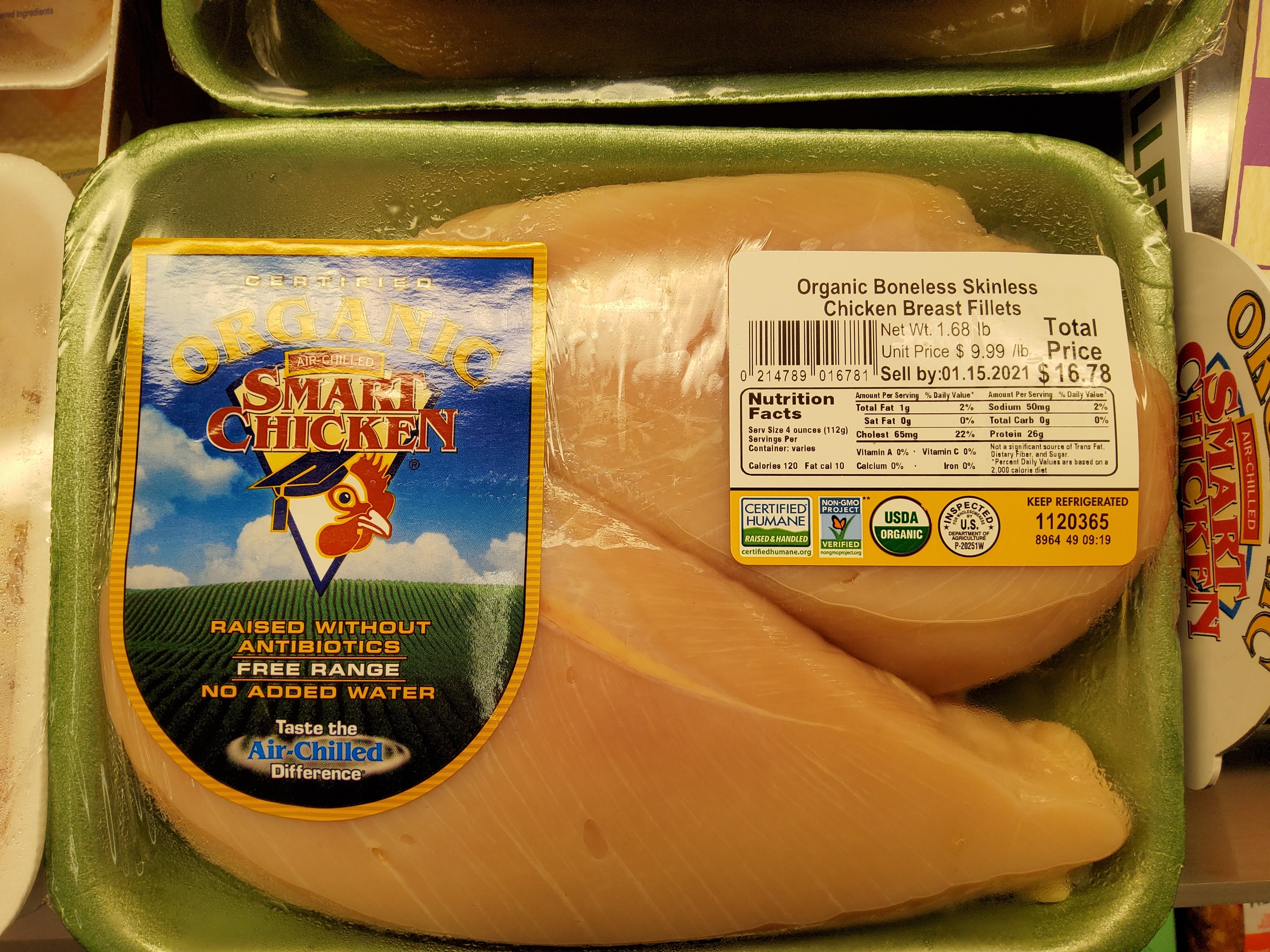
It\’s hard to see on the package, but on the right hand side label, at the bottom left, there\’s the Certified Humane label.  Weirdly, only the organic Smart Chicken has that label.  The regular (blue packaging) version doesn\’t.  

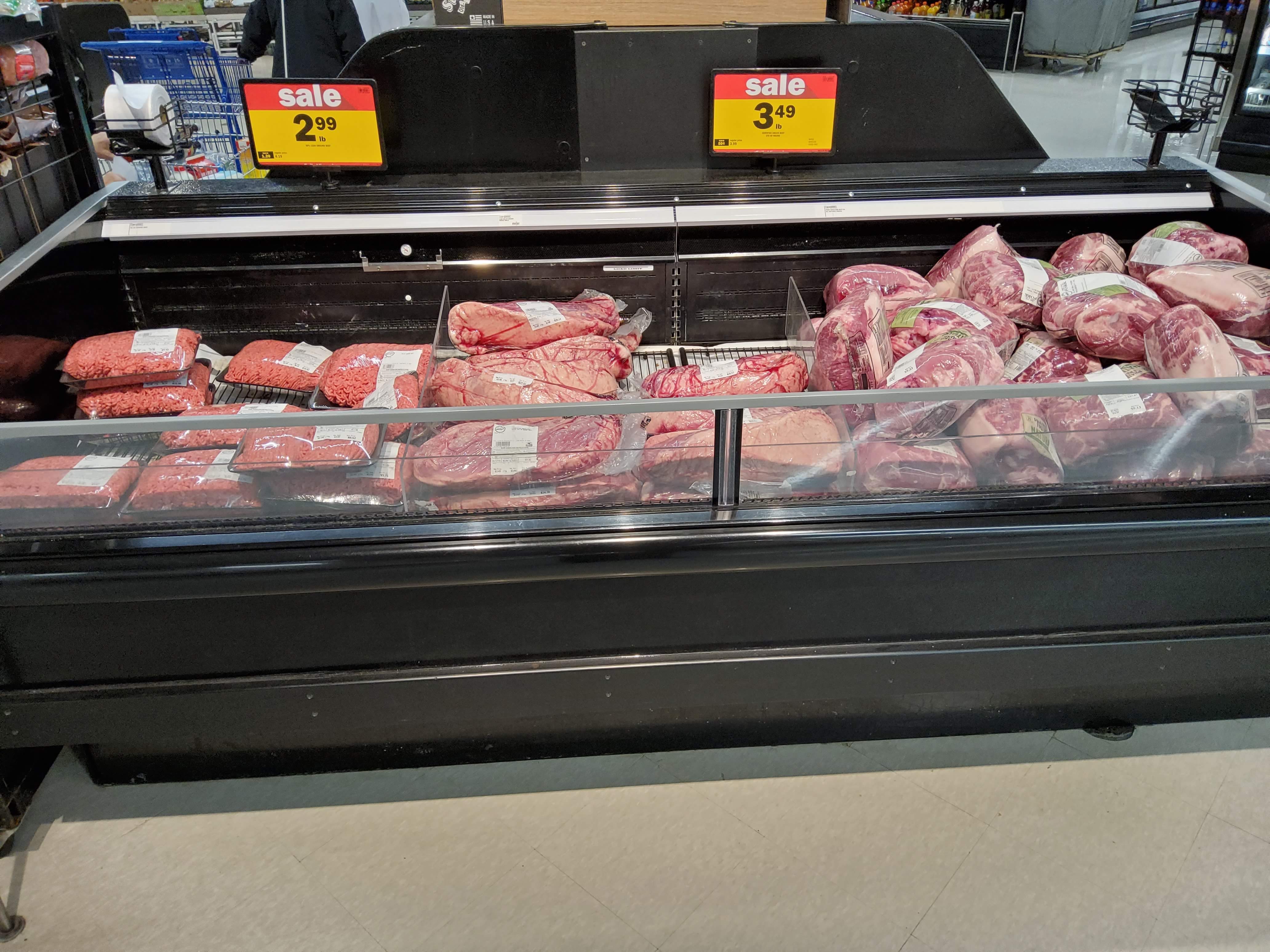
Two of the specials for this week.  This isn\’t the cheapest I\’ve ever seen ground beef (I\’ve seen it for 99 cents a pound a few times), but it\’s pretty inexpensive.  It\’s a pity the cows involved suffered horribly and likely never tasted grass in their lives, because that\’s the only way you can afford to offer meat that cheaply.  
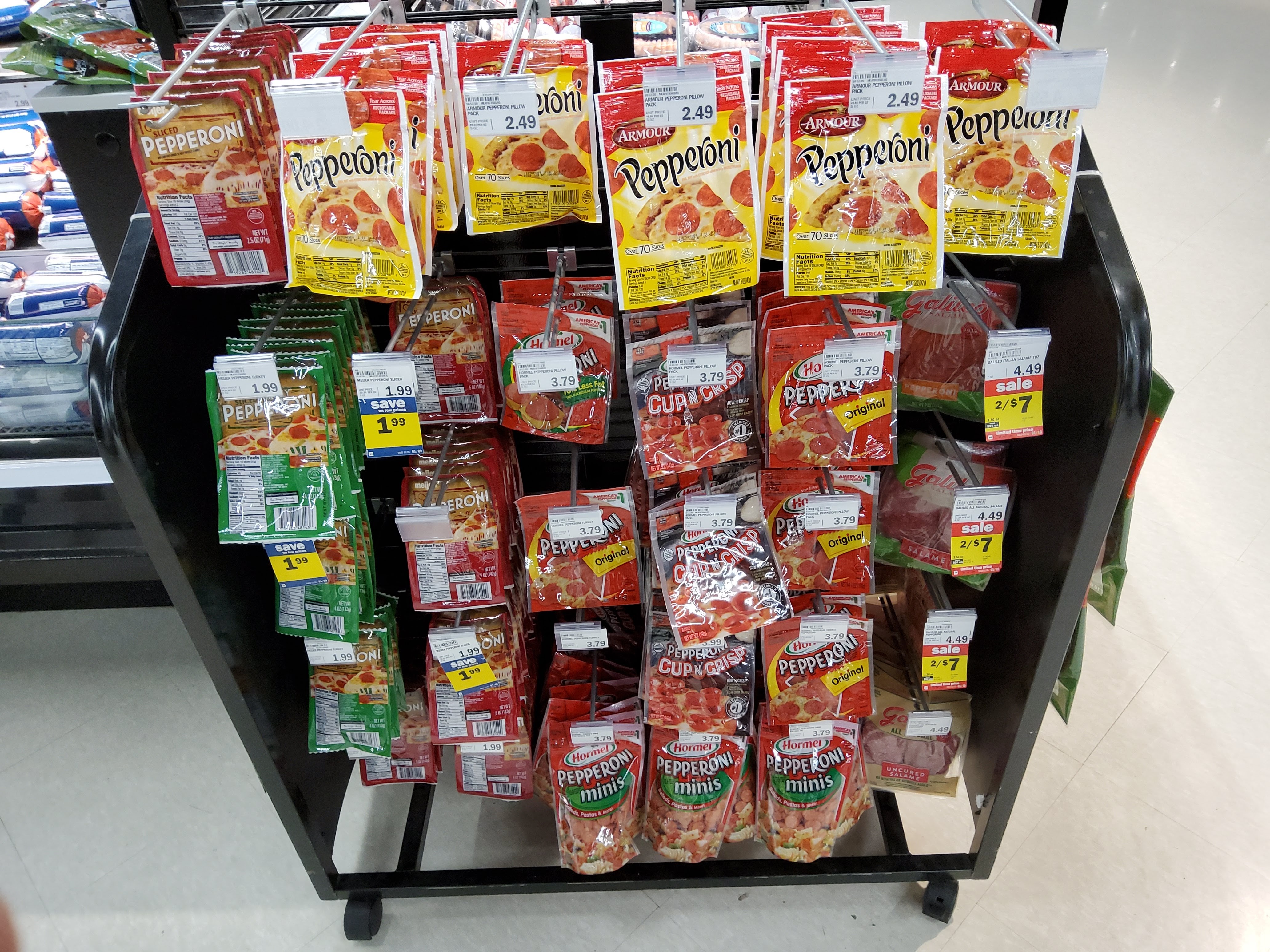
This just makes me wonder how many kinds of pepperoni a person really needs.  For those counting, that\’s four brands, in standard, low fat, tiny, and \”cup shaped\” varieties.  Why?  I really don\’t know.  

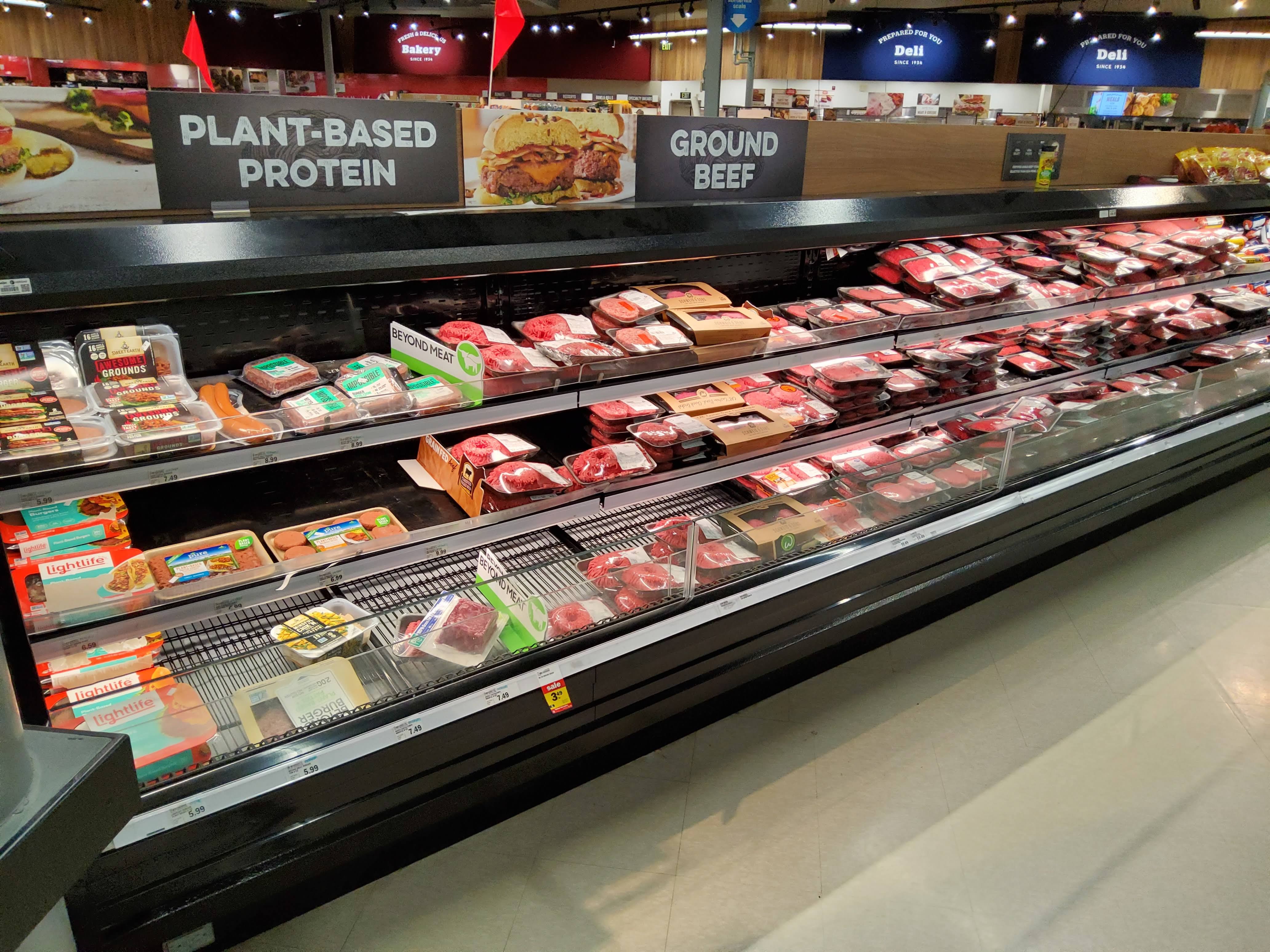
And last in the meat section, the only section I regularly visit.  Ground beef is fine and all, but this section also sometimes contains ground bison.  It also, as you can see, contains the growing share of plant-based protein products.  When Impossible ground \”meat\” showed up next to my ground bison, I was dubious (and bought some anyway, because why not?).  There seems to be a significant demand, though, because now it\’s not just Impossible products, it\’s Lightlife and Pure and Beyond Meat.  I have yet to try most of these, because I\’m pretty happy with ground bison and my locally raised beef.  But I really should, because some of these might be delicious. Variety is the spice of life, after all.
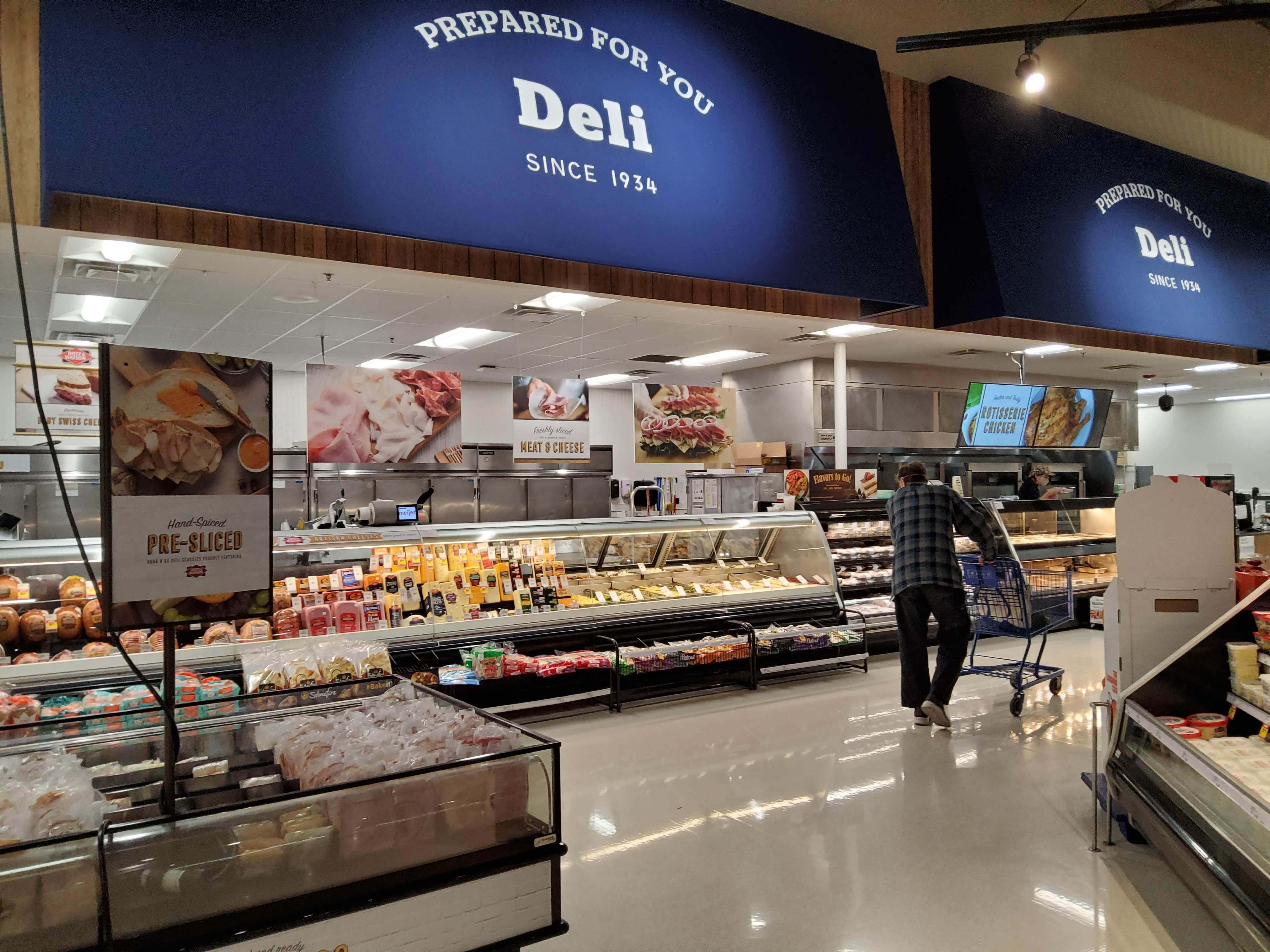
On to the deli section.  The store actually goes Meat Section, Bakery Section, Deli Section, in an L shape, but that would have made no thematic sense and also been a very lengthy post, so I decided to cluster meat and deli in one and get to the bakery later.
Once again, you can go up to the counter and have exact ounces and pounds of meat and cheese portioned out for you for the price of that meat/cheese and a smidgen of human contact.  
Because meat is still meat, and dairy is not my friend, I also don\’t use this counter.  This is a bonus, because I prefer to avoid talking to strangers as a rule.  Too many factors in communicating for (usually) very little reward.  

A shot of the offerings at the counter.  Note the naan and various sandwich breads below the case, ready to immediately pair with whatever you ordered.  
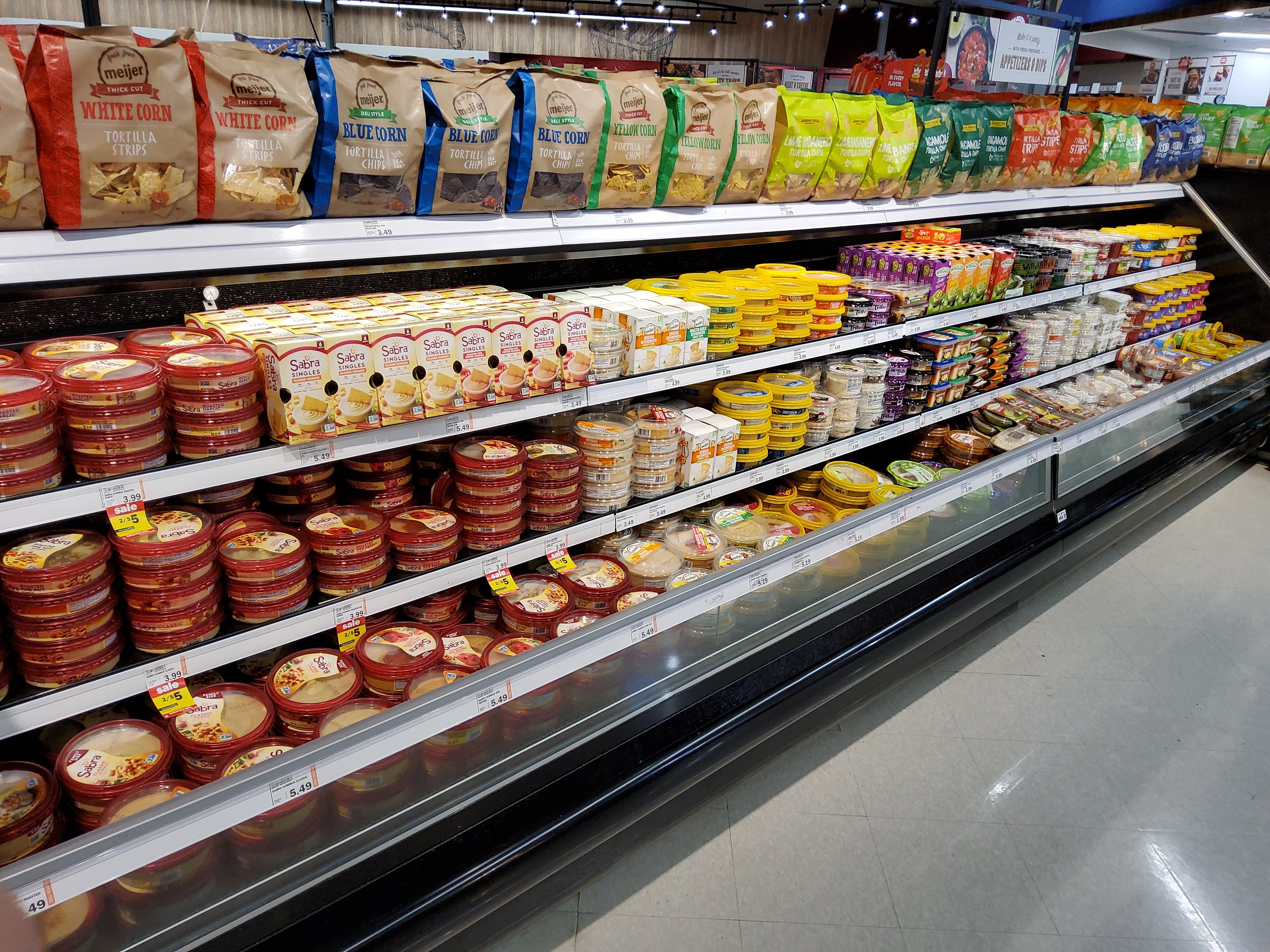
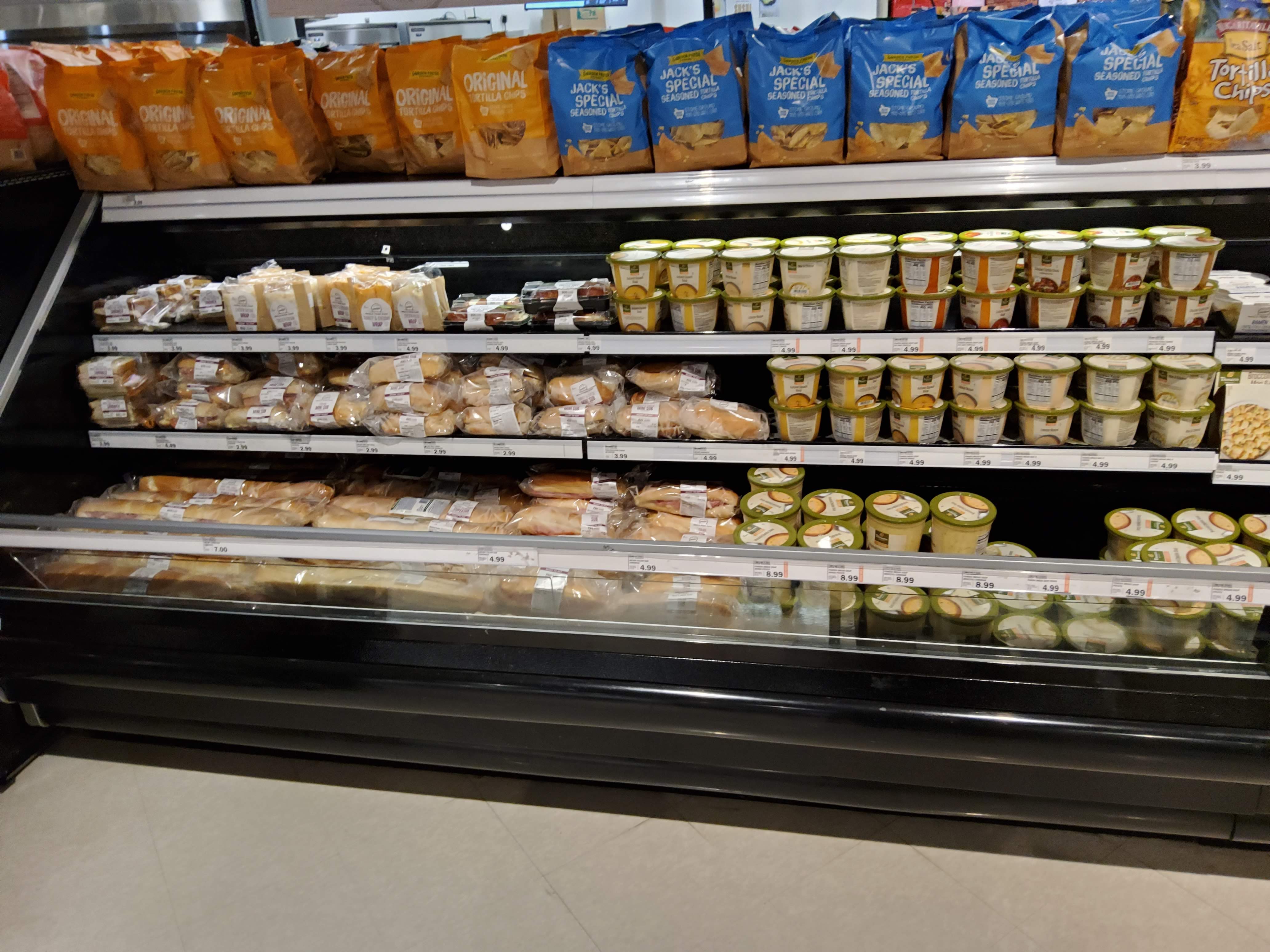
Just past the cheeses, there\’s a great pile of hummus and guacamole.  And of course, the chips to go with it.  
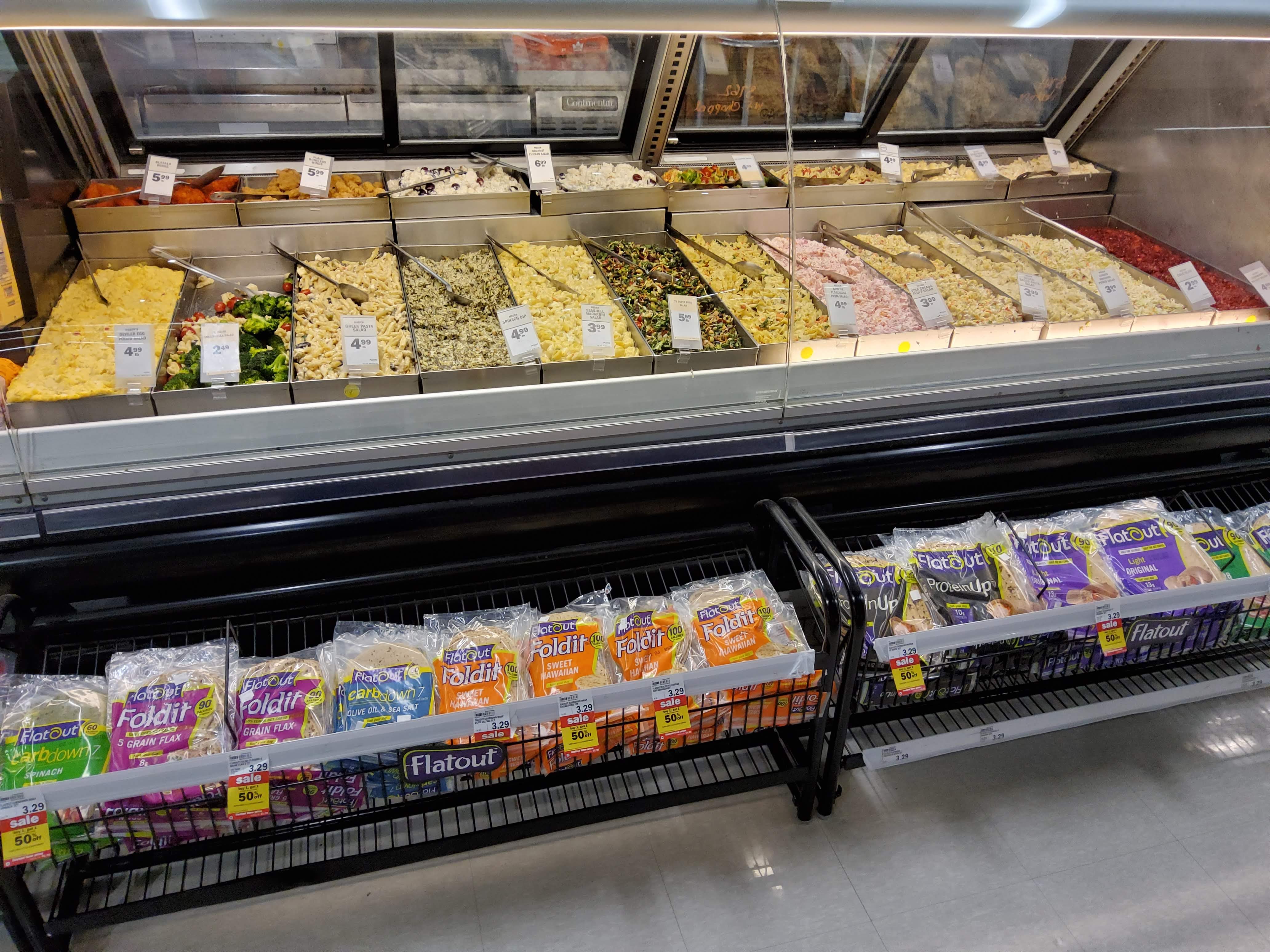
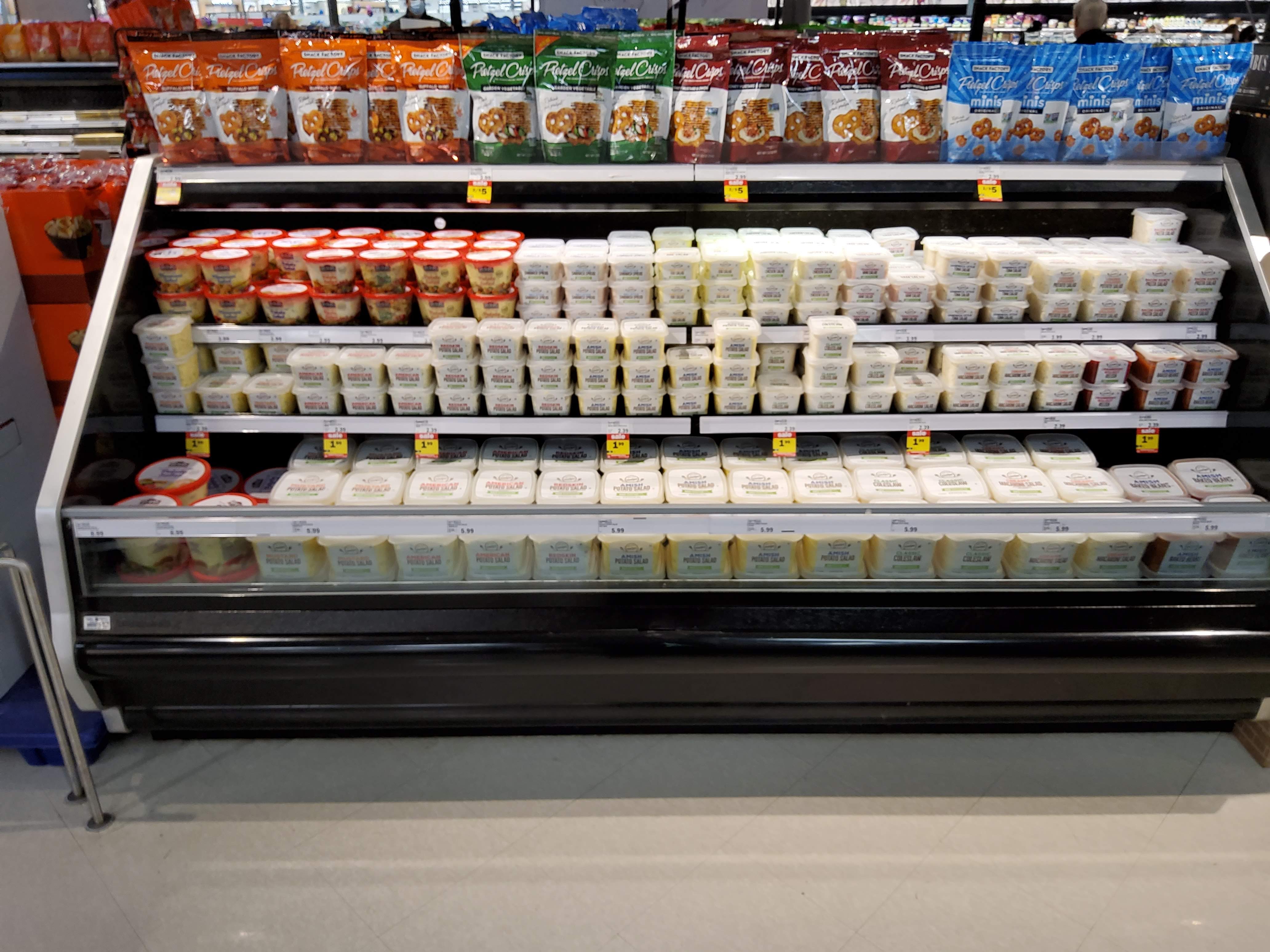
Meat and cheese sandwich not sufficient for your immediate snacking pleasure?  Or perhaps you wanted something on the side.  Either way, here\’s various pasta salads (a food I never learned to enjoy) as well as potato salad (same) and coleslaw (also same).  They come in sweet and savory varieties.  And naturally, more bread to eat it with.  
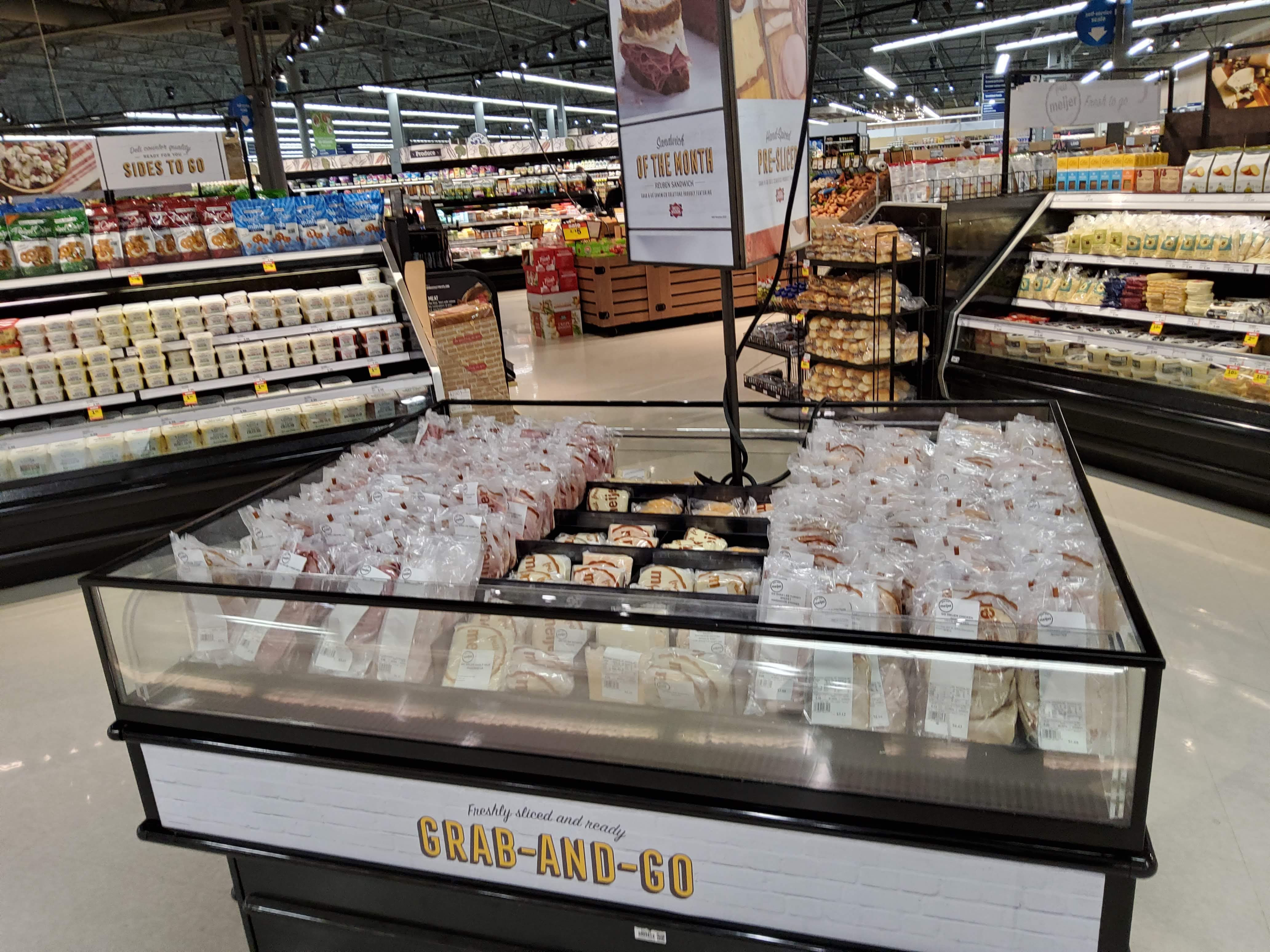
We\’re still dealing with the coronavirus pandemic, so this section 100% makes sense… but I can safely tell you this existed before the pandemic and will almost inevitably exist afterwards.  If you can\’t muster the energy for human contact but still want fresh sliced meats and cheeses, here\’s an option.  These are always meats and cheeses available at the counter, but pre-sliced and bagged.  
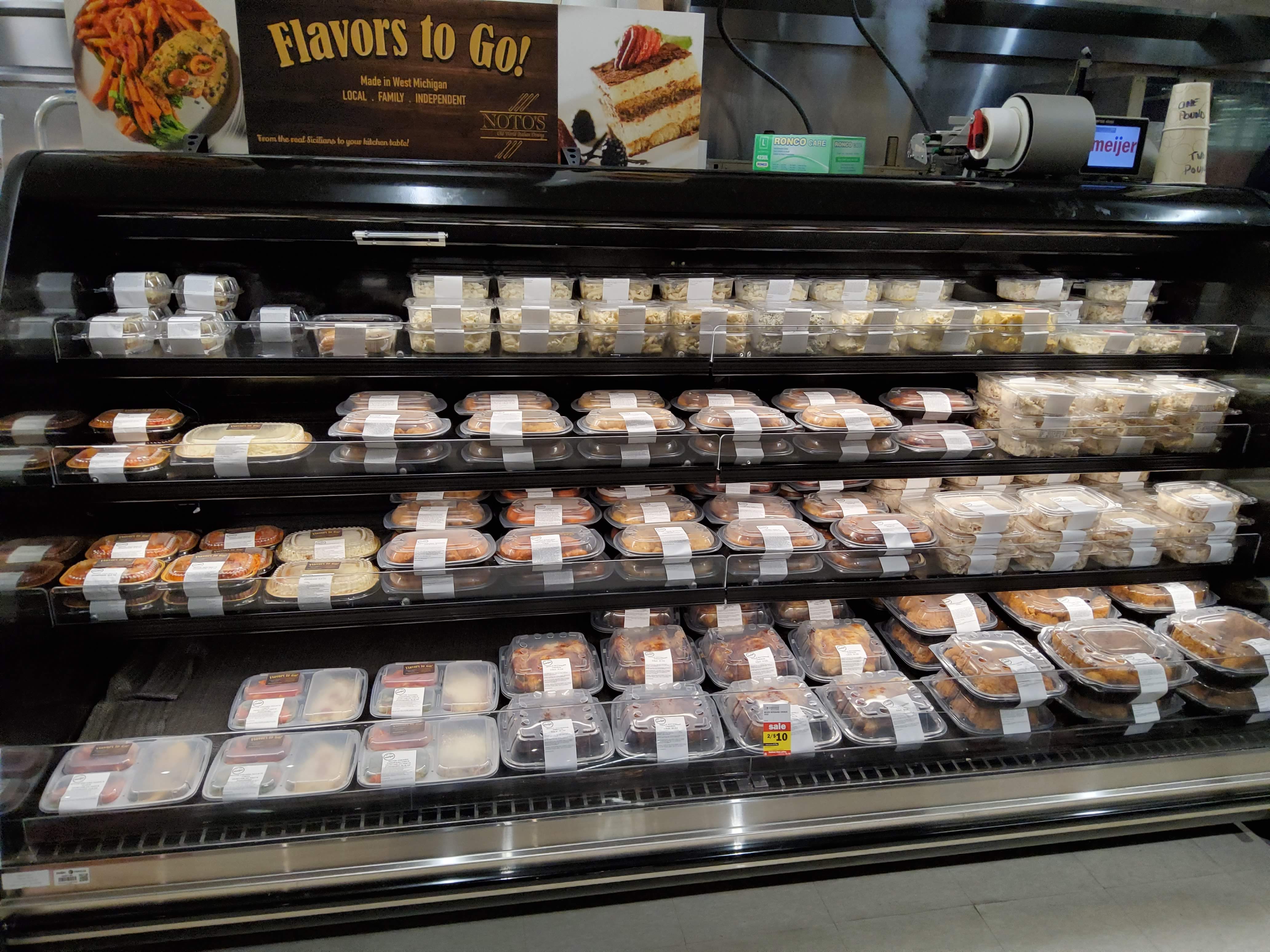
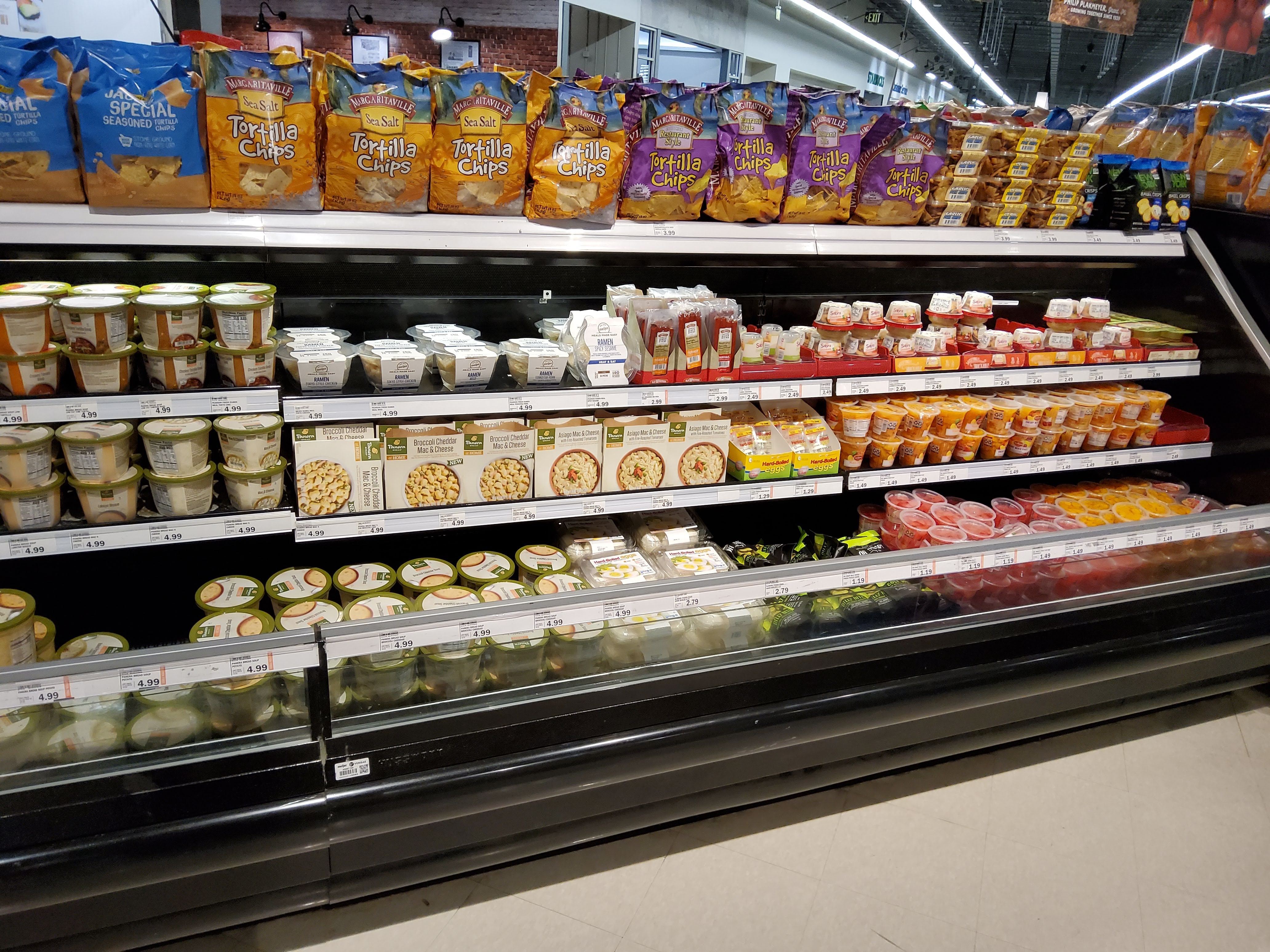
\”But where are the snacks?\” you might be asking.  We\’ve barely had any snacks, but that\’s because, well…  basically the rest of this post will be snacks and convenience food.  Here we have chicken pieces, preportioned pasta salad, miniature Thanksgiving dinner in eco-hostile plastic trays, and more.  
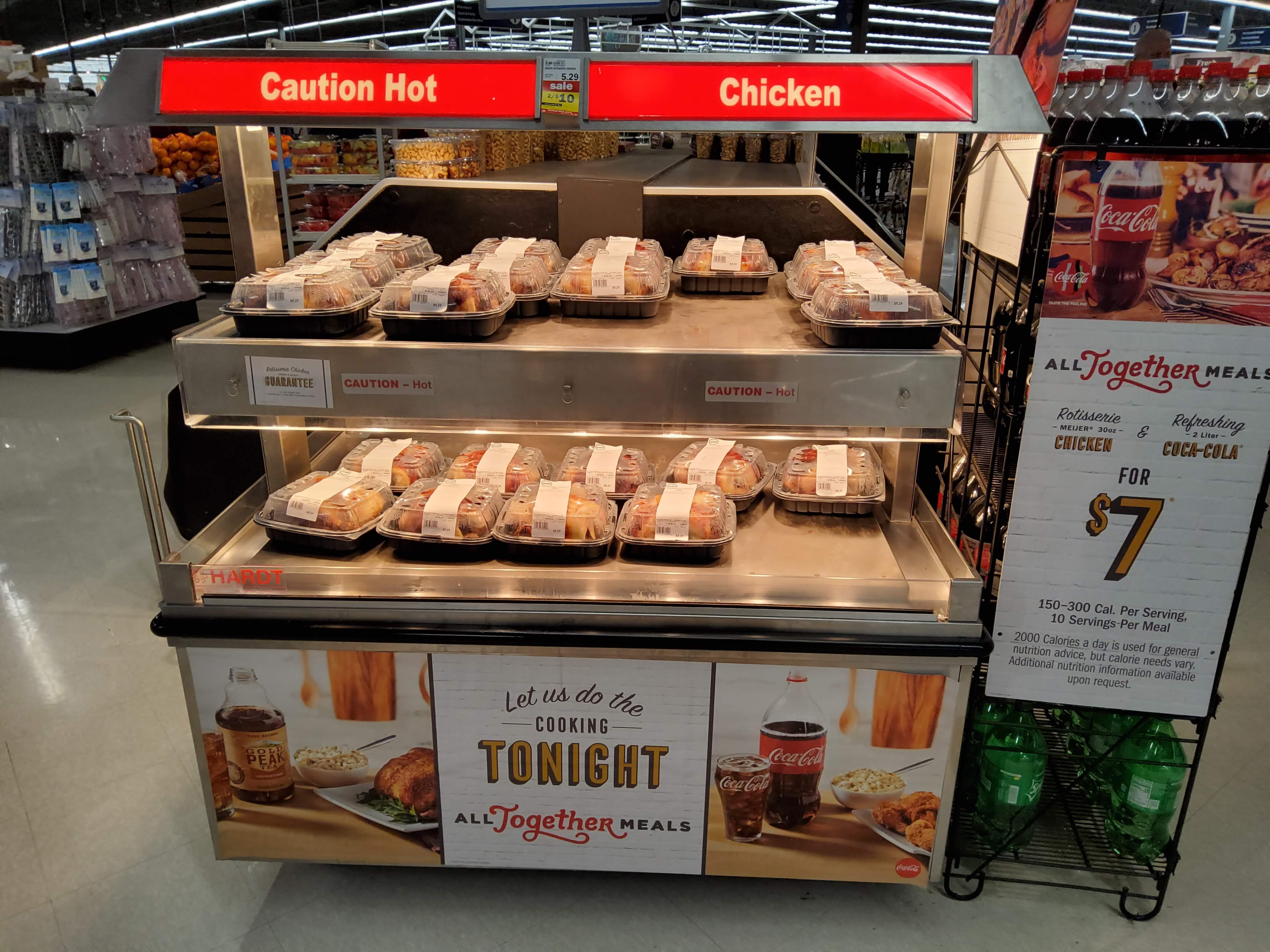
If you can\’t see, that display says, \”Let us do the cooking tonight\” and calls this concept \”All Together Meals.\”  You can get one of those small chickens, plus a 2 liter of Coke, for $7.  That\’s supposed to be dinner.  I suppose you could make it worse by adding a big pile of pasta salad on top of this… which would be very easy to do simply by turning around.  
So for anyone who\’s counting, this grocery store thinks \”dinner\” is a roast chicken and a 2 liter of Coke.  That only works if you split that chicken and pop 10 ways, according to the sign.  And of course it\’s still missing a giant pile of vegetables and a small portion of healthy grains to actually be a real meal.  
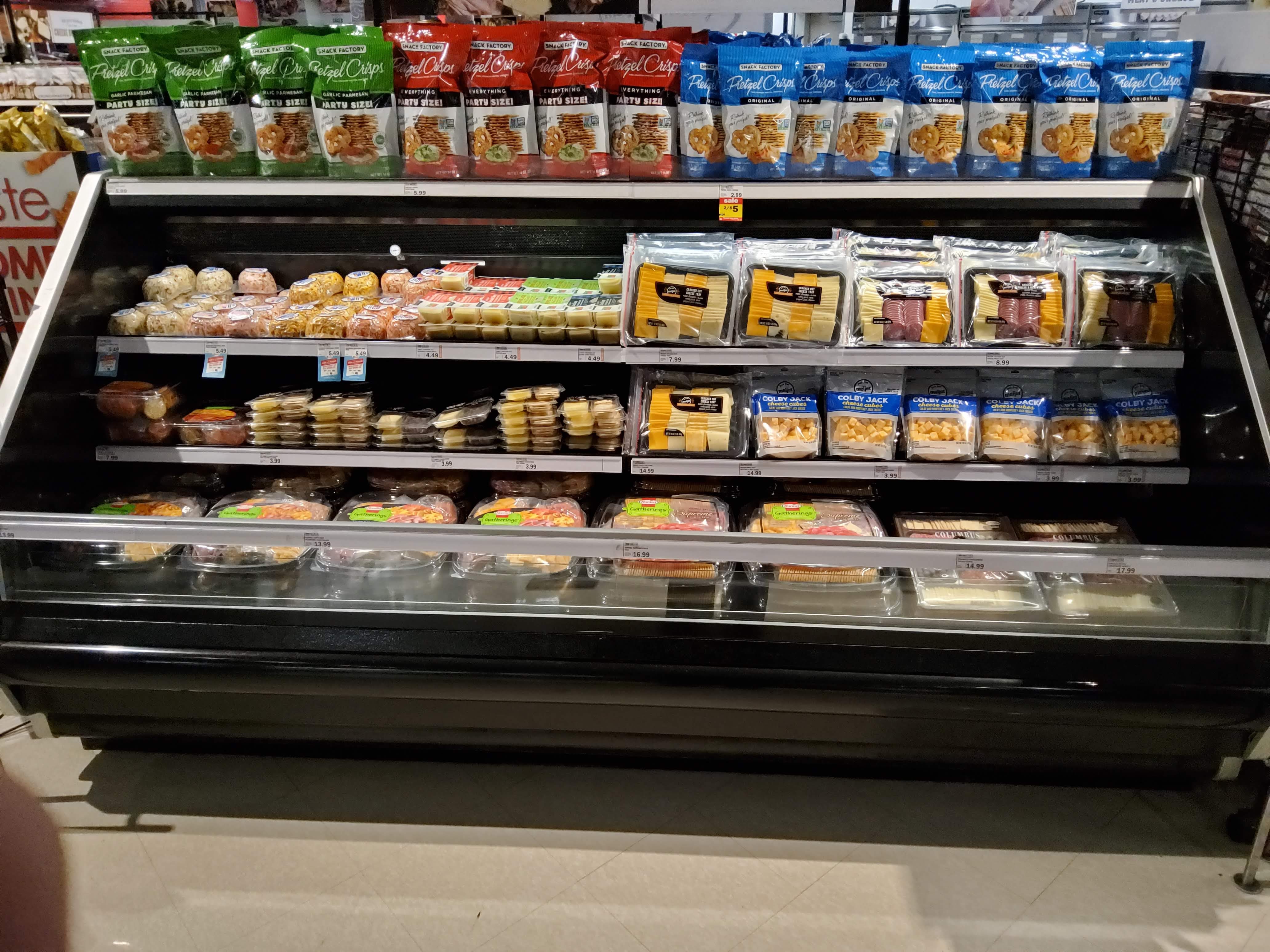
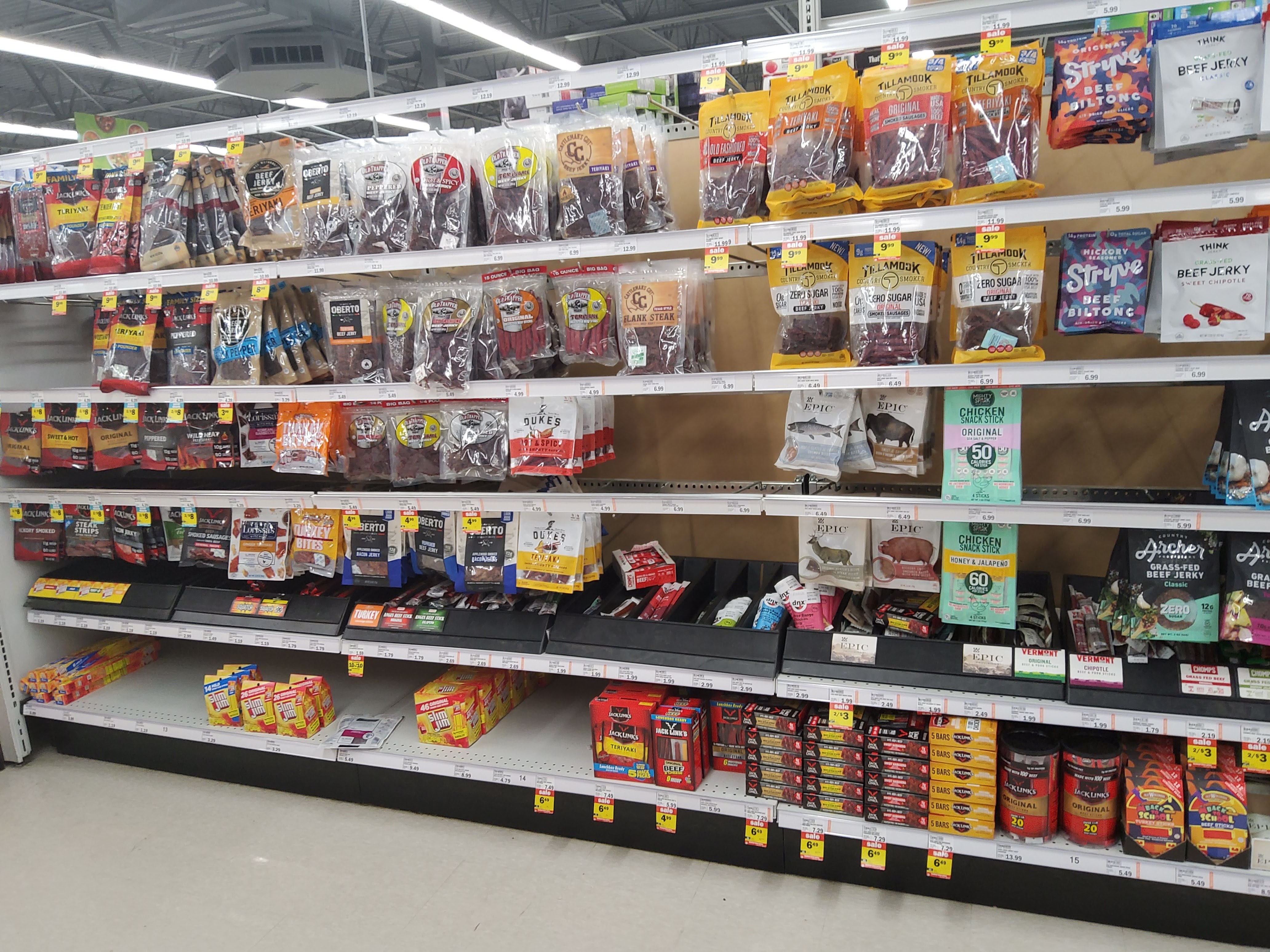
The rest of the deli section is a series of floating island-aisles, about half the length of the meat section ones.  They\’re stubby rectangles with shelves on all four sides. This particular one is the closest to the deli counter, as you can perhaps tell by looking at the packaged-meat contents.  Do note the snack packages of beef jerky and meat/cheese snacks right next to it.  Those are awfully small, though, don\’t you think?

The grocery store agrees!  Here\’s some bigger ones.  Meat and cheese trays, cubed snack cheeses, spreadable cheese balls… and just above it, pretzel crisps to round it out.  
Here\’s some more snack cheeses and meat/cheese snack combos.  Please remember this is the second round of cheese, because we had a regular cheese section in the dairy aisle already.  All of this is just bonus… or in case you couldn\’t be convinced to buy cheese the first time around.  
Additional cheese blocks/chunks.  These are the \”fancy\” compared to the regular cheese section.  This is also your spot to pick up feta cheese.  
More snack cheeses and party cheese options.  Of particular note, the miniature cheese wheels in nine different flavors.  Even with several of those being types of cheddar, it\’s an absurdity.  And again, more crackers to go with your cheese.  In case you don\’t feel like walking all the way to the cracker aisle.  
Even more cheese.  Presumably these are the imported cheeses, but I honestly didn\’t inspect it very carefully.  I can\’t safely consume any of this.  
This is the last \”it\’s just cheese!\” picture, I promise.  But you get the idea.  If you want cheese, you will be buried in cheese.  Choice paralysis has never been so convenient!  And crackers and crisps standing by once you make your choice.  
This was a particularly long aisle, so I split it into two pictures to show you all the options.  There are various premade cold sandwiches and subs (with a high markup) available for hungry shoppers, as well as prepackaged soups, ramen, mac\’n\’cheese, fruit cups, and, inexplicably, hard boiled eggs.  
For the low low price of at least four eggs (possibly as many as eight, depending on the chickens\’ treatment), you may acquire one plastic-encrusted hard boiled egg.  Hooray?

Fish filets, prepackaged crabcakes, etc.  I mostly don\’t do seafood but it\’s here if you want it.  

I don\’t even know what to say to this one.  I guess I\’m in the minority for not liking potato salad?  There\’s a few varieties, of course, but really.  It\’s all potato salad.  

If you thought this place didn\’t have enough convenience food, you were right.  Meet the take and bake pizzas, as well as more party trays and ready-made cheese fondu… ish… stuff.  Have I mentioned this is all right near the vegetable and fruit section and wandering too far in any direction will land you into all this?

Yep.  Before we kiss this section goodbye… if you can be tempted by convenience food but insist it be hot… well, for a nice markup, you may buy a pizza right here and save yourself the trouble of having to wait until you get home, or use the oven.  
So yeah.  That\’s the meat and deli sections of this grocery store.  We\’re almost done with my trip through the grocery store.
By the way, you can eat meat and seafood more sustainably without having to resort to store-hopping the way I do.  There\’s delivery services (pandemic-friendly!) that will ship you a box of clean, sustainably produced meat once a month (or more, if you want).  
Butcher Box is the everything option.  They\’ll do chicken, beef, pork, and seafood.  You can let them send you a mix of what\’s available, or customize your own box. This is a really simple way of ensuring you eat better, fresher, and kinder.  All it takes is some freezer space.  As a bonus, they actually mention Temple Grandin\’s more humane butchering and slaughtering practices as part of their process.  
For folks specifically interested in seafood, please consider VitalChoice, which has a monthly box option but also lets you do regular online orders from their thoroughly-traced and -certified offerings.  Mercury and other heavy metals are a serious problem in seafood, and they\’re particularly detrimental to autistic people, whose bodies may be unable to purge those toxic substances from our systems effectively.  VitalChoice is one of the very few autism-safe seafood options.  

Grocery Shopping on a Special Diet: Bakery, Frozen Dessert, and Frozen Pizza

Welcome back to my autism-aware shopping trip through the grocery store.  Week by week, I\’m showing you what the store sells, prune down the selection to what\’s safe for me (because autistic people can have very sensitive systems) and point out various gotchas the store tries to make you buy stuff you didn\’t come for. 

As a reminder, I shop with the following conditions in mind:

  • dairy-free
  • low sugar
  • avoid ultraprocessed junk
  • avoid food coloring
  • conditional vegetarianism
  • avoid high histamine foods
  • awareness of gluten-free options and sugar-free options
Last time we explored the frozen \”food\” section, where ultra-processed flour, ultra-processed meat (that likely isn\’t what it says it is), and of course, dairy.  We found that, despite most of the aisle being unredeemable junk food, there was the occasional meal that wasn\’t hideous for you.  However, you really had to watch it, because trans fats, massive loads of preservatives, and sneaky sugar bombs are hiding among the options.  Even the healthy-looking ones.  
This week, though… 
It\’s the very last aisle!  I had no idea this series was going to take me months to finish when I started it.  We still have to hit the meat and deli departments, and then the vegetables and fruit, but we\’re almost done.  
Anyway, remember all that frozen convenience food we looked at last time?  Here\’s more.  It\’s all pizza.  

Seriously, basically this entire side of the aisle is pizza.  \”How many kinds of pizza could there possibly be?\” you might be asking.  

Actually, the answer is \”a lot fewer than you\’d hope.\”  Mostly what we have here is a metric ton of different brands, not pizza varieties.  There\’s variations in crust type… thin crust, regular crust, thick crust, and even stuffed crust.  But the toppings are pretty much cheese, often with various kinds of meat (typically pepperoni or sausage, maybe ham once in a while).  Maybe you\’ll get the occasional veggie pizza, or meat plus veggie.  
Why am I complaining about variety, you might wonder, when there\’s all this?  Well, here\’s the thing.  US frozen pizza (and much of the typical pizza joint offerings, too) is pretty much crust, tomato sauce, mozzarella cheese (maybe a couple others if you\’re lucky), and one or more of like… seven basic toppings.  Excessively light on the vegetables in almost all cases.  
If you look around the rest of the world, you\’ll find significantly more variety.  Curry powder or other sauces, dozens of cheese types, seafood, even sweet pizzas or fruit pizzas.  So given all those options, maybe it\’s a bit more understandable if I\’m not excited about 14 different versions of pepperoni pizza. 

The branding varies markedly.  It mostly doesn\’t matter to me, sadly, because cheese is dairy and the crust is ultra-processed grains.  The meat, of course, is unlikely to be sourced humanely.  

An example of multiple crust types. Rising crust is likely to be a medium to deep dish crust, whereas thin crust will be what it says on the tin.  

Did you wonder where the snacks were?  Don\’t worry, I found \’em.  Please note the wide variety that still isn\’t very diverse.  Also some of these are strombolis.  Those are basically rolled up pizzas, toppings inside.  Or at least these are.  
Before we say goodbye to the pizza section and move on entirely to the appetizers, let\’s have a look at the best attempts to make pizza healthy.  There\’s organic versions, dairy-free ones, ones with veggie-based crusts, and gluten-free ones.  
The second section, similar to the first.  It gets a bit more adventurous by including chicken and cauliflower crusts.  I\’ve had cauliflower crust when my uncle came to visit once.  It\’s pretty decent, but I wouldn\’t be able to mistake it for typical pizza crust.  
Which is an issue with most substitutes, really.  We always want something that tastes exactly like what we love, but without being unhealthy/allergenic/whatever else.  I had the same struggle with veggieburgers for the longest time.  Eventually I just got to the point where I appreciated certain veggieburgers (before the era of Beyond Meat/Impossible Burger) for what they tasted like, not how well they replicated what they were replacing.  

Starting the move away from pizzas, we now have pizza in appetizer format.  They\’re cheap, they\’re ultraprocessed, and you can eat a heaping handful of them and still be hungry.  But don\’t worry, it\’ll still cost you hundreds of empty calories!

If you liked pizza in appetizer format, you may also have lasagna in appetizer format, pizza appetizer on tiny bagels, soft pretzels in various forms, and breaded cheese.  I think the healthiest thing in this case is the spinach and artichoke dip, and that\’s still laden with cheese, so…  Probably not even close.

Moving on from convenience appetizers, we apparently didn\’t get enough convenience food last aisle.  So here\’s more.  Grab and go burritos seem to be a big thing, given this section.  They\’re not that hard to make at home, though, though, so this just makes me wonder how these are profitable.  
Also, note the dairy-free Daiya options at the top right, as well as a gluten-free option.  There\’s not much, but there\’s something.  

Speaking of Daiya, we\’re moving onto the other side of the aisle, which has ice cream, and they have stuff here as well.  I\’m honestly not sure why the ice cream aisle starts out with the allergy- and diet-friendly snack-sized options first, but it does.  
I am sorry to say I basically haven\’t tried any of these.  I do enjoy So Delicious\’s typical ice cream (or frozen dessert, whatever) varieties, so it\’s likely their ice cream bar style options here are good.  
As with any seemingly healthy sweet treats, keep an eye out for what they\’re sweetened with.  The good ones are sugar alcohols, like erithrytol, stevia, and monk fruit.  You typically won\’t find those, but it\’s worth checking.  

And on to the more typical frozen treats.  Please don\’t make the mistake of thinking those \”fruit bars\” are healthy.  Their sugar content tends to be nearly your full day\’s serving in one measly bar.  

Another thing to watch out for with brightly-colored treats is what they\’re colored with.  Food dye is often very bad news for autistic people and others with sensitive systems.  (It\’s bad news for everyone else too, but we\’re the ones that show the strongest reactions.)
These are mostly unrepentantly awful for you, so I don\’t have a ton to say about them other than \”seriously, watch your sugar intake.\”  And I guess \”gee, I wish all this dairy didn\’t screw me over.\”  

If a box of frozen treats was too much for you, meet the single serve options, as well as the beginning of the \”pint size\” section.  You\’ll also note the dairy-free So Delicious, Ben & Jerry\’s, and, to my astonishment, the local brand Hudsonville.  
Some investigation was clearly called for!  
This is the nutritional information and ingredients for a pint of caramel cookie dough from Hudsonville.  It\’s coconut based.  As you can see, it is pretty much still ice cream.  This is not a healthy option, it\’s simply a dairy-free option.  It\’s sweetened with brown sugar and and cane sugar, which is a pretty basic option.  At least it\’s not artificial sweeteners.  

And here we have Ben & Jerrys\’ take on dairy-free Chocolate Fudge Brownie, with their trademark mix-ins.  This is an almond-based product, and like the one above, it is definitely not a healthy snack.  I appreciate Ben & Jerry\’s in particular because A) their typical stuff tastes very good and B) they\’re pretty darned serious about using Fair Trade, which safeguards the farmers they buy from.  

Finally, there\’s this, which I actually stared at for quite a while before buying.  Keto ice cream seems, uh…  I dunno, incredibly contradictory?  Anyway, here\’s the nutritional info and the ingredients.  This flavor is not nondairy, though they did have a butter pecan variant that was.  More notably, check the sugar.  Zero grams.  How?  Well, it\’s sweetened with erythritol (a sugar alcohol) and monk fruit extract (a plant-based, non-sugar sweetener).   
Calories-wise, this still isn\’t… really… healthy…  but it won\’t rot your teeth or wreck your blood sugar.  
The beginning of the \”half gallon\” section.  That\’s in quotes because they stopped being half-gallons a few years back.  One of those \”we need to save money so let\’s just hope they don\’t notice\” measures.  This section is more or less organized by brand.  Purple Cow is this store\’s own brand.  

There\’s an acceptable amount of variety on display in these sections.  You\’re still likely to be able to walk down the whole aisle and not find what you\’re looking for, if it\’s something obscure.  But your chances are better than the pizza aisle, at least.  

I don\’t think I\’ve actually tried this local brand, but one hopes the price includes a significant amount of quality.  

If you walked all the way down this aisle for sherbet (naturally dairy-free), here it is.  Right along with the gallon tubs of cheap ice cream.  I\’ve never stopped to think about how many calories must be packed into those tubs, and now that I have, I am both horrified and also hope it never occurs to me to think about it again.  

The aisle ends with even more snack-sized things, because we can never, ever forget where we\’re shopping.  Frozen pies, frozen cheesecakes and ice cream cakes (including dairy-free ones) round off this trip.  
I might be slandering one or two items in this aisle, but I honestly don\’t believe there was a single nutritionally solid item this time.  No nourishing food exists here.  This is an aisle to skip whenever possible.
And that\’s the last aisle.  Really.  There\’s more store to go, but we\’ve finally hit the end of the numbered aisles.  We\’ve still got the meat, deli, bakery, fruit, and vegetable sections to go, but those aren\’t numbered.  They\’re much more freeform.  
As an immediate example, here\’s the best shot I can get of the Bakery.  It\’s mashed between the meat department and the deli department, in a mostly open space peppered with islands.  On the left is the only aisle.  

We\’ll start with that singular aisle, since it\’s the closest to what we\’ve looked at in the past.  It\’s the bread aisle, where you can find a variety of bread loaves.  Notice anything off?  
If you said any variation of \”hey, what are those snack packs of roasted nuts doing at roughly eye-level in the bread aisle?\” please pat yourself on the back, because you win.  Apparently unsatisfied with tempting you in literally every other aisle, and also apparently unable to snackify loaves of bread, the store has opted to simply shove a row of unrelated snacks directly in your path.  

Yes, that row of snacks goes all the way down to the end of the aisle.  It\’s doubly frustrating once you see the rest of this section.  
Anyway, aggravation aside, there\’s about eleventy billion types of bread.  They\’re more or less by brand.  Like the pizza aisle, there\’s a lot of options without there actually being a lot of variety.  Also like the pizza aisle, very little of what\’s in this aisle is good for you.  In large part, most of what\’s here is ultra-processed.  
Honestly, that variety right near the front of the picture is maybe a good example.  \”15 Grain\” whole grain bread.  You don\’t need 15 grains to be healthy, they\’re literally just throwing in trace amounts of whatever might stick in hopes of grabbing attention and pretending to be healthy.  

The other side of this aisle mostly doesn\’t even pretend to be healthy.  It\’s hot dog buns, burger buns, and at the end, bagels and English muffins.  I\’m not sure why the latter two were so sold out at the time of the picture.  

At the end of the bread aisle, we start getting on towards the bakery counter.  But first we have to pass this refrigerated section with the ice cream cakes, cheesecakes, tubbed cookie dough, and other snack options.  Because, as we can never ever forget, this store is roughly half snacks.  

Speaking of snacks, this is the other side of the hot dog/hamburger buns aisle.  And it is all snacks.  I\’ve seen these referred to as \”sweet breads\” which struck me as absurd, and I much prefer the \”snack cakes and donuts\” sign they\’ve got up here.  Yes, this is literally a whole aisle of sugar-coated heart-killing madness.  A lot of these frosted sugary garbage items have trans-fats in them, by the way.  At least nothing in this aisle is even remotely pretending to be healthy.

We now come to one of the first floating islands of treats.  There are many in the bakery section, and they\’re sometimes themed, like this one.  Weirdly, only about half the things on this island are pies.  A few of them are pie-adjacent, like the lemon bars.  I don\’t know what the rest is about.  All of this is bad for you in sugar content and ultra-processed grain content.  

Lest you be worried, no, this is not all the cookies they have for sale.  Please do note the single serve larger cookies available for a dollar.  This store will absolutely bend over backwards to make sure you have access to every snack you could ever want.  As long as it\’s a snack.  

See?  This whole section is geared specifically around the idea of \”treat yourself, a little won\’t hurt.\”  But it absolutely will!  Especially since it\’s statistically unlikely someone will eat just one of those boxed treats.  Because if you\’ve had one, and it\’s good, why not treat yourself to a second?  And a third, and a fourth, and a fifth if you aren\’t paying attention.  Soon the whole box is gone and you feel awful about yourself, not to mention your gut being angry because you\’ve eaten a boatload of sugar.  But shhh, treat yourself!  Consequences are irrelevant!

This picture didn\’t turn out great, but this one of the offerings from the picture above.  It\’s a celebratory box of blondie brownie with sprinkles and frosting.  One of these suckers will cost you 180 calories and your full day\’s worth of sugar.  Remember how people tend to just keep eating?  Yeah, these will absolutely make you ill.  Also, look at the length of that ingredient list!  At the very end there\’s like six artificial colors (probably because of the sprinkles).  This is a very yikes thing to put into your body.  
So about \”yikes,\” here\’s \”breakfast.\”  We\’re mainly looking at muffins here.  Unfortunately, because this is the United States, these muffins have far more in common with cupcakes in terms of sugar and fat content.  Also icing.  And studded with chocolate chips, if not entirely chocolate chip.  These are not breakfast, they\’re dessert.  Start your day out right wrong, with a heaping helping of sugar!
We already did mini-indulgences in a separate section…  So here\’s more, with the exact same sign, because this store desperately wants to drown you in sugar and snacks.  These are mini cakes.  They have even more at the counter proper, but we\’re not quite there yet.  
No sub-heading for these.  It\’s just more of everything, a smorgasbord of cakes, cookies, and everything terrible for you.  Is it any wonder more than 10% of the US population has diabetes?  

You knew we\’d get here eventually.  This is the bakery counter.  You know, when I think \”bakery\” I think bread, actually.  Not \”cakes as far as the eye can see.\”  There\’s various creative options here, and you can get a cake iced with your loved one\’s name or a special message if you want it.  There\’s also various sizes of \”personal celebration\” cakes.  From round ones like you saw above, to \”extra large rectangular slice\” cakes.  Also cupcakes and grab-and-go slices of cheesecake.  Because of course.  

On your right from the bakery counter is more caloric and heart-destroying confections.  I\’m not really sure why the COVID-19 pandemic hasn\’t closed this self-serve nonsense, but it hasn\’t.  At least not here.  Anyway, you hand-select your doughnuts, box them yourself, and pay for them at the checkout.  

Don\’t feel like picking your own?  That\’s fine, here\’s a bunch of plastic-boxed doughnuts for your perusal.  Also more affronts to the concept of a good start to your day, in the form of cinnamon buns, doughnut holes, Danishes, etc.  

That\’s the majority of the bakery section, but I thought we\’d round it out with some actual bread.  I didn\’t take exhaustive pictures of this section, but there\’s various options.  Baguettes, ciabattas, sourdough.  The back side has dinner rolls of various kinds.  

A display for offerings from specific bakery sources. These will mainly be specialty items, but sometimes you get a mixed bag of things.  
By the way, you may have noticed I\’ve been rather disparaging of this whole section.  And you might then wonder, \”well if all of this bread is bad, are we just supposed to not eat bread?\”  And the answer is \”No, but please meet Ezekiel bread and consider trying it.\”  
This is a sprouted grain bread.  That is to say, the grains used to make it were literally grown for the briefest amount of time.  This uses up much of the sugar content inherent in the seeds, provides increased nutrition, and also makes them easier to digest.  There\’s various types, including gluten-free options.  Also English muffins, tortillas, pocket breads, and buns.  
I mostly get the basic loaves and make sandwiches and snacks of them.  A slice of this bread with a thin coating of nut or seed butter goes a stunningly long way to silencing late night food cravings.  Seriously, it\’s my immediate go-to snack.  
And that concludes the final aisle and the bakery section!  We\’ve learned that the very first aisle has nothing of nutritional value in it, and the bakery is only slightly better.  
We\’ve still got the meat and deli sections, and then the fresh fruits and vegetables.  And perhaps the checkout lanes.  I haven\’t quite decided, but they are definitely manipulative.  

Grocery Shopping on a Special Diet: Breakfast and "Breakfast"

Welcome back to my autism-aware shopping trip through the grocery store.  Week by week, I\’m showing you what the store sells, prune down the selection to what\’s safe for me (because autistic people can have very sensitive systems) and point out various gotchas the store tries to make you buy stuff you didn\’t come for. 

As a reminder, I shop with the following conditions in mind:

  • dairy-free
  • low sugar
  • avoid ultraprocessed junk
  • avoid food coloring
  • conditional vegetarianism
  • avoid high histamine foods
  • awareness of gluten-free options and sugar-free options
Last time I got severely unhappy and crushingly disappointed about the heartless manipulation involved with the alcohol aisle, which is why this post is nearly a month later.  We also learned that there\’s basically no diet pop in the pop aisle that\’s good.  The one exception is Zevia, which is sweetened with stevia leaf and typically contains no artificial colors or other additives.  
The caveat for drinking it is that a lot of pop\’s allure literally comes from feeding your sugar addiction.  So when you drink Zevia, you may find yourself feeling rather unsatisfied despite the clear sweetness and flavor of the drink.  If that\’s the case, now you know why: it\’s because it was never about the drink, and always about the sugar.  
Anyway, me being crabbity aside, it\’s time to move on to the breakfast aisle!

By and large, this aisle is cereal on one side, and refrigerated et cetera on the other.  We\’ll start with the cereal.  

Hey, remember how I\’ve been complaining in weeks past about snack foods?  At the start of this aisle, we have both the bulk bags and the snack sized cereals!  One hideous-for-the-environment plastic bowl plus a serving of cereal.  Just add your milk of choice and a spoon, and you\’re good.  I\’ve bought a couple of these recently when I was craving a particular cereal and didn\’t anticipate wanting more of it but it\’s really not an ethical choice.

After the snack-sized things we get into the full array.  The picture basically goes almost to the end of the aisle, and it\’s roughly grouped by manufacturer.  I\’m not sure why Post cereals are here at the head of the line, but presumably it has something to do with their popularity or the amount of money paid to be displayed first.  

Before we dive into a deeper look at everything here, it\’s important to note that all these brightly colored cereals (like the marshmallow bits, fruit colors, and anything that turns milk a color when you\’re eating it), is made with artificial colors.  

I had one mother of an autistic boy comment that she\’d swear \”the color red, in food\” was the cause of some of her kid\’s aggression behaviors.  Which is entirely possible, because food coloring can be made in a lot of different ways, and isn\’t rigorously tested on humans.  

If you\’ve been wondering why I haven\’t gone on a rant about sugar in cereal, well…  Congrats, you\’ve been paying attention.  

My pictures aren\’t the best here so I\’ll summarize the important stuff.  We\’re starting with some obviously terrible cereals.  Really, no one should reasonably look at either of these cereals and assume they\’re healthy.  For one cup of cereal, these will cost you 12 grams of sugar.  That\’s most of your daily sugar budget, right there.  And it\’s added sugar, by the way, so literally sugar mixed into it and also sprayed onto it after it was processed.  Sugar bomb!

That\’s for one cup of cereal.  Does that sound reasonable to you?  Let\’s see, shall we?  

This is my cereal bowl.  It\’s a medium bowl, used for soup or salads or cereal as needed.  It\’s neither particularly large nor small.  

Now we\’ll measure out a cup of our dessert cereal of choice, who I won\’t give free advertising to by naming.  This seems fine so far, right?  Let\’s put the cereal in the bowl.

Seems all right.  Maybe a bit small of a serving.  Is this about how much you\’d usually put in the bowl?  It isn\’t for me, so let\’s fill up the bowl properly.  

Here we are.  This is about how much cereal I\’d typically put in this bowl.  Doesn\’t look like that much more, visually, really.  

But when we pull it back out and measure it… it\’s over two cups.  More than twice the recommended serving.  And it barely looks different to me.  This is a very rough demonstration of how this works, and I\’m sure most people would only err by half a cup, given a similar bowl.  But you see what I mean now, when I say that serving sizes are tricky.  

To avoid making this mistake, you\’d have to measure out your cereal every time.  How many people do that, do you think?  

But maybe Post is particularly terrible in terms of sugar?  Let\’s keep going down the aisle…  The calorie counts vary, but it\’s the same deal here: 12 grams of sugar for a cup.  Again, these are dessert cereals, marketed as children\’s cereal.  As if you graduate from your sugar dependency at age 15 or something and after that only eat boring adult cereal.  (As an adult of over 30, I can safely say adults still eat dessert/\”kids\” cereal all the time.)

So the dessert cereals were clearly morally bankrupt sugar bombs.  Are they all like that?  Let\’s look a bit further, past the obviously bad stuff.  Frosted flakes are frosted, which is bad, but corn flakes are good for you, right?  
Wellllll, no, turns out these are pretty much just dessert cereal.  14 grams of sugar for one cup of cereal.  No dice here.  

What about Life?  Not so much bright packaging and colorful cartoon characters aimed at kids that don\’t necessarily know better than to stuff sugar down their throats… but let\’s see the data.  10 grams of sugar per cup for the cinnamon flavor, and 8 for the original.  This is better, but really, not much.  I\’d still classify this as a dessert cereal, in all honesty.  Disappointing.

Maybe Raisin Bran?  That\’s healthy, right?  Raisins and toasted bran flakes should be nutritious.  
Emphasis on should, here.  This is actually the worst offender so far, at 17 grams of sugar per cup.  Why?  Well, not only has the cereal been sweetened, but also, raisins are dried fruit, which is like candy with fiber.  For added sugar, this is only 9 grams, which is the best so far… but it\’s still far too much to start your day with.  Or include in your day at all, really.  Sugar bomb!
Here\’s a better option.  While the calorie count is still frustratingly high, at 150+ calories per cup, the sugar is 3-4 grams per cup.  It\’s all added sugar, which is bad, but the levels are low enough that even if you doubled it, it\’s not going max out your sugar budget all at once.  
That said, this is still ultra-processed grains, meaning it\’s best to avoid it.  Also, definitely do not make the muddy buddies recipe they\’re advertising on the front there, because that pretty much just adds sugar and more sugar.  

Our best contender so far.  Marketed as healthy, which… it\’s still ultra-processed grains and 140 calories per cup serving, but at 2 grams of sugar, it\’s the clear winner so far.  Mind you, this is only the basic version.  If you opt for frosted variants all bets are off.  

I\’ve heard this brand described as \”sweetened cardboard\” in the past.  I\’m not really sure what it tastes like now, but the packaging at least seems attractive.  Can\’t say the same for the nutrition, though.  Serving size is 3/4 of a cup, not even a full cup, and it has the highest calorie count so far at 200+.  Add in the 10-12 grams of sugar and it\’s pretty clear.  I won\’t be trying these anytime soon.

Last but not least in the cereal aisle, possibly the best available choice.  If you can manage your portion sizing anyway.  Grape Nuts are exceptionally dense, compared to the air-puffed competition all around them.  The serving size is half a cup, which is the smallest yet, and it\’ll cost you 5 grams of sugar and 200 calories.  
Why am I still recommending this when a previous cereal was fewer calories and fewer sugar carbs?  Two reasons.  
First, Grape Nuts might have more sugar overall, but not a single gram of that is added.  The sweetness of this cereal is built into its ingredients, not from spoonfuls of sugar sprinkled on top for palatability.  
Second, remember how everything so far has been ultra-processed?  This isn\’t.  It\’s largely whole grain.  As such, it\’s much kinder to your digestive tract than anything else I\’ve showcased.  
There\’s one more thing to say about cereal before we look at the rest of this aisle, and it\’s that Grape Nuts are not, in fact, your very best cereal option.  
This is more or less in the style of Grape Nuts, but instead of merely wheat products, it\’s opted for a mix of grains and legumes.  The end result has a better spread of nutrients and fibers.  

The other reason this is better than Grape Nuts?  Check the sugar.  This is made of sprouted grains, meaning the literal grain seeds were processed after the plant sprouted.  This uses up the sugar stored in the grain, and thus you have a cereal with no sugar content at all.  I like throwing fresh fruit or nondairy yogurt with some local honey or something on top to add some sweetness and extra textures, but it\’s not really necessary to enjoy this cereal.  

So cereal is sugar bombs, with very few exceptions.  Moving on to the rest of the breakfast aisle! We begin with a short section of bagged granola.  You\’ll note many of the same brands from the granola bars section a few aisles over.  And pretty much the same failings as those granola bars.  It\’s allllll sugar bombs.  

Next there\’s oatmeal.  All kinds of oatmeal.  There\’s quick oats and rolled oats and steel cut oats and old fashioned oats.  I honestly couldn\’t tell you what most of that means, but I can safely say that the instant you add flavorings to it (see the convenience boxes right next to the tubes?) it becomes sugar bombs.  You may even have convenience/snack sugar bombs, as seen in the upper right side there.  
Do note the gluten-free quick oats, at least.  You can actually find unsweetened gluten-free oats at Trader Joe\’s, but in a pinch these will do.  

Remember how there were baking mixes back in the baking aisle?  Including pancake mixes?  Well, here\’s more.  I\’m beginning to realize Meijer uses some of their staggering amounts of shelf space by doing redundant sections.  You could walk to the baking aisle, or you could just stop here for breakfast-specific baking mixes.  
Including, of course, snack-sized containers that you just add water to and then heat in a frying pan.  Because of course those exist.  
Also pictured here: liquid sugar to pour on your already unhealthy pancakes/flapjacks.  Seriously, pancakes really don\’t have a lot going for them nutritionally.  You can mix in nuts or fruit or what-have-you, but the basic recipe is ultraprocessed grain, dairy, oil, and some salt and sugar.  Douse it in liquid sugar and you have a pretty unrepentantly unhealthy meal.  
I\’ll spare you the rant about maple syrup and how most things calling themselves maple syrup aren\’t even close to 100% actual maple syrup.  Just read your labels carefully.  

And finally, speaking of unrepentant things!  At the end of the cereal side is sugar bombs!  I mean Pop-Tarts.  And knockoffs.  Nobody pretends these are healthy, right?  They\’re ultraprocessed white flour layered around sugary filling and typically glazed with even more sugar.  This is a dessert, not a breakfast.  

Turning around to the other side of the aisle now, we start with something that\’s pretty appropriate for the sugerbomb state of the cereal aisle: Cool Whip.  It\’s like whipped cream, only in a tub and even worse for you.  It is accompanied by frozen fruit.  I\’m not really sure why it\’s here, because the ice cream is on the other side of the freezer units.  I guess maybe people use frozen fruit and Cool Whip together frequently?
When I was growing up, I feel like you could mainly find blueberries, strawberries, and raspberries in frozen form.  Maybe cherries and blackberries.  Now there\’s mango and banana and peach and kiwi and pineapple and various mixes of all of these, because frozen fruit is exceptionally handy for making smoothies.  Smoothies are all the rage in healthy eating, or at least they used to be a few years ago.  

So hey, remember how pancakes aren\’t a very good breakfast?  Neither are waffles.  Especially when they have little bits of sugar stuffed into them, Eggo.  Do note the gluten-free option, called Vans, there.  That\’s something.  

After the basic breakfast options/traps we start to move into more complex convenience foods, like sausages and single-serve breakfast sandwiches.  I\’m not 100% sure why the burritos are here too, unless they\’re specifically breakfast burritos.  

And after that we leave breakfast behind.  This is all bagged chicken products, baked, fried, breaded, and ground into a paste and turned in to nuggets, it\’s all here.  
Shoutout to Applegate Farms at the top there, with the only humane chicken in the entire section.  Their internal standards are on par with Certified Humane\’s, so I\’ll typically eat their products.  Also, they produce gluten-free chicken nuggets that are quite good.  I couldn\’t tell I was eating a gluten-free product when I tried them.

After chicken, it\’s on to fish.  Filets, sticks, shapes, sandwich patties…  This is actually only a small part of the seafood section, but it was here, so here it is.  

This frozen section cuts off somewhat abruptly here to turn into these large, open coolers.  The contents of these changes seasonally, and based on whatever\’s in demand.  At the time I took these photos, it was just about Thanksgiving.  So while you typically can\’t find pork chitterlings, here they are in force.  

And, since I mentioned Thanksgiving… you knew this was coming.  Turkeys.  

So many turkeys.  The little ones on the right are Butterball, which surprisingly adheres to the American Humane standard.  That\’s my third choice in independent humane standards, not nearly as stringent as the first two.  But it\’s something, and so if I\’m desperate for turkey and can\’t find local to buy, I typically grab these.  
So this week we discovered that cereal is, by and large, ultra-processed sugerbombs and propaganda.  There continue to be multiple snack sections in every aisle of this supermarket, and sugarbombs infecting even otherwise healthy things like oatmeal and loose granola.  
Next time we\’ll either finish off the frozen section or dive into the meat and deli areas.  These last few posts will be tricky because it\’s getting harder and harder to avoid getting other people in my pictures, and also the floor plan for the meat and fresh fruits/veggies section is significantly less streamlined.  On purpose, I think.  Regardless, we\’re on the home stretch now.  

Grocery Shopping on a Special Diet: Pop and Booze

Welcome back to my autism-aware shopping trip through the grocery store.  Week by week, I\’m showing you what the store sells, prune down the selection to what\’s safe for me (because autistic people can have very sensitive systems) and point out various gotchas the store tries to make you buy stuff you didn\’t come for. 

As a reminder, I shop with the following conditions in mind:

  • dairy-free
  • low sugar
  • avoid ultraprocessed junk
  • avoid food coloring
  • conditional vegetarianism
  • avoid high histamine foods
  • awareness of gluten-free options and sugar-free options
Last week we found the juice aisle was full of sugar water and lies.  This week we\’ll explore the more honest but definitely still sugar water variety: pop.  Or soda, or Coke, depending on where you hail from.  The exact terminology is a whole debate, but because I live in the Midwest, it\’ll be pop in this post.  
I\’ll just state this once.  Sugar water is bad for autistic people.  It\’s bad for humans in general, but the artificial colors and sweeteners found in pop are particularly detrimental to people with shaky biologies.  When nutrition doctors talk about quick-and-dirty measures to improve your health, they\’ll often start with having you stop drinking pop.  The stuff is literally that irredeemable.  
As you can see from just the cursory picture of the aisle here, the US has a love affair with carbonated, flavored sugar water.  

Remember how we couldn\’t get away from snacks in previous aisles? Yeah, there\’s no escape here either.  I\’m not even talking 8 ounce aluminum cans.  Coke has apparently decided that portioning is Serious Business, so they\’re selling 2.3 ounce containers.  \”Sip-sized.\”  I guess that\’s a positive development?  It\’s all going to be unhealthy but if you can handle just having a tiny serving, that\’s an improvement.  
…This is the US, though, so I have doubts it\’ll catch on.  Coke tries many things to keep at the top of the food chain in the sugar-water department.  This will likely join the many failures that policy accrues.  Coke itself, though, will likely stay at the top, because it tries these things and uses what works.  
Please note, too, that this entire picture is Coke products.  Mostly Coke itself, in at least five different packages: 2 liter bottles, 8 ounce aluminum cans, 12ish ounce plastic bottles, those 2.3 ounce \”sip\” size things, and glass bottles somewhere between the cans and the plastic bottles.  When I say people in the US are spoiled for choices, this is one of a dozen things I can easily point to.  

Dr. Pepper is another large drink corporation.  I have no particular fondness for any pop at this point.  I used to drink it occasionally when I was younger, but I always hated the carbonation.  The way it made my mouth feel was upsetting.  

Past the Dr. Pepper is the \”not a major brand\” brands of pop.  Mostly dominated by Zevia. We\’ll come back to that brand later.  You can also find various \”craft\” cream sodas and root beers here.  My spouse and I spent a decent amount of time looking for a cream soda we liked, and ended up only finding one of the 6-7 options.  Cream soda is maybe the only pop I\’ll bother with at this point, and even then, I mostly just steal sips from him.  

Coffee drinks?!  What are you doing in here?  I guess because of what comes right after it: the energy drinks.  For people that are either too young or too callous of their own health to care about what these do to you.  I think I\’ve consumed a couple energy drinks in my life, and regretted it each time.  They\’re everything that\’s wrong with pop, plus shaking your system while screaming, \”WAKE UP WAKE UP WAKE UP!\”

Various iterations of lemon-lime and other non-cola pop.  

And of course, Coca Cola\’s biggest competitor, Pepsi.  

So apparently there are more gaps between aisles than I thought, they just happen in aisles I don\’t frequent.  Here we see the gap between the pop aisle and the booze section.  Likely because mixed drinks are a thing.    

Faygo is a Detroit-based company, fyi.  It\’s a little surprising to me that they\’re this far down the aisle.  On doing my homework, they\’re owned by Dr. Pepper, though, which is definitely a far third in the race for #1 pop company.  

And then there\’s more water.  Sometimes the sectioning in this store makes perfect sense to me, and sometimes it just makes me scratch my head.  Anyway, we have more environmentally-irresponsible plastic bottles here, followed by gallon jugs of three kinds of water: distilled, \”spring,\” and \”purified.\”  I\’m told distilled water tastes horrible, and I have no idea why.  Spring water often isn\’t actually from a spring, and purified water is definitely purified but to what extent and how is typically unknown.  
I have a couple gallons of the last type in the basement just in case of emergency.  It wasn\’t too expensive, and it only takes three days to die of water deprivation.  

On the other side we have even more environmentally-unfriendly bottled water.  Remember from last time that the PH of bottled water varies markedly, too.  Do your homework.  
Before we ditch this aisle of poisonous sugar water, let\’s look at some calorie counts.  12 ounce serving nets you 150 calories and a whopping 41 grams of sugar from high fructose corn syrup.  Yikes.  

Coke is only marginally better, at 140 calories and 39 grams of sugar.  I\’d almost bet that\’s on purpose, actually…  

What about the zero sugar option?  Seems fine nutritionally, but what\’s the sweetener?  Aspartame.  Nope.  Big nope.  Remember, monk fruit, sugar alcohols like erythritol, and stevia are your best non-sugar options.  Artificial sweeteners like sucralose and aspartame are bad news for sensitive guts like mine.  

Aspartame…

And stopping back here, to look at the only semi-redeemable thing in the entire aisle.  Zevia is so named because it\’s sweetened with stevia leaf extract.  It is also not colored, which makes it even safer to drink.  I still don\’t like the carbonation.  
If you decide to try Zevia, please keep in mind that different sweeteners have different tastes and aftertastes.  Just like swapping to diet pop, it tastes slightly different and also has a different aftertaste.  On the bright side, this stuff won\’t rot your teeth.  Also there\’s 12 different flavors, so you won\’t run out of variety anytime soon.
Here\’s the catch, though.  It also will not feed your sugar addiction.  Yes, addiction.  Remember how sugar bombs are everywhere in this store, even in supposedly healthy things like granola bars and yogurt?  Sugar, like drugs, is an addictive substance, and you can become used to and dependant on consuming high amounts of it.
This isn\’t really noticable in a normal US life, because as I\’ve shown us, the grocery store is very happy to feed you piles of sugar.  However, when you do something like swap to sugar-free things, you may find yourself having sugar cravings and withdrawal symptoms. 
Personally?  I became confused as I drank these sweet beverages but didn\’t feel satisfied by doing so.  That\’s the sugar addiction not being met.  

Okay? Moving on, then.  To the only-slightly-more-honest of drugs: alcohol!

I am not much of an alcohol afficianado, so this is going to be a relatively quick tour.  The alcohol section actually comprises three aisles, not one.  As you can see, it\’s not arranged in an aisle fashion so much as an interconnected series of themed sections.  There is still order to the chaos, though, as we\’ll see.
While it\’s a state- and society-approved drug, never forget that alcohol is a drug, and you\’re effectively poisoning your brain when you consume it.  It can have interesting effects on autistic people, even making us feel almost \”normal\” after a certain amount.  But of course, the first thing alcohol affects is your judgement.  I\’ve read stories of autistic people adopting the bar-hopping way of life because that was the only way they could experience human connection.  Suffice it to say these stories typically did not end well.
This first and largest area is devoted to wine.  All kinds of wine.  Including, as you can see, refrigerated options for people that didn\’t have time to plan ahead.  I didn\’t realize canned wine was a thing, but here it is in many varieties.  Bottle or can form, chilled for your convenience.  These are all sugar bombs, even the typical bottles of wine, by the way.  Wine is fermented with sugar, and then often sweetened with more sugar to be palatable.  

Single-serve bottles and juice-box style containers.  Dear me.  Continuing down the aisle finds us the sparkling stuff.  As I mentioned before, I\’m not fond of carbonation.  It\’s okay if it\’s relatively gentle, but pop typically isn\’t, and neither are some of these options here.  
Just to the left of all this are specific sections for each type of wine.  This was the Cabernet Sauvignon section. My father could probably rattle off what each type of wine is like, but apparently in lieu of a guide, the store decor itself will try to help you.  

The Merlot, Zinfandel, and Malbec sections.  There were several more aisles just like this, but you get the idea.  Note the \”10% off any 4 wine bottles\” deal.  A boon to alcoholics everywhere.  
Was 10% off not enough?  Here\’s the really inexpensive bottles, and some free advice for serving sizes.  

Quantity in a glass bottle insufficient for drinking yourself under a table?  Here\’s the big box wines.  Presumably the quality isn\’t great, but for that price, it\’s never been so economical to be a socially-appropriate alcoholic.  
I may have an opinion about all this, can you tell?  
After we pass the wine, we get the only alcohol I gave two figs for when I was 21: the hard stuff.  Rum, vodka, tequila, gin, and cognac, among others.  When I turned 21 I decided I was going to find out my tolerance to alcohol, its effects on me, and how wary I should be of it.  I skipped right past wine because no alcohol tastes good to me, so why bother with the gentle stuff when I could just drink something significantly more effective in smaller quantities? 
I learned a few things.  First, that I could increase my tolerance and ability to recognize how inebriated I was with practice.  Second, that my personality doesn\’t particularly change when I\’m drunk, I simply have reduced judgement and capabilities.  And third, that hangovers are as godawful as they\’re written about in books (and 100% optional if you\’re smart about things).
After I answered those questions for myself, I stopped drinking as much, and then at all save in social company or on rare occasions.  At this point, I think I have a sugary alcoholic beverage maybe once every 2-3 months.  My tolerance has reduced itself accordingly, and it now takes very little alcohol now to make me tipsy.  
I also have the uncanny ability to recognize when something is alcoholic, right down to tasting a teensy amount of it in a dessert I had at a restaurant once.  That was only relevant because one of the other diners was avoiding alcohol like the plague, so she had to set aside her dessert because of it.  Alcohol and some other drugs give me the sensation that something is burning, painlessly, in my stomach.  It\’s kind of a useless superpower, but it\’s mine.  

If you looked carefully in the hard liquor picture, you could spot this display tablet.  It has moving pictures and makes sounds.  You can use it to look up recipes…

Including ones significantly harder to puzzle out than this one, natch.  

You could also use it to look up specific boozes and get… well, someone\’s opinion on how they taste, I guess.  Taste buds and experiences vary quite a bit, actually.  What you taste when you drink something, and what a professional wine taster (or rum taster, I guess) tastes, are likely to be very very different.
I presume these screens serve two purposes.  First, they\’re advertising.  I didn\’t watch them for very long, but they were peppered throughout the section to tell you about specific brands and do cool animations that make alcohol look enticing.  
Second, they save the store a great deal of staffing cost by simply automating the answers to, \”how do I make cocktail X?\” \”What does alcohol Y taste like?\” and \”What booze should I buy?\”

Just like there were sections for wine, there were also sections for whiskey based on geographic location.  This was the US section, but there was also a section for Ireland and several other countries that I guess specialize in making it.  Presumably whiskey is the alcohol of choice for toxic masculinity in this area, or something.  I can\’t imagine why it would have so much shelf space otherwise.

Yeah, you knew we\’d get there eventually.  Now entering the Other Sugar Bombs and beer section.  
Hard ciders and sodas are sugar bombs with booze.  Of all the booze in the store, I pretty much only drink hard cider at this point.  I found one particular European important brand with some neat flavor combinations, bought of a ton of it, and proceded to not give a crap ever since. 

The big brands of beer, I guess?  I\’m not going to lie, I barely know any of these.  

Craft beer has caught on in much of the US in the last 5 years or so. I don\’t entirely hate the trend since it can spark interest in supporting local brands.  However, in some cases people literally just pour brand name beer into fancy cans, seal them up, then charge a premium for it.  

Craft brewing is especially popular here in my city.  At least one of the brands in this picture can quite literally be found downtown.  I\’ve literally had a drink and food at the pub off their brewery.  

A little bit of extra horror for the recovering alcoholic: more adult juice boxes.  I\’ve seen these positioned everywhere in the store, from the impulse buys on the way in, to sitting in the middle of the fruits and vegetables, mocking your desire to leave without buying anything unhealthy.  
As a final note, these two sections, the pop and the booze, sit next to the snacks sections, which are themselves behind the various cooking staples.  The other side, which we\’ll get to next time, is the frozen foods.  So basically a complete shopping trip will always have you going past the ultra-processed snacks, sugar waters, and double-poisons sections.  
I always assumed there was a method behind my grocery store\’s organization, but only now am I seeing how truly manipulative and abusive it is.  And you get to see it with me.  Sorry/You\’re welcome.  

Grocery Shopping on a Special Diet: Chips and Water-Derivatives

Welcome back to my autism-aware shopping trip through the grocery store.  Week by week, I\’m showing you what the store sells, prune down the selection to what\’s safe for me (because autistic people can have very sensitive systems) and point out various gotchas the store tries to make you buy stuff you didn\’t come for. 

As a reminder, I shop with the following conditions in mind:

  • dairy-free
  • low sugar
  • avoid ultraprocessed junk
  • avoid food coloring
  • conditional vegetarianism
  • avoid high histamine foods
  • awareness of gluten-free options and sugar-free options
Last week we found sugar bombs in our \”healthy\” granola bars and snacks laced through our soup.  Our crackers also bled into cookies, and even the sugar-free varieties were bad news.  
It\’s time to delve into the second blatant snack aisle.  A truly dizzying variety of chips await!

I actually had a significant amount of trouble figuring out what the themes for each section were for the chips aisle.  Typically foods of a type are shoved together so you can find what you\’re looking for, but in the chips aisle it wasn\’t quite so clear.  Perhaps that\’s on purpose, to make you wander the aisle more to find what you were looking for…

At any rate, here\’s the first clear section.  Y\’know how people like chips, and also sometimes like popcorn?  This is what happens when you combine those.  The result is actually surprisingly good, or at least I liked the Popcorners versions.  Notable also is the cauliflower tortilla chips there, which are a gluten-free option for folks that deeply miss chips.  I\’ve never had them, sadly.  

Popcorn chips continues into veggie chips and supposedly healthier options.  Protip: these may have less oil or more fiber, but they are still ultraprocessed foods.  Opt for an apple if you want a snack that won\’t silently poison you.  

We now hop from \”healthy\” to \”convenience.\”  Bulk boxes of both chips and cookies, attractive to moms on the go and also portion-conscientious-but-not-environment-conscientious people.  Each of those small pouches is plastic, so that adds up really fast.  

The convenience section turns into the convenience popcorn section.  Not the \”make it yourself\” type yet, just the big grab bags.  For those counting, this is the second popcorn section, we had the first with the popcorn chips earlier.  

Further down the way, we have our meaty snacks.  Jerky from a dozen brands, and at least seven different animal species.  Beef and pork are by far the most common, but turkey, chicken, fish, venison, and bison also feature here.  At the lower left, snack sticks by the brand Chomps, which are Certified Humane (and thus, safe for me to consume).  I actually didn\’t know these existed here until I perused this aisle carefully.  

And now, the cook-it-yourself popcorn, which makes this Popcorn the Third.  I count at least six brands and various levels of butter and salt.  There\’s also the \”provide your own butter and salt\” options at the very bottom, which is the healthiest option in a fairly unhealthy snack.  Humans don\’t actually digest corn very well, by the way.  It also doesn\’t contain much by way of nutrition.  

After Popcorn the Third we\’re back into ultraprocessed junk.  Snack mixes (including sweet ones that I guess didn\’t make it into the granola snack mixes and candy section?), and Combos.  

And we cap off this side of the aisle with tube chips.  They all come in cardboard tubes rather than plastic bags.  That\’s… better?  Maybe?  Except I guess the Stax come in plastic tubes, which is worse.  Bah.  

On the other side of the aisle, more convenience packs for the environmentally oblivious.  Lots of variety, though!

Pretzels.  I really hate pretzels, actually.  Not much to say about these except that if you like them, you definitely have options.  

Tortilla chips, plus salsa and nacho cheese.  You may have your tortilla chips in triangles, strips, big circles, small circles, and shaped scoops.  Is the absurdity of USian snacking habits striking you yet?  

Cheesy snacks.  Cheetos of various kinds, cheese puffs, nacho cheese chips, and a slice in the middle for specialty chips and snacks.  

Kettle cooked chips.  This is a particular frying process that turns out a particularly tasty chip.  Note the dizzying variety of flavors.  This is the US, after all.  
And at last, we hit what USians typically imagine when \”chips\” is mentioned.  Potato chips, with ripples or not.  Barbecue, sour cream and onion, salt and vinegar, or original, it\’s all here.  

And lastly, in case you weren\’t satisfied with the size of all these bags… the party section.  Complete with party-sized salsas and nacho cheeses.  A much more limited selection (and some of everything to boot), but the bag is large enough to give you several days\’ worth of nutritionally-deficient calories.

Next aisle!  

Juice the Second (remember the refrigerated stuff in the first post?), powdered additives for your water, and, well, water.  And products thereof.  

We start off with bottled water.  Hey, remember how the PH (how acidic or basic) of bottled water varies dramatically?  Be careful with your teeth when you buy this stuff.  Also, all those plastic bottles add up really fast, recyclable or no.  

More bottled water, with varying PHs and bottle designs.  At the top where you can\’t see very well, there\’s actually a juicebox-like design.  I truly have no idea whether it\’s better for the environment, but at least one brand opines that it is, I guess.

Canned, carbonated, and flavored water.  Beware the flavoring, it can come with a boatload of sugar.

Impulse buy cap in the middle of the aisle, connecting this aisle to the pop aisle.  The sale is pretty good, at least if you want these products.  

We were promised powdered drinks, and here they are.  Lemonade in powder form, various flavor additives, Kool-Aid, and hyper-concentrated liquids to color and flavor your water.  Artificial colors run rampant in this section, and so do sweeteners.  I have thankfully reached a point in my life where I\’m pretty content just drinking water without extra flavor, so I typically give this whole section a miss.  It\’s a huge industry, though, as you can see.  

It begins!  We move from flavored \”sports water\” (ie: \”we put salt in this and covered the ick factor with sweeteners and flavoring!\”) to actual flavored drinks. More on the latter later, but a reminder to beware of those sweeteners and flavorings… and also the artificial colors.   
The \”sports water\” becomes Gatorade and similar ideas.  Salted sweet beverages that may hydrate and refresh you, but at the cost of filling you with garbage artificial food coloring and possibly sugar.  
Let\’s have a look at one of these zero sugar options…  
I\’ll give them credit for coloring with vegetable juice, but to my complete lack of surprise, their sweetener is sucralose.  That\’s a big NOPE from me.  

Remember how this was the juice aisle?  We start that business with vegetable juice.  Now, you might recall that juice is a deceptive sugar-bomb from Juice the First, back in the very first post of this series.  
But surely vegetable juice is different, right?  Vegetables aren\’t as sweet, and they\’re more full of vitamins and minerals.  

Wellll, prepare to be disappointed.  This wasn\’t a great picture but that\’s 7 grams of sugar in an 8 ounce serving.  They had to sweeten this up to make it tolerable.  (Also, I\’ve tried vegetable juice and was unimpressed regardless of the sugar content, but that\’s a personal preference.)  

Tomato juice is about the same deal.  I will grant you the calorie count is pretty low, but that 6 grams of sugar for an 8 ounce glass is definitely not okay.  Remember, a whole day\’s serving of sugar is 15 grams.  Two glasses of this and you\’re basically done for the day.  

Let\’s compare to the flavored waters, though!  Vitamin Water sounds healthy, right?  Maybe not, with those 26 grams of sugar in one single-serve bottle.  

Something a bit less deceptive?  Seems promising at first, with zero calories and zero carbs and sugars, but check what it\’s sweetened with: sucralose.  That\’s a nope.  

We get some relief from the disappointment train of this whole aisle with Sobewater, which has opted to sweeten its product with stevia.  The nutritional benefits are still minimal, but at least this product isn\’t going to quietly kill you when you drink it.  It\’s been colored with beta carotene, too, which you\’ll know as the same substance that gives carrots their orange color.  

Also less disappointing, Bai appears to be trying to reduce their poisonous impact while still providing a tasty beverage.  Erythritol (a sugar alcohol) and stevia sweeten this lemonade, and it\’s colored with vegetable juice.  I\’ve seen worse.   

After the veggie juice comes more typical juices.  You\’ve got your grape and your cranberry and apple, but there\’s also odder stuff like cherry and grapefruit.  Also cran-??? mixes.  But no peach juice, and I\’m going to whine about that forever. 

As I mentioned before, juice is pretty much just sugar water with some extra vitamins.  Let\’s have a look.  8 ounces will net you 150 calories and a whopping 36 grams of sugar.  Yikes!  I like grape juice, but for that amount of sugar I\’d rather have ice cream.  

Was the name brand any better?  Nope!  Bonus points for trying to add some fiber back into your sugar water, I guess, but grapes would make a better snack for a variety of reasons.  

Apple juice isn\’t much better.  28 grams of sugar and 120 calories for 8 ounces.  

The juice aisle deteriorates into stuff that\’s unapologetically sugar water.  So I looked into an old favorite to see how it compares.  8 ounces of artificially colored sugary garbage water will run you 11 grams of sugar and 40 calories.  What the heck?  Is this better for you than the juice?
Not really.  It\’s because they\’re cheating with sucralose on top of their high fructose corn syrup sweetener.  Definitely don\’t drink this.  Probably don\’t drink the juice, too, but definitely don\’t drink this.
The fruit juice-derivative products melt into unapologetic flavored sugar water, which I won\’t bother getting pictures of.  It\’s tasty and utterly terrible for you.  We all know you don\’t drink Kool-Aid to be healthy.  
To my distaste, though, that section finishes with convenience juice boxes, which I did snag a couple pictures of, but first, one more disappointment…

Fruit punch.  Zero sugar.  Even a mix of fruit juices.  And, right near the end of the middle… sucralose.  Curse you, drink companies!  
I have rather fond memories of this particular brand and its various flavors.  So let\’s look at their nutrition.  177 ml (one environmentally irresponsible pouch) is about 6 ounces of product.  You get three kinds of juice, 13 grams of sugar, and zero nutrition.  Well, at least it\’s honest.  
The \”healthy\” option.  100% fruit juice seems healthier, but as we are now painfully aware, it is not.  The healthier option has the same sized pouch, but will now cost you 20 grams of sugar instead of 13.  Yikes.  
Let\’s dispense with the illusion of healthiness and go find another childhood favorite.  0% juice, it says right on the box.  354 ml for two pouches divides perfectly to 177 ml, which is the same serving size as the CapriSun above.  16 grams of sugar, and it\’ll taste even sweeter because it\’s laced with sucralose.  I guess it really is worse than the CapriSun… but the best possible option so far has been the regular CapriSun.  
One more, because I couldn\’t resist after seeing the brand name.  Honest (Kids).  Surely it must be healthy?  It has a juice content!  (We know that means nothing now.)  
Actually, as sugar water goes, these were the best environmentally-irresponsible juice boxes in the aisle. 8-9 grams of sugar (or about 2/3rds your daily sugar intake) in 200 ml, or about 6.75 ounces.  There\’s no artificial colors or sweeteners, but this shouldn\’t be fed to children, ever.  Or humans in general, really. Maybe hummingbirds? 

This side of the aisle ends in bottled cold teas.  Various kinds, green and black and even herbal in some cases.  Many flavorings.  Most branded to tell you they\’re healthy.  But are they?  

Something called Pure Leaf ought to be healthy.  It\’s even caffeine-free so it won\’t keep you up at night.  What\’s this 27 grams of sugar doing there?  The caffeine might be missing, but this is definitely not a bedtime beverage!  Props for the very short ingredient list, at least.  Tea, sugar, extra flavor, and flower extract for color.  Too much sugar, though.  Wayyyy too much sugar.

Is the organic version any better?  If you guessed \”no,\” you have clearly been paying attention.  20 grams of sugar is not healthy.  This is tea-flavored sugar water, and so was the first one.  

And this is where I started being really grateful I was wearing a face mask, because it\’s harder to read someone\’s utterly disgusted and disbelieving expression from the side when their mouth and nose are covered.  
\”Honest\” organic tea.  \”Just a tad sweet.\”  Your \”just a tad sweet\” is more than my daily recommended intake of sugar, Honest.  I\’ll give them bonus points for using Fair Trade tea leaves and sugar cane, but I will not be putting any of this sugar water in my system or recommending anyone else do so, thank you.  

Bai again.  Remember these guys from the lemonade section?  Yeah, they\’re here in the tea section too, offering their spin on a less-awful-for-you tea-flavored sugar water.  Erythritol again, backed up with stevia.  If you absolutely can\’t give up your flavored tea drinks, this is probably your best option.
So this week we\’ve hopefully driven home the point that sugar water is sugar water, regardless of whether it\’s made from juice or from high fructose corn syrup.  Juice is not good for you.  Not even 100% fruit juice.  It\’s all sugar bombs.  Get your vitamins from actual fruit, or a vitamin pill if you have to.
Next week it\’s the pop (soda, Coke) aisle and a very brief stop in the very extensive alcohol section.