Grocery Shopping: Part 1 of a Sensory-Alert Walkthrough

Last week Autism Support of Kent County, the organization I volunteer with, was invited to the corporate office of the Meijer, the local chain of super grocery stores. Meijer is hoping to make their stores a bit more sensory- and autism-friendly. I was invited along (after asking if I could be), and so in order to be properly prepared, I took a trip to the store I usually shop at.  There, I walked through the whole store, doing a slow but thoughtful shopping trip.

I came away with six pages of stream-of-consciousness notes, and roughly two dozen pictures.  After getting home, I condensed those into four topical headers and organized the information into those.  After that, I put together a very hurried and extremely unpolished presentation, which I will, I suppose, re-publish here with apologies to your eyeballs.  I\’m going to do it in two parts, because otherwise it\’s too long.  
Before I begin, please understand this is a single store I visited, not the chain at large.  It\’s one of the stores I shop at, in large part because it carries so much of what I need, at reasonable prices.  There are a lot of good things about Meijer that may seem ignored in the tide of criticism I offer here.  Check the second post, which will cover Sounds and Store Policies for a lot of those.
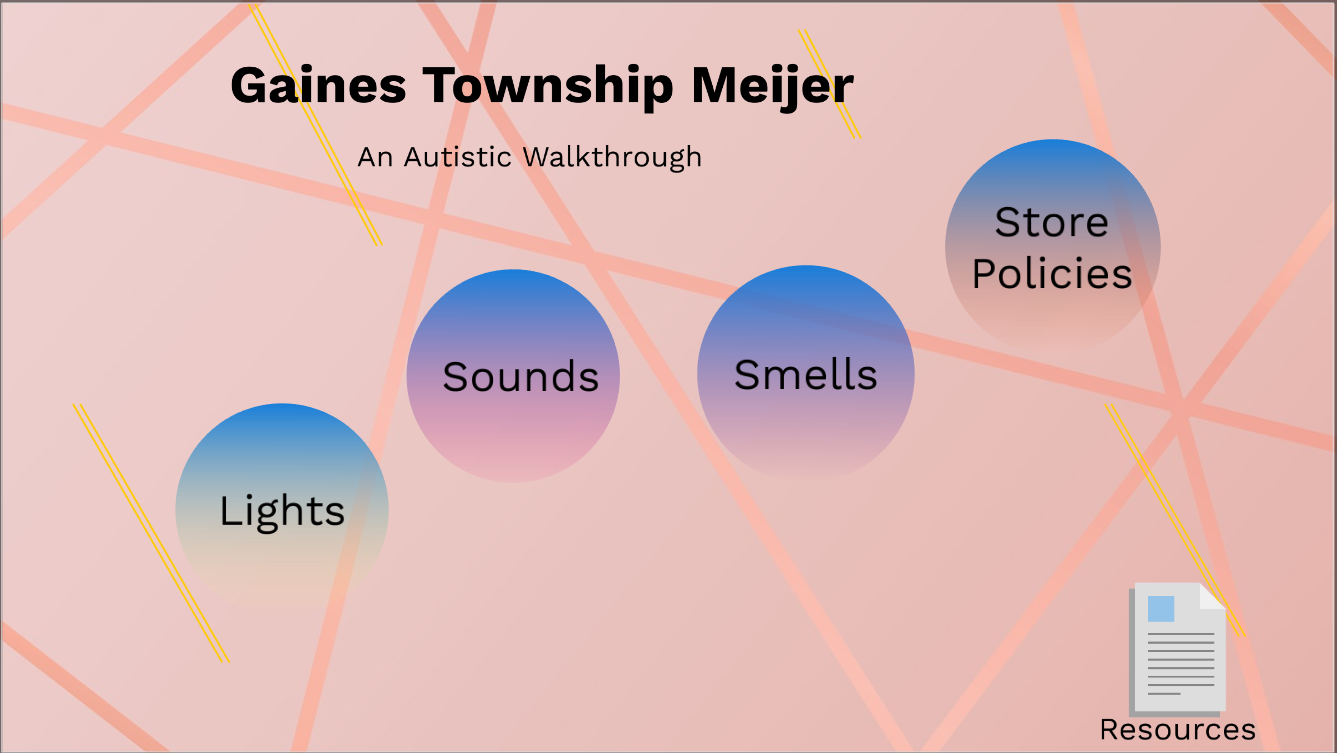
Main slide from a presentation, titled Gaines Township Meijer: An Autistic Walkthrough.  Main topics are Lights, Sounds, Smells, and Store Policies.
I haven\’t made Powerpoint-esque presentations for, um… something in excess of seven years.  Things have slightly changed when I wasn\’t looking, and I wouldn\’t say I was good at them in the first place.  You\’ll see what I mean later.

——————————————————————————-

Slide from a presentation, titled Lights.  Subtopics: Overhead Lights and LED Light Strips

For lighting, I was trying to get the basic understanding for design choices across.  Natural light or at least incandescent light over fluorescent lights.  Warm, soft white lights over harsh blue white lights.  No flickering lights.  These seem obvious to me, but I guess if you\’ve never stared directly into those awful new light blue headlights or into an LED light strip on a dark night, you might not know what I\’m talking about.

Slide in presentation, titled Overhead Lights.
Naturally, fluorescent lights are the cheapest for retail businesses by a hefty margin, so this normally falls somewhat on deaf ears.  When researching the subject, I did run across instances of teachers putting films or sheets over their fluorescent lights, which possibly moderated the flickering and humming.  So that\’s something.  
These particular overhead lights were of an unusual design.  They had a single, bright (probably fluorescent) tube bulb, facing UP.  The rest of the light was a curved white surface, which reflected the light out and down.  I\’m not a person that can actually see the fluorescent lights flicker, so I can\’t be sure that this design was meant to reduce that effect… but it does seem unusual and intentional, so that\’s certainly something.  
The lights themselves were… much too bright, honestly.  The reflections would bounce off every plastic-wrapped item, every glass item, and every polished surface (like, y\’know, the floor).  See the lower picture there?  The reflection of the overhead lights is visible in every single package of meat.  The end result was rather painful once I focused on it.  Dimmers would be a good option here, if the store wanted to be more sensory-friendly. 
LED light strips.  I hate them so much.  Whoever invented them has earned the swift kick in the pants I have saved for them.  They are very often the horrible piercing blue-white variety.  
Meijer, as it turns out, makes copious use of these light strips.  I found them in every refrigerated section, all over the health and beauty aisles, and even in special displays in the food and electronics areas.  Now, to the store designer\’s credit, many of these light strips were not visible from an adult\’s height and perspective.  They\’d installed them facing away from the customers, or blocked the immediate view of them with a plastic strip.  
The issue, of course, is that these precautions don\’t shield children, who are lower to the ground and have a different perspective on the displays… and it also wasn\’t sufficient to keep me from spotting them, because several of them still managed to stab me in the eyeballs.  The next time you see a kid screaming on the ground, apparently having a tantrum, look around for light strips, flickering lights, or obnoxious sounds.  It might not be a tantrum, but a meltdown caused by so many awful and painful sensory inputs.  
There was one exception to the \”light strips are awful\” rule, and I couldn\’t manage to get a good picture of it.  The refrigerated juice aisle had these long warm-colored light strips that had been shielded entirely.  This allowed them to emit light, but reduced the eyestrain to the point where I noticed no pain while staring directly at them.  It was really nice, and I hope it becomes the standard everywhere.
Another thing I found and hated with light strips: the ice cream and frozen food sections have those tall upright freezers.  Those are fine.  However, they decided to install motion-activated lighting in those upright freezers, so when you walk by, everything brightens up.  This is highly disorienting to me, and I hated every minute of it.  I actually had no idea why I felt so disoriented in the freezer section until I did this walkthrough and noted the motion sensors every 3 freezers on each side.  Hate it, do not want.
The view looking up in a grocery store.  Painfully bright spotlights shine down on bottles of alcohol

Something that didn\’t make it into the presentation was spotlights.  I think I\’d meant to have them, but just… didn\’t.   In my defense, it was well past midnight when I was working on the presentation, and I\’d had roughly 24 hours\’ notice that  this meeting was happening, and that I was coming.

I squinted at this flickering spotlight for about a full minute, trying to decide if it was malfunctioning or if this was intentional.  The flickering was quite regular, and wasn\’t making extra sound, so I got the sense that it was intentional.  Obnoxious and possibly dangerous to people with epilepsy, but intentional.  The whole spice display flickered with light, as a result, which I think was to make it stand out more.  It was kind of like poking me in the eye repeatedly.  Needless to say, I am not a fan.  
——————————————————————————-
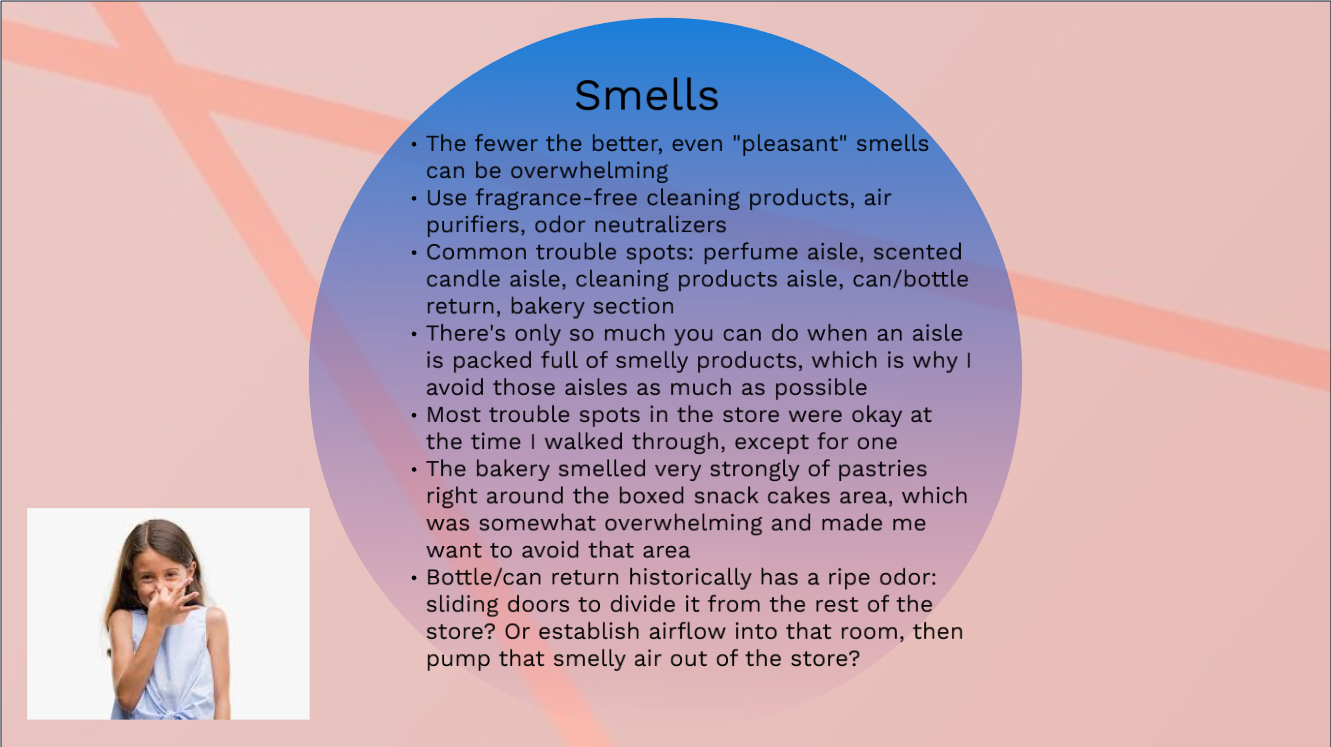
We\’re going to skip over Sounds this week to jump right into Smells.  You can see from how lengthy the bullet points are here that I\’m very out of touch with how one makes a presentation.  I really just wanted to have my thoughts organized.  
As a general sensory-friendly rule, you want zero odors in a public area.  The nose can\’t cause you pain if it has nothing to react to.  Odorless cleaning products are my friends.  Even pleasant smells, like fruit, flowers, or baked goods, can cause pain and sensory overwhelm.  My doctor actually gets bad headaches from flower-scented things, even though basically everyone likes flowers.
Obviously, in a grocery store, this is only so possible.  The perfume aisle, the scented candle aisle, the cleaning products aisle, the can/bottle return, and the bakery section are going to have smells.  You can use odor neutralizers and air purifiers around and in those aisles to help, but the fact remains, those places are full of smelly things.  And worse, those things are often purposely made with porous packaging (the material has tiny holes in it) so you can smell the product and decide if you want it or not.  
In the walkthrough I did, the trouble spots were actually pretty good, with one exception: the bakery.  I\’ve read somewhere that stores like to pump canned \”fresh bread\” or \”baked goods\” smells into their bread and bakery departments, and I\’d bet my comfy blue slippers that Meijer is no exception.  I got a strong noseful of \”baked goods\” smell when I stepped into the packaged snack cakes and cookies section.  Which is curious, since, y\’know, they\’re in packages, and I was still like 10 feet away.  
Historically, though, the can and bottle return is malodorous in the extreme, to the point that even people with normal senses avoid the place.  This location had the entrance to it located right in the entrance to the food, unfortunately, which I can guarantee will make it Bad Times in summer.  
I\’m not really sure how the store handles that, but the entry to the return area is unimpeded by sliding doors.  Adding sliding doors, or establishing a breeze going into that room, which is then pumped out of the store, would probably be a way to handle it.  I\’m no engineer, though.  
When I shop, I tend to avoid all the trouble spots I\’ve mentioned here, simply because I know they\’ll be unpleasant.  The discussion brought up the idea of mapping those trouble spots, as well as any quieter or safer areas in the store, and having those maps be available to parents and anyone else with an interest.  I think that\’s a good idea overall, and I\’ll go into that idea and some related ones next time, when I talk about Sounds and Store Policies.  

Intelligent Lives: Attending a Screening

I went to a screening of Intelligent Lives in my area yesterday.  It\’s a documentary about people with intellectual disability (ID; ie: low IQ).   It touches on the overuse of the IQ test, but its main point is showing how people with intellectual disabilities are normally institutionalized, but don\’t need to be and shouldn\’t be. 

In the main, it follows three people with ID, and tells the finished story of a fourth.  I was pleasantly surprised to see that two of the three living subjects are dark-skinned.  The movie points out that black and brown people are twice as likely to receive ID diagnoses, so was quite appropriate. 

My opinion of IQ is known, but I\’ll summarize it quickly.  The Intelligent Quotient test was never meant to be a catch-all measure of a person\’s value or chances of success in life.  It was created to measure one thing: your ability to learn in a standardized school environment, with standard school subjects. 

This is good information to have, naturally, in a society where schooling is mostly verbal/textwall-y and also compulsory.  However, it\’s hardly the whole picture.  It\’s missing things like:

  • how well you can sense others\’ emotions and motives.
  • self-knowledge, recognizing your own reactions, motives, strengths, and weaknesses.
  • your sense of musical pitch and rhythm (perfect or approximate pitch)
  • how graceful or clumsy you are in team sports and other athletics
  • your grasp of what is important in life, what life is about, why we live, and why we die.
  • how well you can visualize things in 3D, move them in your head, and plan things out without ever touching or seeing them.
A person can excel in many of these things, but still have a low IQ.  And because of how much emphasis we place on IQ, that very intelligent person will be afforded few opportunities to use their natural talents.  They will generally be considered unable to make their own life choices, and set apart from their peers.  
Needless to say, I hope, this is both absurd and wrong.  
I attended this screening without knowing what kinds of people would be there, and how far along the community was in understanding things like \”why self-determination is important,\” \”the stress and frustration common to siblings of people with disabilities,\” and \”the importance of including the voices of the people you\’re talking about in your discussions.\”  
I was pleasantly surprised, as the discussion afterwards seemed to have a good sense for the first two points.  The last, however, was entirely neglected.  While there were people with ID present, their voices were not asked for.  It was, in the end, a meeting of special education teachers and parents.  
I spent a good amount of time being rather uncomfortable about presuming to speak for people with intellectual disability, but opted to do so anyway, merely because no one else was going to.  I do not qualify, and never have qualified for the ID diagnosis.  What I do have is the knowledge that self-advocates are often excluded from these discussions, often out of sheer ignorance.  It simply doesn\’t occur to parents and teachers that adults with the condition would have anything to say.  
I\’m afraid I couldn\’t muster the mental organization and politeness to address the room as a whole, and point out the obviously missing piece in the discussions.  I was running on very little sleep and had to skip dinner in order to attend the movie, which made me distrust my ability to make my point in an approachable fashion.  Honestly, I probably should have made the point anyway, but I was really super uncomfortable representing a group of people that I wasn\’t technically a part of and didn\’t have any immediate friends\’ thoughts to fall back on.  
I\’ll try to do better if I go to one of these things again.  I have a better sense of the community now, which will make me more confident in dealing with it.  Given how the people at my discussion table reacted to my comments on the subject, it seems like this particular message (\”invite adults with ID to the discussion table, give them the microphone, and listen to them\”) needs to be heard.  Repeatedly.  If it takes an autistic self-advocate without an ID to make that heard, at least someone\’s going to do it.  

Mouth Care with Sensory Sensitivities: An Electric Toothbrush Comparison

Today we\’ll discuss oral hygiene, how sensory sensitivities factor in, and compare two electric toothbrushes side-by-side.  
Oral hygiene is a basic part of personal hygiene, which is important for being presentable to people, especially neurotypical people.  If your breath smells bad, people won\’t want to be near you or speak to you, because they can smell it and can get grossed out by it.  Brushing your teeth, and also your tongue and mouth, combats bad breath.  It also fights tooth decay by decimating the responsible bacteria.  
The problem with all this is that brushing your teeth can be a really unpleasant sensory experience.  Having bristles scraping against your gums and teeth can be torturous for people with touch sensitivities.  Especially if you go the extra step and invest in an electric toothbrush, which does a much better job than manually brushing.  The electric toothbrush vibrates in addition to your brushing, which polishes your teeth and under your gums much more effectively… but now you\’re pressing a buzzing object to your gums in addition to the brushing sensations!
Essentially, oral hygiene can be a really unpleasant nightmare for people with sensory sensitivities.  A nightmare that has to be repeated daily, or cavities and fillings and crowns and so many expensive trips to the dentist will result.  

The Toothbrushes

Therefore, making the process as painless as possible is important.  One way to do that is to choose your toothbrush carefully.  Our two toothbrushes are below:

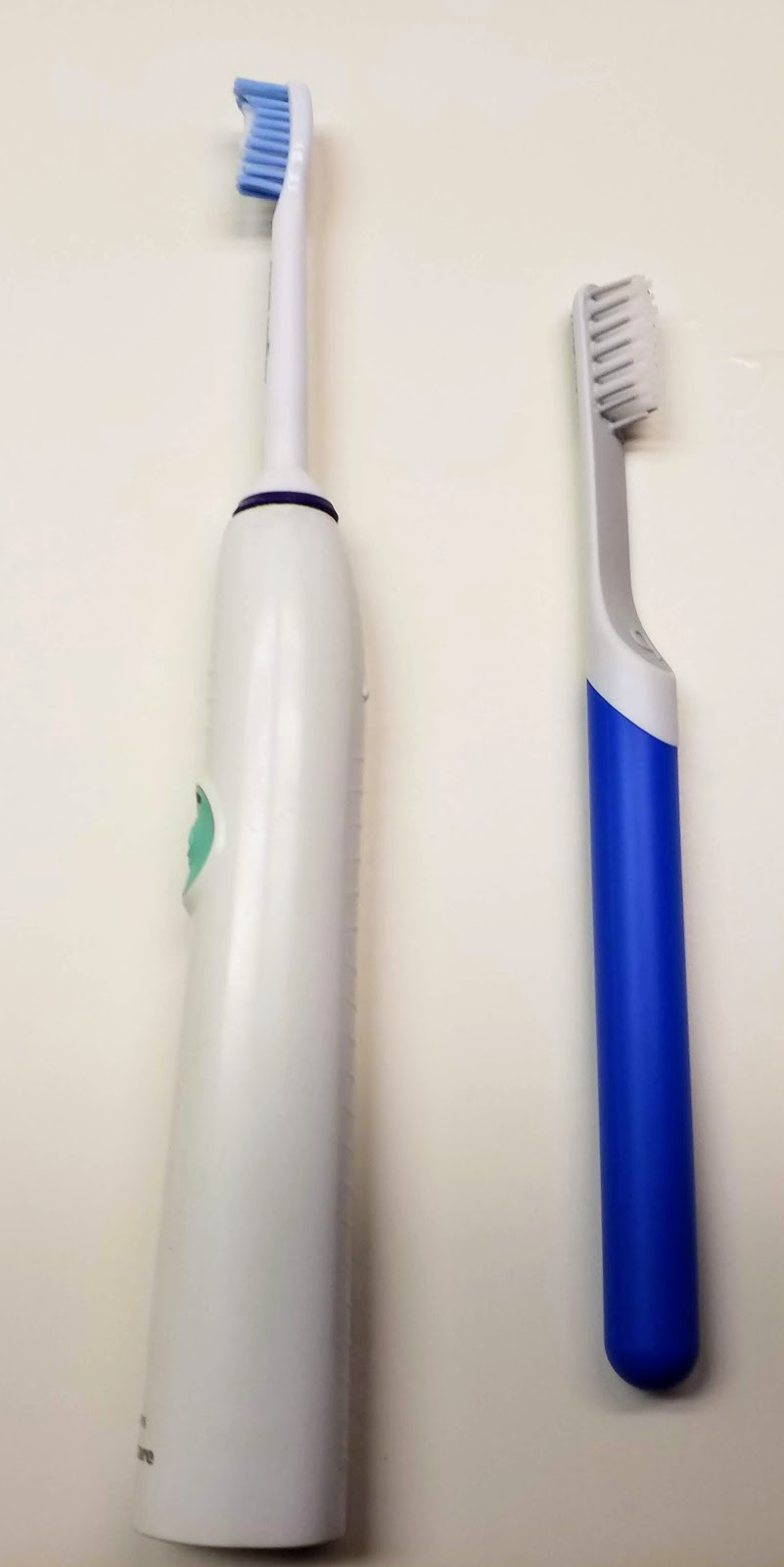
On the left side, my spouse\’s Phillips Sonicare toothbrush.  His is a basic model, but the company is well established in the electric toothbrush market.  I\’ve borrowed this toothbrush and used separate toothbrush heads for a couple years now.  With it, I\’ve stopped having any cavities whatsoever in my teeth.  
This is particular impressive because it\’s despite: A) I\’m sometimes unable to make myself do any toothcare at all for an entire week (thanks to depression and sensory sensitivities) B) I have bad genes (my dad has had many cavities despite brushing and flossing religiously, and I have had some problems as well), and C) I eat way too much sugar overall, which heftily accelerates how quickly your teeth decay.  
On the right is a Quip toothbrush, a relatively new arrival on the mouth care scene.  The toothbrush is actually only one piece of their oral health recommendations, which include letting you do a subscription plan to have new toothbrush heads and toothpaste sent to you every 3 months.  Other than floss, it\’s essentially everything you need to care for your whole mouth.  My in-laws generously gifted the Quip toothbrush to me for my birthday, and I\’ve just gotten the chance to try it out, which is what prompted this blog entry.  Thank you!

Show/Hide

You\’ll notice immediately, as I did, that the Quip toothbrush is much smaller.  It\’s also lighter by a good margin.  What\’s not obvious from that first picture is that both toothbrushes have detachable heads.  The Quip is simply built more seamlessly.  Below is a picture of the brush heads, along with a manual toothbrush.

Two electric toothbrush heads held in a hand.  One has a scrubbing surface, the other does.  Above them, a manual toothbrush with a scrubbing surface.

As you can see, the Quip toothbrush head comes with a scrubbing surface on the back.  This is actually a feature I\’m rather fond of, to the point that I invested in a manual toothbrush like the green one so I could continue to have one available to me.  Having the feature built right into the brush head saves me annoyance, counter space, and money.  
What about the accessories, and the innards?  

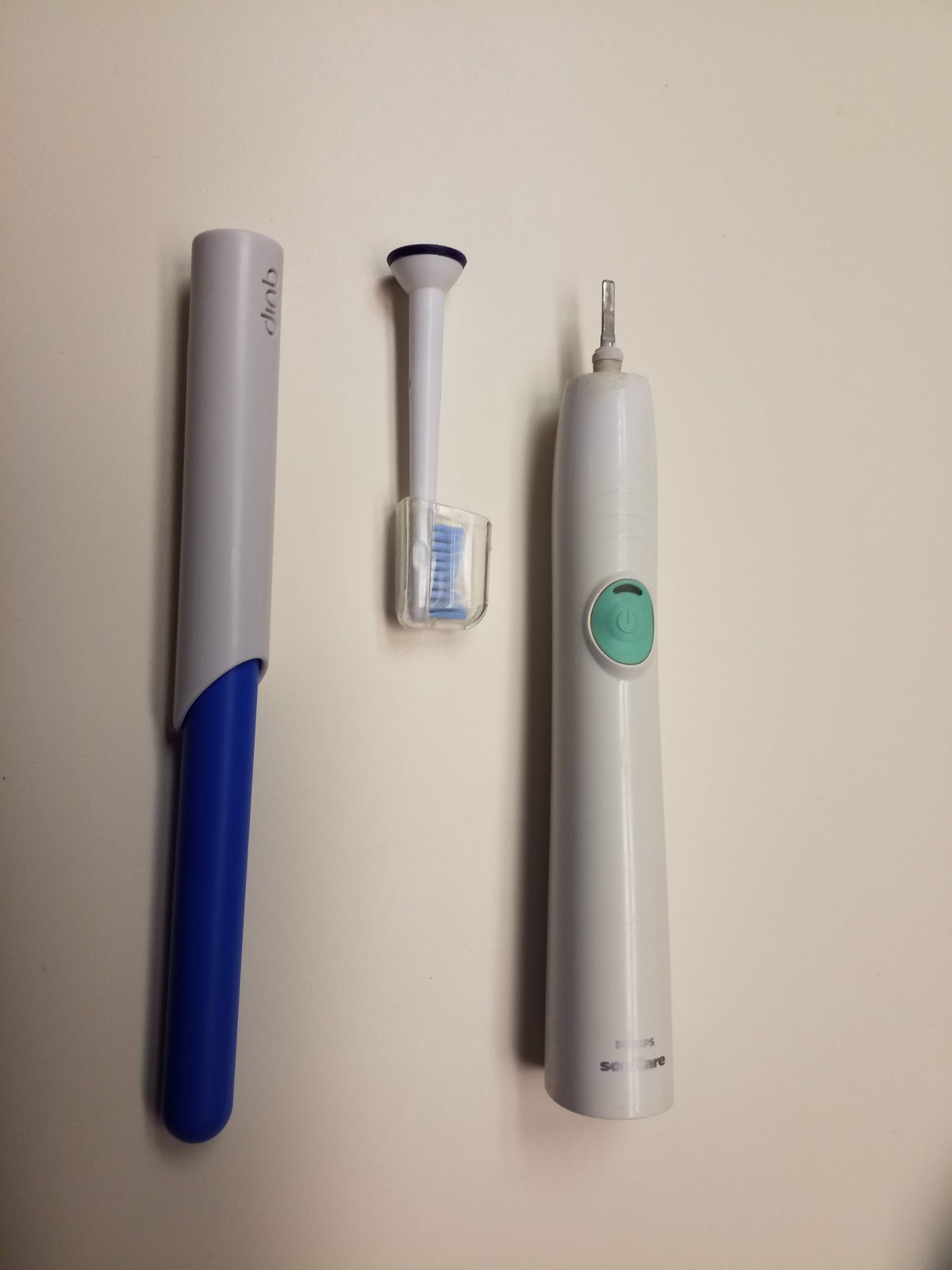
Quip electric toothbrush parts and accessories: handle, toothbrush head, motor, a AAA battery, and a plastic cover for the top half of the toothbrush

Sonicare electric toothbrush charging base, handle, and a toothbrush head with plastic cover.

As you can see, the Quip disassembles a lot more than the Sonicare does.

The Sonicare has the handle (not meant for the user to be able to take apart), the toothbrush head (with plastic cover), and the charging base.  The Quip breaks down into the toothbrush head, motor, battery, plastic handle, and sliding cover.  The cover fits either end of the toothbrush.  Due to the sticky tape (not shown) on the cover, it serves as both a travel cover and holder.  You can literally just stick it to the counter or to your mirror and put the handle into it for easy access.

The Quip uses a standard AAA battery, whereas the Sonicare uses a rechargeable battery pack.  I have no information on how long each lasts, but I can safely say the Sonicare battery pack has lasted like 5 years.  I suppose one could always use a rechargeable AAA battery in the Quip as well.

I\’ll be heading out of town for Thanksgiving soon, so another question arises: How do they handle for traveling?

Quip and Sonicare electric toothbrushes, packed for travel.  The Quip packs into one piece and is much smaller, while the Sonicare\'s toothbrush head detaches from the handle and needs a clear plastic case.
As you can see, the Quip packs into a single unit.  The white plastic cover slides over the brush head and locks into place.  The Sonicare is better packed in two pieces, with the brush head separate from the base.  The brush head then needs to be covered with a clear plastic case.  One of those comes with every toothbrush head, which means a lot of those little plastic cases build up over time.  
And now, most importantly for people with sensory sensitivities: how do they handle?  I got a couple videos of turning them on.  
The Sonicare makes a medium buzzing sound.  When pressed to your mouth, it also buzzes your teeth, gums, and jaw.  Again, this is the toothbrush I used for years.  The experience of using it is not even slightly enjoyable, and I have to shut my eyes and keep anyone from interacting with me while I use it.  This is in part so I can remember to get all parts of my mouth, and in part because the sensory experience is painful and frustrating, and best managed with my full attention.  

The Quip runs a lot quieter, and vibrates my hand a lot less.  This has the added bonus of not making my hand slightly numb after using it.  It does also vibrate the teeth and gums slightly, but not nearly as much as the Sonicare.  This does make me wonder if its cleaning efficacy is as good as the Sonicare, but time alone will tell that.

Another note on using the toothbrushes.  The brush heads my spouse and I use with the Sonicare are \”extra soft.\”  This is because gum erosion is a possibility with the intensity of electric toothbrushes, and the idea of tooth care is to clean the gums, not destroy them.  I don\’t know what the Quip\’s brush softness is, but it\’s definitely not \”extra soft.\”  I\’d guess \”soft,\” not \”medium,\” judging by the manual toothbrushes I own.

It makes sense to me that the Quip perhaps makes up for its gentler vibrations by using \”soft\” rather than \”extra soft\” bristles, but I have literally no formal education in dentistry, so I\’ll double-check that idea when I next visit my dentist.

Both toothbrushes run for 2 minutes.  Every 30 seconds, the toothbrushes stop buzzing for a split second, which tells you to move on to the next quadrant of your mouth.  In this manner, you spend half a minute on each quadrant and get a more thorough cleaning.  This is a good feature, which I\’m guessing is standard these days.

The Winner

At least for me, Quip wins this comparison hands down.

It\’s smaller, lighter, has more functionality, is more portable and travel-safe, and most importantly, its vibrations don\’t upset me nearly as much as the Sonicare toothbrush\’s do.  With the Quip, I could see myself brushing my teeth twice a day, as the dentist recommends, rather than once a day as I do now.  Once a day has been enough to keep me cavity-free, but if the Quip doesn\’t clean as vigorously as the Sonicare, then twice a day would definitely be a wise idea (as well as what the doctor ordered…).

I\’m also extremely impressed that they designed a toothbrush where every single one of the parts is easily replaceable.  If the Sonicare\’s motor ever dies, there won\’t be any option but to replace the whole handle, which is kind of a waste of perfectly serviceable plastic and the rest of the toothbrush.  If the same thing happens with the Quip, I need only buy a new motor.  Or handle.  Or sliding cover.

This strikes me as more environmentally friendly than the Sonicare, though the question of whether the AAA batteries will add up over time is relevant.  You can somewhat offset that by using rechargeable AAA batteries yourself, I expect.  But each toothbrush head with the Sonicare toothbrush comes with a little plastic cover, and I\’m fairly certain Quip\’s refills won\’t.  So it\’s at least a tie, given a conscientious consumer, I expect.

I\’ll start using the Quip instead of my spouse\’s toothbrush immediately, and try to add an evening brushing into my oral care routine.

If you\’re interested in checking out the Quip, I saw it at Target recently on an endcap in the tooth care section.  You can also get your first toothbrush from them for only $25 on their website.

Extra: The Rest of My Mouth Care Routine

Like most children, I was taught how to brush my teeth young.  Unlike most children, I continued to have difficulty adopting that routine and sticking to it into my college years.  I can\’t remember having a specific reason why I didn\’t like the experience, but it wouldn\’t surprise me if the feeling of brush and floss on gums and teeth was just so unpleasant that even 2 minutes was too long to manage.  
After a series of very expensive dental bills, I forced myself to establish a tooth care routine, which I try to do every morning.  I\’ve had multiple oral hygienists tell me it\’s a pretty good routine, so for completeness\’ sake, I\’ll include it here.
  1. Scrub tongue with tongue scrubber.  My tongue tends to build up bacteria, especially in the morning.  Scraping off the buildup makes the clean taste from brushing last longer and reduces the overall amount of bacteria in my mouth.
  2. Floss.  I use two types of floss.  A braided, thicker floss is the staple for between most of my teeth.  It\’s quite gentle, doesn\’t cut into my gums, and catches more food and plaque than the regular floss.  A thinner, waxed floss goes between my lower front teeth and their neighbors, which have a metal wire across the back side of them due to orthodontics.  
  3. Brush teeth (and gums).  I use an electric toothbrush with baking soda toothpaste.  There are about 3 bajillion toothpaste types, but my dentist commented to me that my mouth tended to be more acidic than most.  Baking soda toothpaste helps offset that.  I also try to switch brands after each tube.  I read somewhere that the bacteria in your mouth get used to a toothpaste formula after a while, so it\’s best to do that.  I also try to focus more on the gumline and the back of my mouth rather than the teeth directly.  When the toothbrush\’s timer ends, I brush the roof of my mouth, then brush my tongue again with the remains of the toothpaste.  
  4. Mouthwash.  This keeps my mouth feeling clean a lot longer, even though it can really sting and tastes quite strong.  Listerine\’s a good brand.  There\’s been some back and forth about whether alcoholic mouthwashes are a bad idea, since alcohol can dry out your mouth (which leads to more bacteria).  I brush in the morning, so it\’s not as much of an issue as it would be if I was using it at night.  If you can\’t stand the flavor of alcoholic mouthwashes, or you tend to do your tooth care at night, there are several kinds of non-alcoholic mouthwashes that still definitely help.  

A Week with Woebot

Roughly a year ago, a friend of mine linked me to a cool idea: an AI therapist that helps you track your mood and teaches you the basics of Cognitive Behavioral Therapy (CBT).  The name of the AI is Woebot.  At the time, it was only available on Facebook, and since Facebook kicked me out for refusing to give them my last name, it wasn\’t an option.  But I thought the idea had merit, so I signed up to be notified if they ever took their project to a regular app.

After some time had passed, they did in fact do just that.  So I gave it a try.  The app, simply called \”Woebot,\” is available on both iOS and Android.  I installed it on my support tablet and booted it up.  
You\’re greeted by an animated robot (somewhat similar to Wall-E, honestly) as the app starts up.  This resolves to a smaller picture of the robot, and then there\’s a text box for typing your replies and what\’s basically an instant message conversation window above that.  I did have to make an account, which might be a turn off for anyone who lives with paranoid tendencies.  
From that interface, you chat with Woebot, whose personality vacillates between teenage girl (minus the attitude) and calm mid-20s college guy, with the knowledge of a CBT therapist.  The communication style of the AI is very much the younger generation\’s: text, interspersed liberally with emoticons.  I found that somewhat offputting, but at nearly 30 years old, I am definitely no longer \”the youngest generation.\”  
So the first point of this app is to track your mood.  After greeting you and asking you what you\’re up to, this is the first thing it does each day.  You choose an emoticon to describe your mood, though you can eschew that and use words instead if you really want to.  
This is not my device, but this is basically what the check-in looks like 

I found myself miffed and confused by the bot\’s interpretation of the various emoticons, with the end result being that I\’m now unsure if a particular emoticon is always meant to be \”I feel lonely\” or if the programmers just decided that.  They seem to have also ranked each emoticon on a scale of positive to negative… but the ranking system wasn\’t terribly apparent to me, so I wasn\’t really able to properly respond to the question.  

The AI remembers your moods each time you give them, and plots them on a chart for you as time goes by.  You can thusly track how you\’re feeling each day.  If you\’re me, you\’re always kind of grumpy or tired or whatever, so the chart is kind of boring to look at.  But other folks, especially ones that try the app longer, would likely have more interesting, helpful charts to look at.  
I imagine this would be helpful for people who feel depressed, but actually are doing fairly well most of the time.  But I\’m a huge grump, so it didn\’t do a lot beyond validate my impression that I\’m a huge grump. 
After the AI sympathizes with you or celebrates with you about your mood, it normally has something to tell you or teach you.  This is usually couched in conversational language, like telling jokes, or saying it in a, \”guess what I heard recently?\” kind of indirect way, as opposed to a \”you might find this technique helpful\” direct way.  While that does kind of enhance its appearance of humanity, I also found it kind of annoying.  But I\’m a very direct, \”just spit it out already\” kind of person.  
I think all of that probably would have been fine, if it weren\’t for the last thing I didn\’t like about the AI\’s style of communication.  You see, while we have chatbots that can hold a pretty decent conversation, this is not one of them.  This AI appears to be intended to follow a script, and if you deviate from the script, it continues right along that script merrily, as if nothing had happened.  
When you talk with Woebot, you always have the option to enter your own response… but the app seems to prefer you simply click one of the preoffered responses.  If you type something different, it defaults to the first preoffered response it gave you.  Like the emoticon choice above, but usually only 1-3 responses… and those a great deal more cheerful and full of emoticons than I\’d ever type myself.  As such, it becomes far too easy to just skim the AI\’s words and push pre-programmed responses without investing any real effort or interest into what it\’s trying to teach you.
As such, I was… really not impressed with this app.  It\’s a real pity, because the techniques it was trying to teach me are quite valid and important ones.  For instance, the AI started me out with mindfulness, and then got to working on recognizing and correcting cognitive distortions, keeping a gratitude journal, and setting good goals.  All of these are excellent basic therapeutic techniques, and fine ways to start a person on self-improvement.
I figured out pretty quickly that I mostly know the stuff it was trying to teach me, to the point where I was anticipating roughly what it would say next.  Which I guess tells me this app was not intended for someone with a psychology background…  Which is fair, since the world is a big place with many different kinds of backgrounds and knowledges, and most people don\’t have that particular background.
Actually, I\’m not really sure if this app was meant to be used by adults.  The choice of communication style, emoticons, and personality choice suggest to me that this app was really more meant for use by teenagers, perhaps into college.  Since teenagers aren\’t the most self-aware type of human, and often can use counseling and help with coping skills, this isn\’t necessarily a bad choice… but it doesn\’t cater to me, personally, despite that I do have mental illness and could possibly use help with it.  
Anyway, bottom line is that I won\’t be keeping this app.  It\’s too bad, because the idea is fantastic: in an age where mental healthcare is prohibitively expensive, just teaching the basics via a free mechanism could potentially reduce the suffering of a lot of people, and thus improve the world.  
It could help teenagers (on and off the spectrum) as they struggle with who they are and who they want to be.  Teaching the basics of CBT and other good therapeutic techniques is great for increasing overall knowledge, and better educated people can help educate and support each other.  It could potentially help a patient autistic adult identify, deal with, and compartmentalize their emotions, which is definitely a good thing.  And the app does seem to have helped other people, by the views in the app stores.  But I guess I\’m too old, too cynical, and too educated to really make use of it.  
Hopefully as the developers receive feedback (some of which is mine) and improve the AI, Woebot can become a more helpful, responsive, useful chatbot for people of all ages and backgrounds.  In the meantime, at least it\’s helping some people.  

Trying Huel: An Experiment in Occasional Meal Replacement

Nutrition is hard.  Eating well is hard.  And I\’m a low energy person who doesn\’t like cooking.  What\’s a health-conscientious autistic adult to do?  

Well, science is starting to offer very low-effort solutions to the problem.   After decades of research, we\’re starting to get a handle on exactly which nutrients, and how much, the average person needs in a day.  So then the challenge is simply to provide those nutrients in a simple to use form.  Enter Huel, and its main competitor in the US, Soylent.  These are both complete meal replacement powders, which is to say, instead of making a nutritious meal with lots of fruits, vegetables, and healthy grains and proteins, you can have a serving of this powder and receive relatively similar health benefits.  At least in theory.  Basically, you can \”skip\” a meal and just drink a serving of the powder.  It\’s meant to be both a convenience food, and at least in Huel\’s case, a possible cure for world hunger.

I opted to try Huel rather than Soylent for a few reasons.  First and foremost, I ran the ingredients of both products by my doctor, who has a PhD in Nutrition and works with special needs people mainly.  She frowned over them both, but told me the Huel had the better nutritional profile.  She also commented that it\’d be better to avoid soy as a rule, as it\’s a common allergen and I have a sensitive system.  Also, as a rule, since Huel originated in the UK, its formula has to meet the much stricter and more rigid health standards of Europe.  That means far fewer colors, weird additives, etc. 

The last thing my doctor commented on was the sweetener additive.  Both Soylent and the sweetened version of Huel use sucralose, which is a neurotoxin.  It\’s over a hundred times sweeter than cane sugar, which throws off the brain\’s understanding of sweetness for natural foods.  Huel, however, also offers an unsweetened/unflavored variety, which contains no sucralose.  Since it\’s easy enough to add sweeteners on my end (my kitchen alone has sugar, honey, cocoa powder, monk fruit sweetener, stevia, and erithrytol), that seemed like the better bet.

It also doesn\’t hurt that my very first friend, a Britishman, tried it before me and informed me that it works pretty well.  (As a sidenote, there is also a gluten-free version of Huel, which is an important thing to note for some people on the spectrum as well as anyone with Celiac disease.)

It\’s a bit pricey to try either Huel or Soylent, as they like to send you a big bag or two.  (Huel is $66 for 28 meals, which comes out to about $2.36 per meal.)  Fortunately, that\’s what budgeting is for!  I had the money together a few months after consulting with my doctor about the idea. 

Pictured: the starter kit.  Two bags of powder, one portioning scoop, and one \”shaker\” (basically a water bottle meant to be shaken to help break up powder chunks)

So this was what came after I ordered it.  I was actually a derp and accidentally ordered one bag of the sweetened variety instead of having both be the unsweetened, so I\’m contending with the sucralose.

The powder itself is relatively fine, and very oaty-smelling.  The basic serving directions are to mix five parts water with one part Huel, so you get a decent amount of water along with your calories, particularly since an entire \”meal\” serving is three of those scoops, or 1 cup.  You can also bake the powder into things like pancakes, cookies, etc.  Their website has a number of recipes for that.

I\’ve mostly been having it straight, just mixed into water as per the recommendation.  At least for the vanilla stuff, the flavor is basically like oatmeal.  I can vaguely taste the vanilla and the sweetener, but the strongest flavor is simply its first ingredient: oats.  I\’m basically fine with that, though cocoa powder or other flavors from my kitchen might be in order in the future.

These powders are built with the idea that you could potentially replace all your meals, for weeks or months at a time, with them.  I have not tried that, though some people have, and there are articles written on their experiences.  I\’ve been leery of that.  While I have replaced an entire meal or two, with decent enough results, I prefer to combine a snack-sized serving (1/3 or 2/3s of a meal) with a serving of solid food.  Today\’s breakfast, which I\’m eating right now, is an apple and a single scoop of Huel (1/3 of a meal) mixed with water.  Even before I started using Huel, I\’d been having trouble figuring out how many calories makes for a decent breakfast and lunch.  I don\’t seem to need a lot of food in a meal sometimes, which is confusing because I\’m 5\’8\”, heavy-boned, and weigh over 200 pounds.

With luck, I can try to get that confusion straightened out.  Huel is nice in that you don\’t really have to count calories, just portions.  So if I wanted, I could try the \”whole week of just Huel\” thing that some articles talk about, and see how much I seem to need in a day.  I\’m wary of doing so, though, because I like the various textures and flavors of solid food.  My mother raised me on a relatively varied diet, so it\’s difficult to commit to ditching all of that, even for a single week.  The experience would probably be very educational, though…

If I end up doing that, I\’ll write a \”I tried meal replacement for a week, this is how it went\” article of my own. I\’m not raring to go on it, though, because of the very last thing my doctor mentioned regarding meal replacement…

You see, humans are designed to eat solid food.  Digestion starts with chewing, and we\’re encouraged by health professionals to eat a varied diet because we don\’t know everything about nutrition.  So, in hospitals, you can keep people alive by feeding them via tube.  That\’s been doable for quite awhile, and hospitals even have nutritionists on staff who can calculate how many calories a person needs, and specific nutritional needs that correspond with what conditions the person has.  The thing is, people fed that way don\’t really thrive.  They survive, definitely.  But they don\’t thrive.  They look sickly, have low energy, and overall just don\’t do well.

So things like this meal replacement powder, meant to replace all your meals (in theory) should be used with care.  Particularly for people whose systems are very sensitive anyway, like people on the autism spectrum, or who have a lot of food allergies.  This is very much an experimental technology as of yet.  We don\’t have large scale studies on what happens if you stop eating solid food for a month using Huel or other meal-replacement substances.  So while it would be amazing to just jump right in and swap over to meal replacement substances, especially in food deserts and low-income areas, it\’s wise to be cautious.

But it is kind of awesome to just stir some powder into a glass of water and have lunch without getting slowed down by food prep. 

Pokemon GO, DDR, and WiiFit: The Evolution of Exercise

I was doing my Monday\’s exercise this week when it occurred to me that my views on exercise and gaming might make an interesting explanatory Friday post.  You see, if virtual reality catches on, I fully expect a nice big armada of exercise-based video games to sprout forth.  In present day, there are only a few options.  Depending on who you are, you may have heard of none of them, so let me explain some of the biggest ones briefly.

Pokemon GO

An exploratory walking game, Pokemon GO ties into the popular series Pokemon, first introduced in the late 90s.  
You may recognize parts of this, perhaps.
The idea of Pokemon was that all the animal species in the world are fantastical monsters (called Pokemon), from electric rats (Pikachu) to adorable fire lizards that grow into dragons (Charmander to Charizard), to various kinds of birds, bugs, and other fauna.  As the main character in the Pokemon games, it is your job to go meet them all, learn about them, befriend them, and become the best Pokemon Trainer in the world.  There are a lot of ways to play, but the original games had two versions: Red and Blue (Green, in Japan).  That was so you would play with a friend, and have fun together.  
Pokemon GO takes that same concept, puts it on your smart phone, and bids you go explore your neighborhood and town.  You find Pokemon everywhere, from your front porch to across town at the library.  In short, the game rewards you for getting off your couch and walking or jogging around town.  You don\’t get credit if you drive, because the game tracks how fast you\’re going and nobody walks at 40 mph.  
I played Pokemon GO for over a year, but they made a lot of mistakes when they launched the game and over the months since.  They\’re only now getting their act together, but it was too late, I ran out of patience.  It\’s a shame, because I explored a lot of parks and parts of downtown while I was playing.  

Dance Dance Revolution

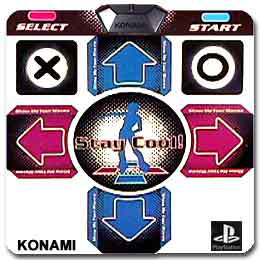
If you were relatively young in the 90s, this entry needs no explanation.  However, for everyone else…. Dance Dance Revolution (DDR) is a competitive dancing/movement game.   Unlike Pokemon GO and most other video games, it uses a controller for your feet instead of your hands.  
Yes, really.
To play, you stand on that, listen to the techno music and press the arrows as they get to the top of the screen, which can look like this:


The arrows, as you can see, scroll up to the top, at which point you\’re supposed to hit the corresponding button on the controller.  Do so in time with the music, and you\’ll get a better score.  \”Perfect\” means you were spot on.  \”Great\” means you were just slightly off, \”Good\” means you were a bit off, etc.  The people playing in this video are far from perfect, as you can see, but in some circles in the 90s, perfection was an art form with this game.  There were literal competitions that paid prizes and even money.  

If you\’re still confused as to what this actually looks like in practice, I took a crappy video of myself doing a relatively easy song. Unfortunately, Blogger apparently doesn\’t like my crappy video, and it\’s not playable, so I found you a video of a couple playing instead.

If you don\’t want to watch the whole minute and a half, they\’re doing a middle-fast song, which involves plenty of steps at a reasonable pace.  It also involves jumping in place to hit two arrows at once, sometimes in quick succession.  The guy shifting his mat halfway through the song?  Very legitimate, though really experienced players usually try to simply adjust for it until the end of the song.

Basically, this video game goes from \”gentle walking in place\” to \”hop at crazy speeds \’til you drop.\”  It tests your fitness and your balance at the same time.  Each song on the CD comes in three difficulties, which gives you replay value and the possibility of learning how to play.  Also, Dance Dance Revolution is an entire series of video games, so when you get tired of one set of 30ish songs, there\’s approximately 15+ more games you could buy and play.  

Wii Fit

If you\’ve ever thought having a personal trainer might do you good for keeping up with your exercise, the folks who made Wii Fit agree with you wholeheartedly, and set out to make you an electronic one.  There are actually a number of video games out there like Wii Fit, some less video gamey than others, but since this was the most popular one, I\’m opting to explain it.  

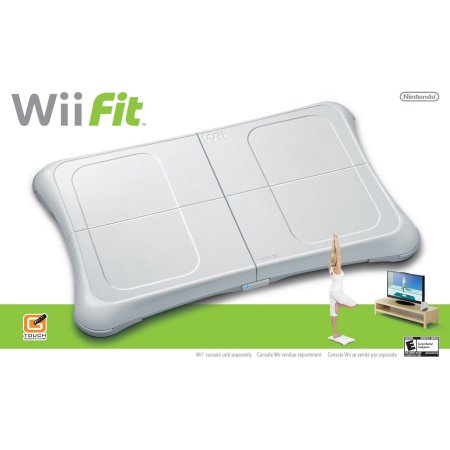
Like Dance Dance Revolution, Wii Fit comes with a special controller. 
I always kind of thought it looked like a scale, which I hated for some reason…
 Unlike DDR, this game is not particularly competitive.  You stand on that controller, which acts like a computerized balance board.   The game features yoga, balancing minigames, and even aerobic exercises.  The game coaches you in how to do the exercises, how to improve at them, and how well you\’re doing at them as you play.  Because the controller tracks where your balance is, it\’s capable of telling if you\’re off balance, how you\’re moving, etc.  
Here\’s a video of a single minigame, with a side-by-side of the actual human playing it.
 
 You\’ll notice he doesn\’t actually jump off the board while he plays, which personally makes me prefer Dance Dance Revolution.  But I\’ve historically been terrible at physical activities, especially balance-related ones.  

So What?

These three games, and knockoffs like them, are a few in the thousands of video games that have come out in the past decade.  However, I think they are the future of exercise for a number of reasons.  
First, inertia and lack of mobility is a factor.  Your average Joe or Jane might want to be more fit, but may not have easy access to a gym, hiking trail, or safe area to walk in.  After a long day at work, most people aren\’t interested in driving another 15-30 minutes to go to the gym, tire themselves out further, and then go home.  They would rather go home, and maybe exercise there, maybe just crash.  With an in-home exercise station, the option is available whenever.  
Second, if you don\’t already love exercise, or don\’t consider it fun (which is the state I\’m in), trying to get into shape is an excruciatingly boring and painful enterprise.  I didn\’t love exercise growing up, and year after year of abysmal yearly school fitness test reports merely solidified my distaste for the subject.  I don\’t hate gyms, but since people drain my energy, I tend to prefer not going to one.  So a more solitary, yet safe alternative is needed.
Lastly, psychology.  Research is showing more and more that \”game-ifying\” your workout (and literally everything else) is very psychologically rewarding.  People love seeing progress, earning rewards (even simple ones like a message on the screen saying, \”You achieved 45 jumping jacks in a row!\”) feeling like they\’ve accomplished something, and even competing with others.  
If full virtual reality becomes viable, the market for this sort of thing could only improve.  After all, why pedal a stationary bike looking at the other gym-goers, when you could wear some fancy glasses and be seeing some high resolution beach scenery?   Instead of jogging on a track and seeing the same thing over and over, you could be looking at a virtual simulated hiking trail, complete with different trees, shrubs, bird sounds, and wildlife.  All the while, the game will track how long you\’ve exercised, how hard you\’re exercising, how far you\’ve gone, and congratulate you after you reach a set goal.

For someone like me, who is not inclined to fitness but does love video games?  It might be the ticket to less effortful, more rewarding fitness.  

Notable Mentions

Not included in this article specifically, but worth knowing about:  
Fitocracy, which is a personalized fitness coach on your phone, but requires you to go exercising yourself.  It tracks the exercises you do, letting you log your goals and activities, and also provides gameified quests and achievements to prod you into doing more, or doing similar exercises.  In addition, it works as a social networking site, kind of like Facebook, so you can compete (or commiserate) with your friends. 

Zombies, Run!, which puts you as the main character in a post-apocalyptic storyline, written by a published author.  The world ended, zombies are everywhere, and the survivors have banded together to form settlements safe from the zombie menace.  You are Runner 5, one of a very necessary group of individuals who retrieves supplies from the wilds so that the enclaves of survivors can continue to exist.  You go running (jogging, walking briskly), and the game paints the story around you.  And the zombies are only the beginning.  As you go, you learn about the world, the people of your community, and what happened to cause the zombie apocalypse.  The game was hugely successful, and is now into its 5th \”season\” of story.  This app was actually successful in motivating me to go jogging for a time, merely because I wanted to know what happened next. 

Riding a LENS brain-shift

This week we touched the motor/sensory strip site that sent me into a towering rage for a full week last time.  I asked the doctor about it, and she offered to skip over that site entirely.  I didn’t really want to do that, for the sake of a complete map and also because if nothing else, the experience was interesting.  The compromise was to just barely touch that site, rather than use the usual signal strength/frequency. 

So naturally, I had immediate effects right after that, and effects for the next two days (per standard LENS-shifts).  This is actually unusual for me; most LENS shifts only manifest as increased or decreased anxiety, or better or worse moods. 

So this one site, as I mentioned, is special.  Other than the initial experimentation, I’ve had virtually no ill effects (and several major good ones) from the LENS system.  Only this site is different, and only that specific one.  There are two sites on the brain’s sensory and motor strips, and the other one doesn’t seem to care if it’s poked.

At the top there are the motor and sensory strips.  The site is basically on top of the divide between them.  

I can never entirely tell whether I imagine things during LENS operation or not, but while that site was being poked, I felt kind of a pulsing from the spot.  It was too slow, in my opinion, to actually be the signal sent to the brain.  But presumably it was a sign something happened.  Thereafter I opened my eyes, and things kinda shifted out of focus for a second.  Both of those are unusual, so I reported them to the doctor and took careful note myself.  That was my first sign I would be having a more interesting couple days than usual.

The drive back, when I first had this site done, was my first clue that something was off.  I’d found myself in a towering road rage, which basically didn’t go away.  (Please note, this rage did not include sitting on someone’s bumper.  Just wishing I could strangle them.)  So this time as I drove back, I paid careful attention while driving.  I didn’t seem to have any road rage.  So I dared to hope this might be an easier experience. 

I went to bed that day with basically no obvious effects.  I woke up the next morning to an all-day marathon of Everything You’ve Ever Done Wrong, Awkwardly, or Stupidly. 

You know how sometimes you’re just thinking about nothing, or something random, and your brain suddenly decides to remember a time in your past when you did something stupid and upset someone?  Or you did something stupid and then had to deal with the fallout of it?  Like accidentally quitting without saving your work in a word processor, or that time someone asked you a question and you just couldn’t think of a good answer in time?

People with depressive and anxiety tendencies experience those kind of memories more often than your average person.  Like, more than a dozen times a day.  The stronger the tendencies, the more frequent the experiences.  I got treated to a marathon of those, all day.  The only respite was keeping myself busy, which was made more difficult by the fact that all those reminders of my failure made me not want to leave the apartment or do anything important. 

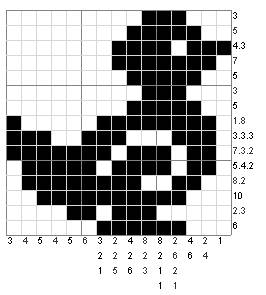
I played a LOT of Picross that day…

Suffice it to say my morning and afternoon was both tiring and miserable.  I tried to compensate for the anxiety and experiences with good food, minor exercise, and GABA (“chill pills”).  Nothing seemed to help.  I guess my brain was in full runaway mode.  By the evening, I’d both gotten rather resentful of the whole experience and the symptoms were starting to fade.  So I’d kind of exchanged some of the marathon for a very toned-down version of the road rage from previously.  So then my energy was devoted to not being mean to Chris and anyone else I had to be in contact with. 

Chris was a sweetheart and opted to buy us lunch at a halfway point between his work and our apartment.  The lunch came with hugs, which were a small comfort.  They didn’t change my brain at all, but hugs are nice. 

This morning (Friday, two and a half days since the LENS appointment), I had trouble sleeping but otherwise was fine.  So I think the worst is past.  Other than the fact that I had to get up early to actually write this (my buffer ran out, nooooo), anyway. 

A final note: at least two people about my age have commented that I’m very brave, prodding my brain with LENS the way I do.  I… can’t really agree, for a simple reason.  Both those people are on medication. 

Far and away, LENS is much less destructive to the body than medication.  Medication for anxiety and depression can make you gain or lose weight, spike your hormones, or even worsen what you’re trying to treat.  And you have to be on it a full month, or more, to see if it’s going to help.  It often won’t, meaning you’ve dealt with a bunch of unpleasant symptoms for a month, for nothing.  Then you have to buy another expensive bottle, and repeat.  And repeat.  And repeat.  I hear it called the medication roulette.

LENS?  Either works or it doesn’t (85% yes, 15% no).  If it works, it’s then up to you and your practitioner to make it work best for you.  The strength, frequency, and variation in the signals you send to your brain can change its workings.  Unlike medication, the good changes stay in the brain.  Much of the human body contains self-healing mechanisms (if you get a cut, it heals up in time), and the brain is no exception.  But it sometimes needs help.  LENS is that help, for all kinds of people.  One day I won’t need to visit the office at all, other than to say hello.  Which makes these rare unpleasant experiences more than worth it, I think. 

Auti-Sim, an online autism simulator

Link here.

This turned up on my Twitter account (realautistic) via the /r/autism subReddit.  The game itself is hosted on an online game website called Kongregate. 

Out of morbid fascination, I decided to try it.  I say “morbid” because the simulator is meant to demonstrate how it feels to have sensory issues.  I already have sensory issues.  As such, the game was very likely to give me a headache.  And it did, in fact, succeed.

The game is very simple. It sets you as a kid on a playground, perhaps in a school yard or community playground.  You have basic movement controls (left, right, forward, back, and jump) and camera control (using the mouse), but can’t interact with anything or anyone.  (also nothing except you moves)

You start in a safe area, a quiet corner away from the other children.  If your volume is turned on, you can hear the sounds of kids on a playground: shrieking, chanting, calling to each other, with occasional thumping or thuds.  You can hop on the playground equipment, but depending on how close to the other children you go, you start to suffer.  Your vision starts going snowy, like static on the television.  Everything gets painfully louder.  The longer you stay, the worse it gets, until you stumble away. 

Or curse audibly at the screen, get a headache, and stumble away, if you’re me.  I’ve only seen a few sensory overload simulators before, and I hadn’t realized how loud it would get.  I queried my fiancee, and he said it was definitely unpleasant.  When you flee away from the other kids back to the edge of the area, the overloading quiets down in a few seconds.  I really wish my overloading quieted down that fast, but it wouldn’t be a very good game if once you’d gotten overloaded, you had to sit for an hour somewhere quiet and alone.

The other children are all faceless, wearing the same clothing, and don’t look at you or respond to your approach.  This mirrors something I tend to deal with in reality: faces are immensely difficult for me to memorize, and names are even worse.  Clothing changes day by day, so even if all the clothing is different for each person, it’s useless as an identifier in the long run.  Finally, the others not responding lines up with the fact that the “weird kid” on the playground usually gets ignored, or worse, mocked.

Other things I noticed about the game:

  1. The colors (especially the sky) are unusually bright.  This is, as I understand it, a kid thing.  Kids often draw the sky in a bright blue, and I read somewhere that this matches their reality.  They see the color of the sky more vividly than we do.  I don’t have a scientific reference, but I remember I did spend a lot of time looking at the sky when I was little.  It was bright and pretty and often had puffy clouds or jet trails in it.  
  2. Included in the play equipment is a merry go round (with another kid on it).  Some kids on the autism spectrum find solace in stimming, which can be anything from flapping your hands to full-body spinning.  I’d hoped that perhaps the spinning would allieviate or at least tone down the overstimulation, but no luck.  Same idea with the swings, which I spent much time on as a child.  I think I mainly liked them because they got me up high, but some stimming might’ve been involved too. 

Finally, the developer of the game included a very important aspect for autistic kids that don’t blend well: escape.  If you hop up on the play equipment behind you at the start of the game, you can leap the fence keeping you inside the play enclosure, and from there, run as far away as you’d like.  Autistic people, especially ones that don’t speak but even ones that do, will sometimes bolt.  You’ll be standing there with them, everything seems to be fine, and off they go.  This causes the parents and caretakers a lot of anxiety, as you can imagine.

I’m not actually sure if they included that option on purpose, or if this is an unfinished version of the game, but I’m glad it was there.  If I’d made the game (no idea how, so props to them for doing so and putting so much effort into it), I’d’ve made the sounds of the children fade into silence as you get further away, leaving you alone with the calming silence and the beautiful outdoors.

Of course, they’d need to set a timer for your kid to get dragged back to the playground, too.

Overall, this Auti-Sim simulator is good teaching tool in proper context, which I hope I’ve provided here.  Please do give it a try.

3 Observations From a Non-judgemental Gym

1.  TV Diversity is Highly Lacking.  Across 8 televisions, playing a variety of TV shows and movies, the most visible diversity I’ve seen in one scan across the screens was three persons of color.  Three.  (Not including sports games, because diversity needs to be in all kinds of TV and it hardly seems fair when you can get an entire team on the screen, 8+ people.)  Gee, modern TV, you know the diversity of the US is changing, right?  Try to keep up.  Prominent examples of shows toting nonwhite characters: the news (thanks President Obama), Castle (but it’s not one of the main-main characters, it’s one of the main-side characters), and some talk show I don’t recognize.  Occasionally Planet Fitness’ channel itself features minority-type people as well, so at least there’s that.

2.  Even in a Non-judgemental Gym, People Still Love to Judge.  So today I watched a thin-ish girl dressed in bright pink walk past a dozen open treadmills to slide between myself and another thicker lady.  She then proceeded to obviously compare herself to us, matching my speed and pace.  Thankfully for my pride and sense of fairness in the world, she got a stitch in her side and burned out in 15 minutes.  Meanwhile I did interval  (run/speedwalk) training for another 10 minutes, because I am no one’s bottom of the barrel comparison, thank you.  Like I don’t have enough self-esteem problems without someone obviously making that judgement.

3.  Weird Decor Is Always Weird.  This gym’s decor is purple and yellow.  Seriously, I cannot make this stuff up.

Yes, those are specifically branded cardio machines.
This isn’t my particular gym, but it’s close enough.  I keep my nose in a book, or use the Internet on my tablet, because looking anywhere else is an eyesore. There is no respite from the colors.  They’re in the lockers, the stretching areas, the consultation room…  It’s a shame I need my eyes to see my feet on the treadmill, or I might wear a blindfold while I exercise. 

Explaining Sound Sensitivity and Why ANC (Active Noise Canceling) Matters

(warning: this blog entry is long.  I divided it into sections to make it easier to read.  I hope that helps.)

The Intro, or Why This Came Up At All 
I’ve just returned from the gym, where I’ve had a membership for a couple weeks now.  The place is called Planet Fitness, a line of gyms that offer $10/month memberships in exchange for a stripped down (but aggressively nonjudgmental) experience.  They have the whole line of exercise machines, for example, but no pool or tennis courts or indoor/outdoor track.  The other relevant feature about them is the decor.  Besides that the colors are purple and yellow (yes, seriously), this particular gym was built in half of an old Menards (home and garden store), and they haven’t done a smidgen of soundproofing since acquiring the property, as far as I can tell.  I swear, if a single machine is clicking halfway across the massive exercise floor, I can hear it.  With at least 20 cardio machines going at any one time, and at least half as many strength training machines plus the music they pipe in…  It’s really bad for concentrating on your workout.

First Attempt
For this reason, and several others, I’ve had noise-canceling headphones on my wishlist since my last pair broke a few years ago.  I’ve gotten along well enough without them, but it’s been an itch in the back of my mind, and between this gym and the fact that my sound sensitivity seems to be worse some days now, I finally put my foot down and invested in a $50 pair.  Hooray for birthday money.

Sadly, despite my enthusiasm, the earbuds did not pan out.  They barely did a thing, in fact.  I might as well have been wearing normal earbuds.  Quite a difference from my last pair, where I could turn them on and the sounds of the road and the whistling of the wind went blissfully quiet with a polite “hiss” as the electronics powered up.

But Fortunately…
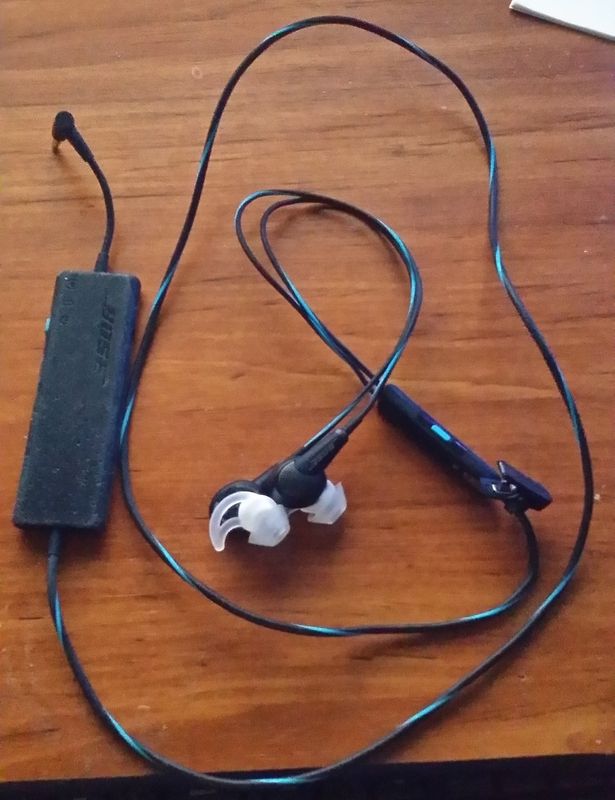
So I was back to square one, and disgruntled to boot.  I count as the working poor, which means I can’t afford to drop several hundred bucks for the high grade headphones my doctor recommended.  (Her kids have sound sensitivity too, go figure.)  As God would have it, my anniversary with my boyfriend was coming up, and given how disappointed I was at the failure of the other earbuds, he hatched a plan.  Long story short: because my boyfriend cares about my sanity and is very sweet, I now own these:

He even got them in blue.

These are Bose (QC20), meaning they’re stupidly expensive but are generally the best the consumer market can offer.  The ratings do bear that out, thankfully.  More than the ratings, though, I’ve tried these out for a week or so.  They bear out and exceed my memories of my old Active Noise Canceling (ANC) earphones.  They come with two modes of ANC operation: one for being able to hear people (Aware mode), and one for not (unnamed, but I snarkily call it “Unaware mode”).  The latter mode is excellent for drowning out road sounds, rumbles, whirs from fans, distant slamming doors, and other annoyances.  It seems to work fairly well across all ranges of sound, from high pitched squeaks on poorly oiled hinges to the bass of the sounds of the road.

(Sidenote: I do not use Unaware mode while driving.  One of the first ways you know something is wrong with your car is by the sounds it makes.  Plus being able to hear cars coming up beside you is an excellent aid to checking your mirrors.)

Active Noise Canceling, Noise Levels, and the Gym
All that said, I’ve been putting those earbuds through their paces at the gym I mentioned above, with its layers upon layers of cacophony.  Impressively, Unaware mode does not, in fact, completely drown out the noise of the gym.  I went at a relatively offpeak hour, 2:30, and I could still hear people chattering behind me (though not as well as I would’ve otherwise).  I could still hear the annoying click click behind me and to the right, the sound of a limping machine some guy wouldn’t get off.  It was all there, just much quieter. 

Having some of the best ANC available, but still being able to hear all that, got me thinking.  Prior to today, I’d always thought sound sensitivity was mainly an issue with loud noises.  The loudness of the gym, for example, necessitated headphones or earplugs.  The loudness of a movie theater always necessitates earplugs, and even then it’s noisy.  I’d get headaches.  I picked up an app that tracks deciBel levels, specifically to check how sensitive I was.

My readings on that app were… underwhelming.  The world around me almost never approximates a jet engine, even though it can really feel like it.  Noise levels rarely get above 70-80 deciBels.  (80 dB, by the way, is being right next to the in-sink garbage disposals while they’re running.  A comparison chart, for the curious.)  That lack of high readings bothered me.  If it wasn’t the noise of a place, why did I still get headaches and want to go hide in quieter places?

Sound Sensitivity Explained
I couldn’t figure it out… until I spent time in that gym today in Unaware mode.  I measured the gym’s noise level out of curiosity.  Never got above 70 dB.  So it wasn’t the sound level that drove me bonkers.  It was the sound complexity.  The sheer number of things going on at one time.  People walking around chattering, the clunks of weights and strength training devices, thud-thuddings from the footsteps on treadmills, high-pitched beeps as people programmed their cardio machines, music blaring from the speakers…

The world, you see, is a symphony of sound.  My brain doesn’t filter all that sound as politely as most peoples’ does.  At this moment in my very quiet apartment (25 dB), there are three smallish fans running, plus the hum of my computer’s machinery.  Every key I hit makes a soft sound somewhere between a tap, a click, and a thud.  The mouse makes sharpish clicking sounds.  Because all of that is relatively quiet, I’m only marginally aware of it.  Most people wouldn’t hear it at all, because the brain filters out extraneous and irrelevant noise.  No one really needs to hear every key they press on a keyboard.

So my brain doesn’t do that very well.  Here in my very quiet apartment, it’s not really overwhelming.  There isn’t much loud or complexity.  Outside, though, is an entirely different experience.  From airplanes to birds to cars to dishes, all the way down the alphabet to zippers, this world has a lot of different sounds.

The vast majority of those sounds are unexpected.  If I see a car coming by, my brain will usually buffer and “quiet” the sound of it passing.  But if a car comes up behind me suddenly, there’s an excellent chance I’ll flinch and look around.  My brain is already bad at ignoring sounds that don’t matter, but adding unpredictability into it basically ensures I won’t be able to ignore it.

Stop for a minute and listen to your surroundings.  Try to note every separate sound you can hear.  Perhaps there’s a coffee maker, or your refrigerator, or the clink of dishes, or your computer’s fan whirs quietly.  If you’re out and about, perhaps there are people talking, or machines working, or cars passing.  Try to listen to all those sounds at once.  That’s what it’s like for me to have sound sensitivity, but all the time. 

Instead of my brain automatically filtering out sounds that don’t matter, I actively have to set them aside.  If the sound was very sudden, sharp, and/or loud, it may have made me physically jump or twitch, and then I have to calm down from the sudden spike of heartrate and adrenaline.  Even if I don’t physically react, I often still suffer the heartrate spike and adrenaline. 

I do this all day. 

The Importance of Active Noise Canceling
I mentioned earlier that because my apartment is pretty quiet, I’m only marginally aware of the various noises in it.  So if I have a device that selectively quiets or eliminates sounds from my threshold of awareness, that saves me a lot of twitching, jumping, flinching, and other unpleasant reactions.  The better the strength and “intelligence” of the device, the less energy I have to spend reacting, setting aside those sounds, and refocusing on the task at hand.  It’s like having a secondary filter, complementing my brain’s subpar filter, leaving me more energy to deal with the rest of life.

I cannot stress enough how incredible that is.  Life is anywhere from draining to exhausting on any given day.  Having something to keep some of that lost energy, or a portable place to isolate myself from the chaos of the day, is wonderful.

I usually go through the day without using any ANC; this is my life, after all.  But knowing it’s there, ready to quiet the multitudinous clamor of life if it gets overwhelming, is comforting.  I’ve taken to carrying them even when I don’t think I’ll need them.  They’re nearly always at hand, and I suspect they will join the list of things I don’t like to leave home without: my tablet, keys, and wallet.  (Once upon a time, “a good book” would also have been on that list, but I digitized most of my library and put it on my tablet.  I’m presently carrying around a paperback, though.)

Some Concerns
I’m a little afraid of wearing these earbuds too often and getting used to the world not being so complex, only to be caught somewhere without them and be unable to focus.  It’s the same rationale I use with painkillers.  For an average day, I should be able to get through life without having to resort to external help.  If my headache isn’t too bad and might be from dehydration or because I haven’t exercised my neck muscles, I prefer to drink some water and exercise my neck, not pop some pills and ignore the potential causes.

There’s also the potential of making my sensitivity worse, in general.  Apparently in some cases paying more attention to these sensitivities (or trying to treat them) can exacerbate them.  I definitely, definitely do not need worse brain-sound filters.  So I’m going to have to be careful with how often I reach for these earbuds.

Does anyone else think life is like a giant balancing act?