Reading the Research: ABA is Abuse

Welcome back to Reading the Research! I trawl the Internet to find noteworthy research on autism and related subjects to share with you. Along the way I discuss the findings with bits from my own life, research, and observations.

Today’s article aligns that data with what autistic self-advocates have been telling us all along about classic Applied Behavioral Analysis (ABA): that it is, in fact, abuse disguised as therapy.

This is a controversy I’ve mostly kept out of (mostly). I was not forced into an ABA program when I was young, because my family didn’t recognize I was autistic at all. So I don’t have the personal experience and scars and trauma that many adult autistics carry as a result of this “therapy.” I can’t personally say “ABA is abuse” and have the firsthand pain to prove it.

However… there are a great number of personal reports from other autistic people, as well as former ABA therapists and parents to attest to the abusive nature of what they experienced.

For those without the time to follow and read or watch all these links, I’ll boil down some issues quickly.

Classical ABA considers behavior irrelevant, except when it’s exactly the behavior desired. This is problematic because all people communicate via behavior.

Paying attention to behavior is even more important with nonspeaking people. You can’t rely on words for knowing how they’re doing and what they’re interested in, so you have to pay attention to their behaviors and actions instead. Essentially, the therapy promotes ignoring the child except when they’re performing as desired. This teaches the child that nothing they have to say is important, and their feelings are pointless.

The desired behavior is typically some estimated standard of neurotypical development, not whatever is normal and healthy for the child.

Autistic people develop at different rates than typical children. They may be faster or slower, or both at the same time. Even typical children develop at different rates. Expecting an autistic child to adhere to an idealized development schedule is an absurdity. Furthermore, it teaches parents, practitioners, and children alike that being autistic is bad and wrong. It promotes that acting neurotypical at all times, at the cost of yourself is the only safe path. Never mind that camouflaging is painful and exhausting and can even drive us to major mental illness and suicide.

ABA stigmatizes stimming and other coping mechanisms.

Stimming is a self-generated coping mechanism, specific to that person. It helps us regulate our emotions, feel more comfortable, and reduce stress. There are many kinds of harmless stims, like flapping hands, spinning, rolling, touching specific textures or having particular smells. These serve an important purpose, not the least of which is communicating how we’re feeling. Forcing the autistic person to stop stimming is oppressive and cruel.

ABA teaches that our bodies don’t belong to us and our consent is irrelevant.

I hope I don’t have to explain why this is bad. ABA often involves ignoring a child’s No or request for a break, physically forcing the child to be still, and taking things forcefully from them. They learn, therefore, that what they want doesn’t matter. How they’re feeling doesn’t matter. And because these are often small children, there is no chance they can fight back. We learn that it’s normal for others to use our bodies as they see fit. No surprise, then, that sexual abuse is so common among autistic adults who’ve experienced ABA.

40 hours a week is far too much.

Remember these are children, with a lot of growing and learning to do. This program is essentially a full time job, long before that’s even slightly reasonable to ask. Autistic people need to develop in our own ways, and learn about ourselves. We are highly individual people, and that means care and space and time need to be involved. Typical ABA gives none of that. 40 hours a week, plus homework for both the child and the parents.

The Actual Article

There’s more. So, so much more. But it’s a bit beyond the scope of this post. Today’s article is… well, it’s a continuation of what’s basically an argument, in science.

A couple years ago, there was a meta-analysis study published that concluded that ABA therapy is both abusive and ineffective at helping autistic people. Meta-analyses look at years of clinical trials and other studies and try to find patterns, so that ideas can be tested and truths be made clear. They hold more weight than the results of a single study.

Seeing this meta-analysis was unfavorable to their jobs, some ABA practitioners got together and published a response. Basically, they attempted to refute various points in the meta-analysis in their own report. Today’s article is a response to that response, doing pretty much the same thing in return.

These arguments are longwinded, as is the way of academia. Like any argument, it’s unlikely either side will change their mind on the subject. The hope is to influence others to their way of thinking.

My bias is pretty clear, I think. I feel that if a thing is in question, one of your best resources is the people who live that reality. I don’t care if the subject is farming, life in another country, or autism. You can learn some from reading secondhand reports and articles, but the best information is from people with firsthand experience. And they tell us quite clearly, in great numbers, that ABA is abuse.

Maybe not every ABA clinic is horrible, abusive, and damaging. But when nearly every autistic adult with ABA experience is against it, that should be quite clear to anyone listening.

(Pst! If you like seeing the latest autism-relevant research, visit my Twitter! There are links and comments on studies that were interesting, but didn’t get a whole Reading the Research article about them.)


Reading the Research: Understanding Feelings

Welcome back to Reading the Research! I trawl the Internet to find noteworthy research on autism and related subjects to share with you. Along the way I discuss the findings with bits from my own life, research, and observations.

Today’s article suggests something interesting about how understanding feelings works. In turn, that suggestion might clarify something about how autistic people process emotions, and why we so often seem to have alexithymia. (Alexithymia is the word that describes when people have trouble identifying and describing emotions.)

Graphing Emotions

As mentioned last week, the latest research shows you can graph all emotions on an X and Y axis chart. If you’ll forgive a hastily drawn MS Paint drawing…

A simple X and Y axis graph for understanding feelings.  X axis is Calm to Wound Up, Y axis is labeled Pleasant to Unpleasant.  All emotions fall within these two axes.
The latest way to graph emotions. Seems kind of basic, doesn’t it? Understanding feelings seems like it ought to be more complicated, but at least according to the latest research, it’s not.

Emotions can be graphed on this chart fairly simply. The energy of the emotion is in the calm-wound up axis. If you’re calm but the feeling is unpleasant, appropriate words might be sad, depressed, or tired. If you’re wound up/high energy and the feeling is pleasant, you might feel excited or joyful.

The thing that always surprises me about this concept is that the measurement on the pleasant-unpleasant scale is entirely subjective. For example, anxiety and excitement are literally the same “wound up” / high energy feeling. The only question is how you personally feel about the situation causing that emotion. If it’s a good thing, then it’s excitement. If it’s a bad thing (or you’re prone to pessimism or anxiety in general), you’ll read it as anxiety. Make sense?

The Study

Moving on to the actual research… the team of researchers had (presumably neurotypical) people listen to a collection of nonverbal people sounds expressing various good and bad emotions. They then had to identify the emotion based on the sound. They did fairly well recognizing the moderate to higher range of emotions. But beyond a certain point, people could only recognize the intensity of the emotion and how energetic it was. And below moderate, the same was often true.

Now, this study was about perceiving emotions via hearing. But something the mentioned here seemed right on point. Natalie Holz, the lead author, said, “At peak intensity, the most vital job might be to detect big events and to assess relevance. A more fine-grained evaluation of affective meaning [the emotion] may be secondary.” Translated: it might be more important to recognize intense emotions exist and decide whether you need to care about them, than to figure out exactly what’s being expressed.

Internal Experience

While she may have been talking about the experience of processing a loud shout or scream, the idea seemed about right in describing how I process emotions internally as well. The stronger an emotion is, the harder it is for me to put a name to it. I might easily describe small irritations, like the ducks pecking on my sliding door, as “slightly annoying.” But large things, like the positive emotions I felt on my wedding day, or negative ones arising from regular friction points with my spouse, defy categorization. It’s about all I can do to pin them down to a quadrant and recognize that they’re intense emotions.

It really becomes less an issue of which emotion I’m experiencing, and more “what do I need to do to survive this situation?” The exact emotion is irrelevant, because I need to make sure I don’t say or do something I’ll regret later. I have the most experience with negative emotions. But even positive ones can sometimes end with your metaphorical foot in your mouth.

It’s known that autistic people often have trouble understanding our feelings and those of others. The Intense World theory suggests that autistic people may feel things more strongly than typically-developing people. Given the overlap of alexithymia and autism (as high as 85%), it might be reasonable to suppose my experience is fairly common.

How about you? Are you also overwhelmed when you experience very strong emotions, or are you always able to name what you’re feeling?

(Pst! If you like seeing the latest autism-relevant research, visit my Twitter! There are links and comments on studies that were interesting, but didn’t get a whole Reading the Research article about them.)

Reading the Research: Reading Emotions

Welcome back to Reading the Research! I trawl the Internet to find noteworthy research on autism and related subjects to share with you. Along the way I discuss the findings with bits from my own life, research, and observations.

Today’s article (full version here) points out a possible fundamental difference between autistic and neurotypical people. Essentially, they had people, autistic and neurotypical, identify emotions on animated .gif-like images. Autistic people weren’t as accurate about reading emotions, especially anger.

Reading emotions challenge: what does the pictured expression say to you?  A young white woman with long blond hair looks at the camera.
What does this expression say to you? Reading emotions isn’t my strong point. I honestly couldn’t tell you without more context. Can you tell what she’s feeling? Photo by Michelle Leman.
A (Neuro)Typical Misunderstanding

Now, typically when something like this is identified, the majority look around at everyone and says, “Well, I get this, and you get this, it’s just these people that don’t get this. Therefore something must be wrong with them.” So props to Connor Keating of University of Birmingham, because instead of that very old ableist song and dance, he suggested that autistic people may simply use our facial expressions differently.

And if that’s the case, then it’s really less “autistic people are bad at reading emotions” and more “autistic people are just different.” It becomes another point in which neurotypical and autistic people must learn to support each other. This is much preferable to yet another one-sided “autistic people just have to be like us” conclusion.

I can actually personally verify Keating’s idea. At some point between “I’m kind of upset” and “I’m about to melt down” my face stops expressing emotions. My spouse has read this as “calm, everything must be okay” in the past. He’s making efforts to recognize that’s not accurate, but it’s hard for him.

Alexithymia and Graphing Emotions

Mixing in alexithymia just makes things harder. We learn our words for emotions from our parents and peers. There’s nothing innate about it. Autistic people can have a really hard time putting words to emotions, especially since we often feel things very strongly. What the science is telling us now is that emotions are actually graphable. You have a spectrum of wound up <–> calm, and a spectrum of good <—> bad. That’s all there is to it.

Anger graphs to wound up-bad, for example. Sadness graphs to calm-bad. The tricky one for me is anxiety versus excitement. The only difference is how you feel about the situation. Physiologically, they’re exactly the same: wound-up. I’m prone to seeing the worst in things, so I experience a lot of anxiety. But perhaps I could experience excitement more, if I worked on it a lot.

Regardless, I’m really glad to see research like this. Researchers like Keating give me hope that one day neurotypical and neurodiverse will find it much easier to communicate. Perhaps it will never be easy, but research like this can turn into guides and training, which in turn can become public knowledge. And with that knowledge, a better tomorrow for all of us.

(Pst! If you like seeing the latest autism-relevant research, visit my Twitter! There are links and comments on studies that were interesting, but didn’t get a whole Reading the Research article about them.)

Reading the Research: Amplifying Diversity in the Workplace

Welcome back to Reading the Research! Each week I trawl the Internet to find noteworthy research on autism and related subjects to share with you. Along the way I discuss the findings with bits from my own life, research, and observations.

Today’s article shows the benefits bosses and companies can reap when diversity in the workplace is respected and amplified. That diversity can include neurodiverse people, like autistic folks, but it can also include black people, immigrants, and even the aged or young among us.

diversity in the workplace: black woman sharing her presentation with her white colleagues
Collaboration takes many forms, but the best ideas come from listening to everyone- not just people who look like you. Diversity in the workplace benefits all of us. Photo by Canva Studio.

There is, I think, the preference for those “like us,” especially in groups and companies predominantly one ethnicity. In the US, that’s white people like me. The problem is that the “ingroup” can only generate so many ideas. We can see this pretty clearly in Hollywood’s choice of major movies. The typical directors and screenwriters are white and male. The Oscars are almost exclusively judged by old white guys. The same ideas get used and reused. It’s incredibly hard for marginalized people to get their ideas up to the highest level. Even if their ideas are actually really good. (A couple that made it through despite the immense difficulty: Creed and Black Panther).

Missing the Best Ideas

So many good ideas are thought up and are never used or even heard by people in power, simply because people don’t put a lot of stock in diversity in the workplace or ideas from marginalized people. (In fact, it’s difficult for marginalized people to get hired at all.) Thankfully, it doesn’t have to be that way. Ideally, we would simply hire and promote marginalized people in all industries. That way ideas could be introduced naturally in an organization’s power structure. Unfortunately, that’s not how most companies are right now.

So until things improve on that front, there’s another solution: making sure managers and other higher-status people in organizations listen to all their employees. If a good idea comes up, that higher-status person can promote it, or signal-boost it and the person that thought of it. Since the person is higher-status, others with power in the business will listen to them and the good idea. In turn, this makes the company more likely to use the good idea and benefit from it. Finally, the inventor of that good idea receives recognition for their work, and the possibility of advancement.

The Problem and a Solution

The tripping point is that many managers don’t see the value in promoting ideas from their underlings. Often, they would rather not rock the metaphorical boat, or take risks associating with lower-status people in the company.

Here’s the thing, though. This article tells us that this decision to promote good ideas from marginalized people pays off big time. The company benefits because good ideas rise to prominence, allowing the decision-makers to choose from the best possible options. The marginalized person benefits from the recognition of their good idea.

And the missing piece: the promoter also gains a status boost from bringing the good idea to the table and crediting the idea’s owner. Essentially, everybody wins. There’s no reason not to do this. Plus, doing this can lead to better, more competitive, fairer organizations where the best idea truly does win.

(Pst! If you like seeing the latest autism-relevant research, visit my Twitter! There are links and comments on studies that were interesting, but didn’t get a whole Reading the Research article about them.)
Reading the Research: Online Social Support

Welcome back to Reading the Research! Each week I trawl the Internet to find noteworthy research on autism and related subjects to share with you. Along the way I discuss the findings with bits from my own life, research, and observations.

A type of social support: people/friends supporting each other at top of cliff after hiking
Social Support can look like this. More often for me it’s talking to someone one-on-one in near-darkness. Photo by PNW Production.

Today’s article about online social support strikes me as both important and disappointing. The rise of social media has made staying in touch (or at least adjacent) to the people you know easier. My hope was that this would also mean better support networks for everyone. In theory, the more people you have in your network, the more expertise you can call on in times of need. Also, the broader you can spread your emergencies. The relationships in your network need to be meaningful to be properly supportive, though. I’d rather hoped that the Internet would still provide that.

According to this article, it seems this is not the case. Or at least it’s not usually the case when it comes to seeking support with difficult situations while addicted to social media. This is a fairly narrowly focused piece of research. Given that at least a third of my friends show signs of social media addiction, though, it seems all-too-relevant.

My guess is that people are trying to meet their social needs by way of the Internet, rather than investing in the time, pain, and effort of in-person relationships. I’m not sure exactly what makes the difference measured in this study. Is it that online people are less people to us? Is it the lack of “reality,” such as not being able to touch or see others? The study doesn’t say.

Personally, Then and Now

I wrote a post about what a social life could or should look like a few years back. Reading it now, I’m disappointed about where I’m at compared to that time. I had regular meetups with friends and family, including built-in exercise. In all honesty, I’d like all that back.

Realistically speaking I really can’t blame anyone for losing much of it. Not even myself. No one predicted exactly when the coronavirus would strike, and no one in power was listening to the scientists that predicted there would be a pandemic event like this. Online meetups can only help so much, compared to in-person activities. And I’m also not much of a planner, since I’m typically overwhelmed. Change is hard for me, just like it is for most autistic people.

I think a lot of people have retreated to Internet-only or Internet-mostly communication during the lockdown. The concern for personal safety and the safety of others meant keeping away from events. Many people, myself included, also avoided close friends and family while we waited to hear what contact, if any, was safe.

With the vaccine rolling out, it’s becoming much safer to spend time with others. At this point, I’ve completed the vaccination process. So I guess it’s time to start trying to pick up the pieces and establish in-person meetups and connections again.

Hopefully I can get back to that place of stability and connectedness soon.

(Pst! If you like seeing the latest autism-relevant research, visit my Twitter! There are links and comments on studies that were interesting, but didn’t get a whole Reading the Research article about them.)

Reading the Research: Eye Contact for Everyone?

Welcome back to Reading the Research! Each week I trawl the Internet to find noteworthy research on autism and related subjects to share with you. Along the way I discuss the findings with bits from my own life, research, and observations.

Today’s article is one of those little ironic joys I sometimes find in my research. These are the articles that point out what a metaphorical house of cards ableists stand on when they preach to autistic people about “correct” communication. Another turn of phrase that goes well with this is “those who live in glass houses shouldn’t throw stones.” Today, you see, is about eye contact.

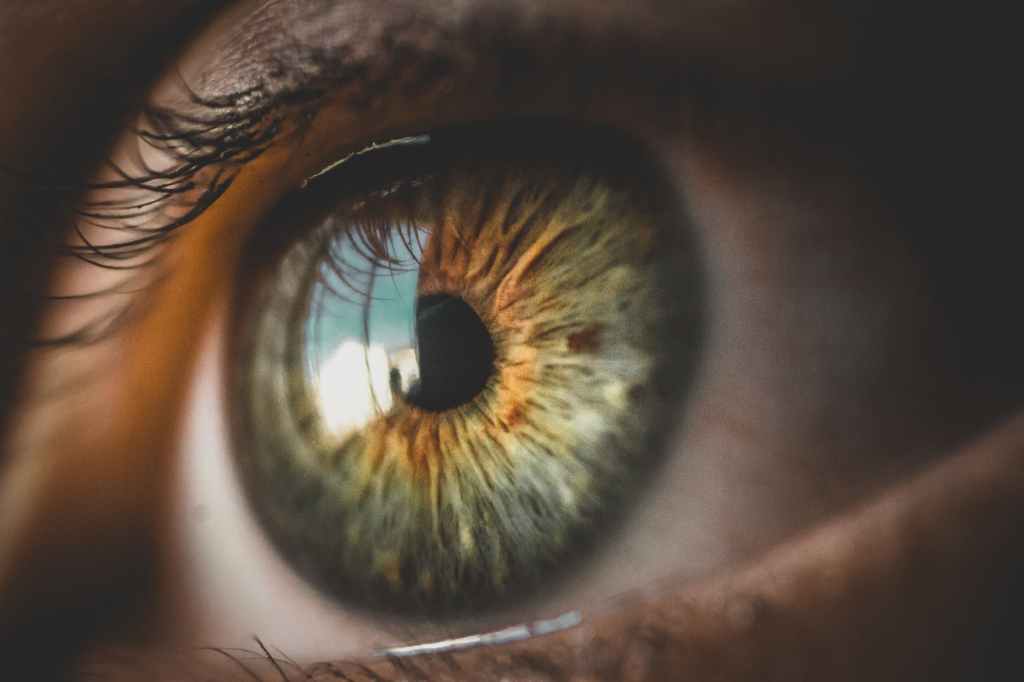
human green eye reflecting building and blue sky
Photo by Bruno Henrique. If you’ve gotten this close to someone’s eyeball, you’re probably doing eye contact wrong. :3
Eye Contact and Mental Static

Eye contact is a subject that often becomes a focal point for “correct” communication. The rough summary is that you should spend about 85% of a conversation looking at the other person or people. The remaining 15% you can spend looking at the scenery or whatever else. Looking at the person speaking allows you to get additional information from their face and body. Seeing how others in the conversation react can likewise give you valuable information about how you’re expected to act and react. In theory, there’s no reason you wouldn’t look at the person or people you’re talking to.

The thing is, looking people in the face is hard. It’s a lot of information all at once. If an autistic or other neurodiverse human is already struggling with information overload, demanding that we look at others directly is not helpful. It’s cruel and counter-productive. Not only are we still going to miss the information conveyed by a person’s face, but we may also miss even more than usual because of the additional overload.

Some people describe looking others in the face as adding a layer of static into their brains. It can cause them to miss words or phrases or even entire sentences. That’s comparable to being hard of hearing in quality-of-life terms. For me, it’s more like being hit on the side of the head with a baseball bat. The more familiar the face is and the better I’m doing that day, the softer the mental impact is. Still, I don’t typically make eye contact with people in the grocery store, even if I’m talking to them directly. I’m sure that bothers them to some extent, but it’s not worth the mental pain and exhaustion to me.

The Kicker

What really tickled my metaphorical funny bone about this article was the fact that otherwise “normal” humans have this same behavior pattern. Teenagers (ages 10-19) and older adults (ages 60-80) show this exact same avoidance of eye contact and faces.

I’m honestly uncertain as to whether the reasons for that behavior are the same as our autistic reasons, but they could well be. Teenagers are typically dealing with both an influx of hormones and a massive expansion in social requirements and feelings. Therefore adding in the extra effort of looking people in the face might well constitute information overload. Older adults have to deal with the deterioration of their bodies, the passing of friends and family, and adjusting to the massive changes the world has gone through. These things, too, could overload a person.

And doesn’t it just figure, regardless of the reason… that the proposed solution the article gives is “obviously these people should pay more attention to faces!” And not something like adjusting communication expectations so everyone, autistic or not, can participate.

That’d be crazy, I guess. It’s not like most people can tell whether you’re looking their eyes or their mouths… oh, wait. They can’t.

(Pst! If you like seeing the latest autism-relevant research, visit my Twitter! There are links and comments on studies that were interesting, but didn’t get a whole Reading the Research article about them.)

Reading the Research: The Autism Service Cliff

Welcome back to Reading the Research! Each week I trawl the Internet to find noteworthy research on autism and related subjects to share with you. Along the way I discuss the findings with bits from my own life, research, and observations.

Today’s article serves as an introduction to the autism services cliff. This is what people call the sudden drop-off of services after the autistic person graduates or ages out of high school. You see, there are typically a lot of therapies and services offered through schools. Things like a one-on-one aide, or speech and language therapy, or occupational therapy are typically managed and implemented by the school.

Take the school out of the equation, and the autistic person is left with nothing, or almost nothing. Because of this sudden loss in services, autistic people often struggle at the transition between high school and adulthood. Some autistic people, like me, still manage to land on our feet. Others try very hard but still don’t succeed in the long term. The parents I’ve spoken to often talk about failed attempts at college, or long strings of jobs held for only a month or two. It’s not all stories of failure and crushed hopes and dreams, but there’s certainly enough of those to dishearten someone quickly.

This autism services cliff typically strikes between ages 18 and 26. Like a lot of things in the US, the maximum age someone can stay in school varies by what state you live in. In my home state of Michigan, that age is 20. Even before that age, though, the difficulties can begin with the loss of child Medicaid.

Transitioning to adulthood doesn’t necessarily mean losing Medicaid for good, but the requirements are significantly different. The rejection rate is very high. When you apply, bring a great deal of perseverance and the expectation that you’ll need to try at least twice. Neatly organized documentation of the disability and the need for services across years of the person’s life helps a lot.

This is why a Medicaid waiver, such as the ones mentioned in this article, can be so valuable. They can continue the autistic person’s Medicaid services into adulthood without disruption. Keeping these autism services and structure over the transition to adulthood can be incredibly helpful to an autistic person’s wellbeing. But even beyond direct services and Medicaid, a lot of structure is simply lost after you leave school. You can’t count on the easy exposure to groups of your peers any more. Nor is there usually free transportation to activity hubs with a variety of options. And now you need to both find and pay for sports facilities and other programs.

The only comparable organization is church. Like schools, churches can offer structure and groups of peers. Some churches offer small group Bible studies or household groups. Some churches may have simple sports equipment, such as a basketball hoop, or a field in which a pick-up group might play soccer or frisbee golf. If nothing else, a church can be a place for autistic people and our families to find structure, activities, and community.

Personally, I’d like to see a universal healthcare replace Medicaid. One of Medicaid’s typical features is the requirement that the receiver be painfully poor. Working part time at minimum wage can be enough to disqualify you, depending on which state and program you’re in. I don’t know if you’ve noticed, but part time jobs, even those that pay above minimum wage, are rarely enough to live on.

Instead, I’d rather have a healthcare that provides for everyone. If a family needs respite care, they should have it. If an autistic person needs help making a schedule or getting a job, that should be available. I don’t feel like we should make people present 20 pages of documentation to prove their need. That’s just another way of punishing people for existing. It doesn’t make the need go away, it just makes the person suffer for having the need.

Personally, I think punishing people for existing is pretty much inexcusably evil.

(Pst! If you like seeing the latest autism-relevant research, visit my Twitter! There are links and comments on studies that were interesting, but didn’t get a whole Reading the Research article about them.)

Reading the Research: The Real Link Between Violence and Mental Illness

Welcome back to Reading the Research, where I trawl the Internet to find noteworthy research on autism and related subjects, then discuss it in brief with bits from my own life, research, and observations.

Today’s article merited underlining simply because this link is still, after all this time, misunderstood over and over.  I’m tired of seeing it, so here’s the truth.  There is, in fact, a link between mental illness and violence.  But it’s not what people think.  
 
People with mental illness (which often includes autistic people) are far more likely to be the targets of violence.  We are not the perpetrators.  The perpetrators typically people without diagnosed disorders.  To quote the article: “The large majority of the perpetrators of violent crimes do not have a diagnosable mental illness, and conversely, most people with psychiatric disorders are never violent,” Dr. Swanson writes.
 
Popular culture and the news seem to desperately want to play pin-the-tail-on-the-donkey with mental illness when some new violent horror pops up.  Because people always want to know “how could this happen,” but never want to consider that it might be because we\’ve been strangling social services for decades, or because the US has so many more guns per person than other Western nations.  They seem to want a nice, safe “it was something specifically wrong with this one person” answer so nothing has to change and we can all move on with our lives.  
 
As any idiot could tell by paying attention, these quick, individualized theories have had no useful effect in ending violence in schools, churches, and against marginalized people.  If it’s not the police shooting a black woman in her bed (or any number of other murders), it’s attacks against US citizens of Asian descent, or the painfully numerous school shootings (including three in 2021).  
 
The suggestion that mental illness might have been involved with violent perpetrators’ motives for their horrific actions is nothing more than victim-blaming misdirection.  It’s much like how some awful humans seem to think that wearing certain clothes is “inviting sexual assault,” as if adult male humans are toddlers with no self control who can’t possibly be expected to answer for their actions.  
 
So the next time you see a news article on the latest school shooting or hate crime, and the author suggests mental illness might have been involved, please recognize it as the gaslighting, red herring bullshit that it is.
People with mental illnesses are the victims of violence, not its perpetrators.  Blaming the victims solves nothing and helps no one.
 
(Pst! If you like seeing the latest autism-relevant research, visit my Twitter, which has links and brief comments on studies that were interesting, but didn’t get a whole Reading the Research article about them.)

Reading the Research: Autistic Sociability in a Pandemic

Welcome back to Reading the Research, where I trawl the Internet to find noteworthy research on autism and related subjects, then discuss it in brief with bits from my own life, research, and observations.

Today’s article has a bit of a skewed view on what likely happened, but presents some positive information I’d like to highlight.  This article comes to us from a university in Spain.  While that’s certainly not the US, it is still a “Western” country with some of the same cultural values and similar home/work patterns.  

The TLDR (Too Long; Didn’t Read) is: autistic kids, and their families, did much better than expected during the COVID 19 lockdown.  These families even improved their communication over the course of the lockdown.  I say “families” rather than focusing specifically on the autistic children, because communication is a two-way street.  Autistic people communicate.  We just don’t always communicate in words.  

This article doesn’t say the transition wasn’t difficult on the families and the autistic children.  The pandemic destroyed or massively altered regular routines, which is very hard on people that rely on those routines for comfort and safety.  That\’s autistic people, and others that struggle with regular life.  Things were also more difficult because support services for the autistic children were not available, or were less available.  Educational options were minimal or nonexistent as well.  So initially, things became more difficult for families with autistic members. 

However, in the long term, as new routines were established, the autistic children and their families thrived more.  The parents, often unable to go to work, spent more time at home, interacting with their kids.  With the additional interaction and attention, the autistic children thrived.  Or put another way: with more social interaction with people they love and trust, autistic people thrived.  

The last thing I want to underline from this article is this: autistic people are often stereotyped as not being social, not caring about others, etc.  This study specifically states that these autistic children were calmer and happier when they were able to use the Internet to see their distanced grandparents, classmates, and other family members.  In other words, autistic people were also happier being social and seeing people they cared about.  

In other words, yes, we are just like you this way- diagnosis or no.  

(Pst! If you like seeing the latest autism-relevant research, visit my Twitter, which has links and brief comments on studies that were interesting, but didn’t get a whole Reading the Research article about them.)

Reading the Research: Supportiveness

Welcome back to Reading the Research, where I trawl the Internet to find noteworthy research on autism and related subjects, then discuss it in brief with bits from my own life, research, and observations.

Today\’s article showcases what I wish every person had.  Especially autistic people, but just in general, too.  

Depression is a part of normal life.  Typically people will experience a couple months of it here or there, when someone they love dies, or a major life change happens… like, y\’know, a worldwide pandemic that mandates staying away from other people as much as possible.  

In most cases, people recover from depression in a few months.  Sometimes, though, the emotional burden is great enough that it doesn\’t.  Or toxic substances, like mold or allergens, cause systemic inflammation, which in turn causes lasting depression.  There\’s a lot of reasons a person can end up depressed.  Autistic people tend to suffer depression at a much higher rate than the general population, in part due to how poorly designed the world is for us.  

In these all cases, the focus is typically on the depressed person to make changes and improve.  Pills may be prescribed.  Changes in diet, in activity level, and in location might be suggested.  Therapeutic services might begin.  New habits might need to be established, and new patterns of thinking or talking.  All of these things can be helpful in recovering from depression.

What\’s not typically considered is the effect of the other people in the household on the depressed person.  So it\’s good to see this article, which shows us a path that others can take to help people with depression.

While the article focuses on significant others (mainly spouses), I have no doubt significant results would have been found if they\’d decided to study depressed children and these behaviors in their parents and siblings.   Having someone closely onhand who understands and will listen without being judgmental or taking it personally is invaluable to feeling supported and helping the person recover.  

There are certainly some people who are naturally better at these listening and supportive behaviors than others, but it\’s all behaviors that can be learned.  I wish it was taught in schools, so everyone would know how to be supportive and kind to people with mental illnesses.  That\’s not just autistic people, after all.  Everyone would benefit from that learning.  

(Pst! If you like seeing the latest autism-relevant research, visit my Twitter, which has links and brief comments on studies that were interesting, but didn\’t get a whole Reading the Research article about them.)