WYR: Nonverbal Communication

This is a link to a good piece about nonverbal communication (actually better termed nonspeaking communication): https://iancommunity.org/aic/neglected-end-autism-spectrum

There are a lot of means of communication besides speech. For example, a person’s posture, tone of voice, gestures, eye contact, and facial expressions are all commonly used alongside speech. However, these are normally overlooked. Many people consider them supplemental to the words used. Which is funny, because in my experience they’re sometimes even more important than the words a person uses. A simple change in expression or a particular tone of voice can change the whole meaning of a sentence.

But when it comes to autistic communication, the expectation is that words are the ultimate goal, and everything else should be ignored.

Perhaps you’re familiar with the above examples of nonverbal communication. Hopefully you recognize their importance. Something we don’t typically recognize, though, is that behavior is also communication.

Behavior as Communication

For example, refusing to do a thing is communicating something. It could be “I don’t like this thing.” Or it might be, “I am doing particularly poorly today, and rejecting this thing I normally enjoy should tell you this is important.”

The exact reason may be unclear, but the message needn’t be clear and precise to be a message.

The correct response to “challenging behavior” is not to punish the person. It’s to ask “why?” What might be happening with the person? Some example questions: Are they in pain (gastro-intestinal problems are common!)? Perhaps they’re frustrated because their communication isn’t being recognized or respected? Have you or they met all their needs? Are you presuming competence and intelligence when talking to them, or are you treating them like you would a small child?

It’s common, unfortunately, to treat nonspeaking people like small children. The presumption seems to be that since they don’t speak, they also don’t have the intelligence to speak. This is categorically false. The counter-examples are numerous. Off the top of my head, Naoki Higashida, the author of The Reason I Jump, is one. Another is D. J. Saverese, who starred in the movie Deej. Finally, there’s Owen Suskind, whose father wrote about him in Life, Animated. Each of these people struggled with typical speech despite being quite intelligent. Each found non-traditional ways to communicate.

Unfair Tests

Our intelligence-measurement tools typically limit us to only measuring people with near-fluent speech, which bars many nonspeaking autistic people from getting fair test results. For adults, there’s also the expectation that they can read. This isn’t always the case, and not even for the usual reasons. Autistic people sometimes also suffer learning disabilities, including dyslexia, tunnel reading, contrast or resolution impairment, and even environmental distortions. We might have 100% functional eyeballs, but the muscles that govern their movement might be uncoordinated. The words on the page might seem to flutter, wiggle, or shake rather than holding still the way they ought to.

Imagine this text shaking and blurring as you squint at it. Now imagine you have to look at textbooks every day for the rest of youre life. Is it any wonder autistic children can find school so miserable? Photo by Dario Fernandez Ruz
A Lifetime of Growth

It is fashionable, in the world of autism therapy, to push for therapy (especially Applied Behavioral Analysis) as early as possible in the autistic person’s life. There’s this sort of loudly unstated assumption that if you don’t get a person speaking before a certain age (6, I guess?), they may never speak at all. Leaving aside the incredible amount of abuse that typically accompanies an ABA program… this article, and many others, show us how false this assumption is.

Psychology itself has progressed past this incredibly backwards mentality decades ago. While we once believed that you truly couldn’t teach an old dog new tricks, the reality is that dogs of any age can learn new tricks. And humans of any age can learn new things. The term for this ability to grow and change over time is “neuroplasticity.” Neuro, like neurons, the nerve cells in your brain. And plasticity, like plastic: moldable, changeable, and shapeable.

Autistic people are people. Like any person, we have the ability to grow and change. Being autistic doesn’t change that. Not speaking fluently doesn’t change that. Communicating with a Picture Exchange Communication System (PECS) doesn’t change that. Nonverbal communication is just as valid as fluent speech, and sometimes far more powerful.

The question has never been “when will my child speak fluently?” It has always been “am I listening to what they’re telling me?” Because all humans communicate. Whether that’s with fluent language, a text-to-speech app on a phone, or simply pointing and smiling is irrelevant. Are you listening?

Book Review: Parallel Play

Parallel Play: Growing Up With Undiagnosed Asperger\’s, by Tim Page, is a \”my life with autism\” story from one of our older survivors.  The book mainly deals with his childhood, as the title suggests, and is written in the typical autistic conversational-explanational tone that so frequently graces our literature.  Mr. Page\’s prose is more polished than most, I would say, which is likely due to his many years of wordsmithing.  

I call this autistic generation The Lost Generation, personally, because few of these autistic people avoided institutionalization, and those that did typically suffered immensely.  Autism was simply not understood, let alone supported.  There was no community to which we could find advice from others like us.  No comradery and fellowship.  No support services designed to meet our needs.  

Those of us that survived without being sent to the destructive prison-institutions typically bear scars and unhealthy adaptations from the experience.  Depression and anxiety are common.  For this author?  One of those unhealthy adaptations is a fixation on death.  This isn\’t uncommon for autistic people- anything can turn into a hobby or fascination.  Morbid subjects aren\’t unreasonable, especially when a close family member (such as the author\’s grandfather) dies when the autistic person is young.  

In the author\’s case, there are no gory details to be had.  His interest in the subject included a much-heightened fear of death and interests in deceased authors, musicians, and silent films.  I suspect this book would be quite a nostalgia trip for an older person, especially one that grew up in the Northeast US at around the same time.  In that sense, I am very much not the target audience.

One thing is painfully consistent regardless of generation, though.  The pain of living in a world that constantly misunderstands and willfully rejects you is clear throughout this book.  You can see this same pain in Liane Holliday Wiley\’s writing.  Both Tim Page and Liane suffered immensely, and neither of them had any kind of fellow autistic community.  They were simply alone, and found their way as best they could with other misfits.  

Another painful echo found in this book as well as other autistic accounts was perhaps summarized best by Jennifer Cook O\’Toole: \”How can I be so smart, yet so stupid?\”  Tim Page mentions scoring well on IQ tests (though no specific numbers) a couple times in the book, and inevitably with those mentions also comes a certain disbelief, and the suggestion that his father might have tampered with the results.  I certainly have no special insight into that suggestion, but I suspect Mr. Page, like many people, operates on the idea that IQ is somehow a blanket score for intelligence.  

I strongly suspect I will go blue in the face before I ever finish convincing people that no, it is not.  IQ is a measure of how well a person is likely to learn in a typical school setting, using typical teaching methods.  It does not account for learning disabilities.  It does not cover common sense, emotional intelligence, musical ability, hand-eye coordination, and social skills.  It\’s a highly restrictive scale that should only be considered useful in highly restrictive settings.  But because of the value people place on it, a person with a high IQ score is assumed to be good at all these other things.  When they turn out not to be, disappointment is about the kindest response I\’ve seen.  Rejection, disbelief, and avoidance are significantly more common.

This aloneness and rejection tends to breed a mindset of \”I don\’t fit in and it\’s my fault.  If only I wasn\’t so ____, I would have friends and be happy.\”  This sense of being wrong and bad is pervasive.  I should know: a part of me still believes that even though it\’s definitely unhealthy, bad, and just flat-out wrong.  It\’s the same poisonous mindset as believing that I can\’t be beautiful because larger women can\’t be beautiful (except for every other larger woman, because obviously the beauty industry is manipulative and horrible).  

It\’s exactly these kinds of experiences that make it worthwhile for me to step forward and identify myself as autistic.  Simply knowing \”there\’s someone else like me\” is a massive relief and boost to quality of life.  It\’s why representation in the media, especially genuine representation, is so important.  Parents do better knowing autistic adults, because it gives them a picture of what their kids might grow to be.  Autistic kids can receive that same benefit, but they also can gain courage to be themselves.  Also strategies and insights they might never have had themselves.

In short, they can have the things I never had, and hopefully be healthier and happier humans for it.  We march to our own drums, we autistic people.  Each of us stunningly unique.  One day I hope that uniqueness won\’t contain a rainbow of trauma as a given.  

Read This Book If

You want to experience a vivid slice of life narrative from an autistic man who grew up in the 50s and 60s.  They were a remarkably different time, those days before the Internet came to everyone\’s phones, computers, and homes.  This era wasn\’t my era, but I think there\’s value in knowing what life was like before the modern one… and in knowing the stories of the Lost Generation, perhaps find something of ourselves.

Worth Your Read: Autistic Meltdowns

http://www.thinkingautismguide.com/2021/05/its-never-just-sandwich.html

Autistic meltdowns are one of those things we all wish didn’t happen. They’re about as much fun as being tied to a railroad track and watching the train rush you at high speed. Nobody wants to melt down. It just happens.

There’s a lot of reasons why. We autistic people live in a world not designed for us. It’s noisy, and full of distractions. The way we communicate isn’t recognized or respected. We’re told, directly and indirectly, that it never will be unless we communicate exactly as everyone else expects. Our coping mechanisms (like stimming and unusual hobbies) are vilified and punished.

We develop comparatively rigid habits and preferences as a result of this unfriendly, unfair, and frustrating world. It’s a way of making a small part of the world more friendly. Small things, at least, can be designed for us. When those small things are violated, it’s upsetting. It’s really less about how the sandwich is cut. Rather, it’s about having that small thing we relied on to keep us sane taken away. Typically, our reliance on that thing is belittled on top of the violation, which only hurts and stresses us more.

Autistic meltdowns are what happens when the body and mind get too wound up from the stress, anger, and frustration. It’s never just one thing. It’s never just a sandwich cut the wrong way, or a flickering lightbulb, or one person being rude for no apparent reason. It’s all about how much we’re already putting up with.

person on watercraft about to go over waterfall- how it can feel to experience an autistic meltdown
Autistic meltdowns sometimes feel like going over a waterfall and hoping there aren’t rocks at the bottom. Photo by Jacob Colvin.
An Overall Burden

It’s the last metaphorical straw on the metaphorical camel’s back. Or, a more solid comparison might be the first World War. The war began after the Archduke Ferdinand, the heir to the throne of the Austro-Hungarian Empire, was assassinated. If you ask most historians, they will tell you this incident was the spark for the World War. But it was not why the war began.

There was, in fact, a great deal of tension between the European countries at the time, as well as an ongoing arms race and some smaller conflicts called the Balkan Wars. The Archduke’s assassination did not cause these circumstances. Rather, it was likely the opposite. Because of all the circumstances around the assassination, the repurcussions devolved into the largest war the world had ever known.

This building of tensions, with specific incidents that paved the way, is very much how I experience meltdowns. Except the incidents are much less notable than an arms race and the Balkan Wars. They’re less notable because they happen every month, every week, sometimes even every day. In small but meaningful ways, the world and the people around me cause me suffering, and that suffering builds up over time.

Personal Examples

In my own life, it’s things like my spouse leaving piles of dishes in the sink for a day straight. (This is either because he doesn’t see them, or because when he does, we’re just heading out the door.) It’s ducks cackling loudly at 2am or landscaping machinery at 7am, waking me from badly-needed sleep. It’s trying to have a conversation with someone, only to see them giving you the “what a weirdo” look or being rude for no particular reason. Or someone choosing to pull their mask off their face indoors mid-pandemic, essentially saying that their personal choices are more important to them than other peoples’ lives.

It’s babies screaming because they’re hungry or wet or suffering some kind of sensory overload themselves. It’s stupid store policies that demand their employees greet every customer at the door whether they want to or not. (These add an extra, very unwanted, social interaction I don’t want to handle and don’t know how to handle to every shopping trip- ugh.) It’s even stuff that’s really only my fault, like people I vaguely know greeting me by name and the ensuing panic attack when I realize my face blindness has once again screwed me over- I have no idea what their names are.

Maybe most lastingly, it’s painful miscommunications between me and people I love. Things that turn into boomerang memories. Stuff that sticks with you just to torment you later. Words people can’t or won’t say to you because you were supposed to know already, and didn’t. Uncommunicated expectations, like criteria set up specifically to make you fail. Family and friends that turn away from you. Assumptions about what you meant, all while they ignore what you actually said.

Inescapable

And over all of it looms the indelible knowledge that all these misunderstandings are your fault. Even though they’re not: the research shows us that autistic people interact just fine with other autistic people. Communication is a two-way street. If neurotypical people were truly so wonderful at communication, they would have no issue making themselves clear to autistic people, and the problem would only be autistic people communicating back. But that’s not how it is. The communication failure is on both ends.

This failure on both sides is a known fact. But in the same way we’re told that women can’t be beautiful unless they’re impossibly thin, the people and systems around us insist that every failed interaction is the autistic person’s fault. That everything would be fine if autistic people just disappeared. It’s hurtful, painful, and for many of us, inescapable. Like the ridiculously unhealthily thin standards of beauty for women, and the impossibly chiseled abs on male models (achievable only by being dehydrated for days at a time), this toxic mentality becomes internalized.

With all of that hanging over us, it’s no surprise that it all becomes too much sometimes. And we haven’t even started adding in the things that typically stress people out, like paying bills, job hunting, commutes, any form of public speaking, or other large life events, like moving, the death of a family member or friend, or living in a global pandemic.

Autistic meltdowns are a natural reaction to the building stress of living in a world not designed for us, among people that don’t understand us and often won’t try to. Punishing us for having them solves nothing. Yelling at us only makes them worse. Instead, please recognize why we’re upset. Don’t get angry or defensive or upset with us. As the article’s author says, a dark room, a cool drink, and clear, simple communication are your best bets.

Book Review: Asperger\’s Syndrome: Helping Siblings

The Visual Guide to Asperger\’s Syndrome: Helping Siblings, by Alis Rowe, is a plainspoken children\’s book-sized publication focused on helping parents help siblings of autistic people adjust and thrive.  I found this book in the autism section, not the children\’s section, but it\’s pretty clear from the font size and pictures where it\’s meant to go.  At less than 100 pages in large sized font, it\’s not a long read. 

I picked it up anyway because this is a vastly under-served and under-recognized need.  There are hundreds, if not thousands of books geared towards educating parents and professionals.  Even books specifically focused on other autistics, often written by the same.  But very little has been done to help siblings of those on the spectrum cope with, say, the resentment of regularly being overlooked in favor of handling the autistic child\’s special needs.  

Sometimes, in the stress of everything that has to be done to manage the finances, support services, and even themselves, parents miss things.  These things can include their own self-care and wellness, and it can also include making time for doing things with just the sibling(s).  This is entirely understandable- after all, every autistic child is different, so there is no one \”do this and everything will be fine\” guide.  Children are already challenging, even without factoring in unusual developmental patterns and the need for support services, specialized learning, etc.  

Though all this happens unintentionally, it can be really hard on the neurotypical sibling(s).  Anger, embarrassment, jealousy, and frustration are common.  If autism isn\’t well-explained to the child, confusion and misunderstandings about why the autistic child is treated differently may result.  

This book tackles the job of pointing out common pitfalls as well as providing answers and suggestions as to how to address each problem.  It lists and addresses specific concerns and feelings a sibling might have, which I thought was useful as well as enlightening.  

One thing I particularly appreciated was that the book spends time explaining the difference between a tantrum and a meltdown, which is an exceptionally important concept for family to understand.  For the unfamiliar: tantrums are goal-oriented.  The person throwing the tantrum wants the attention, or wants something (like candy, ice cream, a toy, etc), and when that want is met, the tantrum ends. 

Meltdowns, on the other hand, are a response to overstimulated senses (like loud environments) or other adverse circumstances, and only end when the person has calmed down.  The two behaviors look superficially the same, especially to someone unfamiliar with the person, but should be treated very differently.  

Read This Book If

You\’re a parent of an autistic child with at least one other, neurotypical child.  This is a tightly focused, easy-to-read book meant to guide parents in helping both their autistic child and their neurotypical child(ren).  It lays out important basics as well as very specific concerns and feelings a sibling might have.  At less than 100 pages and in large, easy-read font, this is a good starting place for a parent to begin with this important, often sidelined, subject.  

Getting Shot (With the COVID Vaccine)

April 5th was the first day in my state that the vaccine is available to the broader public (ie: not just the elderly and healthcare staff).  Thanks to the diligence of a friend, I was able to get an appointment at a downtown clinic for that exact day.  

I had only about a week\’s notice, so I tried to spend the time preparing my body for the panic attack the vaccine would be inducing.  Unfortunately, my poor mental health also had an opinion, and so I was only partially prepared for the injection.  

The ideal would have been to have a month to prepare, with regular light exercise, plenty of water, good nutritious food, extra Vitamin C every day, religious tooth care, and a steady dosage of the zinc-elderberry lozenges I use to prop up my immune system when I\’m sick.  

Instead, I probably achieved less than a third of those preparations in the week between getting an appointment and the day of the injection.  I\’m not a severely at risk human, and my immune system is usually pretty good at its job, but given what the actual virus can and has done to autistic people, I wanted to be very safe about it.  

I woke up that morning feeling anxious and under-rested.  It was storming outside, with distant thunder to prod me awake about a half hour before I\’d normally get up.  I stayed in bed for a full hour out of protest.  But eventually I got up because I wanted to at least make an effort at being prepared for the day.  

I put on comfortable but stylish clothes, favorites of mine delivered by a shopping service.  Then a dose of vitamin C (1000 mcg, the usual daily limit).  Then, begrudgingly, brushed my teeth.  Good digestion (which affects your immune system) starts in the mouth, and brushing and cleaning between your teeth is very important.  The experience is still vastly unpleasant to me, though, and I haven\’t found a way to make it a positive experience yet.  

Next was chopping fruit and preparing green salads.  I\’d see my parents (both fully vaccinated) for lunch before the actual shot, and it wouldn\’t do to not be prepared.  I\’d been slightly adventurous this week in the fruit department: yellow dragonfruit and small yellow mangos accompanied a more typical European pear.  Thankfully my parents are supportive of my interest in diverse food.  

It was a bit of a crunch between lunch time and getting downtown to the vaccine clinic, but we managed to find parking (which was free, yay) in a parking structure just underneath the converted convention center.  We were given directions upon entering, which basically told us to text \”here\” to a particular number, and enter the building when texted back, or when our appointment time arrived.  Despite being 15 minutes early, we were immediately texted to go in.  

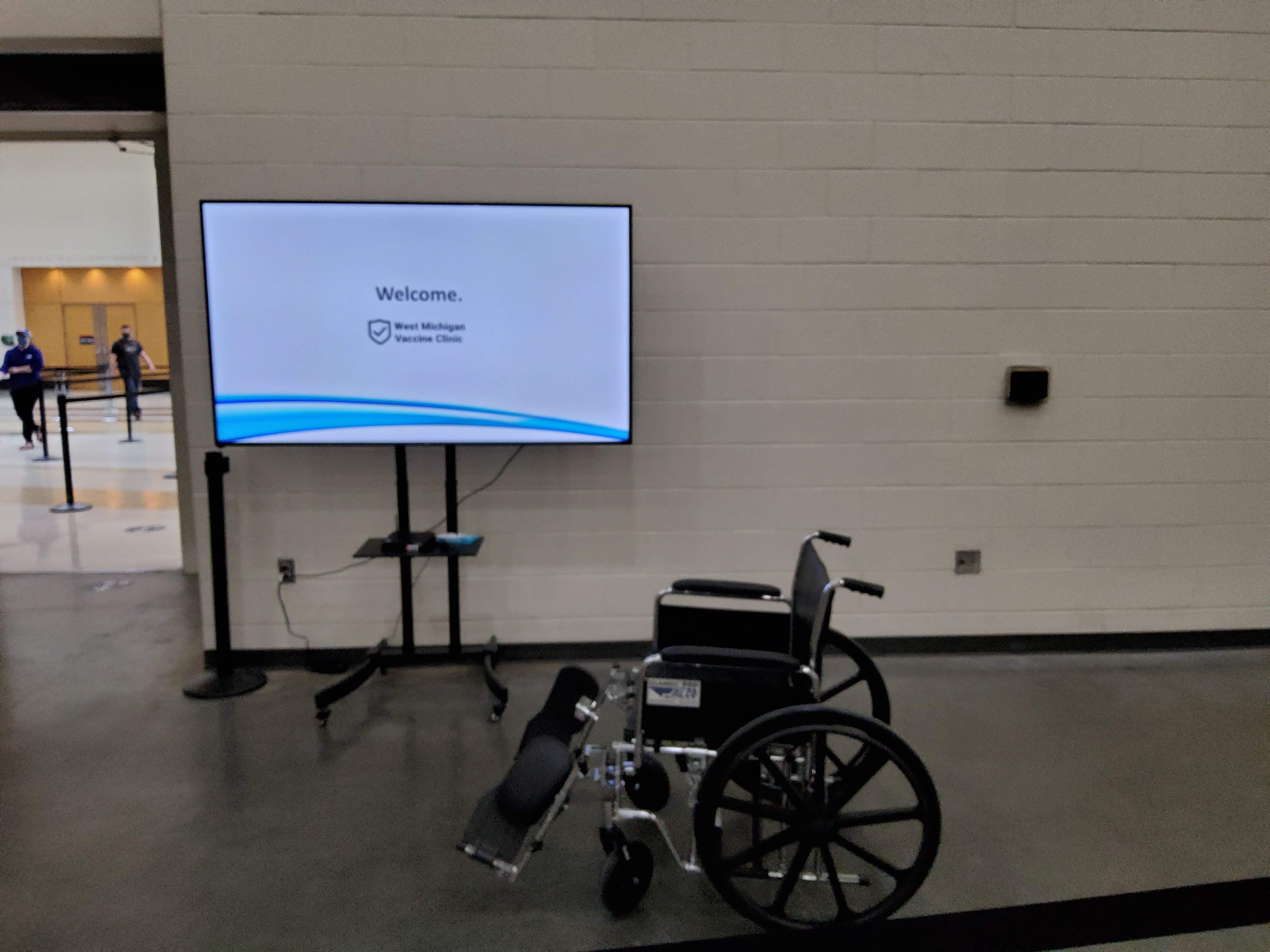
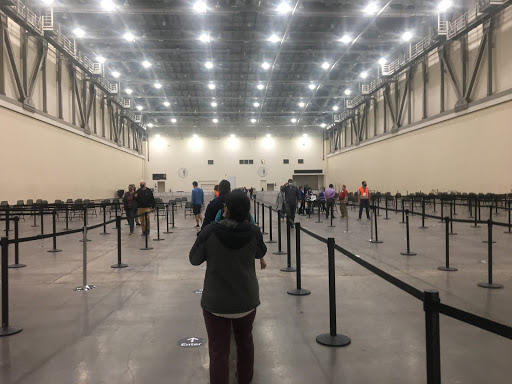
Upon entering the building, the first thing they did was check our temperatures with handheld forehead thermometers.  Since neither of us were running a fever, we were ushered in and offered hand sanitizer.  Once that was applied, it was down the stairs and into the convention hall proper.  Which looked like this:

Everything was very neatly laid out for maximum efficiency, with probably hundreds of volunteers politely guiding you in case the arrows and lanes weren\’t sufficient.  All the volunteers were, at worst, blandly polite.  Some were significantly more cheerful, and a few even thanked us for coming in.  There was no immediate sign of our friend, who we\’d planned to meet up with for the event.  

Mostly what I noticed was that it was very easy to go on autopilot and simply follow the clear signs, lanes, and verbal directions.  We later called this \”being in the flow,\” and I experienced it as something akin to being in a waking trance or a near-dreamlike state.  At every step of the way, you knew where you should be going and what you should be doing.  There was no need for conscious thought, because at the slightest uncertainty, there was immediately a staff member to tell you where to go.  

This actually made it rather difficult to take pictures, but I still did, because it\’s kind of a once (or twice, I guess) in a lifetime experience.  

Several friends of mine referred to this event as Vaccine-Con, which isn\’t the worst name for it, in all honesty.  It\’s definitely getting the foot traffic of a convention, and it\’s in a convention hall.  Seems fair enough to me.  The major difference is that the focus of this is health, and the focus of most conventions is making money.  

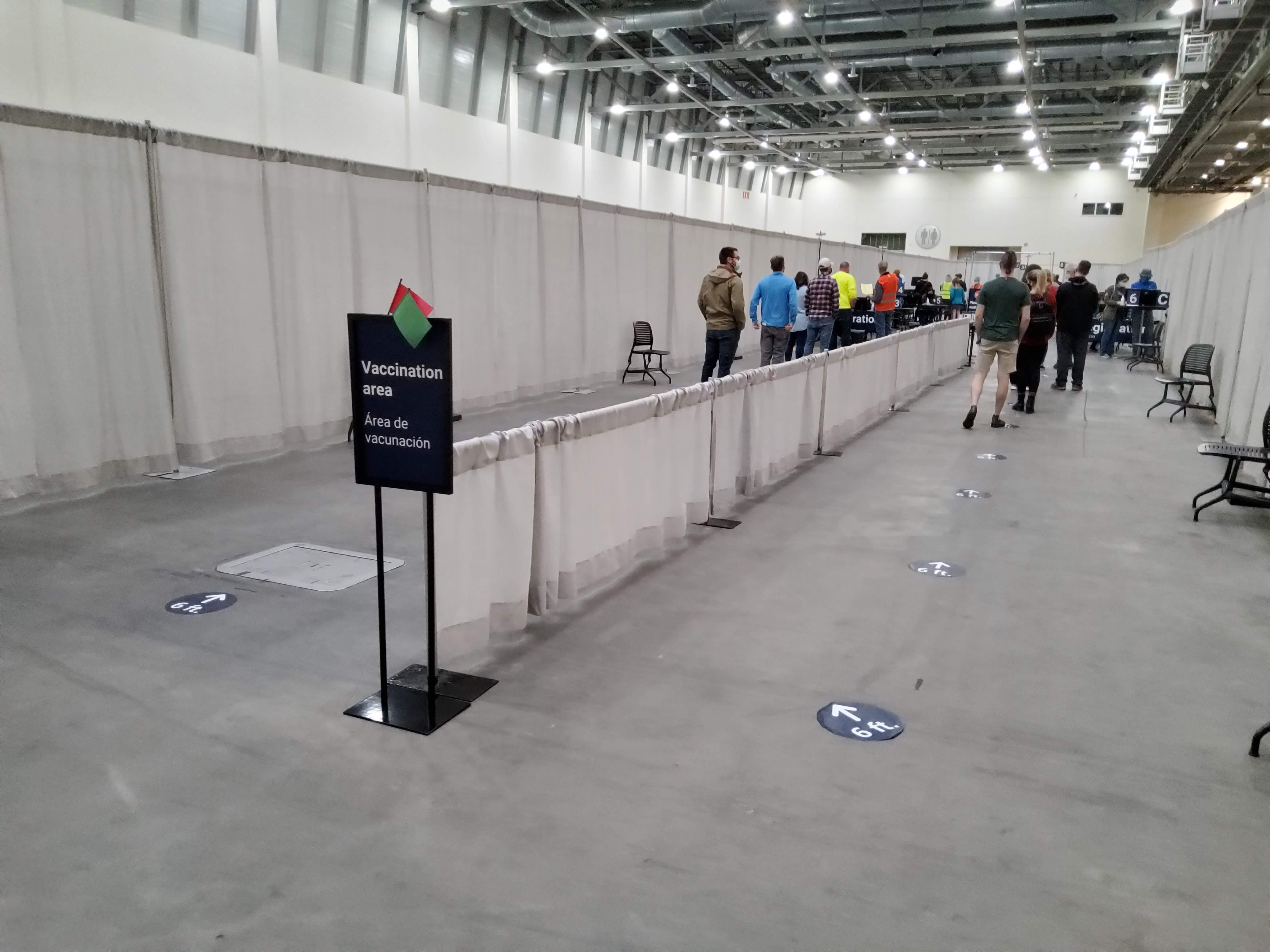
There were four lanes like this in the convention center.  Note the stickers placed 6 feet apart, the extra-wide hallways, and the open ceiling.  Also note the chairs placed strategically for people that don\’t do well standing in line.  In truth, we maybe spent like 10 minutes queuing, if that, but I can imagine the place being significantly busier at other points in the day.  Particularly with the previous eligible group, which was mainly comprised of the elderly.  

Getting to the front of the line afforded you this view, where a staff member would give you some short paperwork and have you sign in and verify essential details on the computer.  It took us maybe a couple minutes.

Once past the final registration, it was time to stand in line for a booth.  Each contained a nurse or someone trained in administering the shots.  The staff that gave us our first dose (Pfizer, one of the two mRNA vaccines) is named Kristin.  She seemed weary, but in reasonably good humor.  I\’d honestly assume there were hundreds of people before us, and maybe it was near the end of her shift.  At any rate, she checked our information and then gave us each our shot.

I went first.  I didn\’t look at the needle going into my skin, because there\’s no need to make the poor nurse\’s life any harder than it already was.  I did watch my spouse get his shot, though.  The vaccine liquid was perfectly clear, which was weird to me for some reason. I didn\’t even bleed, and barely felt the shot at all.  She gave us a bandaid and then we were on our way again.

I left the booth feeling jubilant (one step closer to being done with this pandemic!), but also a little fuzzy in the head.  My doctor tells me I\’m extraordinarily sensitive to changes in my system.  I have the ability to tell, based on the sensation in my stomach, whether something I\’ve eaten or drunk was alcoholic.  Same with painkillers, for some reason.  So it could be simply that I could tell my system was reacting to the \”invader\” vaccine.  Ooor it could be a trick of my imagination.  

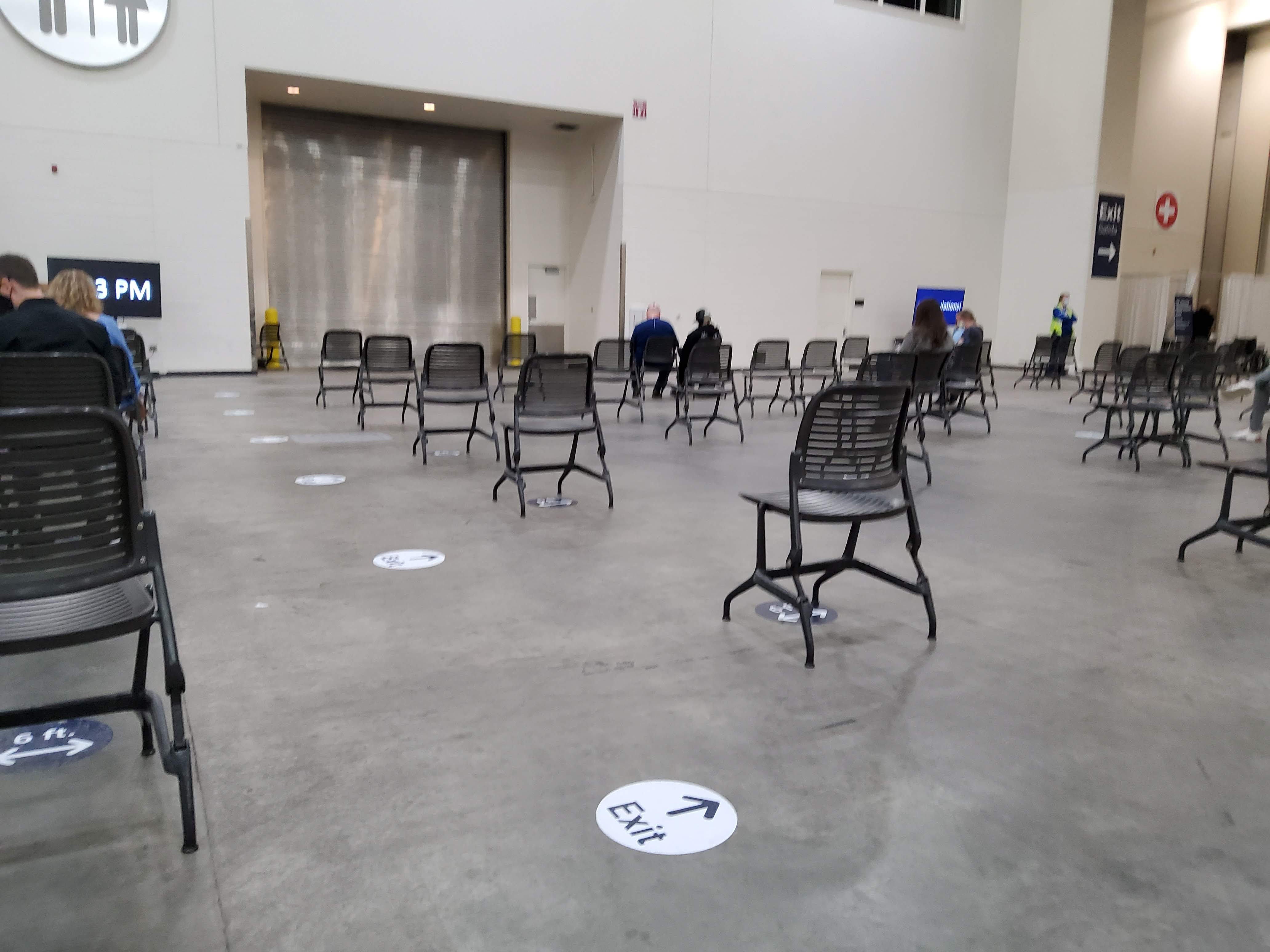
Either way, once the shots were done, it was time for the 15 minute cool-off period.  This was implemented because on rare occasions, people would go into anaphylactic shock after receiving the vaccine.  You really don\’t want that happening while the person is trying to drive home, or on a bus.  So instead they parked us in seats with a big clock to help us track the time.  Bathrooms were also available as needed.  

I\’ve tried to keep people\’s faces out of my pictures on account of not having their permission to appear in this blog, so you can\’t see the row of double-chairs for couples or pairs of friends that went together.  My spouse and I settled into one of those to wait out the 15 minutes.  It was a pretty uneventful wait, thankfully.  We did manage to meet up with our friend, and so we spent most of the time just chatting about whatever happened to be on our minds.  

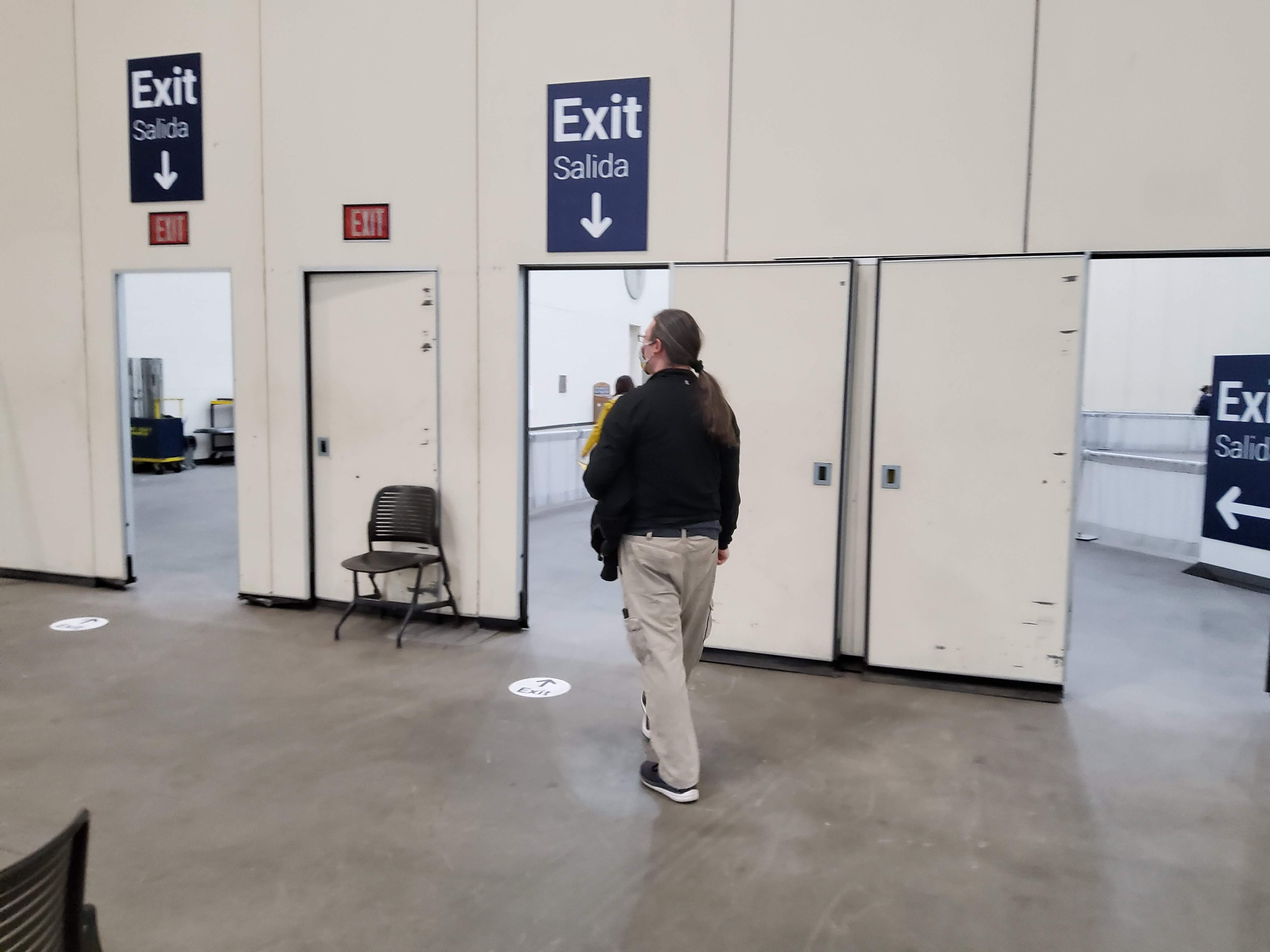
Once the 15 minutes was up, we followed the obvious signs (and verbal directions) to leave Vaccine-Con.  

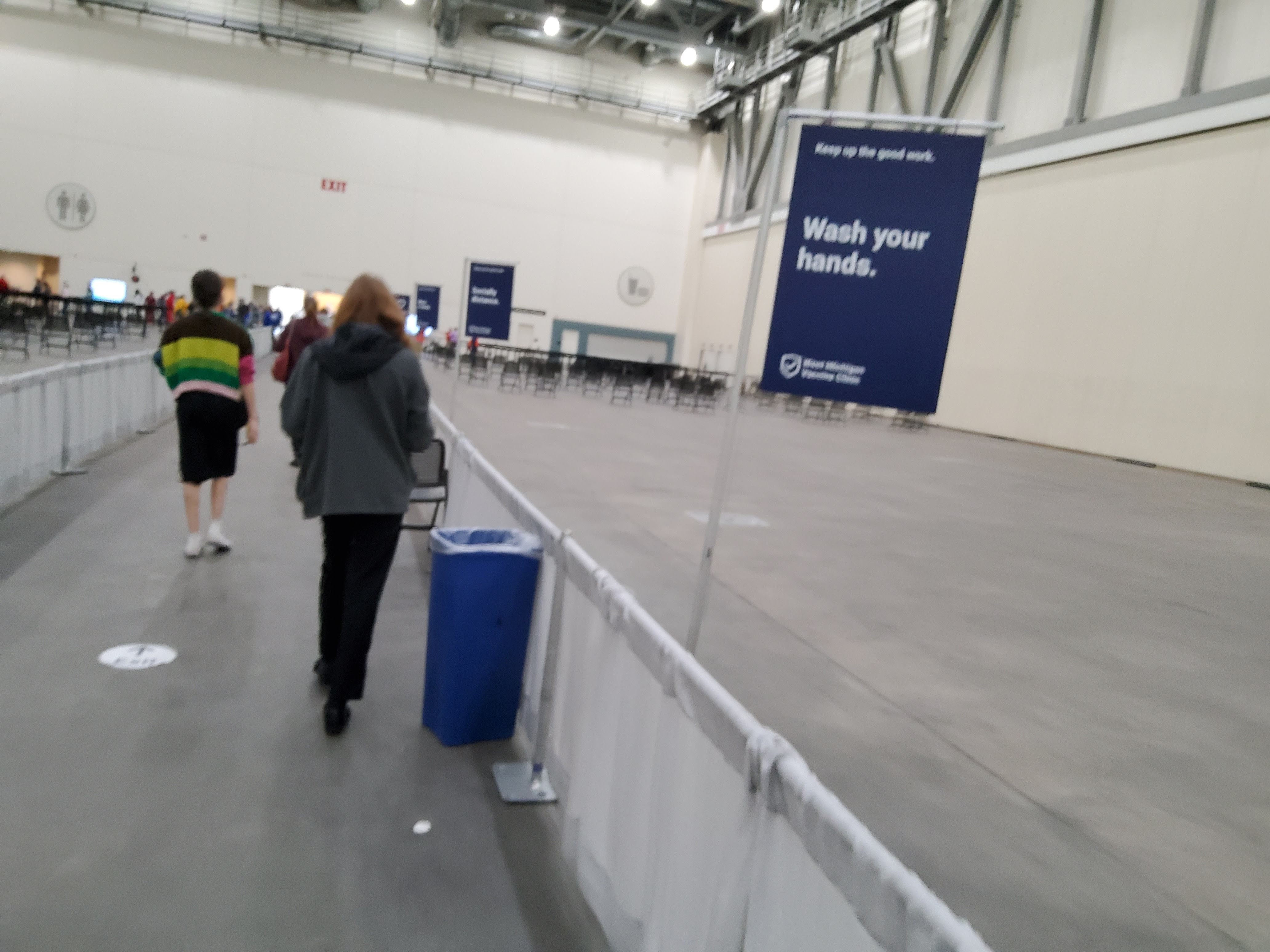
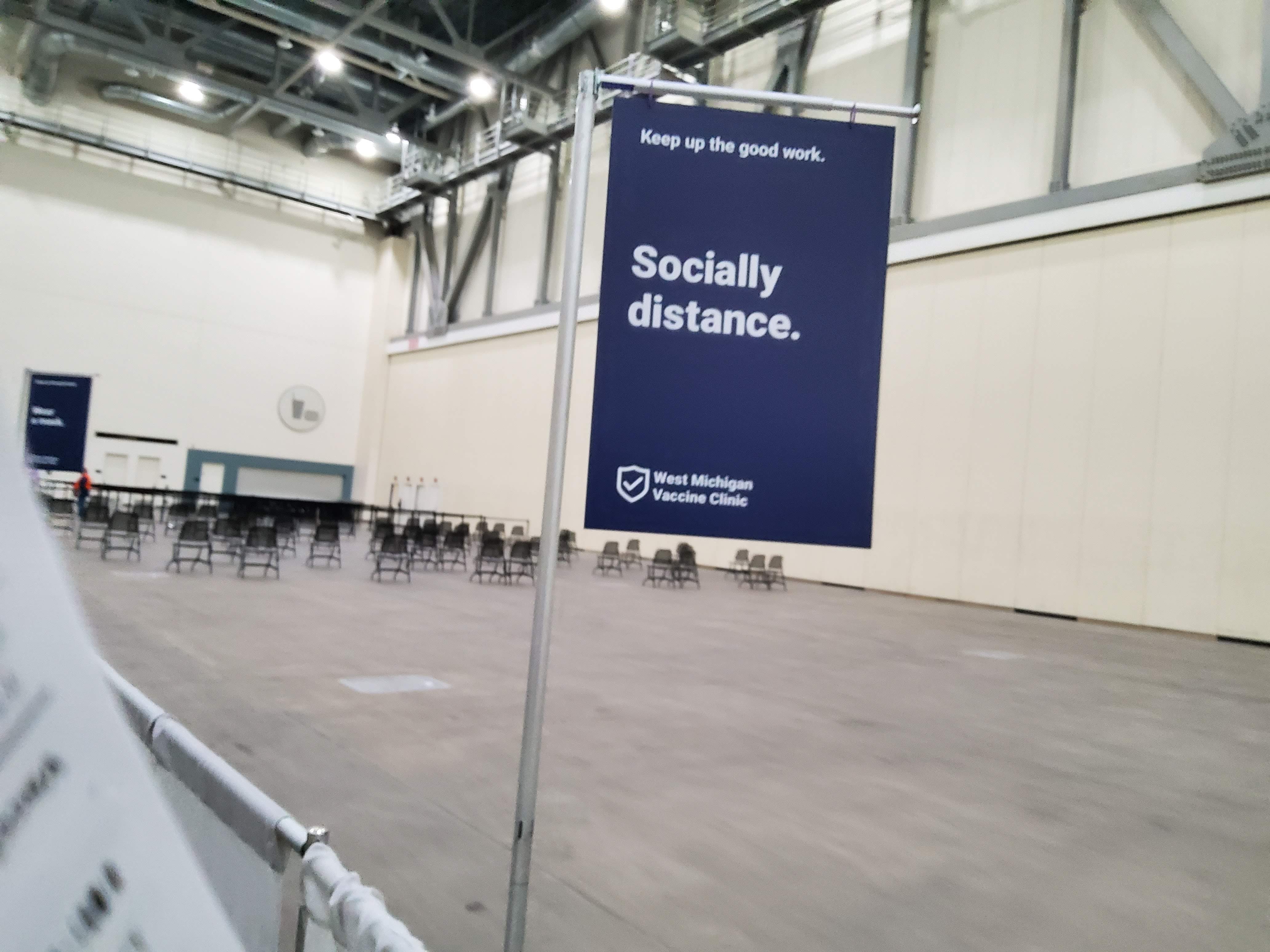
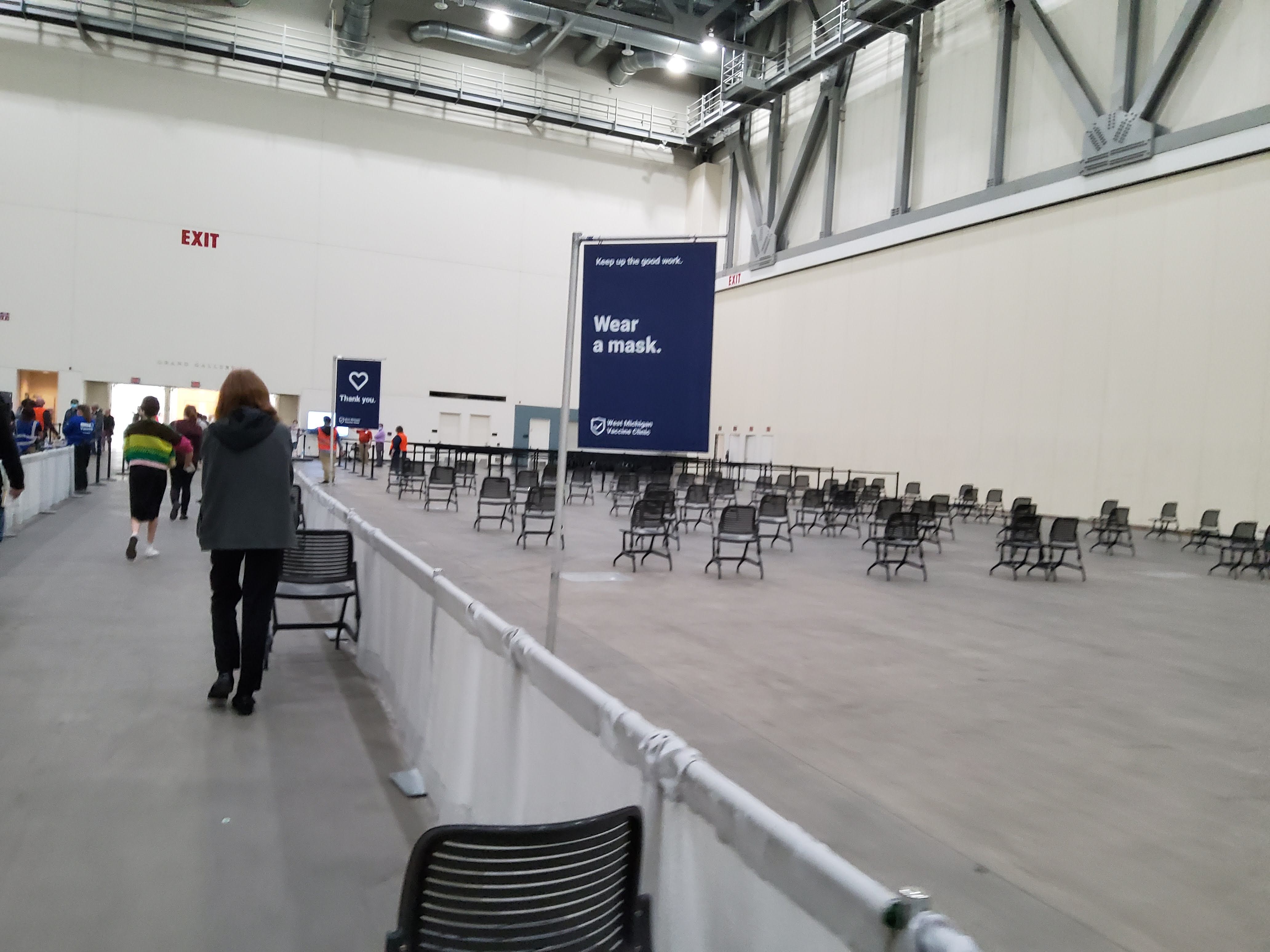
I can\’t begin to describe how big this place was… which I guess makes sense since it\’s a full-on convention center.  Still, as you can see, there was a lot of unused space.  We were lauded with various signs on the way out.  

The \”in the flow\” effect applied here, too.  My pictures aren\’t great because of that.  

From top to bottom, the signs read:
💗 You did it.
Keep up the good work.  Please remember:
Wash your hands.
Socially distance.
Wear a mask.
💗 Thank you.

I\’ll return here in about three weeks for my second dose, which we were able to schedule online within an hour of receiving the first dose.  

The side effects I experienced from this first shot were soreness, mind fog, malaise, and systemic inflammation, which I can now recognize as my neck being crickey-crackity, as well as swollen joints.  The inflammation could be treated with ibuprofen, though I opted not to this time since it wasn\’t that bad.  My spouse and friend only reported soreness in the arm.  

The second shot is said to be harder on the system than the first, so I may take that day off and just prepare to be dead on my feet.  It\’s either that, or I won\’t have symptoms at all, and I\’ll have a strong suspicion that I was an asymptomatic carrier sometime last year.  I can\’t decide which concept I dislike more, but thankfully I have zero choice in the matter.  Either I got it on one of the shopping trips I did during the pandemic, or I didn\’t.  

It\’ll still be two weeks after the second shot before I can really say \”I\’m safe and won\’t need to go to the hospital for this.\”  Even after that, it\’s still possible for me to carry the coronavirus asymptomatically and infect people who can\’t be vaccinated or refuse to do so. So I\’ll have to keep washing my cloth mask and expecting to wear it in the long term.  

Still, it\’ll be a relief.  Both for me and for the people that care about me.  

Worth Your Read: Saying "I Love You" Autistically

http://www.thinkingautismguide.com/2020/11/recognizing-how-autistic-children.html

It\’s strange, that in a world so full of different and diverse people, it can be so difficult to accept that others express simple sentiments like, \”I love you\” differently than you personally do.  

No human, myself included, seems immune to this fallacious assumption.  This author, Ann, has written a very short list of nonstandard ways autistic people might express love, which I\’d urge you to look over.  See if you can find one or two you personally display, or your loved one does.  

Having read the list myself, I would honestly say that I feel each of the four examples given actually falls within the \”Five Love Languages\” categories… it\’s just that they\’re so non-standard that they\’re not even recognized as such.  

The second situation, for example, with the autistic person downloading and presenting information they value to the loved one.  That\’s a form of the fourth love language, quality time together.  It\’s initiating that quality time, and ideally, the loved one shares in that enthusiasm and interest. Maybe not to the same extent the autistic person does,  but enough that the \”togetherness\” aspect is fulfilled.  

This behavior actually isn\’t specific to autism.  Requests for attention and a shared experience can be as simple as \”oh honey, look at that bird outside\” or \”did you see what happened in the news today?\”  Or they can be as large as \”let\’s go see a movie together\” or \”want to start a new TV show on Netflix?\”  It\’s the method of the request, not the actual category, that people don\’t seem to understand.  

The first and third situations are simply iterations of the golden rule: \”treat others the way you want to be treated.\”  Alas, the golden rule is far too simple when it comes to neurodiversity and the broadness of human experience.  A better version (that is harder to teach to small children) incorporates doing your best to treat the person well by their own standards.  

Most neurotypical people, naturally, have no particular issue with regular eye contact or small talk, and may even cherish these things as emotional \”togetherness\” signs.  So avoiding them is not received as the love it\’s meant to be, but as the opposite.  

Something the article didn\’t mention is that it\’s not unusual for an autistic person to say \”I love you\” once, and then never again, contentedly assuming their loved one knows this still applies because it\’s been said and not recanted.  Unfortunately, neurotypical people tend to require repetition to believe it.  Especially after an argument or upsetting event.  So this is another example of a miscommunication between autistic and neurotypical people.  

I can\’t remember, offhand, how affectionate I was as a child.  I would guess \”not very\” especially after I became a teenager.  I don\’t feel I was a very warm person, despite my strong sense of justice, fairness, and fiery temper.  That\’s changed somewhat since I\’ve been doing LENS and more traditional therapy, at least I think it has.  I feel more able to empathize and express concern for others in ways they receive.  

It\’s still difficult, mind.  The way people receive love and the way I tend to express it don\’t often match up.  I do okay with listening to people, since pretty much everyone likes to really be listened to with 100% of the listener\’s attention.  My brain doesn\’t typically give me a choice about the 100% attention thing, which comes in handy sometimes.  After that, though, it gets sticky.  

It\’s of some comfort to me that the Five Love Languages book and associated theory exists because neurotypical people don\’t get this right on a regular basis, too.  It feels to me like it\’s still somewhat well known in therapeutic circles, but less so in common knowledge now that it\’s not the latest hot trend.  

The last thing to say here is that yes, your child loves you.  Maybe they aren\’t expressing it in a way you receive, like the examples in this article.  Maybe they\’re suffering so much from medical issues like chronic pain or epilepsy that they can barely express their love.  But please, please don\’t convince yourself your child doesn\’t love you.  Listen to us.  Become curious about how we think and why we do the things we do.  I guarantee we\’ll make more sense if you do.  

Worth Your Read: An Autistic Experience with the COVID vaccine

http://www.thinkingautismguide.com/2021/03/getting-covid-19-vaccine-while-autistic.html

The COVID-19 pandemic has gone on for almost a year now.  While the vaccine rollout continues in the US, it\’s suffered from poor organization, and there is no centralized method to get an appointment.  Distribution varies by the state.  

In Michigan, I\’m told the best option is to wait until your group is eligible, and then sign up in as many places as possible.  Multiple pharmacy chains have supplies of the vaccine, as does the medical system (in my area, Mercy Health or Spectrum Health).  Sign up with every entity you can.  Just be sure to cancel your place on the waiting list with the others once you\’ve gotten your dose.  

At the moment, I\’m not eligible for a vaccine.  Last I checked, I\’m on the younger side of things and insufficiently medically vulnerable.  To my relief, though, my parents and my one remaining grandparent have all had their first and second shots.  

There will likely be boosters and such for the variants, but even having that baseline immunity in the ones I love is a great weight off my shoulders.  Like the author of this article, I miss giving and receiving hugs from my parents (and others).  

Regardless, this article describes one autistic person\’s experience receiving the vaccine.  It can be very helpful to know what to expect when going into an unfamiliar situation, and Kate, the author, does her best to describe it.  

Unlike the author, I\’m not rushing to get my vaccine.  I strongly believe in the importance of herd immunity and don\’t even slightly discount the importance of getting the vaccine ASAP.  I just happen to also be aware that sometimes testing doesn\’t turn up all possible side effects.  

Since my job does not involve routine contact with the public, and can be done from home, I have the privilege to wait a little longer to see if any interesting additional side effects turn up so I can be more prepared.  My hope is that the new style of vaccine, the mRNA variety, might truly be safer than the older style.  

Either way, my spouse and I hope to get the vaccine in the next half year or so, state and supplies allowing.  Until then, and probably after then, we\’ll continue to wear masks, wash our hands, disinfect surfaces, and self-isolate.  I can\’t wait for spring and the warmer seasons, though.  Staying inside all winter hasn\’t been good for me, and once it warms up I\’ll be able to forage for wild food and enjoy nature again.  

Worth Your Read: Doing More Harm Than Good

https://www.scientificamerican.com/article/has-the-drug-based-approach-to-mental-illness-failed/

The overuse of pharmaceuticals has been a common subject on this blog.  There is, however, a significant difference between me complaining about it in my personal life, and having good journalism backed up with statistics say the same thing.  

I can complain about the systemic treating of the symptoms, not the problem, until I\’m blue in the face, and I will be ignored.  In part because lived experience simply isn\’t valued when the source is a minority.  But also because people in power do need to look at the larger picture.  

The problem, of course, is that most mainstream media and scientific publications don\’t care to investigate this sort of thing.  Or if they do, they don\’t publish it.  And so the heavily flawed, \”pound of cure over the ounce of prevention\” system that feeds the unending greed of medical corporations continues unchecked.  

Actually, this interview goes one step further and suggests that many psychiatric medications don\’t even help some people in the short term, which is a rather disturbing thought. Effectively, people are being prescribed biology altering cocktails… for nothing.  

We know, of course, that not all kinds of depression respond to pharmaceuticals. The industry standard term for this is \”treatment resistant\” depression.  Which is both misleading and inaccurate, because the only treatment they\’re trying is pills.  Dietary changes, exercise, nutritional interventions, and basic therapy are ignored in this calculation.  

Which, if the person is simply suffering a massive lack of vitamin D (which can cause chronic fatigue and low mood climate, among other things), yeah.  No amount of neurotransmitter tinkering is going to fix that.  Going outside in sunlight on a regular basis, or taking a good quality vitamin D supplement will, though.  Speaking from personal experience here, in fact.  

I particularly liked the section in this interview regarding capitalism.  It says a lot in a very short amount of words, and all of it is right if you ask me.  Many of his proposed improvements are also excellent.  I hope you find this reading this interview as useful as I did.  

Grocery Shopping On a Special Diet: Frozen "Food"

Welcome back to my autism-aware shopping trip through the grocery store.  Week by week, I\’m showing you what the store sells, prune down the selection to what\’s safe for me (because autistic people can have very sensitive systems) and point out various gotchas the store tries to make you buy stuff you didn\’t come for. 

As a reminder, I shop with the following conditions in mind:

  • dairy-free
  • low sugar
  • avoid ultraprocessed junk
  • avoid food coloring
  • conditional vegetarianism
  • avoid high histamine foods
  • awareness of gluten-free options and sugar-free options
Last time we inspected the breakfast aisle and found it was full of sugar bombs, ultra-processed grains, and artificial colors.  Most typical US breakfast foods are a terrible way to start your day, and the very best cereal option wasn\’t even sold in this store.  
We\’ll now head into the frozen food section more thoroughly.  This a grocery store, so you\’d expect things like frozen vegetables, potatoes and bread, meats, maybe a few frozen appetizers for the overworked chef that still wants to spiff things up a bit.  
Well, buckle up.  This is going to be a trip.
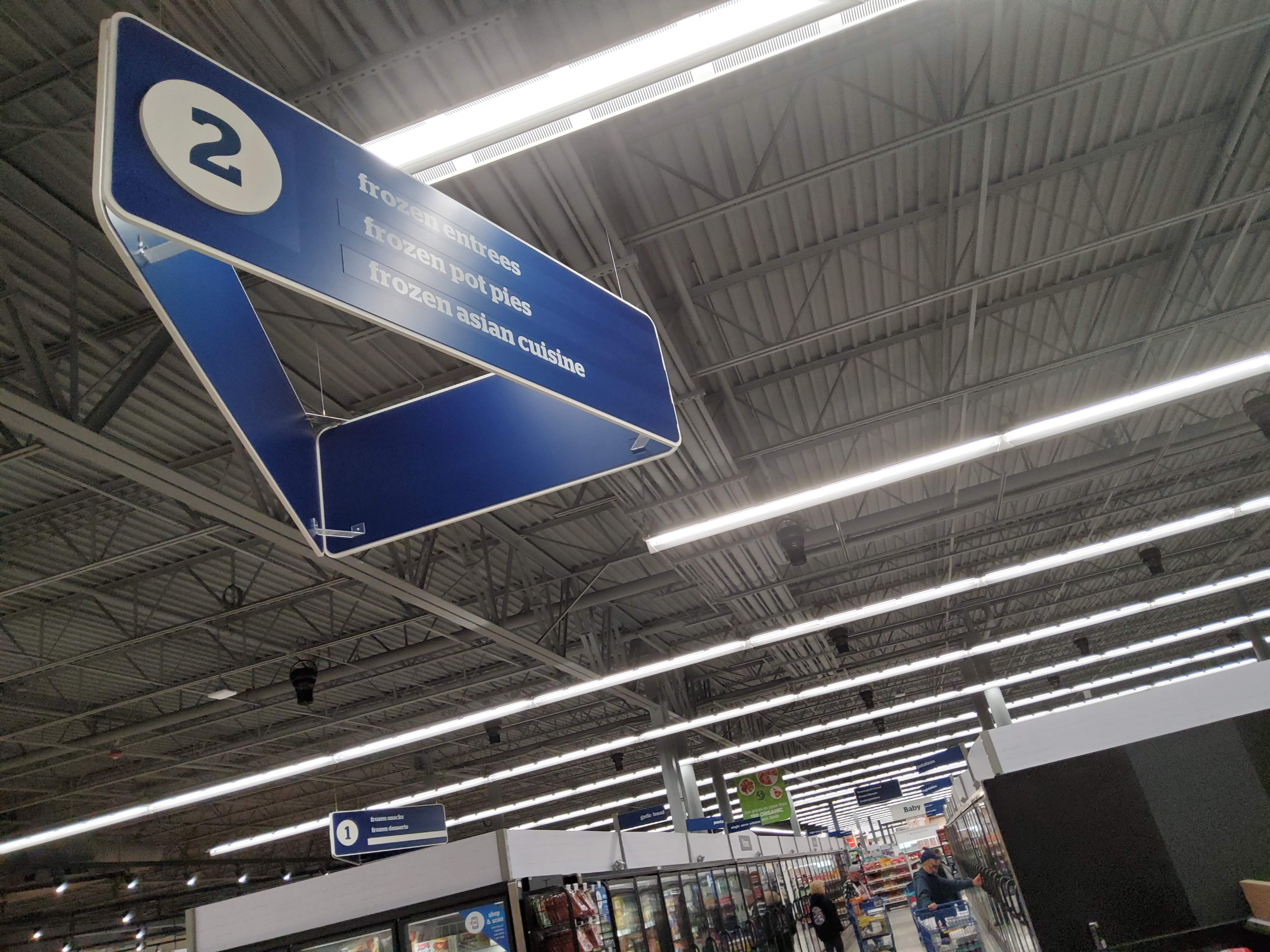
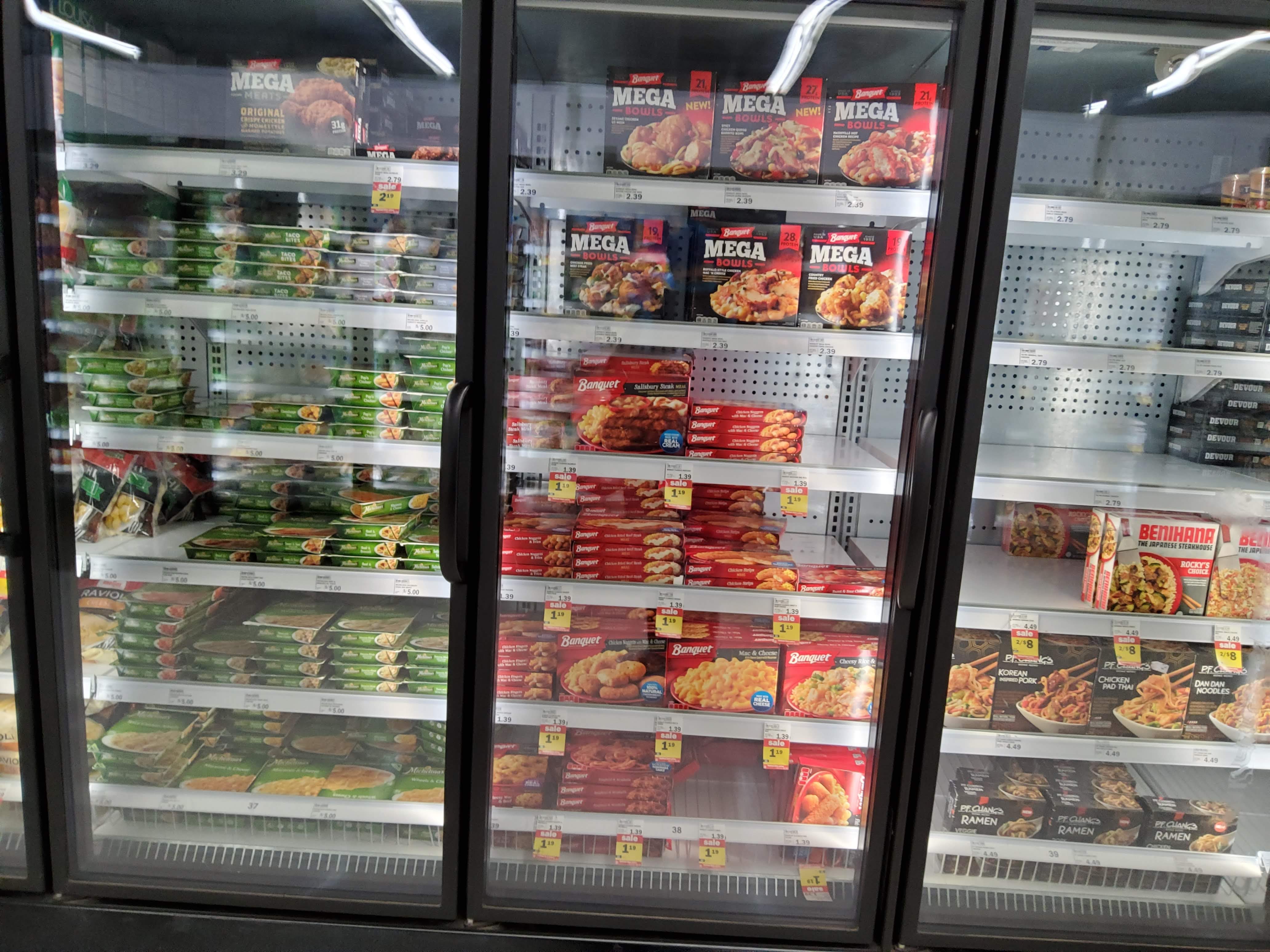
Our first hint that this is going to be significantly different than imagined is this sign.  \”frozen entrees, frozen pot pies, frozen asian cuisine.\”  Yes, \”asian\” lowercase.  Ignoring the multiple levels of badness there, all of these things are ultra-processed convenience food.  
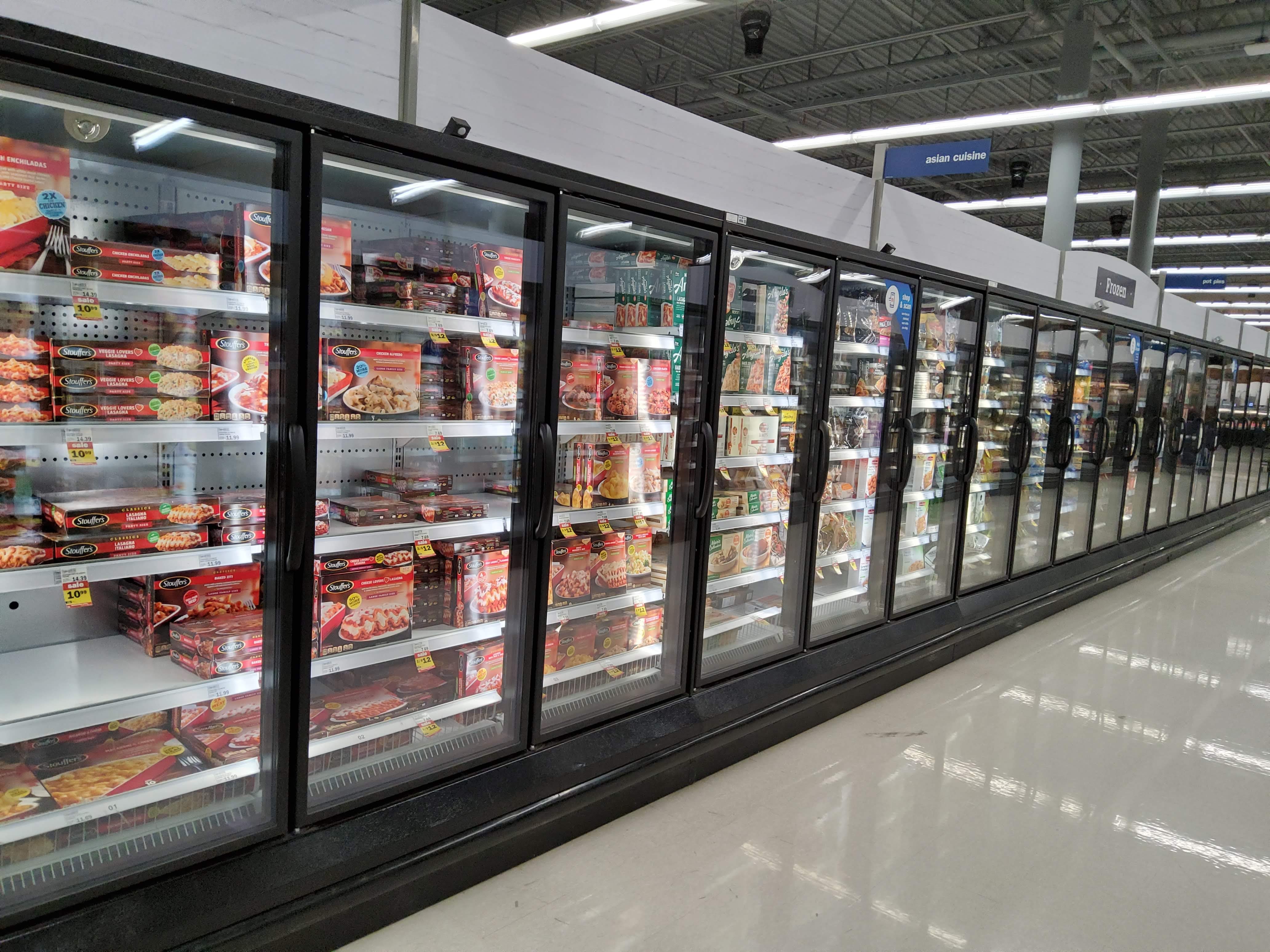
…Yeah.  This whole aisle is convenience meals.  Save right at the end, anyway.  You\’ll see.  

So yeah.  I think I was too demoralized at this point to actually count the brands of convenience meals.  But there are a lot.  The US has its health priorities all wrong, in that we tend to overload on meat and carbs, and ignore everything else.  These meals will be very true to stereotype.
So, I was born privileged.  Not \”silver spoon at birth\” privileged, but only my dad had to have a job for us to have a home and food.  My mother therefore had time to cook, and while she really didn\’t like it, she did it religiously.  
As a result, I am really not familiar with… basically this entire aisle.  I\’ve walked through it probably hundreds of times, but never really looked at everything there, because it wasn\’t something I was interested in.  Never mind the conditional vegetarianism, which nixes everything that has a meat content.

The basic idea here is that it\’s a meal, in a box.  You chuck it in the microwave, or the toaster oven, or the big oven, for whatever the directions say.  After a relatively short amount of time, you have a hot meal.  Maybe it doesn\’t taste quite as good as it would if you\’d made it from scratch, but it\’s definitely way faster than making it from scratch.  
I have a great deal of judgmental things to say about the whole industry, but it\’s worth recognizing that time is at a premium for many people, and the idea of shopping for ingredients, preparing those ingredients, and then cooking a meal for oneself or one\’s family can be exhausting or impossible after working 14+ hours at two different jobs.  

As you can see, there\’s a great abundance of varieties.  Not only brands, but meal types too.  There\’s meat-and-potatoes meals, Italian pasta types, casseroles, pot pies, personal pizzas, Tex-Mex style burritos, and various pan-Asian options like lo mein and pad Thai.  There\’s even frozen PB&J sandwiches with the crusts cut off.  
The appetite for variety is alive and well in the US, even when we\’re barely lifting a finger for the meal.  

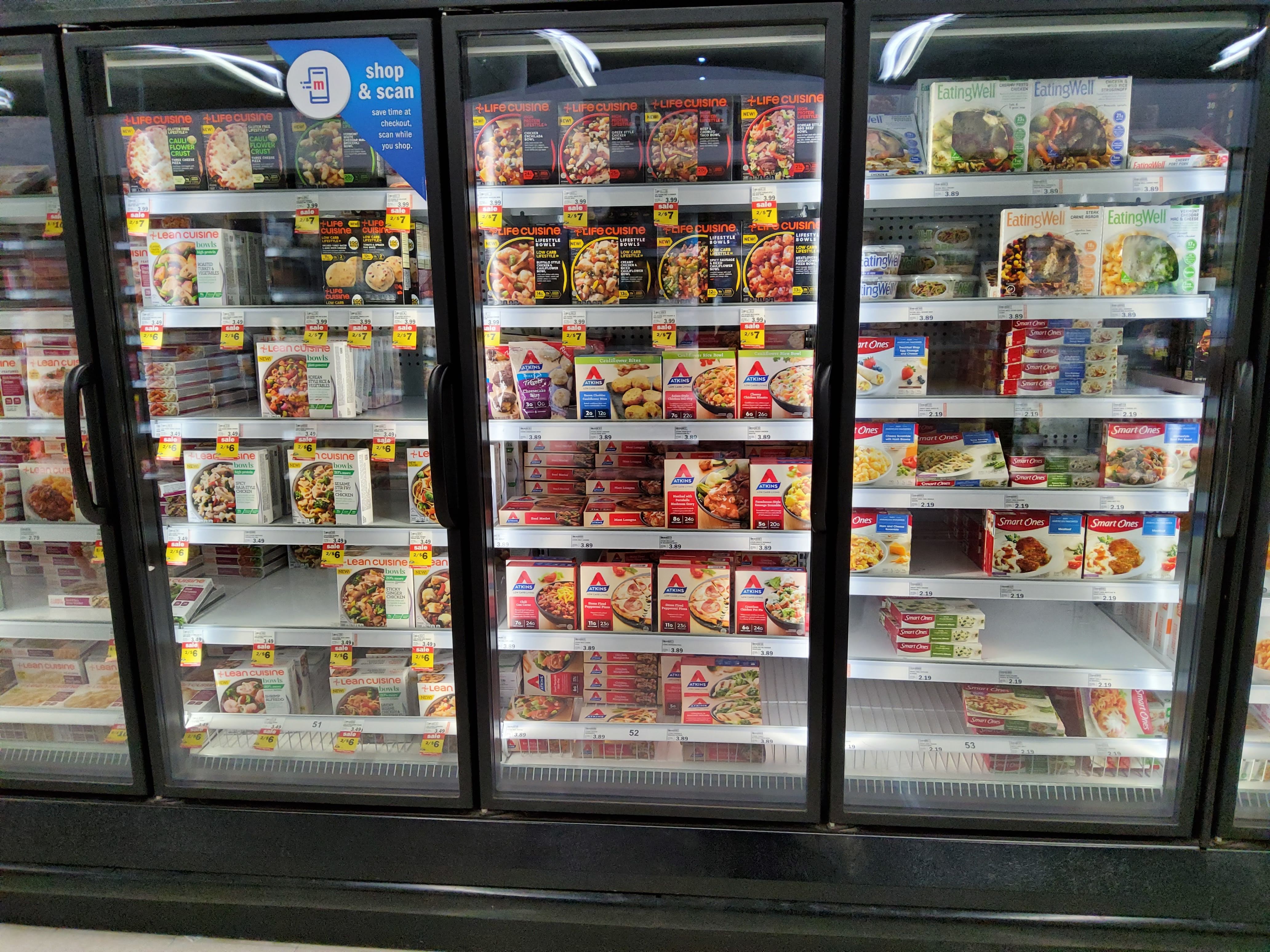
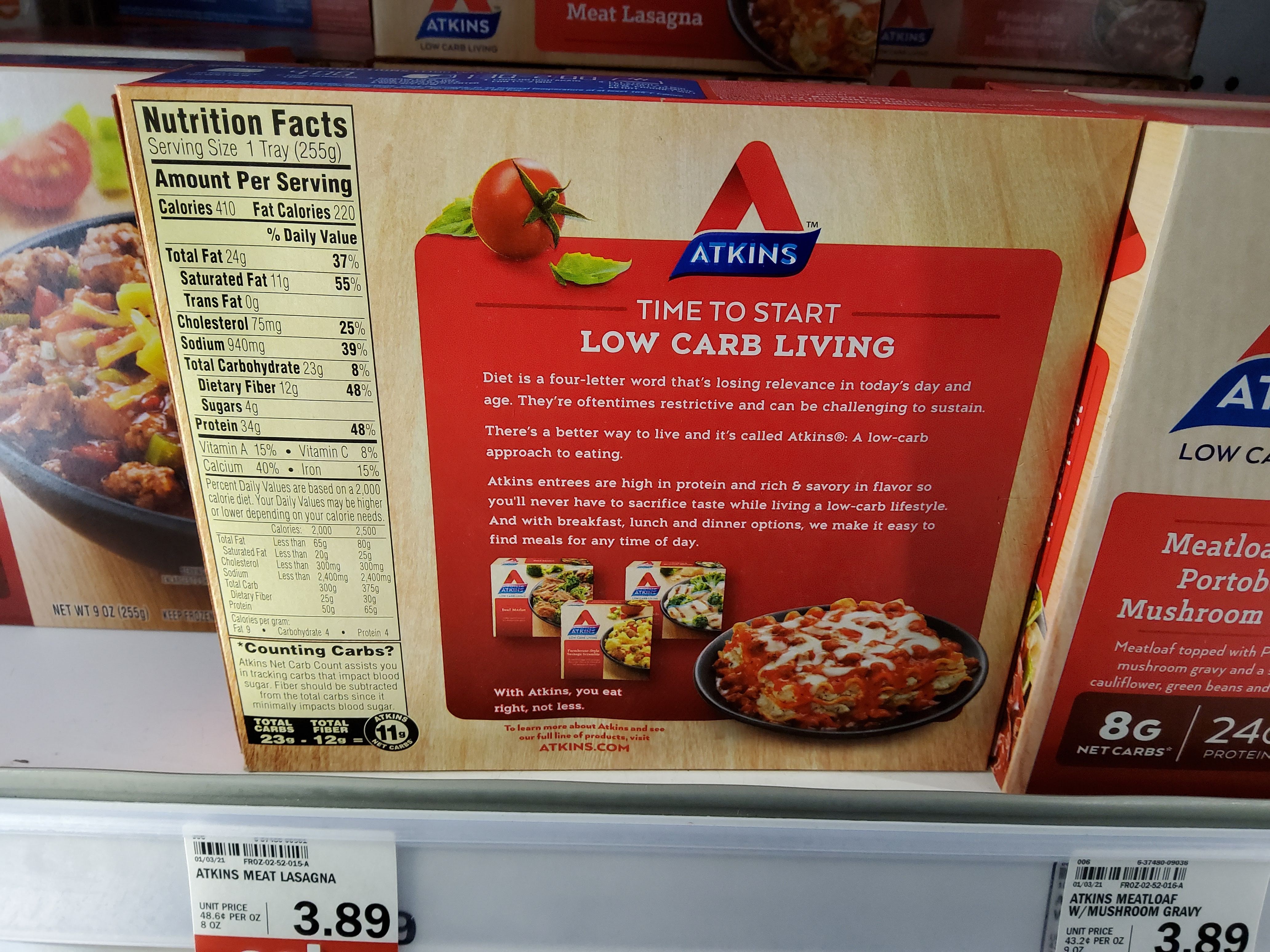
I can\’t make this stuff up.  In some cases the meals are geared towards a certain diet, like the protein-focused Atkins diet.  Some are marketed towards a stereotypical masculinity, others toward health-conscientious individuals.  

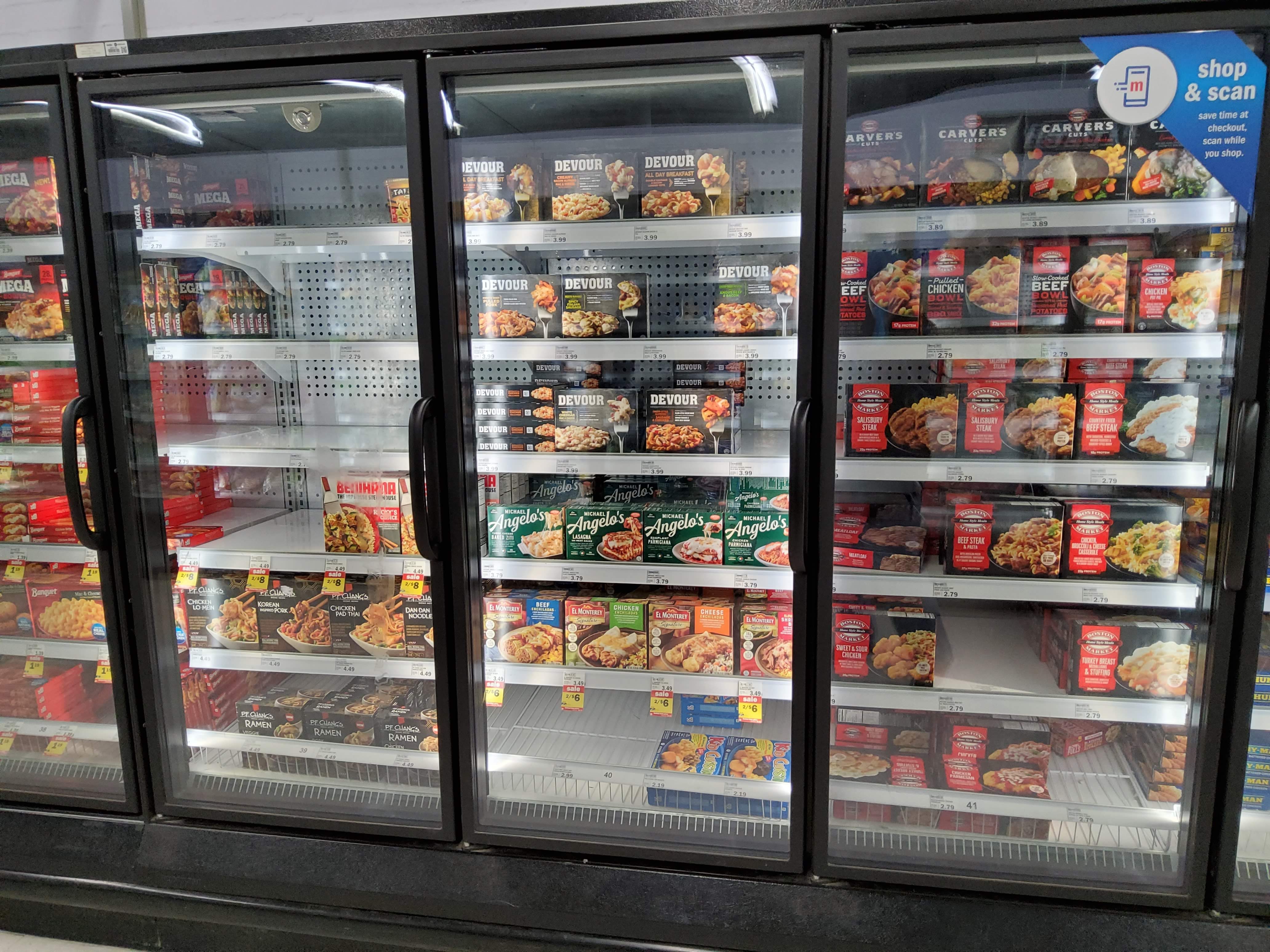
There\’s even \”luxury\” versions of these meals.  Restaurant-branded and marked up, places like Boston Market, Benihana, and PF Chang\’s are very happy to offer you basically the same thing as other boxed ultra-processed meals, for twice the price.  
Gluten-free versions are available as well, lest anyone be left out.  And apparently someone finally decided Indian cuisine shouldn\’t be left out of the convenience food market, because there\’s tikka masala and lemongrass basil and coconut curry meals. 
So, there\’s a lot of problems with these meals.  We\’ll start with nutrition.  
A good, healthy, nourishing meal is at least half vegetables and fruits.  You will note the incredible lack of any vegetables, really, in these meals.  There is no vegetable content in \”Chicken Nuggets with Mac & Cheese.\”  That just boils down to ultra-processed meat and grains, with a heaping serving of dairy.  For those keeping track at home, that\’s yikes, bad times, and \”now my brain is poisoned.\” 

So let\’s have a look at a few of these.  This one box meal has more half your daily recommended saturated fat, which is a poor start already.  There\’s the 75 grams of cholesterol.  It also has nearly a thousand mg of salt, which… let\’s just hope your heart is in excellent condition.  It won\’t stay that way if you eat these regularly, though.
I\’m going to categorically ignore the vitamins and minerals listed below that information.  It\’s not that those things are 100% irrelevant, it\’s that I could literally get better nutrition from a pair of pills.  And do, pretty much every day.  Food from scratch would include tons of micronutrients, and what\’s included here isn\’t really worth mentioning.  
Let\’s look at something slightly less blatantly unhealthy.  
This is a taco bowl meal.  You can see hints of green in the picture.  Now, the picture always looks nicer and more healthy than the real thing inside the box, but it\’s something.  
This still has a decent amount of saturated fat.  It also has a sugar content, and a third of your day\’s salt in one convenient tiny bowl.  It\’s better, but even if I wasn\’t vegetarian, I still wouldn\’t put this in my mouth.  At least not without a heaping helping of greens to put under it.  
Sweet and sour chicken bowl.  The picture shows green, carrots, and peppers.  Healthy, right?  Look carefully.  Did you spot the 15 grams of added sugar on top of the 5 grams of natural sugar?  Yikes.  That\’s most of your sugar for the day, right there in one tiny bowl.  This is one of the ways companies make their products craveable- by loading it with extra sugar to feed your addiction.  
I would say \”maybe we shouldn\’t be surprised, it\’s sweet and sour chicken, after all…\”  But the meal right next to it, the sticky ginger chicken, has exactly the same issue.  
One last pitfall to point out.  See that tiny, unassuming gram of trans fats?  That\’s a big no-no.  Even one gram will muck up your cholesterol.  This box would be worth avoiding for that one gram of trans fat alone.  The pile of salt and saturated fat is just insult atop injury at that point.  
I\’m happy to say it\’s no longer common to have a trans fat content in these meals, but it\’s clearly still happening.  
So that\’s the nutrition.  Now let\’s look at the ingredients.  

The first thing you might notice is that the list is extremely lengthy.  That\’s for a lot of reasons, but not the least of them is that the contents aren\’t as simple as \”steak, potatoes, gravy, spices.\”  
Freezing food can do a metaphorical a number on its texture and flavor.  In order to have the final product look, feel, and taste palatable, a great deal of chemical tinkering has to ensue.  The \”beefsteak\” alone has been propped up with yeast, corn starch, corn sugar, and a salty food stabilizer called sodium phosphate.  Never mind the vitamins and minerals sprayed on there so the whole thing doesn\’t look completely nutritionless.  
The potatoes are made from potato flakes, which you\’ll note is an ultra-processed form of potato.  There\’s not much fiber or nutrition left in them by that point.  Speaking of ultra-processed… I hope you didn\’t get the wrong impression from the phrase \”beef steak.\”  This is not steak, and it\’s been soaked in enough preservatives that the shelf life is probably years.  
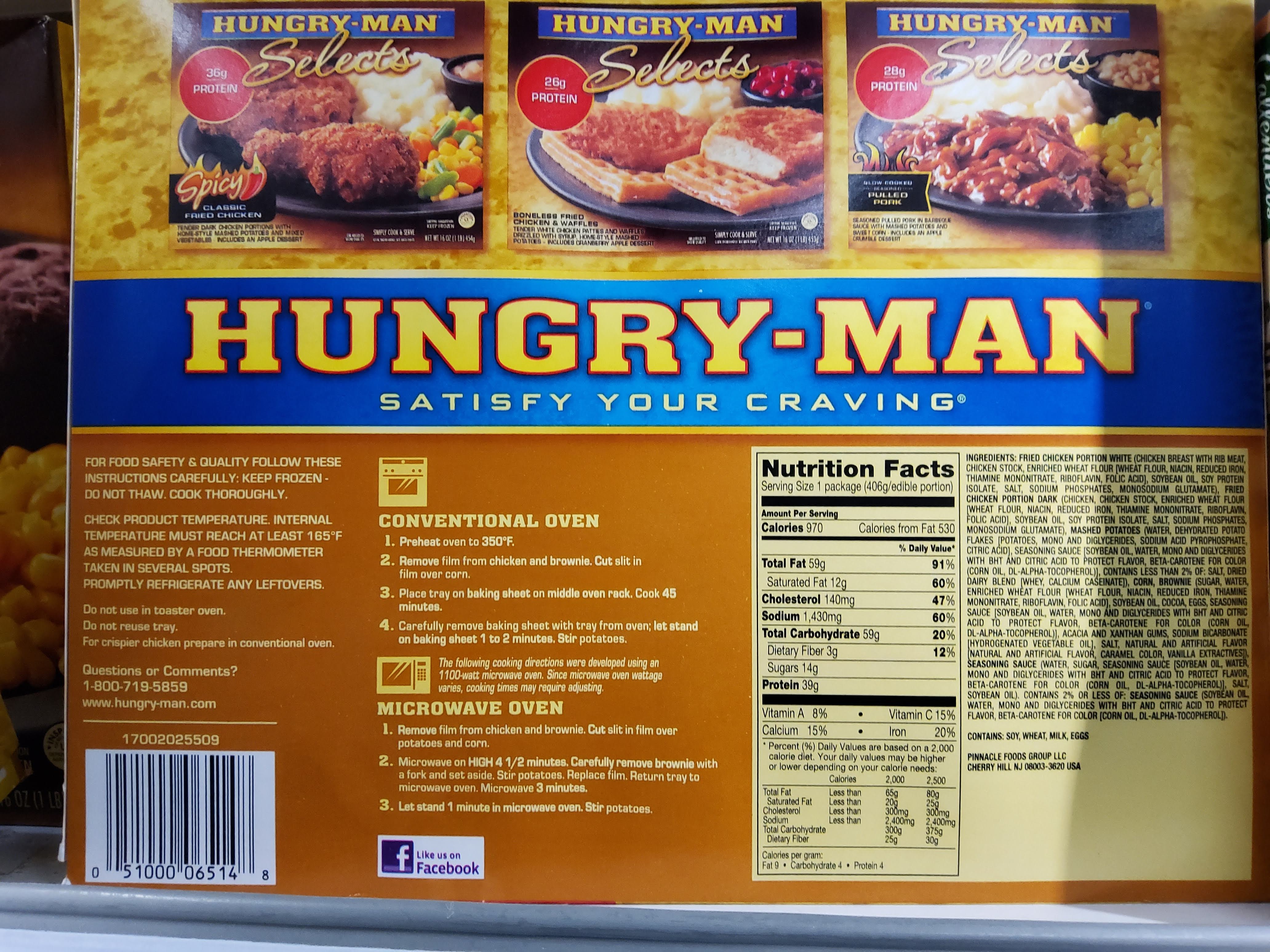
Did you guess it was about to get worse?  Because it suuuure is!  The meals marketed towards male consumers tend to be the most hideous, I guess because stereotypically women care about health and nutrition and men don\’t.  
This chicken dinner does not come with a hunk of breast meat.  It comes with ultra-processed rib meat and some breast meat thrown in, bleached, sprayed with vitamins, and then propped up with soy protein and that sodium phosphate stuff I mentioned earlier to give it a non-vomit-inducing texture.  The dark meat portion doesn\’t even have to pretend to be chicken breast, but it still receives the chemical facelift so as to taste appealing.  
The potatoes are, again, potato flakes.  I did not grow up on potato flakes, and I\’m quite sure it shows.  Real mashed potatoes might take longer to prepare, but they are leaps and bounds better.  These potato flakes had to be artificially colored to be sure you wouldn\’t find them revolting, apparently.  
The most honest ingredient in here is the corn, which it seems they didn\’t have to tinker with to make it shelf-stable.  Finally, this horrifying monstrosity comes with dessert (a brownie), which makes the whole box nearly 1,000 calories, most of your day\’s fat intake, and most of your day\’s sugar intake in one convenient box.  
Also, lest this be lost: this meal is two chunks of breaded ground chicken processed into slabs that look almost like breast and thigh pieces (protein and starch), a serving of corn (starch), a pile of potato flakes (more starch), gravy and seasonings, and then a brownie on top of all that (sugar and even more starch).  This meal spits on the concept of good digestion.  
This wasn\’t even the worst dinner box I ran across, by the way.  The biggest offense to sanity was excessively awkward to get a picture of in the crowded and busy aisle at the time I was doing my research, so I didn\’t bother.  
So, is it all this awful?  Is this whole aisle an unredeemable dumpster fire?  Surprisingly to my privileged self, no.  But perhaps unsurprisingly, it really depends on what kind of food you choose.  
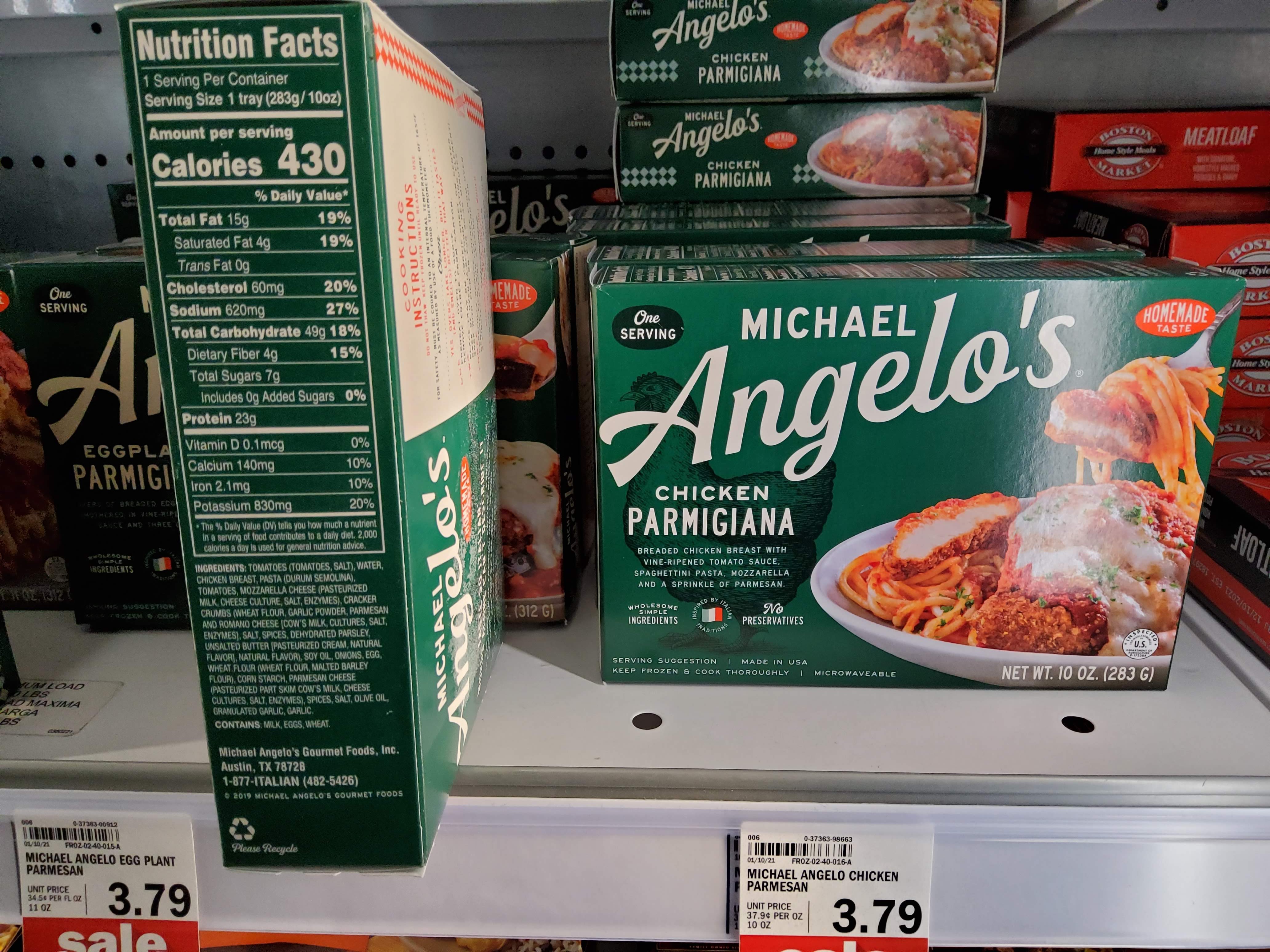
You\’re typically better staying away from breaded and fried options, but if you desperately desire that, and don\’t mind paying a dollar more, this is one (sadly vegetable-free) option.  The chicken part of this meal is literally just \”chicken breast.\”  No more, no less.  No chemical tomfoolery to make it feel and taste fancier than it truly is.  
The ingredients list still ends up long because there\’s multiple avenues of cheese in this meal, but it\’s significantly less processed by comparison.  But we can do better.
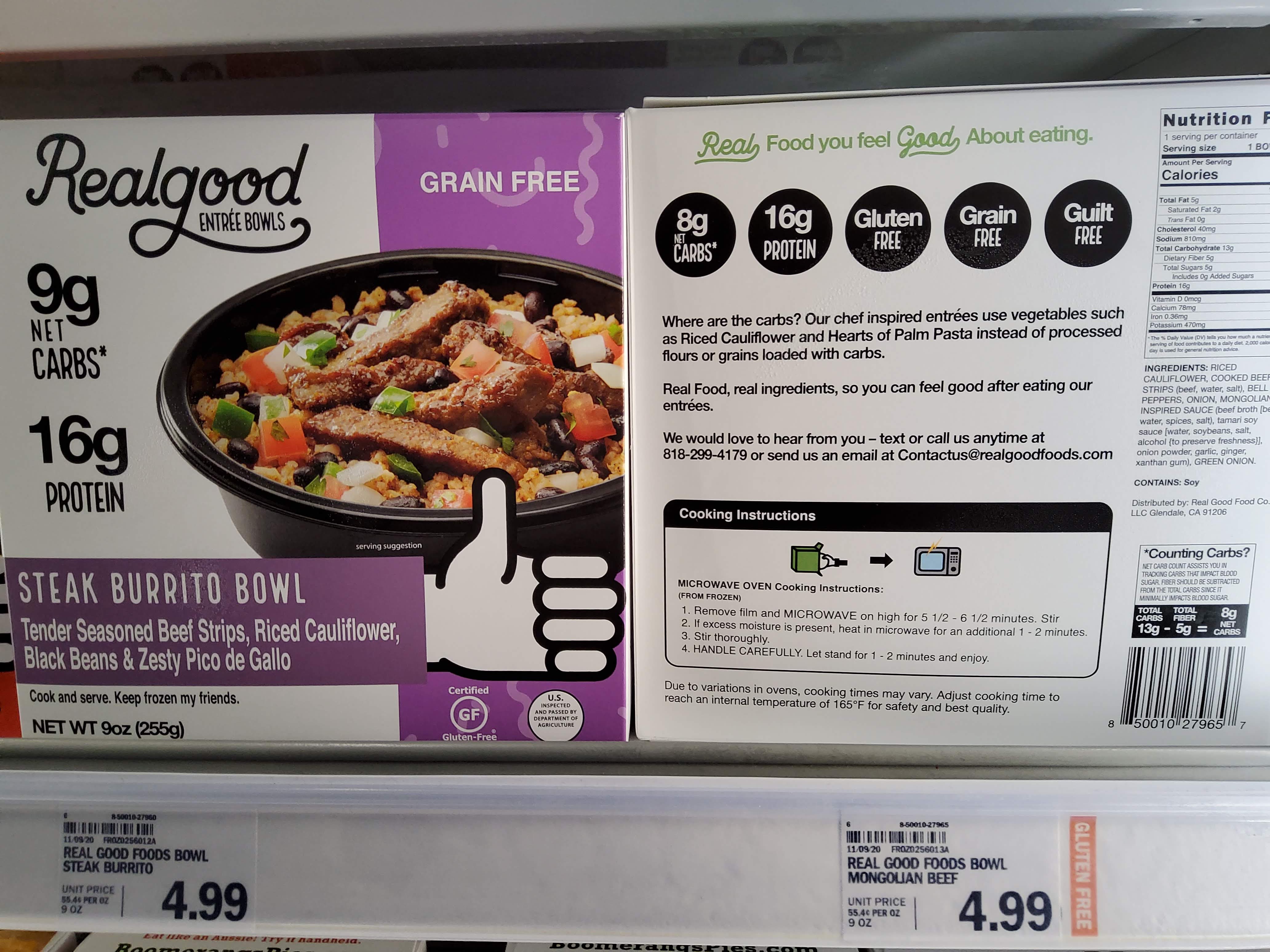
This was the best I found in my random sampling of the frozen meals.  It\’s gluten-free, which is a nice bonus, but I mainly point it out because of the ingredients.  The most complicated thing in there is the sauce, which has only a couple \”preserve this longer\” ingredients in it.  The rest is pretty much \”we froze this and put it in a convenient bowl for you.\”  Onions, cauliflower, beef strips, and peppers.  
It\’s worth noting that the more real the food gets in this aisle, the higher the price is going to be… and I could probably throw together this steak bowl for half the price at home, if I bought steak from the grocery store like a normal person.  
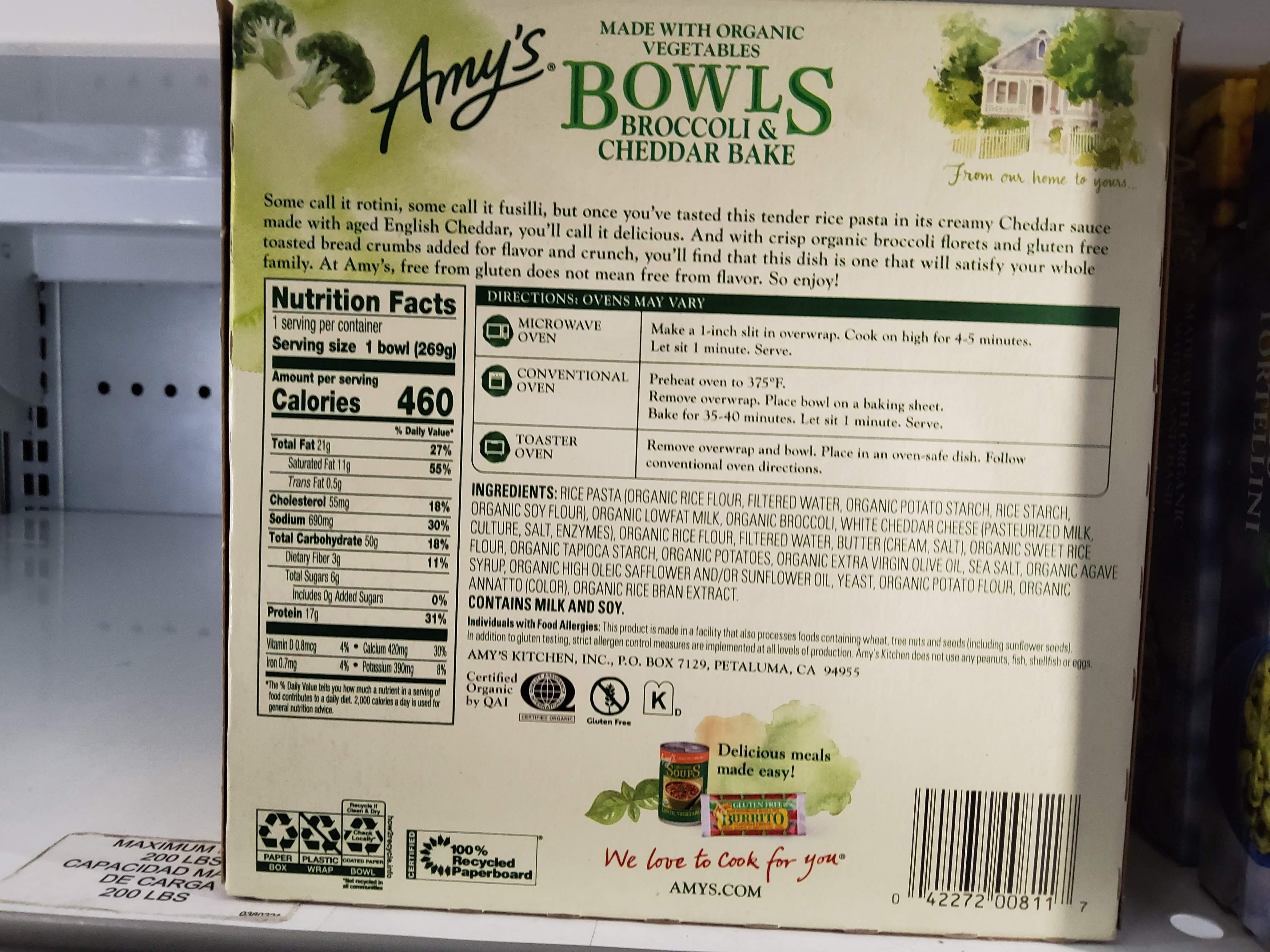
This looks pretty health-conscientous, right?  It\’s organic, vegetarian, even, and the box is green.  The ingredients are fairly basic.  So what\’s the matter?  
Well, check the fats.  Yeah.  Half a gram of heart-stopper trans fats.  Always, always, always read your labels.
Moving on!  We survived the mile-long, both-sides-of-the-aisle convenience food section, so we now get to look at… well.  It\’s still convenience food, but it\’s a little less one-box-and-plastic-microwave-done.  
There\’s the stuff that gets the \”you tried\” award from me.  Meatless patties of various types.  I\’m fond of Quorn and Beyond Meat, of all the options there, but they\’re definitely meal ingredients, not full meals.  

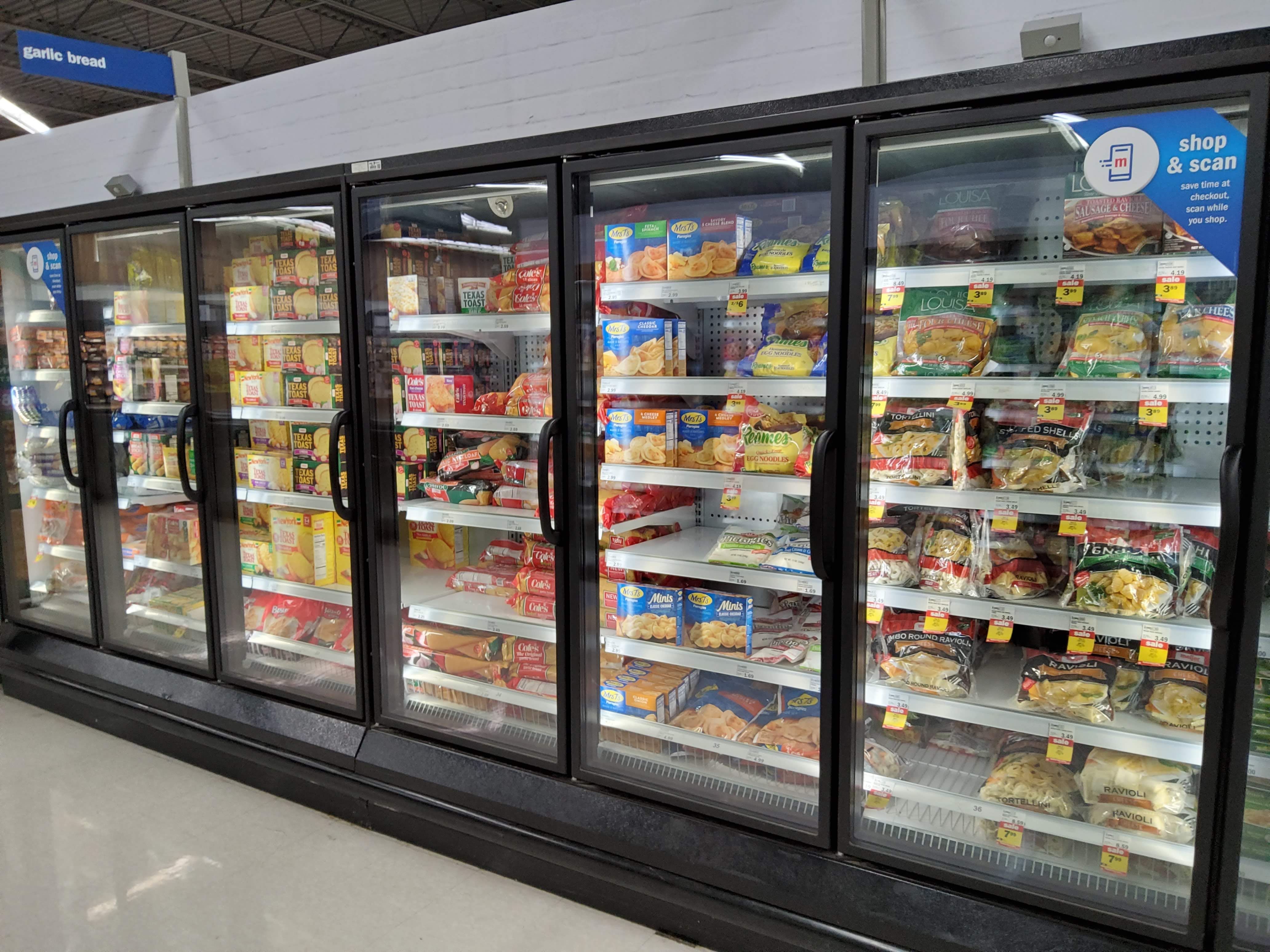
Frozen pasta, bagged and boxed.  It\’s mostly the stuffed varieties: tortellini, ravioli, and pierogis.  This is kind of why I\’m personally less than impressed with the single-box heat and eat things.  For the price of a single convenience \”meal\” you can get a bag of tortellini, dump a can of pasta sauce on it, and have a meal for 2-3.  For bonus points, fry up some ground meat, onions, and wilted greens and mix those in.  You get a healthier meal for just a bit more effort.
There is also frozen bread if you don\’t care to slice, butter, and shake garlic powder  (and perhaps shredded cheese) over your bread before you toss it in the oven.  
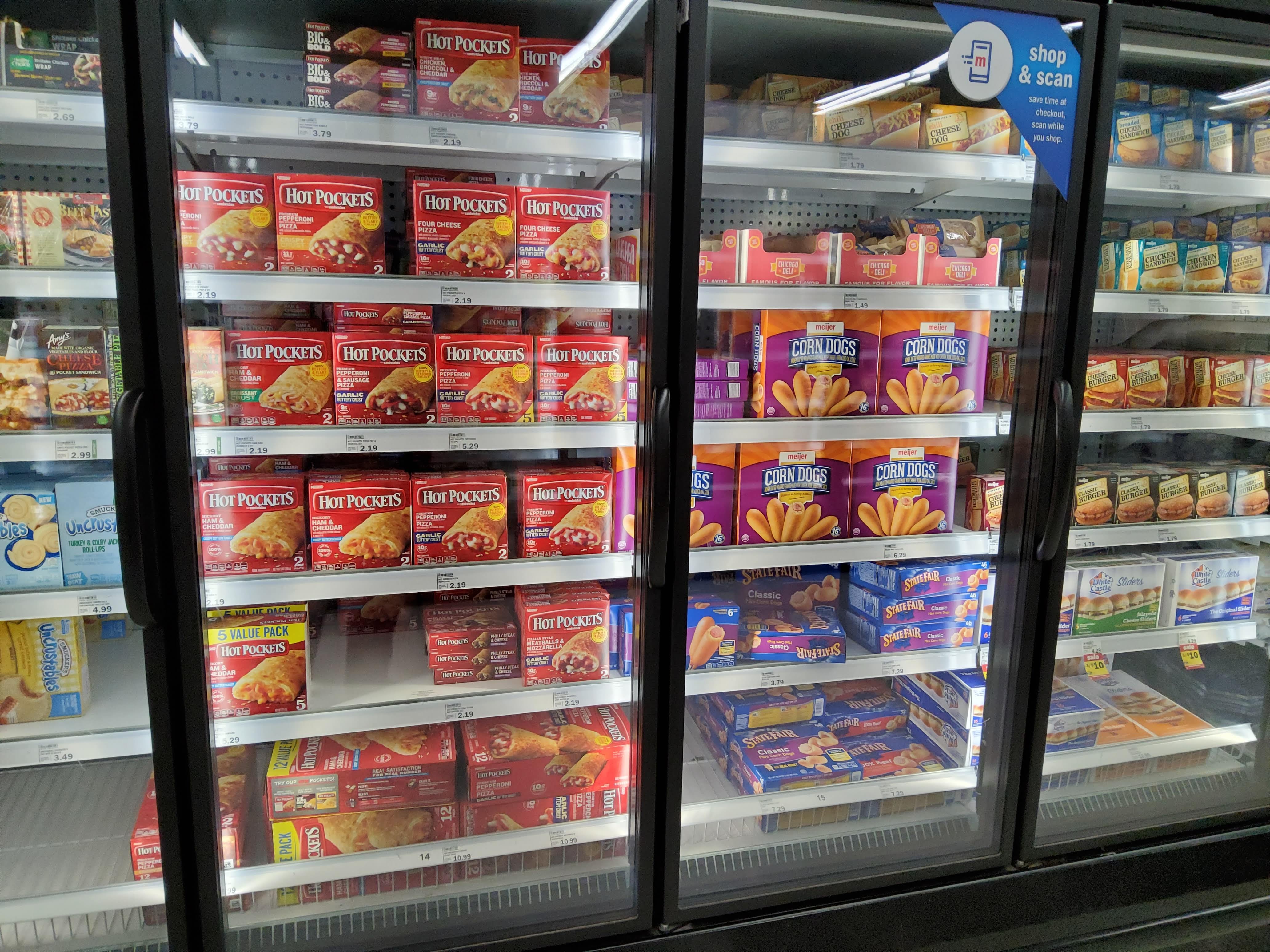
The sandwiches deserved their own section for some reason.  Hot Pockets also live here, and corn dogs just because.  

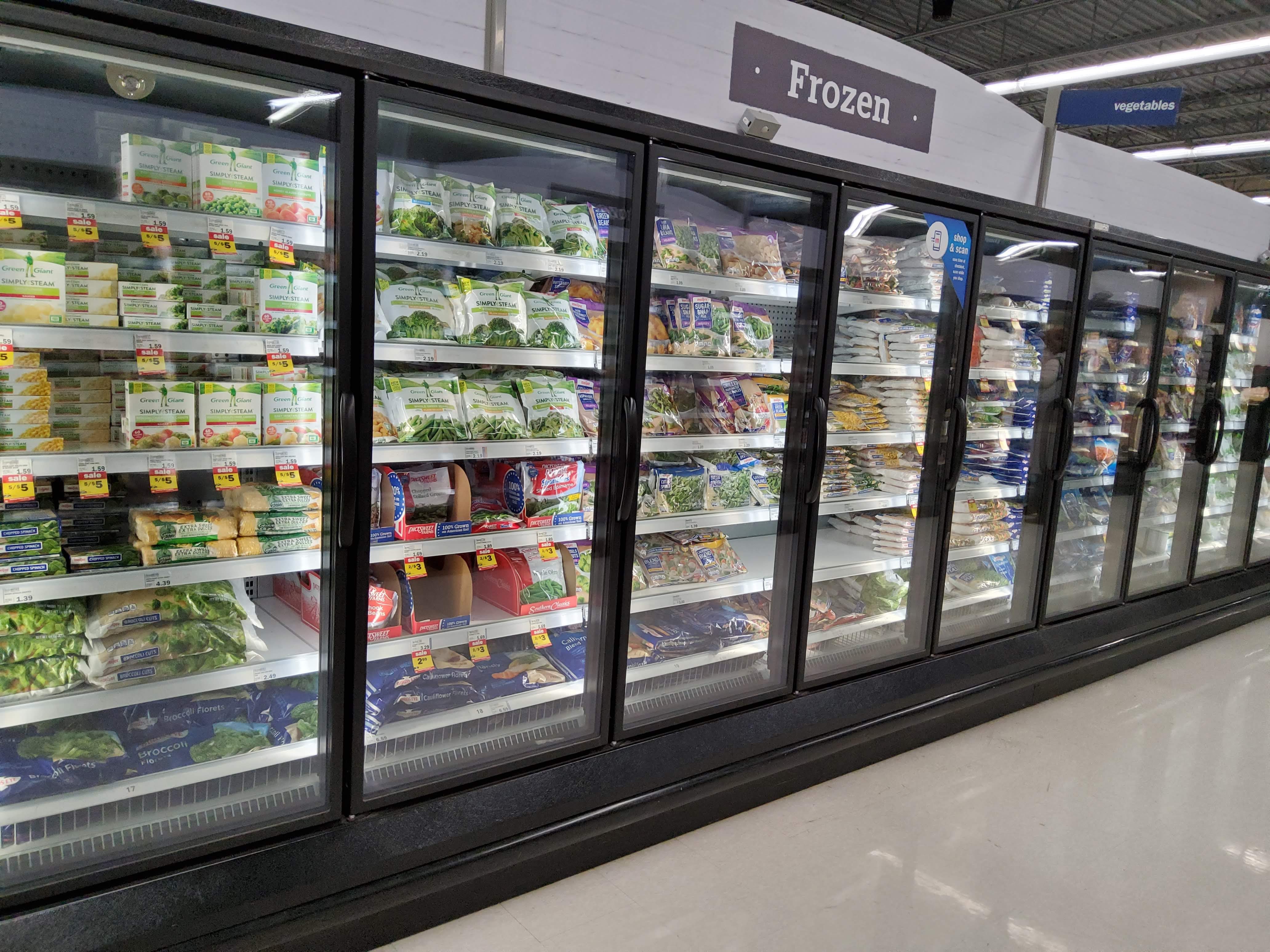
And here, at last, is the only reason I frequent this aisle: the frozen vegetables.  When I was growing up, frozen vegetables were pretty much chopped vegetables in a bag.  At some point when I wasn\’t looking, someone realized that people tend to cook the whole bag at once, and people would probably pay money to be able to do that without removing them from the bag…
So now there\’s \”steam in the bag\” options.  And not only that, they\’ve started coming out with seasoned and sauced varieties for an even bigger markup.  
Personally, I really hate chopping onions, so my spouse and I typically keep frozen onions on hand.  (Except recently those haven\’t been available…)  We also tend to keep steam-in-the-bag green beans around, because my spouse favors green beans above all other vegetables.  On the bright side, this basically ensures we eat a ton of vegetables, because the leftovers aren\’t really appealing.  So we tend to eat the entire bag between the two of us.
The last thing to point out here is that they sell bags of frozen, chopped spinach and kale.  This is by far the easiest way to add nutrition to a meal, in my opinion.  Doesn\’t matter if it\’s pasta, casserole, or stir-fry, you can just dump a handful of frozen chopped greens into it and know you\’re helping yourself without even affecting the flavor.  
Ideally, you\’d do this with fresh greens.  But as we all know, fresh greens don\’t last nearly as long as frozen, and after tossing my hundredth or so bag of half-rotted salad greens, I started to really appreciate the shelf-stability of frozen greens and vegetables.
And that finishes that aisle.  Next time there will be more frozen food, because aisle 2 was already quite long enough by itself.  Don\’t forget ultra-processed convenience food is absolutely out to kill you, so always, always, always read your labels.  And probably eat them with a steamed bag of vegetables on the side. 
(By the way, if you really don\’t have the time to do shopping but do want to eat fresh whole foods instead of ultra-processed junk, please consider Blue Apron as an option.  They\’ll ship the portioned and responsibly-sourced ingredients and recipes right to your door.  This can double as a \”learn to cook more stuff\” course as well.)

Worth Your Read: Avoiding Ableist Language

https://www.liebertpub.com/doi/10.1089/aut.2020.0014

Nobody wants to be the racist uncle in a discussion.  The thing is, many racist uncles (or aunts, or grandmas/grandpas) don\’t honestly feel they\’re being racist.  They simply don\’t know better or don\’t care to learn better.  

Hopefully no one reading this blog is the latter sort of person.  For the rest of us, it can be really simple to accidentally slip into racist uncle territory without realizing it.  That\’s why it\’s so important to listen to black and brown people, and to educate yourself using the resources they\’ve provided over the years.  

By the same token, it\’s important to listen to disabled and autistic people.  Essentially, ableism is racism, except instead of dehumanizing people with a certain amount of melanin in their skin, it dehumanizes people in wheel chairs, people who score low on IQ tests, and/or people with developmental disabilities.

I\’ve seen a reasonable amount of discussion of various types of ableism.  Perhaps the most widespread debate I\’ve seen is between person first (person with autism) and identity first (autistic person) language.  

The person first vs. identity first debate in a nutshell

Person first: Meant to stress the person\’s personhood before their conditions.  An alternative to using medical-terms-turned-derogatory-terms, such as \”retard.\”  Preferred by the community of people with intellectual disorders and the occasional person with autism.  

Identity first: Meant to stress how a condition can be experienced as inseparable from the person.  Autism is a whole-life-affecting condition.  If you could somehow remove the autism from me, I would not be the same person.  I would not, in fact, be even recognizable as me.  Preferred by me and most autistic people I\’ve seen weigh in on the subject.  

There are a number of others, including whether autism should be cured, how a person\’s support needs are described, the ever-dehumanizing \”high-functioning\” and \”low-functioning\” labels, and how things like meltdowns, self-injurious behaviors, and stimming are described.

The point of this article is to summarize what\’s been said and overall agreed upon in the course of a couple decades.  The audience here is mainly autism researchers, but to be honest, this was a good read for me, too.  

Like racism, ableism is systemic to the US.  A person in a wheelchair is, on average, assumed to be less capable on all fronts than someone who isn\’t… even if the criteria have literally nothing to do with physical capabilities.  The same mentality (in a less quantifiable form) goes for autistic people, even though we can be incredibly skilled and knowledgeable in our areas of interest.  

This mentality is fed to us in popular media, in how healthcare professionals treat us and the diagnosis, and how friends and family treat us, among other things.  I did a series a while back on types of stigma, which is rather relevant to this issue.  

All this to say I\’ve swallowed my fair share of poisonous ideas in regards to what people with disabilities are capable of.  Myself, frustratingly enough, included.  There\’s a handy swap table of ableism to acceptable phrases and words in the article, which I think I\’ll try to keep handy.  I can safely say my own writing includes some of these \”should be avoided\” words.