What I learned on #BlackoutTuesday

Yesterday was Blackout Tuesday, when people stop business as usual to boost the typically repressed black voices around us.  I am white, so I took the opportunity to do so on my Twitter account (and donate to Black Lives Matter), but I also spent a few hours that day learning about police violence and why the black community in the US is so upset.

As you read this, please keep in mind that autism is not a white-only phenomenon.  Black and brown autistic people are just as human as I am.  Additionally, the police are typically untrained to handle autistic people of any skin color, so it doesn\’t take much time on Google to find cases of autistic people needlessly shot by the police because the latter misunderstood the situation.  Reducing police violence against black people will bring measures that also save autistic people.

Please also keep in mind that the police are not a monolithic organization.  Each department will be somewhat different, and each member is a human being.  There are some very evil, hideous humans counted among the police (some of whom are in positions of power), but the majority didn\’t join the police for petty, power-seeking reasons.  However, the systems they live and work in have skewed their actions, and even their perspectives.

In the spirit of understanding and building a safer world for us all, I present to you what I found:

  1. The police pay a massively disproportionate amount of attention to black people, and this results in more incarcerations and more deaths.  You can find proof of this in both scientific research and simply in the statistics of the deadRacism does, in fact, exist in the system.
  2. The police, especially in cities, are unionized, and their contracts renew every 4-6 years.  These contracts can include things like erasing officers\’ past misconduct from their files, limiting civilian oversight, and disqualifying misconduct complaints that are submitted too many days after an incident occurs.  Here\’s a good website about this subject, and a study that shows \”bad apple\” cops tend to stay \”bad apple\” cops.  Ever wonder why \”bad apple\” cops get to stay cops?  This is part of why.
  3. Police policies often do not require officers to de-escalate situations, intervene if other officers are using excessive force, give a report each time they use force, or even give a verbal warning before opening fire. Here\’s a particularly good website about this subject.  If you thought, like I did, that all of these things would be in every police department\’s policies… well, I\’m very sorry to say they\’re not.  Which is a pity, because these restrictions save lives.  The police are not required to exercise even basic protections against excessive force.
  4. Police forces are being handed military weapons, and the results, predictably, are more dead people and less safe areas.  Here\’s a publicly available study on the subject.  The police do not need military-grade weapons to do their jobs.
  5. When dealing with mental illnesses and developmental disabilities, the police are almost inevitably out of their depth.  They don\’t receive the kind of training needed to resolve those situations.  There is another option,  though, and it\’s to have a separate agency to handle those crises.  Deaths by police could be reduced by a quarter or more. Here\’s an article about just such an agency in Oregon.  The police are neither prepared nor necessarily needed for crises involving mental health or autism. 

Please remember that evil triumphs only when good people stand by.  The job of the police is to help keep the peace.  That does not include terrorizing racial minorities, shielding their \”bad apple\” members from consequences, and avoiding reasonable restrictions on their use of force.  
To learn more, and stop standing by (and thus silently saying, \”this system is just fine, black (and autistic) lives don\’t matter\”), consider:

Ten Things of Thankful

Ran across this idea while doing some exploratory research.  The gist is that it\’s a challenge to look at your life and find at least ten things to be thankful for.  There\’s some kind of networking component I\’m not sure I\’ll opt into, because I have limited energy, but it seems like a good idea.  
Relatedly, there is a literal boatload of studies (that would actually fill a boat if you printed them out) on how gratitude and taking time to be thankful is good for your health, so here\’s my list (in no particular order).  
  1. Positive People.  This includes my friends, who are few, but each is an incredibly worthwhile person.  It includes my spouse and some of my family, especially my parents.  It also includes various online acquaintances and content creators.  Basically, any person I can think of and immediately have a positive reaction to.  
  2. The Internet.  It is, by definition, a mix of truth and lies, but in these  interesting times, it\’s what\’s made the difference between people staying home and people ignoring quarantine because they\’re bored out of their minds.  It\’s where I met my first friend.  It\’s what makes it possible for me to spend time with family and friends, even now.  
  3. My Bicycle. Which I expect to be using as soon as the weather stops being rainy.  I put air in the tires a few days ago and hopped on for the first time in months… it seems I still remember how to ride, but am hilariously out of shape.  Still, with care, my bike will provide medium range transport to various places, including the local grocery store and some slightly-further-away foraging locations.  
  4. Video Games. For some of the same reasons as the Internet, but more personally.  In World of Warcraft, I regularly interact with a workgroup of 10-20 people.  I mostly don\’t know what they look like, but I\’m able to spend time with them in and out of game, and that helps with the isolation.  There\’s also Animal Crossing, which has a whole world-spanning community around it.  And Ring Fit Adventure, which is literally an exercise game.
  5. The Various Therapies That Support My Wellbeing.  These include my supplements, which are mostly vitamins and minerals (but also some brain chemicals), my biweekly trip to see my therapist and have LENS done, and various dietary modifications.  I avoid dairy and high histamine foods, which means I tend to eat things like sunflower seed butter instead of peanut butter, or pseudocheese products instead of regular cheese.  
  6. My Neighbor the Great Blue Heron. Picture below because it wouldn\’t attach without messing up my list.
  7. Foraging. Giving me a reason to ditch my house while still social distancing.  I like trying new things (to some extent).  Trying new foods, knowing they\’re packed full of nutrients the store produce can\’t hope to match, is a great bonus.  It also makes me feel a bit less anxious about whether there will be food in the future, because while the grocery store is unlikely to run out of food, knowing you can supplement your diet with wild foraged food is invaluable.  It\’s also a great reason to go outside.  
  8. My Spouse.  He\’s technically been mentioned, but he deserves his own listing.  While our relationship is still a work in progress (which is normal, as I understand it), he\’s willing to put in the work to make our communication better and more successful.  Since I\’m autistic and don\’t work on the same wavelength as he does, this is a very valuable choice he\’s made, and continues to make every day.  We have a lot of things in common, but where I\’ve become bitter and crabby over the years, he\’s still somewhat innately joyful and playful.  
  9. Good Food.  The one constant pleasure in my life, which sounds horrible until you consider how bad it might have been if I\’d had none at all.  One of the ways my parents showed their love was by making or buying us food.  Mom typically handled most of the cooking, but sometimes Dad would grill chicken, steaks, or shrimp.  On Sundays we\’d sometimes eat at a restaurant.
  10. The Quietness of My Home.  I have fairly sharp hearing and unfortunately my brain doesn\’t filter out extraneous noise.  So right now I can hear the faint hum of my computer running, as well as the air conditioner, refrigerator, the sound of my chair and keyboard, etc.  However, what I don\’t have to hear is noises from outside.  I used to live in places where people would blare music from stereos, lean on their car horns, yell at each other, and tromp up and down the public stairs at all hours.  It was very distracting and unpleasant.  I now live somewhere significantly quieter, and am much happier for it.  
a great blue heron on grass at the edge of a pond
Growing up, I became accustomed to ducks (especially mallards) and Canada geese.  Herons, however, are a special treat, and this fellow (or lady) comes by every now and then.


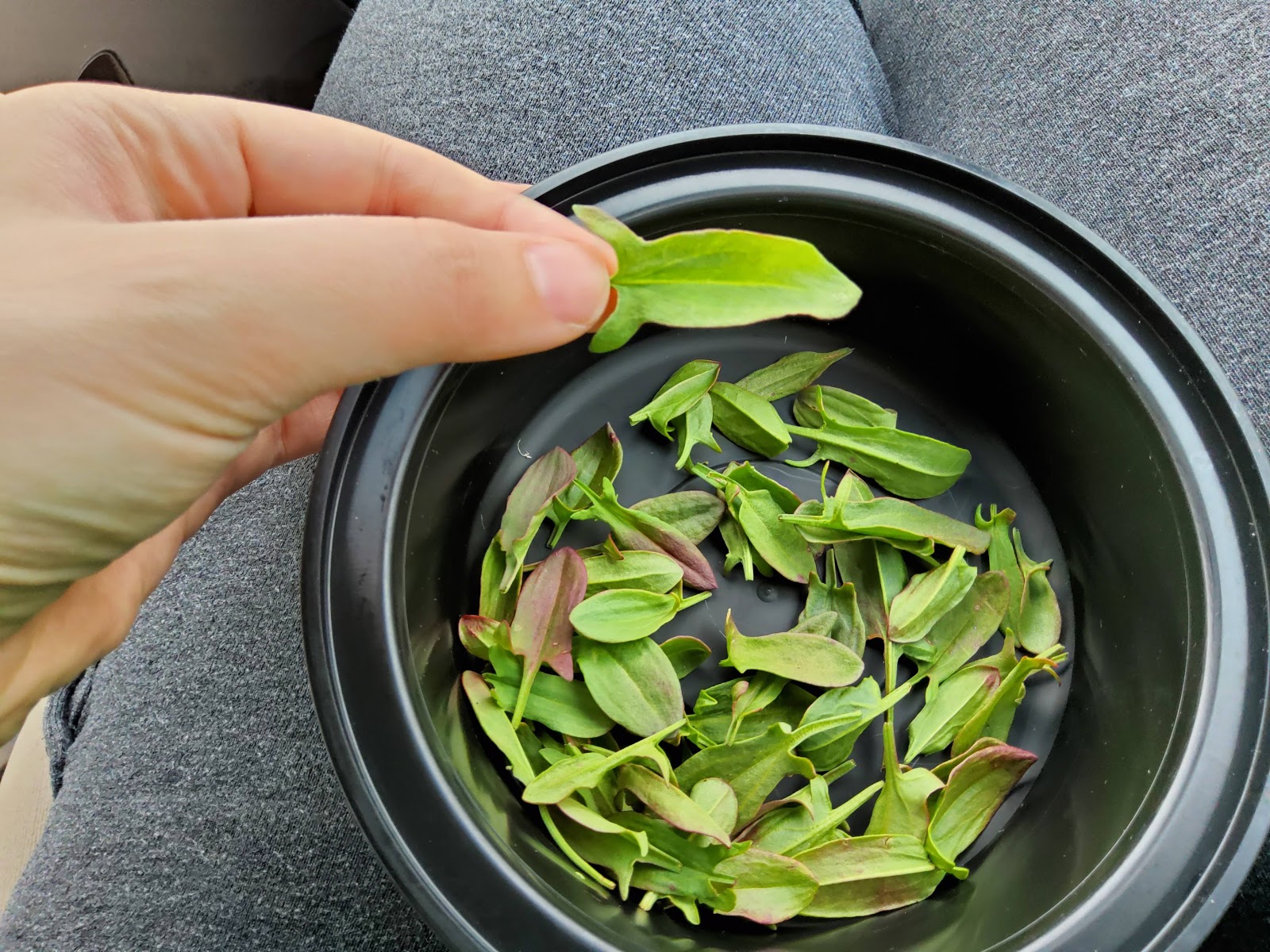
Young dandelion greens salad, sheep sorrel, and shagbark hickory nuts awaiting shelling and consumption.  

Autism Friendly Homes/Business Audit Sheet

About a year ago, I audited a local grocery store, testing to see how autism-friendly or -unfriendly it was.  I\’m well suited for this sort of audit, because I have sensory sensitivities in plenty but I\’m usually able to quantify and express what I experience in an understandable way.  Your typical autistic child or even adult may suffer similarly, but lack the vocabulary or even the understanding of what in particular is hurting them.

At the time, I developed an audit template sheet.  It\’s very much a work in progress, and I\’m sure actual auditors would be able to improve it.  I tried to make my criteria reasonable for a business, but this isn\’t the kind of audit sheet most commercial businesses could score 100% on, even if they\’re dedicated to being accessible.

The sheet is here, and should be publicly available.  Rather than rehash what I\’ve already written on the subject, I thought it might be worthwhile to discuss how these criteria could apply to a home.  We\’re stuck at home during this quarantine, it makes sense to make your home as comfortable and accessible as possible for the autistics in your life.  After all, a supportive environment means fewer meltdowns and less tension and unpleasantness.

Lighting

Lighting is complicated issue in the commercial use,  but thankfully simpler at home.  Fluorescent lights are basically the standard in institutions and commercial buildings because of how cheap they are to run.  You literally turn them on at the beginning of the day, and thereafter they cost pennies to keep lit for hours.  Incandescent lights are far more expensive.  Natural light is beholden to the eccentricities of the weather and the day and night cycles.  The choice, in terms of saving money, is painfully clear.

From an accessibility standpoint, however, fluorescents are awful.  They flicker, even when working properly.  Some autistic people can see that flicker, and it\’s immensely distracting, or even painful.  Allistic/neurotypical people may relate if they\’ve ever been stuck in a room with a malfunctioning, flickering fluorescent light.  Multiply that irritation by at least 3, and you\’re in the ballpark for the autistic people who are less affected by this issue.  It goes up from there, to the point where some autistic people can\’t be in the same room as fluorescent lights.  You can mute the flicker by shading them, or having a mix of light types.

Thankfully, most homes I\’ve been in don\’t bother with fluorescent lights except in laundry rooms.  If there are any rooms in your house that do have them, check with your loved one about those areas of the house.  If the autistic person doesn\’t speak, consider whether they typically avoid those areas of the house, or whether meltdowns seem to happen more frequently in those areas.

Also a plus, most homes don\’t have those horrid blue-white LED light strips, or little flashing TVs to hawk products at you.  Most homes are also not lit to commercial standards, and are darker and easier on the eyes.  Additionally, homes tend to be lit with warmer colored bulbs.  Where industrial settings and some commercial settings use blue-white (or \”outdoor\”) lights, homes use \”indoor\” warm yellow-white lights.  These are less piercing and painful than the alternative.

Sounds

Sounds are a different kind of problem.  There are some places (one restaurant in particular that shall be nameless) that I simply can\’t be in comfortably, because the noise level is too high.  Having a reasonable noise level, including the ambient noise or music, and the noises the other residents make, shouldn\’t be too much to ask in a home.

What\’s reasonable may vary by the person.  I typically have a very quiet home, so quiet you can actually hear the HVAC system and water in the pipes.  But depending on your culture, it may be normal to have at least one stereo blaring music, or a TV on all the time.  Keep in mind that there\’s a difference to autistic people between sounds we don\’t control (like someone else\’s stereo or TV) and ones we do (like banging on a drum, our own music or TV, etc).

Overall volume is only one facet of this problem, though.  You also need to factor in how complex the environment is.  If, like Seaworld, you have competing music in certain areas, that is unpleasant to people with sensory sensitivities. Consider the things that make noise in your home.  This might be something as simple as the refrigerator droning, or the washer/dryer clunking or banging.  Perhaps the heating/cooling system clicks or bangs when it turns on.  Or maybe some of your lights hum when they\’re on.  I have a dimmer switch on the dining room that hums and snaps a bit when it\’s in use.

If you can, ask your loved one about these things.  If that\’s not an option, spend a few minutes in each room of the house, and just listen carefully.  What do you hear?  Keep in mind that younger people can often hear higher frequencies than older people can, so even if you hear nothing of note, there may still be noise you can\’t hear.  Or sounds you would normally tune out, like the buzzing or notification sounds of others\’ phones, that aren\’t as predictable.

Finally, emergency alarms need to be considered.  This includes fire alarms as well as carbon monoxide detectors.  Most fire alarms I\’ve had the misfortune of experiencing were blindingly painful.  They are the typical high-pitched, grating, painfully loud shrieks that are designed to wake people out of a cold sleep and send them shambling down the stairs and out the door in a stupor.  These are widespread, but they\’re not the only kind of fire alarm in existence.  When my second high school remodeled their library, they installed a talking alarm that made lower pitched booping noises and informed people in English that there was an emergency, and to please leave in an orderly fashion (I forget the exact directions).

In 2004, the US Consumer Product Safety Commission put out a document on home fire alarms.  While dense, this document is informative on the various options for alarms, including ones that don\’t rely on sound.  In short, there are many options, but in general most places have stuck with the most sensory-unfriendly ones.

Smells

Smells might be the easiest of the three to address, in most business settings.  Usually you don\’t want to overwhelm a person\’s senses with a cacophony of odors.  There are exceptions, like scented candle shops or places that sell soap and bath products.  Other places, like bakeries and grocery stores, will pump in manufactured smells to mess with your brain for a more positive impression of the store.  Or there may be ripe trash areas, bottle returns full of old beer stink, etc.  That\’s a no-no for being accessible.  Restricting scented items to their own sections is pretty basic, and should be doable for almost every business.

In homes, the situation is much less predictable.  People may burn scented candles or wear perfume or cologne with no thought towards others\’ comfort.  But these overtly scented items aren\’t the only way excessive smells can infect an environment.  Every class of cleaning product, from hand soap to floor cleaners to laundry detergent, comes in scented varieties.  Typically these aren\’t too overwhelmingly powerful, but exceptions exist… and sensitivities vary.  I know of one woman that has to buy all her products in unscented, or she will suffer immensely.

Keep your scented product choices in mind when considering the environment for an autistic person.  Do they tend to complain about or avoid areas that have recently been cleaned?  Or do they prefer the smell?  Keep in mind, too, that even common unscented cleaners, like bleach or vinegar, can have strong odors that can upset a sensory-sensitive person.

Cooking smells can also be a minefield, depending on the person.  Some smells, like cabbage or onions, can bother even neurotypical people.  This is especially true in smaller areas.  So if your autistic loved one typically melts down when you\’re frying fish, that\’s a pretty clear sign.  Maybe skip the fish, or at least try a different kind of fish.

And So

That\’s what the sheet covers.  What I didn\’t get to when I originally made this, and what\’s definitely the least easy to make audit criteria for, is store policies.  For stores, this is fairly basic: be predictable, label your sections, don\’t have socially invasive policies (like demanding your employees greet the customers throughout the store), maybe implement sensory-friendly hours and have a recovery room, that sort of thing.

For a home, it\’s significantly more complicated.  I still think a recovery room or somewhere quiet and comfortable the autistic person can retreat to, to cool down, is very important.  For me, growing up, that was my room.  I wasn\’t made to share a room with my brother, so the space was always mine, and it was always safe to return to.  For larger families and families without the option to give their autistic children separate rooms, a closet might serve this purpose, or a space outside.

The problem with trying to make a one-size-fits-all sheet for autism-friendliness is that autistic people are very NOT one-size-fits-all.  Because the diagnosis is such a trash bin, all kinds of people with all kinds of needs get thrown into it.  So you really need to look carefully at what your autistic loved one needs, what they\’re good at, and what they struggle with.  If they have executive function difficulties (issues planning their day, breaking a task into smaller tasks, organizing themselves), then setting up a calendar and rewards would be a good plan.  If they don\’t, those things might help, but they won\’t have as major of an impact.

In general, be clear and upfront about expectations, whether they\’re social expectations (\”you will sit at the table until everyone is finished eating\”) or chores (\”you will take out the trash on Wednesday evenings\”).  Spell this out on a schedule if this is possible.  I make use of Google Calendar in my household, and my spouse and I have shared our calendars with each other so there are relatively few surprises.

Finally, try to keep positive things available in the house.  This also varies widely by the autistic person.  Perhaps a favorite food can be kept in stock, or a favorite scented product, or a toy.  Perhaps the person loves watching bicycle tires spin, or a particular TV show.  Whatever it is, consider it like self-care for the autistic person… because it is!  Some neurotypical people swear by the soul-restoring benefits of drinking tea, or reading a book, or listening to favorite music.  Autistic people can enjoy these activities too, but they may also enjoy watching lava lamps, staring into bright lights, or putting objects into lines.  Just because these activities fall outside the norm doesn\’t make them any less valid.  Make sure these soul-restoring things are reliably available to your loved one!

I hope this helps you make your home a friendlier, happier environment for everyone.  We\’re all stuck inside at the moment, so the more positive \”inside\” is, the better!

The Autism Community Presents: Resources for These Interesting Times

I did my own version of this a few weeks ago, but as is typical, you get more and better information when more people contribute.  

This list covers a lot of topics, including:
  • Strategies and tips from autistic people on how to manage this crisis.
  • Coronavirus (COVID-19) information, to help counter the misinformation that\’s out there.
  • Plain language guides so everyone can understand the coronavirus situation.
  • Resources, such as emergency planning forms, instructions for face masks and hand sanitizer, and suggestions for how to keep connected socially while social distancing.
  • Links to advocacy organizations and their COVID-19 resources.
  • Guides to self-advocating in medical settings.
  • Homeschooling and \”learn something new while you\’re home!\” resources.
  • Links to legitimate charities that will actually use your money to help others instead of their CEOs\’ yacht funds.  
There\’s a lot here and I\’ll probably work through it slowly, picking and choosing the most relevant-sounding links in each category.  What I\’ve gotten through has been very helpful, though.  

Reading the Research: Walking a Virtual Mile in Someone Else\’s Shoes

Welcome back to Reading the Research, where I trawl the Internet to find noteworthy research on autism and related subjects, then discuss it in brief with bits from my own life, research, and observations.

Today\’s article gives us a glimpse into the future.  There are a lot of potential uses for virtual reality.  These researchers have landed on the idea of making sexism a more real problem to people via putting them into a woman\’s body and having them experience typical sexist verbal abuse.  Because virtual reality reads as real to people, they experience the events more personally and powerfully.  The researchers think this would make a good rehabilitation tool for prisoners.  

While that\’s probably true, and a noble cause, why stop there?  Why not use it to teach people in the first place?  

There have been some attempts, via Google Glass, to teach autistic people parts of \”the hidden curriculum.\”  Things like reading emotions and body language, what things to say in a conversation, and when to say them.  But Google Glass never got very far, and the cost of the technology was too high for all but the richest of parents.  Most autistic people don\’t have access to those resources.  

If, as I suspect, virtual reality becomes more popular and accessible, it may eventually become possible for programs like this to teach all kinds of things.  The Stanford programs could be only the beginning.  You could gameify having a back-and-forth conversation, giving extra points for remembering relevant parts of a person\’s life so your questions and responses are more intelligent.  As face-reading technology improves, a wider database of facial expressions could be developed so autistic people could have enough information to recognize emotions easily, even when the person is a stranger.  

You could even use virtual reality to teach life skills in a safe environment, or even remotely.  One of the barriers for autistic people in learning these skills is not having any familiarity with the skill, and being afraid to fail.  You could walk through the process of cooking a basic meal, doing the laundry, or feeding the cat, without there being a mess afterwards if something spills.  

There are a lot of possibilities.  In this time of quarantine, when we don\’t know how long this will last, when a coronavirus vaccine will be available, and what life will be like afterwards… it gives me hope to know that this technology is on the horizon.  

(Pst! If you like seeing the latest autism-relevant research, visit my Twitter, which has links and brief comments on studies that were interesting, but didn\’t get a whole Reading the Research article about them.)

Types of Stigma: Healthcare Practitioner Stigma

Type 7: Healthcare Practitioner Stigma

Healthcare Practitioner Stigma is when a health professional allows stereotypes about autism to negatively affect a patient\’s care.

When I first looked at this type of stigma, I wasn\’t sure why it was separate from public stigma and structural stigma.  I thought about it, though, and unfortunately, it\’s correct to have it be a separate category.  To explain why, we\’ll revisit Dr. Stephen Shore\’s often-quoted adage: \”If you\’ve met one person with autism, you\’ve met one person with autism.\”

The Diagnostic and Statistical Manual, or the DSM, gives us words to describe different neurologies, mental illnesses, and conditions.  The World Health Organization puts out a series of numerical codes (ICD) to go with those words, which insurance and healthcare entities use.  Patients are coded with these numbers, which serve as a shorthand to who they are and how to handle them when those patients show up in an office.

I wrote a post about this back when I was working at an autism therapy center.  Four codes to summarize, in healthcare-ese, me as a person.  The same four codes a therapist might receive when taking me on as a client, or a doctor might receive when preparing to help me with a health problem.  When I went through school to receive my psychology degree, I was also taught about autism.  I didn\’t recognize myself in the diagnostic criteria, but it\’s what I was taught.

It is, in fact, what they\’re all taught, if they\’re taught anything.

With the diagnostic criteria being so unhelpful, and autism being such a broad and diverse group of people, it\’s maybe not surprising that healthcare practitioners would fall prey to making bad assumptions about autistic people.

The issue, of course, is that unlike random passersby, healthcare practitioners are trusted with the power to open and close doors to therapy and care.

If healthcare practitioners work on the assumption that all autistic people are dependents, or that all autistic people can or can\’t speak, or that we all suffer the same kind of depression, anxiety, or digestive disorders, their decisions will be skewed or even outright wrong.  Each autistic person should be taken separately, like any other human.  Every human has strengths and weaknesses, different biologies and different healthcare needs.

As a rule, autistic people tend to have more health problems, more fragile systems, and more challenges with mental health and wellness, so it\’s incredibly important to have competent healthcare practitioners who know to ask questions rather than making assumptions based on their schooling.

Yet of all the healthcare professionals I\’ve had since getting my diagnosis, only one has made a point of asking lots of questions about me as a person, after I gave them my diagnosis.  Can you guess which one it was?

It was my therapist and LENS practitioner.  Y\’know, the one doctor who has literally no excuse to not know better, given how many of her clients are autistic.

The size estimates for the autism population are still rising.  We need better understanding in our healthcare professionals.  Our lives and health depend on it. 

Types of Stigma: Structural Stigma

Type 6: Structural Stigma

Structural stigma is the existence of institutional policies or other societal structures that result in decreased opportunities for autistic people.

\”Institutional policies\” is kind of a mouthful, so I\’ll start by pointing out that it\’s not just referring to mental institutions or whatever we\’re calling the modern day insane asylums these days.  It\’s also not just talking about sheltered workshops or group homes.

An institution, in the broadest sense, is stuff like churches, schools, hospitals, governments, and other organizations.  An institution is an organization founded around a purpose, whether that purpose is religious, social, educational, or some other reason.  Institutions have rules, bylaws, norms, and unspoken expectations.

There are a lot of kinds of this stigma in existence, but the one I hear about from parents most involves Medicaid.  You see, support services for autistic people cost money.  A lot of money.  Since most parents aren\’t independently wealthy, they cannot afford to pay hundreds of thousands of dollars per year for the services their kids need to thrive.  What\’s a loving parent to do?  Certainly not watch their kid suffer for lack of help, or burn themselves out trying to support the family plus act as their kid\’s only (untrained and uneducated) support full time.

Instead, the typical answer, at least in my state, is to apply for Medicaid.  The government has money set aside to pay for support services in situations like this.  It\’s less and less each year, and because of the US\’s eternal suspicion of the poor (because being poor is SO FUN (/sarcasm)), you have to jump through about eleventy billion hoops to acquire that support, demonstrating in excruiciating detail that yes, your kid really does need this help.  It\’s a process that can take years, and multiple rejections even though the person\’s need is real.

Unfortunately, depending on what kind of Medicaid you receive, there may be income limitations.  Literally, your family or the autistic person themself might make \”too much money\” to qualify.  Let me remind you support services can cost hundreds of thousands per year.  The amount you can\’t exceed per year to receive full support, if you\’re a single working adult? $18,000 a year.  So you could be making $20k a year, barely have enough to make ends meet, and yet be expected to pay multiple times your yearly income in services.  Apparently, this is \”fair\” by the government standards.

What usually happens here is that families and individuals on the spectrum need those services, and need to be on Medicaid to afford them.  They therefore quit their jobs or take massively reduced hours in order to qualify.  The types of jobs that make the cut for these restrictions are usually high stress, unfufilling jobs without hope for advancement or further training.  Even if advancement is available, the autistic person or the family may need to turn down those opportunities in order to continue to qualify for Medicaid.

Thus, one reason for the massive amounts of unemployment and underemployment in the autistic population.

Another easy example is the educational system.  It varies widely on the school system, but in many cases, \”special needs\” children are segregated 100% of the time from their typically developing peers.  Sometimes this is done after assessing the child\’s skills and abilities, but sometimes merely having a diagnosis is enough to mandate immediate separation from your peers.  Sometimes entirely separate school systems are involved.  Often entirely different curriculums are involved.

I\’m not going to pretend the neurotypical school system is flawless and that it\’s appropriate for every child to learn everything taught in a typical school system.  The school system actually has serious issues.  However, inclusion is mandatory.  Curriculums that challenge and spur the growth and development of each child, are mandatory.  These things are not happening in most school districts, and as a result, autistic people do not learn as well or as much as they\’re capable of doing.

Effectively, school policies are stunting our educational opportunities.

Due to this lack, autistic people may have limited higher education options, or even none at all.  We might be denied a chance at trade schools, at colleges, or even at internships or apprenticeships due to our lack of good grades, lack of diploma or GED, and use of alternative curriculums.  You\’ll note this phenomenon, too, ties right back into poor or no employment options.

I\’ve named two major forms of structural stigma here.  There are many more, from churches excommunicating autistic people or refusing to allow them into Sunday school to hiring policies that don\’t allow for neurodiversity overall.  

Handling the Isolation: an Autistic’s Advice

I ran across an article by Maxfield Sparrow pointing out, quite rightly, that I and other autistic people have more experience being alone and being isolated than most neurotypical people.  I was a social outcast for most of my schooling, which led to practicing self-isolation as they describe in this post.  I now have quite a bit of practice managing myself and these situations.  So now there\’s a pandemic and everyone has to be isolated.  Let\’s talk about handling isolation, shall we?

Sociability via the Internet

First and foremost, the Internet has lots of social options.  Just because you shouldn\’t go see people in person, doesn\’t mean you have to be a hermit.

If you feel alone and need people to talk to, know that there are thousands of communities full of people who likely feel similarly and are also reaching out for support.  Look into communities around your hobbies and interests.

Reddit is a good place to start for this.  There are multiple autism-related Reddit communities, but there are also places for knitting, book clubs, parenting, cooking, TV shows…  basically, if you can imagine a topic, there\’s probably a community somewhere for it.  Reddit is not your only option for finding these communities, either.  A bit of time spent Googling your interests can turn up a variety of options, like forums, IRC channels, YouTube personalities, and how-to guides.

Discord is another option.  While it was initially built for video game communities, there are now communities for creative writing, webcomics, city areas (here\’s one for Grand Rapids), gardening, and even knitting.  You can chat by text or voice with people about all kinds of things.  If you play video games, you can even stream your game to your friends in a virtual hangout.  I\’ll expand on this below.

I do not recommend upping your hours on social media, like Twitter, Instagram, or Facebook.  In my research and personal experience, time spent on social media tends to result in feeling worse about yourself and the world.  They also tend to run experiments on you, sell your data to whoever will pay pennies for it, and significantly limit the information they feed back to you.

Instead of passively following your friends and family on social media, consider calling them on the phone, texting them, emailing them, or using Skype, Facetime, or Discord to video call every once a week or so.  I personally prefer emails or text due to the suffering the phone causes me, but you may find the phone a much more satisfying option.  People are different, and that\’s okay!

Finally, you can have a virtual party or hang out time.  You don\’t have to give up your movie night, board game night, or other night out just because you shouldn\’t leave your home.

Movies and TV: Rather than all gathering at a single house, each person can relax in their own home yet watch a movie or TV show together.  The classic example of this is the Chrome extension Netflix Party, which syncs your screen with all of your friends\’ screens, so nobody gets surprised first.  But, there are actually a lot of options for having this kind of experience.  Binge watch a favorite TV show with your friends, or try out a new show together!

Board Games: Did you know you can play board games online?  Specifically, did you know there\’s a virtual tabletop application called Tabletop Simulator, in which you can play games like Risk, Battleship, Settlers of Cataan, Apples to Apples, Clue, and thousands more.  There\’s also an app called Tabletopia that works on phones and does the same kind of thing.  If you love board games and miss being with your friends, why not give these a try?

Video Games: Many gamers already make use of technology like this, but Twitch, Discord, Mixer, Periscope, Livestream, and a ton of other services offer the ability to stream your gameplay to an audience.  You can show off a favorite game, or introduce your friends to something new.

Not interested in being on display?  That\’s okay, you can play with your loved ones instead!  There are hundreds of cooperative video games.  Here\’s a link to a drawing party game that\’s free for the next few weeks.  There are also lots of more indepth games, like Path of Exile, which is a fantasy online multiplayer game.  Or Terraria, an open world survival/exploration game.  If you have a Nintendo Switch, Animal Crossing: New Horizons just came out.  You can escape to your own island, explore and reshape the place as you like, build a community of cheerful animal friends, and relax to a great soundtrack.  There\’s even an option to visit your friends\’ islands, so you can play together too.

Knitting Group/Book Club/Interest Group: Facetime, Discord, Skype, Zoom, Google Hangouts, and WhatsApp all have group call functionality.  Get everyone the same app, set up your phones and/or webcams, and get out your books/knitting needles/D&D character sheets.

With most of the world on lockdown during this pandemic crisis, lots of people are turning to the Internet to meet their social needs.  Thankfully, there\’s a ton of stuff for everyone.  If you\’re starved for people, now\’s the best time to look into your options!  There are so many ways to spend time with your friends and family without worrying about infecting them, and new and interesting friends could be right around the corner.  The Internet has groups who love your hobbies as much as you do, just waiting for you to join them.

A last but important note: If you are suffering any form of mental illness, and the isolation is making it worse, there are options available for you.  Besides the hotlines, many therapists are doing their work via phone or video call, so it\’s worth it to check with your therapist and see if you can get an appointment without risking infection.  At least two of my friends have already had appointments with their therapists over the phone, so the tele-health option does work.

Remember: Depression, anxiety, and other forms of mental illness are real and legitimate forms of pain, just like broken legs and bruises.  Help is available to you, and you do matter.

Self-Care and Self-Improvement

Second, consider this time a chance to do some things for yourself you never seemed to have time for.

Self-care often falls by the wayside in the hustle and bustle of life.  However, it\’s extremely important, especially in trying times like these.  Read an old favorite book, or take a new one from your stack, if you have one.  Schedule some time to drink tea or coffee without looking at your phone.  Take a luxurious bath, or start a video game you\’ve been meaning to play.  Call friends or family and talk for a while.  Play a silly phone game you love for a few minutes.  Listen to old music you love, or new music you\’ve been meaning to look into.  I\’ve spent some of the time rereading old favorite book series and trashy pop literature, because it\’s comfortable and I need the comfort right now.

Whatever relaxes you and feeds your soul, make time every day to do those things.

You can also try new activities. Have you wanted to take more walks outside?  It\’s getting warmer, and you can keep your distance from others while you do so. There are also free exercise classes of all kinds on Youtube, like aerobics, tai chi, yoga, and more.  Or perhaps there\’s a subject you\’ve been meaning to learn about?  There are free Ivy League classes available online.  You can learn to code in HTML, CSS, SQL, Javascript, and a lot more languages for free.

Have you meant to try meditation or some kind of mindfulness to help with the stress of life, but there never seemed to be a good time to practice?  Pick up Headspace or Calm.  Both of these are quality apps with significant sections of free content.  They can help you learn to manage the stress of the isolation in a healthy manner, and give you a break from the worry about the future and the present, and the fear- and frustration-laden cycles the news is going through.

Cooking is another thing you can do at home.  Since grocery shopping is an essential activity, you can try recipes you wouldn\’t normally have time for.  Make a big batch of soup or a favorite dish and freeze some for later.  Stretch your horizons by making a vegetarian dish, or even something dairy-free or gluten-free.  Try new ingredients, or pick up a new kind of spice or seasoning.  The Internet is full of recipes.  I particularly like Budget Bytes, but I also reference the megasite All Recipes as well.  With some time on Google, you may be able to find specific sites that cater to your dietary needs.

Overwhelmed?  Can\’t think of anything to cook?  There\’s a website for that.  Actually, there\’s several, so here\’s another.  Click the ingredients you have available, and the website will show you links to recipes using those ingredients.

Finally, remember that you can easily keep a six foot distance from others outside.  As the weather warms in the northern hemisphere, public parks can be your safe place to go when cabin fever sets in.  Spending time in green spaces, such as gardens, forests, and public parks, has been repeatedly shown to improve stress levels and quality of life overall, so why not stop by your local park?  You could even meet up with a friend and chat while keeping a safe distance from each other.

Whatever your interests, there is something for you.  Stay safe out there!

Handling the Isolation: an Autistic\’s Advice

I ran across an article by Maxfield Sparrow pointing out, quite rightly, that I and other autistic people have more experience being alone and being isolated than most neurotypical people.  I was a social outcast for most of my schooling, which led to practicing self-isolation as they describe in this post.  I now have quite a bit of practice managing myself and these situations.  So now there\’s a pandemic and everyone has to be isolated.  Let\’s talk about handling isolation, shall we?

Sociability via the Internet

First and foremost, the Internet has lots of social options.  Just because you shouldn\’t go see people in person, doesn\’t mean you have to be a hermit.

If you feel alone and need people to talk to, know that there are thousands of communities full of people who likely feel similarly and are also reaching out for support.  Look into communities around your hobbies and interests.

Reddit is a good place to start for this.  There are multiple autism-related Reddit communities, but there are also places for knitting, book clubs, parenting, cooking, TV shows…  basically, if you can imagine a topic, there\’s probably a community somewhere for it.  Reddit is not your only option for finding these communities, either.  A bit of time spent Googling your interests can turn up a variety of options, like forums, IRC channels, YouTube personalities, and how-to guides.

Discord is another option.  While it was initially built for video game communities, there are now communities for creative writing, webcomics, city areas (here\’s one for Grand Rapids), gardening, and even knitting.  You can chat by text or voice with people about all kinds of things.  If you play video games, you can even stream your game to your friends in a virtual hangout.  I\’ll expand on this below.

I do not recommend upping your hours on social media, like Twitter, Instagram, or Facebook.  In my research and personal experience, time spent on social media tends to result in feeling worse about yourself and the world.  They also tend to run experiments on you, sell your data to whoever will pay pennies for it, and significantly limit the information they feed back to you.

Instead of passively following your friends and family on social media, consider calling them on the phone, texting them, emailing them, or using Skype, Facetime, or Discord to video call every once a week or so.  I personally prefer emails or text due to the suffering the phone causes me, but you may find the phone a much more satisfying option.  People are different, and that\’s okay!

Finally, you can have a virtual party or hang out time.  You don\’t have to give up your movie night, board game night, or other night out just because you shouldn\’t leave your home.

Movies and TV: Rather than all gathering at a single house, each person can relax in their own home yet watch a movie or TV show together.  The classic example of this is the Chrome extension Netflix Party, which syncs your screen with all of your friends\’ screens, so nobody gets surprised first.  But, there are actually a lot of options for having this kind of experience.  Binge watch a favorite TV show with your friends, or try out a new show together!

Board Games: Did you know you can play board games online?  Specifically, did you know there\’s a virtual tabletop application called Tabletop Simulator, in which you can play games like Risk, Battleship, Settlers of Cataan, Apples to Apples, Clue, and thousands more.  There\’s also an app called Tabletopia that works on phones and does the same kind of thing.  If you love board games and miss being with your friends, why not give these a try?

Video Games: Many gamers already make use of technology like this, but Twitch, Discord, Mixer, Periscope, Livestream, and a ton of other services offer the ability to stream your gameplay to an audience.  You can show off a favorite game, or introduce your friends to something new.

Not interested in being on display?  That\’s okay, you can play with your loved ones instead!  There are hundreds of cooperative video games.  Here\’s a link to a drawing party game that\’s free for the next few weeks.  There are also lots of more indepth games, like Path of Exile, which is a fantasy online multiplayer game.  Or Terraria, an open world survival/exploration game.  If you have a Nintendo Switch, Animal Crossing: New Horizons just came out.  You can escape to your own island, explore and reshape the place as you like, build a community of cheerful animal friends, and relax to a great soundtrack.  There\’s even an option to visit your friends\’ islands, so you can play together too.

Knitting Group/Book Club/Interest Group: Facetime, Discord, Skype, Zoom, Google Hangouts, and WhatsApp all have group call functionality.  Get everyone the same app, set up your phones and/or webcams, and get out your books/knitting needles/D&D character sheets.

With most of the world on lockdown during this pandemic crisis, lots of people are turning to the Internet to meet their social needs.  Thankfully, there\’s a ton of stuff for everyone.  If you\’re starved for people, now\’s the best time to look into your options!  There are so many ways to spend time with your friends and family without worrying about infecting them, and new and interesting friends could be right around the corner.  The Internet has groups who love your hobbies as much as you do, just waiting for you to join them.

A last but important note: If you are suffering any form of mental illness, and the isolation is making it worse, there are options available for you.  Besides the hotlines, many therapists are doing their work via phone or video call, so it\’s worth it to check with your therapist and see if you can get an appointment without risking infection.  At least two of my friends have already had appointments with their therapists over the phone, so the tele-health option does work.

Remember: Depression, anxiety, and other forms of mental illness are real and legitimate forms of pain, just like broken legs and bruises.  Help is available to you, and you do matter.

Self-Care and Self-Improvement

Second, consider this time a chance to do some things for yourself you never seemed to have time for.

Self-care often falls by the wayside in the hustle and bustle of life.  However, it\’s extremely important, especially in trying times like these.  Read an old favorite book, or take a new one from your stack, if you have one.  Schedule some time to drink tea or coffee without looking at your phone.  Take a luxurious bath, or start a video game you\’ve been meaning to play.  Call friends or family and talk for a while.  Play a silly phone game you love for a few minutes.  Listen to old music you love, or new music you\’ve been meaning to look into.  I\’ve spent some of the time rereading old favorite book series and trashy pop literature, because it\’s comfortable and I need the comfort right now.

Whatever relaxes you and feeds your soul, make time every day to do those things.

You can also try new activities. Have you wanted to take more walks outside?  It\’s getting warmer, and you can keep your distance from others while you do so. There are also free exercise classes of all kinds on Youtube, like aerobics, tai chi, yoga, and more.  Or perhaps there\’s a subject you\’ve been meaning to learn about?  There are free Ivy League classes available online.  You can learn to code in HTML, CSS, SQL, Javascript, and a lot more languages for free.

Have you meant to try meditation or some kind of mindfulness to help with the stress of life, but there never seemed to be a good time to practice?  Pick up Headspace or Calm.  Both of these are quality apps with significant sections of free content.  They can help you learn to manage the stress of the isolation in a healthy manner, and give you a break from the worry about the future and the present, and the fear- and frustration-laden cycles the news is going through.

Cooking is another thing you can do at home.  Since grocery shopping is an essential activity, you can try recipes you wouldn\’t normally have time for.  Make a big batch of soup or a favorite dish and freeze some for later.  Stretch your horizons by making a vegetarian dish, or even something dairy-free or gluten-free.  Try new ingredients, or pick up a new kind of spice or seasoning.  The Internet is full of recipes.  I particularly like Budget Bytes, but I also reference the megasite All Recipes as well.  With some time on Google, you may be able to find specific sites that cater to your dietary needs.

Overwhelmed?  Can\’t think of anything to cook?  There\’s a website for that.  Actually, there\’s several, so here\’s another.  Click the ingredients you have available, and the website will show you links to recipes using those ingredients.

Finally, remember that you can easily keep a six foot distance from others outside.  As the weather warms in the northern hemisphere, public parks can be your safe place to go when cabin fever sets in.  Spending time in green spaces, such as gardens, forests, and public parks, has been repeatedly shown to improve stress levels and quality of life overall, so why not stop by your local park?  You could even meet up with a friend and chat while keeping a safe distance from each other.

Whatever your interests, there is something for you.  Stay safe out there!

Types of Stigma: Associative Stigma

Type 5: Stigma by Association

Stigma by Association occurs when the effects of stigma are extended to someone linked to a person with autism.  This can also be known as \”courtesy stigma,\” \”affiliate stigma,\” and \”associative stigma.\”  This form of stigma can affect anyone around the autistic person: parents, friends, siblings, even significant others and spouses.  It has been noted to be a problem many parts of the world, including China and India as well as in the United States. 

This stigma is most often seen in the isolating effect on a family with one or more autistic individuals.  The autistic person, perhaps a small child, but even an older dependent, is seen as a burden or even a danger.  As a result, the family is not invited to social gatherings, the parents are perhaps told to \”control their child,\” and members of the family may even be shunned in school, at work, or at the grocery store. 

It\’s as if being related to an autistic person somehow makes the family (or other individuals) irrevokably different and other.  This is, of course, utter nonsense.  Just as an autistic person, having received their diagnosis, is no different than they were before, the associated people are no different for their relationships with that person. 

The issue is somewhat confounded by the fact that autism somewhat runs in families.  Autistic traits can often be found in our parents and our siblings, which can then underline others\’ judgmentalness and seemingly make acceptable the alienation of those people.  All forms of stigma are unjust, of course.  This particular stigma blindly ignores the value of neurodiversity in favor of blindly idealizing some imagined \”normalcy.\”  In reality no person is normal. 

Typically the way families fight the isolation is by forming or joining support groups and other safe havens.  Local places like Autism Support of Kent County will sometimes offer parent support groups or local directories to health care, lawyers, respite care, and other inclusive businesses.  More national or regional operations, like The Arc and The Autism Society in the United States, offer immediate information as well as more regional information and directories.

In these inclusive places, the norms are different.  If your kid is having a meltdown, the other adults in the room are likely to be understanding rather than myopically insisting you \”control your child\” or some other idiotic variation. In such places, the alienation isn\’t so powerful, and families can feel more free and able to be themselves.

Another way to fight this stigma is to educate your community.  One family in my church basically went in front of a microphone during a church event and gave the \”our lives with autism\” speech to all those listening.  They educated the congregation about their personal struggles as well as establishing connections and support within the church.  This was incredibly brave of them, and it took a lot of energy to do. 

This kind of effort is difficult and not always possible for families with autistic individuals, because energy and time are often such limited resources.  However, their effort helped pave the way for other families with autistic or neurodiverse kids to find connections.  It raised awareness about these issues overall, which resulted in more church discussion on the subject.  And in some ways, it normalized my adult autistic existence in the church. 

Regardless of what way you choose to fight this stigma, finding or making inclusive groups is important.  Managing life with additional challenges is hard enough.  Don\’t do it alone.