Types of Stigma: Label Avoidance

Type 4: Label Avoidance

Label Avoidance is when a person chooses not to seek out a professional or school diagnosis, therapy, or even community support to avoid being assigned a stigmatizing label.

You can find this behavior in both parents and adults.  It derives from the other types of stigma.  When people have mistaken ideas of what autism is, what it means for the future, and what autistic people are like, they can be very closed-minded to even the thought of being autistic themselves, or someone they love being autistic.

The classical example of this is the parents of an autistic child noticing their child is different, taking the child to the doctor, receiving the suggestion to get them screened for autism, and promptly going home declaring, \”well that\’s clearly not it, that doctor is a hack.\”  This, and variations thereof, are repeated endlessly in \”my family\’s experience with autism\” books.  Naturally, ignoring a developmental disability does not make it go away.

Usually it\’s the mother that gets past the reluctance first.  She sees her child struggling and understands that something is up, regardless of how she feels about the label.  She eventually takes the child for testing, and receives the label.  There may then be a period of anger, resistance, and mourning while the parents adjust their expectations for their child and come to grips with reality… but this mourning is often overblown.  The stigma about autism is that it destroys lives and the child can never have anything close to a \”normal life.\”  (I have Opinions about \”a normal life\” and its expectations, by the way.)

You can also find this behavior in autistic adults and teens.  There are several reasons for this.

First, there\’s the same basic misconception that parents start out with: \”If I acknowledge this difference and receive this diagnosis, my life [my child\’s life] as I\’ve dreamt it will be over and I\’ll [they\’ll] be confined to an institution.\”  The reality is that a diagnosis doesn\’t change who the person is, nor does it change their capabilities.  It\’s simply a word or some words that you can use to start understanding yourself or someone else, or even use to acquire support in doing what you want to do with your life.

Then there\’s the fact that autism has been used as an insult in some circles (including in online video games) to describe people who are being thoughtless, rude, stupid, cruel, or otherwise acting intolerably.  While these adjectives are a poor description of most autistic people, this alternative definition can fuel a rejection of the psychological diagnosis.

There\’s also the deep end of, \”I\’m a person (not a cripple/weird/whatever) and I want to be treated like everyone else.\” Often, we, like any person, want to succeed on our own merit.  After years of being expected to act \”normal,\” autistic people may reject any label that would acknowledge the impossibility of that expectation.  Or even after acquiring the label, refuse to use it in college or in the workforce (when we typically have a chance to make our own decisions for the first time).

In general, because of how this stigma and the other stigmas work, I tend to only tell people to seek out a diagnosis if they think it\’ll help, and not bother if they\’re not sure or think it\’d be negative.  In a perfect world, the diagnosis would only help people and give them a path forward, a community, and a better understanding of themselves.  In the world we live in, all these stigmas and more exist, and we have to do the best we can under the circumstances. 

Types of Stigma: Perceived Stigma

Type 3: Perceived Stigma

Perceived Stigma is the belief that others have negative beliefs (or Public Stigma) about autistic people.  This goes hand in hand with the previous type, Self-Stigma, because humans tend to believe that others think the same way they do.  
So if you believe autism is the Autism Speaks\’ brand of evil possessing demon, you tend to also assume others believe this as well.  If you happen to be autistic and you believe this, even unwillingly, it can feel like others believe you\’re the devil incarnate.  Needless to say, this is incredibly destructive to a person\’s wellbeing and ability to trust and enjoy other people.

I haven\’t run into a lot of autistic people that believe they\’re possessed by an autism-devil.  What I do tend to see is people that self-sabotage or at least have beliefs that hold them back from living their best lives.  They have internalized significant self-stigma, and then make the classical human error of assuming everyone else believes the same things.

So rather than saying, \”I\’m evil and everyone believes I\’m evil,\” they might say, \”I\’m incapable of holding a job because I\’m autistic and everyone knows that, so there\’s no point in trying to get a job.\”  The person will then only halfheartedly apply for jobs, not seek out opportunities, and even not take advantage of options directly in front of them.

Or they may hide their diagnosis, believing, \”I\’m terrible/worthless/incapable/a failure because I\’m autistic and if anyone finds out I\’m autistic, they\’ll believe I\’m terrible/worthless/incapable/a failure also.\”  This also crosses into next time\’s stigma, Label Avoidance.

You can also see this stigma in parents of autistic children.  When your kid is having a noisy meltdown in a public place, the typical assumption made by the parents of that kid is that everyone is staring and making the assumption that it\’s a tantrum because those parents are lazy and terrible.  This assumption may or may not be true.  People do tend to look at a source of noise, and there are certainly enough personal stories of passersby accusing the parents of poor parenting.  (An aside: \”Control your child\” is about the dumbest demand I\’ve ever heard, given that a child is literally a small human and all humans have free will.)

In all honesty, though?  My understanding is that a lot of parents see that meltdown situation and go, \”been there, done that, it sucks to be those poor people.\”  I personally (not a parent) just tend to pay as little attention as possible.  The screams hurt my ears and wreck my brain, but if it\’s a tantrum I don\’t want to signal the kid that this is an acceptable method of getting what they want.  If it\’s a meltdown, more attention won\’t help but could very well make the meltdown worse.

The trick about this type of stigma is that it\’s not required to be accurate.  There is a significant public stigma around autism.  However, most people don\’t have a full or even partial understanding of that stigma, or even the ideas behind it.  Most people just don\’t know a lot about autism at all, in fact.  Autism, in addition, is often an invisible disability.  So assuming people are automatically demonizing you isn\’t productive or even accurate.

Types of Stigma: Self-Stigma

Type 2: Self-Stigma

Self-stigma happens when an autistic person (or family member of an autistic person) internalizes public stigma.

Last week I gave some rather hideous examples of public stigma.  While some autistic people are resistant to a certain amount of the vile fearmongering lies spewed out by Autism Speaks and similar organizations, we still live in the same spaces as everyone else.  With sufficient repetition, we may begin to believe these venomous ideas.

A relateable example to start with: I have rather thoroughly internalized the idea that I will never be beautiful.  This was never told to me directly.   Instead, it was repeatedly shown to me.  The women on television, on the covers of magazines, and in real life who are usually considered beautiful or attractive are very thin.  Their hips are narrow, and they have little, if any, extra fat.  They are usually of average height.  Their complexions are (unrealistically) flawless.  They do not have bad hair days.

None of this is me.  It\’s literally not in my genetics to look like that.  It\’s not in most peoples\’ genetics to look like that.  The standards are intensely unfair and unrealistic, and poisonous to self-esteem.  In this particular case, fortunately, I don\’t give a crap about being beautiful, because I value other things much more highly.

A more direct example now: stimming.  Stimming, as I\’ve pointed out recently, serves a purpose.  It helps the person regulate themselves or express emotions (positive and negative), which results in a happier, healthier person, and fewer meltdowns.  Pragmatically speaking, you would think everyone would be on board with this plan.  Fewer meltdowns and happier people is good, right?

But no, because it\’s \”too weird,\” autistic people are taught (via ABA or simply others\’ reactions) that it\’s not okay to stim.  We\’re told this is bad behavior, and that we\’re bad for doing it.  We\’re told it makes others uncomfortable (because others\’ reactions and then their decisions after those reactions are somehow our problem).  Essentially, we\’re shamed for being ourselves.  Like the impossibly perfect celebrities on TV and the covers of magazines, this is repeated over and over.

There\’s also the ideas that autistic people are damaged, can\’t feel emotions, don\’t have empathy, or in some really special cases, that autism doesn\’t even exist.  There\’s an account here of a person\’s experience with a few of these ideas.  Thankfully for her and for all of us, she\’s resisting and calling out those toxic ideas.

But I can say from personal experience that some people do believe them.  I actually had a friend tell me that she\’d believed for years that I had no empathy until I literally called it out as a stupid myth.  This was after I\’d spent years literally living my empathy: sharing her trials, being there to listen when she was upset, even bringing small treats or activities for special occasions.

This friend is not stupid, by the way.  She\’s a very caring, intelligent, lively human, and I\’m glad to be part of her life.  My anger and sadness about this revelation was balanced by the fact that she was brave enough to admit it to my face and face the consequences, and the fact that, even believing that garbage, she was still willing to befriend me when I\’m not the easiest person to befriend.

My best guess is that she was told this thing, that autistic people don\’t have empathy, relatively young, by someone whose authority she trusted.  She therefore internalized it without question, and because massive errors in communication can look like a lack of empathy without context, it was reinforced at points.

If anyone didn\’t know?  Yes, I do have empathy, thank you.  Autistic people can be jarringly pragmatic, or not recognize a situation as one meriting a more sensitive response, but that\’s not a lack of empathy, it\’s a difference in how the person views a situation.  

Venomous ideas like this can destroy marriages and families.  They alienate us from our communities.  They also drive autistic people to suicide and increase suicidal thoughtsDepression and anxiety are considered comorbid with autism, meaning that those mental illnesses are commonly found in higher rates in autistic people.  No surprise, given all these ideas we\’ve partially or entirely internalized.

I\’m 31 years old, having gotten my diagnosis over a decade ago, and I still half-believe I\’m a broken sub-human, because I was never like everyone else.  Being myself was wrong: it got me bullied, rejected, and alienated.  I know, cognitively, that this internalized idea is wrong.  I fight it every day, while I balance \”not weirding out the normies\” with being myself.  Most days, I think sanity is winning.  But on bad days, it\’s harder to believe that I\’m not the twisted, fundamentally broken, less-than-a-human people constantly imply or even outright say I am.

Generally we don\’t talk about self-stigma that much.  Usually the norm for polite conversation goes with you everywhere, so when someone asks you how you\’re doing, you do not say, \”Well, I\’m a little underrested due to family drama and I forgot to take my pills today, so everything\’s kind of an anxious haze, what about you?\”  You lie, and you say, \”Oh, fine.\”  You don\’t talk about how mental illness affects you and so many others, and you certainly don\’t address how you have personally been affected by the destructive lies about mental illness.  Possibly, you don\’t even think about it.

The Internet has allowed people the safety of anonymity, though.  People who do think about it and are suffering will sometimes put cries for help on places like Reddit, in the National Autistic Society\’s forums, and on personal blogs and social media.  These cries are often answered by autistic communities and outspoken autism activists.  Even with such ready support, it\’s hard to unlearn this kind of stigma.  You can\’t simply find a safe space where people truly believe neurodiversity is a positive thing.  Your own skull contains the poison.

Surrounding yourself with knowledgeable fellow-sufferers-and-fighters can help, though.  Here\’s a link to an excellent list of resources to help.

With time, support, and effort, Self-Stigma can be fought.  With care, it can be countered before it becomes a poisonous, self-destructive force inside a person.  

Types of Stigma: Public Stigma

During my search for new and interesting autism-relevant research, I ran across an article talking about the types of stigma experienced by parents of autistic people.  It included two types of stigma I\’d never heard of before.

I have a psychology degree, a decent amount of experience with stigma, and a general interest in such things, so I did some research… and I found there\’s a whole bunch of types of stigma.  I also hit upon a nice infographic, which I\’ll repost here.  I\’ll go through each of the types with autism-relevant examples from my experiences and reading.

Type 1: Public Stigma.  

This happens when the public endorses negative stereotypes and prejudices, resulting in discrimination against people with autism.  

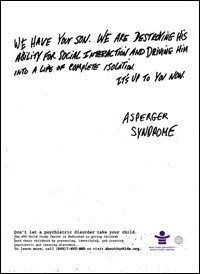
The charming \”Ransom Note\” public campaign by New York University is a good example of this.

Text: We have your son.  We are destroying his ability for social interaction and driving him into a life of complete isolation.  It\’s up to you now. ~Asperger Syndrome

This is stigmatizing in a few ways.  First, social interaction and your ability thereof is a skill… i.e., something that can be learned.  So, no, there is no destruction here, it\’s simply that the child may need extra support to learn those social skills.

Second, do you know why autistic people tend to be more isolated?  It\’s not because we don\’t want friends, or don\’t try.  It\’s because neurotypical people tend to reject people different than them.  When that happens over and over, the person loses the desire to try again.  Saying that\’s their autism\’s fault is not only absurd, it\’s literally the opposite of the problem.

Third, this ad commits the idiocy of assuming you can remove the autism from the autistic.  You can ease the ways an autistic person suffers, like providing sensory support, treating depression and anxiety, allowing them to make decisions (and mistakes!) on their own terms.  And the results may be that they act less \”weird,\” which is then mistaken for \”less autistic.\”  The fact remains that you cannot cure or remove autism, which is a neurologically-based difference, from an autistic human.

This campaign, and others like it, have informed the public opinion of autism.  We are, apparently, a disease, threatening, and something to be feared.  This was the message given to the general public.

Here\’s another horrifying ad by Autism Speaks (stupid name; no autistic people are listened to there).  And here\’s the transcript, in case, like me, you can\’t follow the whole thing.

They\’ve personified autism into some kind of malevolent disease-demon, infecting innocent children and making them have greater challenges than most kids.  Autism Speaks is happy to blame disintegrating marriages on this nonexistent entity rather than the actual children, while demonizing what makes those children unique.

Autism, to Autism Speaks (bullshit name), is nothing less than evil.  Which they, of course, have set themselves up as the \”Good\” to fight against.  There\’s a lovely message of universality, with mentions of various countries and religions.

It\’s a pity it all misses the truth, which is that there is no demon.  If autism has a representative, it\’s your children.  It\’s adults like me.  It\’s the collective community we adults have built.  We don\’t want your marriage to fail any more than we want our own relationships to fail.  We don\’t want you to go bankrupt paying for therapy that traumatizes and stigmatizes us.  We certainly don\’t want you to lose hope.

Mostly, what we want is to be ourselves.  To not be rejected for being different.  No amount of demonizing autism will make that happen.

Some excellent general examples of the typical public stigma experience can be found in the article here.  Highlights include, \”autistic people don\’t have empathy/can\’t feel emotions,\” \”autistic people are damaged,\” and how autistic children are all apparently soul-draining, life-destroying monsters (due to how some parents talk about them).

All of these are examples of Public Stigma, the first of seven types of stigma.  

Worth Your Read: Types of Stims

https://justkeepstimming.com/2017/08/28/stim-toys-and-fidgets-workshop-a-recap/

For a very shortened version in infographic format: https://justkeepstimming.com/2019/05/21/types-of-stimming-infographic/

This is a good primer to the types of stimming that exist, covering most of the senses.  There\’s a little bit at the beginning on why people stim, which I consider mandatory reading.

Honestly, I wish that section was longer.  Stimming is one of those things that\’s been demonized for being abnormal.  Eliminating it is a primary focus in many ABA programs.  This focus ignores the function of the behavior.

It\’s more than that, though…  Autistic stimming is usually just more obvious variants of behaviors that most people do.

Y\’know how some people nervously bounce their legs, or twiddle their thumbs in boredom?  Maybe they fidget a little, crack their knuckles, or even play with their hair.  Some people hum when they\’re alone.

That\’s stimming.  All of that is stimming.  You\’ve been seeing people stim your whole life and never batted an eye about it.  The only reason autistic stimming is deemed unacceptable is because it doesn\’t always look like that.

We also tend to stim more often, because we\’re under far more stress than most people.  There\’s internal stress, from our brain and body not obeying our commands or needing extra support to function well.  And there\’s external stress, from the unfair demands of the people around us (\”Act more normal!\”) and those of society (\”you only have worth as a human being if you\’re making money!\”).

It all adds up.  If the stim isn\’t dangerous to the person or the people around them, LEAVE IT ALONE.  Letting a person stim means fewer meltdowns and a happier autistic person.  

Worth Your Read: Bone-Tired

http://www.thinkingautismguide.com/2019/12/i-identify-as-tired.html

This is me right now.  Maybe it\’s been me all along, through high school and college.  But it\’s particularly me right now with all the things going on in my life.  
I\’m actually too tired to do a whole rant on why I\’m tired, but the basics are this: revamping our budget, the household is down to one car, reworking Chris\’ and my communication so both our needs are met, hosting Chris\’ younger brother and trying to help with his job search/adulting, I keep getting sick (flu, food poisoning, ???), and my country\’s federal government is a fascist mess pretending to be a democracy.  
There\’s been an idea floating around the Internet in regards to limited energy, called Spoon Theory.  The original site seems to have disappeared, but there\’s a version of it here.  I\’ve never had a good sense for how many spoons I have in a day.  I think I also have the ability to borrow spoons from the future, so to speak, such that I\’ll be utterly exhausted the next day but be able to survive the current one.  Unfortunately if you do that too much, you pay for it in spades, and that is what is happening to me.  
In general, I\’m finding that I\’m having trouble making eye contact, managing myself, making conversation, and even formulating the words to express my thoughts.  I\’m doing essentially the bare minimum to keep my life and relationships sustained.  
I\’m also spending massive amounts of time doing self-care, which feels like a horrible waste of time when I could be working or doing things that actually help other people.  Unfortunately, while that\’s how I feel, it\’s not wise or necessarily fair to myself, because I\’m no good to anyone if I can\’t function.  I know, mentally, that you have to be good to yourself so you can be good to others, but emotionally it still feels like a waste of time.  

Worth Your Read: Hospital Equipment is an Auditory Nightmare

https://www.nytimes.com/2019/07/09/science/alarm-fatigue-hospitals.html

I\’ve complained about hospitals before, particularly hospital rooms.  This article is a much more indepth explanation, complete with examples, of the auditory end of things.  Apparently you needn\’t be autistic to be horrified by the experience.  Trained musicians, or even just ordinary people, don\’t enjoy it either.

When I visit people in the hospital, I\’m nearly constantly aware of beeping, rumbling ventilation, carts, doors to patient rooms left wide open, staff loudly talking in the halls, and other machine noises like the IV machine\’s clicks.

I found the examples helpful to illustrate what they were talking about, and particularly enjoyed the Care Tunes Demonstration video near the bottom of the article.

I suspect making these changes would involve a lot of retraining, a lot of replacement costs for machinery, etc…  But I also suspect turnover wouldn\’t be nearly so high in those professions if being in hospitals wasn\’t so horrid, and the patient recovery statistics would be so much better.

I can definitely say that my own recovery in a hospital would go a ton better if I had CareTunes to listen to, rather than the barrage of suffering-inducing beeps and trills I\’ve heard in the past.  I would find the hospital a less terrifying, painful, emotionally-damaging experience.  I think the same is true of most sound-sensitive people, and perhaps even most people.

Worth Your Read: On Applied Behavioral Analysis

https://theaspergian.com/2020/01/11/an-open-letter-to-the-nyt-acknowledge-the-controversy-surrounding-aba/This is a long article, but a really good one in terms of addressing the issue of ABA.   There are many reasons to be wary, not the least of which is how poorly most adult autistics who’ve been through it, view it.  If you can’t take the word of people who’ve been through it, particularly when you’ve never done it yourself, I kind of don’t think you’re listening.  And if you’re not, it might be wise to ask yourself why.

I particularly liked the section on animal training, which was a new take on the ABA debate to me.  One would really hope we could break at least even with current animal training methods for working with other humans, but autistic people are apparently sub-animals as well as sub-humans…  at least to some people.

The (lack of) training issue for ABA therapists was also an excellent point.  I can attest to it, in fact.  While the ABA clinic I worked as a secretary for years ago didn’t just take whoever they wanted off the street, that was absolutely an option.  It was their discretion to hire people with some background in autism and an interest in ABA or at least psychology.  Even so, I wouldn’t have wanted to go through that therapy, even at that facility.

Consider also the sections on eye contact and apraxia.  I, personally, find eye contact unpleasant and mildly distracting.  Meaning I learned to do it anyway, but never like it.  Imagine it was completely destructive to your train of thought, you couldn’t hold a conversation while doing it, but nobody will listen to you unless you do it.  Would that really make you want to try doing it?  It makes me feel terrible just thinking about it.

And apraxia, where stray electrical signals and your brain and body just do things, without your consent?  That’s awful to have to put up with, let alone someone else deciding you need to be punished for it.

Please give this article a read.  It’s very worthwhile.

Worth Your Watch: Lessons from Brain Scans

https://www.youtube.com/watch?v=esPRsT-lmw8

Brains are not made of concrete.  The idea that once you\’re grown up, that\’s it and you\’re done changing and growing, is a fallacy from decades ago.  It\’s been proven stunningly wrong.  While you may not grow any taller, your brain continues to wire and rewire itself as the years go by.  You grow new neurons.  As you learn new ideas, new pathways and connections in your brain must develop to allow you to handle those ideas and live in an ever-changing world. 

Thus, the idea of these brain scans, and neuroplasticity (the idea that brains change continuously through a person\’s life), is a valuable one.  The idea that you can literally change someone\’s brain, to help them heal from an injury or counteract a toxic environment, is invaluable.

That is, in fact, exactly what neurofeedback, especially LENS, the type I benefit from, aims to do.  And it\’s what my doctor, after years of prodding my brainwaves, has likely achieved.  I can\’t prove it, of course, since I have no brain scans of myself prior to treatment.  But the results are kind of hard to argue with:  I\’m less depressed, less anxious, more able to convey emotions and work with neurotypical people.  I would also say I \”read\” people better and more intuitively than I used to, right down to being able to point out specific body language markers. 

I did some research on this speaker after I finished this TED talk.  To my great annoyance, there aren\’t really specifics on how to help autistic people on his website or in the promotional videos.  It\’s very much a \”pay for my services and then I\’ll tell you how I can help you\” scenario.  Of the two \”mother advocate\” videos, only one went into minor detail about the results of these brain scans.  Blood tests, supplementation, and specific behavioral plans were noted, along with much praise for the expertise of the clinic\’s experts. 

It\’s definitely true that autistic people can have specialized dietary requirements or need specific restrictions (like gluten-free casein-free) to thrive.  In fact, what little was described here is rather similar to what my own doctor has guided me through: better nutrition by way of blood tests and supplementation, better guidance for what to do with specific situations. 

I do wonder if \”more movement\” and \”eat less processed crap\” also featured in the treatment plan, because those are extremely significant.  At this point in my life, I can actually feel the changes in my system if I\’ve eaten processed food, versus healthier whole foods.  It\’s both impressive and extremely disappointing, given that a lot of my favorite foods are processed junk. 

In any case, my favorite bit of this video was applicable to any person, autistic or not: you are not stuck the way you are.  You can change the patterns of your life, even if the problem is in your very brain.  I can safely say this is accurate.  There is hope.  You don\’t even have to travel to San Francisco to find someone to help. I find that wonderfully hopeful and heartening.   

Introducing Ought: The Journal of Autistic Culture

https://scholarworks.gvsu.edu/ought/

This is a link to a newly launched journal about autistic culture.  Rather than draw exclusively from scholarly neurotypical outsiders analyzing autistic culture, it draws directly from the culture-makers ourselves.  This is, in my opinion, a fantastic idea, and I hope this journal lasts many years.

Ought contains everything from poetry to opinion pieces to artwork.  It talks about everything from what autism is to education and social norms. and included at the very end is a short book review I wrote about On the Edge of Gone, by Corinne Duyvis.

Each piece can be read, for free, by clicking the \”pdf\” icon.  Please especially note the call for submissions at the very end: parents, teachers, professionals, and autistics alike can all contribute to this journal, and your perspective is valuable.