WYR: The Difficulty of Including Everyone

http://www.thinkingautismguide.com/2019/09/you-cant-have-neurodiversity-without.html

This is a summary of a Twitter thread written by an autistic person with intellectual disabilities.  They have a number of good points, so I highly recommend you read the linked post, particularly if anyone in your life has learning or intellectual disabilities.  
What I wanted to focus on here was a specific complaint Ivanova has regarding the neurodiversity movement.  As you\’ll see, this complaint shows why you basically can\’t have hard and fast rules for any given situation.  They observe that new rules are being made for conferences or gathering places for neurodiverse people, mandating that everyone be quiet.  This is meant to help people who are easily distractible or have sound sensitivities (or both, like me).  With less noise, people like me can focus more clearly on the presentation material.  Sounds great, right?
Well, turns out it\’s only great for that particular type of autistic person.  Ivanova talks about their friends (also with intellectual disability) who actually need noise in order to focus.  These are people who play in the Special Olympics, people who\’ve accomplished good things.  People whose input would be valuable to the conversation about neurodiversity.  Clapping, echoing words, or being able to jump up and run around is just as important to these autistic people as silence is to me.  
So here\’s the tricky part: neurodiversity mandates the inclusion of everyone.  How do you reconcile two such different needs?  
My best guess is that you try to seat people like me towards the front, and people like Ivanova\’s friends towards the back, and you don\’t set a noise policy but you do ask people to stim quietly if they can, and warn people like me that they may need to handle some noise because other people have needs too.  Is this ideal?  Certainly not.  The noise-sensitive autistics may jump with every clap, and the people that need to clap so they can pay attention may feel suppressed because they\’ve been asked to clap quietly or stim in some other manner.  However, I\’m told a good compromise makes everyone unhappy, so it\’s at least a start.  
A truly good policy or rule is inclusive to all people.  That is remarkably hard to pull off when peoples\’ needs can vary so much.  And because people with intellectual disabilities are just as valuable people as I am, it\’s important that we accommodate them and give them a platform for their voices, too.  Even if they use methods of communication that we don\’t already know how to understand.  Even if they\’re entirely nonspeaking and rely on 100% nonvocal methods of communication.  
If this was a more high-tech age with a lot of money to throw around, I would say a reasonable accommodation for very noise-sensitive people like myself would be noise-canceling headphones that are linked into a closed hearing aid loop system.  You see, in churches and some other places, you can have a channel for people with special hearing aids.  Using this, they can hear the music and the sermon as it\’s picked up by the microphones for the church\’s sound system.  It\’s like a direct line to the \”important noise\” of the event.  The noises around them aren\’t amplified, and so they\’re able to pay attention much more clearly.  Having headphones that canceled out the random noises around us, but still gave us the ability to hear what was going on?  That would be a great solution.  
In all honesty, though?  It may take a few decades, but I\’m hoping Virtual Reality (VR) will close the gap and make it so you can virtually attend a conference without having to be in the room.  In such an environment, you could mute everyone who wasn\’t the speaker (if you need silence) or mute yourself (if you need to clap or jump).  With holograms and such fine-tuned control over your surroundings, anyone\’s needs could be met without too much difficulty.  
The movement for quiet in neurodiversity conferences were made with good intentions, but like any group does eventually, it\’s gone too far in a single direction.  In doing so, the people who made these rules have strayed from what neurodiversity is meant to mean.  I fondly hope that these conferences will listen to Ivanova and their friends, revoke these restrictive rules, and seek a way to make events as accessible as possible for everyone.  

Book Review: Asperger\’s and Girls

Asperger\’s and Girls, by Tony Attwood, Temple Grandin, and a bunch of other experts, is a book of essays on specific issues and specialized focuses on topics that come with being born with two X chromosomes and autism.  At the end, it includes a trio of essays by autistic authors, which help put the information from the previous chapters into context.  There are thoughts and guidance on the differences we\’ve seen between male and female autistic people, on sex education and puberty, on navigating the social life of a school, on transitioning to adult life from school, and even pieces on careers, relationships, dating, marriage, and motherhood.

The book is from 2006, so it\’s unfortunately a bit dated.  You wouldn\’t think that much could change in 13 years, but it can!  At that time, it was news that autistic people could be female, and everyone and their sister didn\’t own a smartphone.  Hence, there was a strong need for this book.  Fortunately, the general knowledge of autism has increased.  Possibly less fortunately, or at least very differently, the way kids learn about some of these subjects has changed. For example, never mind school sex ed or even proactive parental teaching, most likely the first place kids learn about sex is via the Internet, either from porn sites or (preferably!) from helpful online resources like this, this, and this.  Even so, the book still contains a good bit of useful advice and insight on the subjects it addresses.

Of particular interest was the section on social groups, how to fit in, how to navigate the school\’s social hierarchy, and the model of relationship levels.  This was information I was definitely missing when I grew up, and while I didn\’t entirely agree with every sentence in the essay, I probably am not the greatest resource for this information anyway.  I spent most of school as a loner (which I was just fine with), and only had an actual friend group in high school.  I must have done okay by them, or at least tolerably, but I can\’t imagine I was anyone\’s Friend #1.

The section I had the most disagreements with was also one of the most important and useful sections: the one on puberty.  In 2006, the culture was beginning to shift, but wasn\’t yet to the point of understanding Consent, or recognizing that while you don\’t just… talk about menstruation or sex with strangers, they\’re also not subjects you should be ashamed of, and it\’s okay to talk about them with your close friends. Or… I guess random strangers in a supportive Internet environment like Scarleteen (All hail the mighty Internet, where you can sidestep your embarrassment on a subject by being anonymous).

At the time this book was written, I was in high school, and these things were beginning to change… but consent was still poorly understood.  And in fact, it\’s mentioned in this book, but not by that name, and certainly not discussed in detail, like the difference between \”no means no\” and \”yes means yes.\”  The book even counsels not talking about having a period, as if it\’s impolite to mention this basic fact of life and people will faint if it\’s brought up.  Maybe it\’s that I\’m autistic, but I personally think if you can\’t handle hearing that a person is suffering cramps or needs to use the bathroom to change their pad, you need to grow up.

A minor concern about this section was the espousing of disposable pads.  I know disposable pads and tampons are easy and convenient and all that, but they\’re incredibly expensive over time, environmentally unfriendly, and there are perfectly good reusable options for both products.  I would rather autistic girls (and all girls, really) be taught how to use these reusable options, and only rely on disposable products for emergencies.  In all honesty, the disposable pads are scratchy and annoying by comparison to the washable ones anyway.

Still, the essay is quite right in telling you to start teaching body changes, cleanliness, use of hygiene products, sex ed, and personal safety.  And not only to teach it outside school, but teach it early, and in steps rather than all at once.

Read This Book If

You want a general overview of the ways autism can be experienced differently in women and girls, and don\’t mind that some of the recommendations and information are outdated.  Teachers, parents, and even some professionals could really benefit from the information here.  In particular, I appreciated that the book didn\’t shy from talking about and instructing you how to teach about menstruation, body changes, and sex.  I really wish Future Horizons (the publisher) would update this book for the Information Age.  A discussion of consent would be an excellent addition to the book.  Regardless, it was a valuable read, especially since, even 13 years later, some people still insist on thinking autism is mainly a condition that guys have.

Extra: Resources for Women

https://www.reddit.com/r/aspergirls/

https://www.aane.org/women-asperger-profiles/

https://awnnetwork.org/

Worth Your Read: Spiky Skillsets

https://theaspergian.com/2019/07/05/autistic-skill-sets/

Let\’s talk about expectations for a bit.  Humans have this tendency to assume that if someone\’s really smart, they\’ll be good at almost anything you put in front of them.  Even though this is demonstrably untrue, this is the assumption. 

For example, I love my father, and he is utterly brilliant in the chemistry lab.  Seriously, if it\’s in his area of expertise, there\’s no one better in the world you can ask to solve a problem.  But if you gave him a pile of raw chicken, grains, spices, produce, and other ingredients, took his phone away, and told him to have a dinner with side dishes and salad all ready to go at a certain time, he would likely not manage that deadline.  My mother, on the other hand, accomplished that every evening for like 20 years when my brother and I were growing up.  This is an example of skill sets.

Now, most peoples\’ skillsets are at least reasonably well-rounded.  Because of the educational system, you can generally assume any given person you run into can do basic arithmetic, read, write, make small talk, and understand the basics of science, history, and computers.  Oddly enough, I live in an area where the census of 1990 told us that 19,000 local adults are functionally illiterate, and can\’t read menus, medicine bottles, and children\’s books. 

If you\’re lacking in any of those categories above, you would be considered disabled, especially if your level of proficiency was nonexistent.  In today\’s world, it\’s simply expected that you know these things and can perform them.  If you\’re unable to meet these expectations, your opportunities are far fewer. 

Now add a diagnosis into the picture.  Autism spans a particularly wide spectrum of difficulties, differences, and oddities.  Any given autistic person will have different challenges, so the word itself is almost meaningless.  The thing is, autism lends itself to even more weirdness in expectations. 

You can have highly intelligent people succeeding brilliantly in academia, but the instant they leave, they find out they can\’t hold a regular 40 hour a week job.  Because for all their brilliance in research or writing papers, they can\’t handle networking, juggling others\’ feelings, social dynamics, or personal care skills.  This is an example of a person with a spiky skillset.  Highly skilled in some areas, painfully poor in others.  Yet when the average person looks at them, they\’ll make an assumption about the rest of the person\’s skills by whatever skill is on display.

If what\’s on display is \”mediocre conversational and self-care skills\” this example intelligent person will be considered disabled, and concern may be expressed about whether they have sufficient supports, or whether they should hold any kind of job at all.  If their favored research subject is being discussed, the autistic person will seem like a genius, a person going places in the world, and it will be assumed they have self-care skills to match their intelligence and devotion to their favored subject. 

Both assumptions are wrong, and the truth is somewhere in between.  The example brilliant-researcher-autistic person may well be going places, but their lack of self-care and conversational skills does disable them and will hamper their ability to succeed.  This is the spiky skills this article talks about, and it\’s a common experience for many autistic people.

Here\’s a poem about exactly this phenomenon, and a comic that includes several panels on the subject.

All this isn\’t to say that autistic skillsets have to be spiky.  Just because a person\’s skillset developed that way doesn\’t mean they can\’t improve and grow their skillset.  An autistic person can learn various personal care skills, and with time, learn conversational skills as well (case in point, me).  A supportive environment, thoughtful help, and plenty of patience are instrumental in making this possible. 

A final note: the focus can\’t all be on autistic people changing to suit others, though.  Others need to adapt to help us, too.  

From the Web: Making Interviews Even Worse

Interviews are awful. They\’re a glorification of the first impression, a phenomenon that is notably inaccurate for actually assessing people, their personalities, and their skillsets.  They are also nearly mandatory for getting hired in the United States.

There are whole classes offered in colleges on how to do an interview.  These aren\’t for autistic people, they\’re offered for everyone, because doing a good interview is an art form.  Few people are naturally good at interviews, so these classes are offered to help offset the dozens of stumbling blocks involved in the process.  Things like what to wear, what questions you might be asked, what type of resume to bring, and how to answer tricky questions like \”what thing would you change about yourself/what\’s your most negative trait?\”  Mostly, though, interviews are an exercise in lying through your teeth.  
Autistic people tend to be worse at interviews than the general population.  Lying often doesn\’t come naturally to us, so when asked \”why do you want to work at this company?\” we\’re more inclined to say \”because I need a roof over my head and food to eat,\” rather than the expected answer of \”oh, I love Company because X, Y, Z, and I think I\’d fit in really well and enjoy the work.\”  The hiring process is so skewed that in order to get hired, you need to say things like that, even though you most likely do not believe them.  Even if the job in question is just being a stocker at a grocery store, or a janitor at a retail store.  
Even if you\’ve learned what the right answers are to all these questions, and what\’s expected of you, you still need to manage the in-person interview with another live human being.  Statistically speaking, that human being will not know much, if anything, about autism, and will only see it as a liability and a reason to pass over you.  If you disclose your diagnosis during the interview, that will be a factor the interviewer will consider consciously, and ableism is quite rampant in the United States.  If you don\’t disclose your diagnosis, you\’re at the mercy of how well you can \”act normal\” during the interview process.  Your tone of voice, amount of eye contact, posture, facial expressions, and word choice will all be scrutinized by the interviewer.   All of which is entirely aside from your actual skills for the job.  
Then there\’s the dress requirement (not everyone can shell out for a nice suit or appropriate formalwear), the resume mess (formatted just so, with just the right information tailored for each job you apply to), and the luck factor (better hope the interviewer likes you).  In short, it\’s no surprise autistic people suffer much higher rates of unemployment and underemployment.  
It\’s probably quite clear by now how poorly I view the hiring process.  So what could make it worse?  Well, how about making the interview one-sided, recorded, and having it be analyzed by a face-reading computer?
You would think this would be an improvement, since there\’s no longer a human being to manage interactions with… but the thing is, that also means there\’s no feedback and no discussion.  There\’s no chance to explain your diagnosis, no chance to make an actual human connection.  You, as a person, are represented solely by how well you can lie to a webcam and pretend it\’s a person.  This includes making eye contact with the webcam as if it\’s a person, which, if you read the comments on the link, neurotypical people find difficult also.

Effectively, this development makes interviewing worse for everyone.  Now, not only do you need to learn how to do a regular in-person interview, you also need to learn webcam etiquette, how to look a webcam in the eye and pretend it\’s a human, and how to have a one-sided conversation while lying through your teeth.  It is, as one commenter points out, more appropriately termed an audition.

Of particular irony is the fact that this software will, invariably, be used to hire for customer service and people-facing jobs.  So instead of putting the candidates in front of actual people in order to check their people-skills, they will put them in front of cameras.  Y\’know, thus checking their YouTuber skills (performing in front of a camera skills) instead.

Now in case this isn\’t unfair enough, people with autism tend towards more unusual facial expressions.  Some are hyper-animated, but some, like me, are more stone-faced.  With computer analysis of my face as I try to talk to a camera like it\’s a human, I have even less chance of passing the interview process and acquiring a job.  Thanks, thoughtless jerks in marketing and human resources!

Book Review: Mindful Living with Asperger\’s Syndrome

Mindful Living with Asperger\’s Syndrome: Everyday Mindfulness Practices to Help You Tune Into the Present Moment, by Chris Mitchell, is a guidebook on meditation and mindfulness specifically for autistic people, by an autistic person.  At less than 125 pages, it\’s a short read, which is nice.

The main of the book discusses mindfulness, how it\’s helpful for autistic people, why you might want to start practicing it, and then, how to practice it.  My attention as a reader was quickly drawn away from that by how hyperfocused the author was on the diagnosis.

The words \”Asperger\’s syndrome\” are on basically every page, as if this is the most important thing about the reader and all the reader\’s personality traits and tendencies are derived from that. I found the repetition rather distracting and kind of superfluous to the topic at hand.  It was so distracting that I stopped reading and counted.  In the first 62 pages, there were exactly four pages that didn\’t mention Asperger\’s syndrome or autism in some fashion.

Honestly, it felt like the author was still in the \”everything strange or different about me is autism\” stage of handling the diagnosis, but that might not be accurate given that he wrote the book some 16 years post-diagnosis.

That highly distracting repetition aside, the book does walk you through several meditation and mindfulness practices and why they\’re relevant to autistic people in particular.  The idea of mindfulness is to take your mind out of the past or the future, and focus on the present, including any sensations you might be experiencing.  Practicing it can pull you from your everyday preoccupations, help you relax, and sharpen your observational skills regarding yourself and others.

The author opines that autistic people tend to get \”stuck in routine,\” because routine in comfortable and safe.  But then when the routine is disrupted, it\’s extremely upsetting and can cause meltdowns.  With mindfulness, you can become more flexible to change, see social situations differently, and manage yourself better.

Most of the mindfulness practices were ones I\’d heard of before, but there was one new one: walking practice.  Generally when one talks about meditation or mindfulness, the assumption is that you\’re in some quiet place, sitting comfortably but with good posture, or perhaps performing yoga.  Apparently you may practice mindfulness in the course of taking a walk, and that is also acceptable.  I have trouble sitting still and focusing on simply being, so combining light exercise with mindfulness might be a good plan, and less likely to drive me batty.

I do kind of wonder about the effect of mindfulness on sensory sensitivities. The practices in this book instruct you to acknowledge and accept incoming sensations, like background noise, strain in your muscles, and any sensations on your skin. I suppose this makes me worried that practicing might lead to sensory overload, because being aware of all these things can be overwhelming and painful. That\’s literally how my flavor of sensory overload works: my brain stops even trying to filter out irrelevant noises and everything gets so loud and sharp and overwhelming that I have to go hide somewhere quiet.

I assume that\’s why you generally practice mindfulness in a quiet, comfortable environment, but as someone who hasn\’t really made a lot of headway with mindfulness or meditation, I really wouldn\’t know. Maybe mindfulness gives you a superpower to head off sensory overwhelm, if you practice faithfully and find what works for you.

In all honesty, I\’m not sure this book was written for someone like me.  I don\’t actually have much by a way of a routine to get stuck in.  There are regularly scheduled events, but if those don\’t happen, I don\’t get really upset.  Schedule changes are really only anger-inducing if they keep happening over and over, with the same events getting pushed back and back.  I\’ve accepted that life is unpredictable by nature, and that I have a certain amount of desire for new and interesting things.  I have disabilities around sensory issues, but I tend to compensate for them and try not to let them keep me from going out or seeing friends and family. 

This might mark the first time an autistic person has made assumptions about how my autism affects me, and been wrong.  I don\’t know why that surprises me.  Professionals, parents, and teachers get it wrong all the time.  There are eleventy billion definitions of autism, and it\’s not like there\’s much agreement on the subject.  So differing opinions, even in the autism community, would be nothing new or surprising. 


Read This Book If
You\’re autistic, prone to getting stuck in routine, and want to change that using mindfulness.  Also, make sure you can get past the endless repetition about your diagnosis. This is a pretty niche book, to be honest. It\’s fine at what it does, but it\’s pretty much the bare basics and doesn\’t strive to be more than that.

Reading the Research: Communication, Pain, and "Problem Behavior"

Welcome back to Reading the Research, where I trawl the Internet to find noteworthy research on autism and related subjects, then discuss it in brief with bits from my own life, research, and observations.

Today\’s article underlines a point I think many parents miss, but is kind of obvious when you think about it.  

First: all behavior is communication.  When we talk about communication in a mainstream sense, we tend to be referring to a very narrow range of what communication actually is.  Mainly, we\’re talking about speaking the country\’s dominant language, while following the rules the majority of the population follows.  We might also be talking about what I\’m doing here: writing and reading in said dominant language.  

The thing is, communication is so much more than that.  It\’s what actions a person takes.  It\’s how they take those actions.  It\’s pictures and graphs and tone of voice and other languages and personal slang.  There are an absolutely dizzying number of ways people can communicate.  

Calling any of that \”problem behavior\” is kind of ignoring the essential nature of that behavior.  If it\’s a problem for you, then you should figure out what the behavior is communicating.  

Non-verbal autistic people sometimes behave aggressively.  This can be for a lot of reasons, from frustration with their situation, to despair in their life prospects, to the one this article is tracking: pain.  

Anyone who\’s dealt with sufferers of chronic pain, or even been in a bad mood due to a headache or backache, shouldn\’t find this surprising.  Being in pain, especially day after day, has real consequences for your mood and outlook.  You can see this often in older people, whose bodies can cause them significant pain due to any number of ailments.  The word I\’ve often heard or such people is \”crotchety,\” but \”crabby,\” \”volatile,\” and \”ill-tempered\” have also been applied.  Because nonverbal or low-verbal people can\’t easily communicate that they\’re hurting, they may also display these less pleasant behaviors, and it\’s not so easy to get treatment for the issues when the person can\’t tell you what hurts, when.  

Then, too, the person may not even realize their suffering is abnormal.  They may be so used to it that they don\’t even think to ask for help.  I\’m a highly verbal person, but I actually spent most of my childhood having regular constipation, which caused me pain on a regular basis.  I wasn\’t aware this was unusual, and thus that issue continued right up to the point that I accidentally nuked my digestive tract and developed the opposite problem, which now lingers when I eat too much sugar or really don\’t eat a perfectly healthy diet.  

One of the common themes I see in \”my family\’s experience with autism\” books and \”fix your child\’s autism with my system\” is the insistence that when the \”problem behaviors\” go away, the autism is cured or lessened.  This is… mostly a misunderstanding, I\’d bet.  The child or adult doesn\’t act up as much, or act as unusually after This or That Technique is tried.  The person is pronounced \”not autistic any more,\” and the day is saved.  

The change in the person\’s behavior is because their body is functioning more healthily, and therefore they are suffering less.  When people don\’t suffer, they\’re less inclined to be angry, frustrated, and lash out at setbacks and smaller disruptions.  Their behavior will change, because their internal state has improved.  You also have a happier, healthier person, which is really the more important part if you ask me.

(Pst! If you like seeing the latest autism-relevant research, visit my Twitter, which has links and brief comments on studies that were interesting, but didn\’t get a whole Reading the Research article about them.)

Reading My Psychological Evaluation

Recently, due to participating in a research study, I was asked to get a copy of the psychological evaluation that told me I was autistic.  I did so, and summarily read it.  I can\’t remember if this is the first time I\’ve read it, or if I had a copy ever.  But it\’s certainly the first time in quite a while that I\’ve read it, so it was interesting… and depressing, reading.

The place that did the evaluation is a local one, with various therapeutic programs in addition to their diagnostic services.  I wasn\’t over-impressed with their offerings at the time, and my insurance wouldn\’t have covered them anyway, so I never got too involved with the organization.  I have no idea if that was a good decision on my part or not.  But all the same, I do at least finally have a date on which I got my autism diagnosis.  It turns out I was almost 20 and a half when I got my diagnosis, right on the tail end of my sophomore year of college.  Near finals week.  No wonder I don\’t remember it very well.

It\’s worth noting, before I begin, that I was diagnosed under the DSM-IV-R, or the revised version of the 4th edition of the American Psychological Association\’s diagnostic manual.  At the time of this writing, the most current DSM is the 5th edition, wherein Asperger\’s Syndrome only exists as a different name for ASD, or Autistic Spectrum Disorder.  Also known as \”autism.\”  I now choose to identify as \”autistic,\” because of this diagnostic change, and because while I speak, live independently, and present as fairly normal, I share some of the same difficulties as a nonspeaking, dependent, poorly-blending autistic person.  Also, by putting a human face on the condition as a whole, it becomes harder for people to treat nonverbal, poorly speaking, dependent autistic people as… less than people.  And there\’s already quite enough abuse of disabled people to go around. 

The First Page and the Interview

The first page of the report involves demographics, including some unusual and probably unnecessary information.  Date of birth, name, education, and medications, naturally.  But they also wanted to know where I was living, any eyewear I happened to need, and which hand is my dominant one.  I have a bachelor\’s degree in psychology, and I really have no idea why those last three pieces of information are relevant.

I remember being mentally exhausted after the test, and looking back at the list of tests and the number of hours billed, I can kind of see why.  The testing process took a minimum of 4 hours, possibly 5.  The psychologist began by interviewing me, which included getting everything from my birth weight to any surgeries, allergies, family history, and my particular descriptions of my personal oddities.  While she was getting all this information, she was also observing what I said and how I said it.  Which is how you get sentences like, \”From the initial interview throughout the assessment process, it was noted that Ms. Frisch does have some unusual intonation and patterns of speaking.  She presents as being very factual and concrete, but often tells stories that are somewhat unusual in that they are more detail focused or seem to be slightly \’off center\’ of the main topic of conversation.\”

As an aside on that second sentence, my brain references things by associated things, rather than in chronological order or some other more pragmatic system.  So if I was trying to remember a particular dog species, I\’d need to flip mentally through my concepts of similar dog breeds until I found the one I was looking for, or try to remember another dog I knew that looked like the one I was trying to remember.  This associational pattern of organization can lend itself to that slightly \”off center\” kind of comment… but in all honesty, this psychologist is the only one to ever complain about it.  And in truth, I\’m not the only one I know that does this, and I find it simply moves the conversation along.  So I don\’t find it all that bothersome.  I am not, after all, an encyclopedia.

There was also this comment: \”While she attempts to engage readily in conversation and is able to be reciprocal back and forth, she sometimes will take the conversation to an unusual level that may reflect intellectual knowledge, but may also be reflective of some of the social dynamics of Asperger\’s.\”   I\’ve included this sentence exactly as written, awkward grammar and all, because it\’s always nice to know that even doctors need to have a human eye check over their work.  As for my conversational skills, I find that the more enlightened and accepting people I speak with find my particular tendencies interesting, rather than detrimental.  Exploring a subject in detail, or from an unusual angle, rather than skimming over it lightly, is an educational exercise. 

This section gets the summary: \”Her overall presentation, tone of voice, being more monotone, and difficulty with eye contact are also consistent with a typical Asperger\’s presentation.\”  It\’s worth noting that some autistic people actually go the exact opposite way in terms of voice tones, to the point of sounding \”sing-song,\” or even cartoonish.  I\’m actually familiar with one such autistic person, and the end result is probably just as confusing as my semi-monotone voice was.  I think my vocal variance has probably improved somewhat in the 9 years since this evaluation was done, but I guess I\’d have to go back to find out.

So Many Tests

After the interview, the tests began.  There were… so many.   (The paper says there were only six, but on average, each took 45 minutes, minimum… so it added up fast.)  One came after the next, too, with almost no breaks.  I think I remember calling for a break after my bladder filled up so much I couldn\’t see getting through another test… and when I got up, my legs felt stiff and tired from all the sitting.  
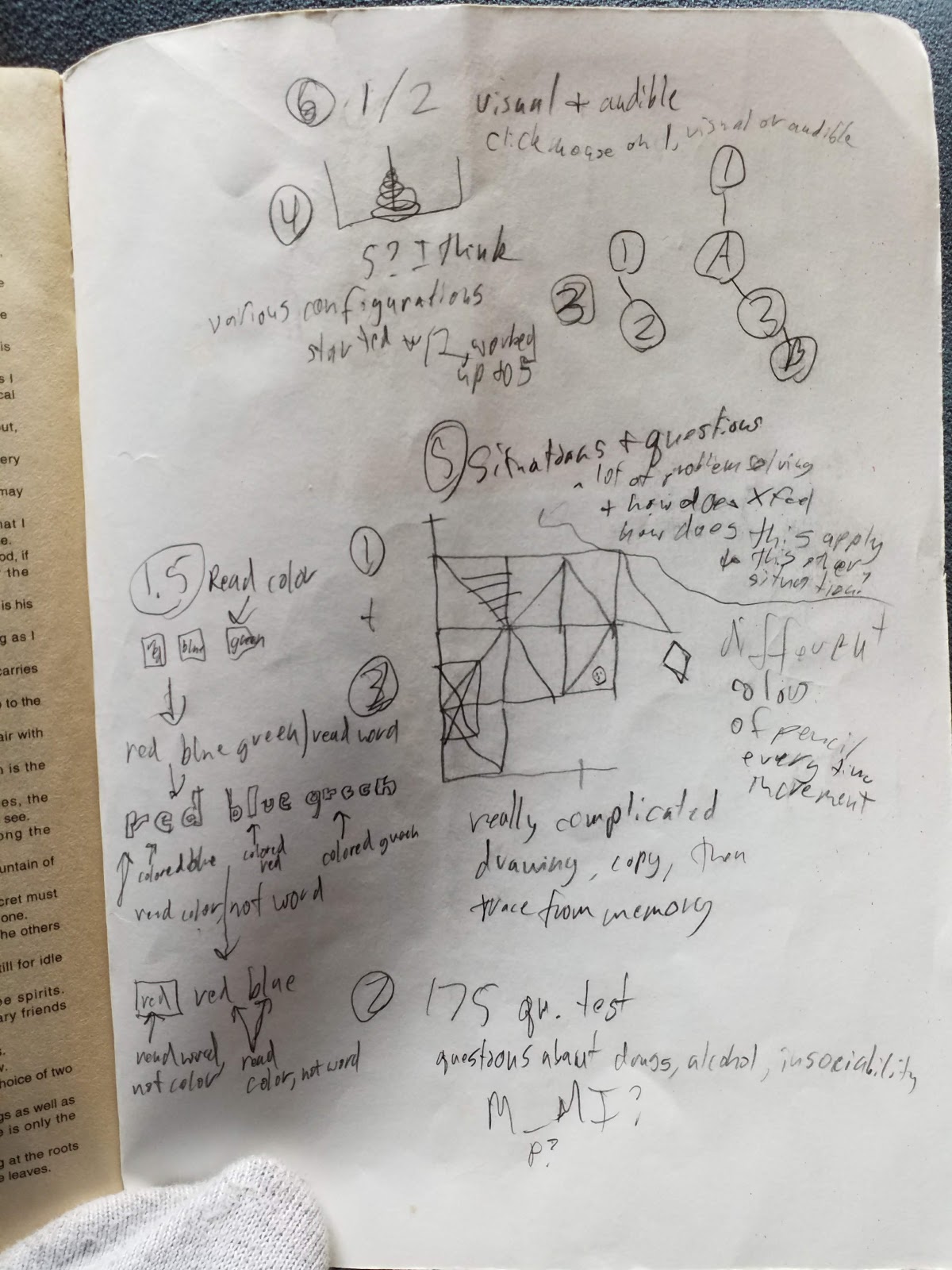
At the time, I found the experience fascinating… at least until I got tired, so I took notes about the tests in my downtime between tests.  I took them on my puzzle book, which I still have because I\’m only occasionally interested in word search puzzles. 
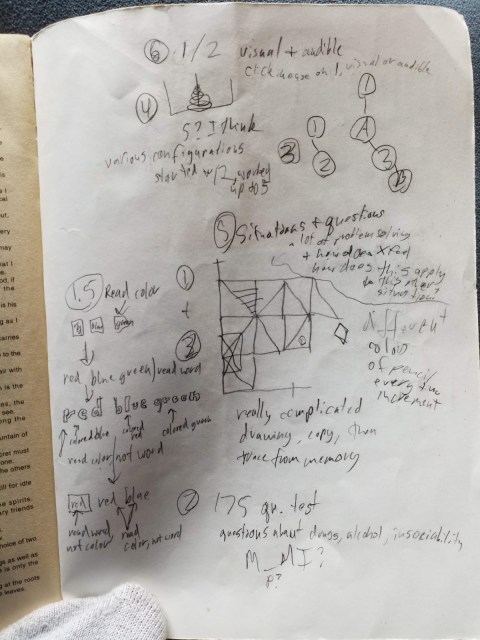
You can also see how frazzled I was overall by how disordered my self-explanation of the tests is…
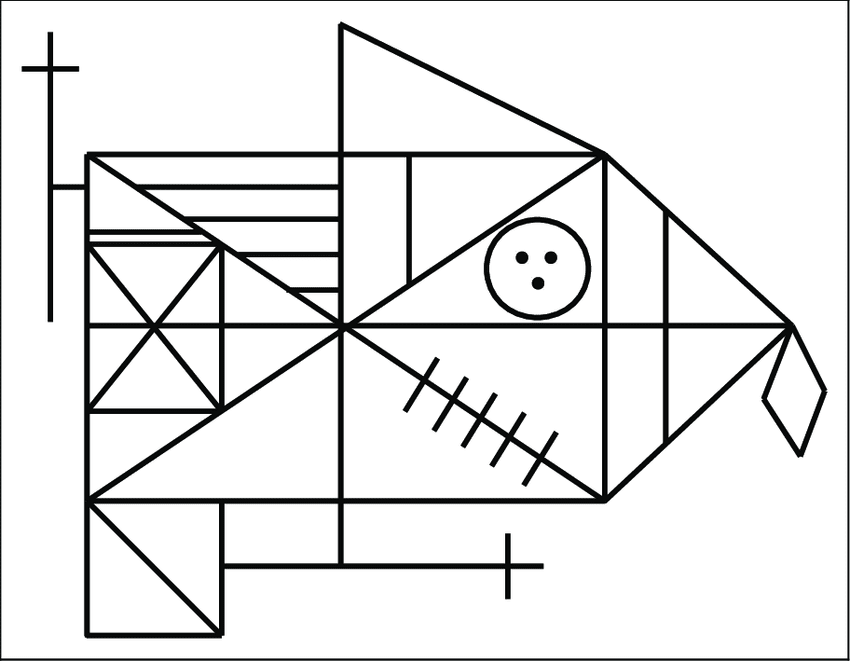
I am not 100% sure which tests came first, even with my notes here… but we have to start somewhere, so we\’ll start with the Rey-Osterreith Figure Drawing.  I linked the complete figure in an earlier post regarding visual processing difficulties, but I\’ll post it here again.

Rey-Osterreith Figure Drawing

This is overly complicated on purpose.
If you compare my drawing in the picture above with this figure, you can kind of start to see how markedly different my visual processing is from the average person\’s.  The average person, you see, recognizes that this figure is an overly complicated box with a fin on top and a triangle on the right side, at its heart.  They then fill in as many details as they can remember.  
My drawing can tell you that I entirely missed that, and instead drew a series of triangles and small boxes, with some of the finer details noted but not necessarily in their correct places.  The report notes, \”Her approach was to start at the top and work her way down rather than conceptualizing the outer gestalt.\” (I should note that I drew this version after my official test results had been recorded.)  The figure is made purposely overly complex so that nobody but a savant would remember and be able to reproduce the full shape and details perfectly, by the way.  Still, \”As a result, her overall drawing was impaired compared to similar adults and does suggest difficulty with complex visual assessment.\”  I can\’t stress enough how true that last bit is.  Most visually complex art is wasted on me. 
The tests were drawn from a larger collection of tests called the Delis-Kaplan Executive Function System.  Specifically, my notes and the report say I did the Color-Word Interference Test, followed by the Trail-Making Test, followed by the Tower Test.  

Color-Word Interference Test

The Color-Word Interference test is a variation on the Stroop effect.  Which is to say, they timed how quickly I could identify colors as shown to me on cards ( ), then how quickly I could read the words of colors (blue), and then how quickly I could read the color of the text that spelled out a different color\’s name (orange).  The correct answer for all these examples is \”blue\” but it\’s harder for a person to read the color of a word, rather than the text of the word.  Now imagine doing that when presented with tons of these:
Apparently I only made two mistakes, but those mistakes knocked my score down below average for my age.  Meh.  

Trail-Making Test

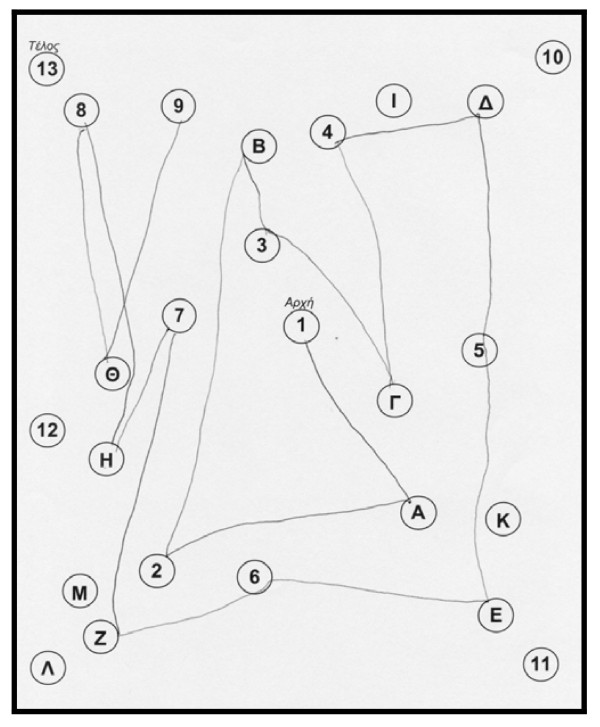
The Trail-Making Test is a test of following a sequence while adhering to rules.  You\’re given a page with the letters A-M and numbers 1-13 on it, and are then told to draw lines from 1 to A, then A to 2, then 2 to B, all the way through the page, without crossing your own lines, until you connect 13 and M.  Here\’s an example of someone getting partway through a variation of this test:  

My particular test results noted, \”…it was difficult for her to draw a straight line.  Most of her lines between the items were very shaky, wavy, almost \’bumpy\’ suggesting that even though she was able to conceptualize the task, her control of the pencil was less than expected for her age.\”  In retrospect, this is particularly funny to me because I already hold the pencil wrong (in four fingers, rather than three).  I do, however, have a hand tremor when riled up, so maybe that was the problem.  Or maybe it was just that I\’m kind of garbage at fine motor control to begin with.

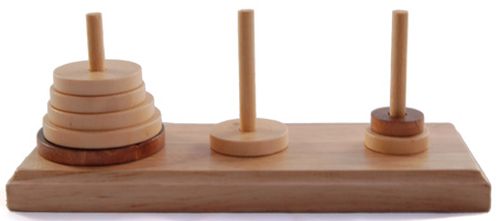
Tower of Hanoi

The Tower Test I remember most because I ended up sitting on my left hand for a good portion of it.

You had a set kind of like this, in different configurations, and were expected to stack the pieces with the smallest on top, expanding to the largest on the bottom.  You may only move one piece at a time.  This is a test of executive functioning, or your ability to coordinate and plan your actions as well as carry them out.  About midway through, though, my interest in trying to solve the puzzle overrode my memory of the \”one piece at a time\” rule, and I snagged two pieces, intending to move them one after the other.  After that was called out as not allowed for the second time, I simply sat on one hand, thus disabling my ability to accidentally violate the rule again.

There were nine of these puzzles, and I scored about average on all of them save the last, which I didn\’t finish. The test results note that I spent a lot longer trying to finish the puzzle than most people do, which the psychologist charitably explained as, \”great perseverance and hard work ethic, even when she is unable to complete something easily.\”

The psychologist in question didn\’t know me, so she was mostly unaware that a lot of my life has been marked by difficulty.  This puzzle being \”not easy\” was just another in a long line of challenges, and one with relatively few poor side effects if I didn\’t succeed.  As I recall, I didn\’t lose interest in trying to figure out the test.  The psychologist actually suggested to me that we could move on to another test unless I thought I had the solution in mind.

\”Perseverance\” is the word my mother uses, and the clinical word the psychologist used.  I tend to be more perverse and stick to \”stubbornness,\” personally.  It\’s part a point of pride and part a personal reminder that being persistent is not always a good thing.

TOPS

The next test was more socially-focused, rather than a test of how well my brain worked.  The test was a series of interpersonal situations followed by questions about each situation.  The contents were mostly problem solving, or \”how does this person feel in this situation,\” or \”how does this apply to this other situation?\”  An example was something along the lines of, \”Mary, a 13 year old girl, lives with her father.  Her father remarries and the new wife has a 10 year old daughter, who will be coming to live with them.  How does Mary feel about sharing a room?\”  
I should note, before I give my scores, that the TOPS test only scores up to age 17.  Why 17?  I have no idea.  I was almost 20.5 years old when I took the test, too, which makes me wonder if the test results might\’ve been off a bit… but never mind.  Cognitively, and in my ability to draw inferences regarding situations, I maxed out the test, scoring at 17 years old.  For determining solutions to the situations I was presented, I only scored at 15 years old, and my ability to communicate insights was at 16 years old.  Here\’s the kicker: when interpreting other peoples\’ perspectives in the given situations, I only scored at 14 years old.  
Basically, taking others\’ perspectives was a lot harder, and understanding emotions and others\’ emotional responses was difficult.  I\’d like to think I\’ve improved since then, and… I think I have, but again, without retaking the same test, I couldn\’t say.  

IVA

This is the test that really tired me out.  The Integrated Visual and Auditory Continuous Performance Test involved you looking at a computer screen, with big bulky headphones.  You needed to click the mouse whenever the correct number (either 1 or 2, it changed) showed on the screen or was pronounced through the headphones.  The graphics were very simple, white numbers on a black screen, and the task mind-numbingly boring.
\”Mind-numbingly boring\” is a particularly apt description, because by the end of it, I really wanted a break and/or to do literally anything else.  I recall them asking how I thought I\’d done on the test.  Somewhat over-optimistically, I said I thought I\’d done okay.  It turns out my visual score was utterly abysmal.  I scored in the lowest 5% on that test, which effectively makes me a dunce on that end of things.  At least I scored about average on the auditory part.  

MCMI

The last test was more to root out any marked signs of mental illness than anything else.  The Millon Clinical Multiaxial Inventory asks a series of kind of obvious (to me) questions about your tendencies and personality type.  I tried to answer as honestly as possible, without leaning too hard on the obvious: I felt like I was kind of depressed and overstressed.  I\’m not sure whether I succeeded in being objective, but regardless, the results came back as \”clinically elevated levels of anxiety with depressive features.\”  I was not noted to have major depression at the time (though actually, I would later slide into and out of major depression next year during finals).  Nothing else was of serious note, apparently.

Results

Interesting as the tests were to me, the whole point was the results.  So, from the report, I was given five diagnoses: Asperger\’s Syndrome, ADHD, Cognitive Disorder (Not Otherwise Specified, concerns in visual processing and complex visual motor integration), Generalized Anxiety Disorder, and Dysthymia.  In more plainspeak: I\’m autistic, they think I have mild impulsivity issues, my brain doesn\’t process what my eyes see very well, everything makes me nervous, and I\’m mildly depressed and probably will be for a very long time.  
The report ends with a list of recommendations, which include \”further testing,\” \”join our therapy sessions,\” and \”maybe get some drugs to help with the anxiety?\”  The precise wording for the last, which I took exception to, was \”Ms. Frisch may wish to speak with her physician regarding possible anti-anxiety medication to \’take the edge off…\’\”  The anti-depressant drugs (note: same drugs as anti-anxiety drugs) tend to be over-prescribed, and the process of finding the correct one can be likened to playing a game of roulette with one\’s health.  Some people get lucky and respond well to the very first one, and others spend months to years suffering from bad side effects from each successive drug.  Things like \”ballooning weight gain,\” \”complete loss of sex drive,\” and \”worsening symptoms of the original problem,\” are included.  
I recognize that these medications offer many people improved health and welfare, and respect the people that choose to embark on that process despite the drawbacks.  Personally?  \”Taking the edge off\” was insufficient reason to throw myself headfirst into that kind of roulette game.  Honestly, those four words might be the exact reason I forewent further treatment or analysis at the company at the time.  
(The very back of the last page includes raw test results for all the tests above, but as I\’m not a trained clinical psychologist with familiarity of all these tests and their scoring, I mostly can\’t read them or explain what they mean, so they\’ve been excluded from this post.)
WYR: Dear Parents- Don\’t Go Alone

http://www.thinkingautismguide.com/2019/05/parenting-kids-with-disabilities-how-to.html

I\’m not a parent.  I\’m an adult that used to be a kid raised by parents.  So my insight here is limited.  What I do have is a background in psychology.

Humans are a social species.  We developed around the concept of tribes, in-groups, essentially.  Our technology level has far outstripped this concept and made it possible to be part of an absolutely dizzying number of \”tribes,\” but the basic need  to be recognized, understood, and have people to lean on remains the same.

Being an autism parent, I\’ve come to see, can be a very alienating experience.  Your kid(s), regardless of their specific capabilities, is/are going to be a lot more difficult to raise than neurotypical children.  That is not your fault.  It is nobody\’s fault.  It simply is, and it falls to you to handle it.

That does not mean you should handle it alone.  The same advice given to autistic self-advocates applies to you too: Find Your Tribe.  Look for community resources.  My own community has at least three parent support groups specifically for autism parents (one is entirely in Spanish!).  Call autism organizations like the Arc and the Autism Society.  Check into group-finding services like MeetUp.  Check on forums, in online communities.  Ask around in your church, if you attend one.

The phrase \”no man is an island\” comes from a piece of poetry, but it\’s particularly true in the modern age.  The house I live in, I couldn\’t build.  The computer I work on, I built from component pieces, but I couldn\’t build those pieces if you put the raw materials and tools in front of me.  The food I eat, I didn\’t grow and don\’t really know how it came to the grocery store.  If my car breaks, it\’s almost immediately a trip to the mechanic, because I can only fix very minor problems with it.  We live in a very interconnected, very dependent world.

Please, if you don\’t have a support network for this kind of thing, you need it.  Fellow parents have insights, ideas, and comradery.  One of the major indicators for how well an autistic kid will do in life, is how well their parents are while raising them.  Take care of yourself.  Find people that support you.  Crises will happen, but they\’re easier handled with the help of others.

Find your tribe.  Find respite care.  Find what you need.  Please.  

WYR: Dear Parents- Don’t Go Alone

http://www.thinkingautismguide.com/2019/05/parenting-kids-with-disabilities-how-to.html

I\’m not a parent.  I\’m an adult that used to be a kid raised by parents.  So my insight here is limited.  What I do have is a background in psychology.

Humans are a social species.  We developed around the concept of tribes, in-groups, essentially.  Our technology level has far outstripped this concept and made it possible to be part of an absolutely dizzying number of \”tribes,\” but the basic need  to be recognized, understood, and have people to lean on remains the same.

Being an autism parent, I\’ve come to see, can be a very alienating experience.  Your kid(s), regardless of their specific capabilities, is/are going to be a lot more difficult to raise than neurotypical children.  That is not your fault.  It is nobody\’s fault.  It simply is, and it falls to you to handle it.

That does not mean you should handle it alone.  The same advice given to autistic self-advocates applies to you too: Find Your Tribe.  Look for community resources.  My own community has at least three parent support groups specifically for autism parents (one is entirely in Spanish!).  Call autism organizations like the Arc and the Autism Society.  Check into group-finding services like MeetUp.  Check on forums, in online communities.  Ask around in your church, if you attend one.

The phrase \”no man is an island\” comes from a piece of poetry, but it\’s particularly true in the modern age.  The house I live in, I couldn\’t build.  The computer I work on, I built from component pieces, but I couldn\’t build those pieces if you put the raw materials and tools in front of me.  The food I eat, I didn\’t grow and don\’t really know how it came to the grocery store.  If my car breaks, it\’s almost immediately a trip to the mechanic, because I can only fix very minor problems with it.  We live in a very interconnected, very dependent world.

Please, if you don\’t have a support network for this kind of thing, you need it.  Fellow parents have insights, ideas, and comradery.  One of the major indicators for how well an autistic kid will do in life, is how well their parents are while raising them.  Take care of yourself.  Find people that support you.  Crises will happen, but they\’re easier handled with the help of others.

Find your tribe.  Find respite care.  Find what you need.  Please.  

WYR: Self-Care

https://thebodyisnotanapology.com/magazine/my-self-care-kit/

Self-care is a highly individualized subject.  This article explains the what, how, and why of one person\’s self-care kit, or the things they use to catch their breath when they\’re suffering from bad spikes of anxiety or just need a break.  The things you might use, or I might use, vary wildly, simply because everyone is different.

The author here talks about how some people just don\’t seem to know how to take time for themselves, or don\’t know how.  That is, I would say, accurate for me.  If I had to guess, the ability to know when you need a break, and what things will help, is a form of intelligence, and it\’s one I\’m not great at.  Fortunately, you can improve on anything with practice.

In the last few months, I\’ve gotten lots of practice with it.  Reading this article, though, tells me how far I have yet to go.  I seem to have gotten better at identifying when I need a break, but I don\’t have much to go in my self-care kit.  At the moment, in fact, I have:

  • Episodes of a D&D story podcast (which will run out sooner or later)
  • A single webcomic (which I\’m working my way through, and will also run out sooner or later)
  • Going for a bike ride (weather and sanity permitting, and it\’s rained a lot this year)
  • A small container of perfume, which helps derail my train of thought for maybe a minute.
  • Music (sometimes)
I\’d kind of hoped to find, but haven\’t yet found, fiddle toys or textures or things like that to add to this list.  Such sensory stimuli are common in the autistic world as comfort items.  A small swatch of a particular fabric, rough or soft or textured in some interesting way, serves some autistic people as a quick and handy help in tough situations.  Weighted blankets, things to chew on, desk toys, squishable animals, whatever it happens to be, there\’s a lot of options, and I haven\’t found a single one that helps me (other than the perfume).  
The major difference you\’ll note between my list and the author\’s here, is that each and every one of my items is conditional or of limited time use.  I will (probably in the next couple weeks) run out of new episodes of the podcast.  They come out once every two weeks, each about an hour long.  At the moment, my needs for self-care far outstrip that.  This is my third readthrough of the webcomic, which I\’m lengthening by also reading the comments from the fans on each page.  I\’ll still run out of it sooner or later.  
Riding my bike requires I keep the bike tuned, and that the weather co-operate, and also that I think I\’ll be okay going past whoever else happens to be out on the trail that day.  Sometimes that last bit causes me enough stress that it\’s almost not worth taking the bike out.  The perfume\’s effect wears off after a minute or so, which isn\’t great if the thoughts plaguing me last longer than that.  And my music collection is vast, but finding just the right thing to bring me out of my misery is daunting, and I\’m actually not great at figuring out what music would actually help.  
I\’m not actually, truly sure if the author here always derives the same comfort each time from each of the things on their list here.  For lack of confirmation, I\’d mentally assume not, and emotionally desperately hope so, because maybe then if I find just the right things, I would always have something to retreat to.  
The thing I notice about the list here, is that it\’s generalized.  They list \”Harry Potter fanfiction\” not \”fanfiction by ____ author.\”  They list several people as contacts to call, and coloring books in general, rather than a specific brand.  I tend to get interested in very specific things, not broad subjects.  One webcomic at a time.  Or one book series.  One podcast.  That makes it easy to run out of whatever it is, leaving me flailing for the next thing.  
My best guess is that I need to keep looking, but I\’m historically pretty awful at recognizing enjoyment when it\’s dancing naked in front of me.  And very good at keeping on doing things I feel I \”should\” be doing, even when they really don\’t make me happy. So it\’s kind of hard to narrow down stuff based on what I spend time doing.