WYR:The Puzzle Piece

https://tsl.news/opinions7549/

The author has a lot of good things to say here, which is of course why I\’m recommending you read it.  I have a few more things to add. 

I actually like puzzles, although not enough to buy the card table and sufficient numbers of puzzles that would be required to make it a regular part of my life.  The thing I\’ve noticed with most puzzles, though, is that the pieces tend to look fairly similar. 

four puzzle pieces, three of which are identical

You can kind of see here there\’s only two types of pieces in this logo.  Three of them are exactly the same, and there\’s one edge piece.   Those three, they\’re what most people think of when told to imagine a puzzle piece. 

There are actually a lot more kinds than that, but once again, look carefully at these.  They\’re all based on a square or a rectangle, with ovals cut into them or sticking out from them.  Very predictable.  Very basic.  In fact, many of these are simply rotated versions of previous pieces.  
Does that sound like autistic people to you?  
It really doesn\’t to me.  We are much too different, much too unusual, to be summarized in so few variations.  
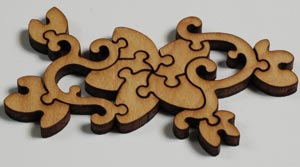
If autism really had to be portrayed via puzzle piece, it would be more appropriate to use something like these:

But in all honesty, I think the author is right, that puzzle pieces give negative connotations and reinforce the disease model of autism.  That if you just find the right therapy, your kid will be normal again and fit into the rest of the world.  That\’s a message desperate parents desperately want to hear, and it\’s an easy one to sell bleach enemas (or other bullshit \”treatments\”) to.  
Humans love the ideal of a silver bullet.  We hunt religiously for a singular, magical cure for all kinds of things.  Search \”weight loss\” to get an idea of how absurdly far people will go for a single solution to this relatively common-in-the-US problem.  There are, off a quick search: pills, special diets, support groups, apps, slimming drinks, patches, injections, and powders.  More than half of what I\’ve just listed is a form of metaphorical snake oil, and as likely to wreck your health as help you.  
Funnily enough, the same is true of most advertised autism treatments.  
There isn\’t, in my opinion, an obvious stand-in for the puzzle piece.  Replacements have been tried, and various organizations have their own logos, of course.  There\’s some interesting suggestions in this article, also. I kind of like ASAN\’s logo, for being pretty and relatively simple while still being inclusive.  

WYR: Automated Phone Prompts

https://miatblog.org/2019/03/communication-frustration-and-assistive-technology/

I\’m going to go on the record and say I really, really prefer to have the option to press buttons when navigating an automated phone line.  I have no documented verbal tics, stuttering, or any other form of diagnosed speaking difficulty.  I do kind of slur my words together, which I\’m sure doesn\’t help people or machines understand me, but it has absolutely nothing on actual speech impediments.

Speech and language issues are common in autistic people, and that\’s even before you mix in things like cerebral palsy and Tourette syndrome.  It\’s patently obvious why multiple input options are necessary, given this slice of life article and those facts.  You shouldn\’t have to struggle to articulate the word \”haircut\” when it\’s simple to provide the additional option to press 1.  Ideally, both verbal and button-pushing options would be available in an automated phone line like this.  It\’s worth noting that you can sometimes go directly to a live person by pressing 0, but that doesn\’t always work. 

Honestly, a lot of these kinds of accommodations are good for everyone.  I find speaking to a phone tree mentally exhausting, and much prefer to press buttons.  It gets orders of magnitude more exhausting when you have to fight to be understood at each step of the process.  Which is why I\’m glad there are websites like this one, which try to present workarounds and assistive technologies.  It\’s not the same as making a world built for everyone, but it\’s a start. 

I\’ve actually used text-to-speech apps in the past, so I could converse with dental assistants.  They have this tendency to try to hold a conversation while shoving fingers in my mouth.  That makes it kind of hard to keep up my end of it, but with my tablet in hand, I merely need to turn up the volume and hold it so I can see what I\’m typing.  Problem solved, don\’t need my lips or tongue to communicate any more.  They never sound quite right (though that\’s changing!), but it\’s far better to have that method of communication than to be barred from it. 

Mostly, in linking you to this article, I want you to really think about what it\’d be like to live Rachel Dancy\’s life.  I feel that, after maybe a dozen interactions with some people with cerebral palsy, I\’m maybe starting to understand little bit.  The two women I spent time with needed plastic straws to drink safely.  Because of their muscular issues, holding a glass, tipping it just the right amount, and swallowing at the right time is nearly impossible.

Both women had slightly different \”accents\” due to their cerebral palsy, and required a certain amount of concentration and time to understand and communicate with.  Every thought they chose to express took at least twice as long for them to verbalize than it would for someone else.  In this fast-paced world, it must be very common for people to become impatient and snippy with you, even though you\’re trying your best.  You can see this impatience in the salon person\’s response to Rachel\’s stuttering, and in Rachel\’s decision to tell the phone system \”manicure\” instead of continuing the struggle with saying the word \”haircut.\” 

Kind of sobering for someone like me, who takes their speech capabilities for granted most of the time.  But a very real situation for many people.  These fellow humans deserve as much attention as I do, if not more.  

Podcast Review: The Problem With the Solution

https://www.npr.org/programs/invisibilia/483855073/the-problem-with-the-solution

I\’ve been listening to non-comedy podcasts for a few months, but this is the first one that\’s been relevant to this blog.  So, exciting!  I\’m hopeful that as I find more disability-relevant podcasts, this will happen more often.

This podcast, Invisibilia, is about the invisible forces that shape culture: ideas, beliefs, assumptions, and emotions.  I studied psychology in college, so no surprise I was interested in this particular podcast.  The show tends to try to humanize its subject, showing different ways to look at a subject through the lens of true stories.

This particular episode is on mental illness, which you\’ll note tends to occur alongside autism due to the stresses of an unaccepting society, as well as biological and neural weirdnesses.  There are a lot of causes of mental illness, and none are the person\’s own fault.

The going philosophy on mental illness is that it needs to be \”fixed.\”  This is because in many cases, the symptoms of mental illness are harmful or extremely unusual.  And the show starts out by noting, in a humorous fashion, that it\’s the US mentality to find solutions to things.

As the episode goes on, though, it suggests a different idea for how to think about mental illness.  It\’s the kind of philosophy that can be taken too far, but aligns very impressively with the general autistic self-advocacy opinion that people should accept, not shun, differences.

I don\’t want to spoil the episode too much, so give it a listen while you\’re doing chores or driving somewhere!  I really enjoyed it, even getting teary-eyed near the end.  

WYR: Running Away for a Reason

http://www.thinkingautismguide.com/2019/04/running-away-autism-and-elopement.html

I\’m going to be interested to see comments on this post.  This touches on a part of life I was never involved in.  I was never a wandering child.  My parents were spared the anxiety-inducing searches for me, because my comfort was indoors.  Away from the crawling bugs, biting mosquitoes, and the cold, clutching a favorite book in my own room, I was content.  Outside was not my friend. 

If it had been, though… if I was less sensitive to the brush of greenery, the chill of outdoor air, and the crawling of insects?  Perhaps I might have been a child that ran away. 

I\’m curious to see what comments show up on this post, because it\’s such a common behavior.  I want to know if \”escape and control of environment\” is always the reason for wandering, or if there are complicating factors.  It\’s a people-related issue, so I\’d guess there are complicating factors.  Still, if this is a major reason for wandering… that would make it a lot easier to improve everyone\’s lives.  Find what\’s distressing the autistic person, and change it.  Immediate effect: less distress and thus less wandering.  Surely everyone could agree that would be excellent.

As I was reading this article, I was reminded of a web game I played and reviewed years ago.  I no longer doubt that the ability to jump the playground fence and leave the area was put into the game on accident.  Rather, I\’m surprised it wasn\’t more clearly marked.  Reading this post reminded me strongly of that experience.  That was what they were going for, no doubt… I simply didn\’t understand fully at the time.  

WYR: Types of Self-Advocacy

http://www.thinkingautismguide.com/2019/02/the-meaning-of-self-advocacy.html

Advocacy comes in a lot of forms.  The kind I do is mostly the socially-acceptable type.  I go through the appropriate channels to speak to the appropriate people.  I politely make an annoyance of myself while asking for change.  Sometimes, this even pans out into actual change. 

I am massively privileged in my ability to do this.  I am, at first glance, a \”functional adult,\” sufficiently \”normal,\” and as such, granted the basic respect most humans give a stranger.  I am fully verbal most days, and my autistic oddities can, on shallow inspection, be shrugged off as simply eccentricities rather than disabilities.  As such, people sometimes listen to me.  What I do is the most acceptable form of self-advocacy. 

The author of this article has clearly led a very different life.  They have experience with institutions, with nonspeaking people, and with oppressive support services.  This makes their words very important to understand. 

\”All behavior is communication\” is a noteworthy philosophy here.  Babies cry if they\’re wet or hungry or in pain.  The fact that they have no words for their distress doesn\’t make it any less communication.  If a child never develops sufficient speaking capabilities to be \”normal\” that does not impede their ability to communicate.  It only impedes our ability to understand. 

Another note about self-advocacy, and advocacy in general: it generally does not make you friends.  This is even true with the most polite self-advocacy that I do.

Most recently, I advocated for myself, the restaurant workers, and my family, when I found us in an excessively loud restaurant environment.  I measured the sound levels in the room and found they were around 90 decibels.  Also known as \”gives you hearing loss in less than 2 hours\” ranges.  Now, this was vastly unpleasant to me, so I put in earplugs… but my family couldn\’t hear each other talk… and the restaurant workers would naturally have shifts longer than 2 hours, so they\’re pretty much doomed to hearing loss. 

The waitress appreciated my concern, but her manager really didn\’t.  So I\’m sitting there wishing I could just melt into the floor, and the guy is explaining to me that the restaurant environment is \”important\” and other peoples\’ enjoyments matter also.  I have a hard time making an ass of myself on purpose, but I really should have.  The noise level really didn\’t drop much at all after I complained. 

Can you imagine if I\’d instead had a meltdown at the table?  Bet it would have dropped the noise level really really fast, with all those people stopping their conversations to stare, and the musicians pausing their routine to to do same.  But the interruption would likely have only been temporary, with my family being asked to leave, I\’m sure.  Still, if the reason was known (for example, if I was screaming \”it\’s too loud!\” repeatedly), it might make people think. 

Both methods are self-advocacy.  One is distinctly less socially-acceptable than the other, but both are valid forms of communication.  They don\’t become invalid just because someone refuses to listen to them, or doesn\’t understand. 

Please, read this article and its examples of advocacy.  If you have nonspeaking or low-verbal people in your life, consider their behaviors in the light of self-advocacy.  

WYR: Experiencing Meltdowns

http://www.thinkingautismguide.com/2019/03/meltdowns-how-autistic-humans.html

This is one of those rare autistic points of view on meltdowns. Because they’re mistaken for tantrums in small children (they’re not tantrums and shouldn’t be treated that way), and are considered extremely socially unacceptable, few people are willing to talk about them. The vast majority of those that are willing, are professionals or parents, as the author mentions.

Professionals and parents have valuable things to tell us about meltdowns. But nothing replaces firsthand experience. Unlike most of the things I link on this blog, this article is not a textwall. It includes comics and artistic illustrations, each of which includes an accessible text description.

A sidenote about accessible text descriptions: they’re meant for the blind or otherwise visually impaired. The idea being, if you can’t see the picture very well (or at all), you can instead read the description of the picture and get the gist of what it’s trying to convey. But like closed captioning, they can help populations they weren\’t intended to help. As a person with vision corrected to 20-20, I should reasonably have no use for text descriptions of pictures. However, possibly due to the weirdness of my brain’s detail processing, I find it can be useful to read someone else’s interpretation of what’s happening in a picture.

This is especially true for art, and I found the descriptions invaluable in this article. They pointed out details I’d completely missed when I looked at them myself. For depictions of this particular subject, it was valuable to have those descriptions around.

Even after reading this description, I’m uncertain as to whether I’ve experienced meltdowns in my life. I have had the immense privilege of having my own room when I was young, and usually having someplace reasonably safe to flee if I can’t handle things while out of the house. Sometimes that’s just the bathroom, but if it works, it works. This lets me escape situations when I’d start getting agitated the way the author describes here. At worst, I’ve socially-ineptly had to shoo a friend out of my room, or had to go sit in the car instead of socializing with my family members. My actions in both those situations hurt feelings, but don’t really compare to the situations and pain the author describes here.

I do think I experience the building up sensations and low energy effects described here. They just don’t end in an explosion, they end in me hiding until I calm down. Or canceling everything in my day so I can go home. Again, I have the privilege of making those decisions to leave. Not everyone does. Especially children, who have far fewer choices in life than adults.

Regardless, I found this point of view piece very educational, and I hope you do too.

WYR: Representation Burnout

https://advice.shinetext.com/articles/we-need-to-talk-about-and-recognize-representation-burnout/

This article is written by a woman of color, but it\’s written to address a much more general phenomenon.  She quite rightly terms it Representation Burnout, referring to the fact that it affects any member of a minority group.  Visible minorities, like African Americans, first generation immigrants, or women in some fields (most sciences, businessplaces, tech), and men in others (nursing, social work, cosmetology), are the obvious examples.  You can often identify these minorities at a glance or in a short amount of time in their proximity.  Skin color, accents, and ethnic or religious clothing serve as these obvious markers.

But she also mentions her friend, who is gay.  That can be a more invisible minority group.  A given gay man may choose to express his sexual orientation by conforming to particular stereotypes: dressing in more feminine clothes, wearing an earring, speaking in a particular fashion, or styling his hair a particular way.  Or he may care for none of that, dress in stereotypically masculine ways, and simply date men instead of women.  Thus his identity as a gay man would be all but invisible to casual observation.  In this way, being gay can be externally expressed, but need not be.  Every 100th man you pass in the grocery store, statistically, might well be gay.  In this way, being gay is a mainly invisible minority group. 

Another mainly invisible minority group?  Autistic people.  Especially, but not limited to, the so-called \”higher functioning\” group, those of us who have learned or been forced to suppress ourselves, successfully camouflaging our autism for the sake of the rejecting, intolerant public.  There are a remarkable number of articles online talking about autistic burnout.  I\’ve actually linked to one previously, when I was suffering burnout.  Seemed appropriate enough.  Autistic burnout is, to my view, a specific type of representation burnout. 

Most minorities are, to a point, expected to conform to the majority\’s ways of behaving.  Immigrants to the US are expected to speak English, for example.  Even if that is extremely difficult for them.  Black and brown people in the US are expected to behave just like they\’re white people, and any \”failure\” on their part is treated as representative of all black and brown people.  Women in male-dominated fields are expected to work within the system, rather than change it.  Likewise for men in female-dominated fields.  These are mainly implicit understandings, and no one will generally tell you what you\’re doing wrong if you don\’t conform.  You just won\’t be as successful in that field or area as you should reasonably be.

What sets autistic people\’s struggles apart somewhat, I think, is the outright and blatant communication to many of us that we\’re not people unless we conform to neurotypical standards.  Applied Behavioral Analysis, or ABA, often makes a point of not simply teaching \”appropriate behavior\” but also eliminating \”inappropriate behavior,\” such as stimming, phrasing things in unusual ways, and doing activities in unintended yet creative ways.  We are literally told we are wrong to be what we are, and often pushed and trained to be otherwise.  For up for 40 hours a week.  It\’s the same message given to any minority, just louder and in the guise of \”helping\” us. 

At its worst, this is reminiscent of the boarding schools we once forced the children of the First People to attend.  Native American children were taken from their parents and tribes, and made to attend federally sponsored boarding schools.  The idea being that by taking them from their tribes and culture, and instead teaching them Western ways, the Native peoples could be assimilated into the broader US culture.  The initial establishment of these schools was mainly benign and meant to facilitate education and empowerment of the First People, but it didn\’t take long for less moral people to realize they could use this schooling system to try to erase the First People.  They kidnapped the children, took their culture (including their names) from them, and disciplined them harshly to the point of abuse.  If you\’re familiar at all with US history, you\’ll note this attempted erasure of the First People is a depressingly common reoccurring theme. 

I found the pointers and insights in this article both relevant and helpful.  By and large, I don\’t really have that many people I\’d consider, \”allies that can say for me what I\’d say\” for my autism identity.  Sometimes my spouse can, but for all the education he\’s had being married to me, and for all the writing on autism I\’ve done, there just doesn\’t feel like a replacement for my speaking for myself.  Perhaps that\’s part of why I spend so much of my time alone.  You don\’t need to advocate for yourself if there\’s no one busily misunderstanding and prejudging you.  

WYR: Through an Autistic Lens

http://www.thinkingautismguide.com/2019/02/starting-points-for-understanding-autism.html

This piece details something of what it\’s like to be autistic in the world, from the \”this is how incoming information is handled\” side of things.  I was interested to note that there is no discussion of how other people handle being around us, or their treatment of autistic people in general.   Also curiously absent, sensory sensitivities and overloads, beyond the context of filtering. 

All six of the points in this piece are or have been relevant to my life.  Of the six points, I found the last couple most comment-worthy.  I would say I tended to get caught up in loops (point 5) more as a child than I do as an adult, save for bad interpersonal interactions that are likely to reoccur. 

There were two incidents of poor communication and hurt feelings around Christmas of last year, and neither of them would leave my poor brain alone until they were somewhat settled.  It was highly unpleasant, but I didn\’t think it wise to try to shelve the incidents entirely due to needing to see those people in the next year or so. 

The more positive version of this, getting looped into a hobby, hasn\’t happened to me for quite a while.  I\’m kind of sad about that, but I guess it probably allows me to manage all aspects of my life better than I would otherwise?  I used to kind of zone out while thinking about things when I was younger, to the point that kids in school would notice I wasn\’t in the present and start making comments about it.  In my adult life, such occurrences are quite rare, and the social awkwardness usually breaks me out of such thought-trances before someone even opens their mouth to comment. 

Related to the opposite phenomenon, needing reminders (point 6)…  I have a To Do app on my phone/support tablet that helps me track things I need to remember to do.  This includes things like washing the bedding, handling tooth care, and following up on health care appointments… but it also includes reminders to contact certain people and try to set up a get-togethers… because I literally don\’t remember to do that if not reminded.  Whatever brain circuits do that for neurotypical people, I\’m missing them.  

WYR: Authentic Communication and Autistic People

http://www.thinkingautismguide.com/2019/01/can-my-child-ever-learn-to-speak.html

This is a really excellent piece on authentic communication and the importance of non-speech communications.  I posted a couple weeks back regarding a nonspeaking (but definitely communicating!) autistic person name Deej.  This is an account from a different person who has valuable thoughts on what communication can look like.

Much is said in the autism world regarding the importance of early intervention, with the assumption that without that early intervention, the child will never learn to communicate \”properly.\”  And by properly, they invariably mean speaking.  More and more, it seems this is inaccurate.  This author didn\’t learn to use speech the way most people do until age 10.

Sometimes, autistic people simply develop more slowly.  That can be on any number of spectrums, speech being one.  Others include emotional intelligence, physical coordination, sensory integration, and time management skills.  In some cases, these things may never develop to \”normal\” capacities.  But in many cases, it\’s just a matter of time.

If you or your loved one struggles with speech as a communication method, consider looking into other methods, such as pictoral systems, sign language, text-to-speech programs, and others.  A place to start might be this page.

This is a subject I can\’t speak to a lot personally, because I\’ve been capable of accepted speech since I was quite young.  It is, however, highly relevant to the autism world in general.  Even those of us who, like me, tend to be highly communicative via speech, can sometimes become mute when put into sufficient stress.

However, like the author, I too think \”use your words\” is a cruel and thoughtless thing to say.  I strongly agree that simply being capable of speech-communication does not guarantee you a normal life.  It certainly hasn\’t for me, normal to above-average speech capabilities or no.

Also, as an ending note: I am highly fluent in speech.  That does not mean I think in words.  I actually don\’t.  Nor am I exactly like Temple Grandin, who thinks in pictures.  I think in some crazy hybrid of music/sounds, pictures, short video clips, flavors/smells, and memory concepts.  I don\’t know how to explain the last one.  It\’s more like muscle memory than anything else, I guess?  It\’s like the remembered flavor of a steak, except for the concept of how a shoulder is supposed to rotate.  Or what adjustments are necessary to walk safely on a sheet of ice.

Words and speech, then, are a second language to me, though one I\’ve practiced extensively.  If I hadn\’t done this, what would authentic communication look like for someone like me?  I truly don\’t know.  Hopefully, as we learn to welcome more nonspeaking people to the table, more methods can be introduced to the general public, and be made available so that everyone can communicate and understand each other.  

WYR: The World is Such a Loud Place And It Seldom Stops Talking

http://www.thinkingautismguide.com/2019/01/the-world-is-such-loud-place-and-it.html

This is a descriptive account by an autistic person who suffers sound sensitivity, like I do.  I think most days she has it worse than I do, or perhaps I\’m merely more fortunate to have a quieter place to live than she does.  Still, every sound or audio experience she lists, I\’ve suffered from repeatedly. 

Have you ever stopped in the middle of a relatively quiet room and just tried to identify all the sounds you can hear?  Or just do that in a more crowded area and see how many you can identify or isolate.  It might surprise you how many things your brain tunes out, automatically, because that\’s what it\’s supposed to do. 

I am very fortunate.  I work in my basement, and my basement is quite quiet in the winter.  Without the ducks and geese outside, the only sources of noise are my computer\’s fans, the clacking of my keyboard as I type, the hum of the heating system, the hum of a USB charger, the hum/clicking of the timer for the lamp behind me, the creaking of the house itself, and occasionally the wind.  (Also any notification sounds from instant messaging systems like Gtalk, but I often have those routed through unworn headphones.) 

By comparison, an average coffee shop will have several conversations going, the clatter of dishes and machinery behind the counter, the beeping of timers set to aid the baristas in making the hot drinks, the music played over the speakers, the screech of chairs and tables being moved, the sound of the door being opened and closed, the clacking of at least one other keyboard, the notifications of other peoples\’ phones, the crinkle and rustle of food wrappers or cup lids being handled, the occasional slurping or sipping noise from someone drinking their hot beverage…  this list could go on. 

Do you think about this sort of thing, or even notice much of it?  I do.  It\’s not a good thing.  I am extremely distractible, and I hate it.  I took care of a pet parrot for some friends last week, and I had to move the parrot\’s cage to the second bedroom to keep from getting frustrated and angry.  This parrot is extremely quiet, barely vocal at all (Pionus parrots are like that), but even the sounds of her climbing around her cage were too much distraction for me to work.  Fortunately I was still able to keep the parrot company sufficiently so she didn\’t get sad and lonely. 

I sympathize thoroughly with the author regarding fire alarms, by the way.  As far as I\’m concerned all fire alarms were imported directly from hell.  They make me wish myself dead every second I\’m anywhere near them.  I am so very grateful to be out of school, because now the only fire alarm I have to worry about is the one in my home. 

For a while, my spouse and I had ambitions of sound-proofing the small bedroom so I could use it to decompress.  Fortunately, that hasn\’t proved necessary due to the comparative differences between the apartment complex and our house.  The latter is exponentially quieter, even though it does creak a remarkable amount.