Merry Christmas and/or Happy Holidays! My spouse told me I should take the day off, so this once, I will. Wishing you a safe and warm celebration, whatever that looks like for you this year.
Reading the Research: Building Confidence
Welcome back to Reading the Research, where I trawl the Internet to find noteworthy research on autism and related subjects, then discuss it in brief with bits from my own life, research, and observations.
Today\’s article showcases an important step in living a happier life. For everyone, really. Everyone benefits from learning independence skills and having more control over their lives. It\’s particularly relevant for autistic people, though, because we don\’t have the same opportunity to learn these skills.
This article focuses on medical self-care skills. Things like filling a prescription, scheduling a doctor\’s appointment, managing co-pays, and understanding insurance plans are stuff I had to more or less learn on the fly. Even now, I\’m not honestly sure I have the latter one all figured out.
Which is why the assessment proposed in the article would be so helpful. Typically, you don\’t really know you lack these skills until the time comes to use them, by which point it\’s very \”sink or swim.\” For people who don\’t typically thrive on improvisation, such as myself, this added challenge on top of all the other life challenges is not a kindness. It\’s exhausting.
I\’m pretty sure if I took the assessment, I\’d probably score low in the \”how to deal with law enforcement\” section. Maybe average to above average in the rest, since I\’ve been on my own for a while. All the same, I kind of wish I could take the assessment and whatever training might come with it. Being an adult is shockingly complicated, especially when you factor in complicated medical needs and support services.
The thing is, a lot of autistic people tend to lack confidence in our skills. Myself included. The world, and sometimes even our friends and family, spends a lot of time telling us that we\’re disabled and can\’t do things for ourselves. Sometimes this is true. Sometimes this is only temporarily true, and with practice and education we can manage things for ourselves.
But we do have to be given the chance to try, and that\’s where a lot of the autism parents I\’ve run into struggle. Making the transition from being Protector from All Harm to Square One is something done in stages, and requires trust, patience, and the willingness to let the person fail.
Teaching self-management skills, such as these medical self-care skills, is one piece of that. No matter how good a job you do protecting a person from the world, there will always come a time when you can\’t be there. Doesn\’t it make sense to prepare them for it, rather than hiding from it as long as possible?
(Pst! If you like seeing the latest autism-relevant research, visit my Twitter, which has links and brief comments on studies that were interesting, but didn\’t get a whole Reading the Research article about them.)
Grocery Shopping on a Special Diet: Breakfast and "Breakfast"
Welcome back to my autism-aware shopping trip through the grocery store. Week by week, I\’m showing you what the store sells, prune down the selection to what\’s safe for me (because autistic people can have very sensitive systems) and point out various gotchas the store tries to make you buy stuff you didn\’t come for.
As a reminder, I shop with the following conditions in mind:
- dairy-free
- low sugar
- avoid ultraprocessed junk
- avoid food coloring
- conditional vegetarianism
- avoid high histamine foods
- awareness of gluten-free options and sugar-free options
Last time I got severely unhappy and crushingly disappointed about the heartless manipulation involved with the alcohol aisle, which is why this post is nearly a month later. We also learned that there\’s basically no diet pop in the pop aisle that\’s good. The one exception is Zevia, which is sweetened with stevia leaf and typically contains no artificial colors or other additives.
The caveat for drinking it is that a lot of pop\’s allure literally comes from feeding your sugar addiction. So when you drink Zevia, you may find yourself feeling rather unsatisfied despite the clear sweetness and flavor of the drink. If that\’s the case, now you know why: it\’s because it was never about the drink, and always about the sugar.
Anyway, me being crabbity aside, it\’s time to move on to the breakfast aisle!
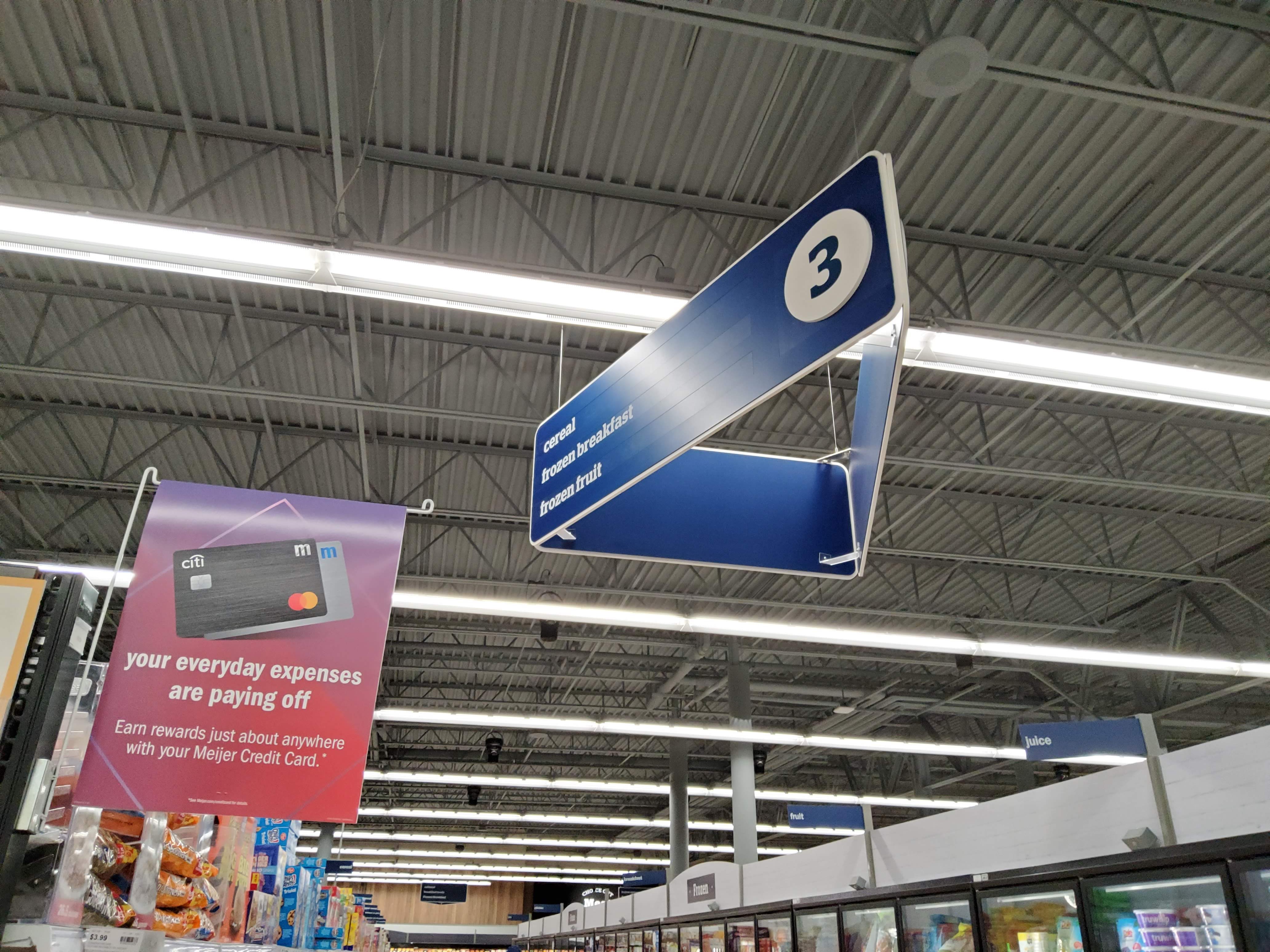
By and large, this aisle is cereal on one side, and refrigerated et cetera on the other. We\’ll start with the cereal.
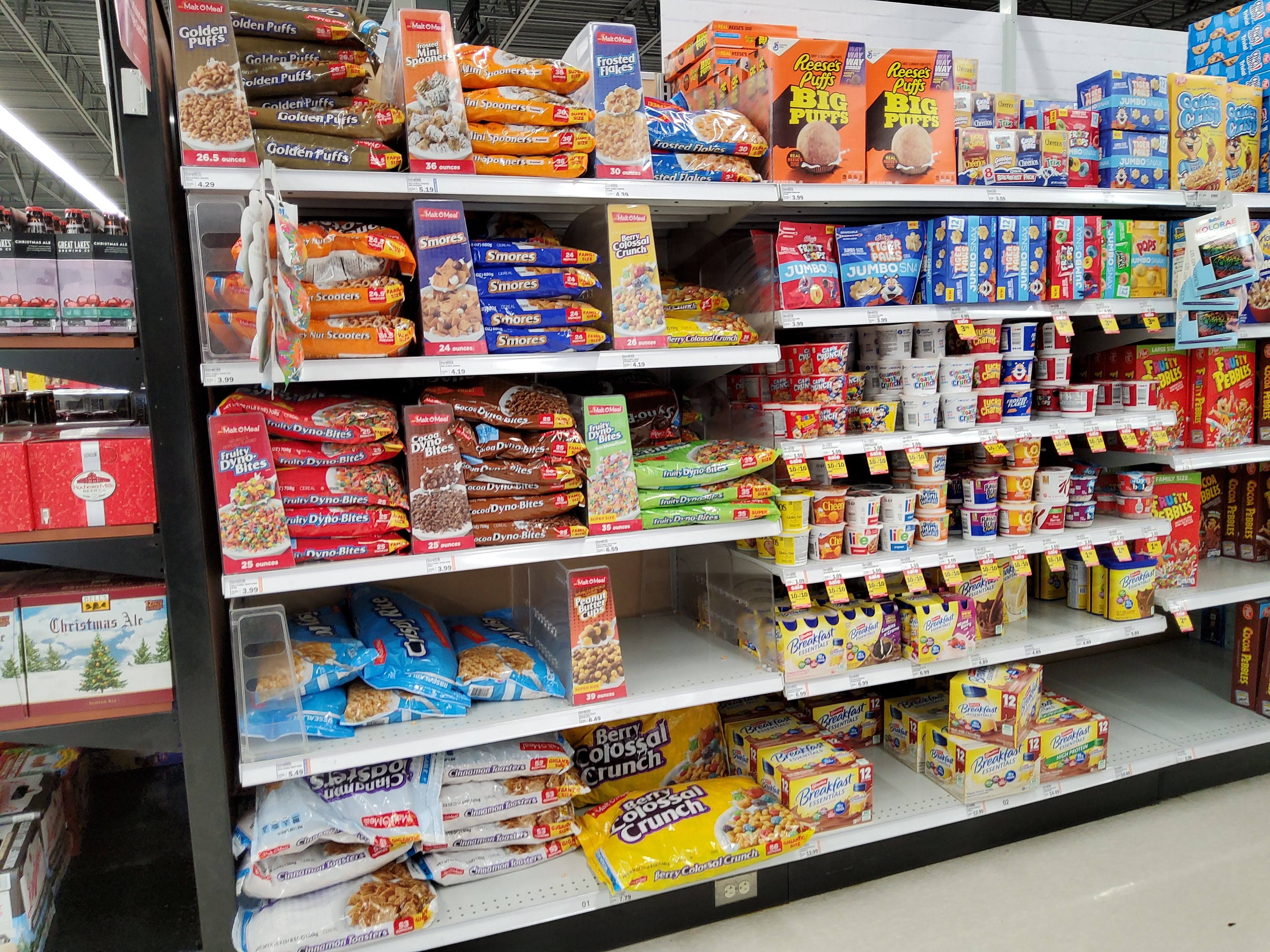
Hey, remember how I\’ve been complaining in weeks past about snack foods? At the start of this aisle, we have both the bulk bags and the snack sized cereals! One hideous-for-the-environment plastic bowl plus a serving of cereal. Just add your milk of choice and a spoon, and you\’re good. I\’ve bought a couple of these recently when I was craving a particular cereal and didn\’t anticipate wanting more of it but it\’s really not an ethical choice.
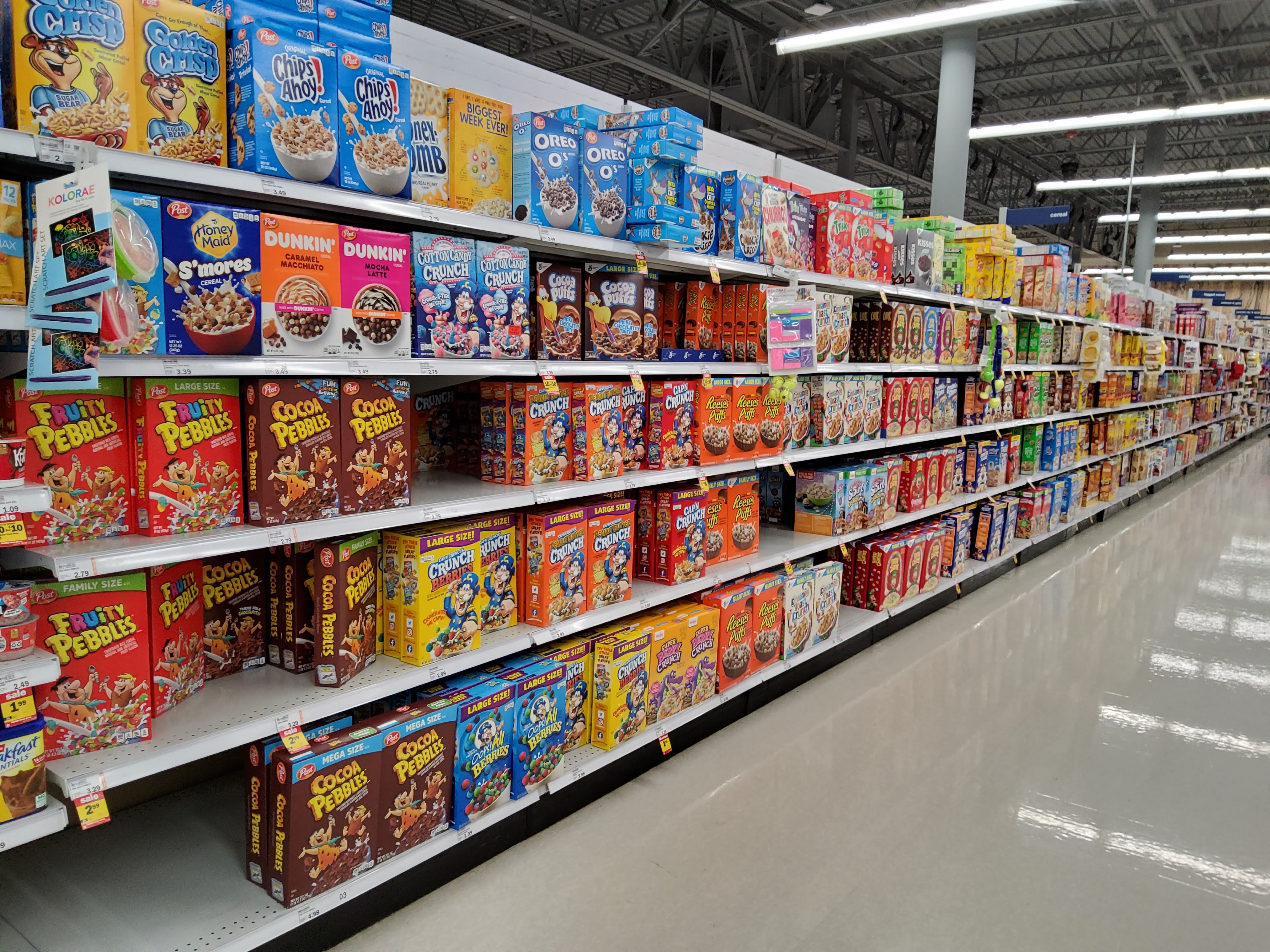
After the snack-sized things we get into the full array. The picture basically goes almost to the end of the aisle, and it\’s roughly grouped by manufacturer. I\’m not sure why Post cereals are here at the head of the line, but presumably it has something to do with their popularity or the amount of money paid to be displayed first.
Before we dive into a deeper look at everything here, it\’s important to note that all these brightly colored cereals (like the marshmallow bits, fruit colors, and anything that turns milk a color when you\’re eating it), is made with artificial colors.
I had one mother of an autistic boy comment that she\’d swear \”the color red, in food\” was the cause of some of her kid\’s aggression behaviors. Which is entirely possible, because food coloring can be made in a lot of different ways, and isn\’t rigorously tested on humans.
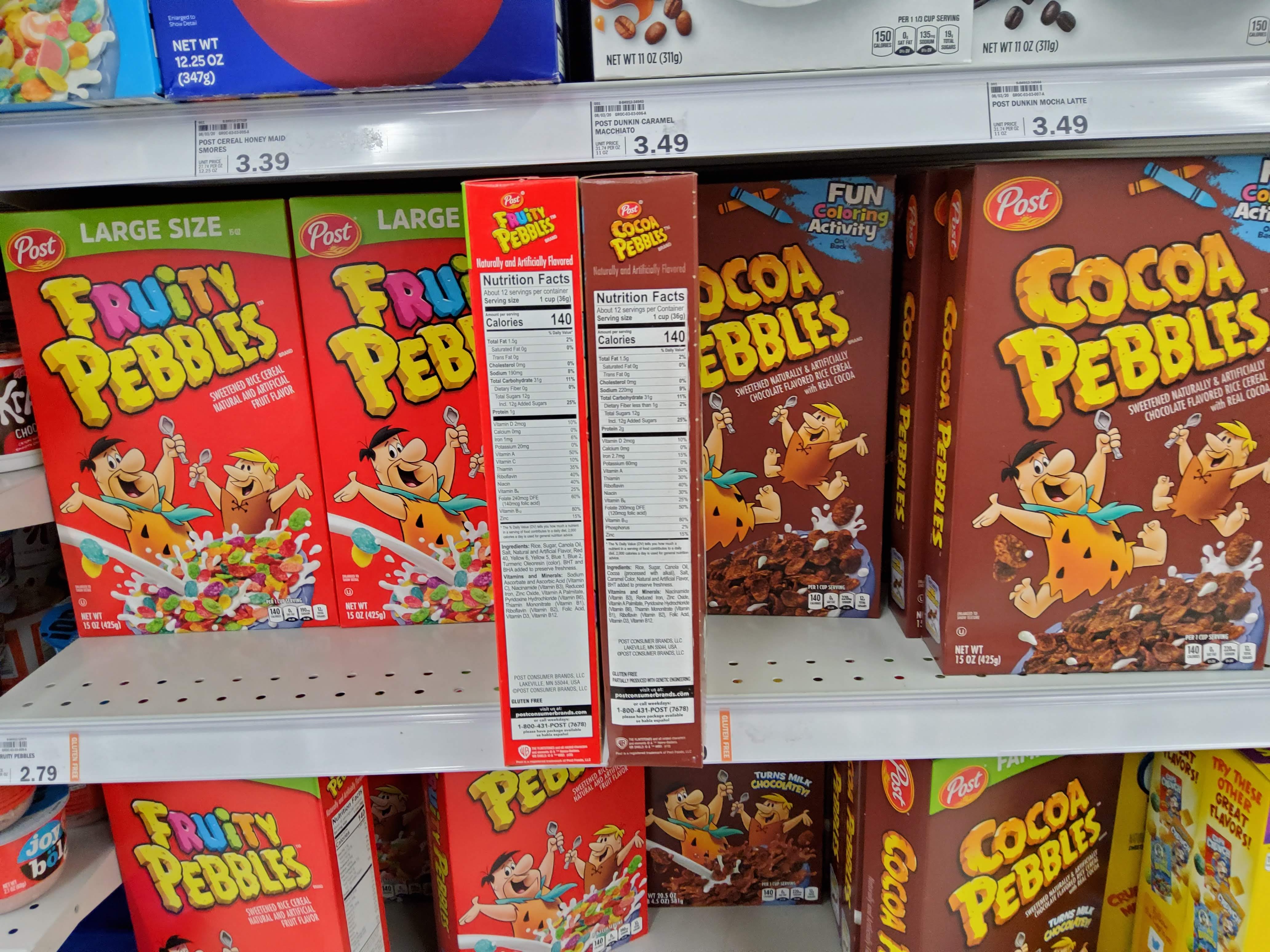
If you\’ve been wondering why I haven\’t gone on a rant about sugar in cereal, well… Congrats, you\’ve been paying attention.
My pictures aren\’t the best here so I\’ll summarize the important stuff. We\’re starting with some obviously terrible cereals. Really, no one should reasonably look at either of these cereals and assume they\’re healthy. For one cup of cereal, these will cost you 12 grams of sugar. That\’s most of your daily sugar budget, right there. And it\’s added sugar, by the way, so literally sugar mixed into it and also sprayed onto it after it was processed. Sugar bomb!
That\’s for one cup of cereal. Does that sound reasonable to you? Let\’s see, shall we?
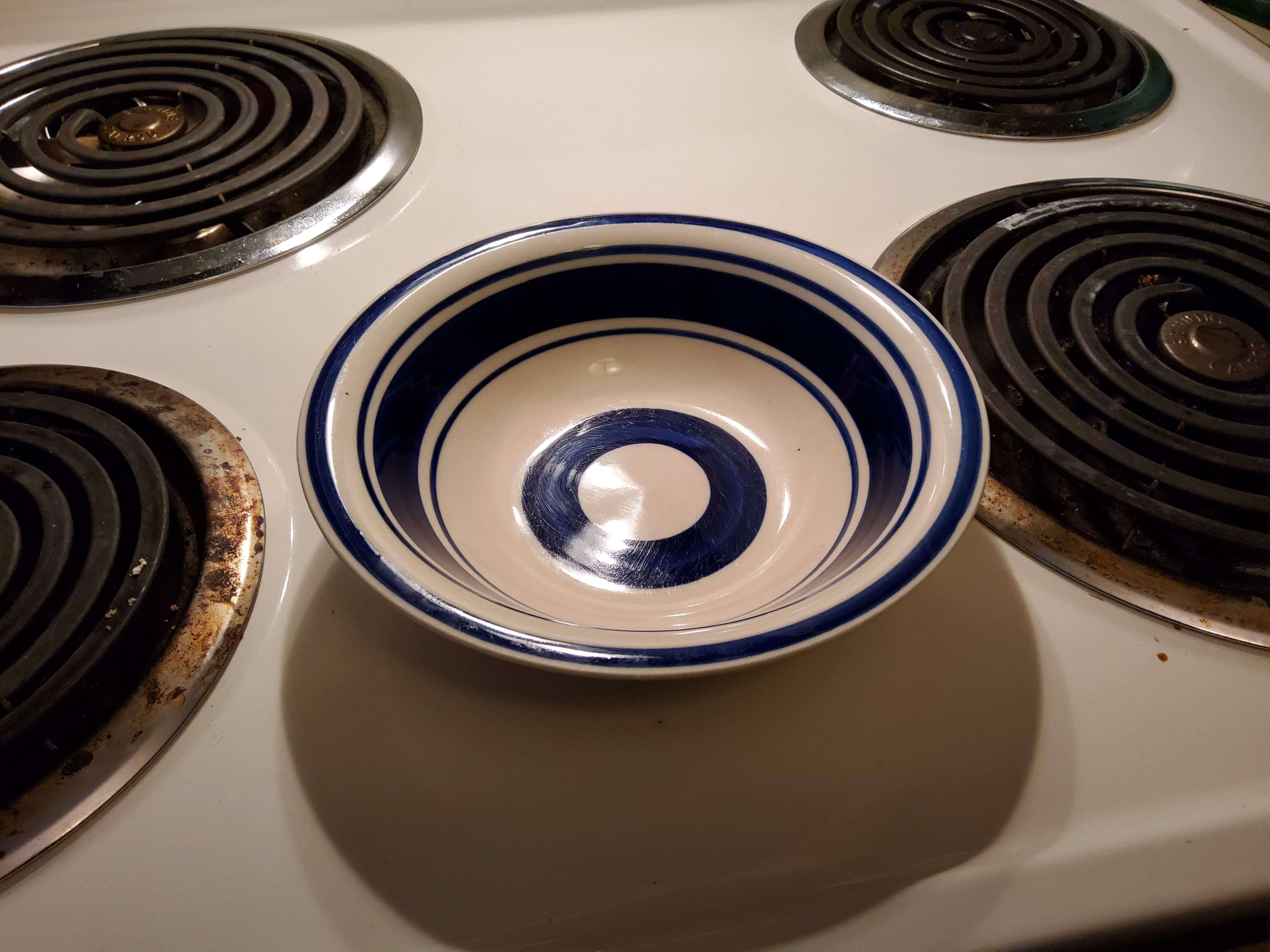
This is my cereal bowl. It\’s a medium bowl, used for soup or salads or cereal as needed. It\’s neither particularly large nor small.
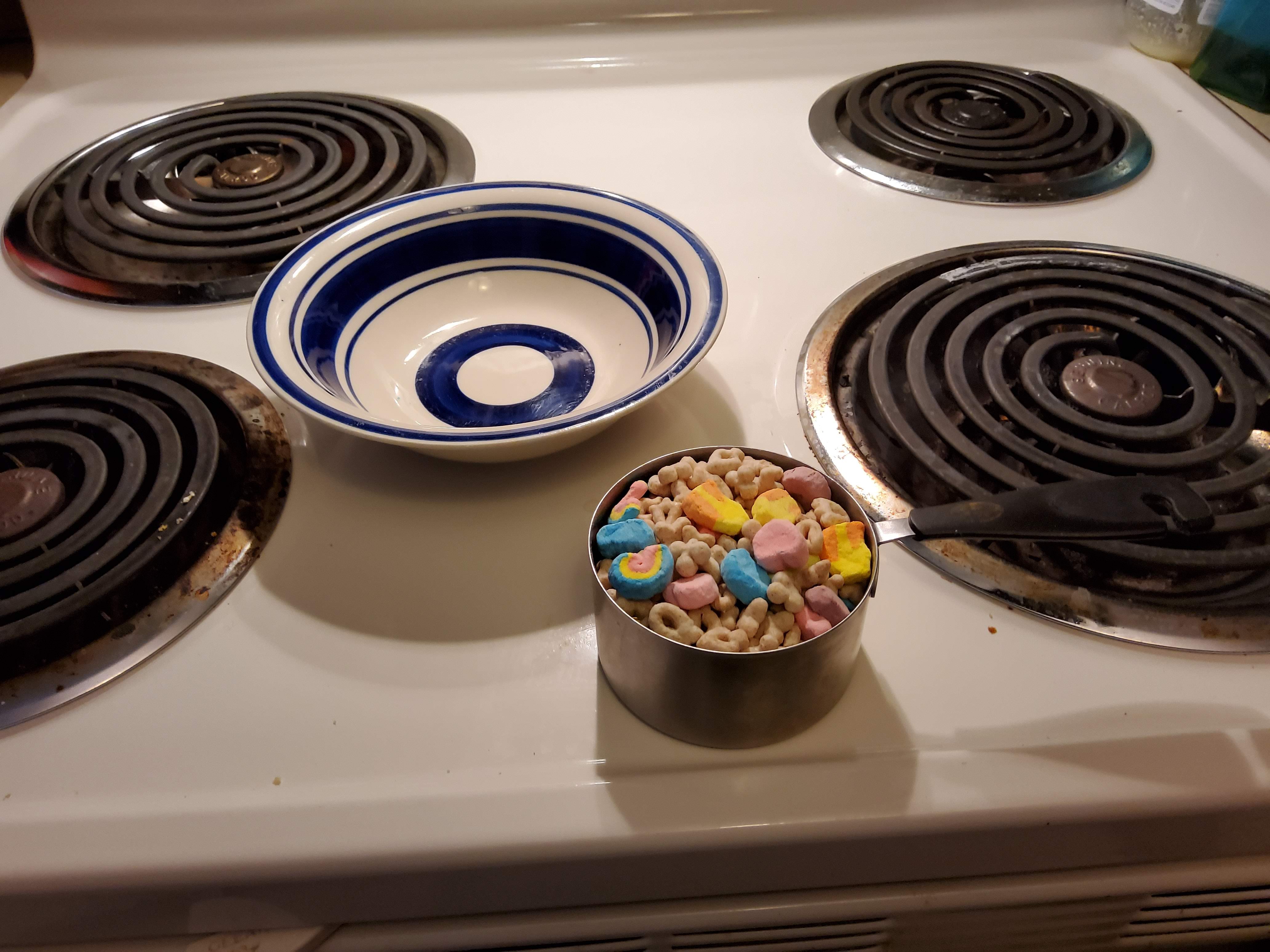
Now we\’ll measure out a cup of our dessert cereal of choice, who I won\’t give free advertising to by naming. This seems fine so far, right? Let\’s put the cereal in the bowl.
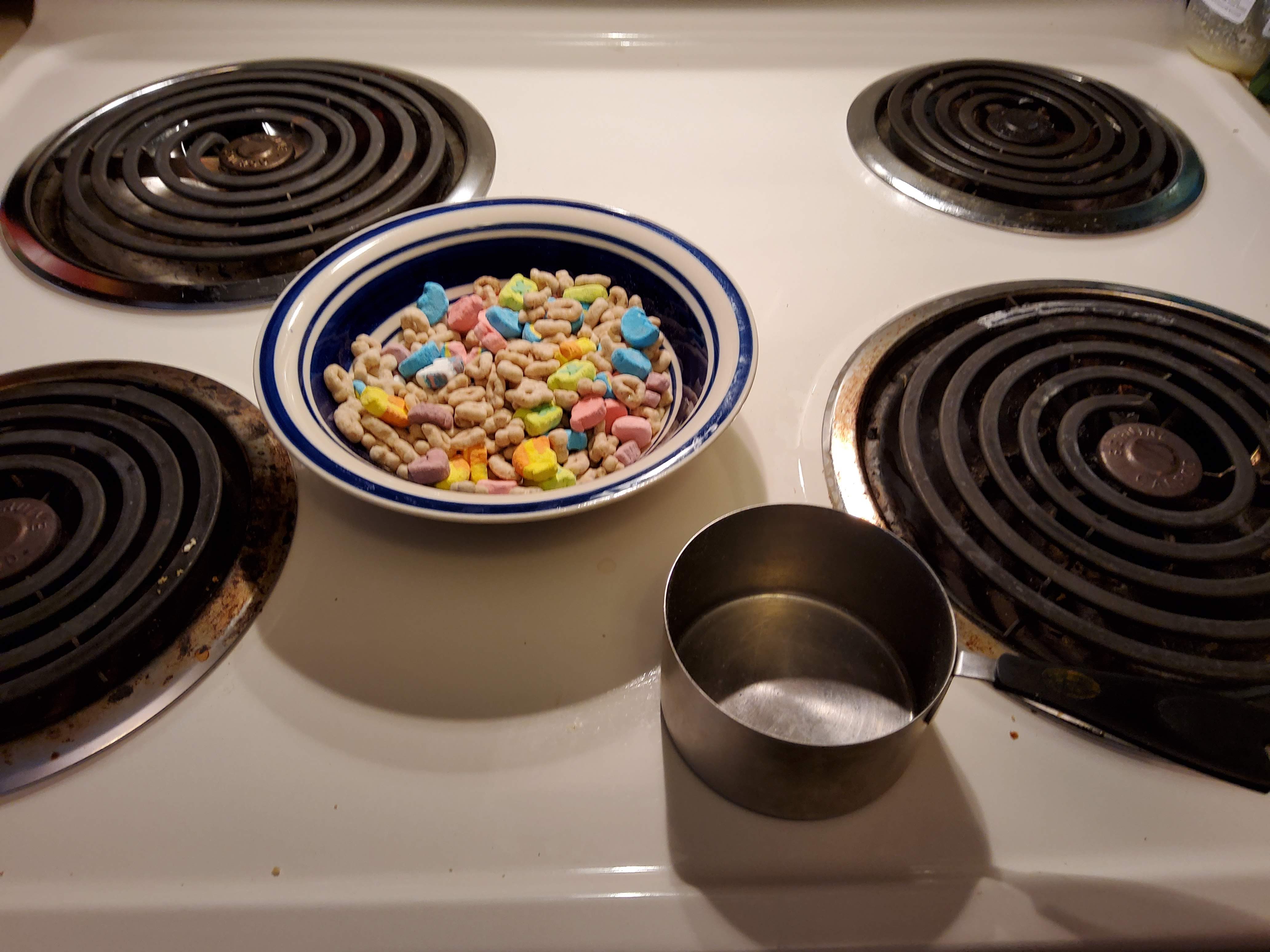
Seems all right. Maybe a bit small of a serving. Is this about how much you\’d usually put in the bowl? It isn\’t for me, so let\’s fill up the bowl properly.
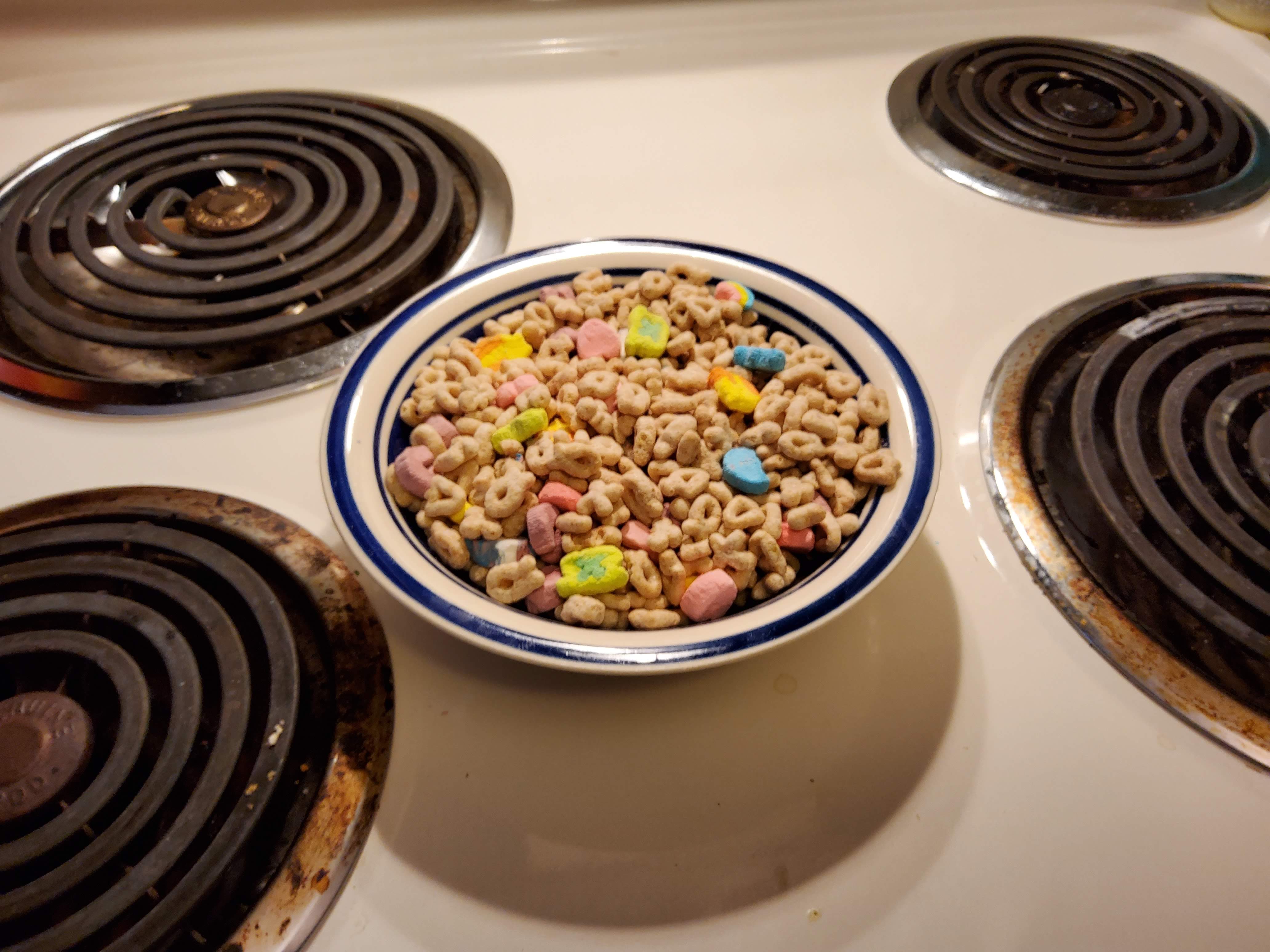
Here we are. This is about how much cereal I\’d typically put in this bowl. Doesn\’t look like that much more, visually, really.
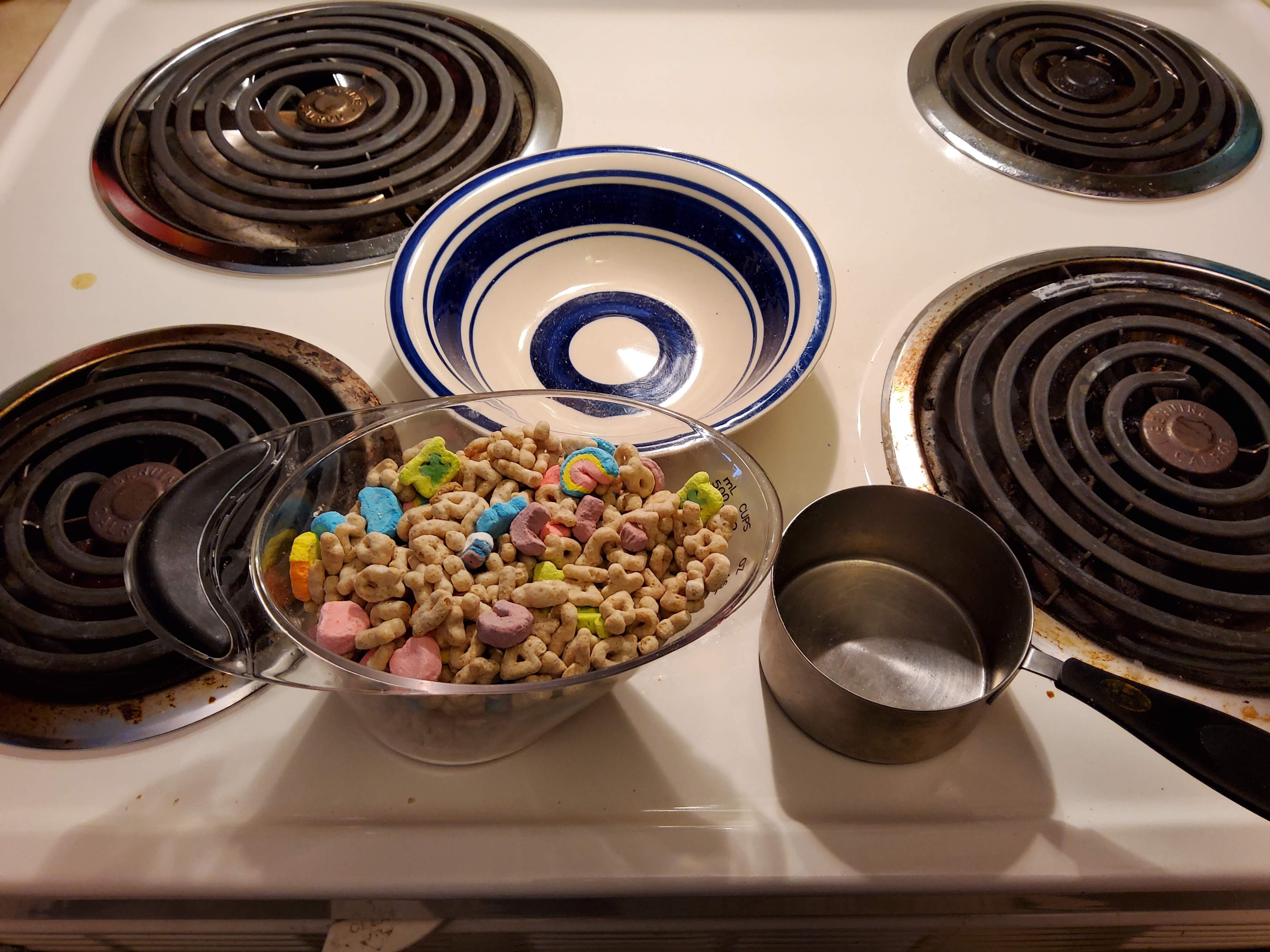
But when we pull it back out and measure it… it\’s over two cups. More than twice the recommended serving. And it barely looks different to me. This is a very rough demonstration of how this works, and I\’m sure most people would only err by half a cup, given a similar bowl. But you see what I mean now, when I say that serving sizes are tricky.
To avoid making this mistake, you\’d have to measure out your cereal every time. How many people do that, do you think?
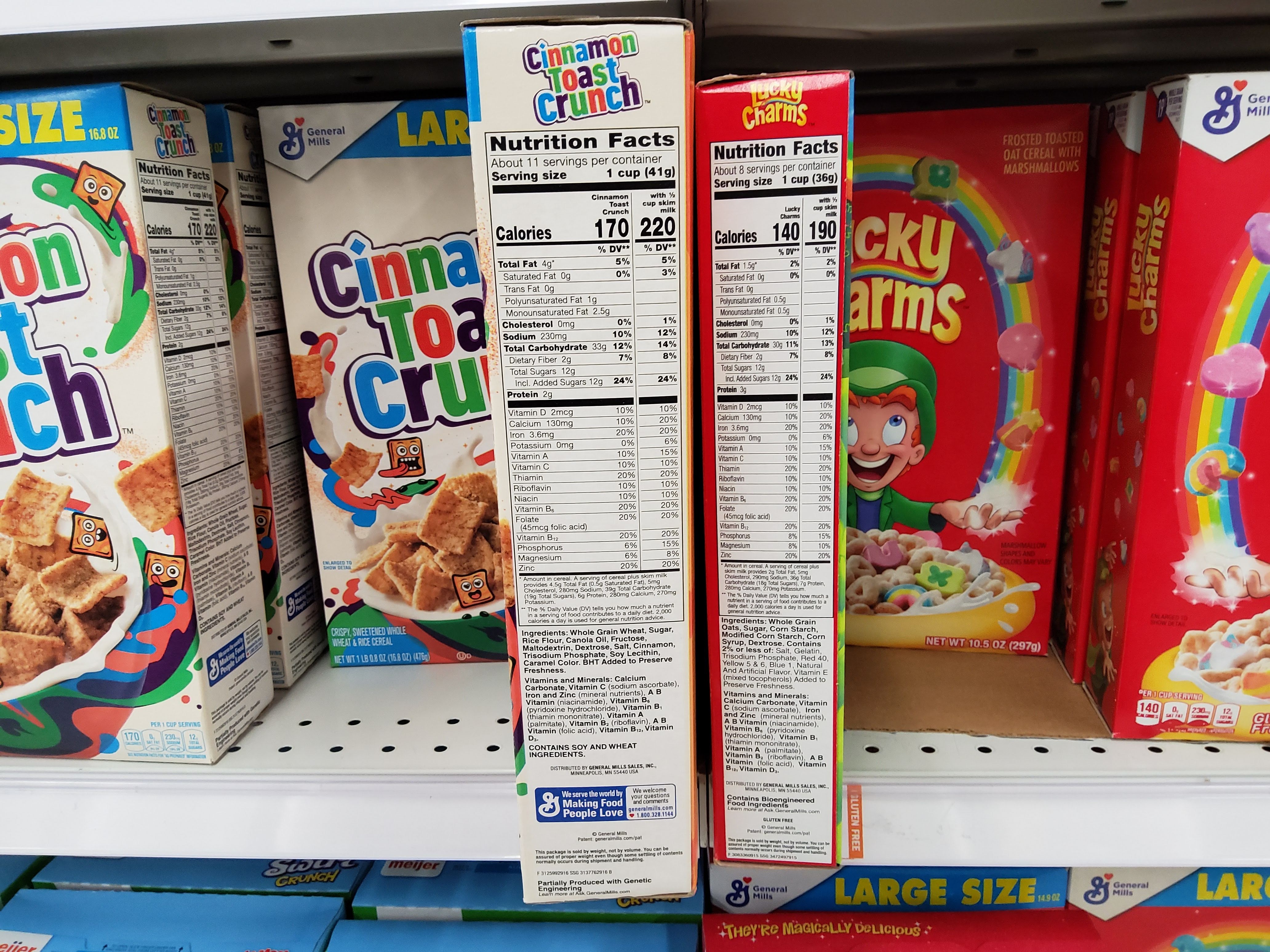
But maybe Post is particularly terrible in terms of sugar? Let\’s keep going down the aisle… The calorie counts vary, but it\’s the same deal here: 12 grams of sugar for a cup. Again, these are dessert cereals, marketed as children\’s cereal. As if you graduate from your sugar dependency at age 15 or something and after that only eat boring adult cereal. (As an adult of over 30, I can safely say adults still eat dessert/\”kids\” cereal all the time.)
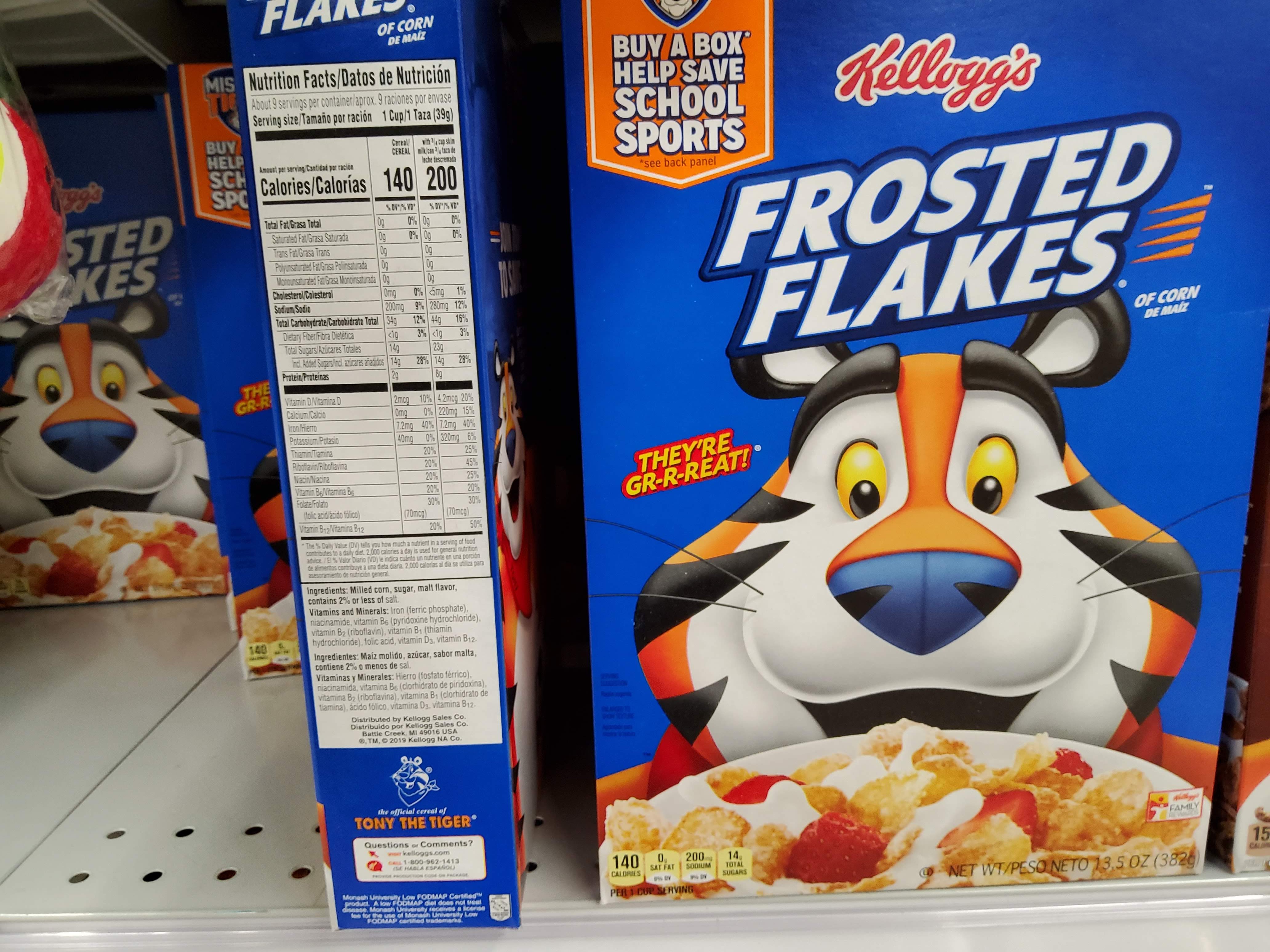
So the dessert cereals were clearly morally bankrupt sugar bombs. Are they all like that? Let\’s look a bit further, past the obviously bad stuff. Frosted flakes are frosted, which is bad, but corn flakes are good for you, right?
Wellllll, no, turns out these are pretty much just dessert cereal. 14 grams of sugar for one cup of cereal. No dice here.
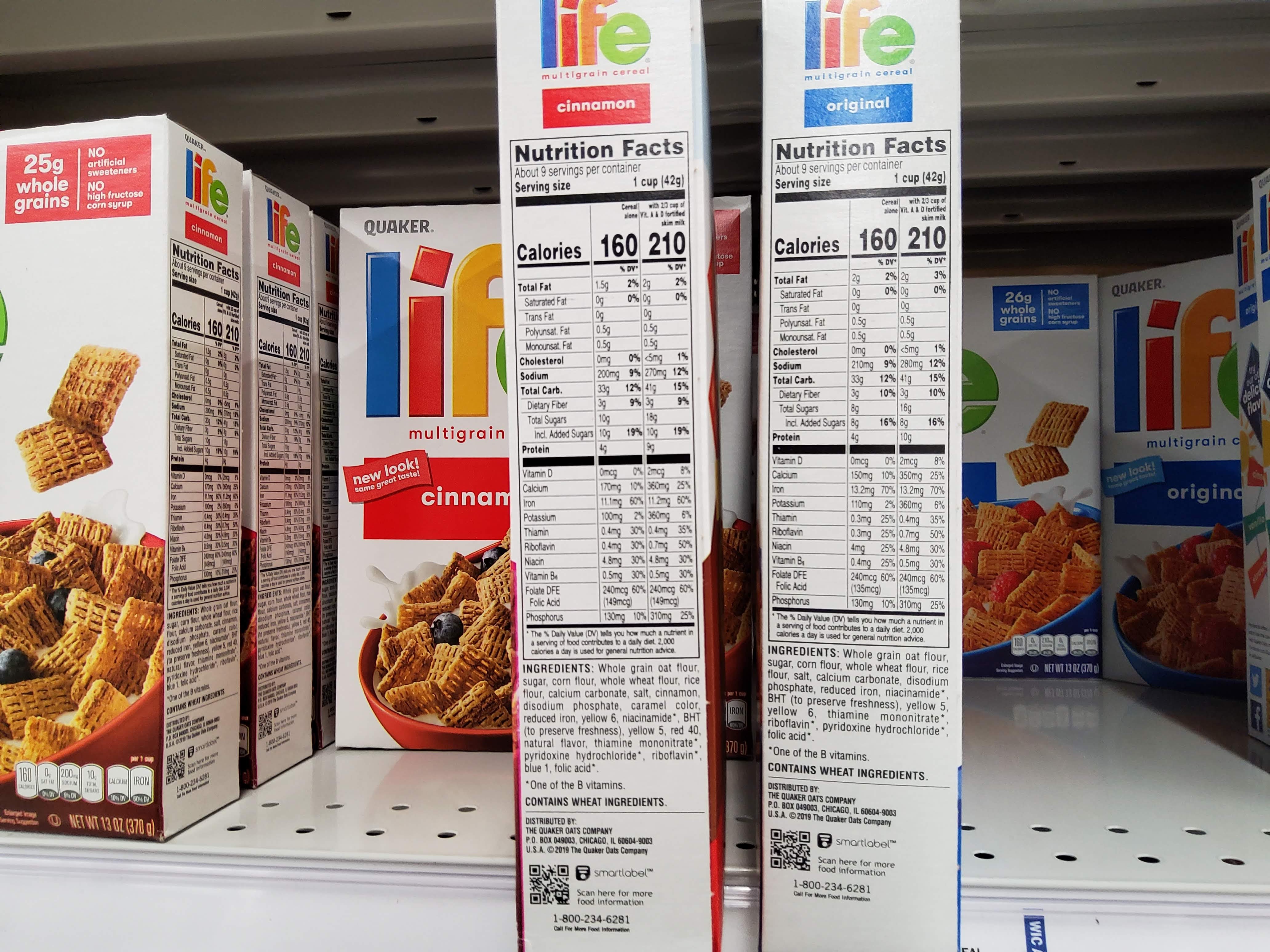
What about Life? Not so much bright packaging and colorful cartoon characters aimed at kids that don\’t necessarily know better than to stuff sugar down their throats… but let\’s see the data. 10 grams of sugar per cup for the cinnamon flavor, and 8 for the original. This is better, but really, not much. I\’d still classify this as a dessert cereal, in all honesty. Disappointing.
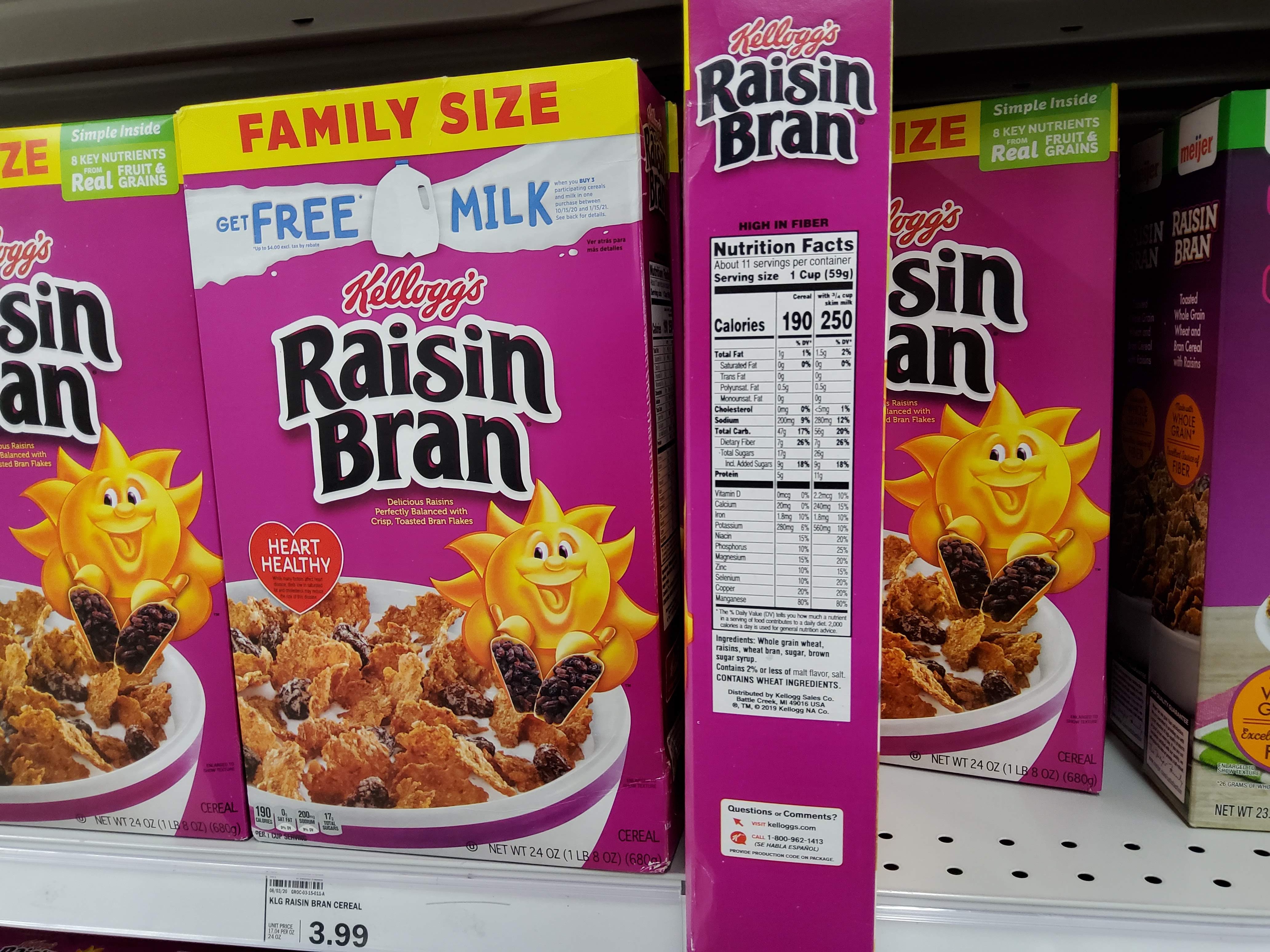
Maybe Raisin Bran? That\’s healthy, right? Raisins and toasted bran flakes should be nutritious.
Emphasis on should, here. This is actually the worst offender so far, at 17 grams of sugar per cup. Why? Well, not only has the cereal been sweetened, but also, raisins are dried fruit, which is like candy with fiber. For added sugar, this is only 9 grams, which is the best so far… but it\’s still far too much to start your day with. Or include in your day at all, really. Sugar bomb!
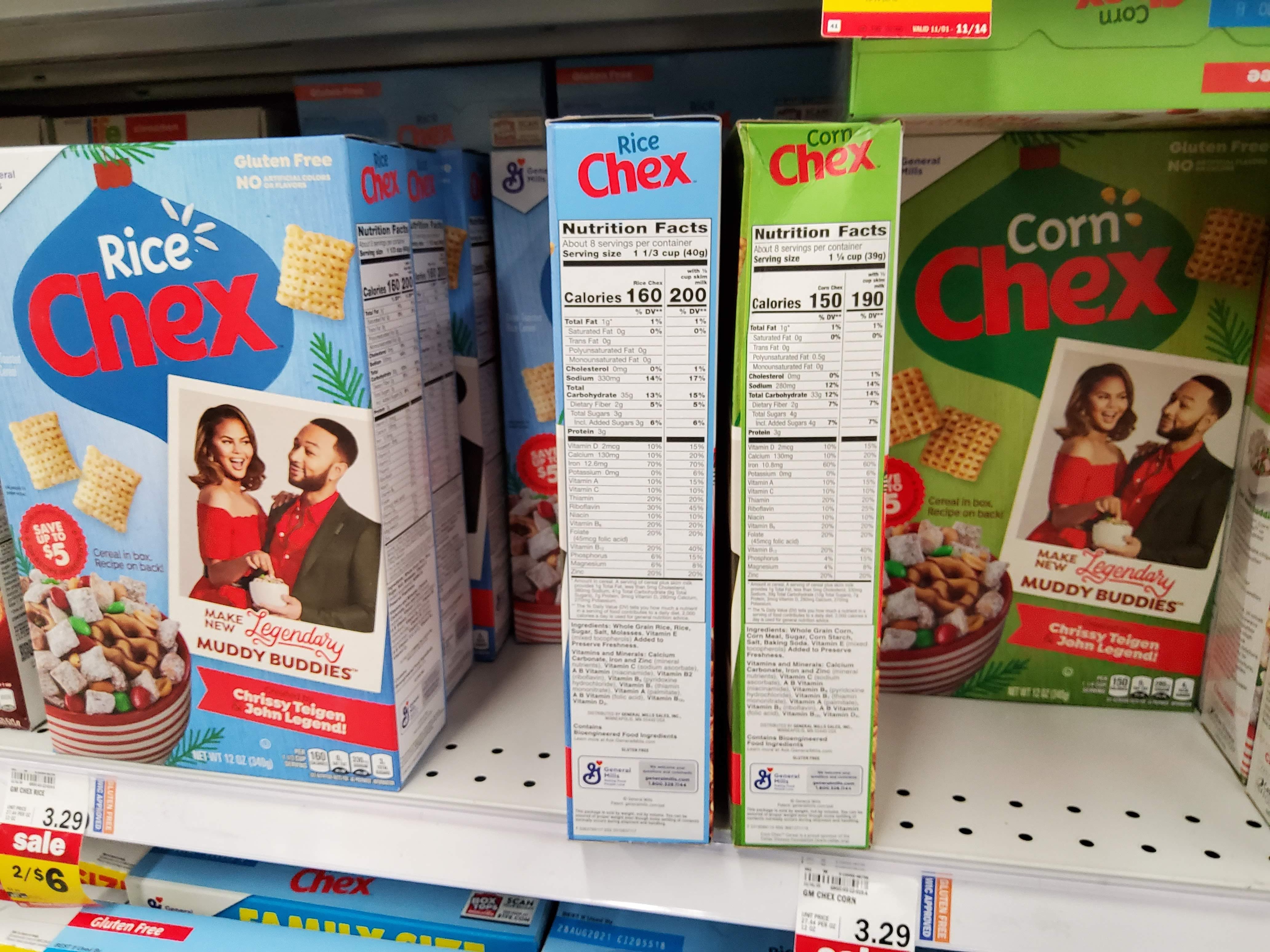
Here\’s a better option. While the calorie count is still frustratingly high, at 150+ calories per cup, the sugar is 3-4 grams per cup. It\’s all added sugar, which is bad, but the levels are low enough that even if you doubled it, it\’s not going max out your sugar budget all at once.
That said, this is still ultra-processed grains, meaning it\’s best to avoid it. Also, definitely do not make the muddy buddies recipe they\’re advertising on the front there, because that pretty much just adds sugar and more sugar.
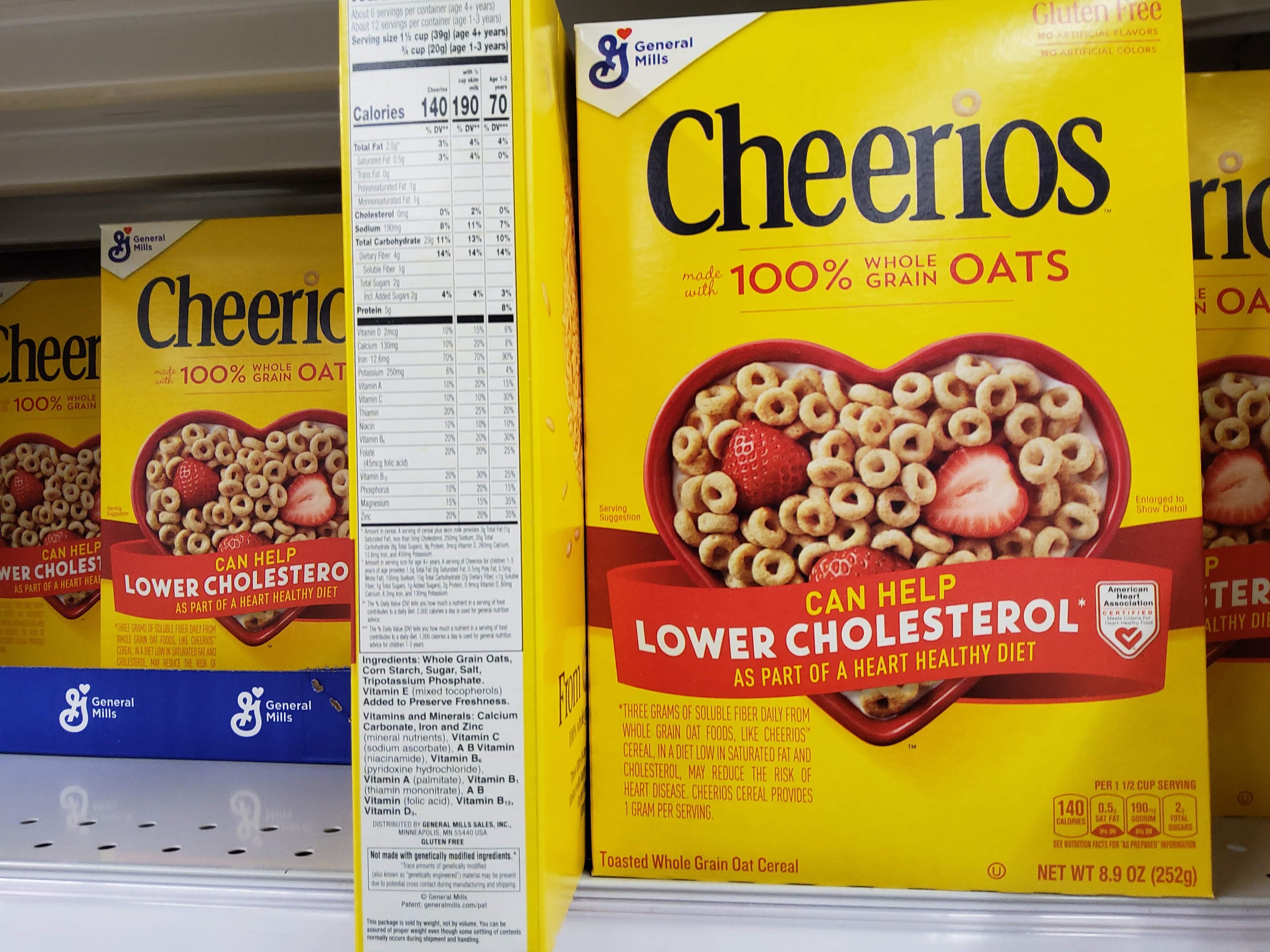
Our best contender so far. Marketed as healthy, which… it\’s still ultra-processed grains and 140 calories per cup serving, but at 2 grams of sugar, it\’s the clear winner so far. Mind you, this is only the basic version. If you opt for frosted variants all bets are off.
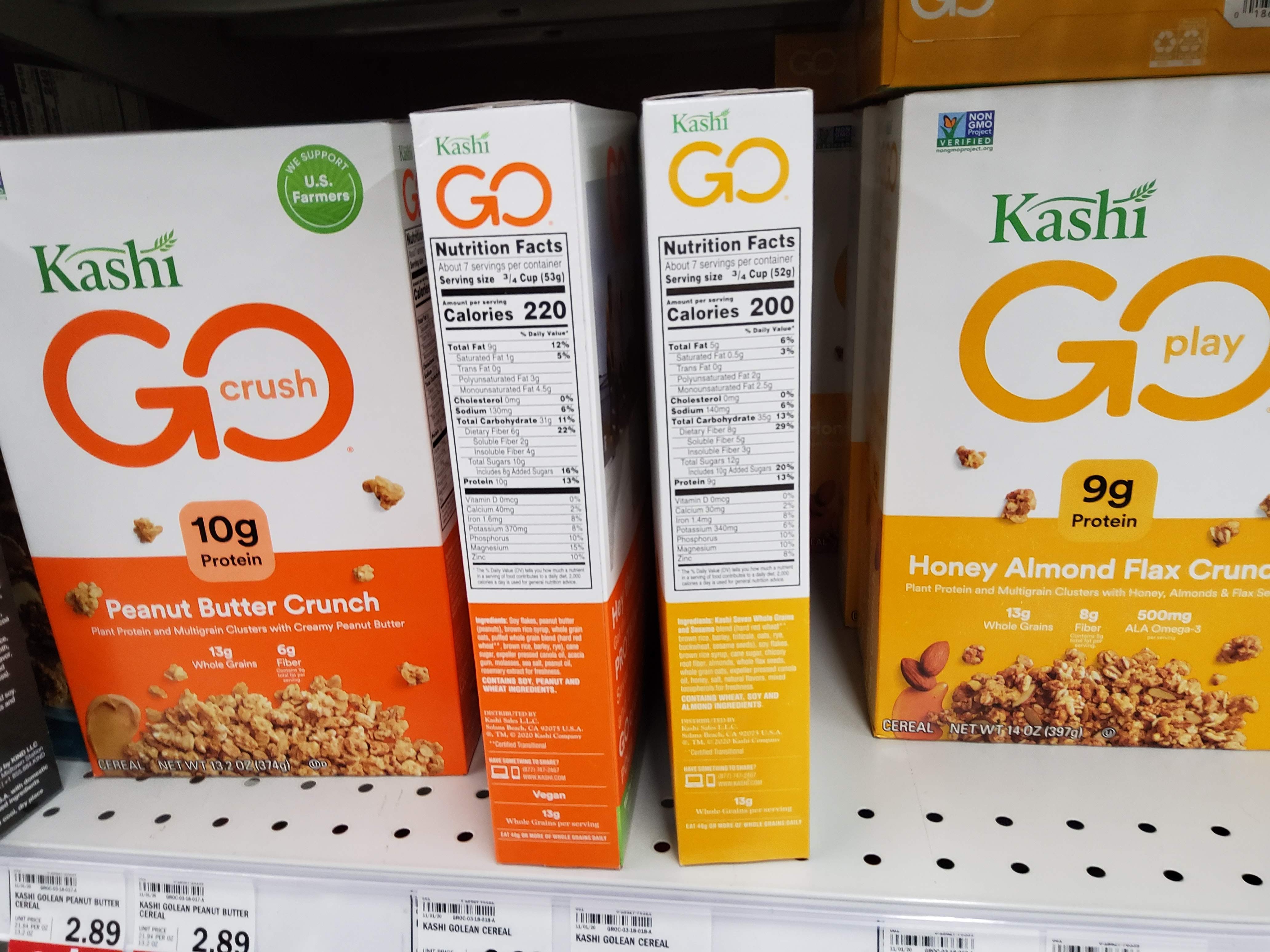
I\’ve heard this brand described as \”sweetened cardboard\” in the past. I\’m not really sure what it tastes like now, but the packaging at least seems attractive. Can\’t say the same for the nutrition, though. Serving size is 3/4 of a cup, not even a full cup, and it has the highest calorie count so far at 200+. Add in the 10-12 grams of sugar and it\’s pretty clear. I won\’t be trying these anytime soon.
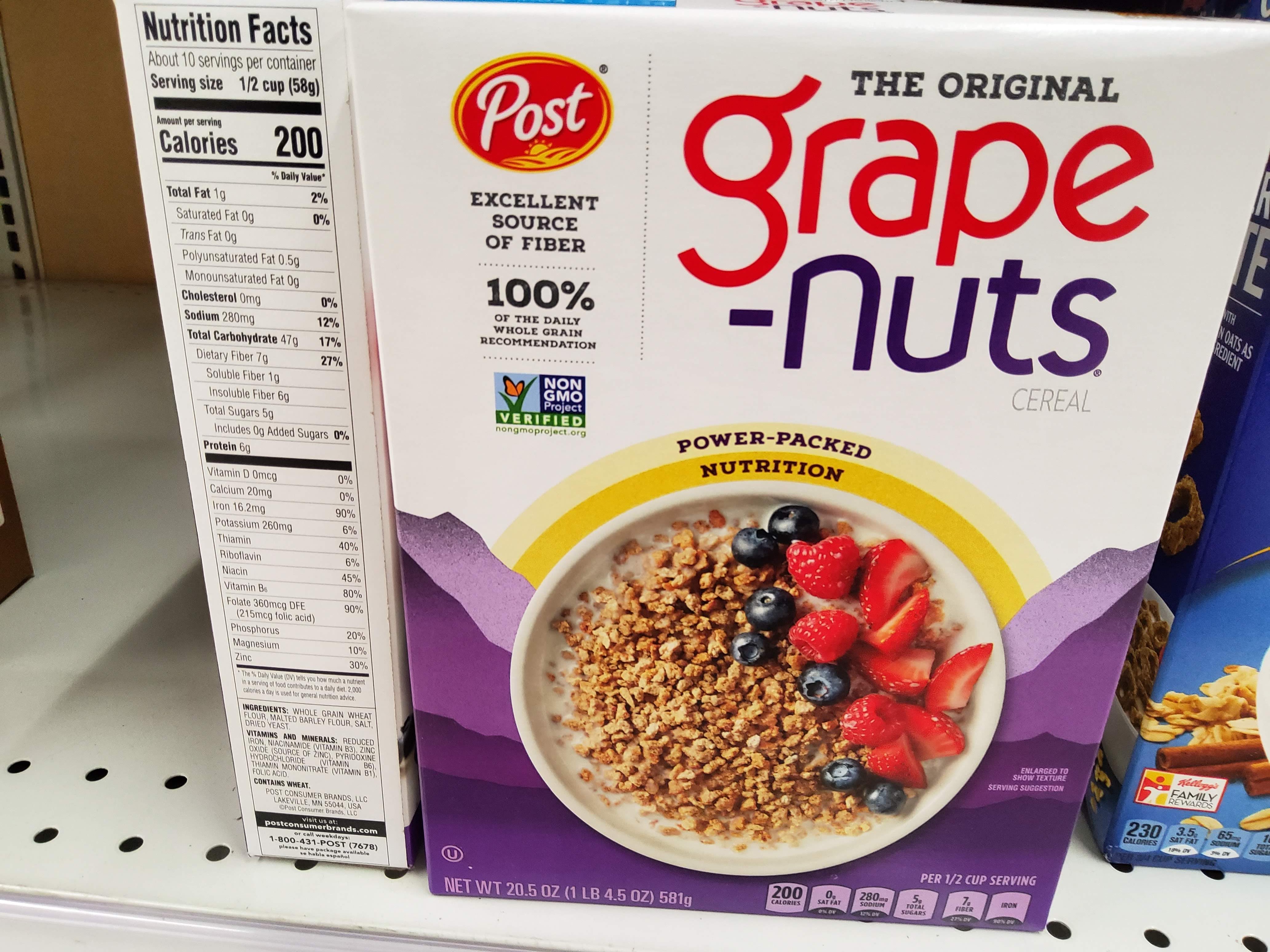
Last but not least in the cereal aisle, possibly the best available choice. If you can manage your portion sizing anyway. Grape Nuts are exceptionally dense, compared to the air-puffed competition all around them. The serving size is half a cup, which is the smallest yet, and it\’ll cost you 5 grams of sugar and 200 calories.
Why am I still recommending this when a previous cereal was fewer calories and fewer sugar carbs? Two reasons.
First, Grape Nuts might have more sugar overall, but not a single gram of that is added. The sweetness of this cereal is built into its ingredients, not from spoonfuls of sugar sprinkled on top for palatability.
Second, remember how everything so far has been ultra-processed? This isn\’t. It\’s largely whole grain. As such, it\’s much kinder to your digestive tract than anything else I\’ve showcased.
There\’s one more thing to say about cereal before we look at the rest of this aisle, and it\’s that Grape Nuts are not, in fact, your very best cereal option.
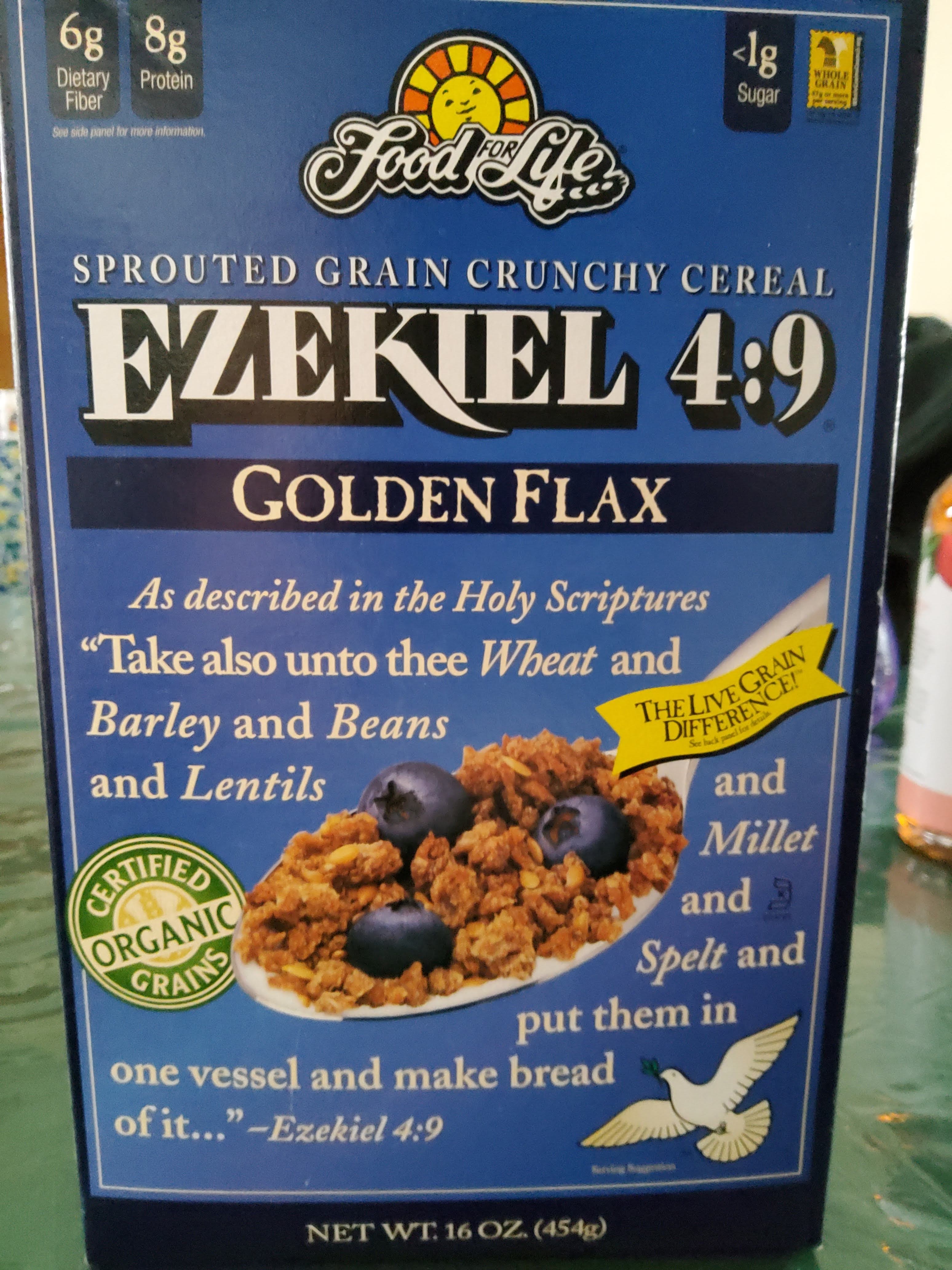
This is more or less in the style of Grape Nuts, but instead of merely wheat products, it\’s opted for a mix of grains and legumes. The end result has a better spread of nutrients and fibers.
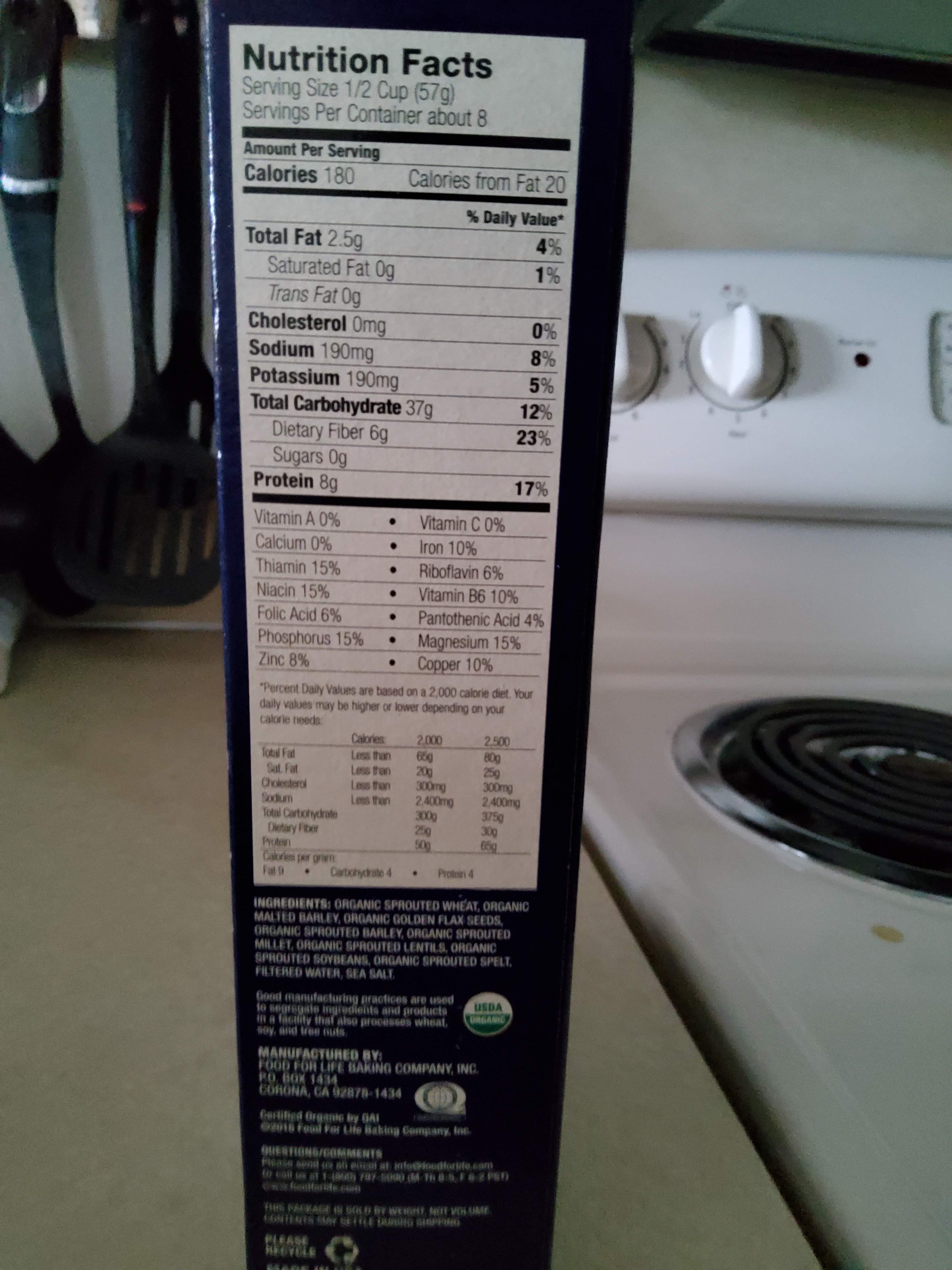
The other reason this is better than Grape Nuts? Check the sugar. This is made of sprouted grains, meaning the literal grain seeds were processed after the plant sprouted. This uses up the sugar stored in the grain, and thus you have a cereal with no sugar content at all. I like throwing fresh fruit or nondairy yogurt with some local honey or something on top to add some sweetness and extra textures, but it\’s not really necessary to enjoy this cereal.
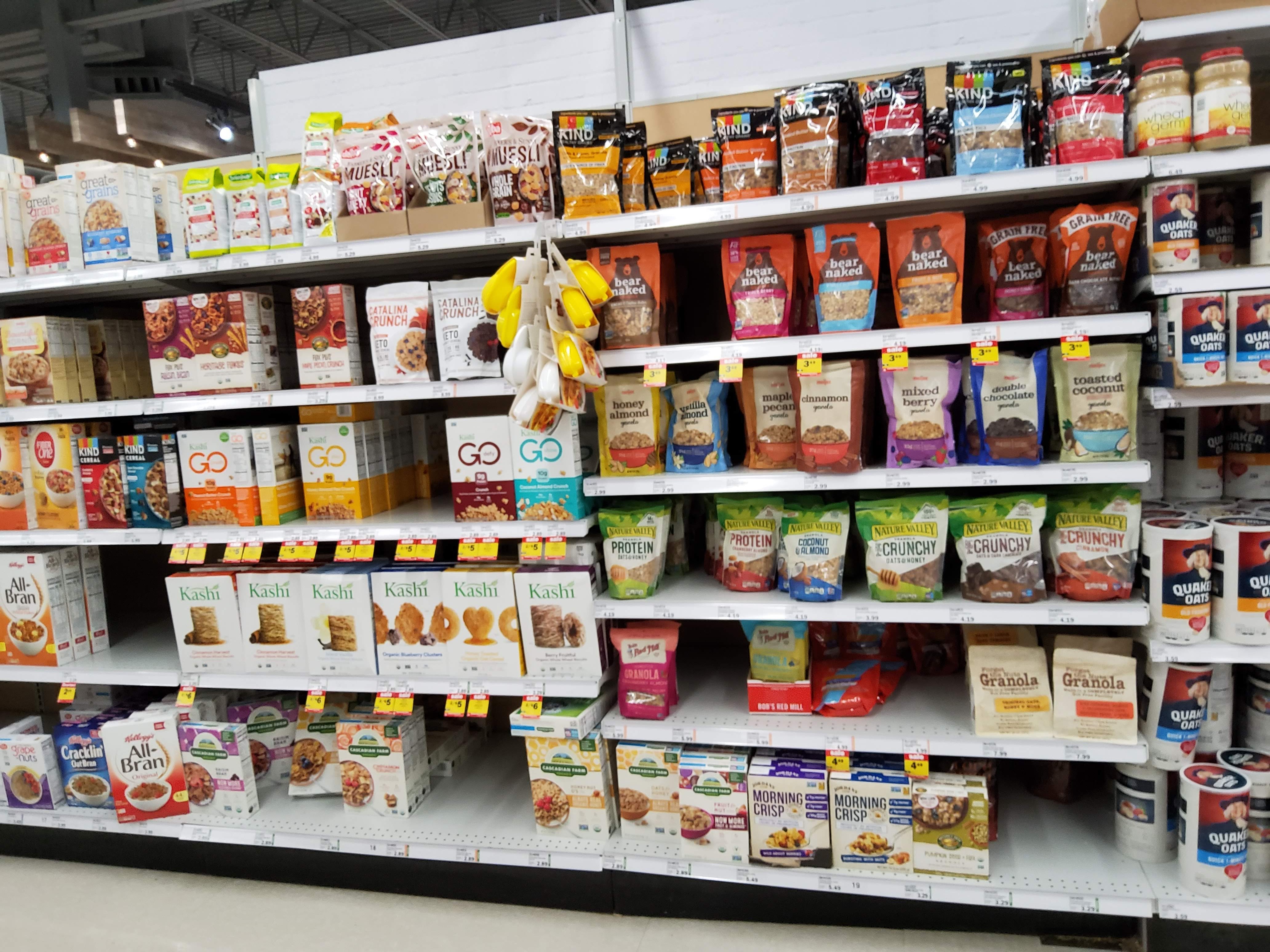
So cereal is sugar bombs, with very few exceptions. Moving on to the rest of the breakfast aisle! We begin with a short section of bagged granola. You\’ll note many of the same brands from the granola bars section a few aisles over. And pretty much the same failings as those granola bars. It\’s allllll sugar bombs.
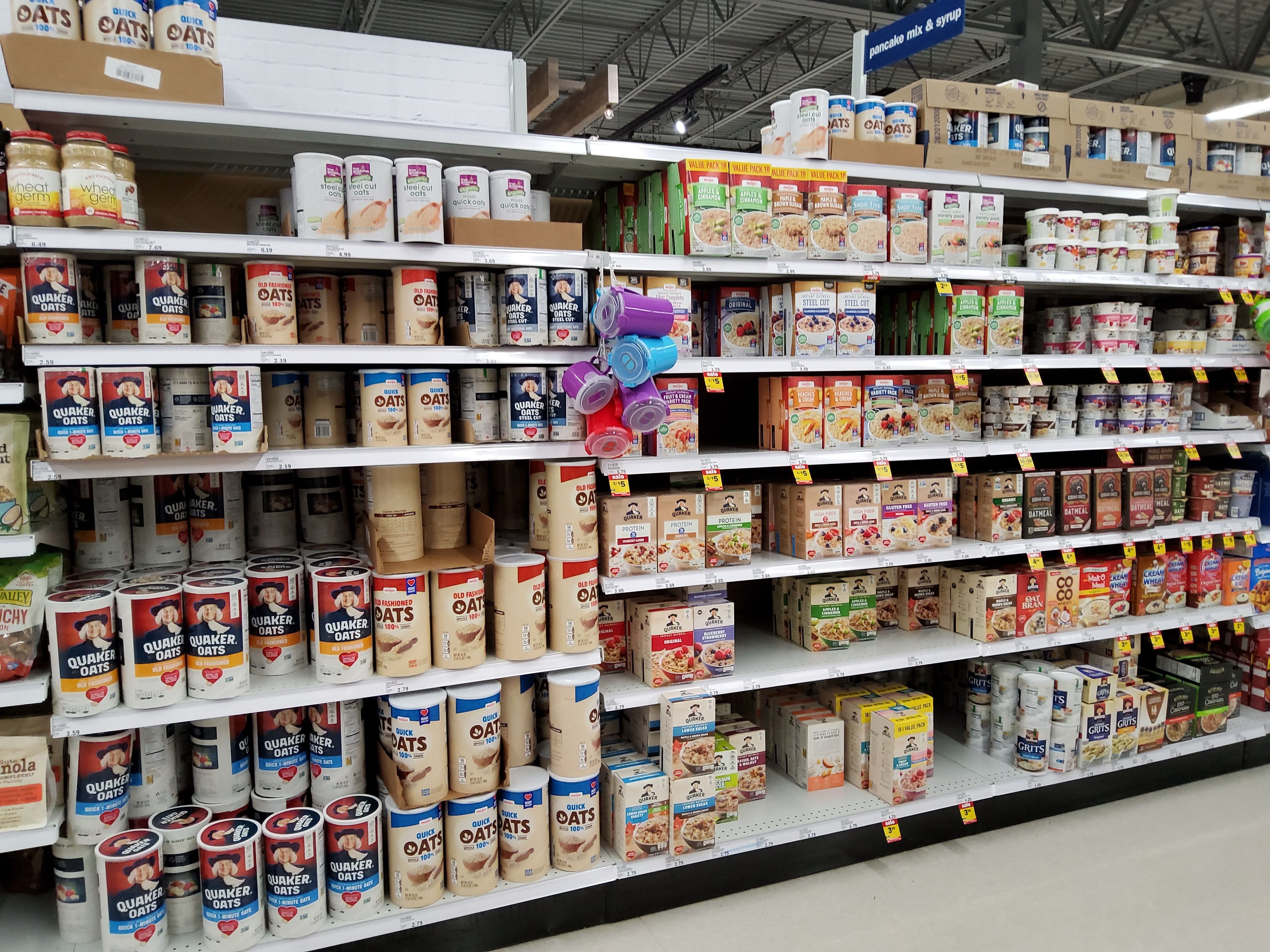
Next there\’s oatmeal. All kinds of oatmeal. There\’s quick oats and rolled oats and steel cut oats and old fashioned oats. I honestly couldn\’t tell you what most of that means, but I can safely say that the instant you add flavorings to it (see the convenience boxes right next to the tubes?) it becomes sugar bombs. You may even have convenience/snack sugar bombs, as seen in the upper right side there.
Do note the gluten-free quick oats, at least. You can actually find unsweetened gluten-free oats at Trader Joe\’s, but in a pinch these will do.
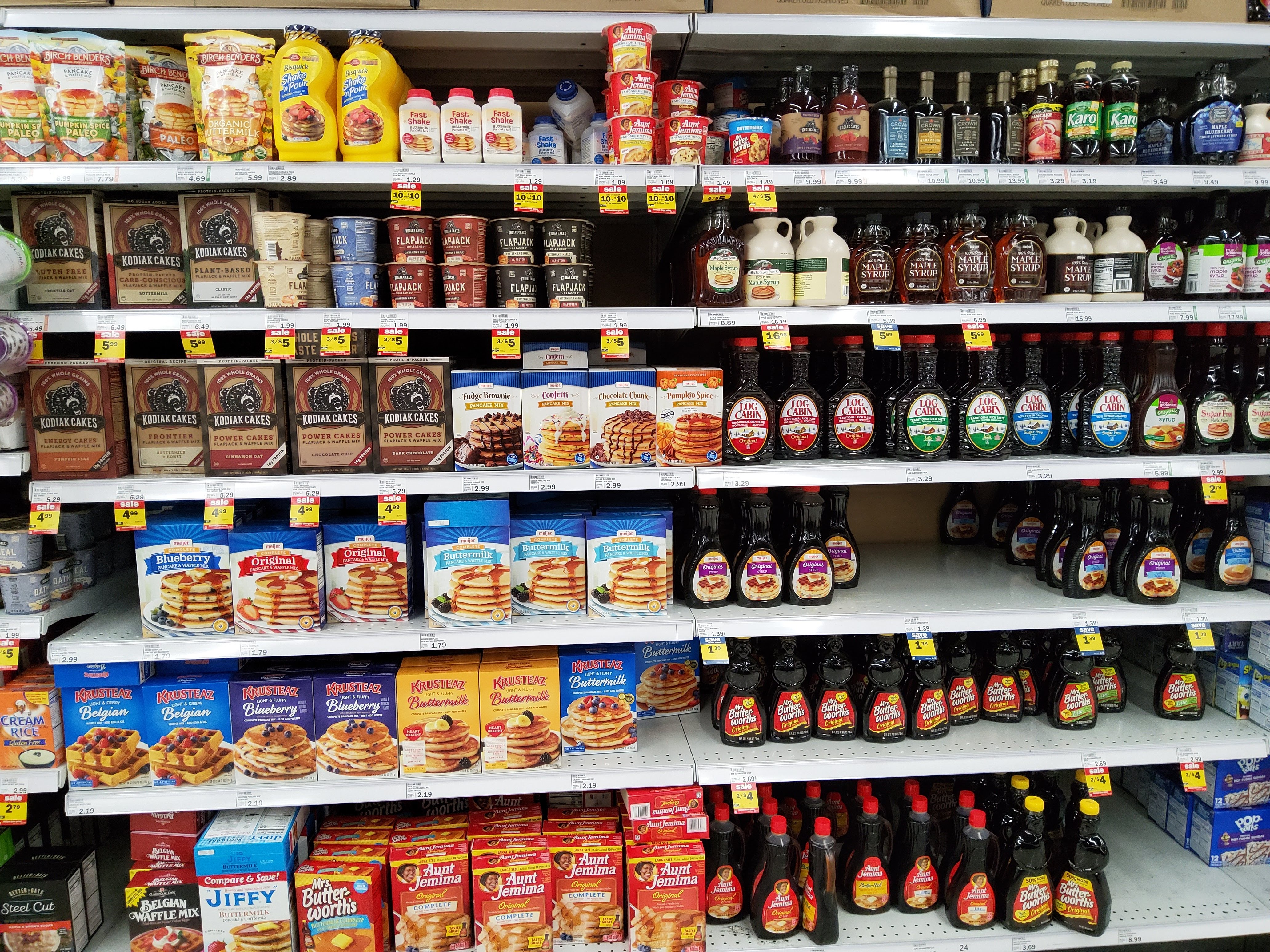
Remember how there were baking mixes back in the baking aisle? Including pancake mixes? Well, here\’s more. I\’m beginning to realize Meijer uses some of their staggering amounts of shelf space by doing redundant sections. You could walk to the baking aisle, or you could just stop here for breakfast-specific baking mixes.
Including, of course, snack-sized containers that you just add water to and then heat in a frying pan. Because of course those exist.
Also pictured here: liquid sugar to pour on your already unhealthy pancakes/flapjacks. Seriously, pancakes really don\’t have a lot going for them nutritionally. You can mix in nuts or fruit or what-have-you, but the basic recipe is ultraprocessed grain, dairy, oil, and some salt and sugar. Douse it in liquid sugar and you have a pretty unrepentantly unhealthy meal.
I\’ll spare you the rant about maple syrup and how most things calling themselves maple syrup aren\’t even close to 100% actual maple syrup. Just read your labels carefully.
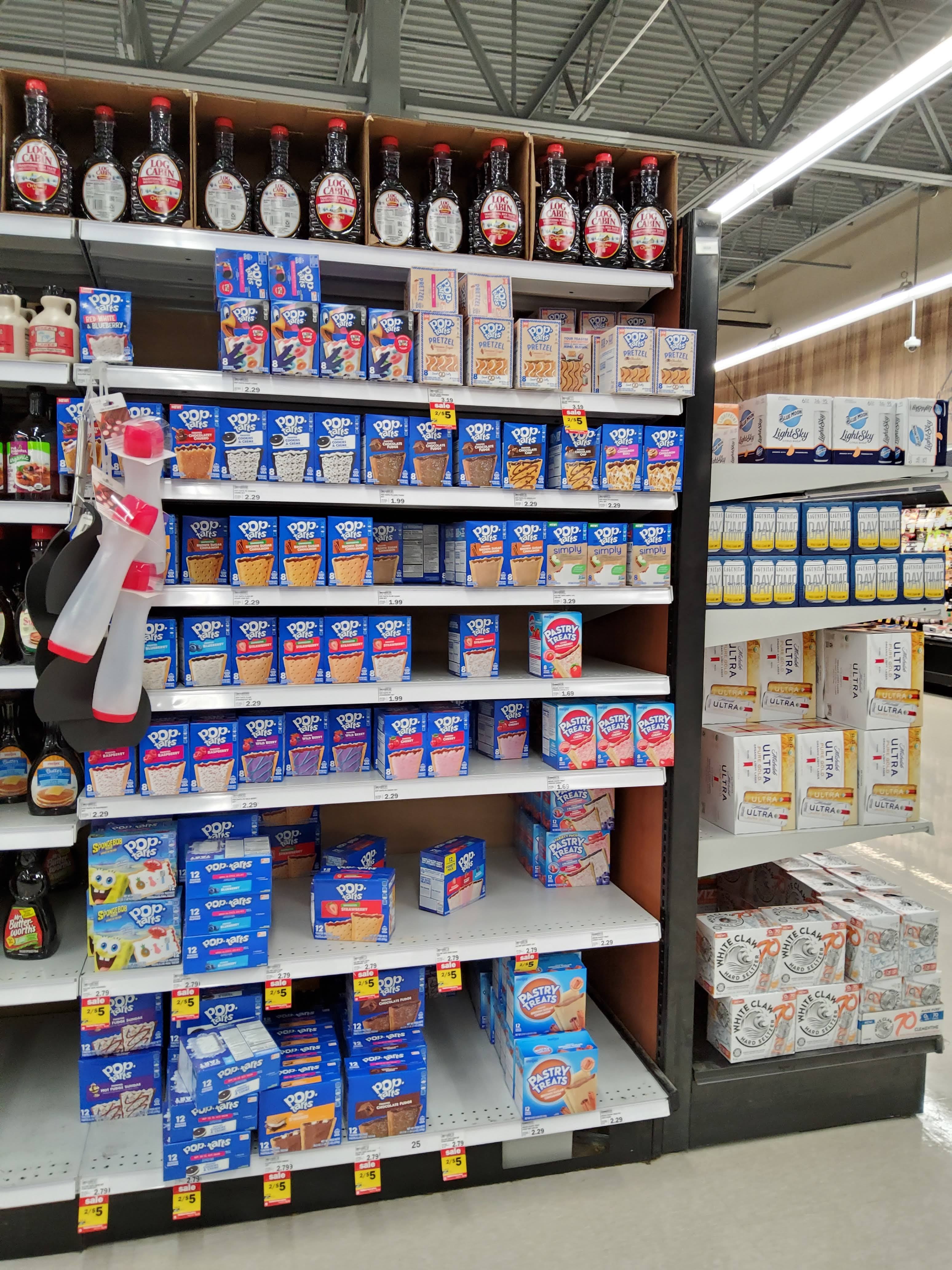
And finally, speaking of unrepentant things! At the end of the cereal side is sugar bombs! I mean Pop-Tarts. And knockoffs. Nobody pretends these are healthy, right? They\’re ultraprocessed white flour layered around sugary filling and typically glazed with even more sugar. This is a dessert, not a breakfast.
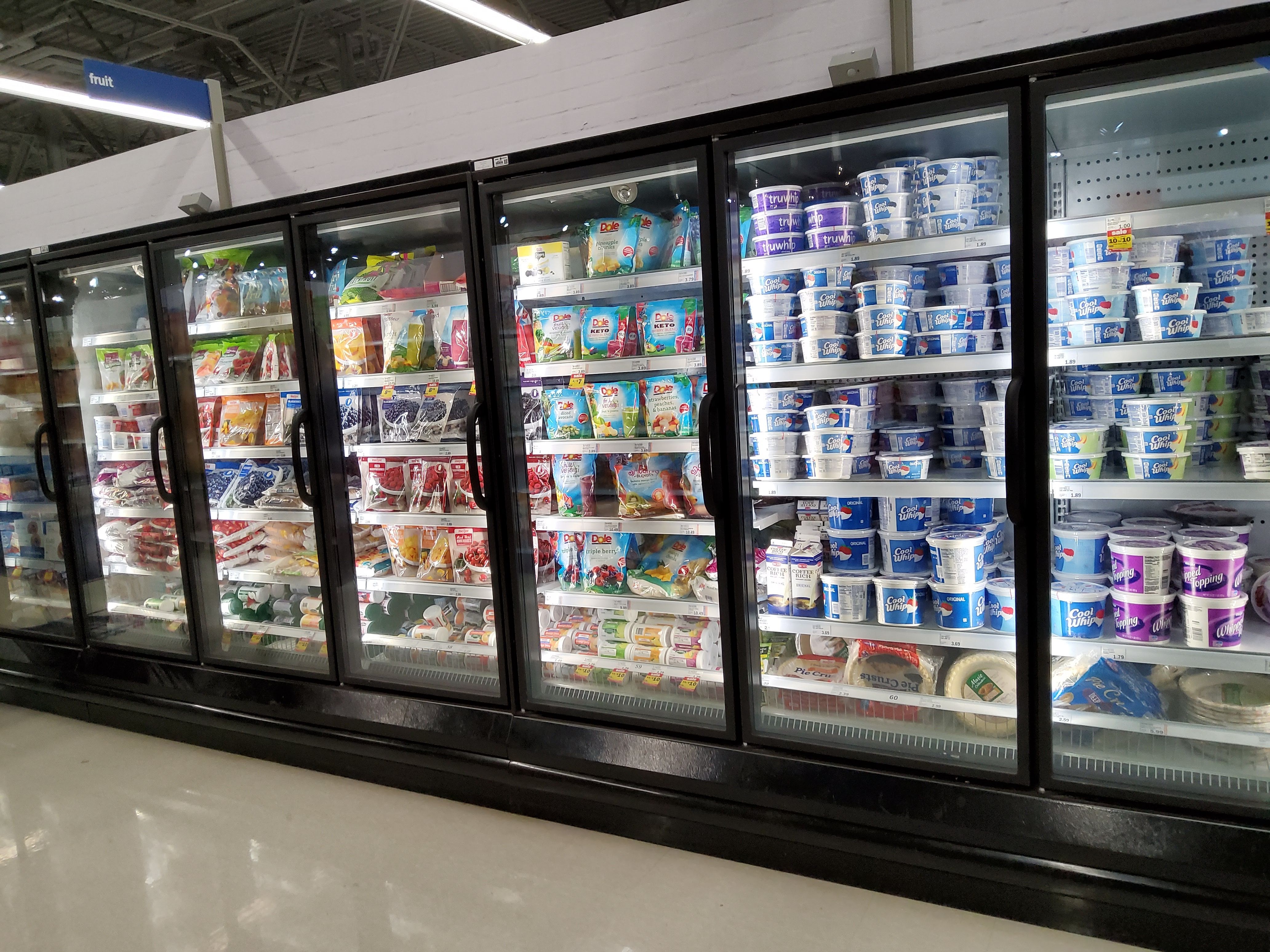
Turning around to the other side of the aisle now, we start with something that\’s pretty appropriate for the sugerbomb state of the cereal aisle: Cool Whip. It\’s like whipped cream, only in a tub and even worse for you. It is accompanied by frozen fruit. I\’m not really sure why it\’s here, because the ice cream is on the other side of the freezer units. I guess maybe people use frozen fruit and Cool Whip together frequently?
When I was growing up, I feel like you could mainly find blueberries, strawberries, and raspberries in frozen form. Maybe cherries and blackberries. Now there\’s mango and banana and peach and kiwi and pineapple and various mixes of all of these, because frozen fruit is exceptionally handy for making smoothies. Smoothies are all the rage in healthy eating, or at least they used to be a few years ago.
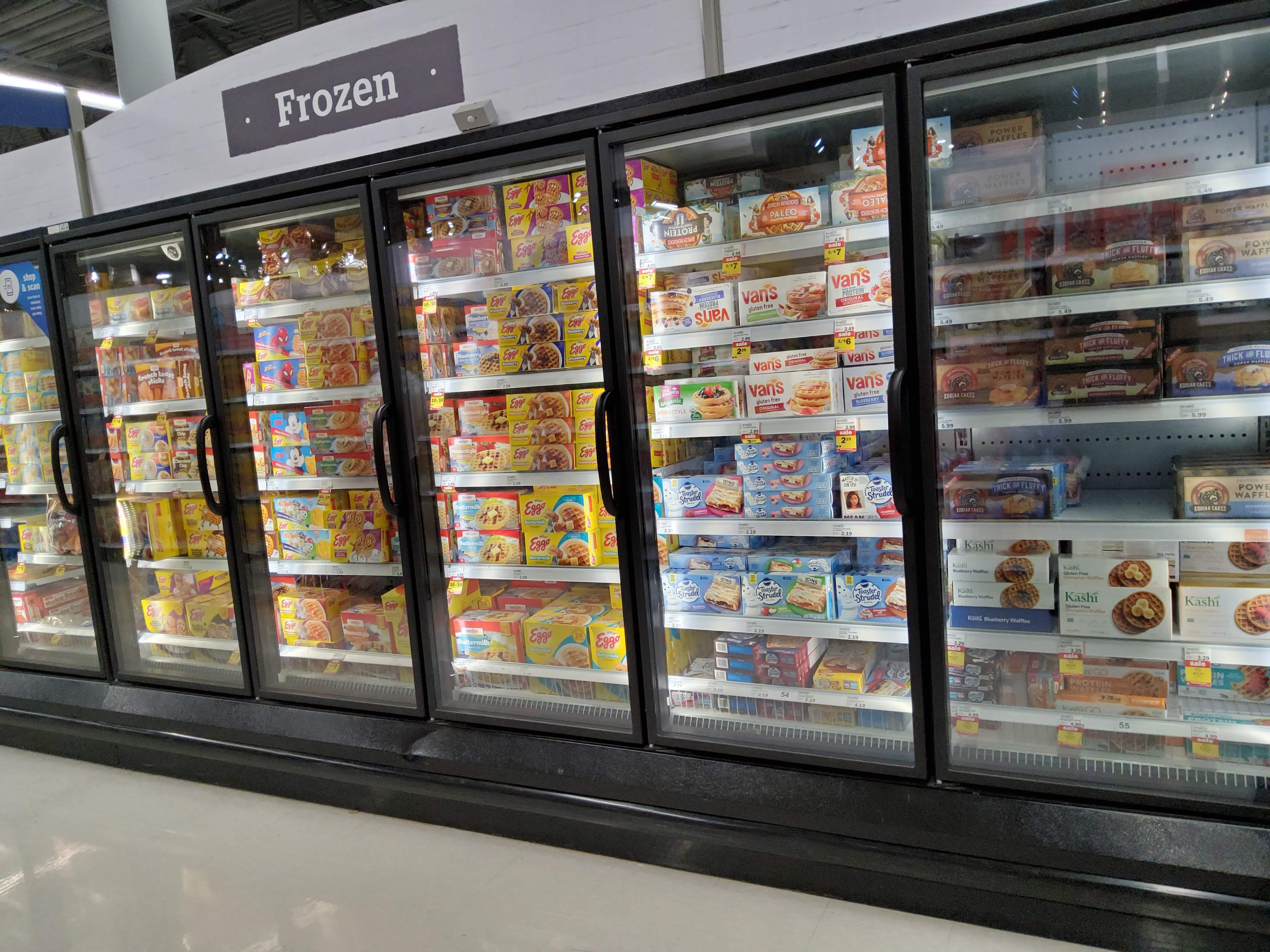
So hey, remember how pancakes aren\’t a very good breakfast? Neither are waffles. Especially when they have little bits of sugar stuffed into them, Eggo. Do note the gluten-free option, called Vans, there. That\’s something.

After the basic breakfast options/traps we start to move into more complex convenience foods, like sausages and single-serve breakfast sandwiches. I\’m not 100% sure why the burritos are here too, unless they\’re specifically breakfast burritos.

And after that we leave breakfast behind. This is all bagged chicken products, baked, fried, breaded, and ground into a paste and turned in to nuggets, it\’s all here.
Shoutout to Applegate Farms at the top there, with the only humane chicken in the entire section. Their internal standards are on par with Certified Humane\’s, so I\’ll typically eat their products. Also, they produce gluten-free chicken nuggets that are quite good. I couldn\’t tell I was eating a gluten-free product when I tried them.
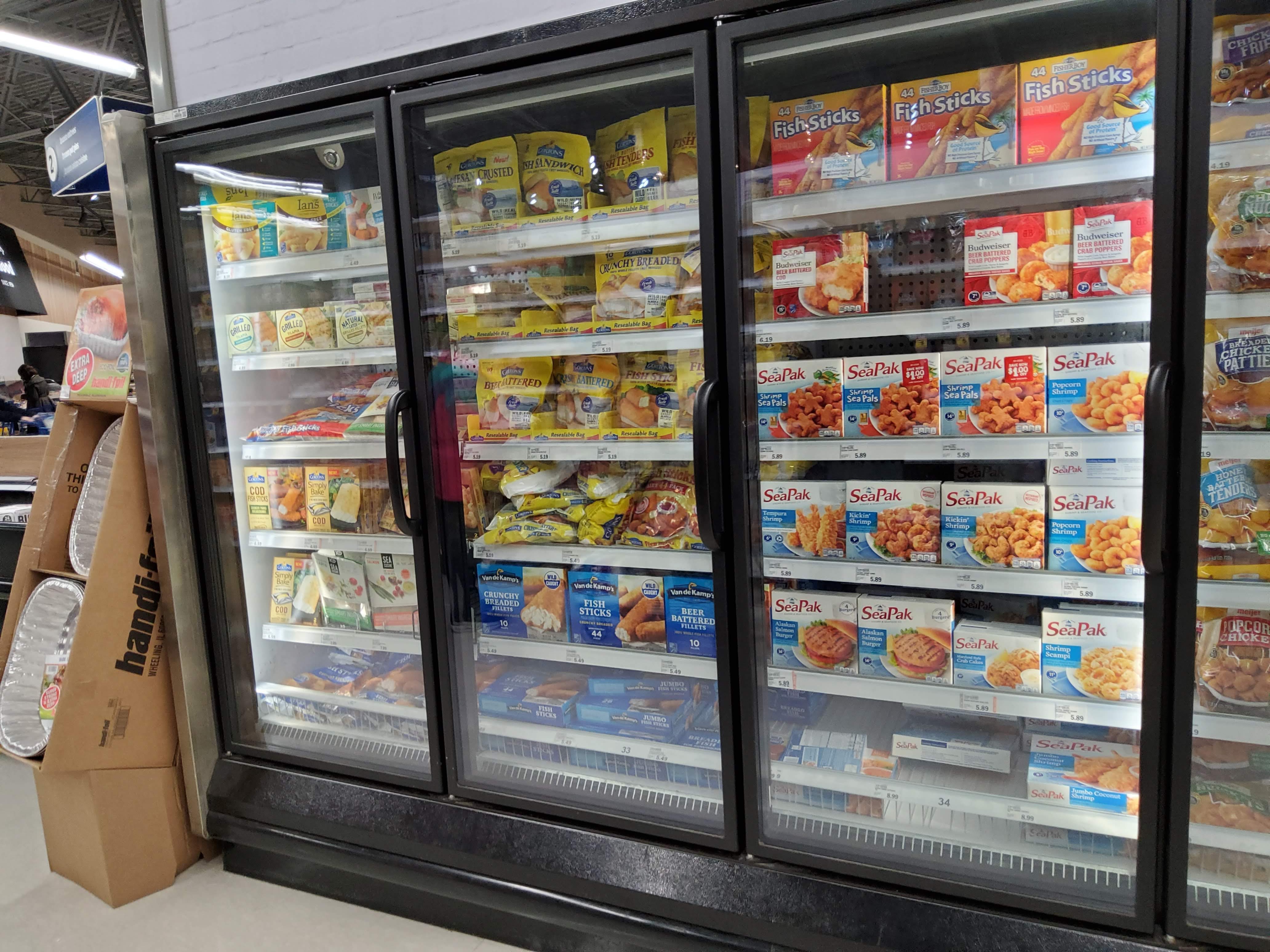
After chicken, it\’s on to fish. Filets, sticks, shapes, sandwich patties… This is actually only a small part of the seafood section, but it was here, so here it is.
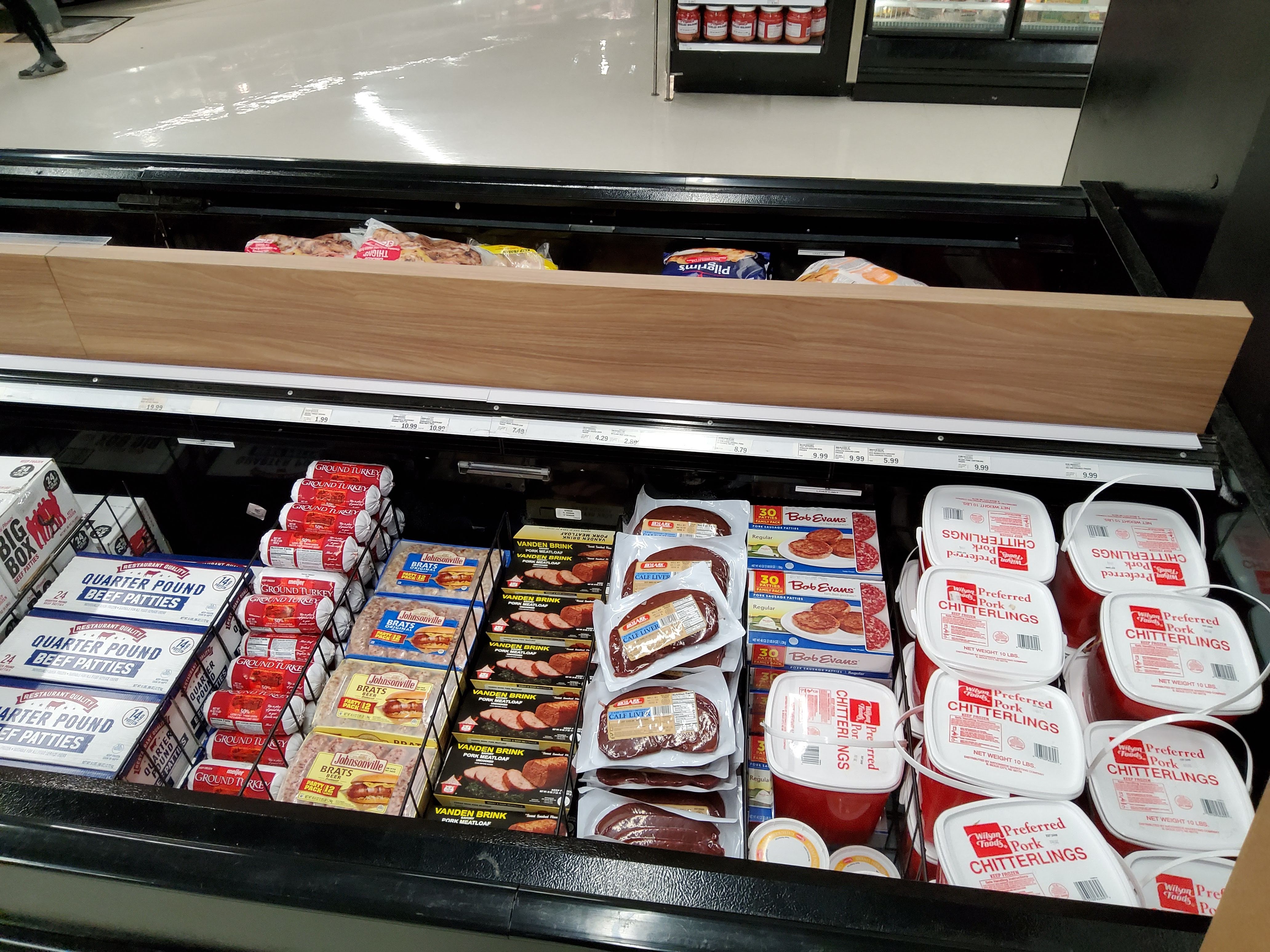
This frozen section cuts off somewhat abruptly here to turn into these large, open coolers. The contents of these changes seasonally, and based on whatever\’s in demand. At the time I took these photos, it was just about Thanksgiving. So while you typically can\’t find pork chitterlings, here they are in force.

And, since I mentioned Thanksgiving… you knew this was coming. Turkeys.

So many turkeys. The little ones on the right are Butterball, which surprisingly adheres to the American Humane standard. That\’s my third choice in independent humane standards, not nearly as stringent as the first two. But it\’s something, and so if I\’m desperate for turkey and can\’t find local to buy, I typically grab these.
So this week we discovered that cereal is, by and large, ultra-processed sugerbombs and propaganda. There continue to be multiple snack sections in every aisle of this supermarket, and sugarbombs infecting even otherwise healthy things like oatmeal and loose granola.
Next time we\’ll either finish off the frozen section or dive into the meat and deli areas. These last few posts will be tricky because it\’s getting harder and harder to avoid getting other people in my pictures, and also the floor plan for the meat and fresh fruits/veggies section is significantly less streamlined. On purpose, I think. Regardless, we\’re on the home stretch now.
Reading the Research: A Very Imperfect Process
Welcome back to Reading the Research, where I trawl the Internet to find noteworthy research on autism and related subjects, then discuss it in brief with bits from my own life, research, and observations.
Today\’s article has some interesting things to say about the diagnostic process, as well as autism diagnoses specifically. This links to the full-text article, not a summary, so be warned.
The intro to this study discusses includes the absurdity of psychiatric diagnoses, especially autism. In the typical medical field, you collect the symptoms until you get a match. Maybe you have to do a blood test, but there\’s typically a single, objective right answer.
Unfortunately, we simply don\’t have that kind of broad knowledge about the brain and the mind. Both are an order of magnitude more complex than most diseases. So when you get to mental illnesses, or into developmental disorders like autism (not a disease, thank you), the diagnosis process becomes messy. Instead of simple blood tests that produce a yes/no result, you get interviews full of subjective questions and subjective answers.
The point of this study was to look into how clinicians handle this uncertainty. Autism diagnosis is far more art than it is science, due to the truly absurd number of differences between individuals. The diagnosis is barely useful in a medical setting, in my opinion, due to that fact… and a significant number of frustrated parents agree.
Despite all that, there is pretty clearly something different about autistic people. We simply don\’t have the terminology and coherence of data to describe it in medically useful ways. (We do have commonality of experience, at least. Which has led to a thriving community where autistic people help each other out, which is beautiful.)
The results were interesting. Clinicians in this data set seem to simultaneously adhere to the medical concept (you are either autistic or not) and yet recognize and operate within the social concept as well (autism can be concealed or exaggerated via masking, gender norms, other medical or mental health conditions, acting, and poor reporting).
There was also the recognition that a diagnosis opens doors to resources and supports. This is particularly true in the US, where Medicaid may be your only hope of affording the appropriate services, like job training, in-home help, and transportation access. It can be significantly safer to have the diagnosis in case you need it, rather than avoid it and be denied access.
In the end, it kind of seems like the studied cases were more \”diagnosis by consensus\” than a doctor consulting the results of various tests and declaring the appropriate condition. That\’s kind of a strange state of affairs, given the rest of medical history.
It\’ll be interesting to see how diagnostic criteria evolve in the future, as we learn more about the brain and neurodiversity overall. Perhaps this \”diagnosis by consensus\” is merely a phase. Or perhaps it\’ll always be that way when it comes to brain-related conditions. Time will tell.
(Pst! If you like seeing the latest autism-relevant research, visit my Twitter, which has links and brief comments on studies that were interesting, but didn\’t get a whole Reading the Research article about them.)
Book Review: Improve Your Social Skills
Improve Your Social Skills by Daniel Wendler, is a plainspoken, relatively brief, \”what it says on the tin\” guide, written by an autistic adult who makes a business out of teaching this subject. Surprisingly to me, since it\’s such a complicated subject, it delivers. In a perfect world, this book could be given to every autistic teenager so we\’d always have a good place to start from, when social stuff gets complicated.
Topics include how to start a conversation and keep it going, a really basic guide to body language, how to make friendships that are meaningful, how to date, and how to tell stories well. The book does this in just over 200 pages. You can thusly guess, then, that it\’s written to address these subjects very, very broadly.
Even at such a broad level, though, I was impressed with this book. The subjects it tackles are complicated as heck, yet the author was able to boil them down to basics. Or the bedrock, as he seems to like to call it. Almost all of the advice and guidelines in the book I agreed with, or at least thought were a good start.
I\’ve reviewed a piece from this author before, and like the other one, it\’s written in the same, basically accurate but adorably optimistic writing style. While I don\’t particularly disagree with any of the information in this book, I suppose reading so much optimism (bordering on idealism) may have clashed with my remarkably pessimistic (read: cynical and depressed in the long term) nature. I had a similar reaction to watching an episode of the new My Little Pony TV show a few years back.
My personal optimism poisoning aside, Mr. Wendler has a gift for creating visual, teachable metaphors. The one that\’s stuck with the most is his concept for creating a successful conversation, which involves making a sandwich from opposite sides of a deli counter. The conversation is the sandwich, and you take turns with your partner adding ingredients to it before sliding it back to the other person. It sounds odd, but it made a lot of sense to me, both visually and in practice for how a good conversation actually works.
A couple improvements come to mind when It\’s a bit outside the scope of the book, but I would have appreciated a bit more in the section about getting a good therapist. The scope of the book does not cover fighting through mental illness to learn these social skills. In fact, it quite literally says, in a few places, that if you\’re struggling with mental illness, to get a therapist to work on that.
Which is good advice, and fine, but the section to help you choose one was limited at best. A good therapist is essential, but you aren\’t always going to find one that fits well the first time. Trust is an essential component. I\’m unsure if the author simply hasn\’t needed to therapist-shop or if he simply didn\’t consider it important information… but considering that up to 80% of autistic people suffer mental illness, it strikes me as far more important than it was made to be here.
A last note: like the other one I read, this seems to be a self-published book. I can\’t tell you how much that disappoints me. Not that the book exists, but that it doesn\’t have conventional advertising or a network to distribute it. This guide is what a lot of teenagers deeply, truly need in their lives (autistic or not). Sure, you can buy this book on Amazon, and that\’s certainly better than nothing. But this book probably won\’t receive the publicity and exposure it\’s due.
Read This Book If
You want a primer on the fundamentals being social. This book is light on the \”why\” of social stuff, but the information it contains is all accurate as far as I can tell. This is a good book for autistic people, especially teens and up, that want to brush up on the thing everyone hammers on us about: social skills. I found it a useful refresher, and it has earned its place on my bookshelf.
Reading the Research: Reducing Aggression
Welcome back to Reading the Research, where I trawl the Internet to find noteworthy research on autism and related subjects, then discuss it in brief with bits from my own life, research, and observations.
Today\’s article gives some valuable information about how much therapy an autistic kid actually benefits from.
I spent a short time working for an ABA clinic a few years back. It was… not really an experience I enjoyed, for a lot of reasons. Not the least of which is that I didn\’t really like what I saw of the ABA therapy. It was kind of dehumanizing, based on bribes and teaching disguised as play. It was something I didn\’t see myself doing well in.
Depending on the child\’s assessed needs and ability to manage a typical classroom and interactions, they were assigned a number of hours to be in therapy. That number went up to 40.
Think about that for a moment. 40 hours of therapy. Effectively, a full time job for a kid that isn\’t even six years old. And that was pretty much inevitably for the kids that were struggling the hardest, which meant that not only were they going to struggle at home, they were also going to be worked very hard, with few breaks, every week day.
Did they learn? Yeah, of course. The clinic wouldn\’t have stayed in business if it didn\’t produce results, though the usefulness of those results is debatable. A kid scoring low on a test, being taught to pass the test, and then scoring better on the test, is kind of obvious. The relevancy of the test to actual life? That, I couldn\’t honestly vouch for. And I have serious doubts, truth be told.
This study didn\’t look into numbers as high as 40 hours. However, I think the results are still rather telling. It didn\’t seem to matter whether the kids were given 15 or 25 hours of therapy. They all improved, even regardless of the specific style of therapy used.
It\’s outside of the scope of the study, but I\’m kind of disappointed they didn\’t measure child happiness. I suspect it\’d be telling if one of these therapies (an offshoot of ABA) left the children less happy than the other. It would also be rather telling if the 15 hours a week kids were happier than the 25 hours a week kids.
One last note: 40 hours of ABA therapy, if not covered by insurance, cost something like $25,000-$40,000 a year. Typically the insurance covered at least half of that, sometimes more, but it\’s still a ludicrous number. That\’s the equivalent of college tuition. Can you imagine how much money parents could save per year if this trend holds true overall?
(Pst! If you like seeing the latest autism-relevant research, visit my Twitter, which has links and brief comments on studies that were interesting, but didn\’t get a whole Reading the Research article about them.)
Book Review: Pretending to be Normal
Pretending to be Normal: Living with Asperger\’s Syndrome, by Liane Holliday Willey, is a \”my life with autism\” account written by an older autistic woman, one of the generation before mine that had little-to-no supports or help unless they were deemed \”completely disabled.\” She was not, and so she had to fend her way through life mostly alone. This is not a long book: less than 200 pages, almost 50 of that in appendices.
I\’ve read Liane\’s work in the past, and actually met her in person during one of the DOD\’s yearly Autism Research Program conferences. She lives in the same state as me, perhaps a few dozen miles north, and has ties to the same entity that diagnosed me as autistic about a decade ago.
She is a very knowledgeable person, but like me, not a cheerful one. In reading this book, one can easily see the myriad of ways life has battered her down. In Japan, the saying is \”the nail that sticks up gets hammered down.\” Meaning, that people who do not fit into proper social norms and expectations get pressured to conform until they do. This is particularly true in Japan, but even in a more individualistic culture like the US, it is still true. I have the depression and anxiety diagnoses to prove it.
I see a couple things of specific note in this account.
First, there is a certain pervasive negativity to her view of autism. I see this often with freshly diagnosed autistic people, those prone to depression, and parents that fit those categories or haven\’t been introduced to neurodiversity as a philosophy.
When I, and others, first receive our diagnoses, there is the tendency to hyperfocus on it, and blame it for everything we don\’t like about ourselves. The depression, the anxiety, the sensory differences, the low energy, even medical things like dietary sensitivities and gut dysbiosis.
This is part of what contributes to the confusion around what exactly is meant when someone says \”autism,\” by the way.
Perhaps more importantly, though, it is inherently unfair.
Autism is not a collection of negative traits that serve only to disable a person. It is not \”everything that\’s wrong with me/my child.\” It is a brain difference, and that comes with positives and negatives. Neurodiversity teaches us to celebrate those positives.
For example, I would say I am a very reliable human. If I say I\’m going to do something, I do it. I am rarely, if ever, late to appointments. I don\’t make promises lightly, or say things I don\’t mean. I make efforts to be conscientious of others\’ time and energy. These traits are a facet of the autistic tendency to adhere to rules.
There are dozens of ways to spin that tendency negatively. \”Rigidity\” is one of them. \”Change intolerant\” is another. \”Inflexible\” is yet another I hear regularly. It\’s true that autistic people can have great difficulty shifting gears and accepting rule changes, and that can make our lives harder. Most recently my friend needed to reschedule my hair appointment due to a sudden change of schedule, and I was doing so poorly at the time that I quite literally couldn\’t face rescheduling it for a couple weeks.
Does my difficulty with sudden changes of plan negate the value of my reliability as a person? I don\’t think it does. Or I don\’t think it should, ideally. But in the course of communication, especially with parents and professionals, it basically does. The strength and value of my differences is ignored in favor of spotlighting my weakness.
It\’s a very cruel thing to do to people. Having our parents, our friends, our support staff, constantly preaching to us all our failings and ignoring our successes and good points… well, it\’s no wonder many autistic people are depressed. Having so many anti-cheerleaders is terribly damaging to one\’s self-worth. Particularly on top of already being the metaphorical nail in the Japanese saying, which is hammered day and night to conform, by people who don\’t know us and don\’t care about us.
The kind of relentless negativity can be internalized, and I wonder if Liane perhaps struggles with exactly that. There\’s certainly a mention here and there of \”becoming less AS [autistic]\” when talking about learning to get by in life better, or improving her social skills.
In the book, Liane wishes in several places that she had found someone like herself earlier in life. Based on how she talks about her daughters (one of which is also autistic), it seems like she eventually found that in her own family. At the time I met her, more than 15 years after she wrote this book, she had also branched out into meeting other autistic people, which I\’m glad of.
The main of the book ends with a hope and a wish for the sort of world that embraces differences, rather than rejecting them. It was, I was glad to see, pretty much exactly what most people who identify as neurodiverse would wish for.
At the very end is a set of seven appendices, which include the author\’s coping strategies, organizational suggestions, thoughts on disclosure of diagnosis, further reading, etc. They span a bit less than 50 pages.
Read This Book If
You\’re interested in the life story of an older autistic adult: one of the generation prior to mine, who was typically diagnosed at middle age or later and had little or nothing by way of community to support them. While the book ends on a note of hope, much of the content is sobering and sad.
Reading the Research: Systemic Reform in Mental Healthcare
Welcome back to Reading the Research, where I trawl the Internet to find noteworthy research on autism and related subjects, then discuss it in brief with bits from my own life, research, and observations.
Today\’s article describes a path to improving existing mental healthcare. Many autistic people suffer various forms of mental illness. I personally have an anxiety disorder and a type of long-lasting, low grade depression called dysthymia.
Longtime readers will recall I have various gripes with the US healthcare system and its accessibility. But even when someone has insurance that covers mental healthcare, this paper points out quite clearly that the outcome is not always good.
The summary has an example of a person being prescribed a particular pill and the fallout when the office failed to follow up with the person. But as we found out a couple weeks back, this is pretty normal, especially when it comes to children.
As a reminder, the best and most effective response to \”I seem to be suffering from mental illness\” is \”Okay, let\’s get you booked with a therapist.\” The typical response from the system seems to be, \”Okay, here\’s some niche pills that might or might not help you.\” This study tells us that even if someone is prescribed appropriate medication, the chances of them receiving proper follow up care are minimal at best.
Considering how frustratingly uncertain the results of pharmacological interventions (ie: pills) are, it\’s simultaneously terrifying and infuriating to know this is how things are. Terrifying because the side effects of anti-depressants are many, varied, and sometimes crippling, and infuriating because of how systemic this utter failure is. It\’s not just scattered bad doctors\’ offices that doesn\’t care about their patients. It\’s basically every doctor\’s office, unless they are spectacularly on top of things.
There\’s a great deal of need for jobs during (and after) this pandemic, and a great deal of hand-wringing about how to provide those jobs. There are various ways to create those jobs, but in all honesty, some of them are more valuable than others. There is a clear and pressing need, nationwide (if not worldwide) for better healthcare and outcomes. So why not hire people to follow this research-proposed framework?
Particularly, why not hire autistic people and other people with disabilities? This kind of work can be done from home. You\’d need database access and a work phone. And the ability to ask scripted questions and listen to the answers, perhaps even ask some followup questions. In short, this is not complicated work, and yet it would be highly valuable. Why not? We\’d all be better for it.
(Pst! If you like seeing the latest autism-relevant research, visit my Twitter, which has links and brief comments on studies that were interesting, but didn\’t get a whole Reading the Research article about them.)
Book Review: Dietary Interventions in Autism Spectrum Disorders
Dietary Interventions in Autism Spectrum Disorders: Why They Work When They Work, Why They Don\’t When They Don\’t, by Kenneth J. Aitken, provides a discussion of the history of special diets for symptom management in autistic people. Despite the rather blunt title, the book seems to be aimed at healthcare professionals. However, a layperson such as myself can follow the gist of the matter without understanding the specific formulas and chemical interactions described.
I\’ll preface this review by informing you, sadly, that there is no one proposed diet that solves all autistic ills. This won\’t surprise you if you\’re familiar with the saying, \”If you\’ve met one person with autism, you\’ve met one person with autism.\”
Also, when the word \”diet\” is used in this book, it is not referring to the typical USian understanding of the word, which refers to the fad weight loss diets that come and go like the wind. These diets are undertaken to lose weight, and, without assuming that goal is even accomplished, dropped quickly. The book does not, in fact, give any care for weight loss at all. Apparently a significant portion of the autistic population is rail thin instead of obese. That sounds nice to me, but the author insists this is as much as problem as obesity.
At any rate, the book\’s intention with the word \”diet\” hearkens back to an older understanding of the word: the food and drink regularly consumed. In short, these diets are meant to be undertaken in the long term. They are lifestyle changes, not temporary measures to appease one\’s guilt or prop up one\’s body image. (I have a deep dislike of \”dieting,\” can you tell?)
The first section of the book discusses ASD and special diets. It contains good background knowledge, some of which is helpful to understanding the how and why of the diets. It also covers how food and nutrition has shifted in the development of humanity and technology, which I thought was quite interesting and helpful. To cap it off, it contains information about particular toxins whose effects are particularly obvious in autistic people, as well as protective factors against these toxins.
The second section is the meat of the title: Nine diets are analyzed and summarized in brief (sometimes \”less than 10 pages\” brief). Factors considered in each analysis include the evidence for and against each diet, possible health problems associated with the diet, and practical difficulties with following the diet.
I was particularly impressed with the author\’s choice to have that last criteria in each section. It strongly suggests he\’s aware of the challenges that come with making these changes. The specific sections, too, suggest his awareness of the differing situational challenges any given family might come up against. Not every family is going to be able to find farro to cook with, for example.
Each analysis also includes a Resources section, which tends to include a healthy mix of books, websites, organizations, and scientific research. This is in additon to the Resources section at the end, which contains all the same info but centralized. The information in this book is about ten years old, so it\’s quite possible that some resources may not work. However, the author has listed enough of them that at least one should serve to get you further information and likely other resources.
Part three of the book is the author\’s answer to \”but which of these diets should I do!?\” He proposes a 10th diet (the Simple Restriction Diet), drawing on the best parts of the most effective diets previously described. He includes a proposed plan, complete with worksheets, a table to help you match problem foods with toxins, and a suggested timetable with which to implement the diet and subsequent re-introductions of food categories.
In all honesty, I kind of want to try this Simple Restriction Diet. It seems distinctly promising in terms of both weight loss and narrowing down whatever keeps wrecking my guts. Maybe even whatever\’s wrecking my spouse\’s guts. In practicality, I\’m… dubious of my ability to convince my spouse to try this diet. \”Restriction\” is a very apt descriptor, because this diet has you eliminate or heftily reduce quite a bit of commonly consumed foods. Feasibility is a serious concern.
The suggested timeline for implementing the diet is actually only three weeks, after which you start adding in carbohydrates to a point, and watching for adverse reactions. And then, assuming none, you move onto transitioning off the next category, and so on. If adding a category back in causes a reaction, then you can take that to your doctor and get more specific tests.
As such, it\’s still a significant expenditure of time and energy… but you aren\’t necessarily bound to a particular diet for life. The author even stresses testing your final resulting diet every once in a while, because none of these are perfectly scientifically sound. Improvements might be seen while on a gluten-free/casein-free diet, but not actually be related to the diet itself, and the person may find some years hence that they don\’t need to adhere to it but still remain healthy.
I have a couple complaints. The first is that no mention is made of the difficulties of transitioning off a typical USian diet. Sugar addiction is a very real and very miserable thing to detox off of. I have done so several times and will need to do so again at some point soon, because Halloween candy and Christmas sweets exist and I only have so much patience with not eating them.
The second is that I don\’t feel there are sufficient resources for the author\’s pet diet, the Simple Restriction Diet. There are resources in plenty for the other nine he looks into, and one could, I suppose, research the relevant ones and try to combine them with a great deal of effort. I would much rather have links to directly relevant cookbooks, with no guesswork about whether I\’m failing at this or that aspect.
All in all, I was impressed with this book. It\’s analytical and healthily skeptical while remaining positive and hopeful. It acknowledges the shortcomings of the science without disallowing their effectiveness. It explains the science in detail without being overly verbose, and you needn\’t truly understand the chemical formulas to follow the rest of the discussion.
Read This Book If
You\’re an interested care provider, interested parent, or interested autistic. This is a pretty focused book. It\’s written well, in a manner that seems aimed at healthcare providers but is accessible to laypeople (except maybe the chemical formulas). It discusses the science (or what exists of the science) as well as providing feasibility information and potential positives and negatives to each diet. In short, this is a good resource for anyone looking into special diets, and I\’m glad my local library has it in their collection.
Reading the Research: Parental Therapists
Welcome back to Reading the Research, where I trawl the Internet to find noteworthy research on autism and related subjects, then discuss it in brief with bits from my own life, research, and observations.
Today\’s article describes a trend I\’m seeing more and more, especially during this pandemic: the tendency to turn parents into work-from-home therapists.
The need for services and therapists, I think we can all agree, is greater than the supply and availability.
This is in part due to the ever-expanding numbers of people diagnosed with autism, but also includes geographical differences. Rural areas, for example, are less likely to have a selection of speech and language pathologists with training to aid them in supporting an autistic youngster. And of course, one must never forget the cost of these services. This too serves as a barrier that keeps people from the supports they need.
So all these barriers exist, but the need hardly disappears simply because the supply isn\’t there. What then?
Increasingly often, in this \”gig economy\” we now find ourselves in… the answer is \”fine, we parents will do it ourselves.\”
At first glance, this sounds great. There are training programs and apps and books that will attempt to teach you the philosophy and the actual mechanics of various types of therapy. Then you don\’t have to shell out hundreds or thousands of dollars for that therapy, never mind transportation costs and the risk of viral infection.
However, there\’s a few problems here.
First, adding the \”therapist\” hat to a parent puts an enormous amount of stress on that person. Parents of autistic people tend to be pretty well stressed already due to our higher support needs. So then, not only do these parents need to absorb an immense amount of knowledge, they also have to put it into practice and then go right back to parenting afterwards. Because the stress level is so high, more mistakes will be made, and the quality of the therapy will suffer. Also, overstressed parents also don\’t do as good of a job parenting, because nobody performs their best when they\’re exhausted all the time.
Second, the quality of these DIY resources varies widely. While the insurance companies push Applied Behavioral Analysis as the One True Autism Therapy and many resources are available to teach those techniques, most autistic adults are firmly against it. I was reasonably well-impressed with Floortime as a therapy, but practitioners are few and far between, never mind DIY resources.
Finally, there\’s the cost in terms of time. The time requirements for therapy are anything from an hour or two a day or \”40 hours a week, so forget cooking, cleaning, and time for yourself.\” This is simply not possible for some parents, who already work a job or three simply to keep a roof and food in existence. In some cases parents will band together and trade off duties so the others can have a moment to take care of their other children, or even, God forbid, have some well-deserved time to themselves. This is difficult to set up at best, and practically impossible during the coronavirus pandemic.
Is the whole idea of parental therapists utterly without value? I don\’t think so, no. But I don\’t see it as an equal value alternative to professional therapists and services, regardless of how effective the training materials are.
(Pst! If you like seeing the latest autism-relevant research, visit my Twitter, which has links and brief comments on studies that were interesting, but didn\’t get a whole Reading the Research article about them.)
 realisticautistic