Reading the Research: Autistic Wiring

Welcome back to Reading the Research, where I trawl the Internet to find noteworthy research on autism and related subjects, then discuss it in brief with bits from my own life, research, and observations.

Today\’s article builds on the understanding that autism is a brain condition, not a medical disease.  

I do find the hope of having a singular treatment to \”repair\” the autistic wiring more than a little shortsighted.  There\’s a difference between improved functioning and \”cured\” which is kind of the vein \”repaired\” goes into.  One more for the folks in back: I am not broken.  I am different.  The fact that y\’all built a society that excludes people like me is not my fault.  

While reducing my suffering and the suffering of other autistic people is a noble goal, take care not to decide my differences should be eradicated.  The mental illnesses I developed from trying to fit into society are suffering.  The spikes of painful sounds in everyday living, like alarms and sirens, are suffering.  The gastrointestinal issues I have are suffering.  

The fact that my brain is more specialized and less social?  That\’s not suffering.  It\’s human diversity.  

Setting that aside, I learned from LENS that there is no one true brain layout.  When you muck around in brain connections, you quickly find out there is no \”normal.\”  The size and strength of parts of the brain vary.  The strength of connections varies.  Trying to shoehorn one person\’s brain to be like another\’s is stupid at best.  

Rather than try to make some kind of wiring diagram to make autistic brains adhere to, it\’s more reasonable to figure out how to prod our brains into functioning best as compared to ourselves.  That\’s the process that was done to me in LENS, and even  on a crap day like today, I\’m still doing better now than I was basically every day in college.  

Should these researchers stop what they\’re doing?  No.  But an attitude adjustment is definitely in order.  Also: mouse models.  It\’s always mouse models.  

(Pst! If you like seeing the latest autism-relevant research, visit my Twitter, which has links and brief comments on studies that were interesting, but didn\’t get a whole Reading the Research article about them.)

Autism Research Program (2020 Edition)

 It\’s that time of year again.  Despite my having served in this program for three years and that usually being it, they called on me for the fourth year to fill in for someone who had to drop out.  

The TL;DR of the program is: \”When the US isn\’t at war, X amount of military money gets put into various research programs to support the troops and the US public.  The ARP is one such program, and there\’s another for breast cancer, and like three dozen more.  Unlike most research programs, the ARP and others include members of the public in their rating panels.  This is so the approved and funded research is not only scientifically valid, but also useful to the community.  

This inclusion of people affected by the condition is not the norm, by the way.  Typically they ask scientists, and only scientists, what research is worth funding.  It\’s a trend that\’s shockingly forward-thinking for the US government, and one I hope to see more in years to come.

This year, unlike previous years, everything was done over video and voice calls.  Typically this program involves needing to fly to near Washington DC to meet with everyone in person, but because of the coronavirus mucking everything up, that wasn\’t an option.  

I have nothing positive to say about being on a Zoom call for 5 hours a day, but we did, at least, get the work done.  I have to say, I much prefer the in-person experience.  It\’s easier to get people to see you as a fellow human and recognize the validity of your experience if they have to look at your face.  

The in-person experience also makes people more able to function as a team, in the main because there\’s usually time at meals to chat and mix.  In the past I\’ve sought out a particular bioethicist because of her outstanding insight into not only the ethics, but also the needs of the community.  There was no opportunity for that this year.  It was a pity.  

Still, the support staff handled the difficulties of the all-virtual conference with grace and zero lost tempers.  All the work got done.  As usual, I was Opinionated and more critical than most people in the room.  I like to think my lack of rose-tinted lenses makes the discussion more objective, and I suppose the fact that they keep inviting me back at least lends itself to supporting that opinion. :3

Anyway, the official press release is below.  I took great satisfaction in amending their suggested \”he/she\” to \”they\” as befitting my gender of \”no thanks.\”  They can\’t stop me, and it\’s more accurate anyway.  

————————————

SCIENTIFIC PEER REVIEW OF CONGRESSIONALLY DIRECTED MEDICAL RESEARCH PROGRAMS’ AUTISM RESEARCH PROGRAM FOR THE DEPARTMENT OF DEFENSE

The Congressionally Directed Medical Research Programs’ (CDMRP), Autism Research Program (ARP) consumer advocate Sarah Frisch recently participated in the evaluation of research applications submitted to the ARP. Sarah was nominated for participation in the program by Autism Support of Kent County, in western Michigan. As a consumer reviewer, they were a full voting member, (along with prominent scientists) at meetings to help determine how the $15 million appropriated by Congress for Fiscal Year 2020 will be spent on autism research.

Consumer reviewers are asked to represent the collective view of patients by preparing comments on the impact of the research on issues such as diagnosis, treatment, and quality of life. When commenting on serving as a consumer reviewer, Sarahsaid, “It\’s a challenging and lengthy process, but highly rewarding.”

Consumer advocates and scientists have worked together in this unique partnership to evaluate the merit of research applications since FY07. COL Sarah B. Goldman, Director of the CDMRP, expressed her appreciation for the consumer advocates’ hard work. “Integrating consumer perspectives into our decision-making process brings energy and focus to our research programs. Patients, caregivers, family members, and advocates help us keep our efforts centered around what is truly important to those impacted. We very much value this critical input from our consumers who help ensure that CDMRP’s work remains critical and relevant,” she said.

Scientists applying propose to conduct innovative research that advances the understanding of autism spectrum disorders and leads to improved outcomes for Service Members, their families, and the American public. The ARP fills important gaps not addressed by other funding agencies by supporting groundbreaking research while encouraging out-of-the-box thinking.

More information about the CDMRP’s ARP is available at the website: https://cdmrp.army.mil/arp/default.

______

Media Contact: 

Kate Poindexter
Public Affairs Specialist
Ripple Effect
Supporting the Congressionally Directed Medical Research Programs,
USAMRDC
301-619-7783
Kathleen.poindexter.ctr@mail.mil

Reading the Research: Gameifying Mental Health

Welcome back to Reading the Research, where I trawl the Internet to find noteworthy research on autism and related subjects, then discuss it in brief with bits from my own life, research, and observations.

Today\’s article is likely a look into the future of mental health support tools.   These days, video games appeal to a fairly broad audience.  That\’s because they have structure, pacing, and celebration of achievements built into them.  Real life kind of doesn\’t, once you get out of school, in my experience.  

For example, in video games you typically have a statistics sheet you can reference at any point.  This sheet tells you important information about your situation and yourself.  For example, you might have a species (human) and a class or job (writer).  It might list your most prominent skills (pattern recognition) or your affiliations and reputations with various entities (unknown cat level supporter of ASAN). You might also have physical statistics, like an intelligence score or a strength score.  The sheet may also tell you whether you\’re suffering from conditions, like the the flu.  It may even tell you how your stats are affected by that condition.  

All of this info is highly useful and lets people plan more precisely for future challenges.  And while I\’ve tried to make real life examples during my explanation, there is no equivalent in real life for a character sheet.  The closest thing I can think of is a resume or a CV, and those are as much about posturing as they are about reality.  

I\’ve tried various apps for mental health at this point, and I can attest to the \”sky-high attrition rates\” mentioned regarding most mental health apps.  In plainspeak: people tend to start with mental health apps, but don\’t keep using them day after day or week after week, which is what you kind of need to do if you\’re going to change habits and benefit in the long term.  

In my particular case, it was either that I wasn\’t seeing anything new or useful come out of my efforts of using the app, or I simply forgot and continued forgetting as time went by.  I have a bachelor\’s degree in psychology and have been in therapy for like 5 years, so it\’s not like the information conveyed in most of these apps is going to be super new and riveting.   But, there is always room for improvement, so it\’s not out of the realm of possibility that I\’d benefit from these apps.  

At any rate, I gave the one in this article a try, after realizing it\’s kind of weird to find your mental health apps by way of scientific research.  It\’s based around the Big Five theory of personality that\’s popular now, but it tries to teach you how to communicate better.  Which is valuable, since, y\’know, I\’m autistic over here.  

There wasn\’t enough app to make a proper Friday review of it, but I can safely say that I would have kept playing if I hadn\’t run out of content.  Actually, I burned through all the content in a single afternoon.  So I guess I need more pacing in my life anyway.  It would have been smarter to play a level a day or something like that.  

(Pst! If you like seeing the latest autism-relevant research, visit my Twitter, which has links and brief comments on studies that were interesting, but didn\’t get a whole Reading the Research article about them.)

Grocery Shopping on a Special Diet: Pasta, "World Foods" and Sauces

Welcome back to my autism-aware shopping trip through the grocery store.  Week by week, I\’m showing you what the store sells, prune down the selection to what\’s safe for me (because autistic people can have very sensitive systems) and point out various \”gotchas\” the store tries to make you buy- stuff you didn\’t come for and don\’t need. 

As a reminder, I shop with the following conditions in mind:

  • dairy-free
  • low sugar
  • avoid ultraprocessed junk
  • avoid food coloring
  • conditional vegetarianism
  • avoid high histamine foods
  • awareness of gluten-free options and sugar-free options
Last week we met the baking aisle and the milk and cheese parts of the dairy aisle.  We learned there about eleventy billion types of sweeteners, and most of them are bad for autistic people, found two different \”snack\” sections in the dairy section, and yet another in the baking aisle.  Sensing a trend?  
Onward, to the pasta, \”world foods,\” and taco aisle!
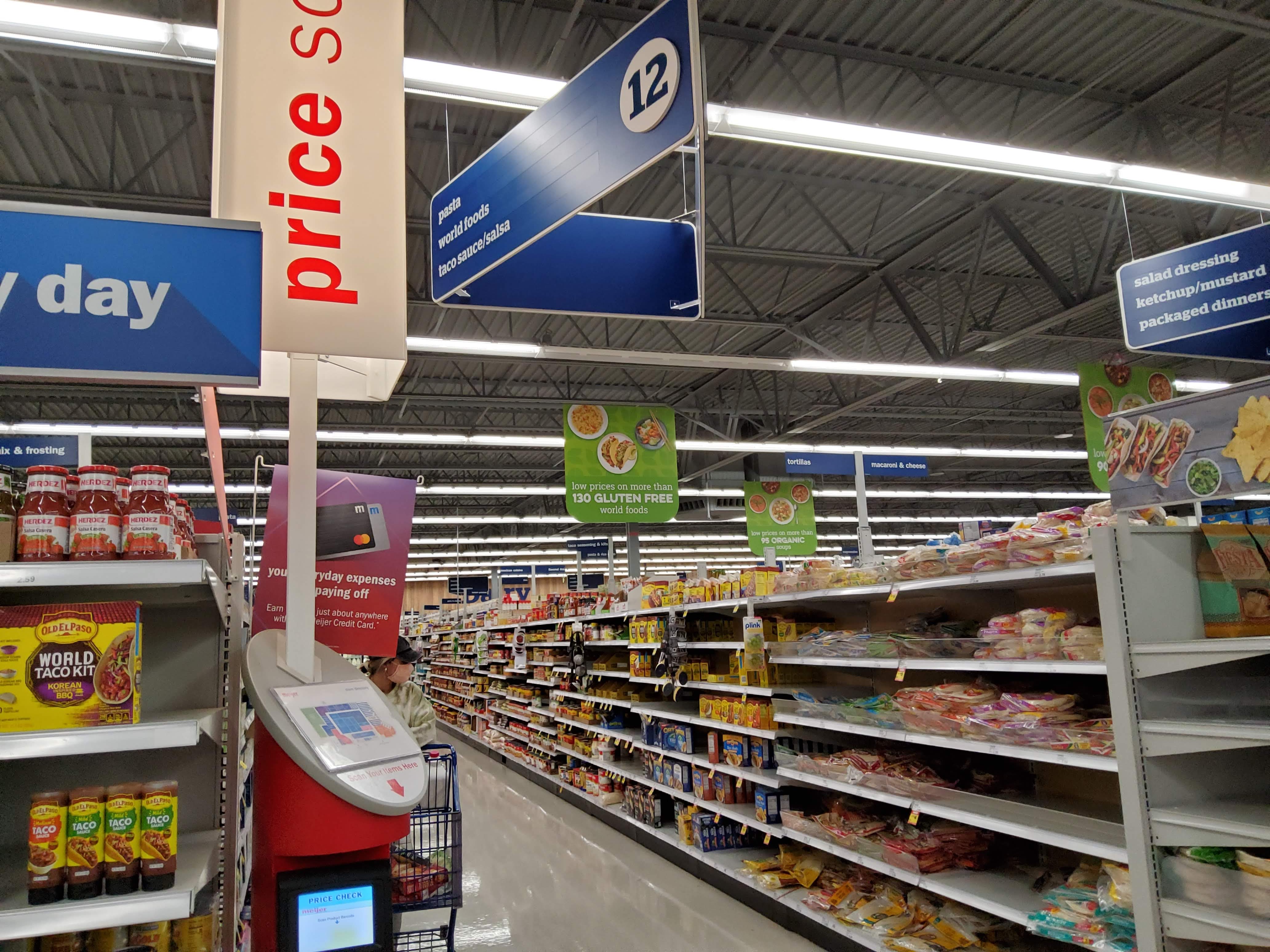
I like a lot of things in this aisle, at least in theory.  

As promised, the pasta section.  Many brands, many types of noodles, decision paralysis central.  Almost invariably this is all ultra-processed.  Whole grain noodles exist, but on account of them having a stronger flavor than the typical ones, there isn\’t as much demand or selection.  
There are some alternatives if you\’re health conscientious or gluten-free, but I have yet to have really good reports on any particular type of wheat noodle substitute.  At any rate, at least there\’s something available.

Tortillas and taco kits, and also my finger at the top there. Oops.  Tortillas and taco shells, like pasta, mainly come in nutrient-deficient varieties and in various sizes.  A couple whole grain options are available, but again, you may not be able to get exactly what you were looking for.

Next, assorted taco seasoning packets and sauces.  You always want to check the latter for their sugar content, because unfortunately that\’s where the sugar sneaks in.  Imported items typically have less sneaky sugar, but it\’s always smart to check.  

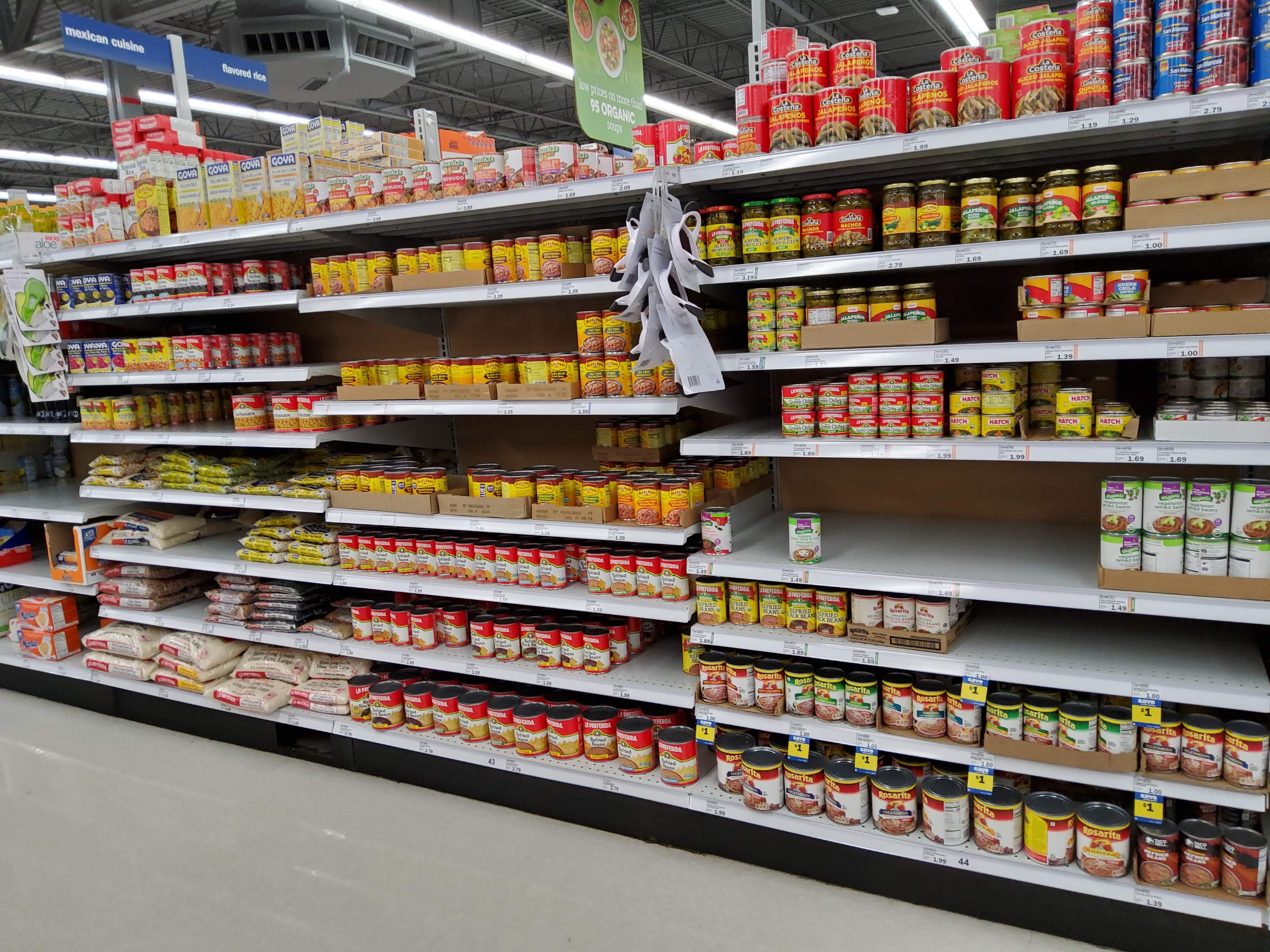
How many kinds of refried beans does a person need?!  But this is also pickled peppers, bags of rice, and cans of whole beans.  Notably, many of these varieties of refried beans have lard (an animal product) mixed into them for extra flavor.  I have to buy the vegetarian type.  

Aww, but we were doing so well…  Hello, sugar bombs!  Coca Cola from Mexico (ie: sweetened with cane sugar, not high fructose corn syrup), and various less US-recognizable sugary drinks.  To my great and abiding disappointment, the peach nectar drink up there has very little to do with actual peach juice.  As I mentioned during the first installment of this grocery store exploration, juice is also sugar bombs.  But, I have a soft spot for peach juice because I drank it every morning when I visited Greece for a couple weeks in school.  Every day there was an adventure, and so I miss the flavor.

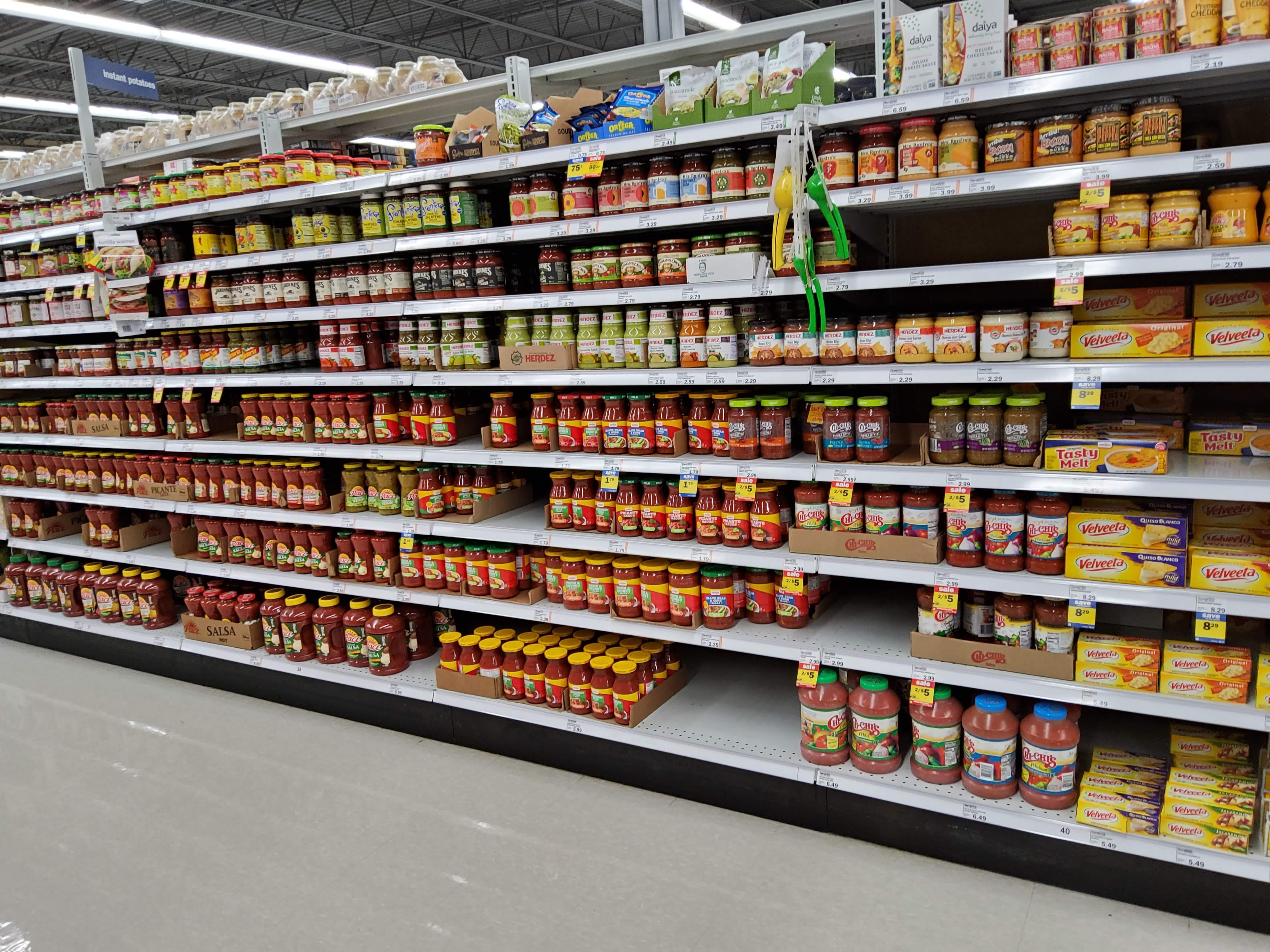
Cheese products (spread, sauce, or perhaps \”ooze\”) plus many kinds of canned salsa and guacamole.  Maybe it\’s because I lack imagination, but I\’m pretty happy with a mild salsa, and if I want something fancier I\’ll make it.  I dunno.  At any rate, many brands, many options.  
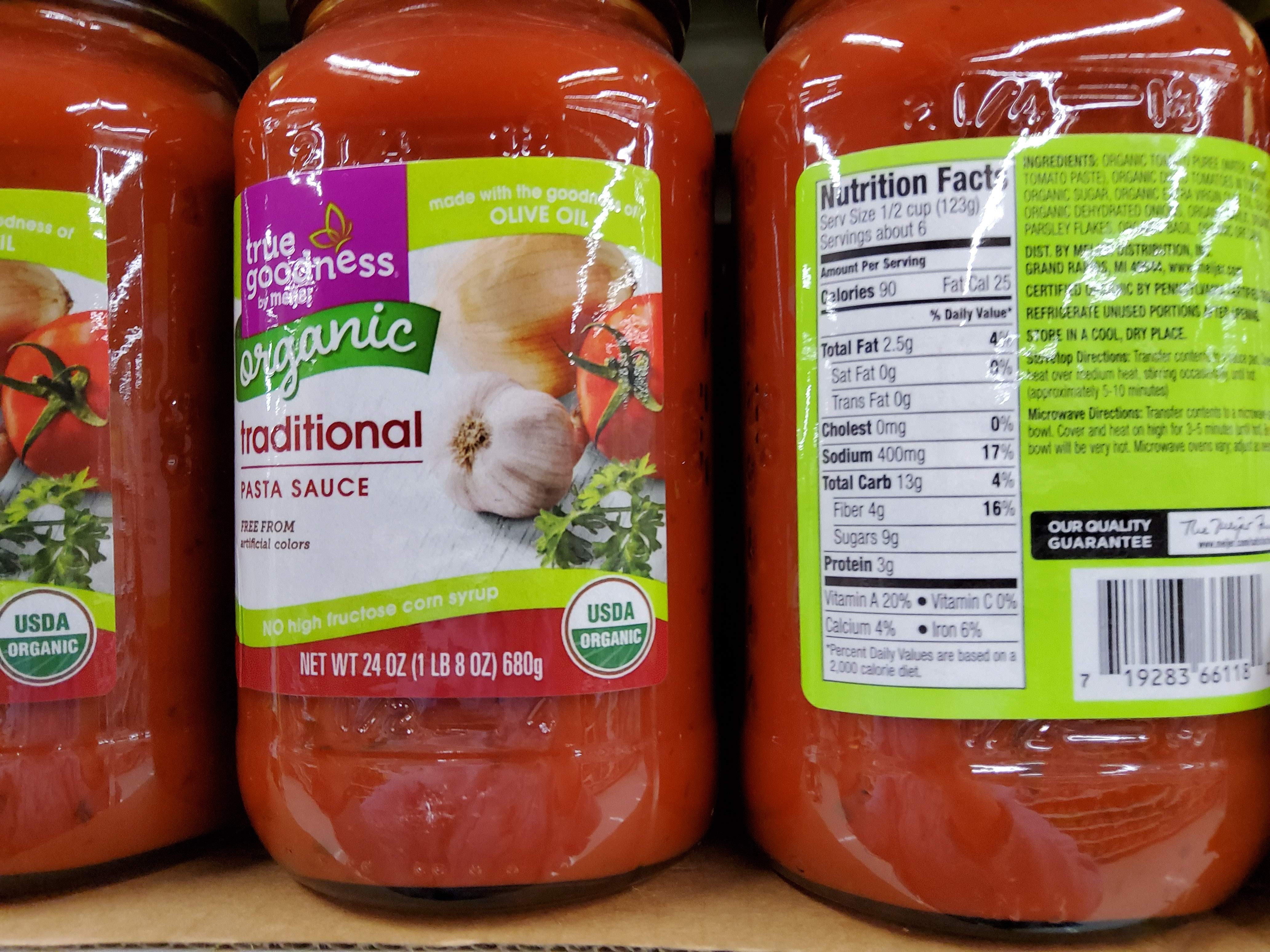
Back to the pasta side of things: it\’s the choice paralysis-inducing selection of red sauce.  Off my picture, I can count 14 brands of sauce, and I\’m pretty sure there\’s at least 6 more down the way.  You\’d think red sauce would pretty much just be savory, right?  

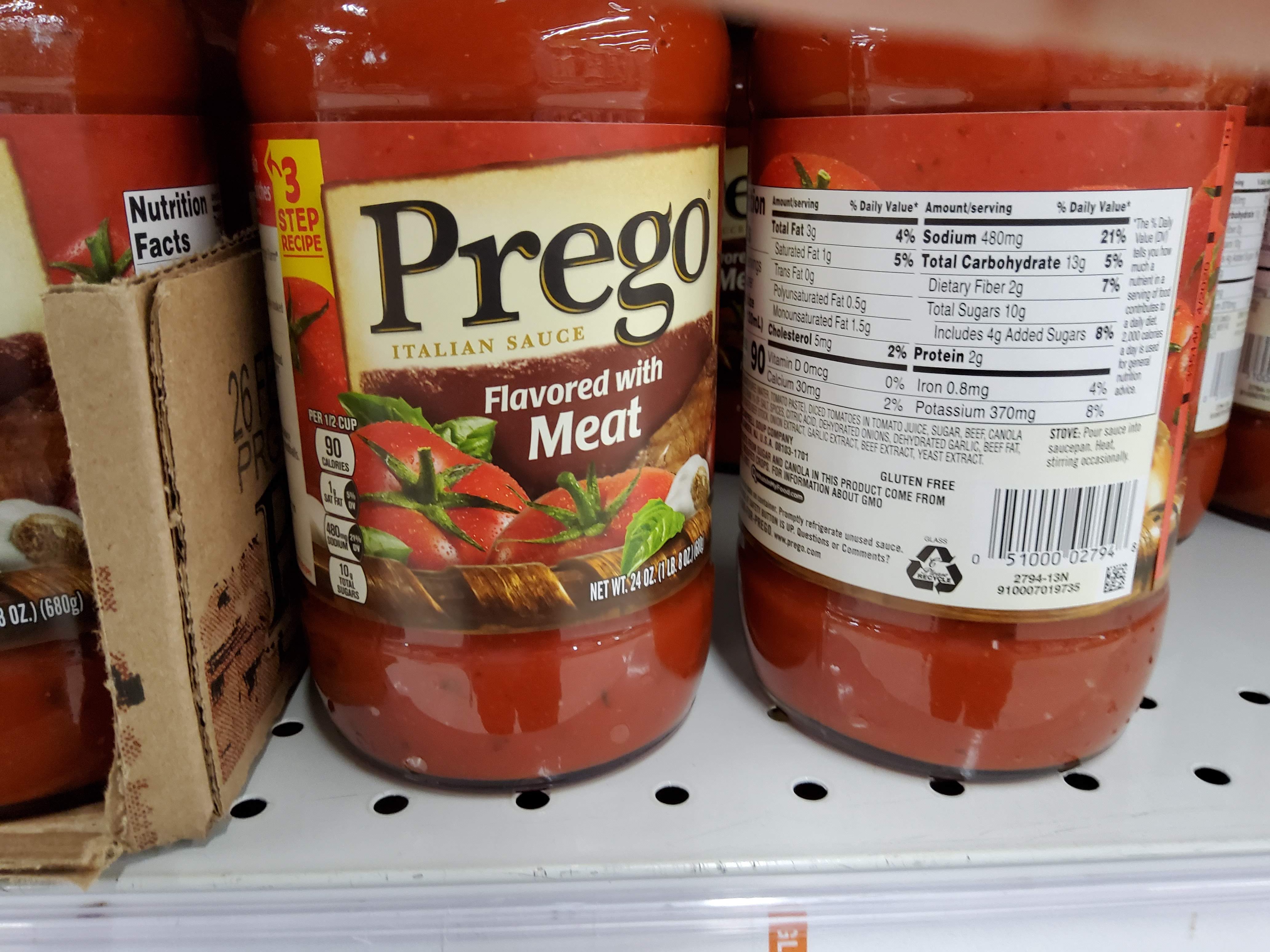
Yeah.  Red sauce is sugar bombs.  Depressing.  
The good news is that there\’s still some you can find in this vast sea of options that are low sugar.  You just have to hunt really hard for them.  I try to get mine with 3 grams of sugar per serving or less.  

Apropos of literally nothing, here\’s the gluten-free section.  Why the pasta aisle?  Why right in the middle?  Is it to make gluten-free people grumpy because they have to walk by so much gluten to get there?  I have no idea.  
The section is mostly snacks, which is even worse… but down at the bottom you can find the Cup For Cup brand baking mixes, which I used to make a pretty okay pie crust from this year for my gluten-free black razz pie.  You\’ll also note some extra pasta options, \”bread crumbs,\” and premade pie crusts and cake mixes.  

Right back to the pasta stuff without batting an eye.  I really don\’t understand the logic in these arrangements, but here\’s the parmesan cheese and extra fixings for your pasta sauce.  Including canned mushrooms.  Ew.  Also on the lower shelves, pizza options.  Pizza sauce, pizza kits, and premade pizza crusts, including a gluten-free cauliflower option.  
What\’s that you say?  There weren\’t enough snacks in this aisle?  Don\’t worry, the powers that be agree with you!

Ahem.  So, this is (I guess) the rest of the world foods section.  We had the sugar bomb drinks earlier, but now we also have various British and pan-European snack options.  It\’s just as well I wasn\’t hungry when I took these pictures, because I\’ve had several of those Stroopwaffels on airplanes and now I kind of want some.  
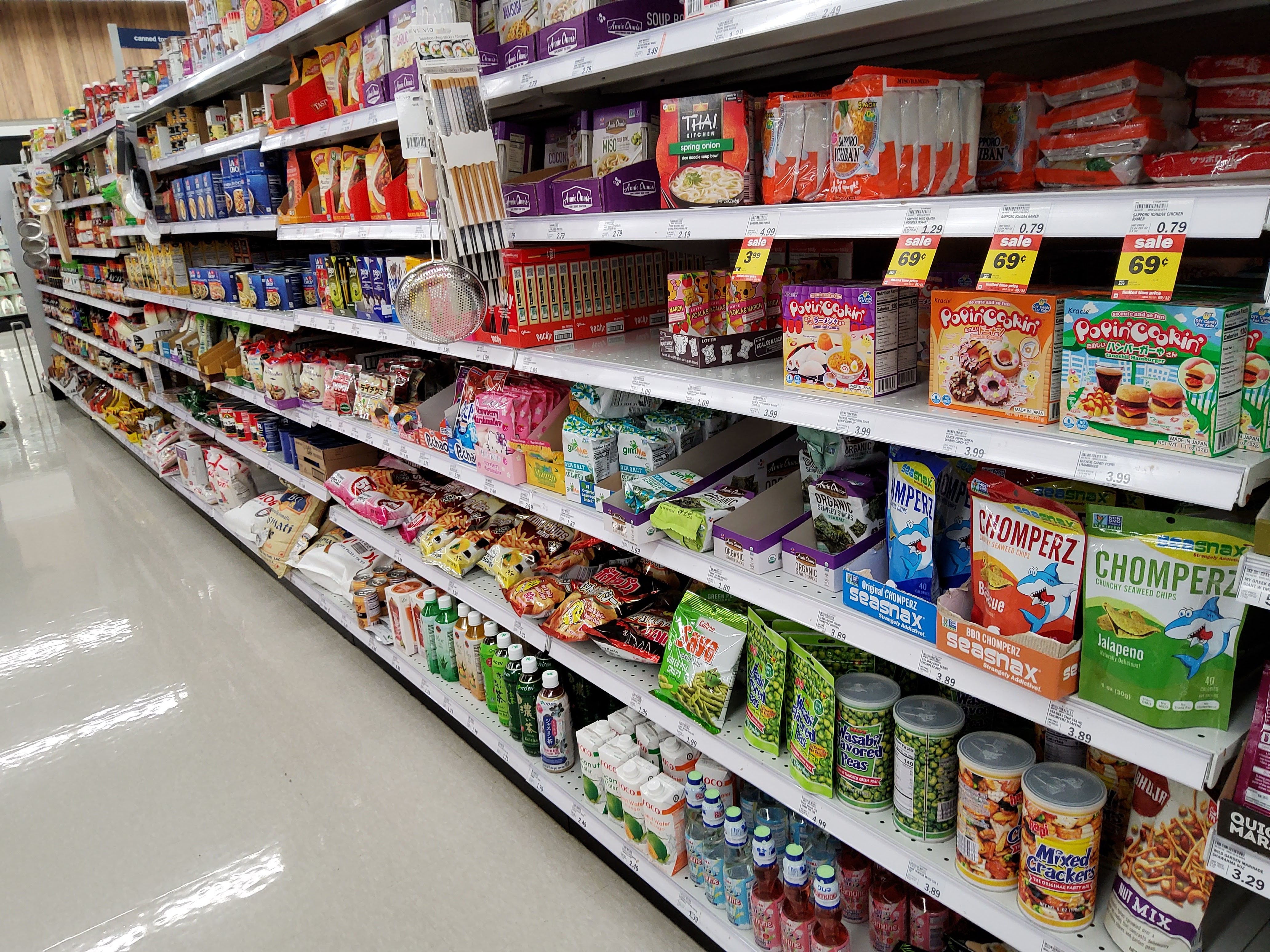
The first picture is more pan-Asian snacks and convenience foods, including sugar bomb drinks at the bottom, wasabi peas, Pocky, and savory snacks.  
It doesn\’t matter.  It\’s all ultraprocessed and nutrient-free.  

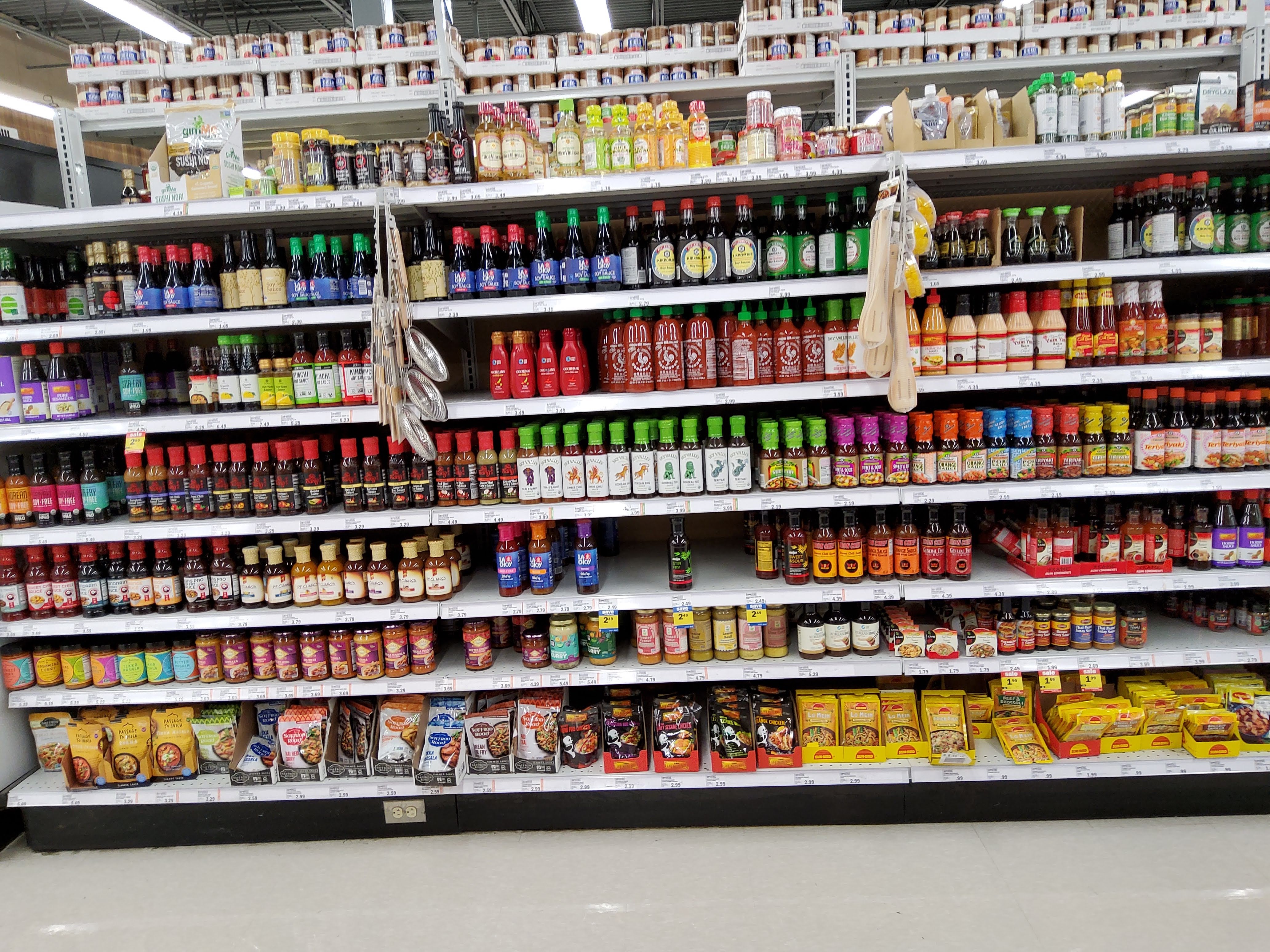
Bleeding into the pan-Asian snacks is the Asian sauces section.  No particular care is given to what part of Asia was involved with which sauce, as teriyaki sauce (Japanese) is just a single shelf down from kimchi (Korean) sauce, and just a few more shelves down is Indian curry of various types.  Slightly more care is given to these things in Asian food stores in the US, but not much.  On behalf of my entire country, I apologize for our incredible ignorance of the differences between Asian countries.  

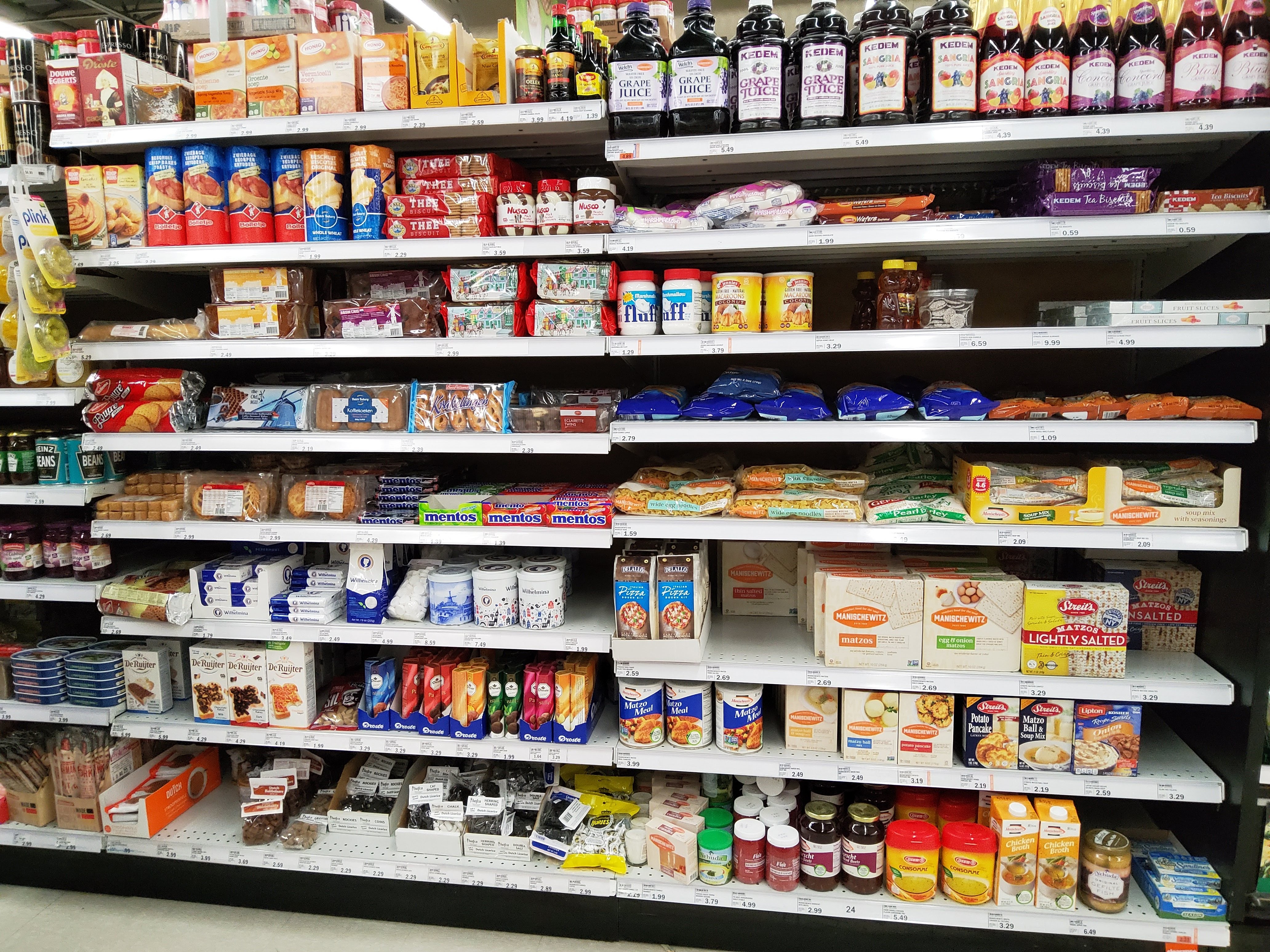
And because we definitely didn\’t have enough snacks on our trip through this aisle, here\’s some imported candy, sweets, and just enough pantry essentials to let the store pretend it\’s offering things besides snacks.
Based on the matzos and latke (potato pancake) mix, I guess this section is meant to serve Jewish cooking needs as well, though I\’ll have to keep an eye out for anything in the meat section calling itself kosher.  Nothing comes to mind, to be perfectly honest.  

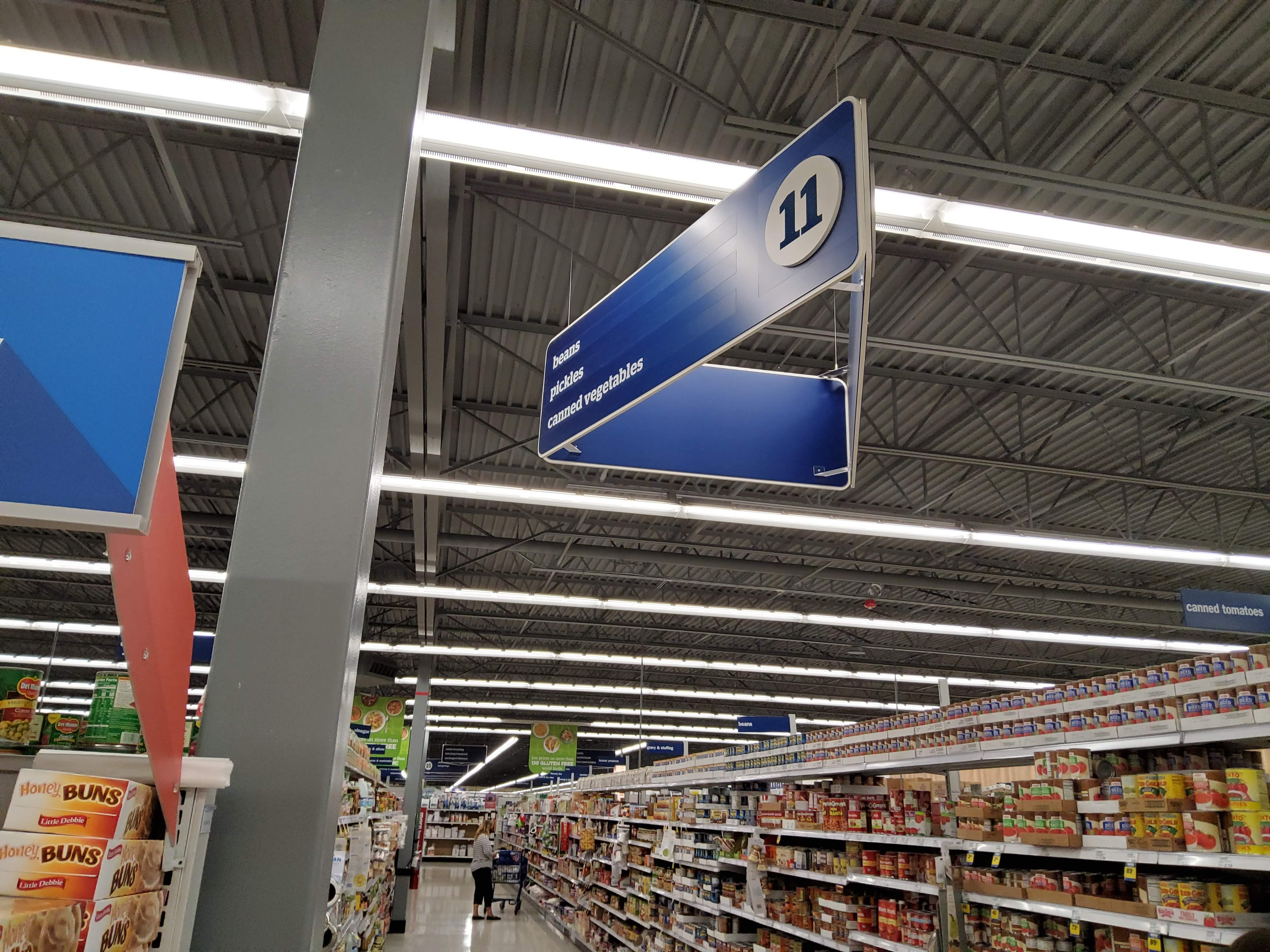
Next aisle: canned and bottled stuff!  Beans, pickles, canned veggies.  Also salad dressing, ketchup, mustard, BBQ sauce, etc.  
Canned tomatoes of many varieties, with and without flavorings.  Diced tomatoes, slices, stewed chunks, and sauce.  You can find versions with Italian herbs mixed in, or Tex-Mex versions with seasonings and even jalapeno pepper chunks.  Tomatoes are either a high histamine food or a histamine-releaser food… and either way, I mostly avoid them.  You\’re going to hear me talk about histamines a lot in this aisle.

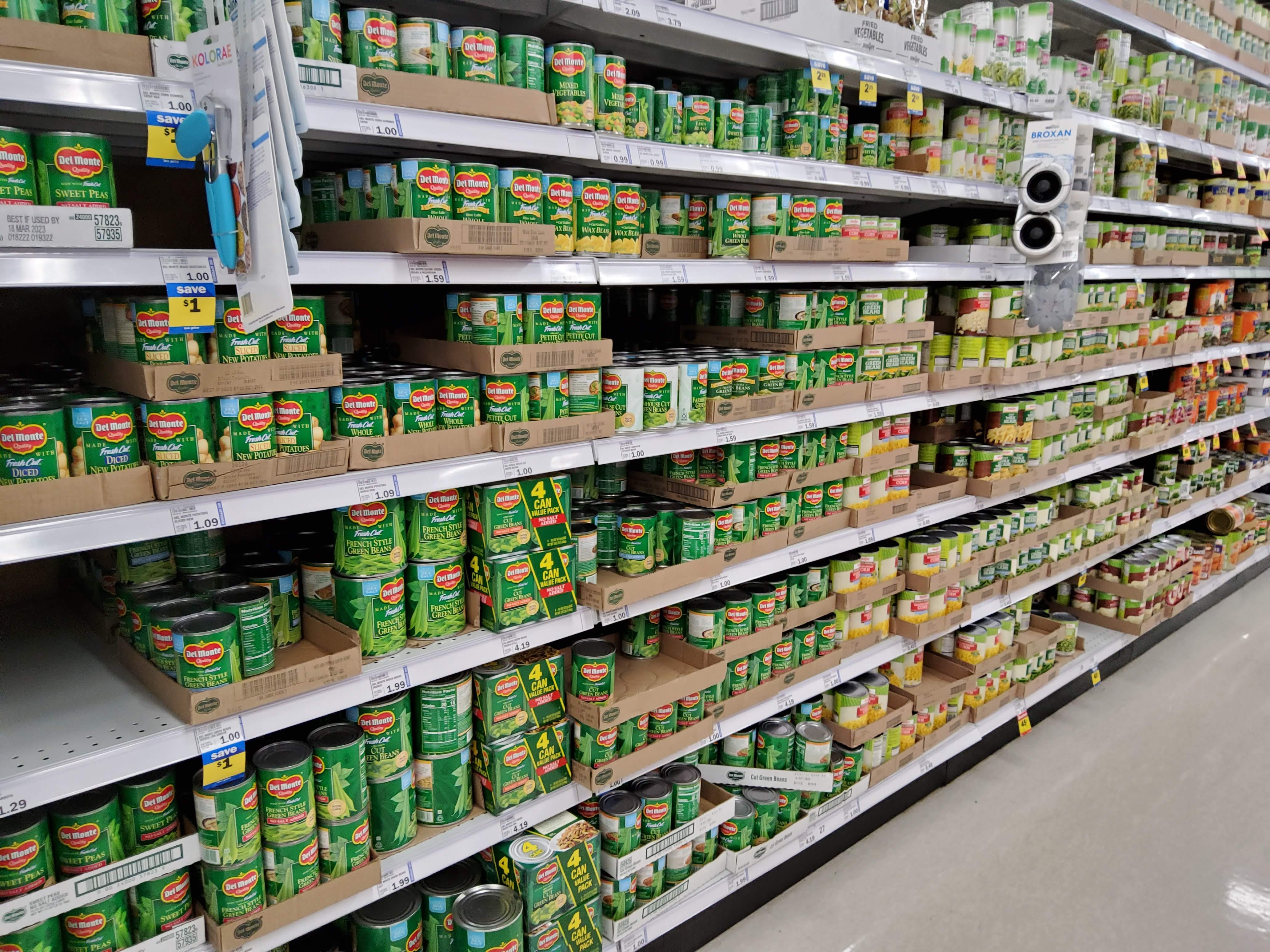
Canned vegetables.  The number of options here is a little dizzying.  Industrial canning unfortunately tends to destroy some of the nutritional content of vegetables, so my mother tended to use fresh or frozen versions rather than these.  But I\’ve had canned green beans in hot lunch at school.  Ick.  Canned vegetables are also higher in histamines, which means I\’m better off avoiding them.  I think the only exception to my blanket \”nope\” for this aisle is canned corn, which I\’ll use if fresh isn\’t available.  
Corn isn\’t a vegetable, by the way.  It\’s a grain.

Beans.  Protein source for vegetarians everywhere.  I only recall eating kidney and refried beans growing up, but that\’s most likely because I didn\’t pay attention.  There are a staggering variety of beans.  This last year or so I\’ve learned to appreciate cannellini beans, but there\’s still great northern beans and pinto beans and a lot more.  Baked beans are typically sugar bombs, by the way.

Vinegar.  This is a very high histamine food, and so is pretty much anything made with it.  It also wrecks my spouse\’s guts, so despite all the interesting flavors on the left, we just keep walking.  My mother says you can substitute lemon juice for vinegar in many recipes, and it\’s much kinder to the gut.  I\’ve yet to try this trick, but it seems potentially valuable.  

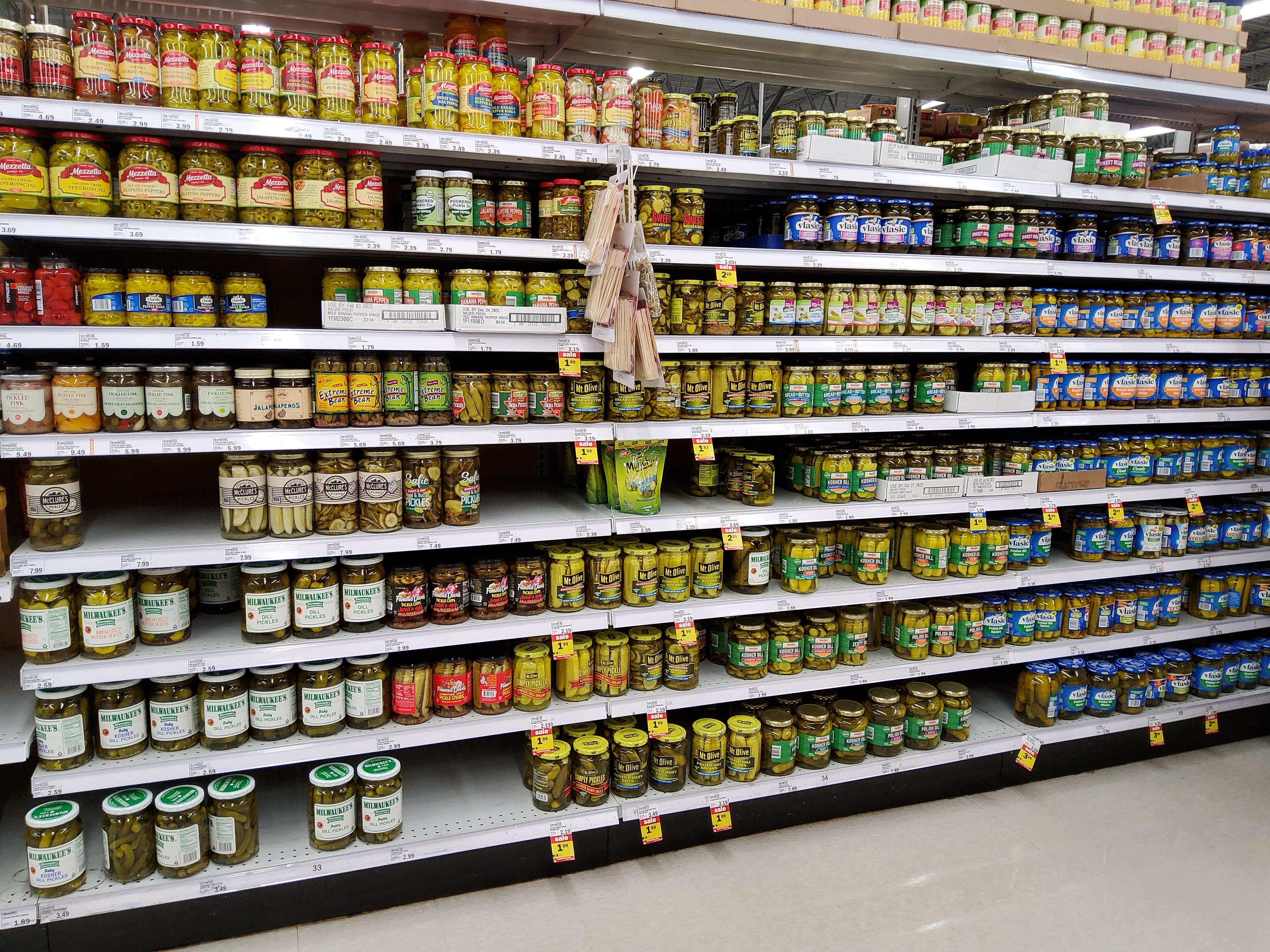
Pickles.  Again, a high histamine food.  Histamines make me feel like I\’m dying, a bit.  And the foods high in them taste bad to me, so I typically avoided them anyway.  It\’s a shame because fermented foods can be really good for your gut.  They can help restore a balance of bacteria, or even introduce new beneficial bacteria.  

Gravy type sauces.  I actually have no idea how difficult it is to make gravy from scratch because I typically only see gravy packets and such, like these.  I also don\’t eat gravy much because it\’s almost invariably full of inhumanely handled animal products.  It\’s definitely tasty when I do get to have it, though. 
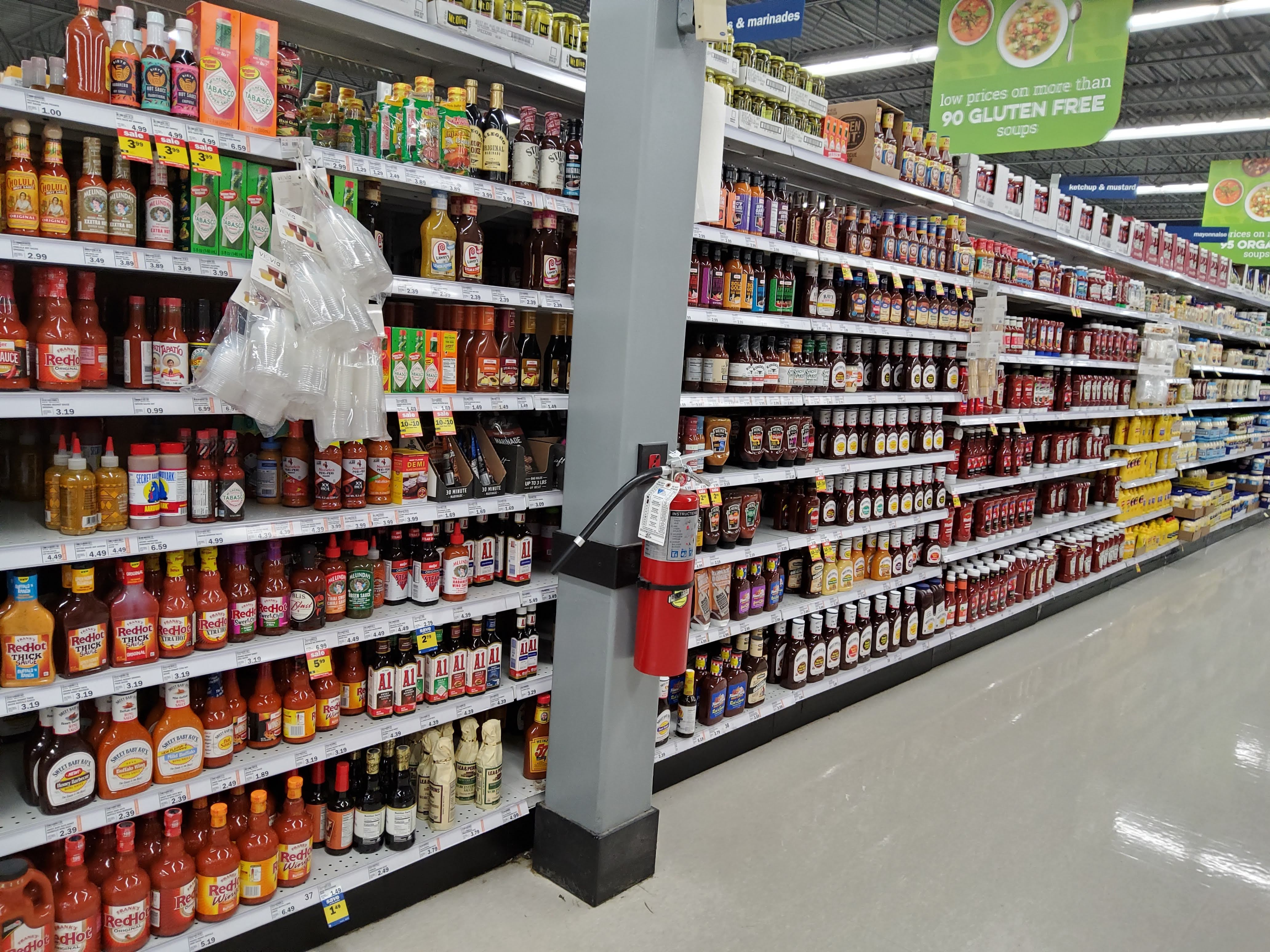
Hot sauce, steak sauce, barbecue/barbeque sauce, ketchup, and mustard.  Watch the sugar content on the BBQ sauce and the ketchup.  Even a couple grams in a tablespoon serving adds up very fast in meals.  

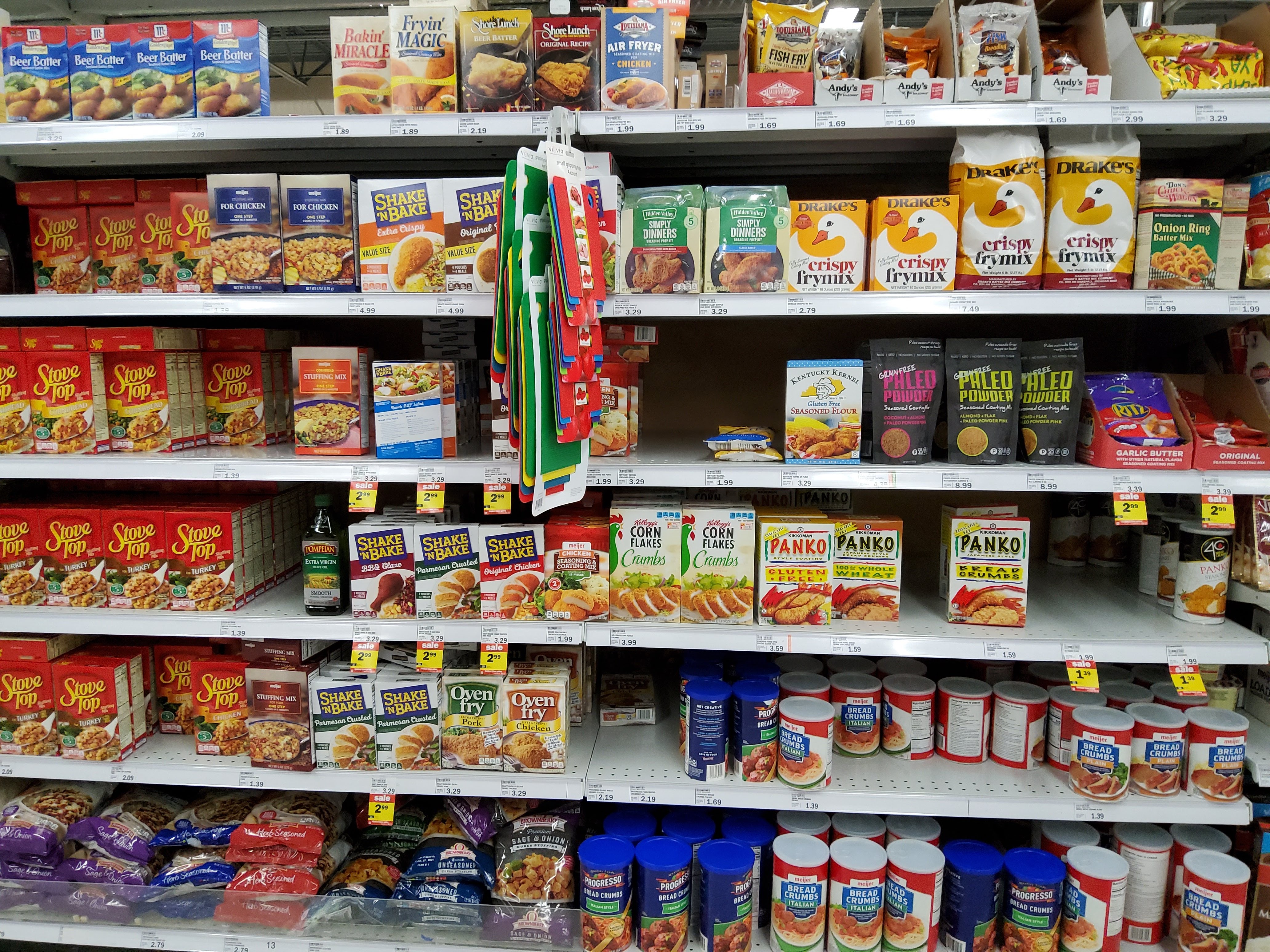
Bread crumbs.  Yeah, there\’s a whole section just for bread crumbs.  Including gluten-free ones.  What can I say? USians love our breaded and fried foods.  

Rice!  Everything from the typical nutritionless, fiberless white rice to brown rice and wild rice, or mixed varieties.  It\’s mostly white rice, because that\’s the staple and people aren\’t used to rice with actual flavor.  
Did you know there\’s hundreds of types of rice?  I can name Jasmine and Basmati rice but there\’s also Jata, Kebo, Gharib, Ariete, Hieri, Murni, Khushbu, and a ton more.  There\’s types used to make rice wine, glutinous and non-glutinous types, red and black rice, aromatic rice…  Rice also comes in long grain, short grain, and medium grain varieties.  While all the varieties I named above are from other countries, even the US has dabbled in creating rice varieties.  
You can only find a few kinds of rice here, but it\’s enough to serve most USians.  On the far side of this section and at the top: convenience rice meal starters.  Basically, rice package with seasonings and/or sauce powder.  Toss in a protein and a heaping helping of vegetables and you basically have a meal.  
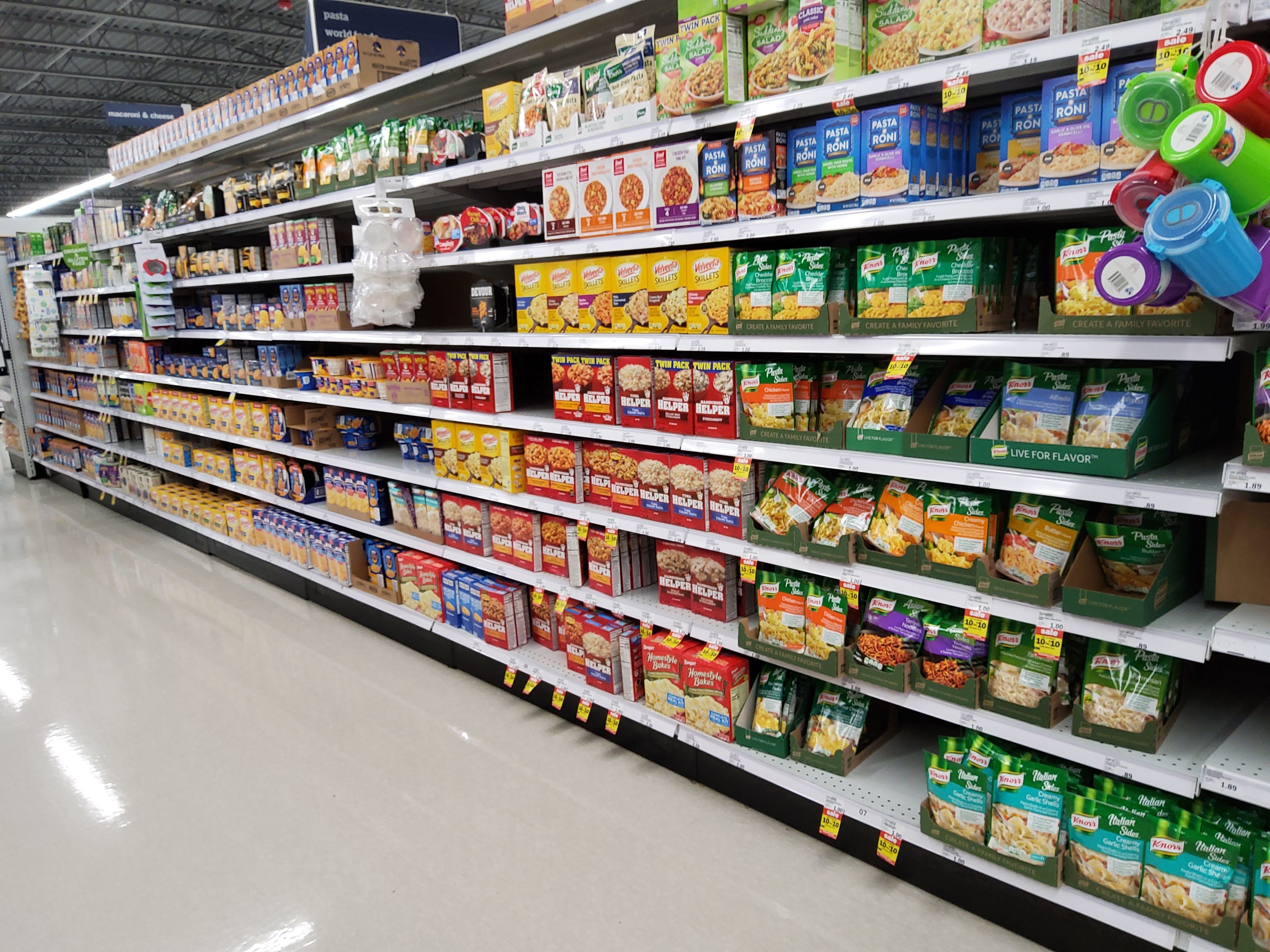
The convenience rice section bleeds right into the convenience pasta section, which is the same sauce powder/spices deal, but with noodles instead.  Obviously, your options for gluten-free are limited… although they\’re not nonexistent.  The other thing to watch out for here is cheese.  We love dairy in the US, and cheese features prominently in this section.  If it\’s not parmesan or cheddar, it\’s some kind of cheese ooze (Velveeta) or similar ideas.  
I actually don\’t hate Velveeta, as it\’s much lower dairy content than most of what\’s in this aisle.  It\’s relatively safe for me and my spouse (who is lactose-intolerant) to consume, so we keep some onhand.  
The problem, of course, is that like white rice, regular noodles convert very quickly in the gut to sugar, so eating noodles is nearly as bad for you as eating sugar straight.  Which is why these meal starters, while comforting to have around, are very firmly in the \”sometimes treat\” territory.  

Honorable mention to the several feet wide section for the health-conscientious-but-still-likes-Mac\’n\’cheese crowd.  The stuff here ranges from organic (eh) to goat cheese or pseudocheese (for dairy-sensitive people) to gluten-free noodles.  

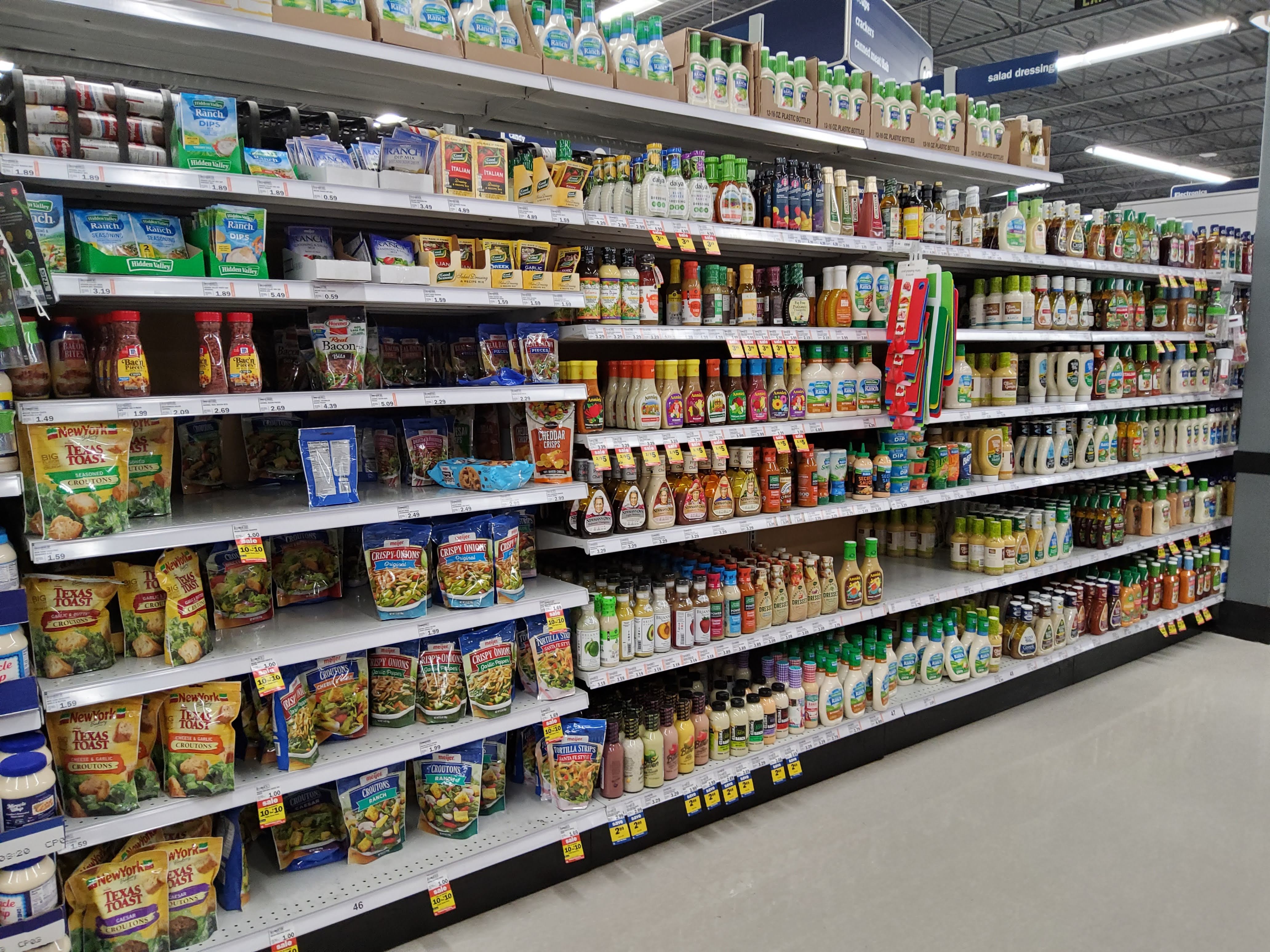
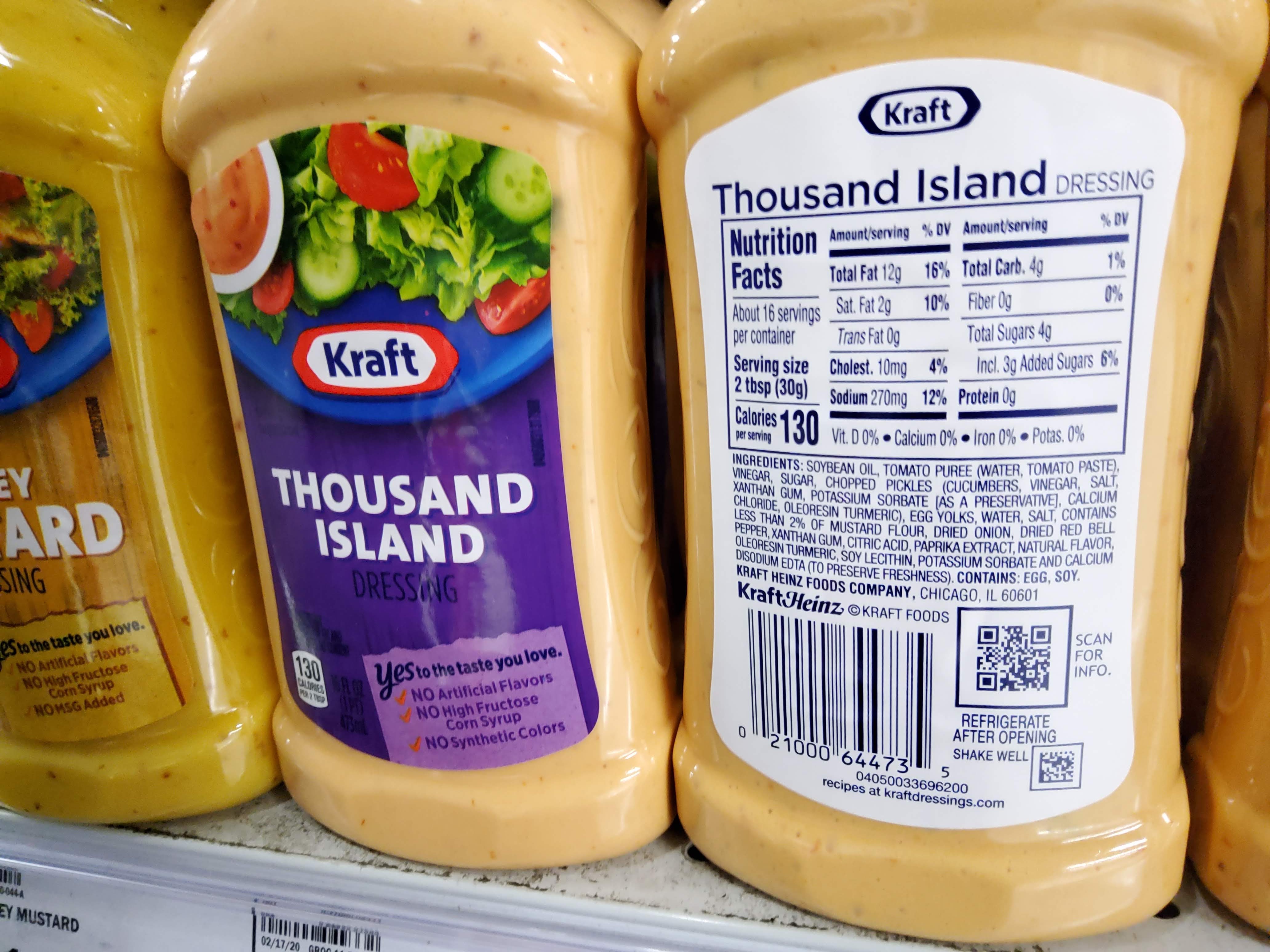
Suddenly, salad stuff!  Croutons and salad dressing.  Mostly the latter.  Croutons, bacon bits, onion bits, and etc. are fine, but I never bother with them.  Salad dressing, on the other hand…  is a trap.  People eat salads because they want to be healthy, right?  Yeah, now look at the calorie counts on these.  

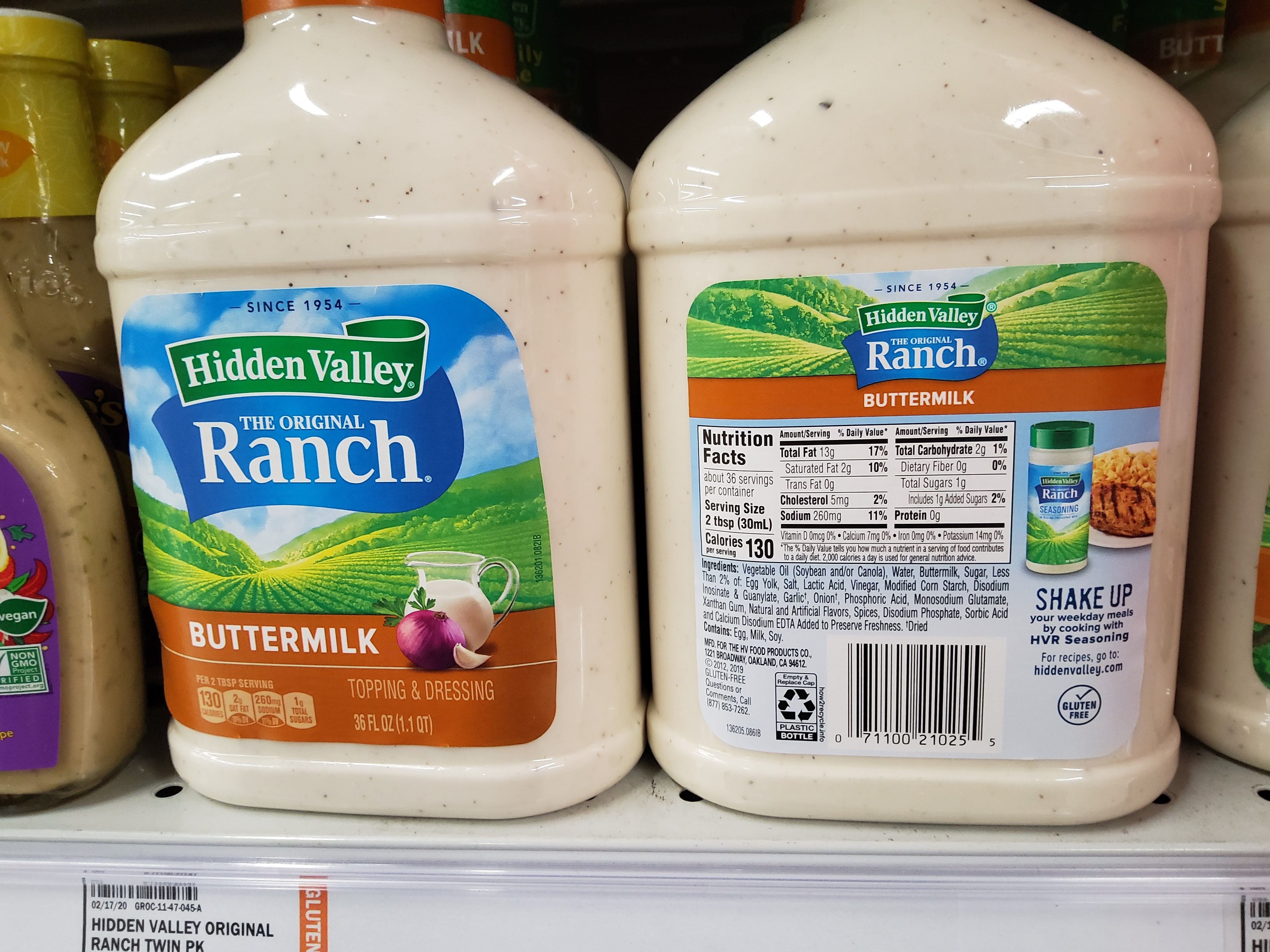
Two tablespoons of this, and you might as well have just had bacon crumbled over your salad.  Also, dairy!  This ranch isn\’t sugar bombs, but let\’s look a little further…
Yep, there it is.  90 calories for 2 tablespoons, but 8 grams of sugar.  Yikes.  Literally the first ingredient is sugar.  

Happy medium?  130 calories and 4 grams of sugar for 2 tablespoons.  Also this dressing seems to be full of vinegar and pickles, which is a bad plan for me and my histamine issues.  
So, if salad dressings are a trap, what do you do instead if you don\’t like the flavor of greens?  
I typically opt for olive oil, salt, and pepper, honestly.  Olive oil is noted to be good for you, and the salt and pepper adds enough that I don\’t get offput by the bitterness of the arugula or whatever else.  
That\’s aisles 12 and 11!  Next time, soups, crackers, nuts, granola, and we inch ever closer to the actual snacks aisles.  Because, y\’know, there weren\’t enough snacks in the rest of the store.  
Reading the Research: Job Skills Focus in Interviews

Welcome back to Reading the Research, where I trawl the Internet to find noteworthy research on autism and related subjects, then discuss it in brief with bits from my own life, research, and observations.

Today\’s article has some solid advice for autistic job-seekers.  It\’s advice I\’ve seen mirrored from self-advocates like Temple Grandin and John Elder Robison, though not in this exact way.  And certainly not with this much statistical rigor to back them up.  

While the study only covered specifically visible disabilities (wheelchair versus no wheelchair), I wouldn\’t be surprised in the slightest if the results generalized to all visible disabilities and many invisible ones as well.  Autism can be an invisible disability but all too often isn\’t.  

Dr. Grandin and Mr. Robison\’s advice has been essentially: bring a portfolio and let it start the conversation for you.  This study suggests that discussing that portfolio or your specific job-related skills (\”hard\” skills) increases your likelihood of being hired.  

It frustrates, but doesn\’t surprise me, that candidates with disabilities were viewed as less trustworthy and less employable than their abled counterparts.  People with disabilities always seem to have to prove we\’re just as good or better than everyone else, and it\’s frustrating and gets old fast.  Between the rest of the song and dance required for surviving the traditional interview process, it\’s enough to put many autistic people off applying for jobs entirely.

At any rate, this study offers some useful tips for what tactics to try and which to avoid when applying for a job.  

(Pst! If you like seeing the latest autism-relevant research, visit my Twitter, which has links and brief comments on studies that were interesting, but didn\’t get a whole Reading the Research article about them.)

Book Review: Drawing Autism

Drawing Autism, curated by Jill Mullin, is, at the most literal level, a collection of art and descriptions by autistic artists (some descriptions by their caretakers).  It could also be considered a deep dive into the unconscious minds of various autistic artists.  The contributors are mainly from the US, Canada, and India, but there are a few additional contributors from places like Singapore and Lithuania.  

Art isn\’t really my thing, so I picked this up more out of curiosity than the genuine desire to immerse myself in art.  Part of the reason I\’m not really an art person is because I don\’t process visual detail terribly well, so to see what everyone else sees in seconds, I have to take minutes.  Then there\’s the mystique that apparently separates art from whatever poorly crafted crap I doodled in my notebook in school… and in a lot of cases, when I go to art museums, I look at the modern stuff and go, \”but why is this art, and why this person over, say, me, or my friend who draws stuff that looks way better?\”

Presumably I\’m doomed to be an art heathen.  At any rate, I gave this book a fair shake.

The types of art in the book range from Temple Grandin\’s technical drawings to child\’s marker scrabbling I might technically have been able to reproduce, to near photorealistic landscapes, to collages.  The emotions covered are everything from joy to deepest frustration and rage turned into petty cruelty.  

After I read this book, I decided I was going to have to go through it and pick one piece of art that I connected with emotionally, because this was going to be a painfully short review otherwise.  So, on page 44, there\’s this piece, made with colored pencils and pastels.

The artist says he drew this after his niece and nephew died in a fire.  He was so sad and desperate that he didn\’t have words to express his emotions, so he drew this werewolf.  

This caught my attention because I have quite literally done a very similar drawing, for a similar depth of unexpressable emotion.  I spent about three weeks in college, between doing my summer job, trying to learn how to draw semi-people because the piece wouldn\’t stop tormenting me until I drew it.  

It actually took me about a half hour to dig up the scan of the piece, find something that could view the Photoshop file, and then screenshot it so you can look at it.  

This is titled \”HEAR ME!\” and as you can see, I have no formal (and precious little informal) art training, never mind any sense of how wing anatomy works.  The being there is a half-dragon paladin, and she\’s a character I created in Dungeons and Dragons.  (Why yes, she was a self-insert and that is why her body shape is roughly the same as mine, why do you ask?)  Rather than mourning the crushing loss of family like the werewolf above, she is expressing my despair at the state of the world and the apparent silence of God.  

Funny how that feeling seem to be perennially relevant.  If I were a better artist, I could have put more strain into her form, as she reaches upwards futilely, trying to experience the divine and failing.  But simply getting the anatomy as close to human as it is, was a strain on my artistic talents, so…  It is what it is.  I did try to clean it up, but the fact that I drew it on lined paper kind of means there\’s only so much to be done there.  

At any rate, the werewolf howling in despair at the moon struck me as markedly similar, and so that\’s the piece I chose.  

There are very many more pieces in this book, many cheerful ones as well as other less cheerful ones.  There are bright colors and subdued ones, many and varied art styles and subjects, and different levels of realism and seriousness.  If you like art and find meaning in such things, this book has something to offer you.  

Read This Book If

You like art and want to experience the autism spectrum by way of art.  There\’s 40 plus artists represented in this book, and a dizzying variety of styles, emotions, mediums, colors, subjects, and ideas.  I\’m not a big art person myself, but I strongly suspect there\’s something for everyone in this book, if you\’re willing to take the time to find it.  

Legwork and Life: Zucchini

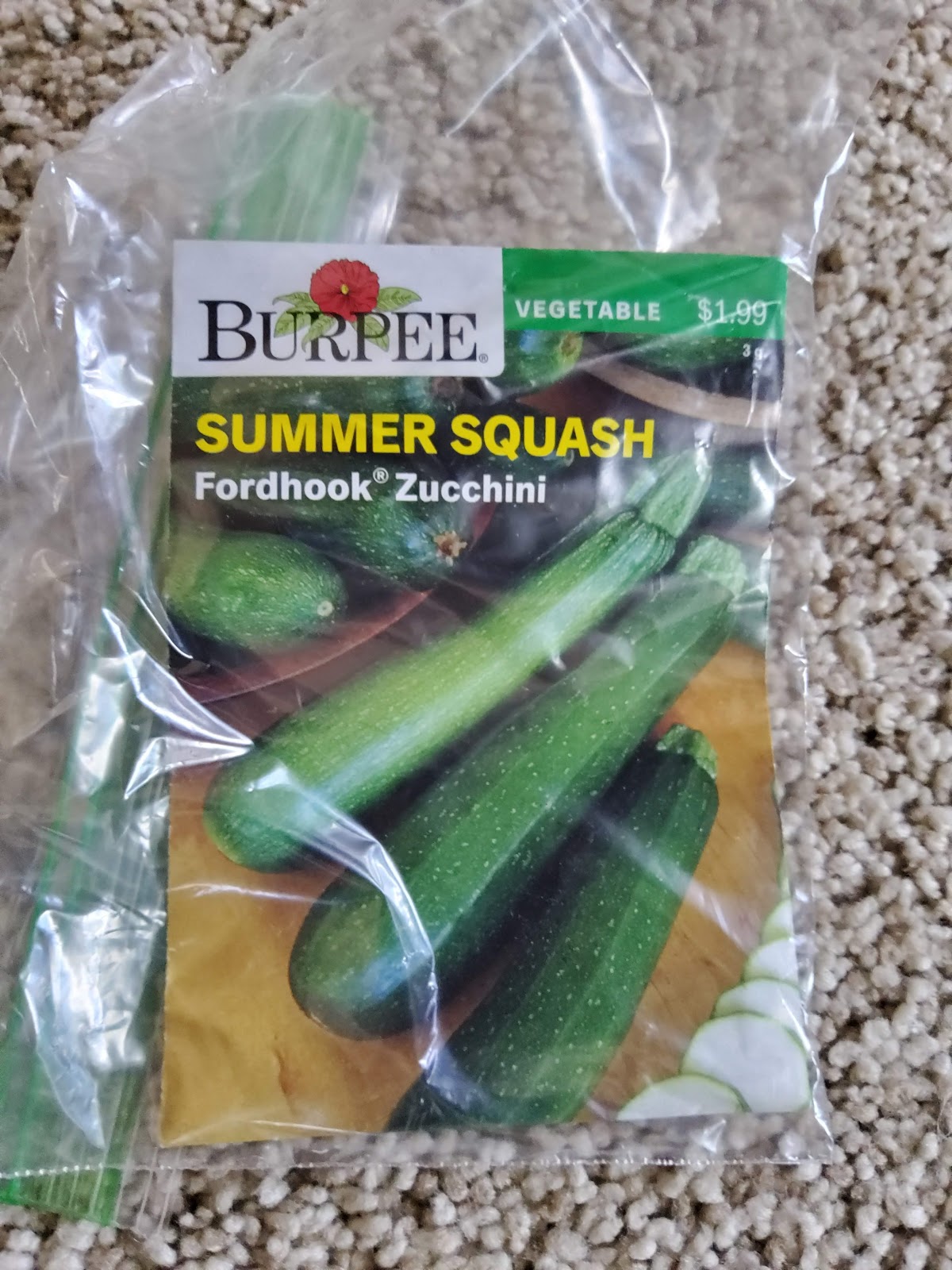
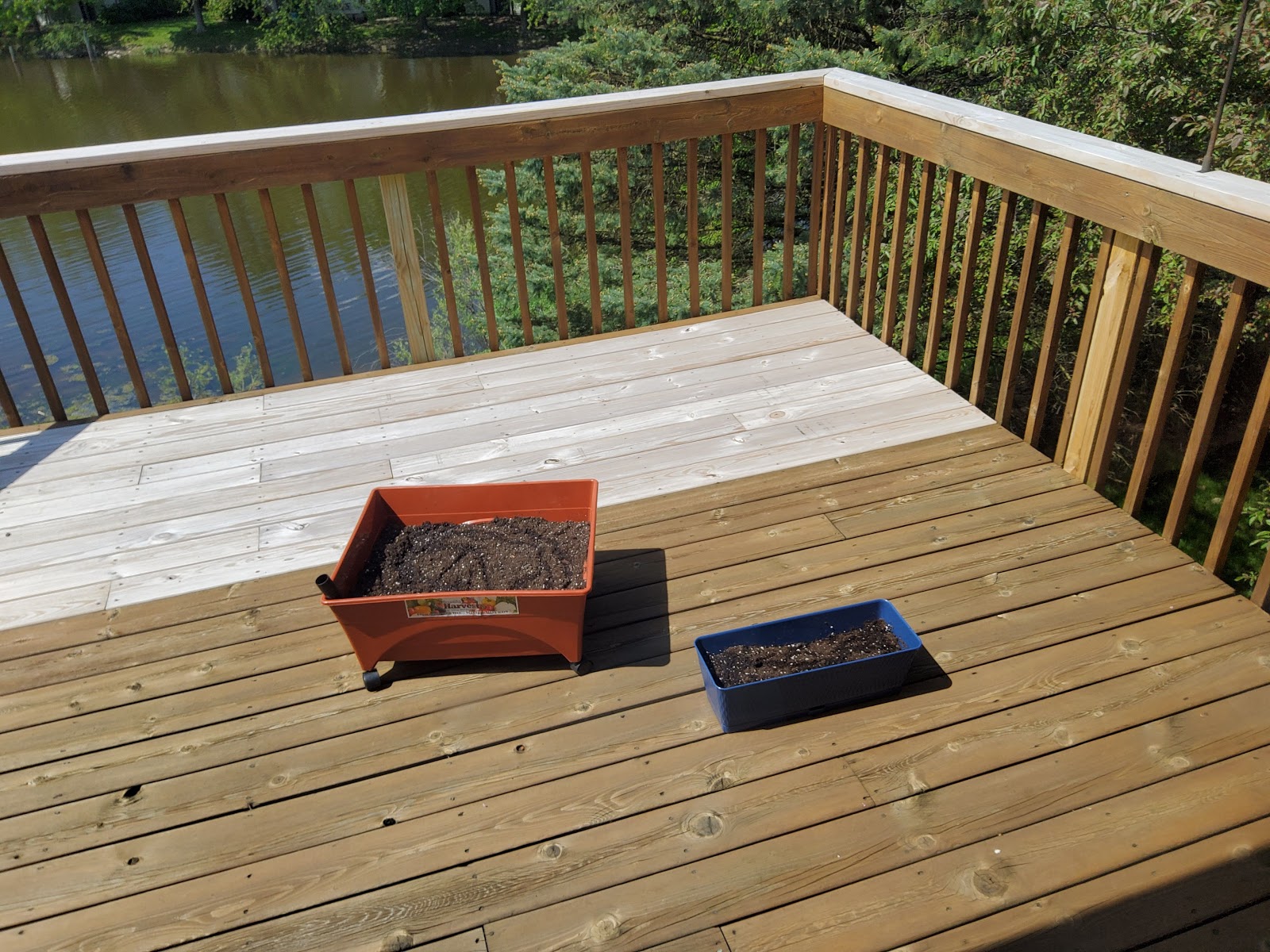
I tried my hand at gardening this year a bit.  It was something to do that made me feel a little more in control of my life, plus growing food is kind of cool.  I started with an idea, some containers, and some seeds…

In all honesty, I planted late.  I could have easily planted a full month earlier, I just wasn\’t sold on the idea.  I try to think through ideas that have price tags over $20 or so, and this was significantly higher.  Still, it was kind of rewarding to see the zucchini sprout and grow…

And grow…

And just keep growing.

Then they flowered, and the harvest began.

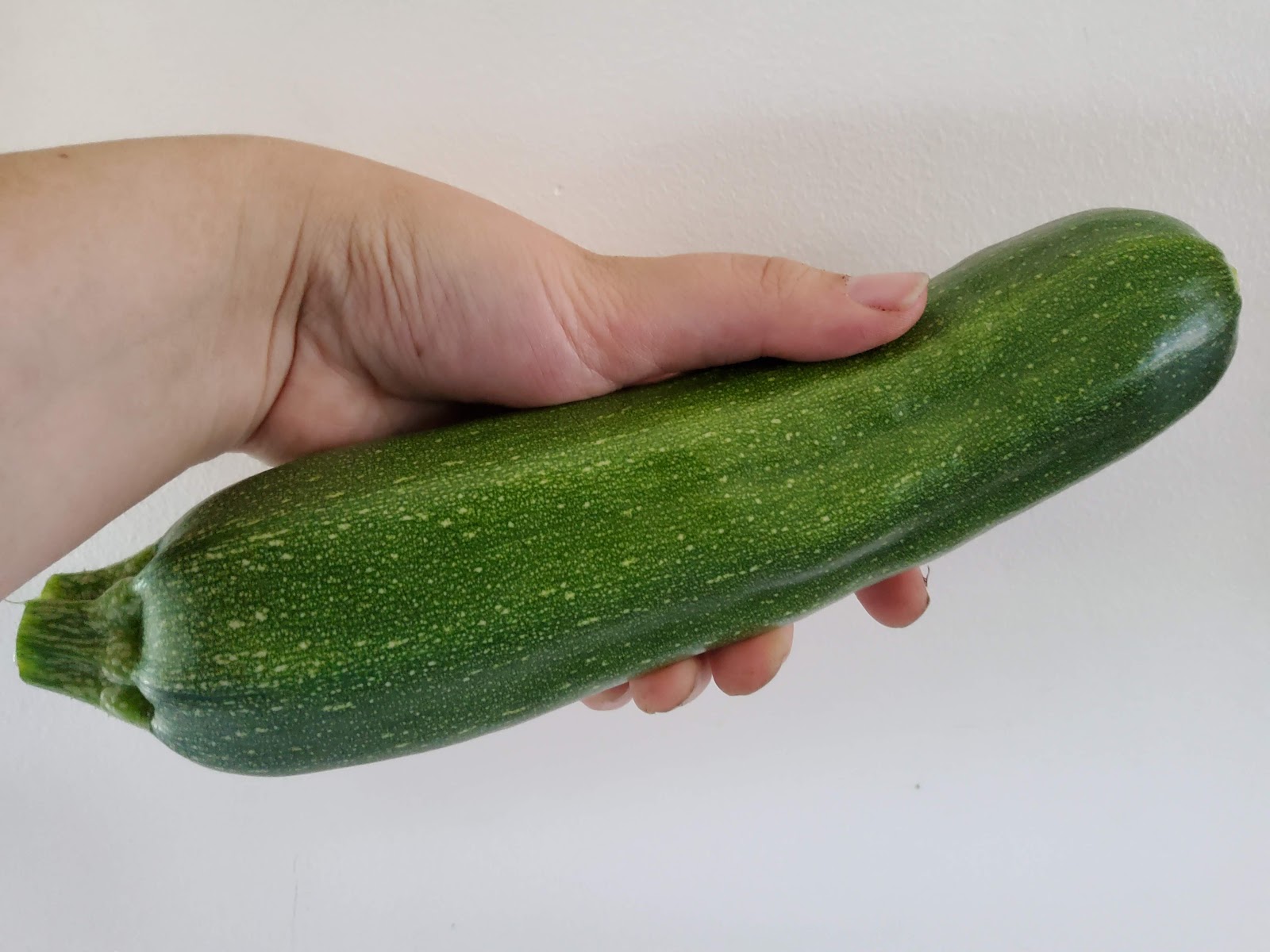
This was the first zucchini I harvested.  As you can see, it is not small.  I was pretty pleased.  We chopped it into pasta dishes.

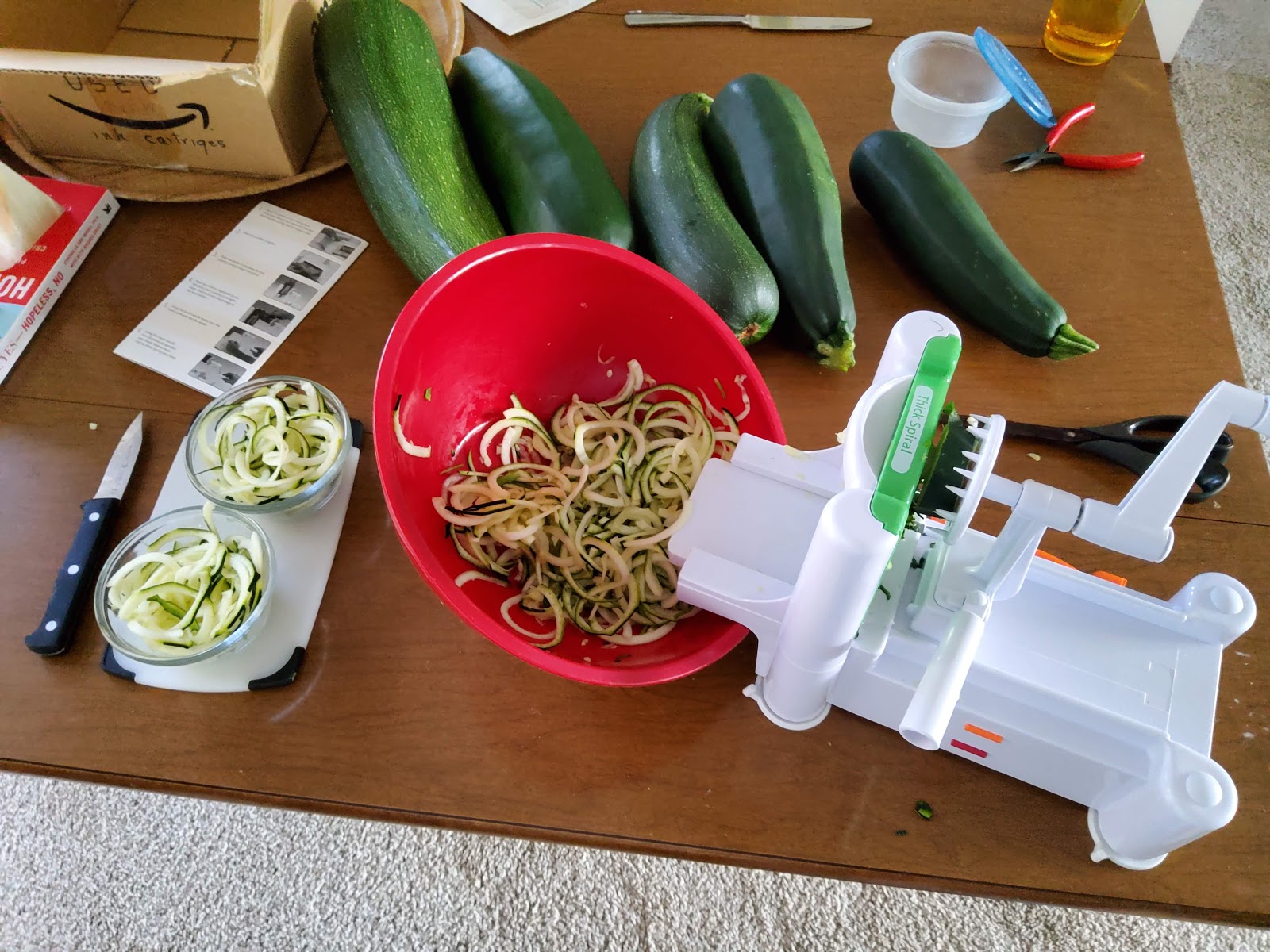
But of course you never get just one zucchini, so…  They began to pile up, even though I made gifts of some.  Notably, due to the coronavirus, the zucchinis sold in the store are a quarter to half the size of the ones here.  Zucchini can grow to be the size of baseball bats (just ask my mother-in-law, who grows an army of zucchini every year), but the insides get very squishy and seedy so you’re better off harvesting them sooner.

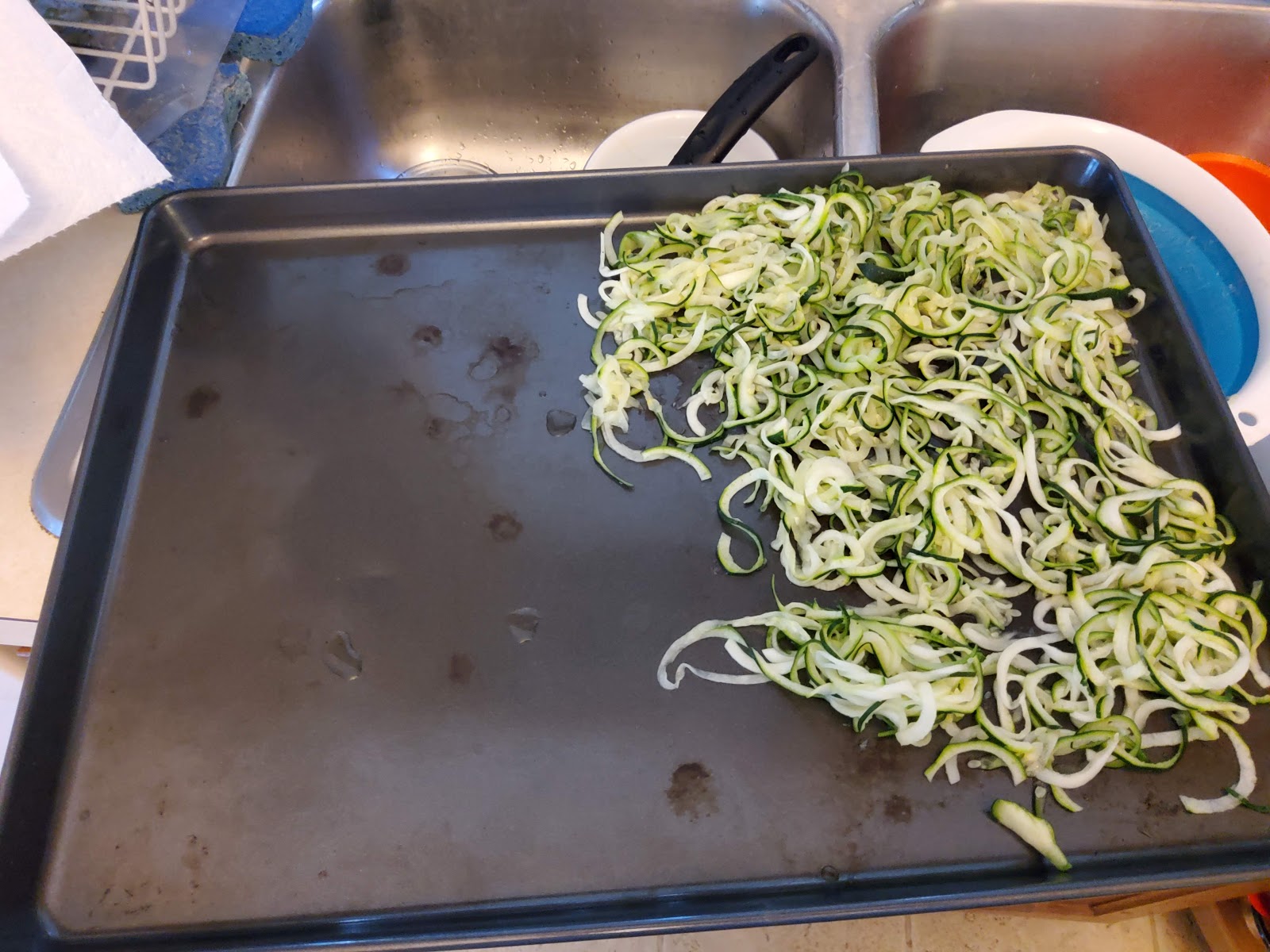
I bought a starter spiralizer to use on fresh zucchini, and to make tossing zucchini in pasta even easier.  You can use spiralizers on most vegetables, but I wanted to specifically try to freeze zucchini spirals.

There’s now a quart bag in the freezer for use whenever, plus more in the fridge.

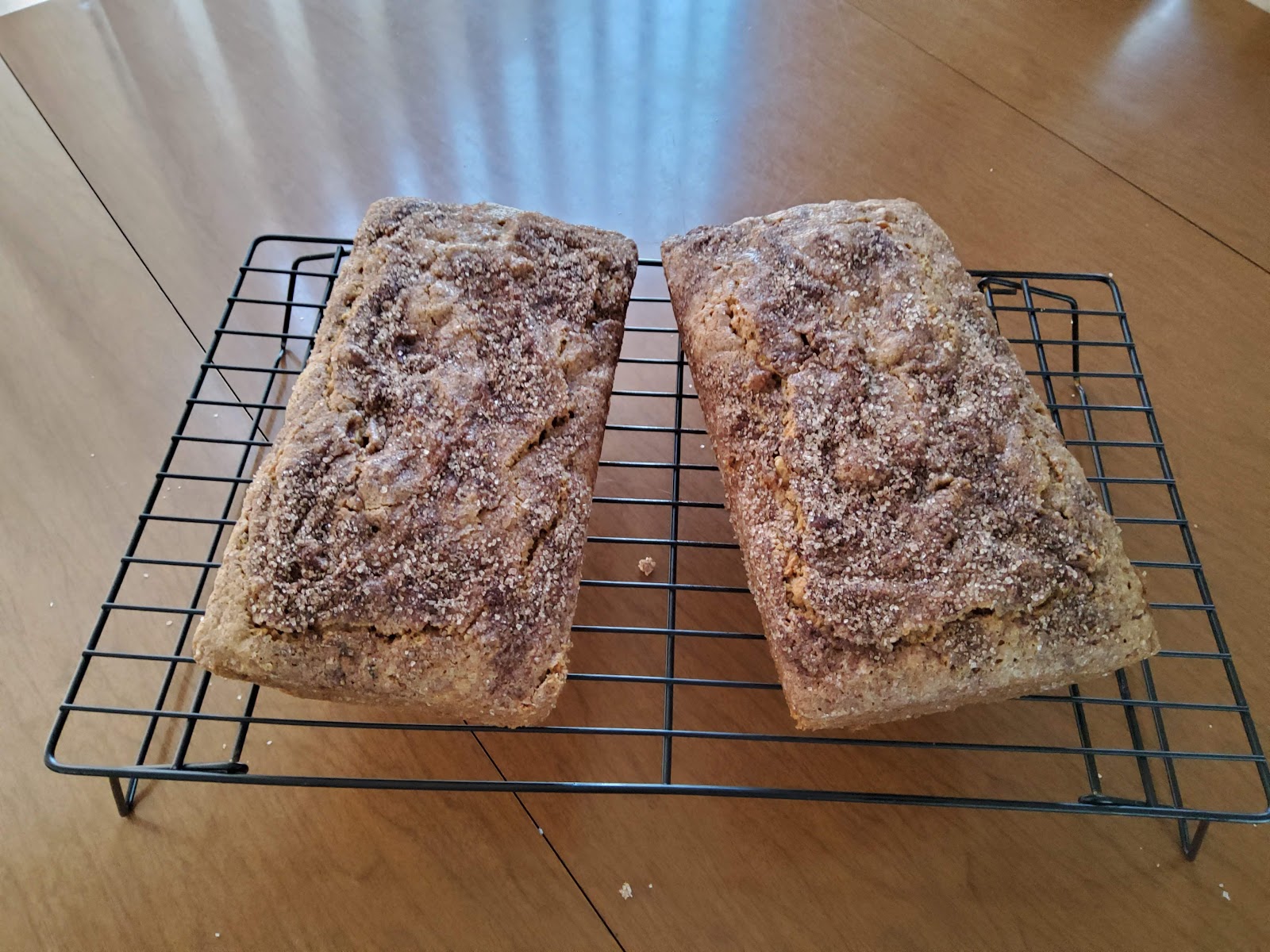
In addition to spiralizing zucchini, I also endeavored to make my spouse’s family zucchini bread recipe, which is notably a dessert.  That’s cinnamon sugar on the top.

At the time of this post, I’ve baked six of these loaves and made gifts of two.  My spouse has agitated for something like 10 loaves to keep in the freezer, because this zucchini bread is familiar, comfort food for him and he wants to have it around all the time now.  I’m not sure I’m up to making and freezing that many, but it’s… certainly possible with how much zucchini I’ve harvested.

Reading the Research: Movement vs. Depression

Welcome back to Reading the Research, where I trawl the Internet to find noteworthy research on autism and related subjects, then discuss it in brief with bits from my own life, research, and observations.

Today\’s article is an excellent reminder that sedentary lifestyles are toxic to the human mental state.  It also nearly started me off on a well-deserved angry rant, because that\’s what happens every time I see the phrase \”treatment-resistant depression.\”  

Let\’s start with that and then move along to the main point of the article, shall we?  (As a quick reminder, autistic people have very much higher than average rates of depression and anxiety.  Myself included, naturally.)

Ready?  Okay.  There is no \”treatment-resistant depression.\”  That is a bullshit category invented by ignorant derps wearing blinders.   What they actually mean when they say that idiotic phrase is \”depression that we can\’t medicate away after trying dozens of pharmaceuticals.\”

Did you spot the key word there, pharmaceuticals?  That\’s literally the only \”treatment\” people try.  If it doesn\’t respond to a barrage of pills (and God save you from the side effects of all those drugs), it must be untreatable!  

Wrong.

Wrong, wrong, wrong wrong WRONG.  Ughhhh.  

Hi, I\’m an autistic human with low grade depression.  It used to be a lot worse, and it used to dip into major depression when I was very stressed (like at finals time, or crunch time at work).  Then I did a few years of LENS (a type of neurofeedback), got help with my nutrition, became more active, and developed hobbies that involve being outside sometimes.  

Now I\’m doing significantly better and it\’s not because I took some fancy new drug.  It\’s because I stopped abusing my body, and as a result, it and my brain are doing better.

Can every case of depression be fixed 100% by changing these things?  Of course not.  Sometimes biochemistry does need intervention.  Sometimes that means a lifetime of pills.  Sometimes it just means you need that for a few months while you do the work to face the traumas causing the depression.  However, you can definitely improve your overall health, and that means your brain will do better, too.  The severity of the depression may lessen.  You may feel better overall.

And that is exactly what this study shows.  I tend to call it movement, rather than exercise, because you don\’t have to go jogging or do some kind of formal exercise.  I play a freaking video game for a half hour most days, go for a walk in the park with my spouse once a week, and go outside to forage for wild food whenever there\’s something in season.  

I do not \”go for a run\” or \”do this many of X exercise, this many Y exercise, that many Z exercise.\”  I don\’t go to the gym.  All of these things are valid ways to get movement into your life, but you honestly don\’t need to be that fancy.  Just going for a walk helps.  Especially if you can walk in a green space, like a local park or hiking trail.

My rant kind of bled into the main point here, which is that humans are animals.  If you trap an animal in a 5 by 5 space, feed it nutritionless garbage, and don\’t allow it to play or enjoy itself, it\’s going to be a miserable and sick.  If you wouldn\’t do that to an animal, don\’t do it to yourself, either.  

Because yeah, humans absolutely tend to do better when they get movement.  Maybe you won\’t qualify to lose the depression diagnosis, but wouldn\’t it be nice to feel better?

(Pst! If you like seeing the latest autism-relevant research, visit my Twitter, which has links and brief comments on studies that were interesting, but didn\’t get a whole Reading the Research article about them.)

Grocery Shopping on a Special Diet: The Baking Aisle + Milk and Cheese

Welcome back to my autism-aware shopping trip through the grocery store.  Week by week, I\’m showing you what the store sells, prune down the selection to what\’s safe for me to eat (because autistic people can have very sensitive systems) and point out various \”gotchas\” the store tries to make you buy- stuff you didn\’t come for and don\’t need.  

As a reminder, I shop with the following conditions in mind:

  • dairy-free
  • low sugar
  • avoid ultraprocessed junk
  • avoid food coloring
  • conditional vegetarianism
  • avoid high histamine foods
  • awareness of gluten-free options and sugar-free options

Last week was the impulse purchases on the way into the store, the yogurt, and the juice, coffee, and tea sections.  We learned that fruit juice and yogurt are a trap (check the sugar levels!), snack foods tend to sneak into every section in the store, and that the PH of bottled water varies quite widely.

This week: the rest of the dairy aisle, and then the baking aisle and friends!  Canned fruit, sugar, flour, PB&J.

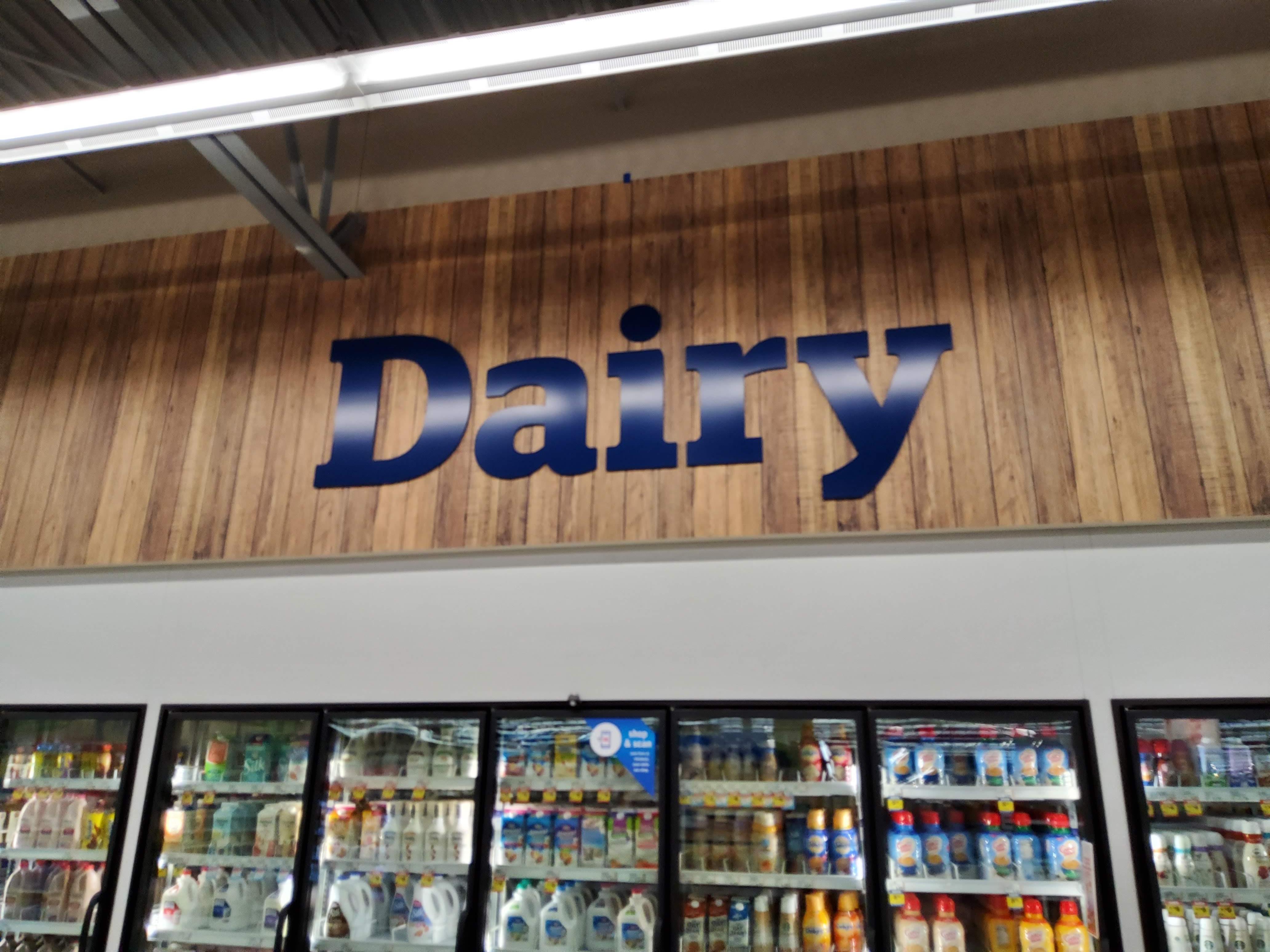
It\’s now time for milk and its friends.  

The milk section.  All of this is moo juice.  Seriously.  I don\’t know how many kinds of milk a person really needs, but I once heard a guy from Europe make jokes about exactly this.  We have skim, 1% milkfat, 2% milkfat, whole milk, high protein milk, buttermilk, milk laced with omega 3 fatty acids, and \”humane\” (questionable) milk.  We have most of these varieties in 4-5 brands, including a store brand.  Who on Earth needs that much decision paralysis?  

By the way, I can\’t drink any of this or I\’ll have a massive mood crash.  Moving on!

Flavored milks!  Remember how I was showing you stealth sugar bombs in yogurt last week?  Yeah, here they are again.  Strawberry milk and chocolate milk are laced with sugar in order to make them craveable or whatever the word marketing firms are using these days.  

And here\’s the only section of use to me: the nondairy milks (part 1).  This is the refrigerated section, so everything is cold and ready to drink.  Note the variety: coconut, almond, soy, cashew, oat, and lactose-free moo juice varieties here.  There will actually be even more later, but suffice to say, no single variety has won the war for the hearts of conscientious USians.  
I personally tend to drink almond milk, mostly because I find the flavor the least objectionable.  I also like that it lasts about twice as long as moo juice.  I don\’t drink milk every day, or even on a regular basis, so having something that lasts longer in the fridge is worth extra money to me.  

Coffee creamer.  Yes, all four of those doors.  Once again, I don\’t drink coffee.  But keep in mind the sugar content of those flavored things.  Because yeah.  Sugar bomb!  (There are some dairy-free options in there if I ever decided to start making lattes and such though.)

Sour cream, cottage cheese, snacks related to both those things, and flavored varieties.  I sulked a little bit when I saw the cottage cheese.  I used to love cottage cheese.  I still do, but it hates me (dairy!), so I basically never buy it any more.  It\’s a dratted shame, because there\’s a really good waffle recipe that uses it and I miss that too.

Hey, remember the milk section and choice paralysis?  Welcome to the egg section!  We have several brands of eggs, but we also have confusing labels!  \”Cage free\” is supposed to mean the birds are never caged, but there\’s no regulation for the label, so it effectively means nothing!  Hooray…  

Please note, that doesn\’t mean the chickens in question aren\’t cage-free.  It just means I have literally no way of knowing if that\’s true.  And I\’m not inclined to trust a major corporation with my morality.  At the moment I\’m getting all my eggs from a local farm, but in times past I\’ve bought the some of the packages on the far left.  The reason being that they have the Certified Humane label on them.

If that label is there, the animals involved with the product were fed appropriate food (chickens are omnivores fyi), had appropriate space, and were treated like living creatures rather than objects to produce profit.  I love finding this label on animal products, but it\’s fairly rare unfortunately.  The Certified Humane website has their standards transparently available on their website for anyone that cares to read them.  You don\’t need a degree in Animal Sciences to understand it, either.  I don\’t know exactly what a bell drinker is (some kind of water container for chickens), but I don\’t particularly need to.  

If this seems very small for the block cheese section, it\’s because this is the \”regular\” block cheese.  If you want the fancy block cheese you gotta go to a different part of the store, specifically the far side of the fruits and vegetables section.

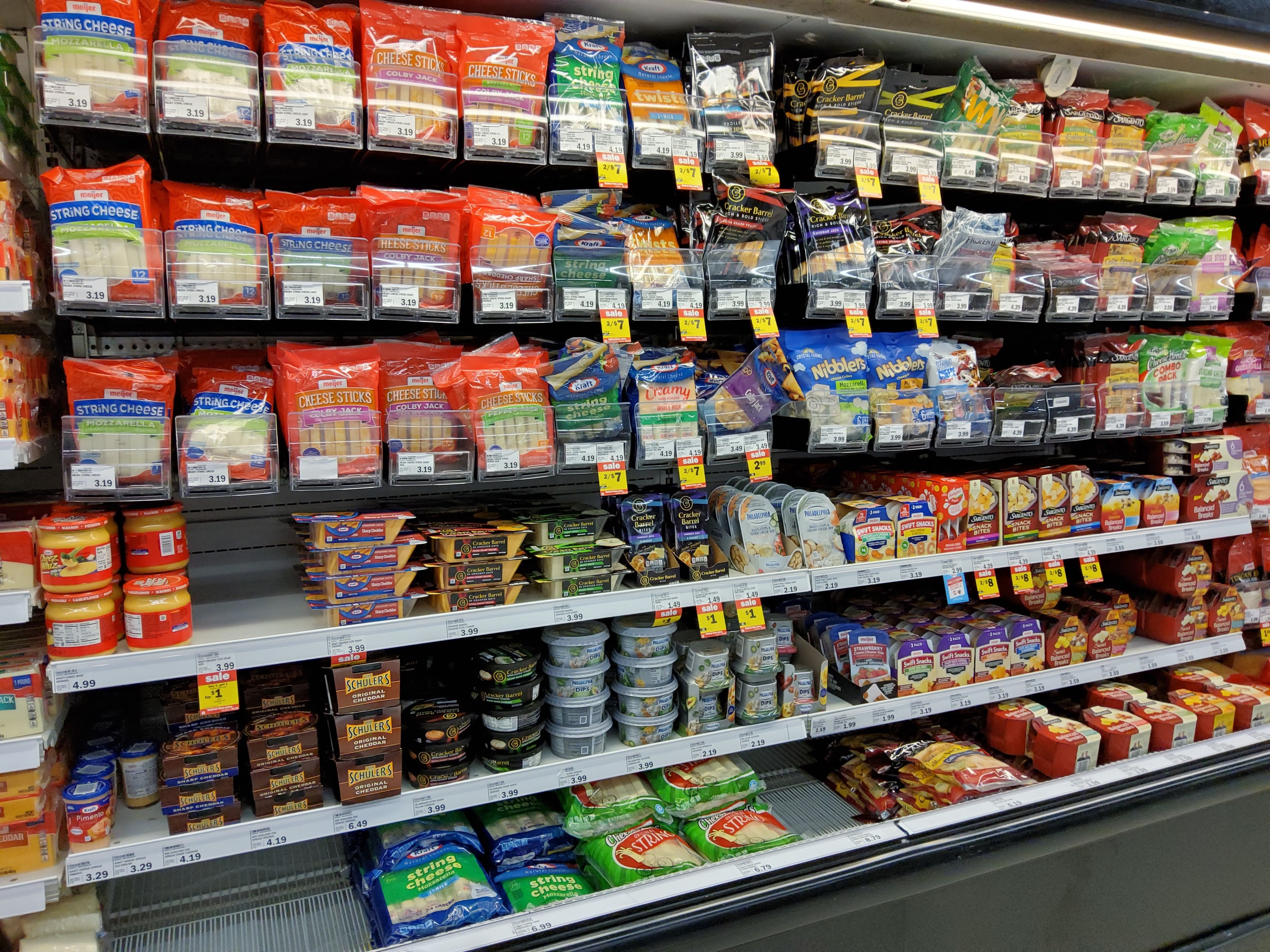
Directly after the block cheese is… snacks.  Yeah.  String cheese, cheese bites, dips, cheese spread (part 1).  While the cheese itself is only bad for you because it\’s dairy, the stuff they package with the cheese is often a convenient hiding place for sugar or ultraprocessed garbage.  For example, crackers and pretzels are devoid of nutritional content (but boy they\’re cheap).  Cream cheese is often laden with sugar, never mind the bagel chips.  And of course cheese spreads often have a higher sugar content because, once again, sugar gets everywhere.
After the snacks (part 1) we get into a truly staggering number of shredded cheese options.  I had to stand a good ways down an aisle to get this picture.  You\’ll notice that for how big this section is, it\’s really only two brands offered plus a smattering of smaller ones at the right end.  The US loves its cheese, though, clearly.  

We then move to the conveniently sliced cheese, in case you wanted perfectly square thin slices of cheese.  Also for if you\’re too lazy to buy a block and slice your own.  I\’m pretty sure most USians fall into the latter camp.  Again, I can\’t eat any of this because it will tank my mood faster than you can say, \”But why would we eat this much dairy if it\’s so bad for us?\”

Remember how we had snacks already?  Yeah, well.  Now it\’s more snacks time.  This is where the cheese section meets the meats section, so these snacks have both.  Shoutout to Lunchables, which I never buy anymore for obvious reasons but miss having sometimes.  Also?  The vast majority of USian humans do not lack for protein in our diets, so these snacks are pretty superfluous.  Moreso than most snacks, I mean.  I guess as snacks go they\’re at least somewhat healthier than other snacks?  At any rate, they\’re both loaded with dairy and the meat is likely inhumanely produced, so I just keep walking…  

Notable mention to a tiny, tiny corner between the shredded cheese and the pre-sliced squares of cheese.  This is the dairy-free section, and this is all you get.  One brand, two shredded cheese flavors, two sliced cheese flavors, and no blocks of cheese at all.  

Suffice it to say I typically shop for cheese substitutes elsewhere.

And now, the baking aisle!  Lucky number 13.  Maybe it\’s only lucky for me and my spouse, but I\’ll take it.  

I\’m not sure why PB&J is a baking need, but whatever, I guess.  

Sugar and sweeteners are a special kind of hell for people who have to be careful with their bodies. There\’s a million non-sugar sweeteners and almost all of them are awful for you. 

So there\’s the classic: cane sugar.  My mother is allergic to it, which makes most of this aisle useless when keeping her needs in mind.  Mine, personally, simply revolve around not putting too much of this stuff into my system.  That\’s actually easier to do when you\’re making your own stuff, because then you literally control how much sugar goes into the recipe.  

Other options available here include your typical brown sugar (which is just cane sugar coated in molasses), corn syrups (eww…), various Stevia options (okay healthwise but not great for baking due to it not being a 1-to-1 substitute with sugar), agave syrups (fine, but only when liquid sweetener is an option), and sweetener blends.  

For the lattermost, the blends vary in their usefulness based on what\’s in them.  Most artificial sweeteners are bad news for the sensitive guts and leaky blood-brain-barriers of autistic people, so stuff like aspartame, saccharin, and sucralose are off the table.  

When I shop for sugar substitutes, I tend to buy sugar alcohols, like xylitol and erythritol, or better yet, a natural option like monk fruit sweetener.  When baking a recipe I\’m willing to experiment with, I\’ll typically substitute half the sugar for monk fruit or a mix of these natural sweeteners.  

Notably missing here is my mother\’s go-to for sugar: beet sugar.  Michigan grows a crop of sugar beets, and these can be turned into granulated sugar just like sugar cane can be.  For reasons unknown, beet sugar doesn\’t harm my mother.  So I\’ll cook with that sometimes.  

PB&J. Jam and jelly are basically just flavored sugar spreads, so I avoid them.  The only exception this year was my homemade black raspberry pulp, which I used as jam.  I figured that was pretty safe since they\’re packed full of fiber and nutrients.

The peanut butter is almost inevitably full of chemicals and sugar, never mind peanuts being a major allergy for many people. I use sunflower seed butter when I eat this kind of food, so this entire section is pretty much ignored.  

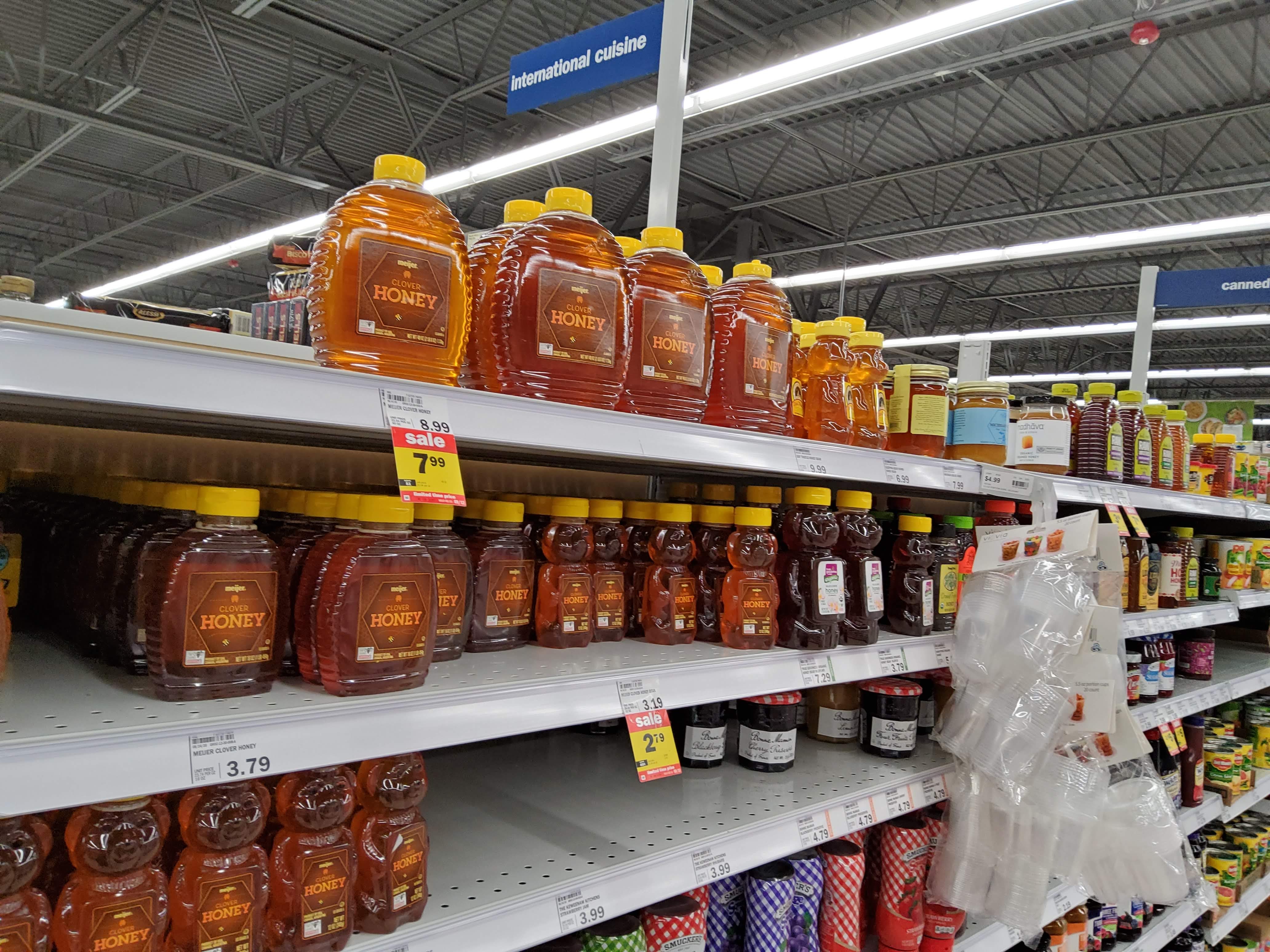
Honey. It\’s delicious and I love it, but obviously it\’s a high sugar product. Use sparingly. Also, ideally you want to buy local (within a couple miles) honey, because that\’s made with local pollen and can help end your allergies by teaching your white blood cells that the pollen isn\’t trying to kill you.  I\’ll sometimes pick up a semi-local variety from here, but mostly I try to buy from neighboring farms.  

Baking supplies.  It\’s 2020 during the coronavirus pandemic, so they\’re out of yeast. Again. Thankfully I have some at home.

They\’re also out of the largest packages of flour.  Most of the flour here is your typical bleached-to-death, glutinous white flour, bereft of nutrition.  This is the first way food goes badly wrong.  Most commercial processes use white flour when making their products, which means the results lack the nutrition and fiber that they could otherwise offer. There are some packages of whole wheat flour, at least.

It\’s not all wheat offerings, thankfully.  Quinoa flour, almond flour, flaxseed meal, cornmeal, hemp hearts, and coconut flour are also available here. Also, fortunately, a gluten-free option flour mix from a major company.  Oddly enough, this isn\’t my go-to spot for baking gluten-free (there\’s a different spot elsewhere), but it\’s at least an option.  

Canned fruit. Typically used for pie fillings and that\’s about it now. The industrial canning process for these destroys much of their nutrition. I had canned fruit on occasion growing up, but as I make my pie fillings fresh, there\’s little point in buying any.  Moving on!

Dried fruit, chopped nuts, and candy for adding to cookies and baked goods. The dried fruit is basically candy with fiber and some vitamins. The chopped tree nuts are common allergens, and also high in histamines, so best avoided. The chocolate chips and other candy, obviously, is just sugar bombs.

Marshmallows and jello. Both ultra-refined foods. Sugar and more sugar, too. Jello has been off my consumption list for years because of the gelatin, most commonly made from cow hoof or bone.  Marshmallows as well, but if you look in the lower left, there\’s some packages of a brand called Dandies.  Those are gelatin-free, so when I feel like a marshmallow-y treat, those are what I turn to.  

Cooking oils. More selection than you\’d expect, with various kinds of coconut oil, seed and nut oils, ghee, and a truly absurd number of olive oil options. Fun fact: US regulations for olive oil are more stringent than ones in Europe, so if you want good quality oil that\’s sure to be actual olive oil and not flavored whatever-other-oil-was-lying-around, buy extra-virgin olive oil from California.

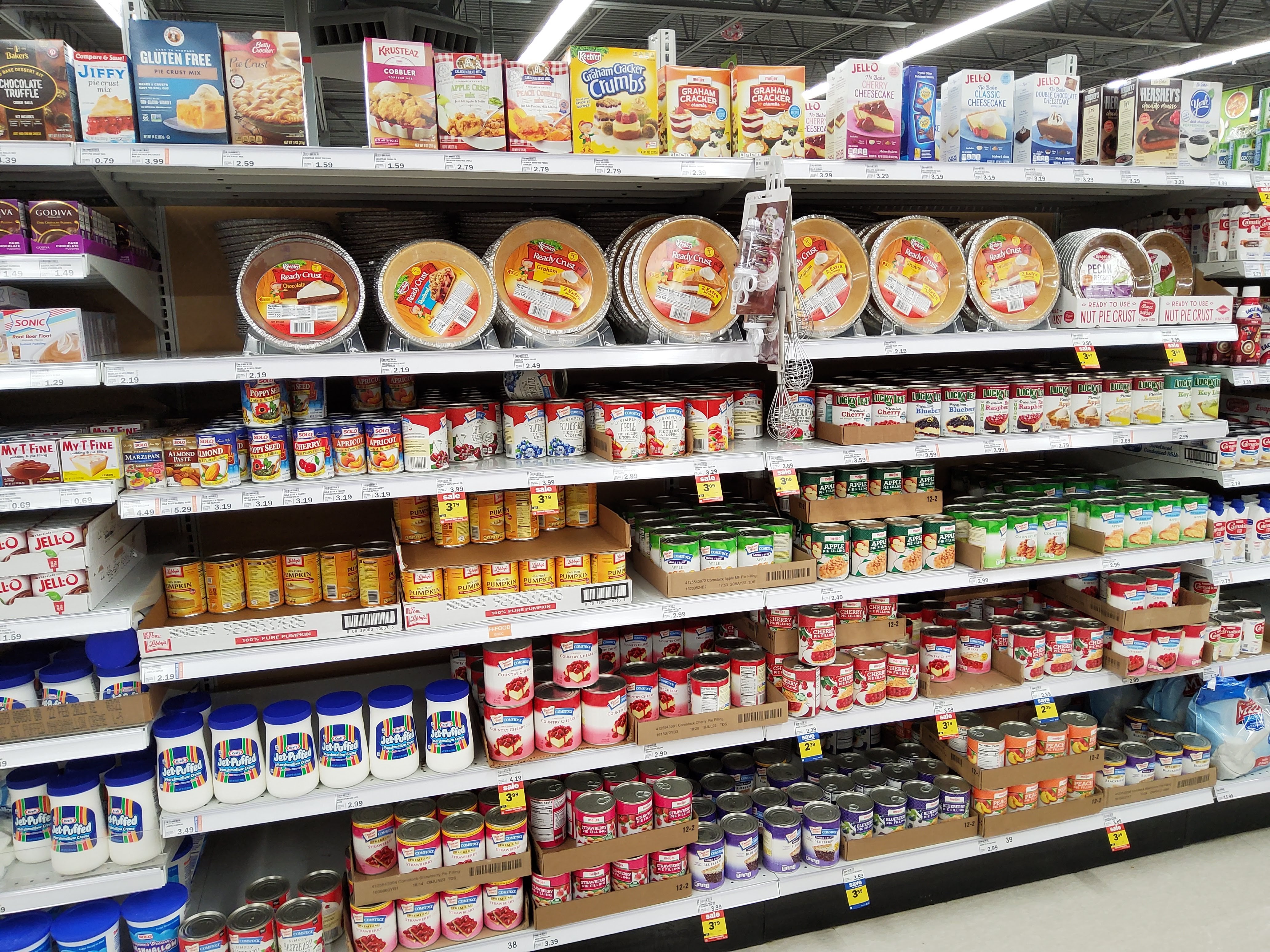
Premade pie fillings and crusts. In all honesty, pie filling is really easy to make, so I\’m not really sure why these are sold save for the specific flavor, I guess?  At any rate, it\’s all sugar bombs, so we just keep walking…

Evaporated and powdered cow milks, and also milk alternatives (part 2).  Even more options!  Remember the almond milk, soy milk, and cashew milk?  You may also buy hemp milk, oat milk, flax milk, macademia milk… and even goat milk.  

Also, see those handy-grab healthy milk drinks at the top? 

Sugar bombs. Surprise!  Definitely don\’t give these to your kids unless you want them to have diabetes.  

Spices. There\’s eleventy billion of them, but at least most of them are safe. The spice mixes aren\’t as safe, as they may contain powdered chicken or beef or pork.  That\’s fine for most autistic people, but not for me. Regardless, making your own spice mixes is an adventure and cheaper to boot.

It\’s a bit dizzying to try to sort through this section looking for powdered thyme or what have you, but here at least, there\’s no sugar bombs hiding in wait.  

Unlike here:  baking mixes. Almost entirely laden in gluten, and highly processed too.  Biscuits, cornbread, pancakes, muffins, cookies, brownies, and cakes. The sugar content on the desserts is obvious, but the cornbread, pancakes, and biscuits might depress you.

Cake fixings.  Otherwise known as, \”Oh look, more sugar!\” Also artificial colors, which are often Very Bad News for autistic people. 

One parent of an autistic kid noticed specifically that her son reacted very poorly to the color red.  If red food coloring was in his food, it was going to be bad times after he\’d eaten it.  I try to avoid them myself, just in case.  

And that\’s those done!  Next time it\’ll be the pasta and \”world foods\” aisle, and we\’ll see what a US corporation thinks represents the world… 

Reading the Research: Trans-Autistic Overlap

Welcome back to Reading the Research, where I trawl the Internet to find noteworthy research on autism and related subjects, then discuss it in brief with bits from my own life, research, and observations.

Today\’s article demonstrates a phenomenon I\’ve been seeing personally for years.  That is, the likelihood for autistic people to be found in the LGBTQIA+ group somewhere.  In the group of autistic adults I frequent, gender is typically a low priority topic.  While most of the adults typically at least present in line with their physical sex, it\’s typically just a matter of \”not weirding out the neurotypicals\” or personal preference.  

I put out a post some four years ago to try to explain trans people to a broad audience.  It holds up kind of okay still, although I\’m getting closer to simply saying, \”yeah, she/her is just kind of wrong when talking about me, please just say they/them.\”  I still identify as agender, and still think you should take your gender expectations of me and throw them out the nearest window.  Also, I learned recently that dysphoria is for everyone, myself included, so that\’s fun.  

The researchers seem to be puzzled as to why autistic people would be so much less likely to subscribe to the traditional \”two genders\” system.  I\’m honestly puzzled as to why they\’d be puzzled.  Autistic people march to our own beats in a lot of ways.  Why would gender be any different?  Society shapes and molds biologically male and female humans toward having a matching gender, it\’s true…  But if you\’re deaf to that guidance, as you\’re deaf to every other kind of social learning, of course you aren\’t going to perfectly match the societal \”ideal.\”  

In some cases, like myself, you may entirely reject it.  It\’s just another box people want to wrongfully stuff you into, after all.  I\’ve got enough expectations on me without people demanding I wear dresses and makeup, or enjoy clothes, interior decorating, pink, and whatever else passes as feminine these days.  If other people like those things, more power to them.  I simply don\’t, and resent the expectations that I should.  

On a final note, it\’s refreshing to see Professor Baron-Cohen saying things I agree with.  I\’ve typically disagreed with him on a lot of points.  However, improving the lives of transgender and gender-diverse people is a cause I can definitely support, and doing so will help autistic and non-autistic people.  

(Pst! If you like seeing the latest autism-relevant research, visit my Twitter, which has links and brief comments on studies that were interesting, but didn\’t get a whole Reading the Research article about them.)