TV Show Review: Love on the Spectrum

Wellp.  I wasn\’t sure this day would ever come, but here we are, and it\’s thanks to one of my pastors at church.  He asked me my opinion of the show in a \”I want to learn more\” kind of way, so I looked into, well, this.  I\’m reviewing a TV show called \”Love on the Spectrum.\”  It\’s an exploration of dating and love, featuring an entire cast of autistic people from the UK.  

Full disclosure?  I don\’t really enjoy this kind of show.  I feel like this sort of thing isn\’t really television material, and putting a camera on it is bound to make it even more awkward and painful than it already was.  

I am pretty sure my feelings on that latter statement are 100% accurate in terms of what happened here.  Keep in mind that most people on the autism spectrum have at least some kind of anxiety problems.  Usually a full-on diagnosable anxiety disorder.  Now put a camera on them.  Now, guess how well they\’re going to function?

To be fair, the worse they are at communicating, the better the spectacle, at least to a point.  In terms of understanding the real autistic humans, though, this isn\’t really a good way to do it.  Maybe it\’s the only way some people can get inside our heads?  But it makes me shake mine, frankly.  

All of this, by the way, is before we even get into the pitfalls of \”dating\” and the absolute poisonous garbage we\’re fed about there being \”one true soulmate\” we have to find in the nearly 8 billion humans on Earth.  

When the participants in this show were asked, their definitions of an ideal partner ranged from, \”I would like the moon and the stars on a silver platter with platinum cutlery, please,\” to \”I would like someone that cares about me for me, rather than uses me for whatever they can get out of me.\”  Very rarely was there a happy medium there.  Often the criteria were superficial (appearances), with no apparent understanding of what makes a long-lasting relationship work.  While they seem to have avoided participants that just scream, \”I\’m so lonely and what I need to fix myself is a partner!\” at the camera, I still got that sense from many of the participants.

This isn\’t terribly surprising, to be honest.  Pop culture has no idea what makes a relationship work in the long term, because it isn\’t concerned with that.  It\’s concerned with having the most stunning, heated, passionate romance phase, and the rest of it be damned.  

The thing is, that\’s not what any of these autistic people were looking for.  No one going into this (to my memory) said, \”yeah, I\’d just like to have some fun with new people and see where stuff goes.\” Autistic people, being more isolated than most, tend to fall prey to the mentality that we\’ll somehow be normal if we just find a partner. So there\’s a fundamental mismatch there between the theme of these dating shows and what autistic people actually want.

Relatedly, the participants kept going on about a wanting to find a \”spark\” with the people they want to date.  I\’m honestly not sure what this means, but it\’s potentially a load of rubbish, to borrow a British phrase.  Sometimes you find that spark later, after you\’ve become friends with a person for a long while.  I never personally experienced love at first sight, and I\’m more than a little dubious that it exists, but even assuming it does, it\’s not an indicator that you\’ll be able to make a relationship last.  

My general experience with dating was typically not \”I\’m going out clubbing to find someone to date!\”  It was more, \”I\’d like more friends please, and… huh, we seem to be getting on quite well.  This one is maybe dating material, actually.\”  Which I think is maybe an approach that serves autistic people better overall.  If you can be good friends with someone, the chances that your relationship will survive years are significantly better than, \”oh, that one looks pretty and we have something in common, let\’s try!\”

Why yes, I am rather opinionated and withering about pop culture and dating, why do you ask?  

I\’ve been married to my spouse for nearly 4 years now (we dated for an additional 4 years prior to getting married), and at this point most of our relationship has not been the stuff the books and movies and songs all love to talk about.  It\’s been hard work and compromises and piles of communication and working things out.  We have a lot of things in common, and that helps a lot, but what\’s kept us together isn\’t that.  It\’s that we\’re both willing to listen to each other, value the other, and are willing to expend the significant amount of effort it takes to communicate our wants, needs, and feelings.  

Maybe that\’s well beyond the scope of the show, since it is a dating show.  But the name is \”Love on the Spectrum,\” not \”Dating and Maybe Marriage Proposals on the Spectrum.\”  

Anyway… I did not enjoy this show.  I have enough of a sense for body language and awkwardness to be made incredibly uncomfortable by the body language of basically everyone the camera was pointed at.  It was like watching awkward teenagers, only instead of a scene or two in an otherwise enjoyable movie, it was the whole thing.  I actually couldn\’t suffer my way through even a single episode without having some kind of distraction going so I didn\’t focus as much on the excruciating awkwardness.  

I actually had this same problem when watching Atypical, another show featuring an autistic person.  Though I didn\’t have the problem when watching Temple Grandin, the HBO movie about the famous autism self-advocate and PhD of Animal Sciences.  Is it because this show and Atypical both play up the awkwardness for the sake of spectacle?  I\’m not sure.

Are the autistic people in the show genuine?  Yeah, probably.  I\’d say you\’re getting higher anxiety versions of each of the people presented, and there\’s probably some \”I must perform for the camera, rather than be myself,\” because almost all humans do that when a camera is pointed at them.  Typically you need special training to not act like an idiot when a camera is pointed at you.  However, autistic people tend to be pretty genuine overall.

My favorite moment in the series was in the 4th episode when Olivia was asked what it\’s like to be a girl on the spectrum.  She replied: \”Extremely difficult, given that there\’s no girl criteria, it\’s only boy.  So you get assessed on how male you are.\”  

This is especially true in the UK, where the \”hyper male brain\” theory of autism is predominant.  Even in the US, though, the criteria and understanding of autism is based on our historical understanding… which is to say, mostly male children.  Autistic girls need not apply, even though we have difficulties and strengths too.  It is, frankly, quite irritating.  Longtime readers will probably recognize why:  

I am not male.  I am not particularly female either.  I am me, which is not \”a boy brain shoved into a girl\’s body.\”  My gender is \”bugger off with those teensy little gender boxes you want to put me in, thanks.\”  This isn\’t an uncommon state of mind for autistic people, which brings me to my next point.

Mostly, this show focused on cisgender interactions: straight male-presenting people attempting to date straight female-presenting people.  When it comes to autistic people, we tend to have more complex gender identities, and are often bisexual or pansexual.  So merely showing \”apparently a guy\” dating \”apparently a girl\” is a very specific choice on the part of the producers.  And not one that\’s very realistic these days.  Honorable mention goes to the single bisexual girl that went on dates with a boy, and then later a girl.  Still, that\’s the rule, not the exception the way they portray it.  

Also, I know this show is set in the UK, and people are predominantly white there, but autism absolutely affects people of all skin tones.  There was one autistic guy of Chinese descent in the show, and that was about it.  No people with heritages from India, the Middle East, or Africa.  This show was not a good representation of the spectrum in that regard.  That failing is pretty typical in modern media, but it still bears pointing out because hey guys, people of color exist and are relevant to these discussions!  Please stop ignoring them because it\’s easier to put white cis guys in front of the camera.  

Lastly, the show focuses exclusively on dating between autistic people. There are no neurotypical people dating autistics at all. This is not how the real world works.  In reality there are many more neurotypical people than autistic people, and while we may find partners among our own, statistically it\’s likely that we will also date non-autistic people as well.  So it seems a bit separatist to me to just show autistic people dating autistic people.  

I did appreciate that they brought in various kinds of supports for the autistic people, including some kind of dating counselor, speed dating options, activities, and workshops.  The advice given seemed remarkably simplistic (find common interests, conversations should be 50-50, expand on things brought up in conversation), but I guess you have to start somewhere.  They also wouldn\’t show the bulk of these workshops, simply because of time constraints.  So I fondly hope the advice was more thorough than just these things, but even having that amount of help is better than, \”we\’re going to set up dates for you and point a camera at them, have fun!\”


Watch This Show If

You like dating shows and don\’t mind incredibly awkwardness.  This is pretty much a dating show, they just threw autism in there because it\’s novel and coming into the public consciousness.  This show isn\’t a good way to understand what it\’s like to live with autism, but at least the people in the show are probably fairly close to how they\’re shown.  Autistic people tend to be exceptionally genuine, but you only see so much of them in the context of dating.  Especially this kind of superficial dating.  I disapprove of the type of show, its definition of love, and its handling of the subjects involved.

This kind of show does not portray anything like how my dating went, as an autistic person.  Nor does it portray anything beyond the popular culture \”romance\” phase of relationships.  Additionally, the show pretty much only covers white autistic people, almost entirely cisgender, and almost entirely heterosexual dating.  This is not representative of the autism spectrum.  Not even in the UK.  

Basically, this is a faintly autism-flavored dating show.  Emphasis on the dating show.  It\’s overall positive about the participants and only slightly condescending, but as introductions to autism go, there are about a million better places to start. 

Reading the Research: Applying Big Data to Autistic Genetics

Welcome back to Reading the Research, where I trawl the Internet to find noteworthy research on autism and related subjects, then discuss it in brief with bits from my own life, research, and observations.

Today\’s article is a glimpse of a possible future for autism diagnostic codes and our understanding of the spectrum.

Autism is what scientists call a heterogeneous condition.  Which is to say, there isn\’t just one cause, and there isn\’t just one treatment.  Symptoms vary incredibly widely, and so do the genetics involved.  As often as not, the experiences of any given group of autistic people will have commonalities, but their specific symptoms might only have the smallest amount of overlap.  

A great deal of money and time have been poured into finding out what causes autism over the last 40 years or so.  The results have not been conclusive.  Everything from air pollution, reduced gut diversity, and the genetic history of humanity itself contributes, it seems.  There\’s evidence that autism has produced human specialists over thousands of years, and those specialists have been valued enough to pass their genetics on throughout the generations.  

It was hoped, with the advent of the human genome project, that we might finally understand how autism is coded for.  That hope proved futile… at least until now.  

Machine learning and Big Data may eventually provide these answers, assuming both can be harnessed.  This study is a very small example of the idea.  Basically, you get enough relevant data points (thousands of autistic people\’s genetics), and then you use a powerful computer find categories for you from those data points.  

The researchers in this study did exactly that, but for one very small subset of autism. If this was done on a grander scale, it\’s likely we could have actual categories of autism, rather than simply sorting ourselves based on symptoms.  

In all honesty, I have mixed feelings about this.  Part of the reason the autism community is a community is because we have a lot in common, including the diagnosis code.  Splitting the spectrum into dozens of microcategories seems like it might intrude on that unity and de-legitimize autistic experiences.  

However, these microcategories might also allow for more targeted treatments for specific issues.  The category these researchers found suffers from cholesterol issues.  Having that knowledge lets you know what to test for, and what to be careful of overall.  In short, having these categories may allow us to more easily and quickly reduce autistic suffering due to related medical conditions.   

(Pst! If you like seeing the latest autism-relevant research, visit my Twitter, which has links and brief comments on studies that were interesting, but didn\’t get a whole Reading the Research article about them.)

Grocery Shopping on a Special Diet: Impulse Buys, Yogurt, and Drinks

Welcome to a new series on life on the autism spectrum.  I\’ve been doing grocery shopping for nearly a decade, and as my diet has needed to change for health reasons, I\’ve noticed I have less and less of the grocery store actually available to me.  As a citizen of the United States, I have a truly staggering number of food options available to me, but if I want to function, most of them are actually illusions.  

I\’d like to explore this a bit.  I\’ll be going aisle by aisle, probably about two aisles a week.  There are 14 aisles plus the bakery, deli, and fruits/vegetables sections, so there\’s plenty to talk about here.  

The store I typically go to is a hypermarket, which is to say that it is both a massive grocery store and a department store combined into a one-stop-shopping experience.  I\’ll be focusing on the grocery store section, since this is about food.  

Speaking of food, I should also establish my consumption limitations.  I have an allergy to casein (a protein in dairy).  Which is to say, if I drank a glass of milk, I would go from neutral-pleasant mood to angry and depressed in the span of about 30 minutes.  So most dairy products except for butter are off limits.  

I also try to adhere to a low-sugar diet, and avoid ultra-processed foods in favor of whole grains.  I try to avoid food coloring.  I try to avoid high histamine foods. Lastly, I\’m a conditional vegetarian.  Unless I\’m quite convinced (usually by way of independently verified labels) that the animals I\’m eating were treated like creatures and not objects, I don\’t eat meat.  

When you enter the store, the first thing they try to do is sell you extra stuff you didn\’t come for.  Also, because it\’s 2020 and there\’s the coronavirus and no vaccine yet, please note the very first display: masks, including child-sized ones.  

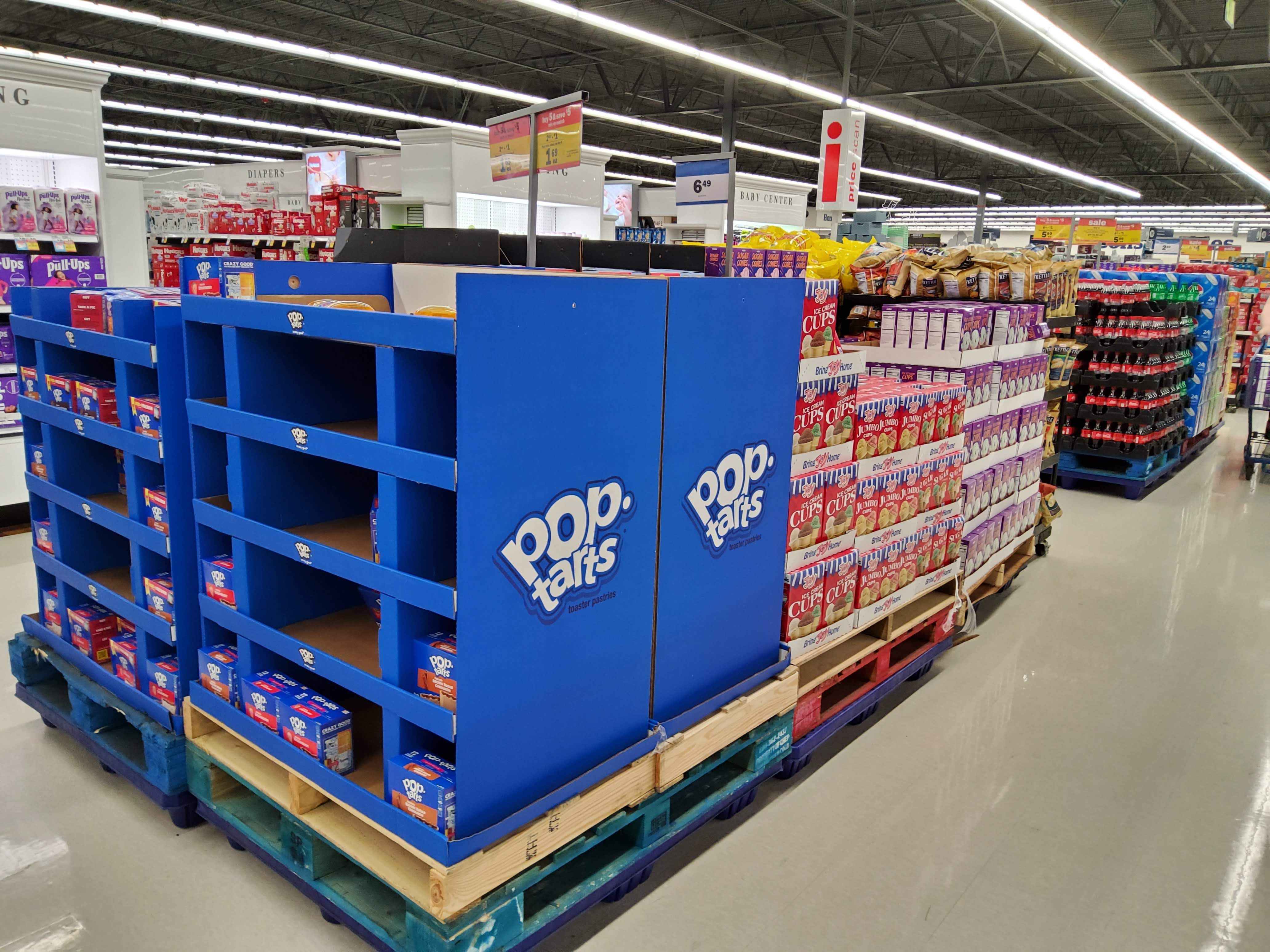
I have to pass on the chips.  I\’ll eat them sometimes but they\’re definitely ultra-processed junk food: no nutritional content at all.  You\’ll see this is a major trend, and also that there\’s literally snack foods everywhere, not just here in the impulse purchase area.

Pop Tarts.  Supposedly a breakfast food.  Ever looked at the sugar content?  I\’d rather have a donut for that amount of calories and sugar.  It\’d have less food coloring, too.  Ice cream cones behind the Pop Tarts.  I like ice cream but between the dairy and the sugar, it doesn\’t like me.  

More chips, plus adult beverages.  I guess they hope you\’ll want to load up on empty calories?  I\’m not making Mexican food this week though, so no ultra-processed tortilla chips.  And definitely no beer.  If I\’m going to have empty calories, I want them to taste good.   

More chips, though these are more tempting.  Pringles, like every other type of chip, is definitely ultra-processed.  Honestly, they\’re like potato sawdust mixed with sugar and salt, and then shaped into a chip form.  The result is delicious, but quite bad for you.
Behind it is salad dressing, which is a way people destroy the nutritiousness of salads…  

I don\’t have specific complaints against bottled water, save that you really need to know what PH it is before putting it in your mouth.  Yeah, I know, it\’s water, it should be 7, but that\’s actually not how it is.  This particular water is most likely 6.5, so slightly acidic.  On a personal note, screw Nestle for profiteering off Michigan\’s water while paying basically nothing for it.  

Behind the water, Chex mix (another ultraprocessed snack), marshmallows (sugar bombs!), and paper towels.  

So those are the impulse purchases and sales as you walk down to the end of the store.  Almost entirely inedible in terms of health and sugar content. But they hope you\’ll forget that and buy them anyway, because look! They\’re right there and on sale!
When I shop I always start at the last aisle and work my way forward.  It just seems the most efficient to me.  And hence: aisle 14.  

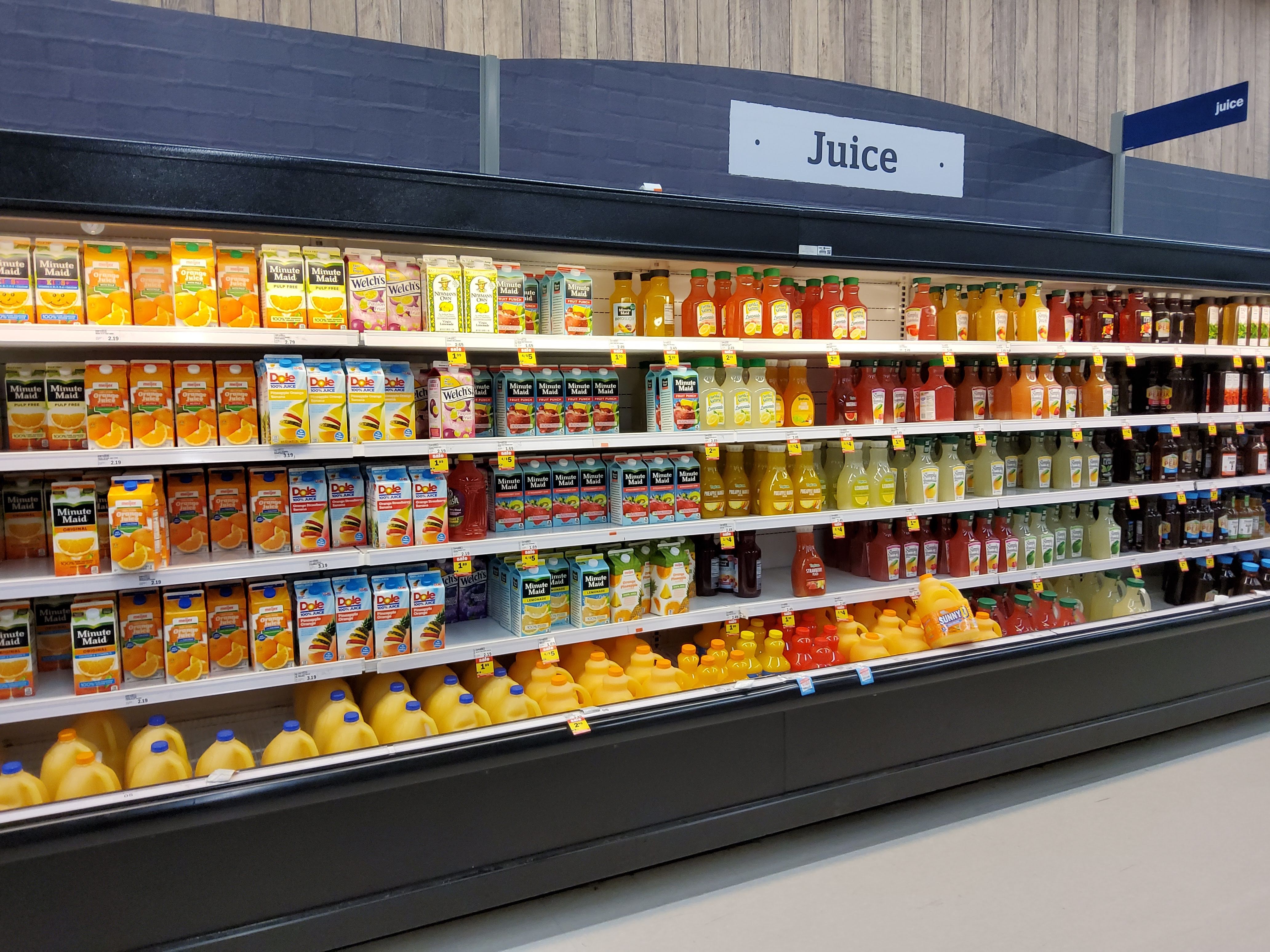
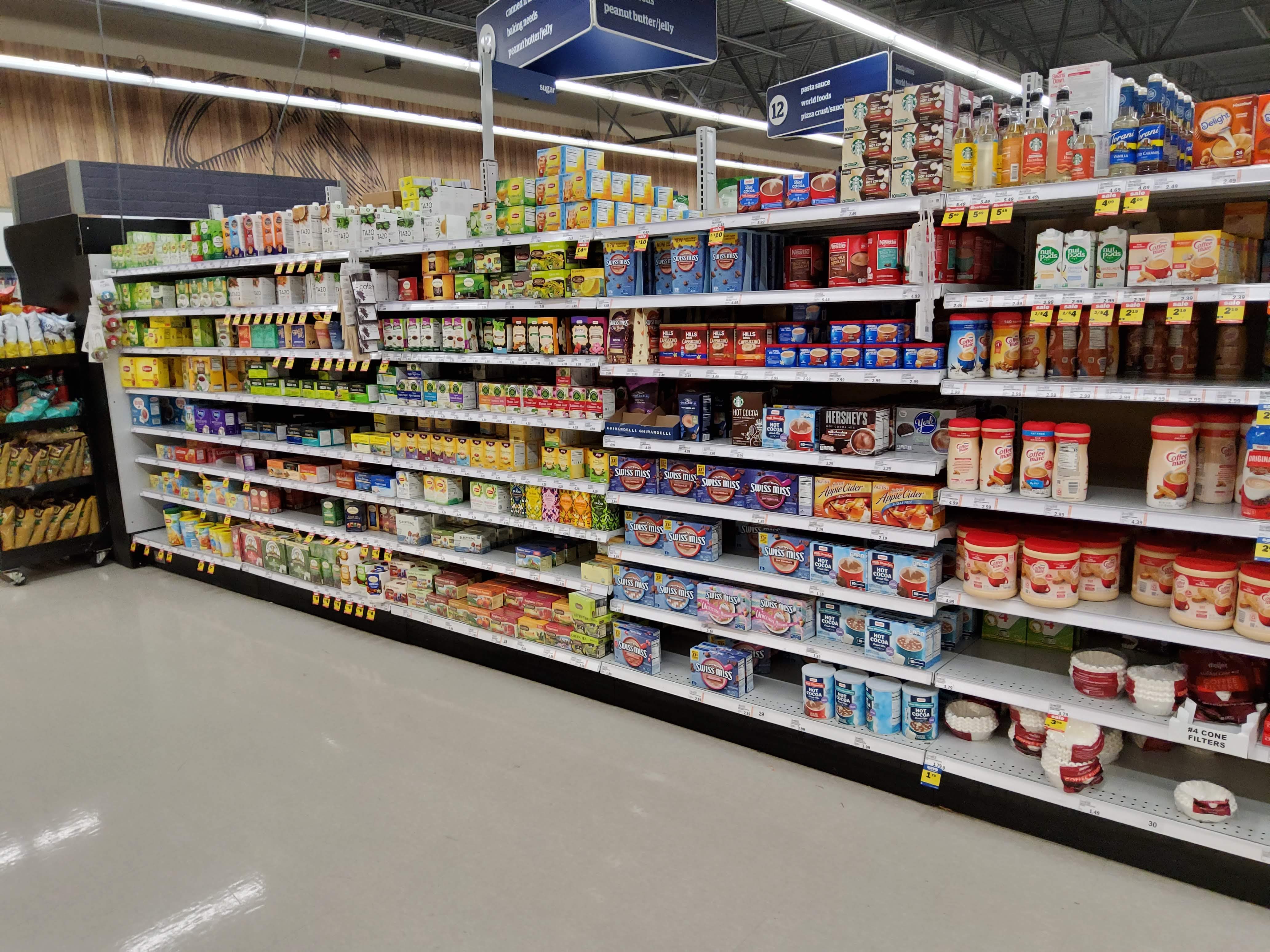
Yogurt, juice, coffee, tea, and hot cocoa.  

To my great annoyance, juice is not healthy.  It\’s sugar water with vitamin C.  The reason fruit is healthy is not just the vitamins, but also because of the fiber.  Y\’know, the stuff they strain out to get the juice.  So what you have here is sugar water, sometimes with extra sugar, food coloring, and flavorings.  

I dislike coffee, but at least it\’s not flatly unhealthy.  Unless it\’s flavored and full of sugar…  

Tea bags and hot cocoa.  A pretty small selection, to be honest, but fortunately I know better places to shop for tea.  I like tea and hot cocoa, but the latter tends to be chocked full of sugar.  At present, I have too much of the former so I\’ve banned myself from buying more tea until I\’ve reduced the levels of my tea collection at home.  

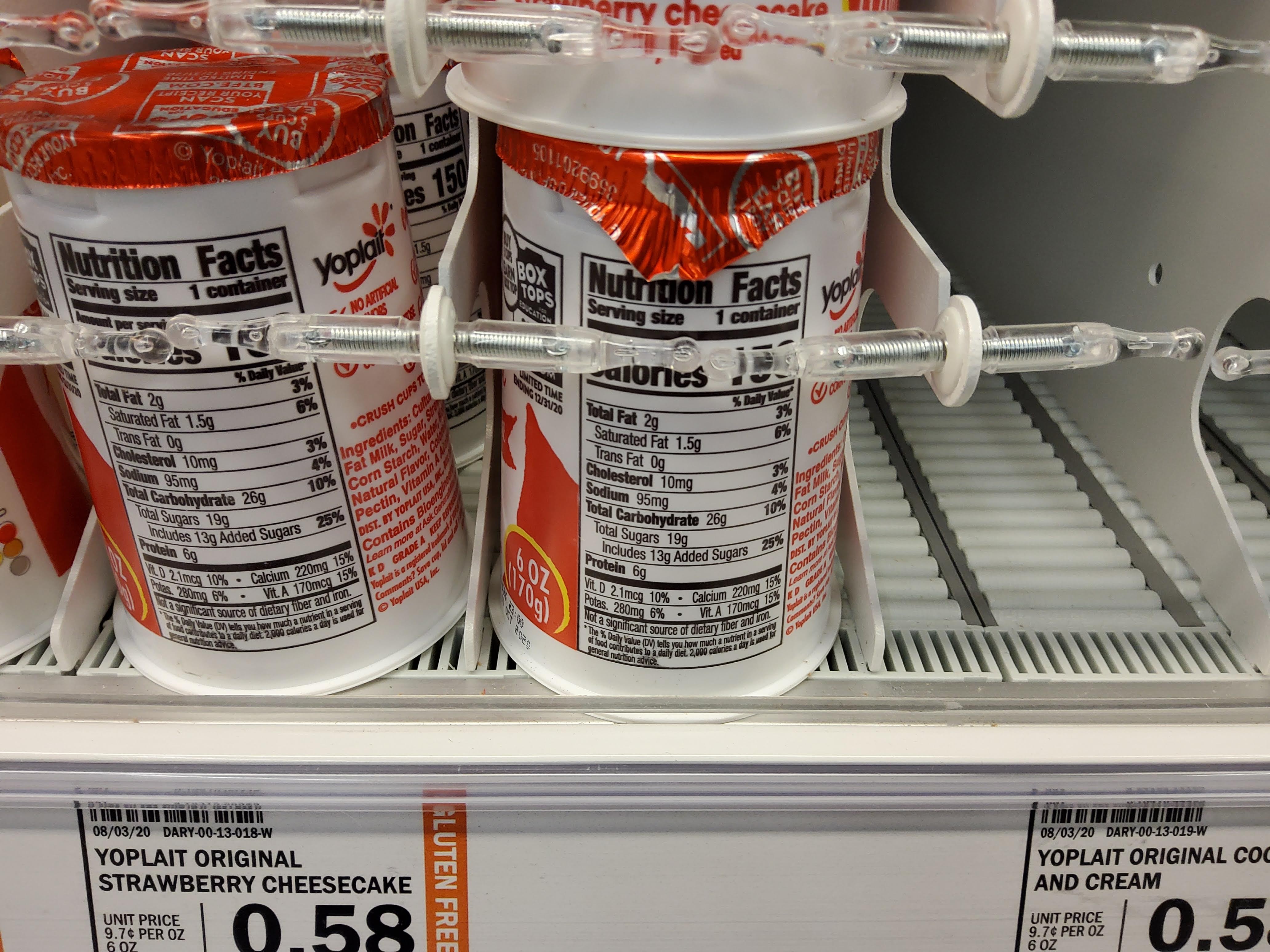
The yogurt section.  Yogurt is supposed to be healthy because of the protein and fermentation process.  It can help rebuild your gut with good bacteria.  Since autistic people often lack healthy guts, this would seem to be a good food choice.  Most yogurt is made with cow dairy, but let\’s have a look at a random yogurt… 

Look at the sugar content! 19 grams of sugar, or basically an entire day\’s worth of sugar for me.  But it\’s cheesecake flavored, surely a nice plain strawberry yogurt wouldn\’t be so bad…

OH COME ON.  Still 19 grams of sugar?!

The minimal but at least slightly existent nondairy yogurt section. Mostly oat products (not gluten-free, notably) and almond or coconut milk products.  Frustratingly, these nondairy products are typically lacking in protein content.  But they do, at least, still have the fermentation process.  

However, these flavored nondairy yogurt cups are just as full of sugar as the regular stuff.  Meaning, they\’re no good unless you buy the giant unsweetened container and add your own flavoring. Which defeats the convenience and portability of yogurt, in my opinion…

The refrigerated \”quick desserts and baked goods\” section.  There\’s everything from single serve puddings and creme brulees to cookie dough and cinnamon buns.  Sugar, sugar, sugar…  

The only notable thing I regularly acquire here is a specific brand of premade pie crust.  It doesn\’t use lard, and is also twice as expensive as any other pie crust available.  That said?  Making pie crusts sucks.  The most healthy option would be to make my own using fine ground whole grain flour, but I have a marked dislike for kneading butter into flour.  So most of the time I buy these crusts rather than make my own.  

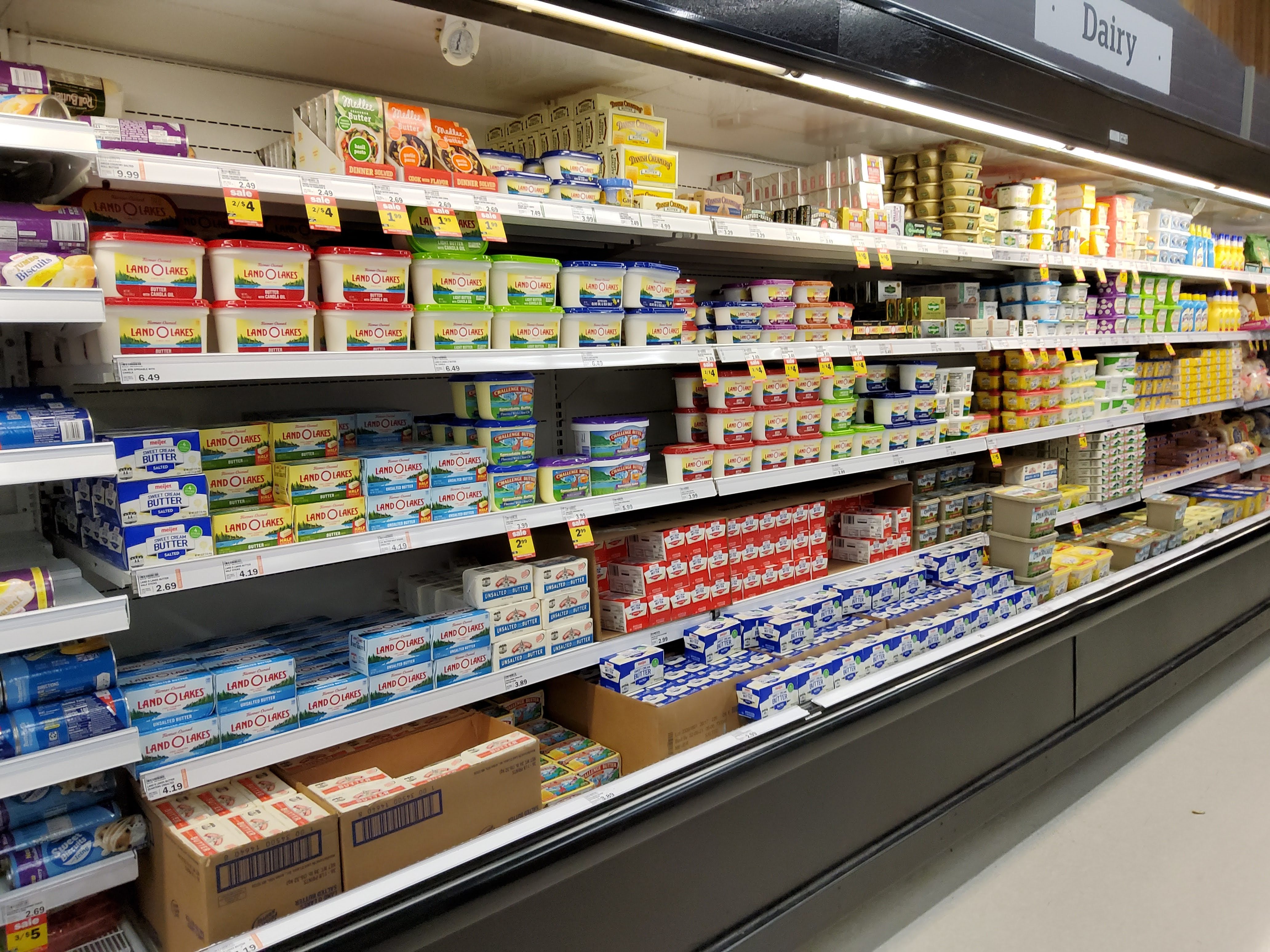
The butter section is over complicated but at least it\’s all safe for me to eat. 

Some people with dairy allergies can\’t do butter, which makes margarine and other options more valuable.  There\’s also ghee, which has had the proteins removed… but we\’ll see more of that later in the baking aisle.

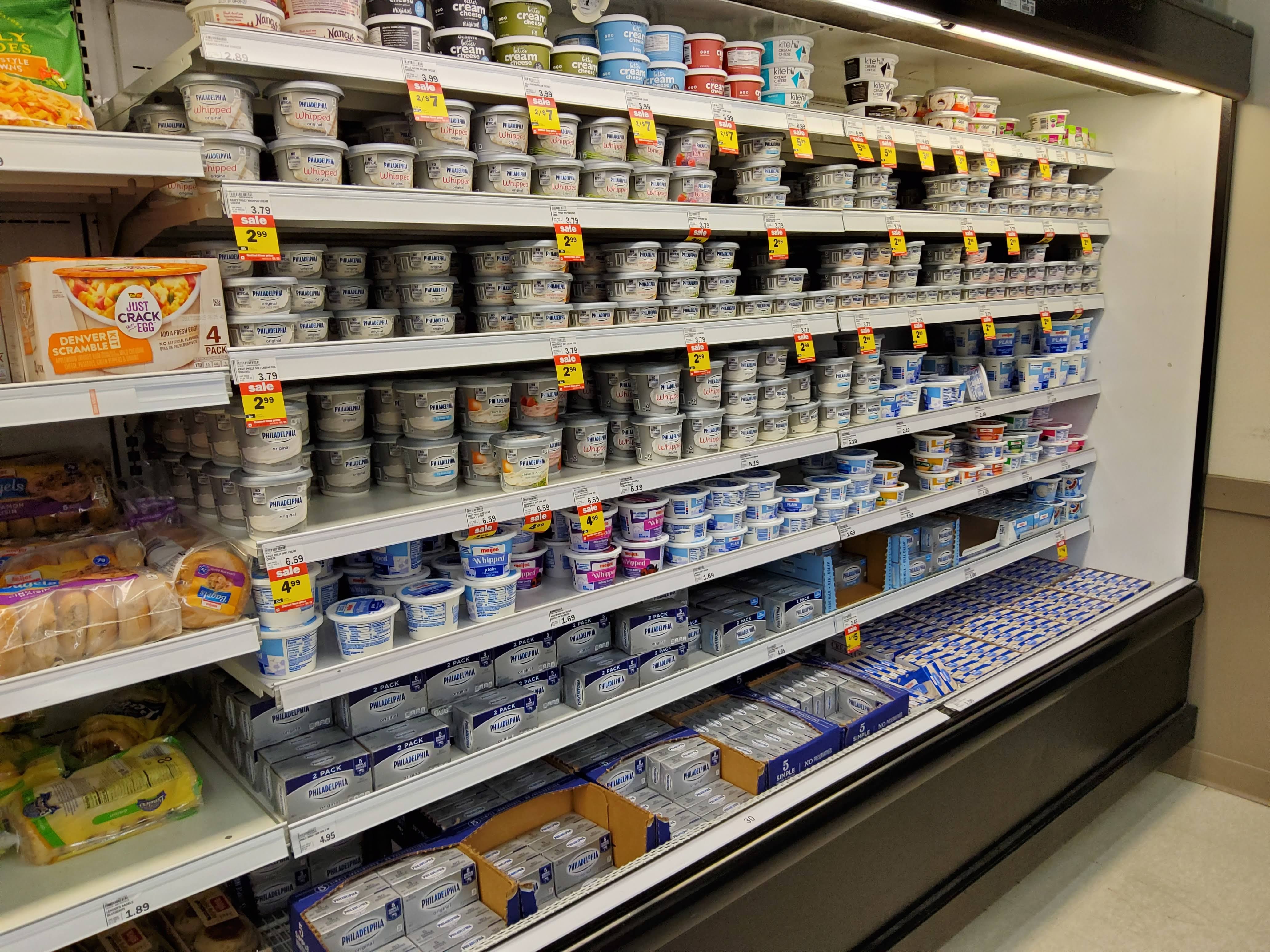
The entire cream cheese section is right out. Even if it wasn\’t dairy, it\’s full of sugar.  

And that\’s the first installment of this trip through the grocery store.  Let me know what you think.  I\’d originally envisioned doing this grocery store trip in a single post, but it took me so many pictures to just get through the first few aisles that I realized no one would want to read such a long post.  

Next week: the baking aisle and the rest of the dairy section!

Reading the Research: GI Misery

Welcome back to Reading the Research, where I trawl the Internet to find noteworthy research on autism and related subjects, then discuss it in brief with bits from my own life, research, and observations.

Today\’s article discusses the effects of gastointestinal symptoms on children.  The more GI issues (trouble swallowing, constipation, diarrhea, bloating), the more likely the child will have sleep issues, self-harm tendencies, focus issues, and higher rates of aggression and restricted/repetitive behaviors.  Can we all guess why?  Good, good.

This is one of those studies that you kind of have to shout \”well DUH\” at.  It\’s good to have the connection between GI distress and \”challenging behavior\” validated empirically, but I don\’t think it\’s quantum physics/brain surgery/rocket science to say, \”if human A is suffering lots of misery on a regular basis, their whole life will be affected negatively.\”  

The study does at least note that autistic children are 2.7 times more likely to suffer these issues than typically developing children, and that half the tested autistic children had frequent GI issues.  That\’s a lot, particularly since the sample size was over 250 autistic children.  

The study also rightfully notes that GI symptoms are very treatable, and the results can truly be life-changing.  Now, keep in mind the best treatments for these issues can be expensive.  We\’re talking a fecal transplant from a good quality donor.  This is one of those things insurance should cover, but generally refuses to because their business is taking as much money as possible and spending as little as possible in return. 

The last thing to note here is that the study was specifically on little kids.  So here\’s the song and dance one more time: Hey y\’all, KIDS GROW UP.  If these problems aren\’t caught and treated young, they can and absolutely will persist into adulthood.  Then instead of angry preschoolers, you have angry adult humans, some of whom can\’t vocalize their suffering in a way that is easily recognized as \”I need help with my GI tract.\”  So you get holes punched in walls, and \”challenging behavior\” as caregivers often term it.  

This is one of those things you want to rule out in cases like that, because sometimes it literally is as simple as \”ease the suffering, \’challenging behavior\’ ceases.\”  For further reading on this subject (and aggressive autistic people in general), please consult this excellent post.

(Pst! If you like seeing the latest autism-relevant research, visit my Twitter, which has links and brief comments on studies that were interesting, but didn\’t get a whole Reading the Research article about them.)

Book Review: Life, Animated

 Life, Animated: A Story of Sidekicks, Heroes, and Autism, by Ron Suskind, is a \”my family\’s story with autism\” type book.  While there is a small mountain of these, this one is remarkable for the particular path the autistic person took.  Most of these stories have been about \”Aspergers\” type autistics.  That\’s me, and that\’s most of the people I know.    

Owen Suskind, on the other hand, fell into the most dreaded variant of autism: regressive autism.  That\’s the one where the child seems to develop normally until a certain point, and then loses developmental progress.  They stop talking or lose tons of vocabulary, their motor skills deteriorate, they stop conveying emotion through body language…  It\’s a parent\’s worst nightmare.  Many of these children backslide all the way to being nonverbal, and that\’s exactly what happened with Owen.  

Most of the stories of this type of autism offer hope in terms of alternative communication devices, finding new ways of listening and seeing from a very different perspective, and above all, an ongoing struggle to thrive in a world not made for humans so different from the norm.  In some ways, this particular story is similar to those.  

However, unlike most of those stories, and thanks to his parents\’ willingness to incorporate their child\’s special interest, a literal village\’s worth of people and support staff, and far more resources and privileges than most families with autistic people have access to… Owen was able to master words, learn to see things from others\’ perspectives, become independent, and even start dating.  You are brought through the process of all of these developments.

It\’s a particularly engaging, well-written story, likely because the author\’s journalism experience is extensive.  Suskind really brings you into the headspace of each family member, including Owen, as much as possible.  You experience the struggle of the parents, the mixed feelings of Walt (Owen\’s brother), and grow to understand Owen just as his parents do, over time.    

This is probably the best written \”my family\’s experience with autism\” account I\’ve ever read, and I\’ve read a hill of them at this point.  When reading these accounts, you always have to keep in mind that the adage about meeting autistic people also applies to their families.  Every family\’s story will be different.  I just wish every family had the kind of resources and privileges the Suskinds had for this journey.  

Read This Book If

You want to better understand how autism can affect a family (and have a guaranteed happy ending), or want an example of how to channel a special interest (in this case, Disney movies) into helping an autistic person engage with the real world.  The Suskinds are a privileged family in a lot of ways, but their struggle is no less real or valuable for that fact.  What they managed, together, shows what could be done for every autistic person, and the good that might result.  (There is also a documentary, for people who prefer video to books)

Reading the Research: Text Message Therapy

Welcome back to Reading the Research, where I trawl the Internet to find noteworthy research on autism and related subjects, then discuss it in brief with bits from my own life, research, and observations.

Today\’s article starts off with kind of a shocking statistic: 19% of all adults in the USA have a diagnosable mental illness.  That\’s basically 1 in 5 adults.  That\’s several people in your family.  Count off people in the grocery store.  Every time you get to five, know that one of those people suffers from depression.  Or anxiety.  Or a personality disorder, or some other condition classified as mental illness.  

That\’s absolutely awful.  

As simple as it would be to blame the coronavirus for Messing Everything Up, it\’s unfortunately not that simple.  The fact is, people in the US mostly don\’t get preventative care.  Our medical system is set up to treat symptoms and bankrupt us in the process.  Our food is created to be addictive, nutrient-deficient, and laced with sugar.  We overall don\’t get enough movement to be anything close to healthy, and we don\’t spend much, if any, time outside in nature.  

The end result is a profoundly unhealthy population.  The obvious consequence: staggeringly high rates of mental illness.  

While I\’m pleased to see this idea of therapy-via-text message seems to work, I\’m a little dubious as to how high quality it can really be.  It\’s one thing to generally teach people about mental illness, self-care, and support techniques, and quite another to put together a file on a client and be able to offer targeted, specific advice and strategies the way a typical therapist would.  

Something is better than nothing when it comes to mental illness, and having someone outside your circle that you can trust to ask about things is extremely valuable.  But I will note that similar systems have been tested using chatbots, with some success.  This might, I suppose, be a better educated and human-centric version of that.  

Mostly, though, I\’m just frustrated these sorts of things aren\’t taught in school.  It would go a long way toward a healthier country if people knew what mental illness looks like and how to help with it.  After all, almost everyone experiences major depression at least once in their lifetime.

(Pst! If you like seeing the latest autism-relevant research, visit my Twitter, which has links and brief comments on studies that were interesting, but didn\’t get a whole Reading the Research article about them.)

Book Review: Come As You Are

Come As You Are: The Surprising New Science That Will Transform Your Sex Life, by Emily Nagoski, is not the usual fare for this blog, but… given how often autistic people miss out on proper sex education, the sections about the stress cycle (which are sadly highly relevant to autistic people), the importance of the subject overall, and the excellence of this particular book, I\’m making an exception.  

Fair warning: this is a book about sex.  If the subject makes you uncomfortable, you may feel you should skip this book.  Quite frankly, I strongly suggest you don\’t.  This book contains information you would typically need to pay a therapist thousands of dollars to obtain over a very long period of time, and only after you\’re literally at your wits\’ end (because that\’s typically the point at which people stop putting off getting help for this sort of thing).  

Also, while the book\’s cover suggests it mainly covers sex from women\’s point of view, the information therein is useful for all sexes (intersex people exist) and all genders (hi, I\’m agender!).  My spouse and I read this book together, and it cleared up a lot of falling down points we\’d had around the subject, as well as improving communication between us overall.  It\’ll take time to improve our actual sex life, since the book revealed some serious issues we have to work through, but I fully expect positive changes and a better relationship as a result.  

One of the key points that\’s stuck with me?  Sex is not a drive.  \”Sex drive\” is a common phrase to refer to peoples\’ desire to have sex, but the phrase is wrong, and worse, it\’s harmful.  Drives, you see, are things your body demands in order to live.  Food, air, and water, for example.  However, there are zero cases of someone dying because they didn\’t have sex for X years.  (There are cases of people believing they\’re owed sex, and because of inadequately supported mental illness and access to deadly weapons they definitely didn\’t need, killing people and/or committing suicide over it… but that\’s significantly different).   

Pop culture and media teach us that the hero always gets the girl (and the kiss, and the sex, etc).  And somewhere between that expectation that women throw themselves at the hero as soon as the hero succeeds, and the stigmatization of men who haven\’t had sex and/or aren\’t some kind of sexual genius with dozens of partners, this idea that sex is a physical need came into play.   

However, the research shows us this is wrong.  Sex can be pretty great, but it\’s merely an incentive-reward system, not a physical need.  Another thing that fall into this category is \”tasty food\” or snacks, which you might find yourself wanting even when you\’re not hungry.  

There are a lot of really helpful insights in this book regarding how much context matters (a lot!), your physical parts (are normal!), and how stress affects everything (also a lot!).  Shoutouts to the parts that talk about brakes and accelerators, which was easy language for my spouse and me to adopt in our discussions.  

I found the sections on the stress cycle especially helpful.  Autistic people like myself are often under a great deal of stress.  The Japanese saying is, \”The nail that sticks up gets hammered down.\”  Meaning, roughly, the person that doesn\’t fit in is going to get a lot of abuse until they do.  You can probably guess how I feel about that, but the point is that this book will teach you, broadly, how to allow your system to let go of that stress.  The specifics are up to you, since you have to find what works best for you.  

I could probably go on and on about the insights in this book, but in all honesty, the author will do a better job of explaining them than I would.  There are six copies of this book in my local library system and another seven (including two eBooks) in the neighboring library system.  Go get one.  

Please note: this book is not specifically written for autistic people.  It contains broad and highly useful explanations of our best (current) understanding of how sexuality works, especially as pertaining to physically female people.  Things like sensory sensitivities, communication difficulties, and consent are not covered.  You may want to refer to the resources listed here for information on these subjects.  

Read This Book

No If.  You, yes you, should read this book.  The only exception is I guess if you\’re 100% certain you don\’t want a sex life and you either don\’t have a partner or that partner is just as onboard with that certainty.  And even so, I\’d suggest you still read the book, simply because there\’s a massive sea of misunderstandings around sexuality and just by existing you\’re subject to them.  Even if you don\’t expect to be having sex anytime soon, knowing the toxic garbage, myths, and flat out misunderstandings in popular culture is important.  Especially for women, but as stated above: my spouse and I read this book together, and we are both better people for it.  

Reading the Research: Improving Likability Measures

Welcome back to Reading the Research, where I trawl the Internet to find noteworthy research on autism and related subjects, then discuss it in brief with bits from my own life, research, and observations.

Today\’s article is somewhat of a relief.  It seems that, when asked, people tend to appreciate the autistic people in their lives.  That\’s a kindness to know, because I and other autistic people I know have often felt burdensome.  

This is particularly highlighted when you look into how these poll questions have been asked in the past.  Some these questions involve reminding the askee of how much money and time and effort it can take to support an autistic person.  Which naturally is neither our fault, nor terribly kind.  

Saying \”Autism is the costliest health condition in the UK, moreso than cancer, stroke, and heart disease combined, now how do you feel about autistic people?\” is like saying, \”cats are a lot of money and effort to take care of, and in the end you\’re not really guaranteed a loving, loveable pet, now do you think people should have cats?\”  Or perhaps more to the point, \”Children cost, on average, about $13,000 a year, they will try your every nerve regularly as long as they live with you, perhaps even after, and make decisions you don\’t approve of on a regular basis.  They may or may not even take care of you when you\’re old. Now how do you feel about people having kids?\”

My point is that phrasing in polls has a lot of falling down points.  They actually teach you a significant amount about this if you go for a degree in psychology, because you need to know how to write good questions instead of crap ones like these when setting up an experiment or conducting other forms of research.  Replacing a clearly biased and unkind survey with a simple thermometer scale seems like a very small, but probably valuable step to humanizing autistic people (and getting more valid data on how people actually feel about us).

Notably, by the way, if you used this thermometer scale in the US, but instead asked about how people felt about autism rather than autistic people, I\’d bet dollars to doughnuts that the response would be much much more negative.  With Autism Speaks basically demonizing the condition as loudly as their millions of dollars allow (which is pretty loud), it ends up being kind of a \”love the sinner, hate the sin\” thing.  Except autistic people didn\’t choose to be born the way we are, nor should it be stigmatized to be autistic.  

A shiny new survey that isn\’t inherently problematic is a very small step, in my opinion, but perhaps an important one.  I can only hope that\’s true.  Public opinion does indeed play into policy change, but even more than that… autistic people have to live on this planet, among everyone else.  The less people shun and hate us for existing, the easier that existence is.  

(Pst! If you like seeing the latest autism-relevant research, visit my Twitter, which has links and brief comments on studies that were interesting, but didn\’t get a whole Reading the Research article about them.)

Book Review: The Social Skills Picture Book

The Social Skills Picture Book for High School and Beyond, by Dr. Jed Baker, was recommended to me by a fellow autistic person.  It\’s meant to be a kind of rudimentary \”how to\” for social skills.  Unlike most such books I\’ve read, this one is mainly pictures rather than words.  The pictures demonstrate, in the most basic way, various common social interactions and how they should go, ideally.  They include word bubbles and thought bubbles to help people understand the pictured situations better.

This was an unusual read.  The idea, I think, is to appeal to and teach more visual autistic people.  While this category does not include me, the idea itself is sound.  Teaching in pictures rather than textwalls is a very reasonable way to try to make this knowledge accessible. I didn\’t love the picture quality, or perhaps the printing quality, of the book itself.  Sometimes the pictures were hard for me to parse, though that could also be my poor visual processing capabilities shooting me in the metaphorical foot.

The implementation was, um… well, probably as good as could be expected, really.  The problem with trying to teach real life social skills is that the types of reactions, facial expressions, postures, etc, vary on the person and situation.  The pictures in this book were taken of people posing for these situations, not of actual live situations.  So as good as the intentions were, as an autistic person who has learned to interact relatively successfully, I didn\’t personally think the pictures really conveyed the kind of visual information needed to truly generalize from.  The pictured people tended to over-act their body language and use stiltedly formal verbal language (like saying \”do not\” fairly often instead of \”don\’t\”). 

Obviously, doing this can help get the point across more clearly to new students of body language, but I\’m not sure the method is good for anything other than the most basic introduction to the subject.  Which I guess could be the point?  But if so, where\’s the advanced version?  Where does someone who\’s mastered these basics go?  There\’s a great deal more to social skills than these very few situations listed in the book.

Also, despite the title, I really feel like most of the situations listed in the book are more for late elementary school to middle school, not high school and beyond.  By the time you\’re in high school, you should probably be familiar with these skills and trying to learn more advanced ones.  Which makes me wonder if the book is actually meant for middle schoolers and they\’re just being clever with psychology.  Y\’know, the \”well this is only supposed to be for the older kids, but you\’re pretty cool so we\’ll make an exception this time\” trick that younger kids and people with low self-esteem (see: most middle schoolers) eat right up because they want to feel like they\’re mature and worthy.  

About the only section I read and said \”yeah, sure, this is for high school and beyond\” is the very last one, the one that deals with interviews.  And even then, while the advice is good, it\’s very very basic.  

Honestly, reading this book reminded me of how many obnoxious nuances there are to neurotypical-handling.  It\’s not just what you say, it\’s how you say it… and it\’s not just what skills or expertise you have, it\’s how well you can put others at ease.  If there\’s one book I have yet to see in my reading, it\’s a philosophical and detailed \”autistic\’s guide to neurotypical handling\” that goes indepth about the how and why of the systems and typical reactions people have.
Which I guess is a book I could probably write, given time.  
In any case…

Read This Book If

You want a refresher on the Very Basics of social interaction, or need to teach an autistic person the Very Basics of social interaction.  Parents, professionals, and teachers could all find a use for this book, assuming the autistic person in question is visually-inclined.  This book may be more approachable for some autistic people than others, and the pictures can help convey the concepts better than any textwall.  I loved the idea of this book, but in practice it\’s very limited, hence calling it \”Very Basics.\”  

Reading the Research: Probiotics and Your Brain

Welcome back to Reading the Research, where I trawl the Internet to find noteworthy research on autism and related subjects, then discuss it in brief with bits from my own life, research, and observations.

Today\’s article underlines how the gut affects the whole body, and why taking care of it can help support a healthy mind as well as body.  One wouldn\’t typically think of the intestinal tract as an important key in how well the brain functions, but as we\’ve found out recently, the intestinal area contain neurons (enteric nervous system) that are linked to your brain via the spinal cord.  If your gut is unhappy or out of balance, often your brain will be as well.

This study is a research review, which means the authors trawled research databases for studies done by others around a certain topic.  In this case, they were looking for studies about probiotics, prebiotics, depression, and anxiety.  The idea in lining up all this research is to find out, in a broader sense, what the research shows about the effects of probiotics and prebiotics on depression and anxiety.  

Perhaps unsurprisingly, most of the good bacteria strains studied helped people manage their depression better.  I say \”perhaps unsurprisingly\” because I also take probiotics (bought from a medical source, not off the store shelves), and it helps me.  

If anyone is wondering or wants to try probiotics that definitely do something (and are on the list of things they mention in this article as working), the probiotics I use are these: Theralac and TruBifido.  They\’re comparatively expensive, but on the other hand, you\’re basically shredding up your money and stuffing it down the drain when you buy probiotic products from a grocery store.  Also, I only need to take one of each a week and that\’s sufficient, so the bottles last more than half a year.  

Notably, repairing one\’s gut is not like taking a painkiller.  It\’s a process that can take weeks, so patience is required and the changes may be gradual.  Still, I found it worthwhile, as it\’s reduced the severity of my dysthymia and anxiety.  

(Pst! If you like seeing the latest autism-relevant research, visit my Twitter, which has links and brief comments on studies that were interesting, but didn\’t get a whole Reading the Research article about them.)