Book Review: My Point of View

My Point of View: Growing Up on the Autism Spectrum, by Mark Hogan, is a set of autobiographical snippets and short stories about the author\’s life growing up autistic in Ireland.  It\’s a very short book, so if you want to immerse yourself in the headspace of an autistic adult, this is probably the quickest read I\’ve ever found for that category.

So, the very first thing to note here is that the author repeats quite often that he has no theory of mind.  Theory of mind is the skill of putting yourself in another person\’s shoes and trying to imagine how they might be thinking or feeling.  It\’s what you use to predict whether a joke will be funny to your audience.  It gives you the information you need to know whether someone is being sarcastic. 

If you\’re familiar with the concept of theory of mind, you\’ll recognize how fundamental this is to communication.  When you make jokes, or decide what subject to talk about, or even decide whether to start a conversation, you use theory of mind to decide what kind of joke is appropriate, what subject that other person would be interested in, and whether the person is going to be receptive to a conversation at all. 

For example, when I go to start a conversation with my spouse, I can make the assumption, based on what I know of him, that he will be interested conversations about the trading card game Magic: The Gathering.  I, personally, am not interested in this subject much, so without theory of mind I might assume no one was interested in Magic: The Gathering and never talk about it.  People without theory of mind don\’t see beyond their own point of view. 

Maybe a more important example is in how my spouse and I handle reconnecting post-argument.  With theory of mind, I know that my spouse appreciates hugs after we\’ve been at odds with each other.  Without it, I would assume that my spouse, like myself, would prefer some space to calm down and mentally distance from the argument.  If you suddenly hug me after an argument I am likely to react very poorly, which is why it\’s good that my spouse tends to ask for hugs after arguments rather than demanding them or just starting them without warning.  But if I always walked away to get my space and distance after an argument, my spouse would feel hurt and alienated.  So theory of mind helps both of us communicate and reconnect. 

Lacking theory of mind, therefore, is a significant disability, which I hope I\’ve made clear here.  Notably, lacking theory of mind is not a specifically autistic trait.  It\’s a trait that can go along with autism, but it is not specifically autistic.  I can say that because I\’m autistic, and several people I know are autistic, but we all have theory of mind. 

There\’s a catch to that ownership of theory of mind, though.  That is: the more different the mind is from your own, the harder it is to have a theory of it.  Autistic people are simply different. Not less, but definitely different.  So like my example above, my spouse (and many neurotypical humans) prefer to re-establish physical closeness after an argument.  This is affirming and positive for most people.  It says, on an emotional level, \”I am still close to you and care about you.\”  That kind of affirmation is a very good thing after an argument and hurt feelings. 

For me, though?  If I\’m upset (and I usually am after an argument), my skin is going to be extra sensitive.  Touch, especially hugs or other kinds of closeness, will actually hurt or at least be unpleasant.  So my preference is to go off by myself and cool down so I can refocus and move past the argument.  I already know my spouse loves me, and giving or receiving a hug will not change that to me.  So in this way, my spouse and I differ fundamentally. 

(If anyone is curious, the compromise is that we usually hug or have some kind of touch, and then my spouse leaves me alone so I can cool down.)

I have theory of mind, but what\’s normal for me isn\’t what\’s normal for most people.  I have, therefore, had to learn to figure out specifically what\’s normal for neurotypical people, bit by bit.  I have a talent for recognizing patterns, which is also somewhat an autistic thing, so that helped me learn. 

However, it\’s something like trying to learn what\’s normal for another culture, or even what\’s normal for aliens.  Y\’all simply don\’t work, act, or think like me.  So I, and other autistic people with theory of mind, have a much harder time using theory of mind.  Even though we often have it. 

Theory of mind explanation aside… reading this book made me kind of sad.  Like many autistic adults, there\’s a lot of frustration in the author\’s memoirs.  A lot of alienation, a lot of miscommunication, and a lot of forcing himself to do things he didn\’t want to and knew ahead of time was going to make him miserable. 

The book is all of 55 pages, so it\’s not a long read and it does, as advertised, give you a sense of what it\’s like to be the author.  This was made more interesting to me by the fact that he\’s Irish, so there\’s bits and pieces of that culture in the stories. 
Read This Book If

You want to explore a facet of the autism spectrum and get a sense for what it can be like to live without theory of mind.  Fellow autistics might read this book to meet a kindred spirit, and parents and teachers might find the descriptions of the author\’s reasoning helpful to understanding their loved ones and students.  This is a very short book, at 55 pages, written in short chunks of story or perspective on specific subjects.  It\’s written fairly accessibly.  There are some words or concepts that reference Ireland\’s accent and culture, but overall I didn\’t have trouble understanding the book.  

Reading the Research: Personality By Writing Style

Welcome back to Reading the Research, where I trawl the Internet to find noteworthy research on autism and related subjects, then discuss it in brief with bits from my own life, research, and observations.

Today\’s article had a surprisingly positive take on autistic electronic communication, which I thought was interesting.

I\’ve never given a whole lot of thought to my emails, but the trends described here about autistic email styles seem to hold about true for me.  In my emails, as in my life, I tend to get directly to the point.  

Social niceties are fine, but I typically only ask about such things if A) I remember, B) there\’s a good reason to ask (such as something being amiss previously), and C) I care.  C is true more often than not, but email communication is often with people I don\’t know well enough about to have anything to actually ask about (B).  

I\’ve also noticed the preference for precision in writing.  When I write emails, I try to include all pertinent information so I can be sure I\’ll be understood.  Perhaps this extra care has something to do with how frequently autistic people are misunderstood?  Because then neurotypical folks wouldn\’t be as inclined to be careful.

I received an email recently asking me to complete a task for someone, but they didn\’t actually give me all the information I needed to do the task, so it sat for a bit before I finally just gave it my best shot and asked for further information.  The situation turned out okay (and honestly, didn\’t matter that much), but it was one of those communications that could have been handled in seconds and then forgotten entirely if communication styles had matched.  

I gotta say, I personally prefer the \”autistic email communication style\” as laid out here.  If I have to get email, I\’d rather it contain all needed details, be polite, and get right to the point.  I guess most neurotypical people prefer the emphasis on niceties? 

(Pst! If you like seeing the latest autism-relevant research, visit my Twitter, which has links and brief comments on studies that were interesting, but didn\’t get a whole Reading the Research article about them.)

Worth Your Read: Bringing Parents and Adult Autistics Together

https://www.psychologytoday.com/us/blog/my-life-aspergers/202007/your-autistic-child-is-perfect-and-may-need-help

There are two majors schools of thought around autism at present. 

Autism as a Disease

The first, the older of the two, is the one most often held by medical professionals and parents: autism is bad.  It makes our children and loved ones suffer.  We should look for a cure and try to help those with it rather than letting them struggle on their own.  This viewpoint includes the medical model of disability as well as Autism $peaks\’ brand of demonization. 

At its best, it\’s the worried but ignorant parent, misled by possibly similarly ignorant others in positions of authority.  Such people simply want the best for their loved ones, and see the autism as the summation of the child\’s problems, whether those problems are caused by society or internally.  But something that, with the right treatment, could be taken away so their cherished child would finally thrive. 

At its worst, this philosophy devolves into rampant ableism.  Tyrannical individuals who won\’t stomach human diversity.  Only some idealized neurotypical \”way of living\” is correct, and all that don\’t fit into it must be forced to do so.  Abusive and coercive ABA \”therapy\” is common, and the mental and emotional scars of such cruelty \”for your own good\” can last decades.  Pointing out that some of our disabilities are societally created, like the unfairness of the job hiring process, doesn\’t typically phase these kinds of people.  The retort tends to be, \”that\’s just how it is, deal with it.\” 

Keep in mind that while many things are wrong with this philosophy, it isn\’t totally wrong in every aspect.  It acknowledges that autism comes with challenges, regardless of whether those challenges are medical or social.  It recognizes the need for help and support.  It\’s what got autism research started, and what lead to the good therapies we have, such as Floortime, our AAC tools, and things like probiotics, enzymes, and nutritional supplements. 

Neurodiversity

The second is the neurodiversity movement, which opines that autism is good.  That human diversity in general is good, and that the human species needs people who are different to survive and thrive.  The social model of disability features here, which notes that some disability is socially created. 

For example, the state of hiring for jobs, especially ones with upward mobility, is slanted heavily against autistic people.  When getting a job, it\’s far more often \”who you know\” than \”what you know.\”  Autistic people may be experts at our hobbies and interests, but without the broad social networks and ease of communication (and white lies) that our neurotypical peers have, we typically don\’t get hired.  And if we do, we\’re often fired for not fitting in.  This is simply how things currently work.  It is not an innate problem with us.

The best of this philosophy is perhaps a conscientious young autistic adult, likely abused by \”therapeutic\” ABA, fighting for inclusion for all people to the best of their ability.  Typically such a person is highly verbal, and while they may struggle in day-to-day life, they may not suffer the crippling chronic medical issues that other autistics must face.  As such, they may not advocate for all the same things that someone with epilepsy, intellectual disability, and gasto-intestinal issues might.  And they may not understand or be able to advocate for users of AAC.

The worst of this philosophy is the sort of person that thinks their experience of autism is everyone\’s, and while they may struggle with some things, overall their perception of their life is literally, \”There\’s nothing wrong with me, and if neurotypical people would stop being jerks and just accept us, we\’d all be fine.\” 

This sort of person may believe that people with more serious disabilities simply need to try harder, or that all their problems are created by neurotypical people, or that if other autistics would adopt a certain diet that helped them, and then everything would be fine.  Unfortunately, you cannot simply diet away epilepsy, visual processing differences, muscular communication challenges or cerebral palsy.  Certainly, a good nutritious and balanced diet can help manage your symptoms and improve your quality of life, and might even help improve the severity of these challenges.  But cure?  No.  This mindset is shortsighted to the point of being cripplingly flawed.  Challenges exist.  Help may be required to manage them.

The other falling down point here is that making a society that works for all kinds of human diversity does not start by telling one group to drop everything and change.  At the moment, the situation is mostly the neurotypical majority telling the autistic minority to do exactly that.  But what these sorts of people advocate for is the polar opposite: autistic people shaping policy for ourselves, without input or care for neurotypical folks.  And sometimes, without input or care for members of any other minority group, such as our fellow minority groups: black and brown folks, people with mental illness, religious minorities, and others.  While only one of those examples fits the \”neuro\” in neurodiversity, these other minority groups include autistic individuals. 

In fact, even if the world was literally only neurotypical people and autistic people, and all those other groups didn\’t exist, the fairest form of society is a compromise.  Autistic needs should be supported and accommodated, but those needs vary, sometimes widely, and having neurotypical people avoid things simply because they might upset an autistic person means a lot of metaphorical walking on eggshells, possibly pointlessly. 

Putting It Together

The thing is, at least in the best case scenario, we all want the same thing: better lives for autistic people.  We may disagree on what that looks like, and each autistic person is different and has different needs, interests, and desires for life.  Like John Elder Robison in this article, I hope someday to help these two groups find common ground so we can more powerfully and effectively advocate for change.  
As is often the case around an issue, there are differing opinions and each side has the tendency to go off the rails.  The truth of the matter is often in the middle ground.  In this case: some autistic people are absolutely disabled, and innately, not merely socially.  This is a fact, not an opinion, and no amount of arguing or whining about neurotypical people being terrible will make it not true.  However, autistic people are also not merely our disabilities.  We are also our strengths, our joys, our quirks, and our creativity.  Humanity needs us, and it has for thousands of years.  Rather than be alienated from humanity in institutions, we should be supported so we can live our best lives within the larger community of humanity.  
I wish this wasn\’t such a hard concept for both sides.  

Reading the Research: Life Rituals and Stimming

Welcome back to Reading the Research, where I trawl the Internet to find noteworthy research on autism and related subjects, then discuss it in brief with bits from my own life, research, and observations.

Today\’s article puts a \”normal life\” into much-needed context.  Rituals, it turns out, ease the effects of stress in humans.  Sounds familiar, right?  Autistic people chewing on things, or rocking, or using echolalia?

Actually, that\’s not what the researcher is talking about.  He\’s talking about going to church, watching football, and having weddings and funerals.  Those are rituals.  Coming home every day from work, feeding the dog, and flopping on the couch to read the news before starting anything else… that is also a ritual.  Sitting around the dinner table together to eat dinner every day is another ritual.  And of course, saying a prayer over a meal is a ritual.

These familiar behavioral patterns make us comfortable and put us at ease.  But they\’re so routine and commonplace that people don\’t typically recognize them as rituals.

But perhaps they should, because if they did, autistic people might not seem so odd after all.  Our rituals and stimming behaviors may be more obvious, but they serve exactly the same purpose: to help us cope with anxiety.  Our lives are full of stress, but according to the article, even neurotypical people become more rigid and repetitive in their behavior when put under stress.

This is not to mention socially appropriate stimming, like cracking your knuckles, bouncing your leg, twiddling your thumbs, fidgeting with your phone, scrolling down Facebook endlessly, and humming.

So basically, autistic people are human… just moreso.  Our behavior is everyone\’s behavior, just amped up.

(Pst! If you like seeing the latest autism-relevant research, visit my Twitter, which has links and brief comments on studies that were interesting, but didn\’t get a whole Reading the Research article about them.)

Worth Your Read: Parental Support For Bullied Autistic Children

http://www.thinkingautismguide.com/2020/06/when-autistic-children-get-bullied-how.html

I\’ll start out by saying I was bullied in elementary school, from grades K to 3.  It only stopped when I changed schools.  Particularly galling was the fact that it was a Christian elementary school, and a small one.  You\’d think people would have, I don\’t know, noticed, cared, and done something about it.  Apparently not.

This is not uncommon, as I understand it.  I can\’t honestly remember how much I told my parents, or the school.  I do think I told my mother, and despite her crippling depression she did give me some pointers that helped somewhat.  The situation wasn\’t resolved, though.  And I don\’t think the school did anything that helped, assuming they believed me at all.  Upon arriving at the new school district in a different state, I essentially resolved to be antisocial forever to avoid being in a similar situation ever again.

That resolution lasted right through middle school, where one of those \”let\’s help the outcasts and outsiders make friends!\” groups slapped me together with a pair of fraternal twins who decided to adopt me as a friend.  As things sometimes do, one friendship led to another and by the time I moved again, I was losing a small network of people I\’d grown fond of.  So it goes.

This was in the 90\’s, which was before smartphones were invented, before social media became a thing, and before everyone carried the Internet in their pockets at basically all times.

This article focuses on in-person bullying, specifically that experienced in schools.  While this is absolutely a current concern, notably missing is any discussion of cyberbullying.

Some of the same considerations apply: presume competence, believe the autistic person, and take care how you ask for information about what\’s going on.

For an article more focused on cyberbullying, Kevin Healey has this story, and there\’s an additional resource here.

So far in my life, I have yet to meet an autistic person who hasn\’t been bullied.  Usually we\’re the favored targets, above and beyond all typical bullying, due to our tendency to take people at face value, our unusual mannerisms and passions, and our smaller support networks.  Let\’s do better for today\’s kids.  

Legwork and Life: Black Raspberries (and other rubus berries)

It\’s been a while, but I thought I\’d say \”hi\” and \”I\’m doing okay despite the virus and stay-at-home orders\” and also \”here\’s what I\’ve kept busy with.\”  There\’s actually a second post I should do on zucchini, but you\’ll forgive me if I keep it brief.

Black raspberry, or rubus occidentalis, is a wild growing bramble berry.  I\’ve enjoyed the flavor since I was quite young and had very little idea what I was putting in my mouth (but Mom said it was safe).  It\’s smaller than domestic blackberries or raspberries, but very flavorful.  Like blackberries and raspberries, the brambles have thorns, but with care, you can get a delicious snack without too much trouble.

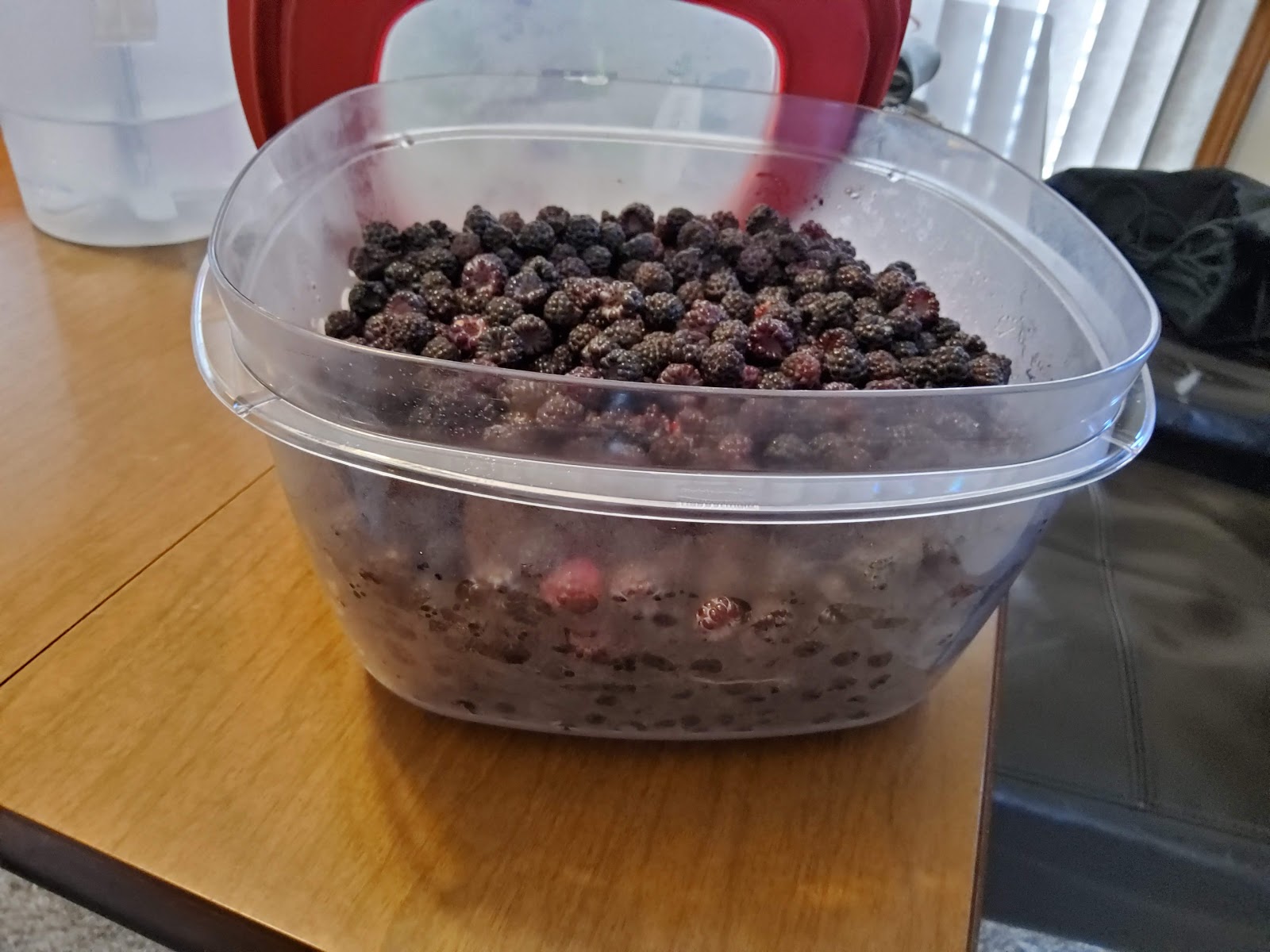
I gathered small handfuls here and there when I was little, but didn\’t think much of it.  Last year, one of my friends got into foraging, and I rediscovered rubus occidentalis.  Together we found several very worthy foraging spots for these delicious berries…  so this year, these happened:

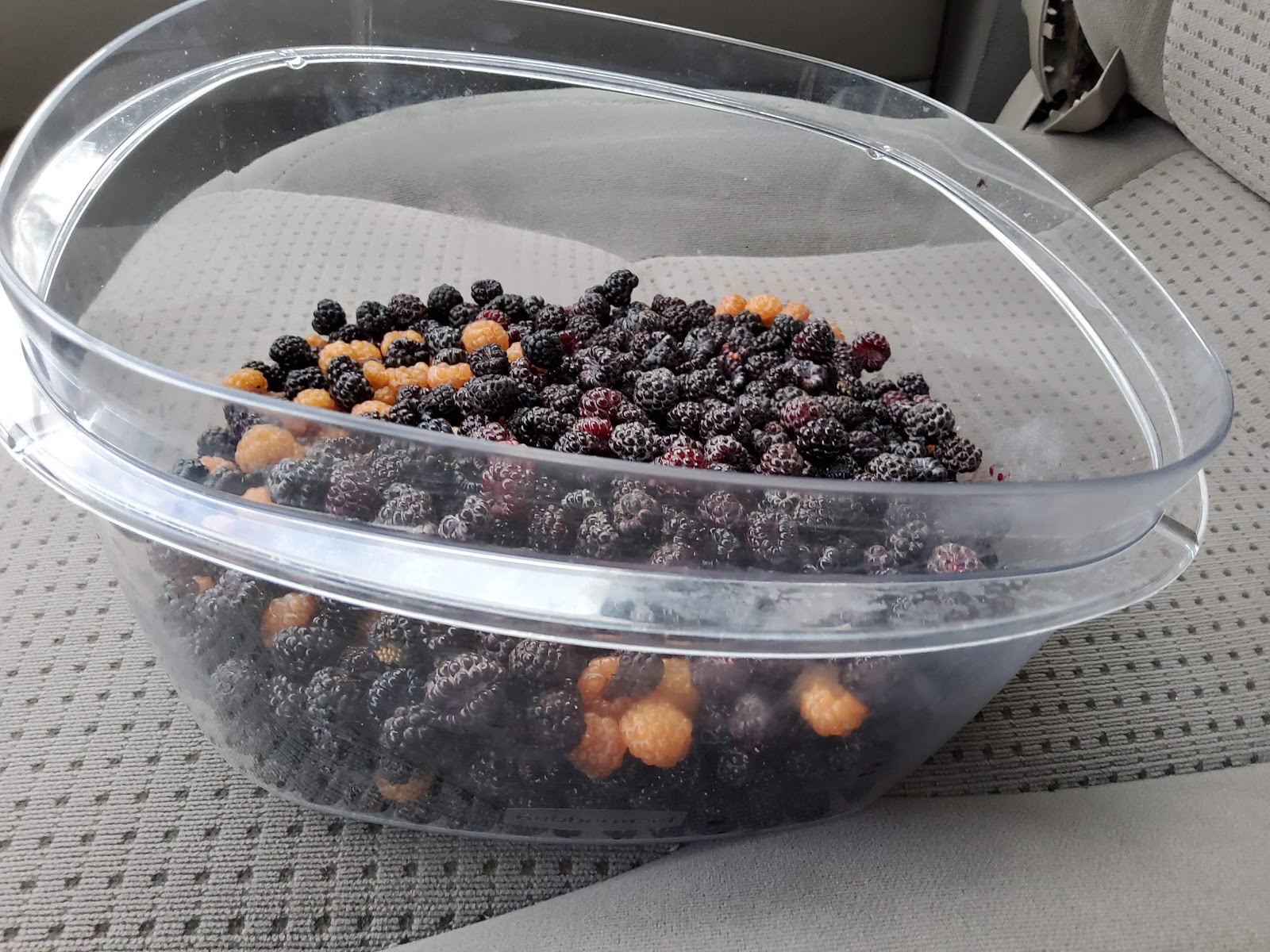
Those are the same size of container, but it\’s three separate trips.  Each container is about the size of a large saucepan… so now you have a better idea of how many berries you\’re looking at.  Suffice it to say, I spent a lot of hours outdoors. 

I think this is one of those things being autistic helps with.  When I wasn\’t berrying with my friend, I\’d put a playlist of podcasts on and just work my way through the area slowly but surely.  This allowed me to get into a state of hyperfocus: much of my mind could be occupied learning about mythology or trying to understand racial oppression in the US, and my hands and eyes were kept busy spotting and harvesting black raspberries.  Meanwhile I\’m breathing fresh air and getting exercise.  Overall, it was a very positive experience.  My main gripe is that I don\’t have enough time in the day when I\’m dedicating several hours to just berrying.

I only got ice cream after berrying once, but being able to throw fresh berries into my treat was really rewarding.  

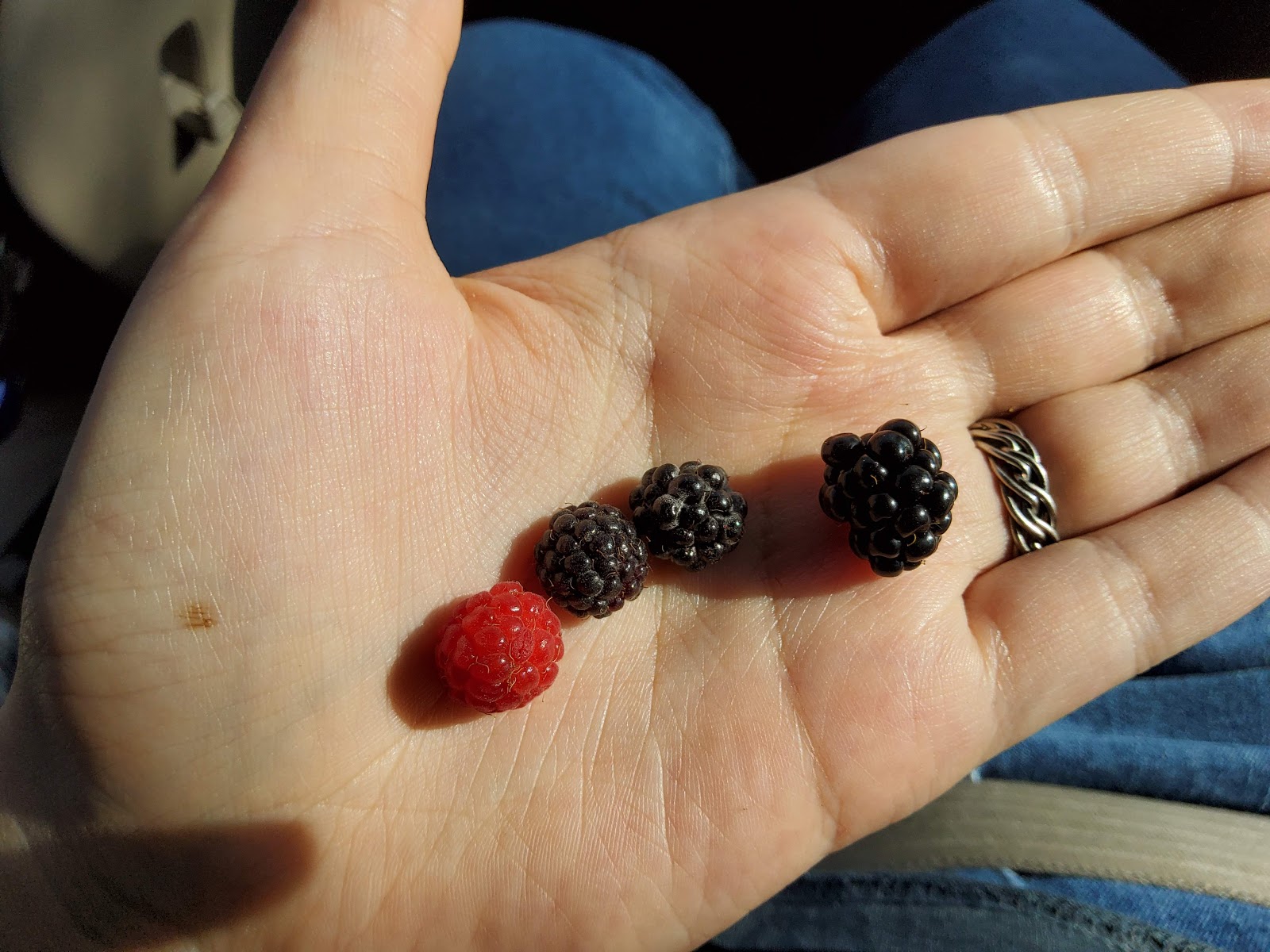
There are actually five kinds of berries in the pictures above.  While the bulk of my harvest was black raspberries, there were also wild red raspberries, wild blackberries, some kind of hybrid blackberry/black raspberry, and what I assume was someone\’s escaped specialized raspberry plants. 

All rubus berries are safe to eat, so I consumed a few of those odd pale yellowish berries.  They tasted exactly like raspberries.  (Please note, not all berries are rubus berries!  Do not eat random berries off plants without IDing them.)

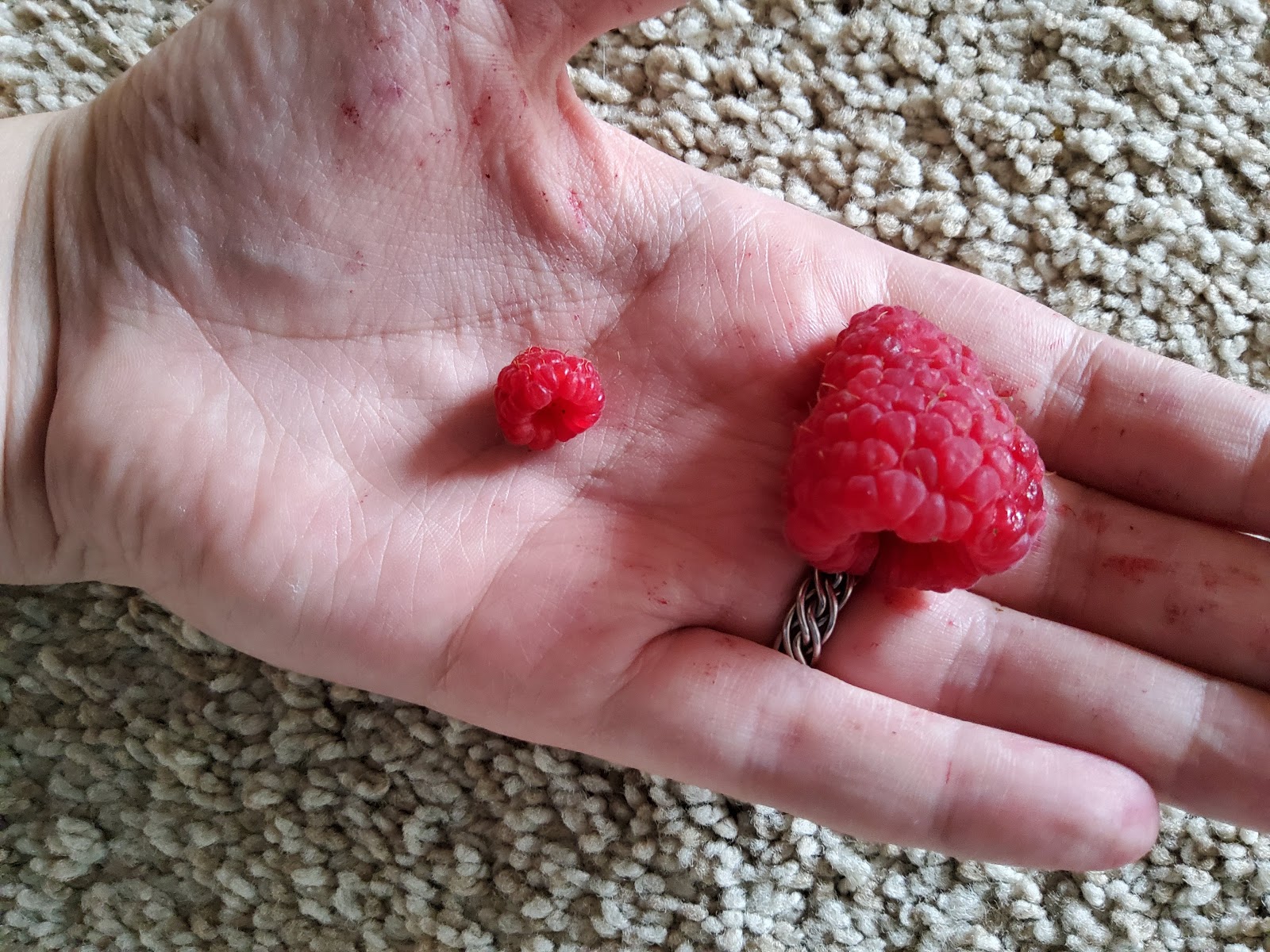
Because it personally amuses me: side by sides of domestic and wild berries.  Selective breeding at work!  I\’m pretty sure raspberries weren\’t the size of my whole knuckle joint when I was little.  Though I think they were still bigger than that wild raspberry in the picture.  Maybe twice the size?

Anyway, once picked, I obviously ate some of my harvest raw…  but I also wanted to cook with them.  Which mean washing them.  From container to soaking (and picking little bits of plant matter out) to drying again. 

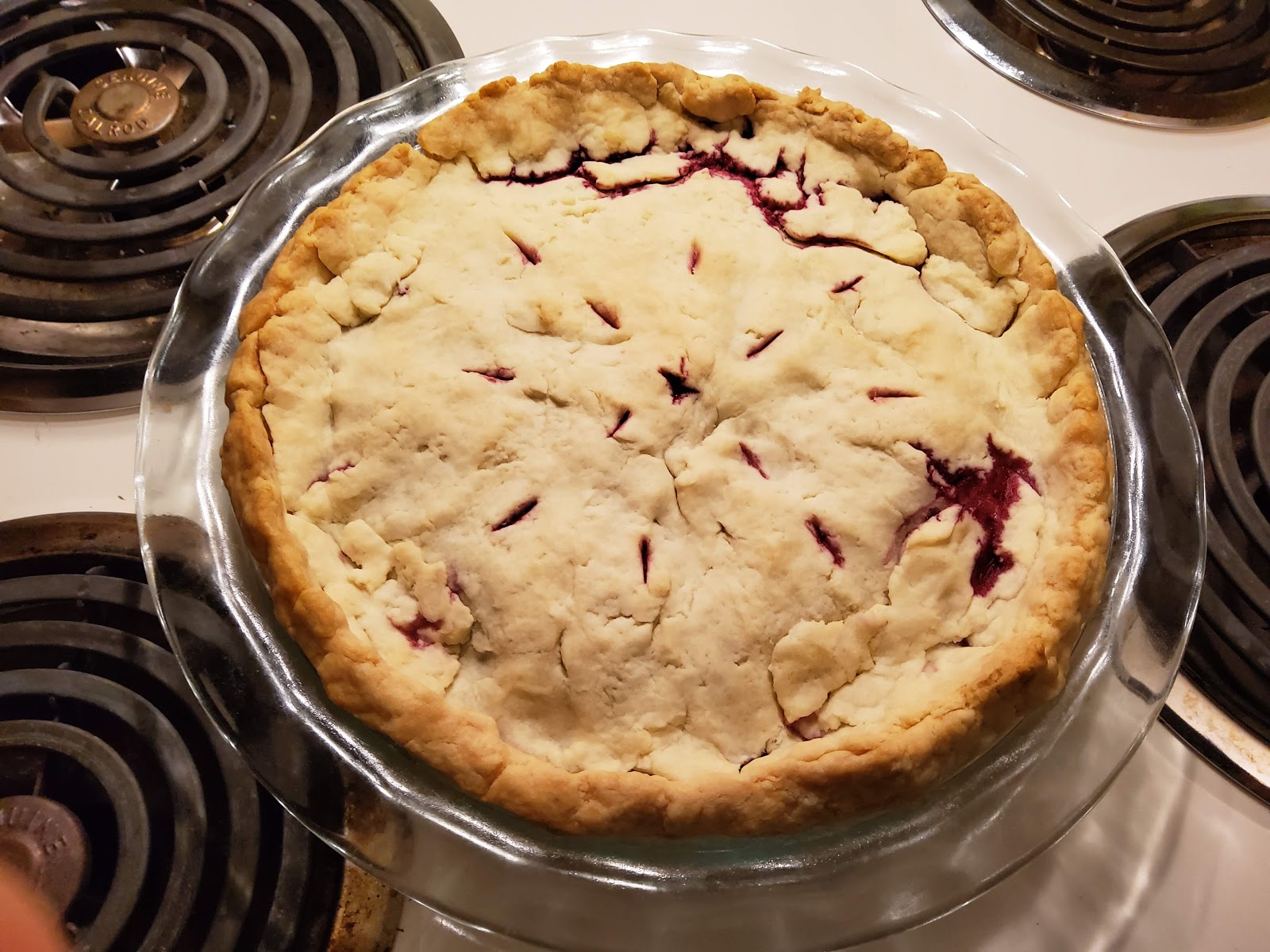
Pies were the obvious choice.  I actually made three, but gave the bulk of those pastries, including a half of a pie to my parents.  I also made a gluten-free pie for the first time, which would be more impressive if I hadn\’t used a baking mix.  The crust still came out poorly, because I couldn\’t use my gluten-infested rolling pin.  So I hand-shaped it and it was fine, but the crust cracked and filling leaked. There will be no awards for best in show, but they were still tasty at least.

There was also freezing them on trays…

And stuffing them into a gallon bag for later.  I may not be inclined to eat a whole gallon bag worth of black razzes (and friends) right now, but winter will likely be another story. 

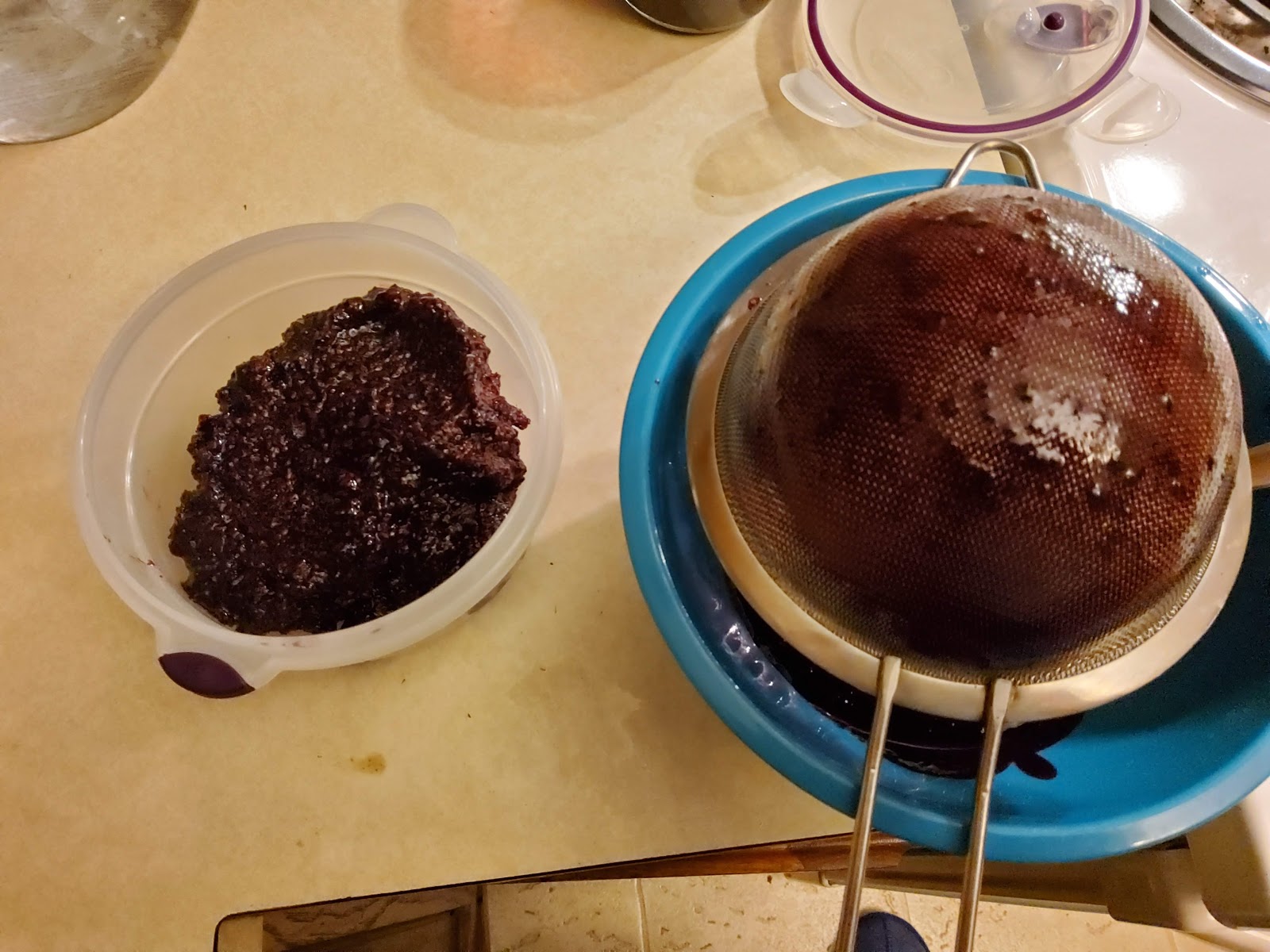
Finally, I also made syrup.  This involved simmering the berries with water, sugar, corn starch (to thicken it) and a bit of vanilla.  The berries have to be mashed pretty good to get most of their liquids out.

You can strain all the pulp out of it, but I left a small amount in, just for some texture.  Leave it all, and you don\’t have a syrup, you have… I guess jam, kinda.  Leave none and you practically have store syrup.  Leaving some reminds you where the flavor came from without making you chew your way through all the seeds.

It\’s pretty good on ice cream!

I\’ve made two batches of syrup now, and frozen most of it in ice cube form.  It\’ll last longer that way and can be thawed out when I want to serve it. 

The season is basically over now, which means I can stop braving the 90+ degree weather and focus a bit more on my plants and handling such things as dental appointments, getting an eye exam, and all that fun health maintenance stuff. 

It\’s been a very active summer for me, and I think I\’m better for it.  Hopefully, my harvest and cooking work will brighten the gloomy winter days ahead.  

Reading the Research: Enforced Poverty

Welcome back to Reading the Research, where I trawl the Internet to find noteworthy research on autism and related subjects, then discuss it in brief with bits from my own life, research, and observations.

Today\’s article is a report issued from Drexel University on the financial status of autistic people.  Or, I should say, the lack of financial stability of most autistic people.

The poverty rate for autistic people is much, much higher than average.  So is the under-employment rate, and the unemployment rate.  There\’s reasons for this.  

First, retaining the services of a therapist or team of care professionals (especially good ones) is incredibly expensive.  There can be a lot of complicated medical issues that come with autism, including epilepsy, sleep issues, a barrage of allergies, and special dietary needs.  Then there\’s services for behavioral and developmental support: Speech-Language Pathologist, school support services, therapist, and home support staff.  

And naturally, sometimes the school refuses to provide what you need, and you also need to retain the services of a lawyer.  

All of this adds up, and atop that mountain of expenses is the typical living expenses: a home, utilities, and food.  How is someone supposed to afford all that?  

Mostly, they can\’t.  Unless your paycheck is in excess of $100k (so, almost no one), that mountain of expenses is impossible to handle on your own.  But the services are still needed.  

So the vast majority of families turn to social security programs.  Medicaid, in particular.  If the need can be demonstrated, the state will arrange (or let you arrange, depending on the specifics of the program) for support services, free of charge.  Sounds great, right?  

There\’s a catch.  Not only is it incredibly hard to get the state to recognize you have legitimate needs, but also Medicaid programs tend to have a limit to household income.  Above that limit, and you do not qualify for services.  

That would seem fine, if the limit was $100k.  But it\’s not.  Instead, it\’s typically around the poverty line or below.  Working class and middle class families are out of luck.  

Say you\’re a family with a middle class income, maybe $60k.  The support services you need will run you tens of thousands of dollars into debt every year, so you can\’t afford to pay.  So then what?  You still need the services.  

The answer that many families have opted for is, \”You quit your middle class job and get something that barely pays your bills, but puts you under the Medicaid limit.\”  

The adult autistic version of this is, \”Well, I might be able to climb the ladder in this company I\’m working at or get training to get a better paying job, but if I do that I\’ll lose my SSI and support services, so I can\’t.\”  That\’s of course assuming they managed to acquire a job with advancement prospects in the first place, which is statistically unlikely.  

Usually autistic people (myself included) simply aren\’t able to get or keep a job of that level.  We might be qualified, even exceptional, for the position, but when office politics comes calling we sink rather than swim, and are quickly let go for not fitting in or understanding.  Here\’s a poem about this.

It\’s a bad situation, and it only gets worse as costs continue to rise, while Medicaid income limits remain the same.  
(Pst! If you like seeing the latest autism-relevant research, visit my Twitter, which has links and brief comments on studies that were interesting, but didn\’t get a whole Reading the Research article about them.)

Worth Your Read: Ask vs. Guess Culture

https://tellmevarric.tumblr.com/post/613906274411823104/ask-culture-and-guess-culture

My spouse ran across this concept from the Internet and shared it with me.  It\’s been very helpful in improving our communication. 

The linked thread is somewhat long (worth reading the full thing, though!), so I\’ll summarize as best I can.

There are two ways of making requests of others.  Say we need to get from Home to Point B, don\’t have the money for rideshare, and don\’t have a car. 

The first is throw caution to the wind and directly ask.  You might call or text friends and family, saying, \”Hey, could you give me a ride to Point B?  My car\’s in the shop right now and I\’m stuck. : (\”  This is Ask Culture, where you can ask for whatever, but you need to be ready to take No for an answer. 

The second is to hint at people, and hope they\’ll volunteer what you need without you having to ask.  It relies on shared expectations and values.  So you might call or text family, and when they ask how you\’re doing, you might say, \”oh, not great, my car\’s in the shop and I\’ve got an appointment at Point B soon.\”  This would clue the other person into your need, and, since they care about you, they might offer you a ride if they\’re able. 

You have not directly asked, and so if they can\’t offer you a ride, they don\’t need to risk hurting or disappointing you by telling you no.  Instead, they might say something like, \”Oh, that sounds terrible.  I wish I wasn\’t home alone watching over the kids- they\’ve got the flu right now.\”  The person has thusly let you know, by way of \”why they can\’t give you a ride to Point B,\” that they are unwilling to give you a ride to Point B.  This is Guess Culture. 

Now, in the original Facebook post my spouse shared with me, someone opined that these two Cultures are equally valid. 

You can probably see where I\’m about to head here. 

Hi, I\’m autistic.  One of these cultures is how I operate naturally, and one of them actively, pointedly, and directly disables me.  Equally valid?  Don\’t be ridiculous. 

Guess culture is rife with literally everything I\’m disadvantaged at: advanced theory of mind, reading body language, subtleties, talking around things rather than directly about them…  All because people don\’t want to say no or be said no to?  Holy forking shirtballs, people. 

The world does not end if someone turns you down.  It may be disappointing, and you may need to find another option, but.  Seriously.  Nor does the sky fall if you have to say no to someone.  If it upsets you that much to do either of those things, you really need to find out why these very normal parts of life are so upsetting to you, and get to work on changing that and learning to be more open about your communication.  Life involves No. 

Another autistic in a different reposting of this thread said, \”guess culture is to autistics as an ice-coated cobblestone beach is to wheelchair users.\”  This is pretty well accurate.  At least the beach can\’t help being what it is.  People can choose how they communicate. 

My spouse and I come from very different backgrounds when it comes to this.  My family, I think, did a mix of Ask and Guess cultures, but because I am who I am, I default pretty heavily to Ask Culture.  My spouse, on the other hand, comes from a pretty thoroughly Guess Culture background.  Needless to say, communicating has been difficult at points. 

The cycle is easy to describe.

I, being somewhat oblivious and exhausted at many points, miss the hints that he tries to give to clue me in that I should offer something.  In turn, he becomes snappish or sad because I haven\’t offered the thing he\’s been cluing me in that he wants.  At some point, an argument starts between us for some unrelated-but-valid reason.  The issue escalates well beyond reasonability, and at some point I learn that my spouse is upset because he wanted me to offer this thing and I didn\’t. 

I become even more frustrated because he didn\’t simply ASK for what he wanted, and he tells me he didn\’t ask because he didn\’t feel comfortable doing so.  I tell him I can\’t read minds and that if he wants something he needs to ask for it, citing that I\’m autistic.  Both of us leave the discussion frustrated, hurt, and sad. 

Thankfully for both my sanity and my marriage, my spouse is working on practicing Ask Culture.  Because my spouse defaults to Guess Culture in times of stress, I am also working on recognizing the signs that I\’m being Guess Culture\’d at.  I can then choose whether to ask straight out, \”Are you Guess Culturing me for something?\” or handle it in some other way. 

I don\’t really appreciate having to put in the extra effort when I\’m stretched thin as it is, but since I love my spouse, it\’s a price I\’ll pay.  I\’m hopeful that at some point I won\’t need to, though.  Guess culture is neither kind, nor helpful, nor supportive for autistic people.  It is rife with passive-aggression, misunderstandings, and chronic over-thinking.  The only reason to learn to deal with it is because other people don\’t give you the option not to.  

Reading the Research: Peering into the How of Sensory Sensitivities

Welcome back to Reading the Research, where I trawl the Internet to find noteworthy research on autism and related subjects, then discuss it in brief with bits from my own life, research, and observations.

Today\’s article gives us some insight into what causes sensory sensitivities.  Unsurprisingly if you\’re familiar with how I define autism, the cause is found in the brain.  

Typically when I speak about sensory sensitivities, I\’m not talking about visual ones.  This is because I mostly don\’t suffer from them.  However, there is actually a wide variety of these sensitivities.  I wrote about them in depth a couple years ago.

As a quick refresher (and for folks that really don\’t have time to read the linked article), there are at least five forms of visual hypersensitivity:

  1. Light sensitivity, which can cause pain when looking at or near LEDs, sunlight reflected off snow, fluorescent lights, camera flashes, and glare from basically any bright light source.
  2. Contrast sensitivity, which can make black letters on a white page blur together.  Needless to say, this causes great difficulty when reading.
  3. \”Tunnel reading,\” which is difficulty reading groups of words or groups of letters together.  It can be hard to move from line to line on a page, which naturally also makes reading a headache.
  4. Impaired print resolution, where the letters on a page or computer screen are unstable, shimmer, or move.  There are a lot of ways to make reading misery, aren\’t there?
  5. Environmental distortions, which is similar to impaired print resolution, except not limited to print.  The whole world, including stairs, faces, furniture, and even flooring can shimmer, vibrate, shift, or warp in your vision.  
This study sought to discover what causes these conditions, and found that autistic brains don\’t moderate themselves very well.  The visual input basically comes in at full force, and rather than tone it down to make it usable, the brain just… gets buried in it.  We can also be more distractible in terms of the motion of large objects.  Finally, they suspect autistic visual areas-of-focus may be smaller than neurotypical ones, meaning some of us may have a sort of \”tunnel vision\” effect.
It seems this team is likely to try to flesh out their findings, so we may get more specific answers as to what\’s going on with visual sensitivities.  Hopefully, with this understood, treatments could be created for people who suffer from these symptoms at a high level.  
Someone like me, who sometimes suffers light sensitivity but is mostly unaffected, wouldn\’t need such a thing.  But a person whose whole world is constantly warping, shifting, and shimmering could hardly focus on school, making friends, and pursing their interests.  
Much of scientific progress is incremental, but I have hope, someday, for less suffering for everyone.  

(Pst! If you like seeing the latest autism-relevant research, visit my Twitter, which has links and brief comments on studies that were interesting, but didn\’t get a whole Reading the Research article about them.)

Book Review: Quirky, Yes — Hopeless, No

Quirky, Yes — Hopeless, No: practical tips to help your child with Asperger\’s syndrome be more socially accepted, by Cynthia La Brie Norall with Beth Wagner Brust, is a topical guidebook focused around handling children in the now defunct \”Aspie\” subset of autism spectrum conditions.

That subtype is basically: visual thinker, no learning disabilities, average to high IQ, mainstream education, fully verbal, no physical disabilities or conditions like epilepsy or cerebral palsy, and fixated on special interests with no general curiosity.

You can essentially look up information on subjects like anxiety, conversation, teasing, sarcasm, and courtesy.  Each has a short section (less than 5 pages) and comes with a \”See also:\” for related subjects.  There\’s a significant amount of repetition of concepts, since some subjects overlap in places.  The overall message is what\’s in the title: autistic people are different, but you shouldn\’t give up on us.  The book is meant to help you understand and give you immediate ideas of what to try.  Sound great, right?

Honestly?  I didn\’t really like this book.  It got a lot of things right, but in some cases it did so in the worst way possible.

For example, one of the early sections talks about meltdowns, and how they\’re different than tantrums.  The issue?  The book doesn\’t use the word meltdown.  It insists on giving you two different definitions of \”tantrum,\” and explaining the autistic meltdown in great depth but not using the obvious word for it.  The content is more or less accurate, in that meltdowns are not about control or getting what you want, but about being overwhelmed or overstimulated and not being able to handle it.  If there\’s a perfectly good word to distinguish a not-tantrum from a tantrum, I can\’t understand why you wouldn\’t use it.

I also didn\’t like the \”one size fits all\” stereotypes the book liked to trumpet.  The thing about autism is that it\’s a spectrum.  The well-worn saying is, \”If you\’ve met one person with autism, you\’ve met one person with autism.\” That includes the subset like myself who were given the label \”Asperger\’s Syndrome\” instead of \”autism\” or \”high functioning autism.\”  There are going to be differences, so saying \”all Aspies do this\” or \”all Aspies have this problem,\” or \”Aspies think like this\” is a massive red flag, and wrong to boot.

This book has tons of those massive red flags.  A personally irritating example is in the section about taking an interest in other people.  The book opines that autistic people are not interested in others, which is a problem because that behavior is expected.  It then says, \”Can we rewire the brain to insert an interest in people?  No, unfortunately, there is no way to hardwire in social thinking.\”  And then talks about how you can train autistic people to fake interest in others so the social expectation is fulfilled.

So, excuse me?  I\’m an autistic person with a general interest in everyone and everything, including other people.  I have had that interest since I was young, and have only gotten better at expressing it as I aged.  I wasn\’t aware that I apparently don\’t exist, thanks for that heads up (sarcasm).

Speaking of ways I don\’t exist, there were a couple mentions of gender talks and dating.  While I absolutely agree it\’s important to discuss these things, the assumption the book makes, that autistic children will be cisgender (either male OR female, both, transgender, or none of the above) and only care about straight dating (never mind all the gay and bi folks), is woefully shortsighted.  Autistic people often find ourselves in gender minorities.  I myself am agender, which puts me in the transgender category…  and apparently again, I don\’t exist.  Talk about LGBTQIA issues, for Pete\’s sake.  It is 2020 and sex and gender are way more complicated than, \”did you check what\’s in their pants?\”

And speaking of things that are outdated…  This whole book, while published in 2009, seems to be stuck in the 90s.  Paper and pencil solutions are stressed.  Phone skills and analog clock-reading skills are pointed out as important.  Look, I get that not every person has a smartphone, but these days, even under the poverty line, it\’s the vast majority.  Children these days are more likely to use a smartphone for organizational solutions, text far more than call, and use their cell phones for clocks rather than squint at a clock with hands.

There\’s a time and place for paper-and-pencil solutions, or whiteboards, or what have you.  But the issue of smartphones was basically entirely ignored throughout the book, and that strikes me as a staggering oversight.  Particularly when talking about bullying.  The book focuses only on in-person bullying, but cyberbullying is now quite common and badly needs addressing in great detail.

My last criticism is that the book seems steeped heavily in the ableist \”autism separate from child\” mentality.  The fallacy in Autism $peaks\’ publicity stuff is that the autism can somehow be peeled away from a person, \”freeing\” the normal human underneath, or some such nonsense.  This shows up in various points in the book, but the one that irked me enough to note it down was on page 163: \”Unlike more severe autism, Asperger\’s syndrome is surmountable to a degree.\”

Hi, it\’s me again, the twice-nonexistent autistic human!  My autism is not a chronic disease.  I have learned to function in your bullshit neurotypical society, but that does not mean I have somehow \”overcome\” my neurology.  I am still autistic, and I will still be autistic even if I solve all my health problems and function at my very best.  Please don\’t imply my existence is something to be \”surmounted,\” and if I just try hard enough I\’ll be \”normal.\”  Yikes.

This is probably the most blistering review I\’ve written and opted to publish, and I think the book bothered me because it got many things right but missed the mark in so many important ways.  The authors spent hundreds of hours around autistic kids, but it\’s like they never spoke to autistic adults or even heard of neurodiversity at all.  I hate to belabor the obvious, but like… maybe do that before you publish your book next time?

Read This Book If

You\’re the parent of an autistic child, and your kid fits neatly into the subtype of autism I\’ve described above.  Most likely, they will not, because autistic people vary quite a lot in our characteristics.  You can still read this book, but it has a lot of problems, not the least of which is that the information would have been most useful in the 90s, and has not been updated for the age of smartphones, cyberbullying, and social media.  There were also major issues with ableism and sweeping stereotypes, which I really did not appreciate.