A Dream: What Might Be

group of people making toast

I had a dream. Last Saturday was my last known weekend for a while. I woke up at like 6am, because apparently my body loves a schedule even while it’s exhausted. But after eating a bit and lying in bed for a couple hours, I made it back to sleep.

I rarely dream, but I tend to pay attention when I do. Sometimes they’re sad. But not always.

Friends, Together

I dreamt of a group of friends, meeting at a restaurant I couldn’t name, but was cozy and dimly lit. Though a couple faces were familiar (Chris, my spouse, and Simon, a person I don’t count as a friend anymore due to his decisions…) most faces I didn’t recognize. Yet each friend (there were at least 7) was familiar and comfortable. We were gathered there to play a tabletop RP game like D&D together.

In this dream, I was DMing (running the game while the others played), and I’d only had minimal time to prepare because of my work. But it didn’t matter, because everyone was having so much fun. Laughter and jokes were frequent. The game got offtrack sometimes but it didn’t matter because everyone was enjoying the experience. There was some drama, but it didn’t bother me for some reason. Perhaps because I knew everyone liked each other and would just get over it. Or perhaps because I’d finally perfected the skill of disengaging and trusting people to be adults about resolving their issues.

A Valued Time

Regardless, we were playing some kind of high fantasy game, but it was a heavily homebrewed thing. I thought D&D, but thinking back on the class names, they’re not from any edition I’m aware of. We played until everyone got hungry, after which we ordered food. There was something for everyone at this restaurant, even me with my incredibly strict no-dairy, no inhumane meat, whole-foods-only thing.

As we were chattering and waiting for food, a couple of the players went off together and did some character development on the side. Because the world and those characters mattered to them and sparked their creativity. After they got back, I offered to run this game every week. I told everyone I had really limited time for prep, so they’d probably only get shallow things like “a quest to kill a particular monstrous pig because a nobleman wanted to eat its bacon.” Somehow, everyone was fine with that. Several jokes were sparked off the bacon idea, and everyone agreed they wanted to do this every week. I felt proud that I was going to be able to help provide this experience for everyone.

A Nation, Known

As we were settling down at the table, I noticed a TV in the corner was playing some kind of video. But instead of an advert for the latest probably-useless product, it was a short piece saluting and depicting immigrants in the US. And acknowledging their importance, and that all of us are descended of immigrants if you trace our ancestries back far enough.

At the beginning, it shunned and called out white supremacy for the lie that it is. But the focus of the movie was really more on the countries from which we all came. There were these little animations with country flags, representing people or populations from those countries. Eventually the shape of the US was formed in the flags of those other countries. This was accompanied by triumphant music.

With my friends, I watched this and put my hand over my heart, acknowledging patriotism and support of this country where differences are strength, and all people have value. I began waking up, but held onto this dream as long as I could. It was perfect and beautiful in ways I may never experience in this life, and I wanted to at least write it down.

What Might Be

This is not the country I live in. It’s the country I wish I lived in. As a nation, we began with immigrants from Europe butchering and displacing the First People nations that lived here. That behavior continues to this day. We begrudgingly allow immigrants into the country (sometimes), but often relegate them to jobs nobody else will take. Such is exactly the case in the job at the food factory, where I find the conditions utterly intolerable. But Spanish is spoken freely and fluently on the floor between most of the line workers. They’ve built a community of sorts, even as the job and the need for money eats away at their lives and souls.

I can’t honestly say whether any of the people in my D&D-esque friend group were black or brown. My focus was less on their faces and identities (save the surprise of the inclusion of one), and more on the atmosphere and interplay between them. For my own sake, I hope so. I didn’t have visible minority friends growing up, and I’m afraid it probably shows in how long it took me to recognize how bad things really are for black and brown people.

Likelihood

I can’t decide if this thing I dreamed is even possible in real life. My sense of reality suggests the first part, with the friends, might be. Maybe not those exact friends, but a friend group like it is a possible thing. It wouldn’t have to be a restaurant. Could be someone’s house, or a park, or whatever. Somewhere everyone could be comfortable.

As for the broader change in the US… well… it’s what I hope for. It’s what I advocate for, when I can. I vote for it when the option is there. I’m old enough to know change typically doesn’t happen quickly. In the dream I felt like I was in my 20s… But at the rate of change I’ve seen…. I’d almost guess I’d’ve had to be at least 60 years old. Maybe even 80.

I won’t rule out real life being able to deliver this dream, if I worked hard for it. I’d need to make friends actively, which is really hard now that I’m working full time. Learn how to improv, so I could run a game off-the-cuff like that. Both of these things are possible, but would have been quite difficult for me in the past.

Are they possible now? I’m not sure.

I also can’t shake the feeling that I’ve been shown a small portion of heaven. That perhaps this dream is not truly achievable in this life.

Wouldn’t it be wonderful if it was, though?

Autism at Food Factory Work

black ship on body of water screenshot

For the last two weeks, I (an adult with autism) have been doing factory work at a local factory that makes baking mixes, breads, and sweets. I thought it might be interesting to give an overview of my experience and tell you whether this kind of work is suitable for autistic people. The workers at the factory have a union. Which I’ve found mostly means that they have their own rules that may or may not make sense or be helpful.

I won’t name the company here because I like avoiding being sued. The job was titled General Labor, which effectively means they’re paying me to pick things up and put them down. It’s a skillset I have, though admittedly not my most valuable skillset. I got this job because I needed work that was full time, quickly. My bills need paying, and at the moment I can’t make part time work pay them.

First Impression

My first and second impressions of the company were not favorable. The online reviews on the job site I applied on were, um… not complimentary in the slightest. That was the first impression. I still applied and interviewed, but I asked some very pointed questions about their conflict and management practices. The answers were somewhat satisfactory. They suggested the management (at least of this section) listens and was reasonably adult about their crap, so I accepted the job.

Second Impression

I formed my second impression on what was supposed to be my first day. I’d been told to arrive a little early to turn in a piece of paperwork for joining the union. Which I did. I arrived about 12 minutes early, and promptly couldn’t get in or reach anyone to let me in. I wasted 5 minutes just trying to get someone to answer a phone so I could turn in this paperwork. Then the lady at the desk took several minutes just to print me a map (which didn’t end up being helpful anyway) and tell me where to go for orientation.

I arrived at 9:02am, two minutes late. The door was closed and locked. There was no built-in way to phone for help. I knocked, and nobody answered. I waited around hoping someone would go through the door, but nobody did. Eventually, in desperation, I called the main line for the company and asked what was going on. The desk jockey told me they would send someone. After another 10 minutes or so, someone did arrive… but she looked me up and down and told me I couldn’t start that day, for two reasons. One, I was late. Two, I was wearing jeans, which weren’t allowed. And there was management in the building, so she didn’t want to risk their displeasure. And thus, because they only do orientation on Mondays, I was sent home and had an entire week off.

Disrupted Schedule

Needless to say, I was not impressed. It was mainly their fault I was late, and punishing me for their failure is not a great way to start a business relationship. It also struck me as astoundingly irresponsible and uncaring of their employees’ time. The start time was 9am. Was I supposed to know, despite not being told, that I should show up at 8:45? Apparently.

Autistic people can be very good at sticking to a schedule and obeying the rules. But we have to know what the rules are. This was not a very autism-friendly start to this factory work job. I’m fortunately fairly graceful about handling sudden changes like this in the moment, but I still cried all the way home and spent much of the day in bed. It was really frustrating to have tried my best to start well, only to have them spit on my efforts and then have to go home for the entire week.

First Day

So, at the appointed time the next week, I arrived 15 minutes early. This time the door was standing open. They checked my documentation at the door and escorted me up to… basically a lecture hall. I had my picture taken for my ID before I’d even chosen a desk.

The ensuing lecture was unpleasantly reminiscent of 8am lectures in college. I came to the lecture tired and somewhat dazed. And just like those lectures, they threw too much information at you to possibly memorize it all. A pen was provided for taking notes, but paper was not. So I took notes on the back of my insurance information folder.

The lectures were with a live presenter, a la the 80s or even the 90s, I guess. Most places I’ve worked simply have training videos, but not here. Like 8am lectures, it was “sit down and listen until we’re done with you.” They then fitted us for uniforms and sent us home. Still not a particularly autism-friendly start to this factory work, in my opinion.

Subjects

We began with training about their onsite freezer chemical (which apparently stinks long before it can harm you, so you really do have to try to hurt yourself with it). Then there was a lecture on Good Manufacturing Practices, which includes a laundry list of things. But it pretty much boils down to “Keep Very Clean,” “Use Proper Clothing and Equipment,” and “Follow the Rules to Ensure Safety.”

After that it was on to Allergens, which is a big deal in food production. You really, really don’t want to accidentally kill someone because somebody had almonds for lunch and a bit got into the waffle mix. I learned here that 90% of food allergies (that are recognized as allergies) are to one of eight things: peanuts, tree nuts (like almonds and cashews), dairy, eggs, soybeans, wheat, fish, and shellfish.

I also learned that there are several additional named categories of foods they need to pay attention to. I’d heard of kosher, organic, gluten-free, and non-GMO. But they also pay attention to halal and pareve designations. All of these mean sourcing only ingredients that meet these standards, so that the final product can also be labeled that way.

After that it was on to various cleaners and chemicals we might use, including the use of protective equipment. And finally, we were taught about how to lock out equipment. And also told we wouldn’t be doing that, but that everyone needed to know it anyway.

There were a couple quizzes about the chemicals and lockout procedures that we needed to fill out and turn in. Thankfully being half-awake was sufficient for that.

Unusual Rules

I’ve never done factory work before this, so a few of their rules struck me as strange. Some are explainable, but others seem just kind of petty.

Rules that Made Sense…

In the explainable category… no one was allowed to have peanuts or tree nuts in their lunch. The exception was peanut butter, but that was it. You couldn’t have candy or gum in the production area. You also weren’t allowed to use any kind of tobacco product, to the point that they’d literally fine you every paycheck if you were. And no strong-smelling perfumes or colognes. Finally, you pretty much couldn’t eat in the production area.

These rules are all meant to limit allergens and contamination of the food products. Perfume and cigarette smoke can make the food product taste like those things. Nobody wants to eat pancakes that taste like cigarette butts or “male musk.” That all made some sense to me.

They also had a rule about not having hair ornaments, like decorative combs, clips, etc. This seems sexist until you remember these things can rip a hole right through your hair net, which then means you’re running the risk of contaminating the food. I have short hair, so I pretty much didn’t care about this rule.

And Rules that Didn’t

But then there were rules that just struck me as pointlessly oppressive or mean. Things that made this factory work job very autism-unfriendly.

No Phones and Internet

My biggest irk: you weren’t to have your phone on the work floor. Not at all, going by the signs on the walls. Absolutely no one paid attention to this when they weren’t being monitored, mind you. There were phones in pockets, phones coming out at moments when no work was immediately necessary, etc. Considering the workplace has no lockers, secure storage, and very limited numbers of clocks, I can’t really blame anyone.

However, my “phone” is a full sized tablet, and no one makes pockets that handle stuff that big. Plus it’d be very obvious. So I ended up having to leave it in the car and bring in an old iPhone I have on long-term loan from a friend. It doesn’t have a data connection, but it has phone games and a clock.

Also? The building has incredibly poor signal for most cellular carriers. The place is saturated with wifi. But when I asked, I was told basic employees weren’t given the wifi passwords on purpose. So during my breaks, I had no Internet unless I went out to my car. Which I believe I was told in my interview is not allowed. (I did it anyway.)

In this modern world, we’re often used to being constantly connected. While I don’t think it’s absurd to expect your employees to work on the clock, I do think it’s unkind to have the expectation that we leave so much of our lives at the door. A rule like this is off-putting, and for autistic people who don’t realize there are two sets of rules (the ones stated and the ones people actually follow), it might be a deal-breaker.

Corollary: No Earbuds, Music, Audiobooks, or Podcasts

I really hated this part. Doing the same thing over and over isn’t the end of the world to me. Some autistic people thrive on repetition, and getting into a rhythm doing the same thing can be exactly what we need. The kicker: some people really need to have music or audiobooks to help keep their focus. Especially people with ADHD, but many autistic people and even neurotypical people as well.

That option is literally nonexistent in this place. You aren’t supposed to have your phone. And even if you do, earbuds and headphones are not allowed. I checked. You can still have earplugs, which helps with the machine noises somewhat, but they’re provided by the company, so I hope you like blue squishy foam earplugs on strings.

This rule made this factory work very not autism-friendly, in my opinion.

Breaks

Speaking of breaks, this factory does not believe in lunch. My state does not mandate any break schedule or lunch after you become an adult. So the union negotiated for two 20 minute breaks. That’s all you get for 8 hours of work. I’m used to two 15 minute breaks and either a half hour paid lunch or an hour unpaid lunch. This rule is very stingy by comparison. Thanks to being at college, I know how to shovel food down my throat quickly. However, it’s a poor practice for enjoying, digesting, and getting the most out of your food.

The shortness of the breaks also means the workers are pretty much limited to bringing food from home. There is no time for, “I’m going to run out for Subway, everyone gimme your orders and money and I’ll bring it back!” Or, “Our team is going to Taco Bell for lunch, see y’all when we get back!” and everyone companionably piling in someone’s car.

On one hand, this means the autistic person’s diet can be catered to as much or as little as they want. If you’re always packing your own lunch, it’s up to you what you put in there. Fast food doesn’t really do dairy-free, gluten-free, low-sugar stuff at the moment. On the other hand, you’re missing the possibility of coworkers and bosses getting to know us as people, rather than just as workers. So those rules for this factory work are kind of a mixed bag in terms of autism-friendliness.

Sitting Down

This is an informal rule I learned while on the job. You are not to sit down. There are basically no places to sit down in the factory. You’re to stay on your feet for your entire shift except for breaks. Management gets upset if they see you sitting.

As someone unused to being on my feet for 8 hours, this was awful. I have two pairs of good shoes suitable for this job. But I’ve never been terribly athletic. Not being allowed to sit to rest my poor, angry feet, strikes me as just cruel. Eventually I’m sure I’d build a tolerance for it, and buying nice padded insoles would probably help. But really, why on Earth would it not be okay to rest your feet when you’ve nothing else to do? That’s stupid, petty, and just mean. If that’s standard for factory work, then factory work is inhumane. Don’t @ me.

The first day I was out on the floor, my legs and feet hurt so badly at the end of my shift that I refused to get out of bed for over 2 hours. Absolutely refused. There were various things I could have been doing that day, but the idea of putting weight onto my feet was so abhorrent that I just couldn’t.

I assume management, had they actually found me resting my feet, would have had a metaphorical heart and let me sit for a bit once I explained my situation. But having a heart is entirely optional. If the person with autism couldn’t explain themselves well and quickly, this factory work might easily become intolerable.

The Actual Work

I’ll now describe the different types of work I did over the course of the weeks. It was never exactly the same work twice over the course of the week, interestingly. I’ve described the first day, which was entirely orientation.

Day 2: Tour and Glaze Packing

The second day I started off with meeting my boss’ boss. He personally gave me and the other two new hires a tour of our area. He also explained his management style, which is aiming for “approachable, open, friendly, and willing to listen.” The tour and explanation probably took an hour or so.

Then we were given our assignments. The other two were assigned to work somewhat like warehouse jobs, where you put together bags of the ingredients needed for recipes going into production. That involves lots of lifting, and they unironically only assign men to that work. It’s insisted that this isn’t sexist. I have my doubts. At UPS, women were fairly evenly assigned to trailers. Here, not so much I guess.

On to the Production Line

I was assigned to a factory line that makes doughnut glaze. Because I was new, I was rotated through exactly two stations: making boxes and filling them with plastic bags of glaze. I was assigned to work with a kindly older Hispanic lady. She A) was clearly very competent and caring, and B) had limited English skills. She would become my Square One for the job. If I didn’t know what I needed to be doing, she was the person to ask. Or in my case, walk over and look confused. That part of the factory work, at least, was autism-friendly. Having a Square One is essential.

Many of my coworkers on this line and elsewhere spoke Spanish more than English. This was more than a little isolating, because I can count to 10 in Spanish and say good morning and thank you, and that’s about it. Learning additional languages is really not my strong point, but it could be a great experience for someone wanting to polish their skills with native speakers.

At any rate, for the rest of the day I taped the bottoms of boxes and lifted bags of icing off the conveyer line and into those boxes. I had concerns about getting a repetitive motion injury, but thankfully that didn’t happen. Fortunately I was only mildly sore, and it went away quickly. I fell into a sort of waking trance during the work, and badly missed my podcasts and music.

It was very much like school. By the last 2 hours or so, I kept checking the clock and willing the hands to move faster. It’s also the most footsore I can remember ever being, which is a big part of why time seemed to move so slowly. When I got home, I took care of a few small things around the house and then got in bed and refused to put weight on my feet for over 2 hours.

Day 3: Glaze Rework

The next day, I was still assigned to the glaze line. However, I also had an appointment to get to at noon, which would turn out to be incredibly fortunate. In this factory (and perhaps elsewhere), when you need to remake a finished product, they call it rework. And that was my job that day.

Literally, there were boxes of icing. We were issued knives, and the job was to cut the bags open and get them emptied down a specific hatch into a heating tub. The knives were not terribly sharp, I’m afraid. But I still had to wear a cut glove, which is basically a tight, knife-resistant cloth glove. That went on my off hand, under the blue gloves we wore to keep the food sanitary.

The machine room was rather warm already, and the hatch in question was up on the second floor. So this was already somewhat unpleasant. Then, despite my mask, I could also smell the icing. And unfortunately, the process of emptying the bags of icing was a messy one. You had to squeeze them with your hands to get all the icing out. Then, when it was sufficiently empty, you’d toss it into a nearby trash can. The icing got everywhere. My shoes, my pants, my shirt, my arms, and apparently even my hair.

I learned later there were plastic aprons I could have been using, but the machine operator and everyone else forgot to mention it (it’s common equipment everyone knows to use, in their defense). I eventually found one and wore it, but by then it was obviously too late to save my clothes. Fortunately, it’s mostly just sugar and liquid. Nothing the washing machine can’t handle.

How to Hate Food in One Easy Step

The real kicker was the smell. I was sweating, my arms hurt, it was hot, and the smell of the icing was all-encompassing. Like most humans, I’m an associative creature. So I began to equate the smell with the experience. Dislike started replacing my immediate “ooh, smells good” reaction to icing and doughnuts.

I strongly suspect, had I not had to leave for my appointment, I would have ended the day with a hatred of the smell of sugar and icing. Which makes me think that working in a food factory might be a spectacular way to ruin your love of food.

Thankfully, I left at noon for my appointment. So I wasn’t particularly footsore that day, and had some time to recover from squeezing all those bags of icing. I did end up with some nice bruising on both forearms from leaning on solid stainless steel equipment while I was working. As of writing this post, those bruises have mostly healed.

Day 4: “Cleaning”

When I came back to work the next morning, I found out that the glaze line had finished their work. There was nothing more to do in production there. Most of the workers went to other lines.

Me, though? I and my Square One got the clean up assignment. This involved wrapping certain pieces of smaller equipment in plastic, to start, so they would be protected from… something. I’m honestly not sure what. Powdered sugar? A pressure washer? Dust? It was never explained.

At any rate, once that was done, the torture began. You see, there was not, in fact, all that much to clean. And there were probably 6 hours to burn after the plastic stuff was done. We got 2 microfiber cloths each, and a bucket with a little water and zero cleaning product. Thus equipped, the Hunt For Anything At All To Clean was on.

I’m actually having trouble recalling precise details of this day, which I think speaks to how miserable it was. It wasn’t just the boredom. It was that there really was nothing that particularly needed the help.

Make Work

I wiped the inside and outside of cabinets, even though they weren’t or were only barely dusty. I cleaned inside phone boxes, at least one of which no longer had a phone. Wiped stainless steel equipment that wasn’t particularly dirty just to make it shine a bit more. And railings that showed no sign at all of needing the care. The water wasn’t disinfectant, so really what was the point?

By the second half of my shift, it was a joy to actually spot dust I could attend to. Even though it was barely there. The once I found some actual glaze spilled down part of a railing, I exclaimed happily out loud. That was how soul-crushing this work was.

I think I took four bathroom breaks that day, and I took zero the days before. I dumped my bucket far more often than was necessary, and took extra long in cleaning it out and refilling it. Sitting down is against the rules, remember. And there was nowhere to hide, really.

Also, it was literally “clean stuff” or “go home,” and I needed the money. I no longer wonder why everyone I’ve ever seen in the factory grimaces when they mention cleaning. It wasn’t hard work. It just made me wish I didn’t exist. At no point can I recommend this kind of factory work to anyone, with or without autism.

Work like this is where motivation and joy go to die. I would quit in a heartbeat if this was going to be my life every day.

Day 5: Waffle Mix Rework

The next day was once again different. With no more cleaning to be done, I was instead assigned to a different production line. This one made waffle and pancake mix. Y’know the self-serve Belgian waffle stations at hotels? The ones with the little cups of batter that you pour into the machine? Yeah, they make that waffle mix at this line.

It was rework again. This time it wasn’t bags of icing, thankfully. It was bags of waffle mix. I was issued a knife and a cut glove to protect my off hand, just like last time. The job was to cut open the bags and empty them into sanitary bins, roughly the size of janitor trash cans.

Once enough boxes had been emptied into the bins, we emptied the bins into the machine. This meant the mix went everywhere and got on everything, basically. Including my shoes and my clothes. After that was done, the machine processed the ingredients for a while. Which meant that after the bins were refilled, you had nothing to do but stand around.

Again, sitting down on the job gets you in trouble. Unlike the other line, though, this line was up high on the third floor. Meaning management doesn’t typically just wander by, and can’t easily spot you. So unlike other days, I did sit down a lot. The other workers mostly didn’t follow suit, but they didn’t give me grief either.

Therefore, this was the only day of factory work that I wasn’t footsore after.

Bonus Day 6: Mandatory Overtime, Just Kidding!

On Friday morning, management told us that there would be mandatory overtime on Saturday. They didn’t name anyone specifically. But when I asked the leadership afterwards, they said this was quite normal and everyone should come in. My local union rep echoed this sentiment. I assumed this meant I was to treat Saturday this like a normal work day.

So bright and early, I showed up as I had each previous day. But when I went to find where I should go, my name wasn’t on the assignment list for a production line. I clocked in anyway and went to where the 8am meeting should have been. There was nothing. No one gathered and waiting. No familiar faces. And of course, no Square One.

A Lack of Answers

I wandered around the facility trying to find someone to ask what I should do. I went to HR, which typically has an open-door policy. They weren’t in. The office was dark. The door was locked. Management wasn’t in. Same deal. I guess it’s all fine and well to demand your workers sacrifice their Saturdays, but doing so yourself is a step too far. (Why yes, I might have Opinions about this.)

Eventually I found a different assignment board that basically said “if your name isn’t on these lists, you’re not working today, go home.” So not only do they expect everyone to show up to work, but also they don’t give you the courtesy of telling you whether you’re going to waste your time and gas getting there.

This deeply displeased me. That kind of schedule disruption and implied disrespect for my time and sleep is really concerning. I can’t imagine most people with autism would handle this mandatory overtime/just kidding facet of factory work well. I really wonder about the union in this place.

At any rate, I clocked out and went home. I couldn’t get back to sleep. That ship had very much sailed. But I was able to do a few things around the house that I hadn’t expected to have time for. I also started writing this post. I felt so annoyed by the situation that I got about 2,500 words down before my brain begged to do something else. I’m kind of proud of that, to be honest.

Pros and Cons

So after all this, what’s the conclusion? Is factory work a good fit for people on the autism spectrum?

Pros

So here’s the thing. Factory work can be really good for people with autism. It’s often steady, predictable work. The hours are fairly regular, particularly with good management and a steady customer base. Autistic people can thrive on repetition, which a factory has plenty of.

The pay was decent enough ($16/hr and up), particularly with the labor shortage. Maybe not enough to pay for house, car, and expenses by yourself, but enough for a good start. And of course there’s advancement, at least ideally. So you might start on the lines, but you could move up to Quality Control or management or being a machine operator.

There’s also limited social interaction expected in factory work, which can be an important factor to keep in mind when job hunting on the autism spectrum. The two production lines I worked on had maybe six people working on them at any given time. Sometimes far less. That’s not too many people to juggle. In my case, I didn’t even need to differentiate that much. All I really needed was to recognize my boss and recognize my Square One. The others mainly kept to themselves and chattered in Spanish.

Finally, this factory was pretty clean. Sanitation is extremely important in food production, of course. Tainted product becomes sick customers and lawsuits and tons of lost money. But some food factories, I’m told, are better than others. This place had a lot of precautions in place, from washing your hands before entering work and after breaks, to shoe brushes and sprays. Hairnets, gloves, and beard nets were mandatory. It was annoying at times, but in all honesty, I’m glad for the concern.

Cons

That said… I’m going to assume success for work like this is a matter of finding a good fit. Policies and rules vary by the company and the type of work. Food production, like the place I worked, likely has more stringent sanitary requirements than other types of production. You probably don’t need to wear a hair net (and a beard net if applicable) and pay very careful attention to which color gloves you’re wearing at some types of factories. You might not need to sanitize your feet every time you leave the break room.

I, for one, found the incredibly limited breaks and the no headphones policy rather intolerable. I like to take my time eating my food. And if I’m going to be doing the same thing over and over, I want to be learning about autism or listening to music or hearing about myths and legends from around the world. Also, anyone should have the option to sit down if they need to. I don’t know what purpose that rule serves, other than to purposely make workers miserable.

Racism and Sexism

Also, the leadership in this factory is pretty white and male. Usually both those things, especially as you move into positions off the factory floor. Whereas the workers in the lines are more often black or brown, and many are female. As a white apparently-female line worker, I’m an oddity. I dislike this state of affairs, as it strongly suggests glass ceilings are in effect. The leadership of the factory doesn’t seem to be drawn from the pool of line workers… or if it is, it strongly favors cis white male workers.

Finally, there’s some fairly strong evidence for a culture of (usually) subtle sexism in the factory. Women aren’t typically assigned to parts of the line where lifting stuff is required. When I talked to a couple people about that, they said something along the lines of “oh, men are better suited for that.” In contrast, when I worked at UPS, I got assigned to trailers of whatever happened to be on hand… If it was heavy, sucked to be me. And all the women who’d worked at UPS longer could have snapped my spine in half, even if they looked tiny and fragile.

I don’t think this food factory is a good fit for me in the long run. That doesn’t mean other factories couldn’t be. Factory work in general seems like it might suit a lot of autistic people. In fact, I recently met an autistic guy that loves his factory job. So there’s definite potential there.

Would I recommend this particular factory to other autistic people? No. No I would not. I’ll be taking a new job elsewhere soon, with no regrets.


Thriving Autistically: Communication

two women sitting on chairs beside window

This post on autism friendly communication is part of a series on thriving as an autistic person. We live in a world that is not always kind or accommodating for people who are different. Not only that, but autistic and other neurodiverse people can have very fragile health and specific medical needs.

Finding out what works for you is a significant endeavor. This week I’ll be focusing on communication styles so you (or your loved one) can live your best life. The first post, which prompted this series, is here. The second post, on food and supplementation, is here. The third post covered movement (exercise and more), and the fourth was on creating an autism-friendly environment at home and work.

As you read this series, please remember autistic people can have very different experiences. I’ll tell you what works for me, and do my best to explain other things I’ve heard of. But in the end, you are your own best resource. Try things. Find what works for you. Find doctors and specialists that will help you explore your options intelligently and safely. How good or bad you feel every day is, in some very important ways, up to you.

Types of Communication

Autistic people communicate in various ways. The societal standard is, of course, verbal communication. It’s expected that you express yourself over the phone or in person. This type of communication is often supplemented by nonverbal information, such as facial expression, posture, and head/body orientation. The modern world also allows and expects a significant amount of ability to communicate via text. Things like sending text messages, emails, or even writing letters are valued to some extent.

The thing is, autism friendly communication can include a whole lot more than just these. I’ve described some forms of communication in more depth in the past, but in truth, I left some things out. Some people use sign language, for example. There are various systems of communication involving pictures, including the Picture Exchange Communication System. Some of these come in smartphone app form, making them extremely accessible.

Alternatives and Preferences

There’s also things that technically count as Augmentative and Alternative Communication, but I consider facets of one of the previous categories. For instance, physicist and genius Steven Hawking used a speech-generating device to communicate verbally. I’d consider that verbal speech, even if the tempo of the speech isn’t an exact match to a human using their vocal cords. Pencil and paper communication is a form of textual communication to me.

Although I learned to speak and write at about the same rate as other children, I still favor textual communication over other forms of communication. I do best with instant messages or texting, where you’re still having a conversation at a rate I can follow, but I don’t need to worry about displaying or reading body language. My absolute least favorite form of communication is using the phone. Something about having the tones of voice and immediacy without having the person’s face to read is utterly maddening to me.

As always, your metaphorical mileage may vary. Some people love talking on the phone above all else, and hate writing emails. Others prefer communication where they don’t feel pressured to respond right away, and so emails and snail mail (physical mail) are their preference. Some autistic people’s vocal cords don’t respond the way they want, which makes verbal communication difficult or impossible. Others have motor skills challenges, which can make sign language and typing immensely frustrating. Autism is a very individual experience, and autism friendly communication means finding what works best for you.

Direct, Honest, and Kind

These three qualities are best practices when communicating with autistic people. When I communicate with people, these are what I aim for, even an an autistic person talking to neurotypical people. Since miscommunications are common in autistic-neurotypical communication, I find it valuable to take steps to minimize them as much as possible. The less time and energy I spend trying to figure out misunderstandings, the better I do.

Direct

Approaching a subject directly, rather than circumspectly, helps us know exactly what you mean. It’s essential for autism friendly communication

For example, say it’s my chore to do the laundry. For some reason, I have not done this chore despite the dirty clothes piling up. One way to remind me of my chore would be to put laundry hampers of dirty clothes in front of my door. The sight of this might remind me.

However, I might simply move the hamper out of my way and continue onwards, entirely oblivious to your implied message. And thus, it is wiser and more effective to say, “Hi Sarah. I had the expectation that you would do the laundry this week, since it is your chore. It doesn’t seem to have been done, and I’m feeling frustrated about that.”

We can then have a discussion about the situation. Perhaps I might recognize the situation and apologize for forgetting. We both might realize I’ve been working extra hours this week, and my normal patterns have been disrupted. Or it might be that we recently swapped chores and that one is actually your responsibility this week. Regardless, your frustration can be addressed and the situation rectified.

Honest

This hopefully goes without saying. Autistic people typically don’t thrive at noticing subtleties or reading between the metaphorical lines. Lying or being misleading about what you want or how you’re feeling is incredibly unhelpful. Even white lies can cause a great deal of confusion. Being “polite” should come second to being understood, in my opinion.

Many autistic people, including myself, tend to take things at face value. If you say you’re feeling a certain way, I tend to believe you. So sarcasm and some types of humor can be really challenging. So can metaphors and turns of phrase.

A few years ago someone used the phrase “loaded for bear” to summarize how incredibly prepared I was for my doctor’s appointment. I was utterly confused until he explained the context, which apparently was that when you went hunting, you took ammunition for the quarry you were after. But very safe (or paranoid) hunters might also take bullets suitable for shooting bears. Just in case one happened along and threatened to ruin your trip.

I find it interesting that some familiar sayings can actually be deconstructed or put into context to make sense, but that’s not always the case. When in doubt, avoid the idiom and just say what you mean clearly. Not every autistic person has an affinity for language.

Kind

I wish this went without saying.

Be kind; everyone you meet is fighting a hard battle.

Ian MacLaren/John Watson

This is typically true of all people, but it’s especially true of autistic people. We often have a multitude of medical issues, emotional baggage, and communication difficulties. These factors make it exponentially more difficult to handle situations, manage ourselves and our emotions, and thrive.

I include being tactful as kindness, by the way. Honesty without kindness is rarely welcome at parties, and wins you no friends or consideration from others. There are ways to say, “Yes, that dress does make you look fat,” that don’t run such a high risk of hurting the asker’s feelings. Although in that particular case, I typically just point that I have no fashion sense and thus my opinion won’t be helpful.

Ask vs. Guess Culture

When you ask for a favor, do you go right out and ask, knowing the person might say no? Or do you hint at your problem and see if the other person will offer what you need? On the whole, which of these two approaches do you use?

For instance, say you need a ride home from school or work. Do you ask a friend or family member, “Hey, I have an appointment after work, but my car’s in the shop. Could you pick me up from work today?” Or do you tell them about the circumstances that have made your usual transport not possible, and hope they’ll offer what you need if they can help? Like, “I have an appointment directly after work, and my car’s still in the shop. It’s such a bother. I’d take the bus, but it’s so slow I’d miss the appointment…”

Defining

This direct method is Ask Culture. The indirect, subtle method is Guess Culture. This is an Internet theory, rather than a scientifically proposed theory. However, I found it rang remarkably true on inspection. So here’s the original inciting story, if you’re interested. The short version is that these two styles of communication exist side by side in people. Sometimes people use a mix of these, or are more likely to use Guess Culture in their families or friendships that aren’t super close.

In Guess Culture, you avoid putting a request into words unless you’re pretty sure the answer will be yes. Guess Culture depends on a tight net of shared expectations. A key skill is putting out delicate feelers. If you do this with enough subtlety, you won’t even have to make the request directly; you’ll get an offer. Even then, the offer may be genuine or pro forma; it takes yet more skill and delicacy to discern whether you should accept.

The original article and thinking insists that these types of communication are equally valid. And I will say that it’s not uncommon to have either style. Some families communicate almost entirely in Guess Culture. So it’s not like either style is abnormal. However…

Choosing Fair Communication

Frankly, when it comes to autism-friendly communication, Guess Culture is disabling. That tight network of shared expectations? And the skill of putting out delicate feelers? That’s putting a steeper learning curve on communication. That’s extra effort and pain, put on a person who’s often already struggling with significant emotional and physical difficulties.

In my opinion, that’s asking us to play mind games. We already often start at a really significant disadvantage when learning how to communicate. Sometimes even stringing together whole sentences is a struggle. And then this is the expectation? If this was math, that’s like asking someone to do Calculus when they haven’t even gotten a handle on Algebra yet. It’s patently, systemically unfair.

So yeah. If your goal is to support your autistic loved one or self, opt for Ask Culture. Become okay with asking directly for what you want, and hearing “no” sometimes. It’s really not the end of the world. It’s clearer, more honest, and it’s a lot fairer to people with all kinds of communication struggles, not just autistic people. In my opinion, there’s nothing polite about complicating your communication and disabling an entire group of people in the process.

Nonverbal communication differences

Autism-friendly communication can mean recognizing and accepting differences in body language. There can be some really major differences, which can cause significant friction if left unaddressed.

Eye Contact

This is such a common metaphorical tripping hazard in autism communication that it was literally the first thing I thought of when I sat down to write these sections. Autistic people, and other neurodiverse people, often have different patterns of eye contact than the established norm.

Allistic or neurotypical people adhere to a socialized norm for eye contact. In conversations in the US, that’s about 85% looking directly at the speaker, 15% looking away at the floor or some other object. If you give 100% eye contact, it comes across as aggressive or like you’re staring. But if you don’t look at the speaker enough, the assumption is that you’re not paying attention.

There’s a problem with those assumptions. Being forced to make eye contact or look at someone’s face can wreck an autistic person’s ability to comprehend spoken words. Some autistic people can’t hear at all if they’re forced to make eye contact.

If this is true of you, it’s something you should communicate to friends, family, and coworkers. The potential for misunderstandings around this facet of communication is quite high, unfortunately. These are expectations neurotypical people have but often don’t realize they have. It’s important to help them realize that their observations and expectations might be incorrect when it comes to autistic people.

Posture and Body Language

This subset of nonverbal communication is actually one of the fastest ways I typically spot other autistic and neurodiverse people. For me, it’s particularly evident when people walk. Autistic and neurodiverse people, myself included, often have a certain clunkiness or stiffness to our movements. I assume this is related to differences in our brains, and goes hand-in-hand with gross motor function challenges and problems with feeling where your body is in space… but I honestly don’t know.

What I do know, though, is that if I’m doing poorly, I notice my movements actually become more stiff and clunky. Which can be one of the first signs of struggling that I notice, sometimes. Which feels kind of backwards, but I figure as long as it works, it’s fine. (I wouldn’t say I’m ever graceful in motion, by the way… except maybe 13 years ago, and only on roller skates. Maybe.)

Regardless, autistic body language can be different than neurotypical body language. Certain parts of body language may be stilted or exaggerated in autism communication, and others may be missing entirely. As a result, I have to confess to significant discomfort when interacting with other neurodiverse people.

I spent years finely tuning my senses to pick up on all these minute details from neurotypical people. There are certain rules that are typically followed. Certain gestures mean things, and I’ve memorized quite a bit in terms of general patterns and specific details. It’s really confusing to now be interacting with people where these rules don’t apply, or partially do. It’s all on a case-by-case basis, because autistic people are very different.

That doesn’t mean I’m going to stop spending time with other autistic people. I simply need to get better at adjusting my expectations for body language and posture.

Complicating Factor: Mental Illness

By the way, a person’s entire posture may be dictated by struggles with mental illness. Depression and anxiety often co-occur with autism due to the difficulties we can experience in a world that isn’t suited to us.

Growing up, my own posture, which included hunched shoulders pretty much all the time, was likely a product of my depression and lack of confidence as well as my general struggles. I’ve seen similar postures since I started paying attention. Here’s an example.

I’ve actually seen even worse versions of the leftmost pose.

Again, body language is partly a socialized thing. It’s not usually directly taught. If it was taught by rote, it wouldn’t be such an issue in autistic communication. I don’t think I chose to slouch in childhood, but I also didn’t try to stand or sit differently. I’m fairly certain I was told to, but it simply wasn’t a priority.

Facial Expressions

This is one of the biggest parts of nonverbal communication that autism research focuses on. It’s been a big thing because autistic people often don’t read them well, or at all. Yet it’s something neurotypical people often take for granted.

Here’s the kicker: facial expressions vary by the person. They vary by the situation. And by the culture we live in. They aren’t simply ways to communicate the speaker’s mood, but also a method of influencing those around us.

Think about it. The way one person expresses anger might include narrowed eyes, furrowed eyebrows, and a raised voice. But some people go quiet when they become truly angry. They stop showing emotion as much, in service of trying to restrain their fury. Or in a quiet, comfortable home setting, a person might feel free to express themselves as they choose. But in a workplace, especially an office, it may not be acceptable to raise your voice to indicate your anger. So a neurotypical person might modulate their anger response or stifle it entirely.

And finally, some cultures prize lively expression. I currently work in a factory with various people with heritages from parts of Central and South America. Some of them dance and sing, even as they work repetitive, boring jobs that could easily crush the soul. One guy I’m particularly fond of actually insisted today that I might call him a mildly insulting word, simply because he forgot to show me the plastic aprons this morning and I got icing all over my clothes.

Nonverbally autism friendly

Nonverbal autism friendly communication doesn’t mean leaving body language out of the conversation. But it can mean noticing what body language you’re using and translating it directly if your words aren’t already doing so.

If you are feeling frustrated because you don’t think your partner is listening to you, your face is likely communicating that fact. But you might also say, “I am feeling frustrated right now because it doesn’t seem to me like you’re listening.” Expressing yourself clearly gives the other person a second chance (or first chance, if they can’t read your body language) to address your concern.

Autism friendly communication also means being okay with atypical body language, eye contact, and facial expression patterns. It can mean learning what’s normal for the autistic person. Because we differ so spectacularly, there aren’t really basic rules to rely on. The only pattern you can link back to is that we’re all trying to “speak” different versions of our cultural standard for body language. How well we learned those standards varies. So does how well we can use our bodies to express what we’ve learned.

Supports

Most of what I’ve discussed here is more about direct communication with people with autism, like talking or emails. I’d like to briefly touch on some things that are also communication, but are more indirect.

It can be helpful for autistic people to have routines and patterns to our lives. It can also be helpful to have expectations expressed clearly, in a central location, where they’re easily accessible to us. This is where supports come in.

Think about the expectations you have for yourself or your loved one with autism. Who does which chores, how often? Where are appointments tracked? Schedules, calendars, and chore boards can all be important and helpful additions to our lives.

For example, I started using Google Calendar in my second year of college. I have it track everything. It’s complete with reminders, notifications, addresses, even the people I went with sometimes. I couldn’t possibly remember most birthdays without it. And definitely not my doctors appointments. I can now look back and find out exactly what I was doing in any given week, which is really helpful for filling out job applications.

Similarly, there’s a chore board up on the wall by my computer. Each chore is on a card. The cards are labeled with their frequency and the chore’s name. The board has two halves, with my name on one side and my spouse’s on the other. I can easily check which chores I’m responsible for at any given time.

Maybe you do better with a physical planner you can carry with you. Or perhaps your chore board should live in the family room. There are a lot of different options to try. Find what works for you.

TL;DR Autism Friendly Communication

Recognize there are many kinds of communication. Speech, texting, emails, Picture Exchange Systems, and behavior are just a few. All of them are valid. Regardless, be direct in your communication as best you can. Be honest. Lying or twisting the truth only makes things harder for us. And be kind. Autistic people often struggle with medical issues, emotional difficulties, and communication difficulties. Recognize each of us has our own problems, and extend grace and kindness to others.

Choose Ask Culture over Guess Culture. Ask directly for things, and be okay with hearing no sometimes. Don’t make us guess what you want or mean. That relies on us knowing your expectations and behavior patterns without communicating them, and that’s disabling. Choose fair communication. Ask.

Be aware of differences in nonverbal communication. Eye contact is a big one. Some autistic people aren’t able to listen well if they’re forced to make eye contact. Forcing neurotypical-style eye contact is disabling to such people. Our body posture and movements can vary too. Facial expressions can be a nightmare to read properly, in part because they vary by the person, the situation, and even the culture.

Translate your body language if needed. Telling people directly that you’re upset, rather than waiting for them to read your frowning face, can help make communication easier for autistic people.

Finally, include supports to clarify communication. Centrally-located calendars chore boards, and schedules can be incredibly helpful to making expectations and routines clear for everyone. These supports can improve the wellbeing of autistic people in the short and long term.

As always, find what works for you.

Book Review: Nonviolent Communication

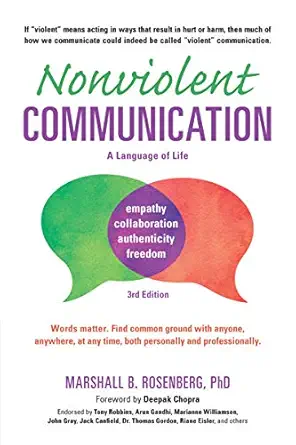
Nonviolent Communication: A Language of Life, by Marshall Rosenberg, is a book describing how to communicate in meaningful ways that are supportive of yourself, your relationships, other people, and life itself. Though the book doesn’t ever talk about autism, I feel it’s still useful to discuss. I feel that this communication style would reduce misunderstandings on and off the spectrum. If I could change English so it mostly used these ideas and rules, I would.

This book is both a work of education and also of philosophy. Rosenberg teaches different mechanics of communication (as in, phrase your thought this way, not that way). But he also teaches a positive, humanistic point of view that’s essential to making those mechanics work best. In reading this work, I could clearly see the influence of the psychology Carl Rogers.

However, Rosenberg has taken those ideas and both expanded on them and also made them practical. Which is to say, the tagline, “Find common ground with anyone, anywhere, at any time, both personally and professionally,” is not a joke or a marketing gimmick. It is quite literally true, and there are several examples in the book of practitioners doing exactly that. In at least one instance, the practice likely saved them from significant injury or even death.

Cover of Nonviolent Communication, by Marshall Rosenberg: a pair of overlapping word bubbles.  One green, one red, purple where they overlap.  Subtext: A language of life.  Words matter.  Find common ground with anyone, anywhere, at any time, both personally and professionally.
Cover of Nonviolent Communication, by Marshall Rosenberg

Violence in English

I agree with Rosenberg that a lot of English and general communication involves a stunning amount of inaccuracy and manipulative language. For example, we often say, “this made me feel angry.” The reality is that although our reactions may be immediate, we choose whether to feed that reaction or set it aside in favor of a different one. Nobody can make you feel or do anything. The phrase shifts the responsibility off the speaker and onto someone or something else. Which is both dishonest and unhelpful, to be honest.

This applies to working with autistic people and kids. One might typically say, “His stimming drives me nuts!” Or even, “His stimming is so annoying!” You could instead say, “I feel aggravated when he stims because I expect a quiet environment right now, and his stimming makes noise.” This recognizes that your aggravation isn’t really with the example stimming autistic guy, and it also expresses why you’re feeling upset. Rather than lecturing the example guy to stop stimming (and thus making things worse), you could politely ask him to move to a different room. Or even move yourself, adjust your expectations, or change the situation positively so he doesn’t feel the need to stim. Instead of attacking the autistic person, this phrasing opens up conversational options, including possible solutions.

Not Easy, but Important

This method of nonviolent communication definitely requires a lot of honesty. It requires you know yourself and what you want and need. And, it requires you be clear and direct about those things when communicating about them. This is not an easy set of requirements. But I do think it’s incredibly important, especially when dealing with autistic people.

By and large, autistic people do not read between the lines. We can have trouble taking others’ perspectives, because others can be so different from us. Our own needs can include things like “taking 15 minutes after work to spin a bicycle wheel and stare at it” (a real stim I heard described once). How, then, can we be expected to understand exactly what everyone else’s wants and needs are unless we’re told?

Especially since those wants and needs can change based on the situation at hand. A mom or roommate might be okay with having a playlist of favorite YouTube videos playing loudly in the morning before school or work, for instance. But many parents and roommates wouldn’t be okay with that same playlist going loudly at 10pm, when everyone is heading towards bed. In the morning, a certain level of noise and activity can be normal. But in the evening, headphones might be a wise choice.

Confusingly, some households might be different if people work second or third shift, or like a certain noise level all day. This is why it’s so important to communicate needs and wants clearly. There isn’t one correct way everyone does things. There are ways that work better for some people than others, and communicating about them is how you find what works best for everyone.

Personal Communication Adjustments

As I was reading this book, and afterwards, I began to notice how my own use of language tended to evoke guilt, shame, and negativity. This was true of how I spoke and thought to myself as well as how I communicated with others. I strongly suspect I have a lot of very significant work to do in terms of word choice adjustments, if I want to use nonviolent communication regularly.

However, it might well be worth it. I have the ability to predict, to some extent, how people will act or react to different ways of phrasing things. I also have a general understanding of how people and systems work. In reading the philosophy and mechanics of this book, it struck me as significantly different than the norm. However, the assertions the author makes ring true to me.

In life, I try to be kind and supportive of others. It’s something I value about myself and in others. This philosophy shares that value. I recognize it as superior to some of my current styles of communication. So I’ll be trying to let this book change me and make my communications with others more positive.

It’s going to be a long road, because I have a lot to unlearn. But this book has made my life and communication better already. I hope you find it as wonderful as I did!

Read This Book If

No if. Just read this book. Autistic people, parents, professionals, teachers, everyone. The ideas, methods, and philosophy Rosenberg teaches would be valuable in any setting where humans are involved. Honestly, my only regret about reading this book is that I opted to do so in audiobook format first. That was all the library had available. I have since purchased a copy and will be rereading it in hopes of improving my own life and communication.

Thriving Autistically: Environment and Sensory Support

living room interior

This post on making an autism friendly environment is part of a series on thriving as an autistic person. We live in a world that is not always kind or accommodating for people who are different. Not only that, but autistic and other neurodiverse people can have very fragile health and specific medical needs.

Finding out what works for you is a significant endeavor. This week I’ll be focusing on environmental and sensory factors so you (or your loved one) can live your best life. The first post, which prompted this series, is here. The second post, on food and supplementation, is here. The third post was on movement (exercise and more).

As you read this series, please remember autistic people can have very different experiences. I’ll tell you what works for me, and do my best to explain other things I’ve heard of. But in the end, you are your own best resource. Try things. Find what works for you. Find doctors and specialists that will help you explore your options intelligently and safely. How good or bad you feel every day is, in some very important ways, up to you.

Environmental Impact

There’s an old saying that seeing is believing. I consider it a commentary on the metaphorical blindness of people, though I’m not sure it’s meant that way. The subjects I’ve talked about in posts prior are somewhat visible things. After all, if you’re sitting around all day instead of getting some movement, that’s somewhat noticeable. And what you put in your mouth every meal, same deal.

This week, though one of the things I’d like to focus on is your home environment. And your work environment, if you have a job or volunteer position. What exactly makes for an autism friendly environment?

Trouble in the Air

We do not, as a rule, think a whole lot about our home environments. The air, after all, is typically invisible. However, the air can carry all sorts of things that interfere with human functioning. Some of the obvious ones are:

  • air pollution
  • mold
  • algae and pollen
  • dust and dust mites
  • perfume/cologne
  • pet dander

At work, things like sawdust, airborne flour or other food products, printer pollution, and industrial chemicals also factor in.

Despite their near-invisibility, these airborne factors can have a huge effect on an autistic brain and body. Usually the human body is supposed to purge toxic or inflammatory substances from our blood and body. However, sometimes autistic bodies do not necessarily do this quickly (or, rarely, at all).

An Autistic Environment Example

A few weeks back, I found myself dropping into depression. My mood climate sank and darkened, and I felt dissociated and sad. As much as I could, I evaluated things. Nothing obvious had changed in my life. I was still eating incredibly healthily. Still getting good exercise 5 days a week. My social life hadn’t changed. Everything seemed the same as it had been a couple days ago.

When I thought about it, my current circumstances weren’t great. I was in a job that didn’t pay my bills, was physically taxing (not in a good way), and had little in common with my interests in life. So I figured the difficulty of my circumstances had simply started hitting home. I assumed there was nothing to be done. It was reasonable, honestly, to be depressed in my circumstances.

The thing is, a day later I happened to stick my hand into the bag of fresh cherry tomatoes on the kitchen counter, and one of them went smush. It had molded. The rest of the bag was 100% fine, it was just that one. I tossed the tomato, washed my bedding, and cleaned up the kitchen. Within a couple days, the depression and dissociation had receded.

As you can guess from this story, I am extraordinarily sensitive to mold. Different kinds of mold affect me differently, which makes detecting its influence difficult. But if I start feeling bad out of the blue, that’s the very first thing to check.

Things to Help with Airborne Issues

If you or your autistic loved one seem to have an easier or harder time with life when traveling or staying over at a relative’s house, you may want to explore why. Or even, if they seem to have different problems in one area versus another. It isn’t always the autism or the person specifically. Sometimes it might be that the trash isn’t taken out as routinely, or the new environment doesn’t have a pet.

Some ways to address these things include having personal air filters and/or upping the quality of your home furnace filter. I live next to a pond that grows toxic algae in the summer, for example. So having a good furnace filter supplemented by some smaller HEPA air filters in the bedroom and office is mandatory.

Personally, I use two of these Levoit air purifiers. They’re fairly inexpensive for what they do, and the filters refills last months and only cost $30. One is located near my home computer, where I work. The other is in the bedroom. This model is particularly nice for the bedroom because it has a “lights off” setting. My bedroom has to be kept as dark as possible for me to sleep well (more on that later), so that feature is mandatory. It also runs very quietly. The marketing says as low as 24 dB. All I can tell you is that I can hear it, but only barely, when the house is completely quiet.

Light, Sound, and Electricity

There’s actually way more to an autism friendly environment than these familiar airborne concerns. These will be briefer, so bear with me. Let’s start with light.

The first thing to mention is that some types of lighting flicker. And while most people don’t notice, some autistic people do. Headaches, annoyance, and focus issues aren’t uncommon as a result. Incandescent lightbulbs are usually your best choice for autism-friendly lighting.

I mentioned above that my bedroom needs to be kept quite dark. That’s because my internal clock (circadian rhythm) is easily disrupted. If my body registers too much light late in the evening, I don’t sleep very well. This is not uncommon with autistic people.

Sunlight

In order to get the best quality sleep, I try to get sunshine in the morning to wake myself up properly. Where I live, though, there often isn’t any during the winter. The days are typically overcast and grey. In lieu of sunlight, they make lamps to simulate sunlight. Verilux is the brand I’d trust for this.

I have one of these lamps, which I use in the morning on occasion. You don’t need a really big or fancy one. At least for me, a few minutes of this light is more than enough to make a difference. You can literally just point it at yourself while you’re brushing your teeth in the morning and that can be enough.

For darkening the bedroom, I found out that blackout cloth is quite inexpensive. Making proper blackout curtains may be difficult, but stapling blackout fabric to the wall or over windows isn’t very hard at all. Weatherproofing stuff can be good for lightproofing door frames. And in lieu of all that, there’s always sleep masks. I like ones with molding over the eyes, so I can blink without feeling like my eyelids are being held down.

Screens

Another complicating factor in an autism friendly environment is blue light. Most phones, TVs, and computer screens generate a lot of blue light in addition to the other colors they display. This light tells your body to wake up. Which is fine in the morning and afternoon. And definitely not great in the evening, when you should be winding down.

For computers and jailbroken phones, the best app hands down is f.lux. It changes the quality of the light your devices emit, warming the colors so your internal clock isn’t fooled into thinking you’re outside in the sunshine. My doctor also strongly recommends simply putting away your phone or getting off the computer or TV an hour before bed. I personally struggle with that, so f.lux is my go-to.

Again, your mileage may vary here. But it’s worth testing using apps, sleep masks, or putting your devices away before bed, to see if it affects you.

Sounds and noise isolation

There’s a few things to keep in mind here. Autistic people are prone to sensory over- and under-sensitivity. So we might as easily seek out playing drums (or pots and pans) loudly as hide from them. A home can be a surprisingly loud place, with cooking in the kitchen, siblings playing or listening to music while they do homework, appliances running, and even perhaps a TV playing.

A soundscape doesn’t need to be loud to be overwhelming. A few years back I reviewed a pair of noise-canceling headphones in conjunction with a complex gym environment. The fact was, the headphones were excellent, but they didn’t entirely spare me from the exhaustion of being in that environment. Having a quiet place to go was essential, even with the volume of the place turned down.

Any autistic person could benefit from a safe, predictable space where everything is the way it should be, mind you. Soundproofing it is a touch that can be added to help isolate the person from the house’s noise, or the person’s noise from the rest of the house.

I personally fall in the over-sensitivity category, which means it’s best for me to have a quiet place to retreat to. Thankfully, most of my house falls into that category. But it can just as easily be a single room in the house, or even a big cardboard box. An autism friendly environment can be any number of things.

Motor sounds

Another sound issue I’ve only recently become aware of is machinery-based. Very low frequency sounds can affect a person’s wellbeing. Some industrial motors generate sounds in this frequency range, and it can affect people even if they can barely hear it.

In my condo association, we installed a motor for some equipment to kill off the toxic algae that grows here. The motor was installed in the back yard behind a few units, fairly near where I live. I don’t particularly notice a difference, but one resident who lives closer to the motor did. They reported not being able to focus or sleep. A fairly major problem I would say!

Because I’m a curious sort, I went and stood by the motor for a while one day. It felt bad. It was like the sound was shaking my internal organs and making them malfunction. I now avoid the area entirely. Usually the equipment that would make this kind of noise is kept away from homes, but workplaces are another story. If you work around boiler rooms or near equipment that makes a low droning sound, and tend to feel worse when you’re there, it might be worth investigating whether this is an issue for you.

EMF

The last thing I want to mention is electromagnetic fields, which are generated by objects that use electricity, such as computers, TVs, and cell phones. A certain amount of this is normal in life. For example, the Earth itself has a magnetic field. It’s really low-grade, but it exists.

The thing is, we’ve filled our modern lives with EMFs. In suburbs and cities, you’ll pretty much always be in range of a wifi network. Even if you can’t connect to it, it’s still permeating the air and vibrating your cells. Same with cell phone towers. If EMFs were audible, it’d be like a dozen orchestras blasting at all times. As our technology improves (3G -> 5G -> whatever we have next), the intensity of these signals amps up. This really doesn’t make for an autism friendly environment.

Most people seem relatively unaffected by the silent cacophony, but because of our sensitive bodies, autistic people can sometimes be severely affected by it. It can affect our sleep, digestion, mood, and mental health. I personally sleep on a grounding mat, put my phone in airplane mode, and turn off my wifi at night. All of these things, though seemingly strange, do actually help me sleep better.

I’m still exploring this subject, to be honest. It’s clear to me that it matters, but my exact tolerance isn’t clear. It remains to be seen what measures help the most. Regardless, here’s a supplier that makes meters and shielding items to help live with less EMF. I’m thinking I might try the hoodie this year, but I want to be sure I can safely wash it before I buy.

Sensory Supports

An autism friendly environment doesn’t need to be all about taking factors away. While it’s good to reduce noise, EMF, and light for someone like me, it can also be important to add things.

I’ve heard this sort of thing called a sensory diet. Basically, a person can be comforted and supported by sensory experiences. A hot cup of tea or coffee is a more mainstream sensory experience. So is familiar music, or comfort foods.

But autistic people can derive comfort and joy from a much broader range of things. Consider chewable or fidget toy jewelry, fabric swatches, essential oils or other scents. All of these things can add to a person’s experience or provide a moment’s respite from the demands of life.

I carry around a small tin of solid perfume, personally. The smell, which is mostly floral with some spice, calms my mind when I smell it. I typically take it out when I’m panicking about a social interaction I can no longer do anything about. Putting my nose into it for a bit helps me mentally move on from the situation by bringing me elsewhere. The tin fits easily in my pocket, but a purse or backpack would serve just as well.

TL;DR: Autism and Environment

There are tons of environmental factors that can affect autistic people’s wellbeing. Airborne factors include allergens like mold, pollen, and dust, but also air pollution and perfume. HEPA air purifiers can help, and so can face masks like the KN-95 types.

Lighting is another factor in an autism friendly environment. Having interior lighting that doesn’t flicker is important, but some peoples’ internal clocks are so sensitive that it’s best to lightproof the bedroom or wear a sleep mask. Finally, computer and phone screens put out blue light, which can trick your internal clock and really wreck your ability to sleep well.

Sound can play a big role in things too. Too much or too little sound can make an autistic person’s life harder. There’s also certain very low frequency sounds that can affect a person’s sleep and focus. Having a safe, sound-dampened space to be can be a very important accommodation.

Finally, EMF is a possible factor. Phones, wifi networks, cell towers, TVs, and computers all put out these fields. While most people aren’t strongly affected by them, some people, including me, are. My sleep is much better without the silent cacophony of my wifi networks, phone, and computer going all night. It’s worth investigating if this is an issue for you, as there are some fairly simple fixes to help.

Don’t forget that building an autism friendly environment isn’t all about taking things away. Having stim toys, comforting scents, fabric swatches, lava lamps, and whatever else makes you happy is also important.

I hope this post has given you some things to explore. Your environment can have a major impact on how good you feel every day. Moreso than I think most people realize. Find what works for you and what makes you happy, and include it in your life as much as possible.

WYR: How to Talk to Disabled People

landscape near hidden kvernufoss waterfall in iceland

https://www.forbes.com/sites/andrewpulrang/2021/06/30/5-sensible-guidelines-for-interacting-with-disabled-people/

I’m really struggling this week, so please have this article passed to me by a fellow advocate.

Like the author, I find there’s a general discomfort people display when interacting with people with disabilities. The way we’re treated can vary wildly. The experience ranges from simply ignoring the person to treating them like a helpless baby that needs your help for everything.

You could consider me “fortunate” in that my disabilities are more or less invisible. Autism doesn’t typically have physical differences. Neither does depression, nor does an anxiety disorder. Effectively, I walk among you, camouflaged to seem “normal.” A person trained to recognize autistic traits might recognize my autism, based on how I communicate and move. But the average person has no idea.

That is not always a kindness. When I break the illusion of normalcy, the reaction is often very negative. Because the observer is surprised as well as upset, they don’t handle the situation gracefully. Hurt feelings and unkind words are common. For example, I once had an acquaintance over to my home in college. We talked for hours, and accidentally ran my mental and emotional energy out. As a result, I had to rather ungracefully have the acquaintance leave so I could recuperate. The suddenness really hurt her feelings, and that’s likely part of why we don’t talk any more.

In contrast, visible disabilities are ones you can see. An amputee, or someone in a mobility device or wheelchair, are obvious examples. There is typically no escape from the recognition. Additionally, some people decide, upon recognizing the disability, that the person must need their help. The implied assumption is that there’s no way the disabled person could handle the situation by themselves, or that it’s just too painful to watch them struggle. Either assumption is degrading.

The article doesn’t use these precise words, but the autism community has a quick way of saying some of the advice in this article: “Presume Competence.” Basically, make the assumption that the disabled person can handle things themself. A disability, visible or not, does not necessarily mean the person can’t navigate daily life. Many of us find workarounds for ourselves over time. They simply aren’t intuitive to a non-disabled person.

Autism as a Disability

This is a bit of a debate. I would personally argue that yes, it is. In part because of the structural ableism and prejudice in our culture, laws, and society. The way others treat us and the opportunities made available to us impact our ability to thrive and grow.

In short, the social model of disability applies here.

I don’t personally think that covers everything, though. Even if you fixed other peoples’ behavior and the systems we live and work in, some autistic people still have significant medical issues. I don’t even mean things like cerebral palsy or epilepsy, although those also exist.

No, what I mean is things like needing a dairy-free diet, or really high grade air purifiers. Our biological processes can be really, really fragile. If one tomato molds in my house, I begin falling into a depressive state. If I were to drink a glass of milk, I would be in a bad mood in 15 minutes. And the bad mood would last at least a day.

Some days I have trouble communicating my needs, emotions, and thoughts. Even days when I’m alone, that can be true.

So I don’t feel the social model of disability explains all those things. Even if I wish it did, so I could just blame others for my hardships.

I hope you find this article as helpful as I did. Even among disabled people, there’s a lot of variety. And I myself, as a person with invisible disabilities, would probably hesitate and make mistakes when talking to someone with visible disabilities. It’s okay to make mistakes. It’s good to educate yourself ahead of time to avoid making mistakes, though. And that’s why this article exists!

Legwork and Life: Full Time Work

Hey y’all. My life circumstances have changed pretty significantly in the last few months. I’m not yet ready to talk about the changes, though I will at some point when I feel able. Right now I’m spending most of my time handling the circumstances and trying to keep my head above water. That doesn’t lend itself well to introspection, loving communication, fairness, or maturity when discussing the changes and circumstances that led to them.

In the meantime, though, I’ve taken on a full time job. It’s not in a field I wanted, and sadly is not even slightly autism-related, but it will pay my bills and allow me to keep my living situation. But, it will cost me a significant amount of time. As such, this blog will be dropping down to once a week. I’ll keep making the Friday posts, which I feel are the most valuable to the average person.

When I started this blog, I wanted it to be a springboard into a career speaking and writing about autism. The fact is, if I’d started it ten years ago, that might have worked. These days you can’t just make quality content and expect people to find it. And that was my mistake. I don’t love marketing myself. I have a decidedly complex relationship with networking. And there are dozens, if not hundreds, of autistic adults out there trying to do the same thing.

I could argue that I’m probably one of the better-read ones, and as such deserve more limelight. But the fact is, I didn’t prioritize the advertising and marketing aspect of things, and didn’t get discovered by someone who really excels at such things. So (somewhat) predictably, I didn’t become popular.

I recognize the issue now, but unfortunately, I’m not in a position to capitalize on that knowledge. I still care very deeply about autism, advocacy, and education. That’s why I intend to continue this blog despite my impending lack of flex time and energy. But I have to be able to eat and have a roof over my head first.

You have my word that I’ll continue to provide thoughtful, useful, and valuable information about autism, life with autism, and other related subjects. My personal education on the subject is far from over. Autism is, after all, a spectrum. My experience is but one color in a brilliant rainbow of valid, fully human lives.

I hope you’ll continue on this journey with me. : )

RtR: Reading Facial Expressions is Contextual

Welcome back to Reading the Research! I trawl the Internet to find noteworthy research on autism and related subjects to share with you. Along the way I discuss the findings with bits from my own life, research, and observations.

Today’s article explains, at least in part, why autistic people can have such trouble reading facial expressions. In Kindergarten or other early education, they teach that certain expressions mean certain things. Unfortunately, that is simply not how it works. The fact is, expressions are contextual. They don’t always mean the same thing.

Up to Interpretation

An exercise in reading facial expressions. One possibility: from top left to bottom right, surprised happiness, alarm, thoughtfulness, shock, a warm welcoming smile, and disbelief. But you might also read it feigned enthusiasm, fear, concentration, hiding a socially impolite smile/laughter, joy, and passing negative judgment. Note how many of these interpretations aren’t simple “happy, sad, angry” designations.

The fact is, expressions are complicated. People don’t simply swap between a palette of 8 basic expressions. If they did, most autistic people would have no issue learning those 8 expressions and then it would be metaphorical smooth sailing from then on.

No, the problem that instead of 8 basic expressions, there are dozens. They vary by the situation, by the person, and even by the culture. Because of all that variation, you have to use context to interpret any given expression. The better you understand the situation and know the person making the expression, the easier it is to figure out what the expression might mean.

Complicating matters, by the way, is how different autistic minds can be from neurotypical ones. When you go to interpret an expression in a situation, you’re performing predictive calculations using theory of mind. The more different you are from the person you’re trying to interpret, the harder that calculation is going to be.

Not Just Emotions

Adding to the difficulty of reading facial expressions, by the way? We’re taught that facial expressions are for conveying a person’s mood. This isn’t entirely wrong, but it’s not right either. Facial expressions also convey what we want people to see. Even if that’s a lie.

That’s actually something LENS and therapy have made possible for me. I can now lie with my face. That wasn’t possible before, which made things harder for me when it came to photography, formal occasions, interviews, and distant relatives. I can now choose to smile reasonably convincingly even if I’m feeling terrible. And often do, though my effectiveness at conveying the expression may be undermined by how bad I’m feeling.

(Pst! If you like seeing the latest autism-relevant research, visit my Twitter! There are links and comments on studies that were interesting, but didn’t get a whole Reading the Research article about them.)

Book Review: How to Be Human

How to Be Human: An Autistic Man’s Guide to Life, by Jory Fleming with Lyric Winik, is an exploration of Fleming’s rather unique mind and perspective. Despite Fleming’s listing as the main author, Winik seems to be the organizing force behind the book. Through his eyes, and through his questions, we meet and see through the eyes of Fleming.

Cover of How to Be Human.  Overlapping circles of the primary colors red, yellow and blue, against a white background.
The cover of How to Be Human: An Autistic Man’s Guide to Life

It’s an interesting journey. The book is not quite stream of consciousness, but it is the product of many interviews and time spent together with Fleming. Winik tries to arrange the topics in a coherent flow, and you’re sort of drawn along in the experience. It starts out with more concrete subjects, but by the end the biographical subjects have ceased and you’re listening to the two authors talk philosophy and the value of human life.

What This Book Is Not

The book is not, I should point out, any kind of guide to autistic life. While I’m somewhat disappointed about that fact, I’m not overly surprised. Every autistic experience is different. Some autistic people, like Jory Fleming, seem to be more divorced from their emotions. I certainly was for a good chunk of my childhood.

This book is also not a “story of my life” tale, as is so often typical for autistic adults to write. Instead, it’s of a much smaller category. This book is one of the very few “see through my eyes at this very moment” types. Other books of this type include The Reason I Jump and How Can I Talk If My Lips Don’t Move? I’d say both of those have more “this was my childhood” built into them than How to Be Human. But that’s in part because Jory Fleming simply doesn’t remember much of his childhood.

He also isn’t typically affected by his emotions, and views most things exceptionally logically. One interesting caveat to that is that he doesn’t seem to understand shared cultures based on geographical area. So the idea of regional accents, shared beliefs about the world because that’s how everyone thinks, etc, those are all alien to him.

Bright Points

I had to laugh at one particular section in the book, where Winik and Fleming discuss art. I laugh, because I’ve finally found a fellow modern art critic with my exact same complaint:

LW: What are things you like and don’t like to look at?

Jory: I hate to say it, but really artsy stuff I don’t get. Like modern art or that art where it’s abstract and you’re supposed to bring meanings from something. My nephew could probably do that if we gave him some paint. I’ve looked at art exhibits and London and Paris, and sometimes I think the work is terrible.

How to Be Human, page 140-141

Jory Fleming describes himself as a relentless optimist. He’s very logical and reasonable about why he chooses to be that way. But it strikes me as rather unusual, because he had a reasonably difficult childhood from the small bits mentioned in the book. He didn’t start talking in the usual way of children. His mother homeschooled him and became an expert in how to communicate in “Joryspeak.” The most common example in the book is Fleming saying, “It’s a cold night” to her to ask her to turn on music for them to listen to. Because that was apparently something she’d sometimes say before turning on the music.

Also interestingly for a person that’s exceptional logical, Fleming is a person of faith. The discussion of that apparent contradiction is near the back of the book, and I found it both interesting and helpful.

Read This Book If

You’d like to explore an exceptionally unique autistic person’s mind and viewpoint on life. Parents, professionals, teachers, and fellow autistics might find commonalities in reading this book. Jory Fleming is eloquent in his way, and Winik guides you through the topics, flowing one into the next. It makes you think. I enjoyed it.

RtR: What is Processed Food?

Welcome back to Reading the Research! I trawl the Internet to find noteworthy research on autism and related subjects to share with you. Along the way I discuss the findings with bits from my own life, research, and observations.

Today’s article about processed food is horrifying to me on multiple levels. Just recently I wrote a piece on eating well to look and feel better. Autistic people often have fragile internal body processes. So what you put into your body as fuel makes a huge difference in how well you feel. If you eat poorly, it can cause depression, anxiety, difficulty focusing or sitting still, low or spiky energy levels, tiredness, malaise, etc. Or it can make those things much worse if you’re already prone to them.

I had an unpleasant object lesson in the importance of avoiding processed food about a week ago. I ate a friend’s homemade bready-cakey thing as a test. I’m honestly unsure of precisely what went into it, but I’m going to assume at least white flour and white sugar, because I developed a headache that lasted 24 hours, my depression worsened (and I started having boomerang memories), I had trouble focusing and kept missing things in my daily life, and I felt tired and vaguely ill. It was really horrible. The symptoms slowly went away as I went back to eating my usual diet of whole foods and vegetables, thankfully.

Defining

So what is processed food? Especially, our main offender in this article, what is ultraprocessed food?

Mostly, they’re ready-to-eat items, like fast food, desserts, most breakfast cereal, candy, TV dinners, and pastries. Pop/soda/Coke and juice also count. You could also define processed food as, “stuff that doesn’t look like the food it’s made from.” These foods have no nutritional content to speak of. They’re simply vehicles for calories, with little or no fiber, vitamins, or minerals. And they’re often loaded with sugar, salt, and saturated fat. No wonder obesity is such a problem. And no wonder sugar addiction plagues most of the US population.

As the article points out, processing is not necessarily an evil. And you don’t necessarily have to stop eating all processed foods to feel better. But having them be more then 2/3s of your diet is definitely bad. And, I will point out that while this article focuses on children, those children will grow up to be adults who will then choose foods based on what they like. While many of my friends have opted to eat healthier now that their bodies punish them for eating poorly, it’s a much harder transition than if they’d been eating well to begin with.

Generally speaking, it’s best to minimize eating processed foods and instead choose whole grains, whole fruits, and fresh or frozen vegetables. I’ve spent the last few months trying that diet, and I think I’ve never been healthier in my life. My skin has never been softer and nicer. My brain has never been so clear and easy to live in. And I’ve never been so well emotionally and mentally balanced.

It’s really nice. And exceptionally important because I’ve been having some rather difficult life circumstances that necessitated getting new jobs and handling some difficult changes in life.

(Pst! If you like seeing the latest autism-relevant research, visit my Twitter! There are links and comments on studies that were interesting, but didn’t get a whole Reading the Research article about them.)