Reading the Research: The Autism Service Cliff

Welcome back to Reading the Research! Each week I trawl the Internet to find noteworthy research on autism and related subjects to share with you. Along the way I discuss the findings with bits from my own life, research, and observations.

Today’s article serves as an introduction to the autism services cliff. This is what people call the sudden drop-off of services after the autistic person graduates or ages out of high school. You see, there are typically a lot of therapies and services offered through schools. Things like a one-on-one aide, or speech and language therapy, or occupational therapy are typically managed and implemented by the school.

Take the school out of the equation, and the autistic person is left with nothing, or almost nothing. Because of this sudden loss in services, autistic people often struggle at the transition between high school and adulthood. Some autistic people, like me, still manage to land on our feet. Others try very hard but still don’t succeed in the long term. The parents I’ve spoken to often talk about failed attempts at college, or long strings of jobs held for only a month or two. It’s not all stories of failure and crushed hopes and dreams, but there’s certainly enough of those to dishearten someone quickly.

This autism services cliff typically strikes between ages 18 and 26. Like a lot of things in the US, the maximum age someone can stay in school varies by what state you live in. In my home state of Michigan, that age is 20. Even before that age, though, the difficulties can begin with the loss of child Medicaid.

Transitioning to adulthood doesn’t necessarily mean losing Medicaid for good, but the requirements are significantly different. The rejection rate is very high. When you apply, bring a great deal of perseverance and the expectation that you’ll need to try at least twice. Neatly organized documentation of the disability and the need for services across years of the person’s life helps a lot.

This is why a Medicaid waiver, such as the ones mentioned in this article, can be so valuable. They can continue the autistic person’s Medicaid services into adulthood without disruption. Keeping these autism services and structure over the transition to adulthood can be incredibly helpful to an autistic person’s wellbeing. But even beyond direct services and Medicaid, a lot of structure is simply lost after you leave school. You can’t count on the easy exposure to groups of your peers any more. Nor is there usually free transportation to activity hubs with a variety of options. And now you need to both find and pay for sports facilities and other programs.

The only comparable organization is church. Like schools, churches can offer structure and groups of peers. Some churches offer small group Bible studies or household groups. Some churches may have simple sports equipment, such as a basketball hoop, or a field in which a pick-up group might play soccer or frisbee golf. If nothing else, a church can be a place for autistic people and our families to find structure, activities, and community.

Personally, I’d like to see a universal healthcare replace Medicaid. One of Medicaid’s typical features is the requirement that the receiver be painfully poor. Working part time at minimum wage can be enough to disqualify you, depending on which state and program you’re in. I don’t know if you’ve noticed, but part time jobs, even those that pay above minimum wage, are rarely enough to live on.

Instead, I’d rather have a healthcare that provides for everyone. If a family needs respite care, they should have it. If an autistic person needs help making a schedule or getting a job, that should be available. I don’t feel like we should make people present 20 pages of documentation to prove their need. That’s just another way of punishing people for existing. It doesn’t make the need go away, it just makes the person suffer for having the need.

Personally, I think punishing people for existing is pretty much inexcusably evil.

(Pst! If you like seeing the latest autism-relevant research, visit my Twitter! There are links and comments on studies that were interesting, but didn’t get a whole Reading the Research article about them.)

Book Review: Asperger\’s Syndrome: Helping Siblings

The Visual Guide to Asperger\’s Syndrome: Helping Siblings, by Alis Rowe, is a plainspoken children\’s book-sized publication focused on helping parents help siblings of autistic people adjust and thrive.  I found this book in the autism section, not the children\’s section, but it\’s pretty clear from the font size and pictures where it\’s meant to go.  At less than 100 pages in large sized font, it\’s not a long read. 

I picked it up anyway because this is a vastly under-served and under-recognized need.  There are hundreds, if not thousands of books geared towards educating parents and professionals.  Even books specifically focused on other autistics, often written by the same.  But very little has been done to help siblings of those on the spectrum cope with, say, the resentment of regularly being overlooked in favor of handling the autistic child\’s special needs.  

Sometimes, in the stress of everything that has to be done to manage the finances, support services, and even themselves, parents miss things.  These things can include their own self-care and wellness, and it can also include making time for doing things with just the sibling(s).  This is entirely understandable- after all, every autistic child is different, so there is no one \”do this and everything will be fine\” guide.  Children are already challenging, even without factoring in unusual developmental patterns and the need for support services, specialized learning, etc.  

Though all this happens unintentionally, it can be really hard on the neurotypical sibling(s).  Anger, embarrassment, jealousy, and frustration are common.  If autism isn\’t well-explained to the child, confusion and misunderstandings about why the autistic child is treated differently may result.  

This book tackles the job of pointing out common pitfalls as well as providing answers and suggestions as to how to address each problem.  It lists and addresses specific concerns and feelings a sibling might have, which I thought was useful as well as enlightening.  

One thing I particularly appreciated was that the book spends time explaining the difference between a tantrum and a meltdown, which is an exceptionally important concept for family to understand.  For the unfamiliar: tantrums are goal-oriented.  The person throwing the tantrum wants the attention, or wants something (like candy, ice cream, a toy, etc), and when that want is met, the tantrum ends. 

Meltdowns, on the other hand, are a response to overstimulated senses (like loud environments) or other adverse circumstances, and only end when the person has calmed down.  The two behaviors look superficially the same, especially to someone unfamiliar with the person, but should be treated very differently.  

Read This Book If

You\’re a parent of an autistic child with at least one other, neurotypical child.  This is a tightly focused, easy-to-read book meant to guide parents in helping both their autistic child and their neurotypical child(ren).  It lays out important basics as well as very specific concerns and feelings a sibling might have.  At less than 100 pages and in large, easy-read font, this is a good starting place for a parent to begin with this important, often sidelined, subject.  

Book Review: Asperger’s Syndrome: Helping Siblings

The Visual Guide to Asperger’s Syndrome: Helping Siblings, by Alis Rowe, is a plainspoken children’s book-sized publication focused on helping parents help siblings of autistic people adjust and thrive. I found this book in the autism section, not the children’s section, but it’s pretty clear from the font size and pictures where it’s meant to go. At less than 100 pages in large sized font, it’s not a long read.

I picked it up anyway because this is a vastly under-served and under-recognized need. There are hundreds, if not thousands of books geared towards educating parents and professionals. Even books specifically focused on other autistics, often written by the same. But very little has been done to help siblings of those on the spectrum cope with, say, the resentment of regularly being overlooked in favor of handling the autistic child’s special needs.

Sometimes, in the stress of everything that has to be done to manage the finances, support services, and even themselves, parents miss things. These things can include their own self-care and wellness, and it can also include making time for doing things with just the sibling(s). This is entirely understandable- after all, every autistic child is different, so there is no one “do this and everything will be fine” guide. Children are already challenging, even without factoring in unusual developmental patterns and the need for support services, specialized learning, etc.

Though all this happens unintentionally, it can be really hard on the neurotypical sibling(s). Anger, embarrassment, jealousy, and frustration are common. If autism isn’t well-explained, confusion and misunderstandings about why the autistic child is treated differently may result.

This book tackles the job of pointing out common pitfalls as well as providing answers and suggestions as to how to address each problem. It lists and addresses specific concerns and feelings a sibling might have, which I thought was useful as well as enlightening.

One thing I particularly appreciated was that the book spends time explaining the difference between a tantrum and a meltdown, which is an exceptionally important concept for family to understand. For the unfamiliar: tantrums are goal-oriented. The person throwing the tantrum wants the attention, or wants something (like candy, ice cream, a toy, etc), and when that want is met, the tantrum ends.

Meltdowns, on the other hand, are a response to overstimulated senses (like loud environments) or other adverse circumstances, and only end when the person has calmed down. The two behaviors look superficially the same, especially to someone unfamiliar with the person, but should be treated very differently.

Read This Book If

You’re a parent of an autistic child with at least one other, neurotypical child. This is a tightly focused, easy-to-read book meant to guide parents in helping both their autistic child and their neurotypical child(ren). It lays out important basics as well as very specific concerns and feelings a sibling might have. At less than 100 pages and in large, easy-read font, this is a good starting place for a parent to begin with this important, often sidelined, subject.

Reading the Research: The Real Link Between Violence and Mental Illness

Welcome back to Reading the Research, where I trawl the Internet to find noteworthy research on autism and related subjects, then discuss it in brief with bits from my own life, research, and observations.

Today’s article merited underlining simply because this link is still, after all this time, misunderstood over and over.  I’m tired of seeing it, so here’s the truth.  There is, in fact, a link between mental illness and violence.  But it’s not what people think.  
 
People with mental illness (which often includes autistic people) are far more likely to be the targets of violence.  We are not the perpetrators.  The perpetrators typically people without diagnosed disorders.  To quote the article: “The large majority of the perpetrators of violent crimes do not have a diagnosable mental illness, and conversely, most people with psychiatric disorders are never violent,” Dr. Swanson writes.
 
Popular culture and the news seem to desperately want to play pin-the-tail-on-the-donkey with mental illness when some new violent horror pops up.  Because people always want to know “how could this happen,” but never want to consider that it might be because we\’ve been strangling social services for decades, or because the US has so many more guns per person than other Western nations.  They seem to want a nice, safe “it was something specifically wrong with this one person” answer so nothing has to change and we can all move on with our lives.  
 
As any idiot could tell by paying attention, these quick, individualized theories have had no useful effect in ending violence in schools, churches, and against marginalized people.  If it’s not the police shooting a black woman in her bed (or any number of other murders), it’s attacks against US citizens of Asian descent, or the painfully numerous school shootings (including three in 2021).  
 
The suggestion that mental illness might have been involved with violent perpetrators’ motives for their horrific actions is nothing more than victim-blaming misdirection.  It’s much like how some awful humans seem to think that wearing certain clothes is “inviting sexual assault,” as if adult male humans are toddlers with no self control who can’t possibly be expected to answer for their actions.  
 
So the next time you see a news article on the latest school shooting or hate crime, and the author suggests mental illness might have been involved, please recognize it as the gaslighting, red herring bullshit that it is.
People with mental illnesses are the victims of violence, not its perpetrators.  Blaming the victims solves nothing and helps no one.
 
(Pst! If you like seeing the latest autism-relevant research, visit my Twitter, which has links and brief comments on studies that were interesting, but didn’t get a whole Reading the Research article about them.)

Valuable Online Resource: Fair Health Consumer

You know how you can use the Kelly Blue Book to look up the price of a car?  You input the make, model, condition, etc, and it tells you more or less what a fair price for the car is?

Imagine having something like that for medical expenses.  Hospital stays are notoriously ruinous without insurance, and sometimes even with it.  The thing about insurance is that they keep staff onhand to dispute markups on services.  So the insurance company (and by extension, you) aren’t stuck paying a thousand percent markup on over-the-counter painkillers.

The Problem

Why is it like this?  It’s actually not as simple as hospitals being greedy.  It’s because the US healthcare system has, overall, shifted away from the metaphorical ounce of prevention in favor of the metaphorical pound of cure.  Hospitals, you see, can’t refuse to treat someone based on whether they can pay.  But because healthcare is so expensive, a lot of people don’t go to the doctor or dentist immediately when they have a problem.

Instead, they postpone dealing with the issue until it goes away or turns into an emergency.  Naturally, this is when it’s most expensive to treat, and narrows your options considerably, but if you can’t afford even the basic prevention (because your insurance sucks, or you don’t have any at all), it doesn’t really matter to you.  So the hospital treats the unfortunate person, but the person can’t pay.  The hospital is still out that money, so what are they to do?  Pestering the person via debt collection agencies isn’t a very successful option, plus it takes time.

The solution, as it happens, is to jack up all their prices on everything.  By making people with actual money pay more, they can systemically balance their budgets after a fashion.

As you can hopefully see, this is a crappy solution.  And it’s vastly unfair to people without insurance companies to negotiate on their behalf, or even with an insurance company that half-asses their negotiations.  It’s also typical that people will go into getting medical procedures with absolutely no idea how much it’ll cost them, then getting slapped with the bill later.

The Immediate Solution

For both of these issues, there’s a solution, and it’s called Fair Health.  While the website has its own tutorials and informative videos, I’ll briefly explain how some of the site works.

You can look up how much a procedure or treatment will cost you.  The site will ask you where you are, because that matters in the calculations.  It may also ask you whether you’re in-network or out-of-network, which is insurance-ese for asking whether you’re getting the service from a doctor they approve of, in a place they approve of.

Finally, they’ll ask for something significantly harder to provide: a CPT code or precise description of the service.  I know about CPT codes because I did a bit of work with them at the front desk of an ABA clinic, but I don’t think most people are familiar, so:

In brief, a CPT code is a precise designation for a medical treatment or procedure.

For example, I looked up D2392, which is “a plain white resin-composite filling that covers two surfaces on a back tooth.”  You’ve got the material type (resin composite), the procedure type (filling), the location (a back tooth, like a molar), and the approximate amount of effort involved (two surfaces, meaning the top and side of the tooth could be involved, which means a moderate amount of material, molding, and drilling is likely to be involved).

You can look these CPT codes up online, but in all honesty, you’re better off just getting the exact CPT codes from the doctor’s office when these procedures are proposed.  If you’ve got a smartphone, you could even look up the codes while you’re in there with the doctor.

The site also has informative sections about insurance, including explanations of common insurance-ese terms like “in network” and “out-of-network.” It’s fairly basic information, and I don’t feel like it’s super-well organized, but it is good information to know.  Having it somewhere free and publically accessible is definitely preferable to not having it.

There’s one odd caveat with this site, and it’s that it doesn’t cover government insurances.  Medicare, Medicaid, and Tricare data is not included here.  The site pretty much exists to help uninsured people, and people on private insurance, make sure they aren’t scammed or overcharged.

In the Long Term

You may have noticed this website doesn’t solve the systemic problem of hospitals jacking up their prices to compensate for treating people who need the help but can’t pay.  It can help by educating individual consumers, but the overall problem persists.  Y’know what would solve that overall problem?

Universal healthcare.  Whether that’s Medicare for All or some other version, returning to the “ounce of prevention is better than a pound of cure” model of healthcare would save us all a fortune.  People would be able to get cavities filled without feeling like they’ve chosen their health over being able to pay rent that month.

In an age of unprecedented bad physical and mental health, where the average lifespan (for everyone, not just autistic people) is actually decreasing for the first time in decades, I feel like we could use the change.

By the way, if you ever want to do a good deed and personally take a metaphorical bite out of the suffering this unfair healthcare system creates, RIP Medical Debt is an excellent way to do so.  They buy up uncollected medical debt from debt collection agencies and forgive it.  It’s an unusual method, but it lets them take $100 in donations and use it, on average, to forgive $10,000 of debt.  Be sure to check it out!

Reading the Research: Autistic Sociability in a Pandemic

Welcome back to Reading the Research, where I trawl the Internet to find noteworthy research on autism and related subjects, then discuss it in brief with bits from my own life, research, and observations.

Today’s article has a bit of a skewed view on what likely happened, but presents some positive information I’d like to highlight.  This article comes to us from a university in Spain.  While that’s certainly not the US, it is still a “Western” country with some of the same cultural values and similar home/work patterns.  

The TLDR (Too Long; Didn’t Read) is: autistic kids, and their families, did much better than expected during the COVID 19 lockdown.  These families even improved their communication over the course of the lockdown.  I say “families” rather than focusing specifically on the autistic children, because communication is a two-way street.  Autistic people communicate.  We just don’t always communicate in words.  

This article doesn’t say the transition wasn’t difficult on the families and the autistic children.  The pandemic destroyed or massively altered regular routines, which is very hard on people that rely on those routines for comfort and safety.  That\’s autistic people, and others that struggle with regular life.  Things were also more difficult because support services for the autistic children were not available, or were less available.  Educational options were minimal or nonexistent as well.  So initially, things became more difficult for families with autistic members. 

However, in the long term, as new routines were established, the autistic children and their families thrived more.  The parents, often unable to go to work, spent more time at home, interacting with their kids.  With the additional interaction and attention, the autistic children thrived.  Or put another way: with more social interaction with people they love and trust, autistic people thrived.  

The last thing I want to underline from this article is this: autistic people are often stereotyped as not being social, not caring about others, etc.  This study specifically states that these autistic children were calmer and happier when they were able to use the Internet to see their distanced grandparents, classmates, and other family members.  In other words, autistic people were also happier being social and seeing people they cared about.  

In other words, yes, we are just like you this way- diagnosis or no.  

(Pst! If you like seeing the latest autism-relevant research, visit my Twitter, which has links and brief comments on studies that were interesting, but didn’t get a whole Reading the Research article about them.)

Book Review: Start Here

Start Here: a guide for parents of autistic kids, is a booklet available for sale or for free online from the Autistic Self Advocacy Network (ASAN), which is a group of adult autistics and parents of autistic people that got together to educate and advocate for the rights of autistic people.  The book is what it says on the tin: a starting place for parents who\’ve gotten the news their kid is or may be autistic, and are sitting back and going \”uhhh, now what..?\”  

Like many publications from ASAN, this is written in an easy-to-read style.  Complicated or specialized words are defined.  Important concepts are defined and repeated regularly to ensure understanding.  The writers don\’t shirk from pointing out the racism and sexism in the system, in addition to the prejudice against disabled people you\’d expect from such a book.  

In total, the book is 52 pages long, which is somewhere between a book and a pamphlet, I suppose.  The resource list begins on page 42, though, so you\’re really only reading about 40 pages.  I agreed with almost everything mentioned in the book, which was a nice change from some of my previous reads.  

Topics covered include: what autism actually is, communication differences, listening to autistic advocates, defining disability, presuming competence, choosing services, and schooling options.  It\’s all done in pretty broad brush strokes, and with the assumption that the parents in question live in the US.  (This isn\’t unreasonable, since ASAN mainly operates in the US.) 

My only disagreement with the publication was its section on vaccines.  I\’m afraid the subject is a great deal more complicated than this book makes it.  While the overall message isn\’t… entirely wrong, it\’s not accurate to say Dr. Wakefield put out a study that said the MMR vaccine causes autism.  He put out a set of case studies, or stories of children he was treating, that suggested the MMR vaccine might be related to their symptoms, including autism.  Case studies are a basis for further research, not a means of determining cause and effect.  By putting out the study, he was simply saying \”hey, someone should maybe look into this, because here\’s what happened with these people.\”  At no point in that study did he say, \”vaccines cause autism\” the way people seem to insist.

Also, vaccines are not always 100% safe, and in rare cases, can have side effects.  Even lifelong ones.  Pretending otherwise is absurd, since the VAERS exists to help track these.  I found it kind of unfair that the publication didn\’t even bother to mention Dr. Wakefield\’s doctorate.  I suspect this was done to give as little legitimacy as possible to the antivax movement, which some consider him a part of.  Still, it sits poorly with me to continue tarring an innocent man that way.  

Beyond that disappointment, this is a broadly useful resource that I feel fulfills the need it sets out to address.  

Read This Book If

You\’re a parent of an autistic child, especially a newly-diagnosed one.  More seasoned parents might still be able to use this as a refresher, but overall it\’s a quite targeted publication.  It\’s a short read, which is appropriate for an overwhelmed parent, but it covers most relevant subjects in broad terms.  A list of resources is included at the end for further (much needed) reading.  

Reading the Research: Supportiveness

Welcome back to Reading the Research, where I trawl the Internet to find noteworthy research on autism and related subjects, then discuss it in brief with bits from my own life, research, and observations.

Today\’s article showcases what I wish every person had.  Especially autistic people, but just in general, too.  

Depression is a part of normal life.  Typically people will experience a couple months of it here or there, when someone they love dies, or a major life change happens… like, y\’know, a worldwide pandemic that mandates staying away from other people as much as possible.  

In most cases, people recover from depression in a few months.  Sometimes, though, the emotional burden is great enough that it doesn\’t.  Or toxic substances, like mold or allergens, cause systemic inflammation, which in turn causes lasting depression.  There\’s a lot of reasons a person can end up depressed.  Autistic people tend to suffer depression at a much higher rate than the general population, in part due to how poorly designed the world is for us.  

In these all cases, the focus is typically on the depressed person to make changes and improve.  Pills may be prescribed.  Changes in diet, in activity level, and in location might be suggested.  Therapeutic services might begin.  New habits might need to be established, and new patterns of thinking or talking.  All of these things can be helpful in recovering from depression.

What\’s not typically considered is the effect of the other people in the household on the depressed person.  So it\’s good to see this article, which shows us a path that others can take to help people with depression.

While the article focuses on significant others (mainly spouses), I have no doubt significant results would have been found if they\’d decided to study depressed children and these behaviors in their parents and siblings.   Having someone closely onhand who understands and will listen without being judgmental or taking it personally is invaluable to feeling supported and helping the person recover.  

There are certainly some people who are naturally better at these listening and supportive behaviors than others, but it\’s all behaviors that can be learned.  I wish it was taught in schools, so everyone would know how to be supportive and kind to people with mental illnesses.  That\’s not just autistic people, after all.  Everyone would benefit from that learning.  

(Pst! If you like seeing the latest autism-relevant research, visit my Twitter, which has links and brief comments on studies that were interesting, but didn\’t get a whole Reading the Research article about them.)

Getting Shot (With the COVID Vaccine)

April 5th was the first day in my state that the vaccine is available to the broader public (ie: not just the elderly and healthcare staff).  Thanks to the diligence of a friend, I was able to get an appointment at a downtown clinic for that exact day.  

I had only about a week\’s notice, so I tried to spend the time preparing my body for the panic attack the vaccine would be inducing.  Unfortunately, my poor mental health also had an opinion, and so I was only partially prepared for the injection.  

The ideal would have been to have a month to prepare, with regular light exercise, plenty of water, good nutritious food, extra Vitamin C every day, religious tooth care, and a steady dosage of the zinc-elderberry lozenges I use to prop up my immune system when I\’m sick.  

Instead, I probably achieved less than a third of those preparations in the week between getting an appointment and the day of the injection.  I\’m not a severely at risk human, and my immune system is usually pretty good at its job, but given what the actual virus can and has done to autistic people, I wanted to be very safe about it.  

I woke up that morning feeling anxious and under-rested.  It was storming outside, with distant thunder to prod me awake about a half hour before I\’d normally get up.  I stayed in bed for a full hour out of protest.  But eventually I got up because I wanted to at least make an effort at being prepared for the day.  

I put on comfortable but stylish clothes, favorites of mine delivered by a shopping service.  Then a dose of vitamin C (1000 mcg, the usual daily limit).  Then, begrudgingly, brushed my teeth.  Good digestion (which affects your immune system) starts in the mouth, and brushing and cleaning between your teeth is very important.  The experience is still vastly unpleasant to me, though, and I haven\’t found a way to make it a positive experience yet.  

Next was chopping fruit and preparing green salads.  I\’d see my parents (both fully vaccinated) for lunch before the actual shot, and it wouldn\’t do to not be prepared.  I\’d been slightly adventurous this week in the fruit department: yellow dragonfruit and small yellow mangos accompanied a more typical European pear.  Thankfully my parents are supportive of my interest in diverse food.  

It was a bit of a crunch between lunch time and getting downtown to the vaccine clinic, but we managed to find parking (which was free, yay) in a parking structure just underneath the converted convention center.  We were given directions upon entering, which basically told us to text \”here\” to a particular number, and enter the building when texted back, or when our appointment time arrived.  Despite being 15 minutes early, we were immediately texted to go in.  

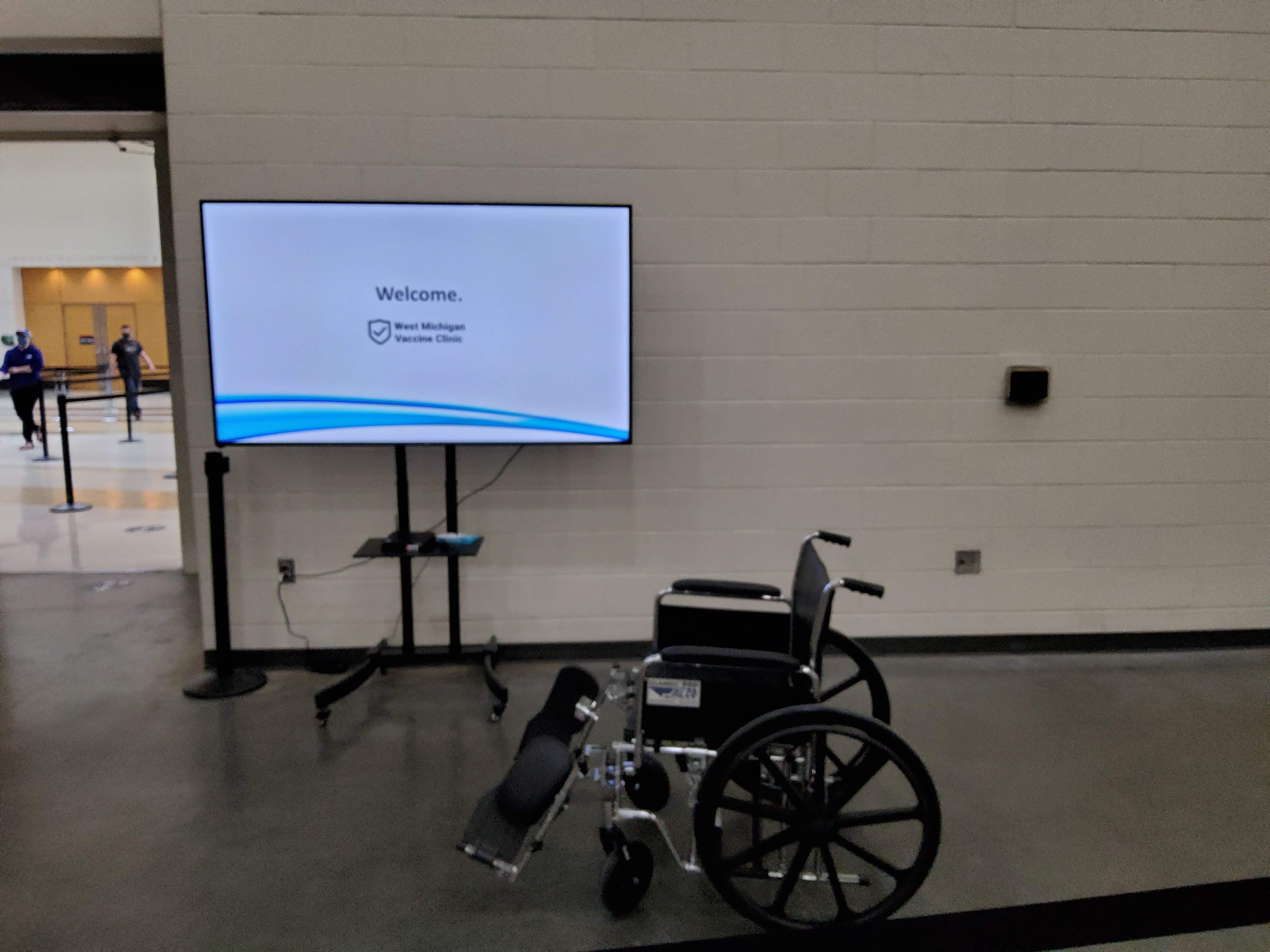
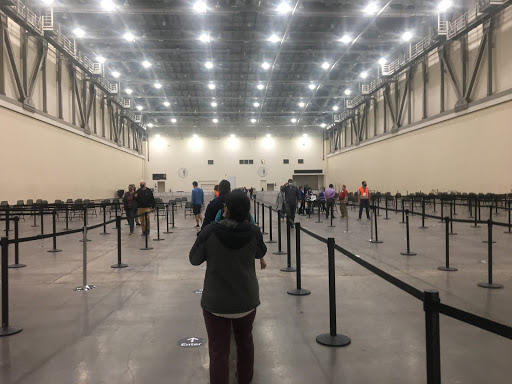
Upon entering the building, the first thing they did was check our temperatures with handheld forehead thermometers.  Since neither of us were running a fever, we were ushered in and offered hand sanitizer.  Once that was applied, it was down the stairs and into the convention hall proper.  Which looked like this:

Everything was very neatly laid out for maximum efficiency, with probably hundreds of volunteers politely guiding you in case the arrows and lanes weren\’t sufficient.  All the volunteers were, at worst, blandly polite.  Some were significantly more cheerful, and a few even thanked us for coming in.  There was no immediate sign of our friend, who we\’d planned to meet up with for the event.  

Mostly what I noticed was that it was very easy to go on autopilot and simply follow the clear signs, lanes, and verbal directions.  We later called this \”being in the flow,\” and I experienced it as something akin to being in a waking trance or a near-dreamlike state.  At every step of the way, you knew where you should be going and what you should be doing.  There was no need for conscious thought, because at the slightest uncertainty, there was immediately a staff member to tell you where to go.  

This actually made it rather difficult to take pictures, but I still did, because it\’s kind of a once (or twice, I guess) in a lifetime experience.  

Several friends of mine referred to this event as Vaccine-Con, which isn\’t the worst name for it, in all honesty.  It\’s definitely getting the foot traffic of a convention, and it\’s in a convention hall.  Seems fair enough to me.  The major difference is that the focus of this is health, and the focus of most conventions is making money.  

There were four lanes like this in the convention center.  Note the stickers placed 6 feet apart, the extra-wide hallways, and the open ceiling.  Also note the chairs placed strategically for people that don\’t do well standing in line.  In truth, we maybe spent like 10 minutes queuing, if that, but I can imagine the place being significantly busier at other points in the day.  Particularly with the previous eligible group, which was mainly comprised of the elderly.  

Getting to the front of the line afforded you this view, where a staff member would give you some short paperwork and have you sign in and verify essential details on the computer.  It took us maybe a couple minutes.

Once past the final registration, it was time to stand in line for a booth.  Each contained a nurse or someone trained in administering the shots.  The staff that gave us our first dose (Pfizer, one of the two mRNA vaccines) is named Kristin.  She seemed weary, but in reasonably good humor.  I\’d honestly assume there were hundreds of people before us, and maybe it was near the end of her shift.  At any rate, she checked our information and then gave us each our shot.

I went first.  I didn\’t look at the needle going into my skin, because there\’s no need to make the poor nurse\’s life any harder than it already was.  I did watch my spouse get his shot, though.  The vaccine liquid was perfectly clear, which was weird to me for some reason. I didn\’t even bleed, and barely felt the shot at all.  She gave us a bandaid and then we were on our way again.

I left the booth feeling jubilant (one step closer to being done with this pandemic!), but also a little fuzzy in the head.  My doctor tells me I\’m extraordinarily sensitive to changes in my system.  I have the ability to tell, based on the sensation in my stomach, whether something I\’ve eaten or drunk was alcoholic.  Same with painkillers, for some reason.  So it could be simply that I could tell my system was reacting to the \”invader\” vaccine.  Ooor it could be a trick of my imagination.  

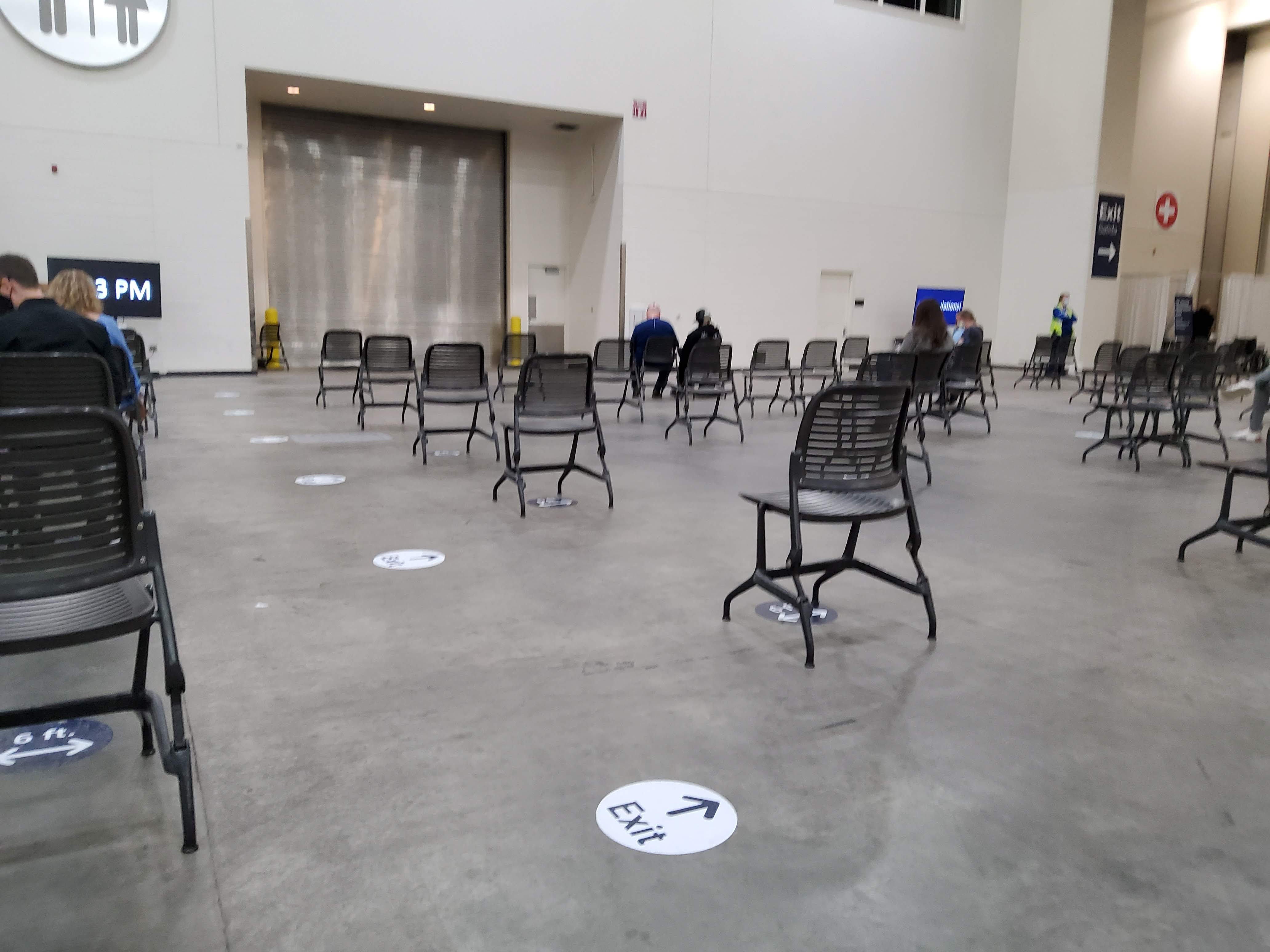
Either way, once the shots were done, it was time for the 15 minute cool-off period.  This was implemented because on rare occasions, people would go into anaphylactic shock after receiving the vaccine.  You really don\’t want that happening while the person is trying to drive home, or on a bus.  So instead they parked us in seats with a big clock to help us track the time.  Bathrooms were also available as needed.  

I\’ve tried to keep people\’s faces out of my pictures on account of not having their permission to appear in this blog, so you can\’t see the row of double-chairs for couples or pairs of friends that went together.  My spouse and I settled into one of those to wait out the 15 minutes.  It was a pretty uneventful wait, thankfully.  We did manage to meet up with our friend, and so we spent most of the time just chatting about whatever happened to be on our minds.  

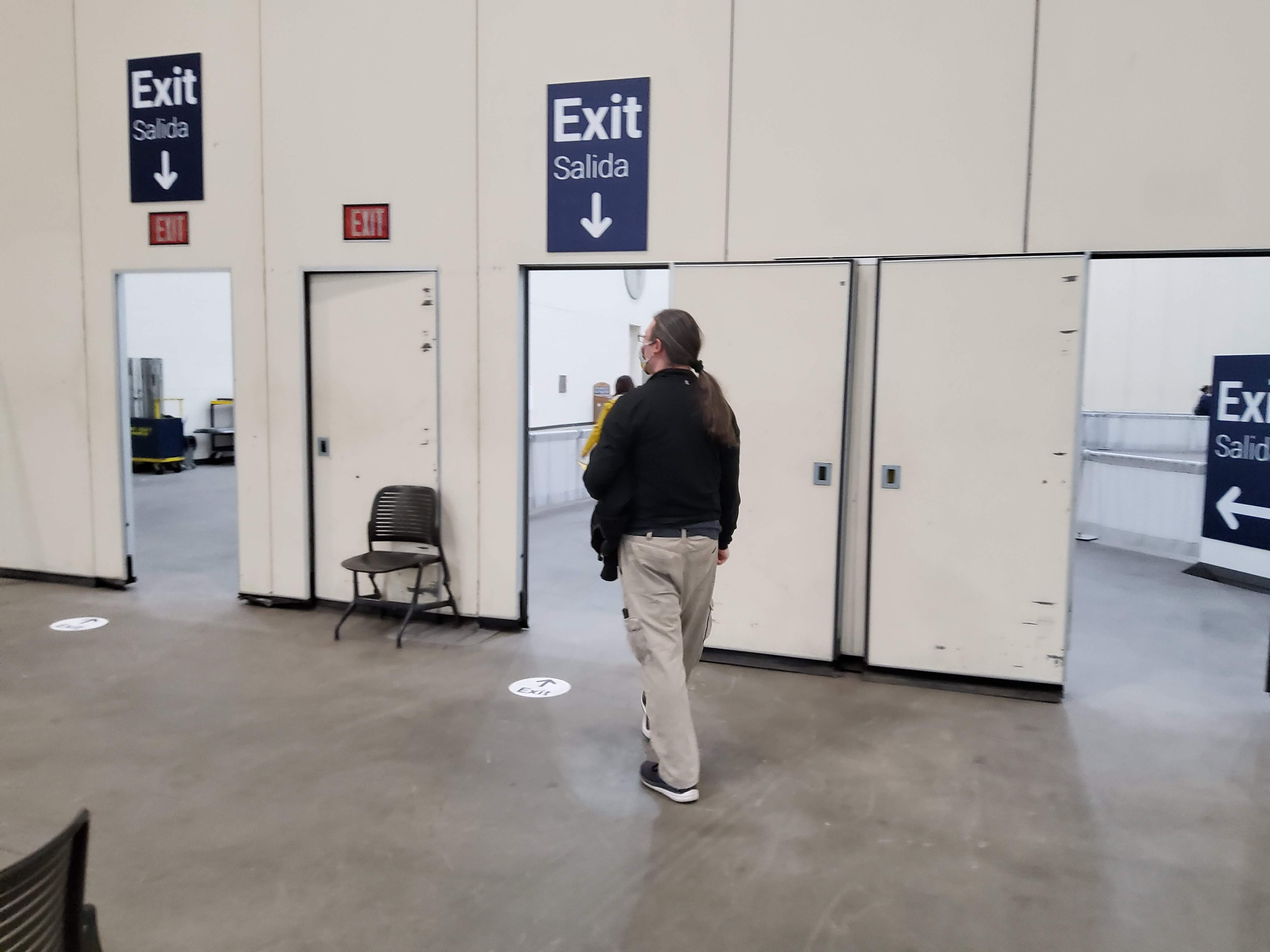
Once the 15 minutes was up, we followed the obvious signs (and verbal directions) to leave Vaccine-Con.  

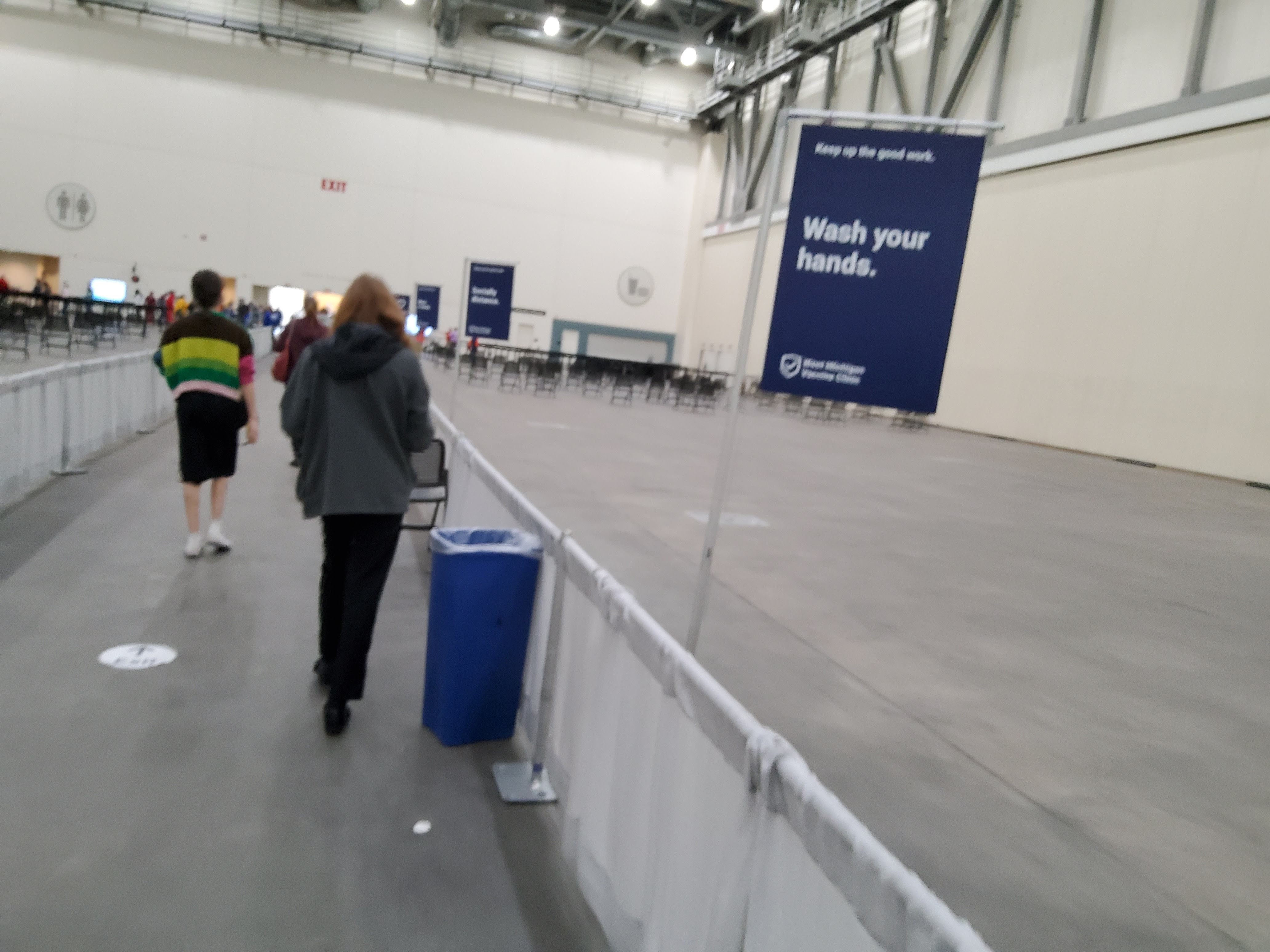
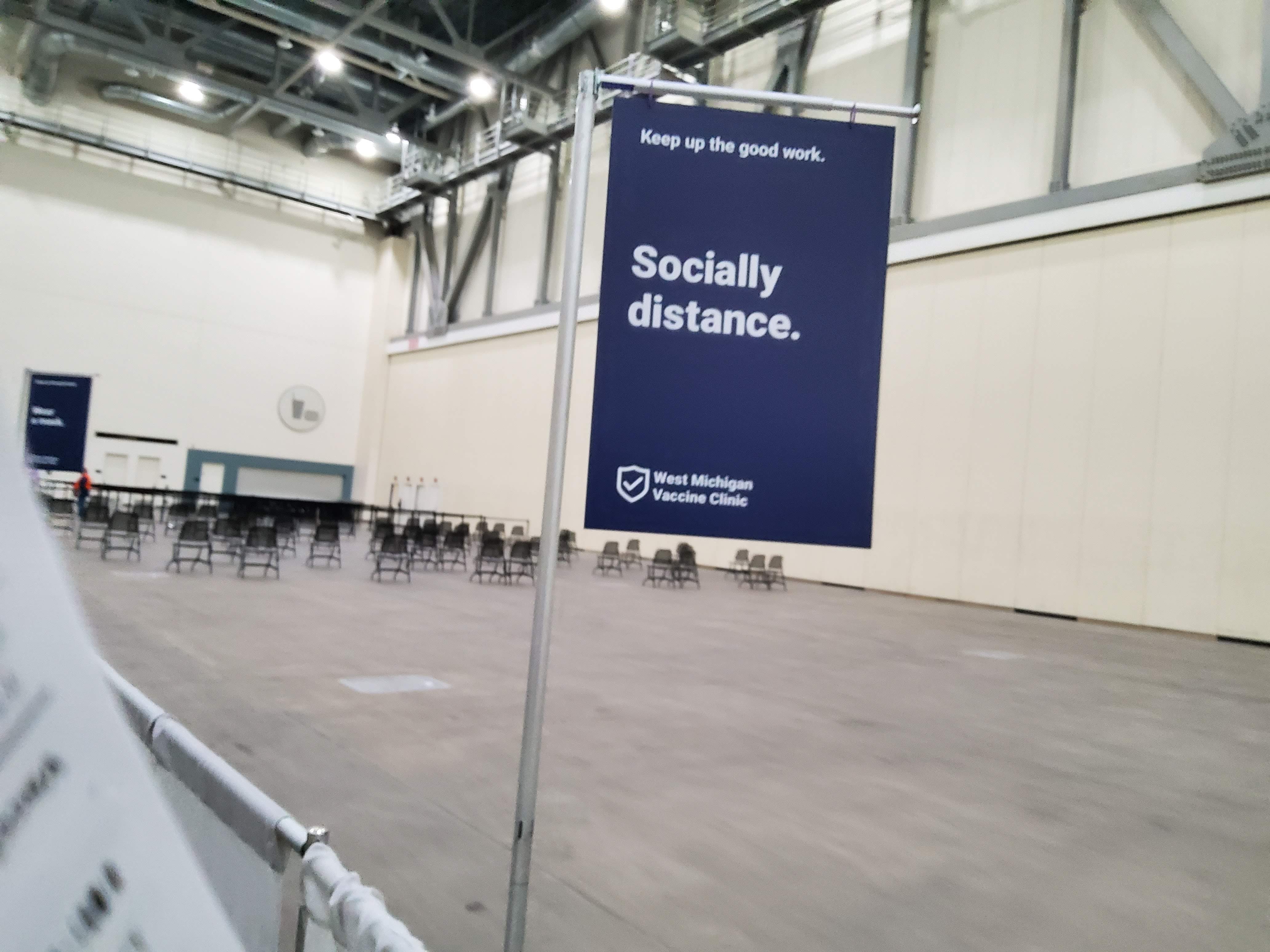
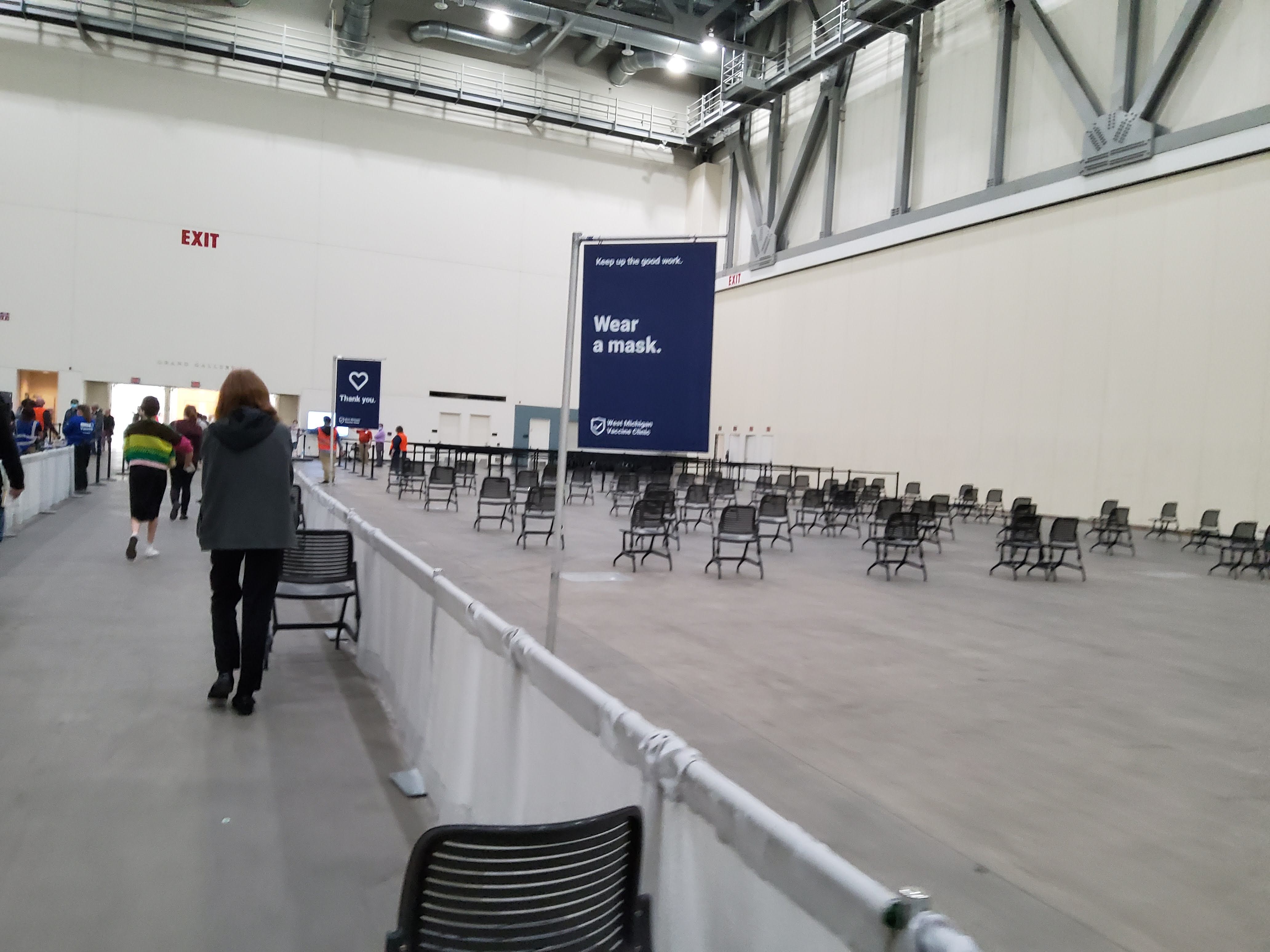
I can\’t begin to describe how big this place was… which I guess makes sense since it\’s a full-on convention center.  Still, as you can see, there was a lot of unused space.  We were lauded with various signs on the way out.  

The \”in the flow\” effect applied here, too.  My pictures aren\’t great because of that.  

From top to bottom, the signs read:
💗 You did it.
Keep up the good work.  Please remember:
Wash your hands.
Socially distance.
Wear a mask.
💗 Thank you.

I\’ll return here in about three weeks for my second dose, which we were able to schedule online within an hour of receiving the first dose.  

The side effects I experienced from this first shot were soreness, mind fog, malaise, and systemic inflammation, which I can now recognize as my neck being crickey-crackity, as well as swollen joints.  The inflammation could be treated with ibuprofen, though I opted not to this time since it wasn\’t that bad.  My spouse and friend only reported soreness in the arm.  

The second shot is said to be harder on the system than the first, so I may take that day off and just prepare to be dead on my feet.  It\’s either that, or I won\’t have symptoms at all, and I\’ll have a strong suspicion that I was an asymptomatic carrier sometime last year.  I can\’t decide which concept I dislike more, but thankfully I have zero choice in the matter.  Either I got it on one of the shopping trips I did during the pandemic, or I didn\’t.  

It\’ll still be two weeks after the second shot before I can really say \”I\’m safe and won\’t need to go to the hospital for this.\”  Even after that, it\’s still possible for me to carry the coronavirus asymptomatically and infect people who can\’t be vaccinated or refuse to do so. So I\’ll have to keep washing my cloth mask and expecting to wear it in the long term.  

Still, it\’ll be a relief.  Both for me and for the people that care about me.  

Reading the Research: Catastrophizing

Welcome back to Reading the Research, where I trawl the Internet to find noteworthy research on autism and related subjects, then discuss it in brief with bits from my own life, research, and observations.

Today\’s article is some long overdue pushback against the Autism $peaks style catastrophizing of autistic lives and outcomes.  

For decades, studies on autistic people and our lives have typically focused on what we can\’t do, and what things we struggle in.  This is because of the history of the diagnosis and the medical field overall.  Things are labeled as illnesses, a treatment (typically just one, like for a broken leg) is prescribed, the patient does the treatment and gets better.  

This is simplistic, but it works for many physical ailments.  The thing is, autism is not that.  There is no broken bone.  Autism is a neurodevelopmental condition.  There is no one-size-fits-all treatment, and there never will be.  We are simply too different from each other.  Those individual differences have to be accounted for.

This study differs from those of the past by having a much broader focus.  Instead of starting and stopping the narrative with, \”well, your kid is autistic, and they\’re always going to be autistic, so it\’s time to give up any dreams and hopes you had for your kid and prepare for a life of suffering,\” this study instead chose to see whether autistic children learn and grow in understanding and ability.  

Unsurprisingly, I hope, to anyone who\’s met an autistic person, the answer is yes.  While not every autistic kid will necessarily reach all milestones for \”normal\” communication or independent living, we do continue learning throughout our lifetimes.  Recognizing those successes is an important part of support for autistic people and our families.  It also goes a long way toward undermining the doom and gloom that medical professionals and even some parents project onto 

The study also examined what factors contributed to autistic growth and development of skills.  Unsurprisingly, it helped to have a certain amount of income.  Adequate income takes a significant amount of stress off the family, and allows for more options for family and singleton therapy, as well as support services, better schooling options, and their choice of doctors and medical professionals.  

I\’ll be interested to see what this group\’s research on adolescents shows.  This study only went up to age 10, which is definitely sufficient to prove that autistic people aren\’t magically stuck at the developmental age they\’re diagnosed at.  But the teenage years are distinctly more demanding and difficult than the years before them, and so that data would be exceptionally useful as well.  

For further information on this learning and growing (also called neuroplasticity), please also consult this podcast episode.

(Pst! If you like seeing the latest autism-relevant research, visit my Twitter, which has links and brief comments on studies that were interesting, but didn\’t get a whole Reading the Research article about them.)