Book Review: The Game of My Life

The Game of My Life: A True Story of Challenge, Triumph, and Growing Up Autistic, by Jason \”J-Mac\” McElwain with David Paisner, is the story of one autistic guy\’s 15 minutes of fame.  It\’s less than 250 pages, mainly narrated by the autistic guy, with bookends from the other author.  

I found this book deeply disappointing, in retrospect.  Save for the blunt honesty of the star and some of the contributing family/friends, this is pretty much a textbook case of inspiration porn.  The vast majority of the book\’s focus is not Jason McElwain\’s life, his childhood, or his future.  It\’s basketball, and more specifically, one particularly meaningful game near the end of Jason\’s high school career.  

Jason\’s favorite hobby and intense interest in the story is basketball.  Terminology from that game is everywhere, including how the sections of the book are named.  It isn\’t too overwhelming, though I did have to look up how many players are in a basketball team (typically five) to understand why his fan club was called \”The 6th Man\” group.  

Bits and pieces are given of Jason\’s life prior to the basketball team, but only enough to give you the faintest amount of background… which is pretty in line with most news articles of the same type.  

A neat feature of this book, which I can now only consider a very extended inspiration porn news article, is that it folds in little pieces from Jason\’s family, friends, coaches, etc.  It\’s done in the conversational tone so common to other autistic writing, too, such that Jason will sometimes respond directly to what was said in those miniature pieces, or even vice versa.  

What I found most telling about this book, and where it became crushingly clear to me what I was reading, was at the end of the book, more than 200 pages in.  The writer here, probably David Paisner, calls it \”bittersweet.\”  I\’m not honestly sure where the sweet is.

The short version is that Jason\’s friends have graduated and, as is typical for that age, scattered to the four winds.  He rarely sees even the ones that remained in the area.  He did not graduate high school with a diploma, and at the time of the book, works as a baker at a supermarket.  A job which he seemingly enjoys, but not one where he does anything with the love of basketball and the team that this book is centered around.  

His parents\’ wish is for him to be able to live independently someday.  It\’s even said, and I quote, \”Forget the sectionals.  Forget the twenty-point game [both things the literal whole point of this book].  That would be the true pinnacle, if Jason could harness his abilities and his growing independence and find a way to make it on his own.\”  

The twenty points Jason scored in under 4 minutes, the feat that made this whole book and dozens of news stories, ESPN clips, etc, possible… and that\’s how they choose to talk about it at the end of the book.  \”Forget all that, this is what matters.\”  Talk about buckets of metaphorical cold water.

I think maybe why this gets my goat so much is that in the end, the 15 minutes of fame is over, and everyone except Jason has moved on.  Those 4 minutes and the surrounding time might be the best his life will ever be.  The community rallied around him, everyone celebrated him, and then it was over.

As a somewhat disabled autistic person, many jobs are closed to him.  Expectations are low.  Opportunities are minimal.  If this is all there is, and by the tone of the book, it pretty much is…  that\’s it.  

Maybe Jason feels otherwise, and I hope he does… but that\’s really depressing to me.  He\’ll likely live another few decades, and only have being a stocker or a clerk to look forward to.  I don\’t see why he couldn\’t learn to be a coach, or aim to be a team manager for a sports team like he was in high school.  Or, I should say, \”I don\’t see why unless he doesn\’t want to.\”  

In the end, this feels like a story of met potential, and then ignored potential.  I\’m aware that the 15 minutes of fame is called that because it goes away after 15 metaphorical minutes, but the expectations the other author and his parents seem to have for him are depressingly low.  

I don\’t know the guy, but I really hope things got better for him after this book was published.  That he did make it to living on his own (maybe with help, maybe without), finding a life partner if he wants one, pursuing whatever dreams he has.  I hope his parents give him the space to do those things, and don\’t stand in his way, afraid he\’ll be disappointed, the way his mother did over and over in the book.  

The struggle with autistic kids is figuring out when to let us try and succeed or fail on our own merits.  Because we don\’t develop at the same rate as our neurotypical peers, it can be really challenging to recognize when it\’s appropriate to do so.  Some parents will stand between their kids and almost every risk in the world, lest we fail and become disheartened.  Which, counterintuitively, steals our opportunities to learn and grow, and makes future failures extra-disheartening.  

Don\’t do that.  Let autistic people try things.  Don\’t treat failure as the end of the world, but instead recognize it as the normal part of life, and the learning experience, that it is.  

And definitely don\’t grab your kid\’s head between your hands to demand their attention.  Good Lord what a hideous, tyrannical action.  Jason hated it, and he says so in the book, and I\’ll back him up.  Don\’t. Do. This.  
Read This Book If

You want to read an account of a very autistic 15 minutes of fame, and don\’t mind that it is definitely inspiration porn.  This story is written mainly in the typical autistic honesty and conversational style, and Jason McElwain is quite frank about the way he puts things and acts.  I\’m not sure his story has a happy ending, but the 15 minutes of fame and what led up to it are described in a way that almost lets you be there in person. 

Reading the Research: Misjudging Stereotypical Autistic Behaviors

Welcome back to Reading the Research, where I trawl the Internet to find noteworthy research on autism and related subjects, then discuss it in brief with bits from my own life, research, and observations.

Today\’s article helps show that the miscommunication issue between autistic people and neurotypical people is not simply an autistic failure, but a failure on neurotypical peoples\’ parts as well.  

There\’s a few stereotypes you can see in the presentation of autistic people mentioned here.  Things like avoiding looking people in the eyes (can be overwhelming), literalist thinking, and repetitive movements (often used to calm ourselves in stressful situations) are all factors.  It\’s gotten to the point where I can, in some circumstances, interact with a person and be able to tell almost immediately that they\’re neurodiverse.  

Apparently, this article says, these behaviors look like the actions of a person being deceptive.  Oddly enough, these behaviors are actually not particularly indicative of a person being deceptive… we as a culture simply think they are.  

The implications go much, much further than the article suggests.  In court, autistic people receive harsher sentences than our typically developing peers.  But I\’ll bet dollars to doughnuts the same effect holds true in other arenas of life, such as job interviews and first impressions.  

When we talk about autistic people being disabled, this is a major part of it: the way others see and react to us.  Others\’ prejudices and failures are not our fault, but we\’re expected to bend over backwards to compensate for them.  That\’s neither fair nor healthy for anyone involved.  

It\’s the same expectation as saying, \”well if women don\’t want to be sexually assaulted, they should wear clothing that hides every inch of skin.\”  Or maybe more accurately, saying, \”Well if black people don\’t want to be murdered by the police, they should act like they\’re white as much as possible and be as nonthreatening as possible at all times.\”

Because of this prejudice effect, autistic people are denied the chance for friendships, the ability to participate in our communities, job and volunteer opportunities, promotions, and general human consideration.  We deserve better.  

(Pst! If you like seeing the latest autism-relevant research, visit my Twitter, which has links and brief comments on studies that were interesting, but didn\’t get a whole Reading the Research article about them.)

Inspiration Porn and Disability

This post is brought to you by the book I\’ll review for next week, but it\’s been an issue for years.  It crops up in local newspapers, in social media, even by word of mouth.  

Defining

What is it?  It\’s typically images, videos, articles, and memes of disabled people accomplishing something, used to motivate or shame abled people.  The gist is basically \”well if this disabled person can do it, of course you (an abled person) can!\”  There\’s a variant where the disabled person is the prop by which an abled person shows how nice/noble a person they are.

Inspiration porn is called this because it is objectifying just like regular porn.  No sex is involved, but it reduces our personalities, loves, hates, and quirks down to our disabilities, as if \”autism spectrum disorder\” or \”cerebral palsy\” or \”sacral agenesis\” tells you anything at all about the human involved.  It erases us and our struggles for the sake of the comfort and happiness of abled people.  

The Problem

I shouldn\’t have to tell most parents of autistic people that not all autistic people are the same.  My life\’s trajectory, as mainly a highly verbal loner without a community to support me, but successful in academia (though not outside it, really), is one possible route of many for autistic people.  

There are also autistic people that are raised by proverbial villages, and have massive support networks and people looking out for them.  There are autistic people with intellectual disability and autistic people with average intelligence.  There are autistic people who are savants, and autistic people without \”special interests\” or favorite hobbies they love intensely.  There are brilliant wordsmiths and nonspeaking people who are still incredibly gifted, thoughtful, intelligent humans.  It is, after all, a spectrum.  

Yet my life, if I were to get famous suddenly, would be boiled down to \”autism spectrum disorder.\”  Maybe \”Asperger\’s Syndrome\” to dissociate me from nonspeaking autistic people, as if I haven\’t spent several points in my adult life nearly or totally unable to communicate verbally.  And as if I don\’t share any traits with nonspeaking autistics, despite sensory sensitivities being very common, as well as depression and anxiety.  

It also demands that disabled people always be inspirational, for the benefit of abled people\’s pleasure and comfort.  It makes the sum total of our disability \”a burden to be overcome\” and refuses to acknowledge the social barriers that so often stand in our way.  And finally,  it reinforces the stereotype that disabled people are less competent and capable than abled people.  

An Example

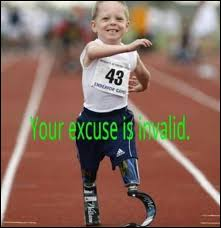
This is probably the first example I ran into, years and years ago, on Facebook.  

The text says \”Your excuse is invalid\” and the unwritten subtext is \”if this small child with prosthetic legs can get out there on a racetrack and enjoy running despite having no legs below the knee, you have no excuse for not doing whatever it is you\’re not doing.\”  

We know nothing at all about the child.  He is simply \”small white boy with prosthetic legs\” and his image is being used to guilt trip people for supposedly not accomplishing enough.  

I did some searching.  This child is now old enough to drive (and soon drink, too).  His name is Cody McCasland, a resident of Texas, and he\’s a serious athlete, but not a runner.  Running is a hobby.  He\’s a swimmer, with hopes of competing in the 2020 Paralympics.  And according to his bio on a website, he also wants to be an anesthesiologist, in part due to all the time he\’s spent in the hospital (30ish surgeries).  

Looking at the information from the media, it seems Cody has leaned into the publicity to some extent.  I sifted through a dozen or so articles, and all they typically wanted to do was rehash what amazing odds Cody beat, his promise as an athlete, and how wonderful that all is.  

Nothing is said about the difficulties inherent in affording, using, and cleaning prosthetic limbs.  Nothing about how many types of limbs he has, or why you can\’t just have one set for everything.  Nothing is asked about Cody\’s high school experience, his home life, any siblings… Nothing about the stares he inevitably gets from strangers, nor the invasive questions.  Nothing about him is of interest except his \”overcoming\” of his disability.  

In summary, Cody McCasland is reduced down to his disability, his struggles are omitted, and he is merely a prop in this picture.  His triumph is reduced to a bludgeon that, in the best case, might be used positively to elbow an abled person into starting to be healthier.  It might also be used to guilt trip someone with an invisible disability, because \”well you have both legs, so get out there!\”  (left unsaid: \”I neither understand nor care that you have chronic back pain or some weird allergy that makes you utterly miserable when you do moderate to high intensity exercise\”).

Let\’s look at an article from a prosthetic arm user.  Let\’s see, it\’s titled, \”I have one of those most advanced prosthetic arms in the world — and I hate it.\”  Hmm, can we guess how this is going to go?  The article is worth your read, by the way.  Real talk from someone whose life is unfamiliar to you often is.  She\’s even included short videos of her using the limbs.  

Generalizing Disabilities

There\’s one more issue with generalizing Cody\’s story to every possible situation, sitting back, and saying, \”well if he can do it, anyone can!\”  

Let\’s start by noting the obvious: Cody\’s disability is physical.  His legs from above the knee are flesh and blood, and below that do not exist due to a major difference in his DNA.  To move around at a normal height, he uses prosthetic legs.  This is a visible, physical disability.  

Visible disabilities mean you get stares and invasive questions.  This is typically unwanted.  However, because your difference is obvious, no one questions whether it is real.  An invisible disability, like mental illness or autism, can be disbelieved.  A person can decide, after looking at you, that your struggles are not real.  Seeing, as they say, is believing.  

Physical disabilities tend to be visible, but they don\’t need to be.  Chronic joint pain, fibromyalgia, and blindness without the person carrying a white cane or some other identifier are all physical disabilities, but not simple ones to notice in a second or two.  

Invisible disabilities include a spectrum of things people don\’t necessarily notice or care about, including depression, anxiety disorders, chronic back pain, chronic dizziness, diabetes, sleep disorders, chronic fatigue, and agoraphobia.  Because no apparent disability is noticed, the effects of these disabilities may be blamed on the sufferer\’s innate qualities.  

Instead of recognizing the very reasonable tiredness and reduced performance of a sufferer of insomnia, people might instead decide she simply isn\’t trying hard enough, or that her sleepiness is because she\’s too busy partying to adhere to a normal sleep schedule.  In reality, she may have spent hours lying in bed, fruitlessly trying everything in her power (from podcasts to boring textbooks to exercise to adult coloring books) to get to sleep, all as the clock mercilessly ticks onward towards the next work day.  

So while Cody\’s disability is clear, obvious, and the path to addressing the disability is clear… that is not the case for other disabilities.  

One need really only look at autism for a demonstration of this.  Some autistic people can find sensory relief in small perfume jars, swatches of fabric, or particular blankets.  Others would find those things ineffective or torturous.  Some autistic people suffer from gut dysbiosis or allergies, and need to eat according to special diets.  Choosing the wrong diet can be terribly painful.  Still others benefit from basic lessons in the mechanics of conversations.  I, however, would find such lessons irritating at best.  

What works for one autistic person does not necessarily work for another.  This is pretty common knowledge, immortalized in the saying, \”If you\’ve met one person with autism, you\’ve met one person with autism.\”

Saying, \”well this kid with a clear disability has a harder life than you, and still is doing this thing, so why aren\’t you doing this thing?\” is insulting not only to him, but to the person you\’re talking to, who may have struggles you don\’t know anything about.  

For further reading, please consult this article, which also links to an excellent TEDx talk.  

Reading the Research: Companion Cats

Welcome back to Reading the Research, where I trawl the Internet to find noteworthy research on autism and related subjects, then discuss it in brief with bits from my own life, research, and observations.

Today\’s article is one of various articles I\’ve seen about companion animals and autistic people.  

The research is pretty simple here.  Owning a compatible pet can be a very positive experience for autistic people.  Many studies focused on dogs, since dogs display their affection more.  As a bonus, they need to be walked, which can mean built-in exercise for the family or individual.  

There\’s something to be said for cats, though, and that\’s that if you get the right one, they\’re comparatively low-maintenance while still being affectionate and supportive.  They\’re typically quieter than dogs, which is a bonus for humans with sensory sensitivities.  

In both cases (or other, less common pets, like rats, snakes, birds, gerbils, hamsters, etc), the fact that the animal doesn\’t judge by human criteria is incredibly valuable.  Their needs are simpler, and they\’re often more forgiving than human peers.  A good pet can be a support and a joy to any household, not merely ones with autistic people.  

I\’d tend to say furred and affectionate animals might be a better match for most autistic people, given that petting the animal can be a pleasing sensory experience.  Particularly with a purring cat, indicating the petting is making both you and the cat happy.  

As with any support for autistic people, careful consideration of the specific person and their needs is required.  Immediately rushing out to buy the cutest cat or dog you can find is not kind to the autistic person or the animal.  Keeping noise considerations, specific human and animal temperaments, required responsibility, and other relevant factors in mind is important in these decisions.

It\’s also relevant to consider whether adopting a grown cat or dog might be worthwhile.  A pet bought while it\’s still a puppy or kitten may not have sufficient socialization to be a proper support animal.  Older pets, on the other hand, have settled personalities.  They also have a harder time being adopted, so you can be a good person and change a pet\’s life for the better, while also being a good person and change your loved one\’s life for the better.  

(Pst! If you like seeing the latest autism-relevant research, visit my Twitter, which has links and brief comments on studies that were interesting, but didn\’t get a whole Reading the Research article about them.)

Book Review: Divergent Mind

Divergent Mind: Thriving in a World That Wasn\’t Designed For You, by Jenara Nerenberg, is less of the practical guidebook I expected from the title, and more a work of history, philosophy, and suggestions and guidelines for changing the broadly disabling systems we live and work in.  Please also note that \”neurodivergent\” includes autism, but it also includes synesthesia, sensory processing disorder, ADHD, and more.  

The book begins with a section which read to me like a defense of the book\’s existence, which… kind of made me sad, because I\’ve only seen such things rarely, and usually by autistic adults needing to prove their viewpoint matters. The author says that this book was written in response to and in addition to Elaine Aron\’s \”The Highly Sensitive Person,\” published in 1996.  I suspect that book might also make for good reading.

Once the defense of the book\’s existence was done, it got into the deconstruction of the words and concepts we use to pathologize people, such as \”mentally ill.\”  The author presents the historical context and evolution of cultural thinking about neurological differences in the recent few centuries.  \”Female hysteria\” is one of the earlier terms discussed, obviously having its roots in the male-dominated thought processes of the day.  

The book also briefly covers more recent developments, like the rise and overdiagnosis of ADHD.  Generally, the point was that what we consider normal or abnormal changes depending on what\’s going on in the world and who has power.  There\’s also discussion of various diagnoses and how they are part of a larger phenomenon that\’s mainly been sidelined up \’til now.  

Finally, the third section talks about changes that can be made in the self, in the home, and in the workplace.  Again, this book doesn\’t really specialize in concrete ideas.  I\’m not at my best in terms of retaining information right now, but mainly what the author seemed to recommend was, \”listen to what you feel you would do well with, try things and keep the ones that work.\”  That included things like paying attention to the paint colors.  

Something that specifically stuck out to me was the suggestion of figuring out what colors appeal to you and making a point to have them around.  Which just reminded me that I tend to buy everything in blue or neutral tones.  I am currently wrapped in a pale blue blanket while typing this at my computer.  Next to me is a bright medium blue cloth organizer box.  My hair is currently two-toned sapphire and Carribean ocean blue.  My computer background is a blue-hued galaxy.  My water pitcher with built in filter is a dusky dark blue.  My pill organizer is blue.  A lot of my clothes are blue. 

Apparently I\’ve been subconsciously shaping my environment towards easing the burden on my senses for years.  Fortunately, my spouse doesn\’t mind my very strongly held preferences.  

I mostly liked this book, but I worry it doesn\’t have a lot to offer people without a lot of control over their lives.  Many autistic people live in poverty so they can get the support services they need.  That situation may not give the person (or their parents) the influence they need to change the paint color on the walls, let alone choose a career that doesn\’t strain their senses to the breaking point every day.  

I can\’t argue with the usefulness of at least teaching people to recognize the differences in their senses and experiences, and finding what ways they can to improve their lives.  Adding in a safe room, with colors to relax the person\’s senses, perhaps textures or smells that do the same, etc, would do pretty much any autistic person good.  

More concrete examples of changes people made in their lives, and how that helped them, would have helped make this book more accessible and useful to a broader audience, in my opinion.  As it stands, this is more of a philosophic piece about changing your mindset away from the disabling and limiting crap we\’ve been fed systemically.  While that\’s valuable, it\’s not immediately… actionable, I guess.  

Changing someone\’s overall mentality is valuable and important, but they have to have the time and energy to devote to it, and my fear is that many autistic people and their parents don\’t have those resources to spare in these unusually and overly interesting times.  

Read This Book If

You\’re autistic, especially if you\’re female, and you want a new perspective on neurodiversity and sensitivity.  I expect parents of autistic people could also benefit from the ideas in this book.  They include history, philosophy, and broad suggestions for improving the experience of home, work, and existing in general.  The suggestions aren\’t concrete, firm, easy-to-follow ones, but nothing valuable in autism is cookie-cutter anyway.  This book is perhaps aimed at people with influence and means, rather than the average autistic person.  Still, the ideas within can be valuable to anyone.  

Reading the Research: Hiring Limitations

Welcome back to Reading the Research, where I trawl the Internet to find noteworthy research on autism and related subjects, then discuss it in brief with bits from my own life, research, and observations.

Today\’s article touches on a sore spot for many unemployed and underemployed autistic people (hi!).

The fact is, the hiring process in most companies is extremely discriminatory.  Not in some cartoonish way, with an evil HR person twirling his mustache and leeringly stating, \”we don\’t hire black people/women/neurodiverse people here.\”  And yet, it might as well happen like that, because that\’s more or less the results, repeated over and over across thousands of companies worldwide.  

As far as I\’ve seen and heard, there isn\’t really a standard set of practices for hiring.  As a result, hiring managers are pretty much given criteria for what skills the job requires, which lets them sort resumes…  but after that, and sometimes even during that, is when things go wrong.  

Hiring managers tend to hire people they personally like.  Their gut tells them this person or that would do a good job, and so they hire that person.  The problem is the criteria used.  Humans tend to shorthand \”this person is like me\” to \”this person is competent and will fit well into the company.\”  Which puts neurodiverse people out in the cold unless the company is already mainly neurodiverse.  So effectively the hiring process is gatekeeping, and on a massive scale.  

It\’s during the interview process that many autistic people fall flat on our faces.  It\’s not that we lack the skills necessary.  It\’s that the interview process is an elaborate dance of lies and wordplay.  Is anyone really enthusiastic about a job in retail?  Especially after applying for 20 more positions elsewhere, managing multiple interviews, and being turned down repeatedly.  And yet \”enthusiasm and positivity\” are major hiring criteria for most retail chains, if not most workplaces.  

Autistic people often aren\’t great at lying.  So we\’re more likely to give honest answers, which get us disqualified.  Sometimes even before the interview, since there\’s an increasing movement to use online psychiatric measures with opaque criteria.

The typical path for autistic people to even be considered is for our work to speak for us.  Portfolios and work samples are key.  Or knowing someone in the company, someone who can vouch for your skill and usefulness, and someone who can help mediate issues as they arise, is another path. Not all jobs have a portfolio option, though, and connections to others even more limited in autistic people than they are in neurotypical people.

So it\’s kind of a mess, and a major reason why neurodiverse and autistic people aren\’t well represented in the workforce.  

This article offers a solution to the problem, in the form of changing the hiring criteria, and changing workplaces so they actively invite and support neurodiverse people.  I agree with the suggestion that doing so would lead to businesses being more successful and competitive.  

As the Hollywood movie industry has shown us in recent years, you can only get so many interesting stories out of older white male Americans. If you want new ideas, you need to look new places.  Women, people of color, neurodiverse humans of all stripes, our ideas will differ.  To continue improving and growing businesses, those different ideas are necessary.   

For all of our sakes, I hope people listen.

(Pst! If you like seeing the latest autism-relevant research, visit my Twitter, which has links and brief comments on studies that were interesting, but didn\’t get a whole Reading the Research article about them.)

Worth Your Read: Saying "I Love You" Autistically

http://www.thinkingautismguide.com/2020/11/recognizing-how-autistic-children.html

It\’s strange, that in a world so full of different and diverse people, it can be so difficult to accept that others express simple sentiments like, \”I love you\” differently than you personally do.  

No human, myself included, seems immune to this fallacious assumption.  This author, Ann, has written a very short list of nonstandard ways autistic people might express love, which I\’d urge you to look over.  See if you can find one or two you personally display, or your loved one does.  

Having read the list myself, I would honestly say that I feel each of the four examples given actually falls within the \”Five Love Languages\” categories… it\’s just that they\’re so non-standard that they\’re not even recognized as such.  

The second situation, for example, with the autistic person downloading and presenting information they value to the loved one.  That\’s a form of the fourth love language, quality time together.  It\’s initiating that quality time, and ideally, the loved one shares in that enthusiasm and interest. Maybe not to the same extent the autistic person does,  but enough that the \”togetherness\” aspect is fulfilled.  

This behavior actually isn\’t specific to autism.  Requests for attention and a shared experience can be as simple as \”oh honey, look at that bird outside\” or \”did you see what happened in the news today?\”  Or they can be as large as \”let\’s go see a movie together\” or \”want to start a new TV show on Netflix?\”  It\’s the method of the request, not the actual category, that people don\’t seem to understand.  

The first and third situations are simply iterations of the golden rule: \”treat others the way you want to be treated.\”  Alas, the golden rule is far too simple when it comes to neurodiversity and the broadness of human experience.  A better version (that is harder to teach to small children) incorporates doing your best to treat the person well by their own standards.  

Most neurotypical people, naturally, have no particular issue with regular eye contact or small talk, and may even cherish these things as emotional \”togetherness\” signs.  So avoiding them is not received as the love it\’s meant to be, but as the opposite.  

Something the article didn\’t mention is that it\’s not unusual for an autistic person to say \”I love you\” once, and then never again, contentedly assuming their loved one knows this still applies because it\’s been said and not recanted.  Unfortunately, neurotypical people tend to require repetition to believe it.  Especially after an argument or upsetting event.  So this is another example of a miscommunication between autistic and neurotypical people.  

I can\’t remember, offhand, how affectionate I was as a child.  I would guess \”not very\” especially after I became a teenager.  I don\’t feel I was a very warm person, despite my strong sense of justice, fairness, and fiery temper.  That\’s changed somewhat since I\’ve been doing LENS and more traditional therapy, at least I think it has.  I feel more able to empathize and express concern for others in ways they receive.  

It\’s still difficult, mind.  The way people receive love and the way I tend to express it don\’t often match up.  I do okay with listening to people, since pretty much everyone likes to really be listened to with 100% of the listener\’s attention.  My brain doesn\’t typically give me a choice about the 100% attention thing, which comes in handy sometimes.  After that, though, it gets sticky.  

It\’s of some comfort to me that the Five Love Languages book and associated theory exists because neurotypical people don\’t get this right on a regular basis, too.  It feels to me like it\’s still somewhat well known in therapeutic circles, but less so in common knowledge now that it\’s not the latest hot trend.  

The last thing to say here is that yes, your child loves you.  Maybe they aren\’t expressing it in a way you receive, like the examples in this article.  Maybe they\’re suffering so much from medical issues like chronic pain or epilepsy that they can barely express their love.  But please, please don\’t convince yourself your child doesn\’t love you.  Listen to us.  Become curious about how we think and why we do the things we do.  I guarantee we\’ll make more sense if you do.  

Reading the Research: Brain Differences

Welcome back to Reading the Research, where I trawl the Internet to find noteworthy research on autism and related subjects, then discuss it in brief with bits from my own life, research, and observations.

Today\’s article is one in a lot of very long overdue research on autistic women.  The scientific term is \”sex differences\” which might weird out a more general audience.  In biology, \”sex\” can refer to the physical organs and characteristics.  In psychology and sociology, this differs from \”gender\” which is the person\’s experience of their masculinity, femininity, both-ness, or neither-ness.  

In this research, the focus is just specifically on the physical, which makes me wonder if they\’ve accidentally thrown monkey wrenches into their work.  The transgender and autistic communities overlap quite a bit (hi, that includes me!).  Since transgender people also tend to have different brain scan readouts than cisgender folks, I\’d kind of assume this would complicate any potential findings…

At any rate, potential flaws in the researchers\’ methods aside, they did find differences between male and female autistic brains. This is maybe not surprising if you\’ve met a decent number of male and female autistics.  The latter tend to learn more camouflaging behaviors and to be quieter due to societal expectations, while the former aren\’t expected to manage such nuances and can thusly be far more visible.

If I\’m reading this summary I linked, and the main research paper correctly, the data shows autistic brains are more similar to each other, regardless of maleness or femaleness, than they are to neurotypical brains.  There were differences based in maleness or femaleness, such as how well the visual parts of the brain communicated (wonder what that corresponds to in actual life? Poorer imagination skills?).  

Mostly, I\’m just glad to see research prioritizing figuring out what differences there are between male and female autistics.  In the very recent past, the focus has pretty much exclusively been on male autistics, to the point that the autism criteria was written around them.  Thusly, to \”qualify\” as autistic medically, you were judged on \”how male you are\” to quote a fellow autistic from the show Love on the Spectrum.  

This isn\’t the first research to examine female autistics, but it might be important in establishing a more generally applicable autism diagnosis.  And it\’s definitely relevant to recognize that distinctive challenges and differences exist between the sexes.  

(Pst! If you like seeing the latest autism-relevant research, visit my Twitter, which has links and brief comments on studies that were interesting, but didn\’t get a whole Reading the Research article about them.)

Grocery Shopping on a Special Diet: The Checkout

Welcome back to the final installment of my autism-aware shopping trip through the grocery store.  Week by week, I\’ve shown you what the store sells, pruned down the selection to what\’s safe for me (because autistic people can have very sensitive systems) and point out various gotchas the store tries to make you buy stuff you didn\’t come for. 

This is a bonus post, which is just for the checkout lanes.  There are actually three kinds of checkout options, including the traditional setup that was the standard for decades: a clerk, at a register, with a lane.

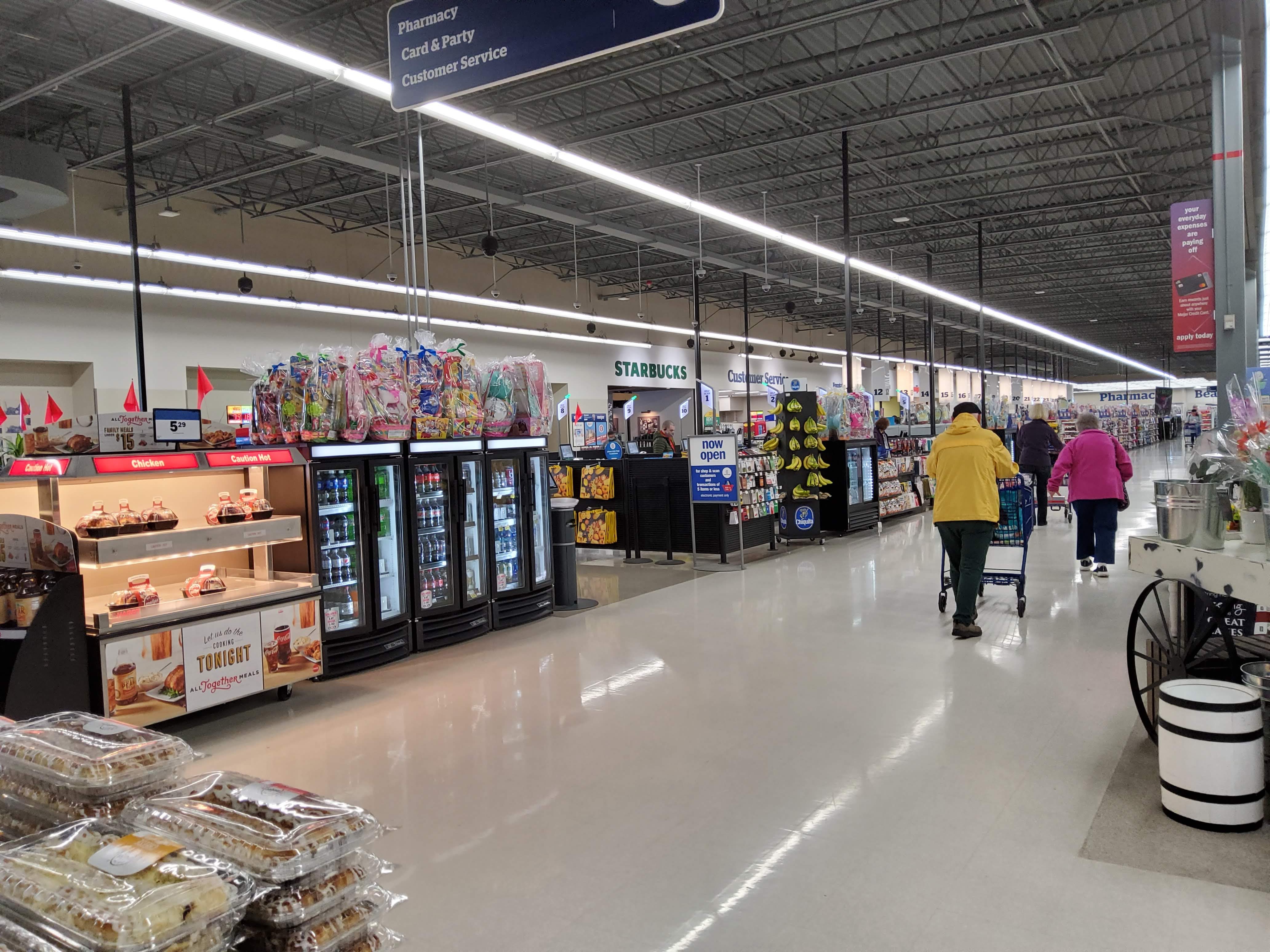
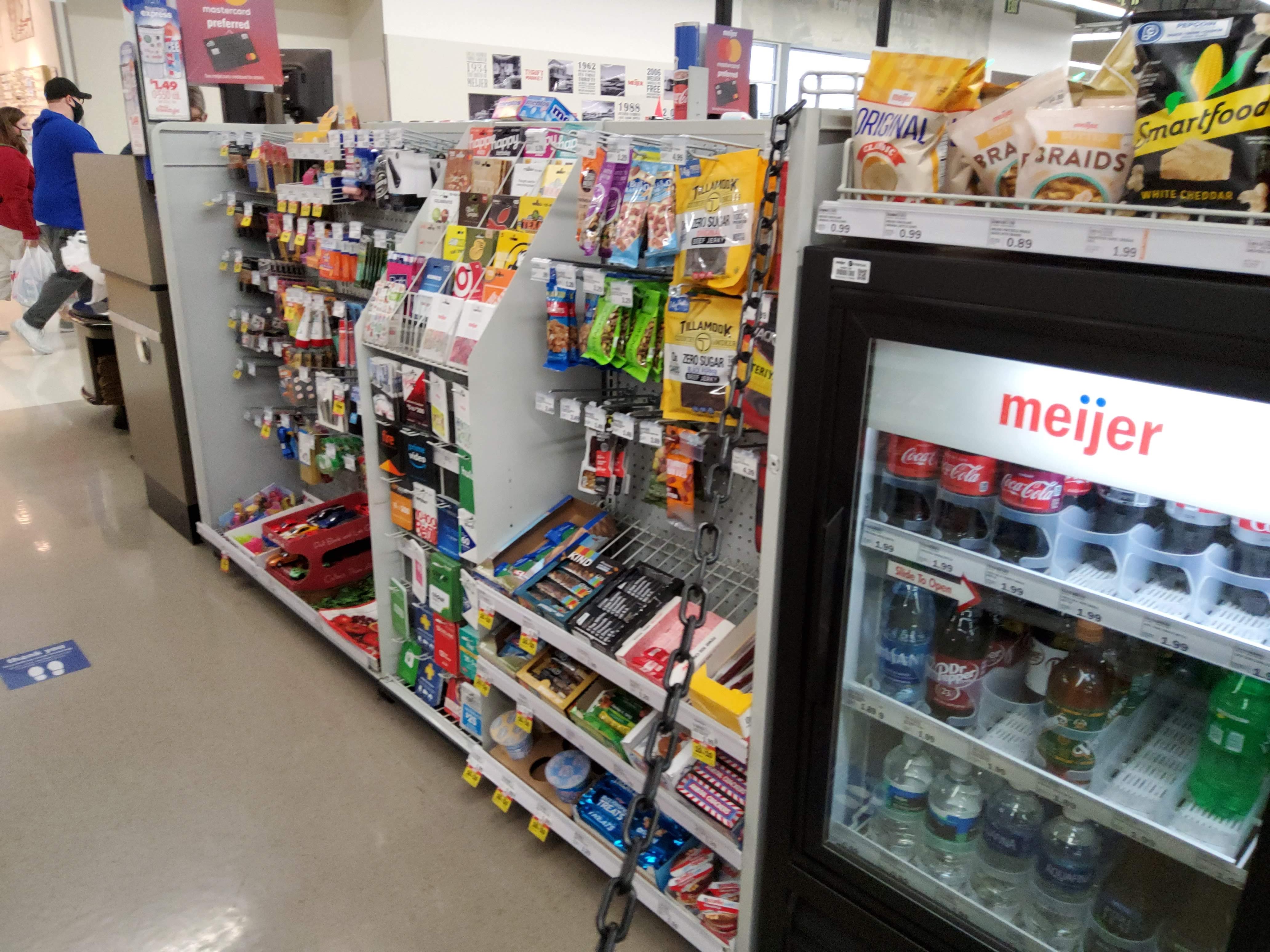
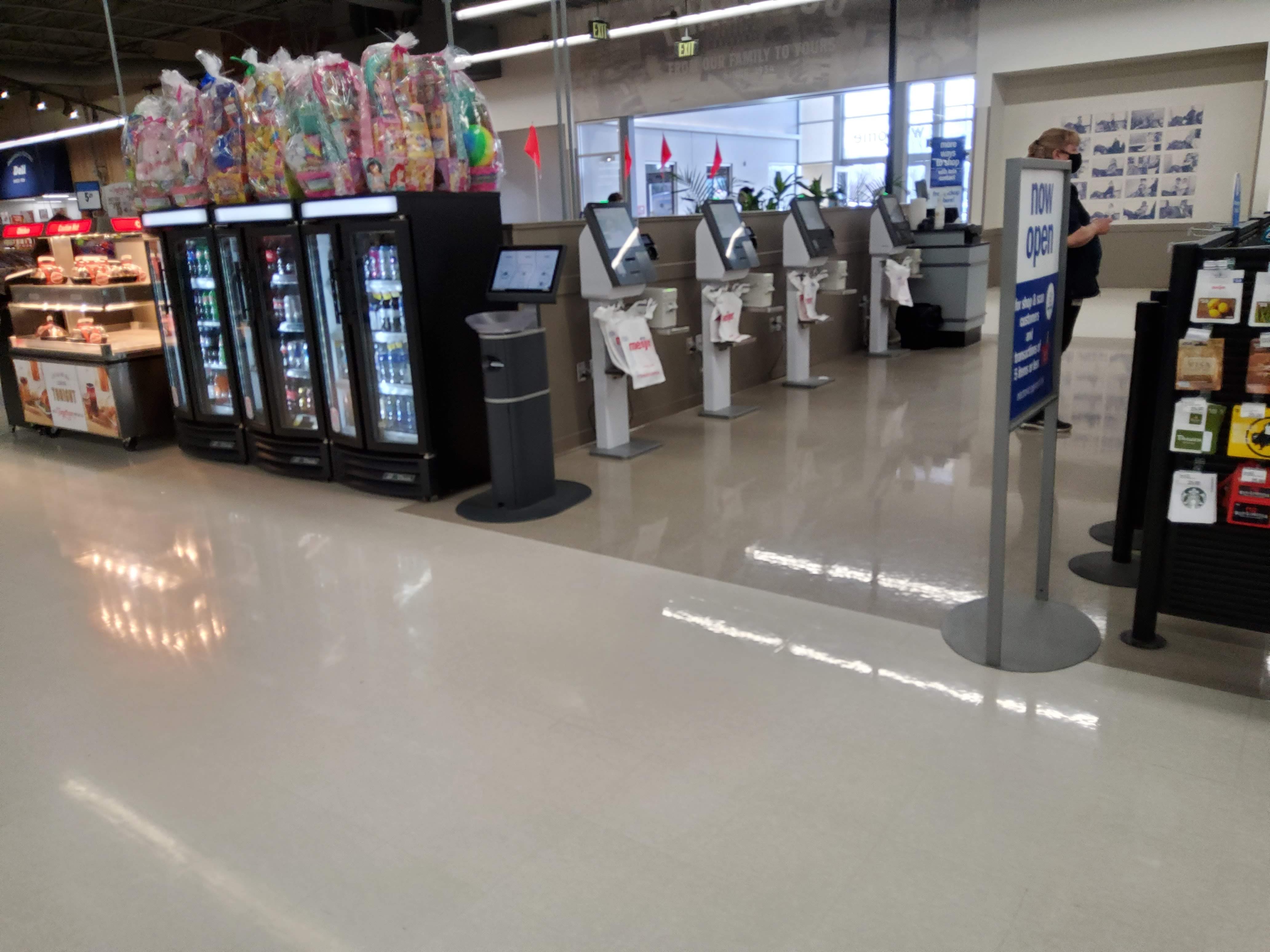
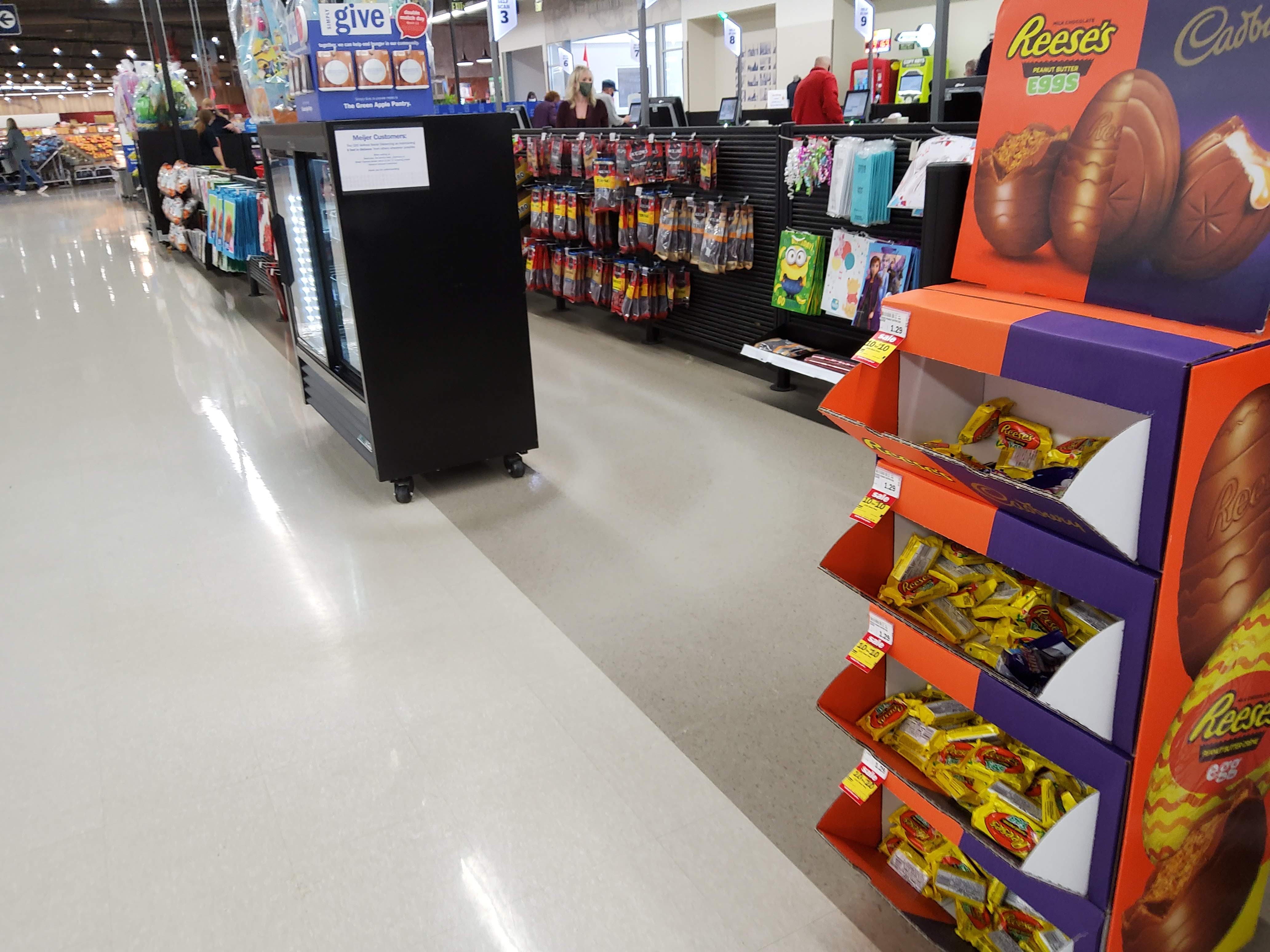
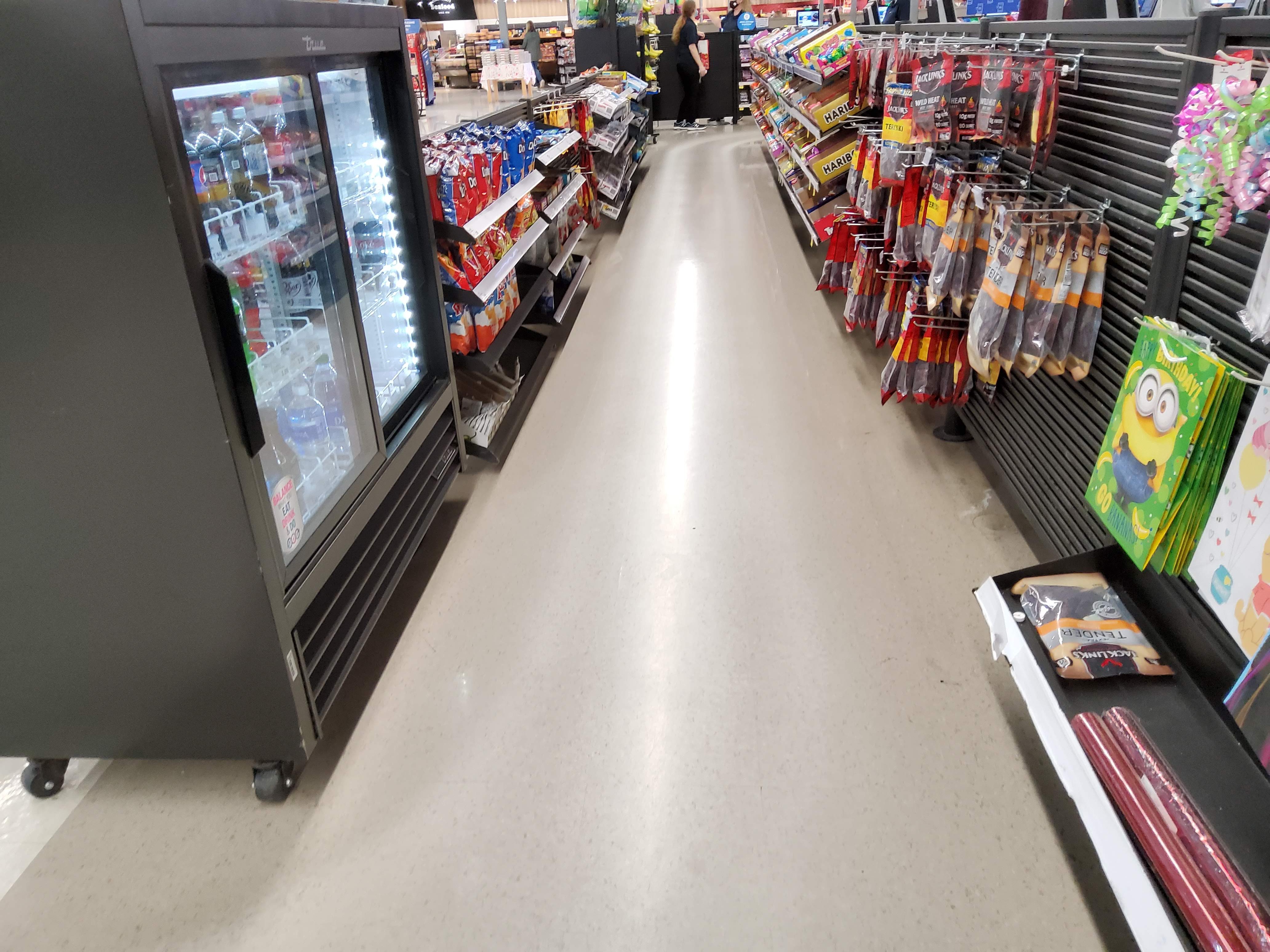
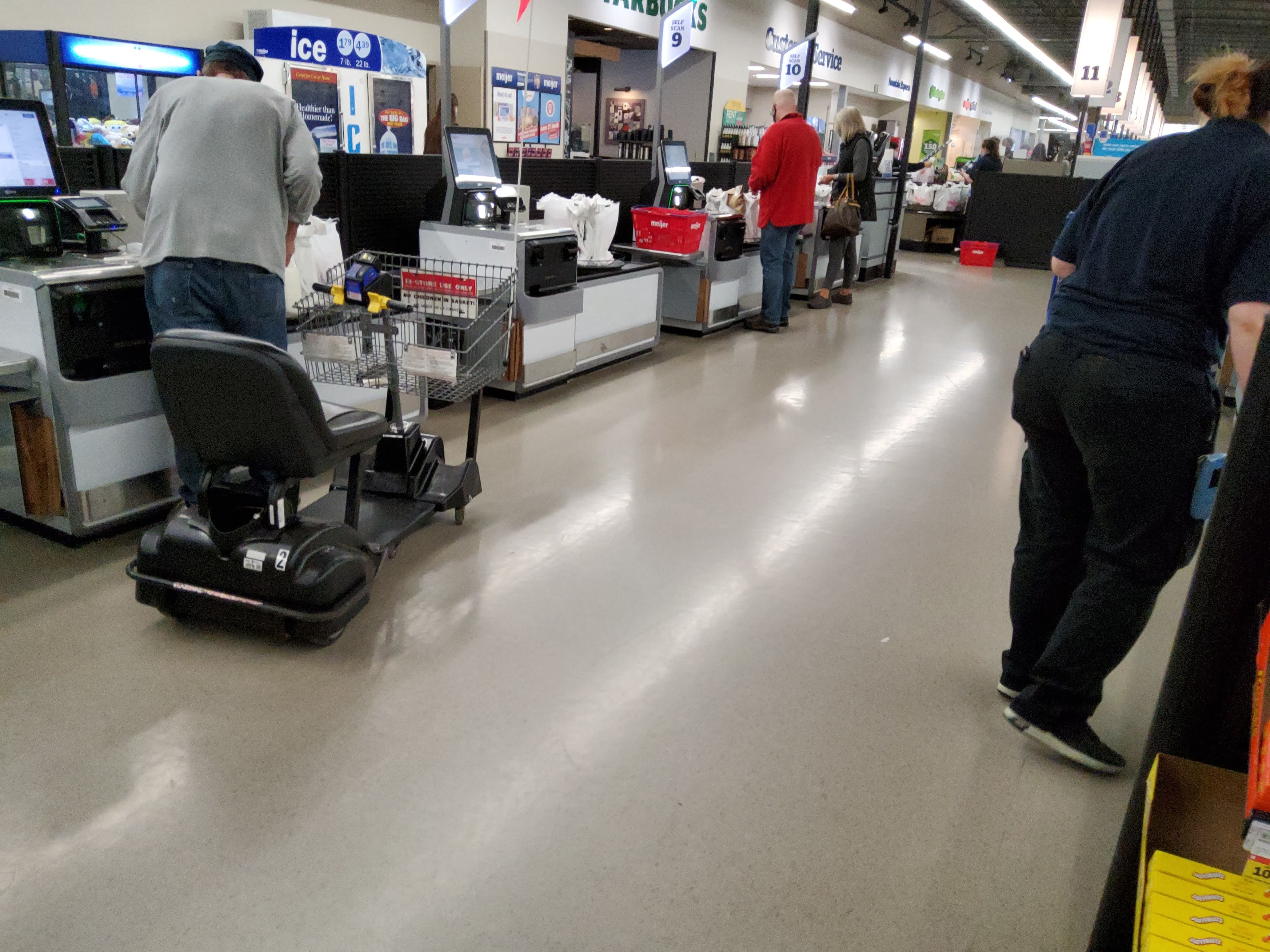
An overview shot.  You can see the sheer amount of snacks and junk food artfully arranged to tempt you at every possible opportunity.  You can also see the entrances to all three checkout options, if you know where to look.  

We\’ll start with the traditional option.  

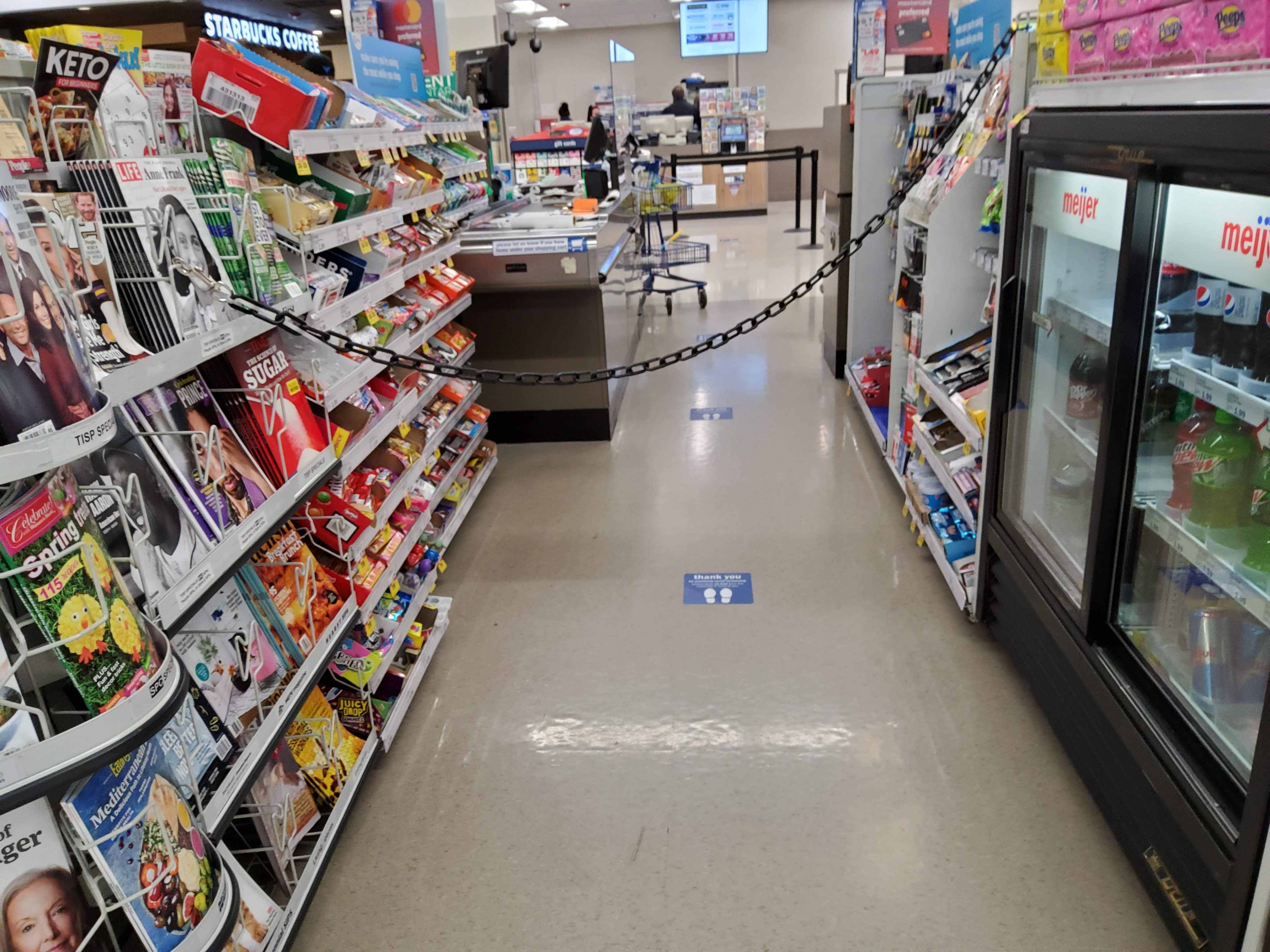
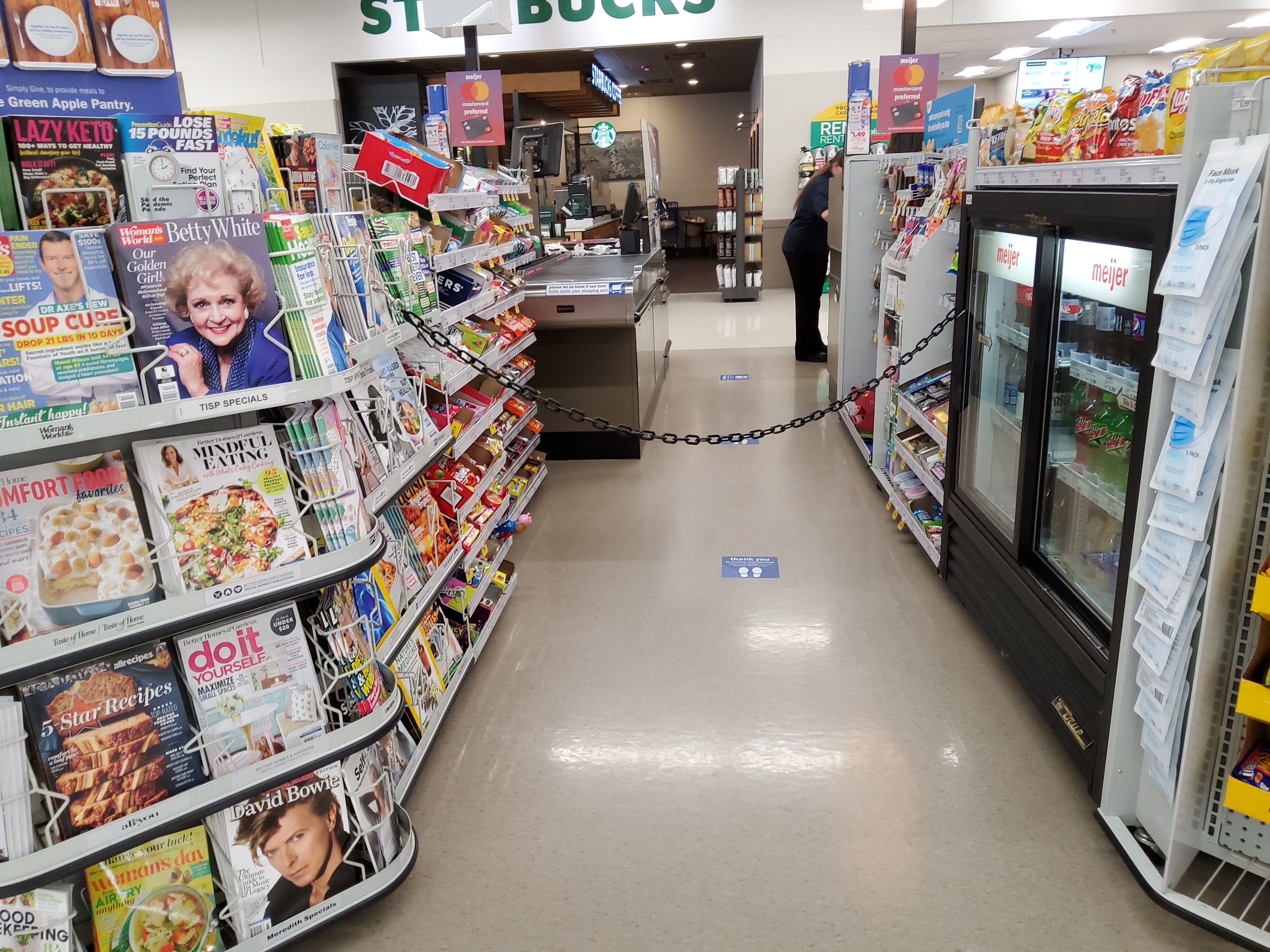
Two versions of the same thing.  You have your impulse purchases on either side, followed by the conveyer you unload your bags/cart onto for the cashier, followed by the cashier\’s station, the register, and the bagging area.  The cashier (a real person) scans your items one at a time, bags them for you, gives you the total cost of your purchases, takes your payment in cash, check, or card, and returns you any change and your receipt.  
I chose closed lanes because I didn\’t want to worry the cashiers, so you can also see the adorable plastic chain that wouldn\’t stop an excited toddler from passing.  
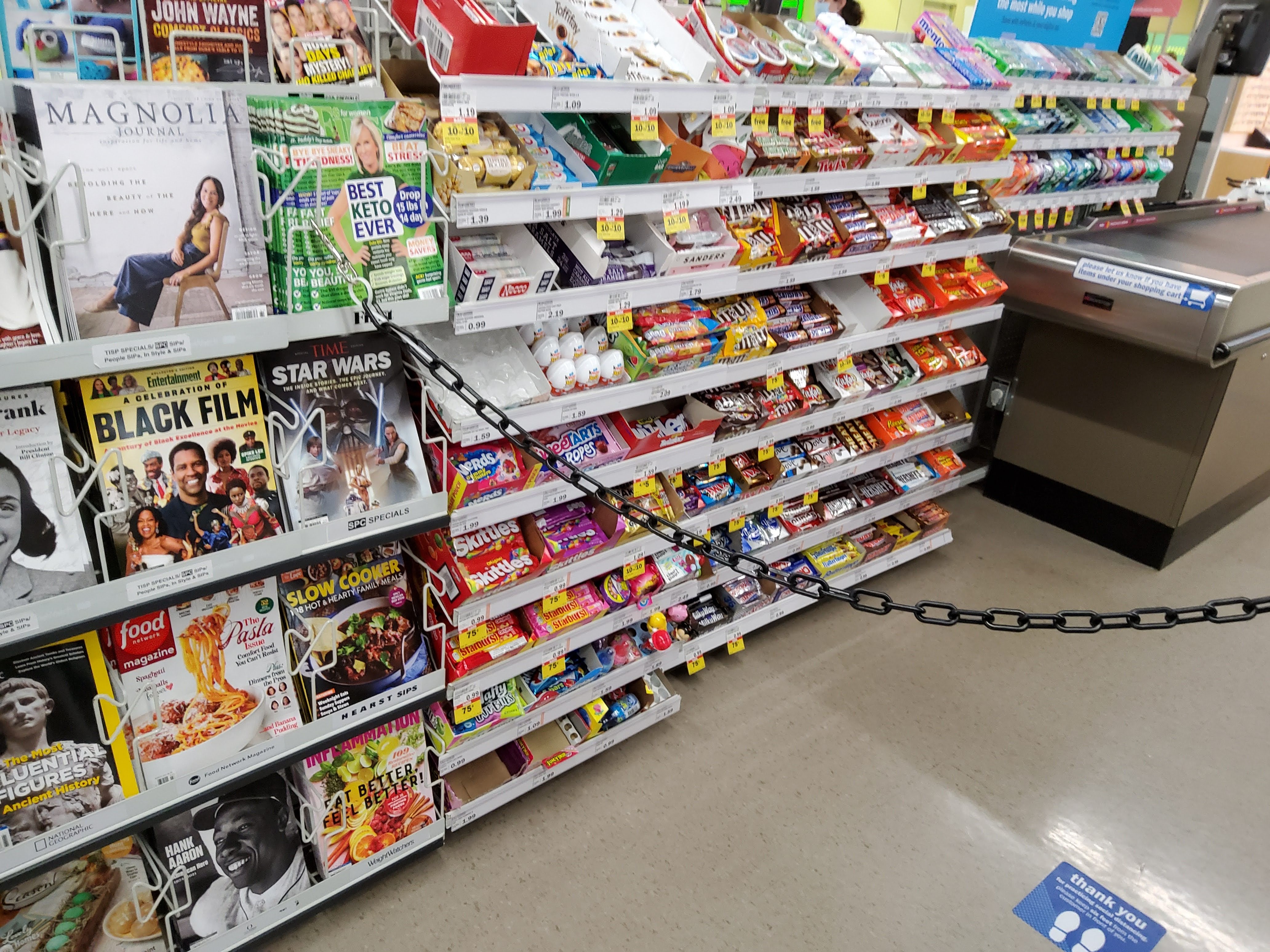
Right side of one of the traditional checkout lanes.  Magazines, which run the gamut from \”might be useful\” to \”what monster was okay with wasting paper on this garbage?\”  And after that, an array of candy.  Remember how there was a candy aisle?  Yeah, so this is in addition to that whole aisle.  
This is all designed to make you do what\’s called impulse buying, which is just buying stuff because the urge grabs you to, perhaps before you can think about it very hard.  Now, a single candy bar might not be that much money on a single shopping trip, but over the course of a year, it adds up, and the toll is taken both on your bank account and on your body.  
The other side of a typical checkout lane.  I was actually surprised at how standardized the lanes are now.  In other stores I remember, the contents of the lanes would vary, sometimes rather widely.  Perhaps because of less available space?  But these seemed pretty cookie cutter.  Magazines across from chilled drinks.  Candy across from salty snacks, gift cards, and some small convenient items, like lighters, lip balm, flash lights, bleach pens, and travel sized hand sanitizer.  
That\’s option 1, the traditional checkout lane.  I typically avoid this because dealing with a live human involves making conversation, or at least interacting to some small extent, and that costs effort and comes with tons of social pitfalls.  And I just want to avoid those as much as possible.  
Let\’s look at the other two options, shall we?  

Here\’s option 2.  It\’s the most high-tech one, and it requires you to have a smart device and their special app.  You scan each item as you put it into your bag or cart, using your phone, and then take your phone and scan that at the checkout here.  You are thus an unpaid cashier your entire trip through the grocery store.  It gives you the total, you pay using the interface, bag your stuff if you want to, and go on your merry way.  

There seems to finally be an employee monitoring the area, but in times past, the whole place was deserted.  Even by the customers.  Seriously, nobody uses this despite the corporation really, really wanting people to.  
In my case, it\’s that I really don\’t want my grocery store having access to my phone, apps, and identity any more than it already does.  Can\’t speak for everyone else though.  
In one store I visited, I saw these converted to \”5 items or less, and also our system we\’re begging you to use PLEASE PLEASE PLEASE.\”  It\’s maybe telling that even in a pandemic, people would rather use option 1 or option 3 over this one…  
And that brings us to option 3: the self-checkout.  
Once upon a time, these used to come in the single lane variety of the first option.  Unfortunately, some manipulative troglodyte in marketing realized that you could make people walk past a ton more impulse purchases if you just rearrange the checkout setup… and so we have this instead:
This is one long aisle that feeds into 10 mini-checkout stations.  It has everything a traditional lane has, and more.  There are candy bars. There are packs of jerky.  There are pastries and sweetbreads.  It\’s a smorgasbord of everything you shouldn\’t put in your body.  
If you\’re wondering why I sound so resentful of this development, it\’s because resisting the urge to buy impulse purchases costs mental effort, and I am painfully short on energy at most times, but especially now.  
These stations used to be \”express.\”  The definition of \”express\” varied, but it was typically 15-20 items or less.  Now, I guess the idea was successful enough that they\’ve pulled the numerical requirement off and opened it to any shopper that cares to traverse the gauntlet.  
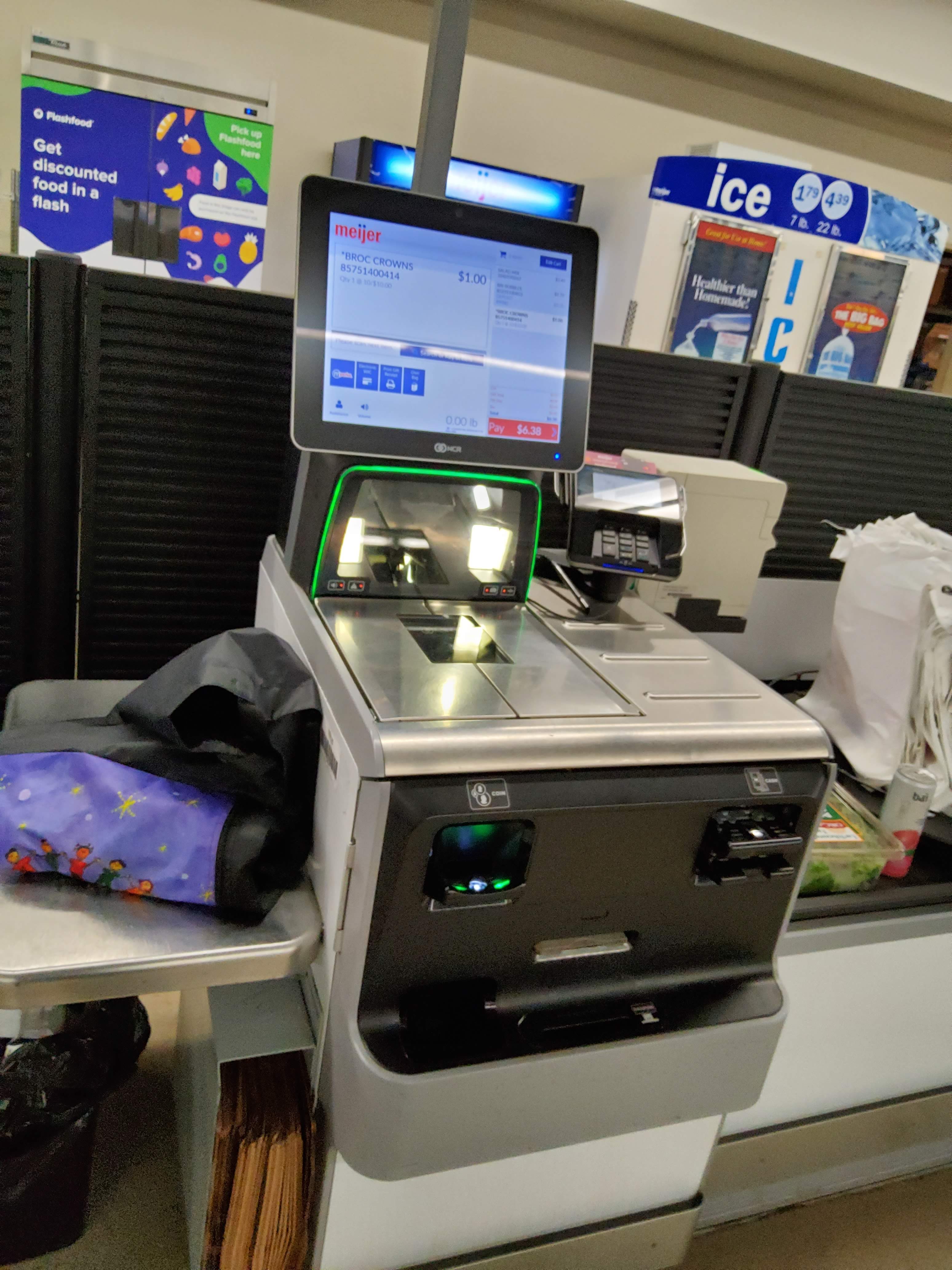
Let\’s have a closer look.  
So, from top to bottom, you have your screen, your scanner and credit card reader, your scanning surface that includes a scale, a surface to put your stuff on before you scan it, and a surface to put stuff on after you scan it.  The latter comes with a plastic bag dispenser, for all your incredibly unfriendly-to-the-environment bagging needs.  Below all of that is the cash and change dispensers, the receipt printout, and the coupon receptacle.  
In this version, you scan everything at the checkout, using the interface here.  There\’s a way to look up fresh produce using the PLU (or Price Look Up) code, like 4162.  That\’s large Pippin variety apples, for anyone who was suddenly curious.  Normally in option 1, the cashier would do this for you.  
You are also responsible for bagging all your own things, which at least lets me use my cloth bags without awkwardness.  
This is the option I almost invariably take when I buy things at this store, because although it makes me an unpaid cashier, it does let me circumvent most social contact, which… I really appreciate most of the time.  
And that\’s that!  Let me know what you thought of this series, and if you\’re interested in similar walkthroughs of other stores, such as Target, Trader Joe\’s, or Aldi.  

Reading the Research: Microbial Transfer Therapy and Mental Health

Welcome back to Reading the Research, where I trawl the Internet to find noteworthy research on autism and related subjects, then discuss it in brief with bits from my own life, research, and observations.

Today\’s article touches on a much lesser-known treatment for autism, or at least autistic suffering.  

It\’s becoming known more widely, in recent years, that our guts (which is to say, mainly our intestinal tracts) have a huge impact on how our brains function.  There are neurons around our guts that pass information to our brain via our spinal cord.  So if you put junk food into your gut, you get bad signals sent back to your brain.  Your mood, ability to plan, and ability to remember information can all be affected.  

I\’ve actually been experiencing this firsthand for the last week or so.  It\’s been a hard week, and I\’m prone to emotional snacking, so I\’ve consumed a greater amount of junk food than normal.  By the end of the work day, I find myself depressed, easily-frustrated, and far less productive than I would\’ve been if I\’d fed myself properly.  Which, naturally, leads to more emotional snacking, thus creating a negative spiral.  

It\’s not even just a question of what you put in your body, though, when it comes to autistic people.  It\’s a question of what\’s already there, too.  It hasn\’t been studied in as much depth as it should be, but what research we have tells us that autistic peoples\’ guts tend to be much simpler and more prone to overgrowth of candida (a class of harmful gut bacteria).  Where most people have thousands of species of gut bacteria, many autistic people only have hundreds.  

Without the checks and balances from all that diversity in the gut, autistic peoples\’ guts simply don\’t perform as well as they should… which means we don\’t absorb nutrients from our food as well, digest foods as much as we should, or break down toxins as quickly and effectively as someone with a healthy gut.  

Which is why I\’m on the wait list to be a subject for a fecal transplant experiment.  It\’s also why I routinely take two hospital grade probiotics.  Trying to keep my gut in balance is extremely important to managing my mental health and ability to function in neurotypical society.  When my gut is properly functioning, I\’m able to communicate more clearly, express myself better, and understand others better.  When it\’s out of balance, I do worse in every aspect of my life.  It\’s honestly that simple.

I\’m glad to see this research, and I hope people are paying attention.  This is one of many options parents and fellow autistics can look into when trying to improve our lives.  In a world where most doctors throw pharmaceuticals at a problem and then say \”there\’s nothing more we can do\” if they don\’t work, we need more of this research to show people there\’s always something more to try.  

On a personal note, Arizona State University and Richard Harth (the article\’s writer) in particular: Autism is not a disease.  Calling it (and autistic people) that is insulting at best, along with being dehumanizing.  It hasn\’t been okay to refer to autism in that manner for over a decade, so I\’m not really sure how this happened… but it did.  If I remember, I\’ll @ y\’all on Twitter about it.  Politely, as best I can.  

(Pst! If you like seeing the latest autism-relevant research, visit my Twitter, which has links and brief comments on studies that were interesting, but didn\’t get a whole Reading the Research article about them.)