One Track Conversation

You know, I describe myself as fundamentally honest. I don’t lie very often. It takes too much energy and mental bandwidth. I’ve known that about myself for a while. It’s not necessarily a positive thing. We lie all the time. Conceal our struggles from each other and even ourselves. (“Hi, how are you?” “Oh I’m fine.”)

But there’s more to my honesty than that. I figured out recently, I often lack the ability to subdivide my experience. To say and act things I don’t mean. I can choose to say what I’m thinking or not, but. That’s as far as it goes.  I have a one-track mind in conversations.

I learned, not that long ago, that most people have a very different, more expansive set of options. Here’s a example.

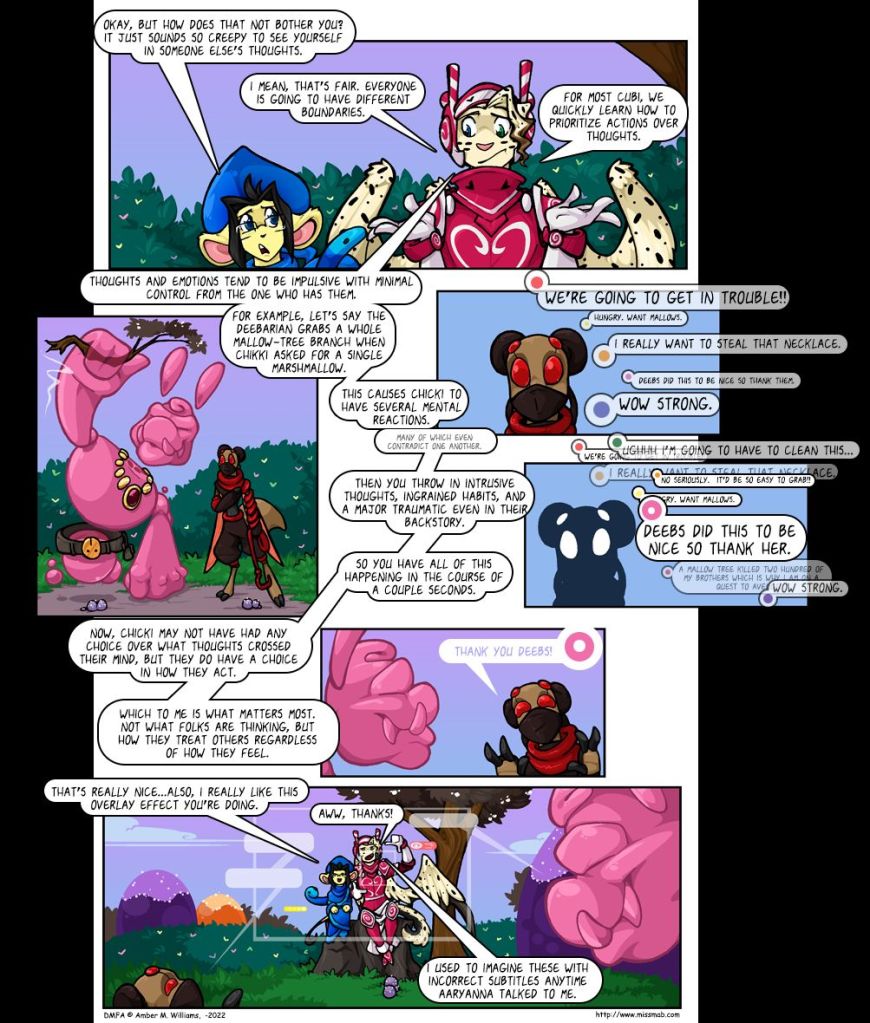
From the excellent webcomic DMFA, at missmab.com. It is, hands down, my absolute favorite storytelling in comic form.

Chicki here has six different options. Six! Most days I have one. Maybe 2 if it’s a good day. No wonder I’m quiet so much.

I’ve been talking with a friend recently about sex and roleplay in sex, and like… he’s into people being mean to him.  Only in fun, and consensually, as is healthy,  but. I thought about it and I actually have a mental block to saying belittling things or acting like I mean them.

I rarely insult people or make fun of them in large part because I’ll mean it if I say it, and the world is usually better if you keep unkind thoughts like that to yourself.  People can absolutely act dumb and mean and frustratingly, but everyone is fighting their demons and you really never know what someone is going through when they cut you off in traffic or say something kinda rude.

The worst part of all this is not the limitation, but that some days, like once a month, I can get like 3 options and the ability to select one or spin one to a better version if I judge it would help the situation.

But not usually. And I still remember what it was like and how positively people responded. How good it felt to competently manage my side of a conversation.  Just think how much easier I’d get along with people if I could do that all the time!

But no; once a month. A glimpse at what I’ve wanted for decades, but can’t have most times. Disability is so fucking frustrating.

Thriving Autistically: Environment and Sensory Support

living room interior

This post on making an autism friendly environment is part of a series on thriving as an autistic person. We live in a world that is not always kind or accommodating for people who are different. Not only that, but autistic and other neurodiverse people can have very fragile health and specific medical needs.

Finding out what works for you is a significant endeavor. This week I’ll be focusing on environmental and sensory factors so you (or your loved one) can live your best life. The first post, which prompted this series, is here. The second post, on food and supplementation, is here. The third post was on movement (exercise and more).

As you read this series, please remember autistic people can have very different experiences. I’ll tell you what works for me, and do my best to explain other things I’ve heard of. But in the end, you are your own best resource. Try things. Find what works for you. Find doctors and specialists that will help you explore your options intelligently and safely. How good or bad you feel every day is, in some very important ways, up to you.

Environmental Impact

There’s an old saying that seeing is believing. I consider it a commentary on the metaphorical blindness of people, though I’m not sure it’s meant that way. The subjects I’ve talked about in posts prior are somewhat visible things. After all, if you’re sitting around all day instead of getting some movement, that’s somewhat noticeable. And what you put in your mouth every meal, same deal.

This week, though one of the things I’d like to focus on is your home environment. And your work environment, if you have a job or volunteer position. What exactly makes for an autism friendly environment?

Trouble in the Air

We do not, as a rule, think a whole lot about our home environments. The air, after all, is typically invisible. However, the air can carry all sorts of things that interfere with human functioning. Some of the obvious ones are:

  • air pollution
  • mold
  • algae and pollen
  • dust and dust mites
  • perfume/cologne
  • pet dander

At work, things like sawdust, airborne flour or other food products, printer pollution, and industrial chemicals also factor in.

Despite their near-invisibility, these airborne factors can have a huge effect on an autistic brain and body. Usually the human body is supposed to purge toxic or inflammatory substances from our blood and body. However, sometimes autistic bodies do not necessarily do this quickly (or, rarely, at all).

An Autistic Environment Example

A few weeks back, I found myself dropping into depression. My mood climate sank and darkened, and I felt dissociated and sad. As much as I could, I evaluated things. Nothing obvious had changed in my life. I was still eating incredibly healthily. Still getting good exercise 5 days a week. My social life hadn’t changed. Everything seemed the same as it had been a couple days ago.

When I thought about it, my current circumstances weren’t great. I was in a job that didn’t pay my bills, was physically taxing (not in a good way), and had little in common with my interests in life. So I figured the difficulty of my circumstances had simply started hitting home. I assumed there was nothing to be done. It was reasonable, honestly, to be depressed in my circumstances.

The thing is, a day later I happened to stick my hand into the bag of fresh cherry tomatoes on the kitchen counter, and one of them went smush. It had molded. The rest of the bag was 100% fine, it was just that one. I tossed the tomato, washed my bedding, and cleaned up the kitchen. Within a couple days, the depression and dissociation had receded.

As you can guess from this story, I am extraordinarily sensitive to mold. Different kinds of mold affect me differently, which makes detecting its influence difficult. But if I start feeling bad out of the blue, that’s the very first thing to check.

Things to Help with Airborne Issues

If you or your autistic loved one seem to have an easier or harder time with life when traveling or staying over at a relative’s house, you may want to explore why. Or even, if they seem to have different problems in one area versus another. It isn’t always the autism or the person specifically. Sometimes it might be that the trash isn’t taken out as routinely, or the new environment doesn’t have a pet.

Some ways to address these things include having personal air filters and/or upping the quality of your home furnace filter. I live next to a pond that grows toxic algae in the summer, for example. So having a good furnace filter supplemented by some smaller HEPA air filters in the bedroom and office is mandatory.

Personally, I use two of these Levoit air purifiers. They’re fairly inexpensive for what they do, and the filters refills last months and only cost $30. One is located near my home computer, where I work. The other is in the bedroom. This model is particularly nice for the bedroom because it has a “lights off” setting. My bedroom has to be kept as dark as possible for me to sleep well (more on that later), so that feature is mandatory. It also runs very quietly. The marketing says as low as 24 dB. All I can tell you is that I can hear it, but only barely, when the house is completely quiet.

Light, Sound, and Electricity

There’s actually way more to an autism friendly environment than these familiar airborne concerns. These will be briefer, so bear with me. Let’s start with light.

The first thing to mention is that some types of lighting flicker. And while most people don’t notice, some autistic people do. Headaches, annoyance, and focus issues aren’t uncommon as a result. Incandescent lightbulbs are usually your best choice for autism-friendly lighting.

I mentioned above that my bedroom needs to be kept quite dark. That’s because my internal clock (circadian rhythm) is easily disrupted. If my body registers too much light late in the evening, I don’t sleep very well. This is not uncommon with autistic people.

Sunlight

In order to get the best quality sleep, I try to get sunshine in the morning to wake myself up properly. Where I live, though, there often isn’t any during the winter. The days are typically overcast and grey. In lieu of sunlight, they make lamps to simulate sunlight. Verilux is the brand I’d trust for this.

I have one of these lamps, which I use in the morning on occasion. You don’t need a really big or fancy one. At least for me, a few minutes of this light is more than enough to make a difference. You can literally just point it at yourself while you’re brushing your teeth in the morning and that can be enough.

For darkening the bedroom, I found out that blackout cloth is quite inexpensive. Making proper blackout curtains may be difficult, but stapling blackout fabric to the wall or over windows isn’t very hard at all. Weatherproofing stuff can be good for lightproofing door frames. And in lieu of all that, there’s always sleep masks. I like ones with molding over the eyes, so I can blink without feeling like my eyelids are being held down.

Screens

Another complicating factor in an autism friendly environment is blue light. Most phones, TVs, and computer screens generate a lot of blue light in addition to the other colors they display. This light tells your body to wake up. Which is fine in the morning and afternoon. And definitely not great in the evening, when you should be winding down.

For computers and jailbroken phones, the best app hands down is f.lux. It changes the quality of the light your devices emit, warming the colors so your internal clock isn’t fooled into thinking you’re outside in the sunshine. My doctor also strongly recommends simply putting away your phone or getting off the computer or TV an hour before bed. I personally struggle with that, so f.lux is my go-to.

Again, your mileage may vary here. But it’s worth testing using apps, sleep masks, or putting your devices away before bed, to see if it affects you.

Sounds and noise isolation

There’s a few things to keep in mind here. Autistic people are prone to sensory over- and under-sensitivity. So we might as easily seek out playing drums (or pots and pans) loudly as hide from them. A home can be a surprisingly loud place, with cooking in the kitchen, siblings playing or listening to music while they do homework, appliances running, and even perhaps a TV playing.

A soundscape doesn’t need to be loud to be overwhelming. A few years back I reviewed a pair of noise-canceling headphones in conjunction with a complex gym environment. The fact was, the headphones were excellent, but they didn’t entirely spare me from the exhaustion of being in that environment. Having a quiet place to go was essential, even with the volume of the place turned down.

Any autistic person could benefit from a safe, predictable space where everything is the way it should be, mind you. Soundproofing it is a touch that can be added to help isolate the person from the house’s noise, or the person’s noise from the rest of the house.

I personally fall in the over-sensitivity category, which means it’s best for me to have a quiet place to retreat to. Thankfully, most of my house falls into that category. But it can just as easily be a single room in the house, or even a big cardboard box. An autism friendly environment can be any number of things.

Motor sounds

Another sound issue I’ve only recently become aware of is machinery-based. Very low frequency sounds can affect a person’s wellbeing. Some industrial motors generate sounds in this frequency range, and it can affect people even if they can barely hear it.

In my condo association, we installed a motor for some equipment to kill off the toxic algae that grows here. The motor was installed in the back yard behind a few units, fairly near where I live. I don’t particularly notice a difference, but one resident who lives closer to the motor did. They reported not being able to focus or sleep. A fairly major problem I would say!

Because I’m a curious sort, I went and stood by the motor for a while one day. It felt bad. It was like the sound was shaking my internal organs and making them malfunction. I now avoid the area entirely. Usually the equipment that would make this kind of noise is kept away from homes, but workplaces are another story. If you work around boiler rooms or near equipment that makes a low droning sound, and tend to feel worse when you’re there, it might be worth investigating whether this is an issue for you.

EMF

The last thing I want to mention is electromagnetic fields, which are generated by objects that use electricity, such as computers, TVs, and cell phones. A certain amount of this is normal in life. For example, the Earth itself has a magnetic field. It’s really low-grade, but it exists.

The thing is, we’ve filled our modern lives with EMFs. In suburbs and cities, you’ll pretty much always be in range of a wifi network. Even if you can’t connect to it, it’s still permeating the air and vibrating your cells. Same with cell phone towers. If EMFs were audible, it’d be like a dozen orchestras blasting at all times. As our technology improves (3G -> 5G -> whatever we have next), the intensity of these signals amps up. This really doesn’t make for an autism friendly environment.

Most people seem relatively unaffected by the silent cacophony, but because of our sensitive bodies, autistic people can sometimes be severely affected by it. It can affect our sleep, digestion, mood, and mental health. I personally sleep on a grounding mat, put my phone in airplane mode, and turn off my wifi at night. All of these things, though seemingly strange, do actually help me sleep better.

I’m still exploring this subject, to be honest. It’s clear to me that it matters, but my exact tolerance isn’t clear. It remains to be seen what measures help the most. Regardless, here’s a supplier that makes meters and shielding items to help live with less EMF. I’m thinking I might try the hoodie this year, but I want to be sure I can safely wash it before I buy.

Sensory Supports

An autism friendly environment doesn’t need to be all about taking factors away. While it’s good to reduce noise, EMF, and light for someone like me, it can also be important to add things.

I’ve heard this sort of thing called a sensory diet. Basically, a person can be comforted and supported by sensory experiences. A hot cup of tea or coffee is a more mainstream sensory experience. So is familiar music, or comfort foods.

But autistic people can derive comfort and joy from a much broader range of things. Consider chewable or fidget toy jewelry, fabric swatches, essential oils or other scents. All of these things can add to a person’s experience or provide a moment’s respite from the demands of life.

I carry around a small tin of solid perfume, personally. The smell, which is mostly floral with some spice, calms my mind when I smell it. I typically take it out when I’m panicking about a social interaction I can no longer do anything about. Putting my nose into it for a bit helps me mentally move on from the situation by bringing me elsewhere. The tin fits easily in my pocket, but a purse or backpack would serve just as well.

TL;DR: Autism and Environment

There are tons of environmental factors that can affect autistic people’s wellbeing. Airborne factors include allergens like mold, pollen, and dust, but also air pollution and perfume. HEPA air purifiers can help, and so can face masks like the KN-95 types.

Lighting is another factor in an autism friendly environment. Having interior lighting that doesn’t flicker is important, but some peoples’ internal clocks are so sensitive that it’s best to lightproof the bedroom or wear a sleep mask. Finally, computer and phone screens put out blue light, which can trick your internal clock and really wreck your ability to sleep well.

Sound can play a big role in things too. Too much or too little sound can make an autistic person’s life harder. There’s also certain very low frequency sounds that can affect a person’s sleep and focus. Having a safe, sound-dampened space to be can be a very important accommodation.

Finally, EMF is a possible factor. Phones, wifi networks, cell towers, TVs, and computers all put out these fields. While most people aren’t strongly affected by them, some people, including me, are. My sleep is much better without the silent cacophony of my wifi networks, phone, and computer going all night. It’s worth investigating if this is an issue for you, as there are some fairly simple fixes to help.

Don’t forget that building an autism friendly environment isn’t all about taking things away. Having stim toys, comforting scents, fabric swatches, lava lamps, and whatever else makes you happy is also important.

I hope this post has given you some things to explore. Your environment can have a major impact on how good you feel every day. Moreso than I think most people realize. Find what works for you and what makes you happy, and include it in your life as much as possible.

Thriving Autisticly: Movement and Exercise

woman running on pathway

This post about autism and exercise/movement is part of a series on thriving as an autistic person. We live in a world that is not always kind or accommodating for people who are different. Not only that, but autistic and other neurodiverse people can have very fragile health and specific medical needs. Finding out what works for you is a significant endeavor. This week I’ll be focusing on movement and exercise so you (or your loved one) can live your best life. The first post, which prompted this series, is here. The second post, on food and supplementation, is here.

As you read this series, please remember autistic people can have very different experiences. I’ll tell you what works for me, and do my best to explain other things I’ve heard of. But in the end, you are your own best resource. Try things. Find what works for you. Find doctors and specialists that will help you explore your options intelligently and safely. How good or bad you feel every day is, in some very important ways, up to you.

Why Movement?

I’ve talked about this before, but movement is incredibly important. Chief among the reasons for me is that movement seems to burn off excess energy. If I don’t take time to move my body, the energy turns into anxiety and nervous habits. My depression gets worse. It’s harder for me to focus. And my thoughts feel murkier. It’s kind of like I’m missing every other frame in a movie. Things just slip by me.

Physically, this means I stim more and don’t handle social situations as gracefully. So when I don’t exercise, my autism sticks out more. Then I have to juggle more neurotypical unease, and the whole thing becomes a downward spiral of anxiety. Keeping movement in my life stops that downward spiral before it can begin.

Another thing I notice is that my physical body seems happier when I have movement in my life. Bodies are made to move. In the past, my lifestyle (both work and leisure) mainly involved sitting at a computer all day, which kind of isn’t great. My past hobbies were all indoors, sedentary ones (reading and video games).

Now, this may be an artifact of my age (I haven’t been in my 20s for years now…), but I notice my back, neck, and legs work and feel better when I move. I’m prone to having tension build up in my shoulders and neck, which can result in some truly horrific tension headaches. Chiropractic work helped change that, but movement in the form of yoga is what made it stick. I used to get tension headaches 2-4 times a month. Now it’s maybe once or twice a year.

Finally, I’m (paradoxically) less tired when I have movement in my life. Because of that energy burnoff, I sleep better. Which means my body repairs itself, stores memories, detoxifies itself, and recuperates better. Basically, I function much better on pretty much every facet when I have movement in my life.

Movement (not Exercise)

When I talk about movement, by the way, I don’t mean exercise.

Exercise as we typically understand it- lifting weights, jogging, using various gym machines- can fill this need. But a lot of people find running on a treadmill excruciatingly boring and unfun. The idea of dragging yourself or your child on the autism spectrum to exercise at the gym might seem impossible. If any of this describes you, that’s normal.

Don’t push yourself to do something you find boring or frustrating. It’s self-defeating and will most likely only make you miserable.

Consider how many people say, “I’m going to get in shape” for their New Year’s resolution. And maybe for a month or so, they’re very good about going to the gym. But then the monotony gets to them or other things in life happen, and they start missing days. Then they stop going at all. This happens over and over, to people who otherwise show no signs of being “lazy” or whatever.

The gym, while a fine institution for some folks, is not really what people are designed for. We’re made to be outside, running or walking or hiking or exploring. But if “going for a jog” in your neighborhood doesn’t sound like fun, take heart. That isn’t your only option either.

Choosing What You Love

Instead, think about the things you like to do. People with autism often have a few hobbies (“special interests”) we’re quite fond of. Are there things you can do with those hobbies that can include movement?

If you like video games, for example, you might consider trying Ring Fit Adventure, Dance Dance Revolution (or any of its clones), or Beat Saber. All of these games will get you moving, either to various kinds of music or to progress in an RPG world. The movement is part of the game, but the game itself is the focus.

If you like eating food or cooking, consider learning how to forage for wild food, or gardening. There’s some really tasty delicacies that might be growing in your own back yard, or just around the corner. The care for your own plants, too, can be surprisingly rewarding. Having fresh herbs available, or growing your own zucchini or tomatoes, can be a really wonderful addition to any meal. The search for hidden wild food gems can build in hiking trips and time spent outdoors into your life. No expensive trips to the gym required!

Perhaps you enjoy birdsong, exploring, or taking walks. Geocaching might be something to try, and it can be done anywhere: city, country, or suburbia, no problem. If you love stories or music, consider trying Zombies, Run! You become the main character is a post-zombie-apocalypse world, where all is not as it seems… The story unfolds while you listen to your favorite music. (Also you can use the app while biking or walking the dog, you don’t have to run. I personally verified this.)

All these activities can be really fun, and they all involve movement… but the movement is typically not the point. It’s simply part of the experience. Choose something you love, and find a way to do it with movement.

Movement/Exercise at Work

Finally, consider that a job can be a reliable way to put movement into your life. People with autism thrive on schedules, and jobs that incorporate exercise can be a perfect match. Whether volunteer or paid jobs, it all factors in.

I currently work at UPS as a person that unloads truck trailers. That means I pick up a lot of boxes and load them onto conveyer belts. It doesn’t sound too tiring until you realize I’m standing for the entire shift, they want us moving as fast as possible, and some of the boxes weigh upwards of 70 pounds. The weight adds up fast. Also, the workplace isn’t air conditioned, and it’s summer. My clothes are almost invariably soaked through by the time my shift is done.

It doesn’t have to be quite that exhausting. Local pet shelters often need help caring for and walking their dogs. Stocking shelves at a local retail store can have you bending high and low while carrying things- which is movement. Landscaping, factory work, construction, and other jobs can involve a decent amount of movement.

It all counts, and it’s another way you can potentially bring your hobbies or special interests into making your life better.

One Caveat: Histamines

I don’t believe this is common, but I’d be remiss if I didn’t mention it. Sometime autism comes with unusual biological differences that can make exercise harder. For most of my life, moderate to high intensity cardio exercise, like running, made me miserable. It still does, because while there are solutions, I haven’t figured out one that works for me yet.

Exercise makes me miserable. It’s not a laziness thing. Or a muscular malfunction. It’s not a heart problem. It doesn’t even appear to be an oxygen processing issue. I explored every one of these avenues while trying to figure out why typical exercise was such a bad experience for me.

To put it simply, exercise made me psychologically miserable. The misery would creep up on me while I was pushing myself, and nothing but stopping would make it go away. I assumed for years that I was just lazy and bad at exercise.

Apparently that was a lie. Apparently, I was experiencing an allergy attack every time I would exercise. Histamines are released when you exercise. But the misery and difficulty breathing was my only sign. My nose wouldn’t plug up, and my eyes wouldn’t water (unless I was crying because of the misery). There were no classical allergic symptoms to help me realize what was going on.

An exercise question answered

Instead, on the advice of my doctor, I took an antihistamine before doing some moderate-intensity exercise. The results were stunning. I got tired, sure. I could tell I was exerting myself and working hard. But I did not get miserable. On one of my tests, I ran a mile and a quarter with no ill effects. After years of dreading the mile run at school, it was a really strange experience.

Apparently, my body simply doesn’t flush out histamines the way it’s supposed to. Most peoples’ bodies clear out the histamines before they get to misery-inducing levels. Mine doesn’t. This hindered me for years as I tried to be more active.

There are solutions to this problem. Taking antihistamines is one, though it’s a bit overkill. Supplementing with extra vitamin C is another. There are also herbal supplements that can help, and reducing your intake of foods that are high in histamines is a good idea as well. My body doesn’t like the herbal supplements and the vitamin C doesn’t help enough, so I’m still looking for a solution that works for me.

Still, I’m glad to know what’s going on. I can declare to the world that I’m not lazy, I’m just disabled. It’s important to know what limitations your body has when considering lifestyle changes. Change is already hard for people on the autism spectrum sometimes; when adding exercise into your life, it’s best to be sure it’ll be workable for you.

TL;DR Movement/Exercise and Autism

Movement (not exercise) is a very important part of a person with autism’s life. It can help manage our moods, anxiety and stress levels, and improve our sleep and physical health. I have personally experienced all these benefits and strongly recommend having movement in your life.

When I say movement, I do not mean exercise. I do not mean going to the gym (unless you really like that). I mean doing things you already love, and having movement in them. Think about your hobbies (special interests) and how you might add movement into them.

Lovers of video games might play Ring Fit Adventure on the Nintendo Switch. You play the game by moving, but the point is the game. People who like food might try gardening or foraging for wild food, both of which involve being outside and moving your body. There are tons of ways to incorporate movement into your life, and paying for a gym membership needn’t be involved.

A job can be an easy solution, whether it’s a volunteer job or a paid one. People on the autism spectrum thrive on routines, which jobs often provide in addition to the exercise. An active job can provide the movement you need as well as time out of the house and the ability to pay your bills.

One thing to keep in mind. When it comes to exercise, autism can come with physical or biological hurdles. One of mine was that exercise made me miserable. This was because of histamines, which are released when you exercise. My body doesn’t flush them out the way everyone else’s bodies do.

Keep your specific body and its needs in mind when you plan your lifestyle changes. Movement and exercise are incredibly important, but part of autism is finding what works for you.

Thriving Autisticly: Food

flat lay photography of vegetable salad on plate

This post about autism and food is part of a series on thriving as an autistic person. We live in a world that is not always kind or accommodating for people who are different. Not only that, but autistic and other neurodiverse people can have very fragile health and specific medical needs. Finding out what works for you is a significant endeavor. This week I’ll be focusing on food and supplementation so you (or your loved one) can live your best life. The first post, which prompted this series, is here.

As you read this series, please remember autistic people can have very different experiences. I’ll tell you what works for me, and do my best to explain other things I’ve heard of. But in the end, you are your own best resource. Find what works for you. Find doctors and specialists that will help you explore your options intelligently and safely. How good or bad you feel every day is up to you.

Eating Better Food

Nutrition is the first category I’m going to highlight in this series. Why? Well, you know that saying, “You are what you eat,” right? A literal-minded person may start imagining being constructed from pizza slices, loaves of bread, and chicken wings.

Autism and food: some might see a  person literally constructed of foods... "You are what you eat" after all.

Which of course isn’t literally how it works… but. What we put in our bodies is turned into fuel. If we put good quality nutritious food into our bodies, it makes good fuel and we do well. We can handle bad situations better, manage ourselves and our lives easier, and overall be happier. If we put bad food into our bodies, we don’t do so well and we don’t feel as good. New things and changes become harder to handle. Depression and anxiety plague our thoughts. Fogginess shrouds our mental landscape, making it hard to focus. Food can make autism feel far better or far worse. It just depends on what you eat.

Choosing Nutritious Food

A great deal of the food sold in grocery stores today tastes good, but effectively makes you sick if you eat it. Sugary foods, like candy, cookies, pop/soda, and cereal (yes, cereal) are big offenders here. So are ultra-processed foods like TV dinners, white bread, pasta, pizza, and most sweets. I did a walkthrough of my local grocery store a year ago where I talked about how much of the store I end up skipping- it was most of the store.

There’s a whole fad industry around telling you what to eat and why. In any given year, eggs might be considered healthy or unhealthy. Ignore all that mess. It’s mainly a scam to make money on gullible people. You won’t find actual good information about nutrition there. The actual food science is found in peer-reviewed articles, not pop science snippets and magazines.

What you want to aim for here is eating whole foods. Whole grains, fruit, vegetables, leaner meats (and less meat overall). A good rule of thumb is to have half your plate be fruits and vegetables. This is actually just basic better eating so far, but it’s a good base for the rest. You’ll get more vitamins and minerals, which help your brain and body function and repair itself. And that means feeling better overall.

I can’t stress enough how much this matters, and how much of a difference it makes in my daily life. We’re told from a pretty early age that it’s good to eat healthy. And then, over time, it becomes just background noise that no one really pays attention to, save for an occasional flash of guilt. That’s how we miss out on one of the easiest ways to feel better every day.

Transitioning to Better Eating

You don’t have to stop eating your favorite foods. People on the autism spectrum often have certain foods as part of our routines. Changing them can be very hard. But starting to choose whole foods options will definitely help your brain and body work better, which translates to you feeling better too. If you love mac’n’cheese, for example, try making it with whole grain noodles. You can also throw in greens, finely chopped broccoli or riced cauliflower, or zucchini slices to lend some fiber and nutrition to the meal.

Pizza can be made from scratch, or you can buy a premade whole grain crust at some grocery stores. I actually like using whole grain English muffins as the base and loading them up with toppings and sauce. They have a nice crunch to them when baked properly. Plus you can always make whatever type you want. If you’re craving like 3 different pizza types, you can just make a couple of each and call it a day. A seasoned salad (with olive or avocado oil as the dressing) and a hand fruit (like an apple or peach) works great to balance out this meal.

Find modifications and substitutions that work for you. Try roasting your vegetables in the oven with a savory spice blend. I have a friend that swears by roast zucchini as a snack. This doesn’t need to be a fast process. I’ve personally only come to my current patterns after years of trying things. It’s okay if it takes that long. Find what works for you, at your own pace.

Dietary and Food Allergies

These are best explored with a knowledgeable doctor’s help. While autism and food don’t necessarily need professional guidance, the subject of allergies gets complicated fast. There are all kinds of sensitivities and allergies. None of mine show up on a typical allergy test, because they’re a different type of allergic reaction. There’s some complicated language around it, and more than one kind. It gets messy fast. I’ll just talk about two major concerns here.

Dairy

I specifically avoid dairy. So cow milk, cheese, ice cream, sour cream, etc. Dairy is an inflammatory substance in the gut, which means it lowkey upsets your body when you eat it. Typically this isn’t a huge issue for most people, especially if you eat it in moderation. But for me, it effectively poisons my brain and clogs up my intestines.

I once went for a week without eating any dairy, then drank a glass of milk. I’d been feeling fine, but within 15 minutes I was in a foul mood. Doing what I did is called an elimination diet, and it’s a typical way to test whether a food is bad for you. You cut the food in question out of your diet entirely for an appropriate period of time (a week or two is usually enough), then try a small portion of it and watch for reactions. If you get no reaction or a positive one, the food is probably okay to add back in.

I tend to consume almond milk products and Follow Your Heart nondairy cheese products. There are a decent number of nondairy products out there at this point. If you find that you also react poorly to dairy after an elimination diet test, it might be worth trying some to see how you like the taste and texture.

Gluten

Gluten is another common dietary issue many autistic people do better without. It’s not a Celiac’s disease thing, necessarily, although that is also a good reason to avoid gluten. It’s just that gluten also lowkey upsets your body the same way milk does. In some cases, the body can end up treating it like an opioid, which can really, really wreck your ability to focus, self-regulate, and be happy.

If you opt to do an elimination test for gluten, keep in mind you’ll need to avoid eating it for at least a month. Gluten sticks around in the system for quite a while.

I personally haven’t gone gluten-free, but I do mainly eat sprouted grain products. There are a lot more options for eating gluten-free than ever before, which is good. When eating gluten-free, keep in mind the first thing I mentioned: eat whole foods. Eating gluten-free won’t help you much if you’re just eating tons of snack food and convenience products.

Vitamin Pills and Supplements

In theory, a person would be to get all their vitamins, minerals, and amino acids from food. A varied, balanced diet made of whole foods helps immensely with this.

However, between food allergies, special diets, and specific biomedical needs, this is not always possible. Autism can come with one or more of these factors, plus a limited tolerance for tastes and textures. That’s where supplements can come in.

On the surface this is pretty simple. Most people are familiar with taking a daily multivitamin, for example. But there’s two problems. One, the quality of the stuff put into most of those daily multivitamins isn’t great, and you don’t necessarily absorb it. And two, autistic biologies can be very unique. A typical multivitamin simply won’t cover it. There is also a major issue with quality. I’ll come back to that in a second.

Tests

When you get into specific nutrition needs, you really need a doctor. Even if it’s just your primary care practitioner. Because the way I found out most of what I needed to address was by blood tests. This gets complicated in a hurry, with all kinds of medical names and such. Some of my tests included a Complete Blood Count (CBC), a Comprehensive Metabolic Panel (CMP), which are measures of whether your blood and metabolism are working as intended. If they’re not, that’s something you A) really want to know, and B) really want to address ASAP.

There were also some specific ones that tested my iron, zinc, vitamin B12, vitamin D, copper, and magnesium levels. The idea with these is finding whether you’re deficient or overdosing with any particular vitamin or mineral. I was deficient in zinc, iron, and vitamin D. So I now take separate supplements of those, to be sure I get enough in my diet. The zinc and vitamin D deficiencies made me more tired and low-energy every day. Addressing those problems helped me feel better. It was a slow improvement, because the nutrients needed to build up in my body. But a very important one.

There were also a couple to test whether my thyroid gland (which regulates your metabolism among other things) was functioning properly. In some people, the thyroid can go into overdrive. Like overclocking a computer, kind of, except never a good idea. Or it can go the other way, and be so sluggish that the person goes through life in a fog. This is also not uncommon in autistic people, and while blood tests aren’t my definition of fun, they’re excellent for figuring this stuff out.

Where and How

Most of my blood tests have been ordered through my primary care practitioner. Because the health care industry is stupid, we needed to give a not-the-real-reason reason to bill insurance for these tests. I think “fatigue” is the one we mostly used. Which, while accurate, was not why we wanted this information.

It’s generally best to get your tests through insurance, because they can get rather pricy. Plus then your doctor is immediately involved to help you understand the results. However, if you don’t have insurance, you aren’t necessarily out of luck. Ulta Lab Tests exists. They’re pretty much a “buy the test, go get it done at one of our locations, receive results online” business, and they’ve done well by me when insurance simply wouldn’t pay for a particular test. You will pay entirely out of pocket, and some of these tests can get expensive in a hurry. Especially specialized genetic testing, which can easily run hundreds of dollars.

Choosing Good Supplements for Autism

Once you’ve identified specific deficiencies, such as vitamin D, you can then start choosing things to address that need. Maybe that’s eating better. But it can also be taking supplements as a backup. For Vitamin D, specifically, it’s not always possible to go outside and get your daily free dose of sunshine.

Do not simply go to the store and pick a random brand of whatever off the shelves. Instead, check with your doctor about good quality brands. Supplements are unregulated by the FDA, meaning false advertising and fillers and additives are the order of the day. Like food, if you put junk in, you’ll get junk out.

I can say my doctor tended to recommend Designs for Health (sold out of her own office and used by herself and her own family), Nordic Naturals, and Master Supplements. If your doctor has no suggestions for good brands, try Labdoor. It’s a free service that ranks the purity, accuracy, and safety of supplements. Here’s the list of Vitamin D options, for example.

My own list of supplements has 11 things on it. Among them, Vitamins C and D, zinc, iron (chelated, so I’ll actually absorb it), magnesium (as magnesium malate), a broad spectrum multivitamin, fish oil, a couple refrigerated probiotics, and a supplement that helps my body purge allergen by-products. I also take a very low dose of melatonin to help me sleep and stay asleep.

TL;DR: Autism and Food

When I eat well, I feel better. My depression and anxiety go way, way down. My brain focuses and organizes better. I’m able to manage events, social situations, and enjoy my favorite things more. “You are what you eat” isn’t literally true, but if you feed your body good food, it makes good fuel and your brain and body work better.

Eating whole foods, and making my plate half fruits and vegetables, is the key to this. You don’t have to stop eating your favorite foods to feel better every day. Modifying them to add vegetables and fruits, or using whole grain options when making them, is a great step to feeling better. Try different ways of making vegetables, too. Oven-roasted and seasoned zucchini or broccoli has become a favorite of several of my friends.

Knowing whether you have dietary allergies or intolerances, like dairy, tree nuts, or gluten, is important to feeding yourself well. Until I cut dairy out of my diet, I suffered much deeper depression and had more significant intestinal problems. Find what works for you.

It’s also good to know if you have specialized dietary needs. Your doctor can help you order blood tests to check whether you’re deficient in anything. Vitamin D is a very common deficiency. It’s not expensive to fix, but don’t simply buy things off store shelves. Supplements are unregulated, meaning no one oversees or tests their production to check for false advertising. Check with your doctor for brand recommendations, or use Labdoor.

What you put in your body determines how good you feel each day. If you put junk food in, you’ll get a junk performance from your brain and body. Feeling better starts with eating better.

Valuable Online Resource: Fair Health Consumer

You know how you can use the Kelly Blue Book to look up the price of a car?  You input the make, model, condition, etc, and it tells you more or less what a fair price for the car is?

Imagine having something like that for medical expenses.  Hospital stays are notoriously ruinous without insurance, and sometimes even with it.  The thing about insurance is that they keep staff onhand to dispute markups on services.  So the insurance company (and by extension, you) aren’t stuck paying a thousand percent markup on over-the-counter painkillers.

The Problem

Why is it like this?  It’s actually not as simple as hospitals being greedy.  It’s because the US healthcare system has, overall, shifted away from the metaphorical ounce of prevention in favor of the metaphorical pound of cure.  Hospitals, you see, can’t refuse to treat someone based on whether they can pay.  But because healthcare is so expensive, a lot of people don’t go to the doctor or dentist immediately when they have a problem.

Instead, they postpone dealing with the issue until it goes away or turns into an emergency.  Naturally, this is when it’s most expensive to treat, and narrows your options considerably, but if you can’t afford even the basic prevention (because your insurance sucks, or you don’t have any at all), it doesn’t really matter to you.  So the hospital treats the unfortunate person, but the person can’t pay.  The hospital is still out that money, so what are they to do?  Pestering the person via debt collection agencies isn’t a very successful option, plus it takes time.

The solution, as it happens, is to jack up all their prices on everything.  By making people with actual money pay more, they can systemically balance their budgets after a fashion.

As you can hopefully see, this is a crappy solution.  And it’s vastly unfair to people without insurance companies to negotiate on their behalf, or even with an insurance company that half-asses their negotiations.  It’s also typical that people will go into getting medical procedures with absolutely no idea how much it’ll cost them, then getting slapped with the bill later.

The Immediate Solution

For both of these issues, there’s a solution, and it’s called Fair Health.  While the website has its own tutorials and informative videos, I’ll briefly explain how some of the site works.

You can look up how much a procedure or treatment will cost you.  The site will ask you where you are, because that matters in the calculations.  It may also ask you whether you’re in-network or out-of-network, which is insurance-ese for asking whether you’re getting the service from a doctor they approve of, in a place they approve of.

Finally, they’ll ask for something significantly harder to provide: a CPT code or precise description of the service.  I know about CPT codes because I did a bit of work with them at the front desk of an ABA clinic, but I don’t think most people are familiar, so:

In brief, a CPT code is a precise designation for a medical treatment or procedure.

For example, I looked up D2392, which is “a plain white resin-composite filling that covers two surfaces on a back tooth.”  You’ve got the material type (resin composite), the procedure type (filling), the location (a back tooth, like a molar), and the approximate amount of effort involved (two surfaces, meaning the top and side of the tooth could be involved, which means a moderate amount of material, molding, and drilling is likely to be involved).

You can look these CPT codes up online, but in all honesty, you’re better off just getting the exact CPT codes from the doctor’s office when these procedures are proposed.  If you’ve got a smartphone, you could even look up the codes while you’re in there with the doctor.

The site also has informative sections about insurance, including explanations of common insurance-ese terms like “in network” and “out-of-network.” It’s fairly basic information, and I don’t feel like it’s super-well organized, but it is good information to know.  Having it somewhere free and publically accessible is definitely preferable to not having it.

There’s one odd caveat with this site, and it’s that it doesn’t cover government insurances.  Medicare, Medicaid, and Tricare data is not included here.  The site pretty much exists to help uninsured people, and people on private insurance, make sure they aren’t scammed or overcharged.

In the Long Term

You may have noticed this website doesn’t solve the systemic problem of hospitals jacking up their prices to compensate for treating people who need the help but can’t pay.  It can help by educating individual consumers, but the overall problem persists.  Y’know what would solve that overall problem?

Universal healthcare.  Whether that’s Medicare for All or some other version, returning to the “ounce of prevention is better than a pound of cure” model of healthcare would save us all a fortune.  People would be able to get cavities filled without feeling like they’ve chosen their health over being able to pay rent that month.

In an age of unprecedented bad physical and mental health, where the average lifespan (for everyone, not just autistic people) is actually decreasing for the first time in decades, I feel like we could use the change.

By the way, if you ever want to do a good deed and personally take a metaphorical bite out of the suffering this unfair healthcare system creates, RIP Medical Debt is an excellent way to do so.  They buy up uncollected medical debt from debt collection agencies and forgive it.  It’s an unusual method, but it lets them take $100 in donations and use it, on average, to forgive $10,000 of debt.  Be sure to check it out!

Inspiration Porn and Disability

This post is brought to you by the book I\’ll review for next week, but it\’s been an issue for years.  It crops up in local newspapers, in social media, even by word of mouth.  

Defining

What is it?  It\’s typically images, videos, articles, and memes of disabled people accomplishing something, used to motivate or shame abled people.  The gist is basically \”well if this disabled person can do it, of course you (an abled person) can!\”  There\’s a variant where the disabled person is the prop by which an abled person shows how nice/noble a person they are.

Inspiration porn is called this because it is objectifying just like regular porn.  No sex is involved, but it reduces our personalities, loves, hates, and quirks down to our disabilities, as if \”autism spectrum disorder\” or \”cerebral palsy\” or \”sacral agenesis\” tells you anything at all about the human involved.  It erases us and our struggles for the sake of the comfort and happiness of abled people.  

The Problem

I shouldn\’t have to tell most parents of autistic people that not all autistic people are the same.  My life\’s trajectory, as mainly a highly verbal loner without a community to support me, but successful in academia (though not outside it, really), is one possible route of many for autistic people.  

There are also autistic people that are raised by proverbial villages, and have massive support networks and people looking out for them.  There are autistic people with intellectual disability and autistic people with average intelligence.  There are autistic people who are savants, and autistic people without \”special interests\” or favorite hobbies they love intensely.  There are brilliant wordsmiths and nonspeaking people who are still incredibly gifted, thoughtful, intelligent humans.  It is, after all, a spectrum.  

Yet my life, if I were to get famous suddenly, would be boiled down to \”autism spectrum disorder.\”  Maybe \”Asperger\’s Syndrome\” to dissociate me from nonspeaking autistic people, as if I haven\’t spent several points in my adult life nearly or totally unable to communicate verbally.  And as if I don\’t share any traits with nonspeaking autistics, despite sensory sensitivities being very common, as well as depression and anxiety.  

It also demands that disabled people always be inspirational, for the benefit of abled people\’s pleasure and comfort.  It makes the sum total of our disability \”a burden to be overcome\” and refuses to acknowledge the social barriers that so often stand in our way.  And finally,  it reinforces the stereotype that disabled people are less competent and capable than abled people.  

An Example

This is probably the first example I ran into, years and years ago, on Facebook.  

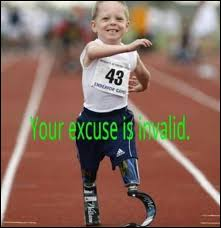
The text says \”Your excuse is invalid\” and the unwritten subtext is \”if this small child with prosthetic legs can get out there on a racetrack and enjoy running despite having no legs below the knee, you have no excuse for not doing whatever it is you\’re not doing.\”  

We know nothing at all about the child.  He is simply \”small white boy with prosthetic legs\” and his image is being used to guilt trip people for supposedly not accomplishing enough.  

I did some searching.  This child is now old enough to drive (and soon drink, too).  His name is Cody McCasland, a resident of Texas, and he\’s a serious athlete, but not a runner.  Running is a hobby.  He\’s a swimmer, with hopes of competing in the 2020 Paralympics.  And according to his bio on a website, he also wants to be an anesthesiologist, in part due to all the time he\’s spent in the hospital (30ish surgeries).  

Looking at the information from the media, it seems Cody has leaned into the publicity to some extent.  I sifted through a dozen or so articles, and all they typically wanted to do was rehash what amazing odds Cody beat, his promise as an athlete, and how wonderful that all is.  

Nothing is said about the difficulties inherent in affording, using, and cleaning prosthetic limbs.  Nothing about how many types of limbs he has, or why you can\’t just have one set for everything.  Nothing is asked about Cody\’s high school experience, his home life, any siblings… Nothing about the stares he inevitably gets from strangers, nor the invasive questions.  Nothing about him is of interest except his \”overcoming\” of his disability.  

In summary, Cody McCasland is reduced down to his disability, his struggles are omitted, and he is merely a prop in this picture.  His triumph is reduced to a bludgeon that, in the best case, might be used positively to elbow an abled person into starting to be healthier.  It might also be used to guilt trip someone with an invisible disability, because \”well you have both legs, so get out there!\”  (left unsaid: \”I neither understand nor care that you have chronic back pain or some weird allergy that makes you utterly miserable when you do moderate to high intensity exercise\”).

Let\’s look at an article from a prosthetic arm user.  Let\’s see, it\’s titled, \”I have one of those most advanced prosthetic arms in the world — and I hate it.\”  Hmm, can we guess how this is going to go?  The article is worth your read, by the way.  Real talk from someone whose life is unfamiliar to you often is.  She\’s even included short videos of her using the limbs.  

Generalizing Disabilities

There\’s one more issue with generalizing Cody\’s story to every possible situation, sitting back, and saying, \”well if he can do it, anyone can!\”  

Let\’s start by noting the obvious: Cody\’s disability is physical.  His legs from above the knee are flesh and blood, and below that do not exist due to a major difference in his DNA.  To move around at a normal height, he uses prosthetic legs.  This is a visible, physical disability.  

Visible disabilities mean you get stares and invasive questions.  This is typically unwanted.  However, because your difference is obvious, no one questions whether it is real.  An invisible disability, like mental illness or autism, can be disbelieved.  A person can decide, after looking at you, that your struggles are not real.  Seeing, as they say, is believing.  

Physical disabilities tend to be visible, but they don\’t need to be.  Chronic joint pain, fibromyalgia, and blindness without the person carrying a white cane or some other identifier are all physical disabilities, but not simple ones to notice in a second or two.  

Invisible disabilities include a spectrum of things people don\’t necessarily notice or care about, including depression, anxiety disorders, chronic back pain, chronic dizziness, diabetes, sleep disorders, chronic fatigue, and agoraphobia.  Because no apparent disability is noticed, the effects of these disabilities may be blamed on the sufferer\’s innate qualities.  

Instead of recognizing the very reasonable tiredness and reduced performance of a sufferer of insomnia, people might instead decide she simply isn\’t trying hard enough, or that her sleepiness is because she\’s too busy partying to adhere to a normal sleep schedule.  In reality, she may have spent hours lying in bed, fruitlessly trying everything in her power (from podcasts to boring textbooks to exercise to adult coloring books) to get to sleep, all as the clock mercilessly ticks onward towards the next work day.  

So while Cody\’s disability is clear, obvious, and the path to addressing the disability is clear… that is not the case for other disabilities.  

One need really only look at autism for a demonstration of this.  Some autistic people can find sensory relief in small perfume jars, swatches of fabric, or particular blankets.  Others would find those things ineffective or torturous.  Some autistic people suffer from gut dysbiosis or allergies, and need to eat according to special diets.  Choosing the wrong diet can be terribly painful.  Still others benefit from basic lessons in the mechanics of conversations.  I, however, would find such lessons irritating at best.  

What works for one autistic person does not necessarily work for another.  This is pretty common knowledge, immortalized in the saying, \”If you\’ve met one person with autism, you\’ve met one person with autism.\”

Saying, \”well this kid with a clear disability has a harder life than you, and still is doing this thing, so why aren\’t you doing this thing?\” is insulting not only to him, but to the person you\’re talking to, who may have struggles you don\’t know anything about.  

For further reading, please consult this article, which also links to an excellent TEDx talk.  

Worth Your Read: Saying "I Love You" Autistically

http://www.thinkingautismguide.com/2020/11/recognizing-how-autistic-children.html

It\’s strange, that in a world so full of different and diverse people, it can be so difficult to accept that others express simple sentiments like, \”I love you\” differently than you personally do.  

No human, myself included, seems immune to this fallacious assumption.  This author, Ann, has written a very short list of nonstandard ways autistic people might express love, which I\’d urge you to look over.  See if you can find one or two you personally display, or your loved one does.  

Having read the list myself, I would honestly say that I feel each of the four examples given actually falls within the \”Five Love Languages\” categories… it\’s just that they\’re so non-standard that they\’re not even recognized as such.  

The second situation, for example, with the autistic person downloading and presenting information they value to the loved one.  That\’s a form of the fourth love language, quality time together.  It\’s initiating that quality time, and ideally, the loved one shares in that enthusiasm and interest. Maybe not to the same extent the autistic person does,  but enough that the \”togetherness\” aspect is fulfilled.  

This behavior actually isn\’t specific to autism.  Requests for attention and a shared experience can be as simple as \”oh honey, look at that bird outside\” or \”did you see what happened in the news today?\”  Or they can be as large as \”let\’s go see a movie together\” or \”want to start a new TV show on Netflix?\”  It\’s the method of the request, not the actual category, that people don\’t seem to understand.  

The first and third situations are simply iterations of the golden rule: \”treat others the way you want to be treated.\”  Alas, the golden rule is far too simple when it comes to neurodiversity and the broadness of human experience.  A better version (that is harder to teach to small children) incorporates doing your best to treat the person well by their own standards.  

Most neurotypical people, naturally, have no particular issue with regular eye contact or small talk, and may even cherish these things as emotional \”togetherness\” signs.  So avoiding them is not received as the love it\’s meant to be, but as the opposite.  

Something the article didn\’t mention is that it\’s not unusual for an autistic person to say \”I love you\” once, and then never again, contentedly assuming their loved one knows this still applies because it\’s been said and not recanted.  Unfortunately, neurotypical people tend to require repetition to believe it.  Especially after an argument or upsetting event.  So this is another example of a miscommunication between autistic and neurotypical people.  

I can\’t remember, offhand, how affectionate I was as a child.  I would guess \”not very\” especially after I became a teenager.  I don\’t feel I was a very warm person, despite my strong sense of justice, fairness, and fiery temper.  That\’s changed somewhat since I\’ve been doing LENS and more traditional therapy, at least I think it has.  I feel more able to empathize and express concern for others in ways they receive.  

It\’s still difficult, mind.  The way people receive love and the way I tend to express it don\’t often match up.  I do okay with listening to people, since pretty much everyone likes to really be listened to with 100% of the listener\’s attention.  My brain doesn\’t typically give me a choice about the 100% attention thing, which comes in handy sometimes.  After that, though, it gets sticky.  

It\’s of some comfort to me that the Five Love Languages book and associated theory exists because neurotypical people don\’t get this right on a regular basis, too.  It feels to me like it\’s still somewhat well known in therapeutic circles, but less so in common knowledge now that it\’s not the latest hot trend.  

The last thing to say here is that yes, your child loves you.  Maybe they aren\’t expressing it in a way you receive, like the examples in this article.  Maybe they\’re suffering so much from medical issues like chronic pain or epilepsy that they can barely express their love.  But please, please don\’t convince yourself your child doesn\’t love you.  Listen to us.  Become curious about how we think and why we do the things we do.  I guarantee we\’ll make more sense if you do.  

Worth Your Read: An Autistic Experience with the COVID vaccine

http://www.thinkingautismguide.com/2021/03/getting-covid-19-vaccine-while-autistic.html

The COVID-19 pandemic has gone on for almost a year now.  While the vaccine rollout continues in the US, it\’s suffered from poor organization, and there is no centralized method to get an appointment.  Distribution varies by the state.  

In Michigan, I\’m told the best option is to wait until your group is eligible, and then sign up in as many places as possible.  Multiple pharmacy chains have supplies of the vaccine, as does the medical system (in my area, Mercy Health or Spectrum Health).  Sign up with every entity you can.  Just be sure to cancel your place on the waiting list with the others once you\’ve gotten your dose.  

At the moment, I\’m not eligible for a vaccine.  Last I checked, I\’m on the younger side of things and insufficiently medically vulnerable.  To my relief, though, my parents and my one remaining grandparent have all had their first and second shots.  

There will likely be boosters and such for the variants, but even having that baseline immunity in the ones I love is a great weight off my shoulders.  Like the author of this article, I miss giving and receiving hugs from my parents (and others).  

Regardless, this article describes one autistic person\’s experience receiving the vaccine.  It can be very helpful to know what to expect when going into an unfamiliar situation, and Kate, the author, does her best to describe it.  

Unlike the author, I\’m not rushing to get my vaccine.  I strongly believe in the importance of herd immunity and don\’t even slightly discount the importance of getting the vaccine ASAP.  I just happen to also be aware that sometimes testing doesn\’t turn up all possible side effects.  

Since my job does not involve routine contact with the public, and can be done from home, I have the privilege to wait a little longer to see if any interesting additional side effects turn up so I can be more prepared.  My hope is that the new style of vaccine, the mRNA variety, might truly be safer than the older style.  

Either way, my spouse and I hope to get the vaccine in the next half year or so, state and supplies allowing.  Until then, and probably after then, we\’ll continue to wear masks, wash our hands, disinfect surfaces, and self-isolate.  I can\’t wait for spring and the warmer seasons, though.  Staying inside all winter hasn\’t been good for me, and once it warms up I\’ll be able to forage for wild food and enjoy nature again.  

Worth Your Read: Doing More Harm Than Good

https://www.scientificamerican.com/article/has-the-drug-based-approach-to-mental-illness-failed/

The overuse of pharmaceuticals has been a common subject on this blog.  There is, however, a significant difference between me complaining about it in my personal life, and having good journalism backed up with statistics say the same thing.  

I can complain about the systemic treating of the symptoms, not the problem, until I\’m blue in the face, and I will be ignored.  In part because lived experience simply isn\’t valued when the source is a minority.  But also because people in power do need to look at the larger picture.  

The problem, of course, is that most mainstream media and scientific publications don\’t care to investigate this sort of thing.  Or if they do, they don\’t publish it.  And so the heavily flawed, \”pound of cure over the ounce of prevention\” system that feeds the unending greed of medical corporations continues unchecked.  

Actually, this interview goes one step further and suggests that many psychiatric medications don\’t even help some people in the short term, which is a rather disturbing thought. Effectively, people are being prescribed biology altering cocktails… for nothing.  

We know, of course, that not all kinds of depression respond to pharmaceuticals. The industry standard term for this is \”treatment resistant\” depression.  Which is both misleading and inaccurate, because the only treatment they\’re trying is pills.  Dietary changes, exercise, nutritional interventions, and basic therapy are ignored in this calculation.  

Which, if the person is simply suffering a massive lack of vitamin D (which can cause chronic fatigue and low mood climate, among other things), yeah.  No amount of neurotransmitter tinkering is going to fix that.  Going outside in sunlight on a regular basis, or taking a good quality vitamin D supplement will, though.  Speaking from personal experience here, in fact.  

I particularly liked the section in this interview regarding capitalism.  It says a lot in a very short amount of words, and all of it is right if you ask me.  Many of his proposed improvements are also excellent.  I hope you find this reading this interview as useful as I did.  

Worth Your Read: Avoiding Ableist Language

https://www.liebertpub.com/doi/10.1089/aut.2020.0014

Nobody wants to be the racist uncle in a discussion.  The thing is, many racist uncles (or aunts, or grandmas/grandpas) don\’t honestly feel they\’re being racist.  They simply don\’t know better or don\’t care to learn better.  

Hopefully no one reading this blog is the latter sort of person.  For the rest of us, it can be really simple to accidentally slip into racist uncle territory without realizing it.  That\’s why it\’s so important to listen to black and brown people, and to educate yourself using the resources they\’ve provided over the years.  

By the same token, it\’s important to listen to disabled and autistic people.  Essentially, ableism is racism, except instead of dehumanizing people with a certain amount of melanin in their skin, it dehumanizes people in wheel chairs, people who score low on IQ tests, and/or people with developmental disabilities.

I\’ve seen a reasonable amount of discussion of various types of ableism.  Perhaps the most widespread debate I\’ve seen is between person first (person with autism) and identity first (autistic person) language.  

The person first vs. identity first debate in a nutshell

Person first: Meant to stress the person\’s personhood before their conditions.  An alternative to using medical-terms-turned-derogatory-terms, such as \”retard.\”  Preferred by the community of people with intellectual disorders and the occasional person with autism.  

Identity first: Meant to stress how a condition can be experienced as inseparable from the person.  Autism is a whole-life-affecting condition.  If you could somehow remove the autism from me, I would not be the same person.  I would not, in fact, be even recognizable as me.  Preferred by me and most autistic people I\’ve seen weigh in on the subject.  

There are a number of others, including whether autism should be cured, how a person\’s support needs are described, the ever-dehumanizing \”high-functioning\” and \”low-functioning\” labels, and how things like meltdowns, self-injurious behaviors, and stimming are described.

The point of this article is to summarize what\’s been said and overall agreed upon in the course of a couple decades.  The audience here is mainly autism researchers, but to be honest, this was a good read for me, too.  

Like racism, ableism is systemic to the US.  A person in a wheelchair is, on average, assumed to be less capable on all fronts than someone who isn\’t… even if the criteria have literally nothing to do with physical capabilities.  The same mentality (in a less quantifiable form) goes for autistic people, even though we can be incredibly skilled and knowledgeable in our areas of interest.  

This mentality is fed to us in popular media, in how healthcare professionals treat us and the diagnosis, and how friends and family treat us, among other things.  I did a series a while back on types of stigma, which is rather relevant to this issue.  

All this to say I\’ve swallowed my fair share of poisonous ideas in regards to what people with disabilities are capable of.  Myself, frustratingly enough, included.  There\’s a handy swap table of ableism to acceptable phrases and words in the article, which I think I\’ll try to keep handy.  I can safely say my own writing includes some of these \”should be avoided\” words.