Worth Your Read: Ask vs. Guess Culture

https://tellmevarric.tumblr.com/post/613906274411823104/ask-culture-and-guess-culture

My spouse ran across this concept from the Internet and shared it with me.  It\’s been very helpful in improving our communication. 

The linked thread is somewhat long (worth reading the full thing, though!), so I\’ll summarize as best I can.

There are two ways of making requests of others.  Say we need to get from Home to Point B, don\’t have the money for rideshare, and don\’t have a car. 

The first is throw caution to the wind and directly ask.  You might call or text friends and family, saying, \”Hey, could you give me a ride to Point B?  My car\’s in the shop right now and I\’m stuck. : (\”  This is Ask Culture, where you can ask for whatever, but you need to be ready to take No for an answer. 

The second is to hint at people, and hope they\’ll volunteer what you need without you having to ask.  It relies on shared expectations and values.  So you might call or text family, and when they ask how you\’re doing, you might say, \”oh, not great, my car\’s in the shop and I\’ve got an appointment at Point B soon.\”  This would clue the other person into your need, and, since they care about you, they might offer you a ride if they\’re able. 

You have not directly asked, and so if they can\’t offer you a ride, they don\’t need to risk hurting or disappointing you by telling you no.  Instead, they might say something like, \”Oh, that sounds terrible.  I wish I wasn\’t home alone watching over the kids- they\’ve got the flu right now.\”  The person has thusly let you know, by way of \”why they can\’t give you a ride to Point B,\” that they are unwilling to give you a ride to Point B.  This is Guess Culture. 

Now, in the original Facebook post my spouse shared with me, someone opined that these two Cultures are equally valid. 

You can probably see where I\’m about to head here. 

Hi, I\’m autistic.  One of these cultures is how I operate naturally, and one of them actively, pointedly, and directly disables me.  Equally valid?  Don\’t be ridiculous. 

Guess culture is rife with literally everything I\’m disadvantaged at: advanced theory of mind, reading body language, subtleties, talking around things rather than directly about them…  All because people don\’t want to say no or be said no to?  Holy forking shirtballs, people. 

The world does not end if someone turns you down.  It may be disappointing, and you may need to find another option, but.  Seriously.  Nor does the sky fall if you have to say no to someone.  If it upsets you that much to do either of those things, you really need to find out why these very normal parts of life are so upsetting to you, and get to work on changing that and learning to be more open about your communication.  Life involves No. 

Another autistic in a different reposting of this thread said, \”guess culture is to autistics as an ice-coated cobblestone beach is to wheelchair users.\”  This is pretty well accurate.  At least the beach can\’t help being what it is.  People can choose how they communicate. 

My spouse and I come from very different backgrounds when it comes to this.  My family, I think, did a mix of Ask and Guess cultures, but because I am who I am, I default pretty heavily to Ask Culture.  My spouse, on the other hand, comes from a pretty thoroughly Guess Culture background.  Needless to say, communicating has been difficult at points. 

The cycle is easy to describe.

I, being somewhat oblivious and exhausted at many points, miss the hints that he tries to give to clue me in that I should offer something.  In turn, he becomes snappish or sad because I haven\’t offered the thing he\’s been cluing me in that he wants.  At some point, an argument starts between us for some unrelated-but-valid reason.  The issue escalates well beyond reasonability, and at some point I learn that my spouse is upset because he wanted me to offer this thing and I didn\’t. 

I become even more frustrated because he didn\’t simply ASK for what he wanted, and he tells me he didn\’t ask because he didn\’t feel comfortable doing so.  I tell him I can\’t read minds and that if he wants something he needs to ask for it, citing that I\’m autistic.  Both of us leave the discussion frustrated, hurt, and sad. 

Thankfully for both my sanity and my marriage, my spouse is working on practicing Ask Culture.  Because my spouse defaults to Guess Culture in times of stress, I am also working on recognizing the signs that I\’m being Guess Culture\’d at.  I can then choose whether to ask straight out, \”Are you Guess Culturing me for something?\” or handle it in some other way. 

I don\’t really appreciate having to put in the extra effort when I\’m stretched thin as it is, but since I love my spouse, it\’s a price I\’ll pay.  I\’m hopeful that at some point I won\’t need to, though.  Guess culture is neither kind, nor helpful, nor supportive for autistic people.  It is rife with passive-aggression, misunderstandings, and chronic over-thinking.  The only reason to learn to deal with it is because other people don\’t give you the option not to.  

The Autism Community Presents: Resources for These Interesting Times

I did my own version of this a few weeks ago, but as is typical, you get more and better information when more people contribute.  

This list covers a lot of topics, including:
  • Strategies and tips from autistic people on how to manage this crisis.
  • Coronavirus (COVID-19) information, to help counter the misinformation that\’s out there.
  • Plain language guides so everyone can understand the coronavirus situation.
  • Resources, such as emergency planning forms, instructions for face masks and hand sanitizer, and suggestions for how to keep connected socially while social distancing.
  • Links to advocacy organizations and their COVID-19 resources.
  • Guides to self-advocating in medical settings.
  • Homeschooling and \”learn something new while you\’re home!\” resources.
  • Links to legitimate charities that will actually use your money to help others instead of their CEOs\’ yacht funds.  
There\’s a lot here and I\’ll probably work through it slowly, picking and choosing the most relevant-sounding links in each category.  What I\’ve gotten through has been very helpful, though.  

Types of Stigma: Healthcare Practitioner Stigma

Type 7: Healthcare Practitioner Stigma

Healthcare Practitioner Stigma is when a health professional allows stereotypes about autism to negatively affect a patient\’s care.

When I first looked at this type of stigma, I wasn\’t sure why it was separate from public stigma and structural stigma.  I thought about it, though, and unfortunately, it\’s correct to have it be a separate category.  To explain why, we\’ll revisit Dr. Stephen Shore\’s often-quoted adage: \”If you\’ve met one person with autism, you\’ve met one person with autism.\”

The Diagnostic and Statistical Manual, or the DSM, gives us words to describe different neurologies, mental illnesses, and conditions.  The World Health Organization puts out a series of numerical codes (ICD) to go with those words, which insurance and healthcare entities use.  Patients are coded with these numbers, which serve as a shorthand to who they are and how to handle them when those patients show up in an office.

I wrote a post about this back when I was working at an autism therapy center.  Four codes to summarize, in healthcare-ese, me as a person.  The same four codes a therapist might receive when taking me on as a client, or a doctor might receive when preparing to help me with a health problem.  When I went through school to receive my psychology degree, I was also taught about autism.  I didn\’t recognize myself in the diagnostic criteria, but it\’s what I was taught.

It is, in fact, what they\’re all taught, if they\’re taught anything.

With the diagnostic criteria being so unhelpful, and autism being such a broad and diverse group of people, it\’s maybe not surprising that healthcare practitioners would fall prey to making bad assumptions about autistic people.

The issue, of course, is that unlike random passersby, healthcare practitioners are trusted with the power to open and close doors to therapy and care.

If healthcare practitioners work on the assumption that all autistic people are dependents, or that all autistic people can or can\’t speak, or that we all suffer the same kind of depression, anxiety, or digestive disorders, their decisions will be skewed or even outright wrong.  Each autistic person should be taken separately, like any other human.  Every human has strengths and weaknesses, different biologies and different healthcare needs.

As a rule, autistic people tend to have more health problems, more fragile systems, and more challenges with mental health and wellness, so it\’s incredibly important to have competent healthcare practitioners who know to ask questions rather than making assumptions based on their schooling.

Yet of all the healthcare professionals I\’ve had since getting my diagnosis, only one has made a point of asking lots of questions about me as a person, after I gave them my diagnosis.  Can you guess which one it was?

It was my therapist and LENS practitioner.  Y\’know, the one doctor who has literally no excuse to not know better, given how many of her clients are autistic.

The size estimates for the autism population are still rising.  We need better understanding in our healthcare professionals.  Our lives and health depend on it. 

Types of Stigma: Structural Stigma

Type 6: Structural Stigma

Structural stigma is the existence of institutional policies or other societal structures that result in decreased opportunities for autistic people.

\”Institutional policies\” is kind of a mouthful, so I\’ll start by pointing out that it\’s not just referring to mental institutions or whatever we\’re calling the modern day insane asylums these days.  It\’s also not just talking about sheltered workshops or group homes.

An institution, in the broadest sense, is stuff like churches, schools, hospitals, governments, and other organizations.  An institution is an organization founded around a purpose, whether that purpose is religious, social, educational, or some other reason.  Institutions have rules, bylaws, norms, and unspoken expectations.

There are a lot of kinds of this stigma in existence, but the one I hear about from parents most involves Medicaid.  You see, support services for autistic people cost money.  A lot of money.  Since most parents aren\’t independently wealthy, they cannot afford to pay hundreds of thousands of dollars per year for the services their kids need to thrive.  What\’s a loving parent to do?  Certainly not watch their kid suffer for lack of help, or burn themselves out trying to support the family plus act as their kid\’s only (untrained and uneducated) support full time.

Instead, the typical answer, at least in my state, is to apply for Medicaid.  The government has money set aside to pay for support services in situations like this.  It\’s less and less each year, and because of the US\’s eternal suspicion of the poor (because being poor is SO FUN (/sarcasm)), you have to jump through about eleventy billion hoops to acquire that support, demonstrating in excruiciating detail that yes, your kid really does need this help.  It\’s a process that can take years, and multiple rejections even though the person\’s need is real.

Unfortunately, depending on what kind of Medicaid you receive, there may be income limitations.  Literally, your family or the autistic person themself might make \”too much money\” to qualify.  Let me remind you support services can cost hundreds of thousands per year.  The amount you can\’t exceed per year to receive full support, if you\’re a single working adult? $18,000 a year.  So you could be making $20k a year, barely have enough to make ends meet, and yet be expected to pay multiple times your yearly income in services.  Apparently, this is \”fair\” by the government standards.

What usually happens here is that families and individuals on the spectrum need those services, and need to be on Medicaid to afford them.  They therefore quit their jobs or take massively reduced hours in order to qualify.  The types of jobs that make the cut for these restrictions are usually high stress, unfufilling jobs without hope for advancement or further training.  Even if advancement is available, the autistic person or the family may need to turn down those opportunities in order to continue to qualify for Medicaid.

Thus, one reason for the massive amounts of unemployment and underemployment in the autistic population.

Another easy example is the educational system.  It varies widely on the school system, but in many cases, \”special needs\” children are segregated 100% of the time from their typically developing peers.  Sometimes this is done after assessing the child\’s skills and abilities, but sometimes merely having a diagnosis is enough to mandate immediate separation from your peers.  Sometimes entirely separate school systems are involved.  Often entirely different curriculums are involved.

I\’m not going to pretend the neurotypical school system is flawless and that it\’s appropriate for every child to learn everything taught in a typical school system.  The school system actually has serious issues.  However, inclusion is mandatory.  Curriculums that challenge and spur the growth and development of each child, are mandatory.  These things are not happening in most school districts, and as a result, autistic people do not learn as well or as much as they\’re capable of doing.

Effectively, school policies are stunting our educational opportunities.

Due to this lack, autistic people may have limited higher education options, or even none at all.  We might be denied a chance at trade schools, at colleges, or even at internships or apprenticeships due to our lack of good grades, lack of diploma or GED, and use of alternative curriculums.  You\’ll note this phenomenon, too, ties right back into poor or no employment options.

I\’ve named two major forms of structural stigma here.  There are many more, from churches excommunicating autistic people or refusing to allow them into Sunday school to hiring policies that don\’t allow for neurodiversity overall.  

Types of Stigma: Associative Stigma

Type 5: Stigma by Association

Stigma by Association occurs when the effects of stigma are extended to someone linked to a person with autism.  This can also be known as \”courtesy stigma,\” \”affiliate stigma,\” and \”associative stigma.\”  This form of stigma can affect anyone around the autistic person: parents, friends, siblings, even significant others and spouses.  It has been noted to be a problem many parts of the world, including China and India as well as in the United States. 

This stigma is most often seen in the isolating effect on a family with one or more autistic individuals.  The autistic person, perhaps a small child, but even an older dependent, is seen as a burden or even a danger.  As a result, the family is not invited to social gatherings, the parents are perhaps told to \”control their child,\” and members of the family may even be shunned in school, at work, or at the grocery store. 

It\’s as if being related to an autistic person somehow makes the family (or other individuals) irrevokably different and other.  This is, of course, utter nonsense.  Just as an autistic person, having received their diagnosis, is no different than they were before, the associated people are no different for their relationships with that person. 

The issue is somewhat confounded by the fact that autism somewhat runs in families.  Autistic traits can often be found in our parents and our siblings, which can then underline others\’ judgmentalness and seemingly make acceptable the alienation of those people.  All forms of stigma are unjust, of course.  This particular stigma blindly ignores the value of neurodiversity in favor of blindly idealizing some imagined \”normalcy.\”  In reality no person is normal. 

Typically the way families fight the isolation is by forming or joining support groups and other safe havens.  Local places like Autism Support of Kent County will sometimes offer parent support groups or local directories to health care, lawyers, respite care, and other inclusive businesses.  More national or regional operations, like The Arc and The Autism Society in the United States, offer immediate information as well as more regional information and directories.

In these inclusive places, the norms are different.  If your kid is having a meltdown, the other adults in the room are likely to be understanding rather than myopically insisting you \”control your child\” or some other idiotic variation. In such places, the alienation isn\’t so powerful, and families can feel more free and able to be themselves.

Another way to fight this stigma is to educate your community.  One family in my church basically went in front of a microphone during a church event and gave the \”our lives with autism\” speech to all those listening.  They educated the congregation about their personal struggles as well as establishing connections and support within the church.  This was incredibly brave of them, and it took a lot of energy to do. 

This kind of effort is difficult and not always possible for families with autistic individuals, because energy and time are often such limited resources.  However, their effort helped pave the way for other families with autistic or neurodiverse kids to find connections.  It raised awareness about these issues overall, which resulted in more church discussion on the subject.  And in some ways, it normalized my adult autistic existence in the church. 

Regardless of what way you choose to fight this stigma, finding or making inclusive groups is important.  Managing life with additional challenges is hard enough.  Don\’t do it alone.  

Types of Stigma: Label Avoidance

Type 4: Label Avoidance

Label Avoidance is when a person chooses not to seek out a professional or school diagnosis, therapy, or even community support to avoid being assigned a stigmatizing label.

You can find this behavior in both parents and adults.  It derives from the other types of stigma.  When people have mistaken ideas of what autism is, what it means for the future, and what autistic people are like, they can be very closed-minded to even the thought of being autistic themselves, or someone they love being autistic.

The classical example of this is the parents of an autistic child noticing their child is different, taking the child to the doctor, receiving the suggestion to get them screened for autism, and promptly going home declaring, \”well that\’s clearly not it, that doctor is a hack.\”  This, and variations thereof, are repeated endlessly in \”my family\’s experience with autism\” books.  Naturally, ignoring a developmental disability does not make it go away.

Usually it\’s the mother that gets past the reluctance first.  She sees her child struggling and understands that something is up, regardless of how she feels about the label.  She eventually takes the child for testing, and receives the label.  There may then be a period of anger, resistance, and mourning while the parents adjust their expectations for their child and come to grips with reality… but this mourning is often overblown.  The stigma about autism is that it destroys lives and the child can never have anything close to a \”normal life.\”  (I have Opinions about \”a normal life\” and its expectations, by the way.)

You can also find this behavior in autistic adults and teens.  There are several reasons for this.

First, there\’s the same basic misconception that parents start out with: \”If I acknowledge this difference and receive this diagnosis, my life [my child\’s life] as I\’ve dreamt it will be over and I\’ll [they\’ll] be confined to an institution.\”  The reality is that a diagnosis doesn\’t change who the person is, nor does it change their capabilities.  It\’s simply a word or some words that you can use to start understanding yourself or someone else, or even use to acquire support in doing what you want to do with your life.

Then there\’s the fact that autism has been used as an insult in some circles (including in online video games) to describe people who are being thoughtless, rude, stupid, cruel, or otherwise acting intolerably.  While these adjectives are a poor description of most autistic people, this alternative definition can fuel a rejection of the psychological diagnosis.

There\’s also the deep end of, \”I\’m a person (not a cripple/weird/whatever) and I want to be treated like everyone else.\” Often, we, like any person, want to succeed on our own merit.  After years of being expected to act \”normal,\” autistic people may reject any label that would acknowledge the impossibility of that expectation.  Or even after acquiring the label, refuse to use it in college or in the workforce (when we typically have a chance to make our own decisions for the first time).

In general, because of how this stigma and the other stigmas work, I tend to only tell people to seek out a diagnosis if they think it\’ll help, and not bother if they\’re not sure or think it\’d be negative.  In a perfect world, the diagnosis would only help people and give them a path forward, a community, and a better understanding of themselves.  In the world we live in, all these stigmas and more exist, and we have to do the best we can under the circumstances. 

Types of Stigma: Perceived Stigma

Type 3: Perceived Stigma

Perceived Stigma is the belief that others have negative beliefs (or Public Stigma) about autistic people.  This goes hand in hand with the previous type, Self-Stigma, because humans tend to believe that others think the same way they do.  
So if you believe autism is the Autism Speaks\’ brand of evil possessing demon, you tend to also assume others believe this as well.  If you happen to be autistic and you believe this, even unwillingly, it can feel like others believe you\’re the devil incarnate.  Needless to say, this is incredibly destructive to a person\’s wellbeing and ability to trust and enjoy other people.

I haven\’t run into a lot of autistic people that believe they\’re possessed by an autism-devil.  What I do tend to see is people that self-sabotage or at least have beliefs that hold them back from living their best lives.  They have internalized significant self-stigma, and then make the classical human error of assuming everyone else believes the same things.

So rather than saying, \”I\’m evil and everyone believes I\’m evil,\” they might say, \”I\’m incapable of holding a job because I\’m autistic and everyone knows that, so there\’s no point in trying to get a job.\”  The person will then only halfheartedly apply for jobs, not seek out opportunities, and even not take advantage of options directly in front of them.

Or they may hide their diagnosis, believing, \”I\’m terrible/worthless/incapable/a failure because I\’m autistic and if anyone finds out I\’m autistic, they\’ll believe I\’m terrible/worthless/incapable/a failure also.\”  This also crosses into next time\’s stigma, Label Avoidance.

You can also see this stigma in parents of autistic children.  When your kid is having a noisy meltdown in a public place, the typical assumption made by the parents of that kid is that everyone is staring and making the assumption that it\’s a tantrum because those parents are lazy and terrible.  This assumption may or may not be true.  People do tend to look at a source of noise, and there are certainly enough personal stories of passersby accusing the parents of poor parenting.  (An aside: \”Control your child\” is about the dumbest demand I\’ve ever heard, given that a child is literally a small human and all humans have free will.)

In all honesty, though?  My understanding is that a lot of parents see that meltdown situation and go, \”been there, done that, it sucks to be those poor people.\”  I personally (not a parent) just tend to pay as little attention as possible.  The screams hurt my ears and wreck my brain, but if it\’s a tantrum I don\’t want to signal the kid that this is an acceptable method of getting what they want.  If it\’s a meltdown, more attention won\’t help but could very well make the meltdown worse.

The trick about this type of stigma is that it\’s not required to be accurate.  There is a significant public stigma around autism.  However, most people don\’t have a full or even partial understanding of that stigma, or even the ideas behind it.  Most people just don\’t know a lot about autism at all, in fact.  Autism, in addition, is often an invisible disability.  So assuming people are automatically demonizing you isn\’t productive or even accurate.

Types of Stigma: Self-Stigma

Type 2: Self-Stigma

Self-stigma happens when an autistic person (or family member of an autistic person) internalizes public stigma.

Last week I gave some rather hideous examples of public stigma.  While some autistic people are resistant to a certain amount of the vile fearmongering lies spewed out by Autism Speaks and similar organizations, we still live in the same spaces as everyone else.  With sufficient repetition, we may begin to believe these venomous ideas.

A relateable example to start with: I have rather thoroughly internalized the idea that I will never be beautiful.  This was never told to me directly.   Instead, it was repeatedly shown to me.  The women on television, on the covers of magazines, and in real life who are usually considered beautiful or attractive are very thin.  Their hips are narrow, and they have little, if any, extra fat.  They are usually of average height.  Their complexions are (unrealistically) flawless.  They do not have bad hair days.

None of this is me.  It\’s literally not in my genetics to look like that.  It\’s not in most peoples\’ genetics to look like that.  The standards are intensely unfair and unrealistic, and poisonous to self-esteem.  In this particular case, fortunately, I don\’t give a crap about being beautiful, because I value other things much more highly.

A more direct example now: stimming.  Stimming, as I\’ve pointed out recently, serves a purpose.  It helps the person regulate themselves or express emotions (positive and negative), which results in a happier, healthier person, and fewer meltdowns.  Pragmatically speaking, you would think everyone would be on board with this plan.  Fewer meltdowns and happier people is good, right?

But no, because it\’s \”too weird,\” autistic people are taught (via ABA or simply others\’ reactions) that it\’s not okay to stim.  We\’re told this is bad behavior, and that we\’re bad for doing it.  We\’re told it makes others uncomfortable (because others\’ reactions and then their decisions after those reactions are somehow our problem).  Essentially, we\’re shamed for being ourselves.  Like the impossibly perfect celebrities on TV and the covers of magazines, this is repeated over and over.

There\’s also the ideas that autistic people are damaged, can\’t feel emotions, don\’t have empathy, or in some really special cases, that autism doesn\’t even exist.  There\’s an account here of a person\’s experience with a few of these ideas.  Thankfully for her and for all of us, she\’s resisting and calling out those toxic ideas.

But I can say from personal experience that some people do believe them.  I actually had a friend tell me that she\’d believed for years that I had no empathy until I literally called it out as a stupid myth.  This was after I\’d spent years literally living my empathy: sharing her trials, being there to listen when she was upset, even bringing small treats or activities for special occasions.

This friend is not stupid, by the way.  She\’s a very caring, intelligent, lively human, and I\’m glad to be part of her life.  My anger and sadness about this revelation was balanced by the fact that she was brave enough to admit it to my face and face the consequences, and the fact that, even believing that garbage, she was still willing to befriend me when I\’m not the easiest person to befriend.

My best guess is that she was told this thing, that autistic people don\’t have empathy, relatively young, by someone whose authority she trusted.  She therefore internalized it without question, and because massive errors in communication can look like a lack of empathy without context, it was reinforced at points.

If anyone didn\’t know?  Yes, I do have empathy, thank you.  Autistic people can be jarringly pragmatic, or not recognize a situation as one meriting a more sensitive response, but that\’s not a lack of empathy, it\’s a difference in how the person views a situation.  

Venomous ideas like this can destroy marriages and families.  They alienate us from our communities.  They also drive autistic people to suicide and increase suicidal thoughtsDepression and anxiety are considered comorbid with autism, meaning that those mental illnesses are commonly found in higher rates in autistic people.  No surprise, given all these ideas we\’ve partially or entirely internalized.

I\’m 31 years old, having gotten my diagnosis over a decade ago, and I still half-believe I\’m a broken sub-human, because I was never like everyone else.  Being myself was wrong: it got me bullied, rejected, and alienated.  I know, cognitively, that this internalized idea is wrong.  I fight it every day, while I balance \”not weirding out the normies\” with being myself.  Most days, I think sanity is winning.  But on bad days, it\’s harder to believe that I\’m not the twisted, fundamentally broken, less-than-a-human people constantly imply or even outright say I am.

Generally we don\’t talk about self-stigma that much.  Usually the norm for polite conversation goes with you everywhere, so when someone asks you how you\’re doing, you do not say, \”Well, I\’m a little underrested due to family drama and I forgot to take my pills today, so everything\’s kind of an anxious haze, what about you?\”  You lie, and you say, \”Oh, fine.\”  You don\’t talk about how mental illness affects you and so many others, and you certainly don\’t address how you have personally been affected by the destructive lies about mental illness.  Possibly, you don\’t even think about it.

The Internet has allowed people the safety of anonymity, though.  People who do think about it and are suffering will sometimes put cries for help on places like Reddit, in the National Autistic Society\’s forums, and on personal blogs and social media.  These cries are often answered by autistic communities and outspoken autism activists.  Even with such ready support, it\’s hard to unlearn this kind of stigma.  You can\’t simply find a safe space where people truly believe neurodiversity is a positive thing.  Your own skull contains the poison.

Surrounding yourself with knowledgeable fellow-sufferers-and-fighters can help, though.  Here\’s a link to an excellent list of resources to help.

With time, support, and effort, Self-Stigma can be fought.  With care, it can be countered before it becomes a poisonous, self-destructive force inside a person.  

Types of Stigma: Public Stigma

During my search for new and interesting autism-relevant research, I ran across an article talking about the types of stigma experienced by parents of autistic people.  It included two types of stigma I\’d never heard of before.

I have a psychology degree, a decent amount of experience with stigma, and a general interest in such things, so I did some research… and I found there\’s a whole bunch of types of stigma.  I also hit upon a nice infographic, which I\’ll repost here.  I\’ll go through each of the types with autism-relevant examples from my experiences and reading.

Type 1: Public Stigma.  

This happens when the public endorses negative stereotypes and prejudices, resulting in discrimination against people with autism.  

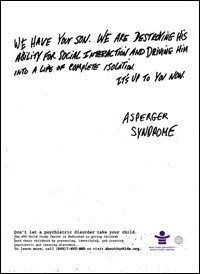
The charming \”Ransom Note\” public campaign by New York University is a good example of this.

Text: We have your son.  We are destroying his ability for social interaction and driving him into a life of complete isolation.  It\’s up to you now. ~Asperger Syndrome

This is stigmatizing in a few ways.  First, social interaction and your ability thereof is a skill… i.e., something that can be learned.  So, no, there is no destruction here, it\’s simply that the child may need extra support to learn those social skills.

Second, do you know why autistic people tend to be more isolated?  It\’s not because we don\’t want friends, or don\’t try.  It\’s because neurotypical people tend to reject people different than them.  When that happens over and over, the person loses the desire to try again.  Saying that\’s their autism\’s fault is not only absurd, it\’s literally the opposite of the problem.

Third, this ad commits the idiocy of assuming you can remove the autism from the autistic.  You can ease the ways an autistic person suffers, like providing sensory support, treating depression and anxiety, allowing them to make decisions (and mistakes!) on their own terms.  And the results may be that they act less \”weird,\” which is then mistaken for \”less autistic.\”  The fact remains that you cannot cure or remove autism, which is a neurologically-based difference, from an autistic human.

This campaign, and others like it, have informed the public opinion of autism.  We are, apparently, a disease, threatening, and something to be feared.  This was the message given to the general public.

Here\’s another horrifying ad by Autism Speaks (stupid name; no autistic people are listened to there).  And here\’s the transcript, in case, like me, you can\’t follow the whole thing.

They\’ve personified autism into some kind of malevolent disease-demon, infecting innocent children and making them have greater challenges than most kids.  Autism Speaks is happy to blame disintegrating marriages on this nonexistent entity rather than the actual children, while demonizing what makes those children unique.

Autism, to Autism Speaks (bullshit name), is nothing less than evil.  Which they, of course, have set themselves up as the \”Good\” to fight against.  There\’s a lovely message of universality, with mentions of various countries and religions.

It\’s a pity it all misses the truth, which is that there is no demon.  If autism has a representative, it\’s your children.  It\’s adults like me.  It\’s the collective community we adults have built.  We don\’t want your marriage to fail any more than we want our own relationships to fail.  We don\’t want you to go bankrupt paying for therapy that traumatizes and stigmatizes us.  We certainly don\’t want you to lose hope.

Mostly, what we want is to be ourselves.  To not be rejected for being different.  No amount of demonizing autism will make that happen.

Some excellent general examples of the typical public stigma experience can be found in the article here.  Highlights include, \”autistic people don\’t have empathy/can\’t feel emotions,\” \”autistic people are damaged,\” and how autistic children are all apparently soul-draining, life-destroying monsters (due to how some parents talk about them).

All of these are examples of Public Stigma, the first of seven types of stigma.  

Autism Panel for Med Students: a summary

About a month ago, I had the privilege of speaking to a group of medical students, most of them on track to become the doctors of tomorrow.  I was asked to make a speech to introduce the subject and lead into the panel discussion of autism and medicine.  Below is the speech, a link to the handout, and my answers to the questions the panel members were given.  I\’ll also include a summary of what other panel members said.

———————

Good evening, and thank you for coming.

Before we begin, a note.  We, the autistic people before you, represent a small portion of the autism spectrum.  We\’re the ones who are verbal enough and organized enough to sit before you in a strange place, prepared to talk about ourselves in coherent detail.  Not everyone you run into in your careers will be able to do this.

In fact, depending on how much stress we\’re under, WE OURSELVES may not always be able to do this.  So the first thing I want you to know is that there are many forms of communication, and what we\’ll do here is only the most mainstream form: verbal speech, supplemented by body language.

This form of communication is what most of society runs on, and our proficiency in it is why we were chosen to be here.  There are other kinds of valid communication, including behavior, sign language, texting, the Picture Exchange System, and text-to-speech apps.  I would strongly encourage you to acquire a passing familiarity with these forms of communication, at least enough to recognize them so you know what to Google.  (smile)  Quite frankly, I expect these forms of communication to become more mainstream as our understanding of autism and nonspeaking humans advances.

So, what is autism?  I\’ve read a lot of books on the subject, and most of them start out with giving the DSM\’s definition.  That\’s the American Psychological Association\’s diagnostic manual.  And y\’know, I could do that, but quite frankly, when I got my diagnosis about a decade ago, those criteria were useless.  So I\’m going to skip them.  I have a bachelor\’s degree in psychology, and I\’m going to tell you that diagnostic criteria for brain differences and mental disorders are far more theory than practicality.

You can rely on the diagnostic criteria for physical diseases like hives or measles because they\’re well understood.  You can\’t, or at least shouldn\’t rely on the criteria for neurological differences and disorders, because quite frankly the APA is grasping at straws.  They\’re trying their best, but apparently the human mind and the human brain are one of the most complicated subjects we as a species have ever tried to study.

Our current best understanding of autism relies on brain scans.  When put under an fMRI, there are functional differences between an autistic brain and a normally developing one.  Some parts of an autistic brain may be over- or under-developed by comparison to the \”typical human brain.\”  The connections between those parts may be stronger or weaker than average.  You can get a wide variety of traits as a result of these differences in our mental machinery.  The most common ones are socially-oriented: things like difficulty reading body language, difficulty reading facial expressions, and difficulty reading tones of voice.

The difficulty goes both ways: sometimes you find flat or singsong tones of voice in autistic people, or a very flat facial expression that doesn\’t convey much emotion, or very rigid and uncommunicative posture.  You can also get things like gastro-intestinal disorders, diet sensitivities, sleep disorders, anxiety disorders, sensory sensitivities, executive function difficulties, and depression.

There are tradeoffs, though.  An autistic person who loves their hobby is one of the most devoted and knowledgeable people you could hope to talk to about that hobby.  As a spouse or a friend, an autistic person tends to be extremely loyal.  We tend to have strong senses of justice.  We also tend towards literal-mindedness, directness and honesty, rather than playing mind games and carefully selecting socially appropriate white lies.  Physical appearances, things like what brands you wear, how perfect your makeup is, and how coordinated your clothes are… these things mean less to us than WHO you are, and what things you like.

Finally, autistic people bring fundamentally different points of view to any discussion.  We are, in essence, different.  That can provoke misunderstandings and slow things down, but it can also be helpful.

For example, when my spouse and I finally gathered enough money to be able to house-hunt, we were told to pick some important things we wanted in a house, tell them to the realtor, and then look around until we found a house we loved.  My spouse may have been happy to do that, but I preferred to consider, in exhaustive detail, every aspect of the house I wanted to live in.

Things like 3 prong electrical outlets, the presence of a bathtub, number of bathrooms, number of shared walls, the tax rate, how the tap water tasted, the age of the roof, the amount of nature around the house, and the average time to Meijer, my parents\’ retirement home, and his workplace.  All of these things were excruciatingly given priorities and point values and put into a spreadsheet, which we filled out for every home we looked at.  Each home received a score at the end, which we used to help determine whether we wanted to put an offer on the home or not.

This was far more work and annoyance than most people would bother with, but I considered it worth the time so that we could find a home we would be happy in for decades.  Was all this work atypical?  Definitely.  Was it worthwhile?  Definitely, at least in my opinion.  My autism, weirdness and all, helped me find a place I genuinely enjoy living in, and my family is better off because of it.

Which brings me to my last point.  In recent years, autistic people have developed communities and schools of thought about ourselves, our difficulties, and our successes.  One of the major philosophies to come out of this coordination is neurodiversity.

Essentially, neurodiversity is the idea that the human race is better with neurological diversity.  That autism is not a disease to be cured, but a difference that should be supported and respected.  That isn\’t to say that autistic people don\’t need help, or that being autistic doesn\’t come with hardships.  It\’s merely to say that without us, you are all made less.  The human race needs people with different points of view, because it takes new and weird ideas to come up with the new and weird inventions that keep humanity moving forward.

Temple Grandin redesigned cattle facilities and slaughterhouses to be more efficient and humane.  John Elder Robison created astonishing new sounds and flaming guitars for the band KISS.  Bill Gates and Steve Jobs transformed the world as we know it with personal computers and iPhones.

Each autistic person is different.  Personally, I can\’t design a slaughterhouse or an iPhone, but I can stand here before you, the medical professionals of tomorrow, and attempt to bridge our worlds.  I firmly believe the world is better with all of us: neurotypical and neurodiverse together.

Thank you.

————————

Link to the handout

————————

Panel Questions

1.  What are you doing now or have you done recently that is a success for you – either because if or in spite of your ASD?

I went to Reston, VA, near the capitol in DC to help direct the Autism Research Program\’s use of US tax dollars.  They contract consumers (ie: people affected by the issue at hand) as well as scientific reviewers of various types.  Each application is reviewed through a set of processes, and eventually a final score is assigned.

From those scores, the most scientifically rigorous and most useful-to-the-community studies are chosen to be funded.  It was an exhausting opportunity, but a worthwhile one.

Most other panel members spoke about their jobs, or personal successes.

2.  Tell us about your support system.  If you want to, you can include your age of diagnosis.

My support system is complicated.

I try to eat dairy-free, because I\’ve noted dairy products tend to send my mood into a downward spiral.  I don\’t know why this is, but it\’s a clear enough effect that I noticed.  I also have my supplements, which at this point is up to 8 pills in the morning, and 4 at night.  These include multivitamins as well as specific minerals and vitamins I tend to be deficient in.

In addition to these, I try to exercise 2-3 days a week.  I see a therapist once every two weeks, where she administers a form of neurofeedback called LENS as well as more traditional talk therapy and managing my supplements.

Other panel members spoke extensively about their families, mostly, some also about their friends.  They mentioned relying on these people to \”get them,\” and advocate for them when they can\’t do so for themselves.

3.  What would you like people to know about autism?  What do you think are some common misconceptions?

Mostly, that we grow up.  The general perception of autism is that of a white male child of perhaps 6 years of age, obnoxiously trapped behind a warped pane of glass.  In fact, the average age of an autistic person is 19, and many of us are people of color, born female, and gender minorities.

Those of us that can blend into the general population often choose to do so, because of the stigma and infantilization of autistic people.  High support needs are equated with being a child or being stupid, and they shouldn\’t be.  But that can drive those of us who are verbal to feel isolated, and unwilling to identify publicly as autistic.

Other common misperceptions included the specific symptoms and presentation of autism.  Women in particular tend to not have the same kinds of symptoms as men, so sometimes an autistic person, or even a small child, is dismissed out of hand for not being like the \”classical autism\” which was described mainly around male children.

4. How do you respond in situations if you\’re scared or worried?  How might you respond in an ER or in a traffic accident?

This is rare for me after three decades of life, but if I have no script or sense for what I should be doing, I tend to freeze.  When sufficiently stressed or when my brain has become too \”worded out\”, I can become nonverbal or very low-verbal.

Other panel members described being fully verbal but completely incapable of handling any decision-making.  One even said she would need to be talked down, preferably with subjects like her favorite TV show, before she\’d be able to engage with an emergency situation.

Another spoke of having a completely abnormal response to a traffic accident, where the panic and stress reaction that neurotypical humans experience quite literally didn\’t kick in.  While the driver of her car was still locked into gripping the steering wheel, she got out of the car, inspected the damage, and found it was a very minor accident.

5.  If you are a person who experiences sensory overload, would you prefer a quiet room in healthcare?  How is the noise level/stimulation in current healthcare areas now?

I am definitely sound-sensitive.  I\’m not sure there is anything that counts as a quiet room in healthcare.  I\’ve been in hospitals, they make me fervently hope I never have to go back.  There\’s always people moving and talking in the hallways, the sounds of machines and medical equipment inside the rooms, the fan or climate control going…

These were nice hospitals, too.  Pleasant staff, lots of windows, art on the walls, all of that.  I can\’t imagine trying to heal and recover in such a place.  I\’m no longer surprised when I go to visit someone in the hospital and they look terrible.  Nobody looks good in a hospital.  They\’re just not good places to be, to me.

There was no disagreement on this subject.  Not one of the four of us found hospitals a relaxing, pleasant environment.

6.  What can a neurotypical physician do to help communicate with a person with autism?

I mentioned this above, but it merits the repetition: learn about and be open to \”nonstandard\” forms of communication.  The Picture Exchange Communication System is one of these.  Sign language, text-to-speech apps, and texting itself are others, and there are more.

Other panel members noted that it\’s best to presume competence (ie: treat the autistic person like they\’re a person, and assume they know what they\’re talking about even if they can\’t express it perfectly).  They also appreciated a willingness to listen, and patience when a person has difficulty giving a succinct answer.

7.  What has a physician done for you that was helpful?  Unhelpful?

I\’ve found self-directed care to be the most useful.  Giving me the information I need to make my own decisions, rather than simply writing a prescription and making the judgement call themselves, was empowering.  Believing me when I describe symptoms that don\’t fit neatly into a medical textbook also features high on the list.  I\’ve had primary care practitioners that either didn\’t do this or didn\’t care because they had such a high caseload or just… didn\’t care overall.