Histamines: Taking the Misery Out of Exercise

About a month ago, I experimented with flooding my system with histamines to see if it would trigger any ill effects.  I did this via food intake, custom-tailoring a day’s meals to add external histamines to my system.  The results were not spectacular, but they did have promise.  I experienced worse than usual brain fog, lack of focus, a burning in my stomach lining, and some trouble breathing.

As it turns out, overloading my system with histamines wasn’t actually the best experiment I could have tried, because the results were simply in degrees of discomfort.  A better experiment would have been to remove them entirely from my system and observe the results, particularly during hard exercise.  So I did that!

The Exercise Experiment

The one thing I didn’t really try during this food overload experiment (quite possibly because I felt too poorly to consider it) was exercise.  I made a note to try the exercise later, but didn’t really set up a good experiment for it until just recently.

As it turns out, as much as vitamin C is excellent for you and a good day-to-day solution, a good over-the-counter anti-histamine is more rigorous and quick to take effect.  Your basic allergy medicine, in fact, will handle this, though naturally you shouldn’t be taking allergy medicine every day unless you actually have allergies and can’t manage them without it.  So, knowing the effects were likely to be obvious, I took a single store-brand Benadryl, gave it 15 minutes, and then went biking as hard as I could.

I went for half an hour, and pushed myself hard.  Sustained cardio exercise at moderate-to-high intensity has reliably made me miserable in a hurry, so even though I was opting for an exercise that allowed for breaks, I figured I could just keep pedaling rather than taking my usual breaks for breathing.  The area I live in doesn’t have all that much by way of hills, but it didn’t matter, because…

The results were about as telling as I could have wished.  I got tired, and had to work very hard… but I did not get miserable.  Histamines, apparently, had been choking me out of my oxygen and proper brain function.  Effectively, I was having an allergy attack every time I exercised… until now.  It was extremely strange to be working my body so hard without becoming mentally exhausted and depressed.

The bane of my existence has always been exercise, and it’s because, to the best of my knowledge, I run short of oxygen very fast and spend the rest of the time simply trying to survive the exercise with enough oxygen to not fall over or stop.  I had a summer cold a couple months ago and experienced the same symptoms (misery and low oxygen intake) from simply sitting, so it was easier for me to recognize the second time around.

The Histamines\’ Source

So if it wasn’t what I was eating (I’d established in the last experiment that I mostly avoid all the foods that are high-histamine), why was my system overloaded with histamines?
The answer appears to be (at least) twofold.

This is the pond out my back door.  All the snot-colored splotches in the water are algae.  They’re some type of toxic species that happily grows in all the fertilizer runoff from the condos on my side of the pond and the apartments on the other side.  Normally they treat the pond for this mess, but after July was over, they kind of stopped, and this is the result.  I have a very high quality furnace filter cleaning the spores out of my house’s air, but it’s not like the house is airtight.  I may set up an air purifier in the bedroom as well, since I spend a third of my day in there.

The “this is definitely a problem” experience that makes me sure this is part of the problem happened when I went out to get pictures of this algae once.  I was out there for maybe two minutes, in the hot summer sun, last year… After I got back inside I had to lie down for like three hours because I felt so bad.  It was like my brain function had been repressed, almost like being extremely drunk, except without the visual impairments, coordination impairments, and nausea.  I had enough presence of mind to take my N-Acetyl-Cysteine, which helps detoxify my system, and drink a ton of water to help flush things out, and then I simply lay down, closed my eyes, and waited it out.

I woke feeling a little better, but not really back to normal, and with a much healthier respect for the toxic sludge that lives outside my back door…  Even opening the back door for a couple seconds has deleterious effects on my brain, though thankfully not the “go lie down for three hours\” effects.  More like “you’re going to feel kind of bad for 15 minutes.”

So, I’m pretty sure the algae is factor one.  Factor two?  House dust mites.

My mother is allergic to these, which is fortunate because otherwise I probably wouldn’t have attached any importance to the fact that my nose starts plugging up when I lie on bedding that hasn’t been washed in a week.  She actually has it much worse, in that she actually can’t sleep if the mites are bad.  Her nose just keeps running and stuffing.

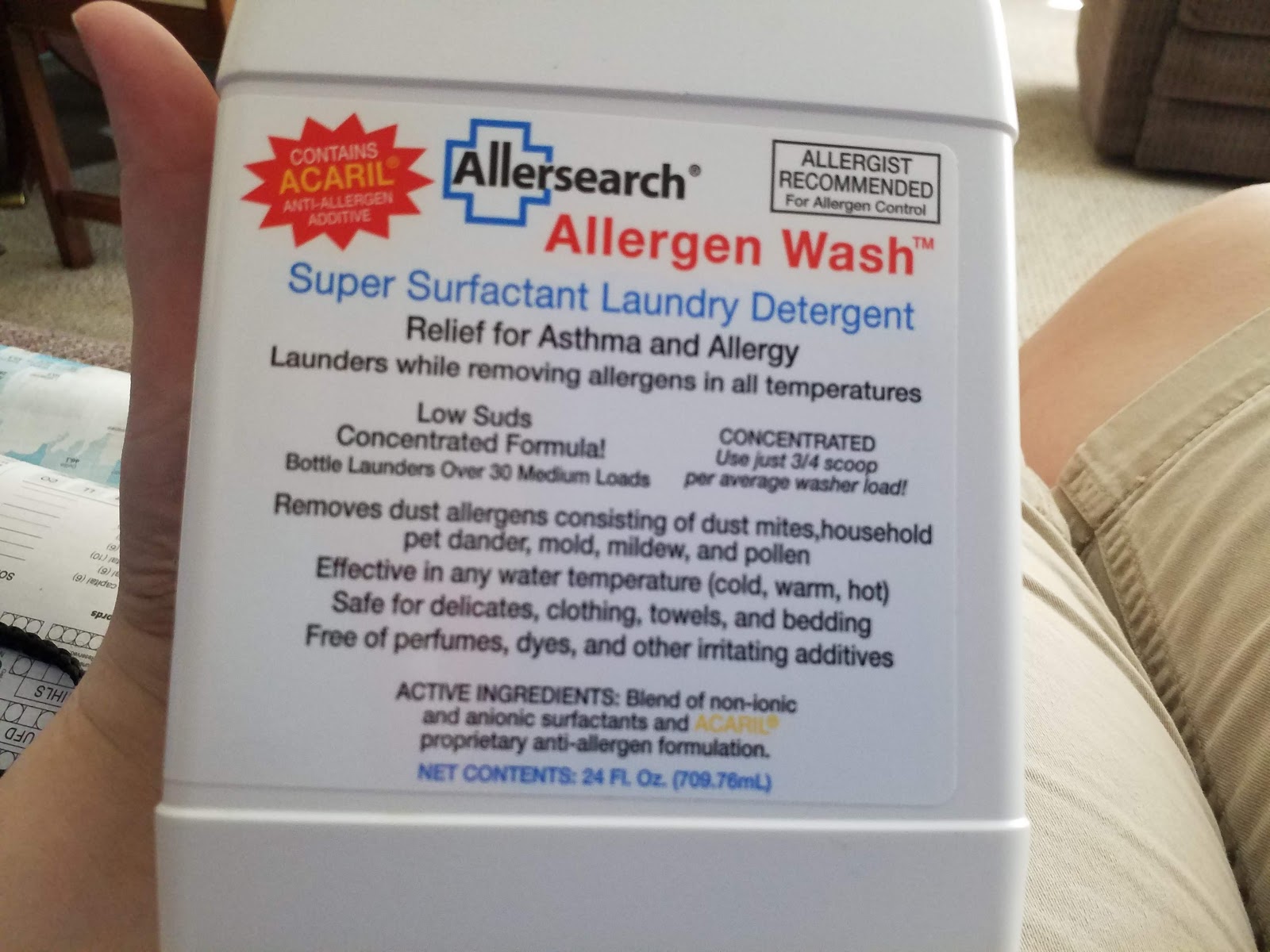
I mentioned this to my doctor, and she recommended washing my bedding in hot water.  The problem is that hot water shrinks things, and I don’t really like fighting my spouse for blanket.  Fortunately, my mother has a solution:

More the former than the latter, but if the former doesn’t entirely fix the problem, the latter might.  Or might just help with the algae also.  I’ve ordered a bottle of the deMite, and will try it next laundry day.

A Healthier Life?

I’m really hoping those are the only two factors, and that good care with both of these factors will sort the problem out.  If it does, I’ll be able to exercise more regularly, and at higher intensities than I’ve ever been able to before.  I’ve been reluctant to exercise… well, at all, really.  But especially at moderate to high intensities, because… misery.  If you’re miserable every moment you’re doing something, you tend not to repeat that activity.

I still have the years of misery associated with exercise, of course… but I’m not going to let that stop me.  Movement is immensely important to mental, physical, and emotional health.  If I can incorporate it in my life without the historically destructive, all-consuming misery, that would be a massive improvement… and it might make all the difference.  I might actually come to like exercise.  (Given my past history, this last sentence would normally equate to “pigs might fly.”  The future might be different, though!)

In the meantime, I need to manage my daily histamine levels.  This often means careful diet management, but in my case, I basically don’t eat anything that’s high in histamines anyway.  I need merely cut a couple foods that I wasn’t extremely fond of anyway.  My doctor has recommended an herbal supplement that should help with the day-to-day management of this histamine overload.

Notably high in vitamin C, of course, but the various herbs listed there also help with histamine management.

In the meantime, further experiments with vitamin C are in order!  I’ve had promising results with drinking a dose of my vitamin C powder about 30 minutes prior to biking.  But biking is just the easiest option.  If I can, I’d like to experiment with my archnemesis of exercise: jogging.  I have a long history with failing miserably at jogging, and it’d be a real turning point if I could succeed at it and get really good, intensive exercise at the same time.  I’m very hopeful!

Histamine Overload Day

The Theory

When I was at my doctor\’s office (my LENS doctor, not my primary care doctor who I rarely see), we were chatting about my health and she suggested, based on my previous complaints, symptoms, and observations about exercise, that I try experimenting with high- and low-histamine foods, as I might have an intolerance or simply be flooded with them.
Essentially, the theory goes that some people may have too high of levels of histamines in their bodies, and this has bad effects on your brain, your immune system, and your digestive tract.  You can tailor your diet to avoid high-histamine foods, which are mainly fermented foods, and thus live a healthier life… but this is only likely to help if you actually do have the intolerance or systemic overload.  
My doctor explained this as kind of like having a low level allergic reaction… except all the time.  So you\’re always dealing with things like congested airways, itching, a skin rash, watery or itchy eyes, etc.  The thing is, it may be so mild you don\’t even notice it, yet still have bad effects on your life.  And in fact, allergies like this can entirely bypass your nose and just affect your brain instead, causing depression, misery, and anxiety.  Now, the reasons she brought this up included the apparently-not-insect-bite-after-all bumps I came back with after one expedition for black raspberries, and my lifelong hatred for exercise.  
The latter doesn\’t immediately make sense.  The thing is, there are two categories of foods you have to watch out for with a histamine issue.  The first is foods with high histamines, of course.  More histamines is bad.  The second category, though, is histamine liberators.  Your body stores histamines, and histamine liberators elbow your body into releasing them, which makes you feel worse.  
Exercise, as it happens, has that exact same liberation effect.  So a person would reasonable hate exercise if it felt like they were dying every time they did it.  Like, say, if their throat closed up, they found it hard to breathe, they itched a lot, and in general they felt terrible.  Which… isn\’t an unreasonable assessment of my feelings on jogging and most other forms of exercise.  
There\’s also the fact that in the summer, I\’m basically marinating in toxic algae spores due to the pond outside, which… I\’d assume would produce histamines, given its deleterious effects on my system if I go outside and breathe for like two minutes.  I also find myself sleeping with my arms over my head, which is notably helpful for opening airways, but does a number on my lower back… so you\’d think I wouldn\’t be doing that on purpose.

Counter-evidence is that I tested negative on a battery of allergy tests at the beginning of the year.  Like, I\’m allergic to nothing they tested.  Literally nothing.  The test included various local plants that often set people off.  I also haven\’t personally noticed regular congestion and such until recently.  It\’s like my cold never truly ended.  I cough a bit here and there these days, and occasionally need to blow my nose.  

There are two informational documents I was sent by my doctor, so here they are: The Healthline Summary and the Topic-Specific Site.  I read them both, or at least skimmed them both, and paid careful attention to the list of foods.  Surprisingly, I don\’t really like most of the high-histamine foods.  So most of them aren\’t in my diet.  I can\’t say the same for the histamine liberators, though.  A good number of those rotate through my diet regularly.  
So there\’s cause to test this theory my doctor has… and I intend to.  Slightly recklessly.

The Plan

I am, as of yet, still fairly young and thus resilient.  I am therefore going to take a single day to present my system with many high-histamine foods and histamine liberators.  The results will either be dramatic and prove the point, or minimal-to-non-existent, and strongly suggest that this is not an issue I have.

I should note my doctor specifically told me not to do this, and instead suggested trying a couple foods here and there, and seeing if I noticed differences.  Which is why I\’m terming this \”slightly reckless.\”  I don\’t think I\’m putting my life on the line, trying this, but I do think I\’m probably setting myself up for an extremely miserable day.

To do this experiment, I read over the foods, and prepared a menu for the day, incorporating enough of them to hopefully give a good test result.  While devising this menu, I made efforts to make the meals healthy, because it\’s already known that eating junk food makes you ill, and eating horrifyingly mismatched foods (like, say, jerky, pickles, and chocolate in the same mouthful) would also complicate the results by making me miserable as I ate them.  
I also had to allow for my particular diet choices, which meant only humane meats.  I know where to get bison jerky, so I can still try the fermented meat option, but things like store salami and most smoked meat products are out.  
With that in mind, the menu is this.
Breakfast: Cup of Greek yogurt with fresh pineapple and strawberry slices mixed in.  Sourdough toast with mixed nut butter on top.  
Lunch: Fancy grilled cheese with tomato soup.  Sourdough bread with aged cheese and shredded bison jerky.  Pickle and a handful of spinach for a side.  Orange for \”dessert.\”
Snack (if desired): chocolate and/or handful of roasted mixed nuts. 
Dinner: Marinated chicken (apple cider vinegar and soy sauce marinade), served over brown rice, with a banana and spinach salad with vinegar dressing for sides.  
Beverages: Green tea, black tea, and possibly a serving of booze at dinner.  
For extra credit, I may try to exercise that day as well, which would help free up any stored histamines I might have.  I haven\’t quite decided on this, because exercise makes me miserable, and I don\’t want to muck up my experiment by biasing it

Now, assuming this theory is correct and I have this problem, the resulting suffering will be misery.  I\’m young enough to try this, but not so reckless that I don\’t have a backup plan for alleviating my misery.  When discussing this theory with my doctor, she mentioned that while testing foods, I might keep vitamin C on hand, as it helps clean histamines out of your system.  So now I have a nice jar of lemon-flavored vitamin C powder, which I will mix into water and consume at regular intervals, should the effects be overwhelming.

I also have various decongestant medicinal products that served me fairly well during my cold a few weeks ago, and I might see about acquiring an anti-histamine as well, which would help curb any impressive acute symptoms.

The Day Of

The day started fairly normally for a summer day: not enough sleep because of the light levels.  Here\’s my ingredients:

Some of these we had at home, but most had to be bought specifically for this experiment.  This isn\’t even all the things, it\’s just what would fit neatly in the picture.

Breakfast commenced.

My yogurt cup didn\’t hold nearly as much fruit as I wanted it to, so I had some on the side.  I decided tea with breakfast was going to happen.  I like tea, but I usually don\’t treat myself to it. So that was nice.

After the first few bites, I had a cough, which left about as fast as it came.  I\’ve had those on and off in the last couple weeks, and still have no real idea what\’s going on.  A more lingering effect, which I didn\’t test because I was focusing on work and other things, was the seeming difficulty breathing.  My work is sedentary, thankfully, so that was not a crippling issue.  But it was very definitely notable.

More interestingly, and more detrimentally for sure, was the brain fog that really shouldn\’t have accompanied such a healthy meal.  It could be the yogurt, which I\’m not really accustomed to eating, and is dairy, after all.  I\’ve had poor effects with dairy.  That would normally be a factor I\’d eliminate for this test, but I had enough trouble coming up with a meal plan without that.

I also felt kind of like my stomach lining was… overwarm.  \”Burning\” implies actual pain, and this wasn\’t a form of pain I recognized.  It was just uncomfortable and a little worrying.  It didn\’t really feel like acid reflux, either.  So that was definitely worth noting.

Lunch was late, because I guess I had too large a breakfast in my enthusiasm for this experiment.

I… still really really do not like pickles.  Like wow, yuck.  I ate all four on the plate, but unless I can foist the rest off on somebody else, I don\’t think I\’m going to eat them.  The rest was basically fine, thankfully.  I ate the banana for lunch instead of dinner because of how ripe it\’d gotten, which was fine.  I was originally going to shred the jerky and put it on the sandwich, but I ran out of time due to needing to run errands.

I did again feel the sort of burn on my stomach lining, which was definitely disconcerting.  I noticed a certain difficulty in breathing again, like I had to work harder for my oxygen.  I may or may not have been imagining that, or letting confirmation bias run away with me.  This experiment couldn\’t be done double-blind as easily as my other experiments.

After lunch, my day\’s pace picked up, which, combined with the brain fog, caused me to forget to take a picture of dinner.  It was the meal as planned, though, vinegar/soy sauce marinated chicken over rice, with balsamic vinegar dressing on spinach, and the orange.

At dinner, I also decided to be a strange person and mix a mug of green tea with a shot of vodka, which wasn\’t as horrifying as you\’d expect.  Actually, I didn\’t really taste the vodka after it had mixed in with the tea and warmed to the correct temperature.  I have no idea if that\’s normal, or just a function of the particular brand of vodka (Grey Goose).

The burn in my stomach lining re-commenced after consuming two types of vinegar (but before consuming the alcohol, which does its own form of stomach-burn sensation).  I felt kind of warm in the face, which was new.  I would also say the brain fog returned, at least to a degree.

I finished off the night without needing to resort to my safety net:

\”BioFizz\” is maybe not the most marketable name I\’ve ever heard, but the product is quality.

Vitamin C is excellent for helping the body filter out histamines, so mixing either of these powders into water and consuming them would have helped flush my system of the mess I\’d forced into it.

The Results

I wasn\’t, I suppose, really expecting to break out in hives or suddenly have my throat close and have to be rushed to the hospital, but I guess I\’d hoped for something a bit more dramatic than \”slight trouble breathing,\” \”kinda burny stomach lining,\” and the ever-debilitating \”brain fog.\”  These were clear and obvious symptoms, but not the type I wa expecting.

I discussed my findings with my doctor.  She mainly told me it was something to be aware of, when considering why I might be feeling poorly.  It\’s clearly not the beginning and end of my health considerations, since I didn\’t end up in the hospital, but the difficulty breathing is suggestive, as are the other effects.

Something of note here is that many of these foods, I wouldn\’t normally eat.  They simply don\’t taste good to me.  Pickles and vinegar in particular come to mind, but in all honesty, I didn\’t really enjoy the jerky either.  There can be a correlation between \”what tastes good to you\” and \”what is good for you.\”

This is obviously not always the case, as per the various cases of autistic children (and sometimes adults) refusing to eat all but a very limited subset of foods.  Sometimes those refusals aren\’t merely based in taste, they\’re based in texture and sensitivities thereof.  I would guess that the \”if it tastes bad, you shouldn\’t eat it\” concept of eating is probably only referring to taste.

A good test during this histamine overload day, which I should have done but was so brain-fogged and tired that I didn\’t, would have been to go biking or power-walking.  The difference in my ability to breathe that day, versus regularly, would have been valuable information.

I\’m not entirely out of luck on that front.  While I probably won\’t redo the high histamine diet, I can attempt the opposite thing: dosing myself up with vitamin C, and then exercising at a moderate intensity.  If the experience isn\’t horrifying, that\’s all I\’ll need to know.  Perhaps I could even try jogging again.  Being able to tolerate high-intensity exercise would make it possible for me to burn calories easier, which would go a long way toward checking the slowing metabolism/rising weight effect of middle age.  Exercise also burns energy I tend to use being anxious, so it might also do wonders for my mental state, too.

In the end, it seems that high histamine levels are a factor in my life, but not an all important one. Fixing my histamine intake would most likely have positive effects, but is unlikely to solve all my health problems the way I\’d like it to.  I\’ll make note of any future testing I do on the subject, particularly the exercise/vitamin C test.

Edit (9/2/19): Histamines are definitely the bane of my exercise.  While apparently overdosing on histamines didn\’t really change my day-to-day experience, taking an anti-histamine and then exercising as hard as I could?  Yielded no misery at all, just hard work.  It was extremely weird to have those two sensations divorced from each other.  Exercise has always been a miserable experience for me in the past.  I\’m going to write an exercise-related post update for this.  As it happens, I know of a researcher that might well be interested…

Edit 2 (9/12/19): Yyyep, it\’s the histamines.  I tested my archnemesis of exercise, jogging, with an anti-histamine on a muggy swelteringly hot day.  I got very tired and my muscles screamed for mercy, but I did not get miserable.  I wrote another post about the exercise experience, which is here!

Double Empathy

Autism is an actively lived condition.  Thousands, even millions of people have it.  Most of them now adults.  In that time, we’ve all been thinking about the treatment we’ve had as children, and as adults, and what autism is, what it means for us, and what we should do because we have it.  
 
The answers to those questions vary by the person, but like any communicating people, we have, as a group, gotten together in places and done some thinking.  New philosophies have risen based on those thoughts.  One of these is the Double Empathy problem.  
 
The basic understanding of autism is that some people are born different, the difference is in their brains, and that makes them have trouble communicating with others.  This would be the single empathy problem: autistic people, we’re told, have trouble communicating.  
 
The thing is, it’s not that simple.  Scads of personal testimony from autistic people networking with other autistic people have led to researchers doing studies on it… and it turns out we communicate with each other just fine.  The problems come when you mix autistic and neurotypical people.  Why is this?  
 
It’s because neurotypical people are set in a single, accepted way of communication.  Specifically: verbal speech in very limited, specific patterns, plus a layer of non-verbal body language reading.  Anyone who doesn’t communicate in that manner, or not exactly in that manner, is deemed “broken” and summarily ignored or not taken seriously.  
 
Autistic people, especially adults, don’t do that as much.  We understand and recognize a broader range of communication, because we ourselves use a broader range of communication.  We’ve spent years learning to be polite and respond appropriately and trying to think in ways unnatural to us, and it’s granted us a form of empathy that neurotypical people… entirely lack.  Because if all you use is one form of communication, you are blind to any other kind of communication.  
 
Research is beginning to bear this out.  I don’t expect the results to change much as these studies are repeated for scientific rigor.  To get an idea of the kinds of calculations you should be doing when faced with an autistic person (or really, any person that strikes you as “different”), check out this example behavioral analysis of a child named Sam in a school classroom.  How many of those factors occurred to you, when presented with the restless child at circle time?  
 
This is the Double Empathy problem.  Yes, autistic people have trouble communicating to neurotypical people.  But no, that’s not a 100% us problem.  Communication is a two-way street, requiring perspective-taking from both sides.  Neurotypical (NT) people don’t communicate back to us in ways we understand, but we’re still blamed for not understanding.  See how this works?  You’d think, if neurotypical people were so ideal and wonderful and everything we autistic people should strive to be, that y’all could communicate back to us in ways we understand.  But that’s not the case.
 
In more visual terms:
 
Autistic person ——> NT person
(difficulty communicating and being understood)
 
NT person ——> Autistic person
(difficulty communicating and being understood)
 
And yet:
 
Autistic person ——> Autistic person
(no difficulties)
 
Double empathy.  Double.  Two-way.  Neurotypical people are part of the communication problem.  We appear to be have different sets of social skills.  Autistic people are demanded to learn neurotypical social skills.  Maybe y’all should learn ours, too.  

Sensory-Alert Grocery Shopping, part 2: Sounds and Policies

Last time I talked about how I was invited along to the corporate Meijer offices with Autism Support of Kent County.  To prepare, I went to my local supermarket and trawled through the place, evaluating it for sensory-friendliness, and put together a short presentation of what I found.

Last week I went over about half the presentation, including the various issues and curiosities with the lights in the store, as well as the pitfalls of smell.  Today I\’ll finish up with the sounds I encountered in the store, as well as store policies and ideas for changes.
——————————————————————————-

Like smell, sound is a facet of the senses that\’s best kept very simple and minimal while shopping.  The fewer noises, the better.  I was surprised as heck that the store\’s music was actually set quite low, making it quite sensory-friendly.  Normally that\’s the first offender in every store and restaurant I set foot in.  They did somewhat make up for this bit of friendliness by having periodic ads interrupt the music, which is both sensory-unfriendly and highly obnoxious.  Still, that was maybe every 5-10 minutes, not constantly.

Speaking of ads, there were many.  The PA system was just the start.  The shoe section had a massive TV screen with an ad for a shoe brand, complete with flashing pictures and sound.  Ew.  There were a couple smaller, tablet-sized ads in the alcohol section, though I couldn\’t say for sure they had noise or not.

By far the most painful sound I encountered was the mobility devices\’ backup noises.  Essentially high pitched shrieks, they grated on my ears like nails on a chalkboard, only louder.  I don\’t begrudge people use of the devices, but I deeply wish the devices didn\’t sound like construction equipment when backing up.

I was, however, rather pleased at how most of the store\’s other operational sounds, like the sound of an item being scanned, the overhead fans, and even the theft alarm, were almost muted and polite.  I recall, growing up, when barcode scanners hurt my ears.  They emitted a high pitched \”sckreek!\” sound for each item.  The ones at this store were several octaves lower.  Not perfectly painless, but much better than it could be.  The theft alarm makes a \”boop boop boop\” sound when triggered, roughly around middle C on a piano keyboard.  So quite tolerable, while still being alarming if it goes off near you.

I wasn\’t as thrilled with the talking self-checkouts.  If the aim is to reduce the amount of noise-clutter, having a half-dozen registers speaking near-simultaneously is… not great.  I also happened upon what I assume is a malfunctioning piece of refrigeration equipment in the vegetable section, which made a high pitched whine I could pick out from several aisles over.

Shopping carts.  They\’re essential, but they come with just… so many horrible noises.  The wheels on the carts are probably what most people think of, and they\’re right to do so.  Dud wheels can make all kinds of deeply unpleasant sounds, from a general thudding (crud buildup) to the improperly greased squeal.  The range is impressive, and it\’s all horrifying.
What people may not think of, though, is the noises carts make when they\’re unstacked.  The carts at this (and most stores) are made of metal.  They make loud crashing sounds when pulled apart, and when the child seat is lowered.  I had some thoughts about this, which included little rubber bits at points of impact.  The actual discussion also pointed out that plastic carts are an option, though I shudder at the environmental impact of that decision.  
——————————————————————————-

The fun bit about this section is that Meijer actually already has a lot of good policies in place already, just in the course of trying to make the shopping experience optimal.  The key here is predictability.  Meijer already labels their departments in absolutely massive lettering and abundant signage, and the stores themselves tend to be organized similarly.  Two main entrances, one side leading to the food, the other to the non-food.

The exact placement of the departments can vary somewhat by the store, but between the aforementioned signage and the general rule of \”food on one side, clothes in the middle, everything else on the other side\” you can usually get where you\’re going fairly quickly.

The one exception to the excellent labeling is the fruits and vegetables department, which is so utterly lacking in signage I just kind of sat and stared for a minute.  I have no idea why that\’s the case.  When I brought it up at the meeting, the official wasn\’t sure either, but thought it might have something to do with how often those sections are reorganized.  I still think signage could be managed, though.

Other immediate ideas included eliminating the current policy of greeting customers throughout the store.  Like Walmart, Meijer has greeters at the entrance.  Those are anxiety-provoking enough for someone like me.  Making the stockers say hello to me at random just makes me want to melt into the floor and die.  This sentiment was echoed by at least one of my autistic adult contacts.

Another thought I suggested was putting together a Social Story.  Ideally these are personalized down to the exact store you\’re going to be going to, but for someplace like Meijer, even a broad-spectrum one would be better than nothing.   The idea is to give the child or adult a sense of the place you\’re going, what to expect there, and what things are expected of them.  This doesn\’t directly address sensory overload, but it could include another thing suggested during the meeting: a sensory map.

The idea of providing a map to a business isn\’t new.  Noting areas that might overload the nose or ears, though, is something I\’ve never seen in a retail setting.  Marking off the perfume aisle (smell), the alcohol section (ears-crashing bottles), and the cleaning products aisle (smell again) as potentially harmful areas could make a shopping experience a lot more tolerable, especially for people new to the store, unfamiliar overall, or people with memory problems.

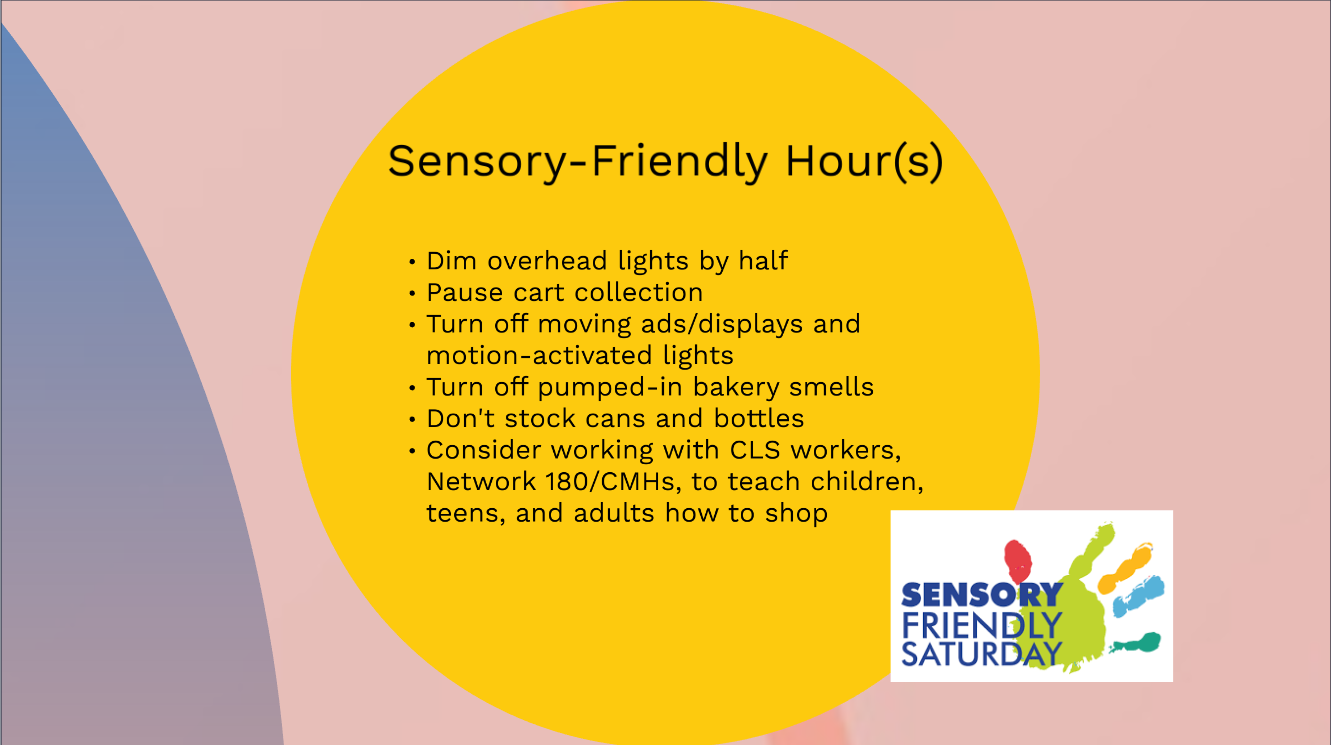
There were two major ideas that were suggested in my various reading materials.  The first is the more feasible one, and is already being done in grocery stores in Australia and Britain.  It\’s fairly simple: a major complaint from autistic people is that stores are too loud and overwhelming.

The solution? Turn everything down, for an hour or two every week, or a day or three every month.

Turn off in-store ads and flashing signs, pause cart collection, and turn down the lights.  Based on my walkthrough experience, I expanded on this little by also suggesting they turn off the pumped in bakery smells and avoid stocking cans and bottles.  To this I\’d probably also add \”silence the talking self-checkouts.\”  Doing these things vastly reduces the amount of sensory information pushed onto shoppers, which is awesome for people with overload tendencies.

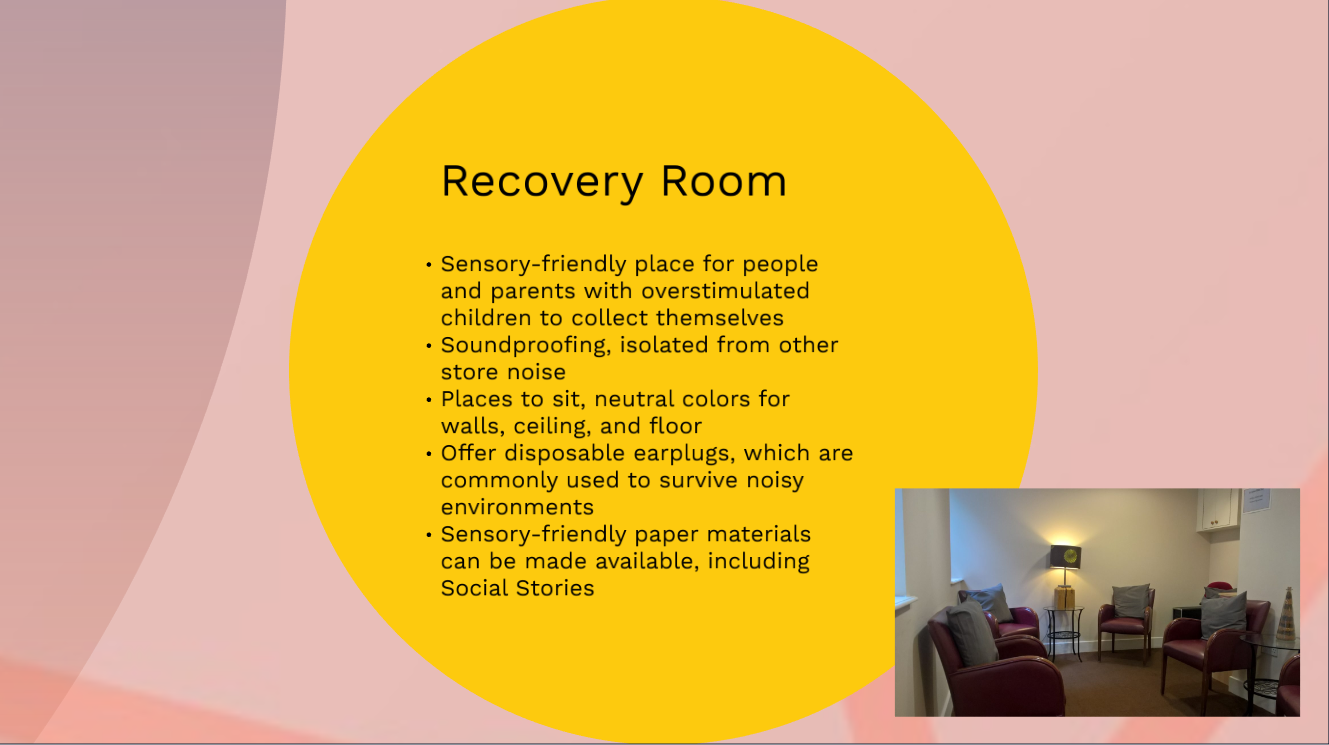
The more expensive and less likely accommodation I saw was a sensory-friendly room.  This is a phenomenon I tend to see more at conventions, but in all honesty, I could really use one everywhere I go.

The idea is to establish an accessible, quiet room with neutral decor and places to sit while someone tries to wind down from a meltdown.  Small autistic child having issues?  Go to the sensory room and get out their favorite stim-toy.  They calm down, and you can get back to your shopping.

In conventions I\’ve been to, this room was literally as simple as \”we turned off the lights in this panel room and left like three basic chairs in there.\”  It wasn\’t exactly comfortable, but it was kinder on my senses than the convention overall.

My additional suggestions for a room like this include offering disposable earplugs, which are a common assistive technology for people with sensory sensitivities, and placing copies of the aforementioned sensory map and Social Story there.

Really though, it doesn\’t need to be fancy.  It just needs to be there and accessible.  I don\’t really think Meijer will go for this idea, though, because any public space they\’re not using to display products is lost income.

——————————————————————————-

I included this, in the main, because it seems negligent not to do so.  The Autistic Self Advocacy Network has taken great pains to establish easily-digested materials on the subject, and the Autism Society has put together an actual program you can qualify your business for.  It seemed criminally negligent not to at least say, \”hey, these are cool, maybe check them out?\”

In all honesty, though, in a perfect world, I might be able to make a living simply by getting hired to walk through places and point out the autism- or sensory-unfriendly parts of them.  I can hear things that most people can\’t, and am sensitive to bright lights in a way most people can\’t imagine.  I\’m also fully verbal and can communicate that information even while stressed.

In this very non-ideal world, I\’m not honestly sure there\’s enough market for such an idea.  If you know someone who\’d like to know if their business is autism-friendly, though, give me a shout.  My rates are very reasonable. : )

Grocery Shopping: Part 1 of a Sensory-Alert Walkthrough

Last week Autism Support of Kent County, the organization I volunteer with, was invited to the corporate office of the Meijer, the local chain of super grocery stores. Meijer is hoping to make their stores a bit more sensory- and autism-friendly. I was invited along (after asking if I could be), and so in order to be properly prepared, I took a trip to the store I usually shop at.  There, I walked through the whole store, doing a slow but thoughtful shopping trip.

I came away with six pages of stream-of-consciousness notes, and roughly two dozen pictures.  After getting home, I condensed those into four topical headers and organized the information into those.  After that, I put together a very hurried and extremely unpolished presentation, which I will, I suppose, re-publish here with apologies to your eyeballs.  I\’m going to do it in two parts, because otherwise it\’s too long.  
Before I begin, please understand this is a single store I visited, not the chain at large.  It\’s one of the stores I shop at, in large part because it carries so much of what I need, at reasonable prices.  There are a lot of good things about Meijer that may seem ignored in the tide of criticism I offer here.  Check the second post, which will cover Sounds and Store Policies for a lot of those.
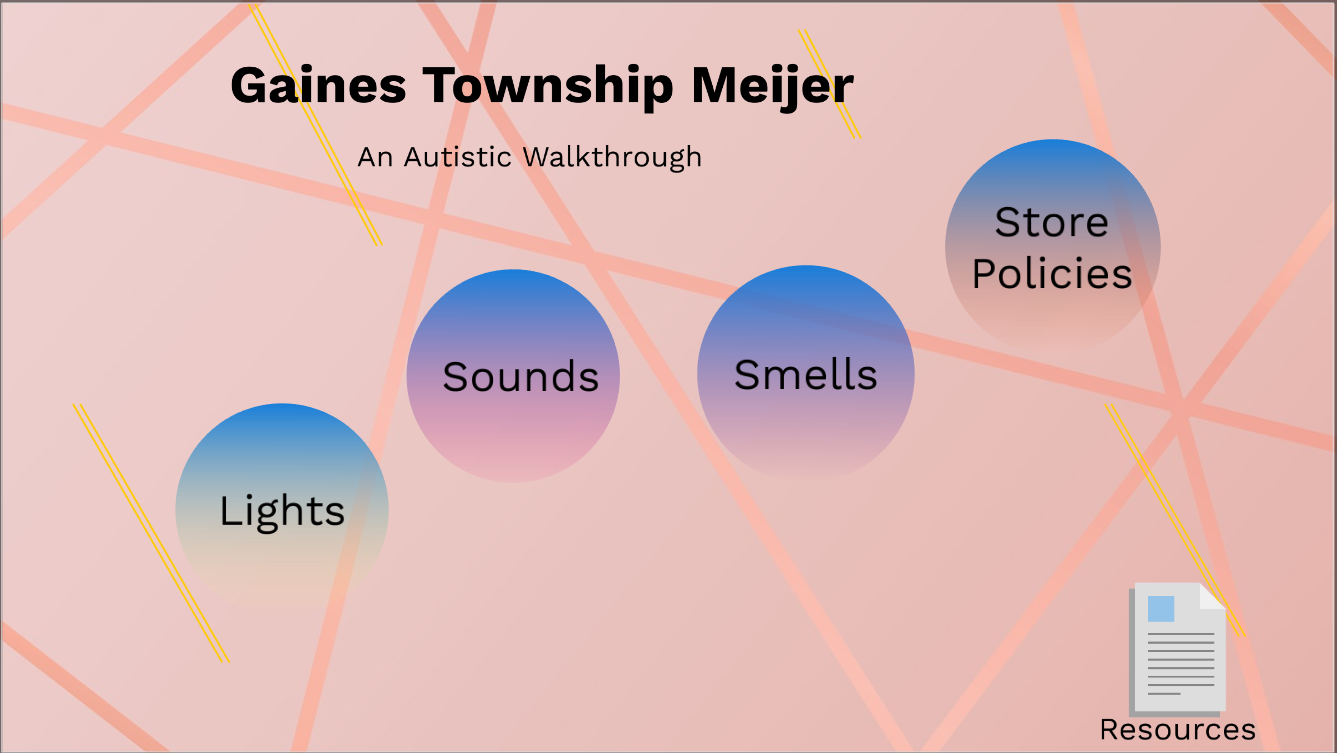
Main slide from a presentation, titled Gaines Township Meijer: An Autistic Walkthrough.  Main topics are Lights, Sounds, Smells, and Store Policies.
I haven\’t made Powerpoint-esque presentations for, um… something in excess of seven years.  Things have slightly changed when I wasn\’t looking, and I wouldn\’t say I was good at them in the first place.  You\’ll see what I mean later.

——————————————————————————-

Slide from a presentation, titled Lights.  Subtopics: Overhead Lights and LED Light Strips

For lighting, I was trying to get the basic understanding for design choices across.  Natural light or at least incandescent light over fluorescent lights.  Warm, soft white lights over harsh blue white lights.  No flickering lights.  These seem obvious to me, but I guess if you\’ve never stared directly into those awful new light blue headlights or into an LED light strip on a dark night, you might not know what I\’m talking about.

Slide in presentation, titled Overhead Lights.
Naturally, fluorescent lights are the cheapest for retail businesses by a hefty margin, so this normally falls somewhat on deaf ears.  When researching the subject, I did run across instances of teachers putting films or sheets over their fluorescent lights, which possibly moderated the flickering and humming.  So that\’s something.  
These particular overhead lights were of an unusual design.  They had a single, bright (probably fluorescent) tube bulb, facing UP.  The rest of the light was a curved white surface, which reflected the light out and down.  I\’m not a person that can actually see the fluorescent lights flicker, so I can\’t be sure that this design was meant to reduce that effect… but it does seem unusual and intentional, so that\’s certainly something.  
The lights themselves were… much too bright, honestly.  The reflections would bounce off every plastic-wrapped item, every glass item, and every polished surface (like, y\’know, the floor).  See the lower picture there?  The reflection of the overhead lights is visible in every single package of meat.  The end result was rather painful once I focused on it.  Dimmers would be a good option here, if the store wanted to be more sensory-friendly. 
LED light strips.  I hate them so much.  Whoever invented them has earned the swift kick in the pants I have saved for them.  They are very often the horrible piercing blue-white variety.  
Meijer, as it turns out, makes copious use of these light strips.  I found them in every refrigerated section, all over the health and beauty aisles, and even in special displays in the food and electronics areas.  Now, to the store designer\’s credit, many of these light strips were not visible from an adult\’s height and perspective.  They\’d installed them facing away from the customers, or blocked the immediate view of them with a plastic strip.  
The issue, of course, is that these precautions don\’t shield children, who are lower to the ground and have a different perspective on the displays… and it also wasn\’t sufficient to keep me from spotting them, because several of them still managed to stab me in the eyeballs.  The next time you see a kid screaming on the ground, apparently having a tantrum, look around for light strips, flickering lights, or obnoxious sounds.  It might not be a tantrum, but a meltdown caused by so many awful and painful sensory inputs.  
There was one exception to the \”light strips are awful\” rule, and I couldn\’t manage to get a good picture of it.  The refrigerated juice aisle had these long warm-colored light strips that had been shielded entirely.  This allowed them to emit light, but reduced the eyestrain to the point where I noticed no pain while staring directly at them.  It was really nice, and I hope it becomes the standard everywhere.
Another thing I found and hated with light strips: the ice cream and frozen food sections have those tall upright freezers.  Those are fine.  However, they decided to install motion-activated lighting in those upright freezers, so when you walk by, everything brightens up.  This is highly disorienting to me, and I hated every minute of it.  I actually had no idea why I felt so disoriented in the freezer section until I did this walkthrough and noted the motion sensors every 3 freezers on each side.  Hate it, do not want.
The view looking up in a grocery store.  Painfully bright spotlights shine down on bottles of alcohol

Something that didn\’t make it into the presentation was spotlights.  I think I\’d meant to have them, but just… didn\’t.   In my defense, it was well past midnight when I was working on the presentation, and I\’d had roughly 24 hours\’ notice that  this meeting was happening, and that I was coming.

I squinted at this flickering spotlight for about a full minute, trying to decide if it was malfunctioning or if this was intentional.  The flickering was quite regular, and wasn\’t making extra sound, so I got the sense that it was intentional.  Obnoxious and possibly dangerous to people with epilepsy, but intentional.  The whole spice display flickered with light, as a result, which I think was to make it stand out more.  It was kind of like poking me in the eye repeatedly.  Needless to say, I am not a fan.  
——————————————————————————-
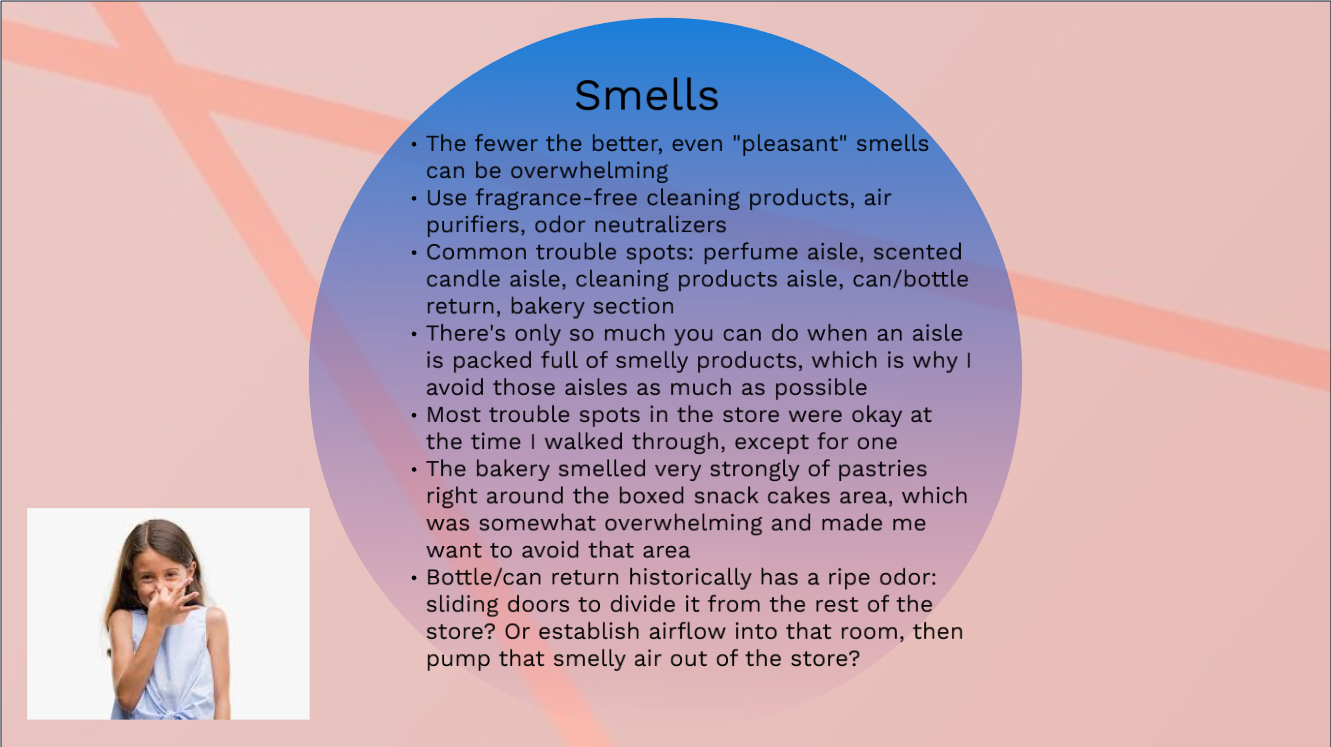
We\’re going to skip over Sounds this week to jump right into Smells.  You can see from how lengthy the bullet points are here that I\’m very out of touch with how one makes a presentation.  I really just wanted to have my thoughts organized.  
As a general sensory-friendly rule, you want zero odors in a public area.  The nose can\’t cause you pain if it has nothing to react to.  Odorless cleaning products are my friends.  Even pleasant smells, like fruit, flowers, or baked goods, can cause pain and sensory overwhelm.  My doctor actually gets bad headaches from flower-scented things, even though basically everyone likes flowers.
Obviously, in a grocery store, this is only so possible.  The perfume aisle, the scented candle aisle, the cleaning products aisle, the can/bottle return, and the bakery section are going to have smells.  You can use odor neutralizers and air purifiers around and in those aisles to help, but the fact remains, those places are full of smelly things.  And worse, those things are often purposely made with porous packaging (the material has tiny holes in it) so you can smell the product and decide if you want it or not.  
In the walkthrough I did, the trouble spots were actually pretty good, with one exception: the bakery.  I\’ve read somewhere that stores like to pump canned \”fresh bread\” or \”baked goods\” smells into their bread and bakery departments, and I\’d bet my comfy blue slippers that Meijer is no exception.  I got a strong noseful of \”baked goods\” smell when I stepped into the packaged snack cakes and cookies section.  Which is curious, since, y\’know, they\’re in packages, and I was still like 10 feet away.  
Historically, though, the can and bottle return is malodorous in the extreme, to the point that even people with normal senses avoid the place.  This location had the entrance to it located right in the entrance to the food, unfortunately, which I can guarantee will make it Bad Times in summer.  
I\’m not really sure how the store handles that, but the entry to the return area is unimpeded by sliding doors.  Adding sliding doors, or establishing a breeze going into that room, which is then pumped out of the store, would probably be a way to handle it.  I\’m no engineer, though.  
When I shop, I tend to avoid all the trouble spots I\’ve mentioned here, simply because I know they\’ll be unpleasant.  The discussion brought up the idea of mapping those trouble spots, as well as any quieter or safer areas in the store, and having those maps be available to parents and anyone else with an interest.  I think that\’s a good idea overall, and I\’ll go into that idea and some related ones next time, when I talk about Sounds and Store Policies.  

Deconstructing A Lifetime’s Expectations

I turned 30 last year, chronologically speaking.  (My actual age is debatable, but that\’s an entirely different discussion.)  Societally speaking, that\’s supposed to mean I\’m to have my life together.  What exactly \”having one\’s life together\” means is also debatable, because the American dream of \”college education, good job, house, car, spouse, kids, retirement,\” isn\’t really feasible in its entirety for most people in my generation, let alone most autistic people overall.

This is less an issue with autistic people as people, and more an issue of how many of those expectations are flatly unfair.

Starting with college education, since that\’s normally the first thing on this list people achieve, or don\’t.  The promise here with a college education is that you\’ll become a well-rounded, well-equipped person who can then proceed more successfully in life.  

First and most obviously to anyone of my generation, if you get a college education and aren\’t rich, you have to take out loans.  Lots of loans.  The days of being able to put yourself through college on a summer job or a part time job during the year ended in the 1980s.

This financial strain of the loans you take out to pay for tuition, room, and board beggars your income from any job you might get post-college… which statistics show us is not guaranteed to be a good one using your degree anyway.  Those statistics are across the mainstream population, and it\’s not just a temporary rut you fall into– the underemployment can last for much of your life.  Your prognosis only gets worse if you add in special needs.

Personally, I attempted to get a \”good job\” via an internship in my minor at the local library system.  The internship went well enough, and led, after some time, to a \”good job\” at a local company… but due to miscommunications, depression, and massive anxiety attacks, I lost that job and pretty much never regained that path since.  I worked several \”underemployment\” jobs doing secretarial work, but even those didn\’t last.   My current job, as an advocate and consultant, pays only sporadically.

Regardless of how much you make and whether it uses the degree you went to college for, you are paying a mortgage on your life, effectively.  On average, this debt will take 21 years to pay off.  
That puts a bit of a damper on getting a house.  To have a chance at a house, you need to have money for a down payment, which means having savings.  Y\’know, that thing you don\’t have because of student loans and medical bills.  You also need to be able to save some money for property taxes, maintenance, and repairs, because stuff does like to break.

I have a house at this moment because my spouse has a \”good job\” that he likes, and I had the good fortune to be born to parents that were good about saving money in the long term, as well as a generous grandmother.  Between our pitiful savings and the support of my relatives (who we are now paying back, and will be for years), we were able to make the down payment on a home in good repair and with sufficient space for us.

Unfortunately, my scenario is not the norm, even for neurotypical people.  Mostly, people of my generation rent or live with our parents.  

The latter option is particularly common for autistic people due to our higher support needs.  Our parents are often our first advocates and know our needs best.  Finding the supports we need to live our best lives is difficult and expensive.  Usually there\’s only one route to receive those services: Medicaid.  Otherwise known as the service that tends to routinely deny first time applicants*.

Show/Hide

The fun part (sarcasm) about Medicaid is that its income restrictions (meant to make sure only the poor and disadvantaged use it) haven\’t scaled with inflation over the years, so you also usually have to be nearly destitute to benefit from it.  Remember that good job you wanted?  Yeah, probably not happening if you need support services.

Even if you can get Medicaid, finding the right services is extremely challenging.  A good supports coordinator is supposed to do that for you, but with the high turnover rate, good ones can be hard to find, and in some cases, your area may simply not have what you\’re looking for.  If you need assistance moving around, taking care of things at home, or simply want something to do during the evenings, you\’re at the mercy of what\’s available to you.  In rural areas and some suburban areas, that\’s not necessarily much.

Having a car is often essential to having a job and a social life, but like a house (on a lesser scale) it isn\’t necessarily affordable (cost of a car, and then insurance, maintenance,  and repairs) or even feasible.  With certain types of disabilities, such as visual difficulties or anxiety disorders, you can\’t even pass the tests or complete driver\’s ed training for your driver\’s license.  In fact, fewer and fewer teens in general are getting their drivers licenses.  Not surprising, then that only 1 in 3 autistic teens are successfully acquiring their licenses.

My first car was a gift from my grandmother, after she decided she was done driving herself around.  Had my need for a car not coincided with that occurrence, I might not have had a car while I was in college.  Trying to buy a car while in college would likely have been impossibly difficult for me, as I was struggling to simply survive college for the first couple years.  And that\’s assuming the money was even there for such a purchase.

With less mobility (either due to lack of a car, or due to other transportation difficulties), it becomes harder to keep up a social life.  Once out of school, the forced daily social interaction disappears, and we\’re left with online communities and little else.  A church can offer some activities, as can supports derived through Medicaid or paid out of pocket.

Beyond that, though, the \”easy\” routes are gone, and you\’re left trawling for interest groups, visiting local events if you can (again, transportation!), and spending lots of time online.  Finding a spouse in all of that is… difficult, to say the least.  Autism is literally defined by having significant difficulties with social interactions and rules.  And a managing relationship is basically that, but all the time, and with high emotional stakes.  Autistic people tend to be fantastically loyal, which endears us to some people, but the strain of routine miscommunication can be difficult for both partners to bear in the long term.

For me, I didn\’t find my spouse, he found me.  This was fortunate, because during most of school, I radiated \”leave me alone\” vibes.  I\’d learned that people tended to be cruel to me, and there weren\’t sufficient positive reasons to interact with people for me to bother.  If you were decent to me, I was decent to you, and otherwise I tended to ignore you.  This does not lend itself well to meeting new friends.

So I knew Chris from my second high school.  He happened across me when I\’d had enough of the day and was having a good cry on the library steps.  I had a class with him, so he wasn\’t simply some stranger come to gawk at me.  He proceeded to plop himself down and sit with me while I was miserable, asking after my wellbeing despite it being blatantly obvious I was not doing well and he was asking to get an unhappy earful.

We did not magically become close friends that day, but I remembered that incident, and so when he said hello again, a couple years later, I responded instead of ignoring him as I would most random messages on Facebook.  This repeated about once a year during college, still with no romantic interest on either side.  We worked at the same place one summer as well, and he was again friendly without expectations or demands of me.  One year (2013, I think?), he messaged me again on Facebook, the conversation never really died after that.

This is all to underline that while the marriage we have now is definitely a partnership of equals, the actual groundwork was all by his efforts. Most autistic people don\’t get that lucky, and don\’t have persistent former acquaintances turn into friends, and then partners in life.  Rather, the autistic person has to put in effort to find friends, through dating sites, church, interest groups, etc, and one of those may turn into a romantic partner, and perhaps into a life partner.

With all the debt and/or limited finances you\’ve accrued, even if you find a good spouse, kids are not necessarily an option.  Not everyone wants kids, first and foremost (which can break relationships, by the way!).  But also the sheer expense makes it not feasible for some couples.  In the US, the cost of raising a single child is around $245,000.  That\’s not including a college education, and if you\’re still in debt paying for your own education, how are you supposed to afford a kid, and then help your kid with their own education?

For autistic people, there\’s worries about autism being genetic and passing it or any mental or physical illnesses you might have on to your kids.  There\’s also the question of whether you can manage yourself and your life as well as a tiny defenseless human.  Or whether the people in your life will allow you to do that, for some people with higher support needs.  (Having high support needs doesn\’t mean you can\’t make a good father or mother, but it does make it more complicated.)

Kids or not, eventually you will grow old.  People my age tend to have less saved aside than previous generations, due to the factors I listed above, and more.  Retirement, therefore, is a bit of a pipe dream.  Eventually, though, our bodies begin to fail us more and more, and work becomes more difficult.  It\’s likely that millennials like myself will be expected to work to age 70, perhaps even longer, in order to qualify for Social Security.  Health advancements might make that extra time more feasible for the general population.

But the autistic population is a bit of a different story.  We already struggle to have work.  Our life expectancies are much less than our peers.  Mental illnesses, seizures, gastointestinal problems, even heart disease, all occur at higher rates for autistic people.  Some estimates for an autistic lifespan are as high as the 50s, some are in the 30s.  Compare that to the current general population\’s life expectancy (70), and you\’ll get the grim picture.

Obviously I won\’t know my personal life expectancy until I actually die, but I got good genes on one side of my family for longevity.  Also, one of the main killers of autistic people, suicide, is not currently a factor.  I have depression and anxiety due to the strain of not fitting in, but my depression is on the milder side, and the emotional pain is not so great and all-encompassing as to outweigh the knowledge of what my death would do to the people that care about me.

Retirement for autistic people won\’t be a simple affair.  The popular conception of a lengthy vacation until your death is mostly a dream at this point.  It\’s better for people overall to have some form of meaningful activity to do with their lives.  Volunteer work, for example.  That is most likely what my retirement, should I live long enough to have one, will look like.

I\’ve deconstructed the \”normal\” expectations for a person\’s life in the US, and why they\’re unfair and unreasonable, especially for autistic people, it begs the question: what is reasonable?  The answer varies by the person.  This is why person-centered planning is important: finding out what the person wants in life, what their skills are, what their interests are, and what their needs are, is how you begin figuring out what kind of life to aim for.  (For a really good parent-written book on this subject, read this post.)

Deconstructing A Lifetime\’s Expectations

I turned 30 last year, chronologically speaking.  (My actual age is debatable, but that\’s an entirely different discussion.)  Societally speaking, that\’s supposed to mean I\’m to have my life together.  What exactly \”having one\’s life together\” means is also debatable, because the American dream of \”college education, good job, house, car, spouse, kids, retirement,\” isn\’t really feasible in its entirety for most people in my generation, let alone most autistic people overall.

This is less an issue with autistic people as people, and more an issue of how many of those expectations are flatly unfair.

Starting with college education, since that\’s normally the first thing on this list people achieve, or don\’t.  The promise here with a college education is that you\’ll become a well-rounded, well-equipped person who can then proceed more successfully in life.  

First and most obviously to anyone of my generation, if you get a college education and aren\’t rich, you have to take out loans.  Lots of loans.  The days of being able to put yourself through college on a summer job or a part time job during the year ended in the 1980s.

This financial strain of the loans you take out to pay for tuition, room, and board beggars your income from any job you might get post-college… which statistics show us is not guaranteed to be a good one using your degree anyway.  Those statistics are across the mainstream population, and it\’s not just a temporary rut you fall into– the underemployment can last for much of your life.  Your prognosis only gets worse if you add in special needs.

Personally, I attempted to get a \”good job\” via an internship in my minor at the local library system.  The internship went well enough, and led, after some time, to a \”good job\” at a local company… but due to miscommunications, depression, and massive anxiety attacks, I lost that job and pretty much never regained that path since.  I worked several \”underemployment\” jobs doing secretarial work, but even those didn\’t last.   My current job, as an advocate and consultant, pays only sporadically.

Regardless of how much you make and whether it uses the degree you went to college for, you are paying a mortgage on your life, effectively.  On average, this debt will take 21 years to pay off.  
That puts a bit of a damper on getting a house.  To have a chance at a house, you need to have money for a down payment, which means having savings.  Y\’know, that thing you don\’t have because of student loans and medical bills.  You also need to be able to save some money for property taxes, maintenance, and repairs, because stuff does like to break.

I have a house at this moment because my spouse has a \”good job\” that he likes, and I had the good fortune to be born to parents that were good about saving money in the long term, as well as a generous grandmother.  Between our pitiful savings and the support of my relatives (who we are now paying back, and will be for years), we were able to make the down payment on a home in good repair and with sufficient space for us.

Unfortunately, my scenario is not the norm, even for neurotypical people.  Mostly, people of my generation rent or live with our parents.  

The latter option is particularly common for autistic people due to our higher support needs.  Our parents are often our first advocates and know our needs best.  Finding the supports we need to live our best lives is difficult and expensive.  Usually there\’s only one route to receive those services: Medicaid.  Otherwise known as the service that tends to routinely deny first time applicants*.

Show/Hide

The fun part (sarcasm) about Medicaid is that its income restrictions (meant to make sure only the poor and disadvantaged use it) haven\’t scaled with inflation over the years, so you also usually have to be nearly destitute to benefit from it.  Remember that good job you wanted?  Yeah, probably not happening if you need support services.

Even if you can get Medicaid, finding the right services is extremely challenging.  A good supports coordinator is supposed to do that for you, but with the high turnover rate, good ones can be hard to find, and in some cases, your area may simply not have what you\’re looking for.  If you need assistance moving around, taking care of things at home, or simply want something to do during the evenings, you\’re at the mercy of what\’s available to you.  In rural areas and some suburban areas, that\’s not necessarily much.

Having a car is often essential to having a job and a social life, but like a house (on a lesser scale) it isn\’t necessarily affordable (cost of a car, and then insurance, maintenance,  and repairs) or even feasible.  With certain types of disabilities, such as visual difficulties or anxiety disorders, you can\’t even pass the tests or complete driver\’s ed training for your driver\’s license.  In fact, fewer and fewer teens in general are getting their drivers licenses.  Not surprising, then that only 1 in 3 autistic teens are successfully acquiring their licenses.

My first car was a gift from my grandmother, after she decided she was done driving herself around.  Had my need for a car not coincided with that occurrence, I might not have had a car while I was in college.  Trying to buy a car while in college would likely have been impossibly difficult for me, as I was struggling to simply survive college for the first couple years.  And that\’s assuming the money was even there for such a purchase.

With less mobility (either due to lack of a car, or due to other transportation difficulties), it becomes harder to keep up a social life.  Once out of school, the forced daily social interaction disappears, and we\’re left with online communities and little else.  A church can offer some activities, as can supports derived through Medicaid or paid out of pocket.

Beyond that, though, the \”easy\” routes are gone, and you\’re left trawling for interest groups, visiting local events if you can (again, transportation!), and spending lots of time online.  Finding a spouse in all of that is… difficult, to say the least.  Autism is literally defined by having significant difficulties with social interactions and rules.  And a managing relationship is basically that, but all the time, and with high emotional stakes.  Autistic people tend to be fantastically loyal, which endears us to some people, but the strain of routine miscommunication can be difficult for both partners to bear in the long term.

For me, I didn\’t find my spouse, he found me.  This was fortunate, because during most of school, I radiated \”leave me alone\” vibes.  I\’d learned that people tended to be cruel to me, and there weren\’t sufficient positive reasons to interact with people for me to bother.  If you were decent to me, I was decent to you, and otherwise I tended to ignore you.  This does not lend itself well to meeting new friends.

So I knew Chris from my second high school.  He happened across me when I\’d had enough of the day and was having a good cry on the library steps.  I had a class with him, so he wasn\’t simply some stranger come to gawk at me.  He proceeded to plop himself down and sit with me while I was miserable, asking after my wellbeing despite it being blatantly obvious I was not doing well and he was asking to get an unhappy earful.

We did not magically become close friends that day, but I remembered that incident, and so when he said hello again, a couple years later, I responded instead of ignoring him as I would most random messages on Facebook.  This repeated about once a year during college, still with no romantic interest on either side.  We worked at the same place one summer as well, and he was again friendly without expectations or demands of me.  One year (2013, I think?), he messaged me again on Facebook, the conversation never really died after that.

This is all to underline that while the marriage we have now is definitely a partnership of equals, the actual groundwork was all by his efforts. Most autistic people don\’t get that lucky, and don\’t have persistent former acquaintances turn into friends, and then partners in life.  Rather, the autistic person has to put in effort to find friends, through dating sites, church, interest groups, etc, and one of those may turn into a romantic partner, and perhaps into a life partner.

With all the debt and/or limited finances you\’ve accrued, even if you find a good spouse, kids are not necessarily an option.  Not everyone wants kids, first and foremost (which can break relationships, by the way!).  But also the sheer expense makes it not feasible for some couples.  In the US, the cost of raising a single child is around $245,000.  That\’s not including a college education, and if you\’re still in debt paying for your own education, how are you supposed to afford a kid, and then help your kid with their own education?

For autistic people, there\’s worries about autism being genetic and passing it or any mental or physical illnesses you might have on to your kids.  There\’s also the question of whether you can manage yourself and your life as well as a tiny defenseless human.  Or whether the people in your life will allow you to do that, for some people with higher support needs.  (Having high support needs doesn\’t mean you can\’t make a good father or mother, but it does make it more complicated.)

Kids or not, eventually you will grow old.  People my age tend to have less saved aside than previous generations, due to the factors I listed above, and more.  Retirement, therefore, is a bit of a pipe dream.  Eventually, though, our bodies begin to fail us more and more, and work becomes more difficult.  It\’s likely that millennials like myself will be expected to work to age 70, perhaps even longer, in order to qualify for Social Security.  Health advancements might make that extra time more feasible for the general population.

But the autistic population is a bit of a different story.  We already struggle to have work.  Our life expectancies are much less than our peers.  Mental illnesses, seizures, gastointestinal problems, even heart disease, all occur at higher rates for autistic people.  Some estimates for an autistic lifespan are as high as the 50s, some are in the 30s.  Compare that to the current general population\’s life expectancy (70), and you\’ll get the grim picture.

Obviously I won\’t know my personal life expectancy until I actually die, but I got good genes on one side of my family for longevity.  Also, one of the main killers of autistic people, suicide, is not currently a factor.  I have depression and anxiety due to the strain of not fitting in, but my depression is on the milder side, and the emotional pain is not so great and all-encompassing as to outweigh the knowledge of what my death would do to the people that care about me.

Retirement for autistic people won\’t be a simple affair.  The popular conception of a lengthy vacation until your death is mostly a dream at this point.  It\’s better for people overall to have some form of meaningful activity to do with their lives.  Volunteer work, for example.  That is most likely what my retirement, should I live long enough to have one, will look like.

I\’ve deconstructed the \”normal\” expectations for a person\’s life in the US, and why they\’re unfair and unreasonable, especially for autistic people, it begs the question: what is reasonable?  The answer varies by the person.  This is why person-centered planning is important: finding out what the person wants in life, what their skills are, what their interests are, and what their needs are, is how you begin figuring out what kind of life to aim for.  (For a really good parent-written book on this subject, read this post.)

“If My Face Has Gone Neutral, It’s Bad”, or Flattened Affect in Camouflaging Autistic People

I’ve been married for over two years now.  That means there has been plenty of time for arguments and getting upset with each other.  While of course we do try not to argue, I can be rather rigid about some things, and my experience of our life together is rather different than my spouse’s on some important facets.  For instance, touch can hurt me rather than comfort me.A lot of the learning we’ve done over the last few years has included how to recognize when the other person is upset, and what to do once that’s recognized.  With me, the first one is an extra complicated challenge.  I thought it might be useful to present this information, because some of it may be applicable to you or your loved ones.

With most people, their faces display the whole range of their emotions, or at least what emotions they want to be displaying.  This emotional expression is called “affect” in psychology.  One of the ways you can start to recognize an autistic person is by their affect.  If their emotional expressions seem flat all the time, that’s a thing to note.  Neurotypical people can also display blunted or flat affect, but it’s usually because they’re depressed or completely worn out.

The word choice amuses me because another definition of “affect”  in the general lexicon means “to put on a pretense of.”  So, “she affected wealth and high position, but in truth was working retail.”  And also, “affected” as an adjective can mean “feigned” or “assumed artificially.”  In short, depending on how you think about the word, everyone’s putting on pretenses of what they show on their faces.

This is particularly relevant when you recall that people don’t merely convey their mental states on their faces, but instead use them as another hidden form of communication and to modify the behaviors of others.

A Matter of Degrees

So, with that in mind!  If I’m slightly annoyed by something, my face may display it briefly before I decide it’s really not worth my time.  If I am more moderately or heavily annoyed, my face may show it and I may try to address the situation.  Easy examples of both situations would be stuff that triggers my sound sensitivity.

Somebody dropping a heavy box of clothes from 60+ feet away might count as slightly annoying.  The sound that produces would be low in pitch, and while it might be loud, the distance helps make that tolerable.  I would hear this sound, but would try not to let it interrupt what I was doing.

However, someone’s child screaming within 20 feet of me is more on the moderate to heavily annoying range.  My face might display the pain of having that high-pitched, grating, unending shriek shredding into my brain.  And if the child doesn’t cease quickly, I might put in earplugs or try to leave the situation.

Emotional pain, such as that caused by arguments, can be much more painful.  This is where it gets tricky.  After a certain point, between “I’m upset” and “I am melting down, stand clear,” my face stops displaying emotions.  This is not because I’m trying to be confusing, and definitely does not mean I’m doing fine.  It means I’ve lost regulation of those muscles and am instead focusing very hard on managing myself and the pain I’m feeling.

Affect, you see, takes effort for me.  If I’m using all my energy to manage a conversation and my own hurt feelings, I have none left for communicating in a way that’s unnatural to me.  I go stone-faced.  This is easy to mistake for “calm.”  It is very much not calm.  In a direct argument, treating it like that can be disastrous.

After I’m pushed beyond “stone-faced,” my face starts expressing emotions again… but only because I’m likely in tears or screaming.  Ideally things never get to this point, but it does happen sometimes.

Not All Bad

This tendency to stone-face while moderately emotionally upset has its upsides.  It made it so that I wasn’t constantly scowling during school.  Formalized education was not a pleasant experience, and more often than not, I was miserable.  Also angry.  But mostly miserable.  If I’d actually looked how depressed and angry I was, much fuss would have been made over me.  And since all I really wanted was to be left alone, this helped me survive.

Although I’m less miserable as an adult, the tendency to stone-face does still come in handy.  In cases of being amongst strangers, I may be made miserable by any number of things, including my depression, screaming children, or people I’ll never see again being cruel or rude to me on accident.  Since I’d still generally prefer not to cause a fuss, this can be helpful.

It\’s probably not the best possible adaptation to the situation, but it beats being unable to go out in public.  Some of my misery-inducing problems, like my depression, don’t go away if asked nicely.  There are just times you need to go grocery shopping, and they can’t wait until you’ve stopped feeling like you’re everything wrong with the world.

What’s Camouflaging?

Camouflaging, in this context, is when autistic people deny their natural mentalities and behaviors in favor of appearing to be neurotypical.  This is what the worst kinds of Applied Behavioral Analysis teach.  On the surface, this might seem like a good thing: after all, neurotypical behavior is what’s expected from everyone.  Camouflaging, then, is trying to fit in.

The thing is, there’s a price for denying who you are and stifling yourself.  It’s paid in emotional pain, which expresses itself as depression, anxiety, and other kinds of mental illness.  All the responsibility is placed on the autistic person to “act normal” but neurotypical people do not then, in kind, try to accept and work with our differences when they are expressed.  The result is an unjust society, and a markedly higher suicide rate in autistic adults.

"If My Face Has Gone Neutral, It\’s Bad", or Flattened Affect in Camouflaging Autistic People

I\’ve been married for over two years now.  That means there has been plenty of time for arguments and getting upset with each other.  While of course we do try not to argue, I can be rather rigid about some things, and my experience of our life together is rather different than my spouse\’s on some important facets.  For instance, touch can hurt me rather than comfort me.

A lot of the learning we\’ve done over the last few years has included how to recognize when the other person is upset, and what to do once that\’s recognized.  With me, the first one is an extra complicated challenge.  I thought it might be useful to present this information, because some of it may be applicable to you or your loved ones.

With most people, their faces display the whole range of their emotions, or at least what emotions they want to be displaying.  This emotional expression is called \”affect\” in psychology.  One of the ways you can start to recognize an autistic person is by their affect.  If their emotional expressions seem flat all the time, that\’s a thing to note.  Neurotypical people can also display blunted or flat affect, but it\’s usually because they\’re depressed or completely worn out.

The word choice amuses me because another definition of \”affect\”  in the general lexicon means \”to put on a pretense of.\”  So, \”she affected wealth and high position, but in truth was working retail.\”  And also, \”affected\” as an adjective can mean \”feigned\” or \”assumed artificially.\”  In short, depending on how you think about the word, everyone\’s putting on pretenses of what they show on their faces.

This is particularly relevant when you recall that people don\’t merely convey their mental states on their faces, but instead use them as another hidden form of communication and to modify the behaviors of others.

A Matter of Degrees

So, with that in mind!  If I\’m slightly annoyed by something, my face may display it briefly before I decide it\’s really not worth my time.  If I am more moderately or heavily annoyed, my face may show it and I may try to address the situation.  Easy examples of both situations would be stuff that triggers my sound sensitivity.

Somebody dropping a heavy box of clothes from 60+ feet away might count as slightly annoying.  The sound that produces would be low in pitch, and while it might be loud, the distance helps make that tolerable.  I would hear this sound, but would try not to let it interrupt what I was doing.

However, someone\’s child screaming within 20 feet of me is more on the moderate to heavily annoying range.  My face might display the pain of having that high-pitched, grating, unending shriek shredding into my brain.  And if the child doesn\’t cease quickly, I might put in earplugs or try to leave the situation.

Emotional pain, such as that caused by arguments, can be much more painful.  This is where it gets tricky.  After a certain point, between \”I\’m upset\” and \”I am melting down, stand clear,\” my face stops displaying emotions.  This is not because I\’m trying to be confusing, and definitely does not mean I\’m doing fine.  It means I\’ve lost regulation of those muscles and am instead focusing very hard on managing myself and the pain I\’m feeling.

Affect, you see, takes effort for me.  If I\’m using all my energy to manage a conversation and my own hurt feelings, I have none left for communicating in a way that\’s unnatural to me.  I go stone-faced.  This is easy to mistake for \”calm.\”  It is very much not calm.  In a direct argument, treating it like that can be disastrous.

After I\’m pushed beyond \”stone-faced,\” my face starts expressing emotions again… but only because I\’m likely in tears or screaming.  Ideally things never get to this point, but it does happen sometimes.

Not All Bad

This tendency to stone-face while moderately emotionally upset has its upsides.  It made it so that I wasn\’t constantly scowling during school.  Formalized education was not a pleasant experience, and more often than not, I was miserable.  Also angry.  But mostly miserable.  If I\’d actually looked how depressed and angry I was, much fuss would have been made over me.  And since all I really wanted was to be left alone, this helped me survive.  
Although I\’m less miserable as an adult, the tendency to stone-face does still come in handy.  In cases of being amongst strangers, I may be made miserable by any number of things, including my depression, screaming children, or people I\’ll never see again being cruel or rude to me on accident.  Since I\’d still generally prefer not to cause a fuss, this can be helpful.  
It\’s probably not the best possible adaptation to the situation, but it beats being unable to go out in public.  Some of my misery-inducing problems, like my depression, don\’t go away if asked nicely.  There are just times you need to go grocery shopping, and they can\’t wait until you\’ve stopped feeling like you\’re everything wrong with the world.

What\’s Camouflaging?

Camouflaging, in this context, is when autistic people deny their natural mentalities and behaviors in favor of appearing to be neurotypical.  This is what the worst kinds of Applied Behavioral Analysis teach.  On the surface, this might seem like a good thing: after all, neurotypical behavior is what\’s expected from everyone.  Camouflaging, then, is trying to fit in.  
The thing is, there\’s a price for denying who you are and stifling yourself.  It\’s paid in emotional pain, which expresses itself as depression, anxiety, and other kinds of mental illness.  All the responsibility is placed on the autistic person to \”act normal\” but neurotypical people do not then, in kind, try to accept and work with our differences when they are expressed.  The result is an unjust society, and a markedly higher suicide rate in autistic adults.  

Communication Methods: An Autistic Comparison

I had the misfortune recently of being trapped handling a complex socio-emotional problem via phone.  That single conversation drained my entire store of energy for the entire weekend, which was, needless to say, not ideal.  Once I\’d recovered, I got to thinking about the various kinds of communication methods we have available to us in the modern day, and decided I might as well compare and contrast them.

We\’ll tackle these from most intensive to least intensive, for ease of understanding.

Face-to-face communication

This is the obvious and most socially-approved form of communication.  It can be as quick or as slow as either party wants it to be, though it\’s usually on the quicker side, as a response from one side usually demands a near-immediate response from the other side.  
It is also the form of communcation that\’s least convenient for the schedule and most effortful in terms of information processing.  Autistic people often stick rigorously to our schedules, so having an interaction like this can range between being tolerable (because it was planned) or completely intolerable (because it wasn\’t).  
There are many forms of unplanned face-to-face interactions in life.  Nobody that I know of goes to a grocery store with the intent to make small talk with people in line.  That just sort of happens.  You can try to avoid chatting with the employee at the checkout line by using the self-checkout machines, but you may not escape being mistaken for an employee while in the store, and thus being asked for the location of some product.  
These unplanned interactions can be very upsetting and anxiety-inducing.  I sometimes have to pull out my little container of solid perfume and take a good whiff to temporarily banish the effects of such interactions.  However, short of hiding in a private space all day, every day, they are inevitable.  Alas for our sanity.  
When spending time with a person directly, you deal with the full range of information they present in real time.  This includes things like:
  • the set of their shoulders and overall posture
  • their facial expression (there are 43 muscles in the face, and minute changes in a few of them make the difference between anger and surprise, or concentration and frustration)
  • what they\’re doing with their hands, arms, and legs (crossed arms- angry or chilly? fidgeting with their fingers- nervous, also autistic, or bored with the conversation?)
  • the amount of eye contact they give you
These are in addition to factors that other forms of communication make you process as well, such as word choice and tone of voice.  All of these pieces of information must be juggled in real time, even as you attempt to project the correct combinations of all those things back to the other person and choose appropriate verbal responses.  Most neurotypical people handle all these factors without having to think about them.  That must be nice.  
The thing that really sets face-to-face interaction apart from every other type I\’ll talk about here, though, is the fact that, at any point, your sense of smell or touch can disrupt your concentration.  At a whim, your personal space can be invaded, and your senses overwhelmed by a single touch of the arm, or a light hug.  The person may be wearing perfume, possess bad breath, or you may be walking by a scented candle store.  
While some autistic people crave sensations like these, others experience them so strongly that their concentration is destroyed.  Even assuming the autistic person was handling the high demands of the in-person interaction, adding in even a faint odor or an unexpected touch can cause the whole thing to become impossible to handle.  Environmental noise, such as small children crying, can have this effect on me.  As I\’ve aged, I\’ve mostly become more graceful about handling it.  Mostly.

Skype/Facetime/video phone calls

We have now entered the realm of not-quite-immediate communication.  Unless both of your devices have excellent connections, any electronic communication involves a certain amount of micro-delay.  This can be confusing and cause miscommunications, such as two people starting to talk at the same time even though they\’ve both learned how to take turns speaking.  This can be anxiety-provoking for autistic people.
Video phone calls still involve analyzing and projecting all the visual and audio data that in-person interactions do, but with the added complication that you may not be able to see the whole of the person and their environment.  But they also allow you to set your own environment, such as \”from the comfort of your living room\” or \”in the smaller, quieter conference room at work.\”  This can go a long way toward making an autistic person more comfortable, but many people will still struggle with the demands of processing and projecting so much visual information.  
Autistic people may have trouble projecting appropriate facial expressions, for example.  I tended to be rather stonefaced, into young adulthood.  If I wasn\’t looking stonefaced, I was probably looking angry, because I was also a rather angry child (with good reason, mind).  As such, people tended to have difficulty reading me, and came to conclusions that were often erroneous.  This included my own father, which did not help our relationship at all during those years.

To make things more confusing, an autistic person may focus so hard on projecting one facet, like facial expression, that the others fall by the wayside.  So their face might be set in the almost-smile that\’s correct for a casual friendly conversation, but their posture might scream \”discomfort.\”  Or their tone of voice and word choice might say, \”I am cautiously positive about this idea\” in a business meeting, but their arms are crossed and their face is blank, which conveys the opposite.

The only innately positive thing that comes to mind when considering these intensive forms of communication is this: there are so many social cues involved, that even if you miss more than half of them, you might still get the gist.

Phone calls/voice services

Buckle up, this is my very least favorite form of communication.  Generally if I have to be on the phone, I am wishing myself dead when I\’m not immediately handling the conversation at hand.  Sometimes I can even multitask and wish myself dead while handling the conversation at hand.

Why?  Well, for me, phone calls straddle the line between face-to-face communication (too much info, but at least I can miss some things and still get the gist) and text messages (where all you have to deal with are the words).  And they do so in the worst way.

You have the person\’s tone of voice, which you need to process, but you do so without the benefit of seeing their face.  Is that a bored tone of voice, or are they simply tired?  You don\’t know for sure.  Maybe you would if you could see their face (also bored, or perhaps puffy-eyed from lack of sleep), or see their posture (rubbing their eyes, or crossed arms because of annoyance?).  I spend a lot of time trying to process that information, guessing and second-guessing, while trying to relay whatever opinions, directions, or information the other person needs.

Their environment is even more of a mystery to you than with video calls.  Beyond audio cues (crying children, raucous music, or perhaps road sounds like car horns), you really have no idea what\’s going on with the person and their life during this conversation.  If that information is needed, it must be either intuited via those cues or communicated verbally.  This can lead to having a sensitive conversation in the middle of a public hallway, with no easy way to escape somewhere safer, which is really not ideal.  And even worse, the other party may have literally no idea that is the case, and thus unknowingly subject you to a great deal of stress and embarrassment.

The other main reason I think I hate phone calls so much, though, is that they\’re extremely disruptive.  Unless I set it to Do Not Disturb (which is not a good idea in case of emergencies), I can expect my phone to go off with no thought for my concentration, the importance of what I\’m doing, or the difficulty of my day.  The person (if it\’s not a robo-caller) on the other end usually has no idea how I\’m doing, or what I\’m doing.  And they may not care, either.

I deeply resent things that demand my entire attention, regardless of my current circumstances.  I dislike being linked to online videos and being expected to watch them immediately for the same reason.

The last reason I hate phone calls and other voice services, I suppose, is the context in which I\’ve most often had to use them: calling on health insurance issues, contacting doctor\’s offices, setting car repair appointments, rescheduling a disrupted day as quickly as possible with the other affected parties, and managing money-related issues.  I dislike doing literally everything on that list.  All of it is necessary, but none of it is enjoyable.

So basically, please never call me unless you literally have no other option.  See below for better options.  Thank you.

Text messages/Instant messaging

We are now entering more friendly territory for many autistic people, especially me.  This is the best method to use when contacting me.  Examples of this type of communication include text messages on your phone, Gtalk, Facebook Messenger, iMessage (iOS), WhatsApp, and Discord.  There are many more.

Text messages and other forms of instant messaging require careful word choice to get your point across, but are very forgiving in terms of information processing.  As the receiver, you are required to read the words, and consider the context in which those words came to you.  Perhaps the sender will also have helped you out by providing emojis/emoticons to set a particular mood associated with their words.

The environment that each participant experiences is still a mystery, but because there is no plain way the participants could know each others\’ environments, any reasonable communicator assumes the other doesn\’t know that information, and acts accordingly.  If it\’s relevant, it must be communicated.  If it\’s not, the conversation excludes any assumption of that knowledge.  For example, if you\’re aware of the fatality rate for texting and driving, and someone texts you, you might text them back: \”Driving, gimme 5 min.\”  That person will then know it is unsafe to continue the conversation, and await your response that it\’s safe.

Tone of voice, posture, circumstances, are all irrelevant unless communicated within the conversation.  This, to me, is freeing.  If the person wants me to understand a thing, they have to say it.  They can\’t just rely on the use of magical mind-reading abilities (social intuition) that neurotypical people develop and use in the previous forms of communication.  Text messages level that playing field and make it so you have to mean what you say and say what you mean.  If you don\’t, that\’s on you, and you\’re being a poor communicator.

The other nice thing about this form of communication is that you can look back at what was said.  In verbal, video, and in-person forms of communication, there is the frequent tendency to fall into \”he said, she said\” interpretations of what was said.  No one save some very gifted people can remember every word that\’s said in a conversation.  Instead, most people remember how they felt about what was said, how they interpreted what was said, and perhaps the precise wording for something particularly important or interesting.

But when it comes to, say, a task list, an important discussion with your spouse about the relationship, or important insurance information, having the possibility for fuzziness and \”he said, she said\” is disastrous.  You may lose essential information, and both parties may think they got their points across, but neither side understood the other.  With the ability to look back at the chat log, you can reference what was said, and ask for clarification as needed.  This is great for assuaging anxiety and ensuring correctness of action and understanding.

Also great for assuaging anxiety, the conversation can be a quick back and forth affair, like an in person conversation, or a more relaxed \”1 message every hour when you\’re available\” interaction, for conversations that aren\’t time-sensitive.  Or anything in between.  Instant messages let you find a stopping point in what you\’re doing, and then give the other person your full attention, rather than demanding you drop everything the instant the person rings and then suffer being distracted through the entire conversation.

Email

We now reach the slowest of modern forms of communication.  While emails can be relayed near-instantly, there is much less of an expectation of an immediate response.  This can be a great kindness to autistic people and people with high anxiety, because it gives you even more leeway about when and where you respond.  
You have time to research a topic if you don\’t feel sufficiently knowledgeable.  You have time to consider your own response and word choice more than once or twice, and come up with multiple plans of action.  You even have time to ask someone else\’s advice on a subject if you don\’t like the responses you\’ve come up with.  
Like text messages, email is referenceable.  This is particularly good because email conversations may span hours, days, or even weeks.  Email is also nice because it\’s all containable boxes.  You can have a single email address to handle all your communication needs, or you can have several, one for business things, one for personal emails, one for spam and stuff you don\’t actually want to look at, etc.

Also like text messages, your ability to read posture, facial expression, and tone of voice is entirely irrelevant.  You do still have to read the tone of the email, which is kind of like tone of voice.  But I personally find it much easier to handle.  Your experience may vary. 

Snail Mail/ the postal service

Notable mention goes to Snail Mail, or the postal service.  While it\’s rare to have actual meaningful correspondences in this day and age, I\’m old enough to remember when that people routinely sent each other handwritten letters.  (Note to anyone younger than 25 reading: Yes, this was a thing.  Yes, I am ancient.  Get off my lawn. 😛 )  
Usually snail mail these days is merely junk mail, bills, form letters, and possibly the occasional newsletter.  Actual personalized communication is rare in snail mail these days.  You might still see greeting cards around Christmas or your birthday, or perhaps post cards from traveling relatives or friends.  The vast majority of this form of communication, however, is not personalized and meaningful. 
I believe some people still have pen pals, or people they write to on a regular basis using physical sheets of paper, envelopes, and stamps.  In some cases, those people are from other countries, or live in remote areas.  It\’s kind of a cool thing, putting that much effort into communicating with someone, but something I never really got into.  In part, this is because my handwriting is atrocious.  
I was taught cursive in elementary school, and even learned a bit of calligraphy in middle school.  However, my hand-eye coordination and fine motor skills aren\’t amazing, and handwriting isn\’t really a skill that has much use in modern life.  It\’s so much faster and easier for me to put my words through a keyboard, rather than struggle to express them via pen or pencil.  Between those factors, my handwriting will likely never improve, and so, at least for me, this style of communication will continue to be almost entirely ignored.