Sensory Processing Difficulties: Taste and Smell (Part 4)

This is part 4 of a series on Sensory Processing Difficulties.  Part 1 was on the sense of touch, part 2 covered the lesser known senses (proprioception and vestibular senses), and part 3 was about sight.

I put these two senses together for a reason when I planned out these blog posts.  A lot (though not all) of what we think of as taste is actually smell.  Some sources contend that you can actually only taste the most basic flavors: sweet, salty, bitter, and sour.  Everything else, they say, is smell.  From personal experience with having very stuffed up noses (thus, presumably, eliminating my sense of smell), I\’m not sure I buy that entirely.  But it\’s definitely true that having a very stuffed nose mutes my sense of taste. 

I went over this a bit in the very first post (which was about touch) but parts of eating belong to that sense instead of to taste.  Temperature, for example, is in the realm of touch, and texture is as well. Those two things are generally considered a major part of the eating experience, but have to be excluded here for scientific accuracy.

Limited Diets, Nails on a Chalkboard, and Cilantro

A common tendency in autistic children is food pickiness.  This is often based in texture, but also in taste and in smell.  The texture (which is touch) can be bothersome because some people hate or love crunching sounds, or mushy feelings on their tongue, or breading on food.  When I say \”hate\” by the way, I mean that in a much more literal sense than it\’s commonly used.  Think hearing \”nails on a chalkboard\” every time you crunched fresh green beans, or dry cereal, or popcorn.   You\’d probably avoid crunchy foods after a while, too, and be upset if you were forced to eat them.

It\’s worth noting here, as I have in past posts about sensory processing, that all of these reactions are involuntary.  You can\’t make yourself suddenly like hearing someone drag their nails down a chalkboard.  You can learn to tolerate it, but it\’s going to be an unpleasant sound basically forever.  If the whole world sounds like nails on a chalkboard, though, you\’re mostly just going to want to avoid everything as much as possible.

Maybe another comparison that might make it more understandable is cilantro.  So, most people taste cilantro as a fresh, tangy, herb-thing.  And like it in food.  However, some people, as apparently determined by genetics, taste it like it\’s soap.  Very strong soap, directly to the mouth.  Needless to say, most of the people like that tend to avoid eating cilantro.  Why ruin your food with soap seasoning, right?

Oddly enough, I kind of taste cilantro both ways.  It does kind of taste like soap, a bit, but not enough to ruin the rest of the flavor for me.  I have a friend, though, that can\’t stand cilantro in things, which I can entirely respect.  

A really common thing I tend to read about in \”my family\’s experience with an autistic child\” accounts and medical recommendation books is the \”all white foods\” diet.   So things like white pasta, milk, bread, white rice, and potatoes.  The child will prefer these foods, even to the point of outright not eating anything that\’s not on that list.  Growing up, my dad called me \”the bread girl\” due to my tendency to enjoy and eat large quantities of bread.  I was never to the point of refusing to eat anything but the bread, but my mother can probably recount her frustration with trying to feed me a varied, healthy diet.

In fact, it was such a problem that the list below was a thing.  I think I recall having to have dozens of huge arguments with my mother before this list came into existence.  This is actually probably one of the later lists, and sadly one of the better examples of my handwriting in existence.  Good thing keyboards and computers became the main mode of communication! (cough) 

As you can see by the specificity of both fish and peppers, I was a pedantic child.  Fortunately for my mother, I didn\’t know that I could have said \”variants of the wild mustard plant\” and gotten cabbage, cauliflower, and broccoli all in one item.

Actually, having moved back into town and having had more meals with adult me, my parents seem pleasantly surprised at how wide and varied my diet is now.  Like, to the point where my dad actually couldn\’t believe I eat fish now.  Which…  I guess is fair, since parents tend to remember their kids as… kids.  But my diet has expanded as I grew up, particularly after I was on my own for a while.  In my junior year at college, I pretty much ate only macaroni and cheese for dinner each night.  I did take my vitamin pills, at least.  (Also, my lunch was much more balanced, which I\’m sure helped.)

Through the Nose to Punch the Brain

Smell, on the other hand, can be a really unfortunate minefield.  Perfume, cologne, and scented products are widespread, and it\’s all too easy to get overwhelmed with the reek of these \”beauty products.\”  People can even get migraines, or sick to their stomachs.  I know someone who actually gets a brutal headache if she smells things that are floral scented.  She isn\’t autistic, but she definitely counts as sensitive to smells!

Beauty products aren\’t the only pitfall.  In an untidy kitchen, the smell of rotting food from the sink, refrigerator, or the garbage can be overwhelmingly revolting.  I have, in the past, had to stay very far away from a kitchen sink because something had been left to \”soak,\” and turned rancid.  People with less overzealous senses of smell simply don\’t understand, and may insist you\’re being excessive about your concern or reaction, which is about the last thing you want to hear when you\’re trying not to vomit. 

Another culprit is cleaning products.  Bleach has a very strong smell, as do some other chemical cleaners.  A freshly cleaned bathroom, like a dirty one, can also be a minefield for people with scent sensitivity.  I once cleaned my bathtub with bleach, and not only did I have to run the bathroom fan, I also had to open two windows for a cross breeze, and vacate the premises until the stench died down some.  I was literally getting dizzy, nearly to the point of passing out, from the smell.

My nose is kind of odd in general.  It seems sensitive, but it\’s either very selective, or I\’m rather bad at identifying what it\’s telling me.  In the last house my parents owned, at dinner time, the food that was cooking would smell like one thing from my room on the second floor.  As I\’d walk down the stairs, the food would smell like a different dish.  And when I finally got to the kitchen, I would find out that it was in fact a third, different food.

I also have a useless superpower for detecting spoiled cow\’s milk.  I can taste and smell when it starts to turn, but is still safe to drink, and the smell/taste gets progressively worse until I find it intolerable and the milk is definitely not safe to drink.  This would be less useless if I wasn\’t only drinking almond milk these days…  But I guess it\’s better to have it than to not have it.

Perfume is thankfully mostly out of fashion where I live, but every once in a while, there\’s that one person who just slathers it on and doesn\’t seem to realize that they reek.  I run into those at church sometimes, but they mostly, thankfully, don\’t sit at the back of the church.  There was this once that someone did, and they sat right by the sound booth, too.  So while I was trying to run the sound board, I kept getting nosefuls of this cloying, revolting fragrance at about 10x stronger than it had any right to be.  This resulted in my choking and coughing fairly often, which I had to try to do quietly, because it was still a church service and nobody except my spouse knew that I couldn\’t breathe.

I\’m not really sure if this counts as smell, but my mother and I are both very sensitive to mold.   Within the last year or so, I went to a memorial service in a stone chapel.  The service was probably very nice, but I spent pretty much the entire time feeling dizzy and foggy and confused.  My mother said afterwards that the place must\’ve had a mold problem, because she reacts to it.  She shook off the effects within 5 minutes, but it took me more like 20 minutes or so, outside, to feel less awful.  I\’ve had similar effects when food molds in the fridge or the cupboards.  Those tend to last longer, because the mold spores get into everything, which then has to be washed.  Bedding, clothes, towels, all of it.

Next Week: Sound

So, this week I\’ve described oddities and sensitivities of taste and smell, including how they manifest in my particular case, as well as more general cases.   Next time I\’ll finish this series with sound, which is the sense that makes me suffer the most on any given day.  That also makes it the sense I have to compensate most for, and I\’ll discuss my methods for that as well. 

Sensory Processing Difficulties: Sight (Part 3)

This is part 3 of a series on Sensory Processing Difficulties.  Part 1 was on touch, part 2 was on the proprioception and vestibular senses, and part 4 is on taste and smell.

Brain-Eyeball Communication

So, usually when people think of their sense of sight, and things going wrong with it, they think about the physical eyeballs, glasses, eye charts, etc.  Perhaps red-green colorblindness comes to mind, or cataracts.  While those are certainly important, when I say \”visual sensory processing difficulties,\” these are not what I mean.  There\’s nothing physically wrong with my eyeballs (well, besides some nearsightedness): the rods, cones, and optic nerve are all just fine.
 
Instead, sensory processing difficulties are:

  • disorganization in the muscles the brain uses to control how the eyes focus
  • oddities in how the brain itself processes the data sent to it.  

One or both of these can affect a person, and because vision is such a basic sense, people tend to take it for granted and assume that others see the exact same way they do.  Particularly when the eye doctor tests come back with no significant problems.  But, like me, just because the eyeball and optic nerve is in good health, you aren\’t guaranteed to not have problems with your vision. 

Brain-Muscle Miscommunication

A normal person can follow the path of a bouncing ball down a driveway, for example.  A person with muscle-coordination visual processing difficulties might not be able to do that.  Their eye muscles may not track the movement properly, and as such, the ball escapes their field of vision and is gone.  They might also have difficulty keeping their eyes on an object as they move, find it hard or impossible to read lines of print in order, or find it difficult to change between looking at a blackboard and looking at a book on their desk.

The end result of these problems can include tons of headaches, regular squinting, frequently losing your place while reading a book (and continuing to resort to using your finger as a guide), trouble copying information from a blackboard, difficulty reading signs or your dashboard while driving, avoidance of stairs, and even avoidance of groups of people due to the dizzying difficulties of keeping track of them all. 

Again, this is not something special glasses or surgery can fix. It\’s a oddity in the brain itself.  The brain itself can be trained by a specialist, and accommodations made so the person can slowly work toward more normal visual processing. 

Visual Hypersensitivity

This comes in all kinds of exciting flavors. 
  • Light sensitivity: oversensitivity to LEDs, sunlight, fluorescent lights, camera flashes, other bright lights, and/or glare from light sources.
  • Contrast sensitivity: separating black text on a white or off-white page is easy to most.  Not to these folks: the letters can seem to blur into the white page rather than being sharp and defined, which makes it very hard to read.  
  • \”Tunnel reading\” or restricted span of recognition: difficulty reading groups of words or letters together.  This can make it hard to move from line to line in a book or article, read for the content as a whole,  and even copy words from a page. 
  • Impaired print resolution:  in which the letters on a page or a computer screen are unstable, shimmer, or even move.  Again, makes for bad times when needing to read books, reports, or blog posts written by snarky autistic adults on the Internet.
  • Environmental distortions: like impaired print resolution, except with whole objects moving, shimmering, or changing.  Stairs, the faces of family, and even the floor itself can become  anxiety-provoking.  
Light sensitivity is by far the most common vision complaint I hear from fellow autistic people, and I myself suffer from it.  You can find yourself overwhelmed quickly in otherwise normal situations, even to the point of feeling like the light is stabbing your eyeballs or brain.  This is particularly true with LEDs, which have gotten more and more popular in headlights and even regular lightbulbs.  There\’s something about the quality of the light that makes it harsher and brighter than incandescent bulbs.  The constant glare can make people tired very quickly, or even become dizzy and develop headaches.

Things like \”walking into sunlight,\” \”looking at clouds in the sky,\” and \”looking at snow\” can all hurt my eyes.  Even on an overcast day in winter, the whiteness of the snow can reflect enough light to cause stabbing pain.  Headlights at night are awful, particularly if someone\’s forgotten they turned on their brights.  I usually have to resist the urge to shut my eyes entirely while making rude gestures at the thoughtless jerk.  And that\’s assuming those headlights aren\’t the newer LED ones, especially the blue-tinted ones.  If LED headlights are involved, chances are I\’m going to suffer if I\’m anywhere near them.  
Also, camera flashes.  Can I just say that they\’re basically the worst?  Most people like taking pictures, and that means nobody gives a second thought to whipping out a camera and telling you to smile.  If it\’s a smartphone without a flash, that\’s one thing… but some people still like their old fashioned cameras, and being told to smile while being metaphorically punched in the eyeball is just adding insult to injury, in my opinion.  I used to never be able to smile for cameras, in part because smiling was hard, and in part because really, who wants to smile if you know you\’re going to be hurt?  As an adult, I try to be graceful about being metaphorically punched in the eyeballs, especially around holidays, but it doesn\’t ever not hurt. 

Fluorescent lights are a whole different kind of suffering.  Did you know that fluorescent lights actually flicker?  They do so at twice the rate of the electrical supply, but most people can\’t see such a quick change, so the light appears to be uninterrupted.  Except to people who can see it, at which point, well… ever been stuck in a room with a flickering light?  Did it distract you from what you were trying to focus on?  Maybe annoy you somewhat?  Possibly, the longer you sat there watching it flicker, the more annoyed you got?
Yeah, now imagine that\’s every light in every room in your workplace.  For many children, it is exactly that.  Fluorescent lights are very common in schools.  If the person has auditory sensitivity, they may also be able to hear the flicker as well as see it.  Needless to say, this is immensely unhelpful to learning and focusing.  If you had to try to take notes or learn in a strobe-light room, you\’d do poorly and dislike being there, too.

I don\’t suffer from any of the other types of visual hypersensitivity, but you can imagine, just from reading what they\’re like, how much they\’d get in the way of an average person\’s life.  If text or objects in your field of vision warp constantly, or even occasionally, recognizing faces or reading reports would become far more tedious, or even impossible.  

Not Listed Above, But Apparently a Thing

What I do have is something that doesn\’t really fit into any of the categories.  

This is an overly complex line figure.  It is also a psychological test.  You have a person look at this thing, then give them a pencil and have them try to draw one by looking at it.  Then you take it away and have the person draw the figure by memory.  Most people get the general outer shape, then fill in what details they remember.  You can then tell how good their visual processing and attention to detail is.  
When I tried to make this drawing from memory, I drew it clumsily as a series of boxes, with most of the details in the correct places, but the overall shape was off.  I didn\’t remember how many boxes they were in total, and didn\’t consider that the whole shape could be construed as \”a big rectangular box with some extra stuff on the edges.\”  I got a decent number of the fiddly details, but the overall reproduction was significantly poorer than average for my age, due to lacking the general structure of the drawing.  I did somewhat better when I was told to try again but instead try to draw the figure as a whole, and then add the details. 
From this, the professional recognized that I tend to see parts of things and not the whole of things, and that it\’s hard for me to take in lots of visual detail.  This is particularly true when it comes to art and visually complex maps or pictures.  I don\’t get a whole lot out of most fine art, as such.  I think this probably also explains why it takes me so much longer to see things in video games, and why it was so complicated for me to learn to drive.  In some video games, especially the one I play, you\’re supposed to be looking for small details in amidst the terrain, and then reacting to them quickly.  This is hard if you have trouble finding those small details amidst all the other details.  Kind of like looking for a very specific bit of hay in a haystack.  

Driving is very visually complex.  There are other cars, road signs, traffic signals, pedestrians, bicyclists, your dashboard, and animals… just to name the things that are relevant to the driving experience.  There\’s also all the scenery: the buildings you pass, flowers and plants, people in your car, billboards…

Part of learning to drive, for me, was learning where to look for things, and what to look for.  The scenery seems pointless to look at, but sometimes it has road signs, so you can\’t ignore it entirely.  Not all road signs look the same, particularly street signs in cities and towns.  Then, too, the problem is multiplied by movement.  All these things are passing by, which means you have a limited time to process them before they\’re gone.  If you missed them, too bad/hope you didn\’t need that information. 

The precise diagnoses that went with this brain-eyeball communication oddity were Attention-Deficit Disorder (specifically, I was more impulsive than usual when it came to visual processing), and Cognitive Disorder: Not Otherwise Specified (concerns in visual processing and complex visual-motor integration).  These can both be summarized by saying, \”She sees stuff weirdly.\”  

Summary

This week I\’ve described visual processing, what it is and isn\’t, and most of the ways it can go wonky.  I\’ve also included a description of my particular oddities when it comes to vision, which include light sensitivity but continue right into something not described in my book on sensory processing disorders.  Next week I\’ll get into the taste and smell senses, which are so intertwined it\’d be silly to try to separate them entirely. 

Sensory Processing Difficulties: Proprioception and Vestibular Senses (Part 2)

This is part 2 of a series on Sensory Processing Difficulties.  Part 1 was on the sense of touch.  Part 3 is on sight, and part 4 is on taste and smell.

Part 2 will cover the two senses we aren\’t taught about in school: proprioception and the vestibular sense.  These two senses, while not waxed about in any kind of poetic fashion by philosophers and artists of the past, do serve very important functions.

Just FYI…

A note, which I\’ll paraphrase from part 1 and then explain a bit more:

While I\’ll talk about these senses separately, you should keep in mind that a person can\’t process these senses separately, or turn off one if it\’s being bothersome.  All people experience all these senses at once.  The only reason you\’re not regularly overwhelmed by feeling where each of your limbs are in space, while smelling the odors of your house, hearing the shrieks of the neighbor\’s children playing outside, smelling the soap you used to wash your hands, tasting the last thing you ate, and feeling both the pull of gravity and the texture of whatever you\’re sitting on… is because our brains filter out all but the most relevant details.  Sometimes this filter doesn\’t work very well, but I\’ll explain about that later.

Proprio-what?

Proprioception (such a weird word) is your sense of where your arms, legs, and body are in space, and it relies on being able to understand feedback from sensors in your joints, ligaments, and muscles.  These sensors tell you what angle your arms and legs are at, whether any force is being applied to any of those areas, and where your limbs are at any given time.  When you reach behind you to shut a door, or move yourself through a dark area, you are relying on this sense alone to not bang your arms and legs into themselves, and any objects you remember in the area.  You also rely on it to use the correct amount of force to shut a door rather than slam it or leave it ajar. 

When this sense goes amiss, a person can\’t locate their arms and legs in space without looking at them.  You could find yourself regularly sliding out of your chair rather than sitting solidly in it.  Or tripping over your own two feet as you walk or run.  You might also grab things too roughly or softly, thus either breaking them or dropping them.  Children with difficulties in this area might avoid (or crave) jumping, crashing into things, pushing, pulling, bouncing, and hanging.  An otherwise mild-mannered child that always seems to be banging into others might not be aggressive, but rather lacking proprioception\’s body awareness.

About a year ago, I reviewed a book called The Reason I Jump, by Naoki Higashida.  I didn\’t comment on the title at the time, because I didn\’t want to spoil the answer to the implied question.  But in light of this particular topic: the essay that explained this answer involved this sense.  Mr. Higashida pretty clearly suffers from lack of body awareness.  His particular description was extremely poetic and very impressive, and I still recommend you read that book.  If nothing else because it gives you another viewpoint on from the autism spectrum, and one that doesn\’t overlap a whole lot with my own experience.

Pencils, Skates, and Origami

As for me, personally?  I think maybe a lessening of this sense might explain some of my innate clumsiness.  As a child, I tended to always look down when I walked.  This was because I tended to trip over my own feet, on apparently flat surfaces.  I knew this, and knew I\’d have a better chance of placing my feet optimally if I simply looked where I was putting them.  This came with the added bonus of being able to see where to catch myself when I inevitably tripped anyway. 

As I grew, I got better at not tripping, and became more adept at catching myself before I fell.  This was in part due to taking up roller skating.  I started in the beginner\’s class, with lots of little children, but with time, effort, and many bruises, I became adept enough to skate on one foot, cross my feet over each other to do fancier tricks, and even perform simple jumps and spins.  I was eventually informed that I should be in the adult class, which helped me refine and stretch those abilities.  My instructor was a retired professional skater, whose high school daughters competed in the state competitions.  So while I would certainly never have made it into any of those competitions, I can safely say that his instruction was excellent.

Another proprioception-related task I had to learn to overcome was my fine motor clumsiness.  I think I still suffer some of that, particularly when I\’m not paying attention.  I do seem to drop things and break things a great deal more regularly than my peers… But it\’s not as bad as it used to be, I think.

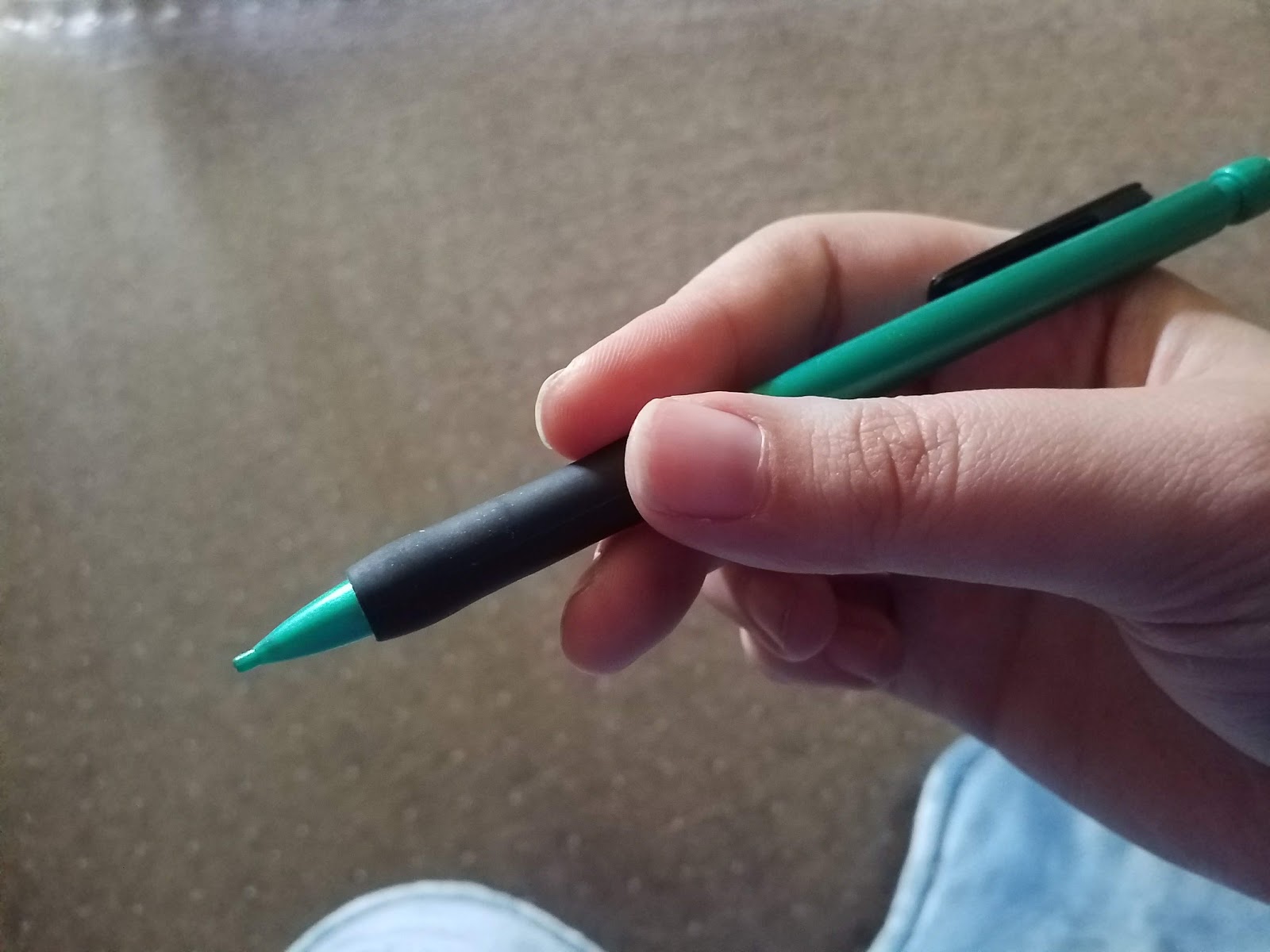
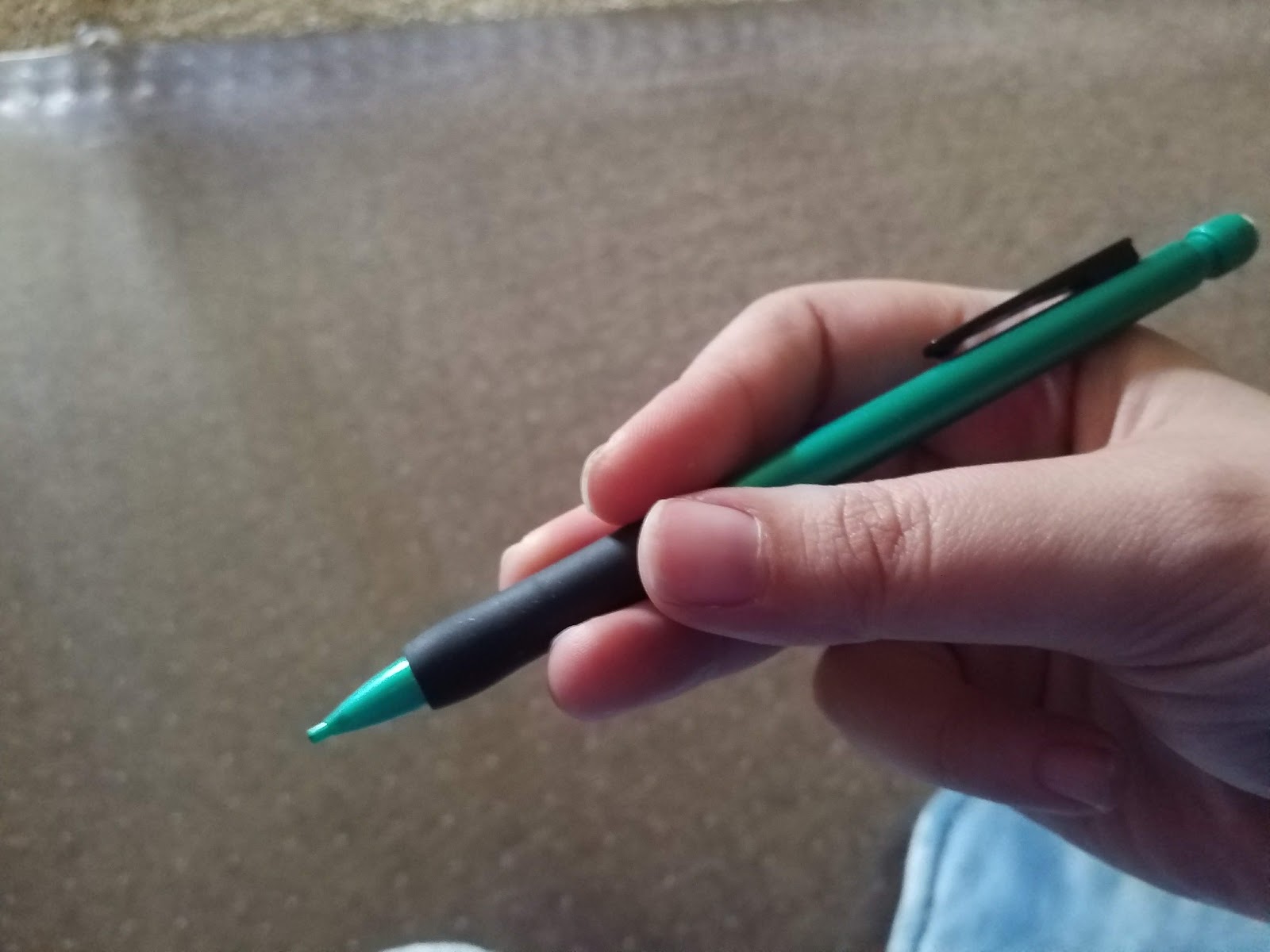
As a child, I tended to hold my pencil with a death grip.  This was noticeable because my hand would tend to cramp up, but also because I held the pencil wrong.  Children are taught to hold a pen with three fingers… 

To this day, I hold mine with four.

This is, as a rule, an inferior grip to the first, as it strains your hand more.  But for someone with clumsiness issues, adding the fourth finger stabilizes the pencil and allows for more control and accuracy.  So that was how I wrote, despite teachers trying to teach me otherwise, and it\’s how I write to this day.  The end result was darker marks on the paper, with occasional tears from pressing too hard.  (This is actually also a sign of a messed up proprioception in children, by the way.)

As an adult, I tried the three-finger grip out, and can now manage it without losing too much by way of speed.  But it\’s not comfortable or how I\’m used to doing it, and since writing has become far less common, I see no need to change my habits.  I did work to overcome some of my fine motor difficulties, though… with another hobby: origami.

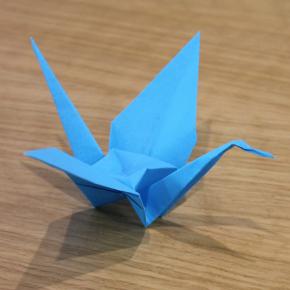
I\’m almost 30, so it bears pointing out that when I was learning, you couldn\’t simply pull up videos on the Internet to teach you how to make this fold and do that technique.  Instead, I had books.  These books had the words \”mountain fold\” and \”valley fold\” and \”bird base\” and all manner of other artistic-not-immediately-helpful-to-a-small-child vocabulary.

So learning was a bit of a struggle, but I\’m extremely stubborn, so after accidentally tearing, smashing, and otherwise destroying probably hundreds of squares of paper, I did actually learn the basics of the art.  Origami is an art of precision, particularly when you\’re working with specialized paper.  The closer your folds are to their destinations, and the thinner the creases, the better your final product.  This means you can manage to follow all the directions, yet still have a final product that doesn\’t look that great.  But it also means that practice really does make perfect.

I can now boast of being able to teach anyone how make a traditional Japanese crane, so long as they\’re patient and willing to put in the effort.  Also, I once pranked my second high school by scattering a thousand of these cranes, along with the wish that the place would become less of a toxic hellhole.  I kind of doubt I got my wish, but at least the prank was fun, and I really doubt they\’ve found them all unless they\’ve renovated their ceilings…

Vestibular Sense

The vestibular sense is also involved with movement, but instead of your joints, it\’s instead linked to your inner ear.  It\’s your sense of how fast you\’re going, whether you\’re accelerating, and the pull of gravity itself, which in turn affects your balance. Apparently this is registered by… what amounts to little hairs with protein crystals suspended on them, inside your inner ear.  It sounds really weird and random, but when you turn your head, the hairs move, pulling the crystals after them, and that movement is gauged by sensors inside the inner ear.

When you lean over to pick something off the ground, you\’re using your vestibular sense to counter-balance yourself so you don\’t tumble to the ground right after the object.  You also use this sense to figure out what position you\’re in, related to the pull of gravity.  After all, a standing position is relatively similar to a lying-down position… at least if you\’re in space.  With gravity, your inner ear tells you which way is down.

When this sense goes awry, all kinds of exciting and unfun things can ensue.  Your balance can go entirely out of whack.  Without the ability to sense the pull of gravity, you can over- or under-compensate for it, resulting in uncoordinated and clumsy movement, if not outright falling.  Stairs, ladders, and slides can become your worst nightmare… or your best friend, if your body craves that sensory input.  Motion sickness might be your constant companion, or you might never ever get motion sick even in circumstances that would make pretty much anyone else ill.

Most interestingly to me, apparently the vestibular sense also factors into your vision.  When a neurotypical person jumps or bounces up and down, their field of vision appears to remain relatively stable.  With a wonky vestibular sense, that is not the case.  So you can have a child perfectly able to read the blackboard or a computer screen, but not able to walk across the school room without banging into desks and classmates.  I guess, something like that accursed \”shaky cam\” technique that keeps making me miserable and confused while watching movies.

Personally, I think I mostly lucked out when it comes to this particular sense, sans the motion sickness aspect.  I don\’t particularly suffer oversensitivity to movement, and my vision complications are brain-related, not inner-ear-related.  I usually don\’t fall while leaning down to pick something up, and my sense of balance is remarkably good considering my proprioception-related limitations.

The motion sickness, though…  I don\’t recall getting very motion sick, ever, as a child.  I could even watch those enormous IMAX 3D screens in reasonable comfort (but my mom couldn\’t).  I didn\’t adore theme park rides, especially not roller coasters, but I could tolerate them.  If it got too bad, I\’d simply shut my eyes, thus eliminating the most dizzying form of sensory input, and huddle until the ride was over.  It was still uncomfortable, but not intolerable.

Now?  Now I can get motion sick from things as simple as \”riding in the back seat of a car.\”  It helps if I\’m hungry.  Something about being hungry makes it exponentially more likely I\’ll get sick on a theme park ride or a car ride.  However, that naturally makes the fix just as basic: get off the ride or out of the car, and eat something simple.  I have no idea why this works.  Even with food freshly in my stomach, though, I no longer care for IMAX 3D movies, and tend to avoid most theme park rides. 

It\’s notable that this particular sense (in conjunction with others) is also used by some autistic people for calming down.  Dr. Temple Grandin, the foremost autistic speaker, includes spinning and rolling as forms of comfort.  There\’s a clip from the HBO movie where the actor playing her explains exactly this.  I… am not like that.  I don\’t really like spinning or rolling, and get dizzy at a regular rate, if not faster than usual.  This actually made learning those skating techniques a great deal harder, as a dizzy person is more likely to fall down than a stable person.

Summary

This week I\’ve described the two \”ignored\” senses, proprioception and vestibular sense, and given you a basic idea of how they work, what it looks like when they work, and what it can look like when they don\’t work.  In addition, I\’ve given you a few examples from my own life as an autistic person as to how these specifically play out.  Next week, I\’ll get into vision, the sense almost all of us take for granted.  I have a unique brain-eyeball communication problem that makes this sense extra fun.  Should be interesting!

Sensory Processing Difficulties: Part 1 (Touch)

(This is part 1 of a series on sensory processing difficulties.  While I\’d initially assumed I could fit them all into one post, the post would unnecessarily long and I really don\’t want to bore you.  So bite-sized chunks it is!  Here\’s Part 2 on the vestibular and proprioception senses, part 3 about sight, and part 4 about taste and smell.)

Why Talk About This?

A book I\’m reading talks about sensory over- and under-sensitivities in children, and how this is a distinct phenomenon from autism, but that it often goes with autism.  And recently there was an incident in church where a staff member shooed me out of the side room I was using to accommodate a sensory overload.  So I thought it might be interesting for you to have some time inside my skull when it comes to sensory issues in an adult autistic.

The book I\’m reading calls for seven senses, rather than the traditional five, which is probably lowballing it, but as good a place to start as any.  The book points out, and I\’ll underline, that these seven senses are not separate input channels.  They are all processed at once, often several senses for each part of the brain that does the processing.  The autistic person does not get to try to turn off their sense of hearing because it\’s hurting them, but still leave the vision, touch, and taste senses active.  That isn\’t how it works.  It\’s all in the same place: the brain.  So you can distract the whole brain from the painful sensory experience, but you need to distract the whole brain.

One more very important note: all the reactions I\’m going to describe to you are involuntary.  I literally do not control how my brain reacts to certain sounds, or to certain types of touch, or anything else I\’ll tell you about.  I did not choose to be the way I am, I simply…am.  The next time you see a child having a tantrum in a public place, keep in mind they might well be like me… just not as old and as well-practiced at handling their suffering in a socially-appropriate manner.

Many Kinds of Touch

Touch is the first and most basic sense.  But there many kinds: 
  • light touches, like someone brushing your arm, or the texture of grass, sand, or dirt.  This also encompasses having your hair brushed, washing your face, and textures felt in the mouth.  (This is the part of touch that most people with sensory issues have trouble with.)
  • deep pressure, like massage, bear hugs, rolling, bouncing, etc.  
  • vibration, like the feeling of touching a washer on spin cycle, or one of those battery-powered back massager devices.  
  • temperature, your hot and cold senses that spare you from both holding cold packs too long and burning your hand on the stove.
  • pain, which covers everything from a light scratch to broken bones.  

As a child, I couldn\’t stand having tags in the back of my shirts.  My poor mother had to painstakingly cut the tags out of every one of my shirts.  The same was true of my underwear, I believe.  This is a form of light touch sensitivity, and I continue to have difficulties with it to this day.

I no longer have to snip the tags in my shirts or undergarments, but sometimes when my spouse touches my arm lightly, in affection, it hurts instead of soothes.  The same is true with my back.  Since I got my hair cut short, my spouse will also pet and gently scritch my head.  The former is nice, the latter hurts after a while.  It\’s emotionally painful for both of us when I have to tell him to stop doing something affectionate because it hurts, but the other option is for him to be causing me physical pain while thinking he\’s being sweet and affectionate.  There really aren\’t good options here, is what I\’m saying.  I try to be gentle and tactful about it, but I know it hurts him, and that hurts me.

Haircuts Are The Worst

Another way this touch sensitivity manifests is when I get my hair cut, or need to wear jewelry.  While I now tolerate tags on the necks of my shirts, I do not take easily to wearing things around my neck.  And I really don\’t take kindly to having things put tightly around my neck.  This is most noticeable in my current life when I get my hair cut.

Haircutters tend to fasten a paper neck band around your neck, to keep the hair from getting down your shirt.  I can\’t stand that.  I have to put my hand to my throat to offset the nearly-unbearable sensation of choking and feeling trapped.  Having that extra sensory input from my fingers at my throat helps confuse the tightening feeling enough that I can tolerate it.  So instead of ripping the stupid piece of paper off and screaming at the poor haircutter, I can instead, seemingly calmly, sit through the application of the neck band. 

After the neck band stops tightening, I can then make myself learn to tolerate the feeling of having something around my neck… particularly if I don\’t move too much.  That lets my brain try to tune out the feeling as \”irrelevant,\” which it\’s not great at, but it sometimes succeeds at. 

This unpleasantness has not, obviously, stopped me from getting my hair cut. (And dyed blue, check it out!)

…but it very much does make the process a lot more miserable than it would be otherwise.  Another way this light touch sensitivity manifests around haircuts is afterwards.  Even with a tight neckband, there\’s inevitably going to be some little bits of hair that escaped into your shirt or stuck to your neck.  Most people just brush these off in annoyance, and after a day or so, they\’re basically gone anyway.  I… have to go home and use a lint roller to get them off, and can think of little more than doing so until they\’re off.

If the house caught fire while I was doing this lint-roller hair-bits removal, I would take the freaking lint roller out of the house with me, forgetting the clothes I took off to get at all of my neck.  That\’s how bad it is.  I am almost invariably miserable when I get home from having a haircut, and don\’t stop being miserable until all the tiny hair-bits are gone and I\’ve had some time to decompress from my misery.

All is Not Lost, Thankfully

It is possible to accustom oneself to things like this, by the way.  The book has suggestions for how to make this sort of thing a regular activity for children, but autistic adults like myself are kind of on our own unless we\’re involved in therapy for it.  Which isn\’t to say we can\’t do it ourselves… it\’s just difficult and not very intuitive.

As I type this, I am currently wrapped in a light blue, ridiculously soft and warm polyester blanket.  It\’s the kind that\’s almost like short, extremely soft, smooth fur.  My spouse noticed it in the store, and we were looking for a nice warm, blue blanket.  But when I first touched it, I immediately yanked my hand back in discomfort.  It was too soft!  My brain couldn\’t process the sensation, it was too overwhelming.  This startled my spouse into amusement, which annoyed me. 

I think I glowered at that silly blanket for a couple minutes, scowling as I made myself touch it over and over.  Just lightly at first, and not very much of it, and I still had to pull my hand back due to sensory overload.  But as I kept at it, I started to be able to handle the sensation.  It must have looked pretty silly, a grown woman scowling at a blanket and touching it repeatedly while her spouse stood by.  But nobody threw me out of the store for being extremely weird, so whatever.

We ended up buying the blanket after I was fairly sure I would be okay with it.  And now obviously, I am.  It still feels a little weird to me to touch with my hands, but it no longer overwhelms me, and the blanket lives by my computer chair to keep me warm when the basement is cold.  Which it usually is, so that blanket gets a lot of use.

Texture of food is another complication in this category.  It\’s not one I\’ve paid a whole lot of attention to, but my spouse is actually pretty picky in some cases about what goes in his mouth.  I was an excessively picky eater when I was growing up.  It drove my mother to frustration quite often.  We ended up having to establish a list of foods I didn\’t have to eat if they were served to me.  Broccoli, cauliflower, brussels sprouts, and other strong-tasting vegetables tended to top that list.

I\’d always assumed my dislike for foods was taste-based.  After all, many of those vegetables do taste pretty strong.  But it may not have been that simple.  I no longer need to have a very limited diet, and make a point of trying new foods as a matter of course.  But I may have to pay more attention to how those foods feel in my mouth.  I do enjoy just-barely-soaked cereal (mostly crunchy, with subtle hints of sogginess) and ice cream blended with M&Ms (which are mostly creamy with some crunch
/and/ subtle hints of sogginess).

All of the above has been about light pressure, and I\’m sure if I gave it a week, I could think of more examples.  But that\’s only one part of touch, so I\’d best move on.

Deep Pressure and Vibration

Deep pressure is what I usually advise my spouse to give me when his gentle touches on my arms hurt, or when he accidentally tickles me.  His actual response is usually to stop touching me entirely, which is kind of saddening, but understandable.  I\’d much rather he press harder with the arm-touches, thus solidifying the sensation and making it more tolerable.

I do like massages, as a rule.  Not only do I suffer basic neck pain, the deep pressure type of touch is very easy to pinpoint and process.  So unless it actively hurts something, it\’s definitely the way to go.  I used to give bear hugs a lot as a child.  I have no idea if that was just because I was odd, or because I liked the sensory feedback of giving a tight hug.  Usually people protested, though, so I think I eventually stopped.

I also bounce my leg when nervous.  This is actually a relatively common nervous habit for all kinds of people.  I actually taught myself how to bounce one leg quickly and slightly, mimicking a friend of mine who had hypertension at the time.  (He actually did both legs at the same time, but one leg was hard enough to learn that I stopped there.)  It became a habit, and now I do it when I\’m seated and anxious.  So, often. 

Vibration type sensory input is relatively scarce in modern life.  When I\’ve run across it, I haven\’t really had much issue with it, beyond it making my hands numb after a minute or two.  I\’m not actually sure if that\’s a common experience or not, but either way, I tend not to hold onto the washer or a battery-powered back massager much.

Temperature

I do seem to be more sensitive to hot things than the average person.  When I was younger, I kind of figured that was probably just the fact that I was young, compared to the people I tended to talk to, who weren\’t.  As you age, you gain calluses on your hands, and the nerves that sense temperature take damage over time, which desensitizes you somewhat.  So something that\’s a little too hot for comfort to a small child would be just fine to a normal adult.  I would often complain about water being too hot, when my mother thought it was just fine. 
This comes up in my current life when I\’m trying to draw a comfortable bath, actually.  I\’m still trying to figure out how much boiling water to add to my tub before filling the rest with hot/lukewarm water from the water heater.  Too hot, and I sweat and am uncomfortable in the tub.  Too cold, and it\’s not relaxing.  
Speaking of too cold, I\’m not really sure how my cold sensitivity lines up with everyone else\’s, but I have very little tolerance for carrying cold things in my bare hands.  And if my whole body gets cold, I get miserable.  Like, pathetically miserable.  \”Small child whining and sulking\” miserable.  I have very little control over this, which is why I really try not to let myself get that cold, ever.  The last few times it happened, years ago at this point, I felt very stupid and embarrassed as soon as I warmed up.  But not \’til then.  
I had always kind of assumed that was a PTSD-style reaction to getting chilled down to my bones in high school, when I was on a rowing team and the coach sent us out half an hour too early… in 40 degree weather… and the rain.  So we sat out on the river for about an hour, slowly getting colder and colder, until the race actually began.  At which point we rowed on cold muscles and did not do terribly well.  
My parents took me back to their car after the race, had me take off most of my clothes, and turned the heat on full blast.  It took an entire hour of that to warm me back up.  It was a pretty awful experience and I resent that coach to this day for that incident and her general treatment of me and the team… which I think is quite fair, frankly.  But maybe it\’s not the whole story, I dunno.  

What A Pain

Pain is a complicated one.  There\’s two factors to how a person deals with pain.  There\’s your \”pain threshold\” which is the level of pain you tolerate, objectively, before recognizing it as pain.  And then there\’s your pain tolerance, which is how well you tolerate pain overall.  Someone with a high pain threshold and tolerance would seem like an action hero, walking away after breaking bones and seeming not to care.  Someone with low tolerance and low threshold would be just the opposite, complaining of small hurts as if they were much worse than they are.  The words \”wuss\” and \”pansy\” are usually used to describe these people, which is kind of cruel when they\’re experiencing those hurts as much worse than someone else would. 
Autistic people, and others with eccentricities in this form of touch, may have one of those two examples above… or they may be in the weird spot where they have a low pain threshold but a high pain tolerance… so they might easily recognize their foot is hurt, but not recognize that the bone is, in fact, broken, and they need to go to the hospital immediately.  They may just assume it will heal over time, as most injuries do, and if they just leave it alone, it will be fine.  This is markedly unfortunate when broken bones and more serious injuries are involved.
Personally?  I\’ve never broken a bone, beyond a hairline fracture in my skull when I was 1 or 2 years old.  I don\’t remember that, so it\’s not terribly useful data.  The closest I\’ve gotten to a broken bone was a few years back, and it\’s the only semi-major incident I can recall.  
So I have these shelves that are actually closet doors, separated by cinder blocks.  They\’re great, and hold all sorts of things… but at the time I\’d thought it would be okay to put my 20 pound weights on the shelf.  It was fine for months… until I leaned on the shelf juuuuust the wrong way while getting out of bed at 2am.  
The shelf overturned, and its contents fell on my foot.  This included the 20 pound weight, which unfortunately managed to catch some decorative spear-like objects on the way down.  The spear-like objects were driven into the top of my foot by the 20 pound weight.  It being 2am, I was rather foggy, but I retained enough coherence to explain what had happened to my startled spouse, go to the bathroom, clean out the injury, put a bandaid on, use the bathroom, and go back to bed.  
Anyone with basic medical knowledge can probably guess what happened next.  I woke up with my foot in a small puddle of blood, within an hour.  So after that, I cleaned it out again and made sure it had stopped bleeding before I taped it up (with gauze and medical tape this time, not a bandaid).  
I\’m not honestly sure whether my inability to assess the damage was simply that I was extremely tired, or because my pain tolerance is higher than average.  I\’ll let you know if I have any other exciting incidents that reveal more…  

What I\’m Not Talking About

I am, as I\’ve repeatedly pointed out in this post, an adult with a spouse.  That means there are some kinds of touch that I haven\’t discussed here.  Sex is its own kind of complicated, but you can probably guess from the things mentioned above that it\’s more complicated for me than it is for any given person.  I don\’t know if my blog has a rating, like PG-13 or whatever, but I do not, as of yet, feel terribly comfortable discussing my sex life on this blog.  
If that changes, I expect the resulting posts would probably be useful to adults on the autism spectrum, as well as parents needing to teach sex ed to their children.  It\’s not that I particularly feel like sex is shameful, like some branches of the Christian church preach, or that I feel like everyone should be private about their sex lives.  I, personally, just do not feel comfortable discussing it right now.  Sorry/You\’re welcome, pick whichever response suits you better.  

Summary

So this week I\’ve given a rundown on what kinds of touch exist, and a number of examples as to how my body deals (abnormally) with these categories.  Like most people with touch sensitivity, I mostly suffer difficulties with aspects of light touch.  This affects my relationship with my spouse (negatively), my experience with haircuts (very negatively), and possibly my experience of food (positively now, negatively in the past).  
Next week I\’ll deal with what some people consider facets of touch: proprioception and vestibular senses.  Proprioception is your sense of where your arms, legs, and body are in space, and it relies on being able to understand feedback from your joints.  The vestibular sense is linked to your inner ear.  It\’s your sense of how fast you\’re going, whether you\’re accelerating, and the pull of gravity itself, which in turn affects your balance.  These two senses are the two excluded from the \”standard 5 senses,\” but they\’re extremely important.  Without them, nobody would ever manage to play sports with any kind of coordination.

House-hunting While Autistic, Part 4: Moving and Making a Home

This is the fourth in a series about my experience of finding a house.  (Part 1 is here, Part 2 is here, Part 3 is here)  As I\’m autistic, the process proved to be a bit more challenging than it would be for most people.  In part 1, I covered why we decided to buy a house and what things we opted to look for, given my disabilities and challenges.  Part 2 describes the actual search process, which proved to be both draining and frustrating.  Part 3 talks about the aftermath of putting an offer down on a home.  This week I\’ll talk about the actual moving process.

————————————

Moving is one of the most trying experiences I\’ve had the misfortune of having.  It\’s hard on a person who thrives with habits and familiar things, when all that is taken away.  Yes, the final result is probably worth the effort, but that doesn\’t make the experience less upsetting while you\’re in it.  At the time of this writing, moving is still in process, and probably will be for a couple weeks yet, but the bulk of it is done.

Moving is not just the process of taking all your stuff from Point A to Point B.  If it was just that, it would be draining and frustrating.  However, Point A and Point B are usually not identical floor plans.  That means your comfy chair is going to go somewhere not quite as adjacent to your computer, or the extra-sunny window.  And your desk, which formerly had a view out the window at the old place, may now be sequestered in a back corner so that other furniture will fit.

Your essentials, like your toothbrush, shampoo, and basic kitchen supplies, will end up in boxes, and your new bathroom and kitchen won\’t have exactly the right drawers and cubbies to put things back the right way.  Your bedside table, power strip, and lamp may not be exactly where they were.

For someone who is comforted by the familiar, moving can be roughly described as \”hellish.\”  All your familiar gets thrown into boxes and then dumped out into the new place, and you have to slowly pick up the pieces and establish new familiars.

Chris had suggested, in order to not make the whole ordeal both painful and overwhelming, that we each take a blue plastic tote full of things to the new place, once a day, for a minimum.  This was a pretty good idea, as it made things more bite-sized rather than \”well, this entire kitchen needs to go… right now…\”

Two of these have gone from the old apartment to the new condo every day since Saturday the 17th of February. 

In most cases, I took more things than just what would fit in that blue plastic tub, but having the minimum settled made it more okay for me to just throw up my hands and say \”screw it, this is good enough.\”  And it also made me feel better about myself when I grabbed just a few extra things.  So that was a very positive strategy.

A normal carload for most days: a tote full of stuff, plus 1-2 extra things. 

I do have to stress that it\’s an unusual one, though.  Our apartment complex insisted on 60 days\’ notice before we could move out.  (The state minimum is 30, and mostly that\’s standard.)  So we ended up paying a lot more rent than would be normal, and having the apartment for a lot longer than would be normal.  In most moves I\’ve been a part of, you needed to get your stuff out of there in a hurry.  So you got a ton of boxes and hired movers and packed what you could before they arrived, and then they took all your stuff and dumped it in the new place, and you spent the next year unpacking it all.

We were able to do the moving process over a longer period of time because of the apartment complex\’s greediness.  So I guess that\’s not all bad.  Moving the stuff ourselves makes it a bit more manageable in some ways.  Then, too, the place is large enough to literally just dump those blue plastic totes out in a corner or something, and then go back the next day without putting everything away.  Which we have done, and quite a bit.  It\’ll be a mess to sort it all, but I\’ll also get a chance to prune some of the stuff I\’ve accumulated.

In addition to the piles of stuff, we also went looking for furniture with which to populate our new home with…  Starting with this thing, which I have dubbed The Monster. 

This is an 8 foot by 4 foot conference table.  It was extremely inexpensive, and you can probably see why. 
This is my spouse sitting at The Monster.  He wanted a conference table to serve us both as a computer desk.  
I was dubious… but it actually does work pretty well.  Our computers are diagonal from each other. 

The Monster isn\’t the only piece of furniture we welcomed into our home.  At my urging, we put together a list of furniture we wanted, and then Chris hunted down a list of secondhand stores for hopefully acquiring those things. 

Nameless corner entertainment center-thingie, found at the Habitat for Humanity ReStore.  The TV barely fits in there, but it does!
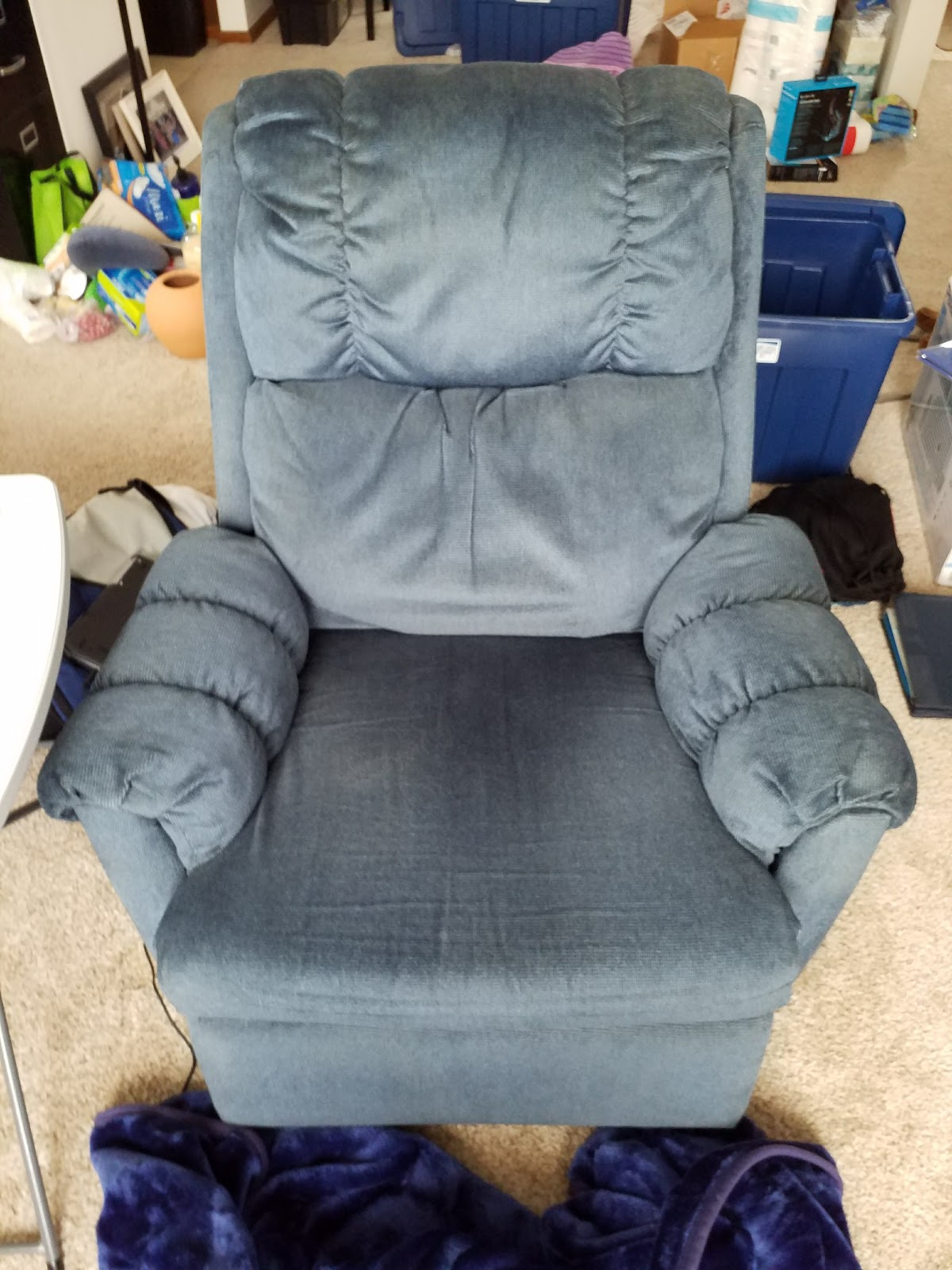
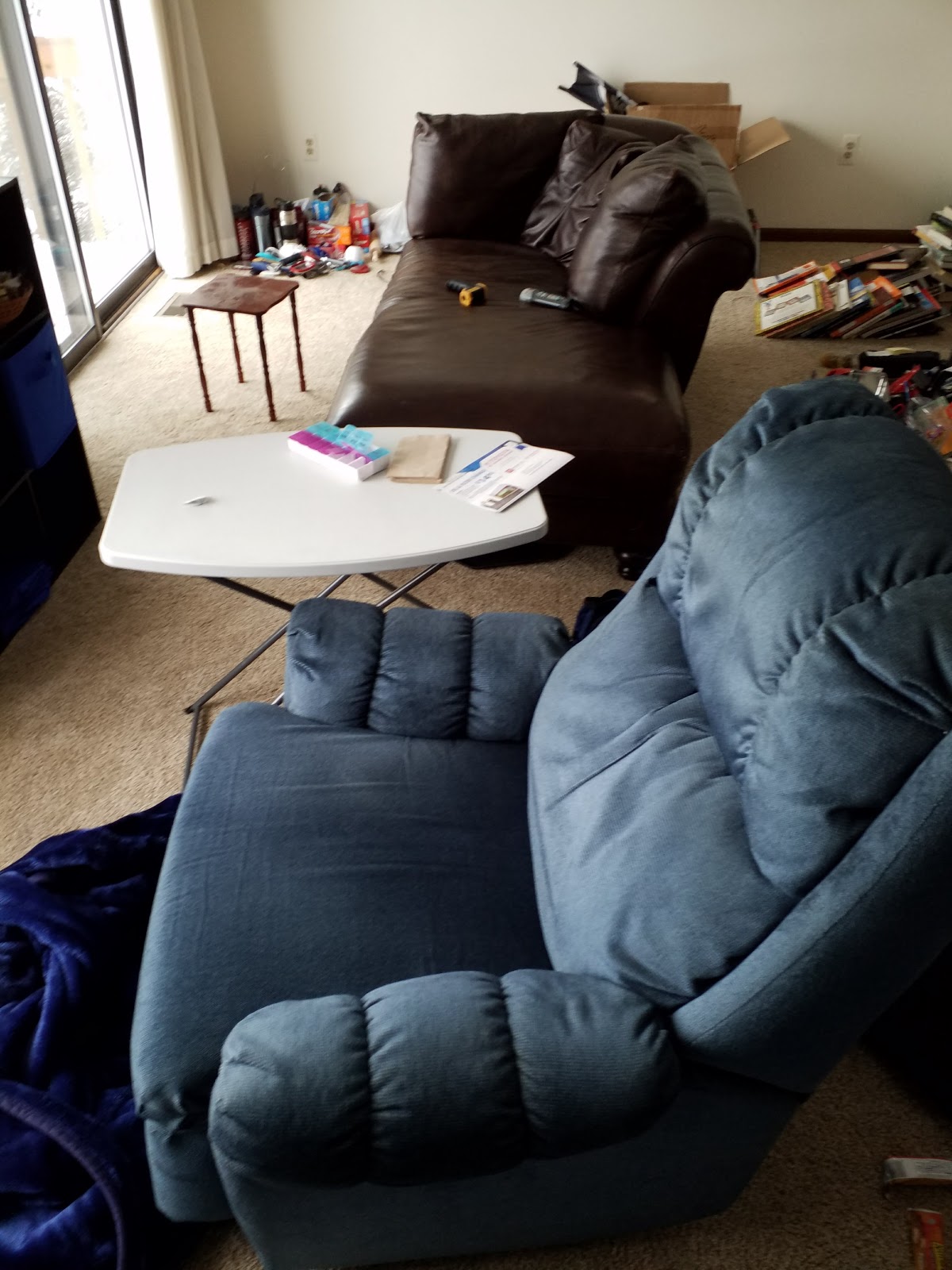
Not just a recliner.  A blue recliner!  Chris settled into this at a furniture store and promptly decided he needed a nap.  I laid claim to it after that, and it\’s now mine.  : 3
But that\’s okay, because this thing, Couchlet, is his.  Minus the change someone left there, anyway.  It\’s very comfortable, and we paid a good bit of money for it despite its mud-brown hue. 
Together, they form the Relaxation Station.  Both sides have windows to look out of, too. 
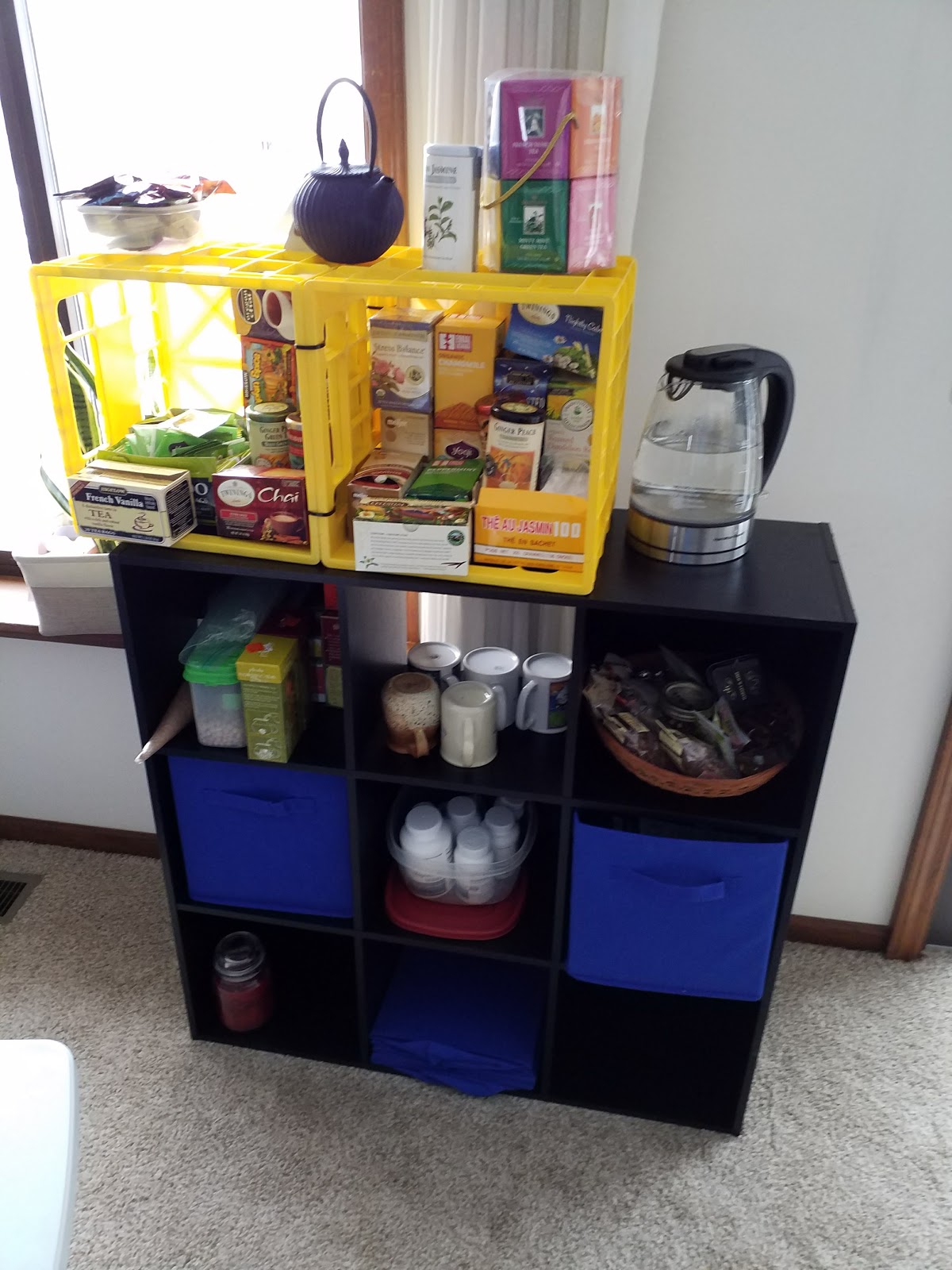
This isn\’t a new piece of furniture, it\’s an old one that\’s been somewhat repurposed to sit in the Relaxation Station.  Tea and hot cocoa for everyone!  And other essentials below, such as crafting materials, my supplements, and some scented candles. 
The exercise bike made it as well, and gets dragged around the basement as the whim takes me.  Mostly it sits by the window, but I tend to use it next to the computer. 
Chris bashed his head on this light one too many times… so in lieu of a carabiner, this was what we had to raise it higher. 

We\’ve mostly adhered to the 1 tote a day per person rule, but sadly one day had to be an exception… we needed to take the bed, most of the bathroom stuff, the kitchen stuff, and our computers all on the same day so that we could start living in the new place.  It ended up taking most of the day to do it, and even then, we didn\’t actually manage all the parts of the kitchen we\’d wanted to.  I was kind of a wreck by the end of the day, too, which did not help matters in the slightest.

In addition to the actual packing and the furniture shopping, we\’ve made trips to various department stores and grocery stores in search of home-making supplies.  Roll-y mats for under our computer chairs (so the chairs don\’t wreck the carpet), floor mats for the various entrances, bathroom cleaning supplies, soaps for each bathroom, more trash cans for the various rooms in the house, etc.  It\’s not something I gave a lot of thought to when we finally closed on the house, but it became more obvious once we started using those areas.

This coming Monday, the last of the furniture is going to make its way here by way of a local moving company, which should settle basically everything.  There isn\’t much left, thankfully, so this won\’t be too expensive… but it is unfortunately mandatory because our chest freezer is far too heavy to move by ourselves.  When we bought it and had it shipped, it took two burly men strapped into harnesses to bring the ridiculous thing up the stairs.  Short of heaving it over the side of the deck, I don\’t think we\’re getting it back down again without help.  So the freezer, the dining room table, the guest bed, and my poor man\’s bookshelves will be taken by the movers.  We\’ll also toss a couple pieces of furniture (my old ratty computer desk and a viciously heavy and mostly broken entertainment center) rather than bringing them.  No sense bringing things we don\’t want to our new home.

All in all, the sheer amount of time and energy poured into this endeavor has cost me a lot of sanity and energy, and the moving in process will continue long after next week is over with.  The 16th of this month is when we have to be out, officially.  But we\’ll be re-arranging and organizing, and I\’ll be pruning my stuff for months, probably.  

It\’ll be worth it.  I just need to manage to keep putting one foot in front of the other \’til this is over…

In the meantime, the view out the back windows is nice.

House-Hunting While Autistic, Part 1: The Criteria

This will be the first a series on my house-hunting experience.  My spouse and I have recently searched for, located, bought, and are in the process of moving into a new home, and I thought it might be useful to explain some of the challenges and why we made the decisions we did.

(This is Part 1, Part 2 is here, Part 3 is here, and Part 4 is here)

——————-

Why A House?

My spouse and I have rented an apartment together for years, now, and the rental rates just keep going up, for less and less space, services, and courtesy.  I\’m sure in some places it\’s cheaper to rent rather than buy a home, but in our case, we figured out we could get about twice the space, for about the same price per month.  So by that metric, it only makes sense.

We don\’t have much illusions by way of expecting to get more money out of the home than we put in, although I\’m told emphatically that used to be the case.  Houses were an investment, people said, and you could expect to gain money if you took care of the house.  That honestly does not seem to be the case any more, even in the market type around here.  
In addition to paying less for more, we also wanted to live in a less populated area, in a different neighborhood.  I\’ve complained in the past about the apartment complex we currently live in, but in brief: it\’s loud (car horns, people shouting, children shrieking), at all hours of the day.  The apartment complex has changed hands four times in the last two years, minimum.  The complex\’s repair staff keeps changing, information keeps getting lost, and whatever remains seems to be mainly ignored.  The gutters sit clogged, month after month.  The roads and parking lots go unplowed, with never enough parking spaces to go around even in good weather.  The trees threaten to fall on the buildings near them.  And the public spaces are dirty, trashed, and get used for all manner of unsanitary and antisocial activities.  

What Kind of House?

I know most people put together some kind of vague criteria for what they want, and then dive into house-hunting until they find something they adore the look of.  That… was not how we did things.  I\’m autistic and detail-oriented, so I wanted to nail down what we wanted, why, and what things we could and couldn\’t compromise on.

This required a lot of talking, and involved some arguing and a bit of sulking at times.  Communication is not a strong point for either of us, so this was a lot more work than you\’d think, and a house has a lot of fiddly details.  Spreadsheets, word processing documents, and hours of verbal and typed communication went into the process.  

We first set some minimum requirements for what we wanted.  2 bedrooms, 1 bathroom, a larger kitchen, in-building washer and dryer, 3 prong outlets in every room, central AC/heat, basic appliances, and parking that\’s at least off-street.  Also, the house had to be livable already, we didn\’t want to spend weeks fixing up a home before we could live in it.  
After that, we decided on what we\’d prefer to have… but were okay with compromising on, if it came down to it.  We also set some additional \”wishlist\” items for an ideal home, which we weren\’t really expecting to find, but knew we\’d really enjoy having if we could get them.  In the l end, we opted to address several issues with these lists:

Sound Sensitivity: This is one of the reasons we wanted multiple bedrooms.  We technically really only need one to sleep in, but having a second to sound proof for a quiet space, or use as a home office, or have guests over in, was very important to us.  This is also why we opted to look for a place that didn\’t share walls, or only had one shared wall, preferably away from high-population areas, children, and other sources of loud noise.

Gastro-Intestinal Challenges:  Both Chris and I suffer from gastro-intestinal issues.  He\’s lactose intolerant, and I get constipated and moody if I\’m fed dairy.  I also end up suffering extra inflammation around the time of my period, and have bouts with diarrhea.  We\’re still figuring out what exactly causes all this, but in the meantime, it behooves us very much to have at least two toilets in the home so one of us doesn\’t suffer while waiting for the other to be done.  We also opted to look for a place with a larger kitchen, which will allow more complicated food prep to cater to special diets, as well as elbow room and ease of use.

Executive Functioning: While Chris and I could probably fix a home up using the Internet, money, and stubbornness, we knew that would be exhausting and time-consuming.  We decided to opt for a \”ready to live in\” place, rather than a \”fixer-upper.\”  We also wanted a place that had most, if not all, of the necessary appliances for living.  A washer, dryer, refrigerator, stove, dishwasher, etc, are all things you can buy post-moving in, but you have to price them out, and it\’s complicated and time-intensive to do so.  If it turns out that we hate one of those appliances post-moving in, it can be replaced.  But signing up to buy all those things was a deal-breaker for us.  It was already going to be hard enough to find a good home, let alone adding that stress on top of it.

Depression/Anxiety: This is another reason for the multiple bedrooms.  Separating oneself from the source of anxiety, or having a quiet place to go to think about things, can be a very important tool against depression and anxiety.  The second (or third) bedroom could be both a home office and a place filled with things I enjoy, like my lava lamps, decorative fountain, healthy snacks, and a comfy chair.

We also stipulated that we wanted a large enough space to entertain friends and family.  Having a comfortable place to invite people back to, whether that\’s just to chat, sip tea together, or host a bad movie night, we wanted to have the option available.  Finally, on \”ideal wishlist,\”, there was a hot tub.  I used to love having baths, but fell out of the habit when I went to college.  I\’ve since found I don\’t fit into most tubs anyway, so the issue has mostly fallen by the wayside… but soaking in hot water is well known as a relaxing thing to do, so we added it, just in case.

Time Management: I work from home, but Chris doesn\’t.  So we made sure to house-hunt in a relatively small area in order to be close to three important places.  First, Chris\’ workplace.  A long commute is a great way to ruin a perfectly good job.  Second, my parents\’ new home.  My parents moved to our area recently, and I wanted to be close to them so it would never be a problem to go visit.  Third, the local supermarket.  Shopping is already fairly time intensive, so being 15 minutes or less away from the supermarket makes for a much less frustrating experience.

We also decided to put preference on condominiums, rather than true houses.  The reasoning for this was that we\’d prefer not worry about lawn care and landscaping.  Neither of us likes that stuff, and it would be one more thing to worry about.  Bonus points if there was a recycling program and community trash pickup so we wouldn\’t have to worry about that, too.

Light Sensitivity/Seasonal Affective Depressive Disorder: I am both photosensitive, which is to say that sunlight and bright lights can really hurt my eyes, and prone to seasonal affective depressive disorder, meaning I need to get a lot of sunlight whenever possible or I\’ll be depressed.  These two traits are naturally and annoyingly at odds with each other.  So the compromise was to look for a place with at least one large, south-facing window… and to have a larger bedroom with windows that could be easily covered with blackout curtains.  On cloudier days, and normal days I\’m handling the sunlight better, I can sit in front of that window with my cacti, or even go outside.  On bad days, I can hide inside and draw the curtains, or stay in the bedroom. 

A copy of the house-scoring spreadsheet we ended up settling on is here.

Next week I\’ll describe the actual house-hunting, and why it was a lot more difficult than expected.

Worth Your Read: Autism, Acting, and Acceptance

http://www.independent.co.uk/life-style/health-and-families/autism-acceptance-affect-mental-health-society-a8043461.html

Been a while since I did an article piece for these Friday posts.  This one got linked to me months ago, and I\’ve been chewing on it since.  Some things said by the other consumer reviewers during my recent trip to Washington DC reminded me of this article, and so here it is.  It\’s about how autistic people tend to suffer when we feel like we have to hide our true selves, and the higher incidence rate of depression and anxiety in the autistic population.

First, on social camouflage.  This is very much a thing.  Autistic people are kind of like aliens stuck on Earth, only without a home world or the strength of a native culture to cling to.  We simply are who and how we are, and we don\’t usually quickly or as easily pick up the cultures surrounding us.  This creates points of conflict, because the people and cultures around us expect us to do that, and feel miffed and upset when we don\’t act according to their specific rulebooks.

Some autistic people are better at maintaining a neurotypical disguise than others.  In general, it appears that autistic women tend to be more adept at it, and some autistic people harness their observational skills and other abilities to excel at acting.  Which naturally translates to managing the neurotypical act relatively well.  This is somewhat rewarding in that people tend to accept us somewhat if we do this acting, rather than almost invariably shunning us if we don\’t.

Herein lies the problem, though.  People who routinely force themselves to lie in this manner, regardless of whether they\’re autistic or not, tend to suffer.  It\’s draining to keep up such a comprehensive act, and it\’s painful to know you have to do so because people won\’t accept you for who you are.  Want to know why the autistic population suffers from a higher incidence rate (up to 70%, or higher) of depression and anxiety?  This is why.  It\’s not just the unusual genetics and poor diet and the lack of exercise.  It\’s having to spend much of your waking life pretending to be something you\’re not.

The article makes a comparison of peoples\’ rejections of autism to a rejection of their Scottish heritage.  Since autism is considered by many autistic people as a part of their identity, being rejected because of it was similar to being rejected for your grandparents\’ country of origin.  I thought this was a somewhat apt comparison, but I have a better one.  Imagine, with me, that you were African American.  And people at work or at school would come to you every day, or every week or so, and say, \”Y\’know, I like you, but I wish you weren\’t so black.  You talk weirdly, and that makes me and other people uncomfortable.  You should stop being so black.\”

Now, when you go home, the fact that you are black doesn\’t matter.  The people who love you are also black, or they know you and are used to how you talk.  They don\’t make an issue about it.  But you regularly get this message from your peers that you, as you are, are not okay.  Don\’t you think this would start to wear on you?  You might try to change a bit.  You could work at talking exactly like your coworkers while you\’re at work.  But really, hard as you try, your skin is going to still be darker than your coworkers\’, and even if you change how you talk, they\’re still going to be uncomfortable.  Do you know why?

Because the problem is not your skin color, or how you talk.  The problem is that your coworkers can\’t handle the diversity.

I visited Washington DC recently, as I mentioned in the beginning of this entry.  It was an enlightening experience for a lot of reasons, but one of the more striking non-science-related things was the sheer amount of diversity in the hotel staff and the airport staff.  I swear to you, at least half of the staff at those places were people of color and widely diverse backgrounds.  There were still white people, obviously, but many of those spoke languages other than English.  And the others, the people with darker skin?  Mexican and South American countries, African American, Middle Eastern, Indian, Asian…  I kid you not, I saw a lady dressed in a full length Muslim garb, wearing a TSA badge, as I was heading home.

It was both confusing and remarkably heartening.  I\’m from a place that is apparently Wonderbread Central when it comes to diversity, despite the African American population in and around the city, and various small communities from South America.  But as I walked through this sea of diversity, I found that despite my strong belief in the superiority of having a diverse mix of humanity, I was nervous.  I didn\’t know what to expect amidst all that diversity.  I hadn\’t had enough exposure to all those different cultures and languages to feel comfortable amidst them all.

The thing is, I was willing to learn.  As far as I can tell, a lot of people aren\’t.  The neurodiversity movement, which insists that humanity is better for having autistic people and other unusual people around, is being ignored by the medical community.  The American Psychological Association continues printing publications that pathologize more and more parts of humanity.

I\’m not going to argue that autism doesn\’t come with downsides and disabilities- it does.  But the hugest emphasis for parents and professionals is \”curing,\” or \”healing,\” or \”reversing\” autism, with autism representing every disability in the autistic person.  No thought is given to the strengths of autism: our unusual perspectives, our love of justice, our empathy, and our expertise in our chosen hobbies.  When everyone constantly rejects you for who you are, and you have to wear a mask in order to be accepted, you\’re going to suffer.

Personally, I learned to build, and then wear, a neurotypical mask over the course of a decade and a half.  The process was so gradual that I cannot, to this day, say precisely where the mask ends and my face begins.  The time I wasn\’t using to establish and maintain friendships in middle school, high school, and college (because I had few-to-none), I spent learning how to act like a \”normal\” person.  Rather than learning a hobby, I learned to make a neurotypical mask.

I\’m still trying to unravel that mask to this day.  My autistic colleagues in DC commented they\’d had similar experiences.  Instead of learning about themselves, autistic people can spend so much time learning about how society expects them to be, that they don\’t necessarily learn what their authentic self is.

Because the author is a decent human being, they end their article on a call for more acceptance of autistic people.  They suggest teaching neurodiversity in college, and researching ways to improve acceptance of autistic people.  I suspect this call doesn\’t go far enough.  Changing how Academia views us is a good step, but we have to go further than that.  The medical profession needs to hear us, too.  If we can change how they\’re taught in Academia, and then educate the remainder who are already out of school, the resulting medical system will begin to see us as people.  Not just a disability.  Not just a diagnosis.  People, with strengths as well as weaknesses. 

RIP Dairy

It finally happened.  I finally got sufficient amounts of proof that I can’t ignore it any more.  I am dairy-sensitive.  (This is different than lactose-intolerant, which is my spouse’s problem and involves digestive issues rather than neurological issues.)

Intro/What is this Madness?

Ever since my LENS doctor suggested looking into the gluten free, casein (dairy) free diet, I’ve been kind of poking at the idea.  Some of the side symptoms of autism, you see, can be made worse by ingesting food dyes, excessive amounts of sugar, gluten, and dairy.  Several of the “my family’s experience raising an autistic kid” books talk about improvements made using gluten-free casein-free (GFCF) diets.  It’s not that changing the kid’s diet “cured their autism” or anything like that.  It was the side effects that improved: anxiety, depression, inattentiveness, sensory issues, cognition speed, etc.  (To some parents, that is autism improving. But that’s an entirely different debate.)

Gluten takes a long time to get out of one’s system, so I’ve shelved that as a possibility for if I ever get ambitious.  But dairy is a lot faster.  Dairy can be out of your system in a week or less.  My doctor suggested two weeks, at least, to abstain from consuming any form of dairy.  I tried that, but not scientifically.  I didn’t abstain entirely, I just eliminated most types of dairy from my diet, and kept tabs on my mood and such after consuming dairy products.

I’d been noticing a downswing in my mood after eating foods that contain dairy.  I’d figured that was the sugar’s fault.  I am very fond of ice cream, but of course ice cream is almost invariably sweetened with sugar or with high fructose corn syrup (HFCS).  And sugar tends to mess with anyone, especially in large amounts.  Given that I already knew my system was sensitive, I tried not to overdo it… and perhaps that’s why I’m only figuring this out for sure now.

The Stumbling Blocks

I’d actually cut milk out of my diet awhile ago, preferring almond milk for its longevity in the fridge.  Slightly different taste, but it lasts three times as long?  Never have to taste sour (or souring) milk, and throw out half a container again?  Yes please!

Cheese is harder.  I definitely no longer buy much cheese, but shredded cheese still goes in some foods that we make at home, and comes on a lot of things in restaurants.  We’re Americans, most Americans have the European mutation that allows digestion of lactose (milk protein) long beyond the nursing years.  I grew up eating cheese.  I like cheese on my burgers, and I can recognize the individual tastes of swiss, colby, cheddar, muenster, mozzarella, gouda, havarti, and provolone.  If you hand me a cheese platter and some crackers, I will enjoy myself.  At least until later, when apparently all the dairy decides that I have had quite enough fun and it is time to suffer.

Ice cream is mainly my last issue with going dairy-free.  I haven’t been impressed with any non-dairy ice creams I\’ve tried, and they’re expensive to boot.  Instead, I got pickier about my ice cream.  I stopped buying regular grocery store ice creams, and started only buying Ben and Jerry’s.  The stuff is expensive, but it goes on sale every so often, it’s Fair Trade, and the Ben and Jerry of the company are highly respectable, moral people for having so much money and a successful business.  They got themselves arrested last year while protesting all the private money in politics in Washington DC.  Also, their ice cream is basically the best stuff on the market.  I kind of couldn’t feel bad about only buying their stuff.

The Tipping Point/”Oh, Duh” Moment

I had been having a pretty average day, at least for this part of my life.  Wasn’t in a bad mood, wasn’t in a good mood, was just kind of “eh, it’s fine.”  We had cow milk in the fridge, for the first time in a good while.  It’s not that I hate milk, is that it goes bad too fast.  But we needed it specifically for a recipe, so I got a quart of it.  That wasn’t much, we could probably go through it, I figured.  He used his bit for the recipe, which left more than half the container… so this afternoon, I made myself some mac’n’cheese, and used some of the cow milk.  And before that, I drank a bit to make sure it was still good.

It tasted fine, and wasn’t souring.  But an hour later, I was in a foul mood, my limbs felt weak and shaky, and my stomach seemed upset.  Not “you’re going to hurl, get to the bathroom now” upset, but definitely unpleased with me.  I had been ignoring the symptoms as they came on, reading a book for my next Friday entry, until suddenly I noticed it all at once.  And recognized, of course, that this was highly abnormal for the situation.

You see, I had no stressful events coming up for the rest of the day.  I’d done everything that was on my plate and was working ahead, which tends to put me in a more satisfied state.  The book I was reading was interesting, even slightly pleasant.  Yet somehow I was now angry, sick, and shakily-weak.

So I began looking backward, comparing the sensations to previous sensations I’d had after eating cheese and ice cream… and it seemed about right.  I suspect milk produces the strongest reaction, being relatively unprocessed.  But cheese and ice cream both had also set me off in a similar way, muted perhaps by the other ingredients they’d been mixed with.

More or less, I accidentally did what’s called a food challenge in allergy testing.  You eliminate the questionable food from your diet for a couple weeks, then give a moderate dosage and record the results.  If you don’t see anything different, that food is probably safe for you.  If you do have a reaction, physiological or neurological, you then know that food is not your friend.

This type of dietary experimentation has been covered in at least three of the books I’ve reviewed, but I suppose I was never willing to commit to not eating cheese and ice cream, purposefully, long enough to actually do it.  Hence it happening on accident instead.

Well Crap, Now What?

Well…  I can definitely stop buying cheese.  I’m not sure I can stop consuming cheese entirely.  Right now, there’s a whole batch of freezer burritos in the freezer that I am flatly unwilling to chuck out simply because they contain shredded cheese.  I can, I suppose, use up the last of the cheese slices in my refrigerator on bison burgers today and then commit to not buying more.

I’m going to need to think up something to put on sandwiches instead of cheese, though.  Apparently my generation likes avocados a lot, on everything, but I never really got into that.  I guess maybe pesto?  Except that has cheese in it too.  Not a lot, though, and maybe I can just find a recipe that’s just almonds, olive oil, basil, lemon zest, and… I guess just skip the grated parmesan or romano cheese…  Or maybe there’s some kind of alternative.  I’ll need to do more research.

I don’t know what to do about the fancy cheese shop in town, though.  Their staffpeople are very sweet and let you try a lot of different samples to get a sense for the various kinds of cheese.  Do you know how many kinds of cheese they have?  It’s over 100 different kinds.  That includes my favorite cheese in existence right now, a sharp cheddar with protein crystals and an utterly delicious taste.  It is basically the best on crackers.  And sandwiches.  And… basically anywhere you put it.  I don’t go to that shop often, but it’s definitely going to be asking a lot to simply… give up all the dizzying varieties of cheese they have.

Maybe I won’t have to, entirely.  They have goat cheese, which I’ve always thought was very strong-flavored and gross.  But they also have sheep cheese, which might not have casein in it.  I’ll have to check with my doctor.  Or do another, more purposeful food challenge, I guess.

Happily, it seems like I can still capitalize on the ice cream snobbery I cultivated over the last year.  I did a bit of research for this post, and it seems Ben and Jerry’s has developed almond milk ice cream.  I don’t think I’ve seen it in my local grocery store, but perhaps I simply haven’t looked hard enough.  I still shouldn’t be eating tons of it, since I need to lose weight and I somehow doubt this stuff will be calorie-free as well as dairy-free.  But it’s at least promising.  And it’s vegan, which is kind of amazing.  I have no doubts it will still be good ice cream, though.  It’s Ben and Jerry’s.  I literally can’t imagine them marketing a bad product.

Gluten..?

The question about gluten still remains, of course.  Gluten and casein apparently have very similar structures, which means the body can sometimes treat them the same.  Especially overly sensitive systems like mine.  I think
I’m still going to shelve the question for a few months, at least.  Gluten not only can take months to get out of your system, it’s in so so so much stuff.  I recognize that bread isn’t the only food in the world, but I actually don’t love rice that much, quinoa is expensive, and a lot of the “ancient grain” products are just mixed right in with more gluten-containing grains.

Also, my father may have nicknamed me “The Bread Girl” growing up because I like bread so much…

Basically, it’s a can of worms I am super not interested in opening up right now.  Trying to make sure I go dairy-free is going to be hard enough.  I think it’ll do me good, and it will definitely do Chris good, since his intestines rebel when he eats dairy products (he has a big box of lactase supplements for when he has to eat cheese and other dairy products).

I’m just… starting to get to the point in the grocery store where I end up looking past entire aisles of food, whole sections dismissed as “irrelevant and/or blatantly harmful.”  And having all those possibilities was one of the things I really liked about grocery shopping.  Now almost everything is calculated risks, off limits, or “use sparingly.”  I have so few pleasures in life, it’s really hard to see this happening more and more.  If gluten turns out to aggravate my system too, it’s going to be even worse.  I don’t think I can handle that right now.

New Vocabulary

This entry is brought to you by a very thoughtless action on the part of someone I rubbed elbows with recently!  They don\’t know they inspired an hour long angry rant at my poor spouse, Chris, and they probably never will, but you all get to enjoy the beneficial results of that rant.  With the help of another friend, who is quite thoughtful in matters of semantics and societal justice, I discovered three new words, which I would like to share with you.

Some introduction / what is neurodiversity?

I am autistic, which means that I do not operate on the same mental and emotional wavelengths as most people.  My brain is literally wired differently, so I naturally think and act differently.  This has made my life difficult, and continues to do so, because most people expect others to think and act the way they themselves think and act.

This seems absurd, perhaps, to the casual reader.  After all, we have many differences, backgrounds, religions, cultural heritages, economic levels, etc.  And that\’s true, humans are a varied species.  But I\’ll also tell you that, at least in the United States, there are certain expectations that are shared across pretty much all those categories.

For instance, you look at someone when they\’re talking to you, but you don\’t stare, so you glance away every now and then.  The percentage is about 85% eye contact, 15% glancing down or to the side or at whatever you\’re talking about.  I know this percentage because I do not automatically want to look at a person when I\’m talking to them.  Looking a person in the eye is uncomfortable, to the point where it can feel like getting hit in the head by a baseball bat.  Yet I am still expected to take that baseball bat to the head every time someone talks to me.  That\’s the rule, and it\’s one that everyone takes for granted: when someone\’s talking to you, you make eye contact without staring.

People on the autism spectrum, and people with other brain differences, are called neurodiverse, or neurodivergent.  The movement for acceptance of people like me is called neurodiversity.  In essence, it\’s basically calling for a \”live and let live\” mentality when it comes to people whose brains, and thus thoughts and actions, don\’t entirely match your own. 

A metaphor / the social contract

This movement is kind of like saying that people with iPhones and people with Android phones can live and work together, if we just put in the effort to accept each other.  We may not entirely \”get\” each other all the time, or even be able to do all of the same things on our phones, but our phones are still phones.  Apple\’s App Store has far fewer apps than the Google Play app store, but they tend to be less buggy and better put together.  However, Apple\’s iPhone won\’t let you play with most of its settings and really customize how the phone works, because Apple\’s motto of \”it just works\” doesn\’t work so well if everything isn\’t cookie-cutter.  Android, on the other hand, will let you stick your fingers into all the settings and customize practically everything, but if you break it, you\’re probably stuck trying to fix it yourself.  Some of the popular apps, like Twitter, Instagram, Facebook, etc, are for both types of phones, but sometimes an app is only for one phone or the other.  Without that app, the two phones don\’t have matching functionality, even if the other phone finds a similar app. 

Get the idea?  Now imagine the whole world is iPhones and you\’re an Android phone.  Depending on how much time, patience, resources, and effort you\’ve put in and others have put in, you may have some of the popular apps that others have.  People on the autism spectrum must often teach themselves or be taught social skills, and once those rules are learned, can then blend reasonably well into neurotypical (normal) society.

As an autistic person who focused very intently on learning social rules and expectations, and then literally studied psychology to learn them even better, I qualify as \”better blended.\”  Unless you know better or are a very astute observer, you would likely think me perfectly normal if you passed me in the store or had a 5 minute conversation with me.  Because I had supportive parents, enough observational skills, and presumably an aptitude of some kind, I learned through hard work what most people know intuitively.  Some autistic people learn these things via therapy, or books, or by lots and lots of experience.  But we don\’t automatically know most of it, because it\’s not innate for us.

When I\’m not at home alone, I spend most of my time \”acting neurotypical.\”  Because neurotypical people tend to expect certain things, like eye contact, I have to make a lot of efforts to make sure I provide those things.  If I don\’t, I tend to get labeled \”rude\” or \”weird\” and avoided or called out.  So I\’m constantly needing to keep details like eye contact, facial expressions, small talk, and rules of politeness in mind when I go out.  If this sounds exhausting, that\’s because it absolutely is. 

Essentially, I have a bargain with the world at large: I act the way your arbitrary social rules expect me to, and you treat me like a human being.  I like being treated like a human being, and unfortunately this is, thus far, the only (mostly) predictable method I have of being treated like a human being.

But sometimes, I slip up in my \”neurotypical act\” or am exhausted and can\’t hold that act together, or I think it\’s safe to be a little more myself, and it bites me in the butt.

Then someone ticked me off, again

Sadly, when I slip up in my pretending to be neurotypical, the reaction I get is usually poor.  Essentially, I get a politer version of \”how dare you be different than me?!\”  I get weird looks.  I don\’t get invited to events.  I stop being counted as human.  It becomes okay to be rude to me, or to ignore me.  I get belittling comments, or polite suggestions that I change the way I am so I don\’t upset people.  
The kinds of things that can trigger those reactions are anything from not looking at a person when they\’re talking, to my choice of relaxational activities at the end of the day, to expressing an dissimilar opinion about a subject under discussion. 
So recently, this happened sort of thing happened.  Again.  I\’m not perfect, I can\’t be what I\’m not all the time.  And there was politely veiled criticism conveyed to me regarding my actions.  And unfortunately, it\’s not a situation I can shrug off and expect to never have happen again. Also, it blindsided me because the person in question was so quiet and polite about it that I had no idea I was upsetting them.  
Usually, I just get frustrated for awhile about these sorts of things, then sigh, shrug, and try to do better next time.  But occasionally the unfairness of the situation gets to me, and I get angry.  I started out with calling them a \”petty, small-minded, egotistical, thoughtless, neurotypical jerk,\” and continued in that vein for a bit before realizing that \”neurotypical\” is really the wrong descriptor for the kind of mentality.  
Neurotypical, you see, refers only to the brain structure and development of a person, not what they choose to do with it.  All neurotypical people are not petty, small-minded, egotistical, thoughtless jerks, even when it comes to neurodiversity or other innate traits, like skin color.  There is a great plethora of examples of good, thoughtful, supportive neurotypical people on this very blog: many of the authors of the books I\’ve reviewed here, for example.
Therefore I needed new words.  I needed a word for a mentality that actively opposes neurodiversity, and a word for people that merely expect neurodiverse people to act \”normal\” in their presence.  Finally, I needed a word for discriminationatory acts based on those mentalities.  

Therefore, meet the words…

Neurorestrictive: the belief that everyone\’s brains, thoughts, and behaviors should meet your expectations of those things, and the expectation that if they aren\’t, the neurodiverse person will restrict themselves to acting that way while in their presence.  This sort of person would invite a neurodiverse person to a party, but be upset if they needed some quiet time in a separate room, or needed to leave early, or didn\’t want to socialize the whole time.

Neuroconfining: the belief that neurodiverse people should not exist (and should therefore be cured / \”corrected until they act normal\” / confined away from \”normal\” people / etc.) and actively oppose any form of neurodiversity.  This sort of person person wouldn\’t invite a neurodiverse person to a party, and likely believes neurodiverse people shouldn\’t be invited to parties at all. 
Neurodiscrimination: discrimination against a person or group of people based on differences in their brains, thoughts, actions, and behaviors.  The act of assuming a neurodiverse person should act \”normal\” at parties, or choosing not to invite a neurodiverse person to a party because they\’re neurodiverse. 
The person that inspired the hour rant and this several hour post, therefore, committed neurodiscrimination against me by assuming I would do everything their way and being hurt, angry, and passive-aggressive when I didn\’t.  
While they have not, in the past, shown signs of being neurorestrictive, this action has clearly indicated that they are, at least in some situations.  I must keep a better eye on them and my actions around them or they\’ll avoid me or dislike me more in the future. I don\’t think they\’re neuroconfining by nature, since they have, in the past, listened to me talk about my life without making judgements like this.
And perhaps I\’ll see if I can\’t ease them, gently, into being a bit more open-minded about autism and more adult about conflicts in the future.  Y\’know, so I don\’t have to spend four hours of an already busy day trying to invent words to properly express why I\’m so livid.

Boomerang Memories: Artifacts of Depression

The vast majority of my life, thus far, has been dogged by the frustrating ailment we call depression.  I have what psychology calls \”dysthymia\” or basically, low grade, long-lasting depression.  Unlike major depression, which usually only lasts weeks to a year or two, dysthymia can be with you for your whole life.  Sort of like having chronic pain, it won\’t ruin your life or make you wish you were dead, but it\’ll sure put a damper on basically everything you do. 

So in the process of living this particular difficulty, and learning about it and other conditions in psychology, I\’ve become rather analytical about the whole thing, and I thought I\’d share a particular feature of depression that\’s been making my life more difficult in the last few weeks. 

I\’m calling them boomerang memories, but I\’m sure there\’s a technical term for it: when your brain reaches back into the past and drags forth an embarrassing, saddening, or hurtful memory.  So if you, like many people, have had dozens of embarrassing moments in your lifetime, you can expect to review the worst of them, regularly.  Tripped over a flat surface in the lunchroom and everyone laughed at you?  Definitely seeing that again, as clearly as if it had just happened again.  Your crush in middle school turned you down?  Going to be reliving that again, without the benefit of the years to soften the emotional blow.  Said something obviously stupid when you were talking to a someone whose opinion you value?  Hope you don\’t mind wincing about that again.  Like a toy boomerang, these unpleasant memories come back, but unlike the boomerang, the memories always hit you in the face. 

Taken one at a time, and infrequently, these sorts of memories are the kind of thing you\’d shrug off.  They\’re downers, they\’re bad for your self-esteem, but they\’re probably not going to ruin your whole day.  Everyone remembers bad things sometimes.  The thing with depression is that these things don\’t politely visit you once a week and then stay away.  Instead, they may opt to visit you every hour.  Or every 15 minutes. 

You\’ll be thinking about what to have for dinner today, or what task you should focus on next, and suddenly you\’ll be remembering a joke you told that not only fell flat, but actually hurt someone you were trying to entertain.  BAM, your train of thought is derailed, and now you\’re sad or frustrated or angry. 

Now, at this point, normal people just wince, shrug, and reroute their train of thoughts back to dinner or work.  You wasted a few seconds remembering this unpleasant thing, but now you\’re back to the matter at hand.  Unfortunately, depression doesn\’t work like that.  Depression, instead, makes that thought process sticky.  Like bugs on flypaper, your brain gets trapped and then stuck on that bad memory.  You live it several times instead of once, and think about what things you should have done instead.  Psychology calls this \”perseverating.\”

Shaking yourself loose from this stickiness is an effort for people that are depressed.  I, personally, have to tell myself, \”You know what, this is a thing that happened, and that\’s okay.  It is long past, and no longer matters.  Let\’s get back to what we were doing.\”   Unfortunately, that is not a magical chant, and does not always work.  Several repetitions or interruptions to the sticky train of thought can be necessary, and this can waste a lot of time and energy. 

It\’s kind of like having your own personal deconstructive critic inside your skull.  No one else can fight it for you, or tell it to buzz off.  Your personal anti-cheerleader has full audio-video access to your brain.  And unfortunately, you have no power to permanently drive off or otherwise silence it.  You can only shoo it away for a time, knowing it will be back.

All of what I\’ve said so far is, as I see it, solid reliable fact.  What I\’m going to say next is not, but merely personal musings, so please consider them or pooh-pooh them away as you please. 

The origin of this personal anti-cheerleader is up for debate, so far as I can tell.  As a person raised in a rationalist, scientific culture, I\’m inclined to think of depression and this particular facet of it as an artifact of a malfunctioning brain.  That\’s what medical science has, thus far, told us.  Depression is caused by problems with brain chemicals and the brain\’s use thereof, and is therefore an internal problem. 

But my description, \”personal anti-cheerleader\” also reminds me of C. S. Lewis\’ writings on devils (see The Screwtape Letters).  The popular image of the angel on one shoulder and the devil on the other, both whispering what someone should do, would almost apply here, minus the angel.  Boomerang memories would then be the devil\’s purview, brought up again and again to wear you down, make you sad and crabby, and overall distracted from your life and what you should be doing with it.

It would make sense to me if the old descriptions of mental illness, ie: demon possession, had some basis in the truth.  The fault of every age and every era is assuming they know best, and that the previous generations knew nothing of value.  Certainly, we know more today than ever before, but much of it, we\’ll find in 20 years, is wrong.  I don\’t particularly think my autism can be attributed to demons, but my anxiety and depression?  Maybe partly.  I\’ll have to reread that book and some of the others that C. S. Lewis wrote. 

That said, medical science has apparently discovered the physical location of depression in the brain as of late last year, so perhaps, soon, our methods of treating depression will be less, ah… shots in the dark.  And perhaps my musing on demons and depression are entirely inaccurate.  Which is fine, I\’m certainly no brilliant religious scholar, philosopher, or world-mover. 

In any case, I hope this explains boomerang memories a bit better for those of you that have them, and those that don\’t.  It\’s hard to get a good understanding of depression when you don\’t have it, or so I\’m told, and those of us that do have depression benefit from the understanding.