LGBTQIA: The Results of a Church Vote

So my church voted yesterday on whether to adopt a fully welcoming stance regarding LGBTQIA people. It was all a bit complicated, but basically they presented a document to the congregation and asked if they wanted to have it be church policy. The document isn’t precisely pro-LGBTQIA so much as it is pro-all kinds of people, regardless of their sexuality and gender identity. It’s a document I view as being made in love, with an ear to those of us marginalized by the Synod. It is also idealistic, for which I love it.

I did not get to vote on this document, because I was not a church member. That was partially my own fault- I haven’t transferred my church membership from like… 3 states ago. Because I couldn’t be made to care. What matters to me is where I spend my time, not whether I’ve jumped through some hoops.

So they voted, and I stood on the margins where I often find myself. And honestly, I stood there without really knowing what I wanted. Like, I knew what was going to be best for me- I’m queer, and I belong in the church. Adopting the document is, I firmly believe, the most Christ-like path. But I also knew full well several people were planning to leave if it was adopted. Including someone I worked closely with. And he’s taking his family with him.

So I sat there on the margins and I worried. And I wondered. I’m one of the most visible LGBTQIA people in the church. Am I worth it? Is it really worth losing those people over something like me?

I’ve had a really, really mixed experience in life, re: my worthiness as a person. It’s been mostly blanket rejection and pain, with a small slice of humanity that thinks I’m spectacular. And like… I think you’re supposed to go find and be with the people that think you’re great, but like… I never really knew how to do that. And there was usually just a couple at a time, not a whole group.

…This church, it’s… a lot of them. I’m sure some of it is my parents, who are good people in their own right, and joined the church a couple years before I did. But not all. I’ve been visible enough, I’ve served the church, and I’ve been open and honest about my struggles. And somehow, these people care. Somehow, they come up to me and say so. It… it boggles my mind. It probably shouldn’t, but it does.

The results have come in. The church voted, and 60% or more said they wanted to adopt the document. To turn their backs on the Synod and their mandates to reject me and others like me.

I should be happy. I should be jubilant, knowing this one church, at least, chose God’s love. But all I can think about is the person that’s said he’ll leave. And so I grieve.

I shouldn’t. He made his choice. I have no control over it, only what I choose to do with what he chooses.

And in the end, it’s not really me the church was voting about. It’s the other two people that spoke with me at the panel a month ago, that grew up in the church. It’s their family, their friends, all the LGBTQIA people that are spread across the myriad of connections of every voting member. It’s the convictions they hold dear, the will to love as Christ did. Even if it costs them. They could get thrown out of the denomination for this decision. People have said they’ll leave.

It’s what we’re called to do, as Christians- to choose to welcome and love the outcast, the prisoner, the impoverished, and the exile. I’m just so unaccustomed to people actually living their faith when push comes to shove, that it shocks me. And of course my own self-worth issues are coming through.

Tomorrow I have to face a world not of my making, and not of my deciding. But I guess I get to do so knowing my church is very, very serious about their belief that I belong there. I can’t seem to untangle the mess of my emotions, but I’m grateful.

In the Mirror

I looked at myself in the mirror today at work. And I saw something new. I saw a boy.

I was wasting time in the bathroom. They’d sent us home early, and I didn’t want to lose all that money. I could linger in the bathroom for a few minutes and be justified as I washed the dust and dirt off my arms. By and large, I don’t pull stunts like this… but it was like this every day this week. We were supposed to be working full time hours, but the company could get away with only giving us 4 hours in a day. So they did. Every single day for two weeks.

I was tired of it, so I was protesting in a very small way. 5 extra minutes in the bathroom, when I’d normally take only the needed amount. A pitiful defiance, really- the wasted time wouldn’t even buy a cup of decent coffee. But I stared into the mirror.

My face, masked as always at work during the Pandemic. Barely-visible, easily-dismissed eyes behind large glasses perched atop the face-swallowing mask. A blue mask, of course. Middling blue today. My hair, cut very short and near-freshly dyed: sapphire blue, fading a bit at the very front as some of my natural golden shine tried to re-assert itself. The result: a more seafoam blue at my forehead than the true sapphire I prefer.

I looked past my face, to my torso. My chest, with the breasts my genetics determined I’d grow. Not so large as to be intrusive and cause back problems. Large enough to not be missed. Broad, manly shoulders- a gift from my father’s side of the family. Most of me is built on a larger scale. Shoulders and hips to start, but legs too. I’ve been overweight most of my life, but because of how big I am, I carry it well.

I returned my own gaze calmly. I’ve been known to unsettle people simply by looking at them. Nobody’s ever told me why. I assume it’s the intensity of the expression. It comes in handy sometimes.

My clothes were work standard. A work t-shirt, grey today to match my mood in the morning. Brownish-grey cargo shorts. Underneath, a plain white sports bra (over a decade old- don’t fix what isn’t broke), and plain white underwear. By and large I don’t give a crap about undergarments. Other people do, and that’s fine. It’s just not my thing.

Bemused, I pressed down on my chest. With my breasts out of the equation, I looked even more like a boy. Inexplicably standing in the women’s restroom.

I don’t particularly identify as male. There’s nothing affirming about being told I’m “manly.” “Capable,” yes. “Strong” or “authoritative” perhaps. But masculinity and the toxicity that so often goes with it is really of no interest to me. I don’t love hunting or fishing or shooting guns or explosions. Or violence.

And really, masculinity shouldn’t be defined by those things… and perhaps it no longer is, as the times change. But it’s how I see it I guess. And gender is, after all, a psychological construct.

I’ve experienced moments of joy when referred to as “sir” or “young man” (by a half-blind older man as I held the door for him). The easy answer would be to assume that’s because I’m a trans man in denial. And that could still be it… but I don’t think so. The answer is a bit more complicated.

I think, thanks to the Internet, I’ve come to see “male” as the default human. When I was growing up, people assumed you were a guy in virtual spaces unless you specified otherwise, or your voice gave you away. Since I stayed away from voice channels, I was merely annoyed by the joke “there are no girls on the Internet.”

In time, though, rather than loudly proclaiming my identity as a vagina-haver, I simply let people think I was male. And thus, rather than bringing gender baggage into the equation, they were more likely to treat me like an equal and a fellow human. And so that was my default.

Real life doesn’t work that way. People of my generation and older look at a person and automatically assign them “male” or “female” based on presentation and physical features. Sex and gender are usually assumed to be one and the same. They are not, obviously.

But I think that mid-point is what I’ve been unconsciously aiming for. T-shirt and jeans or shorts are more “masculine” clothes, but they’re also what’s comfortable for me. I don’t experience dysphoria around my chest. I’d get rid of my breasts for being mildly annoying, but they’re attractive to more than half the world, plus the surgery is expensive. So why bother?

It was a strange, but valuable, experience. I understand a bit better why I identify as non-binary.

Limitations

I’ve been thinking about the nature of our interactions with each other.

You see, as we meet and learn about people, we determine for ourselves what kind of person they are. We take what we know of the world and people in general, and apply it to what we see of a person’s actions and words. We develop a story for ourselves about that person.

That story is inevitably wrong. Sometimes a little, sometimes a lot. Our perceptions and biases warp our judgments. And it’s not possible to entirely understand a person. People are always changing, and act differently in different circumstances based on their own perceptions and history.

That impossibility hasn’t stopped me from trying to fully understand people, but as I’ve aged I’ve come to see I can never truly do it. Like fundamental truths of the universe and life itself, it’s complicated beyond my ability to comprehend.

I know that. And the temptation, in knowing that, is to stop trying. But I can’t. I won’t. Truth is my highest ideal. And in the seeking of truth, I get closer to it, understanding more and more.

Today I feel like I’ve reached a milestone. I realized this morning, based on how people have been dealing with the new supervisors and old ones, that the stories we tell ourselves about us and about others fundamentally limits their potential.

The way we treat people, based on those stories, can limit a person. If, for example, you have supervisor that acts like a bully, a petty human being, and a general pain in the ass, you may come to see him as merely those things.

In truth, he does those things… but not all the time. He is a different person when he’s in a good mood, perhaps a different person to his equals and superiors, and probably a different person at home.

It may be pretty reasonable to expect him to always be a misery to work under… but in doing so you limit his ability to change or be any different.

This was more obvious to me in the treatment of the new supervisors. They seem to be trying to treat us like people with opinions that matter instead of inmates to be herded, which I mightily appreciated. But not everyone seems willing to give them that chance to do better.

Which limits their ability to do better. Enough limitations, and their attempts and intentions won’t matter, and the cycle will repeat itself. I really don’t want that.

It broke my heart, this morning, thinking about how much we limit those around us with our expectations and our judgments. How much we limit ourselves…

In 20 some days I’m going to New Mexico to meet Koopz and Más. Over time, I’ve come to know them. Or at least who they portray themselves to be online. I have, in essence, built stories about who they are. How they act. Why they do what they do. What they want out of life, and what they believe.

Soon I will come face to face with them, and they will not be exactly what I expect. I hope to love them anyway. As much or more than I do now. I can only hope they’ll be able to do the same.

One of the strengths of growing up partially oblivious to the expectations of those around you, is that they don’t limit who you might be. As a result I suspect I’m far odder than I would have been otherwise. But also far more interesting in my opinion.

I am still discovering things about myself, especially now that I’m not held down in shackles of depression. I think I would like to be the sort of person that expands, rather than limits, who and what a person could be.

Reflection on a captured moment in time

I’m sitting outside my house eating breakfast in early fall sunshine, emotionally exhausted on my Friday. But enjoying a Switchfoot album a friend (Sancho) finally gently pestered me into listening to.

I’m sad and crushed because my regular work partner (Cody) moved on without me and didn’t want to stay friends outside work. And a really promising romantic interest (Más) moved on without me.

I’m in a dead end job with barely any energy for trying to get a better one. And it costs me so much energy to deal with the job that I haven’t been able to do as much with house upkeep as I’d like.

But. Another friend (Kristophe) just bought me Baldur’s Gate 3, I’d been wanting to play, and couldn’t afford it. He bought it pretty much just because he wanted to. Blindsided me. It’s downloading and will be waiting for me when I get home.

I’ve kept the email notification alongside the one from earlier this year when someone bought me Diablo 4. Because I kind of can’t believe someone would do that.

And I’m reading a good book series a friend (Prety) recommended and talking to him about it. And One Piece, a manga, same deal with Koopz.

My DMs on Discord have never been so busy. My emotions are a confusing mess of sadness, despair, joy, gratitude, and confusion.

Once upon a time I did 1-2 emotions at a time, and they were always all good or all bad. Mostly all bad. Then my life crashed, my toxic relationship ended, I unpoisoned my brain, and…

Is this what it’s like to have friends?

Fear (from October 2022)

(Note from July 2023: the relationship that provoked this post ended with them withdrawing after a few months. I took things from the experience, grieved, and moved on. I’m declassifying this now because it no longer hurts me enough to fear posting it.)

I never noticed how much of my life was ruled by fear until recently. How much of a coward I can be. Looking back over my life, fear has always warred with love. And, usually, won.

It makes sense, you know. I’ve generally considered myself brave, but how can you be brave unless there’s something to be afraid of? Something to strive against. Something to be brave despite?

I’ve spent the last year of my life in circumstances that, honestly, are miserable. But they do pay the bills. For now. And now, on the tail end of it, I’ve recovered enough from the tragedy of my failed marriage to really, deeply care about somebody else. To feel joy in their presence, enjoy their quirks and their passion and really see the beautiful parts of their personality. To see, through their eyes, the beauty of the world around me.

Nothing will come of it, I’m sure. There are a lot of factors against anything serious coming of it. But it’s so beautiful and the feelings are so good that the idea of losing them apparently shook my unconscious so badly I started resorting to unhealthy behavior in an effort to prolong it… frankly, in circumstances that weren’t really even threatening to the relationship.

I feel ashamed. And small. And so, so weak.

My therapist would say, with a supportive and encouraging smile, “Well, it looks like you’re still human. And that’s okay.” And she might also point out, after so long being miserable, it makes sense to be desperate to keep that kind of joy close.

But I’ve always wanted to be better than human. To not fall prey, over and over, to the same stupid mistakes. To be done with it eventually, and just be able to live unhindered. It’s why I’ve worked so hard on self-improvement. It’s why I try so hard to be kind to others. I want to break limits.

It’s an impossible dream, of course. Until, perhaps, God comes again, I’m stuck being human and having to forgive myself and making mistakes and having to be kind to myself as well as others.

But I have to try.

Straw Armor

So yesterday I went off to face a personal demon I’ve carried for years. I’ve had a rocky relationship with my only brother and his wife for years. The reasons were complicated, and not entirely anyone’s fault. I’ve been a lot harder to deal with in the past, because of all the trauma and pain.

It’s funny, because I’m not actually that different a person. I’m just a different experience now that I’m not depressed.

So I strapped a glass straw across my chest. Over my heart, in fact. In its cloth carrying case, tucked under my bra so it wouldn’t move. Like armor. Something to shield and save me, remind me that even if my family dislikes and wishes me away, there are still other people that care and matter.

The sheer absurdity of strapping a breakable glass item on, like it was armor, had me laughing pretty hard as I drove out to face my fate.

Edit a few months in the future: the family event actually went way better than I expected. All is not fixed. But some positive steps were taken.

Culture (Mis)match

Mismatch

A lovely older couple from my church invited me, my parents, and a couple other, older church folks, to brunch. They were unfailingly polite and kind, making sure there would be plenty to eat for me and my mother, despite our different (but very strict) dietary requirements. I’m honestly grateful for the invitation and experience.

The whole event cost me maybe 3 hours. The food was very good, fresh, clean, and plentiful. They even labeled it to be very sure everyone could eat safely. The home was clean, well put-together, coordinated, spacious. Reminded me of family get-togethers in the past. The hosts and company were polite, good natured, fair-spoken, social. The conversation flowed, lightly touching on beliefs, current events, and personal experiences without me needing to help it along or even contribute much.

Which was good, because I was a fish out of water. I was underdressed: these were older people, dressed up in nice Sunday clothes. Uncomfortable clothes, to my recollection. I wore shorts and a soft T-shirt, and my blue-dyed hair in stark contrast to the natural colors represented in the room. I needed to tone down my words, my cursing, my emotional expression, to fit in.

I started out more myself, being on my phone with a new game I’d picked up the previous day. But as I looked around the room at the behavior of everyone else, I realized how poorly I was fitting in.

My socialization kicked in. I put away my phone and schooled myself to stillness and listened in a way that looked more attentive but was actually less so. Without something to occupy my fingers and part of my attention, I quickly became miserable thinking about all the things I could have been doing instead.

And it occurred to me during all this… this situation was representative of a lot of my childhood. I genuinely did not like being there. The niceties, the restraint, the delicate passing of the conversation from person to person without delving too deeply into any feelings or beliefs. That last bit, the lack of depth, might not be fair, honestly. But when I think on the conversations I’ve had with people I consider friends… they looked nothing like this.

My friends are typically direct, at least somewhat. They’re honest, and they often don’t flinch from uncomfortable subjects. The conversations provoke thought as well as laughter. Their humor is similar, tending into the absurd, occasionally bawdy, loud, and with clever wordplay.

In short, they’re a very far cry from what I experienced at this brunch. And it wasn’t like they were judging me, really, or that they said anything. They seemed honest and genuine. I just… couldn’t get comfortable. I couldn’t feel that I belonged, or that it was okay for me to be myself.

Socialization

In truth, it probably would have been fine for me to just be myself. Gotten out my phone, played my weirdass dinosaur Pokemon GO clone that my work friend showed me. Hummed to myself if I felt like it. Sat with one leg under me, asked for a blanket so I could be comfortable in the chilliness of the house. It would have been abnormal. Uncomfortable for everyone involved, but probably fine.

I just… couldn’t.

I know what my therapist would say: be yourself anyway. There weren’t going to be consequences besides not being invited back. Maybe some looks, uncomfortable body language, comments if people decided it really bothered them. Would have been really indirect, polite comments, judging by history. The kind that hurt the most because of all that’s not said. But frankly, I think I’m being unfair to these folks again. I think they genuinely were as nice and kind as they appeared, and I’m just letting bitterness from my past creep into my experience of the present.

So I should have just sucked it up and been myself.

When I talked to my mom about it afterwards, she thanked me for just…dealing with it. Which is how I was raised. That is exactly how I was raised. Don’t be too you, conform to social expectations regardless of how poorly they suit you, sit still, smile.

Be miserable.

Be miserable, and pretend you aren’t.

I live in a world that doesn’t comprehend how different I am. Those niceties and social norms work for a lot of people, without making them miserable. But not for me. And all too often, when it does, it reacts negatively. And that shit hurts. Especially when I was younger, it hurt a lot.

I’m not young anymore, but part of me is still 6 and fidgety and wanting to be reading a book or playing a game or folding origami rather than listening in miserable boredom as people talk on and on about subjects that don’t interest me enough to keep my full focus.

Match

About a week ago, I came back from a vacation. The first “just for me” vacation in like a decade. I visited people that accepted me for who I am, where I was, and however I wanted to be. I didn’t feel pressured to live up to some kind of set of expectations. It was amazing. It touched me in ways I couldn’t have believed or understood. Ways I’m still trying to sort out, even as my normal life, with my misery-inducing job, sinks its black claws into my soul.

And you know… they were just people, all of them. Flawed. Not really that different from random people on the street… except… except the shared experiences. Except the similar mentalities. The personality quirks, the tendencies. They’re like me. They like me. At worst they tolerate me.

I had no idea that was even possible. A single match here and there, with years between finding people like that, sure, maybe. A whole group? Madness. Logical, since “birds of a feather flock together.” But emotionally a non-reality to me. Until now.

There’s such a huge disconnect between the life I experienced while on vacation and the life I have right now. It’s so massive, it feels insurmountable. I could take more vacation, spend more time out there among these soul-kin I’ve found. But I’d run out of money eventually. I have responsibilities. A life, such as it is. A job, a house. Family.

I don’t know what to do. I’m so grateful to have found these people, these soul-kin. And so lost now that I have. So much of life is strongly affected by your perceptions and mental state. Like stripping colors from the world itself, misery changes the experience of life. It’s so much easier to be kind and good when you’re not miserable. So much easier to love yourself. To love others.

I’m tired of being miserable, though. I know that now. Isn’t 30 years of misery enough?

Valuable Online Resource: Fair Health Consumer

You know how you can use the Kelly Blue Book to look up the price of a car?  You input the make, model, condition, etc, and it tells you more or less what a fair price for the car is?

Imagine having something like that for medical expenses.  Hospital stays are notoriously ruinous without insurance, and sometimes even with it.  The thing about insurance is that they keep staff onhand to dispute markups on services.  So the insurance company (and by extension, you) aren’t stuck paying a thousand percent markup on over-the-counter painkillers.

The Problem

Why is it like this?  It’s actually not as simple as hospitals being greedy.  It’s because the US healthcare system has, overall, shifted away from the metaphorical ounce of prevention in favor of the metaphorical pound of cure.  Hospitals, you see, can’t refuse to treat someone based on whether they can pay.  But because healthcare is so expensive, a lot of people don’t go to the doctor or dentist immediately when they have a problem.

Instead, they postpone dealing with the issue until it goes away or turns into an emergency.  Naturally, this is when it’s most expensive to treat, and narrows your options considerably, but if you can’t afford even the basic prevention (because your insurance sucks, or you don’t have any at all), it doesn’t really matter to you.  So the hospital treats the unfortunate person, but the person can’t pay.  The hospital is still out that money, so what are they to do?  Pestering the person via debt collection agencies isn’t a very successful option, plus it takes time.

The solution, as it happens, is to jack up all their prices on everything.  By making people with actual money pay more, they can systemically balance their budgets after a fashion.

As you can hopefully see, this is a crappy solution.  And it’s vastly unfair to people without insurance companies to negotiate on their behalf, or even with an insurance company that half-asses their negotiations.  It’s also typical that people will go into getting medical procedures with absolutely no idea how much it’ll cost them, then getting slapped with the bill later.

The Immediate Solution

For both of these issues, there’s a solution, and it’s called Fair Health.  While the website has its own tutorials and informative videos, I’ll briefly explain how some of the site works.

You can look up how much a procedure or treatment will cost you.  The site will ask you where you are, because that matters in the calculations.  It may also ask you whether you’re in-network or out-of-network, which is insurance-ese for asking whether you’re getting the service from a doctor they approve of, in a place they approve of.

Finally, they’ll ask for something significantly harder to provide: a CPT code or precise description of the service.  I know about CPT codes because I did a bit of work with them at the front desk of an ABA clinic, but I don’t think most people are familiar, so:

In brief, a CPT code is a precise designation for a medical treatment or procedure.

For example, I looked up D2392, which is “a plain white resin-composite filling that covers two surfaces on a back tooth.”  You’ve got the material type (resin composite), the procedure type (filling), the location (a back tooth, like a molar), and the approximate amount of effort involved (two surfaces, meaning the top and side of the tooth could be involved, which means a moderate amount of material, molding, and drilling is likely to be involved).

You can look these CPT codes up online, but in all honesty, you’re better off just getting the exact CPT codes from the doctor’s office when these procedures are proposed.  If you’ve got a smartphone, you could even look up the codes while you’re in there with the doctor.

The site also has informative sections about insurance, including explanations of common insurance-ese terms like “in network” and “out-of-network.” It’s fairly basic information, and I don’t feel like it’s super-well organized, but it is good information to know.  Having it somewhere free and publically accessible is definitely preferable to not having it.

There’s one odd caveat with this site, and it’s that it doesn’t cover government insurances.  Medicare, Medicaid, and Tricare data is not included here.  The site pretty much exists to help uninsured people, and people on private insurance, make sure they aren’t scammed or overcharged.

In the Long Term

You may have noticed this website doesn’t solve the systemic problem of hospitals jacking up their prices to compensate for treating people who need the help but can’t pay.  It can help by educating individual consumers, but the overall problem persists.  Y’know what would solve that overall problem?

Universal healthcare.  Whether that’s Medicare for All or some other version, returning to the “ounce of prevention is better than a pound of cure” model of healthcare would save us all a fortune.  People would be able to get cavities filled without feeling like they’ve chosen their health over being able to pay rent that month.

In an age of unprecedented bad physical and mental health, where the average lifespan (for everyone, not just autistic people) is actually decreasing for the first time in decades, I feel like we could use the change.

By the way, if you ever want to do a good deed and personally take a metaphorical bite out of the suffering this unfair healthcare system creates, RIP Medical Debt is an excellent way to do so.  They buy up uncollected medical debt from debt collection agencies and forgive it.  It’s an unusual method, but it lets them take $100 in donations and use it, on average, to forgive $10,000 of debt.  Be sure to check it out!

Getting Shot (With the COVID Vaccine)

April 5th was the first day in my state that the vaccine is available to the broader public (ie: not just the elderly and healthcare staff).  Thanks to the diligence of a friend, I was able to get an appointment at a downtown clinic for that exact day.  

I had only about a week\’s notice, so I tried to spend the time preparing my body for the panic attack the vaccine would be inducing.  Unfortunately, my poor mental health also had an opinion, and so I was only partially prepared for the injection.  

The ideal would have been to have a month to prepare, with regular light exercise, plenty of water, good nutritious food, extra Vitamin C every day, religious tooth care, and a steady dosage of the zinc-elderberry lozenges I use to prop up my immune system when I\’m sick.  

Instead, I probably achieved less than a third of those preparations in the week between getting an appointment and the day of the injection.  I\’m not a severely at risk human, and my immune system is usually pretty good at its job, but given what the actual virus can and has done to autistic people, I wanted to be very safe about it.  

I woke up that morning feeling anxious and under-rested.  It was storming outside, with distant thunder to prod me awake about a half hour before I\’d normally get up.  I stayed in bed for a full hour out of protest.  But eventually I got up because I wanted to at least make an effort at being prepared for the day.  

I put on comfortable but stylish clothes, favorites of mine delivered by a shopping service.  Then a dose of vitamin C (1000 mcg, the usual daily limit).  Then, begrudgingly, brushed my teeth.  Good digestion (which affects your immune system) starts in the mouth, and brushing and cleaning between your teeth is very important.  The experience is still vastly unpleasant to me, though, and I haven\’t found a way to make it a positive experience yet.  

Next was chopping fruit and preparing green salads.  I\’d see my parents (both fully vaccinated) for lunch before the actual shot, and it wouldn\’t do to not be prepared.  I\’d been slightly adventurous this week in the fruit department: yellow dragonfruit and small yellow mangos accompanied a more typical European pear.  Thankfully my parents are supportive of my interest in diverse food.  

It was a bit of a crunch between lunch time and getting downtown to the vaccine clinic, but we managed to find parking (which was free, yay) in a parking structure just underneath the converted convention center.  We were given directions upon entering, which basically told us to text \”here\” to a particular number, and enter the building when texted back, or when our appointment time arrived.  Despite being 15 minutes early, we were immediately texted to go in.  

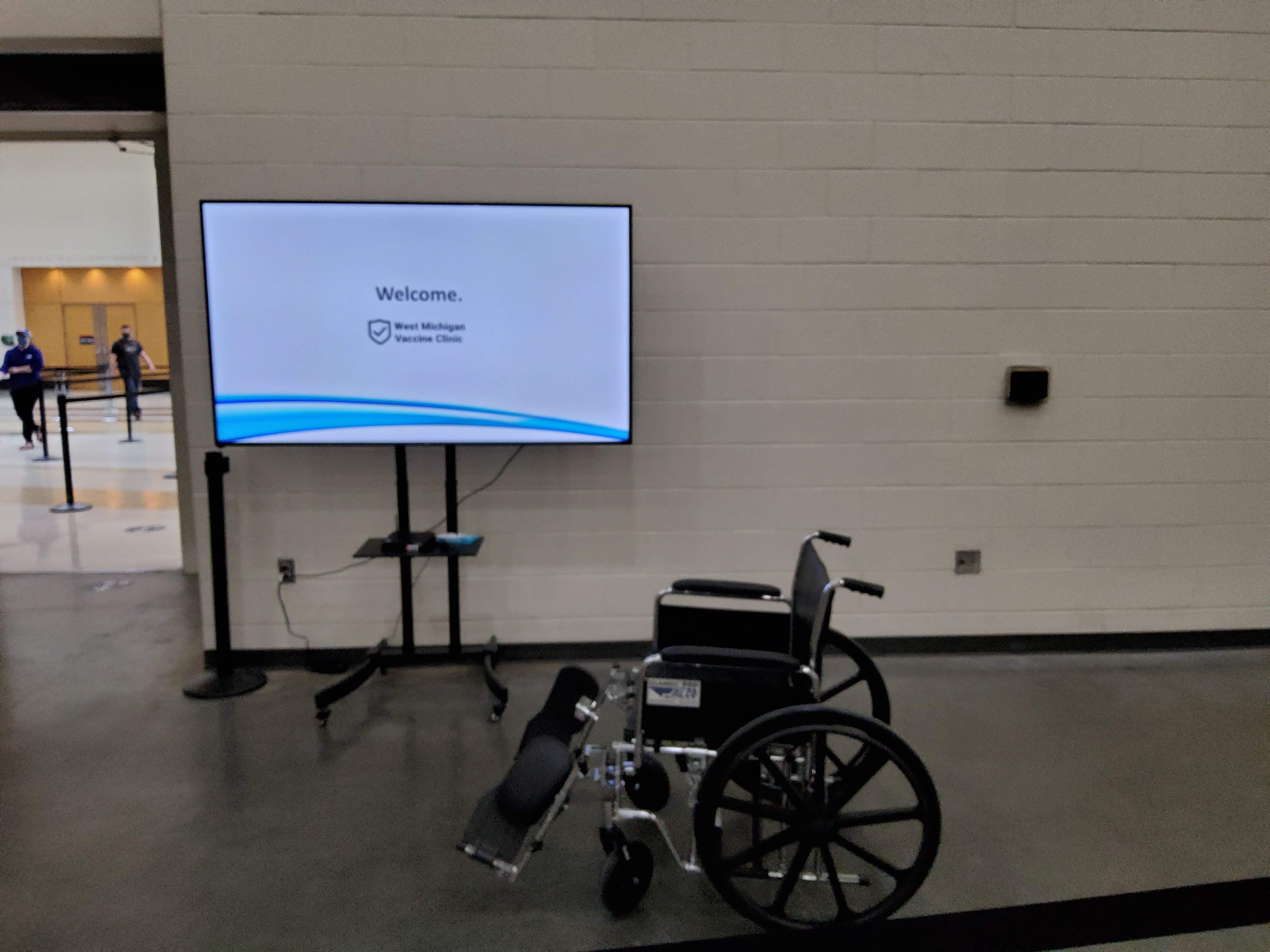
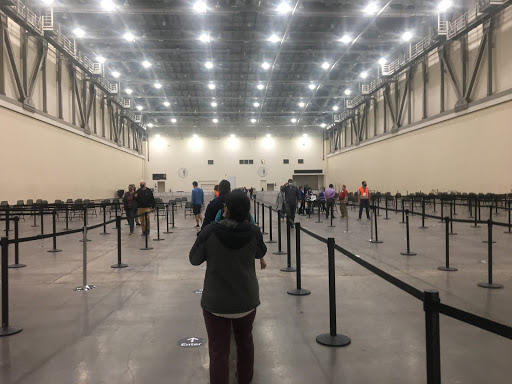
Upon entering the building, the first thing they did was check our temperatures with handheld forehead thermometers.  Since neither of us were running a fever, we were ushered in and offered hand sanitizer.  Once that was applied, it was down the stairs and into the convention hall proper.  Which looked like this:

Everything was very neatly laid out for maximum efficiency, with probably hundreds of volunteers politely guiding you in case the arrows and lanes weren\’t sufficient.  All the volunteers were, at worst, blandly polite.  Some were significantly more cheerful, and a few even thanked us for coming in.  There was no immediate sign of our friend, who we\’d planned to meet up with for the event.  

Mostly what I noticed was that it was very easy to go on autopilot and simply follow the clear signs, lanes, and verbal directions.  We later called this \”being in the flow,\” and I experienced it as something akin to being in a waking trance or a near-dreamlike state.  At every step of the way, you knew where you should be going and what you should be doing.  There was no need for conscious thought, because at the slightest uncertainty, there was immediately a staff member to tell you where to go.  

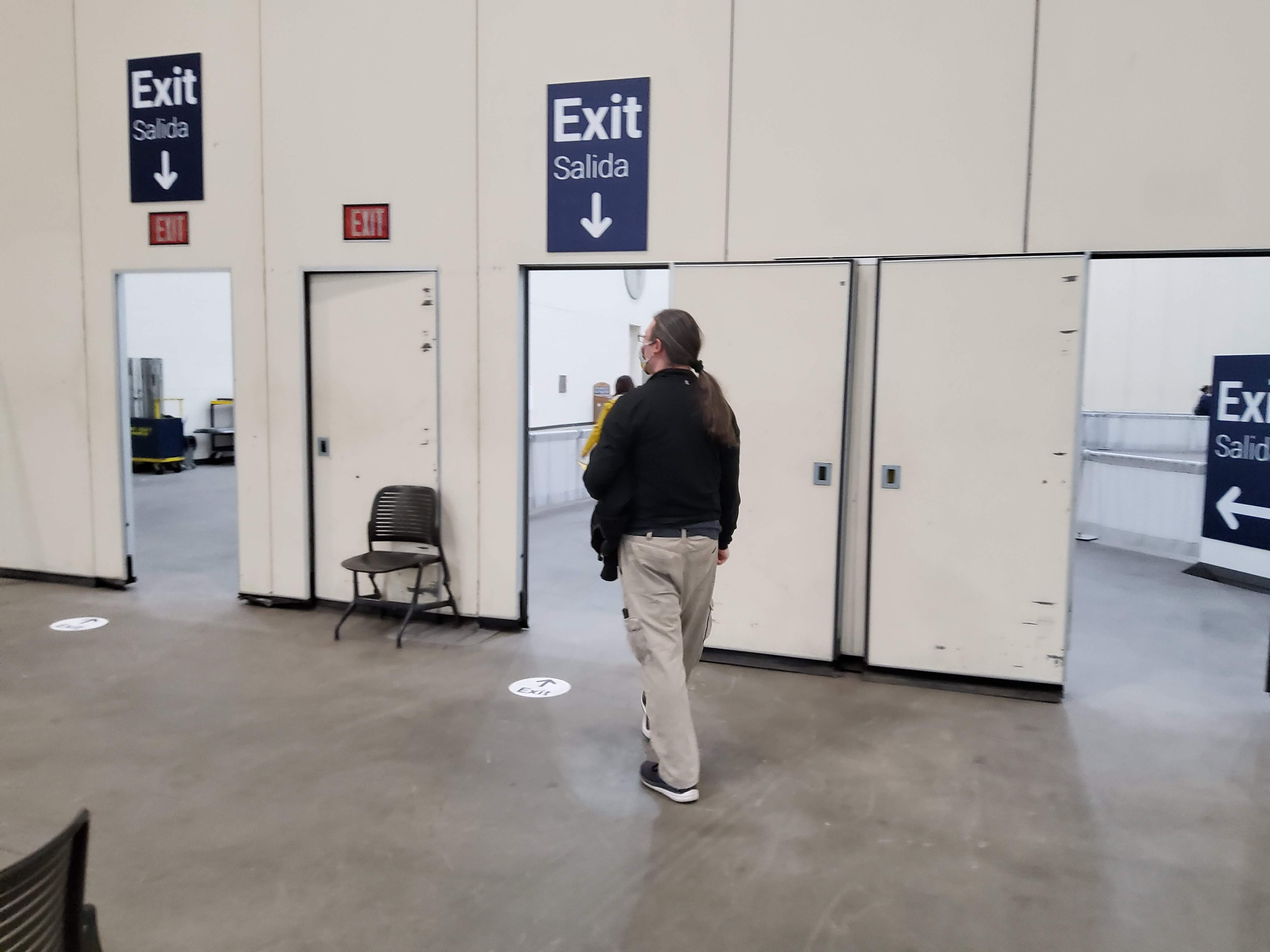
This actually made it rather difficult to take pictures, but I still did, because it\’s kind of a once (or twice, I guess) in a lifetime experience.  

Several friends of mine referred to this event as Vaccine-Con, which isn\’t the worst name for it, in all honesty.  It\’s definitely getting the foot traffic of a convention, and it\’s in a convention hall.  Seems fair enough to me.  The major difference is that the focus of this is health, and the focus of most conventions is making money.  

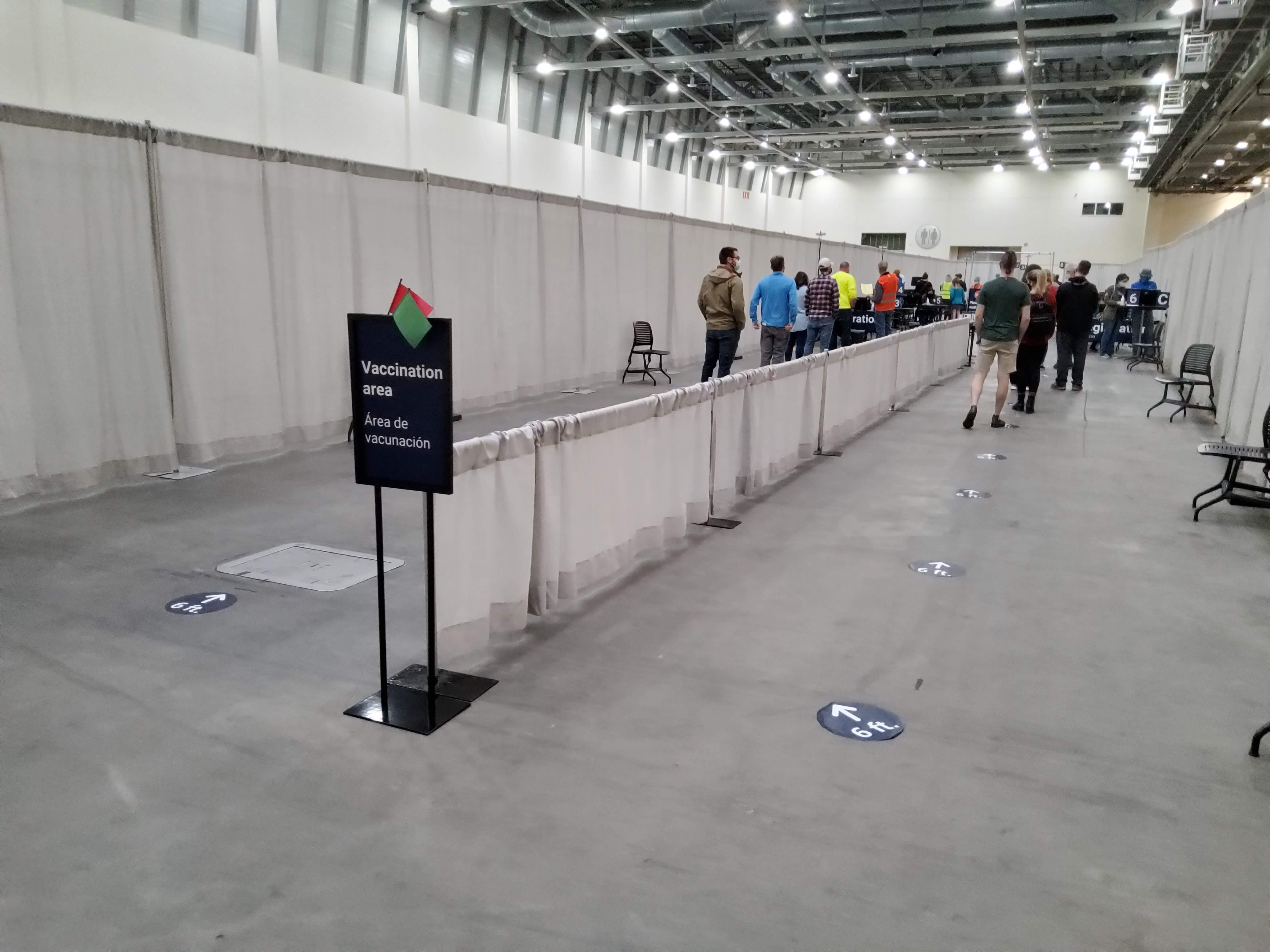
There were four lanes like this in the convention center.  Note the stickers placed 6 feet apart, the extra-wide hallways, and the open ceiling.  Also note the chairs placed strategically for people that don\’t do well standing in line.  In truth, we maybe spent like 10 minutes queuing, if that, but I can imagine the place being significantly busier at other points in the day.  Particularly with the previous eligible group, which was mainly comprised of the elderly.  

Getting to the front of the line afforded you this view, where a staff member would give you some short paperwork and have you sign in and verify essential details on the computer.  It took us maybe a couple minutes.

Once past the final registration, it was time to stand in line for a booth.  Each contained a nurse or someone trained in administering the shots.  The staff that gave us our first dose (Pfizer, one of the two mRNA vaccines) is named Kristin.  She seemed weary, but in reasonably good humor.  I\’d honestly assume there were hundreds of people before us, and maybe it was near the end of her shift.  At any rate, she checked our information and then gave us each our shot.

I went first.  I didn\’t look at the needle going into my skin, because there\’s no need to make the poor nurse\’s life any harder than it already was.  I did watch my spouse get his shot, though.  The vaccine liquid was perfectly clear, which was weird to me for some reason. I didn\’t even bleed, and barely felt the shot at all.  She gave us a bandaid and then we were on our way again.

I left the booth feeling jubilant (one step closer to being done with this pandemic!), but also a little fuzzy in the head.  My doctor tells me I\’m extraordinarily sensitive to changes in my system.  I have the ability to tell, based on the sensation in my stomach, whether something I\’ve eaten or drunk was alcoholic.  Same with painkillers, for some reason.  So it could be simply that I could tell my system was reacting to the \”invader\” vaccine.  Ooor it could be a trick of my imagination.  

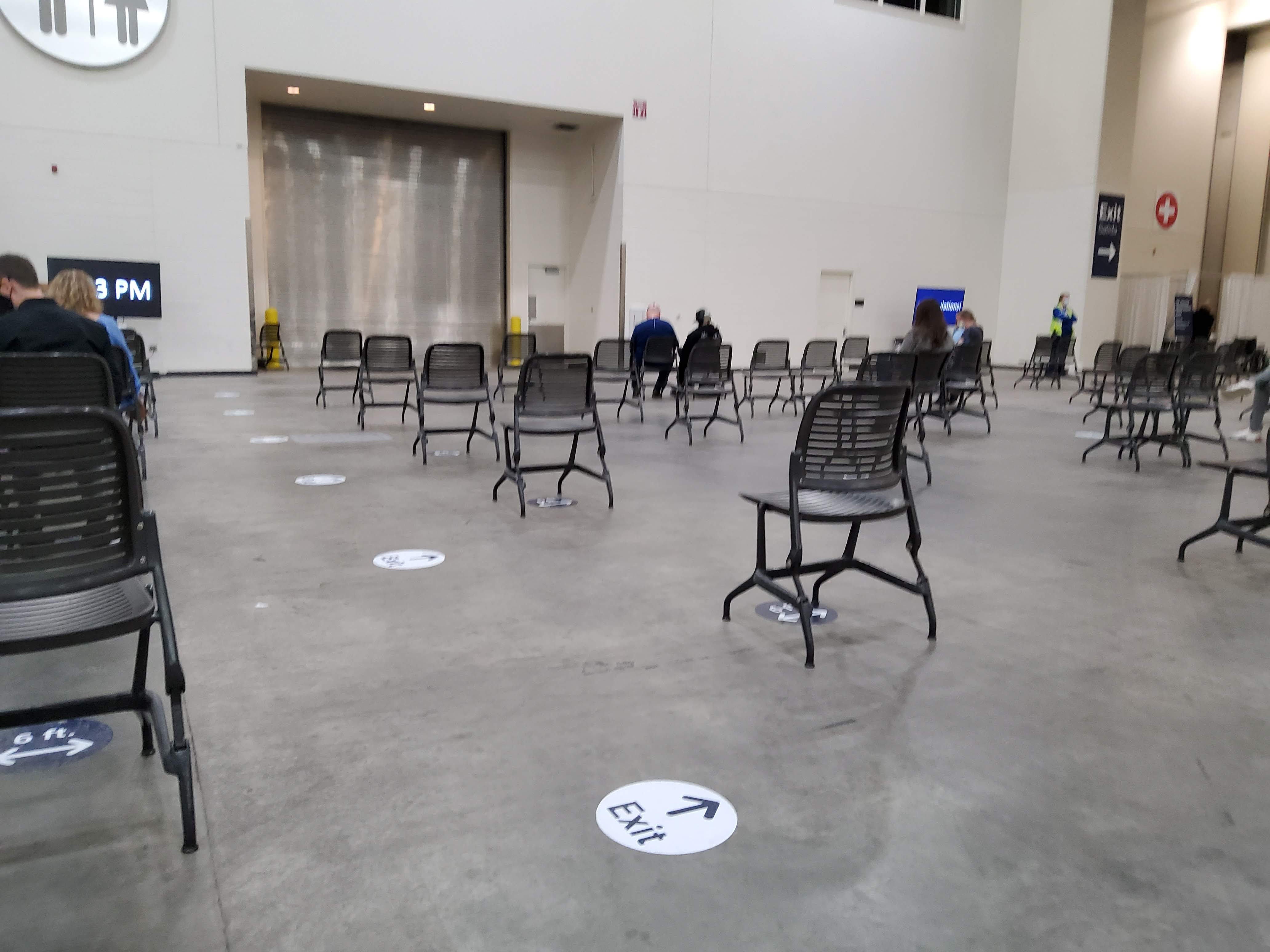
Either way, once the shots were done, it was time for the 15 minute cool-off period.  This was implemented because on rare occasions, people would go into anaphylactic shock after receiving the vaccine.  You really don\’t want that happening while the person is trying to drive home, or on a bus.  So instead they parked us in seats with a big clock to help us track the time.  Bathrooms were also available as needed.  

I\’ve tried to keep people\’s faces out of my pictures on account of not having their permission to appear in this blog, so you can\’t see the row of double-chairs for couples or pairs of friends that went together.  My spouse and I settled into one of those to wait out the 15 minutes.  It was a pretty uneventful wait, thankfully.  We did manage to meet up with our friend, and so we spent most of the time just chatting about whatever happened to be on our minds.  

Once the 15 minutes was up, we followed the obvious signs (and verbal directions) to leave Vaccine-Con.  

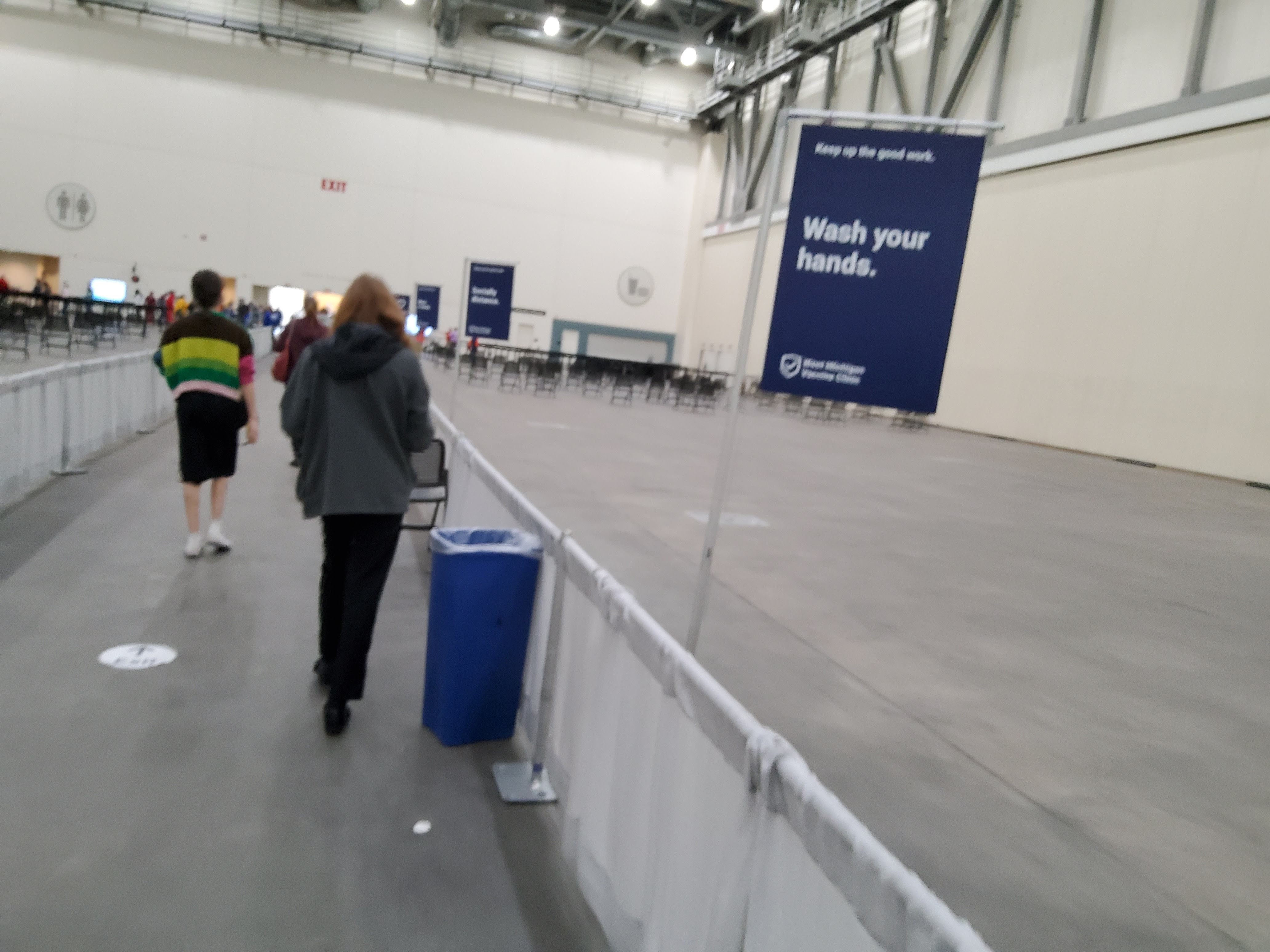
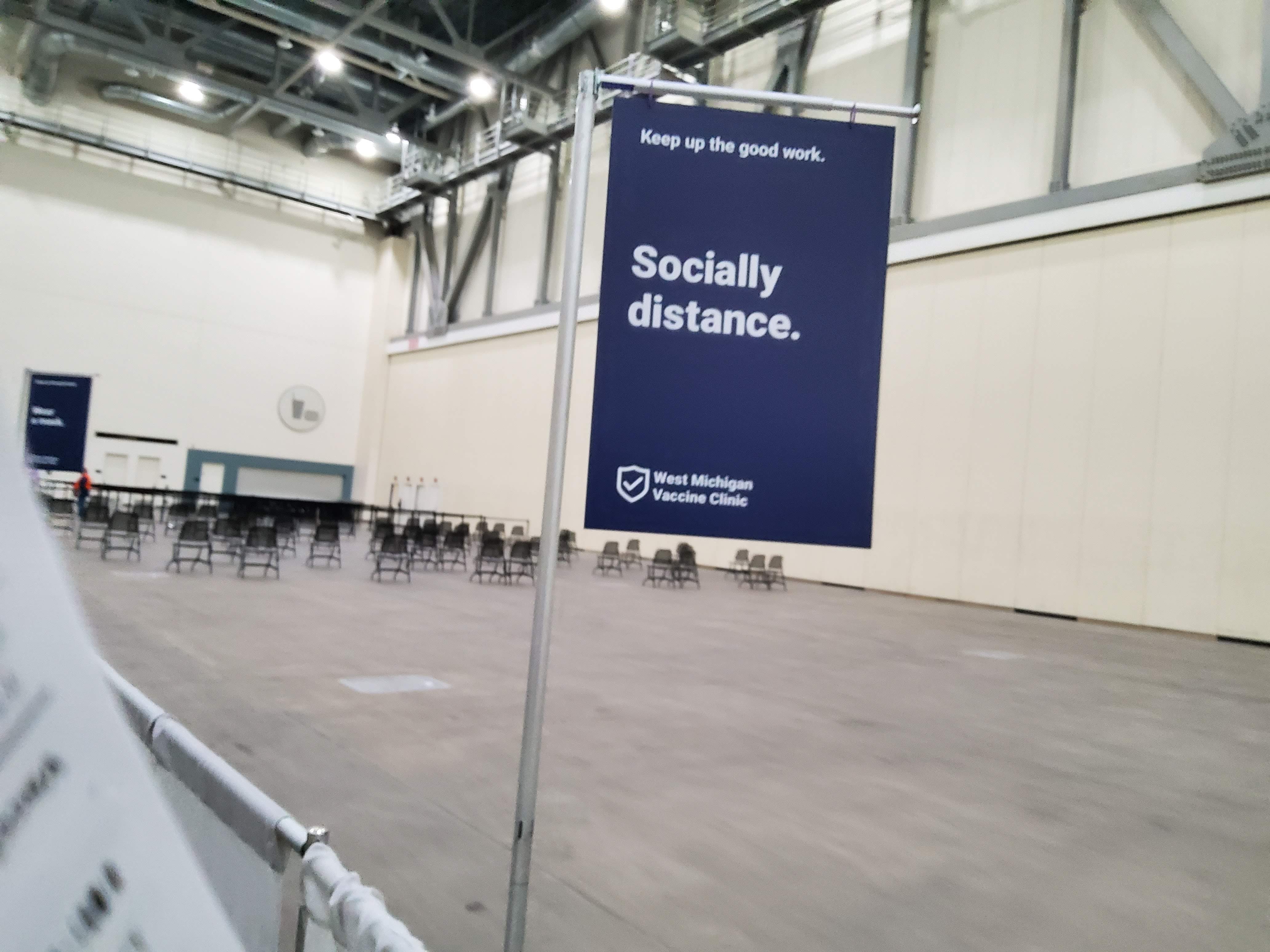
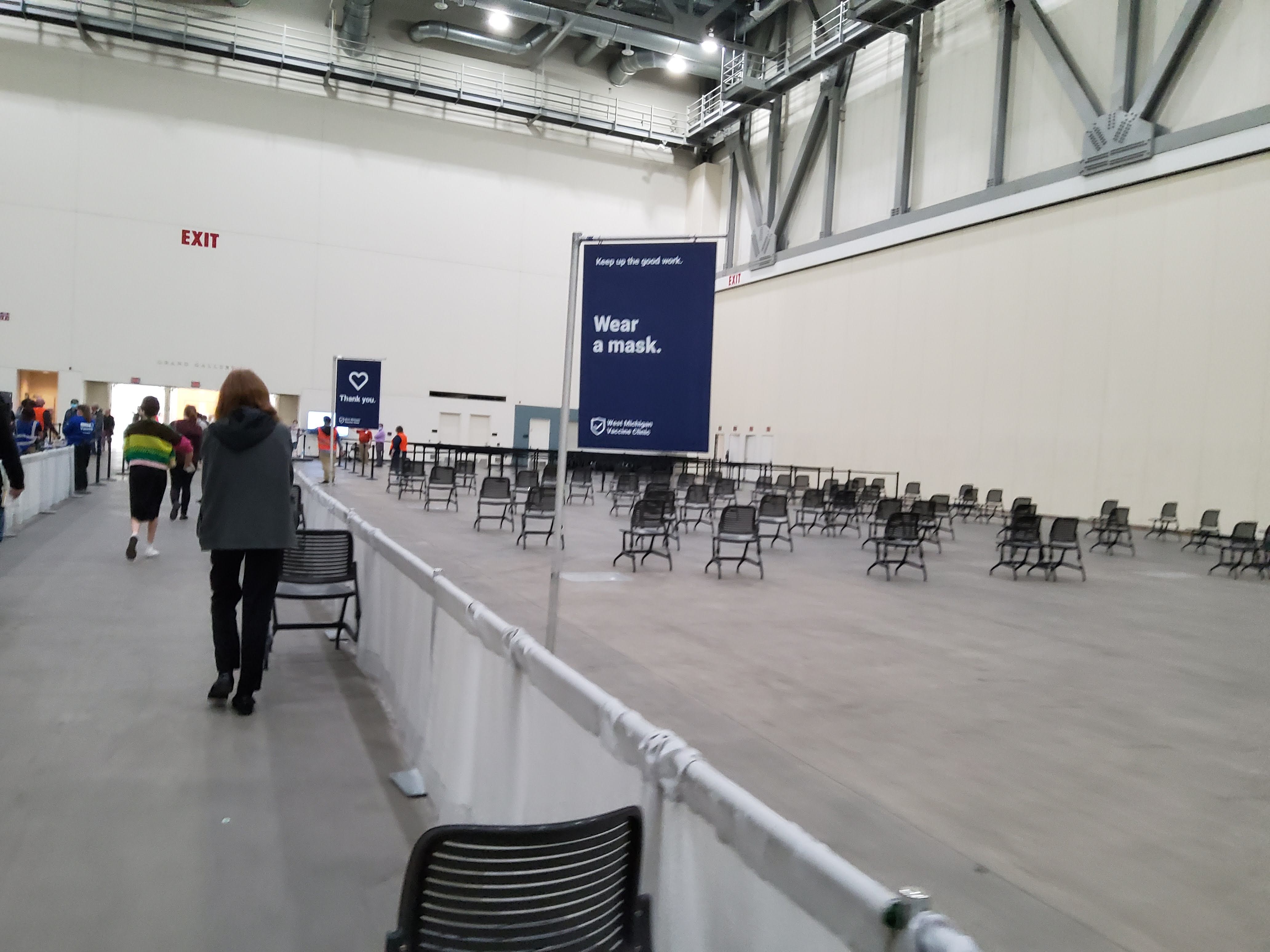
I can\’t begin to describe how big this place was… which I guess makes sense since it\’s a full-on convention center.  Still, as you can see, there was a lot of unused space.  We were lauded with various signs on the way out.  

The \”in the flow\” effect applied here, too.  My pictures aren\’t great because of that.  

From top to bottom, the signs read:
💗 You did it.
Keep up the good work.  Please remember:
Wash your hands.
Socially distance.
Wear a mask.
💗 Thank you.

I\’ll return here in about three weeks for my second dose, which we were able to schedule online within an hour of receiving the first dose.  

The side effects I experienced from this first shot were soreness, mind fog, malaise, and systemic inflammation, which I can now recognize as my neck being crickey-crackity, as well as swollen joints.  The inflammation could be treated with ibuprofen, though I opted not to this time since it wasn\’t that bad.  My spouse and friend only reported soreness in the arm.  

The second shot is said to be harder on the system than the first, so I may take that day off and just prepare to be dead on my feet.  It\’s either that, or I won\’t have symptoms at all, and I\’ll have a strong suspicion that I was an asymptomatic carrier sometime last year.  I can\’t decide which concept I dislike more, but thankfully I have zero choice in the matter.  Either I got it on one of the shopping trips I did during the pandemic, or I didn\’t.  

It\’ll still be two weeks after the second shot before I can really say \”I\’m safe and won\’t need to go to the hospital for this.\”  Even after that, it\’s still possible for me to carry the coronavirus asymptomatically and infect people who can\’t be vaccinated or refuse to do so. So I\’ll have to keep washing my cloth mask and expecting to wear it in the long term.  

Still, it\’ll be a relief.  Both for me and for the people that care about me.  

Inspiration Porn and Disability

This post is brought to you by the book I\’ll review for next week, but it\’s been an issue for years.  It crops up in local newspapers, in social media, even by word of mouth.  

Defining

What is it?  It\’s typically images, videos, articles, and memes of disabled people accomplishing something, used to motivate or shame abled people.  The gist is basically \”well if this disabled person can do it, of course you (an abled person) can!\”  There\’s a variant where the disabled person is the prop by which an abled person shows how nice/noble a person they are.

Inspiration porn is called this because it is objectifying just like regular porn.  No sex is involved, but it reduces our personalities, loves, hates, and quirks down to our disabilities, as if \”autism spectrum disorder\” or \”cerebral palsy\” or \”sacral agenesis\” tells you anything at all about the human involved.  It erases us and our struggles for the sake of the comfort and happiness of abled people.  

The Problem

I shouldn\’t have to tell most parents of autistic people that not all autistic people are the same.  My life\’s trajectory, as mainly a highly verbal loner without a community to support me, but successful in academia (though not outside it, really), is one possible route of many for autistic people.  

There are also autistic people that are raised by proverbial villages, and have massive support networks and people looking out for them.  There are autistic people with intellectual disability and autistic people with average intelligence.  There are autistic people who are savants, and autistic people without \”special interests\” or favorite hobbies they love intensely.  There are brilliant wordsmiths and nonspeaking people who are still incredibly gifted, thoughtful, intelligent humans.  It is, after all, a spectrum.  

Yet my life, if I were to get famous suddenly, would be boiled down to \”autism spectrum disorder.\”  Maybe \”Asperger\’s Syndrome\” to dissociate me from nonspeaking autistic people, as if I haven\’t spent several points in my adult life nearly or totally unable to communicate verbally.  And as if I don\’t share any traits with nonspeaking autistics, despite sensory sensitivities being very common, as well as depression and anxiety.  

It also demands that disabled people always be inspirational, for the benefit of abled people\’s pleasure and comfort.  It makes the sum total of our disability \”a burden to be overcome\” and refuses to acknowledge the social barriers that so often stand in our way.  And finally,  it reinforces the stereotype that disabled people are less competent and capable than abled people.  

An Example

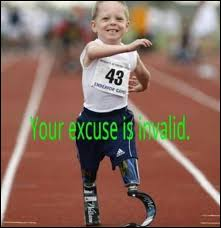
This is probably the first example I ran into, years and years ago, on Facebook.  

The text says \”Your excuse is invalid\” and the unwritten subtext is \”if this small child with prosthetic legs can get out there on a racetrack and enjoy running despite having no legs below the knee, you have no excuse for not doing whatever it is you\’re not doing.\”  

We know nothing at all about the child.  He is simply \”small white boy with prosthetic legs\” and his image is being used to guilt trip people for supposedly not accomplishing enough.  

I did some searching.  This child is now old enough to drive (and soon drink, too).  His name is Cody McCasland, a resident of Texas, and he\’s a serious athlete, but not a runner.  Running is a hobby.  He\’s a swimmer, with hopes of competing in the 2020 Paralympics.  And according to his bio on a website, he also wants to be an anesthesiologist, in part due to all the time he\’s spent in the hospital (30ish surgeries).  

Looking at the information from the media, it seems Cody has leaned into the publicity to some extent.  I sifted through a dozen or so articles, and all they typically wanted to do was rehash what amazing odds Cody beat, his promise as an athlete, and how wonderful that all is.  

Nothing is said about the difficulties inherent in affording, using, and cleaning prosthetic limbs.  Nothing about how many types of limbs he has, or why you can\’t just have one set for everything.  Nothing is asked about Cody\’s high school experience, his home life, any siblings… Nothing about the stares he inevitably gets from strangers, nor the invasive questions.  Nothing about him is of interest except his \”overcoming\” of his disability.  

In summary, Cody McCasland is reduced down to his disability, his struggles are omitted, and he is merely a prop in this picture.  His triumph is reduced to a bludgeon that, in the best case, might be used positively to elbow an abled person into starting to be healthier.  It might also be used to guilt trip someone with an invisible disability, because \”well you have both legs, so get out there!\”  (left unsaid: \”I neither understand nor care that you have chronic back pain or some weird allergy that makes you utterly miserable when you do moderate to high intensity exercise\”).

Let\’s look at an article from a prosthetic arm user.  Let\’s see, it\’s titled, \”I have one of those most advanced prosthetic arms in the world — and I hate it.\”  Hmm, can we guess how this is going to go?  The article is worth your read, by the way.  Real talk from someone whose life is unfamiliar to you often is.  She\’s even included short videos of her using the limbs.  

Generalizing Disabilities

There\’s one more issue with generalizing Cody\’s story to every possible situation, sitting back, and saying, \”well if he can do it, anyone can!\”  

Let\’s start by noting the obvious: Cody\’s disability is physical.  His legs from above the knee are flesh and blood, and below that do not exist due to a major difference in his DNA.  To move around at a normal height, he uses prosthetic legs.  This is a visible, physical disability.  

Visible disabilities mean you get stares and invasive questions.  This is typically unwanted.  However, because your difference is obvious, no one questions whether it is real.  An invisible disability, like mental illness or autism, can be disbelieved.  A person can decide, after looking at you, that your struggles are not real.  Seeing, as they say, is believing.  

Physical disabilities tend to be visible, but they don\’t need to be.  Chronic joint pain, fibromyalgia, and blindness without the person carrying a white cane or some other identifier are all physical disabilities, but not simple ones to notice in a second or two.  

Invisible disabilities include a spectrum of things people don\’t necessarily notice or care about, including depression, anxiety disorders, chronic back pain, chronic dizziness, diabetes, sleep disorders, chronic fatigue, and agoraphobia.  Because no apparent disability is noticed, the effects of these disabilities may be blamed on the sufferer\’s innate qualities.  

Instead of recognizing the very reasonable tiredness and reduced performance of a sufferer of insomnia, people might instead decide she simply isn\’t trying hard enough, or that her sleepiness is because she\’s too busy partying to adhere to a normal sleep schedule.  In reality, she may have spent hours lying in bed, fruitlessly trying everything in her power (from podcasts to boring textbooks to exercise to adult coloring books) to get to sleep, all as the clock mercilessly ticks onward towards the next work day.  

So while Cody\’s disability is clear, obvious, and the path to addressing the disability is clear… that is not the case for other disabilities.  

One need really only look at autism for a demonstration of this.  Some autistic people can find sensory relief in small perfume jars, swatches of fabric, or particular blankets.  Others would find those things ineffective or torturous.  Some autistic people suffer from gut dysbiosis or allergies, and need to eat according to special diets.  Choosing the wrong diet can be terribly painful.  Still others benefit from basic lessons in the mechanics of conversations.  I, however, would find such lessons irritating at best.  

What works for one autistic person does not necessarily work for another.  This is pretty common knowledge, immortalized in the saying, \”If you\’ve met one person with autism, you\’ve met one person with autism.\”

Saying, \”well this kid with a clear disability has a harder life than you, and still is doing this thing, so why aren\’t you doing this thing?\” is insulting not only to him, but to the person you\’re talking to, who may have struggles you don\’t know anything about.  

For further reading, please consult this article, which also links to an excellent TEDx talk.