Types of Stigma: Label Avoidance

Type 4: Label Avoidance

Label Avoidance is when a person chooses not to seek out a professional or school diagnosis, therapy, or even community support to avoid being assigned a stigmatizing label.

You can find this behavior in both parents and adults.  It derives from the other types of stigma.  When people have mistaken ideas of what autism is, what it means for the future, and what autistic people are like, they can be very closed-minded to even the thought of being autistic themselves, or someone they love being autistic.

The classical example of this is the parents of an autistic child noticing their child is different, taking the child to the doctor, receiving the suggestion to get them screened for autism, and promptly going home declaring, \”well that\’s clearly not it, that doctor is a hack.\”  This, and variations thereof, are repeated endlessly in \”my family\’s experience with autism\” books.  Naturally, ignoring a developmental disability does not make it go away.

Usually it\’s the mother that gets past the reluctance first.  She sees her child struggling and understands that something is up, regardless of how she feels about the label.  She eventually takes the child for testing, and receives the label.  There may then be a period of anger, resistance, and mourning while the parents adjust their expectations for their child and come to grips with reality… but this mourning is often overblown.  The stigma about autism is that it destroys lives and the child can never have anything close to a \”normal life.\”  (I have Opinions about \”a normal life\” and its expectations, by the way.)

You can also find this behavior in autistic adults and teens.  There are several reasons for this.

First, there\’s the same basic misconception that parents start out with: \”If I acknowledge this difference and receive this diagnosis, my life [my child\’s life] as I\’ve dreamt it will be over and I\’ll [they\’ll] be confined to an institution.\”  The reality is that a diagnosis doesn\’t change who the person is, nor does it change their capabilities.  It\’s simply a word or some words that you can use to start understanding yourself or someone else, or even use to acquire support in doing what you want to do with your life.

Then there\’s the fact that autism has been used as an insult in some circles (including in online video games) to describe people who are being thoughtless, rude, stupid, cruel, or otherwise acting intolerably.  While these adjectives are a poor description of most autistic people, this alternative definition can fuel a rejection of the psychological diagnosis.

There\’s also the deep end of, \”I\’m a person (not a cripple/weird/whatever) and I want to be treated like everyone else.\” Often, we, like any person, want to succeed on our own merit.  After years of being expected to act \”normal,\” autistic people may reject any label that would acknowledge the impossibility of that expectation.  Or even after acquiring the label, refuse to use it in college or in the workforce (when we typically have a chance to make our own decisions for the first time).

In general, because of how this stigma and the other stigmas work, I tend to only tell people to seek out a diagnosis if they think it\’ll help, and not bother if they\’re not sure or think it\’d be negative.  In a perfect world, the diagnosis would only help people and give them a path forward, a community, and a better understanding of themselves.  In the world we live in, all these stigmas and more exist, and we have to do the best we can under the circumstances. 

Types of Stigma: Perceived Stigma

Type 3: Perceived Stigma

Perceived Stigma is the belief that others have negative beliefs (or Public Stigma) about autistic people.  This goes hand in hand with the previous type, Self-Stigma, because humans tend to believe that others think the same way they do.  
So if you believe autism is the Autism Speaks\’ brand of evil possessing demon, you tend to also assume others believe this as well.  If you happen to be autistic and you believe this, even unwillingly, it can feel like others believe you\’re the devil incarnate.  Needless to say, this is incredibly destructive to a person\’s wellbeing and ability to trust and enjoy other people.

I haven\’t run into a lot of autistic people that believe they\’re possessed by an autism-devil.  What I do tend to see is people that self-sabotage or at least have beliefs that hold them back from living their best lives.  They have internalized significant self-stigma, and then make the classical human error of assuming everyone else believes the same things.

So rather than saying, \”I\’m evil and everyone believes I\’m evil,\” they might say, \”I\’m incapable of holding a job because I\’m autistic and everyone knows that, so there\’s no point in trying to get a job.\”  The person will then only halfheartedly apply for jobs, not seek out opportunities, and even not take advantage of options directly in front of them.

Or they may hide their diagnosis, believing, \”I\’m terrible/worthless/incapable/a failure because I\’m autistic and if anyone finds out I\’m autistic, they\’ll believe I\’m terrible/worthless/incapable/a failure also.\”  This also crosses into next time\’s stigma, Label Avoidance.

You can also see this stigma in parents of autistic children.  When your kid is having a noisy meltdown in a public place, the typical assumption made by the parents of that kid is that everyone is staring and making the assumption that it\’s a tantrum because those parents are lazy and terrible.  This assumption may or may not be true.  People do tend to look at a source of noise, and there are certainly enough personal stories of passersby accusing the parents of poor parenting.  (An aside: \”Control your child\” is about the dumbest demand I\’ve ever heard, given that a child is literally a small human and all humans have free will.)

In all honesty, though?  My understanding is that a lot of parents see that meltdown situation and go, \”been there, done that, it sucks to be those poor people.\”  I personally (not a parent) just tend to pay as little attention as possible.  The screams hurt my ears and wreck my brain, but if it\’s a tantrum I don\’t want to signal the kid that this is an acceptable method of getting what they want.  If it\’s a meltdown, more attention won\’t help but could very well make the meltdown worse.

The trick about this type of stigma is that it\’s not required to be accurate.  There is a significant public stigma around autism.  However, most people don\’t have a full or even partial understanding of that stigma, or even the ideas behind it.  Most people just don\’t know a lot about autism at all, in fact.  Autism, in addition, is often an invisible disability.  So assuming people are automatically demonizing you isn\’t productive or even accurate.

Types of Stigma: Self-Stigma

Type 2: Self-Stigma

Self-stigma happens when an autistic person (or family member of an autistic person) internalizes public stigma.

Last week I gave some rather hideous examples of public stigma.  While some autistic people are resistant to a certain amount of the vile fearmongering lies spewed out by Autism Speaks and similar organizations, we still live in the same spaces as everyone else.  With sufficient repetition, we may begin to believe these venomous ideas.

A relateable example to start with: I have rather thoroughly internalized the idea that I will never be beautiful.  This was never told to me directly.   Instead, it was repeatedly shown to me.  The women on television, on the covers of magazines, and in real life who are usually considered beautiful or attractive are very thin.  Their hips are narrow, and they have little, if any, extra fat.  They are usually of average height.  Their complexions are (unrealistically) flawless.  They do not have bad hair days.

None of this is me.  It\’s literally not in my genetics to look like that.  It\’s not in most peoples\’ genetics to look like that.  The standards are intensely unfair and unrealistic, and poisonous to self-esteem.  In this particular case, fortunately, I don\’t give a crap about being beautiful, because I value other things much more highly.

A more direct example now: stimming.  Stimming, as I\’ve pointed out recently, serves a purpose.  It helps the person regulate themselves or express emotions (positive and negative), which results in a happier, healthier person, and fewer meltdowns.  Pragmatically speaking, you would think everyone would be on board with this plan.  Fewer meltdowns and happier people is good, right?

But no, because it\’s \”too weird,\” autistic people are taught (via ABA or simply others\’ reactions) that it\’s not okay to stim.  We\’re told this is bad behavior, and that we\’re bad for doing it.  We\’re told it makes others uncomfortable (because others\’ reactions and then their decisions after those reactions are somehow our problem).  Essentially, we\’re shamed for being ourselves.  Like the impossibly perfect celebrities on TV and the covers of magazines, this is repeated over and over.

There\’s also the ideas that autistic people are damaged, can\’t feel emotions, don\’t have empathy, or in some really special cases, that autism doesn\’t even exist.  There\’s an account here of a person\’s experience with a few of these ideas.  Thankfully for her and for all of us, she\’s resisting and calling out those toxic ideas.

But I can say from personal experience that some people do believe them.  I actually had a friend tell me that she\’d believed for years that I had no empathy until I literally called it out as a stupid myth.  This was after I\’d spent years literally living my empathy: sharing her trials, being there to listen when she was upset, even bringing small treats or activities for special occasions.

This friend is not stupid, by the way.  She\’s a very caring, intelligent, lively human, and I\’m glad to be part of her life.  My anger and sadness about this revelation was balanced by the fact that she was brave enough to admit it to my face and face the consequences, and the fact that, even believing that garbage, she was still willing to befriend me when I\’m not the easiest person to befriend.

My best guess is that she was told this thing, that autistic people don\’t have empathy, relatively young, by someone whose authority she trusted.  She therefore internalized it without question, and because massive errors in communication can look like a lack of empathy without context, it was reinforced at points.

If anyone didn\’t know?  Yes, I do have empathy, thank you.  Autistic people can be jarringly pragmatic, or not recognize a situation as one meriting a more sensitive response, but that\’s not a lack of empathy, it\’s a difference in how the person views a situation.  

Venomous ideas like this can destroy marriages and families.  They alienate us from our communities.  They also drive autistic people to suicide and increase suicidal thoughtsDepression and anxiety are considered comorbid with autism, meaning that those mental illnesses are commonly found in higher rates in autistic people.  No surprise, given all these ideas we\’ve partially or entirely internalized.

I\’m 31 years old, having gotten my diagnosis over a decade ago, and I still half-believe I\’m a broken sub-human, because I was never like everyone else.  Being myself was wrong: it got me bullied, rejected, and alienated.  I know, cognitively, that this internalized idea is wrong.  I fight it every day, while I balance \”not weirding out the normies\” with being myself.  Most days, I think sanity is winning.  But on bad days, it\’s harder to believe that I\’m not the twisted, fundamentally broken, less-than-a-human people constantly imply or even outright say I am.

Generally we don\’t talk about self-stigma that much.  Usually the norm for polite conversation goes with you everywhere, so when someone asks you how you\’re doing, you do not say, \”Well, I\’m a little underrested due to family drama and I forgot to take my pills today, so everything\’s kind of an anxious haze, what about you?\”  You lie, and you say, \”Oh, fine.\”  You don\’t talk about how mental illness affects you and so many others, and you certainly don\’t address how you have personally been affected by the destructive lies about mental illness.  Possibly, you don\’t even think about it.

The Internet has allowed people the safety of anonymity, though.  People who do think about it and are suffering will sometimes put cries for help on places like Reddit, in the National Autistic Society\’s forums, and on personal blogs and social media.  These cries are often answered by autistic communities and outspoken autism activists.  Even with such ready support, it\’s hard to unlearn this kind of stigma.  You can\’t simply find a safe space where people truly believe neurodiversity is a positive thing.  Your own skull contains the poison.

Surrounding yourself with knowledgeable fellow-sufferers-and-fighters can help, though.  Here\’s a link to an excellent list of resources to help.

With time, support, and effort, Self-Stigma can be fought.  With care, it can be countered before it becomes a poisonous, self-destructive force inside a person.  

Types of Stigma: Public Stigma

During my search for new and interesting autism-relevant research, I ran across an article talking about the types of stigma experienced by parents of autistic people.  It included two types of stigma I\’d never heard of before.

I have a psychology degree, a decent amount of experience with stigma, and a general interest in such things, so I did some research… and I found there\’s a whole bunch of types of stigma.  I also hit upon a nice infographic, which I\’ll repost here.  I\’ll go through each of the types with autism-relevant examples from my experiences and reading.

Type 1: Public Stigma.  

This happens when the public endorses negative stereotypes and prejudices, resulting in discrimination against people with autism.  

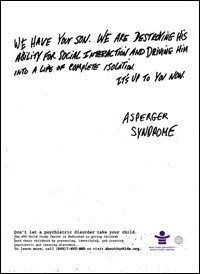
The charming \”Ransom Note\” public campaign by New York University is a good example of this.

Text: We have your son.  We are destroying his ability for social interaction and driving him into a life of complete isolation.  It\’s up to you now. ~Asperger Syndrome

This is stigmatizing in a few ways.  First, social interaction and your ability thereof is a skill… i.e., something that can be learned.  So, no, there is no destruction here, it\’s simply that the child may need extra support to learn those social skills.

Second, do you know why autistic people tend to be more isolated?  It\’s not because we don\’t want friends, or don\’t try.  It\’s because neurotypical people tend to reject people different than them.  When that happens over and over, the person loses the desire to try again.  Saying that\’s their autism\’s fault is not only absurd, it\’s literally the opposite of the problem.

Third, this ad commits the idiocy of assuming you can remove the autism from the autistic.  You can ease the ways an autistic person suffers, like providing sensory support, treating depression and anxiety, allowing them to make decisions (and mistakes!) on their own terms.  And the results may be that they act less \”weird,\” which is then mistaken for \”less autistic.\”  The fact remains that you cannot cure or remove autism, which is a neurologically-based difference, from an autistic human.

This campaign, and others like it, have informed the public opinion of autism.  We are, apparently, a disease, threatening, and something to be feared.  This was the message given to the general public.

Here\’s another horrifying ad by Autism Speaks (stupid name; no autistic people are listened to there).  And here\’s the transcript, in case, like me, you can\’t follow the whole thing.

They\’ve personified autism into some kind of malevolent disease-demon, infecting innocent children and making them have greater challenges than most kids.  Autism Speaks is happy to blame disintegrating marriages on this nonexistent entity rather than the actual children, while demonizing what makes those children unique.

Autism, to Autism Speaks (bullshit name), is nothing less than evil.  Which they, of course, have set themselves up as the \”Good\” to fight against.  There\’s a lovely message of universality, with mentions of various countries and religions.

It\’s a pity it all misses the truth, which is that there is no demon.  If autism has a representative, it\’s your children.  It\’s adults like me.  It\’s the collective community we adults have built.  We don\’t want your marriage to fail any more than we want our own relationships to fail.  We don\’t want you to go bankrupt paying for therapy that traumatizes and stigmatizes us.  We certainly don\’t want you to lose hope.

Mostly, what we want is to be ourselves.  To not be rejected for being different.  No amount of demonizing autism will make that happen.

Some excellent general examples of the typical public stigma experience can be found in the article here.  Highlights include, \”autistic people don\’t have empathy/can\’t feel emotions,\” \”autistic people are damaged,\” and how autistic children are all apparently soul-draining, life-destroying monsters (due to how some parents talk about them).

All of these are examples of Public Stigma, the first of seven types of stigma.  

Autism Panel for Med Students: a summary

About a month ago, I had the privilege of speaking to a group of medical students, most of them on track to become the doctors of tomorrow.  I was asked to make a speech to introduce the subject and lead into the panel discussion of autism and medicine.  Below is the speech, a link to the handout, and my answers to the questions the panel members were given.  I\’ll also include a summary of what other panel members said.

———————

Good evening, and thank you for coming.

Before we begin, a note.  We, the autistic people before you, represent a small portion of the autism spectrum.  We\’re the ones who are verbal enough and organized enough to sit before you in a strange place, prepared to talk about ourselves in coherent detail.  Not everyone you run into in your careers will be able to do this.

In fact, depending on how much stress we\’re under, WE OURSELVES may not always be able to do this.  So the first thing I want you to know is that there are many forms of communication, and what we\’ll do here is only the most mainstream form: verbal speech, supplemented by body language.

This form of communication is what most of society runs on, and our proficiency in it is why we were chosen to be here.  There are other kinds of valid communication, including behavior, sign language, texting, the Picture Exchange System, and text-to-speech apps.  I would strongly encourage you to acquire a passing familiarity with these forms of communication, at least enough to recognize them so you know what to Google.  (smile)  Quite frankly, I expect these forms of communication to become more mainstream as our understanding of autism and nonspeaking humans advances.

So, what is autism?  I\’ve read a lot of books on the subject, and most of them start out with giving the DSM\’s definition.  That\’s the American Psychological Association\’s diagnostic manual.  And y\’know, I could do that, but quite frankly, when I got my diagnosis about a decade ago, those criteria were useless.  So I\’m going to skip them.  I have a bachelor\’s degree in psychology, and I\’m going to tell you that diagnostic criteria for brain differences and mental disorders are far more theory than practicality.

You can rely on the diagnostic criteria for physical diseases like hives or measles because they\’re well understood.  You can\’t, or at least shouldn\’t rely on the criteria for neurological differences and disorders, because quite frankly the APA is grasping at straws.  They\’re trying their best, but apparently the human mind and the human brain are one of the most complicated subjects we as a species have ever tried to study.

Our current best understanding of autism relies on brain scans.  When put under an fMRI, there are functional differences between an autistic brain and a normally developing one.  Some parts of an autistic brain may be over- or under-developed by comparison to the \”typical human brain.\”  The connections between those parts may be stronger or weaker than average.  You can get a wide variety of traits as a result of these differences in our mental machinery.  The most common ones are socially-oriented: things like difficulty reading body language, difficulty reading facial expressions, and difficulty reading tones of voice.

The difficulty goes both ways: sometimes you find flat or singsong tones of voice in autistic people, or a very flat facial expression that doesn\’t convey much emotion, or very rigid and uncommunicative posture.  You can also get things like gastro-intestinal disorders, diet sensitivities, sleep disorders, anxiety disorders, sensory sensitivities, executive function difficulties, and depression.

There are tradeoffs, though.  An autistic person who loves their hobby is one of the most devoted and knowledgeable people you could hope to talk to about that hobby.  As a spouse or a friend, an autistic person tends to be extremely loyal.  We tend to have strong senses of justice.  We also tend towards literal-mindedness, directness and honesty, rather than playing mind games and carefully selecting socially appropriate white lies.  Physical appearances, things like what brands you wear, how perfect your makeup is, and how coordinated your clothes are… these things mean less to us than WHO you are, and what things you like.

Finally, autistic people bring fundamentally different points of view to any discussion.  We are, in essence, different.  That can provoke misunderstandings and slow things down, but it can also be helpful.

For example, when my spouse and I finally gathered enough money to be able to house-hunt, we were told to pick some important things we wanted in a house, tell them to the realtor, and then look around until we found a house we loved.  My spouse may have been happy to do that, but I preferred to consider, in exhaustive detail, every aspect of the house I wanted to live in.

Things like 3 prong electrical outlets, the presence of a bathtub, number of bathrooms, number of shared walls, the tax rate, how the tap water tasted, the age of the roof, the amount of nature around the house, and the average time to Meijer, my parents\’ retirement home, and his workplace.  All of these things were excruciatingly given priorities and point values and put into a spreadsheet, which we filled out for every home we looked at.  Each home received a score at the end, which we used to help determine whether we wanted to put an offer on the home or not.

This was far more work and annoyance than most people would bother with, but I considered it worth the time so that we could find a home we would be happy in for decades.  Was all this work atypical?  Definitely.  Was it worthwhile?  Definitely, at least in my opinion.  My autism, weirdness and all, helped me find a place I genuinely enjoy living in, and my family is better off because of it.

Which brings me to my last point.  In recent years, autistic people have developed communities and schools of thought about ourselves, our difficulties, and our successes.  One of the major philosophies to come out of this coordination is neurodiversity.

Essentially, neurodiversity is the idea that the human race is better with neurological diversity.  That autism is not a disease to be cured, but a difference that should be supported and respected.  That isn\’t to say that autistic people don\’t need help, or that being autistic doesn\’t come with hardships.  It\’s merely to say that without us, you are all made less.  The human race needs people with different points of view, because it takes new and weird ideas to come up with the new and weird inventions that keep humanity moving forward.

Temple Grandin redesigned cattle facilities and slaughterhouses to be more efficient and humane.  John Elder Robison created astonishing new sounds and flaming guitars for the band KISS.  Bill Gates and Steve Jobs transformed the world as we know it with personal computers and iPhones.

Each autistic person is different.  Personally, I can\’t design a slaughterhouse or an iPhone, but I can stand here before you, the medical professionals of tomorrow, and attempt to bridge our worlds.  I firmly believe the world is better with all of us: neurotypical and neurodiverse together.

Thank you.

————————

Link to the handout

————————

Panel Questions

1.  What are you doing now or have you done recently that is a success for you – either because if or in spite of your ASD?

I went to Reston, VA, near the capitol in DC to help direct the Autism Research Program\’s use of US tax dollars.  They contract consumers (ie: people affected by the issue at hand) as well as scientific reviewers of various types.  Each application is reviewed through a set of processes, and eventually a final score is assigned.

From those scores, the most scientifically rigorous and most useful-to-the-community studies are chosen to be funded.  It was an exhausting opportunity, but a worthwhile one.

Most other panel members spoke about their jobs, or personal successes.

2.  Tell us about your support system.  If you want to, you can include your age of diagnosis.

My support system is complicated.

I try to eat dairy-free, because I\’ve noted dairy products tend to send my mood into a downward spiral.  I don\’t know why this is, but it\’s a clear enough effect that I noticed.  I also have my supplements, which at this point is up to 8 pills in the morning, and 4 at night.  These include multivitamins as well as specific minerals and vitamins I tend to be deficient in.

In addition to these, I try to exercise 2-3 days a week.  I see a therapist once every two weeks, where she administers a form of neurofeedback called LENS as well as more traditional talk therapy and managing my supplements.

Other panel members spoke extensively about their families, mostly, some also about their friends.  They mentioned relying on these people to \”get them,\” and advocate for them when they can\’t do so for themselves.

3.  What would you like people to know about autism?  What do you think are some common misconceptions?

Mostly, that we grow up.  The general perception of autism is that of a white male child of perhaps 6 years of age, obnoxiously trapped behind a warped pane of glass.  In fact, the average age of an autistic person is 19, and many of us are people of color, born female, and gender minorities.

Those of us that can blend into the general population often choose to do so, because of the stigma and infantilization of autistic people.  High support needs are equated with being a child or being stupid, and they shouldn\’t be.  But that can drive those of us who are verbal to feel isolated, and unwilling to identify publicly as autistic.

Other common misperceptions included the specific symptoms and presentation of autism.  Women in particular tend to not have the same kinds of symptoms as men, so sometimes an autistic person, or even a small child, is dismissed out of hand for not being like the \”classical autism\” which was described mainly around male children.

4. How do you respond in situations if you\’re scared or worried?  How might you respond in an ER or in a traffic accident?

This is rare for me after three decades of life, but if I have no script or sense for what I should be doing, I tend to freeze.  When sufficiently stressed or when my brain has become too \”worded out\”, I can become nonverbal or very low-verbal.

Other panel members described being fully verbal but completely incapable of handling any decision-making.  One even said she would need to be talked down, preferably with subjects like her favorite TV show, before she\’d be able to engage with an emergency situation.

Another spoke of having a completely abnormal response to a traffic accident, where the panic and stress reaction that neurotypical humans experience quite literally didn\’t kick in.  While the driver of her car was still locked into gripping the steering wheel, she got out of the car, inspected the damage, and found it was a very minor accident.

5.  If you are a person who experiences sensory overload, would you prefer a quiet room in healthcare?  How is the noise level/stimulation in current healthcare areas now?

I am definitely sound-sensitive.  I\’m not sure there is anything that counts as a quiet room in healthcare.  I\’ve been in hospitals, they make me fervently hope I never have to go back.  There\’s always people moving and talking in the hallways, the sounds of machines and medical equipment inside the rooms, the fan or climate control going…

These were nice hospitals, too.  Pleasant staff, lots of windows, art on the walls, all of that.  I can\’t imagine trying to heal and recover in such a place.  I\’m no longer surprised when I go to visit someone in the hospital and they look terrible.  Nobody looks good in a hospital.  They\’re just not good places to be, to me.

There was no disagreement on this subject.  Not one of the four of us found hospitals a relaxing, pleasant environment.

6.  What can a neurotypical physician do to help communicate with a person with autism?

I mentioned this above, but it merits the repetition: learn about and be open to \”nonstandard\” forms of communication.  The Picture Exchange Communication System is one of these.  Sign language, text-to-speech apps, and texting itself are others, and there are more.

Other panel members noted that it\’s best to presume competence (ie: treat the autistic person like they\’re a person, and assume they know what they\’re talking about even if they can\’t express it perfectly).  They also appreciated a willingness to listen, and patience when a person has difficulty giving a succinct answer.

7.  What has a physician done for you that was helpful?  Unhelpful?

I\’ve found self-directed care to be the most useful.  Giving me the information I need to make my own decisions, rather than simply writing a prescription and making the judgement call themselves, was empowering.  Believing me when I describe symptoms that don\’t fit neatly into a medical textbook also features high on the list.  I\’ve had primary care practitioners that either didn\’t do this or didn\’t care because they had such a high caseload or just… didn\’t care overall.  

Fortune Cookie Rant: “Uniqueness”

Fortune from a fortune cookie: Your uniqueness is more than an outward experience.
Fortune cookie: “Your uniqueness is more than an outward experience.”
I went to a Chinese buffet this week. This came out of my fortune cookie. I think the creator of this “fortune” (note: not a fortune, not even advice) meant to be complimentary. Like, “I, this little scrap of paper with some semblance of cultural authority, written by some American wherever this cookie was produced, believe you (a stranger I’ve never met) to be truly unique.” In fact, when I showed it to the friend I’d gone to the buffet with, that’s exactly how they took it.

Me? I looked at the little scrap of paper, scowled, and said, “Well DUH. Ugh.”

So here’s the thing about being autistic and being able to blend in somewhat. Short of when you’re alone, you pretty much never get to forget about it. You are always measuring how you’re doing, how you’re interacting with others, how others are interacting with you, what the environment is like, etc. This is not, frankly, an enviable position, and I don’t enjoy being in it. I recognize it as a necessary evil in order to keep the broad neurotypical majority comfortable, so they’ll treat me like I’m a human rather than a child or something subhuman.

Think I’m being harsh? Here, read this. Or this. Or even this. Autistic lives are lost all the time to situations like this. What doesn’t usually make the news is the other costs of not fitting in. Things like not being able to keep a job, and being unable to find friends. The depression and anxiety that come with those situations piles complications on top of an already complicated life.

Humans are pulled two ways, in terms of this question. We’re a social species. We like to fit in, to be understood, to be part of a community (sameness). But we also like to stand apart in good ways, be valuable for ourselves, be unique (difference). Two sides of a line spectrum. Most people fall somewhere in the middle. I fall somewhere towards the “uniqueness” side and farther away from the “fits in” side.

I got my diagnosis about a decade ago. After I finished being confused about how the DSM criteria didn’t really describe me, I experienced a deep surge of despair and bitterness. I’d spent from about age 10 to about age 20 trying to learn how to fit in, without compromising myself too much. Receiving my diagnosis was the death knell for my hopes of ever finding some place to fit in. I’d tried very hard, but the answer was that it was never going to be enough.

Am I unique? Absolutely. Everyone is to some extent. No two humans are the same. Am I more distinctively unique than most? Probably. I have a strong personality and will, definite viewpoints and opinions, interests, etc. I don’t need a fortune cookie to tell me I’m a unique person. Mostly, it just underlines to me how different I’m always going to be.

My best hope is to try to build a world where it’s not so isolating to be so unique.

I Don’t Do Excitement: Handling Emotions While Autistic

I had kind of an interesting and educational experience last Tuesday.  Briefly, I was invited to help lead and speak on a panel to educate med students about autism.  It was myself and three other autistic people.  This was, thank God, the last major thing this month besides a dual party for myself and a friend.

I wrote the bones of my speech the day before, the speech itself the day of, and then I spent another hour or so putting together a handout with further reading and the main points of the speech.  Because I\’ve been a student and I swear to you, lectures are the least useful way to convey information.

After all this was done, I had about two hours before I needed to leave.  This left me sitting in anticipation.  I assessed the emotion absently, labeled it anxiety, and proceeded to put on depression music to shift my emotional state.  Basically it\’s the kind of sad/angry music you can kind of drown in, which helps you feel understood and also feel calmer, though not better.  I\’ve done this before, and it works quite well.

But I thought about it as I listened to the music, and realized that I was probably going about things wrong.  The anxiety feeling was uncomfortable in its strength, but the situation I was heading to wasn\’t really a bad situation.  It was simply new and important.  If I kept the depression music on, I would be less anxious, but I\’d also approach the situation with resignation and sadness.  That wasn\’t a good attitude to bring to these medical students. 

I also recalled the podcast I\’d listened to a few months back, which mentioned that emotions can be boiled down to two spectrums: wound up-calm, and positive-negative.  Excitement, you see, is merely positive anxiety.  Physiologically, they\’re exactly the same.  The difference is in how you mentally view the situation.

This realization made me realize I honestly don\’t do excitement.  I do anxiety.  All excitement in my life has likely been mislabeled anxiety or worry because it\’s what I\’m used to.  Granted, the excitement-to-anxiety ratio is probably heavily skewed toward the latter, but I don\’t honestly know. 

The end result was that I was so used to feeling bad and reading wound up as anxiety, that it didn\’t immediately occur to me that I should maybe just be happy for myself that I had this opportunity. 

After I thought about this for a while, I put on some more neutral, semi-wound-up music and sniffed my calming perfume scent to take the edge off my wound-up-ness.  I then began playing a favorite puzzle game on my phone until I could be distracted with other things and needed to go. 

I did manage the speech, though I was still pretty…well, it felt like anxiety again frankly, because there was a whole classroom of college-age students looking back at me.  I was a bit busy just trying to read the speech and not rush to question whether it was excitement or anxiety. 

That\’s something I\’ll have to look for, going forward.  I\’m not sure if I\’ll continue to have to do it via deductive work (i.e.: this situation is positive, I should be excited not anxious), or if I\’ll eventually develop a sense for the difference. 

Either way, this is progress.  

I Don\’t Do Excitement: Handling Emotions While Autistic

I had kind of an interesting and educational experience last Tuesday.  Briefly, I was invited to help lead and speak on a panel to educate med students about autism.  It was myself and three other autistic people.  This was, thank God, the last major thing this month besides a dual party for myself and a friend.

I wrote the bones of my speech the day before, the speech itself the day of, and then I spent another hour or so putting together a handout with further reading and the main points of the speech.  Because I\’ve been a student and I swear to you, lectures are the least useful way to convey information.

After all this was done, I had about two hours before I needed to leave.  This left me sitting in anticipation.  I assessed the emotion absently, labeled it anxiety, and proceeded to put on depression music to shift my emotional state.  Basically it\’s the kind of sad/angry music you can kind of drown in, which helps you feel understood and also feel calmer, though not better.  I\’ve done this before, and it works quite well.

But I thought about it as I listened to the music, and realized that I was probably going about things wrong.  The anxiety feeling was uncomfortable in its strength, but the situation I was heading to wasn\’t really a bad situation.  It was simply new and important.  If I kept the depression music on, I would be less anxious, but I\’d also approach the situation with resignation and sadness.  That wasn\’t a good attitude to bring to these medical students. 

I also recalled the podcast I\’d listened to a few months back, which mentioned that emotions can be boiled down to two spectrums: wound up-calm, and positive-negative.  Excitement, you see, is merely positive anxiety.  Physiologically, they\’re exactly the same.  The difference is in how you mentally view the situation.

This realization made me realize I honestly don\’t do excitement.  I do anxiety.  All excitement in my life has likely been mislabeled anxiety or worry because it\’s what I\’m used to.  Granted, the excitement-to-anxiety ratio is probably heavily skewed toward the latter, but I don\’t honestly know. 

The end result was that I was so used to feeling bad and reading wound up as anxiety, that it didn\’t immediately occur to me that I should maybe just be happy for myself that I had this opportunity. 

After I thought about this for a while, I put on some more neutral, semi-wound-up music and sniffed my calming perfume scent to take the edge off my wound-up-ness.  I then began playing a favorite puzzle game on my phone until I could be distracted with other things and needed to go. 

I did manage the speech, though I was still pretty…well, it felt like anxiety again frankly, because there was a whole classroom of college-age students looking back at me.  I was a bit busy just trying to read the speech and not rush to question whether it was excitement or anxiety. 

That\’s something I\’ll have to look for, going forward.  I\’m not sure if I\’ll continue to have to do it via deductive work (i.e.: this situation is positive, I should be excited not anxious), or if I\’ll eventually develop a sense for the difference. 

Either way, this is progress.  

Double Empathy

Autism is an actively lived condition.  Thousands, even millions of people have it.  Most of them now adults.  In that time, we’ve all been thinking about the treatment we’ve had as children, and as adults, and what autism is, what it means for us, and what we should do because we have it.  
 
The answers to those questions vary by the person, but like any communicating people, we have, as a group, gotten together in places and done some thinking.  New philosophies have risen based on those thoughts.  One of these is the Double Empathy problem.  
 
The basic understanding of autism is that some people are born different, the difference is in their brains, and that makes them have trouble communicating with others.  This would be the single empathy problem: autistic people, we’re told, have trouble communicating.  
 
The thing is, it’s not that simple.  Scads of personal testimony from autistic people networking with other autistic people have led to researchers doing studies on it… and it turns out we communicate with each other just fine.  The problems come when you mix autistic and neurotypical people.  Why is this?  
 
It’s because neurotypical people are set in a single, accepted way of communication.  Specifically: verbal speech in very limited, specific patterns, plus a layer of non-verbal body language reading.  Anyone who doesn’t communicate in that manner, or not exactly in that manner, is deemed “broken” and summarily ignored or not taken seriously.  
 
Autistic people, especially adults, don’t do that as much.  We understand and recognize a broader range of communication, because we ourselves use a broader range of communication.  We’ve spent years learning to be polite and respond appropriately and trying to think in ways unnatural to us, and it’s granted us a form of empathy that neurotypical people… entirely lack.  Because if all you use is one form of communication, you are blind to any other kind of communication.  
 
Research is beginning to bear this out.  I don’t expect the results to change much as these studies are repeated for scientific rigor.  To get an idea of the kinds of calculations you should be doing when faced with an autistic person (or really, any person that strikes you as “different”), check out this example behavioral analysis of a child named Sam in a school classroom.  How many of those factors occurred to you, when presented with the restless child at circle time?  
 
This is the Double Empathy problem.  Yes, autistic people have trouble communicating to neurotypical people.  But no, that’s not a 100% us problem.  Communication is a two-way street, requiring perspective-taking from both sides.  Neurotypical (NT) people don’t communicate back to us in ways we understand, but we’re still blamed for not understanding.  See how this works?  You’d think, if neurotypical people were so ideal and wonderful and everything we autistic people should strive to be, that y’all could communicate back to us in ways we understand.  But that’s not the case.
 
In more visual terms:
 
Autistic person ——> NT person
(difficulty communicating and being understood)
 
NT person ——> Autistic person
(difficulty communicating and being understood)
 
And yet:
 
Autistic person ——> Autistic person
(no difficulties)
 
Double empathy.  Double.  Two-way.  Neurotypical people are part of the communication problem.  We appear to be have different sets of social skills.  Autistic people are demanded to learn neurotypical social skills.  Maybe y’all should learn ours, too.  

Deconstructing A Lifetime\’s Expectations

I turned 30 last year, chronologically speaking.  (My actual age is debatable, but that\’s an entirely different discussion.)  Societally speaking, that\’s supposed to mean I\’m to have my life together.  What exactly \”having one\’s life together\” means is also debatable, because the American dream of \”college education, good job, house, car, spouse, kids, retirement,\” isn\’t really feasible in its entirety for most people in my generation, let alone most autistic people overall.

This is less an issue with autistic people as people, and more an issue of how many of those expectations are flatly unfair.

Starting with college education, since that\’s normally the first thing on this list people achieve, or don\’t.  The promise here with a college education is that you\’ll become a well-rounded, well-equipped person who can then proceed more successfully in life.  

First and most obviously to anyone of my generation, if you get a college education and aren\’t rich, you have to take out loans.  Lots of loans.  The days of being able to put yourself through college on a summer job or a part time job during the year ended in the 1980s.

This financial strain of the loans you take out to pay for tuition, room, and board beggars your income from any job you might get post-college… which statistics show us is not guaranteed to be a good one using your degree anyway.  Those statistics are across the mainstream population, and it\’s not just a temporary rut you fall into– the underemployment can last for much of your life.  Your prognosis only gets worse if you add in special needs.

Personally, I attempted to get a \”good job\” via an internship in my minor at the local library system.  The internship went well enough, and led, after some time, to a \”good job\” at a local company… but due to miscommunications, depression, and massive anxiety attacks, I lost that job and pretty much never regained that path since.  I worked several \”underemployment\” jobs doing secretarial work, but even those didn\’t last.   My current job, as an advocate and consultant, pays only sporadically.

Regardless of how much you make and whether it uses the degree you went to college for, you are paying a mortgage on your life, effectively.  On average, this debt will take 21 years to pay off.  
That puts a bit of a damper on getting a house.  To have a chance at a house, you need to have money for a down payment, which means having savings.  Y\’know, that thing you don\’t have because of student loans and medical bills.  You also need to be able to save some money for property taxes, maintenance, and repairs, because stuff does like to break.

I have a house at this moment because my spouse has a \”good job\” that he likes, and I had the good fortune to be born to parents that were good about saving money in the long term, as well as a generous grandmother.  Between our pitiful savings and the support of my relatives (who we are now paying back, and will be for years), we were able to make the down payment on a home in good repair and with sufficient space for us.

Unfortunately, my scenario is not the norm, even for neurotypical people.  Mostly, people of my generation rent or live with our parents.  

The latter option is particularly common for autistic people due to our higher support needs.  Our parents are often our first advocates and know our needs best.  Finding the supports we need to live our best lives is difficult and expensive.  Usually there\’s only one route to receive those services: Medicaid.  Otherwise known as the service that tends to routinely deny first time applicants*.

Show/Hide

The fun part (sarcasm) about Medicaid is that its income restrictions (meant to make sure only the poor and disadvantaged use it) haven\’t scaled with inflation over the years, so you also usually have to be nearly destitute to benefit from it.  Remember that good job you wanted?  Yeah, probably not happening if you need support services.

Even if you can get Medicaid, finding the right services is extremely challenging.  A good supports coordinator is supposed to do that for you, but with the high turnover rate, good ones can be hard to find, and in some cases, your area may simply not have what you\’re looking for.  If you need assistance moving around, taking care of things at home, or simply want something to do during the evenings, you\’re at the mercy of what\’s available to you.  In rural areas and some suburban areas, that\’s not necessarily much.

Having a car is often essential to having a job and a social life, but like a house (on a lesser scale) it isn\’t necessarily affordable (cost of a car, and then insurance, maintenance,  and repairs) or even feasible.  With certain types of disabilities, such as visual difficulties or anxiety disorders, you can\’t even pass the tests or complete driver\’s ed training for your driver\’s license.  In fact, fewer and fewer teens in general are getting their drivers licenses.  Not surprising, then that only 1 in 3 autistic teens are successfully acquiring their licenses.

My first car was a gift from my grandmother, after she decided she was done driving herself around.  Had my need for a car not coincided with that occurrence, I might not have had a car while I was in college.  Trying to buy a car while in college would likely have been impossibly difficult for me, as I was struggling to simply survive college for the first couple years.  And that\’s assuming the money was even there for such a purchase.

With less mobility (either due to lack of a car, or due to other transportation difficulties), it becomes harder to keep up a social life.  Once out of school, the forced daily social interaction disappears, and we\’re left with online communities and little else.  A church can offer some activities, as can supports derived through Medicaid or paid out of pocket.

Beyond that, though, the \”easy\” routes are gone, and you\’re left trawling for interest groups, visiting local events if you can (again, transportation!), and spending lots of time online.  Finding a spouse in all of that is… difficult, to say the least.  Autism is literally defined by having significant difficulties with social interactions and rules.  And a managing relationship is basically that, but all the time, and with high emotional stakes.  Autistic people tend to be fantastically loyal, which endears us to some people, but the strain of routine miscommunication can be difficult for both partners to bear in the long term.

For me, I didn\’t find my spouse, he found me.  This was fortunate, because during most of school, I radiated \”leave me alone\” vibes.  I\’d learned that people tended to be cruel to me, and there weren\’t sufficient positive reasons to interact with people for me to bother.  If you were decent to me, I was decent to you, and otherwise I tended to ignore you.  This does not lend itself well to meeting new friends.

So I knew Chris from my second high school.  He happened across me when I\’d had enough of the day and was having a good cry on the library steps.  I had a class with him, so he wasn\’t simply some stranger come to gawk at me.  He proceeded to plop himself down and sit with me while I was miserable, asking after my wellbeing despite it being blatantly obvious I was not doing well and he was asking to get an unhappy earful.

We did not magically become close friends that day, but I remembered that incident, and so when he said hello again, a couple years later, I responded instead of ignoring him as I would most random messages on Facebook.  This repeated about once a year during college, still with no romantic interest on either side.  We worked at the same place one summer as well, and he was again friendly without expectations or demands of me.  One year (2013, I think?), he messaged me again on Facebook, the conversation never really died after that.

This is all to underline that while the marriage we have now is definitely a partnership of equals, the actual groundwork was all by his efforts. Most autistic people don\’t get that lucky, and don\’t have persistent former acquaintances turn into friends, and then partners in life.  Rather, the autistic person has to put in effort to find friends, through dating sites, church, interest groups, etc, and one of those may turn into a romantic partner, and perhaps into a life partner.

With all the debt and/or limited finances you\’ve accrued, even if you find a good spouse, kids are not necessarily an option.  Not everyone wants kids, first and foremost (which can break relationships, by the way!).  But also the sheer expense makes it not feasible for some couples.  In the US, the cost of raising a single child is around $245,000.  That\’s not including a college education, and if you\’re still in debt paying for your own education, how are you supposed to afford a kid, and then help your kid with their own education?

For autistic people, there\’s worries about autism being genetic and passing it or any mental or physical illnesses you might have on to your kids.  There\’s also the question of whether you can manage yourself and your life as well as a tiny defenseless human.  Or whether the people in your life will allow you to do that, for some people with higher support needs.  (Having high support needs doesn\’t mean you can\’t make a good father or mother, but it does make it more complicated.)

Kids or not, eventually you will grow old.  People my age tend to have less saved aside than previous generations, due to the factors I listed above, and more.  Retirement, therefore, is a bit of a pipe dream.  Eventually, though, our bodies begin to fail us more and more, and work becomes more difficult.  It\’s likely that millennials like myself will be expected to work to age 70, perhaps even longer, in order to qualify for Social Security.  Health advancements might make that extra time more feasible for the general population.

But the autistic population is a bit of a different story.  We already struggle to have work.  Our life expectancies are much less than our peers.  Mental illnesses, seizures, gastointestinal problems, even heart disease, all occur at higher rates for autistic people.  Some estimates for an autistic lifespan are as high as the 50s, some are in the 30s.  Compare that to the current general population\’s life expectancy (70), and you\’ll get the grim picture.

Obviously I won\’t know my personal life expectancy until I actually die, but I got good genes on one side of my family for longevity.  Also, one of the main killers of autistic people, suicide, is not currently a factor.  I have depression and anxiety due to the strain of not fitting in, but my depression is on the milder side, and the emotional pain is not so great and all-encompassing as to outweigh the knowledge of what my death would do to the people that care about me.

Retirement for autistic people won\’t be a simple affair.  The popular conception of a lengthy vacation until your death is mostly a dream at this point.  It\’s better for people overall to have some form of meaningful activity to do with their lives.  Volunteer work, for example.  That is most likely what my retirement, should I live long enough to have one, will look like.

I\’ve deconstructed the \”normal\” expectations for a person\’s life in the US, and why they\’re unfair and unreasonable, especially for autistic people, it begs the question: what is reasonable?  The answer varies by the person.  This is why person-centered planning is important: finding out what the person wants in life, what their skills are, what their interests are, and what their needs are, is how you begin figuring out what kind of life to aim for.  (For a really good parent-written book on this subject, read this post.)