Deconstructing A Lifetime’s Expectations

I turned 30 last year, chronologically speaking.  (My actual age is debatable, but that\’s an entirely different discussion.)  Societally speaking, that\’s supposed to mean I\’m to have my life together.  What exactly \”having one\’s life together\” means is also debatable, because the American dream of \”college education, good job, house, car, spouse, kids, retirement,\” isn\’t really feasible in its entirety for most people in my generation, let alone most autistic people overall.

This is less an issue with autistic people as people, and more an issue of how many of those expectations are flatly unfair.

Starting with college education, since that\’s normally the first thing on this list people achieve, or don\’t.  The promise here with a college education is that you\’ll become a well-rounded, well-equipped person who can then proceed more successfully in life.  

First and most obviously to anyone of my generation, if you get a college education and aren\’t rich, you have to take out loans.  Lots of loans.  The days of being able to put yourself through college on a summer job or a part time job during the year ended in the 1980s.

This financial strain of the loans you take out to pay for tuition, room, and board beggars your income from any job you might get post-college… which statistics show us is not guaranteed to be a good one using your degree anyway.  Those statistics are across the mainstream population, and it\’s not just a temporary rut you fall into– the underemployment can last for much of your life.  Your prognosis only gets worse if you add in special needs.

Personally, I attempted to get a \”good job\” via an internship in my minor at the local library system.  The internship went well enough, and led, after some time, to a \”good job\” at a local company… but due to miscommunications, depression, and massive anxiety attacks, I lost that job and pretty much never regained that path since.  I worked several \”underemployment\” jobs doing secretarial work, but even those didn\’t last.   My current job, as an advocate and consultant, pays only sporadically.

Regardless of how much you make and whether it uses the degree you went to college for, you are paying a mortgage on your life, effectively.  On average, this debt will take 21 years to pay off.  
That puts a bit of a damper on getting a house.  To have a chance at a house, you need to have money for a down payment, which means having savings.  Y\’know, that thing you don\’t have because of student loans and medical bills.  You also need to be able to save some money for property taxes, maintenance, and repairs, because stuff does like to break.

I have a house at this moment because my spouse has a \”good job\” that he likes, and I had the good fortune to be born to parents that were good about saving money in the long term, as well as a generous grandmother.  Between our pitiful savings and the support of my relatives (who we are now paying back, and will be for years), we were able to make the down payment on a home in good repair and with sufficient space for us.

Unfortunately, my scenario is not the norm, even for neurotypical people.  Mostly, people of my generation rent or live with our parents.  

The latter option is particularly common for autistic people due to our higher support needs.  Our parents are often our first advocates and know our needs best.  Finding the supports we need to live our best lives is difficult and expensive.  Usually there\’s only one route to receive those services: Medicaid.  Otherwise known as the service that tends to routinely deny first time applicants*.

Show/Hide

The fun part (sarcasm) about Medicaid is that its income restrictions (meant to make sure only the poor and disadvantaged use it) haven\’t scaled with inflation over the years, so you also usually have to be nearly destitute to benefit from it.  Remember that good job you wanted?  Yeah, probably not happening if you need support services.

Even if you can get Medicaid, finding the right services is extremely challenging.  A good supports coordinator is supposed to do that for you, but with the high turnover rate, good ones can be hard to find, and in some cases, your area may simply not have what you\’re looking for.  If you need assistance moving around, taking care of things at home, or simply want something to do during the evenings, you\’re at the mercy of what\’s available to you.  In rural areas and some suburban areas, that\’s not necessarily much.

Having a car is often essential to having a job and a social life, but like a house (on a lesser scale) it isn\’t necessarily affordable (cost of a car, and then insurance, maintenance,  and repairs) or even feasible.  With certain types of disabilities, such as visual difficulties or anxiety disorders, you can\’t even pass the tests or complete driver\’s ed training for your driver\’s license.  In fact, fewer and fewer teens in general are getting their drivers licenses.  Not surprising, then that only 1 in 3 autistic teens are successfully acquiring their licenses.

My first car was a gift from my grandmother, after she decided she was done driving herself around.  Had my need for a car not coincided with that occurrence, I might not have had a car while I was in college.  Trying to buy a car while in college would likely have been impossibly difficult for me, as I was struggling to simply survive college for the first couple years.  And that\’s assuming the money was even there for such a purchase.

With less mobility (either due to lack of a car, or due to other transportation difficulties), it becomes harder to keep up a social life.  Once out of school, the forced daily social interaction disappears, and we\’re left with online communities and little else.  A church can offer some activities, as can supports derived through Medicaid or paid out of pocket.

Beyond that, though, the \”easy\” routes are gone, and you\’re left trawling for interest groups, visiting local events if you can (again, transportation!), and spending lots of time online.  Finding a spouse in all of that is… difficult, to say the least.  Autism is literally defined by having significant difficulties with social interactions and rules.  And a managing relationship is basically that, but all the time, and with high emotional stakes.  Autistic people tend to be fantastically loyal, which endears us to some people, but the strain of routine miscommunication can be difficult for both partners to bear in the long term.

For me, I didn\’t find my spouse, he found me.  This was fortunate, because during most of school, I radiated \”leave me alone\” vibes.  I\’d learned that people tended to be cruel to me, and there weren\’t sufficient positive reasons to interact with people for me to bother.  If you were decent to me, I was decent to you, and otherwise I tended to ignore you.  This does not lend itself well to meeting new friends.

So I knew Chris from my second high school.  He happened across me when I\’d had enough of the day and was having a good cry on the library steps.  I had a class with him, so he wasn\’t simply some stranger come to gawk at me.  He proceeded to plop himself down and sit with me while I was miserable, asking after my wellbeing despite it being blatantly obvious I was not doing well and he was asking to get an unhappy earful.

We did not magically become close friends that day, but I remembered that incident, and so when he said hello again, a couple years later, I responded instead of ignoring him as I would most random messages on Facebook.  This repeated about once a year during college, still with no romantic interest on either side.  We worked at the same place one summer as well, and he was again friendly without expectations or demands of me.  One year (2013, I think?), he messaged me again on Facebook, the conversation never really died after that.

This is all to underline that while the marriage we have now is definitely a partnership of equals, the actual groundwork was all by his efforts. Most autistic people don\’t get that lucky, and don\’t have persistent former acquaintances turn into friends, and then partners in life.  Rather, the autistic person has to put in effort to find friends, through dating sites, church, interest groups, etc, and one of those may turn into a romantic partner, and perhaps into a life partner.

With all the debt and/or limited finances you\’ve accrued, even if you find a good spouse, kids are not necessarily an option.  Not everyone wants kids, first and foremost (which can break relationships, by the way!).  But also the sheer expense makes it not feasible for some couples.  In the US, the cost of raising a single child is around $245,000.  That\’s not including a college education, and if you\’re still in debt paying for your own education, how are you supposed to afford a kid, and then help your kid with their own education?

For autistic people, there\’s worries about autism being genetic and passing it or any mental or physical illnesses you might have on to your kids.  There\’s also the question of whether you can manage yourself and your life as well as a tiny defenseless human.  Or whether the people in your life will allow you to do that, for some people with higher support needs.  (Having high support needs doesn\’t mean you can\’t make a good father or mother, but it does make it more complicated.)

Kids or not, eventually you will grow old.  People my age tend to have less saved aside than previous generations, due to the factors I listed above, and more.  Retirement, therefore, is a bit of a pipe dream.  Eventually, though, our bodies begin to fail us more and more, and work becomes more difficult.  It\’s likely that millennials like myself will be expected to work to age 70, perhaps even longer, in order to qualify for Social Security.  Health advancements might make that extra time more feasible for the general population.

But the autistic population is a bit of a different story.  We already struggle to have work.  Our life expectancies are much less than our peers.  Mental illnesses, seizures, gastointestinal problems, even heart disease, all occur at higher rates for autistic people.  Some estimates for an autistic lifespan are as high as the 50s, some are in the 30s.  Compare that to the current general population\’s life expectancy (70), and you\’ll get the grim picture.

Obviously I won\’t know my personal life expectancy until I actually die, but I got good genes on one side of my family for longevity.  Also, one of the main killers of autistic people, suicide, is not currently a factor.  I have depression and anxiety due to the strain of not fitting in, but my depression is on the milder side, and the emotional pain is not so great and all-encompassing as to outweigh the knowledge of what my death would do to the people that care about me.

Retirement for autistic people won\’t be a simple affair.  The popular conception of a lengthy vacation until your death is mostly a dream at this point.  It\’s better for people overall to have some form of meaningful activity to do with their lives.  Volunteer work, for example.  That is most likely what my retirement, should I live long enough to have one, will look like.

I\’ve deconstructed the \”normal\” expectations for a person\’s life in the US, and why they\’re unfair and unreasonable, especially for autistic people, it begs the question: what is reasonable?  The answer varies by the person.  This is why person-centered planning is important: finding out what the person wants in life, what their skills are, what their interests are, and what their needs are, is how you begin figuring out what kind of life to aim for.  (For a really good parent-written book on this subject, read this post.)

"If My Face Has Gone Neutral, It\’s Bad", or Flattened Affect in Camouflaging Autistic People

I\’ve been married for over two years now.  That means there has been plenty of time for arguments and getting upset with each other.  While of course we do try not to argue, I can be rather rigid about some things, and my experience of our life together is rather different than my spouse\’s on some important facets.  For instance, touch can hurt me rather than comfort me.

A lot of the learning we\’ve done over the last few years has included how to recognize when the other person is upset, and what to do once that\’s recognized.  With me, the first one is an extra complicated challenge.  I thought it might be useful to present this information, because some of it may be applicable to you or your loved ones.

With most people, their faces display the whole range of their emotions, or at least what emotions they want to be displaying.  This emotional expression is called \”affect\” in psychology.  One of the ways you can start to recognize an autistic person is by their affect.  If their emotional expressions seem flat all the time, that\’s a thing to note.  Neurotypical people can also display blunted or flat affect, but it\’s usually because they\’re depressed or completely worn out.

The word choice amuses me because another definition of \”affect\”  in the general lexicon means \”to put on a pretense of.\”  So, \”she affected wealth and high position, but in truth was working retail.\”  And also, \”affected\” as an adjective can mean \”feigned\” or \”assumed artificially.\”  In short, depending on how you think about the word, everyone\’s putting on pretenses of what they show on their faces.

This is particularly relevant when you recall that people don\’t merely convey their mental states on their faces, but instead use them as another hidden form of communication and to modify the behaviors of others.

A Matter of Degrees

So, with that in mind!  If I\’m slightly annoyed by something, my face may display it briefly before I decide it\’s really not worth my time.  If I am more moderately or heavily annoyed, my face may show it and I may try to address the situation.  Easy examples of both situations would be stuff that triggers my sound sensitivity.

Somebody dropping a heavy box of clothes from 60+ feet away might count as slightly annoying.  The sound that produces would be low in pitch, and while it might be loud, the distance helps make that tolerable.  I would hear this sound, but would try not to let it interrupt what I was doing.

However, someone\’s child screaming within 20 feet of me is more on the moderate to heavily annoying range.  My face might display the pain of having that high-pitched, grating, unending shriek shredding into my brain.  And if the child doesn\’t cease quickly, I might put in earplugs or try to leave the situation.

Emotional pain, such as that caused by arguments, can be much more painful.  This is where it gets tricky.  After a certain point, between \”I\’m upset\” and \”I am melting down, stand clear,\” my face stops displaying emotions.  This is not because I\’m trying to be confusing, and definitely does not mean I\’m doing fine.  It means I\’ve lost regulation of those muscles and am instead focusing very hard on managing myself and the pain I\’m feeling.

Affect, you see, takes effort for me.  If I\’m using all my energy to manage a conversation and my own hurt feelings, I have none left for communicating in a way that\’s unnatural to me.  I go stone-faced.  This is easy to mistake for \”calm.\”  It is very much not calm.  In a direct argument, treating it like that can be disastrous.

After I\’m pushed beyond \”stone-faced,\” my face starts expressing emotions again… but only because I\’m likely in tears or screaming.  Ideally things never get to this point, but it does happen sometimes.

Not All Bad

This tendency to stone-face while moderately emotionally upset has its upsides.  It made it so that I wasn\’t constantly scowling during school.  Formalized education was not a pleasant experience, and more often than not, I was miserable.  Also angry.  But mostly miserable.  If I\’d actually looked how depressed and angry I was, much fuss would have been made over me.  And since all I really wanted was to be left alone, this helped me survive.  
Although I\’m less miserable as an adult, the tendency to stone-face does still come in handy.  In cases of being amongst strangers, I may be made miserable by any number of things, including my depression, screaming children, or people I\’ll never see again being cruel or rude to me on accident.  Since I\’d still generally prefer not to cause a fuss, this can be helpful.  
It\’s probably not the best possible adaptation to the situation, but it beats being unable to go out in public.  Some of my misery-inducing problems, like my depression, don\’t go away if asked nicely.  There are just times you need to go grocery shopping, and they can\’t wait until you\’ve stopped feeling like you\’re everything wrong with the world.

What\’s Camouflaging?

Camouflaging, in this context, is when autistic people deny their natural mentalities and behaviors in favor of appearing to be neurotypical.  This is what the worst kinds of Applied Behavioral Analysis teach.  On the surface, this might seem like a good thing: after all, neurotypical behavior is what\’s expected from everyone.  Camouflaging, then, is trying to fit in.  
The thing is, there\’s a price for denying who you are and stifling yourself.  It\’s paid in emotional pain, which expresses itself as depression, anxiety, and other kinds of mental illness.  All the responsibility is placed on the autistic person to \”act normal\” but neurotypical people do not then, in kind, try to accept and work with our differences when they are expressed.  The result is an unjust society, and a markedly higher suicide rate in autistic adults.  

“If My Face Has Gone Neutral, It’s Bad”, or Flattened Affect in Camouflaging Autistic People

I’ve been married for over two years now.  That means there has been plenty of time for arguments and getting upset with each other.  While of course we do try not to argue, I can be rather rigid about some things, and my experience of our life together is rather different than my spouse’s on some important facets.  For instance, touch can hurt me rather than comfort me.A lot of the learning we’ve done over the last few years has included how to recognize when the other person is upset, and what to do once that’s recognized.  With me, the first one is an extra complicated challenge.  I thought it might be useful to present this information, because some of it may be applicable to you or your loved ones.

With most people, their faces display the whole range of their emotions, or at least what emotions they want to be displaying.  This emotional expression is called “affect” in psychology.  One of the ways you can start to recognize an autistic person is by their affect.  If their emotional expressions seem flat all the time, that’s a thing to note.  Neurotypical people can also display blunted or flat affect, but it’s usually because they’re depressed or completely worn out.

The word choice amuses me because another definition of “affect”  in the general lexicon means “to put on a pretense of.”  So, “she affected wealth and high position, but in truth was working retail.”  And also, “affected” as an adjective can mean “feigned” or “assumed artificially.”  In short, depending on how you think about the word, everyone’s putting on pretenses of what they show on their faces.

This is particularly relevant when you recall that people don’t merely convey their mental states on their faces, but instead use them as another hidden form of communication and to modify the behaviors of others.

A Matter of Degrees

So, with that in mind!  If I’m slightly annoyed by something, my face may display it briefly before I decide it’s really not worth my time.  If I am more moderately or heavily annoyed, my face may show it and I may try to address the situation.  Easy examples of both situations would be stuff that triggers my sound sensitivity.

Somebody dropping a heavy box of clothes from 60+ feet away might count as slightly annoying.  The sound that produces would be low in pitch, and while it might be loud, the distance helps make that tolerable.  I would hear this sound, but would try not to let it interrupt what I was doing.

However, someone’s child screaming within 20 feet of me is more on the moderate to heavily annoying range.  My face might display the pain of having that high-pitched, grating, unending shriek shredding into my brain.  And if the child doesn’t cease quickly, I might put in earplugs or try to leave the situation.

Emotional pain, such as that caused by arguments, can be much more painful.  This is where it gets tricky.  After a certain point, between “I’m upset” and “I am melting down, stand clear,” my face stops displaying emotions.  This is not because I’m trying to be confusing, and definitely does not mean I’m doing fine.  It means I’ve lost regulation of those muscles and am instead focusing very hard on managing myself and the pain I’m feeling.

Affect, you see, takes effort for me.  If I’m using all my energy to manage a conversation and my own hurt feelings, I have none left for communicating in a way that’s unnatural to me.  I go stone-faced.  This is easy to mistake for “calm.”  It is very much not calm.  In a direct argument, treating it like that can be disastrous.

After I’m pushed beyond “stone-faced,” my face starts expressing emotions again… but only because I’m likely in tears or screaming.  Ideally things never get to this point, but it does happen sometimes.

Not All Bad

This tendency to stone-face while moderately emotionally upset has its upsides.  It made it so that I wasn’t constantly scowling during school.  Formalized education was not a pleasant experience, and more often than not, I was miserable.  Also angry.  But mostly miserable.  If I’d actually looked how depressed and angry I was, much fuss would have been made over me.  And since all I really wanted was to be left alone, this helped me survive.

Although I’m less miserable as an adult, the tendency to stone-face does still come in handy.  In cases of being amongst strangers, I may be made miserable by any number of things, including my depression, screaming children, or people I’ll never see again being cruel or rude to me on accident.  Since I’d still generally prefer not to cause a fuss, this can be helpful.

It\’s probably not the best possible adaptation to the situation, but it beats being unable to go out in public.  Some of my misery-inducing problems, like my depression, don’t go away if asked nicely.  There are just times you need to go grocery shopping, and they can’t wait until you’ve stopped feeling like you’re everything wrong with the world.

What’s Camouflaging?

Camouflaging, in this context, is when autistic people deny their natural mentalities and behaviors in favor of appearing to be neurotypical.  This is what the worst kinds of Applied Behavioral Analysis teach.  On the surface, this might seem like a good thing: after all, neurotypical behavior is what’s expected from everyone.  Camouflaging, then, is trying to fit in.

The thing is, there’s a price for denying who you are and stifling yourself.  It’s paid in emotional pain, which expresses itself as depression, anxiety, and other kinds of mental illness.  All the responsibility is placed on the autistic person to “act normal” but neurotypical people do not then, in kind, try to accept and work with our differences when they are expressed.  The result is an unjust society, and a markedly higher suicide rate in autistic adults.

Communication Methods: An Autistic Comparison

I had the misfortune recently of being trapped handling a complex socio-emotional problem via phone.  That single conversation drained my entire store of energy for the entire weekend, which was, needless to say, not ideal.  Once I\’d recovered, I got to thinking about the various kinds of communication methods we have available to us in the modern day, and decided I might as well compare and contrast them.

We\’ll tackle these from most intensive to least intensive, for ease of understanding.

Face-to-face communication

This is the obvious and most socially-approved form of communication.  It can be as quick or as slow as either party wants it to be, though it\’s usually on the quicker side, as a response from one side usually demands a near-immediate response from the other side.  
It is also the form of communcation that\’s least convenient for the schedule and most effortful in terms of information processing.  Autistic people often stick rigorously to our schedules, so having an interaction like this can range between being tolerable (because it was planned) or completely intolerable (because it wasn\’t).  
There are many forms of unplanned face-to-face interactions in life.  Nobody that I know of goes to a grocery store with the intent to make small talk with people in line.  That just sort of happens.  You can try to avoid chatting with the employee at the checkout line by using the self-checkout machines, but you may not escape being mistaken for an employee while in the store, and thus being asked for the location of some product.  
These unplanned interactions can be very upsetting and anxiety-inducing.  I sometimes have to pull out my little container of solid perfume and take a good whiff to temporarily banish the effects of such interactions.  However, short of hiding in a private space all day, every day, they are inevitable.  Alas for our sanity.  
When spending time with a person directly, you deal with the full range of information they present in real time.  This includes things like:
  • the set of their shoulders and overall posture
  • their facial expression (there are 43 muscles in the face, and minute changes in a few of them make the difference between anger and surprise, or concentration and frustration)
  • what they\’re doing with their hands, arms, and legs (crossed arms- angry or chilly? fidgeting with their fingers- nervous, also autistic, or bored with the conversation?)
  • the amount of eye contact they give you
These are in addition to factors that other forms of communication make you process as well, such as word choice and tone of voice.  All of these pieces of information must be juggled in real time, even as you attempt to project the correct combinations of all those things back to the other person and choose appropriate verbal responses.  Most neurotypical people handle all these factors without having to think about them.  That must be nice.  
The thing that really sets face-to-face interaction apart from every other type I\’ll talk about here, though, is the fact that, at any point, your sense of smell or touch can disrupt your concentration.  At a whim, your personal space can be invaded, and your senses overwhelmed by a single touch of the arm, or a light hug.  The person may be wearing perfume, possess bad breath, or you may be walking by a scented candle store.  
While some autistic people crave sensations like these, others experience them so strongly that their concentration is destroyed.  Even assuming the autistic person was handling the high demands of the in-person interaction, adding in even a faint odor or an unexpected touch can cause the whole thing to become impossible to handle.  Environmental noise, such as small children crying, can have this effect on me.  As I\’ve aged, I\’ve mostly become more graceful about handling it.  Mostly.

Skype/Facetime/video phone calls

We have now entered the realm of not-quite-immediate communication.  Unless both of your devices have excellent connections, any electronic communication involves a certain amount of micro-delay.  This can be confusing and cause miscommunications, such as two people starting to talk at the same time even though they\’ve both learned how to take turns speaking.  This can be anxiety-provoking for autistic people.
Video phone calls still involve analyzing and projecting all the visual and audio data that in-person interactions do, but with the added complication that you may not be able to see the whole of the person and their environment.  But they also allow you to set your own environment, such as \”from the comfort of your living room\” or \”in the smaller, quieter conference room at work.\”  This can go a long way toward making an autistic person more comfortable, but many people will still struggle with the demands of processing and projecting so much visual information.  
Autistic people may have trouble projecting appropriate facial expressions, for example.  I tended to be rather stonefaced, into young adulthood.  If I wasn\’t looking stonefaced, I was probably looking angry, because I was also a rather angry child (with good reason, mind).  As such, people tended to have difficulty reading me, and came to conclusions that were often erroneous.  This included my own father, which did not help our relationship at all during those years.

To make things more confusing, an autistic person may focus so hard on projecting one facet, like facial expression, that the others fall by the wayside.  So their face might be set in the almost-smile that\’s correct for a casual friendly conversation, but their posture might scream \”discomfort.\”  Or their tone of voice and word choice might say, \”I am cautiously positive about this idea\” in a business meeting, but their arms are crossed and their face is blank, which conveys the opposite.

The only innately positive thing that comes to mind when considering these intensive forms of communication is this: there are so many social cues involved, that even if you miss more than half of them, you might still get the gist.

Phone calls/voice services

Buckle up, this is my very least favorite form of communication.  Generally if I have to be on the phone, I am wishing myself dead when I\’m not immediately handling the conversation at hand.  Sometimes I can even multitask and wish myself dead while handling the conversation at hand.

Why?  Well, for me, phone calls straddle the line between face-to-face communication (too much info, but at least I can miss some things and still get the gist) and text messages (where all you have to deal with are the words).  And they do so in the worst way.

You have the person\’s tone of voice, which you need to process, but you do so without the benefit of seeing their face.  Is that a bored tone of voice, or are they simply tired?  You don\’t know for sure.  Maybe you would if you could see their face (also bored, or perhaps puffy-eyed from lack of sleep), or see their posture (rubbing their eyes, or crossed arms because of annoyance?).  I spend a lot of time trying to process that information, guessing and second-guessing, while trying to relay whatever opinions, directions, or information the other person needs.

Their environment is even more of a mystery to you than with video calls.  Beyond audio cues (crying children, raucous music, or perhaps road sounds like car horns), you really have no idea what\’s going on with the person and their life during this conversation.  If that information is needed, it must be either intuited via those cues or communicated verbally.  This can lead to having a sensitive conversation in the middle of a public hallway, with no easy way to escape somewhere safer, which is really not ideal.  And even worse, the other party may have literally no idea that is the case, and thus unknowingly subject you to a great deal of stress and embarrassment.

The other main reason I think I hate phone calls so much, though, is that they\’re extremely disruptive.  Unless I set it to Do Not Disturb (which is not a good idea in case of emergencies), I can expect my phone to go off with no thought for my concentration, the importance of what I\’m doing, or the difficulty of my day.  The person (if it\’s not a robo-caller) on the other end usually has no idea how I\’m doing, or what I\’m doing.  And they may not care, either.

I deeply resent things that demand my entire attention, regardless of my current circumstances.  I dislike being linked to online videos and being expected to watch them immediately for the same reason.

The last reason I hate phone calls and other voice services, I suppose, is the context in which I\’ve most often had to use them: calling on health insurance issues, contacting doctor\’s offices, setting car repair appointments, rescheduling a disrupted day as quickly as possible with the other affected parties, and managing money-related issues.  I dislike doing literally everything on that list.  All of it is necessary, but none of it is enjoyable.

So basically, please never call me unless you literally have no other option.  See below for better options.  Thank you.

Text messages/Instant messaging

We are now entering more friendly territory for many autistic people, especially me.  This is the best method to use when contacting me.  Examples of this type of communication include text messages on your phone, Gtalk, Facebook Messenger, iMessage (iOS), WhatsApp, and Discord.  There are many more.

Text messages and other forms of instant messaging require careful word choice to get your point across, but are very forgiving in terms of information processing.  As the receiver, you are required to read the words, and consider the context in which those words came to you.  Perhaps the sender will also have helped you out by providing emojis/emoticons to set a particular mood associated with their words.

The environment that each participant experiences is still a mystery, but because there is no plain way the participants could know each others\’ environments, any reasonable communicator assumes the other doesn\’t know that information, and acts accordingly.  If it\’s relevant, it must be communicated.  If it\’s not, the conversation excludes any assumption of that knowledge.  For example, if you\’re aware of the fatality rate for texting and driving, and someone texts you, you might text them back: \”Driving, gimme 5 min.\”  That person will then know it is unsafe to continue the conversation, and await your response that it\’s safe.

Tone of voice, posture, circumstances, are all irrelevant unless communicated within the conversation.  This, to me, is freeing.  If the person wants me to understand a thing, they have to say it.  They can\’t just rely on the use of magical mind-reading abilities (social intuition) that neurotypical people develop and use in the previous forms of communication.  Text messages level that playing field and make it so you have to mean what you say and say what you mean.  If you don\’t, that\’s on you, and you\’re being a poor communicator.

The other nice thing about this form of communication is that you can look back at what was said.  In verbal, video, and in-person forms of communication, there is the frequent tendency to fall into \”he said, she said\” interpretations of what was said.  No one save some very gifted people can remember every word that\’s said in a conversation.  Instead, most people remember how they felt about what was said, how they interpreted what was said, and perhaps the precise wording for something particularly important or interesting.

But when it comes to, say, a task list, an important discussion with your spouse about the relationship, or important insurance information, having the possibility for fuzziness and \”he said, she said\” is disastrous.  You may lose essential information, and both parties may think they got their points across, but neither side understood the other.  With the ability to look back at the chat log, you can reference what was said, and ask for clarification as needed.  This is great for assuaging anxiety and ensuring correctness of action and understanding.

Also great for assuaging anxiety, the conversation can be a quick back and forth affair, like an in person conversation, or a more relaxed \”1 message every hour when you\’re available\” interaction, for conversations that aren\’t time-sensitive.  Or anything in between.  Instant messages let you find a stopping point in what you\’re doing, and then give the other person your full attention, rather than demanding you drop everything the instant the person rings and then suffer being distracted through the entire conversation.

Email

We now reach the slowest of modern forms of communication.  While emails can be relayed near-instantly, there is much less of an expectation of an immediate response.  This can be a great kindness to autistic people and people with high anxiety, because it gives you even more leeway about when and where you respond.  
You have time to research a topic if you don\’t feel sufficiently knowledgeable.  You have time to consider your own response and word choice more than once or twice, and come up with multiple plans of action.  You even have time to ask someone else\’s advice on a subject if you don\’t like the responses you\’ve come up with.  
Like text messages, email is referenceable.  This is particularly good because email conversations may span hours, days, or even weeks.  Email is also nice because it\’s all containable boxes.  You can have a single email address to handle all your communication needs, or you can have several, one for business things, one for personal emails, one for spam and stuff you don\’t actually want to look at, etc.

Also like text messages, your ability to read posture, facial expression, and tone of voice is entirely irrelevant.  You do still have to read the tone of the email, which is kind of like tone of voice.  But I personally find it much easier to handle.  Your experience may vary. 

Snail Mail/ the postal service

Notable mention goes to Snail Mail, or the postal service.  While it\’s rare to have actual meaningful correspondences in this day and age, I\’m old enough to remember when that people routinely sent each other handwritten letters.  (Note to anyone younger than 25 reading: Yes, this was a thing.  Yes, I am ancient.  Get off my lawn. 😛 )  
Usually snail mail these days is merely junk mail, bills, form letters, and possibly the occasional newsletter.  Actual personalized communication is rare in snail mail these days.  You might still see greeting cards around Christmas or your birthday, or perhaps post cards from traveling relatives or friends.  The vast majority of this form of communication, however, is not personalized and meaningful. 
I believe some people still have pen pals, or people they write to on a regular basis using physical sheets of paper, envelopes, and stamps.  In some cases, those people are from other countries, or live in remote areas.  It\’s kind of a cool thing, putting that much effort into communicating with someone, but something I never really got into.  In part, this is because my handwriting is atrocious.  
I was taught cursive in elementary school, and even learned a bit of calligraphy in middle school.  However, my hand-eye coordination and fine motor skills aren\’t amazing, and handwriting isn\’t really a skill that has much use in modern life.  It\’s so much faster and easier for me to put my words through a keyboard, rather than struggle to express them via pen or pencil.  Between those factors, my handwriting will likely never improve, and so, at least for me, this style of communication will continue to be almost entirely ignored.  

Sensory Processing Difficulties: Taste and Smell (Part 4)

This is part 4 of a series on Sensory Processing Difficulties.  Part 1 was on the sense of touch, part 2 covered the lesser known senses (proprioception and vestibular senses), and part 3 was about sight.

I put these two senses together for a reason when I planned out these blog posts.  A lot (though not all) of what we think of as taste is actually smell.  Some sources contend that you can actually only taste the most basic flavors: sweet, salty, bitter, and sour.  Everything else, they say, is smell.  From personal experience with having very stuffed up noses (thus, presumably, eliminating my sense of smell), I\’m not sure I buy that entirely.  But it\’s definitely true that having a very stuffed nose mutes my sense of taste. 

I went over this a bit in the very first post (which was about touch) but parts of eating belong to that sense instead of to taste.  Temperature, for example, is in the realm of touch, and texture is as well. Those two things are generally considered a major part of the eating experience, but have to be excluded here for scientific accuracy.

Limited Diets, Nails on a Chalkboard, and Cilantro

A common tendency in autistic children is food pickiness.  This is often based in texture, but also in taste and in smell.  The texture (which is touch) can be bothersome because some people hate or love crunching sounds, or mushy feelings on their tongue, or breading on food.  When I say \”hate\” by the way, I mean that in a much more literal sense than it\’s commonly used.  Think hearing \”nails on a chalkboard\” every time you crunched fresh green beans, or dry cereal, or popcorn.   You\’d probably avoid crunchy foods after a while, too, and be upset if you were forced to eat them.

It\’s worth noting here, as I have in past posts about sensory processing, that all of these reactions are involuntary.  You can\’t make yourself suddenly like hearing someone drag their nails down a chalkboard.  You can learn to tolerate it, but it\’s going to be an unpleasant sound basically forever.  If the whole world sounds like nails on a chalkboard, though, you\’re mostly just going to want to avoid everything as much as possible.

Maybe another comparison that might make it more understandable is cilantro.  So, most people taste cilantro as a fresh, tangy, herb-thing.  And like it in food.  However, some people, as apparently determined by genetics, taste it like it\’s soap.  Very strong soap, directly to the mouth.  Needless to say, most of the people like that tend to avoid eating cilantro.  Why ruin your food with soap seasoning, right?

Oddly enough, I kind of taste cilantro both ways.  It does kind of taste like soap, a bit, but not enough to ruin the rest of the flavor for me.  I have a friend, though, that can\’t stand cilantro in things, which I can entirely respect.  

A really common thing I tend to read about in \”my family\’s experience with an autistic child\” accounts and medical recommendation books is the \”all white foods\” diet.   So things like white pasta, milk, bread, white rice, and potatoes.  The child will prefer these foods, even to the point of outright not eating anything that\’s not on that list.  Growing up, my dad called me \”the bread girl\” due to my tendency to enjoy and eat large quantities of bread.  I was never to the point of refusing to eat anything but the bread, but my mother can probably recount her frustration with trying to feed me a varied, healthy diet.

In fact, it was such a problem that the list below was a thing.  I think I recall having to have dozens of huge arguments with my mother before this list came into existence.  This is actually probably one of the later lists, and sadly one of the better examples of my handwriting in existence.  Good thing keyboards and computers became the main mode of communication! (cough) 

As you can see by the specificity of both fish and peppers, I was a pedantic child.  Fortunately for my mother, I didn\’t know that I could have said \”variants of the wild mustard plant\” and gotten cabbage, cauliflower, and broccoli all in one item.

Actually, having moved back into town and having had more meals with adult me, my parents seem pleasantly surprised at how wide and varied my diet is now.  Like, to the point where my dad actually couldn\’t believe I eat fish now.  Which…  I guess is fair, since parents tend to remember their kids as… kids.  But my diet has expanded as I grew up, particularly after I was on my own for a while.  In my junior year at college, I pretty much ate only macaroni and cheese for dinner each night.  I did take my vitamin pills, at least.  (Also, my lunch was much more balanced, which I\’m sure helped.)

Through the Nose to Punch the Brain

Smell, on the other hand, can be a really unfortunate minefield.  Perfume, cologne, and scented products are widespread, and it\’s all too easy to get overwhelmed with the reek of these \”beauty products.\”  People can even get migraines, or sick to their stomachs.  I know someone who actually gets a brutal headache if she smells things that are floral scented.  She isn\’t autistic, but she definitely counts as sensitive to smells!

Beauty products aren\’t the only pitfall.  In an untidy kitchen, the smell of rotting food from the sink, refrigerator, or the garbage can be overwhelmingly revolting.  I have, in the past, had to stay very far away from a kitchen sink because something had been left to \”soak,\” and turned rancid.  People with less overzealous senses of smell simply don\’t understand, and may insist you\’re being excessive about your concern or reaction, which is about the last thing you want to hear when you\’re trying not to vomit. 

Another culprit is cleaning products.  Bleach has a very strong smell, as do some other chemical cleaners.  A freshly cleaned bathroom, like a dirty one, can also be a minefield for people with scent sensitivity.  I once cleaned my bathtub with bleach, and not only did I have to run the bathroom fan, I also had to open two windows for a cross breeze, and vacate the premises until the stench died down some.  I was literally getting dizzy, nearly to the point of passing out, from the smell.

My nose is kind of odd in general.  It seems sensitive, but it\’s either very selective, or I\’m rather bad at identifying what it\’s telling me.  In the last house my parents owned, at dinner time, the food that was cooking would smell like one thing from my room on the second floor.  As I\’d walk down the stairs, the food would smell like a different dish.  And when I finally got to the kitchen, I would find out that it was in fact a third, different food.

I also have a useless superpower for detecting spoiled cow\’s milk.  I can taste and smell when it starts to turn, but is still safe to drink, and the smell/taste gets progressively worse until I find it intolerable and the milk is definitely not safe to drink.  This would be less useless if I wasn\’t only drinking almond milk these days…  But I guess it\’s better to have it than to not have it.

Perfume is thankfully mostly out of fashion where I live, but every once in a while, there\’s that one person who just slathers it on and doesn\’t seem to realize that they reek.  I run into those at church sometimes, but they mostly, thankfully, don\’t sit at the back of the church.  There was this once that someone did, and they sat right by the sound booth, too.  So while I was trying to run the sound board, I kept getting nosefuls of this cloying, revolting fragrance at about 10x stronger than it had any right to be.  This resulted in my choking and coughing fairly often, which I had to try to do quietly, because it was still a church service and nobody except my spouse knew that I couldn\’t breathe.

I\’m not really sure if this counts as smell, but my mother and I are both very sensitive to mold.   Within the last year or so, I went to a memorial service in a stone chapel.  The service was probably very nice, but I spent pretty much the entire time feeling dizzy and foggy and confused.  My mother said afterwards that the place must\’ve had a mold problem, because she reacts to it.  She shook off the effects within 5 minutes, but it took me more like 20 minutes or so, outside, to feel less awful.  I\’ve had similar effects when food molds in the fridge or the cupboards.  Those tend to last longer, because the mold spores get into everything, which then has to be washed.  Bedding, clothes, towels, all of it.

Next Week: Sound

So, this week I\’ve described oddities and sensitivities of taste and smell, including how they manifest in my particular case, as well as more general cases.   Next time I\’ll finish this series with sound, which is the sense that makes me suffer the most on any given day.  That also makes it the sense I have to compensate most for, and I\’ll discuss my methods for that as well. 

Sensory Processing Difficulties: Sight (Part 3)

This is part 3 of a series on Sensory Processing Difficulties.  Part 1 was on touch, part 2 was on the proprioception and vestibular senses, and part 4 is on taste and smell.

Brain-Eyeball Communication

So, usually when people think of their sense of sight, and things going wrong with it, they think about the physical eyeballs, glasses, eye charts, etc.  Perhaps red-green colorblindness comes to mind, or cataracts.  While those are certainly important, when I say \”visual sensory processing difficulties,\” these are not what I mean.  There\’s nothing physically wrong with my eyeballs (well, besides some nearsightedness): the rods, cones, and optic nerve are all just fine.
 
Instead, sensory processing difficulties are:

  • disorganization in the muscles the brain uses to control how the eyes focus
  • oddities in how the brain itself processes the data sent to it.  

One or both of these can affect a person, and because vision is such a basic sense, people tend to take it for granted and assume that others see the exact same way they do.  Particularly when the eye doctor tests come back with no significant problems.  But, like me, just because the eyeball and optic nerve is in good health, you aren\’t guaranteed to not have problems with your vision. 

Brain-Muscle Miscommunication

A normal person can follow the path of a bouncing ball down a driveway, for example.  A person with muscle-coordination visual processing difficulties might not be able to do that.  Their eye muscles may not track the movement properly, and as such, the ball escapes their field of vision and is gone.  They might also have difficulty keeping their eyes on an object as they move, find it hard or impossible to read lines of print in order, or find it difficult to change between looking at a blackboard and looking at a book on their desk.

The end result of these problems can include tons of headaches, regular squinting, frequently losing your place while reading a book (and continuing to resort to using your finger as a guide), trouble copying information from a blackboard, difficulty reading signs or your dashboard while driving, avoidance of stairs, and even avoidance of groups of people due to the dizzying difficulties of keeping track of them all. 

Again, this is not something special glasses or surgery can fix. It\’s a oddity in the brain itself.  The brain itself can be trained by a specialist, and accommodations made so the person can slowly work toward more normal visual processing. 

Visual Hypersensitivity

This comes in all kinds of exciting flavors. 
  • Light sensitivity: oversensitivity to LEDs, sunlight, fluorescent lights, camera flashes, other bright lights, and/or glare from light sources.
  • Contrast sensitivity: separating black text on a white or off-white page is easy to most.  Not to these folks: the letters can seem to blur into the white page rather than being sharp and defined, which makes it very hard to read.  
  • \”Tunnel reading\” or restricted span of recognition: difficulty reading groups of words or letters together.  This can make it hard to move from line to line in a book or article, read for the content as a whole,  and even copy words from a page. 
  • Impaired print resolution:  in which the letters on a page or a computer screen are unstable, shimmer, or even move.  Again, makes for bad times when needing to read books, reports, or blog posts written by snarky autistic adults on the Internet.
  • Environmental distortions: like impaired print resolution, except with whole objects moving, shimmering, or changing.  Stairs, the faces of family, and even the floor itself can become  anxiety-provoking.  
Light sensitivity is by far the most common vision complaint I hear from fellow autistic people, and I myself suffer from it.  You can find yourself overwhelmed quickly in otherwise normal situations, even to the point of feeling like the light is stabbing your eyeballs or brain.  This is particularly true with LEDs, which have gotten more and more popular in headlights and even regular lightbulbs.  There\’s something about the quality of the light that makes it harsher and brighter than incandescent bulbs.  The constant glare can make people tired very quickly, or even become dizzy and develop headaches.

Things like \”walking into sunlight,\” \”looking at clouds in the sky,\” and \”looking at snow\” can all hurt my eyes.  Even on an overcast day in winter, the whiteness of the snow can reflect enough light to cause stabbing pain.  Headlights at night are awful, particularly if someone\’s forgotten they turned on their brights.  I usually have to resist the urge to shut my eyes entirely while making rude gestures at the thoughtless jerk.  And that\’s assuming those headlights aren\’t the newer LED ones, especially the blue-tinted ones.  If LED headlights are involved, chances are I\’m going to suffer if I\’m anywhere near them.  
Also, camera flashes.  Can I just say that they\’re basically the worst?  Most people like taking pictures, and that means nobody gives a second thought to whipping out a camera and telling you to smile.  If it\’s a smartphone without a flash, that\’s one thing… but some people still like their old fashioned cameras, and being told to smile while being metaphorically punched in the eyeball is just adding insult to injury, in my opinion.  I used to never be able to smile for cameras, in part because smiling was hard, and in part because really, who wants to smile if you know you\’re going to be hurt?  As an adult, I try to be graceful about being metaphorically punched in the eyeballs, especially around holidays, but it doesn\’t ever not hurt. 

Fluorescent lights are a whole different kind of suffering.  Did you know that fluorescent lights actually flicker?  They do so at twice the rate of the electrical supply, but most people can\’t see such a quick change, so the light appears to be uninterrupted.  Except to people who can see it, at which point, well… ever been stuck in a room with a flickering light?  Did it distract you from what you were trying to focus on?  Maybe annoy you somewhat?  Possibly, the longer you sat there watching it flicker, the more annoyed you got?
Yeah, now imagine that\’s every light in every room in your workplace.  For many children, it is exactly that.  Fluorescent lights are very common in schools.  If the person has auditory sensitivity, they may also be able to hear the flicker as well as see it.  Needless to say, this is immensely unhelpful to learning and focusing.  If you had to try to take notes or learn in a strobe-light room, you\’d do poorly and dislike being there, too.

I don\’t suffer from any of the other types of visual hypersensitivity, but you can imagine, just from reading what they\’re like, how much they\’d get in the way of an average person\’s life.  If text or objects in your field of vision warp constantly, or even occasionally, recognizing faces or reading reports would become far more tedious, or even impossible.  

Not Listed Above, But Apparently a Thing

What I do have is something that doesn\’t really fit into any of the categories.  

This is an overly complex line figure.  It is also a psychological test.  You have a person look at this thing, then give them a pencil and have them try to draw one by looking at it.  Then you take it away and have the person draw the figure by memory.  Most people get the general outer shape, then fill in what details they remember.  You can then tell how good their visual processing and attention to detail is.  
When I tried to make this drawing from memory, I drew it clumsily as a series of boxes, with most of the details in the correct places, but the overall shape was off.  I didn\’t remember how many boxes they were in total, and didn\’t consider that the whole shape could be construed as \”a big rectangular box with some extra stuff on the edges.\”  I got a decent number of the fiddly details, but the overall reproduction was significantly poorer than average for my age, due to lacking the general structure of the drawing.  I did somewhat better when I was told to try again but instead try to draw the figure as a whole, and then add the details. 
From this, the professional recognized that I tend to see parts of things and not the whole of things, and that it\’s hard for me to take in lots of visual detail.  This is particularly true when it comes to art and visually complex maps or pictures.  I don\’t get a whole lot out of most fine art, as such.  I think this probably also explains why it takes me so much longer to see things in video games, and why it was so complicated for me to learn to drive.  In some video games, especially the one I play, you\’re supposed to be looking for small details in amidst the terrain, and then reacting to them quickly.  This is hard if you have trouble finding those small details amidst all the other details.  Kind of like looking for a very specific bit of hay in a haystack.  

Driving is very visually complex.  There are other cars, road signs, traffic signals, pedestrians, bicyclists, your dashboard, and animals… just to name the things that are relevant to the driving experience.  There\’s also all the scenery: the buildings you pass, flowers and plants, people in your car, billboards…

Part of learning to drive, for me, was learning where to look for things, and what to look for.  The scenery seems pointless to look at, but sometimes it has road signs, so you can\’t ignore it entirely.  Not all road signs look the same, particularly street signs in cities and towns.  Then, too, the problem is multiplied by movement.  All these things are passing by, which means you have a limited time to process them before they\’re gone.  If you missed them, too bad/hope you didn\’t need that information. 

The precise diagnoses that went with this brain-eyeball communication oddity were Attention-Deficit Disorder (specifically, I was more impulsive than usual when it came to visual processing), and Cognitive Disorder: Not Otherwise Specified (concerns in visual processing and complex visual-motor integration).  These can both be summarized by saying, \”She sees stuff weirdly.\”  

Summary

This week I\’ve described visual processing, what it is and isn\’t, and most of the ways it can go wonky.  I\’ve also included a description of my particular oddities when it comes to vision, which include light sensitivity but continue right into something not described in my book on sensory processing disorders.  Next week I\’ll get into the taste and smell senses, which are so intertwined it\’d be silly to try to separate them entirely. 

Sensory Processing Difficulties: Proprioception and Vestibular Senses (Part 2)

This is part 2 of a series on Sensory Processing Difficulties.  Part 1 was on the sense of touch.  Part 3 is on sight, and part 4 is on taste and smell.

Part 2 will cover the two senses we aren\’t taught about in school: proprioception and the vestibular sense.  These two senses, while not waxed about in any kind of poetic fashion by philosophers and artists of the past, do serve very important functions.

Just FYI…

A note, which I\’ll paraphrase from part 1 and then explain a bit more:

While I\’ll talk about these senses separately, you should keep in mind that a person can\’t process these senses separately, or turn off one if it\’s being bothersome.  All people experience all these senses at once.  The only reason you\’re not regularly overwhelmed by feeling where each of your limbs are in space, while smelling the odors of your house, hearing the shrieks of the neighbor\’s children playing outside, smelling the soap you used to wash your hands, tasting the last thing you ate, and feeling both the pull of gravity and the texture of whatever you\’re sitting on… is because our brains filter out all but the most relevant details.  Sometimes this filter doesn\’t work very well, but I\’ll explain about that later.

Proprio-what?

Proprioception (such a weird word) is your sense of where your arms, legs, and body are in space, and it relies on being able to understand feedback from sensors in your joints, ligaments, and muscles.  These sensors tell you what angle your arms and legs are at, whether any force is being applied to any of those areas, and where your limbs are at any given time.  When you reach behind you to shut a door, or move yourself through a dark area, you are relying on this sense alone to not bang your arms and legs into themselves, and any objects you remember in the area.  You also rely on it to use the correct amount of force to shut a door rather than slam it or leave it ajar. 

When this sense goes amiss, a person can\’t locate their arms and legs in space without looking at them.  You could find yourself regularly sliding out of your chair rather than sitting solidly in it.  Or tripping over your own two feet as you walk or run.  You might also grab things too roughly or softly, thus either breaking them or dropping them.  Children with difficulties in this area might avoid (or crave) jumping, crashing into things, pushing, pulling, bouncing, and hanging.  An otherwise mild-mannered child that always seems to be banging into others might not be aggressive, but rather lacking proprioception\’s body awareness.

About a year ago, I reviewed a book called The Reason I Jump, by Naoki Higashida.  I didn\’t comment on the title at the time, because I didn\’t want to spoil the answer to the implied question.  But in light of this particular topic: the essay that explained this answer involved this sense.  Mr. Higashida pretty clearly suffers from lack of body awareness.  His particular description was extremely poetic and very impressive, and I still recommend you read that book.  If nothing else because it gives you another viewpoint on from the autism spectrum, and one that doesn\’t overlap a whole lot with my own experience.

Pencils, Skates, and Origami

As for me, personally?  I think maybe a lessening of this sense might explain some of my innate clumsiness.  As a child, I tended to always look down when I walked.  This was because I tended to trip over my own feet, on apparently flat surfaces.  I knew this, and knew I\’d have a better chance of placing my feet optimally if I simply looked where I was putting them.  This came with the added bonus of being able to see where to catch myself when I inevitably tripped anyway. 

As I grew, I got better at not tripping, and became more adept at catching myself before I fell.  This was in part due to taking up roller skating.  I started in the beginner\’s class, with lots of little children, but with time, effort, and many bruises, I became adept enough to skate on one foot, cross my feet over each other to do fancier tricks, and even perform simple jumps and spins.  I was eventually informed that I should be in the adult class, which helped me refine and stretch those abilities.  My instructor was a retired professional skater, whose high school daughters competed in the state competitions.  So while I would certainly never have made it into any of those competitions, I can safely say that his instruction was excellent.

Another proprioception-related task I had to learn to overcome was my fine motor clumsiness.  I think I still suffer some of that, particularly when I\’m not paying attention.  I do seem to drop things and break things a great deal more regularly than my peers… But it\’s not as bad as it used to be, I think.

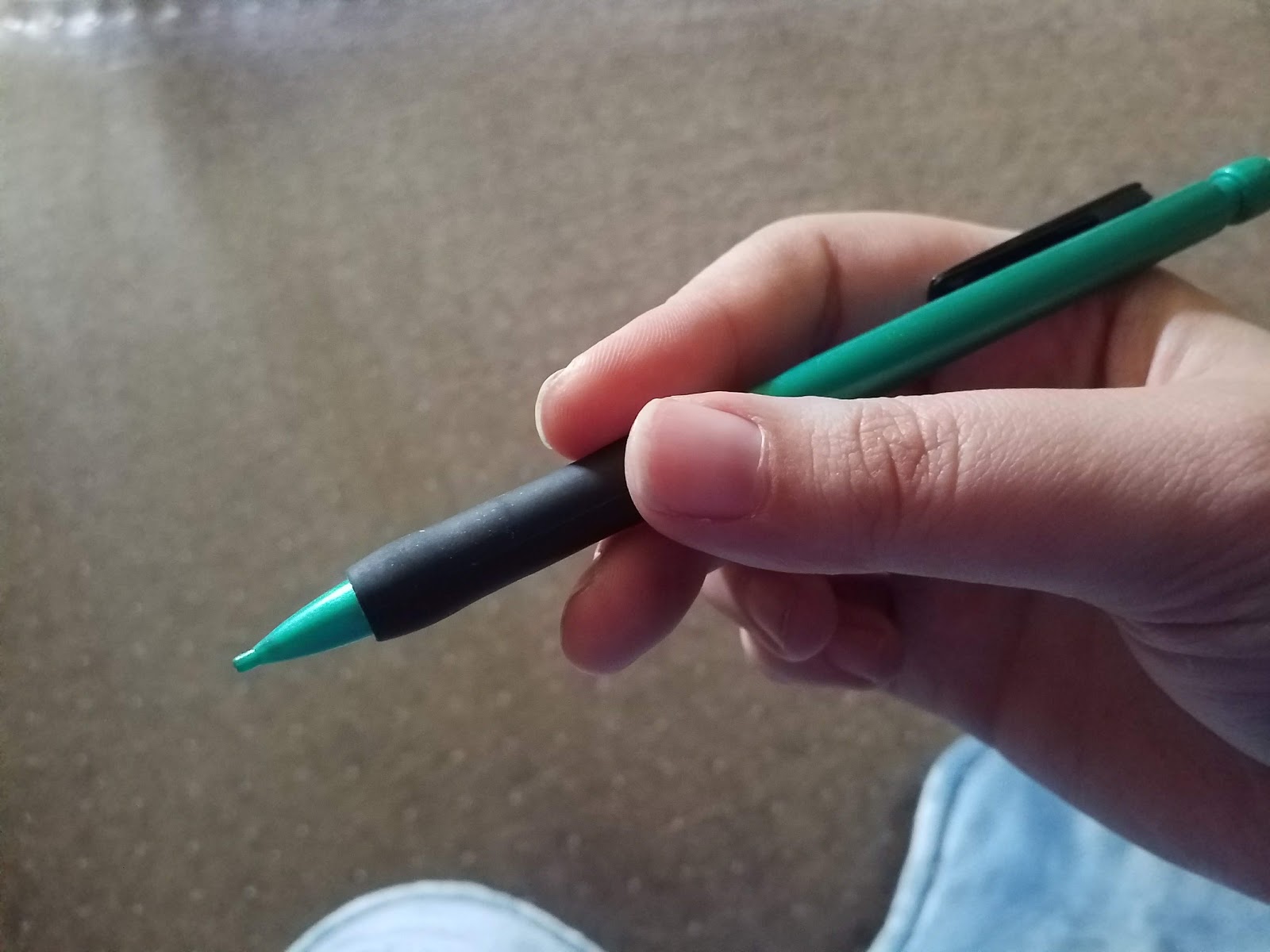
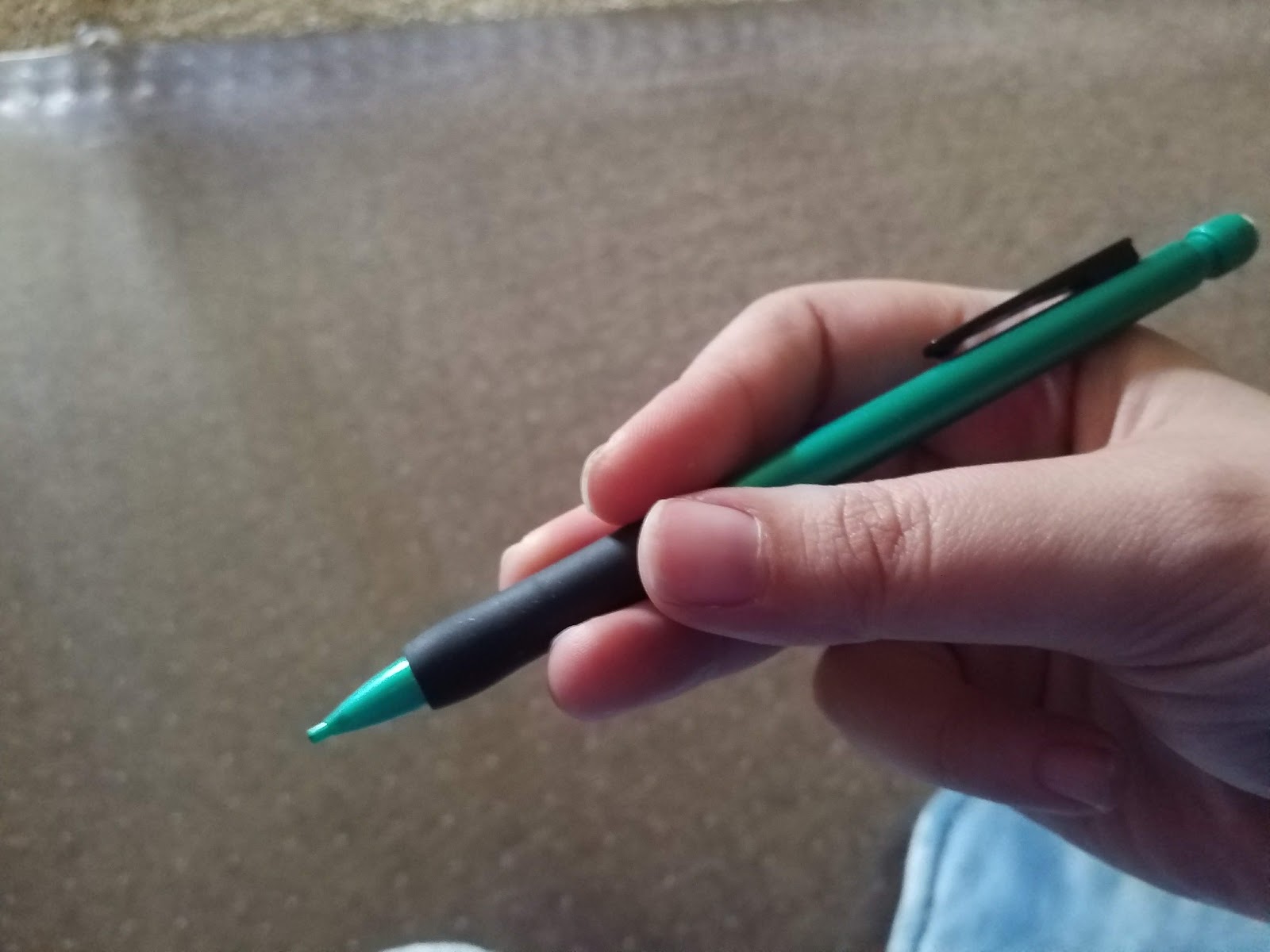
As a child, I tended to hold my pencil with a death grip.  This was noticeable because my hand would tend to cramp up, but also because I held the pencil wrong.  Children are taught to hold a pen with three fingers… 

To this day, I hold mine with four.

This is, as a rule, an inferior grip to the first, as it strains your hand more.  But for someone with clumsiness issues, adding the fourth finger stabilizes the pencil and allows for more control and accuracy.  So that was how I wrote, despite teachers trying to teach me otherwise, and it\’s how I write to this day.  The end result was darker marks on the paper, with occasional tears from pressing too hard.  (This is actually also a sign of a messed up proprioception in children, by the way.)

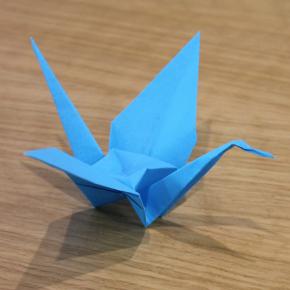
As an adult, I tried the three-finger grip out, and can now manage it without losing too much by way of speed.  But it\’s not comfortable or how I\’m used to doing it, and since writing has become far less common, I see no need to change my habits.  I did work to overcome some of my fine motor difficulties, though… with another hobby: origami.

I\’m almost 30, so it bears pointing out that when I was learning, you couldn\’t simply pull up videos on the Internet to teach you how to make this fold and do that technique.  Instead, I had books.  These books had the words \”mountain fold\” and \”valley fold\” and \”bird base\” and all manner of other artistic-not-immediately-helpful-to-a-small-child vocabulary.

So learning was a bit of a struggle, but I\’m extremely stubborn, so after accidentally tearing, smashing, and otherwise destroying probably hundreds of squares of paper, I did actually learn the basics of the art.  Origami is an art of precision, particularly when you\’re working with specialized paper.  The closer your folds are to their destinations, and the thinner the creases, the better your final product.  This means you can manage to follow all the directions, yet still have a final product that doesn\’t look that great.  But it also means that practice really does make perfect.

I can now boast of being able to teach anyone how make a traditional Japanese crane, so long as they\’re patient and willing to put in the effort.  Also, I once pranked my second high school by scattering a thousand of these cranes, along with the wish that the place would become less of a toxic hellhole.  I kind of doubt I got my wish, but at least the prank was fun, and I really doubt they\’ve found them all unless they\’ve renovated their ceilings…

Vestibular Sense

The vestibular sense is also involved with movement, but instead of your joints, it\’s instead linked to your inner ear.  It\’s your sense of how fast you\’re going, whether you\’re accelerating, and the pull of gravity itself, which in turn affects your balance. Apparently this is registered by… what amounts to little hairs with protein crystals suspended on them, inside your inner ear.  It sounds really weird and random, but when you turn your head, the hairs move, pulling the crystals after them, and that movement is gauged by sensors inside the inner ear.

When you lean over to pick something off the ground, you\’re using your vestibular sense to counter-balance yourself so you don\’t tumble to the ground right after the object.  You also use this sense to figure out what position you\’re in, related to the pull of gravity.  After all, a standing position is relatively similar to a lying-down position… at least if you\’re in space.  With gravity, your inner ear tells you which way is down.

When this sense goes awry, all kinds of exciting and unfun things can ensue.  Your balance can go entirely out of whack.  Without the ability to sense the pull of gravity, you can over- or under-compensate for it, resulting in uncoordinated and clumsy movement, if not outright falling.  Stairs, ladders, and slides can become your worst nightmare… or your best friend, if your body craves that sensory input.  Motion sickness might be your constant companion, or you might never ever get motion sick even in circumstances that would make pretty much anyone else ill.

Most interestingly to me, apparently the vestibular sense also factors into your vision.  When a neurotypical person jumps or bounces up and down, their field of vision appears to remain relatively stable.  With a wonky vestibular sense, that is not the case.  So you can have a child perfectly able to read the blackboard or a computer screen, but not able to walk across the school room without banging into desks and classmates.  I guess, something like that accursed \”shaky cam\” technique that keeps making me miserable and confused while watching movies.

Personally, I think I mostly lucked out when it comes to this particular sense, sans the motion sickness aspect.  I don\’t particularly suffer oversensitivity to movement, and my vision complications are brain-related, not inner-ear-related.  I usually don\’t fall while leaning down to pick something up, and my sense of balance is remarkably good considering my proprioception-related limitations.

The motion sickness, though…  I don\’t recall getting very motion sick, ever, as a child.  I could even watch those enormous IMAX 3D screens in reasonable comfort (but my mom couldn\’t).  I didn\’t adore theme park rides, especially not roller coasters, but I could tolerate them.  If it got too bad, I\’d simply shut my eyes, thus eliminating the most dizzying form of sensory input, and huddle until the ride was over.  It was still uncomfortable, but not intolerable.

Now?  Now I can get motion sick from things as simple as \”riding in the back seat of a car.\”  It helps if I\’m hungry.  Something about being hungry makes it exponentially more likely I\’ll get sick on a theme park ride or a car ride.  However, that naturally makes the fix just as basic: get off the ride or out of the car, and eat something simple.  I have no idea why this works.  Even with food freshly in my stomach, though, I no longer care for IMAX 3D movies, and tend to avoid most theme park rides. 

It\’s notable that this particular sense (in conjunction with others) is also used by some autistic people for calming down.  Dr. Temple Grandin, the foremost autistic speaker, includes spinning and rolling as forms of comfort.  There\’s a clip from the HBO movie where the actor playing her explains exactly this.  I… am not like that.  I don\’t really like spinning or rolling, and get dizzy at a regular rate, if not faster than usual.  This actually made learning those skating techniques a great deal harder, as a dizzy person is more likely to fall down than a stable person.

Summary

This week I\’ve described the two \”ignored\” senses, proprioception and vestibular sense, and given you a basic idea of how they work, what it looks like when they work, and what it can look like when they don\’t work.  In addition, I\’ve given you a few examples from my own life as an autistic person as to how these specifically play out.  Next week, I\’ll get into vision, the sense almost all of us take for granted.  I have a unique brain-eyeball communication problem that makes this sense extra fun.  Should be interesting!

Sensory Processing Difficulties: Part 1 (Touch)

(This is part 1 of a series on sensory processing difficulties.  While I\’d initially assumed I could fit them all into one post, the post would unnecessarily long and I really don\’t want to bore you.  So bite-sized chunks it is!  Here\’s Part 2 on the vestibular and proprioception senses, part 3 about sight, and part 4 about taste and smell.)

Why Talk About This?

A book I\’m reading talks about sensory over- and under-sensitivities in children, and how this is a distinct phenomenon from autism, but that it often goes with autism.  And recently there was an incident in church where a staff member shooed me out of the side room I was using to accommodate a sensory overload.  So I thought it might be interesting for you to have some time inside my skull when it comes to sensory issues in an adult autistic.

The book I\’m reading calls for seven senses, rather than the traditional five, which is probably lowballing it, but as good a place to start as any.  The book points out, and I\’ll underline, that these seven senses are not separate input channels.  They are all processed at once, often several senses for each part of the brain that does the processing.  The autistic person does not get to try to turn off their sense of hearing because it\’s hurting them, but still leave the vision, touch, and taste senses active.  That isn\’t how it works.  It\’s all in the same place: the brain.  So you can distract the whole brain from the painful sensory experience, but you need to distract the whole brain.

One more very important note: all the reactions I\’m going to describe to you are involuntary.  I literally do not control how my brain reacts to certain sounds, or to certain types of touch, or anything else I\’ll tell you about.  I did not choose to be the way I am, I simply…am.  The next time you see a child having a tantrum in a public place, keep in mind they might well be like me… just not as old and as well-practiced at handling their suffering in a socially-appropriate manner.

Many Kinds of Touch

Touch is the first and most basic sense.  But there many kinds: 
  • light touches, like someone brushing your arm, or the texture of grass, sand, or dirt.  This also encompasses having your hair brushed, washing your face, and textures felt in the mouth.  (This is the part of touch that most people with sensory issues have trouble with.)
  • deep pressure, like massage, bear hugs, rolling, bouncing, etc.  
  • vibration, like the feeling of touching a washer on spin cycle, or one of those battery-powered back massager devices.  
  • temperature, your hot and cold senses that spare you from both holding cold packs too long and burning your hand on the stove.
  • pain, which covers everything from a light scratch to broken bones.  

As a child, I couldn\’t stand having tags in the back of my shirts.  My poor mother had to painstakingly cut the tags out of every one of my shirts.  The same was true of my underwear, I believe.  This is a form of light touch sensitivity, and I continue to have difficulties with it to this day.

I no longer have to snip the tags in my shirts or undergarments, but sometimes when my spouse touches my arm lightly, in affection, it hurts instead of soothes.  The same is true with my back.  Since I got my hair cut short, my spouse will also pet and gently scritch my head.  The former is nice, the latter hurts after a while.  It\’s emotionally painful for both of us when I have to tell him to stop doing something affectionate because it hurts, but the other option is for him to be causing me physical pain while thinking he\’s being sweet and affectionate.  There really aren\’t good options here, is what I\’m saying.  I try to be gentle and tactful about it, but I know it hurts him, and that hurts me.

Haircuts Are The Worst

Another way this touch sensitivity manifests is when I get my hair cut, or need to wear jewelry.  While I now tolerate tags on the necks of my shirts, I do not take easily to wearing things around my neck.  And I really don\’t take kindly to having things put tightly around my neck.  This is most noticeable in my current life when I get my hair cut.

Haircutters tend to fasten a paper neck band around your neck, to keep the hair from getting down your shirt.  I can\’t stand that.  I have to put my hand to my throat to offset the nearly-unbearable sensation of choking and feeling trapped.  Having that extra sensory input from my fingers at my throat helps confuse the tightening feeling enough that I can tolerate it.  So instead of ripping the stupid piece of paper off and screaming at the poor haircutter, I can instead, seemingly calmly, sit through the application of the neck band. 

After the neck band stops tightening, I can then make myself learn to tolerate the feeling of having something around my neck… particularly if I don\’t move too much.  That lets my brain try to tune out the feeling as \”irrelevant,\” which it\’s not great at, but it sometimes succeeds at. 

This unpleasantness has not, obviously, stopped me from getting my hair cut. (And dyed blue, check it out!)

…but it very much does make the process a lot more miserable than it would be otherwise.  Another way this light touch sensitivity manifests around haircuts is afterwards.  Even with a tight neckband, there\’s inevitably going to be some little bits of hair that escaped into your shirt or stuck to your neck.  Most people just brush these off in annoyance, and after a day or so, they\’re basically gone anyway.  I… have to go home and use a lint roller to get them off, and can think of little more than doing so until they\’re off.

If the house caught fire while I was doing this lint-roller hair-bits removal, I would take the freaking lint roller out of the house with me, forgetting the clothes I took off to get at all of my neck.  That\’s how bad it is.  I am almost invariably miserable when I get home from having a haircut, and don\’t stop being miserable until all the tiny hair-bits are gone and I\’ve had some time to decompress from my misery.

All is Not Lost, Thankfully

It is possible to accustom oneself to things like this, by the way.  The book has suggestions for how to make this sort of thing a regular activity for children, but autistic adults like myself are kind of on our own unless we\’re involved in therapy for it.  Which isn\’t to say we can\’t do it ourselves… it\’s just difficult and not very intuitive.

As I type this, I am currently wrapped in a light blue, ridiculously soft and warm polyester blanket.  It\’s the kind that\’s almost like short, extremely soft, smooth fur.  My spouse noticed it in the store, and we were looking for a nice warm, blue blanket.  But when I first touched it, I immediately yanked my hand back in discomfort.  It was too soft!  My brain couldn\’t process the sensation, it was too overwhelming.  This startled my spouse into amusement, which annoyed me. 

I think I glowered at that silly blanket for a couple minutes, scowling as I made myself touch it over and over.  Just lightly at first, and not very much of it, and I still had to pull my hand back due to sensory overload.  But as I kept at it, I started to be able to handle the sensation.  It must have looked pretty silly, a grown woman scowling at a blanket and touching it repeatedly while her spouse stood by.  But nobody threw me out of the store for being extremely weird, so whatever.

We ended up buying the blanket after I was fairly sure I would be okay with it.  And now obviously, I am.  It still feels a little weird to me to touch with my hands, but it no longer overwhelms me, and the blanket lives by my computer chair to keep me warm when the basement is cold.  Which it usually is, so that blanket gets a lot of use.

Texture of food is another complication in this category.  It\’s not one I\’ve paid a whole lot of attention to, but my spouse is actually pretty picky in some cases about what goes in his mouth.  I was an excessively picky eater when I was growing up.  It drove my mother to frustration quite often.  We ended up having to establish a list of foods I didn\’t have to eat if they were served to me.  Broccoli, cauliflower, brussels sprouts, and other strong-tasting vegetables tended to top that list.

I\’d always assumed my dislike for foods was taste-based.  After all, many of those vegetables do taste pretty strong.  But it may not have been that simple.  I no longer need to have a very limited diet, and make a point of trying new foods as a matter of course.  But I may have to pay more attention to how those foods feel in my mouth.  I do enjoy just-barely-soaked cereal (mostly crunchy, with subtle hints of sogginess) and ice cream blended with M&Ms (which are mostly creamy with some crunch
/and/ subtle hints of sogginess).

All of the above has been about light pressure, and I\’m sure if I gave it a week, I could think of more examples.  But that\’s only one part of touch, so I\’d best move on.

Deep Pressure and Vibration

Deep pressure is what I usually advise my spouse to give me when his gentle touches on my arms hurt, or when he accidentally tickles me.  His actual response is usually to stop touching me entirely, which is kind of saddening, but understandable.  I\’d much rather he press harder with the arm-touches, thus solidifying the sensation and making it more tolerable.

I do like massages, as a rule.  Not only do I suffer basic neck pain, the deep pressure type of touch is very easy to pinpoint and process.  So unless it actively hurts something, it\’s definitely the way to go.  I used to give bear hugs a lot as a child.  I have no idea if that was just because I was odd, or because I liked the sensory feedback of giving a tight hug.  Usually people protested, though, so I think I eventually stopped.

I also bounce my leg when nervous.  This is actually a relatively common nervous habit for all kinds of people.  I actually taught myself how to bounce one leg quickly and slightly, mimicking a friend of mine who had hypertension at the time.  (He actually did both legs at the same time, but one leg was hard enough to learn that I stopped there.)  It became a habit, and now I do it when I\’m seated and anxious.  So, often. 

Vibration type sensory input is relatively scarce in modern life.  When I\’ve run across it, I haven\’t really had much issue with it, beyond it making my hands numb after a minute or two.  I\’m not actually sure if that\’s a common experience or not, but either way, I tend not to hold onto the washer or a battery-powered back massager much.

Temperature

I do seem to be more sensitive to hot things than the average person.  When I was younger, I kind of figured that was probably just the fact that I was young, compared to the people I tended to talk to, who weren\’t.  As you age, you gain calluses on your hands, and the nerves that sense temperature take damage over time, which desensitizes you somewhat.  So something that\’s a little too hot for comfort to a small child would be just fine to a normal adult.  I would often complain about water being too hot, when my mother thought it was just fine. 
This comes up in my current life when I\’m trying to draw a comfortable bath, actually.  I\’m still trying to figure out how much boiling water to add to my tub before filling the rest with hot/lukewarm water from the water heater.  Too hot, and I sweat and am uncomfortable in the tub.  Too cold, and it\’s not relaxing.  
Speaking of too cold, I\’m not really sure how my cold sensitivity lines up with everyone else\’s, but I have very little tolerance for carrying cold things in my bare hands.  And if my whole body gets cold, I get miserable.  Like, pathetically miserable.  \”Small child whining and sulking\” miserable.  I have very little control over this, which is why I really try not to let myself get that cold, ever.  The last few times it happened, years ago at this point, I felt very stupid and embarrassed as soon as I warmed up.  But not \’til then.  
I had always kind of assumed that was a PTSD-style reaction to getting chilled down to my bones in high school, when I was on a rowing team and the coach sent us out half an hour too early… in 40 degree weather… and the rain.  So we sat out on the river for about an hour, slowly getting colder and colder, until the race actually began.  At which point we rowed on cold muscles and did not do terribly well.  
My parents took me back to their car after the race, had me take off most of my clothes, and turned the heat on full blast.  It took an entire hour of that to warm me back up.  It was a pretty awful experience and I resent that coach to this day for that incident and her general treatment of me and the team… which I think is quite fair, frankly.  But maybe it\’s not the whole story, I dunno.  

What A Pain

Pain is a complicated one.  There\’s two factors to how a person deals with pain.  There\’s your \”pain threshold\” which is the level of pain you tolerate, objectively, before recognizing it as pain.  And then there\’s your pain tolerance, which is how well you tolerate pain overall.  Someone with a high pain threshold and tolerance would seem like an action hero, walking away after breaking bones and seeming not to care.  Someone with low tolerance and low threshold would be just the opposite, complaining of small hurts as if they were much worse than they are.  The words \”wuss\” and \”pansy\” are usually used to describe these people, which is kind of cruel when they\’re experiencing those hurts as much worse than someone else would. 
Autistic people, and others with eccentricities in this form of touch, may have one of those two examples above… or they may be in the weird spot where they have a low pain threshold but a high pain tolerance… so they might easily recognize their foot is hurt, but not recognize that the bone is, in fact, broken, and they need to go to the hospital immediately.  They may just assume it will heal over time, as most injuries do, and if they just leave it alone, it will be fine.  This is markedly unfortunate when broken bones and more serious injuries are involved.
Personally?  I\’ve never broken a bone, beyond a hairline fracture in my skull when I was 1 or 2 years old.  I don\’t remember that, so it\’s not terribly useful data.  The closest I\’ve gotten to a broken bone was a few years back, and it\’s the only semi-major incident I can recall.  
So I have these shelves that are actually closet doors, separated by cinder blocks.  They\’re great, and hold all sorts of things… but at the time I\’d thought it would be okay to put my 20 pound weights on the shelf.  It was fine for months… until I leaned on the shelf juuuuust the wrong way while getting out of bed at 2am.  
The shelf overturned, and its contents fell on my foot.  This included the 20 pound weight, which unfortunately managed to catch some decorative spear-like objects on the way down.  The spear-like objects were driven into the top of my foot by the 20 pound weight.  It being 2am, I was rather foggy, but I retained enough coherence to explain what had happened to my startled spouse, go to the bathroom, clean out the injury, put a bandaid on, use the bathroom, and go back to bed.  
Anyone with basic medical knowledge can probably guess what happened next.  I woke up with my foot in a small puddle of blood, within an hour.  So after that, I cleaned it out again and made sure it had stopped bleeding before I taped it up (with gauze and medical tape this time, not a bandaid).  
I\’m not honestly sure whether my inability to assess the damage was simply that I was extremely tired, or because my pain tolerance is higher than average.  I\’ll let you know if I have any other exciting incidents that reveal more…  

What I\’m Not Talking About

I am, as I\’ve repeatedly pointed out in this post, an adult with a spouse.  That means there are some kinds of touch that I haven\’t discussed here.  Sex is its own kind of complicated, but you can probably guess from the things mentioned above that it\’s more complicated for me than it is for any given person.  I don\’t know if my blog has a rating, like PG-13 or whatever, but I do not, as of yet, feel terribly comfortable discussing my sex life on this blog.  
If that changes, I expect the resulting posts would probably be useful to adults on the autism spectrum, as well as parents needing to teach sex ed to their children.  It\’s not that I particularly feel like sex is shameful, like some branches of the Christian church preach, or that I feel like everyone should be private about their sex lives.  I, personally, just do not feel comfortable discussing it right now.  Sorry/You\’re welcome, pick whichever response suits you better.  

Summary

So this week I\’ve given a rundown on what kinds of touch exist, and a number of examples as to how my body deals (abnormally) with these categories.  Like most people with touch sensitivity, I mostly suffer difficulties with aspects of light touch.  This affects my relationship with my spouse (negatively), my experience with haircuts (very negatively), and possibly my experience of food (positively now, negatively in the past).  
Next week I\’ll deal with what some people consider facets of touch: proprioception and vestibular senses.  Proprioception is your sense of where your arms, legs, and body are in space, and it relies on being able to understand feedback from your joints.  The vestibular sense is linked to your inner ear.  It\’s your sense of how fast you\’re going, whether you\’re accelerating, and the pull of gravity itself, which in turn affects your balance.  These two senses are the two excluded from the \”standard 5 senses,\” but they\’re extremely important.  Without them, nobody would ever manage to play sports with any kind of coordination.

House-hunting While Autistic, Part 4: Moving and Making a Home

This is the fourth in a series about my experience of finding a house.  (Part 1 is here, Part 2 is here, Part 3 is here)  As I\’m autistic, the process proved to be a bit more challenging than it would be for most people.  In part 1, I covered why we decided to buy a house and what things we opted to look for, given my disabilities and challenges.  Part 2 describes the actual search process, which proved to be both draining and frustrating.  Part 3 talks about the aftermath of putting an offer down on a home.  This week I\’ll talk about the actual moving process.

————————————

Moving is one of the most trying experiences I\’ve had the misfortune of having.  It\’s hard on a person who thrives with habits and familiar things, when all that is taken away.  Yes, the final result is probably worth the effort, but that doesn\’t make the experience less upsetting while you\’re in it.  At the time of this writing, moving is still in process, and probably will be for a couple weeks yet, but the bulk of it is done.

Moving is not just the process of taking all your stuff from Point A to Point B.  If it was just that, it would be draining and frustrating.  However, Point A and Point B are usually not identical floor plans.  That means your comfy chair is going to go somewhere not quite as adjacent to your computer, or the extra-sunny window.  And your desk, which formerly had a view out the window at the old place, may now be sequestered in a back corner so that other furniture will fit.

Your essentials, like your toothbrush, shampoo, and basic kitchen supplies, will end up in boxes, and your new bathroom and kitchen won\’t have exactly the right drawers and cubbies to put things back the right way.  Your bedside table, power strip, and lamp may not be exactly where they were.

For someone who is comforted by the familiar, moving can be roughly described as \”hellish.\”  All your familiar gets thrown into boxes and then dumped out into the new place, and you have to slowly pick up the pieces and establish new familiars.

Chris had suggested, in order to not make the whole ordeal both painful and overwhelming, that we each take a blue plastic tote full of things to the new place, once a day, for a minimum.  This was a pretty good idea, as it made things more bite-sized rather than \”well, this entire kitchen needs to go… right now…\”

Two of these have gone from the old apartment to the new condo every day since Saturday the 17th of February. 

In most cases, I took more things than just what would fit in that blue plastic tub, but having the minimum settled made it more okay for me to just throw up my hands and say \”screw it, this is good enough.\”  And it also made me feel better about myself when I grabbed just a few extra things.  So that was a very positive strategy.

A normal carload for most days: a tote full of stuff, plus 1-2 extra things. 

I do have to stress that it\’s an unusual one, though.  Our apartment complex insisted on 60 days\’ notice before we could move out.  (The state minimum is 30, and mostly that\’s standard.)  So we ended up paying a lot more rent than would be normal, and having the apartment for a lot longer than would be normal.  In most moves I\’ve been a part of, you needed to get your stuff out of there in a hurry.  So you got a ton of boxes and hired movers and packed what you could before they arrived, and then they took all your stuff and dumped it in the new place, and you spent the next year unpacking it all.

We were able to do the moving process over a longer period of time because of the apartment complex\’s greediness.  So I guess that\’s not all bad.  Moving the stuff ourselves makes it a bit more manageable in some ways.  Then, too, the place is large enough to literally just dump those blue plastic totes out in a corner or something, and then go back the next day without putting everything away.  Which we have done, and quite a bit.  It\’ll be a mess to sort it all, but I\’ll also get a chance to prune some of the stuff I\’ve accumulated.

In addition to the piles of stuff, we also went looking for furniture with which to populate our new home with…  Starting with this thing, which I have dubbed The Monster. 

This is an 8 foot by 4 foot conference table.  It was extremely inexpensive, and you can probably see why. 
This is my spouse sitting at The Monster.  He wanted a conference table to serve us both as a computer desk.  
I was dubious… but it actually does work pretty well.  Our computers are diagonal from each other. 

The Monster isn\’t the only piece of furniture we welcomed into our home.  At my urging, we put together a list of furniture we wanted, and then Chris hunted down a list of secondhand stores for hopefully acquiring those things. 

Nameless corner entertainment center-thingie, found at the Habitat for Humanity ReStore.  The TV barely fits in there, but it does!
Not just a recliner.  A blue recliner!  Chris settled into this at a furniture store and promptly decided he needed a nap.  I laid claim to it after that, and it\’s now mine.  : 3
But that\’s okay, because this thing, Couchlet, is his.  Minus the change someone left there, anyway.  It\’s very comfortable, and we paid a good bit of money for it despite its mud-brown hue. 
Together, they form the Relaxation Station.  Both sides have windows to look out of, too. 
This isn\’t a new piece of furniture, it\’s an old one that\’s been somewhat repurposed to sit in the Relaxation Station.  Tea and hot cocoa for everyone!  And other essentials below, such as crafting materials, my supplements, and some scented candles. 
The exercise bike made it as well, and gets dragged around the basement as the whim takes me.  Mostly it sits by the window, but I tend to use it next to the computer. 
Chris bashed his head on this light one too many times… so in lieu of a carabiner, this was what we had to raise it higher. 

We\’ve mostly adhered to the 1 tote a day per person rule, but sadly one day had to be an exception… we needed to take the bed, most of the bathroom stuff, the kitchen stuff, and our computers all on the same day so that we could start living in the new place.  It ended up taking most of the day to do it, and even then, we didn\’t actually manage all the parts of the kitchen we\’d wanted to.  I was kind of a wreck by the end of the day, too, which did not help matters in the slightest.

In addition to the actual packing and the furniture shopping, we\’ve made trips to various department stores and grocery stores in search of home-making supplies.  Roll-y mats for under our computer chairs (so the chairs don\’t wreck the carpet), floor mats for the various entrances, bathroom cleaning supplies, soaps for each bathroom, more trash cans for the various rooms in the house, etc.  It\’s not something I gave a lot of thought to when we finally closed on the house, but it became more obvious once we started using those areas.

This coming Monday, the last of the furniture is going to make its way here by way of a local moving company, which should settle basically everything.  There isn\’t much left, thankfully, so this won\’t be too expensive… but it is unfortunately mandatory because our chest freezer is far too heavy to move by ourselves.  When we bought it and had it shipped, it took two burly men strapped into harnesses to bring the ridiculous thing up the stairs.  Short of heaving it over the side of the deck, I don\’t think we\’re getting it back down again without help.  So the freezer, the dining room table, the guest bed, and my poor man\’s bookshelves will be taken by the movers.  We\’ll also toss a couple pieces of furniture (my old ratty computer desk and a viciously heavy and mostly broken entertainment center) rather than bringing them.  No sense bringing things we don\’t want to our new home.

All in all, the sheer amount of time and energy poured into this endeavor has cost me a lot of sanity and energy, and the moving in process will continue long after next week is over with.  The 16th of this month is when we have to be out, officially.  But we\’ll be re-arranging and organizing, and I\’ll be pruning my stuff for months, probably.  

It\’ll be worth it.  I just need to manage to keep putting one foot in front of the other \’til this is over…

In the meantime, the view out the back windows is nice.

House-Hunting While Autistic, Part 3: Complications After the Offer

This is the third in a series about my experience of finding a house.  (Part 1 is here, Part 2 is here, Part 4 is here)  As I\’m autistic, the process proved to be a bit more challenging than it would be for most people.  In part 1, I covered why we decided to buy a house and what things we opted to look for, given my disabilities and challenges.  Last week in part 2, I described the actual search process, which proved to be both draining and frustrating.  This week, I\’ll explain what happened after we put an offer down on a home.

————————————

So there was a bunch of annoying paperwork that went with putting the offer in, but thankfully that can all be done online these days, somehow, and all I really had to do was read a bunch of legalese in .pdf format, then sign at the appropriate places.  Reading it was optional, even, but it\’s never a good idea to sign something without reading it…

After we put in the offer, there was the painful waiting period while the other offers went in, were checked over, and a decision was made on which offer to take.  Fortunately, our offer was accepted.  Had it not been, we would have been back to square one, basically.

Thus far, the process had been exhausting, but relatively straightforward.  Now began the back and forth between waiting and flailing frantically.  Communication came in bursts, with much waiting between each burst, and much activity directly afterwards.

Complications With the Seller

There was the inspection first.  We hired an inspector to do a general inspection, which came back with a few oddities, but no major problems.  The sump pump was broken.  The garage door will happily crush small children or pets to death.  And there were some strange chewmarks on the deck.  But that was it.  No water damage, all the appliances in working order, etc.

The broken sump pump was of sufficient worry to me to request it be replaced before we moved in, so there was a disagreement with the seller about that…   After much back and forth (like, a week\’s worth of back and forth), and after he found out the sump pump was the owner\’s responsibility, he finally paid for a new one.  (All of $150, and him receiving literal thousands of dollars on the sale of this home.  Ugh.)

Unfortunately, that wasn\’t all.  I\’m sensitive to mold, so I had to hire a second inspector to do a proper mold test.  No sense moving into a place and then finding out I couldn\’t live in half of it.  To my horror, the mold test did come back with toxic black mold spores, which was almost enough for us to call it quits on the entire place.  But there hadn\’t been water damage, so we suspected perhaps the sump pump was the problem.  But then we had to bargain with the seller for who was paying for any mold remediation costs… which was a mess.  I think it took another week or so before we were able to get the seller to agree on splitting the cost.  In the meantime, he threatened to back out of the sale, which was extremely frustrating and nerve-wracking to me, given how much time we\’d spent on this place.

The mold cleanup ended up being little more than replacing the sump pump and cleaning the carpets, and the second test came back without any toxic black mold spores, so thankfully I think we dodged most of that bullet.  I\’m breathing the basement air at present and don\’t feel hideous or particularly out of sorts, but I guess we\’ll see how the weeks progress. 

Prior to those messes, the seller had originally offered us all the furniture save a few pieces in the home.  Since it was nice stuff, well matched and coordinated, we were excited and wanted to take him up on it.  We offered a reasonable price, specifying particular pieces we really liked.  Then there was nothing for half a week.  We then heard back that he was going to keep most of what we\’d liked, but did we want anything that wasn\’t already spoken for in the downstairs?  We did, and offered an appropriate price for those pieces… only to hear back a couple days later that, \”just kidding, I\’m taking everything but these pieces you didn\’t want, which you can have for a ridiculous price.\”  I was pretty annoyed with the seller after that.

The final headache with the seller came after the bank had appraised the home, and they decided the place was worth about $4k less than we\’d offered for it.  For some reason, they wouldn\’t redo the appraisal, and so we were stuck figuring out what to do about that last $4k.  The options were: pay the $4k up front, negotiate with the seller to lower the purchase price by $4k, or negotiate some kind of compromise. We really didn\’t want to just pony up $4k unless we absolutely had to, as our bank account tends to be below $10k at all times… so we attempted to negotiate.  Thankfully, this was near the end of the process, and the seller was willing to split the cost.  He dropped the purchase price $2k, and we ponied up the remaining $2k. 

The Trainwreck Mortgage Loan Officer

And that was just the issues with the seller.  The mortgage loan officer was an entirely different mess, of the type I\’d more call a trainwreck than an anxiety-provoking annoyance.

The wreck actually started after we put in our application for \”preapproval.\”  We heard from him briefly, saying he was going to try to finish our application before the end of the week… and then utter silence for basically the whole of the next week, until we emailed… at which point we found out he was on vacation and hadn\’t bothered to tell anyone.  Including the realtor who had recommended him to us.

When he got back from his unannounced vacation, we tried to contact him again, and succeeded… only to find out that he\’d somehow lost vital parts of our application… such as how much our income was.  Then he couldn\’t seem to keep straight the documents we needed for the various parts of the process.  So things like taxes, driver\’s licenses, etc.  He kept asking for a document that didn\’t exist, and he should have known didn\’t exist if he\’d read the documents we\’d already sent him.

To top all of that, he completely messed up our insurance paperwork by informing us that we didn\’t need any additional homeowners insurance on top of the insurance that comes with the condominium.  So we thought we were fine, since he made it sound like he\’d looked into this carefully… only to find out that no, that didn\’t count, and we therefore might lose the bid on the house if the bank didn\’t let us submit proof of insurance late.

And to finish off this shortened version of the angry email I sent to the bank, he was all but impossible to get a hold of.  We had his email address, his office phone number, a secure email line via the bank\’s website, and even his cell phone… and the jerk wouldn\’t respond to any of those, unless you chain-called him every five minutes until he picked up.

So, for any people looking to buy a house, and who would like to avoid this trainwreck, please make sure you avoid one Stephen Kik, of Lake Michigan Credit Union.  I can\’t speak for the rest of LMCU\’s staff, beyond that this was by far the absolute worst service I\’ve had from any employee there.  But yeah, avoid like the plague.

Normally, if you have so many problems with a mortgage loan officer, you can switch to another one with limited issues.  Unfortunately, when we tried to do that, the person who would authorize and oversee that transition was on vacation.  Because apparently everyone takes vacations in January.  So we had to stick with the uncommunicative, avoidant, absent-minded dunce for the entire thing, and it annoys me to this day that he probably made money from the whole debacle.

But In The End…

After dealing with those two sanity-shredding facets of the process, we did manage to get bank approval for our offer, a closing date set, and all our funds straightened out.  My grandmother kindly gifted us with some of the money needed for the 20% down payment, and my parents loaned us the rest.  These days, you don\’t strictly have to do a 20% down payment, but if you don\’t, they make you have an escrow account and you lose access to your money.  It\’s basically an extra tax on the poor.  We were thankfully able to opt out of that mess.

We scheduled a walkthrough to make sure the place was still as we expected it to be, and to check on the new sump pump.  Everything was in order, and in fact, the seller was there and even gave us a set of keys.  He wasn\’t even entirely moved out yet, so that was nice of him.  He also showed us how to use the gas fireplace and gave us the day for trash pickup and such.  

The closing itself was both annoying and anti-climactic.  We had to drive about an hour to the western shore of the state to sign something like 150 pages of paperwork.  The only bright point to it was that our realtor also came with, and she got us a nice blue teapot, some mugs, and some tea.  Since I don\’t actually have a decorative teapot, this was kind of nice.  We took her out to lunch afterwards.

All that remained was waiting for the seller to get done with moving out.  Then we could start moving in.  Next week\’s entry will cover furniture hunting and the actual process of moving in.