Grocery Shopping on a Special Diet: Impulse Buys, Yogurt, and Drinks

Welcome to a new series on life on the autism spectrum.  I\’ve been doing grocery shopping for nearly a decade, and as my diet has needed to change for health reasons, I\’ve noticed I have less and less of the grocery store actually available to me.  As a citizen of the United States, I have a truly staggering number of food options available to me, but if I want to function, most of them are actually illusions.  

I\’d like to explore this a bit.  I\’ll be going aisle by aisle, probably about two aisles a week.  There are 14 aisles plus the bakery, deli, and fruits/vegetables sections, so there\’s plenty to talk about here.  

The store I typically go to is a hypermarket, which is to say that it is both a massive grocery store and a department store combined into a one-stop-shopping experience.  I\’ll be focusing on the grocery store section, since this is about food.  

Speaking of food, I should also establish my consumption limitations.  I have an allergy to casein (a protein in dairy).  Which is to say, if I drank a glass of milk, I would go from neutral-pleasant mood to angry and depressed in the span of about 30 minutes.  So most dairy products except for butter are off limits.  

I also try to adhere to a low-sugar diet, and avoid ultra-processed foods in favor of whole grains.  I try to avoid food coloring.  I try to avoid high histamine foods. Lastly, I\’m a conditional vegetarian.  Unless I\’m quite convinced (usually by way of independently verified labels) that the animals I\’m eating were treated like creatures and not objects, I don\’t eat meat.  

When you enter the store, the first thing they try to do is sell you extra stuff you didn\’t come for.  Also, because it\’s 2020 and there\’s the coronavirus and no vaccine yet, please note the very first display: masks, including child-sized ones.  

I have to pass on the chips.  I\’ll eat them sometimes but they\’re definitely ultra-processed junk food: no nutritional content at all.  You\’ll see this is a major trend, and also that there\’s literally snack foods everywhere, not just here in the impulse purchase area.

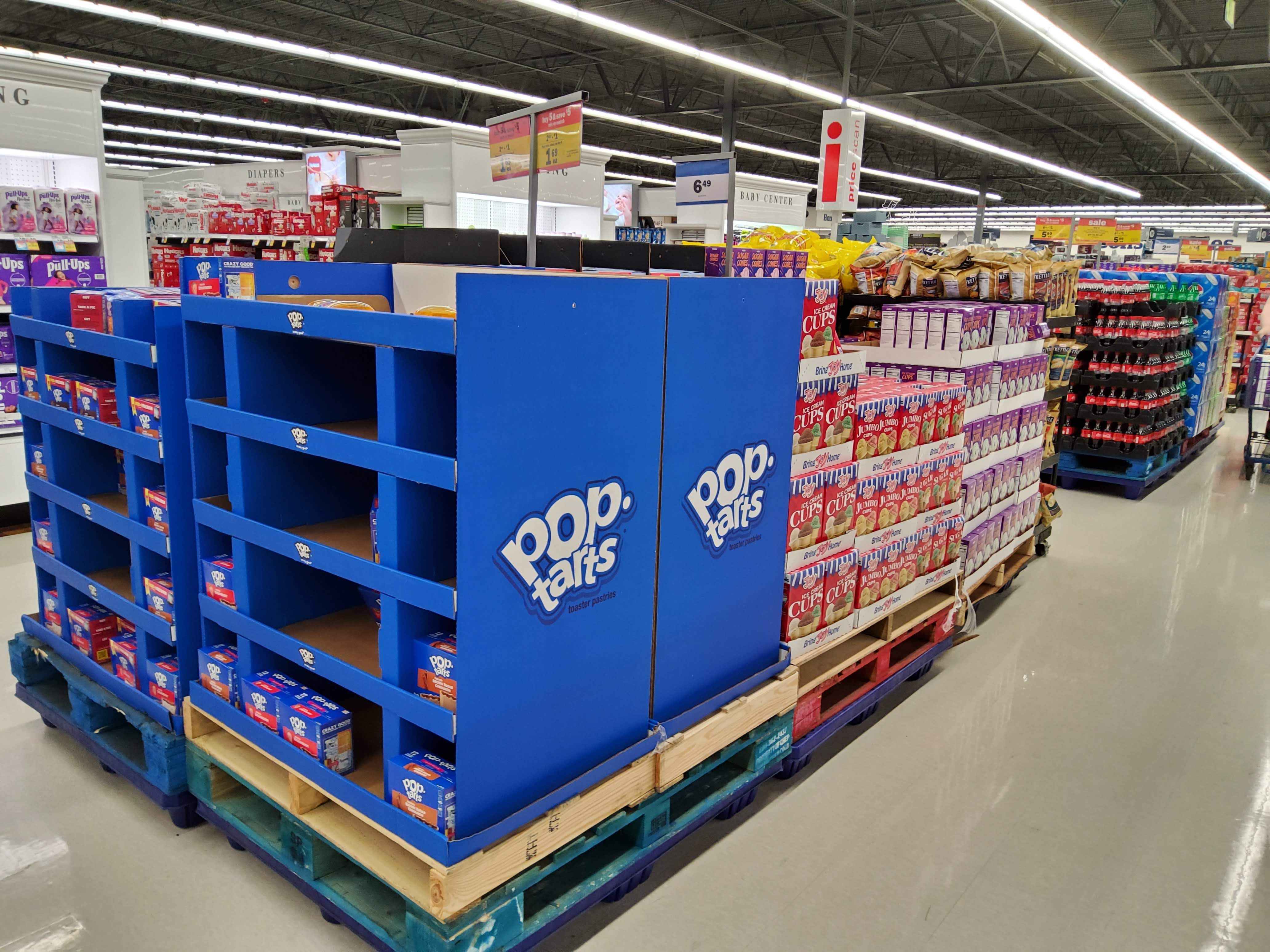
Pop Tarts.  Supposedly a breakfast food.  Ever looked at the sugar content?  I\’d rather have a donut for that amount of calories and sugar.  It\’d have less food coloring, too.  Ice cream cones behind the Pop Tarts.  I like ice cream but between the dairy and the sugar, it doesn\’t like me.  

More chips, plus adult beverages.  I guess they hope you\’ll want to load up on empty calories?  I\’m not making Mexican food this week though, so no ultra-processed tortilla chips.  And definitely no beer.  If I\’m going to have empty calories, I want them to taste good.   

More chips, though these are more tempting.  Pringles, like every other type of chip, is definitely ultra-processed.  Honestly, they\’re like potato sawdust mixed with sugar and salt, and then shaped into a chip form.  The result is delicious, but quite bad for you.
Behind it is salad dressing, which is a way people destroy the nutritiousness of salads…  

I don\’t have specific complaints against bottled water, save that you really need to know what PH it is before putting it in your mouth.  Yeah, I know, it\’s water, it should be 7, but that\’s actually not how it is.  This particular water is most likely 6.5, so slightly acidic.  On a personal note, screw Nestle for profiteering off Michigan\’s water while paying basically nothing for it.  

Behind the water, Chex mix (another ultraprocessed snack), marshmallows (sugar bombs!), and paper towels.  

So those are the impulse purchases and sales as you walk down to the end of the store.  Almost entirely inedible in terms of health and sugar content. But they hope you\’ll forget that and buy them anyway, because look! They\’re right there and on sale!
When I shop I always start at the last aisle and work my way forward.  It just seems the most efficient to me.  And hence: aisle 14.  

Yogurt, juice, coffee, tea, and hot cocoa.  

To my great annoyance, juice is not healthy.  It\’s sugar water with vitamin C.  The reason fruit is healthy is not just the vitamins, but also because of the fiber.  Y\’know, the stuff they strain out to get the juice.  So what you have here is sugar water, sometimes with extra sugar, food coloring, and flavorings.  

I dislike coffee, but at least it\’s not flatly unhealthy.  Unless it\’s flavored and full of sugar…  
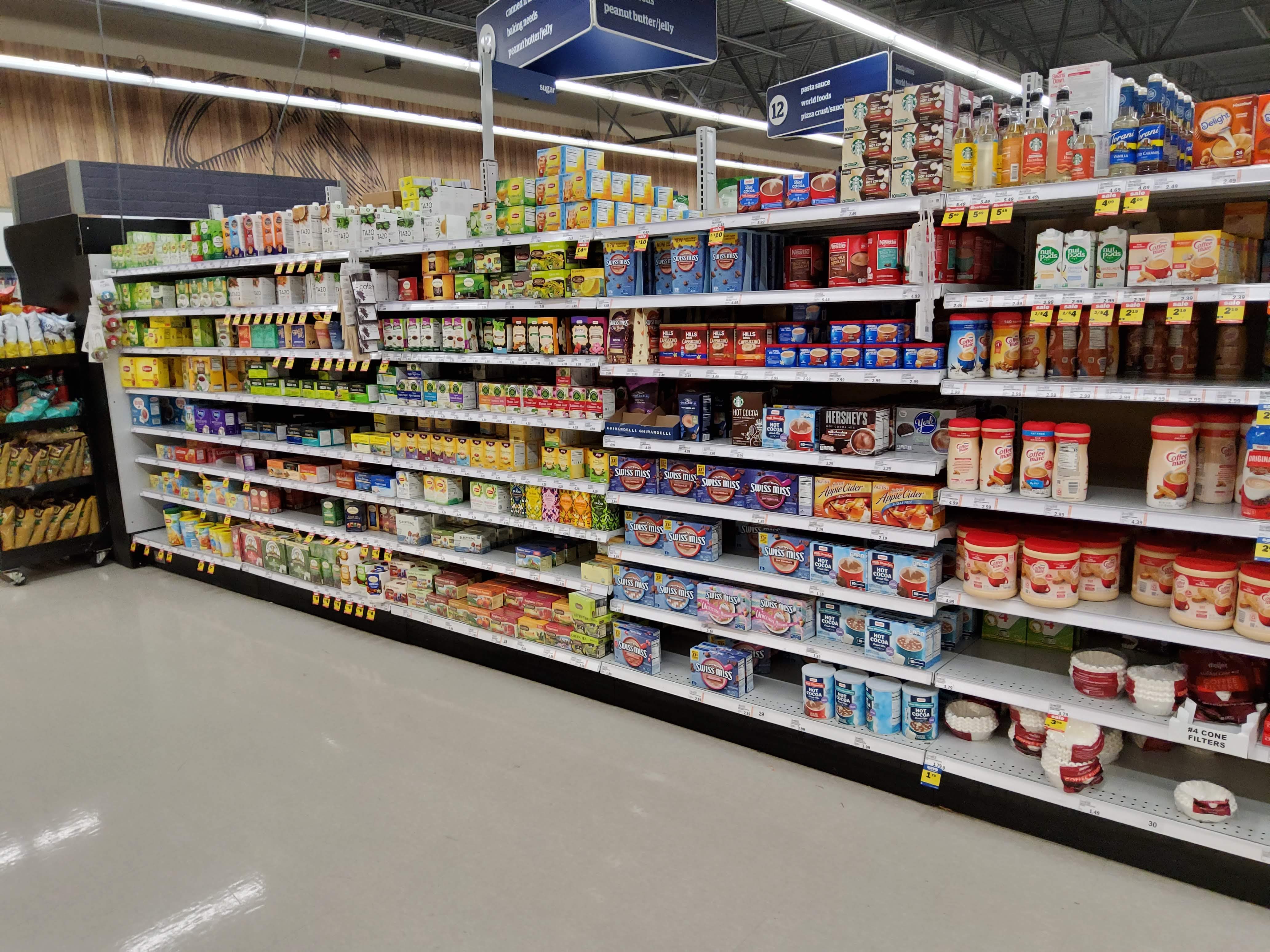
Tea bags and hot cocoa.  A pretty small selection, to be honest, but fortunately I know better places to shop for tea.  I like tea and hot cocoa, but the latter tends to be chocked full of sugar.  At present, I have too much of the former so I\’ve banned myself from buying more tea until I\’ve reduced the levels of my tea collection at home.  

The yogurt section.  Yogurt is supposed to be healthy because of the protein and fermentation process.  It can help rebuild your gut with good bacteria.  Since autistic people often lack healthy guts, this would seem to be a good food choice.  Most yogurt is made with cow dairy, but let\’s have a look at a random yogurt… 
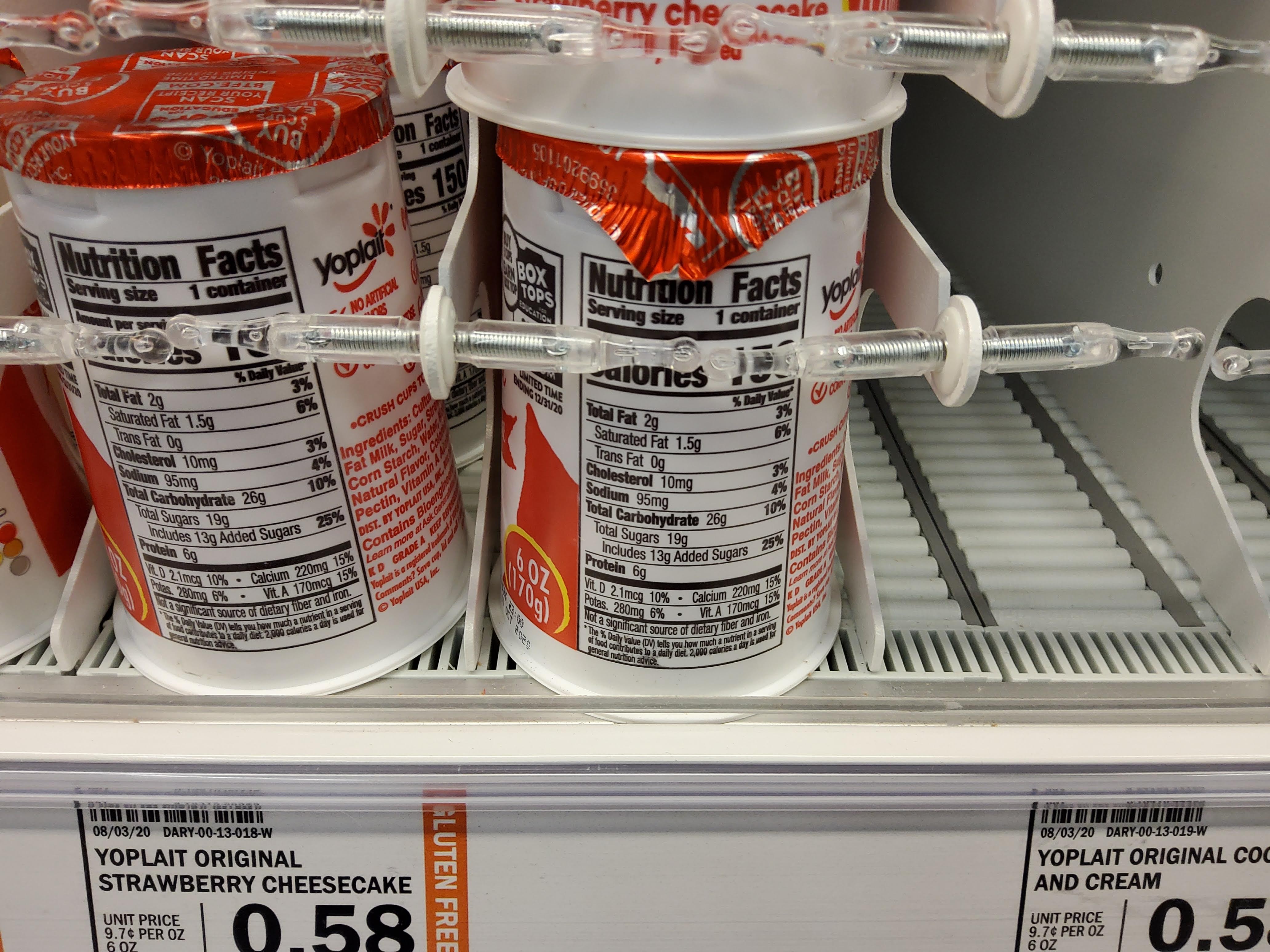
Look at the sugar content! 19 grams of sugar, or basically an entire day\’s worth of sugar for me.  But it\’s cheesecake flavored, surely a nice plain strawberry yogurt wouldn\’t be so bad…

OH COME ON.  Still 19 grams of sugar?!

The minimal but at least slightly existent nondairy yogurt section. Mostly oat products (not gluten-free, notably) and almond or coconut milk products.  Frustratingly, these nondairy products are typically lacking in protein content.  But they do, at least, still have the fermentation process.  

However, these flavored nondairy yogurt cups are just as full of sugar as the regular stuff.  Meaning, they\’re no good unless you buy the giant unsweetened container and add your own flavoring. Which defeats the convenience and portability of yogurt, in my opinion…

The refrigerated \”quick desserts and baked goods\” section.  There\’s everything from single serve puddings and creme brulees to cookie dough and cinnamon buns.  Sugar, sugar, sugar…  

The only notable thing I regularly acquire here is a specific brand of premade pie crust.  It doesn\’t use lard, and is also twice as expensive as any other pie crust available.  That said?  Making pie crusts sucks.  The most healthy option would be to make my own using fine ground whole grain flour, but I have a marked dislike for kneading butter into flour.  So most of the time I buy these crusts rather than make my own.  

The butter section is over complicated but at least it\’s all safe for me to eat. 

Some people with dairy allergies can\’t do butter, which makes margarine and other options more valuable.  There\’s also ghee, which has had the proteins removed… but we\’ll see more of that later in the baking aisle.

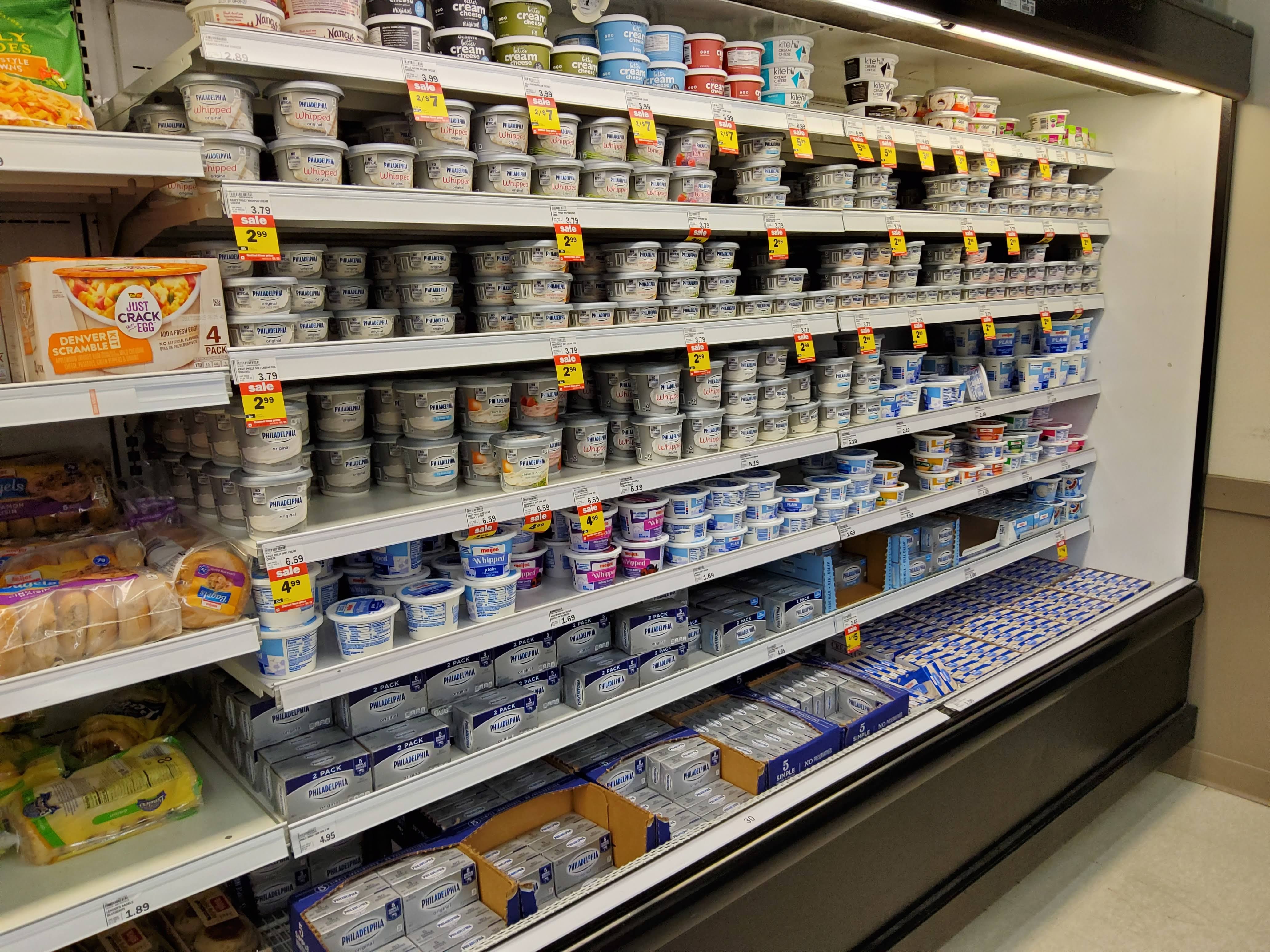
The entire cream cheese section is right out. Even if it wasn\’t dairy, it\’s full of sugar.  
And that\’s the first installment of this trip through the grocery store.  Let me know what you think.  I\’d originally envisioned doing this grocery store trip in a single post, but it took me so many pictures to just get through the first few aisles that I realized no one would want to read such a long post.  

Next week: the baking aisle and the rest of the dairy section!

Trying Intellicare: App Suite for Mental Health

This week I tried a set of apps meant to help combat anxiety and depression this week.  I found them in a press release from Northwestern University while on my hunt for decent research to present to you for Monday posts.  You can read about the apps a bit more here and here.  The article points out that the app is especially useful now, during the Coronovirus pandemic, because more people are suffering mental illness and everyone has reduced contact with their support networks.

I\’ve done a similar app review with Woebot, and also Wysa in a less thorough manner, but neither really helped me that much.  Which isn\’t to say either app isn\’t helpful overall, it\’s more that they were geared towards different groups than me, specifically.

At any rate, I opted to try Intellicare because the suite of apps interested me, and because after a very careful examination, it seems Intellicare does not sell your personal data or even share it unless demanded by law.  Their privacy policy wasn\’t in plainspeak, but neither was it particularly long or onerous to read.  So that was something.

The Apps

I downloaded four of the six available apps.  The hub app was mandatory, of course.  The five additional apps are:

Day To Day, the app that teaches coping skills and gives information on techniques and things to try during the day.  I chose to try this one.

Daily Feats, the app that helps you celebrate your accomplishments and prods you to do some basic self-care.  I chose to try this one as well.

Thought Challenger, the app that helps you challenge negative thoughts and control your mood.  I don\’t currently suffer a lot of negative thoughts other than boomerang memories (and even those are rare), so I did not download this one.

My Mantra, the app that helps you set a guiding phrase or goal.  I chose to try this app.

Worry Knot, the app that teaches you how to manage your worries and helps you spend less time on them.  I chose not to try this one, as I\’m not prone to spending lots of time worrying.

Starting Off

The first thing the Hub app did was present me with a questionnaire, to get a baseline for how I was feeling.  The questions were easy to understand and the given answers were understandable and distinctive.  I ranked as slightly anxious and moderately depressed, which is about right given my diagnoses.  Each week, the Hub app is supposed to have you retake the questionnaire, which can then show you your progress.

I had trouble with the Hub app.  It lost my questionnaire results after I loaded it up for the second time.  After a couple days, it wouldn\’t load up at all.  I wasn\’t thrilled, but the other apps work independently from it, so it\’s not the end of the world.  Being able to track my mood climate week-to-week would\’ve been nice, but since my trial period for this app suite was just over a week, it\’s not like it would have given me much data anyway.

I opted to create my own mantra in the My Mantra app: \”I am a worthwhile person.\”  I sometimes struggle with personal worth issues, so it seemed like the best place to start.  The app gave numerous examples for your mantra, such as, \”I am strong,\” \”I am loved,\” \”I will create,\” and \”I am generous.\”  The app then prompted you to think about your mantra and take pictures throughout the day of things that support that mantra.

The Daily Feats app came with four basic \”feats\” or healthy goals to begin with.  These were: \”I completed a task,\” \”I did something physical today (even just walking),\” \”I smiled at another person,\” and \”I ate something healthy.\”  For my own personal edification, I added \”I tended my plants today\” and \”I did 5 wall pushups and 10 situps today.\”  I wasn\’t great about handling the lattermost, because I didn\’t assign a time of day to do them.  Also doing situps hurts my tailbone for some reason.

No special setup or input was needed for Day To Day, beyond telling it my waking hours.  This let the app calculate when to send me the next bit of knowledge about the skillset of the week.  The first week was called Challenge Thinking, and revolved around noticing, understanding, and challenging negative thoughts.  This was not super relevant to me personally, but Week 2 (Cultivate Gratitude) and Week 3 (Activate Pleasure) struck me as more useful.  Unfortunately, there was no way to hop weeks.

Observations/In Practice

One of the things I noticed early on about these apps, at least on Android, was that they didn\’t seem to know how to rudely run in the background even though you\’ve closed them.

To understand why that\’s a flaw, I should mention that these apps include reminders to use them.  Daily Feats is supposed to remind you to jot down what feats you\’ve accomplished so far that day, or a reminder from My Mantra to review your mantra, add pictures to it, or even set a new one.  Day To Day, in particular, sends you multiple notifications throughout the day to help teach you self-management skills, feeding you a bit of info every few hours across your day.

However, these notifications did not trigger on my device if the apps were closed.  Which means you need to keep each one open instead of closing them when you\’re done with them for the day.  While I\’m sure there are a lot of people that just navigate away from the apps without closing them when they\’re done, I don\’t think it\’s wise to expect your whole userbase to act that way.  In addition, most Android apps that use reminders are programmed to run rudely in the background like I\’ve described, so the fact that these don\’t do that is surprising.

I left the apps open for the last two days of my test, and surprisingly, that did not seem to fix the issue, so perhaps the problem is also linked to the Intellicare Hub app not working. 

Also, some of the apps seemed incomplete or not fully thought out, like My Mantra.  The idea was to set a mantra or two, which you would try to keep repeating to yourself of the course of the day.  You could take pictures and store them under each mantra.  But the app didn\’t really do anything except act as an image repository for categories (your mantras).  If you don\’t regularly take photos of things, this app doesn\’t seem all that useful.

This may also somewhat be a function of the fact that I\’m not a very visual person.  So having to describe, \”I am a worthwhile person\” in pictures taken around my house, I struggled.  Taking a picture of a clean, empty dishwasher (representing that I do my chores and that is worthwhile) doesn\’t convey that extra meaning to me when I immediately look at it.  Taking a picture of an achievement in a video game seems shallow to me, even though I might be somewhat proud of it.  And taking a picture of my plants, which still aren\’t dead for some reason, just reminds me of how much further they have to go before they\’ll produce anything.  Seeing them in person is one thing, but a picture is quite another, at least to me.

I did spot typos in the course of the week, such as the one in Day To Day when setting your day schedule.  Mistakes are italicized.  It asks, \”When dose your day typically start?\”  And an awkward phrasing in the Hub app during the assessment, which asked \”… how often have you felt trouble falling asleep/staying asleep or sleeping too much?\”  Obviously neither of these example typographical and grammatical errors would cause much confusion, so these aren\’t really major issues.  They simply caught my attention, as such things often do.

The apps also seemed to lose track of what day it was on occasion, which resulted in a disappointing broken streak in Daily Feats, as well as only being at Day 5 in Day To Day when I\’ve been trying the app for 8 days.  This phenomenon might be related to the issue I described above, with the apps not running in the background, but I honestly don\’t know.

The information in the apps, at least, seemed valuable.  I don\’t do a whole lot with challenging my negative thoughts recently, though I did a good bit in the past.  I mostly don\’t have tons of them any more, and it\’s become less of an issue, but the promptings of Day To Day and the Hub app (when it worked) seemed about right. 

The Intellicare Hub app contains a set of informational resources about depression, anxiety, self-care, social support, thoughts and feelings, activities and emotions, and social media.  I read through the sections on anxiety, depression, self-care, and social media.  The information within was basic, but accurate, approachable for most reading levels, and positive. 

The Hub app also contained a link to some quick resources, including the National Suicide Prevention Hotline, Crisis Text Line, and Suicide Prevention Lifeline Chat.  I was glad to see these, and particularly the variety of available options.  Some people like using the phone, but I personally despise it, so in an emergency when only phone call options were available, I\’d probably just avoid that entirely.  This offers text options, including a simple over-the-Internet chat rather than a text message service. 

In Summary

At least for the apps I tried, this free suite of mental healthcare apps seems like a work in progress, albeit one with good potential.  The information given by the apps seemed valuable, readable, and accurate.  
However, there are definitely some major compatibility and functionality issues to work through, such as the Hub app simply refusing to open after a couple days and losing my test scores, the sub-apps losing which day it was, and the apps not running in the background (and thus the notifications not working).  I tested the apps on an Android tablet, which may have contributed to the technical difficulties I experienced.  Typically people use a phone, and Android itself covers a very broad base of devices.  Thus, coding for it can be difficult.  It\’s very likely the iOS versions of these apps, which have a much smaller range of applicable devices, are significantly more stable.
Beyond the major issues, there were minor issues like typos or \”that\’s not quite right\” grammatical issues, though not many.  The apps themselves could use a bit of polish as well.  I could have used some examples of how to make My Mantra\’s photo collection idea work for me, because, as mentioned above, I had serious issues with that, and in the end, basically didn\’t use that app at all after the first day.
I think I\’ll keep Day To Day and the Intellicare Hub app around for another week or so, and see what I think of using them in the long term.  Maybe week 2\’s Cultivate Gratitude sections will be helpful to me.  
Based on the performance I had from these apps using an Android tablet, they may or may not be worth your while.  If you have a therapist and support network already, you may not need any of the information within.  If you don\’t, this might be the perfect way to start learning this information.  Particularly now, with the coronavirus isolating us all, this could be a very useful set of tools and reminders for people who are suffering mental illness for the first time, or for the first time in a while.  

I Visited the Autism-Friendly Sesame Street Park in Florida

I went on my first vacation in three years (since the honeymoon) this January.  It was to Orlando, Florida, to see the video game charity event, Awesome Games Done Quick, for most of the trip.  We did make one theme park visit, and it was Seaworld, the one with Sesame Street, the ostensibly autism-friendly park.   It was winter, but winter in Florida apparently means high 60s to low 80s, which is late summer where I come from.  So there were few to no lines and comfortable temperatures: a win in my book.

I\’m just going to start by saying Seaworld overall is distinctly not autism friendly.

It is consistently loud.  They have music blaring in from everywhere, especially restaurants, animal exhibits, show areas, and shops.  As you traverse the park, you move from one noise zone to the next, with no respite between them.  The quietest areas were on the edges of those zones, but at those points, you could hear two zones at the same time, in a dueling stereos effect.  This is not even counting the other park-goers, with their shrieky small children.

I wore earplugs basically the whole time and would recommend others do the same.  Even my neurotypical spouse wore earplugs the whole time simply because he found it more comfortable.

If you do end up visiting, I did manage to find a quieter area to eat.  The Spice Mill Burgers area was only loud because of the people in it, and some of those moved on while my spouse and I were eating.  So I was able to take out my earplugs there for a bit.  I expect during the summer and higher tourism times, it would be significantly louder, but the fish filet was both large and surprisingly excellent.  They also offered an Impossible (meatless, but tasty) Burger, which I was very pleased to see.  The bun and toppings both sandwiches came with were food service standard mediocre, of course.  It\’s cheap(er) park food, what do you expect?

Speaking of which, I did not see gluten-free options at any of the Seaworld food spots I stopped by.  I know Seaworld itself isn\’t really dedicated to accessibility for all, just Sesame Street, but I\’d kind of hoped the latter would infect the former.  There did seem to be dairy-free options, like my fish filet, and a lot of \”normal\” kid-friendly food, like chicken nuggets and fries and such.  I suspect the dairy-free options were more incidental than purposeful.

Into Sesame Street

Nearish the end of the day, we did make it to Sesame Street.  I can\’t say I was overly comfortable, a childless 30-something walking through a kids-and-families-area, but I was feeling overwhelmed, wanted a quiet place to rest, and figured that while Sesame Street was technically geared towards children, autism is autism.

Sesame Street is located on the far right, meaning you have to pass through most of Seaworld to get there.  I cannot stress this enough: most of Seaworld is very sensory-unfriendly.

The front gate of Sesame Street Park at Seaworld.  Elmo and Cookie Monster statues guard either side.  The lighting was not in my favor for this shot of the front gate.

A main road leads into Sesame Street in Seaworld, with storefronts on the right, and rides on the left.  The park itself was a lengthy inverted D shape, with a main road and a side road for kids rides, extra attractions, restrooms, and other services.

A signpost at Sesame Street in Seaworld, with directions to restrooms, first aid station, baby changing area, the Infinity Falls ride in Seaworld, and the autism-friendly quiet room.  There were a few of these signs off the main road, pointing you mostly to services, rather than rides.

The family services building at Sesame Street in Seaworld.  A sign out front directs you to enter the front for baby care, and the side for the autism-friendly quiet room.  The sign here was a little unclear.  After going past the building and all the way to the other end of the park, we finally figured out they meant \”the back door is closest to the Quiet Room\” not \”keep walking this direction \’til you find it.\”  I was annoyed.

Sesame Street has exactly one quiet room, which was part of a larger facility to support families.  Included as other rooms in this facility were a changing and nursing room for mothers, a more comfortable enclosed sitting area, a microwave and sink, and various shelves and cupboards.  The lighting in all rooms was overhead, living room-like light fixtures with incandescent bulbs, rather than more typical commercial/industrial fluorescent lighting.

Inside the family services area at Sesame Street in Seaworld.  An incandescent overhead light shines over a sink, microwave, seating, shelving and a high chair on a hardwood floor.  Also a lounge area, baby changing space, and a nursing area… It was surprisingly well outfitted.  I could, of course, have asked for even more stuff, but seeing all this was a surprise.  It\’s not like the park makes money off having these offerings here.

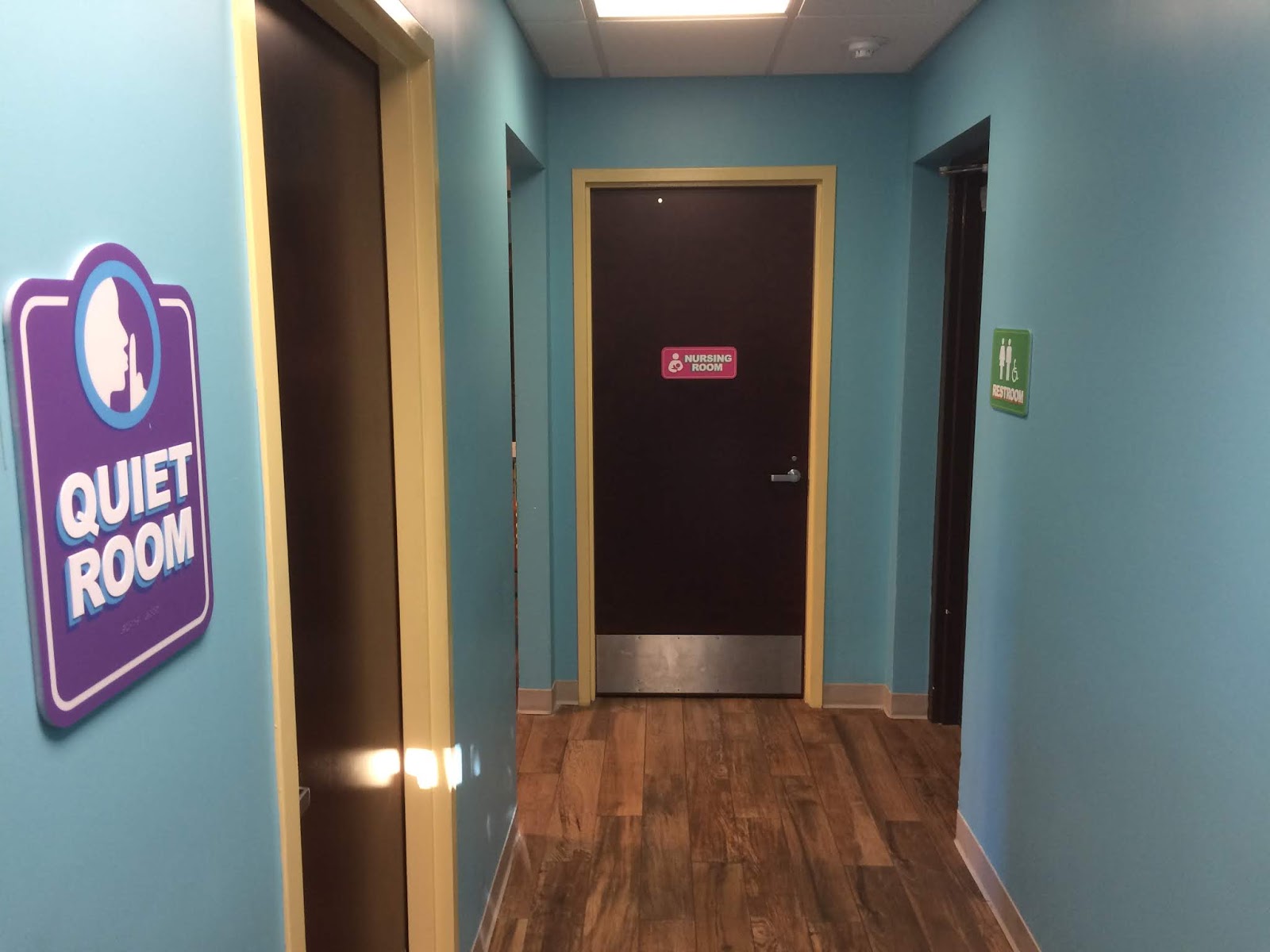
The hallway off the main room in the previous picture.  A trio of doors lead to the autism-friendly quiet room, the nursing room, and the restroom, while an open archway leads to a main room.

Eventually I made it to the quiet room.  Like the main room, it was lit with an incandescent home overhead light thingie.  It\’s not really a chandelier, being far too small and simple, but that\’s the only word I can think of to describe it.

It was a relatively small room, and I had trouble getting a proper picture of the whole thing.  The room had bits and bobs available.  The bean-bag-esque cushions there seemed comfortable, though I didn\’t actually sit in them due to paranoia about germs.  The wooden box-thingies would serve to either climb on or hide within, either of which seems reasonable.  The overhead lights could be turned off (so I did).

A textured wall toy, one of two such toys.  At least 15 different texture were available for stimulation-seeking children.  I was impressed, even if I didn\’t touch due to fear of germs.

A more typical children\’s toy, fastened to a different wall.

The quiet room was not silent, and you could hear the nearest ride outside (Minnie Mouse instructing kids to pay attention to some kind of nature kiddie coaster).  It was, however, significantly quieter, and I was able to take out my earplugs and relax somewhat.  Out of curiosity, I turned on my tablet\’s decibel reader.

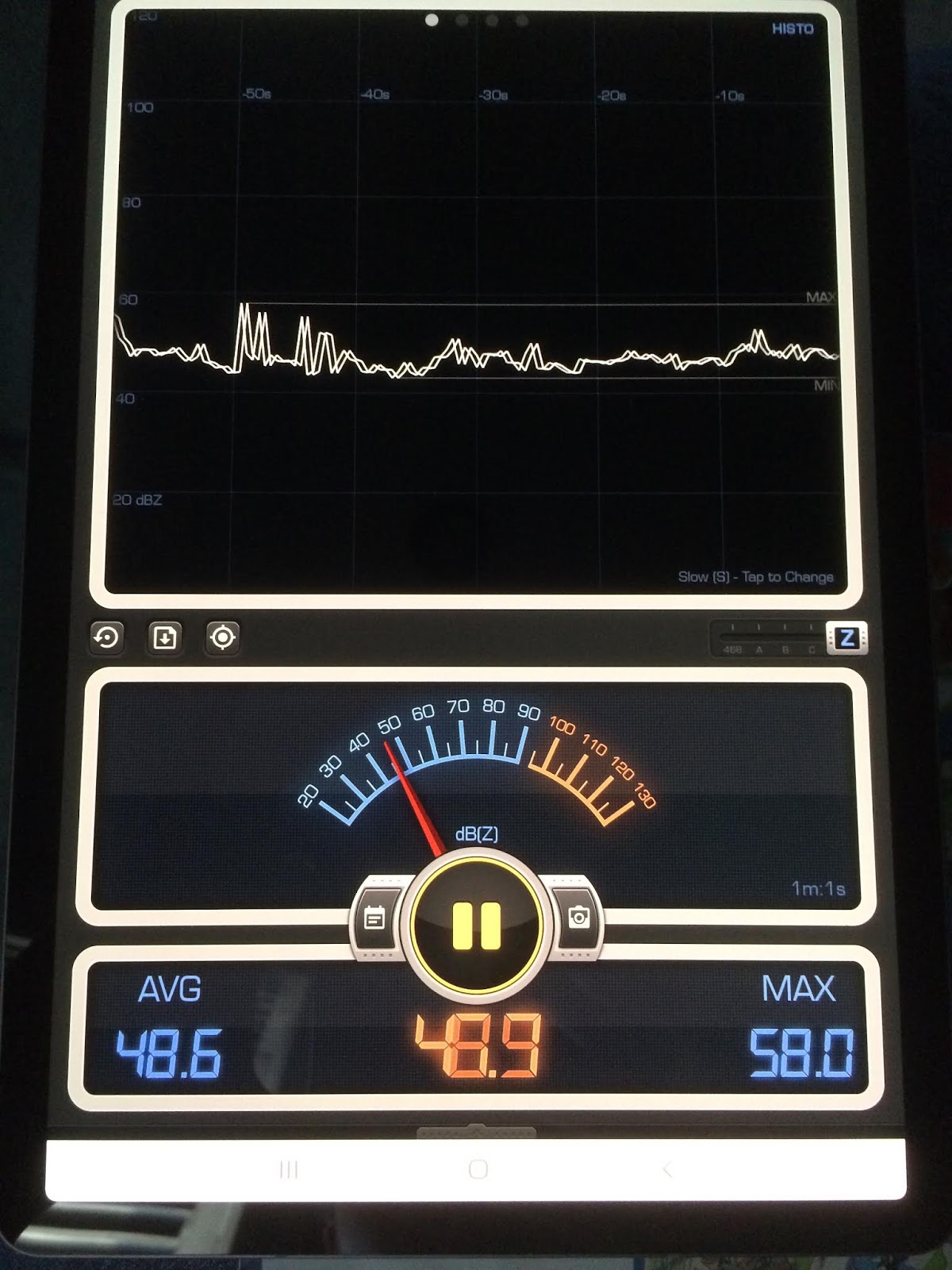
Readout from a decibel meter in the Quiet Room at Sesame Street in Seaworld.  Average decibels 48.6, maximum 58.  Fairly quiet as things go, but not silent.

Readout from a decibel meter in the Quiet Room at Sesame Street in Seaworld.  Average decibels 48.6, maximum 58.  Fairly quiet as things go, but not silent.  The spikes in the graph were due to children and the ride outside.

And here\’s a recording taken while waiting for the killer whale show at Seaworld:

The readout of a decibel meter during the pre-show of Seaworld\'s orca whale show.  Average decibels, 83.7, max 87.2, or roughly 16 times louder than the previous location.

As you can see, the Seaworld pre-show was about 40 decibels louder than the main area, which… if that doesn\’t mean anything to you, it\’s about 16 times as loud…  or the difference between me suffering and me feeling kinda okay.

Sesame Street itself seemed quieter overall than Seaworld, though I don\’t have the data to back that up.  It still definitely had zones of noise that you could travel between, even at the family services area.

My last thought on the Sesame Street area was the food.  We visited in winter, so most of the food options were closed.  They did seem to offer the usual sugary and white flour-laden badness, but I also stepped into a couple store areas and found these:

Refrigerated food and drink offerings at Sesame Street stores, including cheese sticks, yogurt, hummus, fruit cups, cracker/cheese/meat snack boxes, and veggie/fruit/cheese snack boxes

It\’s a bit of a mixed bag, with dairy, sugar, and glutenous snacks dominating the offerings… but it does also have fresh fruit and hummus for sale.  The \”healthy lunchable\” offering with crackers, meat, and cheese, uses Triscuit style whole grain crackers rather than Ritz white flour crackers.  There are also carrot, celery, and cheese snack boxes with some kind of dip that hopefully doesn\’t invalidate the healthiness of the rest of the case.

I was Impressed, but More Can Be Done

As an autistic adult wandering through Sesame Street, I was pleased to see some of the changes and offerings available to families with autistic children or other special needs.  Having a quiet room available at all is a massive step up in terms to tolerability of theme parks.  Sesame Street was a small park (within a larger park), too, so while I\’d rather have more than one quiet room, I can kind of understand why there\’s only one.

I was pleased with the family support facility offerings once I found them.  There was no cheap, sensory-painful fluorescent anywhere that I could see, only the more sensory-friendly incandescent bulbs in home-like configurations.  Having a nursing area for new mothers was a nice touch.  Having a microwave so people could heat up their own food, brought from outside the park, was even better.  While I\’d rather people be able to simply buy gluten-free, casein- (dairy-) free offerings at the park proper, at least letting them bring and enjoy their own food is a start.  They did have a couple offerings for people on restrictive diets, at least.  Can\’t say that for the rest of Seaworld.

I did wish the Quiet Room was more like the Silent Room, but noise-proofing is kind of difficult, especially with a kiddie coaster ride literally 30 feet away.  More than one room would have been good, as someone did open the door and then recoiled when they noticed we were already occupying it.  Perhaps an \”occupied/free\” sign and at least two rooms?  It is, however, a small sub-park, and I can understand why there was only one.  The noise level was a lot more tolerable in the Quiet Room, at least, and the textured wall toy, plush beanbag cushion-things, and wooden play blocks seemed like thoughtful additions to the place.

Overall, especially compared to the rest of Seaworld, I was favorably impressed with Sesame Street.  The signage could be more specific about where the Quiet Room is, and it could really use more than one Quiet Room, but even as it was, the place served my needs fairly well. Hopefully it will continue to serve the families that visit Sesame Street for years to come. 

Histamine Overload Day

The Theory

When I was at my doctor\’s office (my LENS doctor, not my primary care doctor who I rarely see), we were chatting about my health and she suggested, based on my previous complaints, symptoms, and observations about exercise, that I try experimenting with high- and low-histamine foods, as I might have an intolerance or simply be flooded with them.
Essentially, the theory goes that some people may have too high of levels of histamines in their bodies, and this has bad effects on your brain, your immune system, and your digestive tract.  You can tailor your diet to avoid high-histamine foods, which are mainly fermented foods, and thus live a healthier life… but this is only likely to help if you actually do have the intolerance or systemic overload.  
My doctor explained this as kind of like having a low level allergic reaction… except all the time.  So you\’re always dealing with things like congested airways, itching, a skin rash, watery or itchy eyes, etc.  The thing is, it may be so mild you don\’t even notice it, yet still have bad effects on your life.  And in fact, allergies like this can entirely bypass your nose and just affect your brain instead, causing depression, misery, and anxiety.  Now, the reasons she brought this up included the apparently-not-insect-bite-after-all bumps I came back with after one expedition for black raspberries, and my lifelong hatred for exercise.  
The latter doesn\’t immediately make sense.  The thing is, there are two categories of foods you have to watch out for with a histamine issue.  The first is foods with high histamines, of course.  More histamines is bad.  The second category, though, is histamine liberators.  Your body stores histamines, and histamine liberators elbow your body into releasing them, which makes you feel worse.  
Exercise, as it happens, has that exact same liberation effect.  So a person would reasonable hate exercise if it felt like they were dying every time they did it.  Like, say, if their throat closed up, they found it hard to breathe, they itched a lot, and in general they felt terrible.  Which… isn\’t an unreasonable assessment of my feelings on jogging and most other forms of exercise.  
There\’s also the fact that in the summer, I\’m basically marinating in toxic algae spores due to the pond outside, which… I\’d assume would produce histamines, given its deleterious effects on my system if I go outside and breathe for like two minutes.  I also find myself sleeping with my arms over my head, which is notably helpful for opening airways, but does a number on my lower back… so you\’d think I wouldn\’t be doing that on purpose.

Counter-evidence is that I tested negative on a battery of allergy tests at the beginning of the year.  Like, I\’m allergic to nothing they tested.  Literally nothing.  The test included various local plants that often set people off.  I also haven\’t personally noticed regular congestion and such until recently.  It\’s like my cold never truly ended.  I cough a bit here and there these days, and occasionally need to blow my nose.  

There are two informational documents I was sent by my doctor, so here they are: The Healthline Summary and the Topic-Specific Site.  I read them both, or at least skimmed them both, and paid careful attention to the list of foods.  Surprisingly, I don\’t really like most of the high-histamine foods.  So most of them aren\’t in my diet.  I can\’t say the same for the histamine liberators, though.  A good number of those rotate through my diet regularly.  
So there\’s cause to test this theory my doctor has… and I intend to.  Slightly recklessly.

The Plan

I am, as of yet, still fairly young and thus resilient.  I am therefore going to take a single day to present my system with many high-histamine foods and histamine liberators.  The results will either be dramatic and prove the point, or minimal-to-non-existent, and strongly suggest that this is not an issue I have.

I should note my doctor specifically told me not to do this, and instead suggested trying a couple foods here and there, and seeing if I noticed differences.  Which is why I\’m terming this \”slightly reckless.\”  I don\’t think I\’m putting my life on the line, trying this, but I do think I\’m probably setting myself up for an extremely miserable day.

To do this experiment, I read over the foods, and prepared a menu for the day, incorporating enough of them to hopefully give a good test result.  While devising this menu, I made efforts to make the meals healthy, because it\’s already known that eating junk food makes you ill, and eating horrifyingly mismatched foods (like, say, jerky, pickles, and chocolate in the same mouthful) would also complicate the results by making me miserable as I ate them.  
I also had to allow for my particular diet choices, which meant only humane meats.  I know where to get bison jerky, so I can still try the fermented meat option, but things like store salami and most smoked meat products are out.  
With that in mind, the menu is this.
Breakfast: Cup of Greek yogurt with fresh pineapple and strawberry slices mixed in.  Sourdough toast with mixed nut butter on top.  
Lunch: Fancy grilled cheese with tomato soup.  Sourdough bread with aged cheese and shredded bison jerky.  Pickle and a handful of spinach for a side.  Orange for \”dessert.\”
Snack (if desired): chocolate and/or handful of roasted mixed nuts. 
Dinner: Marinated chicken (apple cider vinegar and soy sauce marinade), served over brown rice, with a banana and spinach salad with vinegar dressing for sides.  
Beverages: Green tea, black tea, and possibly a serving of booze at dinner.  
For extra credit, I may try to exercise that day as well, which would help free up any stored histamines I might have.  I haven\’t quite decided on this, because exercise makes me miserable, and I don\’t want to muck up my experiment by biasing it

Now, assuming this theory is correct and I have this problem, the resulting suffering will be misery.  I\’m young enough to try this, but not so reckless that I don\’t have a backup plan for alleviating my misery.  When discussing this theory with my doctor, she mentioned that while testing foods, I might keep vitamin C on hand, as it helps clean histamines out of your system.  So now I have a nice jar of lemon-flavored vitamin C powder, which I will mix into water and consume at regular intervals, should the effects be overwhelming.

I also have various decongestant medicinal products that served me fairly well during my cold a few weeks ago, and I might see about acquiring an anti-histamine as well, which would help curb any impressive acute symptoms.

The Day Of

The day started fairly normally for a summer day: not enough sleep because of the light levels.  Here\’s my ingredients:

Some of these we had at home, but most had to be bought specifically for this experiment.  This isn\’t even all the things, it\’s just what would fit neatly in the picture.

Breakfast commenced.

My yogurt cup didn\’t hold nearly as much fruit as I wanted it to, so I had some on the side.  I decided tea with breakfast was going to happen.  I like tea, but I usually don\’t treat myself to it. So that was nice.

After the first few bites, I had a cough, which left about as fast as it came.  I\’ve had those on and off in the last couple weeks, and still have no real idea what\’s going on.  A more lingering effect, which I didn\’t test because I was focusing on work and other things, was the seeming difficulty breathing.  My work is sedentary, thankfully, so that was not a crippling issue.  But it was very definitely notable.

More interestingly, and more detrimentally for sure, was the brain fog that really shouldn\’t have accompanied such a healthy meal.  It could be the yogurt, which I\’m not really accustomed to eating, and is dairy, after all.  I\’ve had poor effects with dairy.  That would normally be a factor I\’d eliminate for this test, but I had enough trouble coming up with a meal plan without that.

I also felt kind of like my stomach lining was… overwarm.  \”Burning\” implies actual pain, and this wasn\’t a form of pain I recognized.  It was just uncomfortable and a little worrying.  It didn\’t really feel like acid reflux, either.  So that was definitely worth noting.

Lunch was late, because I guess I had too large a breakfast in my enthusiasm for this experiment.

I… still really really do not like pickles.  Like wow, yuck.  I ate all four on the plate, but unless I can foist the rest off on somebody else, I don\’t think I\’m going to eat them.  The rest was basically fine, thankfully.  I ate the banana for lunch instead of dinner because of how ripe it\’d gotten, which was fine.  I was originally going to shred the jerky and put it on the sandwich, but I ran out of time due to needing to run errands.

I did again feel the sort of burn on my stomach lining, which was definitely disconcerting.  I noticed a certain difficulty in breathing again, like I had to work harder for my oxygen.  I may or may not have been imagining that, or letting confirmation bias run away with me.  This experiment couldn\’t be done double-blind as easily as my other experiments.

After lunch, my day\’s pace picked up, which, combined with the brain fog, caused me to forget to take a picture of dinner.  It was the meal as planned, though, vinegar/soy sauce marinated chicken over rice, with balsamic vinegar dressing on spinach, and the orange.

At dinner, I also decided to be a strange person and mix a mug of green tea with a shot of vodka, which wasn\’t as horrifying as you\’d expect.  Actually, I didn\’t really taste the vodka after it had mixed in with the tea and warmed to the correct temperature.  I have no idea if that\’s normal, or just a function of the particular brand of vodka (Grey Goose).

The burn in my stomach lining re-commenced after consuming two types of vinegar (but before consuming the alcohol, which does its own form of stomach-burn sensation).  I felt kind of warm in the face, which was new.  I would also say the brain fog returned, at least to a degree.

I finished off the night without needing to resort to my safety net:

\”BioFizz\” is maybe not the most marketable name I\’ve ever heard, but the product is quality.

Vitamin C is excellent for helping the body filter out histamines, so mixing either of these powders into water and consuming them would have helped flush my system of the mess I\’d forced into it.

The Results

I wasn\’t, I suppose, really expecting to break out in hives or suddenly have my throat close and have to be rushed to the hospital, but I guess I\’d hoped for something a bit more dramatic than \”slight trouble breathing,\” \”kinda burny stomach lining,\” and the ever-debilitating \”brain fog.\”  These were clear and obvious symptoms, but not the type I wa expecting.

I discussed my findings with my doctor.  She mainly told me it was something to be aware of, when considering why I might be feeling poorly.  It\’s clearly not the beginning and end of my health considerations, since I didn\’t end up in the hospital, but the difficulty breathing is suggestive, as are the other effects.

Something of note here is that many of these foods, I wouldn\’t normally eat.  They simply don\’t taste good to me.  Pickles and vinegar in particular come to mind, but in all honesty, I didn\’t really enjoy the jerky either.  There can be a correlation between \”what tastes good to you\” and \”what is good for you.\”

This is obviously not always the case, as per the various cases of autistic children (and sometimes adults) refusing to eat all but a very limited subset of foods.  Sometimes those refusals aren\’t merely based in taste, they\’re based in texture and sensitivities thereof.  I would guess that the \”if it tastes bad, you shouldn\’t eat it\” concept of eating is probably only referring to taste.

A good test during this histamine overload day, which I should have done but was so brain-fogged and tired that I didn\’t, would have been to go biking or power-walking.  The difference in my ability to breathe that day, versus regularly, would have been valuable information.

I\’m not entirely out of luck on that front.  While I probably won\’t redo the high histamine diet, I can attempt the opposite thing: dosing myself up with vitamin C, and then exercising at a moderate intensity.  If the experience isn\’t horrifying, that\’s all I\’ll need to know.  Perhaps I could even try jogging again.  Being able to tolerate high-intensity exercise would make it possible for me to burn calories easier, which would go a long way toward checking the slowing metabolism/rising weight effect of middle age.  Exercise also burns energy I tend to use being anxious, so it might also do wonders for my mental state, too.

In the end, it seems that high histamine levels are a factor in my life, but not an all important one. Fixing my histamine intake would most likely have positive effects, but is unlikely to solve all my health problems the way I\’d like it to.  I\’ll make note of any future testing I do on the subject, particularly the exercise/vitamin C test.

Edit (9/2/19): Histamines are definitely the bane of my exercise.  While apparently overdosing on histamines didn\’t really change my day-to-day experience, taking an anti-histamine and then exercising as hard as I could?  Yielded no misery at all, just hard work.  It was extremely weird to have those two sensations divorced from each other.  Exercise has always been a miserable experience for me in the past.  I\’m going to write an exercise-related post update for this.  As it happens, I know of a researcher that might well be interested…

Edit 2 (9/12/19): Yyyep, it\’s the histamines.  I tested my archnemesis of exercise, jogging, with an anti-histamine on a muggy swelteringly hot day.  I got very tired and my muscles screamed for mercy, but I did not get miserable.  I wrote another post about the exercise experience, which is here!

Product Review: MagnusCards app

A few weeks ago, I was told about an app called MagnusCards.  It\’s basically a collection of sets of directions for various life skill subjects.  Basically, the idea is to have a reference for various day-to-day activities, with pictures, for people to be able to look at and use as needed.

The app is for iOS and Android.  I tested it on an Android tablet.  I\’d say it\’s probably more geared for phones, but you can still manage on a tablet.  I mainly opted to review this app because it has information on my local library system, meaning someone from that library system actually went to the trouble of making these and submitting them to the app.  I actually went and visited the nearest branch, and followed along with the relevant cards while I was there.  I\’ll talk about that below.

The \”cards,\” or sets of instructions, come in categories like Shopping, Personal Care, Leisure, Social, Food, and Travel.  They are all free, and written in very simple English.  You can download cards you like, or cards that are most relevant to your life.  Some of these cards are from Canadian or even British organizations, so it\’d be wise to check the cards before downloading them.

When you\’ve chosen a category, you can then choose a contributing organization or a specific card.  So, in Leisure, you can choose Kent District Library, or scroll down to choose \”Kent District Library- Logging into a computer at the library.\”

You are then presented with the first sub-card, which is usually an introduction to the topic.

You can then swipe left and right to navigate between the sub-cards, which describe the process and also tell you what things you need to do the process or activity.  There are cards for getting a library card, searching the catalogue, using the self-checkout machines, logging into a library computer, and a more general \”what to expect\” card, which basically describes what the library offers (much more than just books!), the presence of helpful staff members, the availability of rest rooms, and other details.

In looking through these cards at KDL, I learned that you can check out a pair of noise-canceling headphones.  This is particularly helpful on the first floor of my location, where kids tend to congregate (and play Fortnite on the public computers).  They were big, over-the-ear, noise-isolating headphones, and they did help, though not as much as my personal pair that has active noise-canceling.  But it might be a bit much to expect every library location to shell out for a $200 pair of headphones, and then replace them when they get damaged.  Libraries, unfortunately, are not rolling in money.

The cards are a mix of qualities.  The KDL ones were of pretty good quality, but the Social cards were extremely basic, sometimes to the point of absurdity.  Considering the complexity of social situations, even things as simple as greeting people can get complicated, so I probably shouldn\’t be too harsh in my judgments here.  I guess it\’s the wistful and tired autistic in me wanting social stuff to be boiled down to easy, simple directions that I could just follow and everyone would be happy.  No such luck.  For basic social interactions and people who don\’t need to perfectly pass as \”normal\” these are better than nothing, at least.

I was reasonably pleased with Colgate\’s series on tooth care, which I thought was pretty good.  There were also a good number of well done \”simple recipe\” cards.  not all of them are the healthiest choices ever, but simple does not always equal healthy.  The Cleaning cards were also fairly decent.

I didn\’t get too indepth with every category, but my best guess is that the more abstract the subject, the less helpful the cards will be.  So, while the card for \”Dealing with Anxiety\” had some helpful pointers in general, I didn\’t find it personally terribly relevant to my Generalized Anxiety Disorder.  Most of the Social cards were in the same boat, and most of the Money Management cards.  Something is still better than nothing, anyway.

Overall, I found the app fairly easy to use, if a little basic.  I would very much like to see the option to make your own cards.  This idea is a good one, but other than my library system, there\’s nothing immediately local to be referenced here.  I could see an enterprising parent putting together this app and the concept of Social Stories into one extremely helpful, meltdown-reducing package.

Another thing I was hoping to see, but mainly didn\’t, was a more non-verbal-friendly approach.  There are a good number of autistic people, especially children, that don\’t read very well, or even at all.  I\’d imagined that perhaps there might be some cards where the reading was optional.  At least for now, that\’s not the case.  The pictures are more accompaniments to the written directions than they are directions themselves.  Again, this isn\’t really surprising, and I\’m not sure I\’d do better if put to the task.  But it\’s a thing that could possibly be improved upon.

In the end, I probably won\’t keep this app for my personal use, but I\’m not its intended target anyway.  This app is geared more towards people who don\’t have personal care and life skills memorized, or may need reminding for how to do them.  It can also ease the load on a parent, who may be asked repeatedly how to accomplish some of these processes, or serve as a support service in helping an autistic person achieve independent living.

TL;DR:  A good, though very limited, app for autistic people who need extra help with life skills and personal care skills.  Has directions for the my local library system.  Needs the ability to make your own cards.  

Sensory-Alert Grocery Shopping, part 2: Sounds and Policies

Last time I talked about how I was invited along to the corporate Meijer offices with Autism Support of Kent County.  To prepare, I went to my local supermarket and trawled through the place, evaluating it for sensory-friendliness, and put together a short presentation of what I found.

Last week I went over about half the presentation, including the various issues and curiosities with the lights in the store, as well as the pitfalls of smell.  Today I\’ll finish up with the sounds I encountered in the store, as well as store policies and ideas for changes.
——————————————————————————-

Like smell, sound is a facet of the senses that\’s best kept very simple and minimal while shopping.  The fewer noises, the better.  I was surprised as heck that the store\’s music was actually set quite low, making it quite sensory-friendly.  Normally that\’s the first offender in every store and restaurant I set foot in.  They did somewhat make up for this bit of friendliness by having periodic ads interrupt the music, which is both sensory-unfriendly and highly obnoxious.  Still, that was maybe every 5-10 minutes, not constantly.

Speaking of ads, there were many.  The PA system was just the start.  The shoe section had a massive TV screen with an ad for a shoe brand, complete with flashing pictures and sound.  Ew.  There were a couple smaller, tablet-sized ads in the alcohol section, though I couldn\’t say for sure they had noise or not.

By far the most painful sound I encountered was the mobility devices\’ backup noises.  Essentially high pitched shrieks, they grated on my ears like nails on a chalkboard, only louder.  I don\’t begrudge people use of the devices, but I deeply wish the devices didn\’t sound like construction equipment when backing up.

I was, however, rather pleased at how most of the store\’s other operational sounds, like the sound of an item being scanned, the overhead fans, and even the theft alarm, were almost muted and polite.  I recall, growing up, when barcode scanners hurt my ears.  They emitted a high pitched \”sckreek!\” sound for each item.  The ones at this store were several octaves lower.  Not perfectly painless, but much better than it could be.  The theft alarm makes a \”boop boop boop\” sound when triggered, roughly around middle C on a piano keyboard.  So quite tolerable, while still being alarming if it goes off near you.

I wasn\’t as thrilled with the talking self-checkouts.  If the aim is to reduce the amount of noise-clutter, having a half-dozen registers speaking near-simultaneously is… not great.  I also happened upon what I assume is a malfunctioning piece of refrigeration equipment in the vegetable section, which made a high pitched whine I could pick out from several aisles over.

Shopping carts.  They\’re essential, but they come with just… so many horrible noises.  The wheels on the carts are probably what most people think of, and they\’re right to do so.  Dud wheels can make all kinds of deeply unpleasant sounds, from a general thudding (crud buildup) to the improperly greased squeal.  The range is impressive, and it\’s all horrifying.
What people may not think of, though, is the noises carts make when they\’re unstacked.  The carts at this (and most stores) are made of metal.  They make loud crashing sounds when pulled apart, and when the child seat is lowered.  I had some thoughts about this, which included little rubber bits at points of impact.  The actual discussion also pointed out that plastic carts are an option, though I shudder at the environmental impact of that decision.  
——————————————————————————-

The fun bit about this section is that Meijer actually already has a lot of good policies in place already, just in the course of trying to make the shopping experience optimal.  The key here is predictability.  Meijer already labels their departments in absolutely massive lettering and abundant signage, and the stores themselves tend to be organized similarly.  Two main entrances, one side leading to the food, the other to the non-food.

The exact placement of the departments can vary somewhat by the store, but between the aforementioned signage and the general rule of \”food on one side, clothes in the middle, everything else on the other side\” you can usually get where you\’re going fairly quickly.

The one exception to the excellent labeling is the fruits and vegetables department, which is so utterly lacking in signage I just kind of sat and stared for a minute.  I have no idea why that\’s the case.  When I brought it up at the meeting, the official wasn\’t sure either, but thought it might have something to do with how often those sections are reorganized.  I still think signage could be managed, though.

Other immediate ideas included eliminating the current policy of greeting customers throughout the store.  Like Walmart, Meijer has greeters at the entrance.  Those are anxiety-provoking enough for someone like me.  Making the stockers say hello to me at random just makes me want to melt into the floor and die.  This sentiment was echoed by at least one of my autistic adult contacts.

Another thought I suggested was putting together a Social Story.  Ideally these are personalized down to the exact store you\’re going to be going to, but for someplace like Meijer, even a broad-spectrum one would be better than nothing.   The idea is to give the child or adult a sense of the place you\’re going, what to expect there, and what things are expected of them.  This doesn\’t directly address sensory overload, but it could include another thing suggested during the meeting: a sensory map.

The idea of providing a map to a business isn\’t new.  Noting areas that might overload the nose or ears, though, is something I\’ve never seen in a retail setting.  Marking off the perfume aisle (smell), the alcohol section (ears-crashing bottles), and the cleaning products aisle (smell again) as potentially harmful areas could make a shopping experience a lot more tolerable, especially for people new to the store, unfamiliar overall, or people with memory problems.

There were two major ideas that were suggested in my various reading materials.  The first is the more feasible one, and is already being done in grocery stores in Australia and Britain.  It\’s fairly simple: a major complaint from autistic people is that stores are too loud and overwhelming.

The solution? Turn everything down, for an hour or two every week, or a day or three every month.

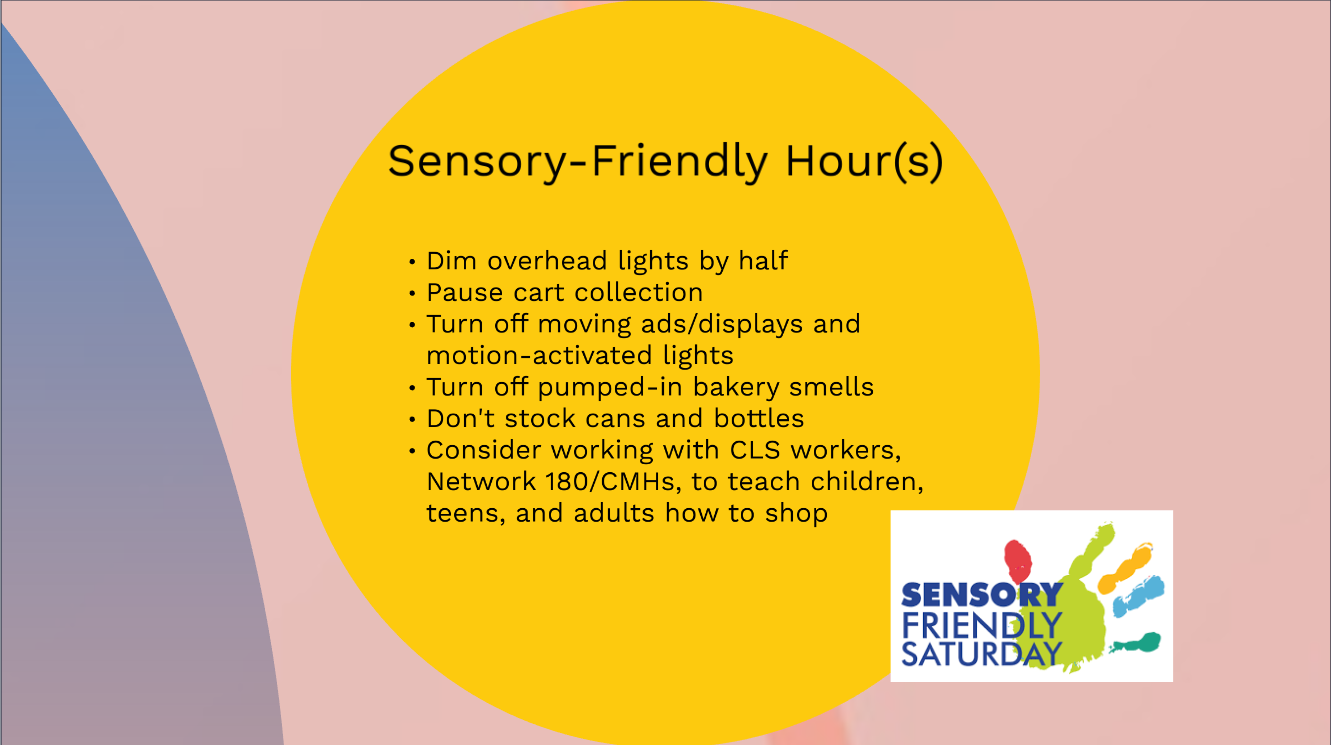
Turn off in-store ads and flashing signs, pause cart collection, and turn down the lights.  Based on my walkthrough experience, I expanded on this little by also suggesting they turn off the pumped in bakery smells and avoid stocking cans and bottles.  To this I\’d probably also add \”silence the talking self-checkouts.\”  Doing these things vastly reduces the amount of sensory information pushed onto shoppers, which is awesome for people with overload tendencies.

The more expensive and less likely accommodation I saw was a sensory-friendly room.  This is a phenomenon I tend to see more at conventions, but in all honesty, I could really use one everywhere I go.

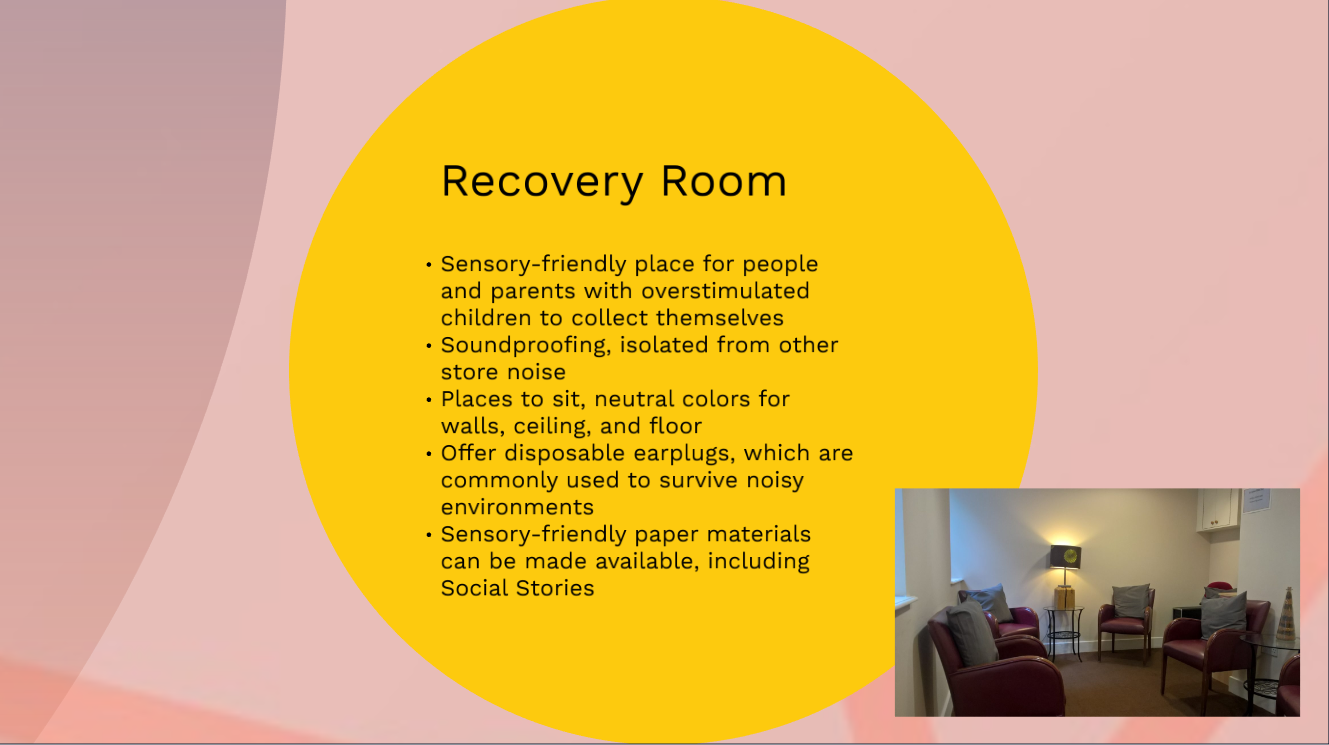
The idea is to establish an accessible, quiet room with neutral decor and places to sit while someone tries to wind down from a meltdown.  Small autistic child having issues?  Go to the sensory room and get out their favorite stim-toy.  They calm down, and you can get back to your shopping.

In conventions I\’ve been to, this room was literally as simple as \”we turned off the lights in this panel room and left like three basic chairs in there.\”  It wasn\’t exactly comfortable, but it was kinder on my senses than the convention overall.

My additional suggestions for a room like this include offering disposable earplugs, which are a common assistive technology for people with sensory sensitivities, and placing copies of the aforementioned sensory map and Social Story there.

Really though, it doesn\’t need to be fancy.  It just needs to be there and accessible.  I don\’t really think Meijer will go for this idea, though, because any public space they\’re not using to display products is lost income.

——————————————————————————-

I included this, in the main, because it seems negligent not to do so.  The Autistic Self Advocacy Network has taken great pains to establish easily-digested materials on the subject, and the Autism Society has put together an actual program you can qualify your business for.  It seemed criminally negligent not to at least say, \”hey, these are cool, maybe check them out?\”

In all honesty, though, in a perfect world, I might be able to make a living simply by getting hired to walk through places and point out the autism- or sensory-unfriendly parts of them.  I can hear things that most people can\’t, and am sensitive to bright lights in a way most people can\’t imagine.  I\’m also fully verbal and can communicate that information even while stressed.

In this very non-ideal world, I\’m not honestly sure there\’s enough market for such an idea.  If you know someone who\’d like to know if their business is autism-friendly, though, give me a shout.  My rates are very reasonable. : )

Grocery Shopping: Part 1 of a Sensory-Alert Walkthrough

Last week Autism Support of Kent County, the organization I volunteer with, was invited to the corporate office of the Meijer, the local chain of super grocery stores. Meijer is hoping to make their stores a bit more sensory- and autism-friendly. I was invited along (after asking if I could be), and so in order to be properly prepared, I took a trip to the store I usually shop at.  There, I walked through the whole store, doing a slow but thoughtful shopping trip.

I came away with six pages of stream-of-consciousness notes, and roughly two dozen pictures.  After getting home, I condensed those into four topical headers and organized the information into those.  After that, I put together a very hurried and extremely unpolished presentation, which I will, I suppose, re-publish here with apologies to your eyeballs.  I\’m going to do it in two parts, because otherwise it\’s too long.  
Before I begin, please understand this is a single store I visited, not the chain at large.  It\’s one of the stores I shop at, in large part because it carries so much of what I need, at reasonable prices.  There are a lot of good things about Meijer that may seem ignored in the tide of criticism I offer here.  Check the second post, which will cover Sounds and Store Policies for a lot of those.
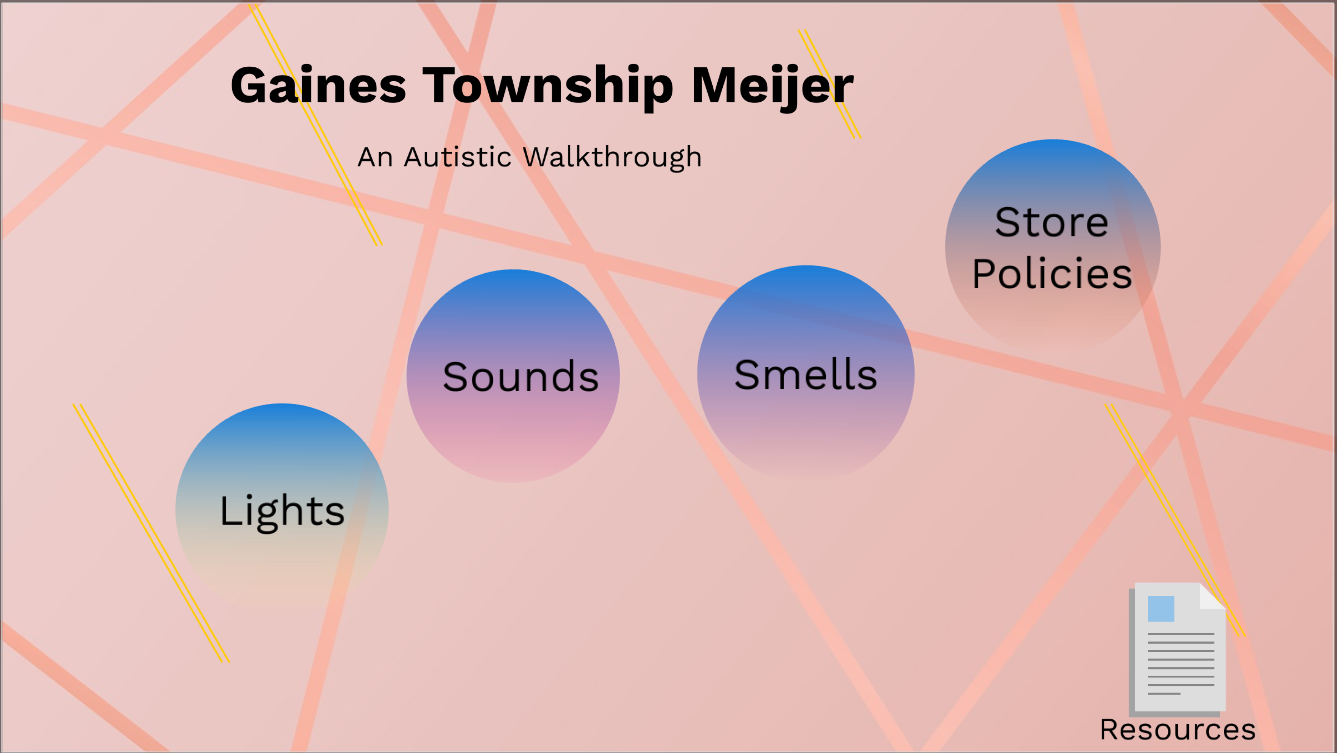
Main slide from a presentation, titled Gaines Township Meijer: An Autistic Walkthrough.  Main topics are Lights, Sounds, Smells, and Store Policies.
I haven\’t made Powerpoint-esque presentations for, um… something in excess of seven years.  Things have slightly changed when I wasn\’t looking, and I wouldn\’t say I was good at them in the first place.  You\’ll see what I mean later.

——————————————————————————-

Slide from a presentation, titled Lights.  Subtopics: Overhead Lights and LED Light Strips

For lighting, I was trying to get the basic understanding for design choices across.  Natural light or at least incandescent light over fluorescent lights.  Warm, soft white lights over harsh blue white lights.  No flickering lights.  These seem obvious to me, but I guess if you\’ve never stared directly into those awful new light blue headlights or into an LED light strip on a dark night, you might not know what I\’m talking about.

Slide in presentation, titled Overhead Lights.
Naturally, fluorescent lights are the cheapest for retail businesses by a hefty margin, so this normally falls somewhat on deaf ears.  When researching the subject, I did run across instances of teachers putting films or sheets over their fluorescent lights, which possibly moderated the flickering and humming.  So that\’s something.  
These particular overhead lights were of an unusual design.  They had a single, bright (probably fluorescent) tube bulb, facing UP.  The rest of the light was a curved white surface, which reflected the light out and down.  I\’m not a person that can actually see the fluorescent lights flicker, so I can\’t be sure that this design was meant to reduce that effect… but it does seem unusual and intentional, so that\’s certainly something.  
The lights themselves were… much too bright, honestly.  The reflections would bounce off every plastic-wrapped item, every glass item, and every polished surface (like, y\’know, the floor).  See the lower picture there?  The reflection of the overhead lights is visible in every single package of meat.  The end result was rather painful once I focused on it.  Dimmers would be a good option here, if the store wanted to be more sensory-friendly. 
LED light strips.  I hate them so much.  Whoever invented them has earned the swift kick in the pants I have saved for them.  They are very often the horrible piercing blue-white variety.  
Meijer, as it turns out, makes copious use of these light strips.  I found them in every refrigerated section, all over the health and beauty aisles, and even in special displays in the food and electronics areas.  Now, to the store designer\’s credit, many of these light strips were not visible from an adult\’s height and perspective.  They\’d installed them facing away from the customers, or blocked the immediate view of them with a plastic strip.  
The issue, of course, is that these precautions don\’t shield children, who are lower to the ground and have a different perspective on the displays… and it also wasn\’t sufficient to keep me from spotting them, because several of them still managed to stab me in the eyeballs.  The next time you see a kid screaming on the ground, apparently having a tantrum, look around for light strips, flickering lights, or obnoxious sounds.  It might not be a tantrum, but a meltdown caused by so many awful and painful sensory inputs.  
There was one exception to the \”light strips are awful\” rule, and I couldn\’t manage to get a good picture of it.  The refrigerated juice aisle had these long warm-colored light strips that had been shielded entirely.  This allowed them to emit light, but reduced the eyestrain to the point where I noticed no pain while staring directly at them.  It was really nice, and I hope it becomes the standard everywhere.
Another thing I found and hated with light strips: the ice cream and frozen food sections have those tall upright freezers.  Those are fine.  However, they decided to install motion-activated lighting in those upright freezers, so when you walk by, everything brightens up.  This is highly disorienting to me, and I hated every minute of it.  I actually had no idea why I felt so disoriented in the freezer section until I did this walkthrough and noted the motion sensors every 3 freezers on each side.  Hate it, do not want.
The view looking up in a grocery store.  Painfully bright spotlights shine down on bottles of alcohol

Something that didn\’t make it into the presentation was spotlights.  I think I\’d meant to have them, but just… didn\’t.   In my defense, it was well past midnight when I was working on the presentation, and I\’d had roughly 24 hours\’ notice that  this meeting was happening, and that I was coming.

I squinted at this flickering spotlight for about a full minute, trying to decide if it was malfunctioning or if this was intentional.  The flickering was quite regular, and wasn\’t making extra sound, so I got the sense that it was intentional.  Obnoxious and possibly dangerous to people with epilepsy, but intentional.  The whole spice display flickered with light, as a result, which I think was to make it stand out more.  It was kind of like poking me in the eye repeatedly.  Needless to say, I am not a fan.  
——————————————————————————-
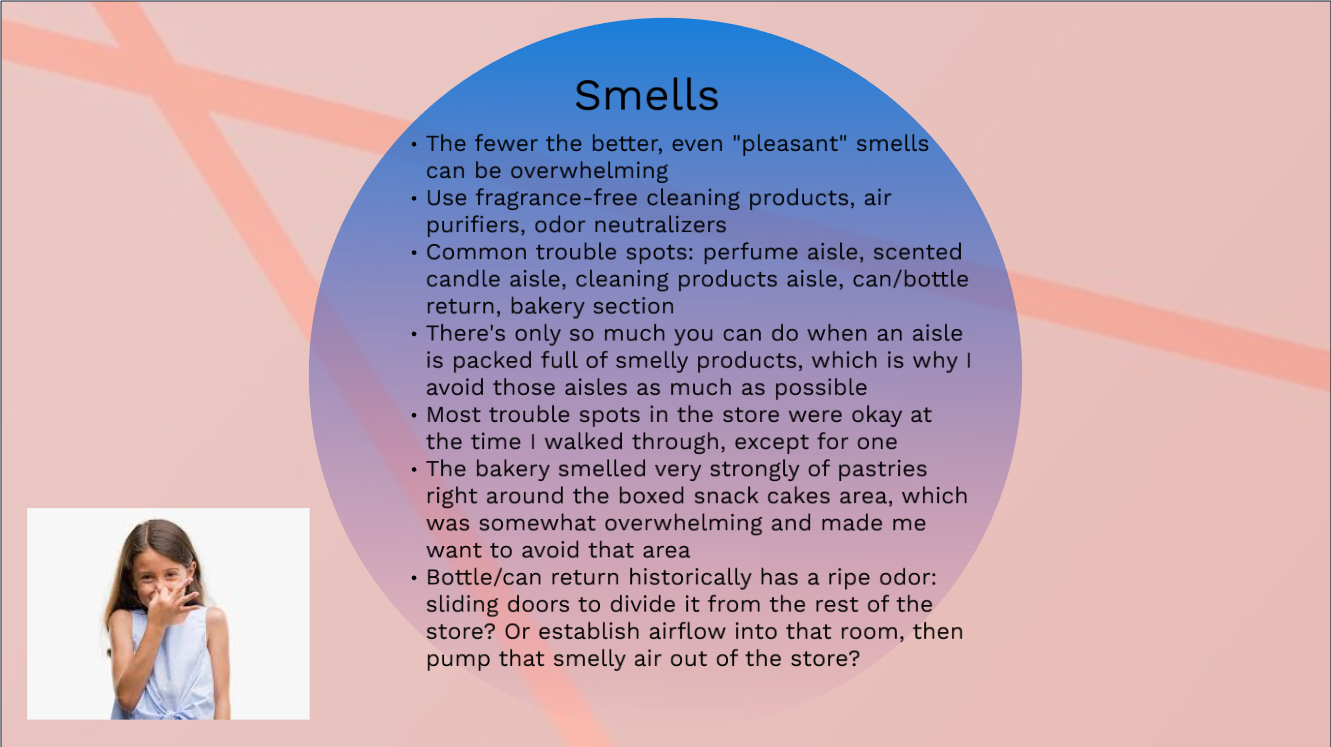
We\’re going to skip over Sounds this week to jump right into Smells.  You can see from how lengthy the bullet points are here that I\’m very out of touch with how one makes a presentation.  I really just wanted to have my thoughts organized.  
As a general sensory-friendly rule, you want zero odors in a public area.  The nose can\’t cause you pain if it has nothing to react to.  Odorless cleaning products are my friends.  Even pleasant smells, like fruit, flowers, or baked goods, can cause pain and sensory overwhelm.  My doctor actually gets bad headaches from flower-scented things, even though basically everyone likes flowers.
Obviously, in a grocery store, this is only so possible.  The perfume aisle, the scented candle aisle, the cleaning products aisle, the can/bottle return, and the bakery section are going to have smells.  You can use odor neutralizers and air purifiers around and in those aisles to help, but the fact remains, those places are full of smelly things.  And worse, those things are often purposely made with porous packaging (the material has tiny holes in it) so you can smell the product and decide if you want it or not.  
In the walkthrough I did, the trouble spots were actually pretty good, with one exception: the bakery.  I\’ve read somewhere that stores like to pump canned \”fresh bread\” or \”baked goods\” smells into their bread and bakery departments, and I\’d bet my comfy blue slippers that Meijer is no exception.  I got a strong noseful of \”baked goods\” smell when I stepped into the packaged snack cakes and cookies section.  Which is curious, since, y\’know, they\’re in packages, and I was still like 10 feet away.  
Historically, though, the can and bottle return is malodorous in the extreme, to the point that even people with normal senses avoid the place.  This location had the entrance to it located right in the entrance to the food, unfortunately, which I can guarantee will make it Bad Times in summer.  
I\’m not really sure how the store handles that, but the entry to the return area is unimpeded by sliding doors.  Adding sliding doors, or establishing a breeze going into that room, which is then pumped out of the store, would probably be a way to handle it.  I\’m no engineer, though.  
When I shop, I tend to avoid all the trouble spots I\’ve mentioned here, simply because I know they\’ll be unpleasant.  The discussion brought up the idea of mapping those trouble spots, as well as any quieter or safer areas in the store, and having those maps be available to parents and anyone else with an interest.  I think that\’s a good idea overall, and I\’ll go into that idea and some related ones next time, when I talk about Sounds and Store Policies.  

Mouth Care with Sensory Sensitivities: An Electric Toothbrush Comparison

Today we\’ll discuss oral hygiene, how sensory sensitivities factor in, and compare two electric toothbrushes side-by-side.  
Oral hygiene is a basic part of personal hygiene, which is important for being presentable to people, especially neurotypical people.  If your breath smells bad, people won\’t want to be near you or speak to you, because they can smell it and can get grossed out by it.  Brushing your teeth, and also your tongue and mouth, combats bad breath.  It also fights tooth decay by decimating the responsible bacteria.  
The problem with all this is that brushing your teeth can be a really unpleasant sensory experience.  Having bristles scraping against your gums and teeth can be torturous for people with touch sensitivities.  Especially if you go the extra step and invest in an electric toothbrush, which does a much better job than manually brushing.  The electric toothbrush vibrates in addition to your brushing, which polishes your teeth and under your gums much more effectively… but now you\’re pressing a buzzing object to your gums in addition to the brushing sensations!
Essentially, oral hygiene can be a really unpleasant nightmare for people with sensory sensitivities.  A nightmare that has to be repeated daily, or cavities and fillings and crowns and so many expensive trips to the dentist will result.  

The Toothbrushes

Therefore, making the process as painless as possible is important.  One way to do that is to choose your toothbrush carefully.  Our two toothbrushes are below:

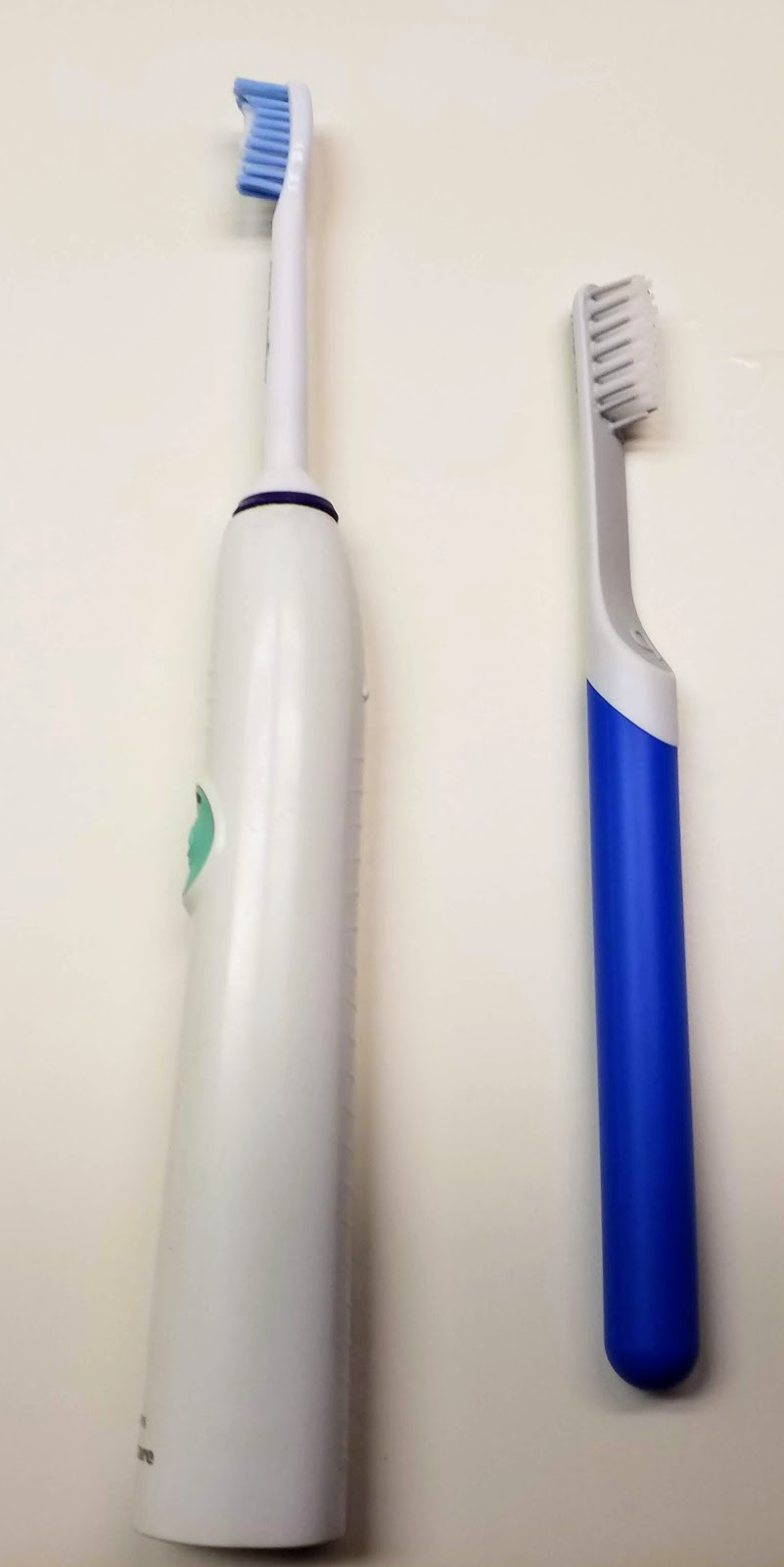
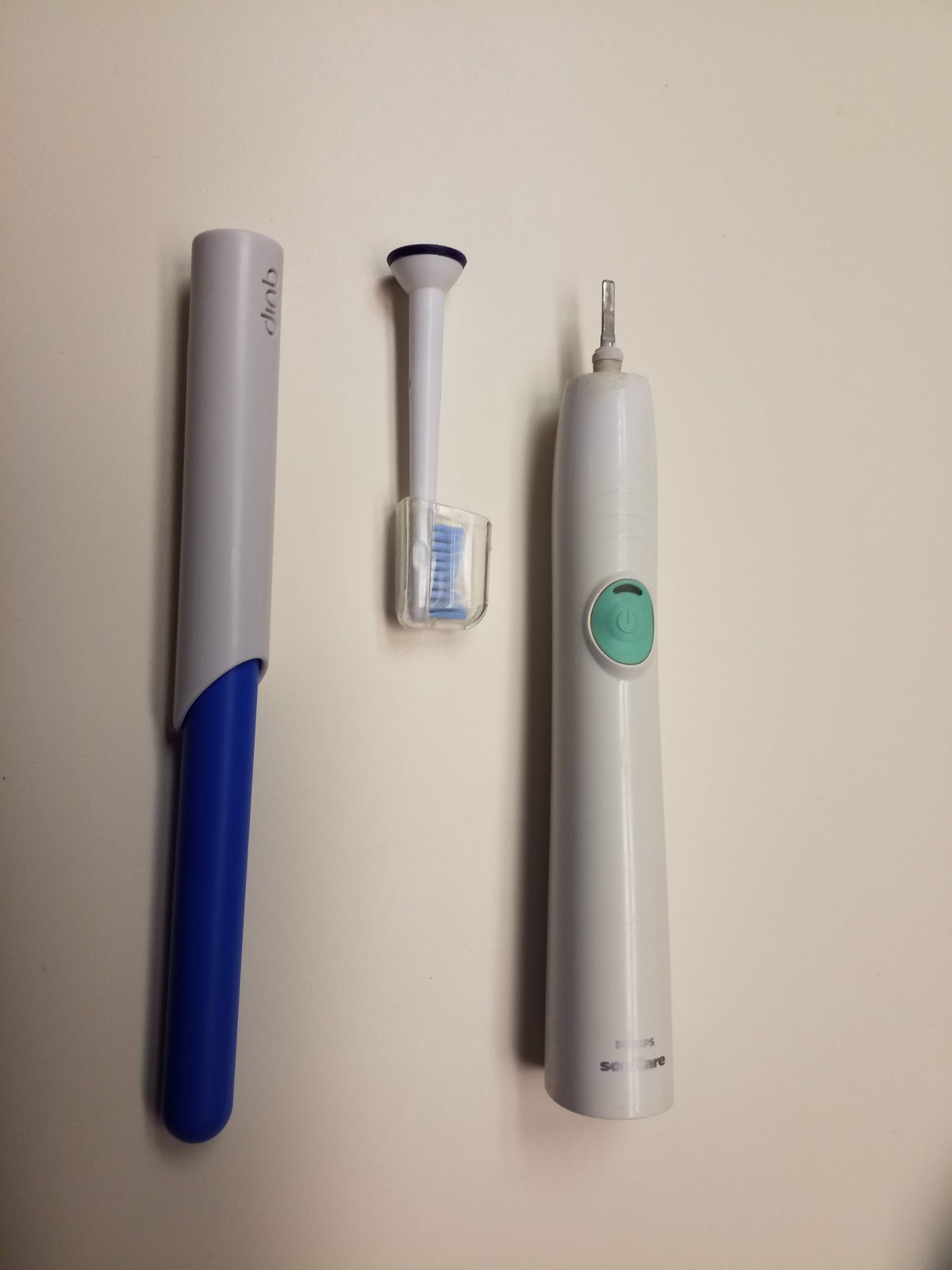
On the left side, my spouse\’s Phillips Sonicare toothbrush.  His is a basic model, but the company is well established in the electric toothbrush market.  I\’ve borrowed this toothbrush and used separate toothbrush heads for a couple years now.  With it, I\’ve stopped having any cavities whatsoever in my teeth.  
This is particular impressive because it\’s despite: A) I\’m sometimes unable to make myself do any toothcare at all for an entire week (thanks to depression and sensory sensitivities) B) I have bad genes (my dad has had many cavities despite brushing and flossing religiously, and I have had some problems as well), and C) I eat way too much sugar overall, which heftily accelerates how quickly your teeth decay.  
On the right is a Quip toothbrush, a relatively new arrival on the mouth care scene.  The toothbrush is actually only one piece of their oral health recommendations, which include letting you do a subscription plan to have new toothbrush heads and toothpaste sent to you every 3 months.  Other than floss, it\’s essentially everything you need to care for your whole mouth.  My in-laws generously gifted the Quip toothbrush to me for my birthday, and I\’ve just gotten the chance to try it out, which is what prompted this blog entry.  Thank you!

Show/Hide

You\’ll notice immediately, as I did, that the Quip toothbrush is much smaller.  It\’s also lighter by a good margin.  What\’s not obvious from that first picture is that both toothbrushes have detachable heads.  The Quip is simply built more seamlessly.  Below is a picture of the brush heads, along with a manual toothbrush.

Two electric toothbrush heads held in a hand.  One has a scrubbing surface, the other does.  Above them, a manual toothbrush with a scrubbing surface.

As you can see, the Quip toothbrush head comes with a scrubbing surface on the back.  This is actually a feature I\’m rather fond of, to the point that I invested in a manual toothbrush like the green one so I could continue to have one available to me.  Having the feature built right into the brush head saves me annoyance, counter space, and money.  
What about the accessories, and the innards?  

Quip electric toothbrush parts and accessories: handle, toothbrush head, motor, a AAA battery, and a plastic cover for the top half of the toothbrush

Sonicare electric toothbrush charging base, handle, and a toothbrush head with plastic cover.

As you can see, the Quip disassembles a lot more than the Sonicare does.

The Sonicare has the handle (not meant for the user to be able to take apart), the toothbrush head (with plastic cover), and the charging base.  The Quip breaks down into the toothbrush head, motor, battery, plastic handle, and sliding cover.  The cover fits either end of the toothbrush.  Due to the sticky tape (not shown) on the cover, it serves as both a travel cover and holder.  You can literally just stick it to the counter or to your mirror and put the handle into it for easy access.

The Quip uses a standard AAA battery, whereas the Sonicare uses a rechargeable battery pack.  I have no information on how long each lasts, but I can safely say the Sonicare battery pack has lasted like 5 years.  I suppose one could always use a rechargeable AAA battery in the Quip as well.

I\’ll be heading out of town for Thanksgiving soon, so another question arises: How do they handle for traveling?

Quip and Sonicare electric toothbrushes, packed for travel.  The Quip packs into one piece and is much smaller, while the Sonicare\'s toothbrush head detaches from the handle and needs a clear plastic case.
As you can see, the Quip packs into a single unit.  The white plastic cover slides over the brush head and locks into place.  The Sonicare is better packed in two pieces, with the brush head separate from the base.  The brush head then needs to be covered with a clear plastic case.  One of those comes with every toothbrush head, which means a lot of those little plastic cases build up over time.  
And now, most importantly for people with sensory sensitivities: how do they handle?  I got a couple videos of turning them on.  
The Sonicare makes a medium buzzing sound.  When pressed to your mouth, it also buzzes your teeth, gums, and jaw.  Again, this is the toothbrush I used for years.  The experience of using it is not even slightly enjoyable, and I have to shut my eyes and keep anyone from interacting with me while I use it.  This is in part so I can remember to get all parts of my mouth, and in part because the sensory experience is painful and frustrating, and best managed with my full attention.  

The Quip runs a lot quieter, and vibrates my hand a lot less.  This has the added bonus of not making my hand slightly numb after using it.  It does also vibrate the teeth and gums slightly, but not nearly as much as the Sonicare.  This does make me wonder if its cleaning efficacy is as good as the Sonicare, but time alone will tell that.

Another note on using the toothbrushes.  The brush heads my spouse and I use with the Sonicare are \”extra soft.\”  This is because gum erosion is a possibility with the intensity of electric toothbrushes, and the idea of tooth care is to clean the gums, not destroy them.  I don\’t know what the Quip\’s brush softness is, but it\’s definitely not \”extra soft.\”  I\’d guess \”soft,\” not \”medium,\” judging by the manual toothbrushes I own.

It makes sense to me that the Quip perhaps makes up for its gentler vibrations by using \”soft\” rather than \”extra soft\” bristles, but I have literally no formal education in dentistry, so I\’ll double-check that idea when I next visit my dentist.

Both toothbrushes run for 2 minutes.  Every 30 seconds, the toothbrushes stop buzzing for a split second, which tells you to move on to the next quadrant of your mouth.  In this manner, you spend half a minute on each quadrant and get a more thorough cleaning.  This is a good feature, which I\’m guessing is standard these days.

The Winner

At least for me, Quip wins this comparison hands down.

It\’s smaller, lighter, has more functionality, is more portable and travel-safe, and most importantly, its vibrations don\’t upset me nearly as much as the Sonicare toothbrush\’s do.  With the Quip, I could see myself brushing my teeth twice a day, as the dentist recommends, rather than once a day as I do now.  Once a day has been enough to keep me cavity-free, but if the Quip doesn\’t clean as vigorously as the Sonicare, then twice a day would definitely be a wise idea (as well as what the doctor ordered…).

I\’m also extremely impressed that they designed a toothbrush where every single one of the parts is easily replaceable.  If the Sonicare\’s motor ever dies, there won\’t be any option but to replace the whole handle, which is kind of a waste of perfectly serviceable plastic and the rest of the toothbrush.  If the same thing happens with the Quip, I need only buy a new motor.  Or handle.  Or sliding cover.

This strikes me as more environmentally friendly than the Sonicare, though the question of whether the AAA batteries will add up over time is relevant.  You can somewhat offset that by using rechargeable AAA batteries yourself, I expect.  But each toothbrush head with the Sonicare toothbrush comes with a little plastic cover, and I\’m fairly certain Quip\’s refills won\’t.  So it\’s at least a tie, given a conscientious consumer, I expect.

I\’ll start using the Quip instead of my spouse\’s toothbrush immediately, and try to add an evening brushing into my oral care routine.

If you\’re interested in checking out the Quip, I saw it at Target recently on an endcap in the tooth care section.  You can also get your first toothbrush from them for only $25 on their website.

Extra: The Rest of My Mouth Care Routine

Like most children, I was taught how to brush my teeth young.  Unlike most children, I continued to have difficulty adopting that routine and sticking to it into my college years.  I can\’t remember having a specific reason why I didn\’t like the experience, but it wouldn\’t surprise me if the feeling of brush and floss on gums and teeth was just so unpleasant that even 2 minutes was too long to manage.  
After a series of very expensive dental bills, I forced myself to establish a tooth care routine, which I try to do every morning.  I\’ve had multiple oral hygienists tell me it\’s a pretty good routine, so for completeness\’ sake, I\’ll include it here.
  1. Scrub tongue with tongue scrubber.  My tongue tends to build up bacteria, especially in the morning.  Scraping off the buildup makes the clean taste from brushing last longer and reduces the overall amount of bacteria in my mouth.
  2. Floss.  I use two types of floss.  A braided, thicker floss is the staple for between most of my teeth.  It\’s quite gentle, doesn\’t cut into my gums, and catches more food and plaque than the regular floss.  A thinner, waxed floss goes between my lower front teeth and their neighbors, which have a metal wire across the back side of them due to orthodontics.  
  3. Brush teeth (and gums).  I use an electric toothbrush with baking soda toothpaste.  There are about 3 bajillion toothpaste types, but my dentist commented to me that my mouth tended to be more acidic than most.  Baking soda toothpaste helps offset that.  I also try to switch brands after each tube.  I read somewhere that the bacteria in your mouth get used to a toothpaste formula after a while, so it\’s best to do that.  I also try to focus more on the gumline and the back of my mouth rather than the teeth directly.  When the toothbrush\’s timer ends, I brush the roof of my mouth, then brush my tongue again with the remains of the toothpaste.  
  4. Mouthwash.  This keeps my mouth feeling clean a lot longer, even though it can really sting and tastes quite strong.  Listerine\’s a good brand.  There\’s been some back and forth about whether alcoholic mouthwashes are a bad idea, since alcohol can dry out your mouth (which leads to more bacteria).  I brush in the morning, so it\’s not as much of an issue as it would be if I was using it at night.  If you can\’t stand the flavor of alcoholic mouthwashes, or you tend to do your tooth care at night, there are several kinds of non-alcoholic mouthwashes that still definitely help.  

A Week with Woebot

Roughly a year ago, a friend of mine linked me to a cool idea: an AI therapist that helps you track your mood and teaches you the basics of Cognitive Behavioral Therapy (CBT).  The name of the AI is Woebot.  At the time, it was only available on Facebook, and since Facebook kicked me out for refusing to give them my last name, it wasn\’t an option.  But I thought the idea had merit, so I signed up to be notified if they ever took their project to a regular app.

After some time had passed, they did in fact do just that.  So I gave it a try.  The app, simply called \”Woebot,\” is available on both iOS and Android.  I installed it on my support tablet and booted it up.  
You\’re greeted by an animated robot (somewhat similar to Wall-E, honestly) as the app starts up.  This resolves to a smaller picture of the robot, and then there\’s a text box for typing your replies and what\’s basically an instant message conversation window above that.  I did have to make an account, which might be a turn off for anyone who lives with paranoid tendencies.  
From that interface, you chat with Woebot, whose personality vacillates between teenage girl (minus the attitude) and calm mid-20s college guy, with the knowledge of a CBT therapist.  The communication style of the AI is very much the younger generation\’s: text, interspersed liberally with emoticons.  I found that somewhat offputting, but at nearly 30 years old, I am definitely no longer \”the youngest generation.\”  
So the first point of this app is to track your mood.  After greeting you and asking you what you\’re up to, this is the first thing it does each day.  You choose an emoticon to describe your mood, though you can eschew that and use words instead if you really want to.  
This is not my device, but this is basically what the check-in looks like 

I found myself miffed and confused by the bot\’s interpretation of the various emoticons, with the end result being that I\’m now unsure if a particular emoticon is always meant to be \”I feel lonely\” or if the programmers just decided that.  They seem to have also ranked each emoticon on a scale of positive to negative… but the ranking system wasn\’t terribly apparent to me, so I wasn\’t really able to properly respond to the question.  

The AI remembers your moods each time you give them, and plots them on a chart for you as time goes by.  You can thusly track how you\’re feeling each day.  If you\’re me, you\’re always kind of grumpy or tired or whatever, so the chart is kind of boring to look at.  But other folks, especially ones that try the app longer, would likely have more interesting, helpful charts to look at.  
I imagine this would be helpful for people who feel depressed, but actually are doing fairly well most of the time.  But I\’m a huge grump, so it didn\’t do a lot beyond validate my impression that I\’m a huge grump. 
After the AI sympathizes with you or celebrates with you about your mood, it normally has something to tell you or teach you.  This is usually couched in conversational language, like telling jokes, or saying it in a, \”guess what I heard recently?\” kind of indirect way, as opposed to a \”you might find this technique helpful\” direct way.  While that does kind of enhance its appearance of humanity, I also found it kind of annoying.  But I\’m a very direct, \”just spit it out already\” kind of person.  
I think all of that probably would have been fine, if it weren\’t for the last thing I didn\’t like about the AI\’s style of communication.  You see, while we have chatbots that can hold a pretty decent conversation, this is not one of them.  This AI appears to be intended to follow a script, and if you deviate from the script, it continues right along that script merrily, as if nothing had happened.  
When you talk with Woebot, you always have the option to enter your own response… but the app seems to prefer you simply click one of the preoffered responses.  If you type something different, it defaults to the first preoffered response it gave you.  Like the emoticon choice above, but usually only 1-3 responses… and those a great deal more cheerful and full of emoticons than I\’d ever type myself.  As such, it becomes far too easy to just skim the AI\’s words and push pre-programmed responses without investing any real effort or interest into what it\’s trying to teach you.
As such, I was… really not impressed with this app.  It\’s a real pity, because the techniques it was trying to teach me are quite valid and important ones.  For instance, the AI started me out with mindfulness, and then got to working on recognizing and correcting cognitive distortions, keeping a gratitude journal, and setting good goals.  All of these are excellent basic therapeutic techniques, and fine ways to start a person on self-improvement.
I figured out pretty quickly that I mostly know the stuff it was trying to teach me, to the point where I was anticipating roughly what it would say next.  Which I guess tells me this app was not intended for someone with a psychology background…  Which is fair, since the world is a big place with many different kinds of backgrounds and knowledges, and most people don\’t have that particular background.
Actually, I\’m not really sure if this app was meant to be used by adults.  The choice of communication style, emoticons, and personality choice suggest to me that this app was really more meant for use by teenagers, perhaps into college.  Since teenagers aren\’t the most self-aware type of human, and often can use counseling and help with coping skills, this isn\’t necessarily a bad choice… but it doesn\’t cater to me, personally, despite that I do have mental illness and could possibly use help with it.  
Anyway, bottom line is that I won\’t be keeping this app.  It\’s too bad, because the idea is fantastic: in an age where mental healthcare is prohibitively expensive, just teaching the basics via a free mechanism could potentially reduce the suffering of a lot of people, and thus improve the world.  
It could help teenagers (on and off the spectrum) as they struggle with who they are and who they want to be.  Teaching the basics of CBT and other good therapeutic techniques is great for increasing overall knowledge, and better educated people can help educate and support each other.  It could potentially help a patient autistic adult identify, deal with, and compartmentalize their emotions, which is definitely a good thing.  And the app does seem to have helped other people, by the views in the app stores.  But I guess I\’m too old, too cynical, and too educated to really make use of it.  
Hopefully as the developers receive feedback (some of which is mine) and improve the AI, Woebot can become a more helpful, responsive, useful chatbot for people of all ages and backgrounds.  In the meantime, at least it\’s helping some people.  

Auti-Sim, an online autism simulator

Link here.

This turned up on my Twitter account (realautistic) via the /r/autism subReddit.  The game itself is hosted on an online game website called Kongregate. 

Out of morbid fascination, I decided to try it.  I say “morbid” because the simulator is meant to demonstrate how it feels to have sensory issues.  I already have sensory issues.  As such, the game was very likely to give me a headache.  And it did, in fact, succeed.

The game is very simple. It sets you as a kid on a playground, perhaps in a school yard or community playground.  You have basic movement controls (left, right, forward, back, and jump) and camera control (using the mouse), but can’t interact with anything or anyone.  (also nothing except you moves)

You start in a safe area, a quiet corner away from the other children.  If your volume is turned on, you can hear the sounds of kids on a playground: shrieking, chanting, calling to each other, with occasional thumping or thuds.  You can hop on the playground equipment, but depending on how close to the other children you go, you start to suffer.  Your vision starts going snowy, like static on the television.  Everything gets painfully louder.  The longer you stay, the worse it gets, until you stumble away. 

Or curse audibly at the screen, get a headache, and stumble away, if you’re me.  I’ve only seen a few sensory overload simulators before, and I hadn’t realized how loud it would get.  I queried my fiancee, and he said it was definitely unpleasant.  When you flee away from the other kids back to the edge of the area, the overloading quiets down in a few seconds.  I really wish my overloading quieted down that fast, but it wouldn’t be a very good game if once you’d gotten overloaded, you had to sit for an hour somewhere quiet and alone.

The other children are all faceless, wearing the same clothing, and don’t look at you or respond to your approach.  This mirrors something I tend to deal with in reality: faces are immensely difficult for me to memorize, and names are even worse.  Clothing changes day by day, so even if all the clothing is different for each person, it’s useless as an identifier in the long run.  Finally, the others not responding lines up with the fact that the “weird kid” on the playground usually gets ignored, or worse, mocked.

Other things I noticed about the game:

  1. The colors (especially the sky) are unusually bright.  This is, as I understand it, a kid thing.  Kids often draw the sky in a bright blue, and I read somewhere that this matches their reality.  They see the color of the sky more vividly than we do.  I don’t have a scientific reference, but I remember I did spend a lot of time looking at the sky when I was little.  It was bright and pretty and often had puffy clouds or jet trails in it.  
  2. Included in the play equipment is a merry go round (with another kid on it).  Some kids on the autism spectrum find solace in stimming, which can be anything from flapping your hands to full-body spinning.  I’d hoped that perhaps the spinning would allieviate or at least tone down the overstimulation, but no luck.  Same idea with the swings, which I spent much time on as a child.  I think I mainly liked them because they got me up high, but some stimming might’ve been involved too. 

Finally, the developer of the game included a very important aspect for autistic kids that don’t blend well: escape.  If you hop up on the play equipment behind you at the start of the game, you can leap the fence keeping you inside the play enclosure, and from there, run as far away as you’d like.  Autistic people, especially ones that don’t speak but even ones that do, will sometimes bolt.  You’ll be standing there with them, everything seems to be fine, and off they go.  This causes the parents and caretakers a lot of anxiety, as you can imagine.

I’m not actually sure if they included that option on purpose, or if this is an unfinished version of the game, but I’m glad it was there.  If I’d made the game (no idea how, so props to them for doing so and putting so much effort into it), I’d’ve made the sounds of the children fade into silence as you get further away, leaving you alone with the calming silence and the beautiful outdoors.

Of course, they’d need to set a timer for your kid to get dragged back to the playground, too.

Overall, this Auti-Sim simulator is good teaching tool in proper context, which I hope I’ve provided here.  Please do give it a try.