Reading the Research: Amplifying Diversity in the Workplace

Welcome back to Reading the Research! Each week I trawl the Internet to find noteworthy research on autism and related subjects to share with you. Along the way I discuss the findings with bits from my own life, research, and observations.

Today’s article shows the benefits bosses and companies can reap when diversity in the workplace is respected and amplified. That diversity can include neurodiverse people, like autistic folks, but it can also include black people, immigrants, and even the aged or young among us.
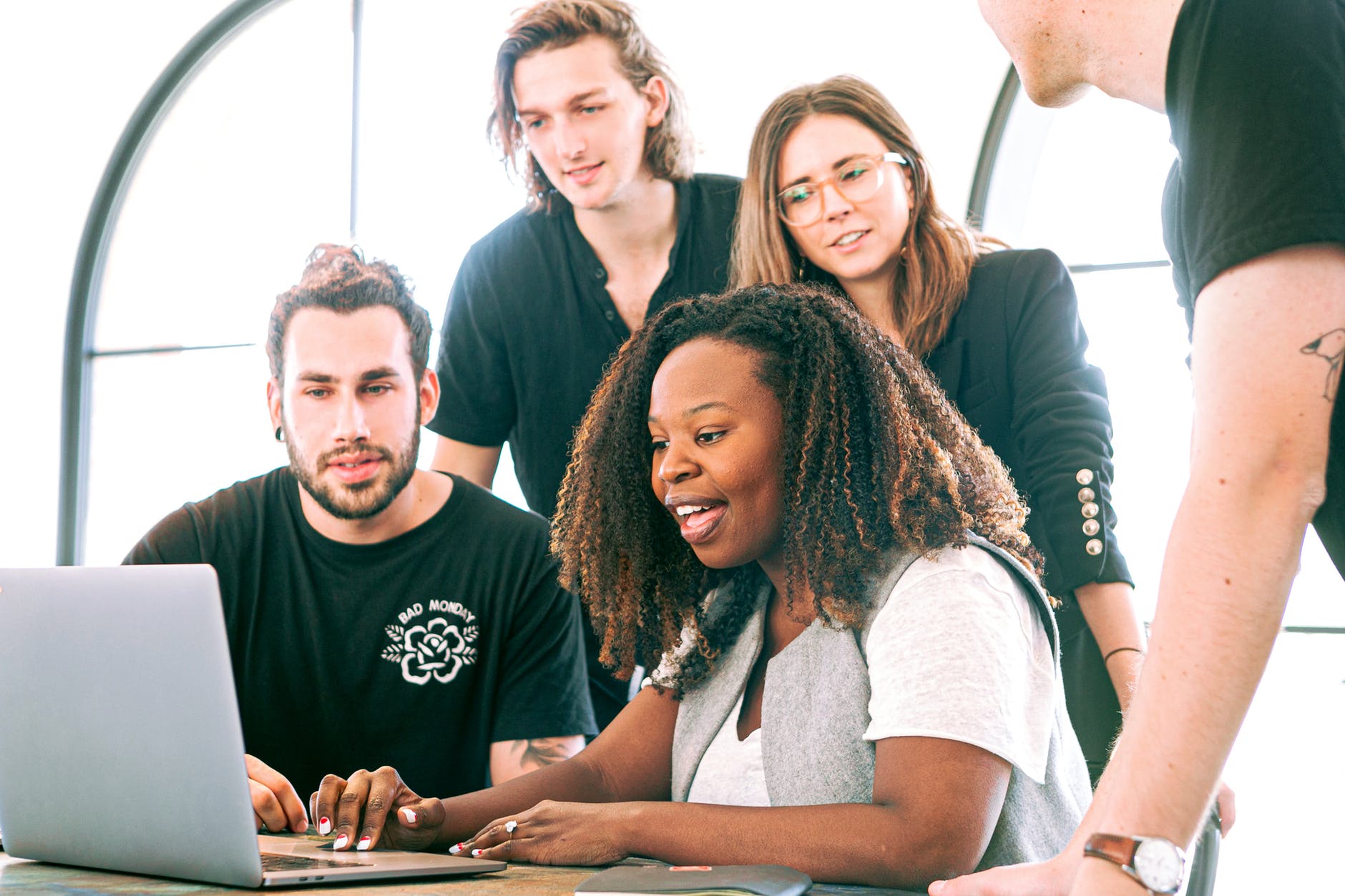
diversity in the workplace: black woman sharing her presentation with her white colleagues
Collaboration takes many forms, but the best ideas come from listening to everyone- not just people who look like you. Diversity in the workplace benefits all of us. Photo by Canva Studio.

There is, I think, the preference for those “like us,” especially in groups and companies predominantly one ethnicity. In the US, that’s white people like me. The problem is that the “ingroup” can only generate so many ideas. We can see this pretty clearly in Hollywood’s choice of major movies. The typical directors and screenwriters are white and male. The Oscars are almost exclusively judged by old white guys. The same ideas get used and reused. It’s incredibly hard for marginalized people to get their ideas up to the highest level. Even if their ideas are actually really good. (A couple that made it through despite the immense difficulty: Creed and Black Panther).

Missing the Best Ideas

So many good ideas are thought up and are never used or even heard by people in power, simply because people don’t put a lot of stock in diversity in the workplace or ideas from marginalized people. (In fact, it’s difficult for marginalized people to get hired at all.) Thankfully, it doesn’t have to be that way. Ideally, we would simply hire and promote marginalized people in all industries. That way ideas could be introduced naturally in an organization’s power structure. Unfortunately, that’s not how most companies are right now.

So until things improve on that front, there’s another solution: making sure managers and other higher-status people in organizations listen to all their employees. If a good idea comes up, that higher-status person can promote it, or signal-boost it and the person that thought of it. Since the person is higher-status, others with power in the business will listen to them and the good idea. In turn, this makes the company more likely to use the good idea and benefit from it. Finally, the inventor of that good idea receives recognition for their work, and the possibility of advancement.

The Problem and a Solution

The tripping point is that many managers don’t see the value in promoting ideas from their underlings. Often, they would rather not rock the metaphorical boat, or take risks associating with lower-status people in the company.

Here’s the thing, though. This article tells us that this decision to promote good ideas from marginalized people pays off big time. The company benefits because good ideas rise to prominence, allowing the decision-makers to choose from the best possible options. The marginalized person benefits from the recognition of their good idea.

And the missing piece: the promoter also gains a status boost from bringing the good idea to the table and crediting the idea’s owner. Essentially, everybody wins. There’s no reason not to do this. Plus, doing this can lead to better, more competitive, fairer organizations where the best idea truly does win.

(Pst! If you like seeing the latest autism-relevant research, visit my Twitter! There are links and comments on studies that were interesting, but didn’t get a whole Reading the Research article about them.)

Reading the Research: The Autism Service Cliff

Welcome back to Reading the Research! Each week I trawl the Internet to find noteworthy research on autism and related subjects to share with you. Along the way I discuss the findings with bits from my own life, research, and observations.

Today’s article serves as an introduction to the autism services cliff. This is what people call the sudden drop-off of services after the autistic person graduates or ages out of high school. You see, there are typically a lot of therapies and services offered through schools. Things like a one-on-one aide, or speech and language therapy, or occupational therapy are typically managed and implemented by the school.

Take the school out of the equation, and the autistic person is left with nothing, or almost nothing. Because of this sudden loss in services, autistic people often struggle at the transition between high school and adulthood. Some autistic people, like me, still manage to land on our feet. Others try very hard but still don’t succeed in the long term. The parents I’ve spoken to often talk about failed attempts at college, or long strings of jobs held for only a month or two. It’s not all stories of failure and crushed hopes and dreams, but there’s certainly enough of those to dishearten someone quickly.

This autism services cliff typically strikes between ages 18 and 26. Like a lot of things in the US, the maximum age someone can stay in school varies by what state you live in. In my home state of Michigan, that age is 20. Even before that age, though, the difficulties can begin with the loss of child Medicaid.

Transitioning to adulthood doesn’t necessarily mean losing Medicaid for good, but the requirements are significantly different. The rejection rate is very high. When you apply, bring a great deal of perseverance and the expectation that you’ll need to try at least twice. Neatly organized documentation of the disability and the need for services across years of the person’s life helps a lot.

This is why a Medicaid waiver, such as the ones mentioned in this article, can be so valuable. They can continue the autistic person’s Medicaid services into adulthood without disruption. Keeping these autism services and structure over the transition to adulthood can be incredibly helpful to an autistic person’s wellbeing. But even beyond direct services and Medicaid, a lot of structure is simply lost after you leave school. You can’t count on the easy exposure to groups of your peers any more. Nor is there usually free transportation to activity hubs with a variety of options. And now you need to both find and pay for sports facilities and other programs.

The only comparable organization is church. Like schools, churches can offer structure and groups of peers. Some churches offer small group Bible studies or household groups. Some churches may have simple sports equipment, such as a basketball hoop, or a field in which a pick-up group might play soccer or frisbee golf. If nothing else, a church can be a place for autistic people and our families to find structure, activities, and community.

Personally, I’d like to see a universal healthcare replace Medicaid. One of Medicaid’s typical features is the requirement that the receiver be painfully poor. Working part time at minimum wage can be enough to disqualify you, depending on which state and program you’re in. I don’t know if you’ve noticed, but part time jobs, even those that pay above minimum wage, are rarely enough to live on.

Instead, I’d rather have a healthcare that provides for everyone. If a family needs respite care, they should have it. If an autistic person needs help making a schedule or getting a job, that should be available. I don’t feel like we should make people present 20 pages of documentation to prove their need. That’s just another way of punishing people for existing. It doesn’t make the need go away, it just makes the person suffer for having the need.

Personally, I think punishing people for existing is pretty much inexcusably evil.

(Pst! If you like seeing the latest autism-relevant research, visit my Twitter! There are links and comments on studies that were interesting, but didn’t get a whole Reading the Research article about them.)

Reading the Research: The Real Link Between Violence and Mental Illness

Welcome back to Reading the Research, where I trawl the Internet to find noteworthy research on autism and related subjects, then discuss it in brief with bits from my own life, research, and observations.

Today’s article merited underlining simply because this link is still, after all this time, misunderstood over and over.  I’m tired of seeing it, so here’s the truth.  There is, in fact, a link between mental illness and violence.  But it’s not what people think.  
 
People with mental illness (which often includes autistic people) are far more likely to be the targets of violence.  We are not the perpetrators.  The perpetrators typically people without diagnosed disorders.  To quote the article: “The large majority of the perpetrators of violent crimes do not have a diagnosable mental illness, and conversely, most people with psychiatric disorders are never violent,” Dr. Swanson writes.
 
Popular culture and the news seem to desperately want to play pin-the-tail-on-the-donkey with mental illness when some new violent horror pops up.  Because people always want to know “how could this happen,” but never want to consider that it might be because we\’ve been strangling social services for decades, or because the US has so many more guns per person than other Western nations.  They seem to want a nice, safe “it was something specifically wrong with this one person” answer so nothing has to change and we can all move on with our lives.  
 
As any idiot could tell by paying attention, these quick, individualized theories have had no useful effect in ending violence in schools, churches, and against marginalized people.  If it’s not the police shooting a black woman in her bed (or any number of other murders), it’s attacks against US citizens of Asian descent, or the painfully numerous school shootings (including three in 2021).  
 
The suggestion that mental illness might have been involved with violent perpetrators’ motives for their horrific actions is nothing more than victim-blaming misdirection.  It’s much like how some awful humans seem to think that wearing certain clothes is “inviting sexual assault,” as if adult male humans are toddlers with no self control who can’t possibly be expected to answer for their actions.  
 
So the next time you see a news article on the latest school shooting or hate crime, and the author suggests mental illness might have been involved, please recognize it as the gaslighting, red herring bullshit that it is.
People with mental illnesses are the victims of violence, not its perpetrators.  Blaming the victims solves nothing and helps no one.
 
(Pst! If you like seeing the latest autism-relevant research, visit my Twitter, which has links and brief comments on studies that were interesting, but didn’t get a whole Reading the Research article about them.)

Reading the Research: Autistic Sociability in a Pandemic

Welcome back to Reading the Research, where I trawl the Internet to find noteworthy research on autism and related subjects, then discuss it in brief with bits from my own life, research, and observations.

Today’s article has a bit of a skewed view on what likely happened, but presents some positive information I’d like to highlight.  This article comes to us from a university in Spain.  While that’s certainly not the US, it is still a “Western” country with some of the same cultural values and similar home/work patterns.  

The TLDR (Too Long; Didn’t Read) is: autistic kids, and their families, did much better than expected during the COVID 19 lockdown.  These families even improved their communication over the course of the lockdown.  I say “families” rather than focusing specifically on the autistic children, because communication is a two-way street.  Autistic people communicate.  We just don’t always communicate in words.  

This article doesn’t say the transition wasn’t difficult on the families and the autistic children.  The pandemic destroyed or massively altered regular routines, which is very hard on people that rely on those routines for comfort and safety.  That\’s autistic people, and others that struggle with regular life.  Things were also more difficult because support services for the autistic children were not available, or were less available.  Educational options were minimal or nonexistent as well.  So initially, things became more difficult for families with autistic members. 

However, in the long term, as new routines were established, the autistic children and their families thrived more.  The parents, often unable to go to work, spent more time at home, interacting with their kids.  With the additional interaction and attention, the autistic children thrived.  Or put another way: with more social interaction with people they love and trust, autistic people thrived.  

The last thing I want to underline from this article is this: autistic people are often stereotyped as not being social, not caring about others, etc.  This study specifically states that these autistic children were calmer and happier when they were able to use the Internet to see their distanced grandparents, classmates, and other family members.  In other words, autistic people were also happier being social and seeing people they cared about.  

In other words, yes, we are just like you this way- diagnosis or no.  

(Pst! If you like seeing the latest autism-relevant research, visit my Twitter, which has links and brief comments on studies that were interesting, but didn’t get a whole Reading the Research article about them.)

Reading the Research: Supportiveness

Welcome back to Reading the Research, where I trawl the Internet to find noteworthy research on autism and related subjects, then discuss it in brief with bits from my own life, research, and observations.

Today\’s article showcases what I wish every person had.  Especially autistic people, but just in general, too.  

Depression is a part of normal life.  Typically people will experience a couple months of it here or there, when someone they love dies, or a major life change happens… like, y\’know, a worldwide pandemic that mandates staying away from other people as much as possible.  

In most cases, people recover from depression in a few months.  Sometimes, though, the emotional burden is great enough that it doesn\’t.  Or toxic substances, like mold or allergens, cause systemic inflammation, which in turn causes lasting depression.  There\’s a lot of reasons a person can end up depressed.  Autistic people tend to suffer depression at a much higher rate than the general population, in part due to how poorly designed the world is for us.  

In these all cases, the focus is typically on the depressed person to make changes and improve.  Pills may be prescribed.  Changes in diet, in activity level, and in location might be suggested.  Therapeutic services might begin.  New habits might need to be established, and new patterns of thinking or talking.  All of these things can be helpful in recovering from depression.

What\’s not typically considered is the effect of the other people in the household on the depressed person.  So it\’s good to see this article, which shows us a path that others can take to help people with depression.

While the article focuses on significant others (mainly spouses), I have no doubt significant results would have been found if they\’d decided to study depressed children and these behaviors in their parents and siblings.   Having someone closely onhand who understands and will listen without being judgmental or taking it personally is invaluable to feeling supported and helping the person recover.  

There are certainly some people who are naturally better at these listening and supportive behaviors than others, but it\’s all behaviors that can be learned.  I wish it was taught in schools, so everyone would know how to be supportive and kind to people with mental illnesses.  That\’s not just autistic people, after all.  Everyone would benefit from that learning.  

(Pst! If you like seeing the latest autism-relevant research, visit my Twitter, which has links and brief comments on studies that were interesting, but didn\’t get a whole Reading the Research article about them.)

Reading the Research: Catastrophizing

Welcome back to Reading the Research, where I trawl the Internet to find noteworthy research on autism and related subjects, then discuss it in brief with bits from my own life, research, and observations.

Today\’s article is some long overdue pushback against the Autism $peaks style catastrophizing of autistic lives and outcomes.  

For decades, studies on autistic people and our lives have typically focused on what we can\’t do, and what things we struggle in.  This is because of the history of the diagnosis and the medical field overall.  Things are labeled as illnesses, a treatment (typically just one, like for a broken leg) is prescribed, the patient does the treatment and gets better.  

This is simplistic, but it works for many physical ailments.  The thing is, autism is not that.  There is no broken bone.  Autism is a neurodevelopmental condition.  There is no one-size-fits-all treatment, and there never will be.  We are simply too different from each other.  Those individual differences have to be accounted for.

This study differs from those of the past by having a much broader focus.  Instead of starting and stopping the narrative with, \”well, your kid is autistic, and they\’re always going to be autistic, so it\’s time to give up any dreams and hopes you had for your kid and prepare for a life of suffering,\” this study instead chose to see whether autistic children learn and grow in understanding and ability.  

Unsurprisingly, I hope, to anyone who\’s met an autistic person, the answer is yes.  While not every autistic kid will necessarily reach all milestones for \”normal\” communication or independent living, we do continue learning throughout our lifetimes.  Recognizing those successes is an important part of support for autistic people and our families.  It also goes a long way toward undermining the doom and gloom that medical professionals and even some parents project onto 

The study also examined what factors contributed to autistic growth and development of skills.  Unsurprisingly, it helped to have a certain amount of income.  Adequate income takes a significant amount of stress off the family, and allows for more options for family and singleton therapy, as well as support services, better schooling options, and their choice of doctors and medical professionals.  

I\’ll be interested to see what this group\’s research on adolescents shows.  This study only went up to age 10, which is definitely sufficient to prove that autistic people aren\’t magically stuck at the developmental age they\’re diagnosed at.  But the teenage years are distinctly more demanding and difficult than the years before them, and so that data would be exceptionally useful as well.  

For further information on this learning and growing (also called neuroplasticity), please also consult this podcast episode.

(Pst! If you like seeing the latest autism-relevant research, visit my Twitter, which has links and brief comments on studies that were interesting, but didn\’t get a whole Reading the Research article about them.)

Reading the Research: Misjudging Stereotypical Autistic Behaviors

Welcome back to Reading the Research, where I trawl the Internet to find noteworthy research on autism and related subjects, then discuss it in brief with bits from my own life, research, and observations.

Today\’s article helps show that the miscommunication issue between autistic people and neurotypical people is not simply an autistic failure, but a failure on neurotypical peoples\’ parts as well.  

There\’s a few stereotypes you can see in the presentation of autistic people mentioned here.  Things like avoiding looking people in the eyes (can be overwhelming), literalist thinking, and repetitive movements (often used to calm ourselves in stressful situations) are all factors.  It\’s gotten to the point where I can, in some circumstances, interact with a person and be able to tell almost immediately that they\’re neurodiverse.  

Apparently, this article says, these behaviors look like the actions of a person being deceptive.  Oddly enough, these behaviors are actually not particularly indicative of a person being deceptive… we as a culture simply think they are.  

The implications go much, much further than the article suggests.  In court, autistic people receive harsher sentences than our typically developing peers.  But I\’ll bet dollars to doughnuts the same effect holds true in other arenas of life, such as job interviews and first impressions.  

When we talk about autistic people being disabled, this is a major part of it: the way others see and react to us.  Others\’ prejudices and failures are not our fault, but we\’re expected to bend over backwards to compensate for them.  That\’s neither fair nor healthy for anyone involved.  

It\’s the same expectation as saying, \”well if women don\’t want to be sexually assaulted, they should wear clothing that hides every inch of skin.\”  Or maybe more accurately, saying, \”Well if black people don\’t want to be murdered by the police, they should act like they\’re white as much as possible and be as nonthreatening as possible at all times.\”

Because of this prejudice effect, autistic people are denied the chance for friendships, the ability to participate in our communities, job and volunteer opportunities, promotions, and general human consideration.  We deserve better.  

(Pst! If you like seeing the latest autism-relevant research, visit my Twitter, which has links and brief comments on studies that were interesting, but didn\’t get a whole Reading the Research article about them.)

Reading the Research: Companion Cats

Welcome back to Reading the Research, where I trawl the Internet to find noteworthy research on autism and related subjects, then discuss it in brief with bits from my own life, research, and observations.

Today\’s article is one of various articles I\’ve seen about companion animals and autistic people.  

The research is pretty simple here.  Owning a compatible pet can be a very positive experience for autistic people.  Many studies focused on dogs, since dogs display their affection more.  As a bonus, they need to be walked, which can mean built-in exercise for the family or individual.  

There\’s something to be said for cats, though, and that\’s that if you get the right one, they\’re comparatively low-maintenance while still being affectionate and supportive.  They\’re typically quieter than dogs, which is a bonus for humans with sensory sensitivities.  

In both cases (or other, less common pets, like rats, snakes, birds, gerbils, hamsters, etc), the fact that the animal doesn\’t judge by human criteria is incredibly valuable.  Their needs are simpler, and they\’re often more forgiving than human peers.  A good pet can be a support and a joy to any household, not merely ones with autistic people.  

I\’d tend to say furred and affectionate animals might be a better match for most autistic people, given that petting the animal can be a pleasing sensory experience.  Particularly with a purring cat, indicating the petting is making both you and the cat happy.  

As with any support for autistic people, careful consideration of the specific person and their needs is required.  Immediately rushing out to buy the cutest cat or dog you can find is not kind to the autistic person or the animal.  Keeping noise considerations, specific human and animal temperaments, required responsibility, and other relevant factors in mind is important in these decisions.

It\’s also relevant to consider whether adopting a grown cat or dog might be worthwhile.  A pet bought while it\’s still a puppy or kitten may not have sufficient socialization to be a proper support animal.  Older pets, on the other hand, have settled personalities.  They also have a harder time being adopted, so you can be a good person and change a pet\’s life for the better, while also being a good person and change your loved one\’s life for the better.  

(Pst! If you like seeing the latest autism-relevant research, visit my Twitter, which has links and brief comments on studies that were interesting, but didn\’t get a whole Reading the Research article about them.)

Reading the Research: Hiring Limitations

Welcome back to Reading the Research, where I trawl the Internet to find noteworthy research on autism and related subjects, then discuss it in brief with bits from my own life, research, and observations.

Today\’s article touches on a sore spot for many unemployed and underemployed autistic people (hi!).

The fact is, the hiring process in most companies is extremely discriminatory.  Not in some cartoonish way, with an evil HR person twirling his mustache and leeringly stating, \”we don\’t hire black people/women/neurodiverse people here.\”  And yet, it might as well happen like that, because that\’s more or less the results, repeated over and over across thousands of companies worldwide.  

As far as I\’ve seen and heard, there isn\’t really a standard set of practices for hiring.  As a result, hiring managers are pretty much given criteria for what skills the job requires, which lets them sort resumes…  but after that, and sometimes even during that, is when things go wrong.  

Hiring managers tend to hire people they personally like.  Their gut tells them this person or that would do a good job, and so they hire that person.  The problem is the criteria used.  Humans tend to shorthand \”this person is like me\” to \”this person is competent and will fit well into the company.\”  Which puts neurodiverse people out in the cold unless the company is already mainly neurodiverse.  So effectively the hiring process is gatekeeping, and on a massive scale.  

It\’s during the interview process that many autistic people fall flat on our faces.  It\’s not that we lack the skills necessary.  It\’s that the interview process is an elaborate dance of lies and wordplay.  Is anyone really enthusiastic about a job in retail?  Especially after applying for 20 more positions elsewhere, managing multiple interviews, and being turned down repeatedly.  And yet \”enthusiasm and positivity\” are major hiring criteria for most retail chains, if not most workplaces.  

Autistic people often aren\’t great at lying.  So we\’re more likely to give honest answers, which get us disqualified.  Sometimes even before the interview, since there\’s an increasing movement to use online psychiatric measures with opaque criteria.

The typical path for autistic people to even be considered is for our work to speak for us.  Portfolios and work samples are key.  Or knowing someone in the company, someone who can vouch for your skill and usefulness, and someone who can help mediate issues as they arise, is another path. Not all jobs have a portfolio option, though, and connections to others even more limited in autistic people than they are in neurotypical people.

So it\’s kind of a mess, and a major reason why neurodiverse and autistic people aren\’t well represented in the workforce.  

This article offers a solution to the problem, in the form of changing the hiring criteria, and changing workplaces so they actively invite and support neurodiverse people.  I agree with the suggestion that doing so would lead to businesses being more successful and competitive.  

As the Hollywood movie industry has shown us in recent years, you can only get so many interesting stories out of older white male Americans. If you want new ideas, you need to look new places.  Women, people of color, neurodiverse humans of all stripes, our ideas will differ.  To continue improving and growing businesses, those different ideas are necessary.   

For all of our sakes, I hope people listen.

(Pst! If you like seeing the latest autism-relevant research, visit my Twitter, which has links and brief comments on studies that were interesting, but didn\’t get a whole Reading the Research article about them.)

Reading the Research: Brain Differences

Welcome back to Reading the Research, where I trawl the Internet to find noteworthy research on autism and related subjects, then discuss it in brief with bits from my own life, research, and observations.

Today\’s article is one in a lot of very long overdue research on autistic women.  The scientific term is \”sex differences\” which might weird out a more general audience.  In biology, \”sex\” can refer to the physical organs and characteristics.  In psychology and sociology, this differs from \”gender\” which is the person\’s experience of their masculinity, femininity, both-ness, or neither-ness.  

In this research, the focus is just specifically on the physical, which makes me wonder if they\’ve accidentally thrown monkey wrenches into their work.  The transgender and autistic communities overlap quite a bit (hi, that includes me!).  Since transgender people also tend to have different brain scan readouts than cisgender folks, I\’d kind of assume this would complicate any potential findings…

At any rate, potential flaws in the researchers\’ methods aside, they did find differences between male and female autistic brains. This is maybe not surprising if you\’ve met a decent number of male and female autistics.  The latter tend to learn more camouflaging behaviors and to be quieter due to societal expectations, while the former aren\’t expected to manage such nuances and can thusly be far more visible.

If I\’m reading this summary I linked, and the main research paper correctly, the data shows autistic brains are more similar to each other, regardless of maleness or femaleness, than they are to neurotypical brains.  There were differences based in maleness or femaleness, such as how well the visual parts of the brain communicated (wonder what that corresponds to in actual life? Poorer imagination skills?).  

Mostly, I\’m just glad to see research prioritizing figuring out what differences there are between male and female autistics.  In the very recent past, the focus has pretty much exclusively been on male autistics, to the point that the autism criteria was written around them.  Thusly, to \”qualify\” as autistic medically, you were judged on \”how male you are\” to quote a fellow autistic from the show Love on the Spectrum.  

This isn\’t the first research to examine female autistics, but it might be important in establishing a more generally applicable autism diagnosis.  And it\’s definitely relevant to recognize that distinctive challenges and differences exist between the sexes.  

(Pst! If you like seeing the latest autism-relevant research, visit my Twitter, which has links and brief comments on studies that were interesting, but didn\’t get a whole Reading the Research article about them.)